

- Market Size (2026)
- USD 15.8 Bn
- Forecast (2036)
- USD 25.3 Bn
- CAGR (2026 to 2036)
- 4.8%
How big is Cocoa Market in 2026?
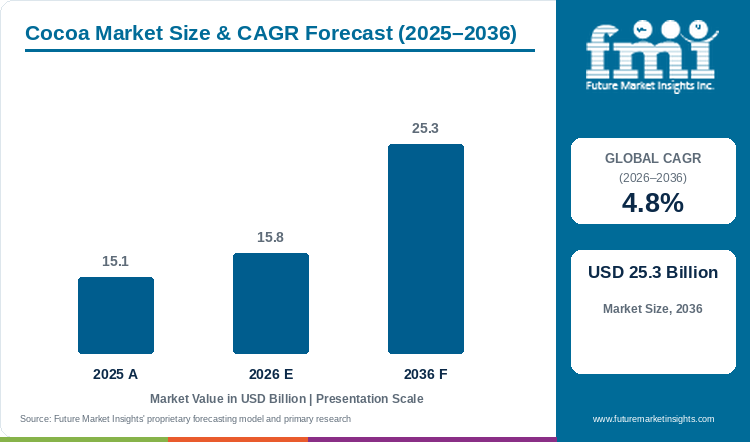
Sales in the cocoa market are projected to grow at 4.8% CAGR, with the market size rising from USD 15.1 billion in 2025 to USD 15.8 billion in 2026 and reaching USD 25.3 billion by 2036.
Industrial chocolatiers and biscuit manufacturers depend on hydraulic pressing of roasted cacao nibs to obtain the exact cocoa butter crystallization curves and alkalized powder colors required on high-speed enrobing lines. Revised balance-sheet estimates published by the International Cocoa Organization in May 2026 in its Quarterly Bulletin of Cocoa Statistics (Volume LII, Issue No. 2) place world cocoa production at 4.723 million metric tons and world grindings at 4.628 million metric tons, with end-of-season stocks at 1.320 million metric tons [1]. Cocoa powder & liquor holds 44.0% of product type demand in 2026. Global cocoa turnover is valued at USD 15.1 billion during 2025 before advancing to USD 15.8 billion in 2026, while ten-year demand is forecast at USD 25.3 billion by 2036 (4.8% CAGR), generating USD 9.5 billion in incremental sales.
Key Market Trends & Insights
- By product type: Cocoa powder & liquor claims 44.0% of 2026 product demand due to versatile dispersion across biscuit batters and dairy beverages.
- By application: Confectionery & chocolate absorbs 52.0% of 2026 tonnage on the back of molded chocolate tablets and seasonal countlines.
- By grade: Conventional grade supplies 63.0% of 2026 ingredient volume through bulk West African warehouse contracts and continuous port pressing.
Regional Highlights
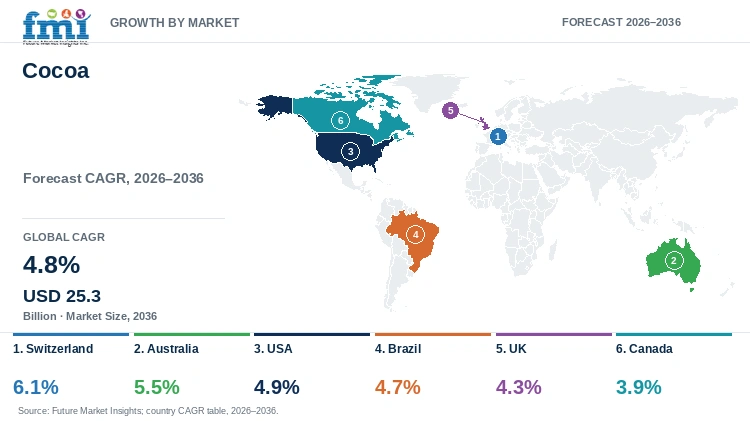
- Switzerland leads the six covered cocoa markets with 6.1% annual expansion from 2026 to 2036 driven by single-origin export tablet refining.
- Australia advances at 5.5% and the USA at 4.9% ahead of Brazil (4.7%) and the UK (4.3%), with Canada progressing at 3.9%.
Market Size & Forecast
Table 1: Market Size and Forecast for the Cocoa Market (USD billion and CAGR percentage), 2025 to 2036
| Metric | Value |
|---|---|
| 2025 Market Size | USD 15.1 billion |
| Estimated Market Size in 2026 | USD 15.8 billion |
| Projected Market Size by 2036 | USD 25.3 billion |
| CAGR, 2026 to 2036 | 4.8% |
| Added Revenue, 2026 to 2036 | USD 9.5 billion |
Dutch and Ivory Coast pressing mills adjust potassium carbonate alkalization and hydraulic press pressures to match the fat and pH tolerances specified by regional bakery and dairy buyers. Quarterly bean-usage reports compiled by the European Cocoa Association across 19 major European grinding and chocolate groups in 2026 recorded second-quarter European grindings at 316,366 metric tons as processors calibrated press schedules against terminal bean prices [2]. To protect margin per ton of input beans, grinders pair thin-film nib roasting with fine ball-mill refining to supply single-origin cocoa liquor alongside low-fat alkalized cake. Meanwhile, Asian pressing hubs in Malaysia and Indonesia continue expanding butter and powder exports to price-sensitive confectionery plants.
Global Bean Grinding and Pressing Capacity Analysis
Table 2: Bean Grinding and Intermediate Output Indicators for the Cocoa Market (USD billion and million metric tons), mixed historical and forecast years from 2025 to 2036
| Metric | 2025 | 2026 | 2036 |
|---|---|---|---|
| Market size (USD billion) | 15.1 | 15.8 | 25.3 |
| Global commercial bean grindings (million metric tons) | 4.75 to 4.85 | 4.85 to 4.98 | 6.10 to 6.35 |
| Finished powder and liquor output (million metric tons) | 2.85 to 2.95 | 2.92 to 3.04 | 3.70 to 3.88 |
| Average realized ingredient value per metric ton (USD) | 3,110 to 3,180 | 3,170 to 3,255 | 3,985 to 4,145 |
Throughput intervals above link global commercial bean grindings after shell and moisture loss (roughly 80% nib yield) to intermediate liquor and powder output.
Per Capita & Industrial Confectionery Sizing
Pressing roasted cocoa liquor at 400 to 500 bars separates golden cocoa butter from solid cocoa presscake, creating two interdependent revenue streams that must be balanced across seasonal confectionery and bakery orders. While chocolate tablet makers absorb deodorized butter to achieve clean snap and mouth-melting gloss, commercial biscuit and ice-cream plants purchase pulverized 10%-to-12% fat powders and heat-stable baking chocolate drops.
Table 3: Per Capita and Industrial Grinding Indicators for the Cocoa Market (USD and billions), mixed historical and forecast years from 2025 to 2036
| Metric | 2025 | 2026 | 2036 |
|---|---|---|---|
| World population (billion) | 8.23 | 8.30 | 8.95 |
| Cocoa ingredient spend per capita (USD) | 1.83 | 1.90 | 2.83 |
| Spend per 1,000 people (USD) | 1,835 | 1,904 | 2,827 |
| Annual cocoa ingredient value per active grinding line (USD million) | 21.5 to 24.0 | 22.5 to 25.0 | 34.0 to 38.0 |
Table 4: Product Type & Application Revenue Indicators for the Cocoa Market (USD billion and percentages), mixed reporting years from 2025 to 2026
| Metric | Value | Basis |
|---|---|---|
| Market size, 2026 | USD 15.8 billion | Report value |
| Confectionery & chocolate application revenue, 2026 | USD 8.2 billion | 52.0% share |
| Cocoa powder & liquor segment revenue, 2026 | USD 7.0 billion | 44.0% share |
| Conventional grade cocoa revenue, 2026 | USD 10.0 billion | 63.0% share |
Analyst Perspective
"Precision nib roasting and GPS-verified farm polygon mapping allow industrial grinders to supply deforestation-free cocoa liquor with consistent flavor notes. West African crop deficits and elevated bean futures still force confectioners to optimize fat-pressing ratios across mass-market bars."
- Nandini Roy Choudhury, Principal Consultant, Future Market Insights.
How is the cocoa market segmented?
The cocoa market is segmented by product type, application, grade, and region. In 2026, cocoa powder & liquor is projected at 44.0%, confectionery & chocolate at 52.0%, and conventional grade at 63.0%.
By product type: Cocoa powder & liquor, cocoa butter, and cocoa beans & inclusions.
By application: Confectionery & chocolate, bakery & confectionery fillings, and beverages & nutritional blends.
By grade: Conventional grade, and certified sustainable & organic.
Why does Cocoa Powder & Liquor lead the product type category?
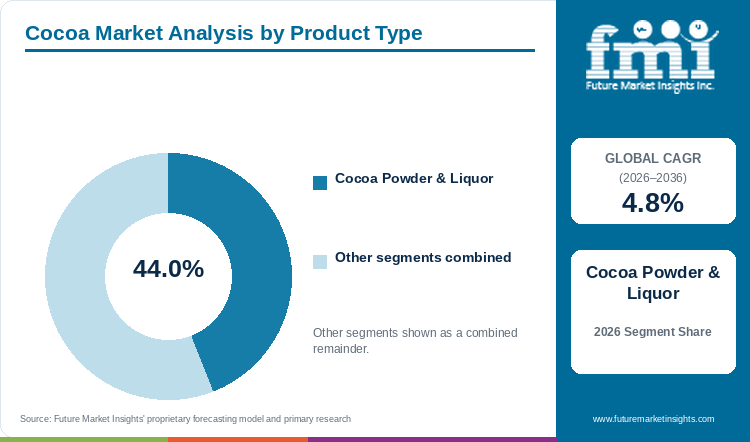
Cocoa powder and liquor are projected to capture 44.0% of product type demand in 2026, enabled by versatile bakery formulation.
Table 5: Product Type Share for the Cocoa Market (percentage share), 2026
| Product Type | Share (2026) |
|---|---|
| Cocoa Powder & Liquor | 44.0% |
| Other Segments Combined | 56.0%* |
| Total | 100.0% |
*Calculated as the balance remaining after deducting the leading segment's reported share from 100.0%.
Table 6: Product Type Leadership and Market Growth for the Cocoa Market (segment and CAGR percentage), 2026 to 2036
| Metric | Value |
|---|---|
| Global CAGR (2026 to 2036) | 4.8% |
| Leading Segment | Cocoa Powder & Liquor |
Whereas cocoa butter (34.0% share in 2026) serves primarily as a continuous fat phase in molded bars and cocoa beans & inclusions (22.0%) target craft roasters, cocoa powder & liquor (44.0%) spans every food and beverage aisle. Liquor provides the non-fat cacao solids and natural butter core for chocolate conching, while pressed cake is milled into natural or Dutch-process cocoa powder for sandwich cookies and protein shakes. When cocoa butter ratios climb, industrial bakers substitute high-fat couverture with 10%-to-12% fat alkalized powders to preserve dark chocolate color and roast aroma at a fraction of the recipe cost.
- Cocoa powder & liquor is projected to capture 44.0% of product type demand in 2026, enabled by dual utility across chocolate refining and defatted bakery coatings.
- Barry Callebaut Group reported 9-month fiscal year 2025/26 sales volume of 1,557,239 metric tons (CHF 9,557.1 million in revenue) in July 2026 as third-quarter Global Cocoa volume rose 18.0% on strong powder restocking [3].
What makes Confectionery & Chocolate central to the application category?
Confectionery and chocolate are estimated to hold 52.0% of application revenue in 2026, propelled by high molded tablet consumption.
Solid dark and milk chocolate bars require 30% to 85% combined cocoa liquor and cocoa butter by weight, compared with just 3% to 8% cocoa powder in flavored dairy drinks or cake batters. That high per-unit inclusion places confectionery & chocolate at 52.0% of application revenue in 2026, as per FMI, ahead of bakery & confectionery fillings (28.5%) and beverages & nutritional blends (19.5%). Artisanal chocolatiers and industrial countline plants increasingly specify single-origin chocolate couverture with verified tempering viscosity to run thin-shell molded pralines.
- Confectionery & chocolate is estimated to represent 52.0% of application revenue in 2026, propelled by high cocoa-solid inclusion rates in dark and milk chocolate bars.
- In July 2026, ofi (Olam Food Ingredients) reported distributing 2.6 million shade and cocoa trees while providing technical support to 98,000 cocoa farmers across Ghana and Côte d'Ivoire to secure sustainable confectionery bean supply [4].
What supports Conventional Grade leadership within the grade category?
Conventional grade is expected to retain 63.0% of grade category sales in 2026, linked to bulk West African bean contracts.
Continuous port-side pressing mills in Amsterdam and Abidjan alongside Delaware run 24-hour shifts fed by bulk conventional bean vessels arriving from Côte d'Ivoire and Ghana. Because halting hydraulic presses and ball mills for segregated organic purge cycles reduces plant utilization, conventional grade retains 63.0% of grade category revenue in 2026. Certified sustainable and organic cocoa accounts for the remaining 37.0% share and is expanding at a faster pace as European grocery chains mandate polygon-verified farm traceability.
- Conventional grade is anticipated to supply 63.0% of grade revenue in 2026, linked to high-volume bulk warehouse blending and cost-sensitive bakery contracts.
- ECOM Agroindustrial Corp. Limited released its 2025 Cocoa Sustainability Report detailing expanded farmer cooperative fermentation and origin traceability programs across Latin America and West Africa [5].
What are the drivers, restraints, and opportunities in the cocoa market?
Consumer demand for high-cacao dark chocolate elevates liquor grinding requirements, whereas West African swollen-shoot crop deficits restrain bean supply, and GPS polygon traceability systems unlock European compliance premiums.
- Driver: Rising consumer preference for high-percentage dark chocolate and flavanol-rich clean-label bakery snacks increases per-unit cocoa liquor and powder inclusion.
- Restraint: Soil cadmium limits and swollen-shoot virus outbreaks tighten compliant bean availability and drive futures volatility.
- Opportunity: Satellite polygon farm mapping and agroforestry rejuvenation programs enable grinders to secure long-term deforestation-free supply contracts with multinational food brands.
Growth Analysis and Future Potential: Qualitative Demand Catalysts
Shifting consumer preference from high-sugar milk candy toward 70%-to-85% dark chocolate tablets directly increases the quantity of cocoa liquor and deodorized cocoa butter required for every ton of finished confectionery. Ultra-performance liquid chromatography trials published in Foods in April 2025 across three cacao genotypes showed that cacao polyphenols comprise 58% proanthocyanidins and 37% catechins (with epicatechin at 30%), while controlled fermentation at 43.86 degrees Celsius reduces bitterness and enhances fruity cacao notes [6]. At the same time, clean-label biscuit and sports-nutrition brands are replacing synthetic brown dyes with Dutch-process cocoa powders and flavanol-rich nib inclusions.
Risk Assessment of the Cocoa Market: Operational and Formulation Friction
Agroecosystem research published in Agriculture in February 2025 documented that while European Commission Regulation (EU) No. 488/2014 caps cadmium in cocoa powder and chocolate between 0.10 and 0.80 mg/kg dry matter, cacao bean cadmium averages 1.39 mg/kg in South America versus 0.09 mg/kg in West Africa [7]. Strict heavy-metal rejection thresholds—where European and North American buyers reject bean lots exceeding 0.50 to 0.80 mg Cd/kg—combine with West African swollen-shoot virus deficits to tighten compliant grinding stocks. To protect shelf price points, mass-market bakers frequently reformulate enrobed snacks into compound chocolate coatings that replace pure cocoa butter with palm-kernel or shea stearin.
Commercial Opportunity Analysis: Formulation Differentiation and Value-Add Formats
European Commission Directorate-General for Environment rules under Regulation (EU) 2023/1115 on deforestation-free products (EUDR)-with December 2025 simplification amendments setting application for large and medium operators on December 30, 2026-require cocoa operators to prove plots are deforestation-free and cut EU-linked carbon emissions by at least 32 million metric tons annually [8]. Rather than buying untraceable spot-market beans, multinational chocolatiers are locking in multi-year contracts with integrated grinders operating digital polygon registries. Processors also pair traceable low-fat cocoa powders with customized chocolate flavors so food manufacturers can maintain rich roast profiles while reducing total cocoa solid dosage.
Cocoa Market by Country (2026 to 2036)
Profiled country growth rates between 2026 and 2036 span 6.1% in Switzerland and 5.5% in Australia down to 3.9% in Canada. Where luxury single-origin tablet exports and gourmet pastry consumption dominate—such as in Switzerland and Australia-grinders capture higher value growth through traceable specialty liquors; in high-tonnage North American and British baking and countline markets, demand tracks domestic pressing utilization and tariff-free intermediate paste trade.
Table 7: Country CAGR and Primary Growth Levers for the Cocoa Market (CAGR percentage and operational drivers), 2026 to 2036
| Country | CAGR (2026 to 2036) | Primary Growth Lever |
|---|---|---|
| Switzerland | 6.1% | Luxury single-origin chocolate exports and precision conching automation |
| Australia | 5.5% | Artisanal bean-to-bar pastry culture and ethical fair-trade cocoa sourcing |
| USA | 4.9% | Large-scale industrial bakery grinding and dark chocolate snack bar demand |
| Brazil | 4.7% | Bahia and Pará domestic grinding capacity and agroforestry crop recovery |
| UK | 4.3% | Fairtrade private-label grocery chocolate and bonded port cocoa warehousing |
| Canada | 3.9% | Clean-label organic bakery manufacturing and seasonal confectionery demand |
Source: Future Market Insights analysis
Switzerland Cocoa Market Outlook (2026 to 2036)
Export-oriented alpine couverture refining and luxury tablet manufacturing set Switzerland apart from bulk grinding hubs, as over 70% of national chocolate output ships to international retail and duty-free markets. Food and Agriculture Organization geospatial cacao value-chain monitoring in 2026 alongside Chocosuisse industry statistics confirmed that Swiss factories processed beans for 192,548 metric tons of chocolate sales in 2025 (with 136,829 metric tons exported across 140 countries) [9]. The outlook for cocoa in Switzerland remains positive, with revenue projected to climb 6.1% annually through 2036 as refiners prioritize traceable Ecuadorian and Ghanaian fine-flavor liquors. While Swiss brands command strong pricing power, high industrial electricity tariffs and alpine labor rates force plants to run automated 72-hour longitudinal conching lines.
Key takeaway: In Switzerland, luxury export tablet production and traceable fine-flavor liquor refining place the market at a leading 6.1% CAGR through 2036.
Australia Cocoa Market Outlook (2026 to 2036)
Melbourne and Sydney's dense specialty cafe and craft bean-to-bar networks create high-margin foodservice pull for single-origin drinking powders and dark commercial chocolate blocks. Through 2036, Australian cocoa ingredient sales are projected to expand at a 5.5% CAGR as boutique roasters procure aromatic cacao beans from neighboring Papua New Guinea and Solomon Islands estates to shorten ocean transit. Bilateral trade statistics published by the U.S. Department of Agriculture Foreign Agricultural Service in its Chocolate and Cocoa Products 2025 Export Highlights showed shipments into Australia rising 7.5% year-on-year to USD 43.0 million alongside growing Asian butter imports [10]. Yet elevated refrigerated container freight rates and summer warehouse cooling costs create commercial friction, pushing industrial bakers toward heat-stable alkalized cocoa powders.
Key takeaway: In Australia, specialty cafe drinking-chocolate demand and Pacific-origin bean roasting support a 5.5% CAGR through 2036.
USA Cocoa Market Outlook (2026 to 2036)
Port-side hydraulic pressing mills along the Delaware River and in the Midwest anchor North America's largest industrial demand center for deodorized cocoa butter and Dutch-process bakery powders. Environmental compliance and sector benchmarks released by the World Cocoa Foundation in April 2025 documented over 410,000 metric tons of annual U.S. bean-grinding throughput as processors integrated satellite land-cover maps across supply chains [11]. However, California Proposition 65 heavy-metal warning thresholds for cadmium and lead combined with volatile New York futures margin calls compel mid-sized U.S. biscuit makers to blend low-cadmium West African liquors with compound coatings. Across the USA, industrial cocoa demand is predicted to advance 4.9% annually through 2036 on strong protein-beverage and dark-bar orders.
Key takeaway: In the USA, high-volume industrial bakery pressing and RTD protein-beverage powder demand anchor a 4.9% CAGR outlook.
Brazil Cocoa Market Outlook (2026 to 2036)
Operating simultaneously as Latin America's largest cacao producer across Bahia and Pará and one of the world's biggest seasonal Easter-egg and bonbon markets gives Brazil a uniquely integrated domestic grinding economy. National Association of Cocoa Processing Industries (AIPC) statistics released in April 2026 showed Brazilian raw cacao bean receipts jumping 61.0% to 28,605 metric tons in early 2026 as member mills ground 93% to 95% of domestic output [12]. Brazil is forecast to emerge as a resilient Latin American processing hub, registering 4.7% CAGR through 2036 on the back of shaded cabruca agroforestry rehabilitation and irrigated Bahia plantations. Nonetheless, witches'-broom fungal pressure and phytosanitary inspection delays on bonded West African bean imports periodically tighten Ilhéus butter yields.
Key takeaway: In Brazil, integrated Ilhéus crushing capacity and cabruca agroforestry expansion sustain a 4.7% CAGR through 2036.
UK Cocoa Market Outlook (2026 to 2036)
Supermarket private-label ethical sourcing commitments and historic milk-chocolate crumb plants in Bournville and York define cocoa ingredient procurement across the United Kingdom. British cocoa ingredient turnover is forecast to grow 4.3% per year through 2036 as grocery chains expand premium dark-chocolate tablets and seasonal chocolate confectionery assortments. Due-diligence protocols and Federation of Cocoa Commerce contract rules published by the European Cocoa Association in September 2025 underscored that more than 34.0% of UK retail confectionery volume relies on certified sustainable and polygon-verified cocoa mass and butter [13]. The central commercial obstacle involves UK High Fat, Salt and Sugar store-aisle promotion restrictions and post-Brexit origin tariffs on continental couverture, prompting British plants to roast West African beans directly.
Key takeaway: In the UK, private-label ethical grocery commitments and domestic chocolate-crumb roasting drive a 4.3% CAGR through 2036.
Canada Cocoa Market Outlook (2026 to 2036)
Duty-free import treatment on raw cacao beans and intermediate cocoa paste paired with non-quota world sugar pricing has turned southern Ontario and Quebec into a vital cross-border production corridor for liquid industrial chocolate. Nevertheless, sub-zero winter highway transit across Ontario and the U.S. Midwest requires heated stainless-steel tankers held at 45 degrees Celsius, raising fleet energy costs. Cross-border agricultural trade records in the U.S. Department of Agriculture Foreign Agricultural Service 2025 Export Highlights confirmed that chocolate and cocoa product trade with Canada reached USD 844.0 million in 2025, advancing 4.3% year-on-year [14]. Canadian cocoa processor volume is expected to increase at a 3.9% CAGR through 2036 as biscuit and snack-bar plants expand procurement of organic cocoa butter and alkalized powders.
Key takeaway: In Canada, duty-free intermediate paste imports and cross-border liquid-chocolate export plants guide a 3.9% CAGR through 2036.
Full report country CAGRs cover: North America; Latin America; Western Europe; Eastern Europe; East Asia; South Asia and Pacific; Middle East and Africa.
Who are the notable companies in the cocoa market?
Barry Callebaut, Cargill, Olam Food Ingredients, ECOM Agroindustrial, Touton, Blommer Chocolate, Guan Chong, and JB Cocoa are the significant market players in this market.
Contract awarding in the global cocoa ingredient market hinges on whether a processor can maintain uninterrupted delivery of EUDR polygon-verified liquor and pH-buffered alkalized powders while absorbing multi-million-dollar futures margin calls. Barry Callebaut and Cargill alongside Olam Food Ingredients operate integrated farmgate buying networks in West Africa and Latin America paired with automated roasting and couverture refineries across Europe and North America. Origin merchants ECOM Agroindustrial and Touton specialize in smallholder cooperative fermentation and satellite plot mapping. Meanwhile, Blommer Chocolate and Guan Chong alongside JB Cocoa run high-capacity hydraulic pressing mills supplying international biscuit and dairy beverage brands.
- Global Integrated Cocoa & Chocolate Processors: Barry Callebaut and Cargill alongside Olam Food Ingredients operate end-to-end origin sourcing and industrial couverture networks.
- Origin Sourcing and Traceability Merchants: ECOM Agroindustrial and Touton manage direct smallholder cooperative networks and traceable bean supply.
- Regional Pressing and Alkalized Powder Specialists: Blommer Chocolate and Guan Chong alongside JB Cocoa supply high-volume cocoa butter and customized Dutch-process powders.
Competitive Benchmarking: Cocoa Market
Table 8: Competitive Benchmarking for the Cocoa Market (qualitative capability ratings), 2026
| Company | Grinding & Pressing Scale | Alkalized Powder & Butter Depth | Origin Traceability & EUDR Readiness | Geographic Reach |
|---|---|---|---|---|
| Barry Callebaut | High | High | High | High |
| Cargill | High | High | High | High |
| Olam Food Ingredients | High | High | High | High |
| ECOM Agroindustrial | Medium | Medium | High | High |
| Touton | Medium | Medium | High | High |
| Blommer Chocolate | High | High | Medium | Medium |
| Guan Chong | High | High | Medium | High |
| JB Cocoa | High | High | Medium | High |
Scoring basis: Grinding & Pressing Scale distinguishes operators running multi-hundred-thousand-ton hydraulic pressing networks across multiple continents (High) from origin-focused bean merchants (Medium). Alkalized Powder & Butter Depth assesses custom Dutch-process color control and deodorized butter crystallization specs alongside single-origin liquor lines. Origin Traceability & EUDR Readiness tracks farm-level GPS polygon mapping across West Africa and Latin America, while Geographic Reach compares global origin-to-destination networks against regionally concentrated grinders.
Key Developments in the Cocoa Market
- In July 2025, Cargill unveiled interconnected cocoa supply chain upgrades across West Africa and the Netherlands—combining cocoa-shell biomass boilers and electric barges to cut site CO2 emissions by up to 31,000 metric tons annually [15].
- During 2026, Guan Chong Berhad expanded industrial cocoa butter and alkalized cocoa powder pressing utilization across its Malaysian and Ivorian grinding hubs alongside European couverture refineries [16].
- In 2025, Blommer Chocolate Company expanded its North American industrial chocolate and bean-roasting sustainability commitments following its full integration into Fuji Oil Group [17].
Key Players in the Cocoa Market
Global Integrated Cocoa Grinders and Couverture Producers
- Barry Callebaut
- Cargill
- Olam Food Ingredients
Origin Sourcing and Sustainable Bean Merchants
- ECOM Agroindustrial
- Touton
High-Capacity Pressing and Alkalized Powder Specialists
- Blommer Chocolate
- Guan Chong
- JB Cocoa
Cocoa Market - Report Scope
Table 9: Report Scope for the Cocoa Market (coverage fields and definitions), 2026 to 2036
| Coverage field | Report scope |
|---|---|
| Market breakdown | Product Type; Application; Grade; Region |
| Quantitative Units | USD Billion |
| Market Definition | Includes commercial B2B supplier revenue from cocoa powder, cocoa liquor/paste, cocoa butter, and commercial cocoa beans and nibs sold for industrial processing. Excludes downstream retail consumer chocolate bar revenues and non-cocoa carob or vegetable fat replacers. Supply Scope Note: Market valuation captures the primary and intermediate B2B cocoa grinding and pressing tier (liquor, butter, and powder sold to industrial food and confectionery manufacturers) rather than downstream retail packaged chocolate confectionery sales. |
| Regions Covered | North America; Latin America; Western Europe; Eastern Europe; East Asia; South Asia and Pacific; Middle East and Africa |
| Countries Covered | Switzerland, Australia, USA, Brazil, UK, Canada, and additional countries in the full report |
| Key Companies Covered | Barry Callebaut, Cargill, Olam Food Ingredients, ECOM Agroindustrial, Touton, Blommer Chocolate, Guan Chong, JB Cocoa |
| Forecast Period | 2026 to 2036 |
| Approach | Primary and secondary research with rigorous market triangulation. |
Cocoa Market - Research Methodology
Table 10: Research Methodology for the Cocoa Market (research methods and approach), 2026 edition
| Method | Approach |
|---|---|
| Primary Research | Primary interviews were conducted with industrial cocoa grinding directors, hydraulic pressing engineers, commodity risk managers, origin cooperative agronomists, and confectionery R&D heads across the value chain to validate butter-to-powder press ratios, EUDR compliance costs, and alkalization trends. |
| Secondary Research | Secondary research included International Cocoa Organization (ICCO) quarterly bulletins, FAO trade statistics, European Cocoa Association technical standards, national customs filings, and corporate sustainability disclosures. |
| Market Sizing and Forecasting | Market sizing and forecasting for the 2026 to 2036 period were developed using top-down and bottom-up approaches reconciling regional bean grindings, butter and powder extraction yields, and contract ingredient pricing. |
| Data Triangulation and Validation | Estimates were validated against licensed port warehouse arrivals, grinding plant utilization rates, and downstream confectionery production volumes to ensure accuracy without double counting retail chocolate sales. |
| Country Forecasting Model | Country-level CAGRs are projected via FMI's cocoa grinding and industrial ingredient econometric model, calibrating evaluated national growth rates against the 4.8% global baseline through verified quarterly bean grindings, EUDR deforestation-free compliance readiness, and single-origin couverture export demand. |
| Operational Benchmark Traceability | Operational benchmarks (global commercial bean grindings, finished cocoa powder and liquor output after 80% nib extraction yield, and realized ingredient value per metric ton) represent modeled estimates synthesized from ICCO quarterly bulletins, European Cocoa Association grind reports, FAO SEPAL trade registries, and commercial grinder disclosures. |
Cocoa Market by Segments
Cocoa Market segmented by Product Type:
- Cocoa Powder & Liquor
- Cocoa Butter
- Cocoa Beans & Inclusions
Cocoa Market segmented by Application:
- Confectionery & Chocolate
- Bakery & Confectionery Fillings
- Beverages & Nutritional Blends
Cocoa Market segmented by Grade:
- Conventional Grade
- Certified Sustainable & Organic
Cocoa Market by Region
- North America
- United States
- Canada
- Latin America
- Brazil
- Ecuador
- Mexico
- Peru
- Western Europe
- Switzerland
- United Kingdom
- Germany
- Netherlands
- France
- Belgium
- Italy
- Eastern Europe
- Poland
- Czech Republic
- Romania
- Hungary
- East Asia
- Japan
- China
- South Korea
- South Asia and Pacific
- Australia and New Zealand
- Malaysia
- Indonesia
- India
- Middle East and Africa
- Côte d'Ivoire
- Ghana
- GCC Countries
- South Africa
Research Sources and Bibliography
- [1] International Cocoa Organization. (2026, May 29). May 2026 quarterly bulletin of cocoa statistics (Vol. LII, Issue No. 2, Cocoa Year 2025/26). ICCO.
- [2] European Cocoa Association. (2026, July 16). Grind stats: Quarterly publication of European bean usage (Q2 2026). ECA.
- [3] Barry Callebaut AG. (2026, July 9). Barry Callebaut Group – 9-month key sales figures, fiscal year 2025/26. Barry Callebaut AG.
- [4] Olam Food Ingredients (ofi). (2026, July 1). ofi distributes 2.6 million trees to help cocoa farmers transition to regenerative agriculture. ofi.
- [5] ECOM Agroindustrial Corp. Limited. (2025). Sustainable sourcing and supply chain solutions for cocoa: 2025 cocoa sustainability report. ECOM Agroindustrial Corp. Limited.
- [6] Calvo, A. M., Montenegro, A. C., Monroy, D. M., Rodriguez-Silva, L. G., Carreño-Olejua, A. R., & Camargo, I. D. (2025, April 22). The impact of controlled fermentation temperature on chemical composition and sensory properties of cacao. Foods, 14(9), 1441.
- [7] García Porras, G. A., Aires dos Santos, J., Rocha de Carvalho, M., Pinzón-Sandoval, E. H., Silva Pereira, A. A., & Guimarães Guilherme, L. R. (2025, February 18). Addressing cadmium in cacao farmland: A path to safer, sustainable chocolate. Agriculture, 15(4), 433.
- [8] European Commission Directorate-General for Environment. (2025, December 18). Regulation on deforestation-free products (Regulation (EU) 2023/1115). European Union.
- [9] Food and Agriculture Organization of the United Nations. (2026). Cocoa: Cartography of cocoa and forest impacts (SEPAL forest and land monitoring for climate action). FAO.
- [10] U.S. Department of Agriculture Foreign Agricultural Service. (2026). Chocolate and cocoa products 2025 export highlights. USDA FAS.
- [11] World Cocoa Foundation. (2025, April 17). Resources: Report – WCF publishes first ever assessment revealing accuracy of key maps cocoa companies rely on for environmental compliance. World Cocoa Foundation.
- [12] Associação Nacional das Indústrias Processadoras de Cacau (AIPC). (2026, April 20). AIPC statistical report: Brazilian domestic cocoa bean receipts and grinding volume in 2026. AIPC.
- [13] European Cocoa Association & Federation of Cocoa Commerce. (2025, September 18). European Union Deforestation Regulation: ECA EUDR protocol on EUDR due diligence and FCC contract rules. ECA.
- [14] U.S. Department of Agriculture Foreign Agricultural Service & Statistics Canada. (2026). North American chocolate and cocoa products trade flow statistics (Canada USD 844M in 2025). USDA FAS.
- [15] Cargill, Incorporated. (2025, July 1). Cargill leads in sustainable cocoa supply chains: Cargill sets a new global benchmark for more sustainable cocoa supply chains. Cargill, Incorporated.
- [16] Guan Chong Berhad. (2026). Guan Chong Berhad (GCB) :: Cocoa manufacturer Malaysia, butter, liquor, mass, and powder annual reports. Guan Chong Berhad.
- [17] Blommer Chocolate Company & Fuji Oil Co., Ltd. (2026). Environmental commitments and industrial chocolate business outline. Blommer Chocolate Company.
- [18] Touton S.A. (2026, February 24). Cocoa | Products and Touton Ghana customer tour 2025 highlights: Inside an integrated cocoa supply chain. Touton S.A.
- [19] JB Cocoa & JB Foods Limited. (2026, July 29). JB Foods Limited annual report 2026 and JB Cocoa CFI report 2025. JB Cocoa.
- [20] Cocoa Research Institute of Ghana (CRIG). (2026, February 11). Distribution of cacao swollen-shoot virus disease (CSSVD) resistant hybrid seedlings across rehabilitation districts. CRIG.
- [21] International Cocoa Organization. (2026, October 1). New International Cocoa Agreement, 2026, enters into force on 1 October. ICCO.
This bibliography is provided for reader reference and is not exhaustive. The full report contains the complete reference list and detailed citations.
This Report Answers
- How large is the cocoa market in 2026 and what is forecast for 2036?
- Which industrial grinding, butter-pressing, and dark-chocolate trends support demand for cocoa?
- Why does cocoa powder & liquor lead the product type category?
- Why does confectionery & chocolate lead the application category globally?
- How do growth rates differ across Switzerland and Australia alongside the USA and Brazil?
- Which leading companies supply cocoa liquor, deodorized butter, and alkalized powder today?
- What West African crop disease and EUDR compliance factors constrain the cocoa market?
- What should confectionery and bakery buyers evaluate before qualifying a cocoa grinder?
Frequently Asked Questions
How big is the cocoa market in 2026, and what is forecast for 2036?
The global cocoa market is projected to reach USD 15.8 billion in 2026 and expand further to USD 25.3 billion by 2036, supported by dark chocolate consumption and clean-label bakery demand.
What is the CAGR for the cocoa market from 2026 to 2036?
FMI research indicates that the cocoa market is projected to grow at a 4.8% CAGR from 2026 to 2036. Growth is supported by automated nib roasting, precision alkalization, and traceable single-origin liquor demand.
Which product type segment holds a notable cocoa demand share in 2026?
Cocoa powder & liquor is projected to hold 44.0% of product type demand in 2026. The segment benefits from essential utility across molded chocolate refining, bakery coatings, and dairy beverages.
Which application segment holds a notable cocoa share in 2026?
Confectionery & chocolate accounts for 52.0% of application demand in 2026. Demand is supported by high cocoa liquor and cocoa butter inclusion rates in dark and milk chocolate tablets.
Which country has a notable cocoa expansion outlook during the forecast period?
FMI finds that Switzerland is projected to expand at a 6.1% CAGR during the 2026 to 2036 assessment period. Growth is supported by luxury chocolate export demand and advanced refining infrastructure.
Which companies are active in the cocoa market during 2026?
Notable companies include Barry Callebaut, Cargill, Olam Food Ingredients, ECOM Agroindustrial, Touton, Blommer Chocolate, Guan Chong, and JB Cocoa. These processors focus on hydraulic butter pressing, Dutch-process powder alkalization, and GPS farm polygon traceability.
Preview the report firsthand - request a free sample
Get SampleGet the brochure for pricing and purchase details.
Get PDFTable of Content
- Key Takeaways
- Market Size and CAGR
- Top Growth Driver
- Fastest Growing Segment
- Leading Region
- Key Companies
- Emerging Opportunities
- Executive Summary
- Global Market Outlook
- Demand-side Trends
- Supply-side Trends
- Technology Roadmap Analysis
- Analysis and Recommendations
- Analyst Perspective (What is happening? Why now? What should investors know?)
- Key Questions Answered
- How large is the market?
- What is the CAGR?
- What are key trends?
- Which region dominates?
- Who are the leaders?
- Market Overview
- Market Coverage / Taxonomy
- Market Definition / Scope / Limitations
- Research Methodology
- Chapter Orientation
- Analytical Lens and Working Hypotheses
- Market Structure, Signals, and Trend Drivers
- Benchmarking and Cross-market Comparability
- Market Sizing, Forecasting, and Opportunity Mapping
- Research Design and Evidence Framework
- Desk Research Programme (Secondary Evidence)
- Expert Input and Fieldwork (Primary Evidence)
- Tooling, Models, and Reference Databases
- Data Engineering and Model Build
- Quality Assurance and Audit Trail
- Market Background
- Market Dynamics (Drivers, Restraints, Opportunity, Trends)
- Scenario Forecast (Optimistic, Likely, Conservative)
- Impact Analysis
- AI Impact
- Sustainability Impact
- Regulatory Impact
- Technology Impact
- Consumer / Buyer Analysis
- Purchase Drivers
- Adoption Barriers
- Buyer Journey
- Opportunity Map Analysis
- Product Life Cycle Analysis
- Supply Chain Analysis
- Investment Feasibility Matrix
- Value Chain Analysis
- PESTLE and Porter's Analysis
- Regulatory Landscape
- Regional Parent Market Outlook
- Production and Consumption Statistics
- Import and Export Statistics
- Global Market Analysis and Forecast, 2021 to 2036
- Historical Market Size Value (USD Billion) Analysis, 2021 to 2025
- Current and Future Market Size Value (USD Billion) Projections, 2026 to 2036
- Y-o-Y Growth Trend Analysis
- Absolute $ Opportunity Analysis
- Global Market Pricing Analysis, 2021 to 2036
- Global Market Analysis and Forecast, By Product Type, 2021 to 2036
- Introduction / Key Findings
- Historical Market Size Value (USD Billion) Analysis By Product Type, 2021 to 2025
- Current and Future Market Size Value (USD Billion) Analysis and Forecast By Product Type, 2026 to 2036
- Cocoa Powder & Liquor
- Cocoa Butter
- Cocoa Beans & Inclusions
- Y-o-Y Growth Trend Analysis By Product Type, 2021 to 2025
- Absolute $ Opportunity Analysis By Product Type, 2026 to 2036
- Global Market Analysis and Forecast, By Application, 2021 to 2036
- Introduction / Key Findings
- Historical Market Size Value (USD Billion) Analysis By Application, 2021 to 2025
- Current and Future Market Size Value (USD Billion) Analysis and Forecast By Application, 2026 to 2036
- Confectionery & Chocolate
- Bakery & Confectionery Fillings
- Beverages & Nutritional Blends
- Y-o-Y Growth Trend Analysis By Application, 2021 to 2025
- Absolute $ Opportunity Analysis By Application, 2026 to 2036
- Global Market Analysis and Forecast, By Grade, 2021 to 2036
- Introduction / Key Findings
- Historical Market Size Value (USD Billion) Analysis By Grade, 2021 to 2025
- Current and Future Market Size Value (USD Billion) Analysis and Forecast By Grade, 2026 to 2036
- Conventional Grade
- Certified Sustainable & Organic
- Y-o-Y Growth Trend Analysis By Grade, 2021 to 2025
- Absolute $ Opportunity Analysis By Grade, 2026 to 2036
- Global Market Analysis and Forecast, By Region, 2021 to 2036
- Introduction
- Historical Market Size Value (USD Billion) Analysis By Region, 2021 to 2025
- Current Market Size Value (USD Billion) Analysis and Forecast By Region, 2026 to 2036
- North America
- Latin America
- Western Europe
- Eastern Europe
- East Asia
- South Asia and Pacific
- Middle East and Africa
- Market Attractiveness Analysis By Region
- North America Market Analysis and Forecast, By Country, 2021 to 2036
- Historical Market Size Value (USD Billion) Trend Analysis By Market Taxonomy, 2021 to 2025
- Market Size Value (USD Billion) Forecast By Market Taxonomy, 2026 to 2036
- By Country
- United States
- Canada
- By Product Type
- By Application
- By Grade
- By Country
- Market Attractiveness Analysis
- By Country
- By Product Type
- By Application
- By Grade
- Key Takeaways
- Latin America Market Analysis and Forecast, By Country
- Historical Market Size Value (USD Billion) Trend Analysis By Market Taxonomy, 2021 to 2025
- Market Size Value (USD Billion) Forecast By Market Taxonomy, 2026 to 2036
- By Country
- Brazil
- Ecuador
- Mexico
- Peru
- By Product Type
- By Application
- By Grade
- By Country
- Market Attractiveness Analysis
- By Country
- By Product Type
- By Application
- By Grade
- Key Takeaways
- Western Europe Market Analysis and Forecast, By Country
- Historical Market Size Value (USD Billion) Trend Analysis By Market Taxonomy, 2021 to 2025
- Market Size Value (USD Billion) Forecast By Market Taxonomy, 2026 to 2036
- By Country
- Switzerland
- United Kingdom
- Germany
- Netherlands
- France
- Belgium
- Italy
- By Product Type
- By Application
- By Grade
- By Country
- Market Attractiveness Analysis
- By Country
- By Product Type
- By Application
- By Grade
- Key Takeaways
- Eastern Europe Market Analysis and Forecast, By Country
- Historical Market Size Value (USD Billion) Trend Analysis By Market Taxonomy, 2021 to 2025
- Market Size Value (USD Billion) Forecast By Market Taxonomy, 2026 to 2036
- By Country
- Poland
- Czech Republic
- Romania
- Hungary
- By Product Type
- By Application
- By Grade
- By Country
- Market Attractiveness Analysis
- By Country
- By Product Type
- By Application
- By Grade
- Key Takeaways
- East Asia Market Analysis and Forecast, By Country
- Historical Market Size Value (USD Billion) Trend Analysis By Market Taxonomy, 2021 to 2025
- Market Size Value (USD Billion) Forecast By Market Taxonomy, 2026 to 2036
- By Country
- Japan
- China
- South Korea
- By Product Type
- By Application
- By Grade
- By Country
- Market Attractiveness Analysis
- By Country
- By Product Type
- By Application
- By Grade
- Key Takeaways
- South Asia and Pacific Market Analysis and Forecast, By Country
- Historical Market Size Value (USD Billion) Trend Analysis By Market Taxonomy, 2021 to 2025
- Market Size Value (USD Billion) Forecast By Market Taxonomy, 2026 to 2036
- By Country
- Australia and New Zealand
- Malaysia
- Indonesia
- India
- By Product Type
- By Application
- By Grade
- By Country
- Market Attractiveness Analysis
- By Country
- By Product Type
- By Application
- By Grade
- Key Takeaways
- Middle East and Africa Market Analysis and Forecast, By Country
- Historical Market Size Value (USD Billion) Trend Analysis By Market Taxonomy, 2021 to 2025
- Market Size Value (USD Billion) Forecast By Market Taxonomy, 2026 to 2036
- By Country
- Côte d'Ivoire
- Ghana
- GCC Countries
- South Africa
- By Product Type
- By Application
- By Grade
- By Country
- Market Attractiveness Analysis
- By Country
- By Product Type
- By Application
- By Grade
- Key Takeaways
- Key Countries Market Analysis
- United States
- Pricing Analysis
- Market Share Analysis, 2025
- By Product Type
- By Application
- By Grade
- Canada
- Pricing Analysis
- Market Share Analysis, 2025
- By Product Type
- By Application
- By Grade
- Mexico
- Pricing Analysis
- Market Share Analysis, 2025
- By Product Type
- By Application
- By Grade
- Brazil
- Pricing Analysis
- Market Share Analysis, 2025
- By Product Type
- By Application
- By Grade
- Germany
- Pricing Analysis
- Market Share Analysis, 2025
- By Product Type
- By Application
- By Grade
- United Kingdom
- Pricing Analysis
- Market Share Analysis, 2025
- By Product Type
- By Application
- By Grade
- Italy
- Pricing Analysis
- Market Share Analysis, 2025
- By Product Type
- By Application
- By Grade
- France
- Pricing Analysis
- Market Share Analysis, 2025
- By Product Type
- By Application
- By Grade
- India
- Pricing Analysis
- Market Share Analysis, 2025
- By Product Type
- By Application
- By Grade
- Australia and New Zealand
- Pricing Analysis
- Market Share Analysis, 2025
- By Product Type
- By Application
- By Grade
- China
- Pricing Analysis
- Market Share Analysis, 2025
- By Product Type
- By Application
- By Grade
- Japan
- Pricing Analysis
- Market Share Analysis, 2025
- By Product Type
- By Application
- By Grade
- South Korea
- Pricing Analysis
- Market Share Analysis, 2025
- By Product Type
- By Application
- By Grade
- Poland
- Pricing Analysis
- Market Share Analysis, 2025
- By Product Type
- By Application
- By Grade
- Hungary
- Pricing Analysis
- Market Share Analysis, 2025
- By Product Type
- By Application
- By Grade
- South Africa
- Pricing Analysis
- Market Share Analysis, 2025
- By Product Type
- By Application
- By Grade
- Switzerland
- Pricing Analysis
- Market Share Analysis, 2025
- By Product Type
- By Application
- By Grade
- Australia
- Pricing Analysis
- Market Share Analysis, 2025
- By Product Type
- By Application
- By Grade
- United States
- Market Structure Analysis
- Competition Dashboard
- Competition Benchmarking
- Market Share Analysis of Top Players
- By Regional
- By Product Type
- By Application
- By Grade
- Emerging Startups
- Innovation Benchmarking
- Competition Analysis
- Competition Deep Dive
- Barry Callebaut
- Overview
- Product Portfolio
- Profitability by Market Segments
- Sales Footprint
- Strategy Overview
- Marketing Strategy
- Product Strategy
- Channel Strategy
- Cargill
- Olam Food Ingredients
- ECOM Agroindustrial
- Touton
- Blommer Chocolate
- Guan Chong
- JB Cocoa
- Barry Callebaut
- Case Studies
- Success Stories
- Recent Developments
- Competition Deep Dive
- Assumptions & Acronyms Used


