

- Market Size (2026)
- USD 1.2 Bn
- Forecast (2036)
- USD 2.4 Bn
- CAGR (2026 to 2036)
- 6.9%
How big is Confined Space Monitors Market in 2026?
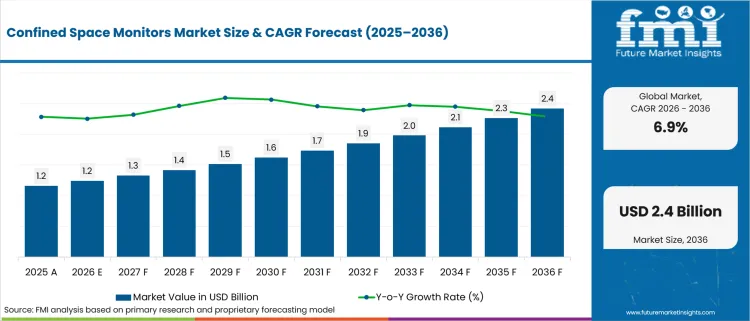
USD 1.2 billion in 2026 and USD 2.4 billion by 2036 at a 6.9% CAGR.
Sales of confined space monitors are estimated to rise at a 6.9% CAGR through 2036, increasing market valuation from USD 1.2 billion in 2026 to USD 2.4 billion by 2036. Compliance programs continue to place greater emphasis on documented atmosphere testing before personnel enter hazardous work areas.
Differences in enforcement intensity and safety-management practices help explain variations in market growth across countries. Singapore is forecast to expand at a 6.5% CAGR compared with 5.9% for the United States during the forecast period. Singapore's Ministry of Manpower brought twelve charges in July 2026 against the authorized manager responsible for confined-space entry permits following its Choa Chu Kang Waterworks investigation. The case underscored the role of atmosphere testing and documented safety procedures in confined-space operations.
Key Takeaways of Confined Space Monitors Market
- Confined-space entry procedures convert atmosphere testing into recurring equipment demand as safety teams need calibrated monitors ready ahead of planned maintenance work.
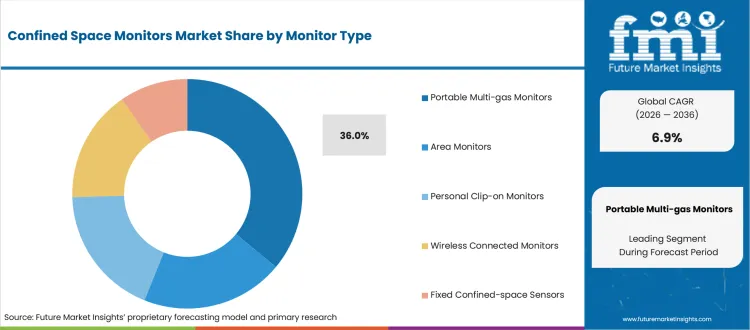
- Portable multi-gas monitors are set to lead the monitor type category with 36.0% share in 2026 due to one serviceable fleet supporting sampled entry checks and personal monitoring.
- By gas coverage, oxygen is estimated to hold 22.0% in 2026 owing to entry procedures requiring a dependable oxygen reading ahead of other atmospheric checks.
- In 2026, electrochemical technology is expected to lead sensor technology with 39.0% share because compact monitors use it for oxygen and common toxic-gas channels.
- Calibration failures and incomplete sampling practices can delay adoption since safety teams must trust the complete measurement chain before authorizing confined-space work.
- Honeywell, Dräger, MSA Safety, Industrial Scientific, RKI Instruments, Blackline Safety, Teledyne Gas & Flame and Crowcon serve this market.
Analyst Perspective
"Remote visibility cannot correct a poor atmospheric sample, so confined-space teams should test sampling reach and alarm reliability before paying for connectivity. A task-matched gas set with simple bump testing and local calibration support reduces entry delays by keeping monitor records easy to retrieve."
- Nikhil Kaitwade, Principal Consultant, Future Market Insights
How is the Confined Space Monitors Market segmented?
The market is segmented by monitor type, gas coverage, sensor technology, application, end use and sales channel.
Monitor type includes portable multi-gas monitors, area monitors, personal clip-on monitors, wireless connected monitors and fixed confined-space sensors. Gas coverage includes oxygen, combustible gases, H₂S, CO and VOC or toxic gases. Sensor technology covers electrochemical, catalytic bead, infrared, PID and metal oxide. Applications cover tank entry, cargo hold entry, sewer or bilge spaces, engine room maintenance and shipyard work. End use includes marine and offshore, shipyards, oil and gas, utilities and industrial safety. Sales channels include safety distributors, direct OEM and rental or calibration service.
What makes portable multi-gas monitors central to the monitor type category?
Portable multi-gas monitors combine remote pre-entry sampling with wearable protection for crews entering tanks and process vessels alongside other industrial safety products used during planned maintenance. MSA Safety debuted the six-gas ALTAIR io 6 in September 2025 with an integrated pump for confined-space sampling.
- By monitor type, portable multi-gas monitors are estimated to hold 36.0% in 2026 owing to one device covering sampled entry checks and personal monitoring.
- Integrated pumps reduce handoffs between sampling and entry work, which simplifies fleet preparation for contractors moving among several permit tasks and short maintenance windows.
How does oxygen shape demand within the gas coverage category?
Oxygen measurement comes first in entry checks because deficiency can disable workers without a visible warning. The oxygen channel also anchors interpretation of combustible and toxic gas detectors under changing process conditions.
- The gas coverage category is forecast to be led by oxygen at 23.0% share in 2026 due to the need for a dependable atmospheric baseline.
- Pumped sampling platforms need oxygen as a baseline channel before contractors add site-specific toxic or combustible sensors. RKI Instruments announced the GX-6100 in March 2026 with oxygen among four standard confined-space gases in a six-gas sample-draw platform.
What role does electrochemical technology play within the sensor technology category?
Electrochemical sensors cover oxygen and common toxic gases inside compact gas sensors that require routine calibration and field replacement. Teledyne acquired DD-Scientific in January 2026 and added electrochemical sensor technology used for industrial toxic-gas detection.
- Electrochemical technology is likely to capture 39.0% share in 2026 attributable to its fit with recurring oxygen and toxic-gas channels plus familiar replacement cycles.
- Manufacturers pair electrochemical cells with catalytic or infrared sensing so one multi-gas platform can match several confined-space hazard profiles without expanding instrument count during routine service.
What supports demand for tank entry within the application category?
Vapors can remain after draining or cleaning at different internal levels, making remote sample drawing necessary during tank entry. Crews test outside the opening and continue measurements during work alongside trench gas detectors in restricted work zones.
- In 2026, tank entry is expected to lead the application category with 27.0% share because repeated maintenance work requires sampled measurements before access.
- Shutdown rentals let contractors add pumped monitors without carrying unused capacity between maintenance campaigns. Industrial Scientific announced in May 2025 that Code Red Safety added 300 Ventis MX4 monitors for sampled confined-space work.
What are the drivers, restraints and opportunities in the Confined Space Monitors Market?
Permit-based atmosphere testing sustains demand as measurement failures raise lifecycle burden and connected monitoring adds remote alarm and readiness visibility.
- Driver: Entry permits require credible atmospheric readings and maintain recurring demand for calibrated instruments that remain ready across scheduled confined-space tasks.
- Restraint: Missed calibration and poorly maintained sampling equipment weaken confidence in readings and increase training plus service requirements across distributed monitor fleets.
- Opportunity: Connected gas detection links live alarms with remote supervision and fleet records without replacing the field instrument that produces the safety measurement.
Formal Entry Controls Sustain Recurring Fleet Demand
Permit systems turn scheduled inspections into equipment-readiness demand across ships and industrial sites that also maintain gas leak detectors for broader process hazards. IMO adopted MSC.581(110) in June 2025 and called for enclosed-space procedures that include atmosphere testing with operational gas-detection equipment. Marine safety teams therefore need calibrated portable monitors ready for scheduled entries and repeated maintenance work.
Calibration Discipline Limits Reliable Adoption
A reliable reading depends on the full testing chain, so missed calibration can make a compliant detector unsafe for entry decisions. OSHA cited Hydro Clear Services in February 2026 after employees entered a permit space without prior testing and a rescue gas monitor lacked calibration or bump testing. The finding raises lifecycle costs for training, calibration and record control as monitor readiness becomes part of every entry decision.
Connected Monitoring Adds a Higher-value Upgrade Route
Connected monitoring is useful when remote supervisors receive gas alarms and device status without adding another field step. Blackline Safety introduced G8 in January 2026 with cloud-streamed gas data and swappable cartridges covering more than twenty gases, including configurations relevant to hydrogen detection. Live status can reduce supervision gaps during simultaneous entries while device records simplify later review of alarms and calibration history.
Which country CAGRs are profiled in the Confined Space Monitors Market?
| Country | CAGR |
|---|---|
| Singapore | 6.5% |
| United Kingdom | 6.2% |
| United States | 5.9% |
| Germany | 5.5% |
| Japan | 5.2% |
How do country-level CAGRs compare in the Confined Space Monitors Market?
The five profiled markets remain within a narrow 1.3-percentage-point forecast spread that points to broadly comparable expansion rates. Singapore and the United Kingdom form the upper group because marine and industrial service routes sustain recurring monitor use. The United States has a middle forecast rate, while Germany and Japan remain close as mature compliance programs place more weight on replacement quality and local service.
- Singapore pairs marine activity with rapid local calibration access.
- United Kingdom accounts emphasize validated sampling within established permit routines.
- United States fleets replace monitors around standardized permit records.
- German sites require certification evidence and dependable local calibration service.
- Japanese sewer work prioritizes H₂S reliability during municipal maintenance.
Similar rates produce order patterns as service depth and installed fleets vary by country.
The full report provides country-level CAGR analysis across North America, Latin America, Europe, East Asia, South Asia, Oceania and the Middle East and Africa.
Country-wise Analysis
- Singapore’s dense marine and process sites make portable monitor readiness a scheduling issue during vessel calls and contractor-led tank work across shipyards and terminals plus industrial facilities with short turnaround windows and inspections. The WSH Council reported five marine-industry fatalities in 2024 during its July 2025 leadership address and identified confined-space work among high-risk operations requiring disciplined entry controls and crews during maintenance campaigns at busy sites. Adoption of confined space monitors in Singapore is estimated to expand at 6.5% CAGR through 2036, aided by nearby rental and calibration access despite training needs among rotating contractors and local equipment handovers.
- United Kingdom industrial sites rely on established risk assessments and permit routines that make sampling accessories, calibration records and familiar rescue procedures central to fleet replacement across recurring engineering maintenance and vessel repair programs. Confined space monitor sales in the United Kingdom are forecast to expand at 6.2% CAGR by 2036, shaped by mature compliance programs and service providers that support long-standing industrial accounts and contractor fleets. HSE issued a February 2025 prohibition notice over TIG welding that posed oxygen-depletion and rescue risks, so new monitors must fit validated sampling practices and training routines without disrupting scheduled work across contractor teams.
- United States employers commonly standardize portable multi-gas monitors around permit-required entry programs, docking routines and site records across wastewater assets and process plants that repeat confined-space work during scheduled maintenance and turnarounds nationwide. A March 2025 OSHA citation documented wastewater-pit entry without atmospheric testing by a calibrated direct-reading instrument, reinforcing the need for usable pre-entry records and clear responsibility for testing across recurring documented site work. Confined space monitor demand in the United States is forecast to rise at 5.9% CAGR over the forecast period, supported by replacement demand despite switching costs tied to docking systems and local calibration routines.
- German chemical and industrial accounts narrow monitor approval around certified measurement performance, local calibration support and training that must fit established hazardous-site fleets across plants and utilities with recurring planned maintenance shutdowns at sites. The German confined space monitors sector is projected to record 5.5% CAGR during the assessment period, supported by formal qualification routes and repeat maintenance across mature industrial accounts with established local service expectations. Industrial Scientific reported ATEX performance certification and BG RCI listing for Ventis Pro5 in February 2025, giving instruments an access route while established fleets raise retraining effort and require dependable service during equipment changes.
- Japanese sewer and maintenance teams use disciplined pre-work controls that treat oxygen deficiency and hydrogen-sulfide exposure as hazards requiring measured confirmation, especially during underground inspection and cleaning across local municipal utility networks nationwide. Japan is estimated to post 5.2% CAGR over the forecast period, shaped by established public-works routines and conservative routine equipment replacement among municipal contractors that rely on familiar alarms and established training practices. An August 2025 Tochigi Labor Bureau emergency request followed four Saitama sewer-work deaths and required pre-work plus continuous H₂S measurement, reinforcing demand for reliable alarms and local calibration support before municipal crews change equipment.
Who are the notable companies in the Confined Space Monitors Market?
Honeywell, Dräger, MSA Safety, Industrial Scientific, RKI Instruments, Blackline Safety, Teledyne Gas & Flame and Crowcon are the notable companies serving this market.
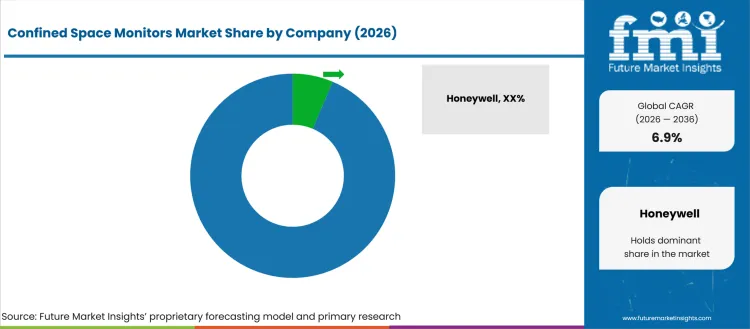
The confined space monitors field is fragmented across pumped portable instruments, connected worker platforms and broader gas-detection portfolios serving industrial and marine accounts. Certification and local calibration service raise entry barriers as monitors must fit established permit workflows. The same requirements separate confined-space equipment from adjacent oil and gas sensors used for wider hazardous area monitoring.
- Honeywell, MSA Safety and Blackline Safety combine portable detection with connected monitoring across industrial fleets.
- Dräger, Industrial Scientific and RKI Instruments combine multi-gas platforms with sampling and service support for recurring entry work.
- Teledyne Gas & Flame and Crowcon broaden toxic-gas and portable-monitor options for accounts comparing sensor range and certification.
Competitive Benchmarking: Confined Space Monitors Market
| Company | Entry Sampling Breadth | Connected Fleet Support | Gas / Sensor Flexibility | Geographic Reach |
|---|---|---|---|---|
| Honeywell | Medium | Medium | High | Global industrial markets |
| Dräger | High | High | High | Global |
| MSA Safety | High | High | High | Global |
| Industrial Scientific | High | High | High | Global |
| RKI Instruments | High | Medium | High | North America and international distributors |
| Blackline Safety | Medium | High | High | North America, Europe and international markets |
| Teledyne Gas & Flame | Medium | Medium | Medium | North America, Europe and international channels |
| Crowcon | High | High | High | International distributor network |
Key Developments in the Confined Space Monitors Market
- In March 2026, Blackline Safety began shipping G8 across North American and European markets with multi-gas detection, two-way communication and live monitoring.
- In September 2025, Crowcon launched its IQ connected portable detector range, including DetectiveIQ with seven-gas monitoring and an optional sampling pump.
- In June 2025, Teledyne Gas & Flame unveiled PS DUO for continuous two-gas monitoring with ATEX and IECEx certification across selectable gas pairings.
Key Players in the Confined Space Monitors Market
Connected Fleet Platforms
- Honeywell
- MSA Safety
- Industrial Scientific
- Blackline Safety
Multi-gas Sampling Specialists
- Dräger
- RKI Instruments
Sensor and Detector Specialists
- Teledyne Gas & Flame
- Crowcon
Confined Space Monitors Market - Report Scope
| Coverage field | Report scope |
|---|---|
| Market breakdown | By monitor type, gas coverage, sensor technology, application, end use, sales channel and region. |
| Quantitative Units | Revenue im USD million and CAGR in %. |
| Market Definition | Portable and fixed instruments used to measure hazardous atmospheres before or during entry into confined spaces across industrial and marine work. |
| Regions Covered | North America, Latin America, Europe, East Asia, South Asia and Pacific and Middle East and Africa. |
| Countries Covered | Singapore, United Kingdom, United States, Germany, Japan, and 20+ countries included in the full report. |
| Key Companies Profiled | Honeywell, Dräger, MSA Safety, Industrial Scientific, RKI Instruments, Blackline Safety, Teledyne Gas & Flame, Crowcon. |
| Forecast Period | 2026 to 2036. |
| Approach | Primary and secondary research with market triangulation. |
Confined Space Monitors Market - Research Methodology
| Method | Approach |
|---|---|
| Primary Research | FMI analysts gathered input from manufacturers, service providers, technology developers, distributors, end users, procurement teams, and subject-matter experts. Interviews examined purchasing decisions, product or service evaluation, adoption barriers, approval requirements, pricing considerations, and expectations for technical or commercial support. Respondents were also asked what evidence is required before a trial, pilot, or initial order develops into regular purchasing. |
| Desk Research | Desk research covered government statistics, regulatory publications, trade data, industry associations, technical literature, standards, company filings, product information, and official corporate announcements. Sources were reviewed for relevance, publication date, geographic coverage, and consistency with the defined market scope. Claims relating to performance, applications, approvals, capacity, investment, and commercial activity were retained only when supported by credible public evidence. |
| Market Sizing and Forecasting | The market model combined the baseline value with historical performance, segment structure, pricing and volume indicators, adoption levels, company participation, and country-level demand conditions. Forecast assumptions considered economic activity, investment trends, regulatory developments, technology adoption, purchasing cycles, supply availability, and barriers to wider market use. Segment and regional estimates were reconciled before the final market total was calculated. |
| Data Validation | Estimates were checked against multiple independent indicators, including public data, company activity, trade patterns, industry developments, and findings from primary interviews. Validation also tested whether products, services, applications, and company revenues fell within the defined market boundaries. Adjacent categories, unsupported claims, overlapping revenues, and activities without direct market relevance were excluded to reduce double counting and maintain consistency across segments and countries. |
Confined Space Monitors Market by Segments
Confined Space Monitors Market segmented by Monitor Type:
- Portable Multi-gas Monitors
- Area Monitors
- Personal Clip-on Monitors
- Wireless Connected Monitors
- Fixed Confined-space Sensors
Confined Space Monitors Market segmented by Gas Coverage:
- Oxygen
- Combustible Gases
- H₂S
- CO
- VOC / Toxic Gases
Confined Space Monitors Market segmented by Sensor Technology:
- Electrochemical
- Catalytic Bead
- Infrared
- PID
- Metal Oxide
Confined Space Monitors Market segmented by Application:
- Tank Entry
- Cargo Hold Entry
- Sewer / Bilge Spaces
- Engine Room Maintenance
- Shipyard Work
Confined Space Monitors Market segmented by End Use:
- Marine & Offshore
- Shipyards
- Oil & Gas
- Utilities
- Industrial Safety
Confined Space Monitors Market segmented by Sales Channel:
- Safety Distributors
- Direct OEM
- Rental / Calibration Service
Confined Space Monitors Market by Region:
- North America
- United States
- Canada
- Latin America
- Brazil
- Mexico
- Chile
- Rest of Latin America
- Western Europe
- Germany
- United Kingdom
- Italy
- Spain
- France
- Nordics
- Benelux
- Rest of Western Europe
- Eastern Europe
- Russia
- Poland
- Hungary
- Balkan and Baltic States
- Rest of Eastern Europe
- East Asia
- China
- Japan
- South Korea
- South Asia and Pacific
- India
- ASEAN
- Australia and New Zealand
- Rest of South Asia and Pacific
- Middle East and Africa
- Kingdom of Saudi Arabia
- Other GCC Countries
- Türkiye
- South Africa
- Other African Union Countries
- Rest of Middle East and Africa
Research Sources and Bibliography
- Occupational Safety and Health Administration. (2025, July 8). Clean Harbors Environmental Services Inc.
- Ministry of Manpower, Singapore. (2026, July 16). Workplace incident at Choa Chua Kang Waterworks - Enforcement Action to be taken against Parties allegedly responsible for Safety Lapses.
- MSA Safety. (2025, September 15). MSA Safety Debuts Two New Safety Solutions at National Safety Congress.
- RKI Instruments. (2026, March 17). Announcing the GX-6100 - Six Gas Sample Draw Monitor.
- Teledyne Technologies Incorporated. (2026, January 14). Teledyne Acquires DD-Scientific.
- Industrial Scientific. (2025, May 29). Code Red Safety to Expand Rental Offerings with Industrial Scientific in $1 Million Deal.
- International Maritime Organization. (2025, June 27). MSC.581(110): Revised recommendations for entering enclosed spaces aboard ships.
- Occupational Safety and Health Administration. (2026, February 27). Hydro Clear Services, Llc.
- Blackline Safety. (2026, January 13). Blackline Safety Introduces G8-The Most Connected Safety Wearable Ever Made.
- Workplace Safety and Health Council. (2025, July 7). Opening Address by Mr Simon Kuik at Marine and Maritime Leadership Breakfast.
- Health and Safety Executive. (2025, February 4). Notice 314975030 served against Progress Engineering Limited.
- Occupational Safety and Health Administration. (2025, March 4). Allen'S Tri-State Mechanical.
- Industrial Scientific. (2025, February 4). Industrial Scientific Secures ATEX Performance Certification for Ventis® Pro5 Multi-Gas Monitor.
- Tochigi Labor Bureau. (2025, August 22).
- Honeywell. (2026, June 2). Honeywell Launches Enhanced Industrial Software to Deliver Real-Time Visibility into Worksite Safety.
- Dräger. (2026, March 17). Dräger expands multi-gas detector functionality with covert feature for high risk operations.
- Blackline Safety. (2026, March 17). Blackline Safety Now Shipping G8, Expanding Leadership in Connected Safety.
- Crowcon Detection Instruments Limited. (2025, September 23). Crowcon launches new IQ range of connected portable gas detectors.
- Teledyne Gas & Flame Detection. (2025, June 23). Next-level safety: New portable PS DUO from Teledyne GFD detects two gases simultaneously.
- Industrial Scientific. (2025, February 24). Industrial Scientific Unveils Center of Excellence in Dammam, Saudi Arabia.
- Blackline Safety. (2025, January 9). Blackline Safety Announces Shipping of EXO 8 Area Monitor, New $1.6 Million Deal with Total Safety.
- MSA Safety Incorporated. (2026, February 11). MSA Safety Announces Fourth Quarter and Full-Year 2025 Results.
This bibliography is provided for reader reference and is not exhaustive. The full report contains the complete reference list and detailed citations.
This Report Answers
- What operating rules convert confined-space entry work into recurring monitor demand?
- How do calibration and sampling design affect detector readiness across industrial fleets?
- Why do portable multi-gas monitors lead the monitor type category in 2026?
- How do oxygen coverage and electrochemical sensors shape confined-space instrument selection?
- Why does tank entry favor pumped pre-entry sampling during maintenance work?
- How do country growth rates change service and channel requirements?
- Which supplier capabilities shape confined-space fleet replacement decisions?
- How does remote visibility create higher-value connected monitoring deployments?
Frequently Asked Questions
How big is the Confined Space Monitors Market in 2026?
The confined space monitors market is expected to be valued at USD 1.2 billion in 2026 and reach USD 2.4 billion by 2036. Permit-based atmosphere testing sustains recurring equipment purchases as safety teams require calibrated monitors for scheduled confined-space entry work.
What is the CAGR of the Confined Space Monitors Market from 2026 to 2036?
The confined space monitors market is forecast to expand at a 6.9% CAGR from 2026 to 2036. Planned entry work and documented atmosphere testing sustain purchases across marine maintenance and industrial safety programs.
Which monitor type is projected to account for 36.0% of the Confined Space Monitors Market?
The confined space monitors market is expected to record a 36.0% monitor type share for portable multi-gas monitors in 2026. One instrument supports sampled pre-entry checks and personal monitoring across recurring permit work at industrial sites.
Which end-use segment is projected to account for 31.0% of the Confined Space Monitors Market?
The confined space monitors market is expected to record a 31.0% end-use share for marine and offshore applications in 2026. Repeated entry into enclosed ship spaces requires dependable portable instrument availability across scheduled vessel maintenance.
Which companies are active in the Confined Space Monitors Market?
The confined space monitors market profiles Honeywell, Dräger, MSA Safety, Industrial Scientific, RKI Instruments, Blackline Safety, Teledyne Gas & Flame and Crowcon. Their roles span connected fleet platforms plus configurable sampling and sensor portfolios for confined-space work.
Preview the report firsthand - request a free sample
Get SampleGet the brochure for pricing and purchase details.
Get PDFTable of Content
- Key Takeaways
- Market Size and CAGR
- Top Growth Driver
- Fastest Growing Segment
- Leading Region
- Key Companies
- Emerging Opportunities
- Executive Summary
- Global Market Outlook
- Demand-side Trends
- Supply-side Trends
- Technology Roadmap Analysis
- Analysis and Recommendations
- Analyst Perspective (What is happening? Why now? What should investors know?)
- Key Questions Answered
- How large is the market?
- What is the CAGR?
- What are key trends?
- Which region dominates?
- Who are the leaders?
- Market Overview
- Market Coverage / Taxonomy
- Market Definition / Scope / Limitations
- Research Methodology
- Chapter Orientation
- Analytical Lens and Working Hypotheses
- Market Structure, Signals, and Trend Drivers
- Benchmarking and Cross-market Comparability
- Market Sizing, Forecasting, and Opportunity Mapping
- Research Design and Evidence Framework
- Desk Research Programme (Secondary Evidence)
- Expert Input and Fieldwork (Primary Evidence)
- Tooling, Models, and Reference Databases
- Data Engineering and Model Build
- Quality Assurance and Audit Trail
- Market Background
- Market Dynamics (Drivers, Restraints, Opportunity, Trends)
- Scenario Forecast (Optimistic, Likely, Conservative)
- Impact Analysis
- AI Impact
- Sustainability Impact
- Regulatory Impact
- Technology Impact
- Consumer / Buyer Analysis
- Purchase Drivers
- Adoption Barriers
- Buyer Journey
- Opportunity Map Analysis
- Product Life Cycle Analysis
- Supply Chain Analysis
- Investment Feasibility Matrix
- Value Chain Analysis
- PESTLE and Porter's Analysis
- Regulatory Landscape
- Regional Parent Market Outlook
- Production and Consumption Statistics
- Import and Export Statistics
- Global Market Analysis and Forecast, 2021 to 2036
- Historical Market Size Value (USD Million) Analysis, 2021 to 2025
- Current and Future Market Size Value (USD Million) Projections, 2026 to 2036
- Y-o-Y Growth Trend Analysis
- Absolute $ Opportunity Analysis
- Global Market Pricing Analysis, 2021 to 2036
- Global Market Analysis and Forecast, By Monitor Type, 2021 to 2036
- Introduction / Key Findings
- Historical Market Size Value (USD Million) Analysis By Monitor Type, 2021 to 2025
- Current and Future Market Size Value (USD Million) Analysis and Forecast By Monitor Type, 2026 to 2036
- Portable Multi-gas Monitors
- Area Monitors
- Personal Clip-on Monitors
- Wireless Connected Monitors
- Fixed Confined-space Sensors
- Portable Multi-gas Monitors
- Y-o-Y Growth Trend Analysis By Monitor Type, 2021 to 2025
- Absolute $ Opportunity Analysis By Monitor Type, 2026 to 2036
- Global Market Analysis and Forecast, By Gas Coverage, 2021 to 2036
- Introduction / Key Findings
- Historical Market Size Value (USD Million) Analysis By Gas Coverage, 2021 to 2025
- Current and Future Market Size Value (USD Million) Analysis and Forecast By Gas Coverage, 2026 to 2036
- Combustible Gases
- Oxygen
- H₂S
- CO
- VOC / Toxic Gases
- Combustible Gases
- Y-o-Y Growth Trend Analysis By Gas Coverage, 2021 to 2025
- Absolute $ Opportunity Analysis By Gas Coverage, 2026 to 2036
- Global Market Analysis and Forecast, By Sensor Technology, 2021 to 2036
- Introduction / Key Findings
- Historical Market Size Value (USD Million) Analysis By Sensor Technology, 2021 to 2025
- Current and Future Market Size Value (USD Million) Analysis and Forecast By Sensor Technology, 2026 to 2036
- Electrochemical
- Catalytic Bead
- Infrared
- PID
- Metal Oxide
- Electrochemical
- Y-o-Y Growth Trend Analysis By Sensor Technology, 2021 to 2025
- Absolute $ Opportunity Analysis By Sensor Technology, 2026 to 2036
- Global Market Analysis and Forecast, By Application, 2021 to 2036
- Introduction / Key Findings
- Historical Market Size Value (USD Million) Analysis By Application, 2021 to 2025
- Current and Future Market Size Value (USD Million) Analysis and Forecast By Application, 2026 to 2036
- Tank Entry
- Cargo Hold Entry
- Sewer / Bilge Spaces
- Engine Room Maintenance
- Shipyard Work
- Tank Entry
- Y-o-Y Growth Trend Analysis By Application, 2021 to 2025
- Absolute $ Opportunity Analysis By Application, 2026 to 2036
- Global Market Analysis and Forecast, By End Use, 2021 to 2036
- Introduction / Key Findings
- Historical Market Size Value (USD Million) Analysis By End Use, 2021 to 2025
- Current and Future Market Size Value (USD Million) Analysis and Forecast By End Use, 2026 to 2036
- Marine & Offshore
- Shipyards
- Oil & Gas
- Utilities
- Industrial Safety
- Marine & Offshore
- Y-o-Y Growth Trend Analysis By End Use, 2021 to 2025
- Absolute $ Opportunity Analysis By End Use, 2026 to 2036
- Global Market Analysis and Forecast, By Region, 2021 to 2036
- Introduction
- Historical Market Size Value (USD Million) Analysis By Region, 2021 to 2025
- Current Market Size Value (USD Million) Analysis and Forecast By Region, 2026 to 2036
- North America
- Latin America
- Western Europe
- Eastern Europe
- East Asia
- South Asia and Pacific
- Middle East & Africa
- Market Attractiveness Analysis By Region
- North America Market Analysis and Forecast, By Country, 2021 to 2036
- Historical Market Size Value (USD Million) Trend Analysis By Market Taxonomy, 2021 to 2025
- Market Size Value (USD Million) Forecast By Market Taxonomy, 2026 to 2036
- By Country
- USA
- Canada
- By Monitor Type
- By Gas Coverage
- By Sensor Technology
- By Application
- By End Use
- By Country
- Market Attractiveness Analysis
- By Country
- By Monitor Type
- By Gas Coverage
- By Sensor Technology
- By Application
- By End Use
- Key Takeaways
- Latin America Market Analysis and Forecast, By Country
- Historical Market Size Value (USD Million) Trend Analysis By Market Taxonomy, 2021 to 2025
- Market Size Value (USD Million) Forecast By Market Taxonomy, 2026 to 2036
- By Country
- Brazil
- Mexico
- Chile
- Rest of Latin America
- By Monitor Type
- By Gas Coverage
- By Sensor Technology
- By Application
- By End Use
- By Country
- Market Attractiveness Analysis
- By Country
- By Monitor Type
- By Gas Coverage
- By Sensor Technology
- By Application
- By End Use
- Key Takeaways
- Western Europe Market Analysis and Forecast, By Country
- Historical Market Size Value (USD Million) Trend Analysis By Market Taxonomy, 2021 to 2025
- Market Size Value (USD Million) Forecast By Market Taxonomy, 2026 to 2036
- By Country
- Germany
- UK
- Italy
- Spain
- France
- Nordic
- BENELUX
- Rest of Western Europe
- By Monitor Type
- By Gas Coverage
- By Sensor Technology
- By Application
- By End Use
- By Country
- Market Attractiveness Analysis
- By Country
- By Monitor Type
- By Gas Coverage
- By Sensor Technology
- By Application
- By End Use
- Key Takeaways
- Eastern Europe Market Analysis and Forecast, By Country
- Historical Market Size Value (USD Million) Trend Analysis By Market Taxonomy, 2021 to 2025
- Market Size Value (USD Million) Forecast By Market Taxonomy, 2026 to 2036
- By Country
- Russia
- Poland
- Hungary
- Balkan & Baltic
- Rest of Eastern Europe
- By Monitor Type
- By Gas Coverage
- By Sensor Technology
- By Application
- By End Use
- By Country
- Market Attractiveness Analysis
- By Country
- By Monitor Type
- By Gas Coverage
- By Sensor Technology
- By Application
- By End Use
- Key Takeaways
- East Asia Market Analysis and Forecast, By Country
- Historical Market Size Value (USD Million) Trend Analysis By Market Taxonomy, 2021 to 2025
- Market Size Value (USD Million) Forecast By Market Taxonomy, 2026 to 2036
- By Country
- China
- Japan
- South Korea
- By Monitor Type
- By Gas Coverage
- By Sensor Technology
- By Application
- By End Use
- By Country
- Market Attractiveness Analysis
- By Country
- By Monitor Type
- By Gas Coverage
- By Sensor Technology
- By Application
- By End Use
- Key Takeaways
- South Asia and Pacific Market Analysis and Forecast, By Country
- Historical Market Size Value (USD Million) Trend Analysis By Market Taxonomy, 2021 to 2025
- Market Size Value (USD Million) Forecast By Market Taxonomy, 2026 to 2036
- By Country
- India
- ASEAN
- Australia & New Zealand
- Rest of South Asia and Pacific
- By Monitor Type
- By Gas Coverage
- By Sensor Technology
- By Application
- By End Use
- By Country
- Market Attractiveness Analysis
- By Country
- By Monitor Type
- By Gas Coverage
- By Sensor Technology
- By Application
- By End Use
- Key Takeaways
- Middle East & Africa Market Analysis and Forecast, By Country
- Historical Market Size Value (USD Million) Trend Analysis By Market Taxonomy, 2021 to 2025
- Market Size Value (USD Million) Forecast By Market Taxonomy, 2026 to 2036
- By Country
- Kingdom of Saudi Arabia
- Other GCC Countries
- Türkiye
- South Africa
- Other African Union
- Rest of Middle East & Africa
- By Monitor Type
- By Gas Coverage
- By Sensor Technology
- By Application
- By End Use
- By Country
- Market Attractiveness Analysis
- By Country
- By Monitor Type
- By Gas Coverage
- By Sensor Technology
- By Application
- By End Use
- Key Takeaways
- Key Countries Market Analysis
- USA
- Pricing Analysis
- Market Share Analysis, 2025
- By Monitor Type
- By Gas Coverage
- By Sensor Technology
- By Application
- By End Use
- Canada
- Pricing Analysis
- Market Share Analysis, 2025
- By Monitor Type
- By Gas Coverage
- By Sensor Technology
- By Application
- By End Use
- Mexico
- Pricing Analysis
- Market Share Analysis, 2025
- By Monitor Type
- By Gas Coverage
- By Sensor Technology
- By Application
- By End Use
- Brazil
- Pricing Analysis
- Market Share Analysis, 2025
- By Monitor Type
- By Gas Coverage
- By Sensor Technology
- By Application
- By End Use
- Chile
- Pricing Analysis
- Market Share Analysis, 2025
- By Monitor Type
- By Gas Coverage
- By Sensor Technology
- By Application
- By End Use
- Germany
- Pricing Analysis
- Market Share Analysis, 2025
- By Monitor Type
- By Gas Coverage
- By Sensor Technology
- By Application
- By End Use
- UK
- Pricing Analysis
- Market Share Analysis, 2025
- By Monitor Type
- By Gas Coverage
- By Sensor Technology
- By Application
- By End Use
- Italy
- Pricing Analysis
- Market Share Analysis, 2025
- By Monitor Type
- By Gas Coverage
- By Sensor Technology
- By Application
- By End Use
- Spain
- Pricing Analysis
- Market Share Analysis, 2025
- By Monitor Type
- By Gas Coverage
- By Sensor Technology
- By Application
- By End Use
- France
- Pricing Analysis
- Market Share Analysis, 2025
- By Monitor Type
- By Gas Coverage
- By Sensor Technology
- By Application
- By End Use
- India
- Pricing Analysis
- Market Share Analysis, 2025
- By Monitor Type
- By Gas Coverage
- By Sensor Technology
- By Application
- By End Use
- ASEAN
- Pricing Analysis
- Market Share Analysis, 2025
- By Monitor Type
- By Gas Coverage
- By Sensor Technology
- By Application
- By End Use
- Australia & New Zealand
- Pricing Analysis
- Market Share Analysis, 2025
- By Monitor Type
- By Gas Coverage
- By Sensor Technology
- By Application
- By End Use
- China
- Pricing Analysis
- Market Share Analysis, 2025
- By Monitor Type
- By Gas Coverage
- By Sensor Technology
- By Application
- By End Use
- Japan
- Pricing Analysis
- Market Share Analysis, 2025
- By Monitor Type
- By Gas Coverage
- By Sensor Technology
- By Application
- By End Use
- South Korea
- Pricing Analysis
- Market Share Analysis, 2025
- By Monitor Type
- By Gas Coverage
- By Sensor Technology
- By Application
- By End Use
- Russia
- Pricing Analysis
- Market Share Analysis, 2025
- By Monitor Type
- By Gas Coverage
- By Sensor Technology
- By Application
- By End Use
- Poland
- Pricing Analysis
- Market Share Analysis, 2025
- By Monitor Type
- By Gas Coverage
- By Sensor Technology
- By Application
- By End Use
- Hungary
- Pricing Analysis
- Market Share Analysis, 2025
- By Monitor Type
- By Gas Coverage
- By Sensor Technology
- By Application
- By End Use
- Kingdom of Saudi Arabia
- Pricing Analysis
- Market Share Analysis, 2025
- By Monitor Type
- By Gas Coverage
- By Sensor Technology
- By Application
- By End Use
- Türkiye
- Pricing Analysis
- Market Share Analysis, 2025
- By Monitor Type
- By Gas Coverage
- By Sensor Technology
- By Application
- By End Use
- South Africa
- Pricing Analysis
- Market Share Analysis, 2025
- By Monitor Type
- By Gas Coverage
- By Sensor Technology
- By Application
- By End Use
- USA
- Market Structure Analysis
- Competition Dashboard
- Competition Benchmarking
- Market Share Analysis of Top Players
- By Regional
- By Monitor Type
- By Gas Coverage
- By Sensor Technology
- By Application
- By End Use
- Emerging Startups
- Innovation Benchmarking
- Competition Analysis
- Competition Deep Dive
- Honeywell
- Overview
- Product Portfolio
- Profitability by Market Segments
- Sales Footprint
- Strategy Overview
- Marketing Strategy
- Product Strategy
- Channel Strategy
- Dräger
- MSA Safety
- Industrial Scientific
- RKI Instruments
- Blackline Safety
- Teledyne Gas & Flame
- GfG Instrumentation
- Crowcon
- RC Systems
- Honeywell
- Case Studies
- Success Stories
- Recent Developments
- Competition Deep Dive
- Assumptions & Acronyms Used


