

- Market Size (2026)
- USD 1.7 Bn
- Forecast (2036)
- USD 4.1 Bn
- CAGR (2026 to 2036)
- 9.2%
How big is Containerized Marine Batteries Market in 2026?
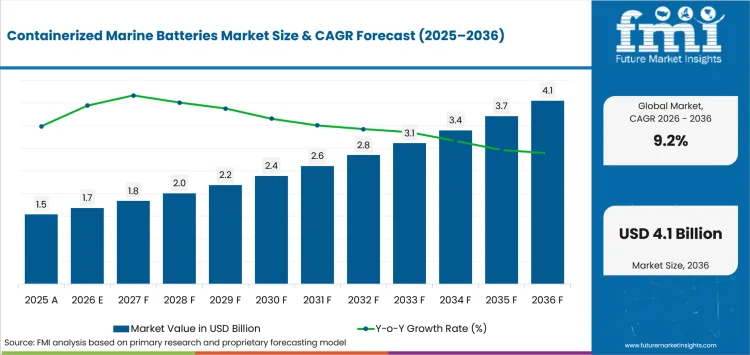
USD 1.7 billion in 2026 and USD 4.1 billion by 2036 at a 9.2% CAGR.
Containerized marine battery demand is projected at 9.2% CAGR from 2026 to 2036 with valuation expected to rise from USD 1.7 billion in 2026 to USD 4.1 billion by 2036. Fleet programs tie battery capacity to vessel electrical design and the charging window available at each terminal. Wärtsilä announced propulsion packages for three USA-built battery-electric ferries in May 2025 with batteries and shore power included in its scope. That package shows why integration coverage can influence how much of each vessel-electrification program a supplier captures.
Norwegian regulation makes terminal power a procurement condition on protected passenger routes instead of a later infrastructure decision. In April 2025, Norway’s climate ministry confirmed zero-emission requirements for passenger ships below 10,000 gross tons in World Heritage fjords from January 1, 2026. Passenger-vessel owners need confirmed charging access before finalizing battery capacity and route schedules because the rules require shore power where available.
Key Takeaways
- Fleet renewal and terminal electrification are converting fixed-route operating plans into battery specifications tied to route energy and charging windows.
- By container size, 10 ft systems are estimated to hold 18.0% in 2026 owing to staged installation and constrained vessel layouts.
- In 2026, LFP systems are expected to lead chemistry with 44.0% share because predictable thermal behavior and lifecycle economics suit sustained marine duty.
- By capacity, below 1 MWh systems are forecast to represent 22.0% in 2026 driven by smaller-vessel and hybrid operating profiles.
- Marine safety review and insufficient shore charging delay projects even after vessel owners have committed capital to electrification programs.
- Key players in the containerized marine batteries market include Corvus Energy, Leclanché, EST-Floattech, Echandia, Wärtsilä, ABB, Kongsberg Maritime, and AYK Energy.
Analyst Perspective
"Containerized marine batteries should be priced against route energy, enclosure footprint, class evidence, and shore-power duty rather than headline MWh alone. A stronger package reduces redesign because battery modules, cooling, fire protection, and charging interfaces reach class review as one coordinated vessel system."
- Nikhil Kaitwade, Principal Consultant, Future Market Insights
How is the containerized marine batteries market segmented?
The containerized marine batteries market is segmented by container size, chemistry, capacity, vessel / site, sales channel, and region.
Taxonomy covers container size, chemistry, capacity, vessel / site, sales channel, and region. Container size includes 10 ft, 20 ft, 40 ft, and custom units. Chemistry includes LFP, NMC, LTO, and hybrid battery-supercapacitor systems while capacity covers below 1 MWh, 1-5 MWh, 5-10 MWh, and above 10 MWh. Vessel / site includes ferries, offshore support vessels, ports, workboats, and hybrid retrofits while sales channels cover shipyards, integrators, fleet programs, and port projects.
How does below 1 MWh support the capacity category?
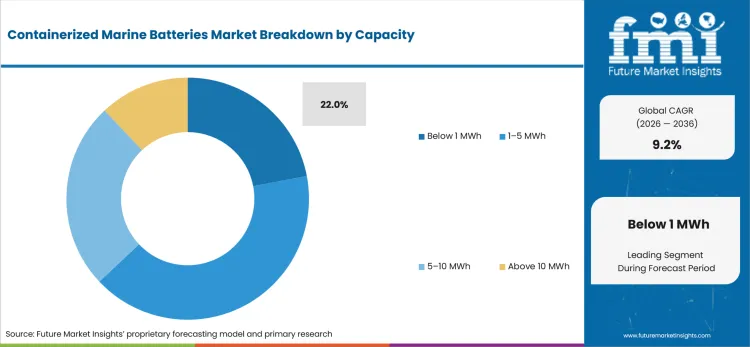
Below 1 MWh systems cover hotel loads, peak shaving, harbor maneuvering, and short workboat cycles without forcing a multi-megawatt-hour retrofit. EST-Floattech documented two electric-hybrid pilot boats in June 2026 using 240 kWh systems that switch among electric, hybrid, and direct-diesel operation.
- Below 1 MWh systems are set to lead the capacity category with 22.0% share in 2026 due to partial-electric duties that do not require larger battery installations.
- Hybrid boat systems at this scale reduce engine hours on repeat duties, but charging frequency and reserve margins still determine usable battery size for each route.
What makes 10 ft systems central to the container size category?
Retrofits often have fixed deck openings and cable routes, so a shorter enclosure can avoid moving vessel systems. Echandia launched Core in June 2026 and reported a 30% smaller installation footprint than its previous system. The smaller footprint can reduce structural rework before class review on vessels with limited deck space.
- Based on container size, 10 ft systems are projected to account for 18.0% in 2026 due to compact footprints that suit constrained retrofit layouts.
- Project engineers qualify marine power battery systems against weight distribution and ventilation limits before class submission. Late enclosure changes can extend docking time and force structural rework during installation.
Why do LFP systems lead the chemistry category?
LFP systems suit energy-oriented vessels that accept a modestly larger footprint for predictable thermal behavior and long cycle life. Marine engineers compare usable energy with fault-containment and cooling requirements before deciding whether LFP fits the intended route duty.
- The LFP systems segment is likely to capture 44.0% share in 2026 attributable to predictable thermal behavior and lifecycle economics in high-energy marine installations.
- Corvus Energy launched Blue Whale NxtGen in December 2025 using cobalt-free lithium iron phosphate batteries for high-energy marine applications. The launch gives LFP a current commercial platform whose qualification still depends on vessel-level safety and thermal-control evidence.
What supports ferries within the vessel - site category?
Ferries suit batteries because fixed routes reveal energy demand and terminal calls define charging time before system sizing. Repeat schedules also let ferry owners compare battery degradation and charging performance against the same operating pattern each day.
- The vessel - site category is forecast to be led by ferries at 29.0% share in 2026 due to fixed routes and repeat terminal charging windows.
- Wärtsilä’s August 2025 Aurora Botnia project raised installed capacity from 2.2 MWh to 12.6 MWh on an operating ferry. The upgrade shows how proven electrical integration can absorb much larger storage on electric ships without changing the route itself.
What are the drivers, restraints and opportunities in the Containerized Marine Batteries Market?
Fleet renewal programs convert route plans into battery specifications. Marine safety approval and shore-power availability constrain deployment. Exchangeable battery containers move charging ashore and allow fleet-standard pack use.
- Driver: Fleet renewal programs turn route-energy requirements into battery specifications that include charging power and class documentation before vessel delivery.
- Restraint: Safety qualification and inadequate high-power charging extend engineering schedules before battery-electric vessels can use their installed capacity.
- Opportunity: Exchangeable battery containers let service operators charge packs ashore and spread battery ownership costs over several inland vessels.
Fleet Renewal Converts Route Commitments into Battery Orders
Fleet owners order storage once route limits become engineering inputs for propulsion, hotel loads, and charging time. Japan’s transport ministry selected a direct-connected lithium-ion hybrid tug demonstration in July 2025 to test energy-saving and non-fossil operation. The project provides a working tug duty cycle for sizing batteries against marine propulsion engines and charging limits, so the specification can be tested against actual service.
Safety Approval and Shore Power Slow Project Conversion
Marine battery projects need safety evidence beyond the checks used for a routine diesel replacement. In January 2026, the IMO agreed a workplan covering lithium-ion batteries and swappable traction battery containers under planned safety rules. The work raises the value of documented battery management systems and fault-containment evidence, although onboard approval cannot compensate for insufficient terminal charging power during commissioning.
Exchangeable Containers Support New Service Models
Exchangeable battery containers shift charging out of sailing time and let a service company own the pack pool instead of each vessel. The Port of Rotterdam documented 20-foot ZESpacks with 2.9 MWh capacity and 1 MW charging in September 2025. Revenue depends on interoperable connectors and enough shore-to-ship power points to keep charged packs available on the routes using the service.
Which country CAGRs are profiled in the Containerized Marine Batteries Market?
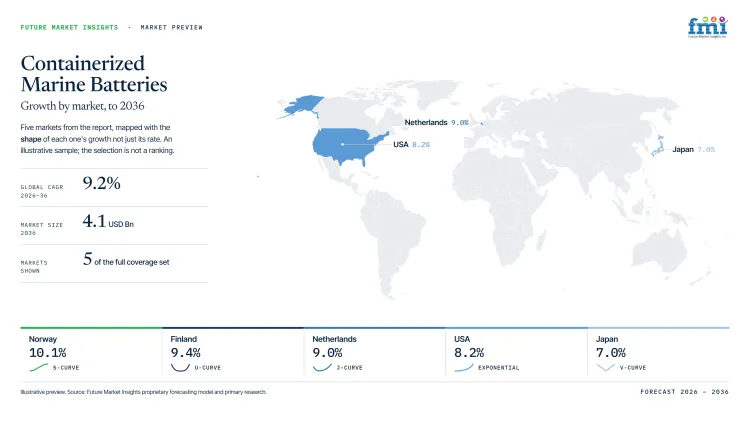
| Country | CAGR |
|---|---|
| Norway | 10.1% |
| Finland | 9.4% |
| Netherlands | 9.0% |
| Canada | 8.7% |
| South Korea | 8.5% |
| USA | 8.2% |
| Japan | 7.0% |
How do country-level CAGRs compare in the Containerized Marine Batteries Market?
The forecasts span 3.1 percentage points, separating Norway’s 10.1% CAGR from Japan’s 7.0%. Norway and Finland form the group because ferry electrification is embedded in fleet operations. The Netherlands, Canada, South Korea, and the USA cluster within 0.8 points as current infrastructure and shipyard readiness constrain conversion.
- Norway also benefits from standardized ferry tenders that reward proven lifecycle service.
- Finland’s marine engineering cluster shortens commissioning support between yards and ferry operators.
- Dutch short-haul routes make frequent battery exchange commercially workable for inland fleets.
- Canada concentrates award potential in ferry fleets where few programs shift demand.
- South Korea converts shipbuilding scale into battery orders after domestic interfaces clear.
- USA public budgets separate vessel procurement from terminal construction on major programs.
- Japan repeats electric vessel designs more slowly because qualification remains project specific.
Forecast rates therefore describe conversion paths, not a common level of installed demand. Full report includes detailed country CAGR with 20+ countries covering North America, Latin America, Europe, East Asia, South Asia, Oceania and the Middle East and Africa.
Country-wise Analysis
- Norwegian ferry operators already manage a large electric fleet, so crews have practical experience with charging routines and battery replacement planning on scheduled coastal services. Statens vegvesen reported in February 2025 that nearly 90 electric ferries were operating nationally. The installed fleet gives battery companies a base for upgrades and lifecycle work. Norway’s containerized marine batteries outlook is anticipated to advance at 10.1% CAGR over the assessment period, supported by mature ferry electrification and established operating experience. Grid capacity at smaller terminals still limits some retrofit schedules, which makes local service coverage and class-ready integration more valuable than basic equipment availability.
- USA marine electrification relies on state ferry programs, port utilities, and public shipyard contracts. Vessel contracts and charging works often follow separate public schedules that must converge before commissioning. Governor Bob Ferguson selected Eastern Shipbuilding Group in July 2025 to build three new 160-vehicle hybrid-electric ferries. The award establishes a defined three-vessel newbuild pipeline for Washington State Ferries. The USA is estimated to post 8.2% CAGR over the forecast period, given fleet replacement needs and public funding for low-emission vessels. Regional utility coordination can delay full battery use after vessel delivery, so integrators managing shipyard interfaces and terminal power retain an advantage during commissioning.
- Adoption of containerized marine batteries in Japan is estimated to expand at 7.0% CAGR through 2036, tied to state support for non-fossil vessel construction and domestic engineering capacity. Before Japanese yards repeat an electric-vessel design, class review and domestic component integration usually need to be settled for the specific ship. Japan’s transport ministry opened its zero-emission ship construction support program in June 2025. The program includes production equipment for vessels using electricity among eligible propulsion energy sources. Long qualification cycles remain the commercial friction, which favors engineering partners able to document battery safety and propulsion interfaces within repeatable Japanese shipbuilding workflows.
- Winter reliability and scheduled departures put thermal control ahead of headline battery capacity in Finnish ferry projects during vessel selection and commissioning. Traficom’s March 2026 maritime barometer found 29% of respondents expected investment to increase and 15% expected a decrease. The split points to selective shipping investment instead of broad capital expansion. By 2036, Finland is projected to grow at 9.4% CAGR, helped by local electrification experience and deep marine engineering capacity. Cold-weather performance requirements keep nearby technical support commercially important, and the strongest projects are likely to protect scheduled winter service without carrying oversized battery reserves during normal operation.
- Frequent calls at dense Dutch inland terminals make standardized battery exchange more workable than on ocean routes with irregular charging access. Containerized marine battery demand in the Netherlands is forecast to rise at 9.0% CAGR over the forecast period, on the back of exchangeable-pack economics and short-haul operating patterns. The Port of Rotterdam stated in September 2025 that ITG operates 17 inland terminals in the Benelux. The 17-terminal network gives battery-service models a broad logistics footprint near commercial routes. Connector durability and charged-pack availability remain the key friction, so revenue favors service networks that keep interoperable packs available without slowing vessel schedules.
- During long coastal renewal programs, Canadian ferries often receive battery capability before every terminal can provide full charging power. Hybrid operation therefore remains practical on those routes until shore infrastructure catches up. The Canada Infrastructure Bank stated in June 2025 that its financing supports eight vessels and related electrification infrastructure. The financing gives BC Ferries a defined path toward higher electric utilization. The Canada containerized marine battery sector is projected to record 8.7% CAGR during the assessment period, attributable to fleet replacement and phased terminal electrification. Long routes and construction schedules still limit full-electric use, which preserves near-term value for systems that perform efficiently in hybrid service.
- Once class documentation is agreed, South Korean shipyards can absorb battery systems into domestic newbuild programs quickly. Qualified manufacturers then gain a direct execution channel through the country’s large domestic yards. Containerized marine battery sales in South Korea are forecast to expand at 8.5% CAGR by 2036, because shipbuilding scale supports project execution and fleet renewal. ABB reported in December 2025 that Busan Port Authority’s all-electric ferry uses twin 1,068 kWh battery packs. The ferry gives domestic yards a public reference for high-capacity vessel electrification. Fire-safety qualification still slows unfamiliar pack designs, so overseas companies need Korean engineering partners and compatible onboard monitoring systems before broader commercial yard adoption.
Who are the notable companies in the Containerized Marine Batteries Market?
Corvus Energy, Leclanché, EST-Floattech, Echandia, Wärtsilä, ABB, Kongsberg Maritime, and AYK Energy are the notable companies serving this market.
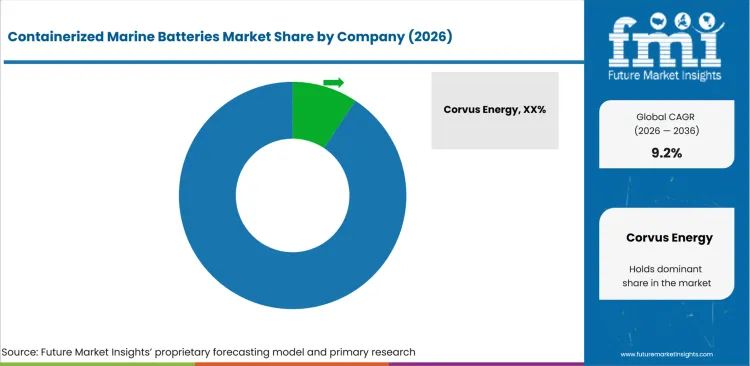
Corvus Energy, Leclanché, EST-Floattech, Echandia, and AYK Energy focus on battery design and marine qualification. Wärtsilä, ABB, and Kongsberg Maritime integrate storage with propulsion and vessel controls. Ferry owners compare battery storage using class evidence, footprint, service access, and charging responsibility.
- Corvus Energy, Leclanché, EST-Floattech, and Echandia compete as marine battery specialists focused on pack design and qualification.
- Wärtsilä and ABB compete as integrated electrification groups covering propulsion, controls, and charging interfaces for fleet programs.
- Kongsberg Maritime provides vessel-integration scope, whereas AYK Energy supplies packaged batteries for ferry and tug projects.
Competitive Benchmarking: Containerized Marine Batteries Market
| Company | Current Marine Project Depth | Pack / Container Modularity | Vessel-to-Shore Integration | Geographic Reach |
|---|---|---|---|---|
| Corvus Energy | High | High | Medium | Europe, North America, and Asia-Pacific |
| Leclanché | High | High | Medium | Europe with international marine projects |
| EST-Floattech | High | High | Medium | Europe with selected global projects |
| Echandia | High | High | Medium | Europe, Asia-Pacific, and selected international projects |
| Wärtsilä | High | Medium | High | Global marine customer and service footprint |
| ABB | High | Medium | High | Global marine and port project footprint |
| Kongsberg Maritime | Medium | Medium | High | Global marine integration footprint |
| AYK Energy | Medium | High | Low | Europe and selected international ferry and tug projects |
Scoring basis: High project depth requires at least three dated 2025+ marine actions. Medium requires two documented actions and Low requires one. High pack modularity requires a container or scalable-pack architecture, with modular racks qualifying as Medium and narrower formats as Low. High vessel-to-shore integration requires onboard and shore-charging scope. Medium covers charging interfaces and Low covers battery supply alone.
Key Developments in the Containerized Marine Batteries Market
- In August 2026, Corvus Energy secured a 40 MWh contract for four BC Ferries vessels with 10 MWh per ship and interfaces for later expansion as terminal charging improves.
- In January 2026, ABB was selected for BC Ferries’ new major vessels with designs supporting up to 70 MWh per ferry and interfaces reserved for later battery expansion.
- In October 2025, Leclanché and Century Ship Services completed a 4 MWh Navius MRS-3 installation for a hybrid ocean cruise vessel and extended certified racks into cruise service.
Key Players in the Containerized Marine Batteries Market
Marine Battery Platform Specialists
- Corvus Energy
- Leclanché
- EST-Floattech
- Echandia
Integrated Vessel and Charging Systems
- Wärtsilä
- ABB
- Kongsberg Maritime
Containerized Marine Battery Specialist
- AYK Energy
Containerized Marine Batteries Market - Report Scope
| Coverage field | Report scope |
|---|---|
| Market breakdown | By container size, chemistry, capacity, vessel / site, sales channel, and region. |
| Quantitative Units | USD billion. |
| Market Definition | Revenue covers containerized or deckhouse-style marine battery energy storage systems for onboard vessels and marine shore-side applications. It includes packaged battery modules, battery management, thermal control, fire-safety architecture, enclosures, and related power electronics sold as part of the battery system. |
| Regions Covered | North America, Latin America, Europe, East Asia, South Asia and Pacific, and Middle East and Africa. |
| Countries Covered | Norway, Finland, Netherlands, Canada, South Korea, USA, Japan, and more than twenty-five additional countries in the full report. |
| Key Companies Profiled | Corvus Energy, Leclanché, EST-Floattech, Echandia, Wärtsilä, ABB, Kongsberg Maritime, and AYK Energy. |
| Forecast Period | 2026 to 2036. |
| Approach | Primary and secondary research with market triangulation. |
Containerized Marine Batteries Market - Research Methodology
| Method | Approach |
|---|---|
| Primary Research | FMI analysts gathered input from manufacturers, service providers, technology developers, distributors, end users, procurement teams, and subject-matter experts. Interviews examined purchasing decisions, product or service evaluation, adoption barriers, approval requirements, pricing considerations, and expectations for technical or commercial support. Respondents were also asked what evidence is required before a trial, pilot, or initial order develops into regular purchasing. |
| Desk Research | Desk research covered government statistics, regulatory publications, trade data, industry associations, technical literature, standards, company filings, product information, and official corporate announcements. Sources were reviewed for relevance, publication date, geographic coverage, and consistency with the defined market scope. Claims relating to performance, applications, approvals, capacity, investment, and commercial activity were retained only when supported by credible public evidence. |
| Market Sizing and Forecasting | The market model combined the baseline value with historical performance, segment structure, pricing and volume indicators, adoption levels, company participation, and country-level demand conditions. Forecast assumptions considered economic activity, investment trends, regulatory developments, technology adoption, purchasing cycles, supply availability, and barriers to wider market use. Segment and regional estimates were reconciled before the final market total was calculated. |
| Data Validation | Estimates were checked against multiple independent indicators, including public data, company activity, trade patterns, industry developments, and findings from primary interviews. Validation also tested whether products, services, applications, and company revenues fell within the defined market boundaries. Adjacent categories, unsupported claims, overlapping revenues, and activities without direct market relevance were excluded to reduce double counting and maintain consistency across segments and countries. |
Containerized Marine Batteries Market by Segments
Containerized Marine Batteries Market segmented by Container Size:
- 10 ft systems
- 20 ft systems
- 40 ft systems
- Custom modular containers
Containerized Marine Batteries Market segmented by Chemistry:
- LFP systems
- NMC systems
- LTO systems
- Hybrid battery-supercapacitor systems
Containerized Marine Batteries Market segmented by Capacity:
- Below 1 MWh
- 1-5 MWh
- 5-10 MWh
- Above 10 MWh
Containerized Marine Batteries Market segmented by Vessel / Site:
- Ferries
- Offshore support vessels
- Ports / shore charging
- Workboats
- Hybrid vessel retrofits
Containerized Marine Batteries Market segmented by Sales Channel:
- Shipyard project supply
- Energy system integrators
- Fleet electrification programs
- Port infrastructure projects
Containerized Marine Batteries Market by Region:
- North America
- United States
- Canada
- Latin America
- Brazil
- Mexico
- Argentina
- Chile
- Western Europe
- Germany
- France
- United Kingdom
- Italy
- Spain
- Benelux
- Nordics
- Eastern Europe
- Poland
- Czech Republic
- Romania
- Hungary
- East Asia
- China
- Japan
- South Korea
- South Asia and Pacific
- India
- ASEAN
- Australia and New Zealand
- Middle East and Africa
- GCC Countries
- South Africa
- Türkiye
- Israel
Research Sources and Bibliography
- Wärtsilä. (2025, May 28). Wärtsilä to supply the electric propulsion system for USA’s first battery-electric zero-emission high-speed passenger ferries.
- Norwegian Ministry of Climate and Environment. (2025, April 22). Zero-Emission Requirements for Passenger Ships in World Heritage Fjords.
- Echandia. (2026, June 2). Echandia launches new battery system - Echandia Core.
- Corvus Energy. (2025, December 4). Corvus Energy Launches Next-Generation Marine LFP Energy Storage System.
- EST-Floattech. (2026, June). EST-Floattech battery systems part of fully electric waste tanker RASA and electric-hybrid pilot boats delivered to the Port of Klaipėda by Baltic Workboats.
- Wärtsilä. (2025, August 27). Wärtsilä and Wasaline’s close cooperation continues with world’s largest marine battery hybrid system project.
- Ministry of Land, Infrastructure, Transport and Tourism of Japan. (2025, July 16). Three demonstration projects selected to advance energy saving and non-fossil fuel use in coastal shipping.
- International Maritime Organization. (2026, January 29). Draft workplan agreed on safety rules for battery, wind and nuclear-powered ships.
- Port of Rotterdam Authority. (2025, September 18). Pioneers present the future of inland shipping: batteries on the water.
- Norwegian Public Roads Administration. (2025, February 17). Celebrating the 10th anniversary of a green revolution at sea.
- Office of the Governor of Washington. (2025, July 1). Governor Ferguson selects Eastern Shipbuilding Group to construct new ferries.
- Ministry of Land, Infrastructure, Transport and Tourism of Japan. (2025, June 6). Call for applications for the FY2025 zero-emission ship construction promotion program.
- Finnish Transport and Communications Agency Traficom. (2026, March 24). Maritime barometer: Cautious optimism for shipping volumes and investments despite uncertainty.
- Canada Infrastructure Bank. (2025, June 26). The CIB supports BC Ferries’ essential service upgrades.
- ABB. (2025, December 11). South Korea’s first state-owned all-electric ferry powered by ABB.
- Corvus Energy. (2026, August 11). Corvus Energy Secures 40MWh Landmark Battery Contract for BC Ferries’ New Major Vessels Program.
- ABB. (2026, January 12). ABB chosen to supply technology for BC Ferries’ New Major Vessels.
- Leclanché. (2025, October 9). Leclanché and Century Ship Services Partner to Supply 4 MWh of Battery Systems for a Hybrid Ocean Cruise Vessel.
- Leclanché. (2025, June 18). Leclanché Commences Serial Production of Navius MRS-3 Marine Rack Systems.
- AYK Energy. (2025, February 18). Marine battery maker AYK Energy supplies second Brittany Ferries vessel with biggest battery in world.
- EST-Floattech. (2025, November 11). EST-Floattech to supply Octopus battery systems for 6 new coasters for Arklow Shipping.
- EST-Floattech. (2026, June). EST-Floattech Receives DNV Type Approval for Octopus LFP Battery System.
- Wärtsilä. (2026, January 29). Wärtsilä electric propulsion selected for third Molslinjen high-speed ferry.
- Echandia. (2026, July 3). Echandia strengthens India position with battery systems for two new electric tugs.
- Corvus Energy. (2026, April 30). Corvus Energy Achieves DNV Cybersecurity Type Approval for Dolphin NxtGen.
- Leclanché. (2025, June 16). Leclanché Receives Lloyds Register and Bureau Veritas Type Approvals for Navius MRS-3 Marine Rack System.
- Echandia. (2026, June 17). Echandia to supply battery system for Incat’s new 78-meter hybrid ferry.
- Wärtsilä. (2025, September 10). Wärtsilä to equip two high-speed fully battery-electric Danish ferries with integrated electric propulsion system and waterjets.
- ABB. (2026, March 31). Delaware River and Bay Authority takes electric route in Cape May-Lewes Ferry modernization project.
- Kongsberg Maritime. (2025, March 6). Kongsberg Maritime to be key player in hybrid conversion of MF Hamlet for Öresundlinjen.
- AYK Energy. (2025, March 11). AYK Energy strikes landmark deal with Turkish yard to supply the world’s first battery-methanol tug.
This bibliography is provided for reader reference and is not exhaustive. The full report contains the complete reference list and detailed citations
This Report Answers
- What is the containerized marine batteries market size in 2026 and 2036?
- Which vessel and terminal conditions support containerized marine battery demand?
- Why do 10 ft systems hold 18.0% share in 2026?
- Why do LFP systems hold 44.0% share in 2026?
- Why do below 1 MWh systems hold 22.0% share in 2026?
- How do growth rates differ among the seven profiled countries?
- Which companies supply marine batteries and integrated vessel electrification?
- How do class approval and shore-power availability limit project conversion?
Frequently Asked Questions
How big is the Containerized Marine Batteries Market in 2026?
The containerized marine batteries market is valued at USD 1.7 billion in 2026 and is projected to reach USD 4.1 billion by 2036. Fleet renewal links onboard storage with route-specific terminal charging and class review.
What is the CAGR of the Containerized Marine Batteries Market from 2026 to 2036?
The containerized marine batteries market is projected to grow at a CAGR of 9.2% between 2026 and 2036. Ferry electrification and shore-charging investment convert route plans into class-ready battery orders.
Which chemistry leads the Containerized Marine Batteries Market?
The LFP systems segment is expected to hold 44.0% of the containerized marine batteries market in 2026, attributable to predictable thermal behavior and lifecycle economics. Marine use requires fault-containment evidence and thermal-control records before final vessel approval.
How much value will the Containerized Marine Batteries Market add between 2026 and 2036?
The containerized marine batteries market is expected to add USD 2.4 billion in value between 2026 and 2036. Fleet programs specify onboard storage and terminal charging in one vessel plan.
Which countries are projected to record the highest growth in the Containerized Marine Batteries Market?
Norway is projected to grow at 10.1% CAGR, followed by Finland at 9.4% and the Netherlands at 9.0% through 2036. Marine electrification experience and charging access accelerate project conversion on repeat ferry routes.
Which companies are active in the Containerized Marine Batteries Market?
Key companies in the containerized marine batteries market include Corvus Energy, Leclanché, EST-Floattech, Echandia, Wärtsilä, ABB, Kongsberg Maritime, and AYK Energy. They differ in marine approvals, pack design, vessel integration, charging interfaces, and service.
Preview the report firsthand - request a free sample
Get SampleGet the brochure for pricing and purchase details.
Get PDFTable of Content
- Key Takeaways
- Market Size and CAGR
- Top Growth Driver
- Fastest Growing Segment
- Leading Region
- Key Companies
- Emerging Opportunities
- Executive Summary
- Global Market Outlook
- Demand-side Trends
- Supply-side Trends
- Technology Roadmap Analysis
- Analysis and Recommendations
- Analyst Perspective (What is happening? Why now? What should investors know?)
- Key Questions Answered
- How large is the market?
- What is the CAGR?
- What are key trends?
- Which region dominates?
- Who are the leaders?
- Market Overview
- Market Coverage / Taxonomy
- Market Definition / Scope / Limitations
- Research Methodology
- Chapter Orientation
- Analytical Lens and Working Hypotheses
- Market Structure, Signals, and Trend Drivers
- Benchmarking and Cross-market Comparability
- Market Sizing, Forecasting, and Opportunity Mapping
- Research Design and Evidence Framework
- Desk Research Programme (Secondary Evidence)
- Expert Input and Fieldwork (Primary Evidence)
- Tooling, Models, and Reference Databases
- Data Engineering and Model Build
- Quality Assurance and Audit Trail
- Market Background
- Market Dynamics (Drivers, Restraints, Opportunity, Trends)
- Scenario Forecast (Optimistic, Likely, Conservative)
- Impact Analysis
- AI Impact
- Sustainability Impact
- Regulatory Impact
- Technology Impact
- Consumer / Buyer Analysis
- Purchase Drivers
- Adoption Barriers
- Buyer Journey
- Opportunity Map Analysis
- Product Life Cycle Analysis
- Supply Chain Analysis
- Investment Feasibility Matrix
- Value Chain Analysis
- PESTLE and Porter's Analysis
- Regulatory Landscape
- Regional Parent Market Outlook
- Production and Consumption Statistics
- Import and Export Statistics
- Global Market Analysis and Forecast, 2021 to 2036
- Historical Market Size Value (USD Billion) Analysis, 2021 to 2025
- Current and Future Market Size Value (USD Billion) Projections, 2026 to 2036
- Y-o-Y Growth Trend Analysis
- Absolute $ Opportunity Analysis
- Global Market Pricing Analysis, 2021 to 2036
- Global Market Analysis and Forecast, By Container Size, 2021 to 2036
- Introduction / Key Findings
- Historical Market Size Value (USD Billion) Analysis By Container Size, 2021 to 2025
- Current and Future Market Size Value (USD Billion) Analysis and Forecast By Container Size, 2026 to 2036
- 10 ft systems
- 20 ft systems
- 40 ft systems
- Custom modular containers
- 10 ft systems
- Y-o-Y Growth Trend Analysis By Container Size, 2021 to 2025
- Absolute $ Opportunity Analysis By Container Size, 2026 to 2036
- Global Market Analysis and Forecast, By Chemistry, 2021 to 2036
- Introduction / Key Findings
- Historical Market Size Value (USD Billion) Analysis By Chemistry, 2021 to 2025
- Current and Future Market Size Value (USD Billion) Analysis and Forecast By Chemistry, 2026 to 2036
- LFP systems
- NMC systems
- LTO systems
- Hybrid battery-supercapacitor systems
- LFP systems
- Y-o-Y Growth Trend Analysis By Chemistry, 2021 to 2025
- Absolute $ Opportunity Analysis By Chemistry, 2026 to 2036
- Global Market Analysis and Forecast, By Capacity, 2021 to 2036
- Introduction / Key Findings
- Historical Market Size Value (USD Billion) Analysis By Capacity, 2021 to 2025
- Current and Future Market Size Value (USD Billion) Analysis and Forecast By Capacity, 2026 to 2036
- Below 1 MWh
- 1–5 MWh
- 5–10 MWh
- Above 10 MWh
- Below 1 MWh
- Y-o-Y Growth Trend Analysis By Capacity, 2021 to 2025
- Absolute $ Opportunity Analysis By Capacity, 2026 to 2036
- Global Market Analysis and Forecast, By Vessel / Site, 2021 to 2036
- Introduction / Key Findings
- Historical Market Size Value (USD Billion) Analysis By Vessel / Site, 2021 to 2025
- Current and Future Market Size Value (USD Billion) Analysis and Forecast By Vessel / Site, 2026 to 2036
- Ferries
- Offshore support vessels
- Ports / shore charging
- Workboats
- Hybrid vessel retrofits
- Ferries
- Y-o-Y Growth Trend Analysis By Vessel / Site, 2021 to 2025
- Absolute $ Opportunity Analysis By Vessel / Site, 2026 to 2036
- Global Market Analysis and Forecast, By Sales Channel, 2021 to 2036
- Introduction / Key Findings
- Historical Market Size Value (USD Billion) Analysis By Sales Channel, 2021 to 2025
- Current and Future Market Size Value (USD Billion) Analysis and Forecast By Sales Channel, 2026 to 2036
- Shipyard project supply
- Energy system integrators
- Fleet electrification programs
- Port infrastructure projects
- Shipyard project supply
- Y-o-Y Growth Trend Analysis By Sales Channel, 2021 to 2025
- Absolute $ Opportunity Analysis By Sales Channel, 2026 to 2036
- Global Market Analysis and Forecast, By Region, 2021 to 2036
- Introduction
- Historical Market Size Value (USD Billion) Analysis By Region, 2021 to 2025
- Current Market Size Value (USD Billion) Analysis and Forecast By Region, 2026 to 2036
- North America
- Latin America
- Western Europe
- Eastern Europe
- East Asia
- South Asia and Pacific
- Middle East & Africa
- Market Attractiveness Analysis By Region
- North America Market Analysis and Forecast, By Country, 2021 to 2036
- Historical Market Size Value (USD Billion) Trend Analysis By Market Taxonomy, 2021 to 2025
- Market Size Value (USD Billion) Forecast By Market Taxonomy, 2026 to 2036
- By Country
- USA
- Canada
- By Container Size
- By Chemistry
- By Capacity
- By Vessel / Site
- By Sales Channel
- By Country
- Market Attractiveness Analysis
- By Country
- By Container Size
- By Chemistry
- By Capacity
- By Vessel / Site
- By Sales Channel
- Key Takeaways
- Latin America Market Analysis and Forecast, By Country
- Historical Market Size Value (USD Billion) Trend Analysis By Market Taxonomy, 2021 to 2025
- Market Size Value (USD Billion) Forecast By Market Taxonomy, 2026 to 2036
- By Country
- Brazil
- Mexico
- Chile
- Rest of Latin America
- By Container Size
- By Chemistry
- By Capacity
- By Vessel / Site
- By Sales Channel
- By Country
- Market Attractiveness Analysis
- By Country
- By Container Size
- By Chemistry
- By Capacity
- By Vessel / Site
- By Sales Channel
- Key Takeaways
- Western Europe Market Analysis and Forecast, By Country
- Historical Market Size Value (USD Billion) Trend Analysis By Market Taxonomy, 2021 to 2025
- Market Size Value (USD Billion) Forecast By Market Taxonomy, 2026 to 2036
- By Country
- Germany
- UK
- Italy
- Spain
- France
- Nordic
- BENELUX
- Rest of Western Europe
- By Container Size
- By Chemistry
- By Capacity
- By Vessel / Site
- By Sales Channel
- By Country
- Market Attractiveness Analysis
- By Country
- By Container Size
- By Chemistry
- By Capacity
- By Vessel / Site
- By Sales Channel
- Key Takeaways
- Eastern Europe Market Analysis and Forecast, By Country
- Historical Market Size Value (USD Billion) Trend Analysis By Market Taxonomy, 2021 to 2025
- Market Size Value (USD Billion) Forecast By Market Taxonomy, 2026 to 2036
- By Country
- Russia
- Poland
- Hungary
- Balkan & Baltic
- Rest of Eastern Europe
- By Container Size
- By Chemistry
- By Capacity
- By Vessel / Site
- By Sales Channel
- By Country
- Market Attractiveness Analysis
- By Country
- By Container Size
- By Chemistry
- By Capacity
- By Vessel / Site
- By Sales Channel
- Key Takeaways
- East Asia Market Analysis and Forecast, By Country
- Historical Market Size Value (USD Billion) Trend Analysis By Market Taxonomy, 2021 to 2025
- Market Size Value (USD Billion) Forecast By Market Taxonomy, 2026 to 2036
- By Country
- China
- Japan
- South Korea
- By Container Size
- By Chemistry
- By Capacity
- By Vessel / Site
- By Sales Channel
- By Country
- Market Attractiveness Analysis
- By Country
- By Container Size
- By Chemistry
- By Capacity
- By Vessel / Site
- By Sales Channel
- Key Takeaways
- South Asia and Pacific Market Analysis and Forecast, By Country
- Historical Market Size Value (USD Billion) Trend Analysis By Market Taxonomy, 2021 to 2025
- Market Size Value (USD Billion) Forecast By Market Taxonomy, 2026 to 2036
- By Country
- India
- ASEAN
- Australia & New Zealand
- Rest of South Asia and Pacific
- By Container Size
- By Chemistry
- By Capacity
- By Vessel / Site
- By Sales Channel
- By Country
- Market Attractiveness Analysis
- By Country
- By Container Size
- By Chemistry
- By Capacity
- By Vessel / Site
- By Sales Channel
- Key Takeaways
- Middle East & Africa Market Analysis and Forecast, By Country
- Historical Market Size Value (USD Billion) Trend Analysis By Market Taxonomy, 2021 to 2025
- Market Size Value (USD Billion) Forecast By Market Taxonomy, 2026 to 2036
- By Country
- Kingdom of Saudi Arabia
- Other GCC Countries
- Türkiye
- South Africa
- Other African Union
- Rest of Middle East & Africa
- By Container Size
- By Chemistry
- By Capacity
- By Vessel / Site
- By Sales Channel
- By Country
- Market Attractiveness Analysis
- By Country
- By Container Size
- By Chemistry
- By Capacity
- By Vessel / Site
- By Sales Channel
- Key Takeaways
- Key Countries Market Analysis
- USA
- Pricing Analysis
- Market Share Analysis, 2025
- By Container Size
- By Chemistry
- By Capacity
- By Vessel / Site
- By Sales Channel
- Canada
- Pricing Analysis
- Market Share Analysis, 2025
- By Container Size
- By Chemistry
- By Capacity
- By Vessel / Site
- By Sales Channel
- Mexico
- Pricing Analysis
- Market Share Analysis, 2025
- By Container Size
- By Chemistry
- By Capacity
- By Vessel / Site
- By Sales Channel
- Brazil
- Pricing Analysis
- Market Share Analysis, 2025
- By Container Size
- By Chemistry
- By Capacity
- By Vessel / Site
- By Sales Channel
- Chile
- Pricing Analysis
- Market Share Analysis, 2025
- By Container Size
- By Chemistry
- By Capacity
- By Vessel / Site
- By Sales Channel
- Germany
- Pricing Analysis
- Market Share Analysis, 2025
- By Container Size
- By Chemistry
- By Capacity
- By Vessel / Site
- By Sales Channel
- UK
- Pricing Analysis
- Market Share Analysis, 2025
- By Container Size
- By Chemistry
- By Capacity
- By Vessel / Site
- By Sales Channel
- Italy
- Pricing Analysis
- Market Share Analysis, 2025
- By Container Size
- By Chemistry
- By Capacity
- By Vessel / Site
- By Sales Channel
- Spain
- Pricing Analysis
- Market Share Analysis, 2025
- By Container Size
- By Chemistry
- By Capacity
- By Vessel / Site
- By Sales Channel
- France
- Pricing Analysis
- Market Share Analysis, 2025
- By Container Size
- By Chemistry
- By Capacity
- By Vessel / Site
- By Sales Channel
- India
- Pricing Analysis
- Market Share Analysis, 2025
- By Container Size
- By Chemistry
- By Capacity
- By Vessel / Site
- By Sales Channel
- ASEAN
- Pricing Analysis
- Market Share Analysis, 2025
- By Container Size
- By Chemistry
- By Capacity
- By Vessel / Site
- By Sales Channel
- Australia & New Zealand
- Pricing Analysis
- Market Share Analysis, 2025
- By Container Size
- By Chemistry
- By Capacity
- By Vessel / Site
- By Sales Channel
- China
- Pricing Analysis
- Market Share Analysis, 2025
- By Container Size
- By Chemistry
- By Capacity
- By Vessel / Site
- By Sales Channel
- Japan
- Pricing Analysis
- Market Share Analysis, 2025
- By Container Size
- By Chemistry
- By Capacity
- By Vessel / Site
- By Sales Channel
- South Korea
- Pricing Analysis
- Market Share Analysis, 2025
- By Container Size
- By Chemistry
- By Capacity
- By Vessel / Site
- By Sales Channel
- Russia
- Pricing Analysis
- Market Share Analysis, 2025
- By Container Size
- By Chemistry
- By Capacity
- By Vessel / Site
- By Sales Channel
- Poland
- Pricing Analysis
- Market Share Analysis, 2025
- By Container Size
- By Chemistry
- By Capacity
- By Vessel / Site
- By Sales Channel
- Hungary
- Pricing Analysis
- Market Share Analysis, 2025
- By Container Size
- By Chemistry
- By Capacity
- By Vessel / Site
- By Sales Channel
- Kingdom of Saudi Arabia
- Pricing Analysis
- Market Share Analysis, 2025
- By Container Size
- By Chemistry
- By Capacity
- By Vessel / Site
- By Sales Channel
- Türkiye
- Pricing Analysis
- Market Share Analysis, 2025
- By Container Size
- By Chemistry
- By Capacity
- By Vessel / Site
- By Sales Channel
- South Africa
- Pricing Analysis
- Market Share Analysis, 2025
- By Container Size
- By Chemistry
- By Capacity
- By Vessel / Site
- By Sales Channel
- USA
- Market Structure Analysis
- Competition Dashboard
- Competition Benchmarking
- Market Share Analysis of Top Players
- By Regional
- By Container Size
- By Chemistry
- By Capacity
- By Vessel / Site
- By Sales Channel
- Emerging Startups
- Innovation Benchmarking
- Competition Analysis
- Competition Deep Dive
- Corvus Energy
- Overview
- Product Portfolio
- Profitability by Market Segments
- Sales Footprint
- Strategy Overview
- Marketing Strategy
- Product Strategy
- Channel Strategy
- Leclanché
- EST-Floattech
- Shift Clean Energy
- Echandia
- Wärtsilä
- ABB
- Kongsberg Maritime
- Siemens Energy
- Saft
- Corvus Energy
- Case Studies
- Success Stories
- Recent Developments
- Competition Deep Dive
- Assumptions & Acronyms Used


