

- Market Size (2026)
- USD 720.7 Mn
- Forecast (2036)
- USD 1219.4 Mn
- CAGR (2026 to 2036)
- 5.4%
How big is Core Porosity Analyzers Market in 2026?
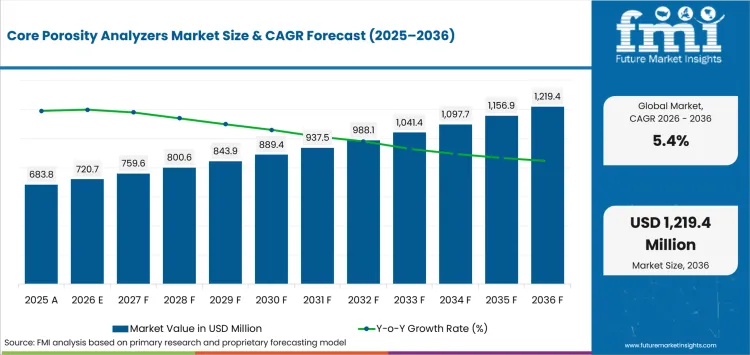
USD 720.7 million in 2026 and USD 1,219.4 million by 2036 at a 5.4% CAGR.
Demand in the core porosity analyzers market is valued at USD 720.7 million in 2026 and is projected to reach USD 1,219.4 million by 2036 at 5.4% CAGR. Core laboratories receive demand from projects that must convert recovered rock into pore-space evidence before reservoir or storage models are accepted. In July 2025, the USA Department of Energy listed core porosity and strength measurements among laboratory tasks for the Alaska Railbelt CCS project. Digital oilfield solutions can shorten interpretation cycles, but physical pore-volume evidence still anchors the laboratory data used to qualify subsurface models.
Country timing changes with appraisal stage, service access and the distance between drilling programs and qualified laboratories. Australia is pulling ahead of Norway in the profiled rates because offshore storage assessment is already generating drilling and sample-handling work. In July 2025, Australia's industry minister said 10 greenhouse-gas storage assessment permits had been granted in 2024 and INPEX drilled West Peron-1 and West Peron-2 to assess CO2 storage. That activity expands testing workloads, though long offshore logistics make carbon capture and storage projects depend on regional laboratory support.
Key Takeaways
- Reservoir appraisal and geological storage programs increase the need for traceable core measurements before development, injection or reservoir-model decisions are approved.
- By analyzer type, helium porosimeters are estimated to hold 31.0% in 2026 owing to gas expansion that calculates grain volume without consuming the plug.
- In 2026, conventional cores are expected to lead core type with 29.0% share because they preserve interval context before laboratories select plugs for repeat measurements.
- Effective porosity is likely to capture 31.0% share in 2026 attributable to connected pore space used with permeability, saturation and storage-capacity interpretation.
- Capital approval can slow where a new platform requires extra calibration work, unfamiliar gas handling, new holders or service coverage that does not match the laboratory schedule.
- Some of the key players in this market include Core Laboratories, Vinci Technologies, Coretest Systems, OFI Testing Equipment, DCI Test Systems, Geotek, Micromeritics, and Anton Paar.
Analyst Perspective
"Core porosity analyzers earn approval from how well they reproduce pore-volume results through a laboratory's existing plug sizes, pressure steps and calibration checks. Service response, raw-data access and holder flexibility determine whether higher throughput survives routine production work."
- Nikhil Kaitwade, Principal Consultant, Future Market Insights
How is the core porosity analyzers market segmented?
The core porosity analyzers market is segmented by analyzer type, core type, measurement, end use, sales channel and region.
Analyzer types include helium porosimeters, gas expansion porosimeters, mercury injection systems, digital core analyzers and automated core analysis systems. Core types include conventional cores, sidewall cores, plug samples, tight rock samples and carbonate cores. Measurements cover effective porosity, grain volume, pore volume, bulk volume and connected porosity. End uses include core analysis labs, E&P operators, universities / research and oilfield service companies. Sales channels cover core lab equipment OEMs, direct lab supply, scientific distributors and service/calibration providers, while regional analysis follows the standard FMI taxonomy.
What makes helium porosimeters central to the analyzer type category?
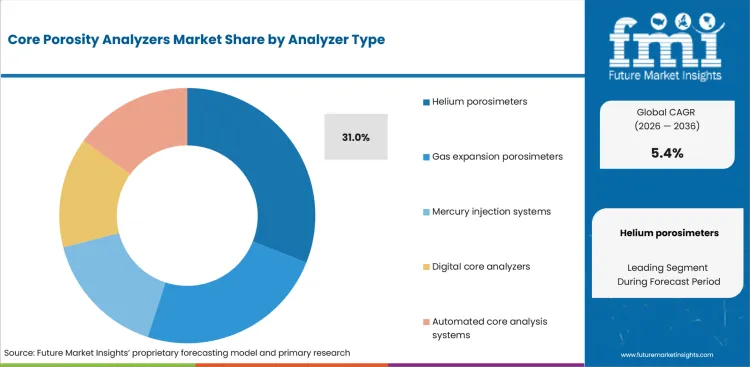
Helium porosimeters fit routine plug work because laboratories can measure grain volume without consuming the specimen. The same core can proceed to permeability or saturation testing after the volume measurement.
- Based on analyzer type, helium porosimeters are projected to account for 31.0% in 2026, owing to non-destructive grain-volume measurement and familiarity in routine rock-property workflows.
- The British Geological Survey updated a petrophysical dataset in December 2025 that calculates rock porosity from geometry and volume measured with a helium pycnometer. The published workflow gives laboratories a current helium-pycnometry reference beside natural gas analyzers used in technical laboratories.
Why do conventional cores lead the core type category?
Conventional cores preserve interval context before technicians cut plugs for individual measurements. Bedding, fractures and lithology remain visible, so laboratories can decide which specimens deserve repeat porosity or permeability work.
- By core type, conventional cores are estimated to hold 29.0% in 2026, given their flexibility for plug selection, repeat sampling and whole-core comparison.
- In March 2025, the USA Department of Energy documented the Red Hills storage study with stratigraphic drilling, well coring and laboratory experiments. That sequence keeps recovered rock central to commercial material testing instruments and porosity workflows used before storage models are accepted.
How does effective porosity influence selection within the measurement category?
Effective porosity focuses on connected void space that can contribute to fluid movement or storage. Reservoir teams compare it with permeability and saturation before using pore volume in producibility or storage-capacity decisions.
- In 2026, effective porosity is expected to lead measurement with 31.0% share, attributable to its direct use in movable-fluid and storage-capacity interpretation.
- The Canada Energy Regulator counted 11 CO2 storage facilities associated with projects under development in western Canada in January 2025. That project pool keeps connected pore-space measurement relevant to storage screening alongside oil and gas field services that already handle subsurface samples.
What supports core analysis labs in the end use category?
Core analysis labs centralize sample preparation, pressure hardware, calibration and reporting for projects that produce large plug queues. A validated platform earns its place if technicians can process several client programs without rebuilding the method for every batch.
- By end use, core analysis labs are forecast to represent 37.0% in 2026, driven by centralized instruments and repeatable procedures that raise sample throughput.
- In September 2025, the USA Department of Energy approved laboratory analysis for the Four Corners Carbon Storage Hub site-characterization program. Programs with repeated sample analysis place core laboratories close to industrial automation decisions where throughput and data traceability determine replacement timing.
What are the drivers, restraints and opportunities in the Core Porosity Analyzers Market?
Reservoir and storage appraisal enlarge the sample workload, while validation and service requirements slow some capital approvals, leaving automation as the clearest route to higher laboratory throughput.
- Driver: More characterization wells and laboratory sample programs increase demand for defensible porosity measurements before reservoir or storage decisions.
- Restraint: Calibration transfer, gas circuits, pressure control and service access can extend qualification before a laboratory accepts a replacement platform.
- Opportunity: Automated loading, controlled measurement sequences and digital reporting can reduce time per batch without weakening traceability.
More storage projects are moving from studies into physical characterization, which raises the number of rock samples that must be screened before investment decisions. In October 2025, the Global CCS Institute counted 77 operating projects, 47 under construction and 610 in development. The pipeline does not guarantee instrument orders, but it expands the pool of core work that can reach laboratories already serving oil and gas CCS programs.
Qualification slows if a new analyzer changes the measurement method or introduces pressure, gas or calibration conditions the laboratory has not validated. ASTM updated D4404 in June 2025 and notes that high-pressure mercury intrusion may alter pore geometry. That limitation makes method selection part of capital approval, especially where factory automation controls must preserve repeatable sequences without hiding method-specific error.
Automation has value where it removes manual repetition from a test sequence that already has a defined validation route. The USA Department of Energy's July 2025 Sweetwater Carbon Storage Hub determination includes stratigraphic wells, sampling and laboratory analysis. That sequence can produce enough sample volume for automated loading, industrial sensors and auditable calculations to reduce batch time without changing the approved method.
Which country CAGRs are profiled in the Core Porosity Analyzers Market?
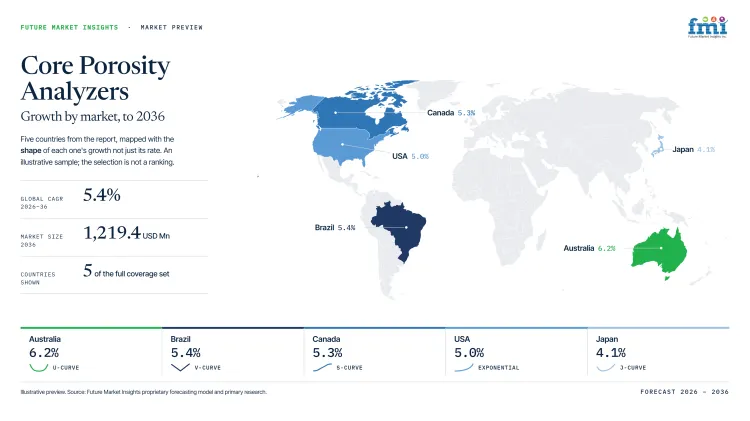
| Country | CAGR |
|---|---|
| Australia | 6.2% |
| Brazil | 5.4% |
| Canada | 5.3% |
| USA | 5.0% |
| Norway | 4.8% |
How do country-level CAGRs compare in the Core Porosity Analyzers Market?
The profiled CAGRs span 1.4 percentage points, from Australia's 6.2% to Norway's 4.8%. Brazil, Canada and USA form a narrow middle band between 5.0% and 5.4%. The spacing points mainly to local project timing, laboratory density and service economics, not a large difference in underlying measurement need.
- Australia's storage permits place porosity work near appraisal decisions.
- Brazil's drilling mix spreads laboratory demand beyond one basin schedule.
- Canada's storage buildout gives established laboratories another route beyond petroleum appraisal.
- USA storage hubs distribute characterization work among several basins.
- Norway's licensing concentrates qualification work among operators used to strict subsurface evidence.
Similar CAGRs produce different sales cycles as service access changes order timing. The full report provides country-level CAGR analysis across North America, Latin America, Western Europe, Eastern Europe, East Asia, South Asia and Pacific, and Middle East and Africa.
Country-wise Analysis
- Offshore northwest Australia concentrates storage appraisal in remote basins, and Geoscience Australia's August 2025 Barrow-Dampier study released 129 relevant well LAS files for petrophysical and rock-physics screening. Australia's core porosity analyzer demand is projected to grow at 6.2% CAGR through 2036, aided by storage programs that convert those subsurface datasets into targeted physical-core testing for porosity confirmation before storage models move into engineering review. Long travel distances and irregular drilling schedules favor manufacturers that stock spares within Australia and diagnose faults remotely, since a service visit arriving after a short offshore campaign loses much of its commercial value.
- Core laboratories near Rio de Janeiro and basin-service hubs handle new offshore and onshore samples locally, reducing export delays during active drilling programs. ANP's December 2025 update recorded 19 exploratory wells and a 90% year-on-year increase in wells started during exploration, a level that gives domestic laboratories a larger stream of fresh material to characterize and keeps routine porosity equipment close to campaign schedules. Core porosity analyzer demand in Brazil is forecast to rise at 5.4% CAGR over the assessment period, tied to renewed drilling, though campaign gaps can leave capacity underused and make scalable maintenance contracts more practical than support models built for constant utilization.
- Western Canada's mature reservoir laboratories already operate validated core-analysis methods, and Natural Resources Canada's July 2025 Bow Valley project page states that 33% of Alberta CCS hub proponents plan to use carbonate formations. Canada's core porosity analyzers market is anticipated to advance at 5.3% CAGR during the forecast period, supported by storage programs that can reuse petrophysical skills developed for conventional reservoirs without changing long-standing sample preparation and reporting steps. A large installed base limits wholesale replacement, so modular hardware, traceable calibration and local service response carry more weight than broad platform changes for laboratories protecting validated procedures.
- USA demand is divided among commercial laboratories, operators, universities and storage programs, so national purchasing does not follow one project calendar. DOE's July 2025 Magnolia Sequestration determination includes drilling, material testing, site modeling and geophysical surveys within storage-complex characterization, which sends several evidence streams into the same subsurface decision. USA may progress at 5.0% CAGR through 2036 because existing core laboratories can absorb new sample programs without rebuilding every testing function and can reuse existing training and calibration records, although separate state and project schedules fragment orders and favor platforms that preserve validated calculations with multi-location service coverage.
- Storage appraisal follows a tight sequence of well data, reservoir samples and injectivity testing, and the Norwegian Offshore Directorate said in May 2025 that Equinor completed four injection tests in each Smeaheia appraisal well. Norway is likely to register 4.8% CAGR during the forecast period, given mature offshore petrophysical expertise and a high evidence threshold that supports high-specification instruments for storage qualification in appraisal wells that produce narrow but technically demanding sample programs. The concentrated project base limits simultaneous laboratory campaigns, so replacement timing and specialist technical support carry more commercial weight than broad distributor coverage for suppliers serving Norwegian operators.
Who are the notable companies in the Core Porosity Analyzers Market?
Core Laboratories, Vinci Technologies, Coretest Systems, OFI Testing Equipment, DCI Test Systems, Geotek, Micromeritics, and Anton Paar are the notable companies serving this market.
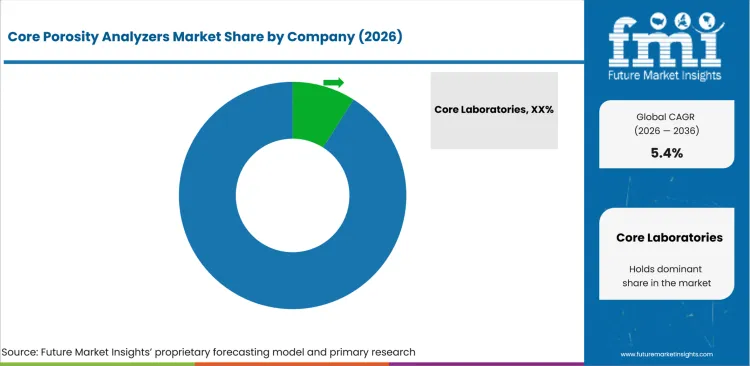
Competition divides among routine-core instrument makers, core-scanning specialists and broader porous-material platforms. Entry barriers come from method fit, holder geometry, software calculations, calibration records and service access. Dedicated vendors lead routine porosity, while Geotek, Micromeritics and Anton Paar compete where laboratories pair core work with imaging or lab automation.
- Core Laboratories, Vinci Technologies, Coretest Systems, OFI Testing Equipment and DCI Test Systems sell dedicated or closely integrated routine core-analysis equipment.
- Geotek focuses on non-destructive petrophysical core scanning. Micromeritics and Anton Paar address porous-material, density and complementary characterization workflows.
Competitive Benchmarking: Core Porosity Analyzers Market
| Company | Core-sample porosity fit | Automation and data workflow | Qualification and service support | Geographic Reach |
|---|---|---|---|---|
| Core Laboratories | High | High | High | Global petroleum and CCS markets |
| Vinci Technologies | High | High | High | Europe with international project sales |
| Coretest Systems | High | High | Medium | International project-based supply |
| OFI Testing Equipment | High | High | High | USA base with worldwide oilfield distribution |
| DCI Test Systems | High | Medium | Medium | North America with international installations |
| Geotek | Medium | High | High | Europe, Americas and global geoscience programs |
| Micromeritics | Medium | High | High | Global materials-characterization network |
| Anton Paar | Medium | High | High | Global laboratory sales and service network |
Scoring basis: High core-sample porosity fit requires a dedicated porosimeter or routine-core workflow. Medium covers geological or porous-material measurement with porosity as one function, while Low is limited to adjacent characterization. High automation requires automated control, calculation and integrated data capture. Medium indicates partial automation, while Low indicates mostly manual operation. High qualification and service support requires documented calibration or broad technical coverage. Medium indicates narrower verified support, while Low indicates limited verified coverage.
Key Developments in the Core Porosity Analyzers Market
- In May 2025, Core Laboratories opened an unconventional core analysis laboratory in Dammam with Abdulla Fouad Group, adding regional core and fluid analysis capacity for Saudi unconventional reservoirs.
- In February 2025, Micromeritics entered a technical collaboration with Fraunhofer ICT and placed a 3Flex adsorption analyzer in its Advanced Electrochemistry Lab for materials characterization and training.
- In January 2025, Anton Paar opened its APAC Technical Center in Kuala Lumpur with a 400 m² laboratory showroom and training rooms for at least 50 people.
Key Players in the Core Porosity Analyzers Market
Dedicated routine core-analysis platforms
- Core Laboratories
- Vinci Technologies
- Coretest Systems
- OFI Testing Equipment
- DCI Test Systems
Digital and non-destructive core characterization
- Geotek
Broader porous-material and density characterization
- Micromeritics
- Anton Paar
Core Porosity Analyzers Market - Report Scope
| Coverage field | Report scope |
|---|---|
| Market breakdown | By analyzer type, core type, measurement, end use, sales channel and region. |
| Quantitative Units | USD million. |
| Market Definition | Revenue includes instruments and integrated systems measuring porosity and related grain, pore or bulk-volume parameters on geological core samples. Stand-alone services, permeability-only systems, unrelated material analyzers and downstream reservoir-engineering revenue are excluded. |
| Regions Covered | North America, Latin America, Western Europe, Eastern Europe, East Asia, South Asia and Pacific, and Middle East and Africa. |
| Countries Covered | Australia, Brazil, Canada, USA, Norway, and 20+ countries included in the full report. |
| Key Companies Profiled | Core Laboratories, Vinci Technologies, Coretest Systems, OFI Testing Equipment, DCI Test Systems, Geotek, Micromeritics, and Anton Paar. |
| Forecast Period | Base 2026 to 2036. |
| Approach | Primary and secondary research with market triangulation. |
Core Porosity Analyzers Market - Research Methodology
| Method | Approach |
|---|---|
| Primary Research | FMI analysts gathered input from manufacturers, service providers, technology developers, distributors, end users, procurement teams, and subject-matter experts. Interviews examined purchasing decisions, product or service evaluation, adoption barriers, approval requirements, pricing considerations, and expectations for technical or commercial support. Respondents were also asked what evidence is required before a trial, pilot, or initial order develops into regular purchasing. |
| Desk Research | Desk research covered government statistics, regulatory publications, trade data, industry associations, technical literature, standards, company filings, product information, and official corporate announcements. Sources were reviewed for relevance, publication date, geographic coverage, and consistency with the defined market scope. Claims relating to performance, applications, approvals, capacity, investment, and commercial activity were retained only when supported by credible public evidence. |
| Market Sizing and Forecasting | The market model combined the baseline value with historical performance, segment structure, pricing and volume indicators, adoption levels, company participation, and country-level demand conditions. Forecast assumptions considered economic activity, investment trends, regulatory developments, technology adoption, purchasing cycles, supply availability, and barriers to wider market use. Segment and regional estimates were reconciled before the final market total was calculated. |
| Data Validation | Estimates were checked against multiple independent indicators, including public data, company activity, trade patterns, industry developments, and findings from primary interviews. Validation also tested whether products, services, applications, and company revenues fell within the defined market boundaries. Adjacent categories, unsupported claims, overlapping revenues, and activities without direct market relevance were excluded to reduce double counting and maintain consistency across segments and countries. |
Core Porosity Analyzers Market by Segments
Core Porosity Analyzers Market segmented by Analyzer Type:
- Helium porosimeters
- Gas expansion porosimeters
- Mercury injection systems
- Digital core analyzers
- Automated core analysis systems
Core Porosity Analyzers Market segmented by Core Type:
- Conventional cores
- Sidewall cores
- Plug samples
- Tight rock samples
- Carbonate cores
Core Porosity Analyzers Market segmented by Measurement:
- Effective porosity
- Grain volume
- Pore volume
- Bulk volume
- Connected porosity
Core Porosity Analyzers Market segmented by End Use:
- Core analysis labs
- E&P operators
- Universities / research
- Oilfield service companies
Core Porosity Analyzers Market segmented by Sales Channel:
- Core lab equipment OEMs
- Direct lab supply
- Scientific distributors
- Service/calibration providers
Core Porosity Analyzers Market by Region:
- North America
- United States
- Canada
- Latin America
- Brazil
- Mexico
- Argentina
- Chile
- Western Europe
- Germany
- France
- United Kingdom
- Italy
- Spain
- Benelux
- Nordics
- Eastern Europe
- Poland
- Czech Republic
- Romania
- Hungary
- East Asia
- China
- Japan
- South Korea
- South Asia and Pacific
- India
- ASEAN
- Australia and New Zealand
- Middle East and Africa
- GCC Countries
- South Africa
- Türkiye
- Israel
Research Sources and Bibliography
- USA Department of Energy, Office of NEPA Policy and Compliance. (2025, July 22). CX-034311: Alaska Railbelt Carbon Capture and Storage (ARCCS) Project
- Australian Government, Department of Industry, Science and Resources. (2025, July 30). Speech at the Low Emission Technology Australia CCUS report launch
- British Geological Survey. (2025, December 17). Petrophysical characteristics of andesitic samples
- USA Department of Energy, Office of NEPA Policy and Compliance. (2025, March 13). CX-033437: Red Hills CO2 Storage Hub Feasibility Study
- Canada Energy Regulator. (2025, January 7). Market Snapshot: Where and how is carbon dioxide stored in Canada?
- USA Department of Energy, Office of NEPA Policy and Compliance. (2025, September 15). CX-034674: Four Corners Carbon Storage Hub: CarbonSAFE Phase III Project
- Global CCS Institute. (2025, October 9). Carbon Capture Stays the Course Despite Global Headwinds, with 54% Rise in Operational Projects
- ASTM International. (2025, June 20). D4404-25 Standard Test Method for Determination of Pore Volume and Pore Volume Distribution of Soil and Rock by Mercury Intrusion Porosimetry
- USA Department of Energy, Office of NEPA Policy and Compliance. (2025, July 24). CX-034317: Sweetwater Carbon Storage Hub
- Geoscience Australia. (2025, August 20). Barrow-Dampier CCS regional study
- Agência Nacional do Petróleo, Gás Natural e Biocombustíveis. (2025, December 19). Número de blocos sob contrato cresce em 2025 e é o maior pelo segundo ano consecutivo
- Natural Resources Canada. (2025, July 9). Bow Valley Carbon Storage Demonstration Project
- USA Department of Energy, Office of NEPA Policy and Compliance. (2025, July 14). CX-034306: Magnolia Sequestration Project
- Norwegian Offshore Directorate. (2025, May 14). The wells 32/7-1 and 32/4-4 proved suitable properties for injection and storage of CO2
- Core Laboratories. (2025, May 7). Core Laboratories announces opening of unconventional core analysis laboratory in Saudi Arabia
- Micromeritics. (2025, February 24). Micromeritics and Fraunhofer ICT announce advanced electrochemistry collaboration
- Anton Paar. (2025, February 11). New APAC Technical Center Opened
- Core Laboratories Inc.. (2026, March 23). 2025 Form 10-K
- Vinci Technologies. (n.d.). About us Retrieved September 1, 2026.
- Coretest Systems. (n.d.). About Coretest Retrieved September 1, 2026.
- OFI Testing Equipment. (n.d.). About us Retrieved September 1, 2026.
- DCI Test Systems. (n.d.). DCI Test Systems Retrieved September 1, 2026.
- Geotek Ltd.. (n.d.). About us Retrieved September 1, 2026.
- Micromeritics. (n.d.). About us Retrieved September 1, 2026.
- Anton Paar. (n.d.). Company Retrieved September 1, 2026.
- Core Laboratories. (2025, October 29). Core Laboratories reports third quarter 2025 results
- Bruker Corporation. (2025, February 27). Bruker Launches X4 POSEIDON Advanced X-Ray Microscope for Three-Dimensional Microscopy in Industrial and Scientific Applications
- ZEISS Research Microscopy Solutions. (2025, March 31). ZEN core now available for all ZEISS scanning electron microscopes
- Anton Paar. (2025, August 20). New Anton Paar ProveTec Building Officially Opened
- Halliburton. (2026, May 18). Halliburton launches Xaminer Deep Testing logging service
- Core Laboratories. (2026, June 4). Core in Action: Supporting Carbon Capture and Storage Projects in Brazil with NITRO
- Anton Paar. (2025, March 31). Anton Paar Density Meters: New Glass U-Tube Production and Improved Calibration
- IFP Energies nouvelles. (2026, February 2). Natural hydrogen: IFPEN and Vinci Technologies launch a consortium
- Coretest Systems. (2026, July). AP-608 Neo Automated Gas Permeameter and Porosimeter
- OFI Testing Equipment. (2026, April 24). New Advances in Spacer Wettability Testing
- Judges Scientific plc. (2026, April 22). Annual report and accounts 2025
- Spectris plc. (2025, August 7). Spectris plc - 2025 half year results
This bibliography is provided for reader reference and is not exhaustive. The full report contains the complete reference list and detailed citations
This Report Answers
- How large is the core porosity analyzers market in 2026 and 2036?
- Which operating conditions increase demand for porosity measurement on geological cores?
- Why do helium porosimeters retain the largest analyzer-type share in 2026?
- How do conventional cores and effective porosity influence laboratory equipment selection?
- What slows qualification of a new core porosity analyzer inside an established laboratory?
- Which profiled countries show the highest forecast growth through 2036?
- How do dedicated core-equipment companies differ from broader characterization platforms?
- Which recent company actions affect laboratory capacity and technical service?
- What should laboratories compare before approving an automated porosity platform?
Frequently Asked Questions
How big is the core porosity analyzers market in 2026?
The core porosity analyzers market is valued at USD 720.7 million in 2026 and is projected to reach USD 1,219.4 million by 2036. Growth follows reservoir appraisal and geological-storage programs that require physical core measurements before development decisions.
What is the CAGR of the core porosity analyzers market from 2026 to 2036?
The core porosity analyzers market is projected to grow at a CAGR of 5.4% between 2026 and 2036. Reservoir characterization, storage-site appraisal and replacement purchases increase spending where installed laboratory systems limit throughput or traceability.
Which analyzer type leads the core porosity analyzers market?
The helium porosimeters segment is expected to hold 31.0% of the core porosity analyzers market in 2026, attributable to non-destructive grain-volume measurement. Laboratories can retain the same core plug for later permeability or saturation testing.
Which core type leads the core porosity analyzers market?
The conventional cores segment is estimated to hold 29.0% of the core porosity analyzers market in 2026, driven by preserved interval context before plug selection. Laboratories can select repeat-test specimens while keeping bedding, fractures and lithology tied to the recovered interval.
How much value will the core porosity analyzers market add between 2026 and 2036?
The core porosity analyzers market is expected to add USD 498.7 million in value between 2026 and 2036. The increase follows more reservoir and storage-characterization work plus replacement demand for laboratory platforms that can handle larger sample queues.
Which countries are projected to record the highest growth in the core porosity analyzers market?
Australia is projected to grow at 6.2% CAGR, followed by Brazil at 5.4% and Canada at 5.3% through 2036. Their growth routes differ through offshore storage appraisal, renewed exploration drilling and carbonate-focused CCS programs.
Which companies are active in the core porosity analyzers market?
Key companies operating in the market include Core Laboratories, Vinci Technologies, Coretest Systems, OFI Testing Equipment, DCI Test Systems, Geotek, Micromeritics, and Anton Paar. Their positions differ by core-method coverage, automation, calibration support and service reach.
Preview the report firsthand - request a free sample
Get SampleGet the brochure for pricing and purchase details.
Get PDFTable of Content
- Key Takeaways
- Market Size and CAGR
- Top Growth Driver
- Fastest Growing Segment
- Leading Region
- Key Companies
- Emerging Opportunities
- Executive Summary
- Global Market Outlook
- Demand-side Trends
- Supply-side Trends
- Technology Roadmap Analysis
- Analysis and Recommendations
- Analyst Perspective (What is happening? Why now? What should investors know?)
- Key Questions Answered
- How large is the market?
- What is the CAGR?
- What are key trends?
- Which region dominates?
- Who are the leaders?
- Market Overview
- Market Coverage / Taxonomy
- Market Definition / Scope / Limitations
- Research Methodology
- Chapter Orientation
- Analytical Lens and Working Hypotheses
- Market Structure, Signals, and Trend Drivers
- Benchmarking and Cross-market Comparability
- Market Sizing, Forecasting, and Opportunity Mapping
- Research Design and Evidence Framework
- Desk Research Programme (Secondary Evidence)
- Expert Input and Fieldwork (Primary Evidence)
- Tooling, Models, and Reference Databases
- Data Engineering and Model Build
- Quality Assurance and Audit Trail
- Market Background
- Market Dynamics (Drivers, Restraints, Opportunity, Trends)
- Scenario Forecast (Optimistic, Likely, Conservative)
- Impact Analysis
- AI Impact
- Sustainability Impact
- Regulatory Impact
- Technology Impact
- Consumer / Buyer Analysis
- Purchase Drivers
- Adoption Barriers
- Buyer Journey
- Opportunity Map Analysis
- Product Life Cycle Analysis
- Supply Chain Analysis
- Investment Feasibility Matrix
- Value Chain Analysis
- PESTLE and Porter's Analysis
- Regulatory Landscape
- Regional Parent Market Outlook
- Production and Consumption Statistics
- Import and Export Statistics
- Global Market Analysis and Forecast, 2021 to 2036
- Historical Market Size Value (USD Million) Analysis, 2021 to 2025
- Current and Future Market Size Value (USD Million) Projections, 2026 to 2036
- Y-o-Y Growth Trend Analysis
- Absolute $ Opportunity Analysis
- Global Market Pricing Analysis, 2021 to 2036
- Global Market Analysis and Forecast, By Analyzer Type, 2021 to 2036
- Introduction / Key Findings
- Historical Market Size Value (USD Million) Analysis By Analyzer Type, 2021 to 2025
- Current and Future Market Size Value (USD Million) Analysis and Forecast By Analyzer Type, 2026 to 2036
- Helium porosimeters
- Gas expansion porosimeters
- Mercury injection systems
- Digital core analyzers
- Automated core analysis systems
- Helium porosimeters
- Y-o-Y Growth Trend Analysis By Analyzer Type, 2021 to 2025
- Absolute $ Opportunity Analysis By Analyzer Type, 2026 to 2036
- Global Market Analysis and Forecast, By Core Type, 2021 to 2036
- Introduction / Key Findings
- Historical Market Size Value (USD Million) Analysis By Core Type, 2021 to 2025
- Current and Future Market Size Value (USD Million) Analysis and Forecast By Core Type, 2026 to 2036
- Conventional cores
- Sidewall cores
- Plug samples
- Tight rock samples
- Carbonate cores
- Conventional cores
- Y-o-Y Growth Trend Analysis By Core Type, 2021 to 2025
- Absolute $ Opportunity Analysis By Core Type, 2026 to 2036
- Global Market Analysis and Forecast, By Measurement, 2021 to 2036
- Introduction / Key Findings
- Historical Market Size Value (USD Million) Analysis By Measurement, 2021 to 2025
- Current and Future Market Size Value (USD Million) Analysis and Forecast By Measurement, 2026 to 2036
- Effective porosity
- Grain volume
- Pore volume
- Bulk volume
- Connected porosity
- Effective porosity
- Y-o-Y Growth Trend Analysis By Measurement, 2021 to 2025
- Absolute $ Opportunity Analysis By Measurement, 2026 to 2036
- Global Market Analysis and Forecast, By End Use, 2021 to 2036
- Introduction / Key Findings
- Historical Market Size Value (USD Million) Analysis By End Use, 2021 to 2025
- Current and Future Market Size Value (USD Million) Analysis and Forecast By End Use, 2026 to 2036
- Core analysis labs
- E&P operators
- Universities / research
- Oilfield service companies
- Core analysis labs
- Y-o-Y Growth Trend Analysis By End Use, 2021 to 2025
- Absolute $ Opportunity Analysis By End Use, 2026 to 2036
- Global Market Analysis and Forecast, By Sales Channel, 2021 to 2036
- Introduction / Key Findings
- Historical Market Size Value (USD Million) Analysis By Sales Channel, 2021 to 2025
- Current and Future Market Size Value (USD Million) Analysis and Forecast By Sales Channel, 2026 to 2036
- Core lab equipment OEMs
- Direct lab supply
- Scientific distributors
- Service/calibration providers
- Core lab equipment OEMs
- Y-o-Y Growth Trend Analysis By Sales Channel, 2021 to 2025
- Absolute $ Opportunity Analysis By Sales Channel, 2026 to 2036
- Global Market Analysis and Forecast, By Region, 2021 to 2036
- Introduction
- Historical Market Size Value (USD Million) Analysis By Region, 2021 to 2025
- Current Market Size Value (USD Million) Analysis and Forecast By Region, 2026 to 2036
- North America
- Latin America
- Western Europe
- Eastern Europe
- East Asia
- South Asia and Pacific
- Middle East & Africa
- Market Attractiveness Analysis By Region
- North America Market Analysis and Forecast, By Country, 2021 to 2036
- Historical Market Size Value (USD Million) Trend Analysis By Market Taxonomy, 2021 to 2025
- Market Size Value (USD Million) Forecast By Market Taxonomy, 2026 to 2036
- By Country
- USA
- Canada
- By Analyzer Type
- By Core Type
- By Measurement
- By End Use
- By Sales Channel
- By Country
- Market Attractiveness Analysis
- By Country
- By Analyzer Type
- By Core Type
- By Measurement
- By End Use
- By Sales Channel
- Key Takeaways
- Latin America Market Analysis and Forecast, By Country
- Historical Market Size Value (USD Million) Trend Analysis By Market Taxonomy, 2021 to 2025
- Market Size Value (USD Million) Forecast By Market Taxonomy, 2026 to 2036
- By Country
- Brazil
- Mexico
- Chile
- Rest of Latin America
- By Analyzer Type
- By Core Type
- By Measurement
- By End Use
- By Sales Channel
- By Country
- Market Attractiveness Analysis
- By Country
- By Analyzer Type
- By Core Type
- By Measurement
- By End Use
- By Sales Channel
- Key Takeaways
- Western Europe Market Analysis and Forecast, By Country
- Historical Market Size Value (USD Million) Trend Analysis By Market Taxonomy, 2021 to 2025
- Market Size Value (USD Million) Forecast By Market Taxonomy, 2026 to 2036
- By Country
- Germany
- UK
- Italy
- Spain
- France
- Nordic
- BENELUX
- Rest of Western Europe
- By Analyzer Type
- By Core Type
- By Measurement
- By End Use
- By Sales Channel
- By Country
- Market Attractiveness Analysis
- By Country
- By Analyzer Type
- By Core Type
- By Measurement
- By End Use
- By Sales Channel
- Key Takeaways
- Eastern Europe Market Analysis and Forecast, By Country
- Historical Market Size Value (USD Million) Trend Analysis By Market Taxonomy, 2021 to 2025
- Market Size Value (USD Million) Forecast By Market Taxonomy, 2026 to 2036
- By Country
- Russia
- Poland
- Hungary
- Balkan & Baltic
- Rest of Eastern Europe
- By Analyzer Type
- By Core Type
- By Measurement
- By End Use
- By Sales Channel
- By Country
- Market Attractiveness Analysis
- By Country
- By Analyzer Type
- By Core Type
- By Measurement
- By End Use
- By Sales Channel
- Key Takeaways
- East Asia Market Analysis and Forecast, By Country
- Historical Market Size Value (USD Million) Trend Analysis By Market Taxonomy, 2021 to 2025
- Market Size Value (USD Million) Forecast By Market Taxonomy, 2026 to 2036
- By Country
- China
- Japan
- South Korea
- By Analyzer Type
- By Core Type
- By Measurement
- By End Use
- By Sales Channel
- By Country
- Market Attractiveness Analysis
- By Country
- By Analyzer Type
- By Core Type
- By Measurement
- By End Use
- By Sales Channel
- Key Takeaways
- South Asia and Pacific Market Analysis and Forecast, By Country
- Historical Market Size Value (USD Million) Trend Analysis By Market Taxonomy, 2021 to 2025
- Market Size Value (USD Million) Forecast By Market Taxonomy, 2026 to 2036
- By Country
- India
- ASEAN
- Australia & New Zealand
- Rest of South Asia and Pacific
- By Analyzer Type
- By Core Type
- By Measurement
- By End Use
- By Sales Channel
- By Country
- Market Attractiveness Analysis
- By Country
- By Analyzer Type
- By Core Type
- By Measurement
- By End Use
- By Sales Channel
- Key Takeaways
- Middle East & Africa Market Analysis and Forecast, By Country
- Historical Market Size Value (USD Million) Trend Analysis By Market Taxonomy, 2021 to 2025
- Market Size Value (USD Million) Forecast By Market Taxonomy, 2026 to 2036
- By Country
- Kingdom of Saudi Arabia
- Other GCC Countries
- Türkiye
- South Africa
- Other African Union
- Rest of Middle East & Africa
- By Analyzer Type
- By Core Type
- By Measurement
- By End Use
- By Sales Channel
- By Country
- Market Attractiveness Analysis
- By Country
- By Analyzer Type
- By Core Type
- By Measurement
- By End Use
- By Sales Channel
- Key Takeaways
- Key Countries Market Analysis
- USA
- Pricing Analysis
- Market Share Analysis, 2025
- By Analyzer Type
- By Core Type
- By Measurement
- By End Use
- By Sales Channel
- Canada
- Pricing Analysis
- Market Share Analysis, 2025
- By Analyzer Type
- By Core Type
- By Measurement
- By End Use
- By Sales Channel
- Mexico
- Pricing Analysis
- Market Share Analysis, 2025
- By Analyzer Type
- By Core Type
- By Measurement
- By End Use
- By Sales Channel
- Brazil
- Pricing Analysis
- Market Share Analysis, 2025
- By Analyzer Type
- By Core Type
- By Measurement
- By End Use
- By Sales Channel
- Chile
- Pricing Analysis
- Market Share Analysis, 2025
- By Analyzer Type
- By Core Type
- By Measurement
- By End Use
- By Sales Channel
- Germany
- Pricing Analysis
- Market Share Analysis, 2025
- By Analyzer Type
- By Core Type
- By Measurement
- By End Use
- By Sales Channel
- UK
- Pricing Analysis
- Market Share Analysis, 2025
- By Analyzer Type
- By Core Type
- By Measurement
- By End Use
- By Sales Channel
- Italy
- Pricing Analysis
- Market Share Analysis, 2025
- By Analyzer Type
- By Core Type
- By Measurement
- By End Use
- By Sales Channel
- Spain
- Pricing Analysis
- Market Share Analysis, 2025
- By Analyzer Type
- By Core Type
- By Measurement
- By End Use
- By Sales Channel
- France
- Pricing Analysis
- Market Share Analysis, 2025
- By Analyzer Type
- By Core Type
- By Measurement
- By End Use
- By Sales Channel
- India
- Pricing Analysis
- Market Share Analysis, 2025
- By Analyzer Type
- By Core Type
- By Measurement
- By End Use
- By Sales Channel
- ASEAN
- Pricing Analysis
- Market Share Analysis, 2025
- By Analyzer Type
- By Core Type
- By Measurement
- By End Use
- By Sales Channel
- Australia & New Zealand
- Pricing Analysis
- Market Share Analysis, 2025
- By Analyzer Type
- By Core Type
- By Measurement
- By End Use
- By Sales Channel
- China
- Pricing Analysis
- Market Share Analysis, 2025
- By Analyzer Type
- By Core Type
- By Measurement
- By End Use
- By Sales Channel
- Japan
- Pricing Analysis
- Market Share Analysis, 2025
- By Analyzer Type
- By Core Type
- By Measurement
- By End Use
- By Sales Channel
- South Korea
- Pricing Analysis
- Market Share Analysis, 2025
- By Analyzer Type
- By Core Type
- By Measurement
- By End Use
- By Sales Channel
- Russia
- Pricing Analysis
- Market Share Analysis, 2025
- By Analyzer Type
- By Core Type
- By Measurement
- By End Use
- By Sales Channel
- Poland
- Pricing Analysis
- Market Share Analysis, 2025
- By Analyzer Type
- By Core Type
- By Measurement
- By End Use
- By Sales Channel
- Hungary
- Pricing Analysis
- Market Share Analysis, 2025
- By Analyzer Type
- By Core Type
- By Measurement
- By End Use
- By Sales Channel
- Kingdom of Saudi Arabia
- Pricing Analysis
- Market Share Analysis, 2025
- By Analyzer Type
- By Core Type
- By Measurement
- By End Use
- By Sales Channel
- Türkiye
- Pricing Analysis
- Market Share Analysis, 2025
- By Analyzer Type
- By Core Type
- By Measurement
- By End Use
- By Sales Channel
- South Africa
- Pricing Analysis
- Market Share Analysis, 2025
- By Analyzer Type
- By Core Type
- By Measurement
- By End Use
- By Sales Channel
- USA
- Market Structure Analysis
- Competition Dashboard
- Competition Benchmarking
- Market Share Analysis of Top Players
- By Regional
- By Analyzer Type
- By Core Type
- By Measurement
- By End Use
- By Sales Channel
- Emerging Startups
- Innovation Benchmarking
- Competition Analysis
- Competition Deep Dive
- Core Laboratories
- Overview
- Product Portfolio
- Profitability by Market Segments
- Sales Footprint
- Strategy Overview
- Marketing Strategy
- Product Strategy
- Channel Strategy
- Vinci Technologies
- Coretest Systems
- POROPERM / Vinci
- Geotek
- PetroLab Engineering
- Micromeritics
- Anton Paar
- Chandler Engineering
- OFI Testing Equipment
- Core Laboratories
- Case Studies
- Success Stories
- Recent Developments
- Competition Deep Dive
- Assumptions & Acronyms Used


