

- Industry Size (2025)
- USD 1.2 Bn
- Forecast (2035)
- USD 1.7 Bn
- CAGR (2025 to 2035)
- 3.3%
Counterfeit Drug Detection Device Market Overview for 2025 to 2035
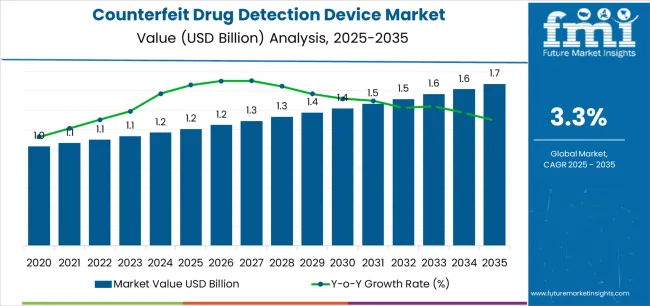
The counterfeit drug detection device market is experiencing robust expansion. Increasing global incidence of counterfeit pharmaceuticals, stringent regulatory frameworks, and rising emphasis on patient safety are major factors driving market growth. Current dynamics highlight the need for rapid, accurate, and portable detection systems that can ensure drug authenticity across complex supply chains.
Continuous advancements in spectroscopic, chromatographic, and imaging technologies are enhancing detection precision and operational reliability. Market participants are focusing on integrating AI-driven analytics and real-time data processing to improve field-level usability and compliance tracking.
The future outlook remains positive as government agencies and healthcare organizations intensify efforts to combat drug counterfeiting through advanced verification solutions Growth rationale is centered on the widespread adoption of compact and high-accuracy detection devices, increasing collaboration between manufacturers and pharmaceutical regulators, and the evolution of technology standards that promote transparency and traceability across global pharmaceutical distribution networks.
Quick Stats for Counterfeit Drug Detection Device Market
- Counterfeit Drug Detection Device Market Industry Value (2025): USD 1.2 billion
- Counterfeit Drug Detection Device Market Forecast Value (2035): USD 1.7 billion
- Counterfeit Drug Detection Device Market Forecast CAGR: 3.3%
- Leading Segment in Counterfeit Drug Detection Device Market in 2025: Counterfeit Chemical Composition Detection Devices (33.7%)
- Key Growth Region in Counterfeit Drug Detection Device Market: North America, Asia-Pacific, Europe
- Top Key Players in Counterfeit Drug Detection Device Market: Thermo Fisher Scientific, Inc, Spectris, Spectral Engines Oy, Consumer Physics, Olympus Corporation, Stratio, Inc., Rigaku Corporation, GAO RFID, Cellular Bioengineering, Inc, Metrohm AG
| Metric | Value |
|---|---|
| Counterfeit Drug Detection Device Market Estimated Value in (2025 E) | USD 1.2 billion |
| Counterfeit Drug Detection Device Market Forecast Value in (2035 F) | USD 1.7 billion |
| Forecast CAGR (2025 to 2035) | 3.3% |
Segmental Analysis
The market is segmented by Product, Modality, and End User and region. By Product, the market is divided into Counterfeit Chemical Composition Detection Devices and Counterfeit Packaging & Labelling Detection Devices. In terms of Modality, the market is classified into Portable Devices, Hand-Held Devices, and Bench-Top Devices. Based on End User, the market is segmented into Pharmaceutical Companies, Drug Testing Laboratories, and Research Organization. Regionally, the market is classified into North America, Latin America, Western Europe, Eastern Europe, Balkan & Baltic Countries, Russia & Belarus, Central Asia, East Asia, South Asia & Pacific, and the Middle East & Africa.
Insights into the Product Segment
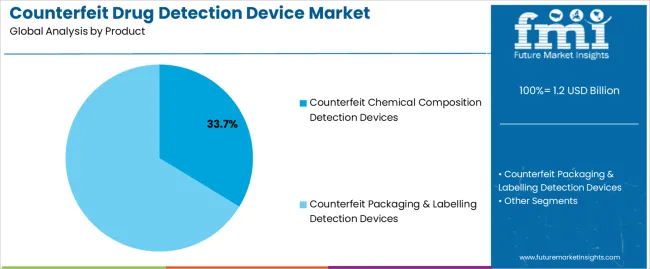
The counterfeit chemical composition detection devices segment, accounting for 33.70% of the product category, has maintained its dominance due to its superior analytical capability in identifying counterfeit formulations through molecular and chemical profiling. The segment’s demand has been reinforced by its high detection accuracy and ability to differentiate authentic products from fraudulent ones.
Increased adoption across quality control laboratories and regulatory enforcement agencies has contributed to steady market penetration. Continuous improvements in sensor technology and miniaturization have enhanced device portability and precision.
Regulatory mandates requiring chemical verification of pharmaceuticals have further elevated segment relevance Ongoing R&D investment in spectroscopy-based identification and integration of cloud-enabled analysis platforms is expected to strengthen this segment’s position and support its sustained contribution to overall market growth.
Insights into the Modality Segment
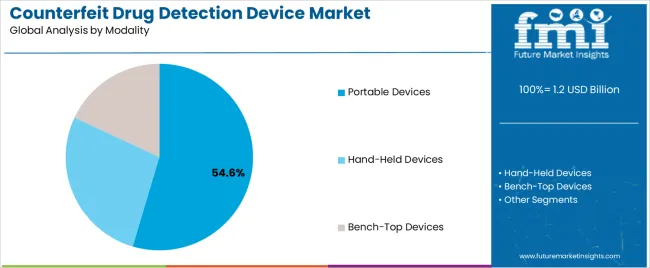
The portable devices segment, holding 54.60% of the modality category, has emerged as the leading mode of deployment owing to its convenience, flexibility, and rapid detection capabilities. Field operability and real-time analysis have made portable systems essential for on-site drug verification across supply chains.
Lightweight design, ease of use, and compatibility with digital monitoring interfaces have enhanced adoption among regulatory bodies and law enforcement agencies. Increasing demand for mobility in pharmaceutical inspections and remote testing environments has further reinforced the segment’s growth.
Manufacturers are focusing on battery efficiency, wireless data transfer, and automated result generation to improve accuracy and user experience Continuous technological innovation and expanding use in resource-constrained regions are expected to maintain the segment’s leading share throughout the forecast period.
Insights into the End User Segment
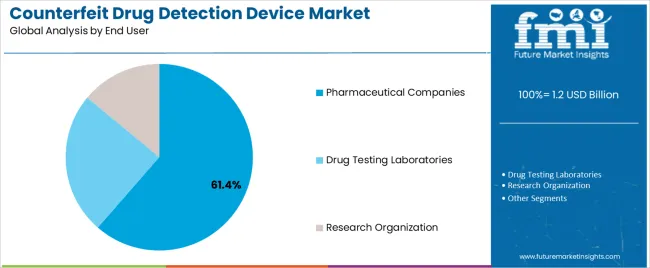
The pharmaceutical companies segment, representing 61.40% of the end user category, has sustained leadership due to its proactive role in safeguarding brand integrity and ensuring product authenticity across distribution channels. Adoption of counterfeit detection devices within pharmaceutical manufacturing and logistics operations has been driven by compliance obligations and the economic impact of counterfeit products.
Integration of advanced detection systems within production and packaging lines has enhanced security measures and traceability. Collaboration between manufacturers, regulatory bodies, and technology providers has accelerated the deployment of high-performance devices for routine quality verification.
The segment’s growth is further supported by corporate initiatives toward sustainable supply chain transparency and digital authentication frameworks Continued investment in device standardization and data integration platforms is expected to reinforce its dominant position and drive market expansion globally.
Counterfeit Drug Detection Device Market Forecast
- Growing concern over the risk of counterfeit drugs causing significant health defects is fueling the drug detection device market.
- Technological innovation in counterfeit drug detection devices, such as holographic duplication, is advancing the demand in the market.
- Increasing budgets of narcotics divisions of police is leading to greater adoption of counterfeit drug detection devices.
- Artificial intelligence is being deployed to increase the accuracy of counterfeit drug detection, thus making the device more attractive.
- Initiatives by governments to nullify the supply of counterfeited drugs are leading to wider adoption of counterfeited drug detection devices.
Counterfeit Drug Detection Device Market Trends
- Portable counterfeit drug detection devices are increasing the accessibility of the device and leading to its greater adoption.
- Counterfeit drug devices are seeing greater adoption as the checkpoints of drug testing are rising.
- Counterfeit drug devices are being used both to scan for empty drugs and drugs with properties other than the ones promoted.
- Increasing number of drug cartels and criminals who engage in drug counterfeit activities are necessitating the use of drug counterfeit devices.
- Increasing functionality of counterfeit drug detection devices, through the medium of advanced scanning systems, is propelling the market.
- Development of an increasing number of illegal drugs is seeing greater adoption of counterfeit drug detection devices.
- Lack of centralized measures to stop the threat of counterfeit drugs in certain countries is hindering the growth of the market.
- Lack of infrastructure to stop the influx of fake drugs in developing nations results in the market’s slow growth in these countries.
Category-wise Outlook
Counterfeit chemical composition detection devices are firm in their position at the top of the product segment. Pharmaceutical companies are the predominant users of counterfeit drug detection devices.
High Accuracy Provided by Counterfeit Chemical Composition Detection Devices Sees them Grow Significantly in Demand
For 2025, counterfeit chemical composition detection devices are expected to account for 55.0% of the market share by product. Some of the key drivers for the increasing use of counterfeit chemical composition detection devices are:
- Counterfeit chemical composition detection devices are trusted in their ability to sniff out the fake stuff and are thus continuing to be used by consumers.
- Chemical components of counterfeit chemical composition detection devices are trusted to identify the active ingredients of drugs quicker and are thus preferred by consumers.
| Attributes | Details |
|---|---|
| Top Product | Counterfeit Chemical Composition Detection Devices |
| Market Share (2025) | 55.0% |
Desire of Pharmaceutical Companies to Clamp Down on Reputation-Tanking Counterfeit Drugs Leads to Progress of the Market
Pharmaceutical industry use of counterfeit drug detection devices is anticipated to account for 37.8% of the market share in 2025. Some of the key drivers for the progress of counterfeit drug detection devices by pharmaceutical companies include:
- Pharmaceutical companies are desirous to weed out any elements that damage their reputation and thus counterfeit drug detection devices are being used by them.
- Increase in checkpoints established by drug detection companies is aiding the growth of the drug detection device market.
| Attributes | Details |
|---|---|
| Top End User | Pharmaceutical Companies |
| Market Share (2025) | 37.8% |
Country-wise Analysis
Increasing governmental initiatives to curb counterfeit drugs are benefitting the market in the Asia Pacific. The rise in scams related to counterfeit drugs is also increasing the importance of the devices in the region.
Europe’s reputed security systems are integrating the device into their work, thus advancing the market’s prospects. The affluent pharmaceutical companies are also not hesitant to integrate the product into their work and thus the market is developing positively in the region.
| Countries | CAGR |
|---|---|
| India | 5.4% |
| Thailand | 5.0% |
| Malaysia | 3.8% |
| France | 3.8% |
| Spain | 4.0% |
Rise in Duping Related to Counterfeit Drugs Catapulting the Market in the Region
The market is set to register a CAGR of 5.4% in India for the forecast period. The key drivers for growth are:
- Rise in scams related to fake drugs is necessitating the use of counterfeit drug detection devices in India.
- Shipping of illegal substances through the means of counterfeit drugs is being stopped in India with the help of counterfeit drug detection devices.
Threat of Health Hazards Drives Public and Private Sector Players to Adopt Counterfeit Drug Detection Devices in Thailand
The CAGR for counterfeit drug detection device in Thailand is tipped to be 5.0% over the forecast period. Some of the key factors driving the growth are:
- Both public and private sector stakeholders in Thailand are looking to counter fake drugs and their potentially lethal effects. Thus, the devices are rising in popularity in Thailand.
- Thailand’s high amount of tourists brings with it the danger of counterfeit drugs and thus the devices are increasingly being adopted in Thailand.
Malaysia’s Strict Actions to Counter Counterfeit Drug Supply Boosting the Market in the Country
The CAGR for counterfeit drug detection device in Malaysia is tipped to be 3.8% over the forecast period. Some of the key factors driving the growth are:
- Malaysia has established strict measures to clamp down on illegal as well as counterfeit drugs. Thus, the use of the devices by the public sector research institutes is growing.
- Technologically advanced counterfeit drug detection devices are seeing increasing adoption in Malaysia as the demand for accuracy gets significant in the country’s pharmaceutical sector.
Encouragement for Research Institutions Propelling the Market in France
The market is expected to register a CAGR of 3.8% in France for the forecast period. Some of the key trends include:
- French research institutions are receiving funding from both private and public sources and thus drug detection devices are becoming more commonplace in these institutions.
- Presence of reputed pharmaceutical companies in France sees the demand for the product increase in the country.
Technology Playing Key Role in Market’s Expansion in Spain
The market is expected to register a CAGR of 4.0% in Spain over the forecast period. Some of the key trends include:
- Counterfeit drug detection devices with technology such as AI are being preferred in Spain and thus the market is experiencing growth in the country.
- Increase in the number of drug testing laboratories is seeing the demand for the product increase in Spain.
Competitive Landscape in the Counterfeit Drug Detection Device Market
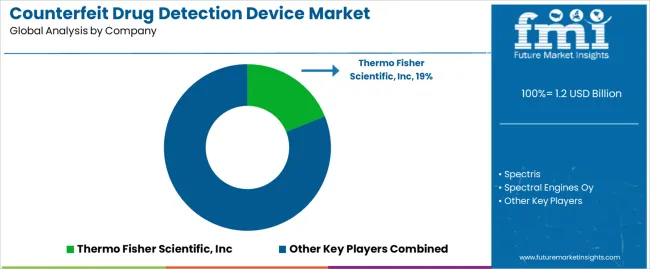
The counterfeit drug detection device market is fairly fragmented. While a few reputed companies have a significant share of the market demand, newer players and small-scale players also have the potential to thrive.
Technologically advancing the products, to keep the product line moving, is given priority by market players. Geographical expansion is also given significance by market players.
Recent Developments in the Counterfeit Drug Detection Device Market
- In February 2025, the AD Minidose U9 RAIN RFID was launched by Avery Dennison Smartrac for enhanced RFID applications in the healthcare sector.
- In August 2024, Vestcom was acquired by Avery Dennison Corporation.
- In December 2024, Stratio, Inc., with the help of South Korea's National IT Industry Promotion Agency (NIPA) launched an AI-enabled imaging solution. It is designed to detect infringements at border checkpoints.
- In September 2024, the Fluoride ISE was introduced by Metrohm for the detection of, as the name suggests, fluoride.
Key Companies in the Counterfeit Drug Detection Device Market
- Spectris
- Spectral Engines Oy
- Consumer Physics
- Olympus Corporation
- Stratio, Inc.
- Rigaku Corporation
- Thermo Fisher Scientific, Inc
- GAO RFID
- Cellular Bioengineering, Inc
- Metrohm AG
Key Coverage in the Counterfeit Drug Detection Device Industry Report
- Counterfeit Drug Device Market Size and Share Analysis
- Counterfeit Drug Detection Device Market Forecast
- growth analysis of the counterfeit drug detection device market
- Sales Analysis Of Counterfeit Drug Detection Device Market
- Counterfeit Drug Detection Device Industry Analysis
- Counterfeit Drug Detection Device Share in Anti-counterfeiting Technology Industry Analysis
Key Segments
By Product:
- Counterfeit Chemical Composition Detection Devices
- Ultraviolet/Vis Devices
- Infrared & Near Infrared Spectroscopy Device
- Raman Spectrometers
- XRD & XRF Spectroscopy Devices
- Counterfeit Packaging & Labelling Detection Devices
- RFID Analyzer
- Scanning & Imaging Systems
- Others
By Modality:
- Portable Devices
- Hand-held Devices
- Bench-top Devices
By End User:
- Pharmaceutical Companies
- Drug Testing Laboratories
- Research Organization
By Region:
- North America
- Latin America
- Europe
- South Asia
- East Asia
- Oceania
- Middle East and Africa (MEA)
Frequently Asked Questions
How big is the counterfeit drug detection device market in 2025?
The global counterfeit drug detection device market is estimated to be valued at USD 1.2 billion in 2025.
What will be the size of counterfeit drug detection device market in 2035?
The market size for the counterfeit drug detection device market is projected to reach USD 1.7 billion by 2035.
How much will be the counterfeit drug detection device market growth between 2025 and 2035?
The counterfeit drug detection device market is expected to grow at a 3.3% CAGR between 2025 and 2035.
What are the key product types in the counterfeit drug detection device market?
The key product types in counterfeit drug detection device market are counterfeit chemical composition detection devices, _ultraviolet/vis devices, _infrared & near infrared spectroscopy device, _raman spectrometers, _xrd & xrf spectroscopy devices, counterfeit packaging & labelling detection devices, _rfid analyzer, _scanning & imaging systems and _others.
Which modality segment to contribute significant share in the counterfeit drug detection device market in 2025?
In terms of modality, portable devices segment to command 54.6% share in the counterfeit drug detection device market in 2025.
Preview the report firsthand - request a free sample
Get SampleGet the brochure for pricing and purchase details.
Get PDFTable of Content
- Executive Summary
- Global Market Outlook
- Demand-side Trends
- Supply-side Trends
- Technology Roadmap Analysis
- Analysis and Recommendations
- Market Overview
- Market Coverage / Taxonomy
- Market Definition / Scope / Limitations
- Market Background
- Market Dynamics
- Drivers
- Restraints
- Opportunity
- Trends
- Scenario Forecast
- Demand in Optimistic Scenario
- Demand in Likely Scenario
- Demand in Conservative Scenario
- Opportunity Map Analysis
- Product Life Cycle Analysis
- Supply Chain Analysis
- Investment Feasibility Matrix
- Value Chain Analysis
- PESTLE and Porter’s Analysis
- Regulatory Landscape
- Regional Parent Market Outlook
- Production and Consumption Statistics
- Import and Export Statistics
- Market Dynamics
- Global Market Analysis 2020 to 2024 and Forecast, 2025 to 2035
- Historical Market Size Value (USD Million) Analysis, 2020 to 2024
- Current and Future Market Size Value (USD Million) Projections, 2025 to 2035
- Y-o-Y Growth Trend Analysis
- Absolute $ Opportunity Analysis
- Global Market Pricing Analysis 2020 to 2024 and Forecast 2025 to 2035
- Global Market Analysis 2020 to 2024 and Forecast 2025 to 2035, By Product
- Introduction / Key Findings
- Historical Market Size Value (USD Million) Analysis By Product , 2020 to 2024
- Current and Future Market Size Value (USD Million) Analysis and Forecast By Product , 2025 to 2035
- Counterfeit Chemical Composition Detection Devices
- Ultraviolet/Vis Devices
- Infrared & Near Infrared Spectroscopy Device
- Raman Spectrometers
- XRD & XRF Spectroscopy Devices
- Counterfeit Packaging & Labelling Detection Devices
- RFID Analyzer
- Scanning & Imaging Systems
- Others
- Counterfeit Chemical Composition Detection Devices
- Y-o-Y Growth Trend Analysis By Product , 2020 to 2024
- Absolute $ Opportunity Analysis By Product , 2025 to 2035
- Global Market Analysis 2020 to 2024 and Forecast 2025 to 2035, By Modality
- Introduction / Key Findings
- Historical Market Size Value (USD Million) Analysis By Modality, 2020 to 2024
- Current and Future Market Size Value (USD Million) Analysis and Forecast By Modality, 2025 to 2035
- Portable Devices
- Hand-Held Devices
- Bench-Top Devices
- Y-o-Y Growth Trend Analysis By Modality, 2020 to 2024
- Absolute $ Opportunity Analysis By Modality, 2025 to 2035
- Global Market Analysis 2020 to 2024 and Forecast 2025 to 2035, By End User
- Introduction / Key Findings
- Historical Market Size Value (USD Million) Analysis By End User, 2020 to 2024
- Current and Future Market Size Value (USD Million) Analysis and Forecast By End User, 2025 to 2035
- Pharmaceutical Companies
- Drug Testing Laboratories
- Research Organization
- Y-o-Y Growth Trend Analysis By End User, 2020 to 2024
- Absolute $ Opportunity Analysis By End User, 2025 to 2035
- Global Market Analysis 2020 to 2024 and Forecast 2025 to 2035, By Region
- Introduction
- Historical Market Size Value (USD Million) Analysis By Region, 2020 to 2024
- Current Market Size Value (USD Million) Analysis and Forecast By Region, 2025 to 2035
- North America
- Latin America
- Western Europe
- Eastern Europe
- East Asia
- South Asia and Pacific
- Middle East & Africa
- Market Attractiveness Analysis By Region
- North America Market Analysis 2020 to 2024 and Forecast 2025 to 2035, By Country
- Historical Market Size Value (USD Million) Trend Analysis By Market Taxonomy, 2020 to 2024
- Market Size Value (USD Million) Forecast By Market Taxonomy, 2025 to 2035
- By Country
- USA
- Canada
- Mexico
- By Product
- By Modality
- By End User
- By Country
- Market Attractiveness Analysis
- By Country
- By Product
- By Modality
- By End User
- Key Takeaways
- Latin America Market Analysis 2020 to 2024 and Forecast 2025 to 2035, By Country
- Historical Market Size Value (USD Million) Trend Analysis By Market Taxonomy, 2020 to 2024
- Market Size Value (USD Million) Forecast By Market Taxonomy, 2025 to 2035
- By Country
- Brazil
- Chile
- Rest of Latin America
- By Product
- By Modality
- By End User
- By Country
- Market Attractiveness Analysis
- By Country
- By Product
- By Modality
- By End User
- Key Takeaways
- Western Europe Market Analysis 2020 to 2024 and Forecast 2025 to 2035, By Country
- Historical Market Size Value (USD Million) Trend Analysis By Market Taxonomy, 2020 to 2024
- Market Size Value (USD Million) Forecast By Market Taxonomy, 2025 to 2035
- By Country
- Germany
- UK
- Italy
- Spain
- France
- Nordic
- BENELUX
- Rest of Western Europe
- By Product
- By Modality
- By End User
- By Country
- Market Attractiveness Analysis
- By Country
- By Product
- By Modality
- By End User
- Key Takeaways
- Eastern Europe Market Analysis 2020 to 2024 and Forecast 2025 to 2035, By Country
- Historical Market Size Value (USD Million) Trend Analysis By Market Taxonomy, 2020 to 2024
- Market Size Value (USD Million) Forecast By Market Taxonomy, 2025 to 2035
- By Country
- Russia
- Poland
- Hungary
- Balkan & Baltic
- Rest of Eastern Europe
- By Product
- By Modality
- By End User
- By Country
- Market Attractiveness Analysis
- By Country
- By Product
- By Modality
- By End User
- Key Takeaways
- East Asia Market Analysis 2020 to 2024 and Forecast 2025 to 2035, By Country
- Historical Market Size Value (USD Million) Trend Analysis By Market Taxonomy, 2020 to 2024
- Market Size Value (USD Million) Forecast By Market Taxonomy, 2025 to 2035
- By Country
- China
- Japan
- South Korea
- By Product
- By Modality
- By End User
- By Country
- Market Attractiveness Analysis
- By Country
- By Product
- By Modality
- By End User
- Key Takeaways
- South Asia and Pacific Market Analysis 2020 to 2024 and Forecast 2025 to 2035, By Country
- Historical Market Size Value (USD Million) Trend Analysis By Market Taxonomy, 2020 to 2024
- Market Size Value (USD Million) Forecast By Market Taxonomy, 2025 to 2035
- By Country
- India
- ASEAN
- Australia & New Zealand
- Rest of South Asia and Pacific
- By Product
- By Modality
- By End User
- By Country
- Market Attractiveness Analysis
- By Country
- By Product
- By Modality
- By End User
- Key Takeaways
- Middle East & Africa Market Analysis 2020 to 2024 and Forecast 2025 to 2035, By Country
- Historical Market Size Value (USD Million) Trend Analysis By Market Taxonomy, 2020 to 2024
- Market Size Value (USD Million) Forecast By Market Taxonomy, 2025 to 2035
- By Country
- Kingdom of Saudi Arabia
- Other GCC Countries
- Turkiye
- South Africa
- Other African Union
- Rest of Middle East & Africa
- By Product
- By Modality
- By End User
- By Country
- Market Attractiveness Analysis
- By Country
- By Product
- By Modality
- By End User
- Key Takeaways
- Key Countries Market Analysis
- USA
- Pricing Analysis
- Market Share Analysis, 2024
- By Product
- By Modality
- By End User
- Canada
- Pricing Analysis
- Market Share Analysis, 2024
- By Product
- By Modality
- By End User
- Mexico
- Pricing Analysis
- Market Share Analysis, 2024
- By Product
- By Modality
- By End User
- Brazil
- Pricing Analysis
- Market Share Analysis, 2024
- By Product
- By Modality
- By End User
- Chile
- Pricing Analysis
- Market Share Analysis, 2024
- By Product
- By Modality
- By End User
- Germany
- Pricing Analysis
- Market Share Analysis, 2024
- By Product
- By Modality
- By End User
- UK
- Pricing Analysis
- Market Share Analysis, 2024
- By Product
- By Modality
- By End User
- Italy
- Pricing Analysis
- Market Share Analysis, 2024
- By Product
- By Modality
- By End User
- Spain
- Pricing Analysis
- Market Share Analysis, 2024
- By Product
- By Modality
- By End User
- France
- Pricing Analysis
- Market Share Analysis, 2024
- By Product
- By Modality
- By End User
- India
- Pricing Analysis
- Market Share Analysis, 2024
- By Product
- By Modality
- By End User
- ASEAN
- Pricing Analysis
- Market Share Analysis, 2024
- By Product
- By Modality
- By End User
- Australia & New Zealand
- Pricing Analysis
- Market Share Analysis, 2024
- By Product
- By Modality
- By End User
- China
- Pricing Analysis
- Market Share Analysis, 2024
- By Product
- By Modality
- By End User
- Japan
- Pricing Analysis
- Market Share Analysis, 2024
- By Product
- By Modality
- By End User
- South Korea
- Pricing Analysis
- Market Share Analysis, 2024
- By Product
- By Modality
- By End User
- Russia
- Pricing Analysis
- Market Share Analysis, 2024
- By Product
- By Modality
- By End User
- Poland
- Pricing Analysis
- Market Share Analysis, 2024
- By Product
- By Modality
- By End User
- Hungary
- Pricing Analysis
- Market Share Analysis, 2024
- By Product
- By Modality
- By End User
- Kingdom of Saudi Arabia
- Pricing Analysis
- Market Share Analysis, 2024
- By Product
- By Modality
- By End User
- Turkiye
- Pricing Analysis
- Market Share Analysis, 2024
- By Product
- By Modality
- By End User
- South Africa
- Pricing Analysis
- Market Share Analysis, 2024
- By Product
- By Modality
- By End User
- USA
- Market Structure Analysis
- Competition Dashboard
- Competition Benchmarking
- Market Share Analysis of Top Players
- By Regional
- By Product
- By Modality
- By End User
- Competition Analysis
- Competition Deep Dive
- Thermo Fisher Scientific, Inc
- Overview
- Product Portfolio
- Profitability by Market Segments (Product/Age /Sales Channel/Region)
- Sales Footprint
- Strategy Overview
- Marketing Strategy
- Product Strategy
- Channel Strategy
- Spectris
- Spectral Engines Oy
- Consumer Physics
- Olympus Corporation
- Stratio, Inc.
- Rigaku Corporation
- GAO RFID
- Cellular Bioengineering, Inc
- Metrohm AG
- Thermo Fisher Scientific, Inc
- Competition Deep Dive
- Assumptions & Acronyms Used
- Research Methodology


