

- Market Size (2026)
- USD 9.6 Bn
- Forecast (2036)
- USD 15.6 Bn
- CAGR (2026 to 2036)
- 5.0%
How big is Crusher Liners Market in 2026?
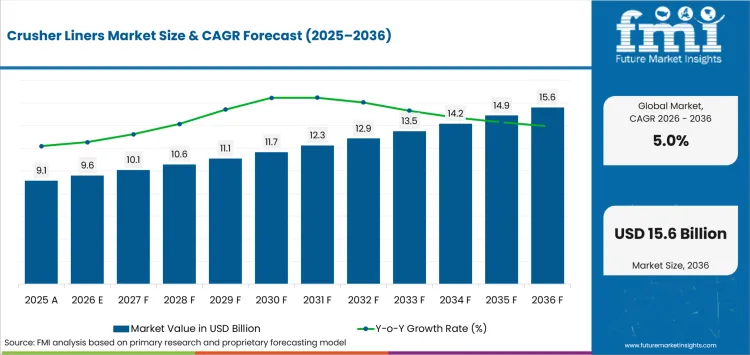
USD 9.6 billion in 2026 and USD 15.6 billion by 2036 at a 5.0% CAGR.
Demand for crusher liners is projected to expand at a 5.0% CAGR between 2026 and 2036, increasing valuation from USD 9.6 billion to USD 15.6 billion. Replacement orders follow wear on chamber surfaces and extend well beyond new crusher sales. Sandvik launched the QH443E cone crusher in March 2025 with Constant Liner Performance technology that tracks liner wear. The condition data gives maintenance teams a clearer basis for scheduling mantle changes before profile loss reduces throughput or product sizing.
Country order economics differ because installed fleets operate under different production intensity and service distances. The USA Geological Survey estimated 2025 crushed-stone output at about 1.5 billion tons from roughly 3,500 quarries. That operating base keeps mineral processing equipment exposed to repeated jaw, cone, and gyratory wear even if new-machine purchases are uneven. Regional stock gains value where emergency freight would extend an unplanned shutdown.
Key Takeaways
- Replacement demand follows abrasive throughput because worn chamber surfaces reduce crushing efficiency before the machine itself reaches end of life.
- By liner type, cone crusher mantles are estimated to hold 28.0% in 2026 owing to repeated secondary and tertiary wear exposure.
- In 2026, manganese steel is expected to lead the material category with 43.0% share because work hardening balances impact toughness with abrasion resistance.
- Cone crushers are projected to hold 34.0% share in 2026 owing to routine mantle and bowl-liner changes during normal operation.
- Feed variability and chamber geometry slow alternative-liner qualification because a poor profile or alloy can shorten campaign life and disrupt planned maintenance.
- Some of the key players in this market include Metso, Sandvik, Columbia Steel Casting, Bradken, FLSmidth, ESCO / Weir, ME Elecmetal, Magotteaux, CMS Cepcor, and H-E Parts International.
Analyst Perspective
"Crusher-liner economics are best judged by tonnes processed between planned stops and the downtime attached to each changeout. A premium profile earns repeat orders after the site verifies wear life, chamber fit, safe installation, and local stock against its own feed."
- Nikhil Kaitwade, Principal Consultant, Future Market Insights
How is the crusher liners market segmented?
The crusher liners market is segmented by liner type, material, crusher type, end use, and sales channel.
Liner type includes cone crusher mantles, jaw plates, bowl liners, impact plates - blow bars, and gyratory crusher liners. Materials cover manganese steel, high-chrome iron, alloy steel, ceramic-insert liners, and composite wear liners. Crusher types include cone, jaw, gyratory, and impact crushers. End uses cover mining, aggregates, cement - quarrying, and recycling - demolition. Sales channels comprise aftermarket wear parts, crusher OEMs, mine-site contracts, and MRO distributors.
What supports mining as the leading end use category?
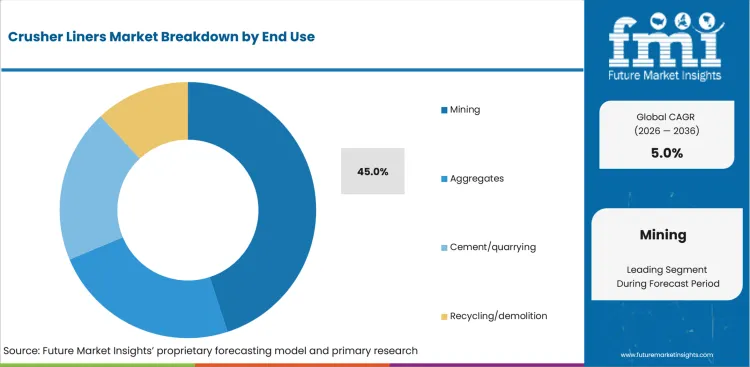
Mining sites can justify engineered liner profiles because lost crushing time can restrict the whole comminution circuit during long high-tonnage ore-processing campaigns.
- Mining is set to lead the end use category with 45.0% share in 2026 due to the cost of lost crushing hours at large sites.
- Brazil’s National Mining Agency recorded 447.2 million tonnes of beneficiated iron-ore production in 2024 in its 2025 Mineral Summary. Concentrated high-tonnage ore processing exposes a sizeable operating base to liner wear that can become a production-cost issue.
Why do cone crusher mantles lead demand within the liner type category?
Cone crusher mantles carry continuous compressive wear against the bowl liner, so profile loss changes chamber volume and product control during long production campaigns.
- Based on liner type, cone crusher mantles are projected to account for 28.0% in 2026 due to repeated replacement in secondary and tertiary duties.
- Weir documented an HP300 quarry trial in August 2025 where an ESCO mantle and liner set ran 1,084 hours and processed 184,930 tons. The field result gives operators a direct cost-per-tonne benchmark for crusher wear parts before adopting a new profile.
Why does manganese steel lead demand within the material category?
Manganese steel gives crusher operators a familiar route for duties that mix impact with abrasion, since its surface hardens under load while the casting retains toughness.
- In 2026, manganese steel is expected to lead the material category with 43.0% share because its work-hardening behavior suits cone, jaw, and gyratory liner duties.
- Sandvik stated in August 2025 that its crusher wear parts use more than 90% recycled steel and that it had produced a certified environmental product declaration for manganese wear parts. Qualification now considers material documentation alongside wear life.
How do cone crushers shape demand within the crusher type category?
Cone crushers expose mantles and bowl liners to sustained wear in secondary and tertiary circuits, which makes chamber profile part of routine process control.
- By crusher type, cone crushers are forecast to represent 34.0% in 2026 driven by repeated mantle and bowl-liner changes in high-utilization campaigns.
- Metso announced its sixth Nordberg HPe model in April 2025 after more than 200 HPe units had been sold globally. The range supports no-backing liners and ten chamber profiles, widening the installed base where profile-specific wear parts require planned replacement.
What are the drivers, restraints and opportunities in the Crusher Liners Market?
Abrasive throughput sustains replacement demand. Site-specific qualification slows switching. Engineered materials can lengthen liner campaigns after field proof.
- Driver: Sustained crushing throughput removes usable liner profile and converts operating hours into repeat replacement demand.
- Restraint: Feed distribution and chamber geometry make liner performance site-specific, which raises the proof threshold for alternative profiles or alloys.
- Opportunity: Engineered materials and chamber analysis can extend campaign life where field trials document lower changeout frequency and cost per processed tonne.
High Throughput Converts Wear into Repeat Orders
High-throughput plants reorder liners because wear removes the chamber profile needed for stable crushing. Weir documented in August 2025 that ESCO wear parts on a Trio TC36 cone crusher increased operating life from 520 to 748 hours at a South African construction aggregates site. Longer campaigns reduce planned interventions, so operating intensity translates directly into replacement volume and service demand.
Qualification Risk Slows Supplier Switching
Switching risk rises if a different liner changes chamber geometry or introduces a maintenance practice the site has not qualified. Sandvik launched the CH442 and CH662 cone crushers in March 2026 with a backing-compound-free design that avoids up to 24 hours of hardening during liner changes. The time saving has commercial value after the replacement part preserves fit, setting control, and safe installation.
Field-Proven Engineering Supports Premium Liners
Premium materials earn a higher price after a site links wear life to processed tonnes and shutdown savings. Metso documented in August 2026 that MX liners at Anglo American’s Minas-Rio operation increased liner lifetime by 110% following 3D scanning and field trials. The stronger commercial position goes to companies that pair metallurgy with chamber measurement and trial records.
Which country CAGRs are profiled in the Crusher Liners Market?
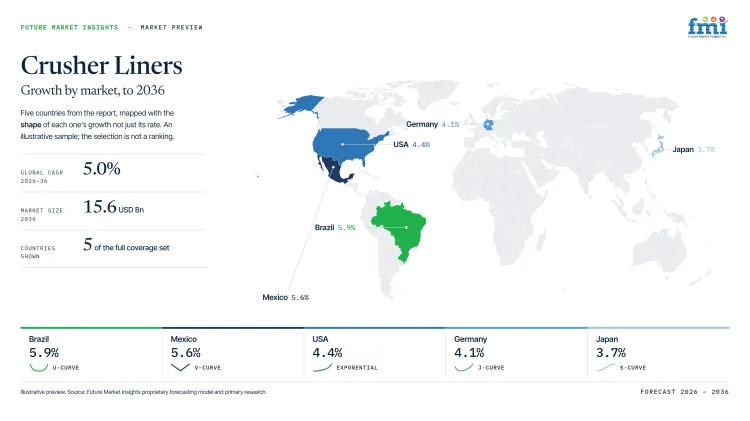
| Country | CAGR |
|---|---|
| Brazil | 5.9% |
| Mexico | 5.6% |
| South Africa | 5.2% |
| Australia | 4.9% |
| USA | 4.4% |
| Germany | 4.1% |
| Japan | 3.7% |
How do country-level CAGRs compare in the Crusher Liners Market?
The country CAGRs span 2.2 percentage points. Brazil and Mexico form the upper pair, with South Africa and Australia close behind. USA and Germany occupy a mature replacement band, and Japan is lower at 3.7%. Service distance, shutdown practice, and fleet mix can therefore matter more than the headline growth gap.
- Brazil’s concentrated iron-ore sector keeps high-volume crushers central to maintenance budgets.
- Mexico’s varied metal-mining base widens the range of chamber profiles required.
- South Africa’s deep mining base places more weight on abrasion-resistant liner life.
- Australia’s large open-pit operations make changeout duration a key liner-selection metric.
- USA’s quarry-heavy aggregate base spreads replacement demand among many operating sites.
- Germany’s mature crusher base limits fleet-led growth and keeps replacement demand steady.
- Japan’s slower rate is consistent with mature aggregate infrastructure and limited fleet expansion.
Similar growth rates therefore translate into different inventory and qualification economics. The full report provides country-level CAGR analysis across North America, Latin America, Western Europe, Eastern Europe, East Asia, South Asia and Pacific, and the Middle East and Africa.
Country-wise Analysis
- In Brazil's iron-ore districts, long production campaigns tie crusher maintenance to planned shutdowns and heavy liner castings make nearby inventory valuable for mines in Minas Gerais and Pará. ANM's February 2026 update to the 2025 Brazilian Mineral Yearbook counted 274 operating mines for covered metallic substances and 109 were iron-ore mines, confirming a concentrated base of high-throughput ore-processing assets. Brazil is projected to expand at 5.9% CAGR through 2036 tied to steady liner consumption in these circuits and companies with field wear measurement plus regional stock can earn repeat orders after proving campaign life without forcing mines to carry excessive safety inventory.
- Long import lead times make distributor inventory important in Mexico because mine and quarry schedules can change faster than ocean freight can replenish proven crusher-liner profiles. Crusher liner demand in Mexico is forecast to grow at 5.6% CAGR over the assessment period given local channels that can stage multi-brand trials and replenish qualified profiles quickly. INEGI documented in February 2026 that minerometallurgical production in December 2025 fell 0.9% month over month and 7.2% year over year, so sites have a reason to limit excess stock and unfamiliar parts still face a local service disadvantage between successive crushing campaigns at local sites.
- Commodity production often resets maintenance spending at South African mines and this makes liner inventory sensitive to the timing and cash requirements of each operating campaign. Statistics South Africa recorded June 2026 mining production 4.0% below the prior year and iron-ore output 10.2% lower, which makes shutdown stock harder to size during uneven production periods. South Africa is expected to maintain 5.2% CAGR through 2036 supported by an installed mining base that consumes liners steadily and longer-life designs can win repeat orders after field trials, though distributors still need critical local stock readily available at nearby sites without encouraging excess inventory.
- At remote Australian mines, late liner deliveries and extended changeouts carry high costs so campaign length and planned site inventory influence maintenance decisions more than unit price alone during planned shutdowns. Crusher liner demand in Australia is predicted to advance at 4.9% CAGR through 2036 propelled by sustained mineral throughput and companies pairing longer-life designs with field engineering can reduce shutdown exposure. The Office of the Chief Economist stated in July 2026 that iron-ore export volumes rose 6% year over year in the March quarter, confirming high material movement while remote freight still raises emergency replacement costs at remote sites.
- Mixed crusher fleets are common in the United States because a large aggregate sector operates beside metal and nonmetal mining with different replacement histories and this requires stock plans tailored to each operating site and installed crusher generation. The Bureau of Labor Statistics recorded 105,500 jobs in nonmetallic mineral mining and quarrying in May 2026 after the industry added 1,600 positions that month. USA is estimated to post 4.4% CAGR over the forecast period reflecting steady liner consumption in mature fleets and regional stock can shorten qualification while unfamiliar profiles still need site evidence before operators change a proven specification.
- Before changing a familiar liner specification, German quarry and recycling operators usually require lifecycle savings to be demonstrated on the installed crusher within long-established maintenance systems at site level. Germany is projected to record 4.1% CAGR during the assessment period because installed crushers still consume wear parts and companies need material traceability plus stable lead times before a site changes established practice. Destatis reported in August 2026 that June construction output rose 0.1% while machinery output fell 3.9% from the previous month, reinforcing cost discipline and limiting speculative inventory even as installed crushers continue requiring routine replacement liners at operating sites.
- Stable material supply keeps Japanese aggregate producers focused on exact part matching and planned replacement instead of speculative stock or rapid new-fleet expansion at mature plants. The transport ministry reported in July 2026 that supply and inventories were balanced for all surveyed major construction materials, reducing the commercial case for emergency stocking when routine replenishment is available. Japan is forecast to grow at 3.7% CAGR through 2036 since installed crushers continue to consume wear parts and new entrants gain repeat orders through consistent casting quality plus service support while stable supply limits the value of simply holding more local inventory.
Who are the notable companies in the Crusher Liners Market?
Metso, Sandvik, Columbia Steel Casting, Bradken, FLSmidth, ESCO / Weir, ME Elecmetal, Magotteaux, CMS Cepcor, and H-E Parts International are the notable companies profiled in this market.
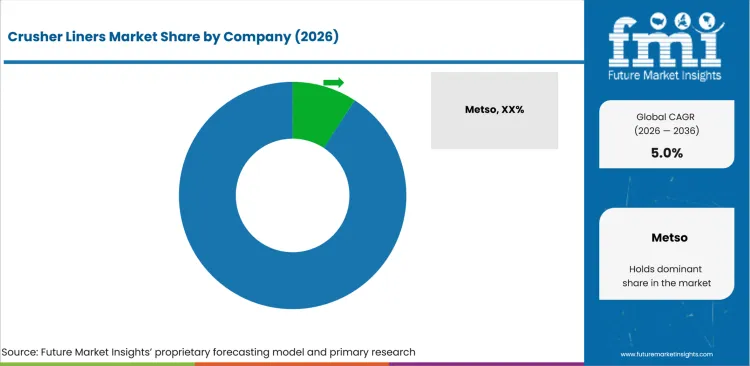
Competition is split between crusher OEMs with installed-base access and engineered wear specialists serving multi-brand fleets. Chamber knowledge, alloy selection, field measurement, and local stock shape the qualification barrier. In the wider stone crushing equipment market, repeat liner business depends on proving fit and wear life under the site feed rather than casting price alone.
- Metso, Sandvik, and FLSmidth link crusher-platform engineering with lifecycle parts and service support.
- Bradken, ESCO / Weir, ME Elecmetal, and H-E Parts International focus heavily on site-specific wear engineering and field performance.
- Columbia Steel Casting, Magotteaux, and CMS Cepcor extend independent, specialist, or multi-brand coverage for mining and aggregate users.
Competitive Benchmarking: Crusher Liners Market
| Company | Multi-crusher Liner Coverage | Site-specific Chamber Engineering | Advanced Wear Metallurgy | Geographic Reach |
|---|---|---|---|---|
| Metso | High | High | High | Global mining and aggregates network |
| Sandvik | High | High | High | Global installed-base and lifecycle network |
| Columbia Steel Casting | Medium | High | Medium | North America with international applications |
| Bradken | Medium | High | High | Major mining regions on several continents |
| FLSmidth | Medium | High | High | Global mining footprint with regional engineering |
| ESCO / Weir | High | High | High | Global mining and aggregates network |
| ME Elecmetal | Medium | High | High | Americas plus other major mining regions |
| Magotteaux | Medium | Medium | High | Global mining, quarrying, and cement network |
| CMS Cepcor | High | Medium | High | UK, USA, Chile, Australia, and export markets |
| H-E Parts International | Medium | High | High | Australia, Americas, and other mining regions |
Scoring basis: High liner coverage requires documented supply across at least three profiled crusher types, Medium indicates narrower coverage, and Low identifies one documented type. High chamber engineering requires site measurement, simulation, or custom profile evidence, while Medium reflects a narrower engineering route. High metallurgy requires several verified alloy or composite options. Geographic reach reflects documented commercial or service presence.
Key Developments in the Crusher Liners Market
- In July 2026, Metso continued a three-year South American supply agreement for MX crusher wear parts used in Nordberg MP1250 crushers with on-site stock plus engineering and liner-usage monitoring.
- In April 2026, Magotteaux launched Advance as a patented metal matrix composite wear solution for VSI impellers and anvils in abrasive recycling plus gravel-pit and quarry duties.
- In September 2025, Weir launched its ENDURON jaw and cone crusher range with ESCO wear parts and liners integrated into the machines to reduce maintenance interventions and improve utilization.
Key Players in the Crusher Liners Market
Crusher OEM and lifecycle wear platforms
- Metso
- Sandvik
Engineered wear and metallurgy specialists
- Columbia Steel Casting
- Bradken
- FLSmidth
- ESCO / Weir
- ME Elecmetal
Specialist and multi-brand aftermarket providers
- Magotteaux
- CMS Cepcor
- H-E Parts International
Crusher Liners Market - Report Scope
| Coverage field | Report scope |
|---|---|
| Market breakdown | By liner type, material, crusher type, end use, sales channel, and region. |
| Quantitative Units | USD billion. |
| Market Definition | Revenue includes replaceable crusher wear liners and crushing-surface castings within the stated liner types, materials, crusher types, end uses, and channels. Crusher-machine revenue, mill liners, and non-crusher wear products are excluded. |
| Regions Covered | North America, Latin America, Western Europe, Eastern Europe, East Asia, South Asia and Pacific, and Middle East and Africa. |
| Countries Covered | Brazil, Mexico, South Africa, Australia, USA, Germany, Japan, and 20+ countries included in the full report. |
| Key Companies Profiled | Metso, Sandvik, Columbia Steel Casting, Bradken, FLSmidth, ESCO / Weir, ME Elecmetal, Magotteaux, CMS Cepcor, and H-E Parts International. |
| Forecast Period | 2026 to 2036. |
| Approach | Primary and secondary research with market triangulation. |
Crusher Liners Market - Research Methodology
| Method | Approach |
|---|---|
| Primary Research | FMI analysts gathered input from manufacturers, service providers, technology developers, distributors, end users, procurement teams, and subject-matter experts. Interviews examined purchasing decisions, product or service evaluation, adoption barriers, approval requirements, pricing considerations, and expectations for technical or commercial support. Respondents were also asked what evidence is required before a trial, pilot, or initial order develops into regular purchasing. |
| Desk Research | Desk research covered government statistics, regulatory publications, trade data, industry associations, technical literature, standards, company filings, product information, and official corporate announcements. Sources were reviewed for relevance, publication date, geographic coverage, and consistency with the defined market scope. Claims relating to performance, applications, approvals, capacity, investment, and commercial activity were retained only when supported by credible public evidence. |
| Market Sizing and Forecasting | The market model combined the baseline value with historical performance, segment structure, pricing and volume indicators, adoption levels, company participation, and country-level demand conditions. Forecast assumptions considered economic activity, investment trends, regulatory developments, technology adoption, purchasing cycles, supply availability, and barriers to wider market use. Segment and regional estimates were reconciled before the final market total was calculated. |
| Data Validation | Estimates were checked against multiple independent indicators, including public data, company activity, trade patterns, industry developments, and findings from primary interviews. Validation also tested whether products, services, applications, and company revenues fell within the defined market boundaries. Adjacent categories, unsupported claims, overlapping revenues, and activities without direct market relevance were excluded to reduce double counting and maintain consistency across segments and countries. |
Crusher Liners Market by Segments
Crusher Liners Market segmented by Liner Type:
- Cone crusher mantles
- Jaw plates
- Bowl liners
- Impact plates - blow bars
- Gyratory crusher liners
Crusher Liners Market segmented by Material:
- Manganese steel
- High-chrome iron
- Alloy steel
- Ceramic-insert liners
- Composite wear liners
Crusher Liners Market segmented by Crusher Type:
- Cone crushers
- Jaw crushers
- Gyratory crushers
- Impact crushers
Crusher Liners Market segmented by End Use:
- Mining
- Aggregates
- Cement - quarrying
- Recycling - demolition
Crusher Liners Market segmented by Sales Channel:
- Aftermarket wear parts
- Crusher OEMs
- Mine-site contracts
- MRO distributors
Crusher Liners Market by Region:
- North America
- United States
- Canada
- Latin America
- Brazil
- Mexico
- Argentina
- Chile
- Western Europe
- Germany
- France
- United Kingdom
- Italy
- Spain
- Benelux
- Nordics
- Eastern Europe
- Poland
- Czech Republic
- Romania
- Hungary
- East Asia
- China
- Japan
- South Korea
- South Asia and Pacific
- India
- ASEAN
- Australia and New Zealand
- Middle East and Africa
- GCC Countries
- South Africa
- Türkiye
- Israel
Research Sources and Bibliography
- Sandvik Rock Processing Solutions. (2025, March 3). Sandvik unveils latest electric crushers and screens - Pioneering sustainable innovation.
- USA Geological Survey. (2026, February 6). Mineral Commodity Summaries 2026.
- Weir. (2025, August 15). ESCO crusher wear parts produce more material for HP300 cone crusher.
- Sandvik Rock Processing Solutions. (2025, August 27). From worn-out to wear parts: certified circularity in the Sandvik foundry.
- Metso. (2025, April 8). Metso announces the 6th model for the Nordberg HPe Crusher Series.
- Agência Nacional de Mineração. (2025, October 2). Sumário Mineral Brasileiro 2025.
- Weir. (2025, August 15). ESCO crusher wear parts for Trio TC36 cone crusher.
- Sandvik Rock Processing Solutions. (2026, March 3). Sandvik launches CH442 and CH662 at CONEXPO.
- Metso. (2026, August 6). Anglo American adopts Metso technology that doubles liner lifetime in crushers.
- Agência Nacional de Mineração. (2026, February 9). Anuário Mineral Brasileiro 2025: principais substâncias metálicas.
- Instituto Nacional de Estadística y Geografía. (2026, February 19). Estadística de la Industria Minerometalúrgica: Indicadores de diciembre de 2025.
- Statistics South Africa. (2026, August 13). Mining: Production and Sales, June 2026, Key Findings.
- Office of the Chief Economist, Australia. (2026, July 3). Resources and Energy Quarterly: June 2026.
- USA Bureau of Labor Statistics. (2026, June 5). The Employment Situation - May 2026.
- Destatis. (2026, August 7). Production in June 2026: +0.2% on the previous month.
- Ministry of Land, Infrastructure, Transport and Tourism, Japan. (2026, July 27). Major Construction Materials Supply, Demand and Price Trends Survey, July 1-5, 2026.
- Metso. (2026, July 3). Metso strengthens long-term partnership with a major mining customer in South America through new technology development for crusher wear parts.
- Magotteaux. (2026, April 23). Magotteaux introduces Advance, a new patented MMC solution for VSI wear parts.
- Weir. (2025, September 30). Weir unveils new ENDURON crushers.
- Metso. (2026, March 4). Metso’s Annual report for 2025 has been published.
- Sandvik AB. (2026, March 10). Sandvik AB Annual Report 2025.
- CMS Cepcor. (2026). Columbia Steel Cast Products: current group location and operating identity. Retrieved September 4, 2026.
- Hitachi Construction Machinery. (2025, September 30). Hitachi Construction Machinery Group Integrated Report 2025.
- FLSmidth. (2026, February 18). FLSmidth 2025 Annual Report: Solid performance provides strong foundation for the next phase, focused on accelerating growth.
- Weir. (2026, March 23). Weir publishes 2025 Annual Report and Financial Statements.
- ME Elecmetal. (2026, August 4). 2025 Sustainability Report: Aligning, Managing, and Projecting ME Elecmetal’s Future.
- Magotteaux. (2026). Annual Report 2025.
- CMS Cepcor. (2026). Certifications and Awards. Retrieved September 4, 2026.
- H-E Parts International. (2025, September 8). H-E Parts Crushing Solutions Overview 2025.
- ME Elecmetal. (2026, August 30). ME Elecmetal strengthens its presence in Canada with new Toronto office.
- Sandvik Rock Processing Solutions. (2026, June 16). Retec Equipment strengthens UK aftermarket support with new local stock availability.
- Metso. (2026, June 3). Metso launches new primary crushers for unmatched safety and availability in mining.
- Sandvik Rock Processing Solutions. (2025, June 26). Better crushing starts here: Sandvik launches new generation of upgraded jaw crushers.
- CMS Cepcor. (2026, May). Mining doesn’t wait - and neither do we.
- Metso. (2026, June 29). Metso strengthens partnership with Grupo Mexico by delivering new cone crushers for La Caridad.
- Sandvik Rock Processing Solutions. (2026, July 30). Sandvik strengthens presence in West Africa through new distribution partnership with Neemba.
- FLSmidth. (2026, September 3). FLSmidth to establish fourth business line focused on crushing, sizing & screening to support its strategic growth journey.
This Report Answers
- What is the crusher liners market size in 2026 and what value is forecast for 2036?
- How does wear-driven replacement convert crusher utilization into recurring liner demand?
- Why do cone crusher mantles lead the liner type category?
- Why does manganese steel hold the largest material share?
- How do cone crushers shape repeat mantle and bowl-liner demand?
- Why does mining account for the largest end use share?
- How do country growth rates differ among the seven profiled markets?
- Which qualification risks slow switching between crusher-liner suppliers?
- Which companies provide OEM-linked, engineered, and multi-brand liner coverage?
- What should operators compare before approving a premium liner for repeat use?
Frequently Asked Questions
How big is the crusher liners market in 2026?
The crusher liners market is valued at USD 9.6 billion in 2026 and is projected to reach USD 15.6 billion by 2036. Replacement demand follows wear on crushing surfaces during sustained mine and quarry operation.
What is the CAGR of the crusher liners market from 2026 to 2036?
The crusher liners market is projected to grow at a CAGR of 5.0% between 2026 and 2036. Expansion follows recurring wear replacement in installed fleets and efforts to extend campaign life between planned shutdowns.
Which liner type leads the crusher liners market?
The cone crusher mantles segment is expected to hold 28.0% of the crusher liners market in 2026, attributable to repeated wear in secondary and tertiary cone-crushing duties. Campaign life directly affects changeout frequency and replacement planning.
Which material leads the crusher liners market?
The manganese steel segment is expected to hold 43.0% of the crusher liners market in 2026, driven by work hardening that balances abrasion resistance with impact toughness. Different manganese grades can then be qualified for specific crushing duties.
Which countries are projected to record the highest growth in the crusher liners market?
Brazil is projected to grow at 5.9% CAGR, followed by Mexico at 5.6% and South Africa at 5.2% through 2036. Their rates reflect mining intensity and the replacement economics of heavy wear castings.
Which companies are active in the crusher liners market?
Key companies operating in the market include Metso, Sandvik, Columbia Steel Casting, Bradken, FLSmidth, ESCO / Weir, ME Elecmetal, Magotteaux, CMS Cepcor, and H-E Parts International. Competition centers on chamber engineering, alloy choice, installed-base access, inventory depth, and field service.
Preview the report firsthand - request a free sample
Get SampleGet the brochure for pricing and purchase details.
Get PDFTable of Content
- Key Takeaways
- Market Size and CAGR
- Top Growth Driver
- Fastest Growing Segment
- Leading Region
- Key Companies
- Emerging Opportunities
- Executive Summary
- Global Market Outlook
- Demand-side Trends
- Supply-side Trends
- Technology Roadmap Analysis
- Analysis and Recommendations
- Analyst Perspective (What is happening? Why now? What should investors know?)
- Key Questions Answered
- How large is the market?
- What is the CAGR?
- What are key trends?
- Which region dominates?
- Who are the leaders?
- Market Overview
- Market Coverage / Taxonomy
- Market Definition / Scope / Limitations
- Research Methodology
- Chapter Orientation
- Analytical Lens and Working Hypotheses
- Market Structure, Signals, and Trend Drivers
- Benchmarking and Cross-market Comparability
- Market Sizing, Forecasting, and Opportunity Mapping
- Research Design and Evidence Framework
- Desk Research Programme (Secondary Evidence)
- Expert Input and Fieldwork (Primary Evidence)
- Tooling, Models, and Reference Databases
- Data Engineering and Model Build
- Quality Assurance and Audit Trail
- Market Background
- Market Dynamics (Drivers, Restraints, Opportunity, Trends)
- Scenario Forecast (Optimistic, Likely, Conservative)
- Impact Analysis
- AI Impact
- Sustainability Impact
- Regulatory Impact
- Technology Impact
- Consumer / Buyer Analysis
- Purchase Drivers
- Adoption Barriers
- Buyer Journey
- Opportunity Map Analysis
- Product Life Cycle Analysis
- Supply Chain Analysis
- Investment Feasibility Matrix
- Value Chain Analysis
- PESTLE and Porter's Analysis
- Regulatory Landscape
- Regional Parent Market Outlook
- Production and Consumption Statistics
- Import and Export Statistics
- Global Market Analysis and Forecast, 2021 to 2036
- Historical Market Size Value (USD Billion) Analysis, 2021 to 2025
- Current and Future Market Size Value (USD Billion) Projections, 2026 to 2036
- Y-o-Y Growth Trend Analysis
- Absolute $ Opportunity Analysis
- Global Market Pricing Analysis, 2021 to 2036
- Global Market Analysis and Forecast, By Liner Type, 2021 to 2036
- Introduction / Key Findings
- Historical Market Size Value (USD Billion) Analysis By Liner Type, 2021 to 2025
- Current and Future Market Size Value (USD Billion) Analysis and Forecast By Liner Type, 2026 to 2036
- Cone crusher mantles
- Jaw plates
- Bowl liners
- Impact plates/blow bars
- Gyratory crusher liners
- Cone crusher mantles
- Y-o-Y Growth Trend Analysis By Liner Type, 2021 to 2025
- Absolute $ Opportunity Analysis By Liner Type, 2026 to 2036
- Global Market Analysis and Forecast, By Material, 2021 to 2036
- Introduction / Key Findings
- Historical Market Size Value (USD Billion) Analysis By Material, 2021 to 2025
- Current and Future Market Size Value (USD Billion) Analysis and Forecast By Material, 2026 to 2036
- Manganese steel
- High-chrome iron
- Alloy steel
- Ceramic-insert liners
- Composite wear liners
- Manganese steel
- Y-o-Y Growth Trend Analysis By Material, 2021 to 2025
- Absolute $ Opportunity Analysis By Material, 2026 to 2036
- Global Market Analysis and Forecast, By Crusher Type, 2021 to 2036
- Introduction / Key Findings
- Historical Market Size Value (USD Billion) Analysis By Crusher Type, 2021 to 2025
- Current and Future Market Size Value (USD Billion) Analysis and Forecast By Crusher Type, 2026 to 2036
- Cone crushers
- Jaw crushers
- Gyratory crushers
- Impact crushers
- Cone crushers
- Y-o-Y Growth Trend Analysis By Crusher Type, 2021 to 2025
- Absolute $ Opportunity Analysis By Crusher Type, 2026 to 2036
- Global Market Analysis and Forecast, By End Use, 2021 to 2036
- Introduction / Key Findings
- Historical Market Size Value (USD Billion) Analysis By End Use, 2021 to 2025
- Current and Future Market Size Value (USD Billion) Analysis and Forecast By End Use, 2026 to 2036
- Mining
- Aggregates
- Cement/quarrying
- Recycling/demolition
- Mining
- Y-o-Y Growth Trend Analysis By End Use, 2021 to 2025
- Absolute $ Opportunity Analysis By End Use, 2026 to 2036
- Global Market Analysis and Forecast, By Sales Channel, 2021 to 2036
- Introduction / Key Findings
- Historical Market Size Value (USD Billion) Analysis By Sales Channel, 2021 to 2025
- Current and Future Market Size Value (USD Billion) Analysis and Forecast By Sales Channel, 2026 to 2036
- Aftermarket wear parts
- Crusher OEMs
- Mine-site contracts
- MRO distributors
- Aftermarket wear parts
- Y-o-Y Growth Trend Analysis By Sales Channel, 2021 to 2025
- Absolute $ Opportunity Analysis By Sales Channel, 2026 to 2036
- Global Market Analysis and Forecast, By Region, 2021 to 2036
- Introduction
- Historical Market Size Value (USD Billion) Analysis By Region, 2021 to 2025
- Current Market Size Value (USD Billion) Analysis and Forecast By Region, 2026 to 2036
- North America
- Latin America
- Western Europe
- Eastern Europe
- East Asia
- South Asia and Pacific
- Middle East & Africa
- Market Attractiveness Analysis By Region
- North America Market Analysis and Forecast, By Country, 2021 to 2036
- Historical Market Size Value (USD Billion) Trend Analysis By Market Taxonomy, 2021 to 2025
- Market Size Value (USD Billion) Forecast By Market Taxonomy, 2026 to 2036
- By Country
- USA
- Canada
- By Liner Type
- By Material
- By Crusher Type
- By End Use
- By Sales Channel
- By Country
- Market Attractiveness Analysis
- By Country
- By Liner Type
- By Material
- By Crusher Type
- By End Use
- By Sales Channel
- Key Takeaways
- Latin America Market Analysis and Forecast, By Country
- Historical Market Size Value (USD Billion) Trend Analysis By Market Taxonomy, 2021 to 2025
- Market Size Value (USD Billion) Forecast By Market Taxonomy, 2026 to 2036
- By Country
- Brazil
- Mexico
- Chile
- Rest of Latin America
- By Liner Type
- By Material
- By Crusher Type
- By End Use
- By Sales Channel
- By Country
- Market Attractiveness Analysis
- By Country
- By Liner Type
- By Material
- By Crusher Type
- By End Use
- By Sales Channel
- Key Takeaways
- Western Europe Market Analysis and Forecast, By Country
- Historical Market Size Value (USD Billion) Trend Analysis By Market Taxonomy, 2021 to 2025
- Market Size Value (USD Billion) Forecast By Market Taxonomy, 2026 to 2036
- By Country
- Germany
- UK
- Italy
- Spain
- France
- Nordic
- BENELUX
- Rest of Western Europe
- By Liner Type
- By Material
- By Crusher Type
- By End Use
- By Sales Channel
- By Country
- Market Attractiveness Analysis
- By Country
- By Liner Type
- By Material
- By Crusher Type
- By End Use
- By Sales Channel
- Key Takeaways
- Eastern Europe Market Analysis and Forecast, By Country
- Historical Market Size Value (USD Billion) Trend Analysis By Market Taxonomy, 2021 to 2025
- Market Size Value (USD Billion) Forecast By Market Taxonomy, 2026 to 2036
- By Country
- Russia
- Poland
- Hungary
- Balkan & Baltic
- Rest of Eastern Europe
- By Liner Type
- By Material
- By Crusher Type
- By End Use
- By Sales Channel
- By Country
- Market Attractiveness Analysis
- By Country
- By Liner Type
- By Material
- By Crusher Type
- By End Use
- By Sales Channel
- Key Takeaways
- East Asia Market Analysis and Forecast, By Country
- Historical Market Size Value (USD Billion) Trend Analysis By Market Taxonomy, 2021 to 2025
- Market Size Value (USD Billion) Forecast By Market Taxonomy, 2026 to 2036
- By Country
- China
- Japan
- South Korea
- By Liner Type
- By Material
- By Crusher Type
- By End Use
- By Sales Channel
- By Country
- Market Attractiveness Analysis
- By Country
- By Liner Type
- By Material
- By Crusher Type
- By End Use
- By Sales Channel
- Key Takeaways
- South Asia and Pacific Market Analysis and Forecast, By Country
- Historical Market Size Value (USD Billion) Trend Analysis By Market Taxonomy, 2021 to 2025
- Market Size Value (USD Billion) Forecast By Market Taxonomy, 2026 to 2036
- By Country
- India
- ASEAN
- Australia & New Zealand
- Rest of South Asia and Pacific
- By Liner Type
- By Material
- By Crusher Type
- By End Use
- By Sales Channel
- By Country
- Market Attractiveness Analysis
- By Country
- By Liner Type
- By Material
- By Crusher Type
- By End Use
- By Sales Channel
- Key Takeaways
- Middle East & Africa Market Analysis and Forecast, By Country
- Historical Market Size Value (USD Billion) Trend Analysis By Market Taxonomy, 2021 to 2025
- Market Size Value (USD Billion) Forecast By Market Taxonomy, 2026 to 2036
- By Country
- Kingdom of Saudi Arabia
- Other GCC Countries
- Türkiye
- South Africa
- Other African Union
- Rest of Middle East & Africa
- By Liner Type
- By Material
- By Crusher Type
- By End Use
- By Sales Channel
- By Country
- Market Attractiveness Analysis
- By Country
- By Liner Type
- By Material
- By Crusher Type
- By End Use
- By Sales Channel
- Key Takeaways
- Key Countries Market Analysis
- USA
- Pricing Analysis
- Market Share Analysis, 2025
- By Liner Type
- By Material
- By Crusher Type
- By End Use
- By Sales Channel
- Canada
- Pricing Analysis
- Market Share Analysis, 2025
- By Liner Type
- By Material
- By Crusher Type
- By End Use
- By Sales Channel
- Mexico
- Pricing Analysis
- Market Share Analysis, 2025
- By Liner Type
- By Material
- By Crusher Type
- By End Use
- By Sales Channel
- Brazil
- Pricing Analysis
- Market Share Analysis, 2025
- By Liner Type
- By Material
- By Crusher Type
- By End Use
- By Sales Channel
- Chile
- Pricing Analysis
- Market Share Analysis, 2025
- By Liner Type
- By Material
- By Crusher Type
- By End Use
- By Sales Channel
- Germany
- Pricing Analysis
- Market Share Analysis, 2025
- By Liner Type
- By Material
- By Crusher Type
- By End Use
- By Sales Channel
- UK
- Pricing Analysis
- Market Share Analysis, 2025
- By Liner Type
- By Material
- By Crusher Type
- By End Use
- By Sales Channel
- Italy
- Pricing Analysis
- Market Share Analysis, 2025
- By Liner Type
- By Material
- By Crusher Type
- By End Use
- By Sales Channel
- Spain
- Pricing Analysis
- Market Share Analysis, 2025
- By Liner Type
- By Material
- By Crusher Type
- By End Use
- By Sales Channel
- France
- Pricing Analysis
- Market Share Analysis, 2025
- By Liner Type
- By Material
- By Crusher Type
- By End Use
- By Sales Channel
- India
- Pricing Analysis
- Market Share Analysis, 2025
- By Liner Type
- By Material
- By Crusher Type
- By End Use
- By Sales Channel
- ASEAN
- Pricing Analysis
- Market Share Analysis, 2025
- By Liner Type
- By Material
- By Crusher Type
- By End Use
- By Sales Channel
- Australia & New Zealand
- Pricing Analysis
- Market Share Analysis, 2025
- By Liner Type
- By Material
- By Crusher Type
- By End Use
- By Sales Channel
- China
- Pricing Analysis
- Market Share Analysis, 2025
- By Liner Type
- By Material
- By Crusher Type
- By End Use
- By Sales Channel
- Japan
- Pricing Analysis
- Market Share Analysis, 2025
- By Liner Type
- By Material
- By Crusher Type
- By End Use
- By Sales Channel
- South Korea
- Pricing Analysis
- Market Share Analysis, 2025
- By Liner Type
- By Material
- By Crusher Type
- By End Use
- By Sales Channel
- Russia
- Pricing Analysis
- Market Share Analysis, 2025
- By Liner Type
- By Material
- By Crusher Type
- By End Use
- By Sales Channel
- Poland
- Pricing Analysis
- Market Share Analysis, 2025
- By Liner Type
- By Material
- By Crusher Type
- By End Use
- By Sales Channel
- Hungary
- Pricing Analysis
- Market Share Analysis, 2025
- By Liner Type
- By Material
- By Crusher Type
- By End Use
- By Sales Channel
- Kingdom of Saudi Arabia
- Pricing Analysis
- Market Share Analysis, 2025
- By Liner Type
- By Material
- By Crusher Type
- By End Use
- By Sales Channel
- Türkiye
- Pricing Analysis
- Market Share Analysis, 2025
- By Liner Type
- By Material
- By Crusher Type
- By End Use
- By Sales Channel
- South Africa
- Pricing Analysis
- Market Share Analysis, 2025
- By Liner Type
- By Material
- By Crusher Type
- By End Use
- By Sales Channel
- USA
- Market Structure Analysis
- Competition Dashboard
- Competition Benchmarking
- Market Share Analysis of Top Players
- By Regional
- By Liner Type
- By Material
- By Crusher Type
- By End Use
- By Sales Channel
- Emerging Startups
- Innovation Benchmarking
- Competition Analysis
- Competition Deep Dive
- Metso
- Overview
- Product Portfolio
- Profitability by Market Segments
- Sales Footprint
- Strategy Overview
- Marketing Strategy
- Product Strategy
- Channel Strategy
- Sandvik
- Columbia Steel Casting
- Bradken
- FLSmidth
- ESCO / Weir
- ME Elecmetal
- Magotteaux
- CMS Cepcor
- H-E Parts International
- Metso
- Case Studies
- Success Stories
- Recent Developments
- Competition Deep Dive
- Assumptions & Acronyms Used


