

- Market Size (2026)
- USD 6.2 Bn
- Forecast (2036)
- USD 11.0 Bn
- CAGR (2026 to 2036)
- 5.9%
How big is Crusher Wear Parts Market in 2026?
USD 6.2 billion in 2026 and USD 11.0 billion by 2036 at a 5.9% CAGR.
Sales of crusher wear parts are estimated to rise at 5.9% CAGR through 2036, increasing valuation from USD 6.2 billion in 2026 to USD 11.0 billion by 2036. Demand is influenced by aggregates production, where crushers operate continuously under abrasive conditions. The USA Geological Survey reported in January 2025 that crushed stone represented 24% of USA mine-production value in 2024. The large aggregates base keeps mineral processing equipment exposed to repeated liner wear as abrasive material passes across installed crushing circuits. Maintenance teams accept higher unit prices as longer campaigns reduce planned changeouts and preserve productive crushing time between shutdowns.
Country order economics differ as service distance and crusher utilization change the cost of a late liner replacement. Brazil’s National Mining Agency reported in February 2026 that more than 270 covered mines operated during 2024, including 109 iron ore mines. The dispersed mining base raises the value of regional stock and field engineering across construction aggregates supply routes. Germany and Japan rely more heavily on established fleets, so premium profiles face a higher proof threshold as replacement teams consider changes to familiar wear specifications.
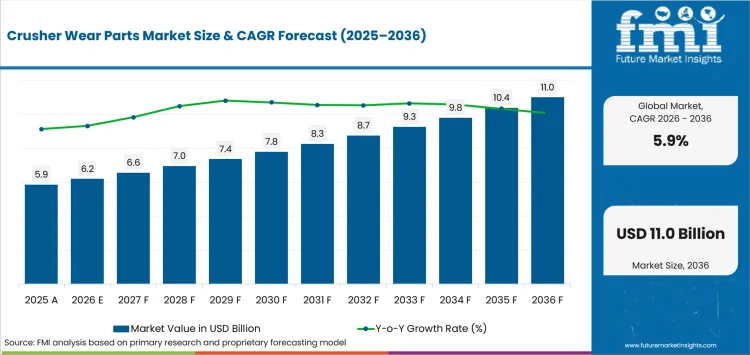
Key Takeaways of Crusher Wear Parts Market
- Recurring crusher wear demand follows abrasive throughput as mines and quarries replace chamber components once usable profiles deteriorate during normal operation.
- By part type, jaw plates are forecast to represent 22.0% in 2026 driven by direct compressive and sliding wear in primary crushing.
- Manganese steel is likely to capture 41.0% share in 2026 attributable to work hardening that balances impact toughness with wear resistance.
- Jaw crushers are set to lead the crusher type category with 27.0% share in 2026 due to their broad primary-stage installed base.
- Alternative-part switching remains constrained by feed-specific wear and chamber fit as a failed liner trial can reduce throughput or force unplanned maintenance.
- Metso, Sandvik, FLS, ESCO / Weir, Magotteaux, ME Elecmetal, CMS Cepcor and Columbia Steel Cast Products LLC compete across OEM-linked and independent wear-part routes.
Analyst Perspective
“A wear-part quote is incomplete until the operator knows how many tonnes the liner should process between planned stops. I would favor offers that pair chamber-specific metallurgy with field measurements and local stock as those inputs determine cost per processed tonne.”
- Nikhil Kaitwade, Principal Consultant, Future Market Insights
How is the Crusher Wear Parts Market segmented?
The crusher wear parts market is segmented by part type, material, crusher type, end use, demand type, sales channel and region.
Part type covers jaw plates, cone crusher liners, impact hammers / blow bars, mantles & concaves, roll shells, rotor tips and side liners. Material includes manganese steel, high chrome iron, alloy steel, ceramic inserts and tungsten carbide / specialty. Crusher type covers cone, jaw, impact, hammer and roll crushers. End use includes mining, aggregates, cement, recycling and construction materials. Demand type separates aftermarket / replacement, OEM parts and performance upgrade parts. Within the demand type category, aftermarket / replacement is estimated to account for 65.0% in 2026 because installed crushing fleets consume working components during normal operation.
Why do cone crushers lead demand within the crusher type category?
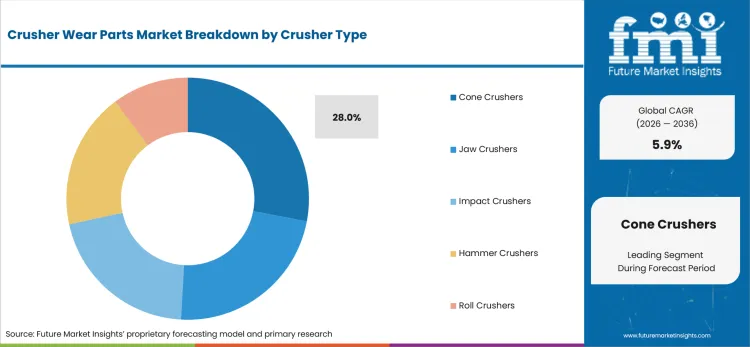
Cone crushers process hard material through a continuously changing chamber profile, making liner wear a recurring operating consideration. Plant teams manage mantle and concave changes around feed characteristics, closed-side settings and planned maintenance windows.
- By crusher type, cone crushers are estimated to hold 28.0% in 2026 because their installed use across mining and aggregates creates recurring liner demand.
- Wear-part suppliers must match chamber geometry and alloy selection to the installed cone crusher. This fit helps operators maintain particle size and throughput while avoiding unplanned changes to downstream processing.
What makes jaw plates central to the part type category?
Jaw plates take the first compressive load in primary crushers, so tooth profile affects feed grip and material movement across stone crushing equipment. Weir connected plate selection with OEM chamber design in September 2025 by fitting ESCO wear parts across its new ENDURON jaw range.
- By part type, jaw plates are estimated to hold 22.0% in 2026 owing to direct contact with coarse feed during primary crushing.
- Maintenance teams qualify alternative plates faster once field wear records confirm compatible tooth geometry and predictable campaign life under local feed conditions. Local inventory then protects the planned changeout window at sites that cannot tolerate emergency freight delays.
Why does manganese steel lead demand within the material category?
Manganese steel remains practical for impact-heavy chambers as its surface work-hardens while the casting retains toughness under repeated shock loads across aggregate processing equipment.
- Manganese steel is projected to hold 41.0% share in 2026 owing to a familiar foundry route for large jaw and cone liners.
- Foundries can adjust chemistry and profile within the same material family without changing the basic qualification route for every chamber. The same material flexibility reduces the need to qualify a new alloy family for every liner profile.
What supports mining as the leading end use category?
Mining circuits place large crushers inside long production campaigns, so liner changes must fit shutdown plans that also cover bearings and mining lubricants. A delayed changeout can idle upstream haulage and disrupt the downstream concentrator schedule during planned production.
- Based on end use, mining is projected to account for 38.0% in 2026 due to high tonnage that makes liner life commercially significant.
- Metso expanded the primary mining crusher field in June 2026 by launching three models designed for different ore duties and maintenance needs. Mine teams favor engineered profiles once site records show longer campaigns without forcing broader crusher replacement or disruptive process changes.
What are the drivers, restraints and opportunities in the Crusher Wear Parts Market?
Abrasive throughput sustains recurring replacement as feed-specific wear slows qualification and condition monitoring gives maintenance teams a measurable basis for premium liner selection.
- Driver: Sustained mineral-processing throughput increases contact between abrasive feed and sacrificial crusher surfaces throughout normal production cycles.
- Restraint: Feed variability makes wear results site-specific and slows approval of unfamiliar alloys or alternative liner profiles.
- Opportunity: Digital wear measurement and engineered materials let wear-part manufacturers sell verified campaign performance instead of undifferentiated casting weight.
High Throughput Increases Wear Exposure
Crusher wear parts are consumed as active circuits process rock and repeated contact removes the chamber profile needed for stable crushing. Regional inventory works best when it follows planned shutdown schedules across high-throughput surface mining equipment. Australia’s Department of Industry reported in June 2026 that March-quarter iron ore export volumes rose 6% year over year, keeping material movement high in wear-intensive iron ore circuits.
Feed Variability Raises Qualification Risk
Crusher performance can vary significantly between sites because wear rates depend on ore characteristics, throughput levels and chamber design. Weir reported in August 2025 that ESCO 14R wear parts on a Polish HP300 cone crusher processed 41.6% more material than locally sourced parts. The measured difference makes site qualification necessary as feed abrasiveness and chamber geometry can change the result of a liner trial. Production-critical crushers therefore need comparable operating records to approve unfamiliar metallurgy for routine site replacement.
Wear Monitoring Makes Performance Easier to Prove
Machine condition monitoring gives maintenance teams a stronger basis for judging premium wear parts against measured service life, remaining profile and planned changeout timing at high-throughput sites during shutdown planning. Sandvik launched the QH443E cone crusher in March 2025 with Constant Liner Performance technology that supplies condition data for liner trials and replacement timing in performance-based service agreements at sites.
Which country CAGRs are profiled in the Crusher Wear Parts Market?
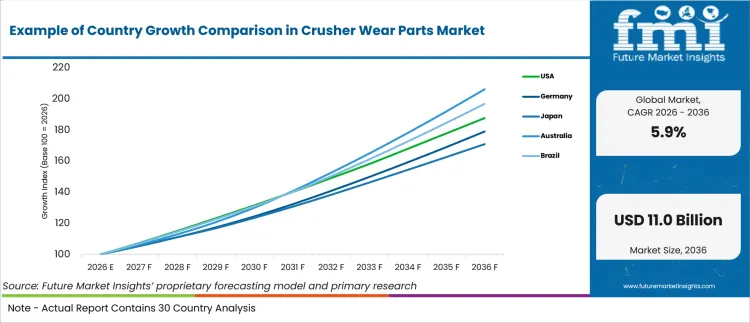
| Country | CAGR |
|---|---|
| Australia | 5.8% |
| Brazil | 5.6% |
| USA | 5.0% |
| Germany | 4.6% |
| Japan | 4.3% |
How do country-level CAGRs compare in the Crusher Wear Parts Market?
The profiled country CAGRs span 1.5 percentage points, forming a narrow distribution with Australia and Brazil in a resource-led upper pair. USA bridges that pair and the mature German and Japanese replacement bases. The spacing reflects mine geography and service economics instead of a ranking of current absolute market size.
- Australia rewards shutdown-aligned inventory as iron ore mines face costly emergency freight.
- Brazil requires regional coverage across iron ore districts and long operating corridors.
- Mixed-brand crusher fleets in USA raise fitment value during replacement approval at aggregate and mining plants.
- Germany places lifecycle evidence ahead of premium metallurgy claims across mature quarries.
- Japan emphasizes exact part matching across established quarries and measured construction schedules.
Similar growth rates therefore produce different order economics across installed crusher fleets. The full report provides country-level CAGR analysis across North America, Latin America, Europe, East Asia, South Asia, Oceania and the Middle East and Africa.
Country-wise Analysis
- Australian hard-rock mines plan liner changes around shutdown windows across remote iron ore regions as a late delivery can leave high-tonnage primary crushing idle. Geoscience Australia reported in December 2025 that 55 iron ore mines produced 954 Mt during 2024, defining a large regional operating base for recurring chamber wear. Adoption of crusher wear parts in Australia is estimated to expand at 5.8% CAGR through 2036, supported by planned replacement across hard-rock mines. Long service distances remain the commercial friction, so wear specialists need site-aligned inventory and dependable field support to qualify premium profiles against local feed wear for repeated campaigns.
- Brazilian crusher maintenance spans iron ore districts and long inland corridors that make regional stock more useful than centralized emergency supply. Urgent-delivery exposure is the local friction, so distributors need application engineers who can compare liner wear across Latin America mining equipment fleets during qualification. The National Mining Agency reported in January 2026 that 13,691 mining processes recorded royalty payments during 2025, giving wear specialists a broad map of active mineral sites. Brazil is estimated to post 5.6% CAGR over the forecast period, shaped by sustained mineral production. Wear specialists with regional stock can tie replenishment to actual liner consumption at each mine instead of holding generic national inventory.
- In February 2026 the USA Geological Survey valued 2025 domestic mineral production at USD 112 billion, defining the scale of activity served by national mining maintenance networks. Mixed-brand crusher fleets make fitment records and nearby stock central to replacement planning across aggregate and mining sites. By 2036, USA is projected to grow at 5.0% CAGR owing to recurring replacement across mature crushing fleets. Multi-brand maintenance remains the local friction because plants must match jaw and cone profiles across different chamber records. Domestic distributors reduce emergency lead-time risk by holding common liners near major aggregate production regions nationwide. Field wear studies provide the proof needed to place unfamiliar liners into routine replacement schedules without carrying excessive emergency inventory.
- German quarry operators have mature crusher fleets and established service choices, so premium liners compete against familiar parts with known campaign histories. The German crusher wear parts sector is projected to record 4.6% CAGR during the assessment period, influenced by recurring replacement instead of rapid fleet additions. Fitment proof is the main local friction as plants need measurable lifecycle savings to justify a change in alloy or chamber profile. Sandvik added Lutze Process Germany as an authorized mobile-crusher distributor in November 2025, extending sales and technical support across twelve German locations. Quarry maintenance teams therefore favor providers that pair documented campaign results with fast regional response during planned maintenance.
- Japanese aggregate producers plan liner replacement around stable quarry output and closely measured construction-material schedules across a mature domestic market. Local service teams therefore place more weight on exact part matching and predictable delivery than on broad emergency stock. Crusher wear part sales in Japan are forecast to expand at 4.3% CAGR by 2036, reinforced by recurring maintenance across established crusher fleets. Conservative qualification remains the main friction as plants expect wear-life gains without major changes to familiar chamber settings. In October 2025, Japan’s Ministry of Land Infrastructure Transport and Tourism estimated fiscal-year crushed stone demand at 87 million cubic meters. The published volume gives replacement specialists a defined operating base for planning recurring maintenance campaigns across domestic quarries.
Who are the notable companies in the Crusher Wear Parts Market?
Metso, Sandvik, FLSmidth, ESCO / Weir, Magotteaux, ME Elecmetal, CMS Cepcor and Columbia Steel Cast Products LLC are the notable companies serving this market.
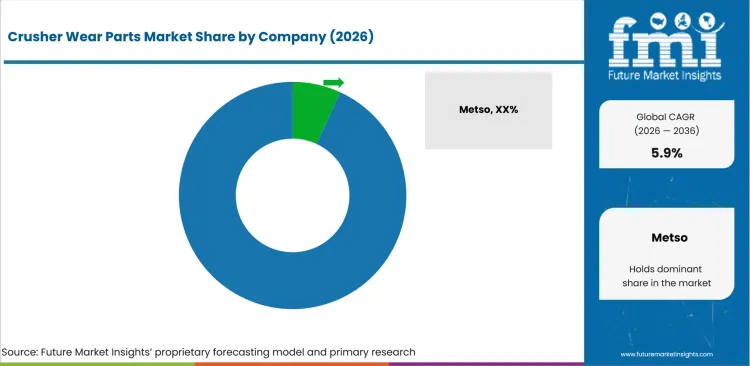
Crusher wear competition is fragmented between OEM-linked programs and independent foundries as operators compare chamber fit with documented campaign performance. Entry requires accurate castings, alloy knowledge and enough regional stock to protect planned shutdowns at remote mining and quarry sites. Field measurement and local service determine how quickly a new liner profile progresses from a controlled trial into routine replacement.
- Metso, Sandvik and FLSmidth combine crusher platforms with original-fit wear programs plus field measurement that reduces chamber-fit uncertainty.
- ESCO / Weir and Magotteaux compete with alloy and composite wear technology for abrasive mining and quarry duties.
- ME Elecmetal, CMS Cepcor and Columbia Steel Cast Products LLC cover independent replacement routes with liner engineering and multi-brand field support.
Competitive Benchmarking: Crusher Wear Parts Market
| Company | Crusher Fitment Breadth | Wear Engineering & Measurement | Operating Evidence & Support | Geographic Reach |
|---|---|---|---|---|
| Metso | High | High | High | Global |
| Sandvik | High | High | High | Global |
| FLSmidth | Medium | Medium | High | Global |
| ESCO / Weir | Medium | High | Medium | Global |
| Magotteaux | Low | Medium | Low | Global |
| ME Elecmetal | Medium | High | High | Americas and international mining markets |
| CMS Cepcor | Medium | Medium | Medium | United Kingdom, Americas, Australia and Chile |
| Columbia Steel Cast Products LLC | High | High | Medium | North America and international sales |
Key Developments in the Crusher Wear Parts Market
- In July 2026, Metso continued a three-year MX wear-parts agreement for Nordberg MP1250 crushers at a South American mine. Dedicated on-site stock and continuous liner monitoring align replacement supply with measured consumption and planned mine availability. The arrangement lets the site compare liner life with operating data while reducing dependence on broad emergency inventory.
- In April 2026, Magotteaux launched Advance MMC wear parts for VSI impellers and anvils in abrasive quarry and recycling duties. The company reported up to 20% longer wear life compared with conventional options in highly abrasive applications. The launch gives operators a documented performance threshold for deciding whether composite parts justify a higher purchase price.
- In February 2026, FLSmidth released CrusherLensIQ for camera-based open-side-setting measurement on gyratory crushers. The method gives maintenance teams a repeatable chamber measurement during inspection and ties wear decisions to a measured open-side setting across planned maintenance campaigns. Sites can compare chamber condition across inspections and plan liner adjustments against the same measured reference.
Key Players in the Crusher Wear Parts Market
OEM-Integrated Crusher Wear Platforms
- Metso
- Sandvik
- FLSmidth
Wear-Material and Composite Specialists
- ESCO / Weir
- Magotteaux
- Columbia Steel Cast Products LLC
Multi-Brand Liner and Field Engineering Specialists
- ME Elecmetal
- CMS Cepcor
Crusher Wear Parts Market - Report Scope
| Coverage field | Report scope |
|---|---|
| Market breakdown | By part type, material, crusher type, end use, demand type, sales channel and region. |
| Quantitative Units | Revenue in USD million and CAGR in %. |
| Market Definition | Commercial revenue from replaceable crusher wear components used in crushing chambers across mining, aggregates, cement, recycling and construction-material operations. |
| Regions Covered | North America, Latin America, Europe, East Asia, South Asia and Pacific, and Middle East and Africa. |
| Countries Covered | Australia, Brazil, USA, Germany, Japan, and 20+ countries included in the full report. |
| Key Companies Profiled | Metso, Sandvik, FLSmidth, ESCO / Weir, Magotteaux, ME Elecmetal, CMS Cepcor, Columbia Steel Cast Products LLC. |
| Forecast Period | 2026 to 2036. |
| Approach | Primary and secondary research with market triangulation. |
Crusher Wear Parts Market - Research Methodology
| Method | Approach |
|---|---|
| Primary Research | FMI analysts gathered input from manufacturers, service providers, technology developers, distributors, end users, procurement teams, and subject-matter experts. Interviews examined purchasing decisions, product or service evaluation, adoption barriers, approval requirements, pricing considerations, and expectations for technical or commercial support. Respondents were also asked what evidence is required before a trial, pilot, or initial order develops into regular purchasing. |
| Desk Research | Desk research covered government statistics, regulatory publications, trade data, industry associations, technical literature, standards, company filings, product information, and official corporate announcements. Sources were reviewed for relevance, publication date, geographic coverage, and consistency with the defined market scope. Claims relating to performance, applications, approvals, capacity, investment, and commercial activity were retained only when supported by credible public evidence. |
| Market Sizing and Forecasting | The market model combined the baseline value with historical performance, segment structure, pricing and volume indicators, adoption levels, company participation, and country-level demand conditions. Forecast assumptions considered economic activity, investment trends, regulatory developments, technology adoption, purchasing cycles, supply availability, and barriers to wider market use. Segment and regional estimates were reconciled before the final market total was calculated. |
| Data Validation | Estimates were checked against multiple independent indicators, including public data, company activity, trade patterns, industry developments, and findings from primary interviews. Validation also tested whether products, services, applications, and company revenues fell within the defined market boundaries. Adjacent categories, unsupported claims, overlapping revenues, and activities without direct market relevance were excluded to reduce double counting and maintain consistency across segments and countries. |
Crusher Wear Parts Market by Segments
Crusher Wear Parts Market segmented by Part Type:
- Jaw Plates
- Cone Crusher Liners
- Impact Hammers / Blow Bars
- Mantles & Concaves
- Roll Shells
- Rotor Tips
- Side Liners
Crusher Wear Parts Market segmented by Material:
- Manganese Steel
- High Chrome Iron
- Alloy Steel
- Ceramic Inserts
- Tungsten Carbide / Specialty
Crusher Wear Parts Market segmented by Crusher Type:
- Jaw Crushers
- Cone Crushers
- Impact Crushers
- Hammer Crushers
- Roll Crushers
Crusher Wear Parts Market segmented by End Use:
- Mining
- Aggregates
- Cement
- Recycling
- Construction Materials
Crusher Wear Parts Market segmented by Demand Type:
- OEM Parts
- Aftermarket / Replacement
- Performance Upgrade Parts
Crusher Wear Parts Market segmented by Sales Channel:
- Crusher OEMs
- Independent Wear Part Suppliers
- MRO Distributors
- Service Contracts
Crusher Wear Parts Market by Region:
- North America
- United States
- Canada
- Latin America
- Brazil
- Mexico
- Chile
- Rest of Latin America
- Western Europe
- Germany
- United Kingdom
- Italy
- Spain
- France
- Nordics
- Benelux
- Rest of Western Europe
- Eastern Europe
- Russia
- Poland
- Hungary
- Balkan and Baltic States
- Rest of Eastern Europe
- East Asia
- China
- Japan
- South Korea
- South Asia and Pacific
- India
- ASEAN
- Australia and New Zealand
- Rest of South Asia and Pacific
- Middle East and Africa
- Kingdom of Saudi Arabia
- Other GCC Countries
- Türkiye
- South Africa
- Other African Union Countries
- Rest of Middle East and Africa
Research Sources and Bibliography
- USA Geological Survey. (2025, January 31). USGS: Value of USA mineral production edged up in 2024.
- Agência Nacional de Mineração. (2026, February 9). Produção de substâncias metálicas soma R$ 220,5 bilhões e mantém Brasil entre os grandes exportadores globais.
- Weir. (2025, September 30). Weir unveils new ENDURON® crushers designed to deliver safer, smarter, and more sustainable mining operations.
- Sandvik Rock Processing. (2025, August 27). From worn-out to wear parts.
- Metso. (2025, October 9). Metso celebrates 50 years of Nordberg C Series jaw crushers - a legacy of reliability in primary crushing.
- Metso. (2026, June 3). Metso launches new primary crushers for unmatched safety and availability in mining.
- Australian Government Department of Industry, Science and Resources. (2026, June). Resources and energy quarterly: June 2026.
- Weir. (2025, August 15). ESCO® crusher wear parts produce more material for HP300™ cone crusher.
- Sandvik Rock Processing. (2025, March 31). Sandvik launch the electrifying QH443E tracked cone crusher.
- Geoscience Australia. (2025, December 10). 2025 Preliminary Tables.
- Agência Nacional de Mineração. (2026, January 20). Quase R$ 8 bilhões arrecadados com royalties da mineração em 2025.
- USA Geological Survey. (2026, February 6). Value of USA mineral production rose last year, driven by precious metals prices.
- Sandvik Rock Processing. (2025, November 11). Lutze Process Germany appointed as new distributor for Sandvik mobile crushers & screens in Germany.
- Ministry of Land, Infrastructure, Transport and Tourism. (2025, October 31). 本年度の主要建設資材需要見通しはセメント、生コンクリート、普通鋼鋼材にて増加 ~令和7年度主要建設資材需要見通しを算出~.
- FLSmidth & Co. A/S. (2025, February 19). FLSmidth to significantly expand its global service centre network in 2025, further strengthening its service offerings and customer proximity.
- FLSmidth & Co. A/S. (2025, December 15). FLS selected as technology partner and supplier of all the main process technologies for a gold project in Ghana.
- ME Elecmetal. (2026, April 21). ME Elecmetal’s 2026 Customer Summit 360° - Value-Added Technical Training.
- CMS Cepcor. (2026). Our Blog & Industry News | CMS Cepcor. Retrieved August 11, 2026.
- Metso. (2026, July 3). Metso strengthens long-term partnership with a major mining customer in South America through new technology development for crusher wear parts.
- Magotteaux. (2026, April 23). Magotteaux introduces Advance, a new patented MMC solution for VSI wear parts.
- FLS. (2026, February 11). CrusherLensIQ for Gyratory Crushers - safer, more reliable and more accurate measurement.
This bibliography is provided for reader reference and is not exhaustive. The full report contains the complete reference list and detailed citations.
This Report Answers
- How large is the crusher wear parts market in 2026 and 2036?
- Which operating conditions sustain recurring replacement demand across active crushing circuits?
- Why do jaw plates lead the part type category during 2026?
- How does manganese steel suit impact-heavy crusher chambers and repeated abrasion?
- Why do jaw crushers create a large recurring plate replacement base?
- How do profiled countries differ in crusher wear parts growth conditions?
- Which companies combine fitment coverage with metallurgy and field wear support?
- How do feed variability and chamber fitment slow alternative-part qualification?
Frequently Asked Questions
How big is the Crusher Wear Parts Market in 2026?
The crusher wear parts market is valued at USD 6.2 billion in 2026 and is projected to reach USD 11.0 billion by 2036. Abrasive throughput creates recurring replacement demand across operating crushing circuits.
What is the CAGR of the Crusher Wear Parts Market from 2026 to 2036?
The crusher wear parts market is projected to grow at a CAGR of 5.9% between 2026 and 2036. Ongoing plate and liner replacement across mining and aggregate fleets supports growth.
Which part type leads the Crusher Wear Parts Market?
Jaw plates are projected to account for 22.0% of the crusher wear parts market in 2026. Direct compression and sliding abrasion make their usable profile central to primary-crusher performance.
How much value will the Crusher Wear Parts Market add between 2026 and 2036?
The crusher wear parts market is expected to add USD 4.8 billion in value between 2026 and 2036. Recurring plate and liner replacement across installed crushing fleets supports the increase.
Which companies are active in the Crusher Wear Parts Market?
Key companies include Metso, Sandvik, FLSmidth, ESCO / Weir, Magotteaux, ME Elecmetal, CMS Cepcor and Columbia Steel Cast Products LLC. They compete through fitment, metallurgy, wear engineering and field support.
Preview the report firsthand - request a free sample
Get SampleGet the brochure for pricing and purchase details.
Get PDFTable of Content
- Key Takeaways
- Market Size and CAGR
- Top Growth Driver
- Fastest Growing Segment
- Leading Region
- Key Companies
- Emerging Opportunities
- Executive Summary
- Global Market Outlook
- Demand-side Trends
- Supply-side Trends
- Technology Roadmap Analysis
- Analysis and Recommendations
- Analyst Perspective (What is happening? Why now? What should investors know?)
- Key Questions Answered
- How large is the market?
- What is the CAGR?
- What are key trends?
- Which region dominates?
- Who are the leaders?
- Market Overview
- Market Coverage / Taxonomy
- Market Definition / Scope / Limitations
- Research Methodology
- Chapter Orientation
- Analytical Lens and Working Hypotheses
- Market Structure, Signals, and Trend Drivers
- Benchmarking and Cross-market Comparability
- Market Sizing, Forecasting, and Opportunity Mapping
- Research Design and Evidence Framework
- Desk Research Programme (Secondary Evidence)
- Expert Input and Fieldwork (Primary Evidence)
- Tooling, Models, and Reference Databases
- Data Engineering and Model Build
- Quality Assurance and Audit Trail
- Market Background
- Market Dynamics (Drivers, Restraints, Opportunity, Trends)
- Scenario Forecast (Optimistic, Likely, Conservative)
- Impact Analysis
- AI Impact
- Sustainability Impact
- Regulatory Impact
- Technology Impact
- Consumer / Buyer Analysis
- Purchase Drivers
- Adoption Barriers
- Buyer Journey
- Opportunity Map Analysis
- Product Life Cycle Analysis
- Supply Chain Analysis
- Investment Feasibility Matrix
- Value Chain Analysis
- PESTLE and Porter's Analysis
- Regulatory Landscape
- Regional Parent Market Outlook
- Production and Consumption Statistics
- Import and Export Statistics
- Global Market Analysis and Forecast, 2021 to 2036
- Historical Market Size Value (USD Billion) Analysis, 2021 to 2025
- Current and Future Market Size Value (USD Billion) Projections, 2026 to 2036
- Y-o-Y Growth Trend Analysis
- Absolute $ Opportunity Analysis
- Global Market Pricing Analysis, 2021 to 2036
- Global Market Analysis and Forecast, By Part Type, 2021 to 2036
- Introduction / Key Findings
- Historical Market Size Value (USD Billion) Analysis By Part Type, 2021 to 2025
- Current and Future Market Size Value (USD Billion) Analysis and Forecast By Part Type, 2026 to 2036
- Jaw Plates
- Cone Crusher Liners
- Impact Hammers / Blow Bars
- Mantles & Concaves
- Roll Shells
- Rotor Tips
- Side Liners
- Jaw Plates
- Y-o-Y Growth Trend Analysis By Part Type, 2021 to 2025
- Absolute $ Opportunity Analysis By Part Type, 2026 to 2036
- Global Market Analysis and Forecast, By Material, 2021 to 2036
- Introduction / Key Findings
- Historical Market Size Value (USD Billion) Analysis By Material, 2021 to 2025
- Current and Future Market Size Value (USD Billion) Analysis and Forecast By Material, 2026 to 2036
- Manganese Steel
- High Chrome Iron
- Alloy Steel
- Ceramic Inserts
- Tungsten Carbide / Specialty
- Manganese Steel
- Y-o-Y Growth Trend Analysis By Material, 2021 to 2025
- Absolute $ Opportunity Analysis By Material, 2026 to 2036
- Global Market Analysis and Forecast, By Crusher Type, 2021 to 2036
- Introduction / Key Findings
- Historical Market Size Value (USD Billion) Analysis By Crusher Type, 2021 to 2025
- Current and Future Market Size Value (USD Billion) Analysis and Forecast By Crusher Type, 2026 to 2036
- Cone Crushers
- Jaw Crushers
- Impact Crushers
- Hammer Crushers
- Roll Crushers
- Cone Crushers
- Y-o-Y Growth Trend Analysis By Crusher Type, 2021 to 2025
- Absolute $ Opportunity Analysis By Crusher Type, 2026 to 2036
- Global Market Analysis and Forecast, By End Use, 2021 to 2036
- Introduction / Key Findings
- Historical Market Size Value (USD Billion) Analysis By End Use, 2021 to 2025
- Current and Future Market Size Value (USD Billion) Analysis and Forecast By End Use, 2026 to 2036
- Mining
- Aggregates
- Cement
- Recycling
- Construction Materials
- Mining
- Y-o-Y Growth Trend Analysis By End Use, 2021 to 2025
- Absolute $ Opportunity Analysis By End Use, 2026 to 2036
- Global Market Analysis and Forecast, By Demand Type, 2021 to 2036
- Introduction / Key Findings
- Historical Market Size Value (USD Billion) Analysis By Demand Type, 2021 to 2025
- Current and Future Market Size Value (USD Billion) Analysis and Forecast By Demand Type, 2026 to 2036
- Aftermarket / Replacement
- OEM Parts
- Performance Upgrade Parts
- Aftermarket / Replacement
- Y-o-Y Growth Trend Analysis By Demand Type, 2021 to 2025
- Absolute $ Opportunity Analysis By Demand Type, 2026 to 2036
- Global Market Analysis and Forecast, By Region, 2021 to 2036
- Introduction
- Historical Market Size Value (USD Billion) Analysis By Region, 2021 to 2025
- Current Market Size Value (USD Billion) Analysis and Forecast By Region, 2026 to 2036
- North America
- Latin America
- Western Europe
- Eastern Europe
- East Asia
- South Asia and Pacific
- Middle East & Africa
- Market Attractiveness Analysis By Region
- North America Market Analysis and Forecast, By Country, 2021 to 2036
- Historical Market Size Value (USD Billion) Trend Analysis By Market Taxonomy, 2021 to 2025
- Market Size Value (USD Billion) Forecast By Market Taxonomy, 2026 to 2036
- By Country
- USA
- Canada
- By Part Type
- By Material
- By Crusher Type
- By End Use
- By Demand Type
- By Country
- Market Attractiveness Analysis
- By Country
- By Part Type
- By Material
- By Crusher Type
- By End Use
- By Demand Type
- Key Takeaways
- Latin America Market Analysis and Forecast, By Country
- Historical Market Size Value (USD Billion) Trend Analysis By Market Taxonomy, 2021 to 2025
- Market Size Value (USD Billion) Forecast By Market Taxonomy, 2026 to 2036
- By Country
- Brazil
- Mexico
- Chile
- Rest of Latin America
- By Part Type
- By Material
- By Crusher Type
- By End Use
- By Demand Type
- By Country
- Market Attractiveness Analysis
- By Country
- By Part Type
- By Material
- By Crusher Type
- By End Use
- By Demand Type
- Key Takeaways
- Western Europe Market Analysis and Forecast, By Country
- Historical Market Size Value (USD Billion) Trend Analysis By Market Taxonomy, 2021 to 2025
- Market Size Value (USD Billion) Forecast By Market Taxonomy, 2026 to 2036
- By Country
- Germany
- UK
- Italy
- Spain
- France
- Nordic
- BENELUX
- Rest of Western Europe
- By Part Type
- By Material
- By Crusher Type
- By End Use
- By Demand Type
- By Country
- Market Attractiveness Analysis
- By Country
- By Part Type
- By Material
- By Crusher Type
- By End Use
- By Demand Type
- Key Takeaways
- Eastern Europe Market Analysis and Forecast, By Country
- Historical Market Size Value (USD Billion) Trend Analysis By Market Taxonomy, 2021 to 2025
- Market Size Value (USD Billion) Forecast By Market Taxonomy, 2026 to 2036
- By Country
- Russia
- Poland
- Hungary
- Balkan & Baltic
- Rest of Eastern Europe
- By Part Type
- By Material
- By Crusher Type
- By End Use
- By Demand Type
- By Country
- Market Attractiveness Analysis
- By Country
- By Part Type
- By Material
- By Crusher Type
- By End Use
- By Demand Type
- Key Takeaways
- East Asia Market Analysis and Forecast, By Country
- Historical Market Size Value (USD Billion) Trend Analysis By Market Taxonomy, 2021 to 2025
- Market Size Value (USD Billion) Forecast By Market Taxonomy, 2026 to 2036
- By Country
- China
- Japan
- South Korea
- By Part Type
- By Material
- By Crusher Type
- By End Use
- By Demand Type
- By Country
- Market Attractiveness Analysis
- By Country
- By Part Type
- By Material
- By Crusher Type
- By End Use
- By Demand Type
- Key Takeaways
- South Asia and Pacific Market Analysis and Forecast, By Country
- Historical Market Size Value (USD Billion) Trend Analysis By Market Taxonomy, 2021 to 2025
- Market Size Value (USD Billion) Forecast By Market Taxonomy, 2026 to 2036
- By Country
- India
- ASEAN
- Australia & New Zealand
- Rest of South Asia and Pacific
- By Part Type
- By Material
- By Crusher Type
- By End Use
- By Demand Type
- By Country
- Market Attractiveness Analysis
- By Country
- By Part Type
- By Material
- By Crusher Type
- By End Use
- By Demand Type
- Key Takeaways
- Middle East & Africa Market Analysis and Forecast, By Country
- Historical Market Size Value (USD Billion) Trend Analysis By Market Taxonomy, 2021 to 2025
- Market Size Value (USD Billion) Forecast By Market Taxonomy, 2026 to 2036
- By Country
- Kingdom of Saudi Arabia
- Other GCC Countries
- Türkiye
- South Africa
- Other African Union
- Rest of Middle East & Africa
- By Part Type
- By Material
- By Crusher Type
- By End Use
- By Demand Type
- By Country
- Market Attractiveness Analysis
- By Country
- By Part Type
- By Material
- By Crusher Type
- By End Use
- By Demand Type
- Key Takeaways
- Key Countries Market Analysis
- USA
- Pricing Analysis
- Market Share Analysis, 2025
- By Part Type
- By Material
- By Crusher Type
- By End Use
- By Demand Type
- Canada
- Pricing Analysis
- Market Share Analysis, 2025
- By Part Type
- By Material
- By Crusher Type
- By End Use
- By Demand Type
- Mexico
- Pricing Analysis
- Market Share Analysis, 2025
- By Part Type
- By Material
- By Crusher Type
- By End Use
- By Demand Type
- Brazil
- Pricing Analysis
- Market Share Analysis, 2025
- By Part Type
- By Material
- By Crusher Type
- By End Use
- By Demand Type
- Chile
- Pricing Analysis
- Market Share Analysis, 2025
- By Part Type
- By Material
- By Crusher Type
- By End Use
- By Demand Type
- Germany
- Pricing Analysis
- Market Share Analysis, 2025
- By Part Type
- By Material
- By Crusher Type
- By End Use
- By Demand Type
- UK
- Pricing Analysis
- Market Share Analysis, 2025
- By Part Type
- By Material
- By Crusher Type
- By End Use
- By Demand Type
- Italy
- Pricing Analysis
- Market Share Analysis, 2025
- By Part Type
- By Material
- By Crusher Type
- By End Use
- By Demand Type
- Spain
- Pricing Analysis
- Market Share Analysis, 2025
- By Part Type
- By Material
- By Crusher Type
- By End Use
- By Demand Type
- France
- Pricing Analysis
- Market Share Analysis, 2025
- By Part Type
- By Material
- By Crusher Type
- By End Use
- By Demand Type
- India
- Pricing Analysis
- Market Share Analysis, 2025
- By Part Type
- By Material
- By Crusher Type
- By End Use
- By Demand Type
- ASEAN
- Pricing Analysis
- Market Share Analysis, 2025
- By Part Type
- By Material
- By Crusher Type
- By End Use
- By Demand Type
- Australia & New Zealand
- Pricing Analysis
- Market Share Analysis, 2025
- By Part Type
- By Material
- By Crusher Type
- By End Use
- By Demand Type
- China
- Pricing Analysis
- Market Share Analysis, 2025
- By Part Type
- By Material
- By Crusher Type
- By End Use
- By Demand Type
- Japan
- Pricing Analysis
- Market Share Analysis, 2025
- By Part Type
- By Material
- By Crusher Type
- By End Use
- By Demand Type
- South Korea
- Pricing Analysis
- Market Share Analysis, 2025
- By Part Type
- By Material
- By Crusher Type
- By End Use
- By Demand Type
- Russia
- Pricing Analysis
- Market Share Analysis, 2025
- By Part Type
- By Material
- By Crusher Type
- By End Use
- By Demand Type
- Poland
- Pricing Analysis
- Market Share Analysis, 2025
- By Part Type
- By Material
- By Crusher Type
- By End Use
- By Demand Type
- Hungary
- Pricing Analysis
- Market Share Analysis, 2025
- By Part Type
- By Material
- By Crusher Type
- By End Use
- By Demand Type
- Kingdom of Saudi Arabia
- Pricing Analysis
- Market Share Analysis, 2025
- By Part Type
- By Material
- By Crusher Type
- By End Use
- By Demand Type
- Türkiye
- Pricing Analysis
- Market Share Analysis, 2025
- By Part Type
- By Material
- By Crusher Type
- By End Use
- By Demand Type
- South Africa
- Pricing Analysis
- Market Share Analysis, 2025
- By Part Type
- By Material
- By Crusher Type
- By End Use
- By Demand Type
- USA
- Market Structure Analysis
- Competition Dashboard
- Competition Benchmarking
- Market Share Analysis of Top Players
- By Regional
- By Part Type
- By Material
- By Crusher Type
- By End Use
- By Demand Type
- Emerging Startups
- Innovation Benchmarking
- Competition Analysis
- Competition Deep Dive
- Metso
- Overview
- Product Portfolio
- Profitability by Market Segments
- Sales Footprint
- Strategy Overview
- Marketing Strategy
- Product Strategy
- Channel Strategy
- Sandvik
- FLSmidth
- Columbia Steel
- Bradken
- Magotteaux
- AIA Engineering
- ME Elecmetal
- ESCO / Weir
- CMS Cepcor
- Metso
- Case Studies
- Success Stories
- Recent Developments
- Competition Deep Dive
- Assumptions & Acronyms Used


