

- Market Size (2026)
- USD 121.4 Mn
- Forecast (2036)
- USD 257.3 Mn
- CAGR (2026 to 2036)
- 7.8%
How big is Curvic Precision Couplings Market in 2026?
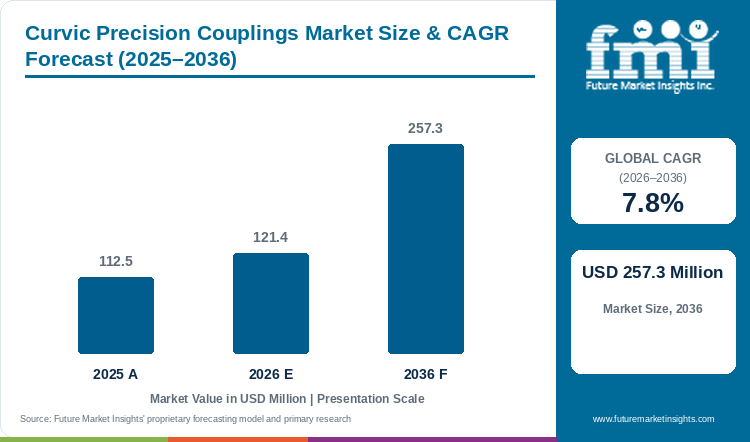
Valued at USD 112.5 million during 2025, worldwide Curvic precision couplings demand is projected to stand at USD 121.4 million for 2026 and is forecast to reach USD 257.3 million by the end of 2036 on an anticipated 7.8% CAGR.
After recording USD 112.5 million during 2025, worldwide Curvic precision couplings expenditure is estimated at USD 121.4 million for 2026 and is projected to reach USD 257.3 million during 2036 via an expected 7.8% CAGR that is predicted to add USD 135.9 million to annual market revenue between 2026 and 2036. High-speed gas turbine and axial compressor rotors spinning above 10,000 rpm cannot rely on flat-flanged rabbet bolts or straight radial splines without suffering centrifugal eccentric unbalance and thermal bow across stacked disc stages in turbofan engines. Because a cylindrical cup-type grinding wheel generates convex barrel teeth on one rotor face and matching concave hourglass teeth on the mating face, Fixed-Ratio Hourglass Concave/Convex Mating Teeth are expected to command 74.5% of tooth flank geometry demand in 2026 by automatically recentering stacked discs under differential thermal expansion. Confirming the multi-year propulsion build and overhaul cycle behind this demand, the Federal Aviation Administration (FAA) projected in its Aerospace Forecast for Fiscal Years 2026-2046 that U.S. commercial airline revenue passenger miles will grow 2.6% annually while active turbine general aviation aircraft expand 2.1% annually through 2046 [1].
Key Market Trends & Insights
- By tooth flank geometry: Fixed-Ratio Hourglass Concave/Convex Mating Teeth (74.5% expected share for 2026) are projected to dominate rotor design because the outside diameter of the cup grinding wheel machines convex barrel teeth on one member while the inside diameter grinds matching concave hourglass teeth on the mating disk.
- By metallurgy & heat treatment: Inconel 718 / Waspaloy Nickel Superalloy Ground Rings (56.2% projected share for 2026) are anticipated to form the primary material tier since high-pressure compressor and turbine disks must retain tie-bolt preload without stress relaxation under extreme combustion temperatures.
- By end-use turbomachinery & defense system: Aviation Gas Turbine & Turbofan Spool Shafts (58.6% anticipated share for 2026) are predicted to represent the largest revenue pool as multi-stage axial rotors rely on integral Curvic face splines for modular overhaul and zero-pilot concentricity.
Regional Highlights
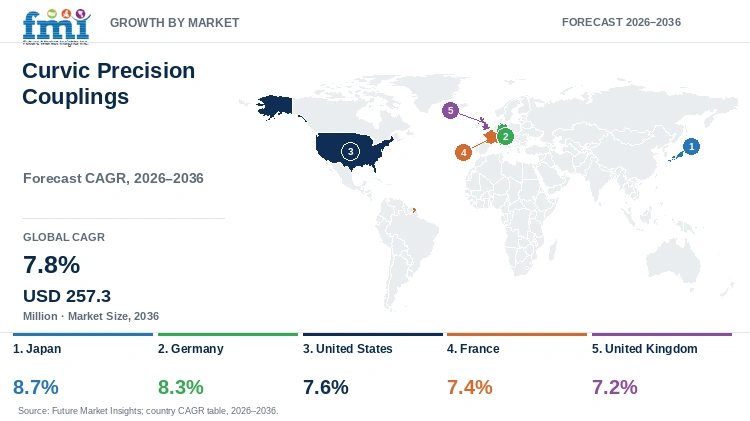
- Fastest national growth trajectory: Japan is projected to pace global turbomachinery manufacturing economies by expanding 8.7% per annum until 2036 on heavy-duty H-series gas turbine and aero-engine disk manufacturing.
- Continental European rotor hubs: Germany is expected to gain 8.3% every year and France is anticipated to move upward at 7.4% annually through 2036 as commercial turbofan and hydrogen-ready turbine programs scale.
- Transatlantic propulsion centers: The United States is forecast to advance 7.6% per year over the decade while the United Kingdom is predicted to increase 7.2% per annum across civil widebody and naval marine gas turbine assembly lines.
Market Size & Forecast
Table 1: Market Size and Forecast for the Curvic Precision Couplings Market (USD million and CAGR percentage), 2025 to 2036
| Metric | Value |
|---|---|
| 2025 Market Size | USD 112.5 million |
| Estimated Market Size in 2026 | USD 121.4 million |
| Projected Market Size by 2036 | USD 257.3 million |
| CAGR, 2026 to 2036 | 7.8% |
| Added Revenue, 2026 to 2036 | USD 135.9 million |
Rising commercial aircraft flight hours and data-center peaking power installations are stretching global grinding capacity for flight-critical rotor couplings. In October 2026, U.S. Bureau of Labor Statistics Producer Price Index data covering September 2026 showed final demand prices climbing 1.3% over August (+6.3% over twelve months) while processed intermediate goods jumped 2.5% monthly (+14.1% annually) across structural metal products and lubricating oil base stocks [2]. Whereas North American and British propulsion primes concentrate Curvic grinding cells on commercial turbofan and military turbojet spools, German and Japanese OEMs deploy large-diameter Curvic rings across utility-scale aeroderivative gas turbines. Tier-1 aerospace grinding shops that hold Gleason cup-wheel machines and NADCAP non-destructive testing accreditations secure sole-source disk machining contracts.
Turbine Rotor Spool and Cup-Wheel Grinding Sizing
Table 2: Rotor Spool and Ground Coupling Volume Indicators for the Curvic Precision Couplings Market (USD million, thousand coupling pairs, and USD per pair), mixed historical and forecast years from 2025 to 2036
| Metric | 2025 | 2026 | 2036 |
|---|---|---|---|
| Market size (USD million) | 112.5 | 121.4 | 257.3 |
| Precision Curvic coupling pairs ground (thousand pairs) | 29.5 to 32.0 | 31.5 to 34.2 | 61.0 to 66.5 |
| Nickel superalloy coupling pairs ground (thousand pairs) | 16.5 to 17.9 | 17.7 to 19.2 | 35.0 to 38.2 |
| Average realized value per coupling pair (USD) | 3,515 to 3,810 | 3,550 to 3,855 | 3,870 to 4,215 |
Operational note: Ground coupling pair counts encompass both integral face splines machined directly onto turbine rotor disks and standalone replaceable Curvic rings across aviation and industrial turbomachinery.
Machining circular-arc Curvic teeth into forged superalloy turbine stages requires specialized CNC cup-wheel grinders that control tooth bearing contact pattern and pitch-line runout within 1.5 microns. In February 2026, Intra Aerospace highlighted its multi-decade investment in advanced Gleason Curvic coupling grinding and automated coordinate metrology for modern aerospace propulsion programs [3]. Because a single grinding burn on a forged nickel superalloys disk can scrap a high-value rotor stage, engine primes mandate closed-loop vitrified CBN wheel dressing and temper-etch inspection.
Aero-Engine Build Rates & Rotor Stage Economics
Table 3: Turbomachinery Build and Rotor Coupling Intensity Indicators for the Curvic Precision Couplings Market (USD and technical metrics), mixed historical and forecast years from 2025 to 2036
| Metric | 2025 | 2026 | 2036 |
|---|---|---|---|
| Global aviation & industrial gas turbine builds (thousand units) | 6.8 | 7.2 | 12.4 |
| Average Curvic coupling value per turbine build (USD) | 16,544 | 16,861 | 20,750 |
| Standard tooth pressure angle specification (degrees) | 30 | 30 | 30 |
| Typical circumferential tooth contact bearing area (%) | 75 to 85 | 78 to 88 | 80 to 90 |
Table 4: Turbomachinery Application and Material Share Benchmarks for the Curvic Precision Couplings Market (USD million and percentages), 2026
| Benchmark Indicator | Reported / Modeled Value | Institutional Reference Basis |
|---|---|---|
| Market size, 2026 | USD 121.4 million | 2026 report valuation |
| Fixed-ratio hourglass tooth coupling revenue, 2026 | USD 90.4 million | 74.5% geometry share |
| Inconel 718 / Waspaloy coupling revenue, 2026 | USD 68.2 million | 56.2% metallurgy share |
| Aviation gas turbine & turbofan spool revenue, 2026 | USD 71.1 million | 58.6% end-use share |
Stacking individual compressor and turbine wheels via 30-degree pressure-angle Curvic teeth allows engine manufacturers to pair dissimilar rotor alloys across cold and hot sections without thermal distortion. Forward fan and intermediate compressor stages machined from aerospace titanium alloys mate directly against aft nickel-superalloy stages held together by a central tie shaft.
Analyst Perspective
"Cup-wheel-ground Curvic couplings remain irreplaceable for maintaining sub-micron rotor concentricity across high-speed aviation turbofans and utility gas turbines. Suppliers combining automated CBN cup-wheel grinding with NADCAP non-destructive flaw verification will capture long-term rotor spool programs."
- Nikhil Kaitwade, Principal Consultant, Future Market Insights.
How is the Curvic precision couplings market segmented?
The Curvic precision couplings market is segmented by tooth flank geometry, metallurgy & heat treatment, end-use turbomachinery & defense system, and region. In 2026, Fixed-Ratio Hourglass Concave/Convex Mating Teeth are expected at 74.5%, Inconel 718 / Waspaloy Nickel Superalloy Ground Rings are projected at 56.2%, and Aviation Gas Turbine & Turbofan Spool Shafts are anticipated at 58.6%.
By tooth flank geometry: Fixed-Ratio Hourglass Concave/Convex Mating Teeth, and Semi-Universal Angular-Compensating Curvic Teeth.
By metallurgy & heat treatment: Inconel 718 / Waspaloy Nickel Superalloy Ground Rings, Carburized & Case-Hardened 9310 / 4340 Aerospace Steel, and Titanium Ti-6Al-4V Compressor Rotor Couplings.
By end-use turbomachinery & defense system: Aviation Gas Turbine & Turbofan Spool Shafts, Industrial & Marine Aeroderivative Gas Turbines, and High-Speed Centrifugal Compressors & Precision Indexing.
How Do Fixed-Ratio Hourglass Concave/Convex Mating Teeth Anchor Three-Quarters of Geometry Demand?
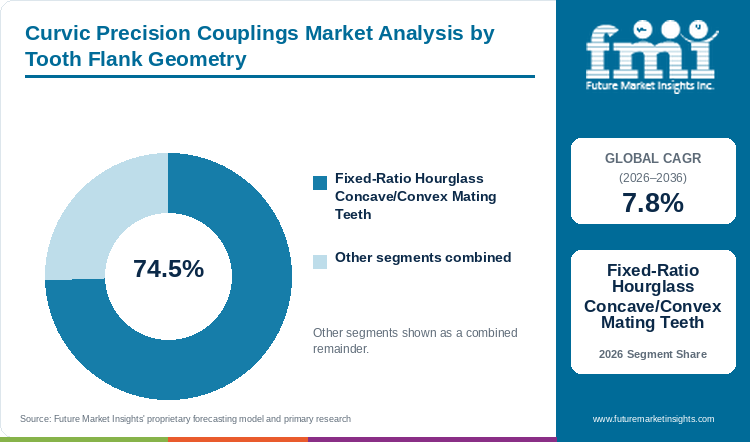
Fixed-Ratio Hourglass Concave/Convex Mating Teeth are expected to capture 74.5% of 2026 geometry revenue, reflecting self-centering rotor spool preload.
Table 5: Tooth Flank Geometry Share for the Curvic Precision Couplings Market (percentage share), 2026
| Tooth Flank Geometry Segment | Share (2026) |
|---|---|
| Fixed-Ratio Hourglass Concave/Convex Mating Teeth | 74.5% |
| Other Segments Combined | 25.5%* |
| Total | 100.0% |
*Note: Combined share of remaining tooth flank geometry categories totaling 100.0% of 2026 market demand.
Table 6: Tooth Flank Geometry Leadership and Market Growth for the Curvic Precision Couplings Market (segment and CAGR percentage), 2026 to 2036
| Metric | Value |
|---|---|
| Global CAGR (2026 to 2036) | 7.8% |
| Leading Segment | Fixed-Ratio Hourglass Concave/Convex Mating Teeth |
Generating Curvic teeth with a rotating cup-shaped grinding wheel produces a convex barrel profile on one rotor face and a complementary concave hourglass profile on the mating face. When clamped axially by a central tie bolt, this localized longitudinal crowning concentrates load at the center of the tooth face and prevents edge stress risers even when centrifugal forces expand the rotor disk radially. Whereas semi-universal teeth are reserved for low-angle shaft misalignment up to 2 degrees, fixed-ratio hourglass couplings serve as the rigid backbone for power generation gas turbines and jet engine spools.
- Fixed-Ratio Hourglass Concave/Convex Mating Teeth are expected to generate 74.5% of 2026 tooth flank geometry sales by eliminating edge-loading stress concentrations under high-speed rotation.
- In August 2026, Gleason Corporation unveiled its AMB 2026 Stuttgart technology lineup featuring 175GMS nano sub-micron gear metrology with cobot closed-loop integration and LeCount expanding mandrels [4].
What Propels Inconel 718 and Waspaloy Nickel Superalloy Ground Rings to Lead Metallurgy Spending?
Inconel 718 / Waspaloy Nickel Superalloy Ground Rings are projected to claim 56.2% of 2026 metallurgy sales, linked to creep resistance.
Aft compressor stages and high-pressure turbine rotors operate in gas streams exceeding 600 degrees Celsius where case-hardened 9310 steel and titanium alloys lose yield strength and suffer tie-bolt relaxation. Precipitation-hardened Inconel 718 and Waspaloy nickel superalloys preserve tooth flank hardness and resist fretting fatigue under intense thermal cycling and centrifugal tensile loads. Machining these work-hardening superalloys requires continuous-dress creep-feed CBN grinding wheels paired with high-velocity oil chillers alongside aviation titanium alloys in forward fan stages.
- Retention of axial clamping preload at elevated turbine temperatures is projected to give Inconel 718 / Waspaloy Nickel Superalloy Ground Rings 56.2% of 2026 metallurgy revenue.
- In March 2025, GE Aerospace announced plans to invest nearly USD 1 billion across its United States factories and supply chain (including USD 500 million for CFM LEAP and commercial engine assembly and USD 100+ million for innovative hot-section materials) while hiring 5,000 U.S. workers [5].
Why Do Aviation Gas Turbine & Turbofan Spool Shafts Represent the Largest End-Use System?
Aviation Gas Turbine & Turbofan Spool Shafts are anticipated to secure 58.6% of 2026 system demand, enabled by commercial jet backlogs.
Modern commercial geared turbofans and military turboshaft engines rely on Curvic couplings to join bladed disks and drum rotors into a rigid modular rotating assembly. During heavy maintenance shop visits, technicians unbolt the central tie shaft to replace an individual life-limited turbine disk and reassemble the spool with guaranteed angular indexing and balance repeatability. This modular architecture also carries over into process plant gas turbines and naval propulsion turbines.
- Modular rotor overhaul and high-speed dynamic balance are anticipated to give Aviation Gas Turbine & Turbofan Spool Shafts 58.6% of 2026 end-use system turnover.
- In July 2026, RTX Corporation reported at the Farnborough International Airshow that Pratt & Whitney GTF engines surpassed 800 orders and commitments year-to-date in 2026, lifting the GTF backlog above 8,000 engines [6].
What are the drivers, restraints, and opportunities in the Curvic precision couplings market?
Commercial narrowbody engine production and AI data-center gas turbine orders are expected to expand the Curvic precision couplings market through 2036, while long lead times for aerospace superalloy forgings and proprietary cup-wheel grinders restrain spot capacity additions.
- Driver:Record commercial turbofan backlogs and utility gas turbine orders for data-center power generation drive sustained demand for ground Curvic rotor couplings.
- Restraint:Extended lead times for vacuum-melted nickel superalloy forgings and dependence on specialized CNC cup-wheel grinding platforms restrict rapid supply scaling.
- Opportunity:Hydrogen-ready industrial gas turbines and modular maintenance-repair-overhaul (MRO) disk replacement programs create high-margin demand for precision-ground coupling rings.
Growth Analysis and Future Potential: Qualitative Demand Catalysts
Simultaneous expansion in commercial aviation engine build rates and gas-turbine peaking installations for hyperscale data centers is driving multi-year capacity reservations across Curvic grinding shops. Selected multi-stage industrial gas turbines (such as Mitsubishi Power J-series and JAC units) and aeroderivative or centrifugal compressor rotors (such as Baker Hughes NovaLT and pipeline compressor trains) incorporate multiple Curvic tooth faces to transmit tens of megawatts of shaft torque without radial pilot fretting, whereas other heavy utility frames (such as Siemens Energy SGT5-8000H rotors) employ Hirth-serrated disc assemblies. In February 2026, Siemens Energy AG announced a USD 1 billion United States manufacturing expansion to scale grid and gas turbine equipment alongside industrial turbomachinery production for rising power demand [7]. Securing certified aerospace forging materials and dedicated cup-wheel grinding slots has become a top procurement priority for propulsion and compressor OEMs.
Risk Assessment of the Curvic Precision Couplings Market: Operational and Supply Friction
Producing a flight-certified Curvic coupling requires proprietary geometric calculation software and dedicated cup-wheel CNC grinders paired with master control gears calibrated specifically for each tooth count and pitch diameter. Any thermal grinding abuse or wheel-loading chatter on a non-magnetic Inconel 718 rotor stage triggers mandatory rejection under aerospace chemical macro-etch (temper-etch) and fluorescent-penetrant inspections alongside ultrasonic flaw testing. Advance durable goods statistics published by the U.S. Department of Commerce in September 2026 placed August 2026 durable goods bookings at USD 338.6 billion (+0.3% excluding transportation) and transportation equipment orders at USD 114.1 billion [8]. These forging and grinding bottlenecks lengthen qualification timelines for new suppliers serving industrial air compressors and aviation propulsion primes.
Commercial Opportunity Analysis: Hydrogen-Ready Turbines and MRO Spool Refurbishment
Transitioning industrial and marine gas turbines toward hydrogen-natural gas fuel blends increases firing temperatures and rotational speeds, requiring upgraded superalloy Curvic couplings with optimized root fillet radii. At the same time, airlines extending the service lives of existing narrowbody and widebody fleets are expanding MRO shop visits where worn rotor face splines are finish-ground or fitted with replacement coupling rings. In June 2026, Baker Hughes Company received RINA marine propulsion certification for its fuel-flexible NovaLT 16 gas turbine architecture engineered for low-carbon offshore and marine vessels [9]. Combining high-speed Curvic rotor joints with auxiliary fluid couplings and automated blue-light optical tooth inspection enables tier-1 suppliers to win multi-decade lifecycle contracts.
Curvic Precision Couplings Market by Country (2026 to 2036)
Japan is projected to lead global Curvic precision couplings production centers by expanding 8.7% per annum until 2036, trailed by Germany at an expected 8.3% annual rate as utility gas turbine and aero-engine disk manufacturing scales. American rotor demand (forecast at 7.6%) and French propulsion output (anticipated at 7.4%) together with British overhaul volume (predicted at 7.2%) post sustained growth anchored by commercial turbofan assembly and MRO shop capacity.
Table 7: Country CAGR and Primary Growth Levers for the Curvic Precision Couplings Market (CAGR percentage and operational drivers), 2026 to 2036
| Country | CAGR (2026 to 2036) | Primary Growth Lever |
|---|---|---|
| Japan | 8.7% | Heavy-duty JAC-series gas turbine rotors and international aero-engine risk-sharing spool production |
| Germany | 8.3% | Utility gas turbine rotor manufacturing, MTU aero-engine modules, and precision CBN grinding automation |
| United States | 7.6% | Gleason cup-wheel grinding origination, commercial turbofan assembly, and USD 1B+ MRO/OEM plant expansions |
| France | 7.4% | CFM LEAP narrowbody turbofan production ramp and helicopter turboshaft rotor coupling demand |
| United Kingdom | 7.2% | Widebody Trent civil turbofan spools, naval marine gas turbines, and defense propulsion programs |
Source: Future Market Insights analysis
Japan Curvic Precision Couplings Market Outlook (2026 to 2036)
What distinguishes Japan from Western propulsion markets that focus primarily on standalone aircraft engine assembly is its dual industrial structure across Takasago and Nagoya, combining 15% to 30% workshare stakes in global commercial turbofan spools with world-leading heavy-duty hydrogen-co-fired utility gas turbine exports. Revised June 2026 production indices released by METI in August 2026 showed Japanese factory production index rising 1.9% from May (+4.9% over prior-year levels) to 104.6 while the manufacturing operating ratio climbed 4.1% to 107.2 [10]. Consequently, Japanese Curvic precision couplings revenue is projected to climb at a world-leading 8.7% CAGR until 2036. Even so, imported nickel-cobalt superalloy price swings and retiring master grinding technicians push Japanese plants toward automated CNC cup-wheel cells.
Key takeaway: In Japan, booming export orders for utility gas turbines and international aero-engine rotor stages are projected to deliver an 8.7% yearly expansion until 2036.
Germany Curvic Precision Couplings Market Outlook (2026 to 2036)
German Curvic precision couplings expenditure is expected to gain 8.3% per year through 2036 as hydrogen-ready utility power plants and European defense engine programs accelerate across domestic facilities. Unlike markets reliant solely on aviation spools, Germany is structurally unique because domestic demand bridges high-speed geared turbofan compressor modules in Munich and Berlin with multi-stage integrally geared centrifugal compressors (API 617) built across North Rhine-Westphalia for carbon-capture and hydrogen pipelines. October 2026 Euro-indicator tables from Eurostat recorded a 0.4% monthly and twelve-month gain in Germany's August 2026 factory index while eurozone capital goods volume grew 3.0% over August 2025 [11]. High industrial power surcharges nevertheless compel German rotor shops to adopt high-speed vitrified CBN grinding spindles.
Key takeaway: In Germany, utility gas turbine rotor exports and integrally geared compressor manufacturing are expected to generate an 8.3% yearly gain through 2036.
United States Curvic Precision Couplings Market Outlook (2026 to 2036)
Full M3 manufacturing tables released by the U.S. Census Bureau in October 2026 confirmed that unfilled manufactured goods backlogs expanded by USD 9.9 billion (+0.6%) in August 2026 to reach USD 1,609.6 billion after rising in 25 of 26 months [12]. The United States occupies a uniquely integrated position in the global market because upstate New York serves as the sole origination hub for Gleason cup-wheel Curvic grinding machines and master gears while Ohio and Connecticut plants assemble commercial turbofan and military fighter fleets. Backed by this domestic ecosystem, U.S. Curvic precision couplings expenditure is predicted to expand at a 7.6% CAGR over the decade. However, 18-month lead times on vacuum-melted superalloy forgings still constrain spot MRO deliveries.
Key takeaway: In the United States, multibillion-dollar aero-engine manufacturing investments and data-center aeroderivative turbine orders are predicted to anchor a 7.6% yearly advance.
France Curvic Precision Couplings Market Outlook (2026 to 2036)
France differs structurally from other turbomachinery nations because domestic Curvic coupling demand is overwhelmingly concentrated in high-rate single-aisle commercial turbofan spools (CFM LEAP) and high-RPM helicopter turboshaft axial-centrifugal compressor rotors manufactured across Villaroche and Bordes alongside Le Creusot. Mid-June 2026 Eurostat industrial production bulletins documented a 1.5% monthly rise in French March 2026 output and a 2.8% year-on-year expansion in April 2026 alongside a 3.4% annual gain in euro-area capital goods [13]. Supported by record narrowbody engine delivery schedules and Rafale fighter propulsion exports, French Curvic precision couplings sales are anticipated to move upward at 7.4% annually through 2036. Persistent bottlenecks in European aerospace titanium and nickel superalloy ring forging capacity remain the primary operational constraint facing French sub-tier rotor machinists.
Key takeaway: In France, high-rate narrowbody turbofan assembly and helicopter turboshaft rotor production are forecast to propel a 7.4% annual increase.
United Kingdom Curvic Precision Couplings Market Outlook (2026 to 2036)
British Curvic precision couplings demand is slated to increase 7.2% per annum to 2036 across civil widebody and defense propulsion overhaul shops. In September 2026, the UK Office for National Statistics (ONS) reported in its Index of Production bulletin that British manufacturing output increased 0.9% month-on-month in July 2026 with production advancing across 8 of 13 manufacturing subsectors [14]. What makes the British market uniquely specialized compared with global peers is its focus on three-shaft widebody commercial turbofans (Trent family) and naval marine gas turbines (MT30) engineered in Derby and Bristol, which require larger-diameter intermediate-pressure Curvic drums than two-shaft narrowbody engines. Post-Brexit cross-Channel forging logistics and high UK industrial electricity tariffs remain key cost hurdles.
Key takeaway: In the United Kingdom, widebody three-shaft civil turbofan overhauls and naval gas turbine programs are slated to back a 7.2% yearly expansion.
Full report country CAGRs cover: North America; Latin America; Western Europe; Eastern Europe; East Asia; South Asia and Pacific; Middle East and Africa.
Who are the notable companies in the Curvic precision couplings market?
Gleason Corporation, RTX Corporation, GE Aerospace, Rolls-Royce Holdings plc, Safran S.A., Mitsubishi Heavy Industries, Ltd., Baker Hughes Company, and Siemens Energy AG are the notable companies in the Curvic precision couplings market.
Competitive structure across the Curvic precision couplings industry is defined by coupling origination and cup-wheel grinding machine leadership alongside aviation turbofan primes and industrial turbomachinery OEMs. Gleason Corporation originated the Curvic coupling design and supplies the proprietary CNC cup-wheel grinding machines and diamond dressing systems used with master control gears worldwide. Aviation propulsion primes including RTX Corporation and GE Aerospace together with Rolls-Royce Holdings plc and Safran S.A. engineer and grind captive flight-critical Curvic rotor stages across civil and military engines. Meanwhile, Mitsubishi Heavy Industries Ltd. (across its M501JAC and M701JAC gas turbines) and Baker Hughes Company (across NovaLT and centrifugal compressor rotors) alongside Siemens Energy AG (across selected aeroderivative and industrial compressor trains, distinct from its Hirth-serrated SGT utility turbine rotors) machine high-torque Curvic rotor joints for power generation and mechanical-drive service.
- Curvic Coupling Originator & Cup-Wheel Grinding Technology Leader: Gleason Corporation provides Curvic geometric design software and CNC cup-wheel grinding machines alongside master inspection gears and contract manufacturing.
- Aviation Gas Turbine & Defense Propulsion Primes: RTX Corporation and GE Aerospace together with Rolls-Royce Holdings plc and Safran S.A. produce Curvic-coupled compressor and turbine rotor spools for commercial and military engines.
- Industrial Power & Aeroderivative Turbomachinery OEMs: Mitsubishi Heavy Industries Ltd. and Baker Hughes Company alongside Siemens Energy AG (in aeroderivative and centrifugal compressor lines outside its Hirth-serrated SGT utility rotors) build high-speed turbine and compressor rotors utilizing precision Curvic couplings.
Competitive Benchmarking: Curvic Precision Couplings Market
Table 8: Competitive Benchmarking for the Curvic Precision Couplings Market (qualitative capability ratings), 2026
| Company | Cup-Wheel Grinding Tech | Superalloy Rotor Depth | Aerospace & Defense Certs | Geographic Reach |
|---|---|---|---|---|
| Gleason Corporation | High | High | High | High |
| RTX Corporation | High | High | High | High |
| GE Aerospace | High | High | High | High |
| Rolls-Royce Holdings plc | High | High | High | High |
| Safran S.A. | High | High | High | High |
| Mitsubishi Heavy Industries, Ltd. | High | High | Medium | High |
| Baker Hughes Company | Medium | High | Medium | High |
| Siemens Energy AG | Medium | High | Medium | High |
Scoring basis: Cup-Wheel Grinding Tech rates High when an organization develops proprietary CNC Curvic grinding platforms or operates multi-site automated CBN cup-wheel rotor grinding cells, and Medium when focused on select industrial rotor lines. Superalloy Rotor Depth reflects documented production of Inconel 718 and Waspaloy alongside Ti-6Al-4V Curvic stages. Aerospace & Defense Certs evaluates AS9100 and NADCAP non-destructive testing credentials across flight-critical propulsion programs.
Key Developments in the Curvic Precision Couplings Market
- In July 2026, Safran S.A. (Safran Aircraft Engines) inaugurated its new USD 140 million CFM LEAP engine maintenance shop in Queretaro to expand Americas MRO rotor overhaul capacity [15].
- In October 2026, Rolls-Royce Holdings plc won an order from Avolon for 70 Trent 7000 widebody turbofan engines to power 35 Airbus A330neo aircraft, expanding multi-year three-shaft rotor production [16].
- In July 2026, Mitsubishi Heavy Industries Ltd. (through Mitsubishi Power Americas and MHIA) signed a collaborative MOU with Entergy to deploy M501JAC gas turbine combined-cycle and carbon capture solutions across U.S. utility sites [17].
Key Players in the Curvic Precision Couplings Market
Curvic Coupling Originator & Grinding Technology Leader
- Gleason Corporation
Aviation Gas Turbine & Defense Propulsion Primes
- RTX Corporation
- GE Aerospace
- Rolls-Royce Holdings plc
- Safran S.A.
Industrial Power, Marine & Aeroderivative Turbomachinery OEMs
- Mitsubishi Heavy Industries, Ltd.
- Baker Hughes Company
- Siemens Energy AG
Curvic Precision Couplings Market - Report Scope
Table 9: Report Scope for the Curvic Precision Couplings Market (coverage fields and definitions), 2026 to 2036
| Coverage field | Report scope |
|---|---|
| Market breakdown | Precision-ground circular-arc face splines and radial tooth couplings (including fixed-ratio hourglass concave/convex mating teeth and semi-universal couplings) machined with cup-type grinding wheels onto gas turbine, aero-engine, and axial/centrifugal compressor rotor discs and shafts. Category Scope Note: Covers captive OEM rotor-stage Curvic grinding and merchant precision coupling ring sets across Curvic-equipped aero-engines and industrial/aeroderivative turbomachinery; excludes complete gas turbine generator sets, straight-sided Hirth machine-tool indexing rings, Hirth-serrated utility gas-turbine rotors (such as Siemens Energy SGT5-8000H and SGT-series disc assemblies), bolted or welded drum rotors, and flexible diaphragm or gear shaft couplings. |
| Quantitative Units | USD Million |
| Market Definition | Includes manufacturer and captive/contract grinding value of precision circular-arc Curvic face-spline couplings (fixed-ratio hourglass concave/convex and semi-universal angular-compensating geometries) machined onto or supplied as rings for aviation gas turbines, industrial/marine gas turbines, and high-speed centrifugal compressors. Supply Scope Note: Excludes complete gas turbine generator sets, straight-sided Hirth machine-tool indexing rings, and flexible diaphragm or gear shaft couplings. |
| Regions Covered | North America; Latin America; Western Europe; Eastern Europe; East Asia; South Asia and Pacific; Middle East and Africa |
| Countries Covered | Japan, Germany, United States, France, United Kingdom, and additional countries in the full report |
| Key Companies Covered | Gleason Corporation, RTX Corporation, GE Aerospace, Rolls-Royce Holdings plc, Safran S.A., Mitsubishi Heavy Industries, Ltd., Baker Hughes Company, Siemens Energy AG |
| Forecast Period | 2026 to 2036 |
| Approach | Primary and secondary research with rigorous market triangulation. |
Curvic Precision Couplings Market - Research Methodology
Table 10: Research Methodology for the Curvic Precision Couplings Market (research methods and approach), 2026 edition
| Method | Approach |
|---|---|
| Primary Research | Primary interviews were conducted with Gleason Curvic grinding application specialists, aerospace rotor stress engineers, NADCAP grinding shop directors, and industrial gas turbine MRO managers to validate tooth contact tolerances, superalloy share splits, and overhaul intervals. |
| Secondary Research | Secondary research included FAA Aerospace Forecasts, U.S. Census Bureau M3 durable goods orders, METI and ONS industrial production bulletins, Gleason Curvic coupling design guidelines, and corporate filings from major propulsion primes. |
| Market Sizing and Forecasting | Market sizing and forecasting for 2026 to 2036 reconciled annual commercial and military aero-engine deliveries, documented Curvic-equipped industrial and aeroderivative gas turbine and compressor rotor builds (such as MHI J-series/JAC and Baker Hughes NovaLT trains), and MRO disk replacement rates against per-stage coupling grinding realizations, while keeping Hirth-serrated utility turbine rotors (such as Siemens Energy SGT-series discs) outside the Curvic installation count. |
| Data Triangulation and Validation | Estimates were triangulated against global superalloy ring forging shipments, CNC cup-wheel grinder installations, and airline shop-visit forecasts to exclude Hirth-equipped utility rotors and prevent double counting of full turbine modules. |
| Country Forecasting Model | Country CAGRs are modeled around the 7.8% global baseline using national aero-engine and gas turbine assembly backlogs, sovereign defense propulsion budgets, and industrial production indices from METI, Destatis, Census Bureau, INSEE, and ONS. |
| Operational Benchmark Traceability | Operational benchmarks in Tables 2, 3, and 4 (ground coupling pairs, realization per pair, 30-degree pressure angle, and tooth contact area) trace to Gleason Curvic design standards, FAA fleet registries, and OEM rotor overhaul manuals. |
Curvic Precision Couplings Market by Segments
Curvic Precision Couplings Market segmented by Tooth Flank Geometry:
- Fixed-Ratio Hourglass Concave/Convex Mating Teeth
- Semi-Universal Angular-Compensating Curvic Teeth
Curvic Precision Couplings Market segmented by Metallurgy & Heat Treatment:
- Inconel 718 / Waspaloy Nickel Superalloy Ground Rings
- Carburized & Case-Hardened 9310 / 4340 Aerospace Steel
- Titanium Ti-6Al-4V Compressor Rotor Couplings
Curvic Precision Couplings Market segmented by End-Use Turbomachinery & Defense System:
- Aviation Gas Turbine & Turbofan Spool Shafts
- Industrial & Marine Aeroderivative Gas Turbines
- High-Speed Centrifugal Compressors & Precision Indexing
Curvic Precision Couplings Market by Region
- North America
- United States
- Canada
- Latin America
- Brazil
- Mexico
- Argentina
- Chile
- Western Europe
- Germany
- France
- United Kingdom
- Italy
- Austria
- Spain
- Benelux
- Nordics
- Eastern Europe
- Poland
- Czech Republic
- Romania
- Hungary
- East Asia
- China
- Japan
- South Korea
- Taiwan
- South Asia and Pacific
- India
- ASEAN
- Australia and New Zealand
- Middle East and Africa
- GCC Countries
- South Africa
- Türkiye
- Israel
Research Sources and Bibliography
- [1] Federal Aviation Administration (FAA). (2025, January 23). FAA Aerospace Forecast Fiscal Years 2026–2046. U.S. Department of Transportation, Federal Aviation Administration.
- [2] U.S. Bureau of Labor Statistics (BLS). (2026, October 15). Producer Price Index News Release summary - 2026 M09 Results. U.S. Department of Labor, Bureau of Labor Statistics.
- [3] Intra Aerospace. (2026, February 18). Curvic Couplings — Decades of Expertise for Modern Aerospace Precision. Intra Aerospace (A Gleason Company).
- [4] Gleason Corporation. (2026, August 10). Gleason Presents Next-Level Gear Manufacturing Technologies at AMB 2026. Gleason Corporation.
- [5] GE Aerospace. (2025, March 12). GE Aerospace to Invest Nearly $1B in U.S. Manufacturing in 2025. GE Aerospace.
- [6] RTX Corporation. (2026, July 22). RTX's Pratt & Whitney GTF™ engines surpass 800 orders and commitments in 2026, year to date. RTX Corporation.
- [7] Siemens Energy AG. (2026, February 03). Siemens Energy is investing $1 billion and creating highly skilled jobs in the United States. Siemens Energy AG.
- [8] U.S. Census Bureau. (2026, September 25). Monthly Advance Report on Durable Goods Manufacturers' Shipments Inventories and Orders. U.S. Department of Commerce.
- [9] Baker Hughes Company. (2026, June 04). Baker Hughes' fuel flexible NovaLT™ 16 Gas Turbine Certified by RINA for Marine Propulsion. Baker Hughes Company.
- [10] Ministry of Economy, Trade and Industry (METI). (2026, August 17). Indices of Industrial Production (Revised Report for June 2026). Ministry of Economy, Trade and Industry, Japan.
- [11] Eurostat. (2026, October 15). Industrial production down by 0.5% in the euro area and by 0.3% in the EU. Publications Office of the European Union.
- [12] U.S. Census Bureau. (2026, October 02). Monthly Full Report on Manufacturers' Shipments, Inventories, & Orders. U.S. Department of Commerce.
- [13] Eurostat. (2026, June 15). Industrial production up by 0.1% in both the euro area and the EU. Publications Office of the European Union.
- [14] Office for National Statistics (ONS). (2026, September 11). Index of Production, UK: July 2026. UK Office for National Statistics.
- [15] Safran S.A. (2026, July 01). Safran opens new maintenance shop in Querétaro (Mexico), strengthening its MRO hub in the Americas. Safran Group.
- [16] Rolls-Royce Holdings plc. (2026, October 13). Rolls-Royce welcomes Avolon order for 70 Trent 7000 engines. Rolls-Royce Holdings plc.
- [17] Mitsubishi Heavy Industries, Ltd. (2026, July 15). Entergy and MHI Group Outline Collaborative Partnership Designed to Accelerate Commercialization and Affordability Around CCS Solutions. Mitsubishi Power / Mitsubishi Heavy Industries, Ltd.
- [18] RTX Corporation. (2026, April 21). RTX's Pratt & Whitney invests more than $100M to expand MRO footprint in the U.S. RTX Corporation.
- [19] GE Aerospace. (2026, March 18). GE Aerospace to Invest €110M+ in European Manufacturing, Boost Workforce Development. GE Aerospace.
This bibliography is provided for reader reference and is not exhaustive. The full report contains the complete reference list and detailed citations.
This Report Answers
- How large is the Curvic precision couplings market in 2026 and what is forecast for 2036?
- Which aviation propulsion and utility gas turbine pressures support Curvic coupling demand?
- Why do Fixed-Ratio Hourglass Concave/Convex Mating Teeth lead the tooth flank geometry category?
- Why do Inconel 718 / Waspaloy Nickel Superalloy Ground Rings lead the metallurgy category?
- How do growth rates differ across Japan, Germany, the United States, France, and the UK?
- Which leading companies manufacture cup-wheel grinders and Curvic-coupled turbine rotors today?
- What limits adoption or supplier switching in the Curvic precision couplings market?
- What should turbomachinery engineers evaluate before specifying a Curvic precision coupling?
Frequently Asked Questions
How big is the Curvic precision couplings market in 2026, and what is forecast for 2036?
Global Curvic precision couplings expenditure is estimated at USD 121.4 million in 2026 (up from USD 112.5 million in 2025) and is projected to reach USD 257.3 million by 2036 on rising commercial turbofan and utility gas turbine rotor builds.
What 10-year CAGR is projected for the Curvic precision couplings market?
As per FMI, the market is anticipated to expand at a 7.8% CAGR from 2026 to 2036, which is expected to increase annual market revenue by USD 135.9 million between 2026 and 2036 across aerospace propulsion and high-speed compressor programs.
Which tooth flank geometry leads the Curvic precision couplings market in 2026?
Fixed-Ratio Hourglass Concave/Convex Mating Teeth are expected to capture 74.5% of 2026 geometry demand because circular-arc cup-wheel grinding produces self-centering barrel and hourglass teeth that maintain rotor concentricity above 10,000 rpm.
Which metallurgy & heat treatment segment holds the largest share in 2026?
Inconel 718 / Waspaloy Nickel Superalloy Ground Rings are projected to account for 56.2% of 2026 metallurgy sales owing to their resistance to thermal creep and tie-bolt preload relaxation inside hot-section turbine stages.
Which country exhibits the fastest growth in the Curvic precision couplings market?
Future Market Insights projects that Japan will lead global turbomachinery manufacturing economies at an anticipated 8.7% CAGR through 2036, supported by heavy-duty JAC gas turbine exports and international civil aero-engine disk production.
Which companies are key players in the Curvic precision couplings market?
Key market participants include Gleason Corporation, RTX Corporation, GE Aerospace, Rolls-Royce Holdings plc, Safran S.A., Mitsubishi Heavy Industries, Ltd., Baker Hughes Company, and Siemens Energy AG.
Preview the report firsthand - request a free sample
Get SampleGet the brochure for pricing and purchase details.
Get PDFTable of Content
- Key Takeaways
- Market Size and CAGR
- Top Growth Driver
- Fastest Growing Segment
- Leading Region
- Key Companies
- Emerging Opportunities
- Executive Summary
- Global Market Outlook
- Demand-side Trends
- Supply-side Trends
- Technology Roadmap Analysis
- Analysis and Recommendations
- Analyst Perspective (What is happening? Why now? What should investors know?)
- Key Questions Answered
- How large is the market?
- What is the CAGR?
- What are key trends?
- Which region dominates?
- Who are the leaders?
- Market Overview
- Market Coverage / Taxonomy
- Market Definition / Scope / Limitations
- Research Methodology
- Chapter Orientation
- Analytical Lens and Working Hypotheses
- Market Structure, Signals, and Trend Drivers
- Benchmarking and Cross-market Comparability
- Market Sizing, Forecasting, and Opportunity Mapping
- Research Design and Evidence Framework
- Desk Research Programme (Secondary Evidence)
- Expert Input and Fieldwork (Primary Evidence)
- Tooling, Models, and Reference Databases
- Data Engineering and Model Build
- Quality Assurance and Audit Trail
- Market Background
- Market Dynamics (Drivers, Restraints, Opportunity, Trends)
- Scenario Forecast (Optimistic, Likely, Conservative)
- Impact Analysis
- AI Impact
- Sustainability Impact
- Regulatory Impact
- Technology Impact
- Consumer / Buyer Analysis
- Purchase Drivers
- Adoption Barriers
- Buyer Journey
- Opportunity Map Analysis
- Product Life Cycle Analysis
- Supply Chain Analysis
- Investment Feasibility Matrix
- Value Chain Analysis
- PESTLE and Porter's Analysis
- Regulatory Landscape
- Regional Parent Market Outlook
- Production and Consumption Statistics
- Import and Export Statistics
- Global Market Analysis and Forecast, 2021 to 2036
- Historical Market Size Value (USD Million) Analysis, 2021 to 2025
- Current and Future Market Size Value (USD Million) Projections, 2026 to 2036
- Y-o-Y Growth Trend Analysis
- Absolute $ Opportunity Analysis
- Global Market Pricing Analysis, 2021 to 2036
- Global Market Analysis and Forecast, By Tooth Flank Geometry, 2021 to 2036
- Introduction / Key Findings
- Historical Market Size Value (USD Million) Analysis By Tooth Flank Geometry, 2021 to 2025
- Current and Future Market Size Value (USD Million) Analysis and Forecast By Tooth Flank Geometry, 2026 to 2036
- Fixed-Ratio Hourglass Concave/Convex Mating Teeth
- Semi-Universal Angular-Compensating Curvic Teeth
- Y-o-Y Growth Trend Analysis By Tooth Flank Geometry, 2021 to 2025
- Absolute $ Opportunity Analysis By Tooth Flank Geometry, 2026 to 2036
- Global Market Analysis and Forecast, By Metallurgy & Heat Treatment, 2021 to 2036
- Introduction / Key Findings
- Historical Market Size Value (USD Million) Analysis By Metallurgy & Heat Treatment, 2021 to 2025
- Current and Future Market Size Value (USD Million) Analysis and Forecast By Metallurgy & Heat Treatment, 2026 to 2036
- Inconel 718 / Waspaloy Nickel Superalloy Ground Rings
- Carburized & Case-Hardened 9310 / 4340 Aerospace Steel
- Titanium Ti-6Al-4V Compressor Rotor Couplings
- Y-o-Y Growth Trend Analysis By Metallurgy & Heat Treatment, 2021 to 2025
- Absolute $ Opportunity Analysis By Metallurgy & Heat Treatment, 2026 to 2036
- Global Market Analysis and Forecast, By End-Use Turbomachinery & Defense System, 2021 to 2036
- Introduction / Key Findings
- Historical Market Size Value (USD Million) Analysis By End-Use Turbomachinery & Defense System, 2021 to 2025
- Current and Future Market Size Value (USD Million) Analysis and Forecast By End-Use Turbomachinery & Defense System, 2026 to 2036
- Aviation Gas Turbine & Turbofan Spool Shafts
- Industrial & Marine Aeroderivative Gas Turbines
- High-Speed Centrifugal Compressors & Precision Indexing
- Y-o-Y Growth Trend Analysis By End-Use Turbomachinery & Defense System, 2021 to 2025
- Absolute $ Opportunity Analysis By End-Use Turbomachinery & Defense System, 2026 to 2036
- Global Market Analysis and Forecast, By Region, 2021 to 2036
- Introduction
- Historical Market Size Value (USD Million) Analysis By Region, 2021 to 2025
- Current Market Size Value (USD Million) Analysis and Forecast By Region, 2026 to 2036
- North America
- Latin America
- Western Europe
- Eastern Europe
- East Asia
- South Asia and Pacific
- Middle East and Africa
- Market Attractiveness Analysis By Region
- North America Market Analysis and Forecast, By Country, 2021 to 2036
- Historical Market Size Value (USD Million) Trend Analysis By Market Taxonomy, 2021 to 2025
- Market Size Value (USD Million) Forecast By Market Taxonomy, 2026 to 2036
- By Country
- United States
- Canada
- By Tooth Flank Geometry
- By Metallurgy & Heat Treatment
- By End-Use Turbomachinery & Defense System
- By Country
- Market Attractiveness Analysis
- By Country
- By Tooth Flank Geometry
- By Metallurgy & Heat Treatment
- By End-Use Turbomachinery & Defense System
- Key Takeaways
- Latin America Market Analysis and Forecast, By Country
- Historical Market Size Value (USD Million) Trend Analysis By Market Taxonomy, 2021 to 2025
- Market Size Value (USD Million) Forecast By Market Taxonomy, 2026 to 2036
- By Country
- Brazil
- Mexico
- Argentina
- Chile
- By Tooth Flank Geometry
- By Metallurgy & Heat Treatment
- By End-Use Turbomachinery & Defense System
- By Country
- Market Attractiveness Analysis
- By Country
- By Tooth Flank Geometry
- By Metallurgy & Heat Treatment
- By End-Use Turbomachinery & Defense System
- Key Takeaways
- Western Europe Market Analysis and Forecast, By Country
- Historical Market Size Value (USD Million) Trend Analysis By Market Taxonomy, 2021 to 2025
- Market Size Value (USD Million) Forecast By Market Taxonomy, 2026 to 2036
- By Country
- Germany
- France
- United Kingdom
- Italy
- Austria
- Spain
- Benelux
- Nordics
- By Tooth Flank Geometry
- By Metallurgy & Heat Treatment
- By End-Use Turbomachinery & Defense System
- By Country
- Market Attractiveness Analysis
- By Country
- By Tooth Flank Geometry
- By Metallurgy & Heat Treatment
- By End-Use Turbomachinery & Defense System
- Key Takeaways
- Eastern Europe Market Analysis and Forecast, By Country
- Historical Market Size Value (USD Million) Trend Analysis By Market Taxonomy, 2021 to 2025
- Market Size Value (USD Million) Forecast By Market Taxonomy, 2026 to 2036
- By Country
- Poland
- Czech Republic
- Romania
- Hungary
- By Tooth Flank Geometry
- By Metallurgy & Heat Treatment
- By End-Use Turbomachinery & Defense System
- By Country
- Market Attractiveness Analysis
- By Country
- By Tooth Flank Geometry
- By Metallurgy & Heat Treatment
- By End-Use Turbomachinery & Defense System
- Key Takeaways
- East Asia Market Analysis and Forecast, By Country
- Historical Market Size Value (USD Million) Trend Analysis By Market Taxonomy, 2021 to 2025
- Market Size Value (USD Million) Forecast By Market Taxonomy, 2026 to 2036
- By Country
- China
- Japan
- South Korea
- Taiwan
- By Tooth Flank Geometry
- By Metallurgy & Heat Treatment
- By End-Use Turbomachinery & Defense System
- By Country
- Market Attractiveness Analysis
- By Country
- By Tooth Flank Geometry
- By Metallurgy & Heat Treatment
- By End-Use Turbomachinery & Defense System
- Key Takeaways
- South Asia and Pacific Market Analysis and Forecast, By Country
- Historical Market Size Value (USD Million) Trend Analysis By Market Taxonomy, 2021 to 2025
- Market Size Value (USD Million) Forecast By Market Taxonomy, 2026 to 2036
- By Country
- India
- ASEAN
- Australia and New Zealand
- By Tooth Flank Geometry
- By Metallurgy & Heat Treatment
- By End-Use Turbomachinery & Defense System
- By Country
- Market Attractiveness Analysis
- By Country
- By Tooth Flank Geometry
- By Metallurgy & Heat Treatment
- By End-Use Turbomachinery & Defense System
- Key Takeaways
- Middle East and Africa Market Analysis and Forecast, By Country
- Historical Market Size Value (USD Million) Trend Analysis By Market Taxonomy, 2021 to 2025
- Market Size Value (USD Million) Forecast By Market Taxonomy, 2026 to 2036
- By Country
- GCC Countries
- South Africa
- Türkiye
- Israel
- By Tooth Flank Geometry
- By Metallurgy & Heat Treatment
- By End-Use Turbomachinery & Defense System
- By Country
- Market Attractiveness Analysis
- By Country
- By Tooth Flank Geometry
- By Metallurgy & Heat Treatment
- By End-Use Turbomachinery & Defense System
- Key Takeaways
- Key Countries Market Analysis
- United States
- Pricing Analysis
- Market Share Analysis, 2025
- By Tooth Flank Geometry
- By Metallurgy & Heat Treatment
- By End-Use Turbomachinery & Defense System
- Canada
- Pricing Analysis
- Market Share Analysis, 2025
- By Tooth Flank Geometry
- By Metallurgy & Heat Treatment
- By End-Use Turbomachinery & Defense System
- Mexico
- Pricing Analysis
- Market Share Analysis, 2025
- By Tooth Flank Geometry
- By Metallurgy & Heat Treatment
- By End-Use Turbomachinery & Defense System
- Brazil
- Pricing Analysis
- Market Share Analysis, 2025
- By Tooth Flank Geometry
- By Metallurgy & Heat Treatment
- By End-Use Turbomachinery & Defense System
- Chile
- Pricing Analysis
- Market Share Analysis, 2025
- By Tooth Flank Geometry
- By Metallurgy & Heat Treatment
- By End-Use Turbomachinery & Defense System
- Germany
- Pricing Analysis
- Market Share Analysis, 2025
- By Tooth Flank Geometry
- By Metallurgy & Heat Treatment
- By End-Use Turbomachinery & Defense System
- United Kingdom
- Pricing Analysis
- Market Share Analysis, 2025
- By Tooth Flank Geometry
- By Metallurgy & Heat Treatment
- By End-Use Turbomachinery & Defense System
- Italy
- Pricing Analysis
- Market Share Analysis, 2025
- By Tooth Flank Geometry
- By Metallurgy & Heat Treatment
- By End-Use Turbomachinery & Defense System
- Spain
- Pricing Analysis
- Market Share Analysis, 2025
- By Tooth Flank Geometry
- By Metallurgy & Heat Treatment
- By End-Use Turbomachinery & Defense System
- France
- Pricing Analysis
- Market Share Analysis, 2025
- By Tooth Flank Geometry
- By Metallurgy & Heat Treatment
- By End-Use Turbomachinery & Defense System
- India
- Pricing Analysis
- Market Share Analysis, 2025
- By Tooth Flank Geometry
- By Metallurgy & Heat Treatment
- By End-Use Turbomachinery & Defense System
- ASEAN
- Pricing Analysis
- Market Share Analysis, 2025
- By Tooth Flank Geometry
- By Metallurgy & Heat Treatment
- By End-Use Turbomachinery & Defense System
- Australia and New Zealand
- Pricing Analysis
- Market Share Analysis, 2025
- By Tooth Flank Geometry
- By Metallurgy & Heat Treatment
- By End-Use Turbomachinery & Defense System
- China
- Pricing Analysis
- Market Share Analysis, 2025
- By Tooth Flank Geometry
- By Metallurgy & Heat Treatment
- By End-Use Turbomachinery & Defense System
- Japan
- Pricing Analysis
- Market Share Analysis, 2025
- By Tooth Flank Geometry
- By Metallurgy & Heat Treatment
- By End-Use Turbomachinery & Defense System
- South Korea
- Pricing Analysis
- Market Share Analysis, 2025
- By Tooth Flank Geometry
- By Metallurgy & Heat Treatment
- By End-Use Turbomachinery & Defense System
- Poland
- Pricing Analysis
- Market Share Analysis, 2025
- By Tooth Flank Geometry
- By Metallurgy & Heat Treatment
- By End-Use Turbomachinery & Defense System
- Hungary
- Pricing Analysis
- Market Share Analysis, 2025
- By Tooth Flank Geometry
- By Metallurgy & Heat Treatment
- By End-Use Turbomachinery & Defense System
- Türkiye
- Pricing Analysis
- Market Share Analysis, 2025
- By Tooth Flank Geometry
- By Metallurgy & Heat Treatment
- By End-Use Turbomachinery & Defense System
- South Africa
- Pricing Analysis
- Market Share Analysis, 2025
- By Tooth Flank Geometry
- By Metallurgy & Heat Treatment
- By End-Use Turbomachinery & Defense System
- United States
- Market Structure Analysis
- Competition Dashboard
- Competition Benchmarking
- Market Share Analysis of Top Players
- By Regional
- By Tooth Flank Geometry
- By Metallurgy & Heat Treatment
- By End-Use Turbomachinery & Defense System
- Emerging Startups
- Innovation Benchmarking
- Competition Analysis
- Competition Deep Dive
- Gleason Corporation
- Overview
- Product Portfolio
- Profitability by Market Segments
- Sales Footprint
- Strategy Overview
- Marketing Strategy
- Product Strategy
- Channel Strategy
- RTX Corporation
- GE Aerospace
- Rolls-Royce Holdings plc
- Safran S.A.
- Mitsubishi Heavy Industries, Ltd.
- Baker Hughes Company
- Siemens Energy AG
- Gleason Corporation
- Case Studies
- Success Stories
- Recent Developments
- Competition Deep Dive
- Assumptions & Acronyms Used


