

- Market Size (2026)
- USD 2.9 Bn
- Forecast (2036)
- USD 8.1 Bn
- CAGR (2026 to 2036)
- 10.8%
How big is Customer Success Management Market in 2026?
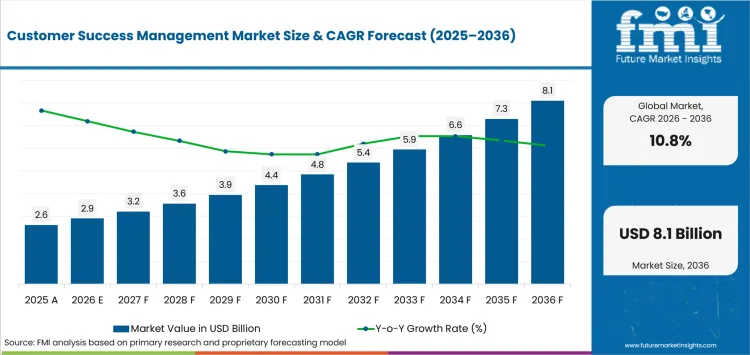
USD 2.9 billion in 2026 and USD 8.1 billion by 2036 at a 10.8% CAGR.
Demand for customer success management is projected to increase industry valuation from USD 2.9 billion in 2026 to USD 8.1 billion by 2036 at a 10.8% CAGR. Subscription contracts place renewal execution inside revenue planning because customer loss removes contracted income before the next sales cycle begins. Salesforce disclosed in May 2026 that subscription and support revenue reached USD 10.6 billion within USD 11.1 billion of first-quarter revenue. That mix gives customer-success systems a direct budget case if product use and service history reach renewal planning early enough to change account action.
Predictive account management depends on governed data plus staff who can review automated decisions prior to customer action. OECD data published in December 2025 show AI use at 40% among large firms compared with 11.9% among small firms. The same paper identifies skills and data quality as adoption requirements, which gives larger firms an advantage in funding integration and specialist review. Smaller firms need simpler cloud configurations that demonstrate measurable onboarding or retention gains as a condition for wider spending.
Key Takeaways of Customer Success Management Market
- Subscription businesses fund customer success systems because adoption failure and renewal risk now affect contracted revenue forecasts ahead of commercial negotiations.
- Customer success platform is set to lead the platform category with 44.0% share in 2026 due to health scoring that routes visible account risk into renewal decisions.
- By business process, customer onboarding is estimated to hold 34.0% in 2026 owing to milestone plans that expose time-to-value early in the retention cycle.
- By end-use industry, information technology is forecast to represent 32.0% in 2026 driven by usage telemetry that reveals adoption loss early enough to influence renewal negotiations.
- CRM identities often require reconciliation with product usage and service history, so fragmented customer records delay reliable health scoring and automation.
- Some of the key players in this market include Gainsight, Inc., ChurnZero, Inc., Salesforce, Inc., HubSpot, Inc., Zendesk, Inc., Microsoft Corporation, Oracle Corporation, and SAP SE.
Analyst Perspective
"Customer success software earns renewal budget once account health triggers a named intervention early enough to alter commercial exposure. The stronger platforms make each intervention auditable to finance teams that need evidence post-sale work changed renewal timing or expansion probability."
- Sudip saha, Principal Consultant, Future Market Insights
How is the Customer Success Management Market segmented?
The market is assessed by platform, business process, end-use industry, organization size, deployment model, and region.
Platform covers customer success applications, analytics, engagement, and professional services used after the initial sale. Business process follows onboarding through retention, expansion, support, and voice-of-customer activity within active account management. End-use industry separates information technology, financial services, healthcare, and retail and e-commerce. Organization size distinguishes enterprise deployments from smaller teams while deployment model covers cloud and hybrid delivery plus AI and application integration.
Why does Customer Onboarding lead the Business Process category?
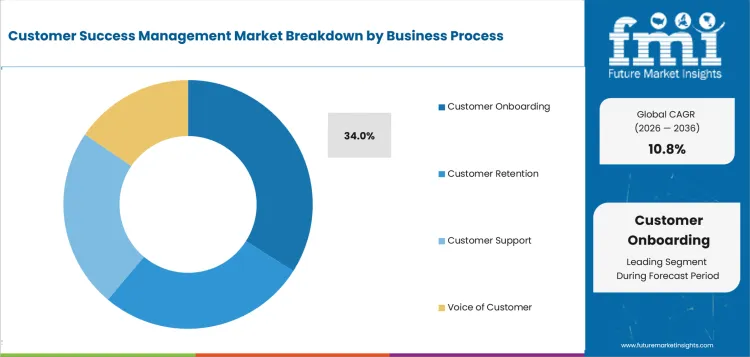
Customer onboarding gives account teams the first controlled handoff after contract signature and milestone ownership exposes early delivery failure during implementation. Feedback captured through enterprise feedback management can enter later health assessment without shifting renewal responsibility into the feedback system.
- By business process, customer onboarding is estimated to hold 34.0% in 2026 owing to milestone completion that exposes time-to-value during the earliest retention work.
- Gainsight launched Atlas agents in May 2025 for post-sale workflows from onboarding through measurable customer outcomes. Its adoption agents identify drop-off points and prepare targeted intervention paths early enough to prevent weak usage from becoming a renewal problem.
What makes Customer Success Platform central to the Platform category?
Post-sale teams use a customer success platform as the record for health assessment and assigned account action. Gainsight announced in April 2026 that MCP support lets customer-success teams direct AI agents through risk escalation and renewal workflows. The platform becomes more useful as customer analytics feeds intervention decisions instead of remaining in a reporting layer.
- Customer success platform is set to lead the platform category with 44.0% share in 2026 due to health scoring that coordinates renewal action from one operating record.
- Account teams adopt purpose-built platforms to replace manual portfolio reviews with health rules and owned tasks that preserve responsibility through renewal execution.
How does Information Technology sustain leadership in the End-use Industry category?
Software and telecommunications companies see product usage well ahead of contract renewal, which makes post-sale risk easier to quantify. Statistics Canada found in June 2025 that information and cultural businesses recorded 35.6% AI use, the highest rate among reported industries. Service records also provide text analytics inputs that rank account risk ahead of renewal negotiations.
- By end-use industry, information technology is forecast to represent 32.0% in 2026 driven by subscription contracts that expose measurable adoption and renewal behavior.
- Technology companies attach product telemetry to support history and contract dates so account teams receive risk evidence early enough to correct adoption problems.
What drives Cloud Deployment in the Deployment Model category?
Cloud deployment fits post-sale work that requires frequent customer-record and automation updates without separate infrastructure projects. The model also aligns with SaaS enterprise applications that already use subscription administration and remote access. API access keeps product signals available during account review without requiring local server changes or separate infrastructure projects.
- In 2026, cloud deployment is expected to lead the deployment model category with 81.0% share because remote configuration suits distributed customer-success teams.
- Germany's Federal Statistical Office documented in November 2025 that 54% of enterprises with at least ten employees purchased cloud services. Existing cloud use lowers the infrastructure work required for customer-success applications to reach distributed account teams.
What are the drivers, restraints and opportunities in the Customer Success Management Market?
Renewal economics increase demand while fragmented customer records delay reliable automation and agentic workflows extend account coverage without proportional staffing growth.
- Driver: Subscription contracts make weak product adoption commercially visible ahead of final renewal negotiation and account-level revenue forecasting.
- Restraint: Incompatible systems and inconsistent customer records delay health models since automated actions depend on trusted account identities.
- Opportunity: Agentic workflows can prepare account analysis and bounded intervention steps under customer-success manager approval.
Renewal Economics Put Post-Sale Execution Under Revenue Control
Subscription contracts place retained revenue inside operating forecasts several months ahead of final renewal dates and commercial negotiation. Salesforce stated in its March 2025 annual filing that customer-success programs aim to reduce attrition and secure subscription renewals. That exposure gives customer experience management software a budget case if usage and service signals reach account teams early enough to change renewal planning instead of merely documenting churn afterward.
Data Preparation Delays Reliable Automation
A health score loses commercial credibility once product usage no longer reconciles with CRM and service records. Destatis data dated November 2025 show system incompatibility affected 45% of German firms considering AI while data availability or quality affected 44%. Microsoft Dynamics deployments face the same preparation problem because account identities must align before automated playbooks carry customer actions with renewal consequences.
Agentic Workflows Extend Account Coverage
Agentic workflows change long-tail account coverage once software can prepare bounded work for manager approval. In August 2026 ChurnZero launched Retrospective to draft churn analyses from full account histories and attach confidence scores to supporting evidence. AI-powered CRM providers can charge for this execution layer once automated preparation reduces review time without removing human control over renewal interventions ahead of renewal deadlines.
Which country CAGRs are profiled in the Customer Success Management Market?
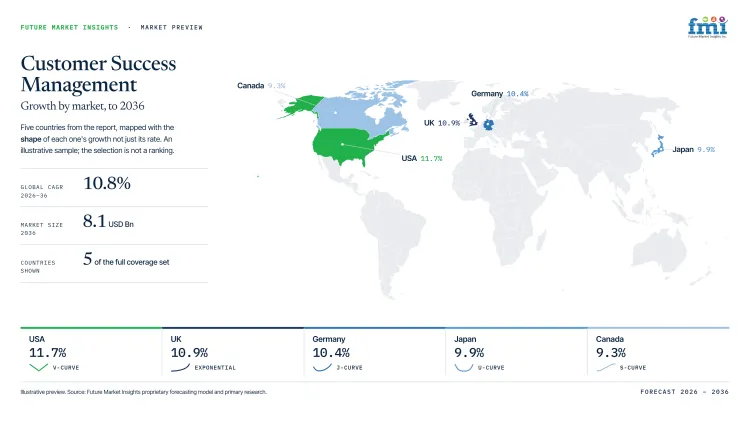
| Country | CAGR |
|---|---|
| USA | 11.7% |
| UK | 10.9% |
| Germany | 10.4% |
| Japan | 9.9% |
| Canada | 9.3% |
How do country-level CAGRs compare in the Customer Success Management Market?
A 2.4-point spread separates USA at 11.7% from Canada at 9.3%. UK and Germany form an upper-middle pair within half a point. Japan stays below 10%. Implementation capacity differentiates these markets more clearly than software availability since global application companies already reach all five countries through direct or partner channels.
- US SaaS concentration gives customer-success platforms direct access to mature revenue-operations teams.
- UK CRM partners narrow first deployments during early adoption and expand scope after customer-success workflows stabilize.
- German ERP estates make interface design harder to qualify than software access.
- Japanese consensus purchasing favors phased account-health rollouts until companies approve broader workflow changes.
- Canadian technology accounts give US platforms familiar commercial routes into larger enterprises.
Local implementation conditions should influence market priority alongside these close CAGRs. The full report provides country-level CAGR analysis across North America, Latin America, Europe, East Asia, South Asia, Oceania and the Middle East and Africa.
Country-wise Analysis
- Large US software accounts already maintain subscription billing and product telemetry inside revenue-operations teams that can fund customer-success integration without creating a separate data program for initial account analysis. USA is estimated to post 11.7% CAGR over the forecast period because those teams can act on weak adoption earlier in the renewal cycle. The US Census Bureau reported in May 2026 that 37% of businesses with at least 250 employees used AI in business operations. Account identities still differ between CRM and support systems, so platforms that reconcile records ahead of risk scoring have a faster route into larger deployments.
- Inside UK cloud-based CRM estates, customer-success programs often begin with implementation partners limiting the first release to a defined group of accounts and workflows. The Office for National Statistics found in March 2025 that 69% of firms used cloud-based computing systems and applications during 2023. Customer success management demand in the UK is forecast to rise at 10.9% CAGR through 2036 given the installed cloud base and subscription-heavy service economy. Customer-success platforms that prove one renewal workflow first can contain change-management effort during wider deployment. Uneven management practice means cloud readiness does not translate into uniform implementation speed even among firms already running core applications online.
- Prior to automated health scoring, German customer-success teams usually complete security review within established ERP and CRM estates during enterprise application rollout for larger deployments. The German customer success management sector is projected to record 10.4% CAGR through 2036 tied to enterprise digitization and demand for controlled post-sale automation. Destatis data dated November 2025 show 26% of German enterprises used AI during 2025 as enterprise interest in predictive workflows widened. Privacy review and interface ownership remain structural constraints since external platforms cannot automate account decisions until customer identities and data boundaries are documented at enterprise scale across multiple business units.
- Local-language implementation is often required in Japan prior to changing health definitions or automating customer contact during major account transitions with local account owners. IPA documented in June 2025 that more than 80% of Japanese companies reported shortages in personnel needed to advance digital transformation. Japan's customer success management outlook is anticipated to advance at 9.9% CAGR through 2036 attributable to continuing DX programs and local subscription software adoption. Local partners therefore carry more configuration and training work, giving foreign platforms a clearer entry route if Japanese support depth offsets scarce digital staff during the first enterprise deployment phase.
- AI already reaches customer-facing work in Canadian technology and financial-services accounts, giving customer-success automation a familiar budget route inside software and banking organizations. Local cloud estates and relationships with US application companies shorten initial integration work for many larger accounts. Statistics Canada documented in May 2026 that 19.2% of businesses used AI during the preceding twelve months. Adoption of customer success management in Canada is estimated to expand at 9.3% CAGR through 2036 helped by rising use of analytics and virtual agents. As privacy controls mature, platforms with auditable data-handling policies should expand pilot accounts into broader coverage sooner.
Who are the notable companies in the Customer Success Management Market?
Notable companies serving this market include Gainsight, Inc., ChurnZero, Inc., Salesforce, Inc., HubSpot, Inc., Zendesk, Inc., Microsoft Corporation, Oracle Corporation, and SAP SE.
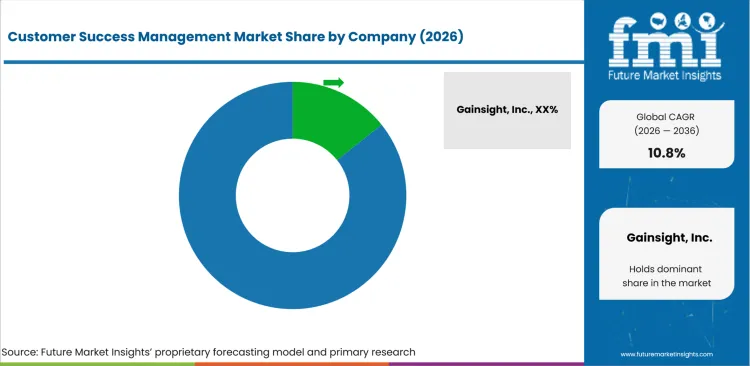
Competition separates purpose-built retention platforms from enterprise suites and service-led engagement systems in customer success management. Gainsight and ChurnZero concentrate on post-sale orchestration, whereas Salesforce and Microsoft extend customer-success work from broader application records. Data integration and workflow depth define entry barriers since company scale alone does not establish whether account signals reach owned renewal actions.
- Gainsight, Inc. and ChurnZero, Inc. focus on health scoring plus onboarding and renewal workflows for customer-success teams.
- Salesforce, Inc., Microsoft Corporation, Oracle Corporation, and SAP SE use wider application estates to place customer activity beside sales and service records.
- HubSpot, Inc. and Zendesk, Inc. enter through customer engagement and service workflows that extend into retention activity.
Competitive Benchmarking: Customer Success Management Market
| Company | Post-sale Workflow Coverage | AI-led Action Depth | Enterprise Data Integration | Geographic Reach |
|---|---|---|---|---|
| Gainsight, Inc. | High | High | High | Global |
| ChurnZero, Inc. | High | High | Medium | North America and Europe |
| Salesforce, Inc. | Medium | High | High | Global |
| HubSpot, Inc. | High | High | Medium | Global |
| Zendesk, Inc. | Medium | High | Medium | Global |
| Microsoft Corporation | Medium | High | High | Global |
| Oracle Corporation | Medium | High | High | Global |
| SAP SE | Medium | Medium | High | Global |
Scoring basis: High workflow coverage requires at least three documented post-sale processes, with Medium requiring two processes and Low identifying one within scope. High AI depth requires autonomous or multi-step action, with Medium covering analytical assistance and Low covering limited automation within one workflow. High integration requires cross-application data plus external action routes, with Medium requiring one documented integration route and Low identifying platform-native execution.
Key Developments in the Customer Success Management Market
- In May 2026, Gainsight, Inc. launched its Agentic Stack for Customer Retention with Agent Studio plus prebuilt agents and expanded MCP access.
- In October 2025, ChurnZero, Inc. announced autonomous AI teammates that execute customer-success tasks in response to identified account signals.
- In April 2025, HubSpot, Inc. introduced its Customer Success Workspace to organize schedules and account books so managers could surface customer risks earlier.
Key Players in the Customer Success Management Market
Purpose-Built Customer Success Platforms
- Gainsight, Inc.
- ChurnZero, Inc.
CRM and Service-Led Customer Platforms
- Salesforce, Inc.
- HubSpot, Inc.
- Zendesk, Inc.
Enterprise Application Suites
- Microsoft Corporation
- Oracle Corporation
- SAP SE
Customer Success Management Market - Report Scope
| Coverage field | Report scope |
|---|---|
| Market breakdown | By platform, business process, end-use industry, organization size, deployment model and region. |
| Quantitative Units | USD Billion. |
| Market Definition | Revenue includes subscription, license, implementation and managed-service revenue attributable to customer success management offerings within the defined segmentation. General CRM, contact-center, product-analytics and consulting revenue is excluded unless sold specifically for customer success management use. |
| Regions Covered | North America, Latin America, Europe, East Asia, South Asia and Pacific and Middle East and Africa. |
| Countries Covered | USA, UK, Germany, Japan, Canada, and 20+ countries included in the full report. |
| Key Companies Profiled | Gainsight, Inc., ChurnZero, Inc., Salesforce, Inc., HubSpot, Inc., Zendesk, Inc., Microsoft Corporation, Oracle Corporation, and SAP SE. |
| Forecast Period | 2026 to 2036. |
| Approach | Primary and secondary research with market triangulation. |
Customer Success Management Market - Research Methodology
| Method | Approach |
|---|---|
| Primary Research | FMI analysts gathered input from manufacturers, service providers, technology developers, distributors, end users, procurement teams, and subject-matter experts. Interviews examined purchasing decisions, product or service evaluation, adoption barriers, approval requirements, pricing considerations, and expectations for technical or commercial support. Respondents were also asked what evidence is required before a trial, pilot, or initial order develops into regular purchasing. |
| Desk Research | Desk research covered government statistics, regulatory publications, trade data, industry associations, technical literature, standards, company filings, product information, and official corporate announcements. Sources were reviewed for relevance, publication date, geographic coverage, and consistency with the defined market scope. Claims relating to performance, applications, approvals, capacity, investment, and commercial activity were retained only when supported by credible public evidence. |
| Market Sizing and Forecasting | The market model combined the baseline value with historical performance, segment structure, pricing and volume indicators, adoption levels, company participation, and country-level demand conditions. Forecast assumptions considered economic activity, investment trends, regulatory developments, technology adoption, purchasing cycles, supply availability, and barriers to wider market use. Segment and regional estimates were reconciled before the final market total was calculated. |
| Data Validation | Estimates were checked against multiple independent indicators, including public data, company activity, trade patterns, industry developments, and findings from primary interviews. Validation also tested whether products, services, applications, and company revenues fell within the defined market boundaries. Adjacent categories, unsupported claims, overlapping revenues, and activities without direct market relevance were excluded to reduce double counting and maintain consistency across segments and countries. |
Customer Success Management Market by Segments
Customer Success Management Market segmented by Platform:
- Customer Success Platform
- Customer Health Monitoring
- Lifecycle Automation
- Customer Analytics
- Predictive Analytics
- Churn Prediction
- Customer Engagement
- Digital Engagement
- In-app Guidance
- Professional Services
- Implementation Services
- Managed Services
Customer Success Management Market segmented by Business Process:
- Customer Onboarding
- User Implementation
- Product Adoption
- Customer Retention
- Renewal Management
- Expansion Management
- Customer Support
- Technical Support
- Case Resolution
- Voice of Customer
- Feedback Management
- Customer Experience Insights
Customer Success Management Market segmented by End-use Industry:
- Information Technology
- Software & SaaS
- Telecommunications
- Banking & Financial Services
- Banking
- Insurance
- Healthcare
- Hospitals
- Healthcare Technology
- Retail & E-commerce
- Online Retail
- Retail Chains
Customer Success Management Market segmented by Organization Size:
- Large Enterprises
- Global Enterprises
- Multinational Companies
- Small & Medium Enterprises
- Growing Businesses
- Mid-sized Enterprises
- Customer Success Teams
- Service Providers
- BPO Providers
- Consulting Organizations
- System Integrators
- Channel Partners
- Service Providers
Customer Success Management Market segmented by Deployment Model:
- Cloud Deployment
- Public Cloud
- Private Cloud
- Hybrid Deployment
- Cloud & On-premises
- Multi-cloud Deployment
- Artificial Intelligence
- Generative AI
- Predictive Intelligence
- Application Integration
- Open API Integration
- Low-code Integration
Customer Success Management Market by Region:
- North America
- United States
- Canada
- Latin America
- Brazil
- Mexico
- Chile
- Rest of Latin America
- Western Europe
- Germany
- United Kingdom
- Italy
- Spain
- France
- Nordics
- Benelux
- Rest of Western Europe
- Eastern Europe
- Russia
- Poland
- Hungary
- Balkan and Baltic States
- Rest of Eastern Europe
- East Asia
- China
- Japan
- South Korea
- South Asia and Pacific
- India
- ASEAN
- Australia and New Zealand
- Rest of South Asia and Pacific
- Middle East and Africa
- Kingdom of Saudi Arabia
- Other GCC Countries
- Türkiye
- South Africa
- Other African Union Countries
- Rest of Middle East and Africa
Research Sources and Bibliography
- Salesforce, Inc. (2026, May 27). Salesforce delivers record first quarter fiscal 2027 results.
- Organisation for Economic Co-operation and Development. (2025, December). AI adoption by small and medium-sized enterprises.
- Gainsight, Inc. (2026, April 2). Gainsight opens its platform with MCP, bringing customer retention into the agentic era.
- Gainsight, Inc. (2025, May 28). Gainsight launches Atlas: A new generation of AI agents for customer retention and growth.
- Statistics Canada. (2025, June 16). Analysis on artificial intelligence use by businesses in Canada, second quarter of 2025.
- Federal Statistical Office of Germany. (2025, November 24). Enterprises using cloud computing services.
- Salesforce, Inc. (2025, March 5). Annual report for the fiscal year ended January 31, 2025.
- Federal Statistical Office of Germany. (2025, November 24). Reasons against the use of artificial intelligence technologies, by employment size class.
- ChurnZero, Inc. (2026, August 12). ChurnZero launches Retrospective, an AI churn analysis agent, expanding its Agentic Essentials package.
- USA Census Bureau. (2026, May 26). Large firms with at least 20 employees biggest AI users.
- Office for National Statistics. (2025, March 24). Management practices and the adoption of technology and artificial intelligence in UK firms: 2023.
- Federal Statistical Office of Germany. (2025, November 24). Enterprises using artificial intelligence technologies, by employment size class.
- Information-technology Promotion Agency, Japan. (2025, June 26).
- Statistics Canada. (2026, May 27). The Daily - Canadian Survey on Business Conditions, second quarter 2026.
- Gainsight, Inc. (2026, May 5). Glean and Gainsight partner to put customer context to work for revenue teams.
- ChurnZero, Inc. (2026, June 12). ChurnZero launches Agentic Essentials.
- Salesforce, Inc. (2026, March 10). Introducing the Agentic Contact Center: AI, channels, CRM all in one.
- HubSpot, Inc. (2026, April 14). HubSpot puts Growth Context to work with new HubSpot AEO, Smart Deal Progression, AI agents, and 100+ updates.
- Zendesk, Inc. (2025, October 8). Zendesk unveils powerful new AI capabilities within the Resolution Platform to accelerate service at scale.
- Microsoft Corporation. (2025, April 30). 2025 release wave 1 brings hundreds of updates to Microsoft Dynamics 365 and Power Platform.
- Oracle Corporation. (2026, February 10). Oracle AI agents help marketing, sales, and service leaders enhance customer experiences.
- SAP SE. (2025, April 7). SAP Business AI: Release highlights Q1 2025.
- Gainsight, Inc. (2026, May 28). Gainsight launches the Agentic Stack for Customer Retention.
- ChurnZero, Inc. (2025, October 9). ChurnZero reveals agentic AI teammates to autonomously drive customer growth.
- HubSpot, Inc. (2025, April 10). Vision and velocity: HubSpot launches 200+ features to help SMBs move fast.
- ChurnZero, Inc. (2025, January 22). ChurnZero launches new superpower for customer teams with Engagement AI.
- HubSpot, Inc. (2025, May 8). Expanding access to Breeze Customer Agent with HubSpot Credits.
- Gainsight, Inc. (2026, May 27). Gainsight announces new AI-native services business.
- Salesforce, Inc. (2026, June 16). Salesforce signs definitive agreement to acquire Fin.
- Zendesk, Inc. (2026, March 26). Zendesk completes acquisition of Forethought.
- Microsoft Corporation. (2026, April 27). Turning customer experience into a growth engine.
- Oracle Corporation. (2026, April 9). Oracle introduces Fusion Agentic Applications for Customer Experience.
- SAP SE. (2025, October 7). SAP Customer Experience Innovations Drive Profitable Growth.
- Totango Team. (2025, October 10). A Leader Among Top Customer Success Platforms: Our Strategic Vision for Customer-Led Growth.
- Planhat. (2025, November 7). Gartner Names Planhat a Leader.
- ChurnZero, Inc. (2026). ChurnZero Trust Center.
- Salesforce, Inc. (2026, April 17). ISO/IEC 27001:2022 Certificate.
- Gainsight, Inc. (2025, April 30). Gainsight Completes Two Acquisitions To Accelerate The Future Of Customer Communities.
- ChurnZero, Inc. (2025, March 18). ChurnZero and Synthesia pioneer the future of AI-powered customer engagement.
- Salesforce, Inc. (2025, November 18). Salesforce Completes Acquisition of Informatica.
- HubSpot Communications. (2025, September 3). Spotlight product deep dive: Build your AI team with over 20 Breeze Agents and Assistants, plus the new Breeze Studio.
- Zendesk, Inc. (2025, May 20). Zendesk Completes Acquisition of Local Measure.
This bibliography is provided for reader reference and is not exhaustive. The full report contains the complete reference list and detailed citations.
This Report Answers
- How large is the customer success management market in 2026 and 2036?
- Which factors support customer success management spending during the forecast period?
- Why does customer success platform lead the platform category in 2026?
- Why does customer onboarding lead the business process category in 2026?
- Why does information technology account for the largest end-use industry share in 2026?
- How do customer-success adoption conditions differ among USA, UK, Germany, Japan, and Canada?
- Which companies form the reconciled competitive set for customer success management?
- How are customer success management companies differentiated by workflow coverage and integration depth?
Frequently Asked Questions
How big is the Customer Success Management Market in 2026?
The customer success management market is valued at USD 2.9 billion in 2026 and is projected to reach USD 8.1 billion by 2036. Growth follows subscription businesses seeking earlier control over adoption and renewal risk.
What is the CAGR of the Customer Success Management Market from 2026 to 2036?
The customer success management market is projected to grow at a CAGR of 10.8% between 2026 and 2036. Expansion follows subscription economics and wider use of customer data in post-sale decisions.
Which platform leads the Customer Success Management Market?
The customer success platform segment is expected to hold 44.0% of the customer success management market in 2026, driven by health scoring that guides renewal decisions. Purpose-built orchestration keeps account action tied to visible risk and preserves enough intervention time for account teams.
Which countries are projected to record the highest growth in the Customer Success Management Market?
USA is projected to grow at 11.7% CAGR, followed by UK at 10.9% and Germany at 10.4% through 2036. Large-enterprise digital adoption and stronger implementation capacity place these countries above Japan and Canada.
Which companies are active in the Customer Success Management Market?
Key companies operating in the market include Gainsight, Inc., ChurnZero, Inc., Salesforce, Inc., HubSpot, Inc., Zendesk, Inc., Microsoft Corporation, Oracle Corporation, and SAP SE. These companies differentiate through post-sale workflow depth and enterprise data integration as AI systems prepare account actions for manager approval.
Preview the report firsthand - request a free sample
Get SampleGet the brochure for pricing and purchase details.
Get PDFTable of Content
- Key Takeaways
- Market Size and CAGR
- Top Growth Driver
- Fastest Growing Segment
- Leading Region
- Key Companies
- Emerging Opportunities
- Executive Summary
- Global Market Outlook
- Demand-side Trends
- Supply-side Trends
- Technology Roadmap Analysis
- Analysis and Recommendations
- Analyst Perspective (What is happening? Why now? What should investors know?)
- Key Questions Answered
- How large is the market?
- What is the CAGR?
- What are key trends?
- Which region dominates?
- Who are the leaders?
- Market Overview
- Market Coverage / Taxonomy
- Market Definition / Scope / Limitations
- Research Methodology
- Chapter Orientation
- Analytical Lens and Working Hypotheses
- Market Structure, Signals, and Trend Drivers
- Benchmarking and Cross-market Comparability
- Market Sizing, Forecasting, and Opportunity Mapping
- Research Design and Evidence Framework
- Desk Research Programme (Secondary Evidence)
- Expert Input and Fieldwork (Primary Evidence)
- Tooling, Models, and Reference Databases
- Data Engineering and Model Build
- Quality Assurance and Audit Trail
- Market Background
- Market Dynamics (Drivers, Restraints, Opportunity, Trends)
- Scenario Forecast (Optimistic, Likely, Conservative)
- Impact Analysis
- AI Impact
- Sustainability Impact
- Regulatory Impact
- Technology Impact
- Consumer / Buyer Analysis
- Purchase Drivers
- Adoption Barriers
- Buyer Journey
- Opportunity Map Analysis
- Product Life Cycle Analysis
- Supply Chain Analysis
- Investment Feasibility Matrix
- Value Chain Analysis
- PESTLE and Porter's Analysis
- Regulatory Landscape
- Regional Parent Market Outlook
- Production and Consumption Statistics
- Import and Export Statistics
- Global Market Analysis and Forecast, 2021 to 2036
- Historical Market Size Value (USD Billion) Analysis, 2021 to 2025
- Current and Future Market Size Value (USD Billion) Projections, 2026 to 2036
- Y-o-Y Growth Trend Analysis
- Absolute $ Opportunity Analysis
- Global Market Pricing Analysis, 2021 to 2036
- Global Market Analysis and Forecast, By Platform, 2021 to 2036
- Introduction / Key Findings
- Historical Market Size Value (USD Billion) Analysis By Platform, 2021 to 2025
- Current and Future Market Size Value (USD Billion) Analysis and Forecast By Platform, 2026 to 2036
- Customer Success Platform
- Customer Health Monitoring
- Lifecycle Automation
- Customer Analytics
- Predictive Analytics
- Churn Prediction
- Customer Engagement
- Digital Engagement
- In-app Guidance
- Professional Services
- Implementation Services
- Managed Services
- Customer Success Platform
- Y-o-Y Growth Trend Analysis By Platform, 2021 to 2025
- Absolute $ Opportunity Analysis By Platform, 2026 to 2036
- Global Market Analysis and Forecast, By Business Process, 2021 to 2036
- Introduction / Key Findings
- Historical Market Size Value (USD Billion) Analysis By Business Process, 2021 to 2025
- Current and Future Market Size Value (USD Billion) Analysis and Forecast By Business Process, 2026 to 2036
- Customer Onboarding
- User Implementation
- Product Adoption
- Customer Retention
- Renewal Management
- Expansion Management
- Customer Support
- Technical Support
- Case Resolution
- Voice of Customer
- Feedback Management
- Customer Experience Insights
- Customer Onboarding
- Y-o-Y Growth Trend Analysis By Business Process, 2021 to 2025
- Absolute $ Opportunity Analysis By Business Process, 2026 to 2036
- Global Market Analysis and Forecast, By End-use Industry, 2021 to 2036
- Introduction / Key Findings
- Historical Market Size Value (USD Billion) Analysis By End-use Industry, 2021 to 2025
- Current and Future Market Size Value (USD Billion) Analysis and Forecast By End-use Industry, 2026 to 2036
- Information Technology
- Software & SaaS
- Telecommunications
- Banking & Financial Services
- Banking
- Insurance
- Healthcare
- Hospitals
- Healthcare Technology
- Retail & E-commerce
- Online Retail
- Retail Chains
- Information Technology
- Y-o-Y Growth Trend Analysis By End-use Industry, 2021 to 2025
- Absolute $ Opportunity Analysis By End-use Industry, 2026 to 2036
- Global Market Analysis and Forecast, By Organization Size, 2021 to 2036
- Introduction / Key Findings
- Historical Market Size Value (USD Billion) Analysis By Organization Size, 2021 to 2025
- Current and Future Market Size Value (USD Billion) Analysis and Forecast By Organization Size, 2026 to 2036
- Large Enterprises
- Global Enterprises
- Multinational Companies
- Small & Medium Enterprises
- Growing Businesses
- Mid-sized Enterprises
- Customer Success Teams
- Service Providers
- BPO Providers
- Consulting Organizations
- System Integrators
- Channel Partners
- Large Enterprises
- Y-o-Y Growth Trend Analysis By Organization Size, 2021 to 2025
- Absolute $ Opportunity Analysis By Organization Size, 2026 to 2036
- Global Market Analysis and Forecast, By Deployment Model, 2021 to 2036
- Introduction / Key Findings
- Historical Market Size Value (USD Billion) Analysis By Deployment Model, 2021 to 2025
- Current and Future Market Size Value (USD Billion) Analysis and Forecast By Deployment Model, 2026 to 2036
- Cloud Deployment
- Public Cloud
- Private Cloud
- Hybrid Deployment
- Cloud & On-premises
- Multi-cloud Deployment
- Artificial Intelligence
- Generative AI
- Predictive Intelligence
- Application Integration
- Open API Integration
- Low-code Integration
- Cloud Deployment
- Y-o-Y Growth Trend Analysis By Deployment Model, 2021 to 2025
- Absolute $ Opportunity Analysis By Deployment Model, 2026 to 2036
- Global Market Analysis and Forecast, By Region, 2021 to 2036
- Introduction
- Historical Market Size Value (USD Billion) Analysis By Region, 2021 to 2025
- Current Market Size Value (USD Billion) Analysis and Forecast By Region, 2026 to 2036
- North America
- Latin America
- Western Europe
- Eastern Europe
- East Asia
- South Asia and Pacific
- Middle East & Africa
- Market Attractiveness Analysis By Region
- North America Market Analysis and Forecast, By Country, 2021 to 2036
- Historical Market Size Value (USD Billion) Trend Analysis By Market Taxonomy, 2021 to 2025
- Market Size Value (USD Billion) Forecast By Market Taxonomy, 2026 to 2036
- By Country
- USA
- Canada
- By Platform
- By Business Process
- By End-use Industry
- By Organization Size
- By Deployment Model
- By Country
- Market Attractiveness Analysis
- By Country
- By Platform
- By Business Process
- By End-use Industry
- By Organization Size
- By Deployment Model
- Key Takeaways
- Latin America Market Analysis and Forecast, By Country
- Historical Market Size Value (USD Billion) Trend Analysis By Market Taxonomy, 2021 to 2025
- Market Size Value (USD Billion) Forecast By Market Taxonomy, 2026 to 2036
- By Country
- Brazil
- Mexico
- Chile
- Rest of Latin America
- By Platform
- By Business Process
- By End-use Industry
- By Organization Size
- By Deployment Model
- By Country
- Market Attractiveness Analysis
- By Country
- By Platform
- By Business Process
- By End-use Industry
- By Organization Size
- By Deployment Model
- Key Takeaways
- Western Europe Market Analysis and Forecast, By Country
- Historical Market Size Value (USD Billion) Trend Analysis By Market Taxonomy, 2021 to 2025
- Market Size Value (USD Billion) Forecast By Market Taxonomy, 2026 to 2036
- By Country
- Germany
- UK
- Italy
- Spain
- France
- Nordic
- BENELUX
- Rest of Western Europe
- By Platform
- By Business Process
- By End-use Industry
- By Organization Size
- By Deployment Model
- By Country
- Market Attractiveness Analysis
- By Country
- By Platform
- By Business Process
- By End-use Industry
- By Organization Size
- By Deployment Model
- Key Takeaways
- Eastern Europe Market Analysis and Forecast, By Country
- Historical Market Size Value (USD Billion) Trend Analysis By Market Taxonomy, 2021 to 2025
- Market Size Value (USD Billion) Forecast By Market Taxonomy, 2026 to 2036
- By Country
- Russia
- Poland
- Hungary
- Balkan & Baltic
- Rest of Eastern Europe
- By Platform
- By Business Process
- By End-use Industry
- By Organization Size
- By Deployment Model
- By Country
- Market Attractiveness Analysis
- By Country
- By Platform
- By Business Process
- By End-use Industry
- By Organization Size
- By Deployment Model
- Key Takeaways
- East Asia Market Analysis and Forecast, By Country
- Historical Market Size Value (USD Billion) Trend Analysis By Market Taxonomy, 2021 to 2025
- Market Size Value (USD Billion) Forecast By Market Taxonomy, 2026 to 2036
- By Country
- China
- Japan
- South Korea
- By Platform
- By Business Process
- By End-use Industry
- By Organization Size
- By Deployment Model
- By Country
- Market Attractiveness Analysis
- By Country
- By Platform
- By Business Process
- By End-use Industry
- By Organization Size
- By Deployment Model
- Key Takeaways
- South Asia and Pacific Market Analysis and Forecast, By Country
- Historical Market Size Value (USD Billion) Trend Analysis By Market Taxonomy, 2021 to 2025
- Market Size Value (USD Billion) Forecast By Market Taxonomy, 2026 to 2036
- By Country
- India
- ASEAN
- Australia & New Zealand
- Rest of South Asia and Pacific
- By Platform
- By Business Process
- By End-use Industry
- By Organization Size
- By Deployment Model
- By Country
- Market Attractiveness Analysis
- By Country
- By Platform
- By Business Process
- By End-use Industry
- By Organization Size
- By Deployment Model
- Key Takeaways
- Middle East & Africa Market Analysis and Forecast, By Country
- Historical Market Size Value (USD Billion) Trend Analysis By Market Taxonomy, 2021 to 2025
- Market Size Value (USD Billion) Forecast By Market Taxonomy, 2026 to 2036
- By Country
- Kingdom of Saudi Arabia
- Other GCC Countries
- Türkiye
- South Africa
- Other African Union
- Rest of Middle East & Africa
- By Platform
- By Business Process
- By End-use Industry
- By Organization Size
- By Deployment Model
- By Country
- Market Attractiveness Analysis
- By Country
- By Platform
- By Business Process
- By End-use Industry
- By Organization Size
- By Deployment Model
- Key Takeaways
- Key Countries Market Analysis
- USA
- Pricing Analysis
- Market Share Analysis, 2025
- By Platform
- By Business Process
- By End-use Industry
- By Organization Size
- By Deployment Model
- Canada
- Pricing Analysis
- Market Share Analysis, 2025
- By Platform
- By Business Process
- By End-use Industry
- By Organization Size
- By Deployment Model
- Mexico
- Pricing Analysis
- Market Share Analysis, 2025
- By Platform
- By Business Process
- By End-use Industry
- By Organization Size
- By Deployment Model
- Brazil
- Pricing Analysis
- Market Share Analysis, 2025
- By Platform
- By Business Process
- By End-use Industry
- By Organization Size
- By Deployment Model
- Chile
- Pricing Analysis
- Market Share Analysis, 2025
- By Platform
- By Business Process
- By End-use Industry
- By Organization Size
- By Deployment Model
- Germany
- Pricing Analysis
- Market Share Analysis, 2025
- By Platform
- By Business Process
- By End-use Industry
- By Organization Size
- By Deployment Model
- UK
- Pricing Analysis
- Market Share Analysis, 2025
- By Platform
- By Business Process
- By End-use Industry
- By Organization Size
- By Deployment Model
- Italy
- Pricing Analysis
- Market Share Analysis, 2025
- By Platform
- By Business Process
- By End-use Industry
- By Organization Size
- By Deployment Model
- Spain
- Pricing Analysis
- Market Share Analysis, 2025
- By Platform
- By Business Process
- By End-use Industry
- By Organization Size
- By Deployment Model
- France
- Pricing Analysis
- Market Share Analysis, 2025
- By Platform
- By Business Process
- By End-use Industry
- By Organization Size
- By Deployment Model
- India
- Pricing Analysis
- Market Share Analysis, 2025
- By Platform
- By Business Process
- By End-use Industry
- By Organization Size
- By Deployment Model
- ASEAN
- Pricing Analysis
- Market Share Analysis, 2025
- By Platform
- By Business Process
- By End-use Industry
- By Organization Size
- By Deployment Model
- Australia & New Zealand
- Pricing Analysis
- Market Share Analysis, 2025
- By Platform
- By Business Process
- By End-use Industry
- By Organization Size
- By Deployment Model
- China
- Pricing Analysis
- Market Share Analysis, 2025
- By Platform
- By Business Process
- By End-use Industry
- By Organization Size
- By Deployment Model
- Japan
- Pricing Analysis
- Market Share Analysis, 2025
- By Platform
- By Business Process
- By End-use Industry
- By Organization Size
- By Deployment Model
- South Korea
- Pricing Analysis
- Market Share Analysis, 2025
- By Platform
- By Business Process
- By End-use Industry
- By Organization Size
- By Deployment Model
- Russia
- Pricing Analysis
- Market Share Analysis, 2025
- By Platform
- By Business Process
- By End-use Industry
- By Organization Size
- By Deployment Model
- Poland
- Pricing Analysis
- Market Share Analysis, 2025
- By Platform
- By Business Process
- By End-use Industry
- By Organization Size
- By Deployment Model
- Hungary
- Pricing Analysis
- Market Share Analysis, 2025
- By Platform
- By Business Process
- By End-use Industry
- By Organization Size
- By Deployment Model
- Kingdom of Saudi Arabia
- Pricing Analysis
- Market Share Analysis, 2025
- By Platform
- By Business Process
- By End-use Industry
- By Organization Size
- By Deployment Model
- Türkiye
- Pricing Analysis
- Market Share Analysis, 2025
- By Platform
- By Business Process
- By End-use Industry
- By Organization Size
- By Deployment Model
- South Africa
- Pricing Analysis
- Market Share Analysis, 2025
- By Platform
- By Business Process
- By End-use Industry
- By Organization Size
- By Deployment Model
- USA
- Market Structure Analysis
- Competition Dashboard
- Competition Benchmarking
- Market Share Analysis of Top Players
- By Regional
- By Platform
- By Business Process
- By End-use Industry
- By Organization Size
- By Deployment Model
- Emerging Startups
- Innovation Benchmarking
- Competition Analysis
- Competition Deep Dive
- Gainsight, Inc.
- Overview
- Product Portfolio
- Profitability by Market Segments
- Sales Footprint
- Strategy Overview
- Marketing Strategy
- Product Strategy
- Channel Strategy
- Totango Ltd.
- ChurnZero, Inc.
- Salesforce, Inc.
- HubSpot, Inc.
- Zendesk, Inc.
- Microsoft Corporation
- Oracle Corporation
- SAP SE
- Intercom, Inc.
- Gainsight, Inc.
- Case Studies
- Success Stories
- Recent Developments
- Competition Deep Dive
- Assumptions & Acronyms Used


