

- Market Size (2026)
- USD 38.4 Mn
- Forecast (2036)
- USD 121.4 Mn
- CAGR (2026 to 2036)
- 12.2%
How big is Cutin Bio-Polyester Films Market in 2026?
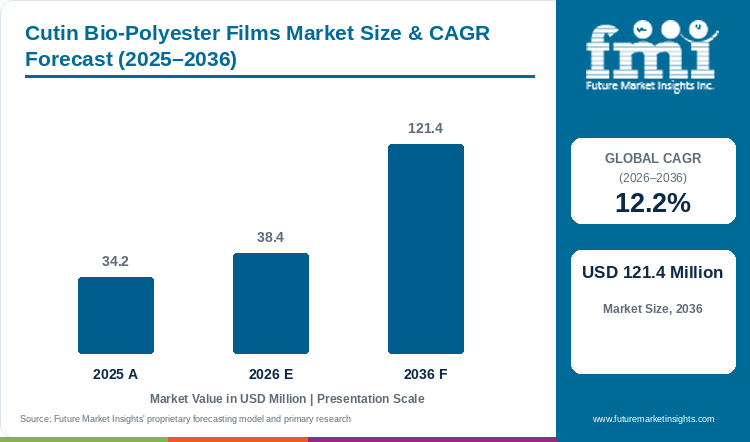
Backed by a projected 12.2% CAGR over the ten-year horizon, cutin bio-polyester films demand is forecast to climb past USD 34.2 million recorded for 2025 and USD 38.4 million estimated for 2026 toward an anticipated USD 121.4 million by the close of 2036.
Starting from USD 34.2 million during 2025 and an estimated USD 38.4 million for 2026, global cutin bio-polyester films revenue is slated to cross USD 121.4 million in 2036 via a predicted 12.2% CAGR that adds an expected USD 83.0 million in new value. Polycondensing 10,16-dihydroxypalmitic acid monomer streams extracted from fruit peel cuticles produces hydrophobic thermoset bio-polyesters that withstand 121-degree-Celsius acidic retort sterilization inside tinplate food cans without leaching bisphenol A or suffering styrene-acrylic blistering. Industrial Tomato Peel Pomace (10,16-Dihydroxypalmitic Acid) is anticipated to concentrate 66.2% of 2026 pomace feedstock volume across packaging lacquering and bio-film lines because steam-peeled tomato skins yield over 80% homogeneous C16 dihydroxyfatty acid monomers. During August 2025, California NASS agricultural statisticians corroborated this raw-material scale by documenting that contracted California processing tomato production reached 11.0 million tons in 2025, generating over 300,000 tons of cutin-rich peel pomace in a single regional harvest [1].
Key Market Trends & Insights
- By agro-industrial pomace source: Industrial Tomato Peel Pomace (10,16-Dihydroxypalmitic Acid) (66.2% forecast share in 2026) dominates extraction because tomato cuticles lack heavy triterpenoid wax contamination found in apple and grape skins.
- By application format: BPA-Free Internal Metal Can Lacquer (Cutin Bio-Resin) (48.5% expected in 2026) leads revenue as tinplate and aluminum can coaters replace epoxy-phenolic and bisphenol-F internal linings.
- By co-polymer formulation: Pure Polyhydroxy-Fatty-Acid Cutin Ester (52.0% projected in 2026) anchors formulation sales since homopolymerized C16 dihydroxy fatty acids crosslink thermally at 190 to 205 degrees Celsius without synthetic isocyanates.
- By end-use sector: Acidic Canned Tomatoes, Beans & Beverage Can Linings (46.8% anticipated in 2026) represent the primary end-use outlet by circularly lining tomato and pulse cans with resin extracted from the cannery's own peel waste.
Regional Highlights
- Fastest horticultural export growth: Mexican demand is forecast to top major horticultural and canning nations with a 13.4% CAGR from 2026 to 2036 while Chilean demand is anticipated to climb at 13.1% and Turkish canners are slated to advance 12.7% per year on booming avocado and tomato-paste exports.
- Mediterranean cutin biorefinery core: Italian turnover is predicted to grow 11.9% per annum while Spanish sales are estimated to rise 11.6% yearly through 2036 as Parma and Extremadura tomato canneries scale commercial cutin bio-lacquer plants.
- North American canning and produce hub: United States demand is foreseen to rise 11.7% per annum through 2036 on California tomato-pomace valorization and non-BPA metal can coating conversions.
Market Size & Forecast
Table 1: Market Size and Forecast for the Cutin Bio-Polyester Films Market (USD million and CAGR percentage), 2025 to 2036
| Metric | Value |
|---|---|
| 2025 Market Size | USD 34.2 million |
| Estimated Market Size in 2026 | USD 38.4 million |
| Projected Market Size by 2036 | USD 121.4 million |
| CAGR, 2026 to 2036 | 12.2% |
| Added Revenue, 2026 to 2036 | USD 83.0 million |
Strict European prohibitions on bisphenol A and bisphenol derivatives in food-contact coatings alongside retailer shelf-life mandates for unpacked fresh produce drive regional cutin adoption between 2026 and 2036. Following the European Commission's entry into force of Regulation (EU) 2024/3190 banning BPA across food-contact varnishes and coatings with transition deadlines running through 2026 to 2028, European canmakers are qualifying plant-derived polyhydroxy-fatty-acid esters over acrylic and styrene replacements [2]. In Mediterranean and Californian tomato-processing belts, steam-peeling lines already segregate clean tomato skins from seeds, creating a zero-collection-cost feedstock for metal containers coil and sheet coaters. Concurrently, Latin American and Turkish fruit exporters apply emulsified cuticular monoglycerides and cutin esters to double the cold-storage shelf life of avocados alongside sweet cherries.
Cannery Pomace Valorization and Cutin Monomer Extraction Sizing
Table 2: Cannery Pomace Valorization and Cutin Bio-Resin Output Indicators for the Cutin Bio-Polyester Films Market (USD million, metric tons, and USD per kg), mixed historical and forecast years from 2025 to 2036
| Metric | 2025 | 2026 | 2036 |
|---|---|---|---|
| Market size (USD million) | 34.2 | 38.4 | 121.4 |
| Purified cutin bio-resin & film output (metric tons) | 1,850 to 2,050 | 2,100 to 2,330 | 7,250 to 8,050 |
| Processed dry fruit & tomato peel pomace (metric tons) | 11,500 to 12,800 | 13,100 to 14,500 | 45,300 to 50,300 |
| Average realized cutin resin/film price (USD per kg) | 16.70 to 18.50 | 16.50 to 18.30 | 15.10 to 16.70 |
Operational note: Pomace mass balances are based on 15% to 18% monomer recovery of 10,16-dihydroxypalmitic acid and oligomeric cutin esters from dried, seed-separated tomato peel fractions via alkaline thermal hydrolysis and acid precipitation.
Separating tomato skins from seeds via wet hydrocyclones immediately at the cannery pulper prevents seed-oil rancidity and yields a cuticle-enriched cake containing 55% to 65% cutin on a dry-peel basis. Thermal alkaline hydrolysis in dilute sodium hydroxide cleaves the cuticular polyester matrix in under two hours, after which hydrochloric or citric acid acidification precipitates pure 10,16-dihydroxypalmitic acid paste. In March 2025, polymer scientists at the University of Pavia and the University of Milan demonstrated in Polymers that supercritical-CO2-purified and alkaline-depolymerized tomato peel cutin blends with biodegradable polyesters into hydrophobic, gamma-sterilizable barrier films and nonwoven webs [3]. Cannery cooperatives that integrate cutin extraction alongside canned fruits and tomato-paste lines convert a wet disposal cost into a high-margin specialty monomer stream.
Metal Can Coil Coating & Produce Shelf-Life Coverage Sizing
Table 3: Coated Can-Stock Area and Film/Emulsion Indicators for the Cutin Bio-Polyester Films Market (million square meters, gsm, and USD), mixed historical and forecast years from 2025 to 2036
| Metric | 2025 | 2026 | 2036 |
|---|---|---|---|
| Global cutin-coated can & film area (million sq. meters) | 520 to 580 | 590 to 660 | 2,050 to 2,280 |
| Typical internal can lacquer dry film weight (gsm) | 5.5 to 7.5 | 5.5 to 7.2 | 5.0 to 6.8 |
| Annual spend per qualified coil/sheet coating plant (USD thousand) | 270 to 315 | 295 to 345 | 680 to 790 |
| Acidic retort sterilization survival (121 °C, 60 min, pH 3.5) | Pass (0 blister) | Pass (0 blister) | Pass (0 blister) |
Table 4: Segment Revenue and Operational Benchmark Traceability for the Cutin Bio-Polyester Films Market (USD million and percentages), 2026
| Metric | Value | Basis |
|---|---|---|
| Market size, 2026 | USD 38.4 million | Report value |
| Industrial tomato peel pomace revenue, 2026 | USD 25.4 million | 66.2% pomace-source share |
| BPA-free internal metal can lacquer revenue, 2026 | USD 18.6 million | 48.5% application-format share |
| Acidic canned tomatoes, beans & beverage linings revenue, 2026 | USD 18.0 million | 46.8% end-use sector share |
Replacing epoxy-bisphenol-A internal food-can linings requires a thermoset resin that adheres tenaciously to tinplate and electrolytic chromium-coated steel during deep-drawing while blocking citric and lactic acid corrosion. Because 10,16-dihydroxypalmitic acid possesses both primary and secondary hydroxyl groups on a flexible C16 aliphatic chain, stoving sheet-fed cutin bio-lacquers in wicket ovens at 195 to 205 degrees Celsius for 10 to 12 minutes yields a densely cross-linked, wedge-bend-flexible film. Canmakers supplying metal packaging and beverage lines avoid both bisphenol endocrine-disruptor liabilities and the brittle cracking seen in first-generation polyester-phenolic coatings.
Analyst Perspective
"Tomato-derived 10,16-dihydroxypalmitic acid cutin resins give metal can coaters a truly bisphenol-free internal lacquer that survives 121-degree-Celsius acidic tomato and bean retorting without delamination. Scaling beyond seasonal August-to-October cannery harvests requires ensiling or rapid belt-drying of wet peel pomace at regional collection hubs."
- Nandini Roy Choudhury, Principal Consultant, Future Market Insights.
How is the cutin bio-polyester films market segmented?
The cutin bio-polyester films market is segmented by agro-industrial pomace source, application format, co-polymer formulation, end-use sector, and region. In 2026, Industrial Tomato Peel Pomace (10,16-Dihydroxypalmitic Acid) is projected at 66.2%, BPA-Free Internal Metal Can Lacquer (Cutin Bio-Resin) at 48.5%, Pure Polyhydroxy-Fatty-Acid Cutin Ester at 52.0%, and Acidic Canned Tomatoes, Beans & Beverage Can Linings at 46.8%.
By agro-industrial pomace source: Industrial Tomato Peel Pomace (10,16-Dihydroxypalmitic Acid), Apple, Cranberry & Grape Cuticular Pomace, and Citrus & Bell-Pepper Peel Cuticle Residues.
By application format: BPA-Free Internal Metal Can Lacquer (Cutin Bio-Resin), Free-Standing Melt-Extruded & Cast Bio-Polyester Film, and Post-Harvest Cuticular Produce Spray Emulsion.
By co-polymer formulation: Pure Polyhydroxy-Fatty-Acid Cutin Ester, Cutin-Alginate & Cutin-Pectin Interpenetrating Films, and Cutin-PLA Toughened Reactive Blends.
By end-use sector: Acidic Canned Tomatoes, Beans & Beverage Can Linings, Fresh Berry, Avocado & Stone-Fruit Shelf-Life Coating, and Home-Compostable Dry Food Pouches.
Why Does Industrial Tomato Peel Pomace (10,16-Dihydroxypalmitic Acid) Dominate Pomace Sources?
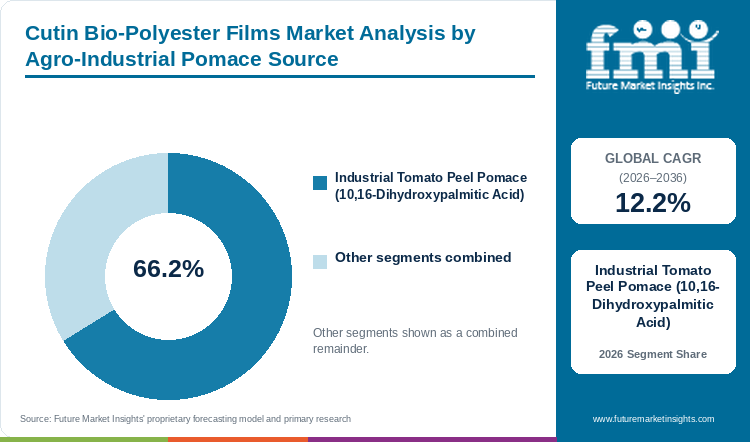
Industrial Tomato Peel Pomace (10,16-Dihydroxypalmitic Acid) is forecast to concentrate 66.2% of agro-industrial pomace source in 2026, benefiting from high monomer extraction yields.
Table 5: Agro-Industrial Pomace Source Share for the Cutin Bio-Polyester Films Market (percentage share), 2026
| Agro-Industrial Pomace Source | Share (2026) |
|---|---|
| Industrial Tomato Peel Pomace (10,16-Dihydroxypalmitic Acid) | 66.2% |
| Apple, Cranberry & Grape Cuticular Pomace | 20.4% |
| Citrus & Bell-Pepper Peel Cuticle Residues | 13.4%* |
| Total | 100.0% |
*Note: Combined share of remaining agro-industrial pomace source categories totaling 100.0% of 2026 market demand.
Table 6: Agro-Industrial Pomace Source Leadership and Market Growth for the Cutin Bio-Polyester Films Market (segment and CAGR percentage), 2026 to 2036
| Metric | Value |
|---|---|
| Global CAGR (2026 to 2036) | 12.2% |
| Leading Segment | Industrial Tomato Peel Pomace (10,16-Dihydroxypalmitic Acid) |
Centralized steam-peeling and pulping across global tomato-paste factories generates over 1.2 million tonnes of wet tomato skins annually, making Industrial Tomato Peel Pomace (10,16-Dihydroxypalmitic Acid) the most homogeneous cuticular lipid source on Earth. More than 80% of the fatty acids inside tomato cutin consist of a single monomer (10,16-dihydroxypalmitic acid), which yields reproducible viscosity and curing profiles during industrial polycondensation. By contrast, apple and cranberry pomaces contain up to 35% ursolic and oleanolic triterpenoid waxes that must be stripped with organic solvents before resin synthesis for packaging films or metal lacquers. Citrus and bell-pepper peel residues serve niche regional extractors where pectin-recovery plants co-fractionate cuticular waxes.
- Monomer homogeneity above 80% 10,16-dihydroxypalmitic acid is forecast to secure Industrial Tomato Peel Pomace (10,16-Dihydroxypalmitic Acid) 66.2% of 2026 feedstock demand.
- In June 2026, the World Processing Tomato Council (WPTC) estimated 2026 global processing tomato volume at 40.1 million tonnes, led by 17.6 million tonnes across Mediterranean and European AMITOM member canneries supplying industrial peel pomace [4].
What Propels BPA-Free Internal Metal Can Lacquer (Cutin Bio-Resin) to Lead Application Formats?
BPA-Free Internal Metal Can Lacquer (Cutin Bio-Resin) is expected to deliver 48.5% of application format in 2026, accompanied by European bisphenol A bans.
Sheet-fed three-piece food-can wicket ovens stoving at 195 to 205 degrees Celsius for 10 to 12 minutes and continuous coil-coating lines operating at 25 to 45 seconds peak metal dwell require internal coatings that resist sulfur staining and acid migration. Formulating 10,16-dihydroxypalmitic acid monomers into crosslinkable oligomeric lacquers gives BPA-Free Internal Metal Can Lacquer a projected 48.5% share of 2026 application demand across metal cans and closure converting plants. Unlike brittle first-generation acrylic replacements that suffer micro-cracking along beaded can walls, aliphatic cutin polyesters provide intrinsic ester-chain flexibility during double-seaming operations. Meanwhile, post-harvest produce packers apply aqueous cuticular lipid emulsions to extend ambient and cold-storage fruit quality without single-use plastic overwrap.
- Drop-in roller-coater stoving compatibility and bisphenol-free compliance are expected to allot BPA-Free Internal Metal Can Lacquer (Cutin Bio-Resin) 48.5% of 2026 format turnover.
- In May 2025, Akzo Nobel N.V. published its Packaging Coatings Trends report highlighting accelerated canmaker transitions toward next-generation non-BPA internal coatings under tightened EU rules [5].
How Does Pure Polyhydroxy-Fatty-Acid Cutin Ester Retain the Largest Co-Polymer Formulation Share?
Pure Polyhydroxy-Fatty-Acid Cutin Ester is projected to attain 52.0% of co-polymer formulation in 2026, anchored by cross-linked retort sterilization resistance.
Self-esterifying purified C16 dihydroxy and trihydroxy fatty acids without hydrophilic polysaccharide modifiers produces a cross-linked hydrophobic matrix with water contact angles exceeding 95 degrees, which is projected to keep Pure Polyhydroxy-Fatty-Acid Cutin Ester at 52.0% of formulation sales. Blending cutin with sodium alginate or fruit pectin facilitates low-temperature water-cast films for dry food wraps, but hydrophilic polysaccharide domains swell when exposed to boiling acidic tomato sauce inside a food can. Similarly, reactive extrusion of cutin oligomers into global bio plastics such as polylactic acid (PLA) serves flexible pouch converters rather than high-temperature metal coil coaters. Pure polyhydroxy-fatty-acid esters therefore capture both internal metal can lacquers and waterless lipid produce coatings.
- Hydrophobic cross-link density and 95-degree water contact angles are projected to deliver Pure Polyhydroxy-Fatty-Acid Cutin Ester 52.0% of 2026 formulation revenue.
- In February 2025, PPG Industries expanded its non-BPA internal metal-packaging coatings at Paris Packaging Week with PPG Hoba Pro 2848 (a non-bisphenol and PFAS-NI internal liner) alongside its PPG Nutrishield and PPG Innovel food and beverage can coatings [6].
Why Do Acidic Canned Tomatoes, Beans & Beverage Can Linings Lead End-Use Sectors?
Acidic Canned Tomatoes, Beans & Beverage Can Linings are anticipated to garner 46.8% of end-use sector in 2026, guided by sulfur-stain and acid resistance.
Peeled tomatoes and baked beans alongside carbonated beverages combine low pH (3.2 to 4.5) with aggressive sulfur-bearing amino acids that pit unprotected tinplate, which is anticipated to make Acidic Canned Tomatoes, Beans & Beverage Can Linings the primary end-use sector at 46.8% share. Italian and Spanish tomato canners lead adoption because lining three-piece tinplate cans with bio-resin extracted from their own tomato peels creates a closed-loop circularity story for supermarket private-label buyers. In parallel, aluminum beverage cans and fresh berry or avocado shelf-life coatings provide rapid volume expansion across North and Latin America. Home-compostable dry-food pouches laminated with cutin-PLA blends capture specialty snack and coffee brands seeking moisture-barrier films.
- Closed-loop cannery circularity and high citric-acid corrosion holdout are anticipated to earn Acidic Canned Tomatoes, Beans & Beverage Can Linings 46.8% of 2026 end-use sector demand.
- In April 2025, The Sherwin-Williams Company highlighted more than 40 FDA Food Contact Notifications and regulatory approvals across over 100 countries for its valPure and Safety by Design non-BPA packaging coatings applied to billions of cans [7].
What are the drivers, restraints, and opportunities in the cutin bio-polyester films market?
Statutory European Union bans on bisphenol A in food-contact can varnishes and abundant tomato-cannery peel waste are projected to drive cutin bio-polyester film growth through 2036, whereas seasonal 70-day tomato harvest windows create raw-pomace storage bottlenecks.
- Driver:Binding EU prohibitions on BPA and bisphenol derivatives in metal food cans alongside retail plastic-free produce goals accelerate cutin bio-resin and cuticular emulsion procurement.
- Restraint:Highly seasonal August-to-October tomato canning campaigns produce wet peel pomace that ferments within 48 hours unless dried or ensiled at capital-intensive depot facilities.
- Opportunity:Reactive melt-compounding of cutin oligomers with polylactic acid (PLA) and pectin enables flexible home-compostable pouches and multi-harvest apple/citrus pomace blending.
Growth Analysis and Future Potential: Qualitative Demand Catalysts
Regulatory elimination of bisphenol-based epoxy resins across food and beverage metal packaging is compelling global coil coaters to secure bio-based thermoset monomers that pass strict migration tests. In December 2025, the European Commission issued its Note for Guidance (C/2025/6721) clarifying how food-contact varnish and can-coating producers must phase out bisphenol A under Regulation (EU) 2024/3190 [8]. At the same time, supermarket chains across Europe and North America are replacing plastic shrink-wrap on avocados and citrus with edible cuticular lipid emulsions that cut retail shrink by 30% to 50%. Integrating cutin bio-polyesters into produce packaging and three-piece food cans satisfies both non-BPA safety mandates and circular bioeconomy targets.
Risk Assessment of the Cutin Bio-Polyester Films Market: Operational and Formulation Friction
Concentrating 85% of Northern Hemisphere processing-tomato harvests into an eight-to-ten-week late-summer window creates severe logistics and preservation friction for cutin biorefineries. Fresh wet tomato pomace leaves the cannery pulper at 75% to 80% moisture content and undergoes rapid microbial acidification and mold spoilage within 36 to 48 hours in warm ambient storage. During April 2026, USDA ERS vegetable specialists examined processing-tomato supply and trade trends in the Vegetables and Pulses Outlook (VGS-378), noting tight margin management across North American canneries [9]. Biorefineries supplying year-round resin to pouch packaging and coil-coating plants must either invest in rotary steam-tube dryers at each cannery or supplement autumn tomato peel stocks with winter citrus and apple pomace.
Commercial Opportunity Analysis: Formulation Differentiation and Value-Add Formats
Grafting flexible cutin hydroxy-fatty-acid oligomers onto brittle polylactic acid (PLA) or polyhydroxybutyrate (PHB) chains via reactive twin-screw extrusion creates tough, transparent bio-polyester films for flexible food pouches. Adding 10% to 15% oligomeric cutin ester into PLA lowers film glass-transition stiffness and reduces water vapor permeability by more than 40% without sacrificing industrial or home compostability. In October 2025, Eurostat reported that plastic packaging waste in the European Union averaged 35.3 kilograms per inhabitant (15.8 million tonnes total) with a 42.1% recycling rate, intensifying brand transitions toward compostable bio-polyester films [10]. Formulators that market both stoving metal-can bio-lacquers and cutin-toughened premade pouch packaging masterbatches capture year-round converter orders.
Cutin Bio-Polyester Films Market by Country (2026 to 2036)
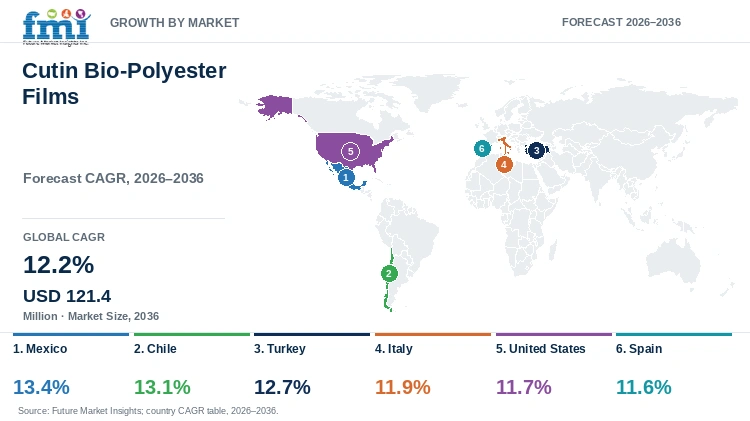
Mexican horticultural packhouses and canneries are projected to set the fastest national growth pace at a 13.4% CAGR from 2026 to 2036, while Chilean fruit exporters are anticipated to register 13.1% and Turkish tomato-paste canners are expected to post 12.7%. Meanwhile, Mediterranean and North American tomato-processing centers in Italy (predicted 11.9% CAGR) and the United States (foreseen at 11.7% CAGR) together with Spain (estimated 11.6% CAGR) provide bulk 10,16-dihydroxypalmitic acid monomer extraction for BPA-free can linings.
Table 7: Country CAGR and Primary Growth Levers for the Cutin Bio-Polyester Films Market (CAGR percentage and operational drivers), 2026 to 2036
| Country | CAGR (2026 to 2036) | Primary Growth Lever |
|---|---|---|
| Mexico | 13.4% | Export avocado, lime, and berry cuticular shelf-life coatings plus domestic jalapeno/tomato canning |
| Chile | 13.1% | Trans-equatorial stone-fruit, cherry, and blueberry export coatings and southern tomato paste mills |
| Turkey | 12.7% | Bursa and Aegean tomato-paste cannery pomace valorization and EU-compliant non-BPA can exports |
| Italy | 11.9% | Parma and Campania tomato-peel biorefineries (Tomapaint/Salchi/Mutti) and circular tinplate can linings |
| United States | 11.7% | 11-million-ton California processing-tomato harvest and non-BPA metal food can conversions |
| Spain | 11.6% | Extremadura and Ebro Valley tomato/citrus pomace extraction and Royal Decree packaging compliance |
Source: Future Market Insights analysis
Italy Cutin Bio-Polyester Films Market Outlook (2026 to 2036)
Industrial consortia linking Parma and Piacenza tomato-paste processors directly with specialty coil-coating formulators set Italy apart globally as the commercial birthplace of circular tomato-peel-to-can-lining supply chains. Pioneering collaborations between Tomapaint S.r.l. and Salchi Metalcoat S.r.l. alongside Mutti S.p.A. have scaled alkaline hydrolysis of steam-peeled tomato skins into thermoset BPA-NI internal can varnishes. During January 2026, Mediterranean horticultural analysts at USDA FAS confirmed Italy's leading regional fruit and vegetable processing base supplying European supermarket chains with shelf-stable and fresh products [11]. Italian cutin bio-polyester films revenue is predicted to advance by 11.9% per year between 2026 and 2036, although high seasonal natural-gas drying costs during the August-to-September campaign pressure independent pomace dehydrators.
Key takeaway: In Italy, commercial Parma tomato-pomace biorefineries and circular tinplate can-lacquer partnerships are predicted to anchor an 11.9% yearly expansion through 2036.
Spain Cutin Bio-Polyester Films Market Outlook (2026 to 2036)
Spain differs from single-crop tomato processing markets because Badajoz (Extremadura) paste mega-factories led by Conesa Group operate alongside Valencia and Murcia citrus-juice mills to provide dual summer-and-winter cuticular pomace streams. During March 2026, USDA Madrid attachés reported in their Food Processing Ingredients Annual that Spain ranks as the EU's third-largest agricultural producer and a premier processed food hub [12]. Spanish cutin bio-polyester films sales are estimated to expand at an 11.6% compound annual clip through 2036 as domestic vegetable and seafood canners phase out bisphenol-A epoxy linings. Nevertheless, recurrent summer irrigation restrictions across the Guadiana and Guadalquivir river basins create year-to-year swings in raw tomato tonnage available for peel extraction.
Key takeaway: In Spain, Extremadura tomato-paste factories and Valencia citrus-peel side-streams are estimated to support an 11.6% yearly expansion in cutin can lacquers and produce coatings.
United States Cutin Bio-Polyester Films Market Outlook (2026 to 2036)
Unlike European markets focused primarily on metal can linings, the United States combines California's Central Valley processing-tomato scale with nationwide retail grocery deployment of plant-derived cuticular produce coatings. In January 2026, California NASS tomato statisticians reported that California processors intended to contract 9.8 million tons (8.89 million metric tons) across 185,000 planted acres at 53 tons per acre for the 2026 season [13]. Backed by commercial post-harvest cuticular lipid emulsions from Apeel Sciences and non-BPA metal can-lining lines from Sherwin-Williams and PPG, U.S. cutin bio-polyester revenue is foreseen to grow at an 11.7% compound annual pace through 2036. However, high capital costs for building food-grade monomer purification reactors in California and competition from acrylic can linings temper near-term price parity.
Key takeaway: In the United States, Central Valley tomato-pomace scale and commercial post-harvest produce coatings are foreseen to maintain an 11.7% annual growth rate to 2036.
Mexico Cutin Bio-Polyester Films Market Outlook (2026 to 2036)
Year-round export packing of Michoacán avocados and Sinaloa tomatoes alongside Jalisco berries makes Mexico structurally unique as the world's largest consumer of post-harvest cuticular lipid emulsions for cross-border cold chains. During June 2026, USDA FAS Mexico City analysts forecasted 2026 Mexican tomato production at 2.6 million metric tons alongside 1.8 million metric tons of fresh export shipments [14]. Applying plant-derived cutin and monoglyceride spray coatings at Mexican export packhouses cuts cross-border moisture loss by 40% and is projected to push national market turnover upward at a 13.4% annual rate from 2026 to 2036. Still, fragmented small-holder canning operations outside Sinaloa require centralized pomace drying hubs before domestic monomer extraction can replace imported resins.
Key takeaway: In Mexico, high-volume avocado and berry export packhouses adopting cuticular shelf-life coatings are projected to fuel a market-leading 13.4% CAGR through 2036.
Chile Cutin Bio-Polyester Films Market Outlook (2026 to 2036)
Chile occupies a distinct counter-seasonal position in the global value chain by generating Maule and O'Higgins tomato-paste pomace from January to April while applying cuticular barrier coatings onto 30-day trans-Pacific cherry and stone-fruit shipments to Asia. During August 2026, FAS Santiago horticultural analysts projected in their Stone Fruit Annual that marketing year 2026/27 Chilean cherry production will reach a record 727,000 metric tons with exports hitting 667,000 metric tons [15]. Consequently, Chilean cutin bio-polyester films turnover is slated to climb at an anticipated 13.1% CAGR over the 2026-to-2036 window as export packhouses replace synthetic fungicide waxes and domestic canners valorize summer peel waste. Expansion remains constrained mainly by high imported specialty solvent and co-polymer catalyst maritime freight costs.
Key takeaway: In Chile, 30-day trans-Pacific cherry and stone-fruit export voyages and counter-seasonal Maule tomato pomace are anticipated to drive a 13.1% annual growth trajectory.
Turkey Cutin Bio-Polyester Films Market Outlook (2026 to 2036)
Ranking among the world's top four processing-tomato producers across Bursa and Manisa alongside Çanakkale, Turkey stands apart as a non-EU manufacturing hub whose tomato-paste (salça) exporters must meet EU Regulation 2024/3190 BPA bans to retain European Customs Union access. Turkish pickled-vegetable canners alongside olive-oil packers exporting into European supermarkets are qualifying domestic tomato-cutin internal drum and can linings. During October 2026, FAO World Food Forum delegates highlighted agricultural processing innovation and value-chain waste reduction across Mediterranean and Near East food corridors [16]. Consequently, Turkish cutin bio-polyester films demand is expected to rise 12.7% per annum from 2026 to 2036, despite domestic lira inflation elevating imported polymerization reactor financing costs for local extractors.
Key takeaway: In Turkey, Bursa and Aegean tomato-paste pomace volumes paired with EU-mandated BPA-free can exports are forecast to power a 12.7% annual expansion through 2036.
Full report country CAGRs cover: North America; Latin America; Western Europe; Eastern Europe; East Asia; South Asia and Pacific; Middle East and Africa.
Who are the notable companies in the cutin bio-polyester films market?
Apeel Sciences, Tomapaint S.r.l., Salchi Metalcoat S.r.l., Mutti S.p.A., The Sherwin-Williams Company, PPG Industries, Inc., Akzo Nobel N.V., and Conesa Group are the notable companies in the cutin bio-polyester films market.
Market participation across the cutin bio-polyester films value chain connects global metal-packaging coating multinationals with specialized Italian and Californian cuticular-lipid innovators and large tomato-paste processors. Global coil- and can-coating leaders The Sherwin-Williams Company (Valspar packaging coatings) and PPG Industries alongside Akzo Nobel N.V. supply non-BPA internal food and beverage can linings across hundreds of canmaking plants worldwide. Dedicated cutin and cuticular-ester specialists including Tomapaint S.r.l. and Salchi Metalcoat S.r.l. alongside Apeel Sciences hold foundational patents on tomato-pomace 10,16-dihydroxypalmitic acid depolymerization and post-harvest produce shelf-life emulsions. Upstream agro-industrial leaders Mutti S.p.A. in Italy and Conesa Group in Spain provide segregated, steam-peeled tomato skin feedstocks and serve as circular anchor customers for cutin-lined tomato cans.
- Global Non-BPA Metal Can Coating Manufacturers: The Sherwin-Williams Company and PPG Industries alongside Akzo Nobel N.V. formulate and qualify bisphenol-free internal food and beverage can lacquers globally.
- Cutin Bio-Lacquer & Cuticular Lipid Specialists: Tomapaint S.r.l. and Salchi Metalcoat S.r.l. together with Apeel Sciences commercialize tomato-pomace cutin bio-resins and post-harvest fruit cuticle coatings.
- Integrated Tomato Canning & Pomace Valorization Partners: Mutti S.p.A. and Conesa Group supply industrial steam-peeled tomato cuticles and qualify circular bio-lined tinplate cans.
Competitive Benchmarking: Cutin Bio-Polyester Films Market
Table 8: Competitive Benchmarking for the Cutin Bio-Polyester Films Market (qualitative capability ratings), 2026
| Company | Pomace Feedstock Access | Cutin Monomer & Ester IP | Can / Produce Line Reach | Geographic Footprint |
|---|---|---|---|---|
| Apeel Sciences | Medium | High | High | High |
| Tomapaint S.r.l. | High | High | Medium | Medium |
| Salchi Metalcoat S.r.l. | Medium | High | High | Medium |
| Mutti S.p.A. | High | Medium | Medium | High |
| The Sherwin-Williams Company | Medium | Medium | High | High |
| PPG Industries, Inc. | Medium | Medium | High | High |
| Akzo Nobel N.V. | Medium | Medium | High | High |
| Conesa Group | High | Medium | Medium | Medium |
Scoring basis: Pomace Feedstock Access is rated High for integrated tomato processors or biorefineries locked into captive cannery peel streams and Medium for coating formulators procuring isolated hydroxy-fatty-acid monomers. Cutin Monomer & Ester IP evaluates granted patents covering 10,16-dihydroxypalmitic acid isolation and thermoset can-lacquer stoving alongside post-harvest cuticular monoglyceride/ester emulsions. Can / Produce Line Reach measures commercial qualification on high-speed coil/sheet metal coaters and export fruit-packing lines across international corridors.
Key Developments in the Cutin Bio-Polyester Films Market
- In June 2025, Apeel Sciences documented that its plant-based Edipeel and Organipeel cuticular lipid coatings have prevented 166 million pieces of fresh produce from spoiling and conserved 1.8 billion gallons of water globally [17].
- In October 2025, Conesa Group subsidiary Agraz partnered with Grupo Fertiberia across more than 2,200 hectares of Iberian tomato farmland to deploy green-hydrogen Impact Zero fertilizers and biotechnological crop solutions [18].
- In January 2025, Italian metal-packaging coatings specialist Salchi Metalcoat S.r.l. inaugurated its SAP S/4HANA-integrated automated industrial coatings warehouse in Burago di Molgora capable of handling over 100 load units per hour [19].
Key Players in the Cutin Bio-Polyester Films Market
Global Non-BPA Metal Can Coating Manufacturers
- The Sherwin-Williams Company
- PPG Industries, Inc.
- Akzo Nobel N.V.
Cutin Bio-Lacquer & Cuticular Lipid Specialists
- Tomapaint S.r.l.
- Salchi Metalcoat S.r.l.
- Apeel Sciences
Integrated Tomato Canning & Pomace Valorization Partners
- Mutti S.p.A.
- Conesa Group
Cutin Bio-Polyester Films Market - Report Scope
Table 9: Report Scope for the Cutin Bio-Polyester Films Market (coverage fields and definitions), 2026 to 2036
| Coverage field | Report scope |
|---|---|
| Market breakdown | Agro-Industrial Pomace Source; Application Format; Co-Polymer Formulation; End-Use Sector; Region |
| Quantitative Units | USD Million |
| Market Definition | Includes B2B revenue from isolated plant-cuticle hydroxy-fatty-acid monomers (such as 10,16-dihydroxypalmitic acid), thermoset cutin internal metal-can bio-lacquers, melt-extruded/cast cutin-copolymer films, and post-harvest cuticular lipid produce emulsions. Category Scope Note: Excludes unextracted wet tomato pomace sold for cattle feed or biogas, petrochemical epoxy or polyester can coatings containing zero plant cutin, and downstream filled metal cans or fresh produce. |
| Regions Covered | North America; Latin America; Western Europe; Eastern Europe; East Asia; South Asia and Pacific; Middle East and Africa |
| Countries Covered | Italy, Spain, United States, Mexico, Chile, Turkey, and additional countries in the full report |
| Key Companies Covered | Apeel Sciences, Tomapaint S.r.l., Salchi Metalcoat S.r.l., Mutti S.p.A., The Sherwin-Williams Company, PPG Industries, Inc., Akzo Nobel N.V., Conesa Group |
| Forecast Period | 2026 to 2036 |
| Approach | Primary and secondary research with rigorous market triangulation. |
Cutin Bio-Polyester Films Market - Research Methodology
Table 10: Research Methodology for the Cutin Bio-Polyester Films Market (research methods and approach), 2026 edition
| Method | Approach |
|---|---|
| Primary Research | Primary interviews were conducted with Italian and Spanish tomato-cannery valorization managers, cutin depolymerization chemists, metal-can coil-coating formulators, post-harvest fruit packhouse directors, and EU food-contact regulatory specialists. |
| Secondary Research | Secondary research covered USDA NASS California Processing Tomato reports, WPTC global harvest updates, European Commission BPA ban (Regulation 2024/3190) and PPWR (Regulation 2025/40) filings, peer-reviewed cutin polymer studies, and corporate disclosures from Sherwin-Williams, PPG, AkzoNobel, Apeel, Tomapaint, Salchi Metalcoat, and Mutti. |
| Market Sizing and Forecasting | Market sizing and forecasting from 2026 to 2036 combined bottom-up tomato/fruit peel extraction capacities and cutin bio-resin pricing (USD/kg) with top-down substitution rates in BPA-NI food-can linings and export fruit shelf-life coatings. |
| Data Triangulation and Validation | Estimates were validated against regional processing-tomato tonnages, three-piece tinplate food-can production, and avocado/berry export volumes to prevent double counting with synthetic polyester can lacquers or carnauba/shellac produce waxes. |
| Country Forecasting Model | Country CAGRs (ranging from 11.6% in Spain to 13.4% in Mexico around the 12.2% global baseline) are calibrated using national tomato-paste and fruit-pomace volumes, EU BPA-NI metal-can compliance deadlines, and refrigerated horticultural export growth. |
| Operational Benchmark Traceability | Physical and operational metrics in Tables 2, 3, and 4 (15-18% monomer yield on dry peel, 5.5-7.5 gsm internal can lacquer weight, and 121 °C acidic retort sterilization pass rates) trace to WPTC/USDA cannery balances, EN 13130 / FDA 21 CFR 175.300 migration tests, and industrial coil-coater stoving parameters. |
Cutin Bio-Polyester Films Market by Segments
Cutin Bio-Polyester Films Market segmented by Agro-Industrial Pomace Source:
- Industrial Tomato Peel Pomace (10,16-Dihydroxypalmitic Acid)
- Apple, Cranberry & Grape Cuticular Pomace
- Citrus & Bell-Pepper Peel Cuticle Residues
Cutin Bio-Polyester Films Market segmented by Application Format:
- BPA-Free Internal Metal Can Lacquer (Cutin Bio-Resin)
- Free-Standing Melt-Extruded & Cast Bio-Polyester Film
- Post-Harvest Cuticular Produce Spray Emulsion
Cutin Bio-Polyester Films Market segmented by Co-Polymer Formulation:
- Pure Polyhydroxy-Fatty-Acid Cutin Ester
- Cutin-Alginate & Cutin-Pectin Interpenetrating Films
- Cutin-PLA Toughened Reactive Blends
Cutin Bio-Polyester Films Market segmented by End-Use Sector:
- Acidic Canned Tomatoes, Beans & Beverage Can Linings
- Fresh Berry, Avocado & Stone-Fruit Shelf-Life Coating
- Home-Compostable Dry Food Pouches
Cutin Bio-Polyester Films Market by Region
- North America
- United States
- Canada
- Latin America
- Brazil
- Mexico
- Argentina
- Chile
- Western Europe
- Germany
- France
- United Kingdom
- Italy
- Spain
- Benelux
- Nordics
- Eastern Europe
- Poland
- Czech Republic
- Romania
- Hungary
- East Asia
- China
- Japan
- South Korea
- South Asia and Pacific
- India
- ASEAN
- Australia and New Zealand
- Middle East and Africa
- GCC Countries
- South Africa
- Türkiye
- Israel
Research Sources and Bibliography
- [1] U.S. Department of Agriculture, National Agricultural Statistics Service (NASS). (2025, August 28). 2025 California Processing Tomato Report. USDA National Agricultural Statistics Service Pacific Region.
- [2] European Commission. (2026, February 23). Commission Regulation (EU) 2024/3190 of 19 December 2024 on the use of bisphenol A (BPA) and other bisphenols and bisphenol derivatives with harmonised classification for specific hazardous properties in certain materials and articles intended to come into contact with food. EUR-Lex Consolidated Text (02024R3190-20260223).
- [3] Pecorini, G., Tamburriello, M., Tottoli, E. M., Genta, I., Conti, B., Garcia Gonzalez, M. N., Nasti, R., & Dorati, R. (2025, March 19). Bioengineering the Future: Tomato Peel Cutin as a Resource for Medical Textiles. Polymers, 17(6), 810 (MDPI).
- [4] World Processing Tomato Council (WPTC). (2026, June 07). WPTC crop update as of 7 June 2026. World Processing Tomato Council.
- [5] Akzo Nobel N.V. (2025, May 01). Packaging Coatings Trends for 2025. AkzoNobel Packaging Coatings.
- [6] PPG Industries, Inc. (2025, February 03). PPG launches non-BPA PPG HOBA coatings for aluminum bottles at Paris Packaging Week. PPG Investor Relations (Packaging Coatings).
- [7] The Sherwin-Williams Company. (2025, April 16). Safety by Design Process - Sherwin-Williams Industrial Coatings. Sherwin-Williams Packaging Coatings.
- [8] European Commission. (2025, December 17). Note for Guidance on the implementation of Commission Regulation (EU) 2024/3190 on the use of bisphenol A (BPA) and other bisphenols and bisphenol derivatives with harmonised classification for specific hazardous properties in certain materials and articles intended to come into contact with food. EUR-Lex Official Journal of the European Union (C/2025/6721).
- [9] Davis, W. V., Weber, C., & Wakefield, H. (2026, April 30). Vegetables and Pulses Outlook: April 2026. U.S. Department of Agriculture, Economic Research Service (VGS-378).
- [10] Eurostat. (2025, October 22). Plastic packaging waste in the EU: 35.3 kg per person. Eurostat News Articles.
- [11] U.S. Department of Agriculture, Foreign Agricultural Service (FAS). (2026, January 07). European Union: Citrus Annual. USDA Foreign Agricultural Service (GAIN Report E42025-0032).
- [12] U.S. Department of Agriculture, Foreign Agricultural Service (FAS). (2026, March 31). Spain: Food Processing Ingredients Annual. USDA Foreign Agricultural Service (GAIN Report SP2026-0003).
- [13] U.S. Department of Agriculture, National Agricultural Statistics Service (NASS). (2026, January 23). 2026 California Processing Tomato Report. USDA National Agricultural Statistics Service Pacific Region.
- [14] U.S. Department of Agriculture, Foreign Agricultural Service (FAS). (2026, June 02). Mexico: Tomatoes and Products Annual. USDA Foreign Agricultural Service (GAIN Report MX2026-0028).
- [15] U.S. Department of Agriculture, Foreign Agricultural Service (FAS). (2026, August 27). Chile: Stone Fruit Annual. USDA Foreign Agricultural Service (GAIN Report CI2026-0009).
- [16] Food and Agriculture Organization of the United Nations (FAO). (2026, October 16). World Food Forum 2026 closes with renewed commitment to end hunger. Food and Agriculture Organization of the United Nations.
- [17] Apeel Sciences. (2025, June 03). A Plant-Based, Edible Coating Is Making Avocados Last Longer (Finally!). Apeel Sciences Newsroom.
- [18] Conesa Group & Grupo Fertiberia. (2025, October 30). Agraz (Conesa Group) partners with Fertiberia to reduce emissions and accelerate biotechnological innovation in tomato cultivation. Grupo Fertiberia News.
- [19] Salchi Metalcoat S.r.l. (2025, January 15). New Industrial Coatings Warehouse. Salchi Metalcoat News and Updates.
- [20] Mutti S.p.A. (2026, June 15). Sustainability Report 2025. Mutti S.p.A. Corporate Publications.
This bibliography is provided for reader reference and is not exhaustive. The full report contains the complete reference list and detailed citations.
This Report Answers
- How large is the cutin bio-polyester films market in 2026 and what is forecast for 2036?
- Why does tomato-peel 10,16-dihydroxypalmitic acid outperform apple and citrus pomace for bio-lacquers?
- How do European Union BPA bans (Regulation 2024/3190) accelerate internal metal can lacquer conversions?
- Why does Pure Polyhydroxy-Fatty-Acid Cutin Ester lead over cutin-alginate and cutin-PLA blends?
- How do national growth rates compare across Mexico, Chile, Turkey, Italy, the United States, and Spain?
- Which can-coating multinationals, cutin biorefineries, and tomato canners lead the market today?
- How do biorefineries overcome the 70-day late-summer tomato harvest storage bottleneck?
- What retort sterilization and wedge-bend flexibility tests must cutin can lacquers pass?
Frequently Asked Questions
How big is the cutin bio-polyester films market in 2026, and what is forecast for 2036?
After recording USD 34.2 million in 2025, global cutin bio-polyester films turnover is anticipated to total USD 38.4 million in 2026 and is expected to reach USD 121.4 million by 2036 as metal canners and fresh-produce exporters adopt tomato-peel bio-lacquers and cuticular shelf-life coatings.
What is the CAGR for the cutin bio-polyester films market from 2026 to 2036?
Future Market Insights forecasts a 12.2% compound annual growth rate from 2026 to 2036, adding USD 83.0 million in market value as European bisphenol-A prohibitions take full effect across food-contact metal cans.
Which agro-industrial pomace source leads the cutin bio-polyester films market?
Industrial Tomato Peel Pomace (10,16-Dihydroxypalmitic Acid) is forecast to command 66.2% of 2026 pomace feedstock volume because steam-peeled tomato skins contain low triterpenoid wax levels and yield over 80% homogeneous C16 dihydroxy fatty acid monomers.
Which application format accounts for the largest share in 2026?
BPA-Free Internal Metal Can Lacquer (Cutin Bio-Resin) is expected to hold 48.5% of 2026 application format sales as three-piece tinplate food canners replace epoxy-phenolic linings with thermoset cutin polyesters.
Which country registers the fastest growth in the cutin bio-polyester films market?
FMI analysis indicates that Mexico is projected to pace major horticultural export nations with a 13.4% CAGR from 2026 to 2036, backed by avocado and berry export packhouses applying cuticular shelf-life emulsions.
Who are the notable companies in the cutin bio-polyester films market?
Key market participants include Apeel Sciences, Tomapaint S.r.l., Salchi Metalcoat S.r.l., Mutti S.p.A., The Sherwin-Williams Company, PPG Industries, Inc., Akzo Nobel N.V., and Conesa Group, spanning cannery pomace extraction, BPA-NI coil coatings, and post-harvest produce protection.
Preview the report firsthand - request a free sample
Get SampleGet the brochure for pricing and purchase details.
Get PDFTable of Content
- Key Takeaways
- Market Size and CAGR
- Top Growth Driver
- Fastest Growing Segment
- Leading Region
- Key Companies
- Emerging Opportunities
- Executive Summary
- Global Market Outlook
- Demand-side Trends
- Supply-side Trends
- Technology Roadmap Analysis
- Analysis and Recommendations
- Analyst Perspective (What is happening? Why now? What should investors know?)
- Key Questions Answered
- How large is the market?
- What is the CAGR?
- What are key trends?
- Which region dominates?
- Who are the leaders?
- Market Overview
- Market Coverage / Taxonomy
- Market Definition / Scope / Limitations
- Research Methodology
- Chapter Orientation
- Analytical Lens and Working Hypotheses
- Market Structure, Signals, and Trend Drivers
- Benchmarking and Cross-market Comparability
- Market Sizing, Forecasting, and Opportunity Mapping
- Research Design and Evidence Framework
- Desk Research Programme (Secondary Evidence)
- Expert Input and Fieldwork (Primary Evidence)
- Tooling, Models, and Reference Databases
- Data Engineering and Model Build
- Quality Assurance and Audit Trail
- Market Background
- Market Dynamics (Drivers, Restraints, Opportunity, Trends)
- Scenario Forecast (Optimistic, Likely, Conservative)
- Impact Analysis
- AI Impact
- Sustainability Impact
- Regulatory Impact
- Technology Impact
- Consumer / Buyer Analysis
- Purchase Drivers
- Adoption Barriers
- Buyer Journey
- Opportunity Map Analysis
- Product Life Cycle Analysis
- Supply Chain Analysis
- Investment Feasibility Matrix
- Value Chain Analysis
- PESTLE and Porter's Analysis
- Regulatory Landscape
- Regional Parent Market Outlook
- Production and Consumption Statistics
- Import and Export Statistics
- Global Market Analysis and Forecast, 2021 to 2036
- Historical Market Size Value (USD Million) Analysis, 2021 to 2025
- Current and Future Market Size Value (USD Million) Projections, 2026 to 2036
- Y-o-Y Growth Trend Analysis
- Absolute $ Opportunity Analysis
- Global Market Pricing Analysis, 2021 to 2036
- Global Market Analysis and Forecast, By Agro-Industrial Pomace Source, 2021 to 2036
- Introduction / Key Findings
- Historical Market Size Value (USD Million) Analysis By Agro-Industrial Pomace Source, 2021 to 2025
- Current and Future Market Size Value (USD Million) Analysis and Forecast By Agro-Industrial Pomace Source, 2026 to 2036
- Industrial Tomato Peel Pomace (10,16-Dihydroxypalmitic Acid)
- Apple, Cranberry & Grape Cuticular Pomace
- Citrus & Bell-Pepper Peel Cuticle Residues
- Y-o-Y Growth Trend Analysis By Agro-Industrial Pomace Source, 2021 to 2025
- Absolute $ Opportunity Analysis By Agro-Industrial Pomace Source, 2026 to 2036
- Global Market Analysis and Forecast, By Application Format, 2021 to 2036
- Introduction / Key Findings
- Historical Market Size Value (USD Million) Analysis By Application Format, 2021 to 2025
- Current and Future Market Size Value (USD Million) Analysis and Forecast By Application Format, 2026 to 2036
- BPA-Free Internal Metal Can Lacquer (Cutin Bio-Resin)
- Free-Standing Melt-Extruded & Cast Bio-Polyester Film
- Post-Harvest Cuticular Produce Spray Emulsion
- Y-o-Y Growth Trend Analysis By Application Format, 2021 to 2025
- Absolute $ Opportunity Analysis By Application Format, 2026 to 2036
- Global Market Analysis and Forecast, By Co-Polymer Formulation, 2021 to 2036
- Introduction / Key Findings
- Historical Market Size Value (USD Million) Analysis By Co-Polymer Formulation, 2021 to 2025
- Current and Future Market Size Value (USD Million) Analysis and Forecast By Co-Polymer Formulation, 2026 to 2036
- Pure Polyhydroxy-Fatty-Acid Cutin Ester
- Cutin-Alginate & Cutin-Pectin Interpenetrating Films
- Cutin-PLA Toughened Reactive Blends
- Y-o-Y Growth Trend Analysis By Co-Polymer Formulation, 2021 to 2025
- Absolute $ Opportunity Analysis By Co-Polymer Formulation, 2026 to 2036
- Global Market Analysis and Forecast, By End-Use Sector, 2021 to 2036
- Introduction / Key Findings
- Historical Market Size Value (USD Million) Analysis By End-Use Sector, 2021 to 2025
- Current and Future Market Size Value (USD Million) Analysis and Forecast By End-Use Sector, 2026 to 2036
- Acidic Canned Tomatoes, Beans & Beverage Can Linings
- Fresh Berry, Avocado & Stone-Fruit Shelf-Life Coating
- Home-Compostable Dry Food Pouches
- Y-o-Y Growth Trend Analysis By End-Use Sector, 2021 to 2025
- Absolute $ Opportunity Analysis By End-Use Sector, 2026 to 2036
- Global Market Analysis and Forecast, By Region, 2021 to 2036
- Introduction
- Historical Market Size Value (USD Million) Analysis By Region, 2021 to 2025
- Current Market Size Value (USD Million) Analysis and Forecast By Region, 2026 to 2036
- North America
- Latin America
- Western Europe
- Eastern Europe
- East Asia
- South Asia and Pacific
- Middle East and Africa
- Market Attractiveness Analysis By Region
- North America Market Analysis and Forecast, By Country, 2021 to 2036
- Historical Market Size Value (USD Million) Trend Analysis By Market Taxonomy, 2021 to 2025
- Market Size Value (USD Million) Forecast By Market Taxonomy, 2026 to 2036
- By Country
- United States
- Canada
- By Agro-Industrial Pomace Source
- By Application Format
- By Co-Polymer Formulation
- By End-Use Sector
- By Country
- Market Attractiveness Analysis
- By Country
- By Agro-Industrial Pomace Source
- By Application Format
- By Co-Polymer Formulation
- By End-Use Sector
- Key Takeaways
- Latin America Market Analysis and Forecast, By Country
- Historical Market Size Value (USD Million) Trend Analysis By Market Taxonomy, 2021 to 2025
- Market Size Value (USD Million) Forecast By Market Taxonomy, 2026 to 2036
- By Country
- Brazil
- Mexico
- Argentina
- Chile
- By Agro-Industrial Pomace Source
- By Application Format
- By Co-Polymer Formulation
- By End-Use Sector
- By Country
- Market Attractiveness Analysis
- By Country
- By Agro-Industrial Pomace Source
- By Application Format
- By Co-Polymer Formulation
- By End-Use Sector
- Key Takeaways
- Western Europe Market Analysis and Forecast, By Country
- Historical Market Size Value (USD Million) Trend Analysis By Market Taxonomy, 2021 to 2025
- Market Size Value (USD Million) Forecast By Market Taxonomy, 2026 to 2036
- By Country
- Germany
- France
- United Kingdom
- Italy
- Spain
- Benelux
- Nordics
- By Agro-Industrial Pomace Source
- By Application Format
- By Co-Polymer Formulation
- By End-Use Sector
- By Country
- Market Attractiveness Analysis
- By Country
- By Agro-Industrial Pomace Source
- By Application Format
- By Co-Polymer Formulation
- By End-Use Sector
- Key Takeaways
- Eastern Europe Market Analysis and Forecast, By Country
- Historical Market Size Value (USD Million) Trend Analysis By Market Taxonomy, 2021 to 2025
- Market Size Value (USD Million) Forecast By Market Taxonomy, 2026 to 2036
- By Country
- Poland
- Czech Republic
- Romania
- Hungary
- By Agro-Industrial Pomace Source
- By Application Format
- By Co-Polymer Formulation
- By End-Use Sector
- By Country
- Market Attractiveness Analysis
- By Country
- By Agro-Industrial Pomace Source
- By Application Format
- By Co-Polymer Formulation
- By End-Use Sector
- Key Takeaways
- East Asia Market Analysis and Forecast, By Country
- Historical Market Size Value (USD Million) Trend Analysis By Market Taxonomy, 2021 to 2025
- Market Size Value (USD Million) Forecast By Market Taxonomy, 2026 to 2036
- By Country
- China
- Japan
- South Korea
- By Agro-Industrial Pomace Source
- By Application Format
- By Co-Polymer Formulation
- By End-Use Sector
- By Country
- Market Attractiveness Analysis
- By Country
- By Agro-Industrial Pomace Source
- By Application Format
- By Co-Polymer Formulation
- By End-Use Sector
- Key Takeaways
- South Asia and Pacific Market Analysis and Forecast, By Country
- Historical Market Size Value (USD Million) Trend Analysis By Market Taxonomy, 2021 to 2025
- Market Size Value (USD Million) Forecast By Market Taxonomy, 2026 to 2036
- By Country
- India
- ASEAN
- Australia and New Zealand
- By Agro-Industrial Pomace Source
- By Application Format
- By Co-Polymer Formulation
- By End-Use Sector
- By Country
- Market Attractiveness Analysis
- By Country
- By Agro-Industrial Pomace Source
- By Application Format
- By Co-Polymer Formulation
- By End-Use Sector
- Key Takeaways
- Middle East and Africa Market Analysis and Forecast, By Country
- Historical Market Size Value (USD Million) Trend Analysis By Market Taxonomy, 2021 to 2025
- Market Size Value (USD Million) Forecast By Market Taxonomy, 2026 to 2036
- By Country
- GCC Countries
- South Africa
- Türkiye
- Israel
- By Agro-Industrial Pomace Source
- By Application Format
- By Co-Polymer Formulation
- By End-Use Sector
- By Country
- Market Attractiveness Analysis
- By Country
- By Agro-Industrial Pomace Source
- By Application Format
- By Co-Polymer Formulation
- By End-Use Sector
- Key Takeaways
- Key Countries Market Analysis
- United States
- Pricing Analysis
- Market Share Analysis, 2025
- By Agro-Industrial Pomace Source
- By Application Format
- By Co-Polymer Formulation
- By End-Use Sector
- Canada
- Pricing Analysis
- Market Share Analysis, 2025
- By Agro-Industrial Pomace Source
- By Application Format
- By Co-Polymer Formulation
- By End-Use Sector
- Mexico
- Pricing Analysis
- Market Share Analysis, 2025
- By Agro-Industrial Pomace Source
- By Application Format
- By Co-Polymer Formulation
- By End-Use Sector
- Brazil
- Pricing Analysis
- Market Share Analysis, 2025
- By Agro-Industrial Pomace Source
- By Application Format
- By Co-Polymer Formulation
- By End-Use Sector
- Chile
- Pricing Analysis
- Market Share Analysis, 2025
- By Agro-Industrial Pomace Source
- By Application Format
- By Co-Polymer Formulation
- By End-Use Sector
- Germany
- Pricing Analysis
- Market Share Analysis, 2025
- By Agro-Industrial Pomace Source
- By Application Format
- By Co-Polymer Formulation
- By End-Use Sector
- United Kingdom
- Pricing Analysis
- Market Share Analysis, 2025
- By Agro-Industrial Pomace Source
- By Application Format
- By Co-Polymer Formulation
- By End-Use Sector
- Italy
- Pricing Analysis
- Market Share Analysis, 2025
- By Agro-Industrial Pomace Source
- By Application Format
- By Co-Polymer Formulation
- By End-Use Sector
- Spain
- Pricing Analysis
- Market Share Analysis, 2025
- By Agro-Industrial Pomace Source
- By Application Format
- By Co-Polymer Formulation
- By End-Use Sector
- France
- Pricing Analysis
- Market Share Analysis, 2025
- By Agro-Industrial Pomace Source
- By Application Format
- By Co-Polymer Formulation
- By End-Use Sector
- India
- Pricing Analysis
- Market Share Analysis, 2025
- By Agro-Industrial Pomace Source
- By Application Format
- By Co-Polymer Formulation
- By End-Use Sector
- ASEAN
- Pricing Analysis
- Market Share Analysis, 2025
- By Agro-Industrial Pomace Source
- By Application Format
- By Co-Polymer Formulation
- By End-Use Sector
- Australia and New Zealand
- Pricing Analysis
- Market Share Analysis, 2025
- By Agro-Industrial Pomace Source
- By Application Format
- By Co-Polymer Formulation
- By End-Use Sector
- China
- Pricing Analysis
- Market Share Analysis, 2025
- By Agro-Industrial Pomace Source
- By Application Format
- By Co-Polymer Formulation
- By End-Use Sector
- Japan
- Pricing Analysis
- Market Share Analysis, 2025
- By Agro-Industrial Pomace Source
- By Application Format
- By Co-Polymer Formulation
- By End-Use Sector
- South Korea
- Pricing Analysis
- Market Share Analysis, 2025
- By Agro-Industrial Pomace Source
- By Application Format
- By Co-Polymer Formulation
- By End-Use Sector
- Poland
- Pricing Analysis
- Market Share Analysis, 2025
- By Agro-Industrial Pomace Source
- By Application Format
- By Co-Polymer Formulation
- By End-Use Sector
- Hungary
- Pricing Analysis
- Market Share Analysis, 2025
- By Agro-Industrial Pomace Source
- By Application Format
- By Co-Polymer Formulation
- By End-Use Sector
- Türkiye
- Pricing Analysis
- Market Share Analysis, 2025
- By Agro-Industrial Pomace Source
- By Application Format
- By Co-Polymer Formulation
- By End-Use Sector
- South Africa
- Pricing Analysis
- Market Share Analysis, 2025
- By Agro-Industrial Pomace Source
- By Application Format
- By Co-Polymer Formulation
- By End-Use Sector
- Turkey
- Pricing Analysis
- Market Share Analysis, 2025
- By Agro-Industrial Pomace Source
- By Application Format
- By Co-Polymer Formulation
- By End-Use Sector
- United States
- Market Structure Analysis
- Competition Dashboard
- Competition Benchmarking
- Market Share Analysis of Top Players
- By Regional
- By Agro-Industrial Pomace Source
- By Application Format
- By Co-Polymer Formulation
- By End-Use Sector
- Emerging Startups
- Innovation Benchmarking
- Competition Analysis
- Competition Deep Dive
- Apeel Sciences
- Overview
- Product Portfolio
- Profitability by Market Segments
- Sales Footprint
- Strategy Overview
- Marketing Strategy
- Product Strategy
- Channel Strategy
- Tomapaint S.r.l.
- Salchi Metalcoat S.r.l.
- Mutti S.p.A.
- The Sherwin-Williams Company
- PPG Industries, Inc.
- Akzo Nobel N.V.
- Conesa Group
- Apeel Sciences
- Case Studies
- Success Stories
- Recent Developments
- Competition Deep Dive
- Assumptions & Acronyms Used


