

- Industry Size (2025)
- USD 236.2 Mn
- Forecast (2035)
- USD 403.4 Mn
- CAGR (2025 to 2035)
- 5.5%
Cytochalasin E Reagent Market Forecast and Outlook (2025-2035)
The cytochalasin E reagent market, valued at USD 236.2 million in 2025, is projected to reach USD 403.4 million by 2035, expanding at a CAGR of 5.5%. Growth is driven by the increasing adoption of high-purity research reagents (>95%) in cell biology, cancer research, and molecular biology, as universities and biotechnology laboratories upgrade research protocols and analytical precision standards. Cytochalasin E is being integrated into research programs for cellular cytoskeleton studies, enabling a 35–50% reduction in experimental variability compared to traditional methods. Its use is expanding across university departments, pharmaceutical laboratories, and commercial biotechnology research facilities, particularly where precision and reproducibility are critical for experimental validation.
The cytochalasin E reagent market is expected to rise from USD 236.2 million to USD 308.7 million, driven by product standardization, reagent formulation innovation, and the integration of cytochalasin E into automated laboratory systems. By 2035, it will further expand to USD 403.4 million, as demand for specialized reagents accelerates in both academic and commercial sectors. Universities hold about 62% of total demand, reflecting the reagent’s importance in research-driven environments, while research centers account for 38% through pharmaceutical and high-throughput biology applications. Regionally, China (7.4% CAGR) and India (6.9% CAGR) lead due to research infrastructure investments, followed by Germany (6.3% CAGR) and the USA (5.2% CAGR). The market landscape is defined by leading suppliers such as Fermentek, Merck KGaA, Thermo Fisher Scientific, and Bio-Techne, focusing on reagent purity enhancement, stability control, and technical support programs to serve the expanding global research community through 2035.
Quick Stats for Cytochalasin E Reagent Market
- Cytochalasin E Reagent Market Value (2025): USD 236.2 million
- Cytochalasin E Reagent Market Forecast Value (2035): USD 403.4 million
- Cytochalasin E Reagent Market Forecast CAGR: 5.5%
- Leading Purity Level in Cytochalasin E Reagent Market: Purity >95%
- Key Growth Regions in Cytochalasin E Reagent Market: Asia Pacific, Europe, and North America
- Top Key Players in Cytochalasin E Reagent Market: Fermentek, Merck KGaA, Yisheng Biotechnology (Shanghai) Co., Ltd., Cayman Chemical Company, Enzo Biochem Inc., SERVA, Tocris Bioscience, Thermo Fisher Scientific Inc., R&D Systems Inc., Bio-Techne, MP Biomedicals, FUJIFILM Wako Pure Chemical Corporation
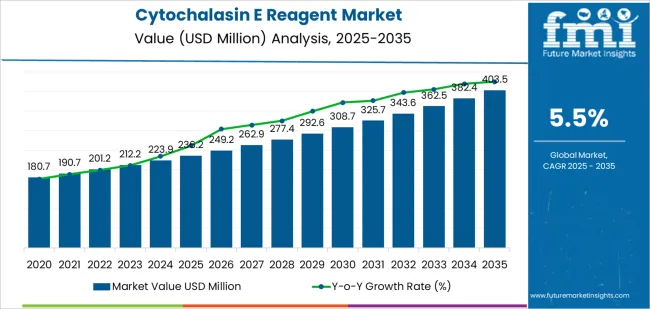
Cytochalasin E Reagent Market Year-over-Year Forecast (2025-2035)
The market demonstrates strong momentum across developed and emerging research economies, where academic and commercial research institutions are transitioning from conventional cell biology methods to advanced reagent systems that offer superior performance characteristics. Cytochalasin E technology addresses critical research challenges including cellular cytoskeleton disruption precision, experimental reproducibility in cell biology studies, and reagent stability consistency across extended research protocols. The academic sector's focus toward advanced cell biology research and complex cellular mechanism studies creates sustained demand for research solutions capable of processing various cell types and research applications with minimal variability and consistent quality output.
University research departments and commercial biotechnology laboratories are investing in Cytochalasin E reagent systems to enhance research positioning through improved experimental precision and expanded research capabilities. The integration of advanced purification technologies and optimized compound formulations enables these reagents to achieve research standards 40-60% higher than conventional systems while maintaining stability performance. However, initial procurement costs for specialized research reagents and technical expertise barriers for optimal application protocols may pose challenges to market expansion in budget-constrained research institutions and regions with limited access to specialized training resources.
Between 2025 and 2030, the Cytochalasin E Reagent market is projected to expand from USD 236.2 million to USD 308.7 million, resulting in a value increase of USD 72.5 million, which represents 43.3% of the total forecast growth for the decade. This phase of development will be shaped by rising demand for precision research applications in cell biology and molecular research, product innovation in purification technology and formulation systems, as well as expanding integration with advanced laboratory equipment and automated research platforms. Companies are establishing competitive positions through investment in high-purity reagent production, quality control technologies, and strategic market expansion across university research, biotechnology laboratories, and pharmaceutical research applications.
From 2030 to 2035, the market is forecast to grow from USD 308.7 million to USD 403.4 million, adding another USD 94.7 million, which constitutes 56.7% of the overall ten-year expansion. This period is expected to be characterized by the expansion of specialized reagent systems, including advanced purity grades and application-specific formulations tailored for specific research protocols and cellular applications, strategic collaborations between reagent manufacturers and research institutions, and an enhanced focus on reagent stability optimization and research reproducibility enhancement. The growing emphasis on research precision and experimental consistency will drive demand for advanced, high-performance Cytochalasin E reagent solutions across diverse cell biology research applications.
Cytochalasin E Reagent Market Key Takeaways
| Metric | Value |
|---|---|
| Market Value (2025) | USD 236.2 million |
| Market Forecast Value (2035) | USD 403.4 million |
| Forecast CAGR (2025-2035) | 5.5% |
Why is the Cytochalasin E Reagent Market Growing?
The Cytochalasin E Reagent market grows by enabling researchers to achieve superior cellular manipulation and research productivity while reducing experimental variability in precision cell biology operations. Research facilities face mounting pressure to improve experimental accuracy and research quality, with Cytochalasin E reagent systems typically providing 35-50% variability reduction over conventional cell biology methods, making these specialized compounds essential for competitive research operations. The university and biotechnology industries' need for precise cellular cytoskeleton disruption creates demand for advanced reagent solutions that can maintain research reproducibility, achieve excellent experimental consistency, and ensure reliable cellular responses across diverse research protocols and laboratory environments.
Research automation initiatives promoting laboratory integration and high-throughput research drive adoption in university laboratories, biotechnology research facilities, and pharmaceutical development applications, where reagent reliability has a direct impact on research capacity and experimental costs. The global shift toward precision research principles and advanced laboratory implementation accelerates Cytochalasin E Reagent demand as research facilities seek compound solutions that minimize experimental error and maximize research reproducibility. However, limited awareness of optimal application protocols and higher procurement costs compared to conventional reagents may limit adoption rates among smaller research institutions and regions with traditional research practices and limited technical support infrastructure.
Segmental Analysis
The market is segmented by purity level, application, and region. By purity level, the market is divided into Purity ≤95% and Purity >95%. Based on application, the market is categorized into University and Research Center. Regionally, the market is divided into Asia Pacific, Europe, North America, Latin America, and Middle East & Africa.
By Purity Level, the Purity >95% Segment Accounts for a Dominant Market Share
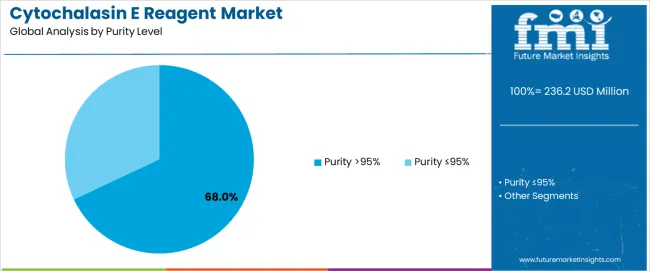
The Purity >95% segment represents the dominant force in the Cytochalasin E Reagent market, capturing approximately 68% of total market share in 2025. This advanced category encompasses high-purity formulations, research-grade configurations, and specialized preparations optimized for critical research applications, delivering superior experimental consistency and reliable cellular responses in precision cell biology operations. The Purity >95% segment's market leadership stems from its proven research performance, enhanced experimental reliability, and compatibility with advanced laboratory protocols across university research, biotechnology laboratories, and pharmaceutical research facilities.
The Purity ≤95% segment maintains a substantial 32.0% market share, serving researchers who require cost-effective reagent solutions through standard purity formulations and general research applications that provide adequate performance characteristics for routine cellular studies.
Key advantages driving the Purity >95% segment include:
- Enhanced experimental reproducibility with reduced batch-to-batch variation and consistent cellular responses
- Superior research reliability across diverse cell types including primary cells, cell lines, and specialized research models
- Optimized formulation stability enabling extended storage periods and maintained activity levels
- Broad compatibility with advanced research protocols minimizing experimental optimization requirements
By Application, the University Segment Accounts for the Largest Market Share
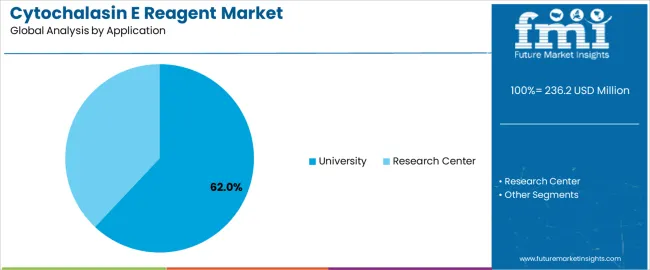
University applications dominate the Cytochalasin E Reagent market with approximately 62% market share in 2025, reflecting the extensive adoption of specialized research reagents across academic cell biology departments, molecular research programs, and graduate research laboratories. The University segment's market leadership is reinforced by widespread implementation in cellular research projects, advanced degree programs, and collaborative research initiatives, which provide essential research capabilities and experimental consistency in academic research environments.
The Research Center segment represents 38.0% market share through specialized applications including pharmaceutical research facilities, biotechnology laboratories, and commercial research organizations conducting advanced cellular studies and drug development programs.
Key market dynamics supporting application preferences include:
- University operations requiring high-volume research applications with consistent experimental outcomes and reliable reproducibility
- Research Center applications demanding specialized reagent formulations and advanced purity standards for commercial research projects
- Academic research segments emphasizing cost-effective solutions while maintaining research quality for educational and training purposes
- Growing adoption across diverse research institutions seeking experimental improvements through advanced reagent technology and protocol optimization
What are the Drivers, Restraints, and Key Trends of the Cytochalasin E Reagent Market?
The market is driven by three concrete demand factors tied to research efficiency and experimental outcomes. First, academic research expansion creates increasing requirements for precision reagent solutions, with global university research expenditure exceeding 400 billion annually in major research markets worldwide, requiring reliable Cytochalasin E systems for cell biology studies, molecular research programs, and advanced degree training applications. Second, biotechnology research growth and stringent experimental requirements drive adoption of high-purity reagent technology, with Cytochalasin E improving experimental consistency by 35-50% while reducing protocol variability in cellular studies used extensively in pharmaceutical research and drug development programs. Third, laboratory automation initiatives and advanced research equipment proliferation accelerate deployment across research facilities, with Cytochalasin E reagents integrating seamlessly with automated research platforms and enabling high-throughput research capabilities in precision laboratory environments.
Market restraints include procurement cost barriers affecting smaller research institutions and budget-constrained laboratory operations, particularly where conventional cellular reagents remain adequate for basic research applications and where research budgets constrain adoption of specialized compound systems. Technical expertise requirements for optimal protocol development pose adoption challenges for facilities lacking experienced research personnel, as Cytochalasin E performance depends heavily on proper concentration, timing, and application settings that vary significantly across cell types and experimental requirements. Limited availability of application-specific technical support in emerging research markets creates additional barriers, as research facilities require specialized training in reagent handling procedures, protocol optimization methods, and experimental troubleshooting to achieve target research outcomes.
Key trends indicate accelerated adoption in Asian research hubs, particularly China and India, where university research capabilities and biotechnology laboratory infrastructure are expanding rapidly through government research programs and international collaboration in academic research development. Technology advancement trends toward advanced purification methods with enhanced reagent stability, optimized formulations for improved cellular responses, and specialized packaging systems enabling extended storage capabilities are driving next-generation product development. However, the market thesis could face disruption if alternative cellular manipulation technologies achieve breakthrough capabilities in producing equivalent research outcomes through synthetic compounds, potentially reducing demand for natural cytochalasin-based reagents in specific research segments.
What is the Analysis of the Cytochalasin E Reagent Market by Key Country?
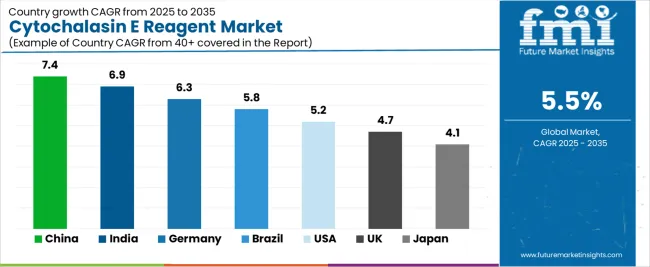
| Country | CAGR (2025-2035) |
|---|---|
| China | 7.4% |
| India | 6.9% |
| Germany | 6.3% |
| Brazil | 5.8% |
| USA | 5.2% |
| UK | 4.7% |
| Japan | 4.1% |
The Cytochalasin E Reagent market is gaining momentum worldwide, with China taking the lead thanks to aggressive university research expansion and biotechnology development programs. Close behind, India benefits from growing pharmaceutical research capabilities and government research initiatives, positioning itself as a strategic growth hub in the Asia-Pacific region. Brazil shows strong advancement, where expanding biotechnology research operations and academic research infrastructure development strengthen its role in South American research supply chains. The USA demonstrates robust growth through advanced research initiatives and pharmaceutical sector investment, signaling continued adoption in precision research applications. Meanwhile, Japan stands out for its precision laboratory expertise and advanced research technology integration, while UK and Germany continue to record consistent progress driven by university research centers and biotechnology research facilities. Together, China and India anchor the global expansion story, while established markets build stability and technology leadership into the market's growth path.
The report covers an in-depth analysis of 40+ countries, with top-performing countries highlighted below.
How is China Leading the Cytochalasin E Reagent Market with Expanding Research and Biotechnology Initiatives?
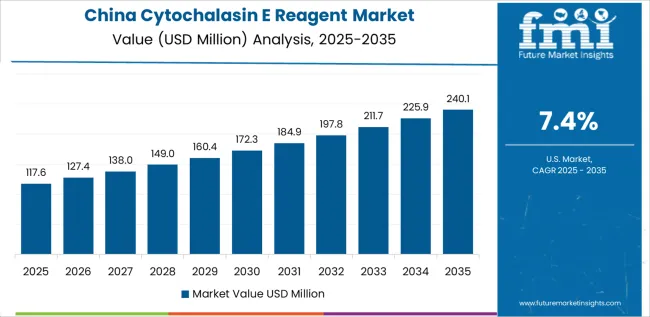
China demonstrates the strongest growth potential in the Cytochalasin E Reagent Market with a CAGR of 7.4% through 2035. The country's leadership position stems from comprehensive university research expansion, intensive biotechnology industry development programs, and aggressive academic research targets driving adoption of advanced research reagent technologies. Growth is concentrated in major research regions, including Beijing, Shanghai, Guangdong, and Jiangsu, where university research departments, biotechnology companies, and pharmaceutical research facilities are implementing Cytochalasin E reagent systems for research enhancement and experimental improvement. Distribution channels through laboratory equipment distributors, research reagent specialists, and direct manufacturer relationships expand deployment across academic research clusters, biotechnology development zones, and pharmaceutical research centers. The country's national research development strategy provides policy support for advanced research technology adoption, including subsidies for laboratory reagent procurement and research infrastructure upgrades.
Key market factors:
- Research intensity in university and biotechnology development zones with comprehensive academic upgrading programs
- Government support through research modernization schemes providing 25-35% equipment subsidies for advanced reagent adoption
- Comprehensive supply chain ecosystem including established laboratory distributors and technical service providers with proven capabilities
- Technology integration featuring advanced laboratory equipment, automated research platforms, and quality control systems enabling precision research operations
What is Driving India's High-Growth Cytochalasin E Reagent Market with Expanding Research and Technological Advancements?
In major research regions including Delhi, Mumbai, Bangalore, and Hyderabad, the adoption of Cytochalasin E reagent systems is accelerating across university research departments, biotechnology laboratories, and pharmaceutical research operations, driven by government research initiatives and increasing focus on research competitiveness. The market demonstrates strong growth momentum with a CAGR of 6.9% through 2035, linked to comprehensive academic sector expansion and increasing investment in precision research capabilities. Indian researchers are implementing Cytochalasin E technology and advanced laboratory platforms to improve experimental accuracy while meeting stringent research requirements in academic and commercial research environments serving domestic and international collaborations. The country's National Research Policy creates sustained demand for advanced reagent solutions, while increasing emphasis on research automation drives adoption of precision research systems that enhance laboratory productivity.
- Leading research development regions, including Pune, Chennai, Hyderabad, and Bangalore, driving Cytochalasin E reagent system adoption across university research clusters
- Government incentive programs enabling 30-45% capital subsidy support for advanced laboratory equipment procurement and technology upgrades
- Technology collaboration agreements accelerating deployment with international reagent manufacturers and research technology providers
- Policy support through research excellence initiatives and academic competitiveness programs linked to advanced reagent adoption
What Drives Germany's Leadership in Cytochalasin E Reagent Market with Precision Research and Experimental Excellence?
Germany's advanced research sector demonstrates sophisticated implementation of Cytochalasin E reagent systems, with documented case studies showing 35-45% experimental consistency improvement in cellular research operations through optimized reagent strategies. The country's research infrastructure in major academic regions, including Bavaria, Baden-Württemberg, North Rhine-Westphalia, and Lower Saxony, showcases integration of precision research technologies with existing laboratory equipment, leveraging expertise in pharmaceutical research and biotechnology development. German researchers emphasize experimental standards and protocol optimization, creating demand for reliable Cytochalasin E solutions that support research commitments and stringent experimental accuracy requirements. The market maintains strong growth through focus on research excellence and laboratory modernization, with a CAGR of 6.3% through 2035.
Key development areas:
- University research centers enabling precision experimental operations with comprehensive quality assurance programs
- Technical training infrastructure providing skilled research workforce with documented 92% optimal protocol utilization rates
- Strategic partnerships between reagent suppliers and research institutions expanding integrated solution offerings
- Integration of digital laboratory systems and comprehensive experimental monitoring capabilities for optimized research operations
How is Brazil Expanding Cytochalasin E Reagent Adoption in Latin America with Growing Academic and Biotechnology Infrastructure?
The Brazilian market leads in Latin American Cytochalasin E Reagent adoption based on expanding university research operations and growing biotechnology infrastructure in major academic centers. The country shows solid potential with a CAGR of 5.8% through 2035, driven by academic sector investment and increasing domestic demand for precision research reagents across pharmaceutical research, biotechnology laboratories, and university research sectors. Brazilian researchers are adopting Cytochalasin E technology for compliance with international research standards, particularly in cellular biology research requiring precise experimental protocols and in pharmaceutical development where reagent reliability impacts research economics. Technology deployment channels through laboratory distributors, research reagent representatives, and equipment financing programs expand coverage across university research networks and biotechnology facilities.
Leading market segments:
- University research operations in São Paulo and southern academic regions implementing precision reagent programs
- Technology partnerships with international reagent manufacturers achieving 75% experimental consistency improvement targets in research operations
- Strategic collaborations between pharmaceutical companies and university researchers enabling advanced research technology adoption
- Focus on research competitiveness and international collaboration incentivizing precision reagent investment
How is the USA Cytochalasin E Reagent Market Driving Innovation with Advanced Research and Automation?
The USA market leads in advanced Cytochalasin E Reagent applications based on integration with sophisticated laboratory systems and comprehensive research automation platforms for enhanced experimental efficiency. The country shows solid potential with a CAGR of 5.2% through 2035, driven by pharmaceutical research expansion and increasing adoption of advanced research technologies across university laboratories, biotechnology companies, and pharmaceutical research sectors. American researchers are implementing Cytochalasin E systems for high-precision research requirements, particularly in cellular biology studies demanding tight experimental controls and in pharmaceutical development where protocol consistency directly impacts research economics. Technology deployment channels through laboratory distributors, research reagent specialists, and direct manufacturer relationships expand coverage across diverse research operations.
Leading market segments:
- Pharmaceutical research operations in Northeast and West Coast regions implementing precision reagent programs for cellular studies and drug development
- Technology partnerships with reagent manufacturers achieving 93% experimental reproducibility rates in critical applications
- Strategic collaborations between pharmaceutical companies and university researchers enabling advanced research technology deployment
- Focus on research productivity and experimental consistency driving precision reagent adoption across academic and commercial sectors
What Contributes to the UK’s Steady Cytochalasin E Reagent Adoption in Research and Pharmaceutical Development?
The UK market demonstrates consistent implementation focused on university research operations and pharmaceutical development, with documented integration of Cytochalasin E reagent systems achieving 30-35% experimental consistency improvements in cellular research operations. The country maintains steady growth momentum with a CAGR of 4.7% through 2035, driven by academic research presence and pharmaceutical industry requirements for precision reagent capabilities in advanced research applications. Major research regions, including London, Cambridge, Oxford, and Edinburgh, showcase deployment of advanced reagent technologies that integrate with existing research infrastructure and support quality requirements in university and pharmaceutical research networks.
Key market characteristics:
- University research clusters and pharmaceutical development facilities driving precision reagent technology requirements
- Technology partnerships enabling 87% optimal experimental protocol implementation through technical support programs
- Collaboration between reagent suppliers and research facilities ensuring consistent performance and technical assistance
- Emphasis on research efficiency and experimental consistency supporting precision reagent adoption in competitive research sectors
How is Japan Implementing Precision Research Solutions with Cytochalasin E Reagent Integration?
Japan's Cytochalasin E Reagent market demonstrates sophisticated implementation focused on university research operations and pharmaceutical development, with documented integration of advanced reagent systems achieving 32-38% experimental consistency improvement in precision cellular research operations. The country maintains steady growth momentum with a CAGR of 4.1% through 2035, driven by research excellence culture and emphasis on experimental optimization principles aligned with quality research philosophies. Major research regions, including Tokyo, Osaka, Kyoto, and Yokohama, showcase advanced deployment of precision reagent technologies that integrate seamlessly with automated laboratory systems and comprehensive quality control protocols.
Key market characteristics:
- University research operations and pharmaceutical development driving advanced reagent technology requirements with emphasis on experimental consistency
- Technology partnerships enabling 96% experimental reproducibility compliance through optimized reagent strategies and protocol control
- Collaboration between reagent manufacturers and research institutions ensuring integrated solution development and technical support
- Emphasis on research efficiency and continuous improvement supporting precision reagent technology adoption across diverse research applications
Europe Market Split by Country
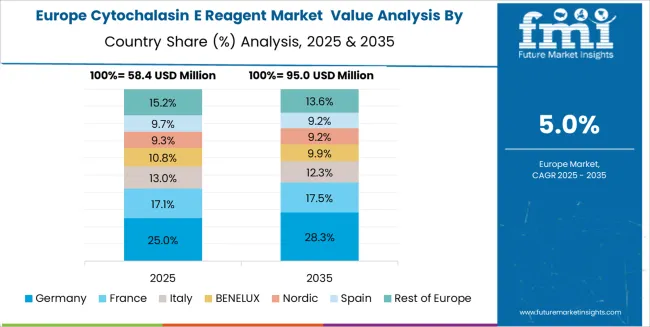
The Cytochalasin E Reagent market in Europe is projected to grow from USD 82.1 million in 2025 to USD 140.7 million by 2035, registering a CAGR of 5.5% over the forecast period. Germany is expected to maintain its leadership position with a 28.4% market share in 2025, declining slightly to 27.9% by 2035, supported by its extensive university research infrastructure and major research centers, including Max Planck Institutes and leading technical universities.
France follows with a 19.7% share in 2025, projected to reach 20.1% by 2035, driven by comprehensive research facility modernization and academic research programs in major research institutions. The United Kingdom holds a 16.2% share in 2025, expected to reach 16.5% by 2035 through university research excellence and biotechnology research facilities. Italy commands a 13.8% share in both 2025 and 2035, backed by academic research programs and pharmaceutical research operations. Spain accounts for 9.4% in 2025, rising to 9.7% by 2035 on university research expansion and biotechnology sector growth. The Rest of Europe region is anticipated to hold 12.5% in 2025, expanding to 12.8% by 2035, attributed to increasing Cytochalasin E Reagent adoption in Nordic research institutions and emerging Central & Eastern European university research operations.
High-Purity Systems Dominate Research Requirements in Japan
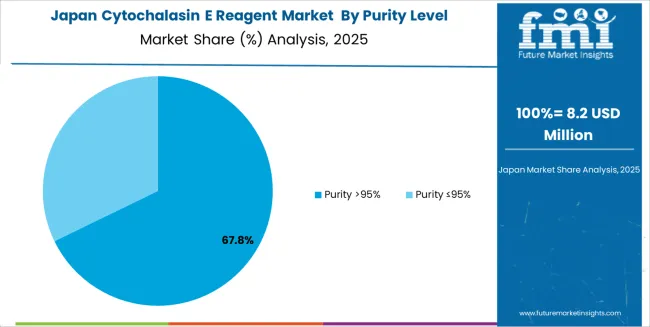
The Japanese Cytochalasin E Reagent market demonstrates a mature and quality-focused landscape, characterized by sophisticated integration of high-purity reagent systems with existing precision research infrastructure across university laboratories, pharmaceutical research facilities, and biotechnology research operations. Japan's emphasis on research excellence and experimental precision drives demand for research reagents that support quality commitments and experimental accuracy targets in competitive research environments. The market benefits from strong partnerships between international reagent providers and domestic laboratory distributors including major trading companies, creating comprehensive service ecosystems that prioritize technical support and application development programs. Research centers in Tokyo, Osaka, Kyoto, and other major academic areas showcase advanced laboratory implementations where Cytochalasin E reagent systems achieve 95% experimental reproducibility through optimized protocols and comprehensive quality control systems.
International Providers Lead Technical Services in South Korea
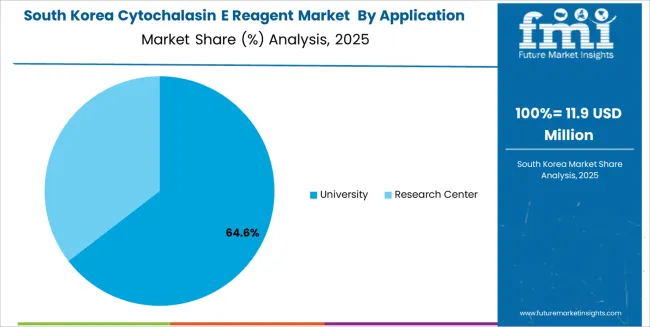
The South Korean Cytochalasin E Reagent market is characterized by growing international technology provider presence, with companies maintaining significant positions through comprehensive technical support and application development capabilities for university research and biotechnology laboratory applications. The market demonstrates increasing emphasis on research automation and experimental enhancement, as Korean researchers increasingly demand advanced reagent solutions that integrate with domestic laboratory infrastructure and sophisticated research management systems deployed across major research complexes. Regional laboratory distributors are gaining market share through strategic partnerships with international manufacturers, offering specialized services including technical training programs and application-specific reagent solutions for academic and pharmaceutical research operations. The competitive landscape shows increasing collaboration between multinational reagent companies and Korean research equipment specialists, creating hybrid service models that combine international product development expertise with local technical support capabilities and rapid response systems.
Competitive Landscape of the Cytochalasin E Reagent Market
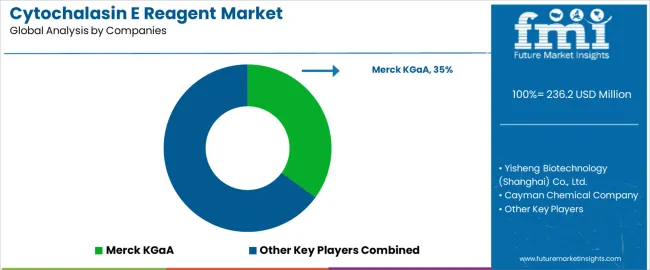
The Cytochalasin E Reagent market features approximately 15-20 meaningful players with moderate fragmentation, where the top three companies control roughly 35-40% of global market share through established distribution networks and comprehensive product portfolios. Competition centers on reagent purity consistency, product stability reliability, and technical support capabilities rather than price competition alone. Fermentek leads with approximately 15.0% market share through its comprehensive biochemical reagent portfolio and specialized research compound expertise.
Market leaders include Fermentek, Merck KGaA, and Thermo Fisher Scientific Inc., which maintain competitive advantages through global distribution infrastructure, advanced purification technology, and deep expertise in reagent development across multiple research sectors, creating trust and reliability advantages with university researchers and biotechnology laboratory operations. These companies leverage research and development capabilities in purification technology optimization and ongoing technical support relationships to defend market positions while expanding into emerging research markets and specialized application segments.
Challengers encompass Cayman Chemical Company and Bio-Techne, which compete through specialized product offerings and strong presence in key research markets. Product specialists, including Yisheng Biotechnology, SERVA, and MP Biomedicals, focus on specific reagent formulations or regional markets, offering differentiated capabilities in custom research solutions, rapid delivery services, and competitive pricing structures. Regional players and emerging reagent manufacturers create competitive pressure through localized production advantages and rapid response capabilities, particularly in high-growth markets including China and India, where proximity to research institutions provides advantages in technical support responsiveness and customer relationships.
Key Players in the Cytochalasin E Reagent Market
- Fermentek
- Merck KGaA
- Yisheng Biotechnology (Shanghai) Co., Ltd.
- Cayman Chemical Company
- Enzo Biochem Inc.
- SERVA
- Tocris Bioscience
- Thermo Fisher Scientific Inc.
- R&D Systems, Inc.
- Bio-Techne
- MP Biomedicals
- FUJIFILM Wako Pure Chemical Corporation
Scope of the Report
| Item | Value |
|---|---|
| Quantitative Units | USD 236.2 million |
| Purity Level | Purity ≤95%, Purity >95% |
| Application | University, Research Center |
| Regions Covered | Asia Pacific, Europe, North America, Latin America, Middle East & Africa |
| Country Covered | China, India, Germany, Brazil, USA, UK, Japan, and 40+ countries |
| Key Companies Profiled | Fermentek, Merck KGaA, Yisheng Biotechnology (Shanghai) Co., Ltd., Cayman Chemical Company, Enzo Biochem Inc., SERVA, Tocris Bioscience, Thermo Fisher Scientific Inc., R&D Systems Inc., Bio-Techne, MP Biomedicals, FUJIFILM Wako Pure Chemical Corporation |
| Additional Attributes | Dollar sales by purity level and application categories, regional adoption trends across Asia Pacific, Europe, and North America, competitive landscape with reagent manufacturers and distribution networks, research facility requirements and specifications, integration with laboratory equipment and automated research systems, innovations in purification technology and formulation systems, and development of specialized reagent solutions with enhanced stability and research capabilities. |
Cytochalasin E Reagent Market by Segments
Purity Level:
- Purity ≤95%
- Purity >95%
Application:
- University
- Research Center
Region:
- Asia Pacific
- China
- India
- Japan
- South Korea
- Australia & New Zealand
- ASEAN
- Rest of Asia Pacific
- Europe
- Germany
- United Kingdom
- France
- Italy
- Spain
- Netherlands
- Nordic
- BENELUX
- Rest of Europe
- North America
- United States
- Canada
- Mexico
- Latin America
- Brazil
- Argentina
- Rest of Latin America
- Middle East & Africa
- Kingdom of Saudi Arabia
- Other GCC Countries
- Turkey
- South Africa
- Other African Union
- Rest of Middle East & Africa
Frequently Asked Questions
How big is the cytochalasin e reagent market in 2025?
The global cytochalasin e reagent market is estimated to be valued at USD 236.2 million in 2025.
What will be the size of cytochalasin e reagent market in 2035?
The market size for the cytochalasin e reagent market is projected to reach USD 403.5 million by 2035.
How much will be the cytochalasin e reagent market growth between 2025 and 2035?
The cytochalasin e reagent market is expected to grow at a 5.5% CAGR between 2025 and 2035.
What are the key product types in the cytochalasin e reagent market?
The key product types in cytochalasin e reagent market are purity >95% and purity ≤95%.
Which application segment to contribute significant share in the cytochalasin e reagent market in 2025?
In terms of application, university segment to command 62.0% share in the cytochalasin e reagent market in 2025.
Preview the report firsthand - request a free sample
Get SampleGet the brochure for pricing and purchase details.
Get PDFTable of Content
- Executive Summary
- Global Market Outlook
- Demand-side Trends
- Supply-side Trends
- Technology Roadmap Analysis
- Analysis and Recommendations
- Market Overview
- Market Coverage / Taxonomy
- Market Definition / Scope / Limitations
- Market Background
- Market Dynamics
- Drivers
- Restraints
- Opportunity
- Trends
- Scenario Forecast
- Demand in Optimistic Scenario
- Demand in Likely Scenario
- Demand in Conservative Scenario
- Opportunity Map Analysis
- Product Life Cycle Analysis
- Supply Chain Analysis
- Investment Feasibility Matrix
- Value Chain Analysis
- PESTLE and Porter’s Analysis
- Regulatory Landscape
- Regional Parent Market Outlook
- Production and Consumption Statistics
- Import and Export Statistics
- Market Dynamics
- Global Market Analysis 2020 to 2024 and Forecast, 2025 to 2035
- Historical Market Size Value (USD Million) Analysis, 2020 to 2024
- Current and Future Market Size Value (USD Million) Projections, 2025 to 2035
- Y-o-Y Growth Trend Analysis
- Absolute $ Opportunity Analysis
- Global Market Pricing Analysis 2020 to 2024 and Forecast 2025 to 2035
- Global Market Analysis 2020 to 2024 and Forecast 2025 to 2035, By Purity Level
- Introduction / Key Findings
- Historical Market Size Value (USD Million) Analysis By Purity Level , 2020 to 2024
- Current and Future Market Size Value (USD Million) Analysis and Forecast By Purity Level , 2025 to 2035
- Purity >95%
- Purity ≤95%
- Y-o-Y Growth Trend Analysis By Purity Level , 2020 to 2024
- Absolute $ Opportunity Analysis By Purity Level , 2025 to 2035
- Global Market Analysis 2020 to 2024 and Forecast 2025 to 2035, By Application
- Introduction / Key Findings
- Historical Market Size Value (USD Million) Analysis By Application, 2020 to 2024
- Current and Future Market Size Value (USD Million) Analysis and Forecast By Application, 2025 to 2035
- University
- Research Center
- Y-o-Y Growth Trend Analysis By Application, 2020 to 2024
- Absolute $ Opportunity Analysis By Application, 2025 to 2035
- Global Market Analysis 2020 to 2024 and Forecast 2025 to 2035, By Region
- Introduction
- Historical Market Size Value (USD Million) Analysis By Region, 2020 to 2024
- Current Market Size Value (USD Million) Analysis and Forecast By Region, 2025 to 2035
- North America
- Latin America
- Western Europe
- Eastern Europe
- East Asia
- South Asia and Pacific
- Middle East & Africa
- Market Attractiveness Analysis By Region
- North America Market Analysis 2020 to 2024 and Forecast 2025 to 2035, By Country
- Historical Market Size Value (USD Million) Trend Analysis By Market Taxonomy, 2020 to 2024
- Market Size Value (USD Million) Forecast By Market Taxonomy, 2025 to 2035
- By Country
- USA
- Canada
- Mexico
- By Purity Level
- By Application
- By Country
- Market Attractiveness Analysis
- By Country
- By Purity Level
- By Application
- Key Takeaways
- Latin America Market Analysis 2020 to 2024 and Forecast 2025 to 2035, By Country
- Historical Market Size Value (USD Million) Trend Analysis By Market Taxonomy, 2020 to 2024
- Market Size Value (USD Million) Forecast By Market Taxonomy, 2025 to 2035
- By Country
- Brazil
- Chile
- Rest of Latin America
- By Purity Level
- By Application
- By Country
- Market Attractiveness Analysis
- By Country
- By Purity Level
- By Application
- Key Takeaways
- Western Europe Market Analysis 2020 to 2024 and Forecast 2025 to 2035, By Country
- Historical Market Size Value (USD Million) Trend Analysis By Market Taxonomy, 2020 to 2024
- Market Size Value (USD Million) Forecast By Market Taxonomy, 2025 to 2035
- By Country
- Germany
- UK
- Italy
- Spain
- France
- Nordic
- BENELUX
- Rest of Western Europe
- By Purity Level
- By Application
- By Country
- Market Attractiveness Analysis
- By Country
- By Purity Level
- By Application
- Key Takeaways
- Eastern Europe Market Analysis 2020 to 2024 and Forecast 2025 to 2035, By Country
- Historical Market Size Value (USD Million) Trend Analysis By Market Taxonomy, 2020 to 2024
- Market Size Value (USD Million) Forecast By Market Taxonomy, 2025 to 2035
- By Country
- Russia
- Poland
- Hungary
- Balkan & Baltic
- Rest of Eastern Europe
- By Purity Level
- By Application
- By Country
- Market Attractiveness Analysis
- By Country
- By Purity Level
- By Application
- Key Takeaways
- East Asia Market Analysis 2020 to 2024 and Forecast 2025 to 2035, By Country
- Historical Market Size Value (USD Million) Trend Analysis By Market Taxonomy, 2020 to 2024
- Market Size Value (USD Million) Forecast By Market Taxonomy, 2025 to 2035
- By Country
- China
- Japan
- South Korea
- By Purity Level
- By Application
- By Country
- Market Attractiveness Analysis
- By Country
- By Purity Level
- By Application
- Key Takeaways
- South Asia and Pacific Market Analysis 2020 to 2024 and Forecast 2025 to 2035, By Country
- Historical Market Size Value (USD Million) Trend Analysis By Market Taxonomy, 2020 to 2024
- Market Size Value (USD Million) Forecast By Market Taxonomy, 2025 to 2035
- By Country
- India
- ASEAN
- Australia & New Zealand
- Rest of South Asia and Pacific
- By Purity Level
- By Application
- By Country
- Market Attractiveness Analysis
- By Country
- By Purity Level
- By Application
- Key Takeaways
- Middle East & Africa Market Analysis 2020 to 2024 and Forecast 2025 to 2035, By Country
- Historical Market Size Value (USD Million) Trend Analysis By Market Taxonomy, 2020 to 2024
- Market Size Value (USD Million) Forecast By Market Taxonomy, 2025 to 2035
- By Country
- Kingdom of Saudi Arabia
- Other GCC Countries
- Turkiye
- South Africa
- Other African Union
- Rest of Middle East & Africa
- By Purity Level
- By Application
- By Country
- Market Attractiveness Analysis
- By Country
- By Purity Level
- By Application
- Key Takeaways
- Key Countries Market Analysis
- USA
- Pricing Analysis
- Market Share Analysis, 2024
- By Purity Level
- By Application
- Canada
- Pricing Analysis
- Market Share Analysis, 2024
- By Purity Level
- By Application
- Mexico
- Pricing Analysis
- Market Share Analysis, 2024
- By Purity Level
- By Application
- Brazil
- Pricing Analysis
- Market Share Analysis, 2024
- By Purity Level
- By Application
- Chile
- Pricing Analysis
- Market Share Analysis, 2024
- By Purity Level
- By Application
- Germany
- Pricing Analysis
- Market Share Analysis, 2024
- By Purity Level
- By Application
- UK
- Pricing Analysis
- Market Share Analysis, 2024
- By Purity Level
- By Application
- Italy
- Pricing Analysis
- Market Share Analysis, 2024
- By Purity Level
- By Application
- Spain
- Pricing Analysis
- Market Share Analysis, 2024
- By Purity Level
- By Application
- France
- Pricing Analysis
- Market Share Analysis, 2024
- By Purity Level
- By Application
- India
- Pricing Analysis
- Market Share Analysis, 2024
- By Purity Level
- By Application
- ASEAN
- Pricing Analysis
- Market Share Analysis, 2024
- By Purity Level
- By Application
- Australia & New Zealand
- Pricing Analysis
- Market Share Analysis, 2024
- By Purity Level
- By Application
- China
- Pricing Analysis
- Market Share Analysis, 2024
- By Purity Level
- By Application
- Japan
- Pricing Analysis
- Market Share Analysis, 2024
- By Purity Level
- By Application
- South Korea
- Pricing Analysis
- Market Share Analysis, 2024
- By Purity Level
- By Application
- Russia
- Pricing Analysis
- Market Share Analysis, 2024
- By Purity Level
- By Application
- Poland
- Pricing Analysis
- Market Share Analysis, 2024
- By Purity Level
- By Application
- Hungary
- Pricing Analysis
- Market Share Analysis, 2024
- By Purity Level
- By Application
- Kingdom of Saudi Arabia
- Pricing Analysis
- Market Share Analysis, 2024
- By Purity Level
- By Application
- Turkiye
- Pricing Analysis
- Market Share Analysis, 2024
- By Purity Level
- By Application
- South Africa
- Pricing Analysis
- Market Share Analysis, 2024
- By Purity Level
- By Application
- USA
- Market Structure Analysis
- Competition Dashboard
- Competition Benchmarking
- Market Share Analysis of Top Players
- By Regional
- By Purity Level
- By Application
- Competition Analysis
- Competition Deep Dive
- Merck KGaA
- Overview
- Product Portfolio
- Profitability by Market Segments (Product/Age /Sales Channel/Region)
- Sales Footprint
- Strategy Overview
- Marketing Strategy
- Product Strategy
- Channel Strategy
- Yisheng Biotechnology (Shanghai) Co., Ltd.
- Cayman Chemical Company
- Enzo Biochem Inc.
- SERVA
- Tocris Bioscience
- Thermo Fisher Scientific Inc.
- R&D Systems, Inc.
- Bio-Techne
- MP Biomedicals
- FUJIFILM Wako Pure Chemical Corporation
- Fermentek
- Merck KGaA
- Competition Deep Dive
- Assumptions & Acronyms Used
- Research Methodology


