

- Market Size (2026)
- USD 695.8 Mn
- Forecast (2036)
- USD 1144.2 Mn
- CAGR (2026 to 2036)
- 5.1%
How big is Deshuttering Oil Agents Market in 2026?
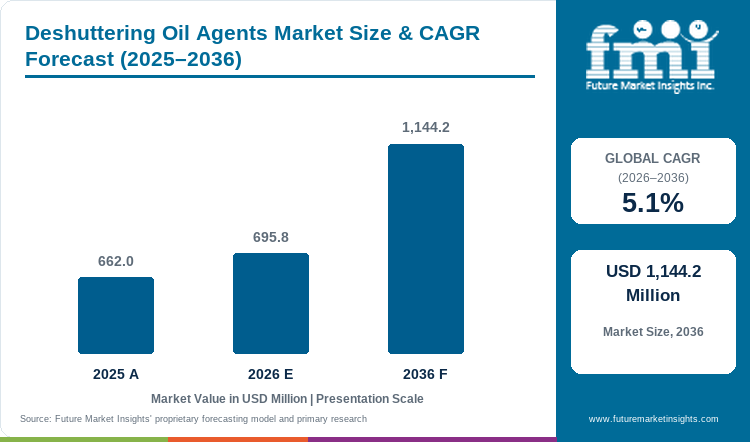
USD 695.8 Million in 2026 and USD 1,144.2 Million by 2036 at a 5.1% CAGR.
Demand for deshuttering oil agents is estimated to rise at 5.1% CAGR from USD 695.8 Million in 2026 to USD 1,144.2 Million by 2036. The market was valued at USD 662.0 Million in 2025. Release agents sit at a recurring point in the concrete forming cycle, so demand tracks the number of formwork applications and stripping cycles rather than the sale value of concrete itself. Public infrastructure work reinforces that consumption base. The U.S. Federal Highway Administration announced more than USD 5.0 billion of FY2024 Large Bridge Project awards in July 2024. Long bridge programs require repeated form preparation, concrete placement and stripping. That operating pattern supports recurring chemical consumption across the broader construction chemicals market.
The purchase decision is practical. A release agent must separate hardened concrete cleanly from the specified form surface without staining, residue or interference with later coatings and repairs. Formwork reuse makes that requirement more visible because poor release raises cleaning labor and can shorten useful form life. Country conditions then change the route to market. Gulf projects reward local stock and technical response during fast construction cycles. U.S. demand is spread across contractors, precast plants and state infrastructure specifications. Germany places more weight on environmental documentation and controlled application. Suppliers therefore gain more from matching chemistry to formwork practice and finish tolerance than from treating every project as a generic construction-volume opportunity.
Key Takeaways
- The market is projected to increase from USD 695.8 Million in 2026 to USD 1,144.2 Million by 2036 at a 5.1% CAGR. The 2025 base is USD 662.0 Million, and the forecast adds USD 448.4 Million over the decade.
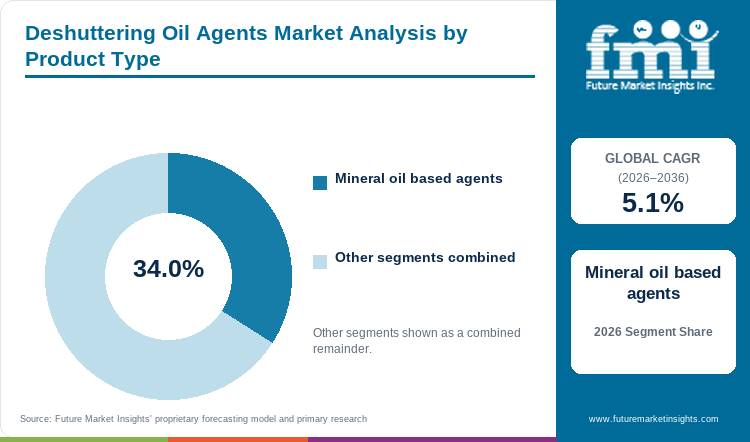
- Mineral oil based agents hold 34.0% of Product Type demand in 2026 because established spray practice and ready-to-use handling keep them relevant across routine concrete forming cycles.
- Steel formwork accounts for 31.0% of Formwork Type demand in 2026. Reuse economics make clean stripping, corrosion control and residue management visible on every cycle.
- Cast-in-place concrete represents 38.0% of Application demand in 2026. Standard release holds 32.0% of Performance, while Construction chemical distributors account for 39.0% of Sales Channel demand.
- Country growth ranges from 6.0% CAGR in KSA to 3.9% in Germany from 2026 to 2036. Project intensity, technical documentation and channel structure shape how quickly growth converts into recurring orders.
- Competition spans construction-chemical portfolios, specialist release chemistry and formwork-integrated supply. Product fit, local availability and application guidance are more useful differentiators than company scale alone.
Analyst Perspective
Poor release can damage both the concrete finish and reusable formwork. A suitable agent forms a thin, consistent film that separates cleanly and leaves the surface ready for subsequent work. Coverage per liter, cleaning time and remedial finishing costs matter alongside purchase price. Lower-emission formulations must meet the same practical requirements under the site's application conditions.
- Nikhil Kaitwade, Principal Consultant, Future Market Insights
How is the deshuttering oil agents market segmented?
The market is segmented by Product Type, Formwork Type, Application, Performance, Sales Channel, and Region.
Product Type distinguishes the release chemistry and carrier. Formwork Type identifies the surface on which the agent is applied, while Application separates site casting from factory production. Performance requirements range from routine separation to architectural finish, corrosion protection and environmental specifications. Sales Channel determines how contractors obtain product and application support during repeated pours.
What makes Mineral oil based agents central to the Product Type category?
Mineral oil based agents remain a reference formulation for routine release work because applicators understand their spray behavior and coverage. They can form a durable separating film on steel, coated timber and other common surfaces when applied thinly. Buyers usually compare coverage per liter, release consistency, residue and cleaning effort rather than chemistry alone. Water-based and vegetable-oil systems gain where environmental criteria or finish requirements become more demanding. Synthetic systems address specialized conditions. The same buyer may therefore use more than one chemistry across a project, much as concrete producers use different products within the wider concrete admixtures market to match performance to the concrete system.
- Mineral oil based agents hold 34.0% of Product Type in 2026. Their position reflects established site practice and broad use across conventional concrete forming cycles.
- Sika currently lists mold release agents within its concrete auxiliary products, while Mapei documents both vegetable-oil emulsion and mineral-oil form-release products for different formwork conditions.
Why does Steel formwork lead the Formwork Type category?
Steel formwork concentrates release-agent value because the same panels are used repeatedly and expose both the concrete face and the form asset to the consequences of poor separation. A thin and uniform film must prevent adhesion without pooling or leaving residue. Corrosion control can also matter between cycles. The release agent therefore affects both finish quality and maintenance economics. Plywood remains widely used, while aluminum and composite systems raise different compatibility questions. Steel leads because repeated-use economics make form cleaning, corrosion and stripping performance measurable across many pours.
- Steel formwork accounts for 31.0% of Formwork Type in 2026. Reuse economics and the cost of cleaning or corrosion make release performance directly measurable.
- PERI presented a new generation of MAXIMO steel-frame panel formwork in January 2025 with PERIskin corrosion protection and redesigned reusable formlining, reinforcing the importance of durability and easier deshuttering in repeated-use systems.
How does Cast-in-place concrete shape the Application category?
Cast-in-place concrete creates recurring site demand because walls, slabs, columns, foundations and infrastructure elements require form preparation before placement and stripping after curing. The work is decentralized across active projects, so pack size and local availability matter alongside formulation. Site crews also face changing weather and mixed formwork inventories. Precast production offers more controlled dosing but concentrates volume in factories. Demand from the adjacent precast concrete market raises finish and cycle-time requirements, while bridge, tunnel and architectural work can justify specialized chemistry. Cast-in-place leads because it combines broad structural use with repeated consumption throughout long project schedules.
- Cast-in-place concrete represents 38.0% of Application in 2026. Its leading position follows the frequency of jobsite forming cycles and the breadth of structural concrete uses.
- FHWA announced more than USD 5.0 billion in FY2024 Large Bridge Project awards in July 2024, creating extended sequences of formed structural concrete across bridge replacement and rehabilitation programs.
What supports Standard release in the Performance category?
Standard release remains the baseline purchase because most users first need predictable separation without concrete damage or excessive form cleaning. Premium requirements become economically relevant when the project has exposed architectural surfaces, low-emission criteria, long form reuse cycles or explicit corrosion concerns. A standard product can therefore serve a wide range of routine pours, while stain-free, biodegradable and anti-rust variants solve narrower problems. The trade-off is not only formulation cost. Rework, cleaning and downstream coating compatibility can quickly outweigh a modest difference in purchase price.
- Standard release holds 32.0% of Performance in 2026 because clean separation is the common minimum requirement across concrete-forming projects.
- Master Builders Solutions stated in its February 2025 form-release guidance that correct chemistry helps separate hardened concrete without compromising structural integrity, surface finish or appearance, and it emphasizes project-specific product selection.
What drives Construction chemical distributors in the Sales Channel category?
Construction chemical distributors lead because release agents are recurring consumables that need local stock, manageable pack sizes and product guidance close to active projects. The route is effective for contractors that source several chemical categories from one supplier. Direct contractor supply becomes more attractive on large projects with predictable volume. Formwork suppliers can bundle release practice with system maintenance, while retail channels serve smaller jobs. Distributor economics also benefit from adjacent categories such as waterproofing and flooring chemicals because the same project account may purchase several construction consumables through one branch.
- Construction chemical distributors hold 39.0% of Sales Channel in 2026. Their position is supported by recurring replenishment and the need for locally available product choice.
- FUCHS consolidated SOK, BETONEX and BITEEREX under the RENOCAST brand in August 2025 while retaining product formulations, creating a more uniform family for concrete and asphalt release-agent customers.
What are the drivers, restraints and opportunities in the Deshuttering Oil Agents Market?
Concrete-forming activity expands recurring demand, while compatibility and application errors can create rework. Low VOC, biodegradable and low-carbon-concrete-compatible chemistries open new specification opportunities.
- Driver: More concrete pours and higher formwork reuse increase the number of release-agent application cycles.
- Restraint: Incorrect chemistry or uneven application can cause sticking, staining, residue or downstream coating problems.
- Opportunity: Low VOC, biodegradable and low-carbon-concrete-compatible products can win projects with tighter environmental or material specifications.
Demand begins with the number of active forming cycles. Dubai Media Office reported in October 2024 that infrastructure and related construction projects would account for 46% of Dubai government spending in the 2025 budget. Roads, tunnels, bridges, transport systems and drainage all create concrete work over extended schedules. For release-agent suppliers, the commercial effect comes from repeated form preparation before each pour. High-cycle contractors value coverage rate and reliable stripping because both affect labor productivity. The demand signal becomes stronger when project pipelines translate into sustained formwork utilization rather than one-time announcements.
Incorrect application can undermine an otherwise suitable release agent. A release agent can work on one form surface and still create defects when it is over-applied or mismatched with the desired finish. Selection must account for formwork material, concrete formulation, temperature and downstream surface treatment. Doka guidance for fair-faced concrete states that release-agent type and application can materially affect the result and recommends testing before use. This qualification step can slow supplier switching even when price is attractive. Technical data and site trials help contractors select the correct product and application rate.
Lower-emission and biodegradable agents must still provide clean separation from the form. MC-Bauchemie introduced Ortolan GeCO2 330 in March 2026 for Earth Friendly Concrete and reported less than 1% VOC content plus 72% biodegradability after 28 days. The formulation was developed to address strong adhesion to steel formwork. That logic also matters in adjacent low-emission construction categories such as the waterproofing admixtures market. Compatibility with the concrete and formwork determines whether the new formulation can be adopted.
Which country CAGRs are profiled in the Deshuttering Oil Agents Market?
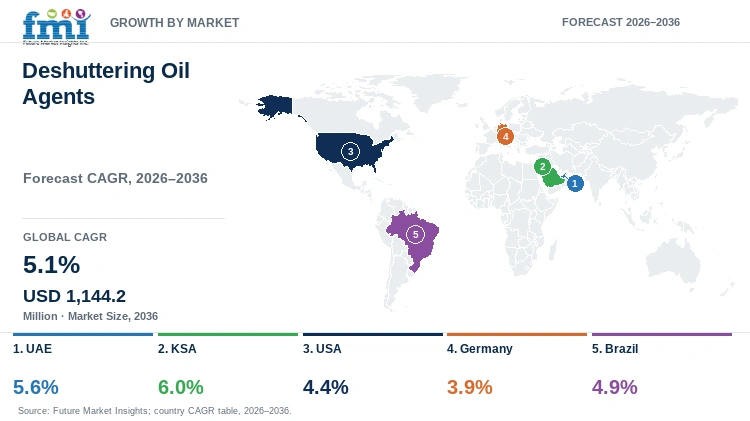
| Country | CAGR |
|---|---|
| UAE | 5.6% |
| KSA | 6.0% |
| USA | 4.4% |
| Germany | 3.9% |
| Brazil | 4.9% |
How do country-level CAGRs compare in the Deshuttering Oil Agents Market?
KSA leads the profiled markets at 6.0% CAGR from 2026 to 2036, compared with Germany at 3.9%, a 2.1 percentage-point spread. Concrete-intensive projects in KSA and UAE support frequent formwork reuse. Germany's mature market places more emphasis on controlled application and environmental characteristics. In each case, release-agent consumption follows the number of pours and the coating needed for the specified form surface.
- KSA at 6.0% is 0.4 percentage points above UAE at 5.6%. Localization and sustainable-concrete programs increase the need for local qualification support.
- UAE at 5.6% is 0.7 percentage points above Brazil at 4.9%. UAE projects reward fast local replenishment, while Brazil requires wider distribution across a larger geography.
- Brazil at 4.9% is 0.5 percentage points above USA at 4.4%. Brazil carries a stronger rate signal, while U.S. bridge and precast specifications can reward documented surface performance.
- USA at 4.4% is 0.5 percentage points above Germany at 3.9%. Germany places more weight on environmental classification and controlled application, which can support specialized formulations in a slower-growth market.
Country-wise Analysis
- UAE: Demand for Deshuttering Oil Agents in UAE is forecast to expand at 5.6% CAGR from 2026 to 2036. Dubai Media Office reported that infrastructure and related construction projects represented 46% of Dubai government spending in the 2025 budget. Fast form cycles make local stock and spray consistency commercially important. Suppliers need documented performance on steel and aluminum systems plus technical response that fits project schedules.
- KSA: Sales of Deshuttering Oil Agents in KSA are forecast to rise at 6.0% CAGR from 2026 to 2036. Saudi Arabia's Oil Sustainability Program launched the NovusCrete Consortium in January 2025, bringing together PIF, SIRC, NEOM, Sika, and ClimateCrete to advance sustainable concrete technologies and localization priorities in the Kingdom. New concrete systems create qualification work because conventional release chemistry may behave differently. Suppliers need local trials and technical support tied to project-specific concrete and formwork.
- USA: Adoption of Deshuttering Oil Agents in USA is forecast to expand at 4.4% CAGR from 2026 to 2036. FHWA announced more than USD 5.0 billion of FY2024 Large Bridge Project awards in July 2024. The opportunity is spread across contractors, precast plants and regional distribution. Suppliers need broad documentation for substrate compatibility, finish control and thin-film application across different state and project requirements.
- Germany: Demand for Deshuttering Oil Agents in Germany is forecast to expand at 3.9% CAGR from 2026 to 2036. Destatis reported that real order intake in main construction increased 6.8% in 2025, with building orders up 7.5%. Buyers operate in a mature technical market, so low-emission options and precise consumption guidance can matter alongside price and availability.
- Brazil: Sales of Deshuttering Oil Agents in Brazil are forecast to rise at 4.9% CAGR from 2026 to 2036. Brazil's federal government reported more than R$49.2 billion for the 2025 Novo PAC Seleções stage, including R$22.6 billion for infrastructure and urban mobility plus 110,000 housing units. Projects across a large territory require local stocks that follow site schedules. Distributor density and economical coverage rates are central to that conversion.
Who are the notable companies in the Deshuttering Oil Agents Market?
Sika; Fosroc (Saint-Gobain); Mapei; MC-Bauchemie; Chryso (Saint-Gobain); Master Builders Solutions; FUCHS; PERI; Doka; Cresset Chemical
Competition is shaped by where suppliers sit in the concrete and formwork workflow. Sika, Fosroc, Mapei, MC-Bauchemie, Chryso and Master Builders Solutions can position release agents inside broader construction-chemical relationships that also include admixtures, waterproofing or flooring products. Those adjacent categories link the market to the construction flooring chemicals market and similar project supply routes. FUCHS approaches the category from specialist industrial release chemistry. Cresset Chemical concentrates on form release for architectural, structural and special-purpose concrete. PERI and Doka compete from the formwork side, where release practice is tied directly to form-facing materials, cleaning and reuse.
- Construction-chemical portfolios: Sika, Fosroc, Mapei, MC-Bauchemie, Chryso and Master Builders Solutions use wider concrete-technology relationships to support specification and cross-category technical service.
- Specialist release chemistry: FUCHS and Cresset Chemical differentiate through dedicated release-agent ranges that cover conventional, environmental, architectural and infrastructure use cases.
- Formwork-integrated supply: PERI and Doka connect release-agent choice with formwork material, concrete appearance, cleaning practice and reuse economics.
Competitive Benchmarking: Deshuttering Oil Agents Market
| Company | Release-agent formulation breadth | Formwork and surface compatibility | Application and site integration | Geographic Reach |
|---|---|---|---|---|
| Sika | High | High | High | Global construction-chemical network |
| Fosroc (Saint-Gobain) | Medium | High | High | India, Middle East, Asia-Pacific and wider global channels |
| Mapei | Medium | High | Medium | Europe, Americas, Middle East and Asia-Pacific |
| MC-Bauchemie | High | High | High | Europe with broad international construction-chemical operations |
| Chryso (Saint-Gobain) | High | High | High | Global construction-chemicals platform |
| Master Builders Solutions | High | High | High | Global and regional concrete-technology operations |
| FUCHS | High | High | High | Global industrial network with concrete release-agent coverage |
| PERI | Medium | High | High | Global formwork and scaffolding network |
| Doka | Medium | High | High | Global formwork network across major construction markets |
| Cresset Chemical | High | High | Medium | United States and Canada with construction-distribution reach |
Scoring basis: Release-agent formulation breadth measures documented coverage across oil-based, water-based, vegetable, synthetic and specialized technologies. Formwork and surface compatibility considers steel, timber, aluminum, plastic and absorbent or smooth surfaces. Application and site integration covers guidance, spray practice, formwork-system fit and field-oriented selection. High indicates broad documented capability against the criterion. Medium indicates narrower but relevant coverage. Low is used only when a documented limitation is present.
Key Developments in the Deshuttering Oil Agents Market
- In March 2026, MC-Bauchemie introduced Ortolan GeCO2 330 for Earth Friendly Concrete. The company said the formulation addresses strong adhesion to steel formwork and enables clean residue-free demoulding. It reported less than 1% VOC content and 72% biodegradability after 28 days.
- In August 2025, FUCHS consolidated the SOK, BETONEX and BITEEREX release-agent families under the RENOCAST brand. FUCHS stated that formulations and performance profiles would remain unchanged while the product architecture became more uniform across concrete and asphalt applications.
- In February 2025, Saint-Gobain completed the acquisition of Fosroc. Saint-Gobain reported that Fosroc had 20 manufacturing plants and around 3,000 employees with a strong footprint in India, the Middle East and Asia-Pacific. The acquisition expands construction-chemical channels that can also carry concrete release products.
Key Players in the Deshuttering Oil Agents Market
Integrated Construction Chemical Portfolios
- Sika
- Fosroc (Saint-Gobain)
- Mapei
- MC-Bauchemie
- Chryso (Saint-Gobain)
- Master Builders Solutions
Specialist Release and Lubrication Suppliers
- FUCHS
- Cresset Chemical
Formwork-Integrated Release Solutions
- PERI
- Doka
Deshuttering Oil Agents Market - Report Scope
| Coverage field | Report scope |
|---|---|
| Market breakdown | Product Type; Formwork Type; Application; Performance; Sales Channel; Region |
| Quantitative Units | USD Million |
| Market Definition | Revenue includes deshuttering oil agents sold for concrete formwork and mold release within the stated segmentation universe. Formwork-system revenue, finished concrete products, curing compounds, cleaners and adjacent substitutes are excluded. |
| Regions Covered | North America; Latin America; Western Europe; Eastern Europe; East Asia; South Asia & Pacific; Middle East & Africa |
| Countries Covered | UAE; KSA; USA; Germany; Brazil; and more than twenty-five additional countries in the full report |
| Key Companies Profiled | Sika; Fosroc (Saint-Gobain); Mapei; MC-Bauchemie; Chryso (Saint-Gobain); Master Builders Solutions; FUCHS; PERI; Doka; Cresset Chemical |
| Forecast Period | 2026 to 2036 |
| Approach | Hybrid bottom-up and top-down market sizing that reconciles supplier revenue signals, channel economics, concrete-forming activity and segment-level demand within the defined revenue boundary. |
Deshuttering Oil Agents Market - Research Methodology
| Method | Approach |
|---|---|
| Primary Research | FMI uses structured consultations with manufacturers, distributors, formwork specialists, concrete contractors, precast producers and technical or procurement professionals to test buying criteria, product substitution, channel behavior and application practice. |
| Desk Research | Company technical literature, public filings, government construction and infrastructure releases, trade material, standards and authoritative technical sources are reviewed for evidence tied to the defined market. |
| Market Sizing and Forecasting | Supplier and channel revenue signals are reconciled with concrete-forming activity, contractor and precast consumption patterns, formulation mix, formwork reuse and country construction conditions. Forecast assumptions consider project pipelines, specification shifts, channel development and lower-emission formulations. |
| Data Validation | Findings are cross-checked across company, technical and public sources. Downstream finished-product revenue, adjacent chemical categories and company-share claims are kept outside the defined market boundary. |
Deshuttering Oil Agents Market by Segments
Deshuttering Oil Agents Market segmented by Product Type:
- Mineral oil based agents
- Vegetable oil based agents
- Water-based emulsions
- Synthetic release agents
- Wax / polymer based agents
Deshuttering Oil Agents Market segmented by Formwork Type:
- Steel formwork
- Plywood formwork
- Aluminum formwork
- Plastic / composite formwork
- Precast molds
Deshuttering Oil Agents Market segmented by Application:
- Cast-in-place concrete
- Precast concrete
- Bridge / infrastructure works
- Tunnel linings
- Architectural concrete
Deshuttering Oil Agents Market segmented by Performance:
- Standard release
- Stain-free finish
- Low VOC / biodegradable
- High reuse cycle
- Anti-rust release
Deshuttering Oil Agents Market segmented by Sales Channel:
- Construction chemical distributors
- Direct contractor supply
- Formwork OEM supply
- Retail / dealer channel
Deshuttering Oil Agents Market by Region:
- North America
- United States
- Canada
- Latin America
- Brazil
- Mexico
- Argentina
- Chile
- Western Europe
- Germany
- France
- United Kingdom
- Italy
- Spain
- Benelux
- Nordics
- Eastern Europe
- Poland
- Czech Republic
- Romania
- Hungary
- East Asia
- China
- Japan
- South Korea
- South Asia & Pacific
- India
- ASEAN
- Australia and New Zealand
- Middle East & Africa
- GCC Countries
- South Africa
- Türkiye
- Israel
Research Sources and Bibliography
- MC-Bauchemie. (2026, March 24). Release agent for climate-friendly concrete.
- MC-Bauchemie. (2026, June 5). Sustainable release agents: quality and environmental protection.
- FUCHS. (2025, August 12). SOK becomes RENOCAST.
- Saint-Gobain. (2025, February 10). Saint-Gobain completes the acquisition of Fosroc.
- PERI. (2025, January 15). The new generation of MAXIMO Panel Formwork.
- Dubai Media Office. (2024, October 29). Mohammed bin Rashid approves Dubai Government General Budget Cycle for 2025-2027.
- Public Investment Fund. (2025, January 29). Oil Sustainability Program launches NovusCrete Consortium.
- U.S. Federal Highway Administration. (2024, July 17). Large Bridge Project awards through the Bridge Investment Program.
- Federal Statistical Office of Germany (Destatis). (2026, February 25). Auftragseingang im Bauhauptgewerbe 2025 um 6,8% höher als im Vorjahr.
- Brazil Federal Government. (2025, February 12). Novo PAC Seleções investment announcement.
- Sika. Concrete Auxiliary Products. Accessed September 2026.
- Fosroc. Reebol E mould release agent. Accessed September 2026.
- Mapei. MAPEFORM ECO 91 product information and safety documentation. 2025.
- Master Builders Solutions. (2025, February). The crucial role of Form Release Agents.
- Doka. Release-agents: the right release-agent for every application. Accessed September 2026.
- Cresset Chemical. Form Release Agents. Accessed September 2026.
This Report Answers
- What is the Deshuttering Oil Agents Market size in 2026 and what value is forecast for 2036?
- Which concrete-forming conditions create recurring demand for deshuttering oil agents?
- Why do Mineral oil based agents hold the leading position within Product Type?
- How does Steel formwork influence release-agent performance and form reuse?
- Why does Cast-in-place concrete lead the Application category?
- How do the profiled CAGRs compare across UAE, KSA, USA, Germany and Brazil?
- How do suppliers differ across formulation breadth, surface compatibility and application support?
- What should construction procurement and technical teams evaluate before selecting a deshuttering oil agent?
Frequently Asked Questions
How big is the Deshuttering Oil Agents Market in 2026?
The market is estimated at USD 695.8 Million in 2026 and is forecast to reach USD 1,144.2 Million by 2036 at a 5.1% CAGR. The 2025 market value is USD 662.0 Million.
What is driving growth in the Deshuttering Oil Agents Market?
Growth comes from recurring concrete forming cycles in infrastructure, buildings and precast production. Reusable formwork increases the cost of poor stripping, which pushes contractors toward consistent release performance and controlled application.
Which Product Type leads the Deshuttering Oil Agents Market?
Mineral oil based agents are projected to hold 34.0% of Product Type demand in 2026. Familiar handling and broad compatibility keep them relevant across routine concrete-forming work.
Which Application leads the Deshuttering Oil Agents Market?
Cast-in-place concrete is projected to represent 38.0% of Application demand in 2026. Site-based wall, slab, column and infrastructure pours create repeated release-agent consumption across long project schedules.
Who are the key players in the Deshuttering Oil Agents Market?
Key companies include Sika, Fosroc (Saint-Gobain), Mapei, MC-Bauchemie, Chryso (Saint-Gobain), Master Builders Solutions, FUCHS, PERI, Doka and Cresset Chemical. Their positions range from broad construction-chemical portfolios to specialist release chemistry and formwork-integrated supply.
What notable restraint affects the Deshuttering Oil Agents Market?
Compatibility and application errors can cause sticking, surface residue, staining or coating problems. This raises the value of trials, thin-film application guidance and substrate-specific product selection before repeat purchasing is standardized.
Preview the report firsthand - request a free sample
Get SampleGet the brochure for pricing and purchase details.
Get PDFTable of Content
- Key Takeaways
- Market Size and CAGR
- Top Growth Driver
- Fastest Growing Segment
- Leading Region
- Key Companies
- Emerging Opportunities
- Executive Summary
- Global Market Outlook
- Demand-side Trends
- Supply-side Trends
- Technology Roadmap Analysis
- Analysis and Recommendations
- Analyst Perspective (What is happening? Why now? What should investors know?)
- Key Questions Answered
- How large is the market?
- What is the CAGR?
- What are key trends?
- Which region dominates?
- Who are the leaders?
- Market Overview
- Market Coverage / Taxonomy
- Market Definition / Scope / Limitations
- Research Methodology
- Chapter Orientation
- Analytical Lens and Working Hypotheses
- Market Structure, Signals, and Trend Drivers
- Benchmarking and Cross-market Comparability
- Market Sizing, Forecasting, and Opportunity Mapping
- Research Design and Evidence Framework
- Desk Research Programme (Secondary Evidence)
- Expert Input and Fieldwork (Primary Evidence)
- Tooling, Models, and Reference Databases
- Data Engineering and Model Build
- Quality Assurance and Audit Trail
- Market Background
- Market Dynamics (Drivers, Restraints, Opportunity, Trends)
- Scenario Forecast (Optimistic, Likely, Conservative)
- Impact Analysis
- AI Impact
- Sustainability Impact
- Regulatory Impact
- Technology Impact
- Consumer / Buyer Analysis
- Purchase Drivers
- Adoption Barriers
- Buyer Journey
- Opportunity Map Analysis
- Product Life Cycle Analysis
- Supply Chain Analysis
- Investment Feasibility Matrix
- Value Chain Analysis
- PESTLE and Porter's Analysis
- Regulatory Landscape
- Regional Parent Market Outlook
- Production and Consumption Statistics
- Import and Export Statistics
- Global Market Analysis and Forecast, 2021 to 2036
- Historical Market Size Value (USD Million) Analysis, 2021 to 2025
- Current and Future Market Size Value (USD Million) Projections, 2026 to 2036
- Y-o-Y Growth Trend Analysis
- Absolute $ Opportunity Analysis
- Global Market Pricing Analysis, 2021 to 2036
- Global Market Analysis and Forecast, By Product Type, 2021 to 2036
- Introduction / Key Findings
- Historical Market Size Value (USD Million) Analysis By Product Type, 2021 to 2025
- Current and Future Market Size Value (USD Million) Analysis and Forecast By Product Type, 2026 to 2036
- Mineral oil based agents
- Vegetable oil based agents
- Water-based emulsions
- Synthetic release agents
- Wax / polymer based agents
- Y-o-Y Growth Trend Analysis By Product Type, 2021 to 2025
- Absolute $ Opportunity Analysis By Product Type, 2026 to 2036
- Global Market Analysis and Forecast, By Formwork Type, 2021 to 2036
- Introduction / Key Findings
- Historical Market Size Value (USD Million) Analysis By Formwork Type, 2021 to 2025
- Current and Future Market Size Value (USD Million) Analysis and Forecast By Formwork Type, 2026 to 2036
- Steel formwork
- Plywood formwork
- Aluminum formwork
- Plastic / composite formwork
- Precast molds
- Y-o-Y Growth Trend Analysis By Formwork Type, 2021 to 2025
- Absolute $ Opportunity Analysis By Formwork Type, 2026 to 2036
- Global Market Analysis and Forecast, By Application, 2021 to 2036
- Introduction / Key Findings
- Historical Market Size Value (USD Million) Analysis By Application, 2021 to 2025
- Current and Future Market Size Value (USD Million) Analysis and Forecast By Application, 2026 to 2036
- Cast-in-place concrete
- Precast concrete
- Bridge / infrastructure works
- Tunnel linings
- Architectural concrete
- Y-o-Y Growth Trend Analysis By Application, 2021 to 2025
- Absolute $ Opportunity Analysis By Application, 2026 to 2036
- Global Market Analysis and Forecast, By Performance, 2021 to 2036
- Introduction / Key Findings
- Historical Market Size Value (USD Million) Analysis By Performance, 2021 to 2025
- Current and Future Market Size Value (USD Million) Analysis and Forecast By Performance, 2026 to 2036
- Standard release
- Stain-free finish
- Low VOC / biodegradable
- High reuse cycle
- Anti-rust release
- Y-o-Y Growth Trend Analysis By Performance, 2021 to 2025
- Absolute $ Opportunity Analysis By Performance, 2026 to 2036
- Global Market Analysis and Forecast, By Sales Channel, 2021 to 2036
- Introduction / Key Findings
- Historical Market Size Value (USD Million) Analysis By Sales Channel, 2021 to 2025
- Current and Future Market Size Value (USD Million) Analysis and Forecast By Sales Channel, 2026 to 2036
- Construction chemical distributors
- Direct contractor supply
- Formwork OEM supply
- Retail / dealer channel
- Y-o-Y Growth Trend Analysis By Sales Channel, 2021 to 2025
- Absolute $ Opportunity Analysis By Sales Channel, 2026 to 2036
- Global Market Analysis and Forecast, By Region, 2021 to 2036
- Introduction
- Historical Market Size Value (USD Million) Analysis By Region, 2021 to 2025
- Current Market Size Value (USD Million) Analysis and Forecast By Region, 2026 to 2036
- North America
- Latin America
- Western Europe
- Eastern Europe
- East Asia
- South Asia & Pacific
- Middle East & Africa
- Market Attractiveness Analysis By Region
- North America Market Analysis and Forecast, By Country, 2021 to 2036
- Historical Market Size Value (USD Million) Trend Analysis By Market Taxonomy, 2021 to 2025
- Market Size Value (USD Million) Forecast By Market Taxonomy, 2026 to 2036
- By Country
- United States
- Canada
- By Product Type
- By Formwork Type
- By Application
- By Performance
- By Sales Channel
- By Country
- Market Attractiveness Analysis
- By Country
- By Product Type
- By Formwork Type
- By Application
- By Performance
- By Sales Channel
- Key Takeaways
- Latin America Market Analysis and Forecast, By Country
- Historical Market Size Value (USD Million) Trend Analysis By Market Taxonomy, 2021 to 2025
- Market Size Value (USD Million) Forecast By Market Taxonomy, 2026 to 2036
- By Country
- Brazil
- Mexico
- Argentina
- Chile
- By Product Type
- By Formwork Type
- By Application
- By Performance
- By Sales Channel
- By Country
- Market Attractiveness Analysis
- By Country
- By Product Type
- By Formwork Type
- By Application
- By Performance
- By Sales Channel
- Key Takeaways
- Western Europe Market Analysis and Forecast, By Country
- Historical Market Size Value (USD Million) Trend Analysis By Market Taxonomy, 2021 to 2025
- Market Size Value (USD Million) Forecast By Market Taxonomy, 2026 to 2036
- By Country
- Germany
- France
- United Kingdom
- Italy
- Spain
- Benelux
- Nordics
- By Product Type
- By Formwork Type
- By Application
- By Performance
- By Sales Channel
- By Country
- Market Attractiveness Analysis
- By Country
- By Product Type
- By Formwork Type
- By Application
- By Performance
- By Sales Channel
- Key Takeaways
- Eastern Europe Market Analysis and Forecast, By Country
- Historical Market Size Value (USD Million) Trend Analysis By Market Taxonomy, 2021 to 2025
- Market Size Value (USD Million) Forecast By Market Taxonomy, 2026 to 2036
- By Country
- Poland
- Czech Republic
- Romania
- Hungary
- By Product Type
- By Formwork Type
- By Application
- By Performance
- By Sales Channel
- By Country
- Market Attractiveness Analysis
- By Country
- By Product Type
- By Formwork Type
- By Application
- By Performance
- By Sales Channel
- Key Takeaways
- East Asia Market Analysis and Forecast, By Country
- Historical Market Size Value (USD Million) Trend Analysis By Market Taxonomy, 2021 to 2025
- Market Size Value (USD Million) Forecast By Market Taxonomy, 2026 to 2036
- By Country
- China
- Japan
- South Korea
- By Product Type
- By Formwork Type
- By Application
- By Performance
- By Sales Channel
- By Country
- Market Attractiveness Analysis
- By Country
- By Product Type
- By Formwork Type
- By Application
- By Performance
- By Sales Channel
- Key Takeaways
- South Asia & Pacific Market Analysis and Forecast, By Country
- Historical Market Size Value (USD Million) Trend Analysis By Market Taxonomy, 2021 to 2025
- Market Size Value (USD Million) Forecast By Market Taxonomy, 2026 to 2036
- By Country
- India
- ASEAN
- Australia and New Zealand
- By Product Type
- By Formwork Type
- By Application
- By Performance
- By Sales Channel
- By Country
- Market Attractiveness Analysis
- By Country
- By Product Type
- By Formwork Type
- By Application
- By Performance
- By Sales Channel
- Key Takeaways
- Middle East & Africa Market Analysis and Forecast, By Country
- Historical Market Size Value (USD Million) Trend Analysis By Market Taxonomy, 2021 to 2025
- Market Size Value (USD Million) Forecast By Market Taxonomy, 2026 to 2036
- By Country
- GCC Countries
- South Africa
- Türkiye
- Israel
- By Product Type
- By Formwork Type
- By Application
- By Performance
- By Sales Channel
- By Country
- Market Attractiveness Analysis
- By Country
- By Product Type
- By Formwork Type
- By Application
- By Performance
- By Sales Channel
- Key Takeaways
- Key Countries Market Analysis
- United States
- Pricing Analysis
- Market Share Analysis, 2025
- By Product Type
- By Formwork Type
- By Application
- By Performance
- By Sales Channel
- Canada
- Pricing Analysis
- Market Share Analysis, 2025
- By Product Type
- By Formwork Type
- By Application
- By Performance
- By Sales Channel
- Mexico
- Pricing Analysis
- Market Share Analysis, 2025
- By Product Type
- By Formwork Type
- By Application
- By Performance
- By Sales Channel
- Brazil
- Pricing Analysis
- Market Share Analysis, 2025
- By Product Type
- By Formwork Type
- By Application
- By Performance
- By Sales Channel
- Chile
- Pricing Analysis
- Market Share Analysis, 2025
- By Product Type
- By Formwork Type
- By Application
- By Performance
- By Sales Channel
- Germany
- Pricing Analysis
- Market Share Analysis, 2025
- By Product Type
- By Formwork Type
- By Application
- By Performance
- By Sales Channel
- United Kingdom
- Pricing Analysis
- Market Share Analysis, 2025
- By Product Type
- By Formwork Type
- By Application
- By Performance
- By Sales Channel
- Italy
- Pricing Analysis
- Market Share Analysis, 2025
- By Product Type
- By Formwork Type
- By Application
- By Performance
- By Sales Channel
- Spain
- Pricing Analysis
- Market Share Analysis, 2025
- By Product Type
- By Formwork Type
- By Application
- By Performance
- By Sales Channel
- France
- Pricing Analysis
- Market Share Analysis, 2025
- By Product Type
- By Formwork Type
- By Application
- By Performance
- By Sales Channel
- India
- Pricing Analysis
- Market Share Analysis, 2025
- By Product Type
- By Formwork Type
- By Application
- By Performance
- By Sales Channel
- ASEAN
- Pricing Analysis
- Market Share Analysis, 2025
- By Product Type
- By Formwork Type
- By Application
- By Performance
- By Sales Channel
- Australia and New Zealand
- Pricing Analysis
- Market Share Analysis, 2025
- By Product Type
- By Formwork Type
- By Application
- By Performance
- By Sales Channel
- China
- Pricing Analysis
- Market Share Analysis, 2025
- By Product Type
- By Formwork Type
- By Application
- By Performance
- By Sales Channel
- Japan
- Pricing Analysis
- Market Share Analysis, 2025
- By Product Type
- By Formwork Type
- By Application
- By Performance
- By Sales Channel
- South Korea
- Pricing Analysis
- Market Share Analysis, 2025
- By Product Type
- By Formwork Type
- By Application
- By Performance
- By Sales Channel
- Poland
- Pricing Analysis
- Market Share Analysis, 2025
- By Product Type
- By Formwork Type
- By Application
- By Performance
- By Sales Channel
- Hungary
- Pricing Analysis
- Market Share Analysis, 2025
- By Product Type
- By Formwork Type
- By Application
- By Performance
- By Sales Channel
- Türkiye
- Pricing Analysis
- Market Share Analysis, 2025
- By Product Type
- By Formwork Type
- By Application
- By Performance
- By Sales Channel
- South Africa
- Pricing Analysis
- Market Share Analysis, 2025
- By Product Type
- By Formwork Type
- By Application
- By Performance
- By Sales Channel
- UAE
- Pricing Analysis
- Market Share Analysis, 2025
- By Product Type
- By Formwork Type
- By Application
- By Performance
- By Sales Channel
- KSA
- Pricing Analysis
- Market Share Analysis, 2025
- By Product Type
- By Formwork Type
- By Application
- By Performance
- By Sales Channel
- United States
- Market Structure Analysis
- Competition Dashboard
- Competition Benchmarking
- Market Share Analysis of Top Players
- By Regional
- By Product Type
- By Formwork Type
- By Application
- By Performance
- By Sales Channel
- Emerging Startups
- Innovation Benchmarking
- Competition Analysis
- Competition Deep Dive
- Sika
- Overview
- Product Portfolio
- Profitability by Market Segments
- Sales Footprint
- Strategy Overview
- Marketing Strategy
- Product Strategy
- Channel Strategy
- Fosroc (Saint-Gobain)
- Mapei
- MC-Bauchemie
- Chryso (Saint-Gobain)
- Master Builders Solutions
- FUCHS
- PERI
- Doka
- Cresset Chemical
- Sika
- Case Studies
- Success Stories
- Recent Developments
- Competition Deep Dive
- Assumptions & Acronyms Used


