

- Market Size (2026)
- USD 1.8 Bn
- Forecast (2036)
- USD 5.9 Bn
- CAGR (2026 to 2036)
- 12.7%
How big is the DNA Encoded Library Market in 2026?
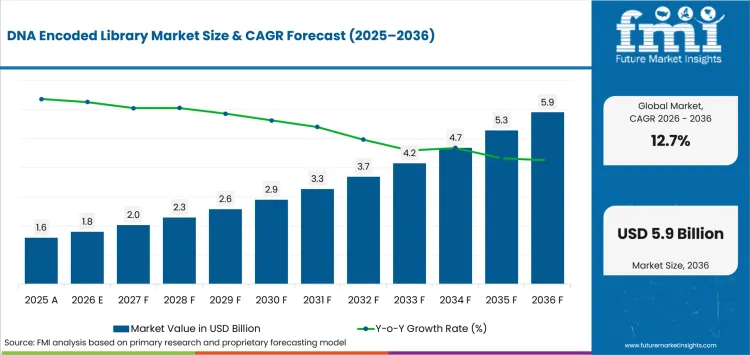
USD 1.8 billion in 2026 and USD 5.9 billion by 2036 at a 12.7% CAGR.
The DNA encoded library market is projected to rise from USD 1.8 billion in 2026 to USD 5.9 billion by 2036 at a 12.7% CAGR. Pharmaceutical research teams use encoded libraries within drug discovery services to test vast chemical collections prior to committing resources to synthesis and conventional screening.
Program demand persists as discovery groups seek chemical starting points for difficult targets with limited material and controlled assay conditions. In January 2026, FDA reported 46 novel drug approvals for 2025 and preserved a broad downstream need for differentiated small-molecule candidates. The approval count does not measure DEL spending but it clarifies why efficient hit generation remains commercially relevant across active pipelines.
Key Takeaways of DNA Encoded Library Market
- Discovery demand rises as research teams sample billions of encoded compounds prior to funding physical synthesis and repeated conventional screening.
- Single-pharmacophore libraries are estimated to represent 43.0% by library type in 2026 due to direct compound-to-barcode interpretation.
- Pharmaceutical companies are projected to account for 42.0% of end user demand in 2026 supported by integrated discovery capabilities.
- Affinity-based screening is forecast to capture 48.0% of screening method demand in 2026 owing to established selection workflows.
- Target preparation and off-DNA hit confirmation restrict wider use as apparent enrichment sometimes reflects assay artifacts instead of actionable binding.
- X-Chem, HitGen, WuXi AppTec, Vipergen, Orogen Therapeutics, Totus Medicines, Amgen and Charles River Laboratories serve distinct library-access or proprietary discovery routes.
Analyst Perspective
"Discovery teams cannot judge a DNA encoded library from compound count alone during selection campaigns. Commercial advantage depends on reproducible target preparation and sequencing controls that convert enriched barcodes into confirmed off-DNA hits."
- Anurag Sharma, Principal Consultant, Future Market Insights
How is the DNA Encoded Library Market segmented?
The DNA encoded library industry is segmented by library type, application, end user, screening method, therapeutic area and region.
The DNA encoded library market is segmented by library type, application, end user, screening method, therapeutic area and region. Library types cover single-pharmacophore, peptide, small-molecule, dual-pharmacophore, macrocycle and custom designs used across specialized discovery programs. Applications include drug discovery, target identification, academic research and specialized diagnostic or agricultural research programs. End users span pharmaceutical companies, biotechnology companies, contract research organizations and academic institutes that fund screening campaigns. Screening methods cover affinity selection, cell-based selection, next-generation sequencing and computational analysis across oncology, neurological, infectious, cardiovascular, metabolic, autoimmune and rare-disease programs.
How does drug discovery shape the application category?
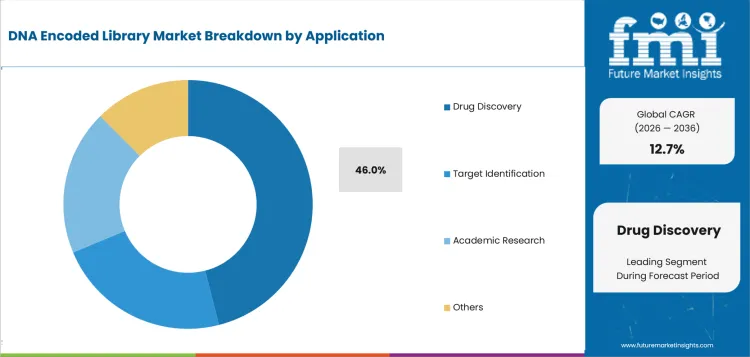
Drug discovery programs use encoded libraries to identify binding chemotypes ahead of larger medicinal chemistry investment in analogue series. The approach fits AI-enabled drug discovery workflows that combine selection counts with structural filters and predicted properties.
- Drug discovery is projected to account for 46.0% of application demand in 2026 reinforced by broad hit-identification use.
- Project teams expand DEL use as screening outputs arrive with commercial target controls and clear resynthesis priorities. Amgen reported in April 2025 that its platform screens 2 billion molecules in a single morning, which links rapid primary selection with downstream design work.
What supports single-pharmacophore libraries within the library type category?
Single-pharmacophore libraries attach one encoded chemical entity to each barcode and simplify the link between enrichment and compound identity. Their purchase case strengthens as commercial high-throughput screening teams require broad chemical coverage with limited target material.
- By library type, single-pharmacophore libraries are estimated to hold 43.0% share in 2026 influenced by direct compound-to-barcode interpretation.
- Selection teams confirm enriched sequences through resynthesis and orthogonal assays prior to advancing a credible hit candidate. NCATS reported in July 2025 that its conventional screening collection contained 2,900 approved molecular entities. The smaller physical scale illustrates the intensive confirmation work required during primary encoded-library selection campaigns.
Why do pharmaceutical companies remain central within the end user category?
Pharmaceutical companies combine target biology and medicinal chemistry with dedicated budgets for repeated selection and internal hit confirmation. Their development pipelines also support clinical research organizations that provide library access or specialized assays under controlled intellectual-property terms.
- Pharmaceutical companies are expected to represent 42.0% of end user demand in 2026 supported by integrated discovery capabilities.
- Large sponsors repeat screens across related targets and compare enrichment patterns prior to ordering complete off-DNA synthesis. Smaller biotechnology firms often depend on milestone-based service contracts as full platform ownership requires specialized chemistry and bioinformatics staff during active campaigns.
What makes affinity-based screening central to the screening method category?
Affinity-based screening exposes tagged compounds to a purified or solution-phase target and enriches binders through repeated controlled selection rounds. Clinical NGS analysis tools decode the surviving barcodes but target quality and nonspecific binding often distort compound ranking.
- Affinity-based screening is forecast to capture 48.0% of screening method demand in 2026 driven by established selection workflows.
- Teams improve confidence by running negative controls and independent assays against resynthesized compounds during each campaign. HitGen introduced OpenDEL 5.0 in August 2025 with four billion compounds and 59 libraries, which expanded accessible chemical diversity without removing confirmation requirements.
What are the drivers, restraints and opportunities in the DNA Encoded Library Market?
Demand rises through broad chemical sampling and integrated confirmation, while target quality and uncertain hit translation constrain repeat purchasing despite expanding specialized library designs.
- Driver: Encoded libraries let discovery teams screen billions of compounds with limited target material ahead of financing larger physical collections.
- Restraint: Nonspecific enrichment and DNA-linked assay artifacts require costly resynthesis until medicinal chemists trust apparent binding signals.
- Opportunity: Covalent and macrocycle libraries extend screening toward difficult binding sites that conventional small-molecule collections often represent poorly.
Library scale creates value through breadth instead of direct proof of biological activity during early selection campaigns. NCATS reported in September 2025 that its partnerships enabled more than 45 promising drugs to enter clinical trials. The translational record reinforces commercial demand for credible starting points and disciplined follow-up across discovery portfolios.
Selection counts often reflect protein aggregation or matrix binding instead of genuine target engagement during poorly controlled campaigns. Discovery teams therefore resynthesize prioritized compounds without DNA and repeat orthogonal assays during lead optimization decisions. Weak controls raise project cost and reduce confidence in repeat screening orders across subsequent target campaigns.
Specialized libraries extend addressable target classes through covalent warheads and macrocyclic scaffolds within discovery programs. WuXi AppTec described a covalent DEL route in January 2026 that connects selection with on-DNA and off-DNA validation. Bioinformatics platforms subsequently prioritize chemotypes across related warheads and target conditions during confirmation planning activities.
Which country CAGRs are profiled in the DNA Encoded Library Market?'
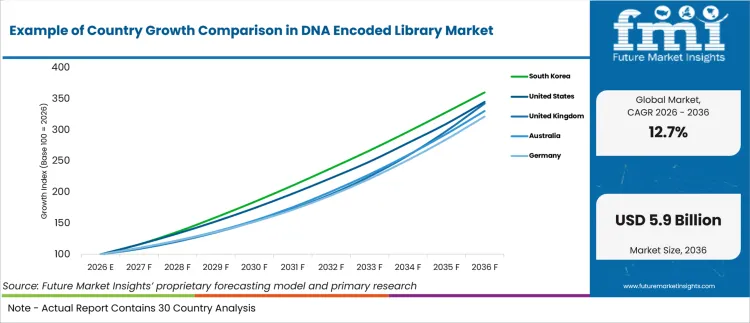
| Country | CAGR |
|---|---|
| South Korea | 13.7% |
| United States | 13.2% |
| United Kingdom | 13.1% |
| Australia | 12.7% |
| Germany | 12.4% |
How do country-level CAGRs compare in the DNA Encoded Library Market?
The displayed country CAGRs span 1.3 percentage points and describe forecast pace instead of present market size or current provider revenue.
- South Korea records the highest approved rate as dense biopharma research clusters support precision medicine genomics and outsourced hit discovery around Seoul.
- The United States combines broad pharmaceutical pipelines with personalized medicine programs and several domestic DEL providers across established discovery centers.
- The United Kingdom benefits from university-linked screening expertise but smaller sponsors often depend on external libraries and specialist assay partners.
- Australia matches the global CAGR as DNA sequencing services support decoding even though long shipping routes complicate target and sample logistics.
- Germany maintains a near-global rate through strong medicinal chemistry expertise alongside demanding reproducibility and data-governance requirements for contracted research.
Comparable CAGRs often produce materially different entry conditions across national research systems and specialized discovery networks. The full report covers country-level growth across North America, Latin America, Europe, East Asia, South Asia and Pacific, and the Middle East and Africa.
Country-wise Analysis
- South Korean pharmaceutical companies operate within concentrated Seoul-area research networks that purchase DEL screening through cross-border contracts and coordinate sequencing plus hit confirmation with domestic organizations across regional research hubs serving national biomedical programs. The DNA encoded library market in South Korea is expected to expand at 13.7% CAGR through 2036 as active pipelines sustain repeat target screening and off-DNA validation demand across several target classes. MFDS reported in March 2026 that 783 clinical trials received approval during 2025, yet smaller teams face limited local DEL infrastructure and complex documentation for protein shipment and confirmation beyond metropolitan research centers.
- United States discovery teams contract domestic DEL laboratories and integrated CROs across major biotechnology clusters with direct access to protein production plus sequencing and medicinal chemistry plus hit-confirmation services without international sample shipment. The United States market is projected to record 13.2% CAGR during the forecast period as local provider depth supports rapid assay redesign and repeat screening across several target classes and diverse modalities. NCSES reported in 2025 that pharmaceutical manufacturers devoted 17.8% of sales to research during 2023, but high specialist labor costs and intellectual-property reviews delay contracts for emerging biotechnology companies with limited validation budgets.
- United Kingdom discovery programs use university-linked chemistry groups and Cambridge-area biotechnology networks as external providers deliver large DEL collections through cross-border contracts supported by local assay specialists and confirmation laboratories across national research clusters. The United Kingdom market is estimated to advance at 13.1% CAGR over the assessment period as national pharmaceutical research sustains target generation and specialist assay demand across oncology and neurological discovery programs. The Office for Life Sciences reported in March 2026 that pharmaceuticals represented 17% of business R&D expenditure during 2024, although sponsors lack sequencing teams and face data-residency or intellectual-property terms for overseas screening.
- Australian research groups usually access large DEL platforms through overseas service contracts that require refrigerated target shipment and remote project management as domestic screening capacity remains concentrated in academic and specialized biotechnology laboratories nationally. Australia is forecast to post 12.7% CAGR between 2026 and 2036 as established sequencing facilities support barcode decoding plus collaborative hit analysis during repeated selection rounds across dispersed national research centers. ABS reported in August 2025 that Australian business research expenditure increased 18% during 2023-24, yet long transport distances raise protein-stability risks and restrict smaller teams from accessing resynthesis services for confirming enriched compounds.
- German pharmaceutical and academic teams combine strong medicinal chemistry with local target-production specialists nationwide as many DEL campaigns depend on international platform owners plus cross-border sequencing and specialized resynthesis laboratories serving difficult target programs. The German market is anticipated to register 12.4% CAGR through 2036 supported by reproducibility-focused research and specialist partnerships that stabilize difficult membrane targets across repeated selection programs and protein classes nationwide. Destatis reported in March 2026 that research expenditure reached 3.17% of GDP during 2024, but data-governance reviews and protein-transfer agreements lengthen screening schedules for universities or biotechnology companies without legal and bioinformatics teams.
Who are the notable companies in the DNA Encoded Library Market?
X-Chem, HitGen, WuXi AppTec, Vipergen, Orogen Therapeutics, Totus Medicines, Amgen and Charles River Laboratories are the notable companies serving this market.
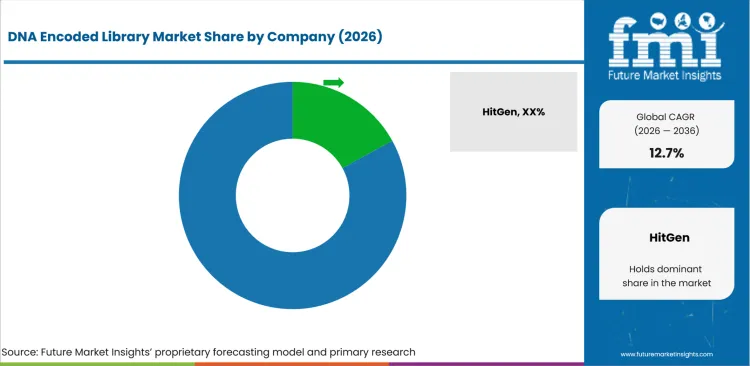
The field remains fragmented as external screening providers and proprietary drug developers apply different commercial models to encoded-library discovery programs. Entry barriers come from library chemistry and barcode fidelity plus target preparation, sequencing analytics and confirmed off-DNA small-molecule inhibitors instead of compound count alone.
- X-Chem, HitGen, WuXi AppTec and Vipergen provide external library access through service contracts or research kits for discovery teams.
- Orogen Therapeutics, Totus Medicines and Amgen apply proprietary DEL platforms inside drug-development programs that target specialized chemistry or difficult proteins.
- Charles River Laboratories extends access through integrated target production and hit-to-lead services linked with X-Chem’s screening platform.
Competitive Benchmarking: DNA Encoded Library Market
| Company | Library Access | Workflow Integration | Specialized Screening | Geographic Reach |
|---|---|---|---|---|
| X-Chem | High | High | High | North America, Europe and Asia |
| HitGen | High | High | High | Asia, North America and Europe |
| WuXi AppTec | High | High | High | Global |
| Vipergen | Medium | Medium | High | Europe, North America and Asia |
| Orogen Therapeutics | High | High | High | United States and Europe |
| Totus Medicines | Medium | High | High | United States |
| Amgen | Medium | High | High | Global |
| Charles River Laboratories | High | High | Medium | Global |
Key Developments in the DNA Encoded Library Market
- In November 2025, HitGen entered a Gates Foundation contract to screen 15 targets covering tuberculosis and malaria plus non-hormonal contraception discovery.
- In October 2025, Charles River Laboratories formed a strategic collaboration that gives clients access to X-Chem’s library of more than 15 billion compounds.
- In October 2025, Vipergen launched the 511-million-compound Lib100 and upgraded its Series 50 collection to Lib058 for wider chemical-space coverage.
Key Players in the DNA Encoded Library Market
External DEL and Screening Providers
- X-Chem
- HitGen
- WuXi AppTec
- Vipergen
Proprietary DEL Drug Developers
- Orogen Therapeutics
- Totus Medicines
- Amgen
Integrated Discovery Access
- Charles River Laboratories
DNA Encoded Library Market - Report Scope
| Coverage field | Report scope |
|---|---|
| Market breakdown | By library type, application, end user, screening method, therapeutic area and region. |
| Quantitative Units | Revenue USD billion and CAGR in % |
| Market Definition | Commercial revenue from DNA-encoded library design, access, screening, decoding, hit confirmation and related discovery services. |
| Regions Covered | North America, Latin America, Europe, East Asia, South Asia and Pacific, and Middle East and Africa. |
| Countries Covered | South Korea, United States, United Kingdom, Australia, Germany, and 20+ countries included in the full report. |
| Key Companies Profiled | X-Chem, HitGen, WuXi AppTec, Vipergen, Orogen Therapeutics, Totus Medicines, Amgen and Charles River Laboratories. |
| Forecast Period | 2026 to 2036. |
| Approach | Primary and secondary research with market triangulation. |
DNA Encoded Library Market - Research Methodology
| Method | Approach |
|---|---|
| Primary Research | FMI analysts reviewed structured input from library developers, discovery service providers, pharmaceutical research teams, biotechnology companies and academic users. Discussions examined library selection, target preparation, assay controls, sequencing outputs, resynthesis requirements, pricing models and technical support expectations. |
| Desk Research | Desk research covered government statistics, regulatory publications, nonprofit research resources, technical literature, company filings and official corporate announcements. Each source was assessed for publication date and geography plus direct relevance to the defined market scope. |
| Market Sizing and Forecasting | The market model combined the 2026 baseline and 2036 endpoint with segment shares, country growth patterns, library access models, company participation and downstream validation requirements. Segment and country assumptions were reconciled against the global total across the ten-year forecast interval. |
| Data Validation | Values and market boundaries were checked against independent indicators covering research intensity, drug approvals, company activity and current service routes. The assessment excluded adjacent sequencing revenue, general chemical libraries and research activity without a direct encoded-library transaction. |
DNA Encoded Library Market by Segments
DNA Encoded Library Market segmented by Library Type:
- Single-Pharmacophore Libraries
- Peptide Libraries
- Small Molecule Libraries
- Dual-Pharmacophore Libraries
- Bispecific Libraries
- Linker-Based Libraries
- Macrocycle Libraries
- Cyclic Peptide Libraries
- Macrocyclic Small Molecules
- Others
- DNA-Templated Libraries
- Custom DEL Libraries
DNA Encoded Library Market segmented by Application:
- Drug Discovery
- Hit Identification
- Lead Optimization
- Target Identification
- Protein Target Screening
- Receptor Screening
- Academic Research
- Chemical Biology
- Genomics Research
- Others
- Diagnostic Research
- Agricultural Biotechnology
DNA Encoded Library Market segmented by End User:
- Pharmaceutical Companies
- Large Pharmaceutical Companies
- Specialty Pharma Companies
- Biotechnology Companies
- Early-Stage Biotech
- Contract Biotech Research
- Contract Research Organizations (CROs)
- Discovery CROs
- Preclinical CROs
- Academic & Research Institutes
- Universities
- Public Research Institutes
DNA Encoded Library Market segmented by Screening Method:
- Affinity-Based Screening
- Protein Binding Assays
- Target-Based Screening
- Selection-Based Screening
- In Vitro Selection
- Cell-Based Selection
- Next-Generation Sequencing (NGS)-Based Analysis
- High-Throughput Sequencing
- Barcode Decoding
- Others
- Computational Screening
- AI-Assisted Hit Analysis
DNA Encoded Library Market segmented by Therapeutic Area:
- Oncology
- Solid Tumors
- Hematological Malignancies
- Neurological Disorders
- Neurodegenerative Diseases
- CNS Disorders
- Infectious Diseases
- Antiviral Drug Discovery
- Antibacterial Drug Discovery
- Cardiovascular Diseases
- Heart Failure
- Metabolic Disorders
- Others
- Autoimmune Diseases
- Rare Diseases
DNA Encoded Library Market by Region:
- North America
- United States
- Canada
- Mexico
- Latin America
- Brazil
- Chile
- Rest of Latin America
- Western Europe
- Germany
- United Kingdom
- Italy
- Spain
- France
- Nordics
- Benelux
- Rest of Western Europe
- Eastern Europe
- Russia
- Poland
- Hungary
- Balkan and Baltic States
- Rest of Eastern Europe
- East Asia
- China
- Japan
- South Korea
- South Asia and Pacific
- India
- ASEAN
- Australia and New Zealand
- Rest of South Asia and Pacific
- Middle East and Africa
- Kingdom of Saudi Arabia
- Other GCC Countries
- Türkiye
- South Africa
- Other African Union Countries
- Rest of Middle East and Africa
Research Sources and Bibliography
- USA Food and Drug Administration. (2026, January). Novel Drug Approvals for 2025.
- National Center for Advancing Translational Sciences. (2025, July 18). NCATS Pharmaceutical Collection.
- Amgen. (2025, April). Driving Drug Design Using DNA Encoded Libraries.
- HitGen. (2025, August 27). DEL Technology for the Research Lab: HitGen Introduces OpenDEL™ 5.0.
- National Center for Advancing Translational Sciences. (2025, September 9). Our Impact on Drug Discovery and Development.
- WuXi AppTec. (2026, January 19). Redefining the Undruggable: Covalent Therapies Driving a New Era for Small Molecules.
- Ministry of Food and Drug Safety. (2026, March 6).
- National Center for Science and Engineering Statistics. (2025, October). Business R&D Performance in the United States Increases to $722 Billion in 2023.
- Office for Life Sciences. (2026, March 19). Life sciences competitiveness indicators, 2026.
- Australian Bureau of Statistics. (2025, August 22). Research and Experimental Development, Businesses, Australia.
- Federal Statistical Office of Germany. (2026, March 27). 3,8 % mehr Ausgaben für Forschung und Entwicklung im Jahr 2024.
- HitGen. (2025, November 20). HitGen Receives New Funding to Discover Novel Therapeutics for Underserved Diseases.
- X-Chem. (2025, October 20). Charles River and X-Chem Announce Strategic Collaboration to Enhance Hit Identification Capabilities.
- Vipergen. (2025, October 7). Vipergen launches new DEL series with Lib100 and updates Series 50 to Lib058.
- HitGen. (2026). About History.
- Orogen Therapeutics. (2026). Our Discovery Platform.
- Orogen Therapeutics. (2025, July 16). Orogen Therapeutics and Chemspace/Enamine Announce a Strategic Collaboration to Enable Unique REAL-Driven DNA Encoded Small Molecule Libraries.
- Totus Medicines. (2026). Platform.
- Totus Medicines. (2026, April 16). Totus Medicines to Present First-in-Class Covalent IRF5 Inhibitor Data at AAI IMMUNOLOGY2026.
- Charles River Laboratories. (2025, October 20). Charles River and X-Chem Announce Strategic Collaboration to Enhance Hit Identification Capabilities.
This bibliography is provided for reader reference and is not exhaustive. The full report contains the complete reference list and detailed citations.
This Report Answers
- How large is the DNA encoded library market in 2026 and what valuation is projected by 2036?
- Which operating conditions support commercial demand for DNA encoded library screening across pharmaceutical and biotechnology discovery programs?
- Which library type accounts for the largest approved 2026 share within commercial DNA encoded library programs?
- How does application selection shape target screening and hit-confirmation planning across pharmaceutical discovery and early research workflows?
- Which screening method conditions support DNA encoded library adoption across difficult targets and specialized assay environments?
- How do approved country growth rates differ across the profiled DNA encoded library market through 2036?
- Which companies provide external screening services or proprietary DNA encoded library platforms across current discovery programs?
- Which technical and commercial conditions currently limit DNA encoded library adoption across discovery and validation workflows?
Frequently Asked Questions
How big is the DNA encoded library market in 2026?
In 2026, the DNA encoded library market is valued at USD 1.8 billion across library access and screening services used in early discovery programs. Broad chemical sampling and sequencing-led decoding support the projected increase to USD 5.9 billion by 2036 despite target-preparation and hit-confirmation costs.
What is the CAGR of the DNA encoded library market from 2026 to 2036?
The DNA encoded library market is projected to expand at 12.7% CAGR from 2026 to 2036 across commercial discovery programs. Growth depends on reproducible selection controls and off-DNA confirmation that convert enriched barcodes into credible chemical starting points for medicinal chemistry.
Which library type is projected to account for 43.0% of the DNA encoded library market?
Single-pharmacophore libraries are projected to account for 43.0% of the DNA encoded library market by library type in 2026. Direct compound-to-barcode interpretation supports their share as selection teams compare enrichment patterns ahead of resynthesis and orthogonal validation.
How much will the DNA encoded library market add between 2026 and 2036?
USD 4.1 billion is expected to be added to the DNA encoded library market between 2026 and 2036. Forecast value depends on repeat screening orders that combine broad library access with target controls, sequencing analysis and confirmed off-DNA activity.
Which companies are active in the DNA encoded library market?
Companies in the DNA encoded library market across external screening and proprietary drug-development models include X-Chem, HitGen, WuXi AppTec, Vipergen, Orogen Therapeutics, Totus Medicines, Amgen and Charles River Laboratories.
Preview the report firsthand - request a free sample
Get SampleGet the brochure for pricing and purchase details.
Get PDFTable of Content
- Key Takeaways
- Market Size and CAGR
- Top Growth Driver
- Fastest Growing Segment
- Leading Region
- Key Companies
- Emerging Opportunities
- Executive Summary
- Global Market Outlook
- Demand-side Trends
- Supply-side Trends
- Technology Roadmap Analysis
- Analysis and Recommendations
- Analyst Perspective (What is happening? Why now? What should investors know?)
- Key Questions Answered
- How large is the market?
- What is the CAGR?
- What are key trends?
- Which region dominates?
- Who are the leaders?
- Market Overview
- Market Coverage / Taxonomy
- Market Definition / Scope / Limitations
- Research Methodology
- Chapter Orientation
- Analytical Lens and Working Hypotheses
- Market Structure, Signals, and Trend Drivers
- Benchmarking and Cross-market Comparability
- Market Sizing, Forecasting, and Opportunity Mapping
- Research Design and Evidence Framework
- Desk Research Programme (Secondary Evidence)
- Expert Input and Fieldwork (Primary Evidence)
- Tooling, Models, and Reference Databases
- Data Engineering and Model Build
- Quality Assurance and Audit Trail
- Market Background
- Market Dynamics (Drivers, Restraints, Opportunity, Trends)
- Scenario Forecast (Optimistic, Likely, Conservative)
- Impact Analysis
- AI Impact
- Sustainability Impact
- Regulatory Impact
- Technology Impact
- Consumer / Buyer Analysis
- Purchase Drivers
- Adoption Barriers
- Buyer Journey
- Opportunity Map Analysis
- Product Life Cycle Analysis
- Supply Chain Analysis
- Investment Feasibility Matrix
- Value Chain Analysis
- PESTLE and Porter's Analysis
- Regulatory Landscape
- Regional Parent Market Outlook
- Production and Consumption Statistics
- Import and Export Statistics
- Global Market Analysis and Forecast, 2021 to 2036
- Historical Market Size Value (USD Billion) Analysis, 2021 to 2025
- Current and Future Market Size Value (USD Billion) Projections, 2026 to 2036
- Y-o-Y Growth Trend Analysis
- Absolute $ Opportunity Analysis
- Global Market Pricing Analysis, 2021 to 2036
- Global Market Analysis and Forecast, By Library Type, 2021 to 2036
- Introduction / Key Findings
- Historical Market Size Value (USD Billion) Analysis By Library Type, 2021 to 2025
- Current and Future Market Size Value (USD Billion) Analysis and Forecast By Library Type, 2026 to 2036
- Single-Pharmacophore Libraries
- Peptide Libraries
- Small Molecule Libraries
- Dual-Pharmacophore Libraries
- Bispecific Libraries
- Linker-Based Libraries
- Macrocycle Libraries
- Cyclic Peptide Libraries
- Macrocyclic Small Molecules
- Others
- DNA-Templated Libraries
- Custom DEL Libraries
- Single-Pharmacophore Libraries
- Y-o-Y Growth Trend Analysis By Library Type, 2021 to 2025
- Absolute $ Opportunity Analysis By Library Type, 2026 to 2036
- Global Market Analysis and Forecast, By Application, 2021 to 2036
- Introduction / Key Findings
- Historical Market Size Value (USD Billion) Analysis By Application, 2021 to 2025
- Current and Future Market Size Value (USD Billion) Analysis and Forecast By Application, 2026 to 2036
- Drug Discovery
- Hit Identification
- Lead Optimization
- Target Identification
- Protein Target Screening
- Receptor Screening
- Academic Research
- Chemical Biology
- Genomics Research
- Others
- Diagnostic Research
- Agricultural Biotechnology
- Drug Discovery
- Y-o-Y Growth Trend Analysis By Application, 2021 to 2025
- Absolute $ Opportunity Analysis By Application, 2026 to 2036
- Global Market Analysis and Forecast, By End User, 2021 to 2036
- Introduction / Key Findings
- Historical Market Size Value (USD Billion) Analysis By End User, 2021 to 2025
- Current and Future Market Size Value (USD Billion) Analysis and Forecast By End User, 2026 to 2036
- Pharmaceutical Companies
- Large Pharmaceutical Companies
- Specialty Pharma Companies
- Biotechnology Companies
- Early-Stage Biotech
- Contract Biotech Research
- Contract Research Organizations
- Discovery CROs
- Preclinical CROs
- Academic and Research Institutes
- Universities
- Public Research Institutes
- Pharmaceutical Companies
- Y-o-Y Growth Trend Analysis By End User, 2021 to 2025
- Absolute $ Opportunity Analysis By End User, 2026 to 2036
- Global Market Analysis and Forecast, By Screening Method, 2021 to 2036
- Introduction / Key Findings
- Historical Market Size Value (USD Billion) Analysis By Screening Method, 2021 to 2025
- Current and Future Market Size Value (USD Billion) Analysis and Forecast By Screening Method, 2026 to 2036
- Affinity-Based Screening
- Protein Binding Assays
- Target-Based Screening
- Selection-Based Screening
- In Vitro Selection
- Cell-Based Selection
- Next-Generation Sequencing Based Analysis
- High-Throughput Sequencing
- Barcode Decoding
- Others
- Computational Screening
- AI-Assisted Hit Analysis
- Affinity-Based Screening
- Y-o-Y Growth Trend Analysis By Screening Method, 2021 to 2025
- Absolute $ Opportunity Analysis By Screening Method, 2026 to 2036
- Global Market Analysis and Forecast, By Therapeutic Area, 2021 to 2036
- Introduction / Key Findings
- Historical Market Size Value (USD Billion) Analysis By Therapeutic Area, 2021 to 2025
- Current and Future Market Size Value (USD Billion) Analysis and Forecast By Therapeutic Area, 2026 to 2036
- Oncology
- Solid Tumors
- Hematological Malignancies
- Neurological Disorders
- Neurodegenerative Diseases
- CNS Disorders
- Infectious Diseases
- Antiviral Drug Discovery
- Antibacterial Drug Discovery
- Cardiovascular Diseases
- Heart Failure
- Metabolic Disorders
- Others
- Autoimmune Diseases
- Rare Diseases
- Oncology
- Y-o-Y Growth Trend Analysis By Therapeutic Area, 2021 to 2025
- Absolute $ Opportunity Analysis By Therapeutic Area, 2026 to 2036
- Global Market Analysis and Forecast, By Region, 2021 to 2036
- Introduction
- Historical Market Size Value (USD Billion) Analysis By Region, 2021 to 2025
- Current Market Size Value (USD Billion) Analysis and Forecast By Region, 2026 to 2036
- North America
- Latin America
- Western Europe
- Eastern Europe
- East Asia
- South Asia and Pacific
- Middle East & Africa
- Market Attractiveness Analysis By Region
- North America Market Analysis and Forecast, By Country, 2021 to 2036
- Historical Market Size Value (USD Billion) Trend Analysis By Market Taxonomy, 2021 to 2025
- Market Size Value (USD Billion) Forecast By Market Taxonomy, 2026 to 2036
- By Country
- USA
- Canada
- By Library Type
- By Application
- By End User
- By Screening Method
- By Therapeutic Area
- By Country
- Market Attractiveness Analysis
- By Country
- By Library Type
- By Application
- By End User
- By Screening Method
- By Therapeutic Area
- Key Takeaways
- Latin America Market Analysis and Forecast, By Country
- Historical Market Size Value (USD Billion) Trend Analysis By Market Taxonomy, 2021 to 2025
- Market Size Value (USD Billion) Forecast By Market Taxonomy, 2026 to 2036
- By Country
- Brazil
- Mexico
- Chile
- Rest of Latin America
- By Library Type
- By Application
- By End User
- By Screening Method
- By Therapeutic Area
- By Country
- Market Attractiveness Analysis
- By Country
- By Library Type
- By Application
- By End User
- By Screening Method
- By Therapeutic Area
- Key Takeaways
- Western Europe Market Analysis and Forecast, By Country
- Historical Market Size Value (USD Billion) Trend Analysis By Market Taxonomy, 2021 to 2025
- Market Size Value (USD Billion) Forecast By Market Taxonomy, 2026 to 2036
- By Country
- Germany
- UK
- Italy
- Spain
- France
- Nordic
- BENELUX
- Rest of Western Europe
- By Library Type
- By Application
- By End User
- By Screening Method
- By Therapeutic Area
- By Country
- Market Attractiveness Analysis
- By Country
- By Library Type
- By Application
- By End User
- By Screening Method
- By Therapeutic Area
- Key Takeaways
- Eastern Europe Market Analysis and Forecast, By Country
- Historical Market Size Value (USD Billion) Trend Analysis By Market Taxonomy, 2021 to 2025
- Market Size Value (USD Billion) Forecast By Market Taxonomy, 2026 to 2036
- By Country
- Russia
- Poland
- Hungary
- Balkan & Baltic
- Rest of Eastern Europe
- By Library Type
- By Application
- By End User
- By Screening Method
- By Therapeutic Area
- By Country
- Market Attractiveness Analysis
- By Country
- By Library Type
- By Application
- By End User
- By Screening Method
- By Therapeutic Area
- Key Takeaways
- East Asia Market Analysis and Forecast, By Country
- Historical Market Size Value (USD Billion) Trend Analysis By Market Taxonomy, 2021 to 2025
- Market Size Value (USD Billion) Forecast By Market Taxonomy, 2026 to 2036
- By Country
- China
- Japan
- South Korea
- By Library Type
- By Application
- By End User
- By Screening Method
- By Therapeutic Area
- By Country
- Market Attractiveness Analysis
- By Country
- By Library Type
- By Application
- By End User
- By Screening Method
- By Therapeutic Area
- Key Takeaways
- South Asia and Pacific Market Analysis and Forecast, By Country
- Historical Market Size Value (USD Billion) Trend Analysis By Market Taxonomy, 2021 to 2025
- Market Size Value (USD Billion) Forecast By Market Taxonomy, 2026 to 2036
- By Country
- India
- ASEAN
- Australia & New Zealand
- Rest of South Asia and Pacific
- By Library Type
- By Application
- By End User
- By Screening Method
- By Therapeutic Area
- By Country
- Market Attractiveness Analysis
- By Country
- By Library Type
- By Application
- By End User
- By Screening Method
- By Therapeutic Area
- Key Takeaways
- Middle East & Africa Market Analysis and Forecast, By Country
- Historical Market Size Value (USD Billion) Trend Analysis By Market Taxonomy, 2021 to 2025
- Market Size Value (USD Billion) Forecast By Market Taxonomy, 2026 to 2036
- By Country
- Kingdom of Saudi Arabia
- Other GCC Countries
- Türkiye
- South Africa
- Other African Union
- Rest of Middle East & Africa
- By Library Type
- By Application
- By End User
- By Screening Method
- By Therapeutic Area
- By Country
- Market Attractiveness Analysis
- By Country
- By Library Type
- By Application
- By End User
- By Screening Method
- By Therapeutic Area
- Key Takeaways
- Key Countries Market Analysis
- USA
- Pricing Analysis
- Market Share Analysis, 2025
- By Library Type
- By Application
- By End User
- By Screening Method
- By Therapeutic Area
- Canada
- Pricing Analysis
- Market Share Analysis, 2025
- By Library Type
- By Application
- By End User
- By Screening Method
- By Therapeutic Area
- Mexico
- Pricing Analysis
- Market Share Analysis, 2025
- By Library Type
- By Application
- By End User
- By Screening Method
- By Therapeutic Area
- Brazil
- Pricing Analysis
- Market Share Analysis, 2025
- By Library Type
- By Application
- By End User
- By Screening Method
- By Therapeutic Area
- Chile
- Pricing Analysis
- Market Share Analysis, 2025
- By Library Type
- By Application
- By End User
- By Screening Method
- By Therapeutic Area
- Germany
- Pricing Analysis
- Market Share Analysis, 2025
- By Library Type
- By Application
- By End User
- By Screening Method
- By Therapeutic Area
- UK
- Pricing Analysis
- Market Share Analysis, 2025
- By Library Type
- By Application
- By End User
- By Screening Method
- By Therapeutic Area
- Italy
- Pricing Analysis
- Market Share Analysis, 2025
- By Library Type
- By Application
- By End User
- By Screening Method
- By Therapeutic Area
- Spain
- Pricing Analysis
- Market Share Analysis, 2025
- By Library Type
- By Application
- By End User
- By Screening Method
- By Therapeutic Area
- France
- Pricing Analysis
- Market Share Analysis, 2025
- By Library Type
- By Application
- By End User
- By Screening Method
- By Therapeutic Area
- India
- Pricing Analysis
- Market Share Analysis, 2025
- By Library Type
- By Application
- By End User
- By Screening Method
- By Therapeutic Area
- ASEAN
- Pricing Analysis
- Market Share Analysis, 2025
- By Library Type
- By Application
- By End User
- By Screening Method
- By Therapeutic Area
- Australia & New Zealand
- Pricing Analysis
- Market Share Analysis, 2025
- By Library Type
- By Application
- By End User
- By Screening Method
- By Therapeutic Area
- China
- Pricing Analysis
- Market Share Analysis, 2025
- By Library Type
- By Application
- By End User
- By Screening Method
- By Therapeutic Area
- Japan
- Pricing Analysis
- Market Share Analysis, 2025
- By Library Type
- By Application
- By End User
- By Screening Method
- By Therapeutic Area
- South Korea
- Pricing Analysis
- Market Share Analysis, 2025
- By Library Type
- By Application
- By End User
- By Screening Method
- By Therapeutic Area
- Russia
- Pricing Analysis
- Market Share Analysis, 2025
- By Library Type
- By Application
- By End User
- By Screening Method
- By Therapeutic Area
- Poland
- Pricing Analysis
- Market Share Analysis, 2025
- By Library Type
- By Application
- By End User
- By Screening Method
- By Therapeutic Area
- Hungary
- Pricing Analysis
- Market Share Analysis, 2025
- By Library Type
- By Application
- By End User
- By Screening Method
- By Therapeutic Area
- Kingdom of Saudi Arabia
- Pricing Analysis
- Market Share Analysis, 2025
- By Library Type
- By Application
- By End User
- By Screening Method
- By Therapeutic Area
- Türkiye
- Pricing Analysis
- Market Share Analysis, 2025
- By Library Type
- By Application
- By End User
- By Screening Method
- By Therapeutic Area
- South Africa
- Pricing Analysis
- Market Share Analysis, 2025
- By Library Type
- By Application
- By End User
- By Screening Method
- By Therapeutic Area
- USA
- Market Structure Analysis
- Competition Dashboard
- Competition Benchmarking
- Market Share Analysis of Top Players
- By Regional
- By Library Type
- By Application
- By End User
- By Screening Method
- By Therapeutic Area
- Emerging Startups
- Innovation Benchmarking
- Competition Analysis
- Competition Deep Dive
- HitGen
- Overview
- Product Portfolio
- Profitability by Market Segments
- Sales Footprint
- Strategy Overview
- Marketing Strategy
- Product Strategy
- Channel Strategy
- X-Chem
- WuXi AppTec
- Vipergen
- Charles River Laboratories
- ZoBio
- Nissan Chemical
- Axcelead DDP
- Totus Medicines
- Orogen Therapeutics
- Amgen
- HitGen
- Case Studies
- Success Stories
- Recent Developments
- Competition Deep Dive
- Assumptions & Acronyms Used


