

- Market Size (2026)
- USD 4.9 Bn
- Forecast (2036)
- USD 8.7 Bn
- CAGR (2026 to 2036)
- 6.0%
How big is Dual Fuel Engine Market in 2026?
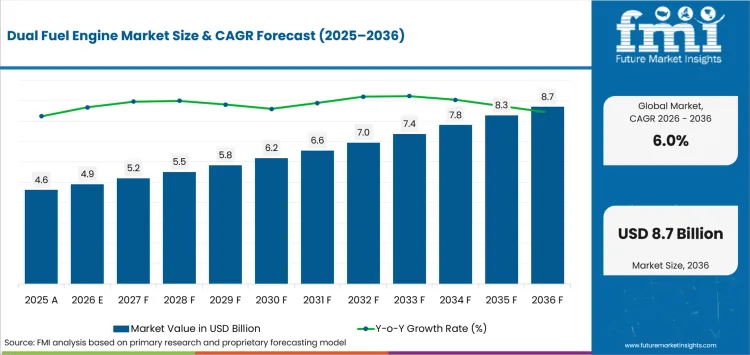
USD 4.9 billion in 2026 and USD 8.7 billion by 2036 at a 6.0% CAGR.
Demand for dual fuel engines is projected to expand at 6.0% CAGR between 2026 and 2036, increasing valuation from USD 4.9 billion in 2026 to USD 8.7 billion by 2036. High-utilization assets justify a second fuel system once substitution reduces conventional-fuel use without removing diesel fallback. In February 2025, MAN Energy Solutions disclosed an order for four ME-GI dual-fuel engines for two 174,000-cbm LNG carriers. Marine propulsion engines therefore keep two-fuel combustion commercially relevant for owners needing fuel flexibility over long vessel lives.
Norway’s is expected to expand at a 7.0% CAGR which is significant than USA at 5.6%, creating a 1.4-percentage-point spread between the two forecasts. Marine projects concentrate fuel access at ports, while USA applications span fleets, drilling and stationary power. USA Department of Energy data counted 1,385 public and private CNG stations in 2025, establishing a large refueling base without guaranteeing access on every commercial route. Gas generator sets and fleet conversions capture the USD 3.8 billion incremental opportunity at sites with local fuel access, service coverage and certification matched to the duty cycle.
Key Takeaways
- Fuel flexibility supports demand by reducing conventional-fuel use without surrendering diesel fallback during supply interruptions.
- Based on fuel combination, diesel-natural gas is projected to account for 42.0% in 2026 due to established gas handling and diesel fallback.
- By engine type, heavy-duty truck engines are estimated to hold 27.0% in 2026 owing to high fuel throughput and costly downtime.
- In 2026, 100-500 kW systems are expected to lead power range with 31.0% share because mid-range platforms balance output with installation flexibility.
- Storage volume, methane control, fuel-quality variation and approval work can extend payback even after engine-level substitution performs as intended.
- Some of the key players in this market include Wärtsilä, Caterpillar, MAN Energy Solutions, Cummins, HD Hyundai Heavy Industries, Mitsubishi Heavy Industries, Volvo Penta, and Yanmar.
Analyst Perspective
"Dual-fuel engines earn their premium once substitution rates, transient response, emissions control and fallback behavior are proven on the actual duty cycle. The strongest offers protect the installed engine asset and give operators a credible second-fuel route without weakening serviceability."
- Nikhil Kaitwade, Principal Consultant, Future Market Insights
How is the dual fuel engine market segmented?
The dual fuel engine market is segmented by fuel combination, engine type, power range, end use, sales channel and region.
The market is evaluated by fuel combination, engine type, power range, end use, sales channel and region. Fuel combinations cover diesel-natural gas, diesel-LPG, marine gas-diesel, diesel-hydrogen and gasoline-CNG routes. Engine types cover heavy-duty truck, generator set, marine, industrial and off-highway engines. Power ranges extend from below 100 kW through ratings above 2 MW. End uses cover commercial vehicles, marine, power generation, oil and gas and mining/construction. Sales channels include engine OEMs, genset packagers, marine integrators and retrofit providers.
Why do engine OEMs lead the sales channel category?
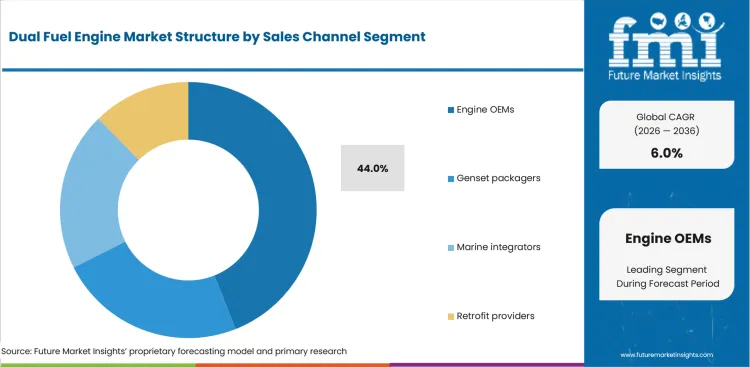
Engine OEMs control calibration, safety logic, diagnostics and warranty responsibility for power units that require two fuel systems to behave as one. Gas engines used in classed or certified applications therefore keep integration accountability close to the original platform.
- By sales channel, engine OEMs are forecast to represent 44.0% in 2026 driven by platform-level control of calibration, diagnostics and warranty.
- MAN Energy Solutions completed type approval testing for the L35/44DF CD GenSet in May 2025 with six classification societies. Approval work of that depth makes OEM-led integration difficult to separate from the purchase decision for classed installations.
What makes diesel-natural gas central to the fuel combination category?
Diesel-natural gas gives high-hour marine and stationary assets a second-fuel route without removing compression-ignition fallback. Gas & dual-fuel injection systems must preserve load response and fuel-quality tolerance during repeated load changes to gain operator acceptance in service.
- Diesel-natural gas is set to lead the fuel combination with 42.0% share in 2026 due to mature gas handling and diesel fallback reducing conversion risk.
- Wärtsilä introduced Spark Gas Conversion for the 50DF platform in April 2025, targeting up to 75% lower methane emissions during LNG operation. Methane performance now enters qualification directly beside fuel substitution and engine availability.
Why do heavy-duty truck engines lead the engine type category?
Heavy-duty trucks make fuel substitution financially visible on long duty cycles that expose both fuel cost and lost uptime. Mining haulage also gives integrators controlled routes for evaluating tank packaging, transient response and service access.
- Heavy-duty truck engines are projected to hold 27.0% share in 2026 owing to high fuel throughput and costly downtime on long-haul and mine-haul duty.
- Bosch Brasil documented in October 2025 that its diesel-ethanol system, announced that February, was available for OEM applications and scheduled for retrofit field testing in 2026. Severe-duty validation therefore becomes a direct gate to wider adoption in working commercial mine fleets.
How does the 100-500 kW range lead the power range category?
The 100-500 kW band fits mobile and smaller stationary duties with manageable tank volume and balance-of-plant cost. Hydrogen combustion engines also provide a practical test route for extending two-fuel control into larger generating or off-highway platforms.
- The 100-500 kW range is likely to capture 31.0% share in 2026 attributable to useful output without megawatt-scale balance-of-plant requirements.
- Yanmar disclosed in January 2025 that its hydrogen-engine production plan had received government approval and cited an approximately 500 kW pilot-ignition unit already tested onshore. The program places current hydrogen dual-fuel validation at the upper edge of this band.
What are the drivers, restraints and opportunities in the Dual Fuel Engine Market?
Fuel switching protects uptime under favorable second-fuel economics, storage and emissions controls lengthen integration work, and retrofit-ready platforms provide the clearest route into installed diesel assets.
- Driver: Dual-fuel operation reduces exposure to one fuel supply without removing diesel-rated fallback for high-utilization assets.
- Restraint: A second fuel system introduces storage, safety, calibration, emissions treatment and approval work that can lengthen commissioning.
- Opportunity: Engine-level conversion packages let operators test substitution economics without replacing the complete vehicle, vessel or power asset.
Fuel Flexibility Protects High-Utilization Assets
High-hour power assets justify two fuel systems at sites facing lost-output costs above the added fuel hardware. Wärtsilä’s August 2025 Nebraska order covers twelve 50DF engines for a 217 MW plant, with diesel available if natural gas supply is interrupted. The order gives construction generator sets a comparable continuity case, while storage and service access still determine which sites convert.
Emissions Control Extends Qualification Work
Methane control can extend approval work once an engine proves stable two-fuel combustion. In May 2025, Mitsubishi Heavy Industries began a one-year vessel demonstration of a methane-oxidation catalyst following initial tests that reached at least 70% oxidation. The catalyst raises packaging and maintenance requirements, so a project can meet its substitution target yet lose payback through higher downtime or installed cost.
Retrofit Routes Reduce Replacement Capital
Engine-level conversion preserves the remaining value of installed diesel machines without replacing the complete power package. In May 2025, MAN Energy Solutions joined the NH3 Spark FutureFlex project to develop a retrofit-suitable dual-fuel ammonia GenSet concept for a base exceeding 20,000 MAN units. Surface mining equipment presents similar economics because conversion preserves the higher-value machine while controls, parts and commissioning determine whether downtime still supports payback.
Which country CAGRs are profiled in the Dual Fuel Engine Market?
| Country | CAGR |
|---|---|
| Norway | 7.0% |
| Saudi Arabia | 6.7% |
| Brazil | 6.3% |
| Australia | 6.0% |
| USA | 5.6% |
How do country-level CAGRs compare in the Dual Fuel Engine Market?
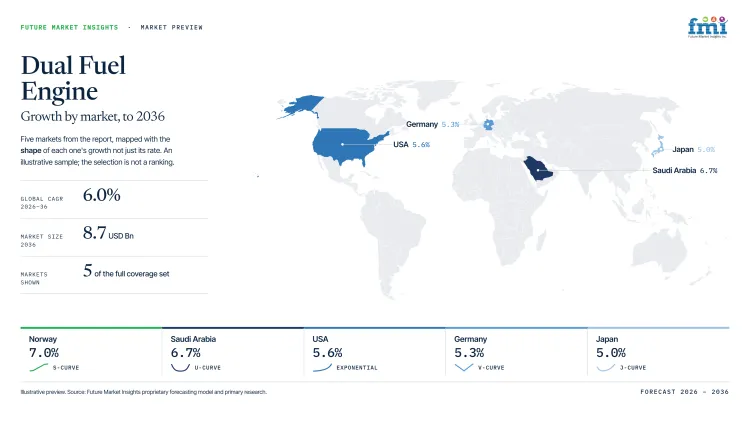
The five profiled countries span 1.4 percentage points from Norway at 7.0% to USA at 5.6%, placing Norway and Saudi Arabia in the upper band. Brazil and Australia follow closely, while USA expands more slowly despite natural gas vehicles, with fleet structure, operating conditions and certification costs differing by duty cycle.
- Norwegian coastal trades concentrate fuel planning near ports serving regular vessel routes.
- Saudi captive-power loads make fuel substitution measurable against liquid-fuel use at sites.
- Brazilian mine cycles expose retrofit economics ahead of complete haul-truck replacement decisions.
- Western Australian mine loads make fuel-switching performance comparable over fixed operating cycles.
- USA dealer channels split qualification routes between trucking, drilling and stationary power.
Similar growth rates conceal different qualification costs, service models and conversion timelines. The full report provides country-level CAGR analysis across North America, Latin America, Western Europe, Eastern Europe, East Asia, South Asia and Pacific, and Middle East and Africa.
Country-wise Analysis
- Demand for dual fuel engines in Norway is forecast to rise at 7.0% CAGR over the forecast period because marine operators already use gas-handling and classification routines that protect vessel availability. Statistics Norway counted 1,498 vessels in the merchant fleet for 2025, giving shipowners a large classed base for comparing retrofit timing with newbuilding replacement during planned drydocks and scheduled coastal maintenance. Methane-slip performance and uncertain future-fuel costs narrow the eligible project pool, so engine companies need conversion packages that fit drydock schedules and service teams able to support major ports without extending vessel downtime on short coastal rotations.
- Large industrial and power sites can substitute gas for liquid fuel most effectively at locations with coordinated pipeline access, compression equipment and severe-duty maintenance for continuous process loads. Aramco announced in February 2026 that Jafurah had started production and Tanajib Gas Plant had commenced operations, expanding the domestic gas-supply route without removing site-specific conditioning requirements. The Saudi Arabia dual fuel engine sector is projected to record 6.7% CAGR during the assessment period, tied to greater gas availability for industrial loads, while remote facilities favor companies with field technicians and controls that tolerate variable gas quality without weakening diesel fallback.
- Mine operators can test dual-fuel conversion on high-value haulage assets without replacing the complete truck, making fuel substitution measurable against a known severe-duty cycle over repeated haul routes. Brazil is estimated to post 6.3% CAGR over the forecast period, driven by retrofit interest in mining and heavy transport that can preserve the existing machine. ANP reported in June 2026 that ethanol production reached 35.9 billion liters in 2025, giving alcohol-fuel programs a credible domestic supply pool, though wider fleet adoption still requires local calibration, durable components and parts support that perform through multiyear mine maintenance cycles and scheduled engine overhauls.
- Isolated mine-power projects put unusual weight on continuous engine output, and Department of Climate Change, Energy, the Environment and Water data show natural gas supplied 57.8% of Western Australian electricity generation in 2025. Long service distances increase the cost of commissioning errors and parts delays during daily operations, especially at sites balancing thermal generation with growing renewable output. Dual fuel engine sales in Australia are forecast to expand at 6.0% CAGR by 2036, attributable to remote-power demand, with site uptime outweighing small engine-price differences and favoring platforms backed by regional commissioning teams and stocked critical spares for remote operators.
- Fleet, drilling and power applications use different duty cycles, so a conversion that works at one site does not transfer automatically to another operating route or service model. In the USA, dual fuel engine demand is predicted to advance at 5.6% CAGR through 2036, given abundant domestic gas and mature engine-service networks despite uneven fuel delivery between applications. The USA Energy Information Administration reported marketed natural gas production at a record 118.5 Bcf/d in 2025, so route-level fuel economics and application-specific emissions evidence are still needed for national gas abundance to convert into repeat engine orders in commercial fleets and remote sites.
Who are the notable companies in the Dual Fuel Engine Market?
Wärtsilä, Caterpillar, MAN Energy Solutions, Cummins, HD Hyundai Heavy Industries, Mitsubishi Heavy Industries, Volvo Penta, and Yanmar are the notable companies serving this market.
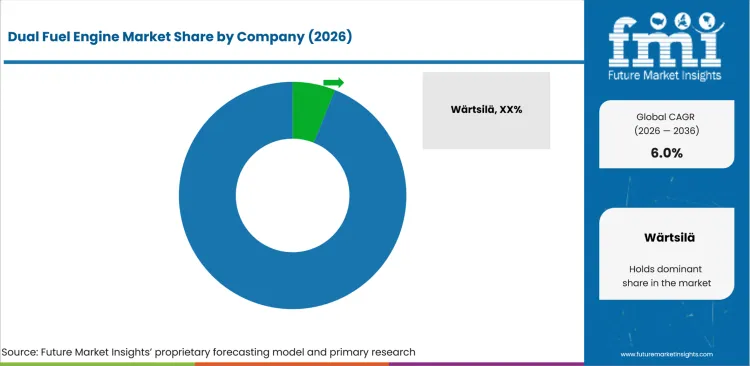
Competition separates by duty cycle and proof route more clearly than by corporate scale. Marine engines require class acceptance, integrated fuel controls and service support from organizations with operating references. Oilfield and mining platforms place more weight on retrofit economics, field service coverage and replacement downtime.
- Integrated engine and conversion platforms: Wärtsilä, Caterpillar, MAN Energy Solutions and Cummins cover marine, power, mining and retrofit routes with proven service networks.
- Shipbuilding and marine systems integration: HD Hyundai Heavy Industries and Mitsubishi Heavy Industries bring vessel integration, fuel handling and large-engine qualification experience.
- Transition-fuel engine development: Volvo Penta and Yanmar are advancing hydrogen-based dual-fuel platforms for stationary, off-highway and marine use.
Competitive Benchmarking: Dual Fuel Engine Market
| Company | Fuel-Pathway Breadth | Application Coverage | Qualification / Deployment Maturity | Geographic Reach |
|---|---|---|---|---|
| Wärtsilä | High | High | High | Global marine and energy markets |
| Caterpillar | Medium | High | High | Americas with international marine and industrial reach |
| MAN Energy Solutions | High | High | High | Global marine and large-engine markets |
| Cummins | Medium | High | High | Americas with global industrial and mining operations |
| HD Hyundai Heavy Industries | High | High | Medium | Asia-Pacific with international marine and power projects |
| Mitsubishi Heavy Industries | High | Medium | High | Japan with international marine reach |
| Volvo Penta | Medium | Medium | Medium | Europe with international industrial and power trials |
| Yanmar | Medium | Medium | Medium | Japan, Asia-Pacific, Europe and North America |
Scoring basis: High fuel-pathway breadth requires at least two documented two-fuel pairings. Medium covers one commercial pairing plus another active development route, and Low covers one pairing. High application coverage requires two or more documented duty groups relevant to dual-fuel engine demand. Medium covers one duty plus a validated adjacent use, and Low covers one narrow application. High maturity requires a commercial order, formal approval or verified field deployment. Medium requires a named field or full-engine demonstration, and Low indicates documented bench-stage development.
Key Developments in the Dual Fuel Engine Market
- In April 2025, Wärtsilä extended NextDF methane-slip technology to the 46TS-DF engine, targeting methane emissions below 1.4% of fuel use at all load points.
- In May 2025, MAN Energy Solutions announced an 82,440 kW methanol-capable 12G95ME-C10.5-LGIM engine for 24,000 TEU container vessels, confirming commercial scale for methanol dual-fuel propulsion.
- In March 2025, Mitsubishi Shipbuilding received three additional RORO orders for methanol and A-heavy-fuel-oil dual-fuel main engines serving Japanese domestic cargo routes.
Key Players in the Dual Fuel Engine Market
Integrated Engine and Conversion Platforms
- Wärtsilä
- Caterpillar
- MAN Energy Solutions
- Cummins
Shipbuilding and Marine Systems Integration
- HD Hyundai Heavy Industries
- Mitsubishi Heavy Industries
Transition-Fuel Engine Development
- Volvo Penta
- Yanmar
Dual Fuel Engine Market - Report Scope
| Coverage field | Report scope |
|---|---|
| Market breakdown | By fuel combination, engine type, power range, end use, sales channel and region. |
| Quantitative Units | USD billion. |
| Market Definition | Revenue includes dual-fuel combustion engines and engine-level conversion packages within the listed fuel combinations, engine types, power ranges, end uses and sales channels, excluding complete downstream vehicles, vessels and power plants beyond the engine system. |
| Regions Covered | North America, Latin America, Western Europe, Eastern Europe, East Asia, South Asia and Pacific, and Middle East and Africa. |
| Countries Covered | Norway, Saudi Arabia, Brazil, Australia, USA, and 20+ countries included in the full report. |
| Key Companies Profiled | Wärtsilä, Caterpillar, MAN Energy Solutions, Cummins, HD Hyundai Heavy Industries, Mitsubishi Heavy Industries, Volvo Penta, and Yanmar. |
| Forecast Period | Base 2026 to 2036. |
| Approach | Primary and secondary research with market triangulation. |
Dual Fuel Engine Market - Research Methodology
| Method | Approach |
|---|---|
| Primary Research | FMI analysts gathered input from manufacturers, service providers, technology developers, distributors, end users, procurement teams, and subject-matter experts. Interviews examined purchasing decisions, product or service evaluation, adoption barriers, approval requirements, pricing considerations, and expectations for technical or commercial support. Respondents were also asked what evidence is required before a trial, pilot, or initial order develops into regular purchasing. |
| Desk Research | Desk research covered government statistics, regulatory publications, trade data, industry associations, technical literature, standards, company filings, product information, and official corporate announcements. Sources were reviewed for relevance, publication date, geographic coverage, and consistency with the defined market scope. Claims relating to performance, applications, approvals, capacity, investment, and commercial activity were retained only when supported by credible public evidence. |
| Market Sizing and Forecasting | The market model combined the baseline value with historical performance, segment structure, pricing and volume indicators, adoption levels, company participation, and country-level demand conditions. Forecast assumptions considered economic activity, investment trends, regulatory developments, technology adoption, purchasing cycles, supply availability, and barriers to wider market use. Segment and regional estimates were reconciled before the final market total was calculated. |
| Data Validation | Estimates were checked against multiple independent indicators, including public data, company activity, trade patterns, industry developments, and findings from primary interviews. Validation also tested whether products, services, applications, and company revenues fell within the defined market boundaries. Adjacent categories, unsupported claims, overlapping revenues, and activities without direct market relevance were excluded to reduce double counting and maintain consistency across segments and countries. |
Dual Fuel Engine Market by Segments
Dual Fuel Engine Market segmented by Fuel Combination:
- Diesel-natural gas
- Diesel-LPG
- Marine gas-diesel
- Diesel-hydrogen
- Gasoline-CNG
Dual Fuel Engine Market segmented by Engine Type:
- Heavy-duty truck engines
- Generator set engines
- Marine engines
- Industrial engines
- Off-highway engines
Dual Fuel Engine Market segmented by Power Range:
- 100-500 kW
- 500 kW-2 MW
- Above 2 MW
- Below 100 kW
Dual Fuel Engine Market segmented by End Use:
- Commercial vehicles
- Marine
- Power generation
- Oil & gas
- Mining/construction
Dual Fuel Engine Market segmented by Sales Channel:
- Engine OEMs
- Genset packagers
- Marine integrators
- Retrofit providers
Dual Fuel Engine Market by Region:
- North America
- United States
- Canada
- Latin America
- Brazil
- Mexico
- Chile
- Rest of Latin America
- Western Europe
- Germany
- United Kingdom
- Italy
- Spain
- France
- Nordics
- Benelux
- Rest of Western Europe
- Eastern Europe
- Russia
- Poland
- Hungary
- Balkan and Baltic States
- Rest of Eastern Europe
- East Asia
- China
- Japan
- South Korea
- South Asia and Pacific
- India
- ASEAN
- Australia and New Zealand
- Rest of South Asia and Pacific
- Middle East and Africa
- Kingdom of Saudi Arabia
- Other GCC Countries
- Türkiye
- South Africa
- Other African Union Countries
- Rest of Middle East and Africa
Research Sources and Bibliography
- MAN Energy Solutions (2025, February 13). ME-GI Engine Orders Pick Up Momentum in LNG Carrier Segment.
- USA Department of Energy, Alternative Fuels Data Center (2026, January). USA public and private alternative fueling stations by fuel type.
- Wärtsilä Corporation (2025, April 9). Newly introduced solution for Wärtsilä 50DF engine further reduces methane slip by up to 75 percent.
- Yanmar Holdings Co., Ltd. (2025, January 27). Yanmar Hydrogen Engine Production Plan Approved Under Zero-Emission Ships Project.
- Volvo Penta (2025, March 13). MEE: Powering progress in renewable fuels & energy storage.
- MAN Energy Solutions (2025, May 19). MAN L35/44DF CD GenSet passes type approval test.
- Wärtsilä Corporation (2025, August 28). Wärtsilä engines selected for new 217 MW Nebraska power plant.
- Mitsubishi Heavy Industries (2025, May 20). MHI Marine Machinery begin demonstration testing of methane oxidation catalyst system for marine LNG engines.
- MAN Energy Solutions (2025, May 22). MAN Energy Solutions to Lead New Ammonia GenSet Project.
- Statistics Norway (2026, January 23). The Norwegian merchant fleet.
- Aramco (2026, February 26). Aramco’s gas strategy builds momentum with major progress towards growth target.
- Bosch Brasil. (2025, October 3). Uma nova era para os veículos comerciais: mais conectados, sustentáveis e seguros.
- Agência Nacional do Petróleo, Gás Natural e Biocombustíveis (2026, June 30). ANP divulga dados consolidados do setor regulado em 2025.
- Department of Climate Change, Energy, the Environment and Water (2026). Australian electricity generation - fuel mix calendar year 2025.
- USA Energy Information Administration (2026, March 13). USA natural gas production reached a new record in 2025.
- Wärtsilä Corporation (2025, April 30). Wärtsilä expands methane slip reduction capabilities by introducing NextDF technology for third engine.
- MAN Energy Solutions (2025, May 20). World’s most powerful methanol engine announced.
- Mitsubishi Heavy Industries (2025, March 21). Mitsubishi Shipbuilding receives additional orders for three methanol-fueled RORO cargo ships.
- Wärtsilä Corporation (2026, February 17). Wärtsilä Corporation’s Annual Report 2025 published.
- Yanmar Holdings Co., Ltd. (2026, February 6). Investigation of fundamental combustion characteristics of hydrogen dual-fuel engine: Combustion modeling using single-cylinder engine testing and simulation.
- MAN Energy Solutions (2025, March 25). Multiple dual-fuel engines bound for newbuilding powerships.
- Wärtsilä Corporation (2025, March 25). Wärtsilä 25 engine with NextDF feature to minimise methane emissions for new Ibaizabal LNG bunkering vessel.
- HD Hyundai (2025, October 21). HD Hyundai Presents Vision for Future Ocean Technologies at “Kormarine 2025”.
- Yanmar Holdings Co., Ltd. (2025, October 28). World’s first land-based operation of marine hydrogen engine achieved by consortium.
- Rolls-Royce Power Systems (2025, October 27). Rolls-Royce successfully tests first pure methanol marine engine.
- Caterpillar (2026, August 28). Caterpillar receives approval in principle for MaK dual-fuel conversion.
- WinGD (2026, May 19). WinGD secures world-first ethanol-fuelled engine orders for ocean-going ships.
- Wärtsilä Corporation (2026, June 17). Wärtsilä’s fuel conversion upgrade will lower costs and emissions for Jordanian cement works power plant.
- HD Hyundai Heavy Industries (2026, April 10). HD Hyundai Heavy Industries Builds World’s First Ammonia-Powered Vessel.
- Yanmar Holdings Co., Ltd. (2026, January 27). Yanmar Obtains Ship Classification Certification for Hydrogen 4-Stroke High-Speed Engine.
- Caterpillar (2025, March 31). Caterpillar Inc. and SAAM Towage Sign Memorandum of Understanding to Implement Electrification and Alternative Fuel Technologies for Towage Applications.
- Cummins Inc. (2025, June 17). Cummins, Vale, and Komatsu Advance Joint Dual Fuel Program to Develop Large Truck Engine Powered by Both Ethanol and Diesel.
- Mitsubishi Heavy Industries (2026, June 26). Mitsubishi Shipbuilding Receives Order for the MAmmoSS Ammonia Fuel Handling System.
- Anglo Belgian Corporation (2025, May 23). FATs Completed for DF MeOH Engines JDN's Fleeming Jenkin.
- Japan Engine Corporation (2025, April 21). The first Japanese developed and manufactured commercial unit of a large, low-speed, two-stroke engine started co-firing operation with ammonia, a zero-emission fuel for next-generation ships.
- Wärtsilä Corporation (2025, August 21). Wärtsilä’s flexible engine technology to power up Rapid City’s grid.
- MAN Energy Solutions (2025, April 1). ME-GI two-stroke engine continues march towards 1,000 orders.
This bibliography is provided for reader reference and is not exhaustive. The full report contains the complete reference list and detailed citations
This Report Answers
- What is the dual fuel engine market size in 2026 and what value is forecast for 2036?
- Which fuel-cost, resilience and emissions pressures support demand for dual fuel engines?
- Why does diesel-natural gas hold the leading position within fuel combination?
- Why do heavy-duty truck engines account for the leading engine-type share?
- Why does the 100-500 kW power range hold the leading position?
- How do growth rates differ among Norway, Saudi Arabia, Brazil, Australia and USA?
- Which companies compete through marine integration, industrial platforms, retrofit capability or transition-fuel development?
- How do storage, fuel infrastructure, methane control, certification and service access limit adoption?
Frequently Asked Questions
How big is the dual fuel engine market in 2026?
The dual fuel engine market is valued at USD 4.9 billion in 2026 and is projected to reach USD 8.7 billion by 2036. Growth follows fuel substitution that preserves diesel fallback in high-utilization commercial assets.
What is the CAGR of the dual fuel engine market from 2026 to 2036?
The dual fuel engine market is projected to grow at a CAGR of 6.0% between 2026 and 2036. Expansion depends on fuel access, retrofit economics, emissions control and service coverage.
Which fuel combination leads the dual fuel engine market?
The diesel-natural gas segment is expected to hold 42.0% of the dual fuel engine market in 2026, attributable to mature gas handling and diesel fallback during fuel interruptions. Its position is strongest in high-hour assets with reliable local gas access.
Which engine type leads the dual fuel engine market?
The heavy-duty truck engine segment is estimated to hold 27.0% of the dual fuel engine market in 2026, owing to high annual fuel throughput. Long duty cycles make substitution savings easier to measure against conversion cost.
How much value will the dual fuel engine market add between 2026 and 2036?
The dual fuel engine market is expected to add USD 3.8 billion in value between 2026 and 2036. The incremental opportunity concentrates in applications with adequate second-fuel access and engine service support.
Which countries are projected to record the highest growth in the dual fuel engine market?
Norway is projected to grow at 7.0% CAGR, followed by Saudi Arabia at 6.7% and Brazil at 6.3% through 2036. Their growth routes differ between marine fleets, expanding gas supply and mining retrofit demand.
Which companies are active in the dual fuel engine market?
Key companies operating in the dual fuel engine market include Wärtsilä, Caterpillar, MAN Energy Solutions, Cummins, HD Hyundai Heavy Industries, Mitsubishi Heavy Industries, Volvo Penta and Yanmar. Their positions differ by fuel pathway, application coverage, retrofit route and service reach.
Preview the report firsthand - request a free sample
Get SampleGet the brochure for pricing and purchase details.
Get PDFTable of Content
- Key Takeaways
- Market Size and CAGR
- Top Growth Driver
- Fastest Growing Segment
- Leading Region
- Key Companies
- Emerging Opportunities
- Executive Summary
- Global Market Outlook
- Demand-side Trends
- Supply-side Trends
- Technology Roadmap Analysis
- Analysis and Recommendations
- Analyst Perspective (What is happening? Why now? What should investors know?)
- Key Questions Answered
- How large is the market?
- What is the CAGR?
- What are key trends?
- Which region dominates?
- Who are the leaders?
- Market Overview
- Market Coverage / Taxonomy
- Market Definition / Scope / Limitations
- Research Methodology
- Chapter Orientation
- Analytical Lens and Working Hypotheses
- Market Structure, Signals, and Trend Drivers
- Benchmarking and Cross-market Comparability
- Market Sizing, Forecasting, and Opportunity Mapping
- Research Design and Evidence Framework
- Desk Research Programme (Secondary Evidence)
- Expert Input and Fieldwork (Primary Evidence)
- Tooling, Models, and Reference Databases
- Data Engineering and Model Build
- Quality Assurance and Audit Trail
- Market Background
- Market Dynamics (Drivers, Restraints, Opportunity, Trends)
- Scenario Forecast (Optimistic, Likely, Conservative)
- Impact Analysis
- AI Impact
- Sustainability Impact
- Regulatory Impact
- Technology Impact
- Consumer / Buyer Analysis
- Purchase Drivers
- Adoption Barriers
- Buyer Journey
- Opportunity Map Analysis
- Product Life Cycle Analysis
- Supply Chain Analysis
- Investment Feasibility Matrix
- Value Chain Analysis
- PESTLE and Porter's Analysis
- Regulatory Landscape
- Regional Parent Market Outlook
- Production and Consumption Statistics
- Import and Export Statistics
- Global Market Analysis and Forecast, 2021 to 2036
- Historical Market Size Value (USD Billion) Analysis, 2021 to 2025
- Current and Future Market Size Value (USD Billion) Projections, 2026 to 2036
- Y-o-Y Growth Trend Analysis
- Absolute $ Opportunity Analysis
- Global Market Pricing Analysis, 2021 to 2036
- Global Market Analysis and Forecast, By Fuel Combination, 2021 to 2036
- Introduction / Key Findings
- Historical Market Size Value (USD Billion) Analysis By Fuel Combination, 2021 to 2025
- Current and Future Market Size Value (USD Billion) Analysis and Forecast By Fuel Combination, 2026 to 2036
- Diesel-natural gas
- Diesel-LPG
- Marine gas-diesel
- Diesel-hydrogen
- Gasoline-CNG
- Diesel-natural gas
- Y-o-Y Growth Trend Analysis By Fuel Combination, 2021 to 2025
- Absolute $ Opportunity Analysis By Fuel Combination, 2026 to 2036
- Global Market Analysis and Forecast, By Engine Type, 2021 to 2036
- Introduction / Key Findings
- Historical Market Size Value (USD Billion) Analysis By Engine Type, 2021 to 2025
- Current and Future Market Size Value (USD Billion) Analysis and Forecast By Engine Type, 2026 to 2036
- Heavy-duty truck engines
- Generator set engines
- Marine engines
- Industrial engines
- Off-highway engines
- Heavy-duty truck engines
- Y-o-Y Growth Trend Analysis By Engine Type, 2021 to 2025
- Absolute $ Opportunity Analysis By Engine Type, 2026 to 2036
- Global Market Analysis and Forecast, By Power Range, 2021 to 2036
- Introduction / Key Findings
- Historical Market Size Value (USD Billion) Analysis By Power Range, 2021 to 2025
- Current and Future Market Size Value (USD Billion) Analysis and Forecast By Power Range, 2026 to 2036
- 100-500 kW
- 500 kW-2 MW
- Above 2 MW
- Below 100 kW
- 100-500 kW
- Y-o-Y Growth Trend Analysis By Power Range, 2021 to 2025
- Absolute $ Opportunity Analysis By Power Range, 2026 to 2036
- Global Market Analysis and Forecast, By End Use, 2021 to 2036
- Introduction / Key Findings
- Historical Market Size Value (USD Billion) Analysis By End Use, 2021 to 2025
- Current and Future Market Size Value (USD Billion) Analysis and Forecast By End Use, 2026 to 2036
- Commercial vehicles
- Marine
- Power generation
- Oil & gas
- Mining/construction
- Commercial vehicles
- Y-o-Y Growth Trend Analysis By End Use, 2021 to 2025
- Absolute $ Opportunity Analysis By End Use, 2026 to 2036
- Global Market Analysis and Forecast, By Sales Channel, 2021 to 2036
- Introduction / Key Findings
- Historical Market Size Value (USD Billion) Analysis By Sales Channel, 2021 to 2025
- Current and Future Market Size Value (USD Billion) Analysis and Forecast By Sales Channel, 2026 to 2036
- Engine OEMs
- Genset packagers
- Marine integrators
- Retrofit providers
- Engine OEMs
- Y-o-Y Growth Trend Analysis By Sales Channel, 2021 to 2025
- Absolute $ Opportunity Analysis By Sales Channel, 2026 to 2036
- Global Market Analysis and Forecast, By Region, 2021 to 2036
- Introduction
- Historical Market Size Value (USD Billion) Analysis By Region, 2021 to 2025
- Current Market Size Value (USD Billion) Analysis and Forecast By Region, 2026 to 2036
- North America
- Latin America
- Western Europe
- Eastern Europe
- East Asia
- South Asia and Pacific
- Middle East & Africa
- Market Attractiveness Analysis By Region
- North America Market Analysis and Forecast, By Country, 2021 to 2036
- Historical Market Size Value (USD Billion) Trend Analysis By Market Taxonomy, 2021 to 2025
- Market Size Value (USD Billion) Forecast By Market Taxonomy, 2026 to 2036
- By Country
- USA
- Canada
- By Fuel Combination
- By Engine Type
- By Power Range
- By End Use
- By Sales Channel
- By Country
- Market Attractiveness Analysis
- By Country
- By Fuel Combination
- By Engine Type
- By Power Range
- By End Use
- By Sales Channel
- Key Takeaways
- Latin America Market Analysis and Forecast, By Country
- Historical Market Size Value (USD Billion) Trend Analysis By Market Taxonomy, 2021 to 2025
- Market Size Value (USD Billion) Forecast By Market Taxonomy, 2026 to 2036
- By Country
- Brazil
- Mexico
- Chile
- Rest of Latin America
- By Fuel Combination
- By Engine Type
- By Power Range
- By End Use
- By Sales Channel
- By Country
- Market Attractiveness Analysis
- By Country
- By Fuel Combination
- By Engine Type
- By Power Range
- By End Use
- By Sales Channel
- Key Takeaways
- Western Europe Market Analysis and Forecast, By Country
- Historical Market Size Value (USD Billion) Trend Analysis By Market Taxonomy, 2021 to 2025
- Market Size Value (USD Billion) Forecast By Market Taxonomy, 2026 to 2036
- By Country
- Germany
- UK
- Italy
- Spain
- France
- Nordic
- BENELUX
- Rest of Western Europe
- By Fuel Combination
- By Engine Type
- By Power Range
- By End Use
- By Sales Channel
- By Country
- Market Attractiveness Analysis
- By Country
- By Fuel Combination
- By Engine Type
- By Power Range
- By End Use
- By Sales Channel
- Key Takeaways
- Eastern Europe Market Analysis and Forecast, By Country
- Historical Market Size Value (USD Billion) Trend Analysis By Market Taxonomy, 2021 to 2025
- Market Size Value (USD Billion) Forecast By Market Taxonomy, 2026 to 2036
- By Country
- Russia
- Poland
- Hungary
- Balkan & Baltic
- Rest of Eastern Europe
- By Fuel Combination
- By Engine Type
- By Power Range
- By End Use
- By Sales Channel
- By Country
- Market Attractiveness Analysis
- By Country
- By Fuel Combination
- By Engine Type
- By Power Range
- By End Use
- By Sales Channel
- Key Takeaways
- East Asia Market Analysis and Forecast, By Country
- Historical Market Size Value (USD Billion) Trend Analysis By Market Taxonomy, 2021 to 2025
- Market Size Value (USD Billion) Forecast By Market Taxonomy, 2026 to 2036
- By Country
- China
- Japan
- South Korea
- By Fuel Combination
- By Engine Type
- By Power Range
- By End Use
- By Sales Channel
- By Country
- Market Attractiveness Analysis
- By Country
- By Fuel Combination
- By Engine Type
- By Power Range
- By End Use
- By Sales Channel
- Key Takeaways
- South Asia and Pacific Market Analysis and Forecast, By Country
- Historical Market Size Value (USD Billion) Trend Analysis By Market Taxonomy, 2021 to 2025
- Market Size Value (USD Billion) Forecast By Market Taxonomy, 2026 to 2036
- By Country
- India
- ASEAN
- Australia & New Zealand
- Rest of South Asia and Pacific
- By Fuel Combination
- By Engine Type
- By Power Range
- By End Use
- By Sales Channel
- By Country
- Market Attractiveness Analysis
- By Country
- By Fuel Combination
- By Engine Type
- By Power Range
- By End Use
- By Sales Channel
- Key Takeaways
- Middle East & Africa Market Analysis and Forecast, By Country
- Historical Market Size Value (USD Billion) Trend Analysis By Market Taxonomy, 2021 to 2025
- Market Size Value (USD Billion) Forecast By Market Taxonomy, 2026 to 2036
- By Country
- Kingdom of Saudi Arabia
- Other GCC Countries
- Türkiye
- South Africa
- Other African Union
- Rest of Middle East & Africa
- By Fuel Combination
- By Engine Type
- By Power Range
- By End Use
- By Sales Channel
- By Country
- Market Attractiveness Analysis
- By Country
- By Fuel Combination
- By Engine Type
- By Power Range
- By End Use
- By Sales Channel
- Key Takeaways
- Key Countries Market Analysis
- USA
- Pricing Analysis
- Market Share Analysis, 2025
- By Fuel Combination
- By Engine Type
- By Power Range
- By End Use
- By Sales Channel
- Canada
- Pricing Analysis
- Market Share Analysis, 2025
- By Fuel Combination
- By Engine Type
- By Power Range
- By End Use
- By Sales Channel
- Mexico
- Pricing Analysis
- Market Share Analysis, 2025
- By Fuel Combination
- By Engine Type
- By Power Range
- By End Use
- By Sales Channel
- Brazil
- Pricing Analysis
- Market Share Analysis, 2025
- By Fuel Combination
- By Engine Type
- By Power Range
- By End Use
- By Sales Channel
- Chile
- Pricing Analysis
- Market Share Analysis, 2025
- By Fuel Combination
- By Engine Type
- By Power Range
- By End Use
- By Sales Channel
- Germany
- Pricing Analysis
- Market Share Analysis, 2025
- By Fuel Combination
- By Engine Type
- By Power Range
- By End Use
- By Sales Channel
- UK
- Pricing Analysis
- Market Share Analysis, 2025
- By Fuel Combination
- By Engine Type
- By Power Range
- By End Use
- By Sales Channel
- Italy
- Pricing Analysis
- Market Share Analysis, 2025
- By Fuel Combination
- By Engine Type
- By Power Range
- By End Use
- By Sales Channel
- Spain
- Pricing Analysis
- Market Share Analysis, 2025
- By Fuel Combination
- By Engine Type
- By Power Range
- By End Use
- By Sales Channel
- France
- Pricing Analysis
- Market Share Analysis, 2025
- By Fuel Combination
- By Engine Type
- By Power Range
- By End Use
- By Sales Channel
- India
- Pricing Analysis
- Market Share Analysis, 2025
- By Fuel Combination
- By Engine Type
- By Power Range
- By End Use
- By Sales Channel
- ASEAN
- Pricing Analysis
- Market Share Analysis, 2025
- By Fuel Combination
- By Engine Type
- By Power Range
- By End Use
- By Sales Channel
- Australia & New Zealand
- Pricing Analysis
- Market Share Analysis, 2025
- By Fuel Combination
- By Engine Type
- By Power Range
- By End Use
- By Sales Channel
- China
- Pricing Analysis
- Market Share Analysis, 2025
- By Fuel Combination
- By Engine Type
- By Power Range
- By End Use
- By Sales Channel
- Japan
- Pricing Analysis
- Market Share Analysis, 2025
- By Fuel Combination
- By Engine Type
- By Power Range
- By End Use
- By Sales Channel
- South Korea
- Pricing Analysis
- Market Share Analysis, 2025
- By Fuel Combination
- By Engine Type
- By Power Range
- By End Use
- By Sales Channel
- Russia
- Pricing Analysis
- Market Share Analysis, 2025
- By Fuel Combination
- By Engine Type
- By Power Range
- By End Use
- By Sales Channel
- Poland
- Pricing Analysis
- Market Share Analysis, 2025
- By Fuel Combination
- By Engine Type
- By Power Range
- By End Use
- By Sales Channel
- Hungary
- Pricing Analysis
- Market Share Analysis, 2025
- By Fuel Combination
- By Engine Type
- By Power Range
- By End Use
- By Sales Channel
- Kingdom of Saudi Arabia
- Pricing Analysis
- Market Share Analysis, 2025
- By Fuel Combination
- By Engine Type
- By Power Range
- By End Use
- By Sales Channel
- Türkiye
- Pricing Analysis
- Market Share Analysis, 2025
- By Fuel Combination
- By Engine Type
- By Power Range
- By End Use
- By Sales Channel
- South Africa
- Pricing Analysis
- Market Share Analysis, 2025
- By Fuel Combination
- By Engine Type
- By Power Range
- By End Use
- By Sales Channel
- USA
- Market Structure Analysis
- Competition Dashboard
- Competition Benchmarking
- Market Share Analysis of Top Players
- By Regional
- By Fuel Combination
- By Engine Type
- By Power Range
- By End Use
- By Sales Channel
- Emerging Startups
- Innovation Benchmarking
- Competition Analysis
- Competition Deep Dive
- Wärtsilä
- Overview
- Product Portfolio
- Profitability by Market Segments
- Sales Footprint
- Strategy Overview
- Marketing Strategy
- Product Strategy
- Channel Strategy
- Caterpillar
- MAN Energy Solutions
- Cummins
- Hyundai Heavy Industries Engine & Machinery
- Mitsubishi Heavy Industries
- Yanmar
- Rolls-Royce Power Systems
- Volvo Penta
- Doosan Enerbility
- Wärtsilä
- Case Studies
- Success Stories
- Recent Developments
- Competition Deep Dive
- Assumptions & Acronyms Used


