

- Market Size (2026)
- USD 220.3 Mn
- Forecast (2036)
- USD 379.9 Mn
- CAGR (2026 to 2036)
- 5.6%
How Big is the Ectoin Market in 2026?
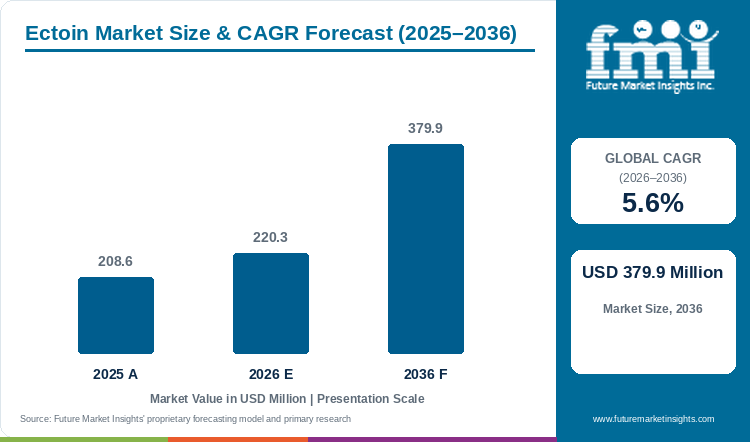
The ectoin market size is USD 220.3 Million in 2026, up from USD 208.6 Million in 2025, and is projected to reach USD 379.9 Million by 2036 at 5.6% CAGR.
The ectoin market size is estimated at USD 220.3 Million in 2026 and is projected to reach USD 379.9 Million by 2036 at 5.6% CAGR, according to FMI. Starting from USD 208.6 Million in 2025, the market size chart shows USD 159.6 Million added over the decade. Downstream demand is larger, as the ectoin-infused skincare market is projected to grow from USD 435.6 Million in 2025 to USD 779.2 Million by 2035.
Consumption of ectoin is concentrated in a few product groups. Facial skincare takes 33% of demand by application in 2026, anti-aging 28% by function and standard cosmetic grade 52% by grade, so most volume goes into mid-priced face serums and creams. Penetration across new launches is still thin, as only 0.03% of new skincare launches over the past five years cited osmolytes as a claim [1]. Korean brands point to the next source of volume, as Overlaps showed nine products across four lines formulated with ectoin at Intercharm Korea 2026 [2]. Barrier-led face-care ranges in Korea, Europe and the Gulf are expected to add the most new ectoin consumption through 2036.
Key Takeaways
- Leading companies in the ectoin market include BASF, Lubrizol, Symrise, Croda, Evonik, DSM-Firmenich, IFF, Clariant, Ashland and Givaudan.
- Standard cosmetic grade will carry 52% of demand by grade in 2026, as most skincare briefs accept cosmetic-quality documentation.
- Anti-aging is expected to hold 28% of demand by function in 2026. Brands pair ectoin with well-aging claims in serums and creams.
- Demand for ectoin is projected to grow fastest in the UAE, owing to a steady flow of new cosmetic launches cleared through conformity certification. By country, the UAE will lead with 6.8% CAGR through 2036, ahead of Saudi Arabia at 6.4%.
Analyst Perspective
“Certified fermentation output is in short supply for ectoin, and I expect brands to sign multi-year supply terms before launching new barrier lines. Standard cosmetic grade, at 52% of demand in 2026, will absorb most new Chinese and European output, and the UAE and Saudi Arabia, growing at 6.8% and 6.4% CAGR through 2036, will add the fastest new launch volume.”
- Nikhil Kaitwade, Principal Consultant, Future Market Insights
How is the Ectoin Market Segmented?
The ectoin market is divided into product type, function, application, grade, sales channel and region.
FMI divides product type into standard grade, high-purity and clinical grade, natural and certified grade, and customized systems. Functions tracked in the study are anti-aging, hydration and barrier, brightening, soothing and sensitive, and UV and protection. Applications covered include facial skincare, body care, haircare, color cosmetics and suncare. Grade segregation spans standard cosmetic grade, COSMOS and natural certified, pharma and clinical grade, and organic certified. Sales channels are split into direct to brands, specialty distributors, contract manufacturers and online B2B. The regional analysis covers seven regions and more than 25 countries.
Why Does Standard Grade Lead the Ectoin Market by Product Type?
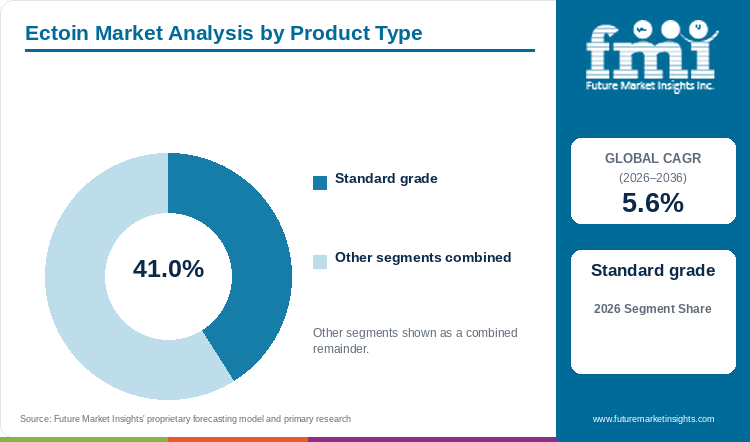
Standard grade is set to lead product type with 41% of market share in 2026.
Standard grade is the most bought ectoin format, with 41% of demand by product type in 2026. High-purity and clinical grade is the main rival, chosen by medical device and dermatology programs that pay more for tighter specifications. Mass and masstige brands add ectoin at low dosage, so one standard grade with routine quality papers covers most first projects, and natural, certified and customized formats stay with smaller brand groups.
- Most mass and masstige brands launch with standard grade and move to certified grades only for clean-beauty lines.
- Bitop presented Ectoin natural for in-cosmetics Global in March 2026, produced in pharma-grade quality under ISO 13485 with COSMOS and NATRUE certifications [3].
Why Does Anti-aging Lead the Ectoin Market by Function?
Anti-aging is projected to hold 28% of market share by function in 2026.
Anti-aging leads the function category at 28% of demand in 2026, and new cell research gives brands a reason to keep ectoin in well-aging lines. A February 2026 study in Frontiers in Aging found that ectoine reduced oxidative-stress senescence markers in human skin cells [4]. Hydration, soothing, brightening and UV products use ectoin as a supporting active, as cheaper humectants already cover basic moisture claims.
- Higher shelf prices in well-aging serums absorb the cost of a premium active and claim testing.
- In May 2026, dsm-firmenich introduced the GLYCARE SK range, with a clinically shown 19% reduction in transepidermal water loss for the RENEW product [5].
Why Does Facial Skincare Lead the Ectoin Market by Application?
Facial skincare will represent 33% of market share by application in 2026.
Facial skincare is expected to take 33% of demand by application in 2026, as leave-on serums, creams and day moisturizers carry hydration, barrier and pollution-protection claims together. Body care, haircare, color cosmetics and suncare use smaller amounts, since large pack sizes need a cheaper active and the other categories treat ectoin as a minor benefit.
- Facial ampoules and essences from Korean and Japanese brands are set to add new ectoin volume through 2036.
- South Korea recorded a 2025 cosmetics trade surplus of USD 10.1 billion and ranked as the world's second-largest cosmetics exporter [6].
Why Does Standard Cosmetic Grade Lead the Ectoin Market by Grade?
Standard cosmetic grade is estimated to capture 52% of market share by grade in 2026.
Standard cosmetic grade holds 52% of demand by grade in 2026, as cosmetic rules in most countries ask for a specification sheet, safety data and stability guidance, and seldom for pharmaceutical qualification. Certified grades follow retailer standards, and COSMOS, NATRUE and organic audits add fees to every kilogram. Pharma and clinical grade stays with medical device and dermatology products that need registered excipient status.
- Clean-beauty retailers tightening ingredient standards are expected to move part of new launches to COSMOS and natural certified grade.
- Bloomage Biotech obtained Chinese pharmaceutical excipient registration for medical-grade ectoine in 2024, after US registration in 2022 [7].
Why Does Direct to Brands Lead the Ectoin Market by Sales Channel?
In 2026, direct to brands will account for 45% of market share by sales channel.
Direct to brands moves 45% of demand by sales channel in 2026, since large skincare brands agree dosage and claim evidence with the producer during formula work. Specialty distributors are the faster-growing route for mid-sized brands needing local stock and regulatory files, and contract manufacturers and online B2B buy to set specifications or in sample sizes.
- Large brands lock a specification only after joint stability tests with the producer, which keeps direct accounts in place for years.
- DKSH was named in 2026 to handle marketing, sales, logistics and distribution of bitop cosmetic ingredients in France, Belgium, the Netherlands and Luxembourg [8].
What are the Drivers, Restraints, and Opportunities in the Ectoin Market?
Multi-claim formulation is increasing demand for ectoin, according to FMI. Low osmolyte awareness and repeat source testing slow adoption, and certified grades sold through technical distributors are set to open the largest new pool of orders through 2036.
- Driver: Brands can support hydration, barrier and anti-aging claims with one active, which keeps ectoin on serum and cream briefs.
- Restraint: Low shopper awareness of osmolytes and repeat stability testing for each new source slow the move from trial to regular orders.
- Opportunity: Technical distributors carrying certified grades can reach mid-sized brands in Europe, the Gulf and Asia without direct sourcing teams.
Barrier-repair and sensitive-skin launches are the main entry point for ectoin. Brands add one osmolyte to cover moisture and barrier claims together, which shortens formula work. Supplier education is expected to open briefs in the ceramide skincare market and the moisturizing skincare products market, two categories already built on barrier and hydration claims.
Rival barrier actives and the cost of qualifying each new source form the main challenges. Plant-derived actives in the botanical bioactives market and lower-cost moisture actives in the humectant-infused skincare market compete for the same formulation budget, and price per kilogram against glycerin and betaine limits dosage in standard formulas.
Which Country CAGRs are Profiled in the Ectoin Market?
| Country | CAGR, 2026 to 2036 |
|---|---|
| UAE | 6.8% |
| Saudi Arabia | 6.4% |
| South Korea | 6.1% |
| USA | 5.8% |
| UK | 5.5% |
| France | 5.1% |
| Germany | 4.8% |
| Japan | 4.5% |
How do Country-level CAGRs Compare in the Ectoin Market?
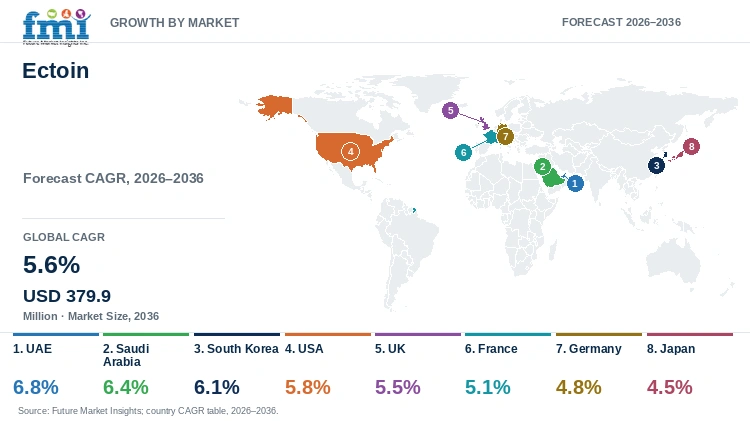
Gulf launch pipelines and mature European formulation bases set the range in FMI's country analysis. The UAE has the tallest bar on the country CAGR chart at 6.8%, and Japan the shortest at 4.5% through 2036. The UAE, Saudi Arabia and South Korea are projected to grow above 6%, as conformity checks, SFDA notification and export-led brands bring frequent new launches. The USA, the UK and France are expected to grow between 5.1% and 5.8% on formal listing and notification systems. Demand in Germany and Japan will rise below 5%, as ectoin is already familiar to German formulators and Japanese mature-skin sales hold steady. Serums and ampoules lead new product activity across the anti-aging skincare market, adding ectoin briefs in every profiled country.
- The UAE is projected to grow fastest at 6.8% CAGR through 2036. Accredited laboratory testing paces every cosmetic import into the country.
- Claim limits between cosmetics and drugs will shape ectoin positioning in Saudi Arabia, supporting 6.4% CAGR during the forecast period.
- Export-led barrier launches will keep South Korea ahead of the USA at 6.1% CAGR by 2036.
- Sales in the USA are set to expand at 5.8% CAGR over the decade to 2036, as MoCRA listings formalize ingredient records.
- Claim evidence required in each UK product file will hold growth at 5.5% CAGR through 2036.
- France is projected at 5.1% CAGR during the forecast period. A large export base keeps French formulators testing new actives.
- At 4.8% CAGR by 2036, Germany will grow faster than Japan, with ectoin already familiar to local formulators.
- Japan is expected to record the slowest rate at 4.5% CAGR through 2036, as mature-skin sales stay steady.
CAGR estimates for seven regions and more than 25 countries and country groups are available in the full report beyond these eight profiles.
Country Outlook
- Accredited laboratory reports are required for cosmetic conformity certificates in the UAE, and importers move each new skincare range through these checks before launch. Demand for ectoin in the UAE is projected to grow at 6.8% CAGR through 2036, the fastest in the profiled group.
- Saudi Arabia is expected to post 6.4% CAGR during the forecast period, second in the group. A product marketed with a medical claim can be classified as a drug, and new cosmetics are notified to the SFDA, so importers need careful claim wording for barrier and soothing actives.
- Key drivers of demand for ectoin in South Korea include export-led brands launching barrier and well-aging products at high speed. Frequent launches create a steady flow of new briefs, and South Korea is projected at 6.1% CAGR by 2036, with suppliers offering fast sampling taking the most Korean projects.
- Ingredient records are being formalized in the USA through MoCRA facility registration and product listing. Brands need clean safety data and specifications to move from trial batch to listed product, and demand for ectoin in the USA is projected to grow at 5.8% CAGR through 2036.
- The UK cosmetic notification system had received 861,686 submissions from 24,112 registered Responsible Persons by May 28, 2026 [9]. Every Product Information File needs claim evidence, so brands favour actives with ready test data, and growth in the UK is projected at 5.5% CAGR during the forecast period.
- Adoption of ectoin in France is expected to grow at 5.1% CAGR through 2036. A large cosmetics manufacturing and export base keeps demand for new actives steady, and local distributor stock now gives mid-sized French brands easier access to certified grades.
- Ectoin is already well known to German formulators through domestic producer bitop, so specification consistency and formulation guidance guide supplier choice. Demand for ectoin in Germany is projected to grow at 4.8% CAGR by 2036.
- Japan offers a quasi-drug approval route with a tighter claim pathway for qualified actives, and an aging population keeps mature-skin and barrier-care sales steady. Demand for ectoin in Japan is expected to rise at 4.5% CAGR during the forecast period, the slowest of the eight countries.
Who are the Notable Companies in the Ectoin Market?
BASF, Symrise, Croda, DSM-Firmenich, IFF and Givaudan are among the ten leading companies profiled by FMI, competing on osmolyte science, claim substantiation and formulation support.
Ectoin supply is concentrated at the molecule level, with a few fermentation specialists selling the active to brands and large ingredient houses. Buyers compare purity, certification status, stability data and clinical evidence offered with each grade. Bitop supplies Ectoin natural with COSMOS, NATRUE, EcoCert, Halal and Vegan certifications, and large houses are adding rival barrier actives, as dsm-firmenich launched the HMO-based GLYCARE SK range in May 2026 [3] [5]. Brands repeat stability and claim checks before changing source, so approved suppliers keep accounts for several years. FMI identifies certified fermentation capacity as the main differentiator through 2036.
- Skin-Active and Biotech Science Platforms: Symrise, Croda, DSM-Firmenich and Givaudan supply biotechnology-led skin actives and delivery systems that compete for the same formulation budget as ectoin.
- Functional and Formulation Platform Suppliers: BASF, Lubrizol, Evonik, Clariant and Ashland combine broad personal-care portfolios with formulation, testing and distribution support for brand customers.
- Osmolyte-Adjacent Science Platform: IFF promotes osmolytes for hydration and barrier care, and the company launched an osmolyte awareness campaign with Chemist Confessions in October 2025 [1].
Competitive Benchmarking
| Company | Osmolyte Science Evidence | Skin-Active Substantiation | Formulation & Delivery Support | Geographic Reach |
|---|---|---|---|---|
| BASF | Low | High | High | Global production and development sites across regions |
| Lubrizol | Low | High | High | Global personal-care business with regional R&D infrastructure |
| Symrise | Low | High | Medium | Global Scent & Care and cosmetic-ingredient reach |
| Croda | Low | High | High | 91 locations across 36 countries |
| Evonik | Low | High | High | Beauty and Personal Care presence within a group active in more than 100 countries |
| DSM-Firmenich | Low | High | High | Operations in almost 60 countries |
| IFF | High | High | High | Global Beauty & Personal Care platform and formulation resources |
| Clariant | Low | Medium | High | Global personal-care ingredient platform with major regional customer coverage |
| Ashland | Low | Medium | High | Customers in more than 100 countries with dedicated US distribution support |
| Givaudan | Low | High | High | Global Fragrance & Beauty and Active Beauty presence |
Scoring basis: Osmolyte Science Evidence rates documented work on osmolyte ingredients, mechanisms or formulation concepts, Skin-Active Substantiation rates the breadth of documented cosmetic-active science and human-use evidence, and Formulation & Delivery Support rates documented formulation systems, delivery technology and testing support. High reflects broad documented capability, Medium a narrower proven range, and Low limited public documentation for the criterion.
Key Developments
- In March 2026, Bitop presented Ectoin natural for in-cosmetics Global, produced in pharma-grade quality under ISO 13485 with EcoCert, COSMOS, NATRUE, Halal and Vegan certifications [3].
- In May 2026, dsm-firmenich introduced the GLYCARE SK range, an HMO biotechnology line for skin regeneration and barrier resilience in sensitive and stressed skin [5].
- In June 2026, DKSH was reported as the new distributor of bitop active ingredients in France, Belgium, the Netherlands and Luxembourg, covering marketing, sales and logistics [8].
Key Players
Skin-Active and Biotech Science Platforms
- Symrise
- Croda
- DSM-Firmenich
- Givaudan
Functional and Formulation Platform Suppliers
- BASF
- Lubrizol
- Evonik
- Clariant
- Ashland
Osmolyte-Adjacent Science Platform
- IFF
Report Scope and Methodology
| Coverage field | Report scope |
|---|---|
| Market breakdown | 5 categories plus region: Product Type (Standard grade, High-purity / clinical grade, Natural & certified grade, Customized systems), Function (Anti-aging, Hydration & barrier, Brightening, Soothing & sensitive, UV & protection), Application (Facial skincare, Body care, Haircare, Color cosmetics, Suncare), Grade (Standard cosmetic grade, COSMOS / natural certified, Pharma & clinical grade, Organic certified), Sales Channel (Direct to brands, Specialty distributors, Contract manufacturers, Online B2B), and Region |
| Quantitative units | USD Million |
| Market definition | Revenue from ectoin active ingredient sold for use across the stated product type, function, application, grade and sales channel segments. Ingredient sales for clinical or specialized formulations are included when the revenue is ectoin ingredient revenue. Finished-product revenue, bundled finished systems, adjacent osmolytes and substitute actives are excluded. |
| Regions covered | North America, Latin America, Western Europe, Eastern Europe, East Asia, South Asia and Pacific, Middle East and Africa |
| Countries covered | More than 25 countries and country groups, including the USA, Germany, France, the UK, Saudi Arabia, the UAE, Japan and South Korea |
| Key companies profiled | A few of the leading companies out of many players covered in the study: BASF, Lubrizol, Symrise, Croda, Evonik, DSM-Firmenich, IFF, Clariant, Ashland and Givaudan |
| Forecast period | 2026 to 2036 |
| Approach | A hybrid bottom-up and top-down model built by FMI reconciles ingredient volumes, grade pricing, supplier revenue and brand formulation activity within the defined revenue boundary. |
Research Methodology
| Method | Approach |
|---|---|
| Primary research | Interviews with ectoin producers, personal-care ingredient suppliers, technical distributors, brand formulators and contract manufacturers test purchase criteria, grade choice, stability and claim requirements, switching costs and pricing. |
| Desk research | The analysis reviews cosmetic regulations, notification data, company announcements, product documentation, scientific literature and trade statistics, retaining sources that are recent and relevant to ectoin. |
| Market sizing and forecasting | The sizing framework combines ingredient volumes, grade pricing, application mix, brand launch activity and country operating conditions. Forecasts consider regulation, claim substantiation, certification needs and competing actives. |
| Data validation | Estimates are cross-checked across source types and buyer-side purchasing logic. Finished-product value, adjacent osmolyte revenue and unsupported company rankings are excluded to avoid double counting. |
Ectoin Market by Segments
Ectoin Market Segmented by Product Type
- Standard grade
- High-purity / clinical grade
- Natural & certified grade
- Customized systems
Ectoin Market Segmented by Function
- Anti-aging
- Hydration & barrier
- Brightening
- Soothing & sensitive
- UV & protection
Ectoin Market Segmented by Application
- Facial skincare
- Body care
- Haircare
- Color cosmetics
- Suncare
Ectoin Market Segmented by Grade
- Standard cosmetic grade
- COSMOS / natural certified
- Pharma & clinical grade
- Organic certified
Ectoin Market Segmented by Sales Channel
- Direct to brands
- Specialty distributors
- Contract manufacturers
- Online B2B
Ectoin Market Segmented by Region
- North America
- Latin America
- Western Europe
- Eastern Europe
- East Asia
- South Asia and Pacific
- Middle East and Africa
Research Sources and Bibliography
- [1] Cosmetics Business (2025, October 19). IFF teams up with influencers Chemist Confessions to raise awareness of osmolytes.
- [2] Venturesquare (2026, July 2). Overlaps, Focusing on 'Skin Barrier'… Unveiling Brand Competitiveness at Intercharm Korea.
- [3] Cosmetics Business (2026, March 31). Ectoin natural continues to be one of the most sought-after active ingredients in modern skincare.
- [4] Frontiers in Aging (2026, February 26). Ectoine attenuates H2O2-induced cellular senescence in human keratinocytes and endothelial cells by modulating the p53/p21 and p16 pathways.
- [5] dsm-firmenich (2026, May 1). dsm-firmenich introduces GLYCARE SK range: HMO biotechnology for skin regeneration and resilience.
- [6] Ministry of Food and Drug Safety, Republic of Korea (2026, September 7). “The Confidence of K-Beauty, In Full Bloom” 2026 Cosmetics Day Ceremony.
- [7] China Securities Journal (2026, April 23). Bloomage Biotech Co., Ltd. 2025 Annual Report Summary.
- [8] SpecialChem (2026, June 19). DKSH to distribute bitop's active ingredients in France and Benelux.
- [9] Office for Product Safety and Standards (2026, July 17). New data on UK cosmetic product safety notifications.
This bibliography is provided for reader reference and is not exhaustive. The full report contains the complete reference list and detailed citations.
This Report Answers
- What will the Ectoin Market size be in 2026, and what value will the market reach by 2036?
- Which skincare claims will bring the most new orders for ectoin through 2036?
- Why will standard cosmetic grade hold more than half of demand by grade in 2026?
- What effect will low shopper awareness of osmolytes have on ectoin sales growth?
- Why will facial skincare and anti-aging formulas account for the largest ectoin volumes?
- Which growth rates will the UAE, Saudi Arabia, South Korea, the USA, the UK, France, Germany and Japan post till 2036?
- Which barrier actives from large ingredient houses will compete with ectoin for formulation budgets?
- What documentation will brands request before approving a new ectoin supplier?
Frequently Asked Questions
How Big Is the Ectoin Market Expected to Be in 2026?
Ectoin sales will reach USD 220.3 Million in 2026, up from USD 208.6 Million in 2025, as FMI estimates show. Revenue will rise to USD 379.9 Million by 2036 as brands add the active to barrier and well-aging skincare.
What Is the CAGR of the Ectoin Market from 2026 to 2036?
The market will grow at a 5.6% CAGR from 2026 to 2036. Multi-claim facial products and certified grades will add most new revenue, and low shopper awareness of osmolytes will hold back faster conversion.
Which Grade Holds the Largest Share of the Ectoin Market?
Standard cosmetic grade will lead with 52% of market share by grade in 2026. Cosmetic-quality documentation accepted by most brands will support the position at a moderate price per kilogram.
Which Function Leads the Ectoin Market?
Anti-aging will account for 28% of market share by function in 2026. Higher shelf prices for well-aging serums and creams will cover the cost of a premium active and claim testing.
Which Country Is Expected to Grow Fastest in the Ectoin Market?
The UAE will grow fastest at a 6.8% CAGR till 2036, followed by Saudi Arabia at 6.4% and South Korea at 6.1%. Japan will post the slowest rate of the eight profiled countries at 4.5%.
What Notable Restraint Affects the Ectoin Market?
Key challenges will come from low awareness of osmolytes and competing barrier actives from large ingredient houses. Brands will also repeat stability and claim checks before approving a new ectoin source, slowing supplier switching.
Which Are the Key Companies in the Ectoin Market?
BASF, Lubrizol, Symrise, Croda, Evonik, DSM-Firmenich, IFF, Clariant, Ashland and Givaudan rank among the leading companies covered by FMI. The report assigns each company to one of three supplier groups.
Preview the report firsthand - request a free sample
Get SampleGet the brochure for pricing and purchase details.
Get PDFTable of Content
- Key Takeaways
- Market Size and CAGR
- Top Growth Driver
- Fastest Growing Segment
- Leading Region
- Key Companies
- Emerging Opportunities
- Executive Summary
- Global Market Outlook
- Demand-side Trends
- Supply-side Trends
- Technology Roadmap Analysis
- Analysis and Recommendations
- Analyst Perspective (What is happening? Why now? What should investors know?)
- Key Questions Answered
- How large is the market?
- What is the CAGR?
- What are key trends?
- Which region dominates?
- Who are the leaders?
- Market Overview
- Market Coverage / Taxonomy
- Market Definition / Scope / Limitations
- Research Methodology
- Chapter Orientation
- Analytical Lens and Working Hypotheses
- Market Structure, Signals, and Trend Drivers
- Benchmarking and Cross-market Comparability
- Market Sizing, Forecasting, and Opportunity Mapping
- Research Design and Evidence Framework
- Desk Research Programme (Secondary Evidence)
- Expert Input and Fieldwork (Primary Evidence)
- Tooling, Models, and Reference Databases
- Data Engineering and Model Build
- Quality Assurance and Audit Trail
- Market Background
- Market Dynamics (Drivers, Restraints, Opportunity, Trends)
- Scenario Forecast (Optimistic, Likely, Conservative)
- Impact Analysis
- AI Impact
- Sustainability Impact
- Regulatory Impact
- Technology Impact
- Consumer / Buyer Analysis
- Purchase Drivers
- Adoption Barriers
- Buyer Journey
- Opportunity Map Analysis
- Product Life Cycle Analysis
- Supply Chain Analysis
- Investment Feasibility Matrix
- Value Chain Analysis
- PESTLE and Porter's Analysis
- Regulatory Landscape
- Regional Parent Market Outlook
- Production and Consumption Statistics
- Import and Export Statistics
- Global Market Analysis and Forecast, 2021 to 2036
- Historical Market Size Value (USD Million) Analysis, 2021 to 2025
- Current and Future Market Size Value (USD Million) Projections, 2026 to 2036
- Y-o-Y Growth Trend Analysis
- Absolute $ Opportunity Analysis
- Global Market Pricing Analysis, 2021 to 2036
- Global Market Analysis and Forecast, By Product Type, 2021 to 2036
- Introduction / Key Findings
- Historical Market Size Value (USD Million) Analysis By Product Type, 2021 to 2025
- Current and Future Market Size Value (USD Million) Analysis and Forecast By Product Type, 2026 to 2036
- Standard grade
- High-purity / clinical grade
- Natural & certified grade
- Customized systems
- Y-o-Y Growth Trend Analysis By Product Type, 2021 to 2025
- Absolute $ Opportunity Analysis By Product Type, 2026 to 2036
- Global Market Analysis and Forecast, By Function, 2021 to 2036
- Introduction / Key Findings
- Historical Market Size Value (USD Million) Analysis By Function, 2021 to 2025
- Current and Future Market Size Value (USD Million) Analysis and Forecast By Function, 2026 to 2036
- Anti-aging
- Hydration & barrier
- Brightening
- Soothing & sensitive
- UV & protection
- Y-o-Y Growth Trend Analysis By Function, 2021 to 2025
- Absolute $ Opportunity Analysis By Function, 2026 to 2036
- Global Market Analysis and Forecast, By Application, 2021 to 2036
- Introduction / Key Findings
- Historical Market Size Value (USD Million) Analysis By Application, 2021 to 2025
- Current and Future Market Size Value (USD Million) Analysis and Forecast By Application, 2026 to 2036
- Facial skincare
- Body care
- Haircare
- Color cosmetics
- Suncare
- Y-o-Y Growth Trend Analysis By Application, 2021 to 2025
- Absolute $ Opportunity Analysis By Application, 2026 to 2036
- Global Market Analysis and Forecast, By Grade, 2021 to 2036
- Introduction / Key Findings
- Historical Market Size Value (USD Million) Analysis By Grade, 2021 to 2025
- Current and Future Market Size Value (USD Million) Analysis and Forecast By Grade, 2026 to 2036
- Standard cosmetic grade
- COSMOS / natural certified
- Pharma & clinical grade
- Organic certified
- Y-o-Y Growth Trend Analysis By Grade, 2021 to 2025
- Absolute $ Opportunity Analysis By Grade, 2026 to 2036
- Global Market Analysis and Forecast, By Sales Channel, 2021 to 2036
- Introduction / Key Findings
- Historical Market Size Value (USD Million) Analysis By Sales Channel, 2021 to 2025
- Current and Future Market Size Value (USD Million) Analysis and Forecast By Sales Channel, 2026 to 2036
- Direct to brands
- Specialty distributors
- Contract manufacturers
- Online B2B
- Y-o-Y Growth Trend Analysis By Sales Channel, 2021 to 2025
- Absolute $ Opportunity Analysis By Sales Channel, 2026 to 2036
- Global Market Analysis and Forecast, By Region, 2021 to 2036
- Introduction
- Historical Market Size Value (USD Million) Analysis By Region, 2021 to 2025
- Current Market Size Value (USD Million) Analysis and Forecast By Region, 2026 to 2036
- North America
- Latin America
- Western Europe
- Eastern Europe
- East Asia
- South Asia and Pacific
- Middle East and Africa
- Market Attractiveness Analysis By Region
- North America Market Analysis and Forecast, By Country, 2021 to 2036
- Historical Market Size Value (USD Million) Trend Analysis By Market Taxonomy, 2021 to 2025
- Market Size Value (USD Million) Forecast By Market Taxonomy, 2026 to 2036
- By Country
- By Product Type
- By Function
- By Application
- By Grade
- By Sales Channel
- Market Attractiveness Analysis
- By Country
- By Product Type
- By Function
- By Application
- By Grade
- By Sales Channel
- Key Takeaways
- Latin America Market Analysis and Forecast, By Country
- Historical Market Size Value (USD Million) Trend Analysis By Market Taxonomy, 2021 to 2025
- Market Size Value (USD Million) Forecast By Market Taxonomy, 2026 to 2036
- By Country
- By Product Type
- By Function
- By Application
- By Grade
- By Sales Channel
- Market Attractiveness Analysis
- By Country
- By Product Type
- By Function
- By Application
- By Grade
- By Sales Channel
- Key Takeaways
- Western Europe Market Analysis and Forecast, By Country
- Historical Market Size Value (USD Million) Trend Analysis By Market Taxonomy, 2021 to 2025
- Market Size Value (USD Million) Forecast By Market Taxonomy, 2026 to 2036
- By Country
- By Product Type
- By Function
- By Application
- By Grade
- By Sales Channel
- Market Attractiveness Analysis
- By Country
- By Product Type
- By Function
- By Application
- By Grade
- By Sales Channel
- Key Takeaways
- Eastern Europe Market Analysis and Forecast, By Country
- Historical Market Size Value (USD Million) Trend Analysis By Market Taxonomy, 2021 to 2025
- Market Size Value (USD Million) Forecast By Market Taxonomy, 2026 to 2036
- By Country
- By Product Type
- By Function
- By Application
- By Grade
- By Sales Channel
- Market Attractiveness Analysis
- By Country
- By Product Type
- By Function
- By Application
- By Grade
- By Sales Channel
- Key Takeaways
- East Asia Market Analysis and Forecast, By Country
- Historical Market Size Value (USD Million) Trend Analysis By Market Taxonomy, 2021 to 2025
- Market Size Value (USD Million) Forecast By Market Taxonomy, 2026 to 2036
- By Country
- By Product Type
- By Function
- By Application
- By Grade
- By Sales Channel
- Market Attractiveness Analysis
- By Country
- By Product Type
- By Function
- By Application
- By Grade
- By Sales Channel
- Key Takeaways
- South Asia and Pacific Market Analysis and Forecast, By Country
- Historical Market Size Value (USD Million) Trend Analysis By Market Taxonomy, 2021 to 2025
- Market Size Value (USD Million) Forecast By Market Taxonomy, 2026 to 2036
- By Country
- By Product Type
- By Function
- By Application
- By Grade
- By Sales Channel
- Market Attractiveness Analysis
- By Country
- By Product Type
- By Function
- By Application
- By Grade
- By Sales Channel
- Key Takeaways
- Middle East and Africa Market Analysis and Forecast, By Country
- Historical Market Size Value (USD Million) Trend Analysis By Market Taxonomy, 2021 to 2025
- Market Size Value (USD Million) Forecast By Market Taxonomy, 2026 to 2036
- By Country
- By Product Type
- By Function
- By Application
- By Grade
- By Sales Channel
- Market Attractiveness Analysis
- By Country
- By Product Type
- By Function
- By Application
- By Grade
- By Sales Channel
- Key Takeaways
- Key Countries Market Analysis
- UAE
- Pricing Analysis
- Market Share Analysis, 2025
- By Product Type
- By Function
- By Application
- By Grade
- By Sales Channel
- Saudi Arabia
- Pricing Analysis
- Market Share Analysis, 2025
- By Product Type
- By Function
- By Application
- By Grade
- By Sales Channel
- South Korea
- Pricing Analysis
- Market Share Analysis, 2025
- By Product Type
- By Function
- By Application
- By Grade
- By Sales Channel
- USA
- Pricing Analysis
- Market Share Analysis, 2025
- By Product Type
- By Function
- By Application
- By Grade
- By Sales Channel
- UK
- Pricing Analysis
- Market Share Analysis, 2025
- By Product Type
- By Function
- By Application
- By Grade
- By Sales Channel
- France
- Pricing Analysis
- Market Share Analysis, 2025
- By Product Type
- By Function
- By Application
- By Grade
- By Sales Channel
- Germany
- Pricing Analysis
- Market Share Analysis, 2025
- By Product Type
- By Function
- By Application
- By Grade
- By Sales Channel
- Japan
- Pricing Analysis
- Market Share Analysis, 2025
- By Product Type
- By Function
- By Application
- By Grade
- By Sales Channel
- UAE
- Market Structure Analysis
- Competition Dashboard
- Competition Benchmarking
- Market Share Analysis of Top Players
- By Regional
- By Product Type
- By Function
- By Application
- By Grade
- By Sales Channel
- Emerging Startups
- Innovation Benchmarking
- Competition Analysis
- Competition Deep Dive
- BASF
- Overview
- Product Portfolio
- Profitability by Market Segments
- Sales Footprint
- Strategy Overview
- Marketing Strategy
- Product Strategy
- Channel Strategy
- Lubrizol
- Symrise
- Croda
- Evonik
- DSM-Firmenich
- IFF
- Clariant
- Ashland
- Givaudan
- BASF
- Case Studies
- Success Stories
- Recent Developments
- Competition Deep Dive
- Assumptions & Acronyms Used


