

- Market Size (2026)
- USD 356.3 Mn
- Forecast (2036)
- USD 614.4 Mn
- CAGR (2026 to 2036)
- 5.6%
How Big is the Retinaldehyde Market in 2026?
The retinaldehyde market size is USD 356.3 Million in 2026, up from USD 337.4 Million in 2025, and is projected to reach USD 614.4 Million by 2036 at 5.6% CAGR.
The retinaldehyde market size is estimated at USD 356.3 Million in 2026 and is projected to reach USD 614.4 Million by 2036 at 5.6% CAGR. Value stood at USD 337.4 Million in 2025 on the market size chart, and the decade adds USD 258.1 Million. Production capacity sets the pace of this market, as retinal is made from vitamin A, produced by a handful of plants in Germany, Switzerland, France and China. In July 2026, BASF warned of possible force majeure at the Ludwigshafen site, home to the company's vitamin A plant, as the Rhine fell to 28 cm at Kaub [1].
Brands buying direct from producers will place 43% of retinaldehyde orders in 2026, according to FMI, so most volume moves under supply contracts. Cosmetics form a small outlet for vitamin A makers, as dsm-firmenich ran the vitamin plants inside the Animal Nutrition & Health unit that the company agreed to sell to CVC Capital Partners in February 2026 [2]. Plant schedules are expected to follow feed orders first, with only a small share of output converted into cosmetic-grade retinal. Retinal makers with feedstock contracts in Europe and China are expected to fill most new orders through 2036.
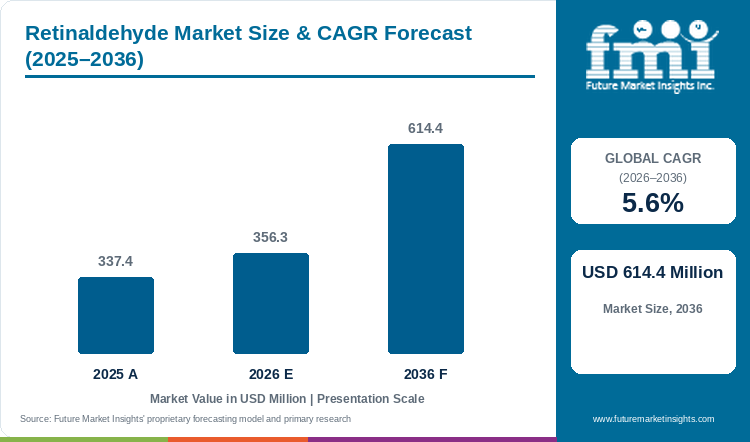
Retinaldehyde Market Size & CAGR Forecast (2025-2036)
| Year | Type | Market value (USD million) |
|---|---|---|
| 2025 | Actual (A) | 337.4 |
| 2026 | Estimate (E) | 356.3 |
| 2036 | Forecast (F) | 614.4 |
| Metric | Value |
|---|---|
| Global CAGR (2026-2036) | 5.6% |
| Market size, 2036 | USD 614.4 million |
Source: Future Market Insights proprietary forecasting model and primary research.
Key Takeaways
- Leading companies in the retinaldehyde market include Evonik, DSM-Firmenich, Clariant, Givaudan, BASF, Croda, Lubrizol, Symrise, Ashland and IFF.
- Facial skincare will take 41% of demand by application in 2026. Night serums and eye creams account for most new retinal launches in this segment.
- Standard cosmetic grade is set to hold 44% of demand by grade in 2026, and standard grade 42% by product type, as mainstream face-care brands buy one approved specification.
- The UAE will post the fastest growth in demand for retinaldehyde at 6.9% CAGR through 2036, with Saudi Arabia next at 6.6%. Dubai entry points and SFDA notification are moving new retinoid products to shelf in both markets.
Analyst Perspective
“I would advise brands planning retinal launches for 2027 and 2028 to secure supply early, as vitamin A capacity is changing owners and cosmetic-grade retinal comes from a short list of producers. Facial skincare, at 41% of demand in 2026, will absorb most of that supply, and the UAE and Saudi Arabia, at 6.9% and 6.6% CAGR through 2036, will see the quickest rise in new launch filings.”
- Nikhil Kaitwade, Principal Consultant, Future Market Insights
How is the Retinaldehyde Market Segmented?
The retinaldehyde market is split into product type, function, application, grade, sales channel and region.
FMI groups the market by product type into standard grade, high-purity and clinical grade, natural and certified grade, and customized systems. Functions covered in the study are anti-aging, hydration and barrier, brightening, soothing and sensitive, and UV and protection. Application coverage spans facial skincare, body care, haircare, color cosmetics and suncare. On grade, the analysis separates standard cosmetic grade, COSMOS and natural certified, pharma and clinical grade, and organic certified. Sales channels are tracked across direct to brands, specialty distributors, contract manufacturers and online B2B. The regional analysis covers seven regions and more than 25 countries.
Why Does Standard Grade Lead the Retinaldehyde Market by Product Type?
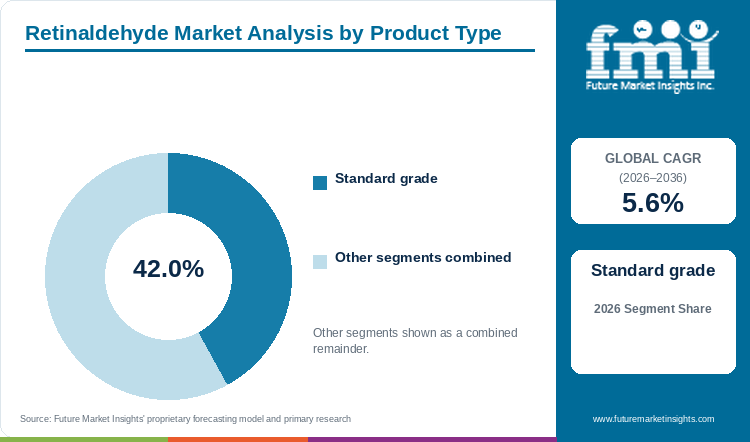
Standard grade is set to lead product type with 42% of market share in 2026.
| Product type | Share (2026) |
|---|---|
| Standard grade | 42.0% |
| Other segments combined | 58.0%* |
| Total | 100.0% |
| Metric | Value |
|---|---|
| Global CAGR (2026-2036) | 5.6% |
| Leading segment | Standard grade |
Standard grade is the most purchased retinaldehyde format, with 42% of demand by product type in 2026. Customized systems are the nearest rival, bought by sensitive-skin lines that pay more for an encapsulated or blended format. Each customized order is built for one project, so reorders come less often, and mainstream brands stay with a standard specification reused across launches.
- Mainstream face-care brands reuse one approved standard-grade specification across several launches, keeping reorders steady through 2036.
- Coast Southwest highlighted VitAlease from Infinitec Activos in April 2026, an ingredient with 7% retinol encapsulated in carnauba wax [3].
Why Does Anti-aging Lead the Retinaldehyde Market by Function?
Anti-aging is projected to hold 24% of market share by function in 2026.
Anti-aging leads the function category at 24% of demand in 2026, and the August 2026 launch of the Dieux Firm Revival HydroRetinal Firming Serum shows the reason. The serum carries 0.05% retinal at USD 42 and is sold on firming, the core anti-aging claim for mid-priced shoppers [4]. Brightening, hydration, soothing and UV lines buy far less retinal, since shoppers choose those products for tone, comfort or sun protection.
- Fine lines and uneven texture are the main reasons shoppers try a retinal product for the first time.
- Ashland unveiled Eternight in April 2026, an Iris pallida root extract that improved perceived skin age by up to four years after one month in clinical trials [5].
Why Does Facial Skincare Lead the Retinaldehyde Market by Application?
Facial skincare will represent 41% of market share by application in 2026.
Facial skincare is expected to account for 41% of demand by application in 2026, as night serums and eye creams make up most retinal launches, such as the Venn Retinal Infusion MLV5 Serum listed by NewBeauty in March 2026 at USD 155 [6]. Body care, haircare, color cosmetics and suncare order less because a body product needs more active per pack and the other categories make few retinoid claims.
- Night serums and eye creams used in evening routines are set to carry most new facial launches through 2036.
- EU caps on retinol and retinyl esters took effect on November 1, 2025, at 0.3% for face and hand products and 0.05% for body lotions [7].
Why Does Standard Cosmetic Grade Lead the Retinaldehyde Market by Grade?
Standard cosmetic grade is estimated to capture 44% of market share by grade in 2026.
Standard cosmetic grade holds 44% of demand by grade in 2026, as cosmetic rules in the USA, Europe and Asia ask for identity, impurity and stability data that this grade already carries. Australia added a retinal-specific step on June 27, 2026, requiring an assessment certificate for retinal in consumer products regardless of concentration [8]. Rules of this kind add filing work without moving brands to pharma and clinical grade, which stays limited to dermatology labels sold through clinics and pharmacies.
- Certified natural and organic grades have little supply for a vitamin A derivative, so both grades stay small during the forecast period.
- AICIS placed retinal in Human Health Hazard Band C after a developmental toxicity classification [8].
Why Does Direct to Brands Lead the Retinaldehyde Market by Sales Channel?
In 2026, direct to brands will account for 43% of market share by sales channel.
Direct to brands holds 43% of demand by sales channel in 2026. Large brands agree stability, packaging and claim support with the producer before scale-up, and a direct contract also secures volume during the change in vitamin A ownership. Specialty distributors, contract manufacturers and online B2B mainly serve smaller brands buying small lots.
- Indie brands buying through specialty distributors often wait for local stock and technical help before switching to retinal.
- In February 2026, dsm-firmenich agreed to keep a long-term vitamins supply agreement with the new vitamins company formed under CVC Capital Partners [2].
What are the Drivers, Restraints, and Opportunities in the Retinaldehyde Market?
Rising purchases of anti-aging skincare by older shoppers are increasing demand for retinaldehyde, according to FMI. Retinal-specific safety rules slow new launches, and encapsulated systems offer the next growth pool for producers through 2036.
- Driver: Aging shoppers in the USA, Europe and Japan are buying more wrinkle and texture care, and brands answer with retinal night serums at mid-range prices.
- Restraint: Retinal-specific rules, such as the Australian assessment certificate, add filing time and cost for every brand selling into regulated markets.
- Opportunity: Encapsulated retinal systems give mainstream brands a ready-to-use format, opening orders from brands that avoided retinoids until now.
Regulation in Europe is pushing brands to rethink vitamin A choices, as EU caps on retinol, retinyl acetate and retinyl palmitate have applied to new products since November 1, 2025 [7]. Brands reformulating face serums are expected to test retinal as an alternative, and dsm-firmenich research on vitamin A activation received an Outstanding Paper Award in July 2025 [9]. The anti-aging creams and serums market is projected to rise from USD 78.6 Billion in 2026 to USD 151.7 Billion by 2036, and the anti-wrinkle products market at 7.8% CAGR through 2036, adding more night serums that can carry retinal.
Oxidation, irritation and retinal-specific regulation keep qualification slow for new buyers. Each brand repeats stability and safety review before switching to a new active. Competing options are growing as well, with the bioactive retinol alternatives market projected at 12.8% CAGR from 2025 to 2035 and the water-soluble retinol market at 13% CAGR through 2035.
Which Country CAGRs are Profiled in the Retinaldehyde Market?
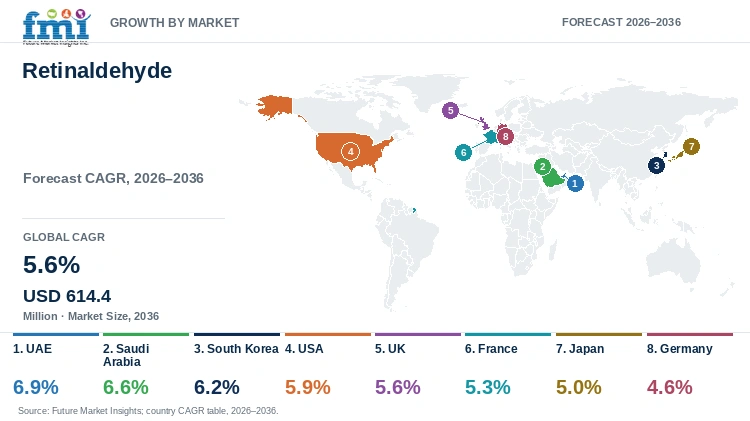
| Country | CAGR, 2026 to 2036 |
|---|---|
| UAE | 6.9% |
| Saudi Arabia | 6.6% |
| South Korea | 6.2% |
| USA | 5.9% |
| UK | 5.6% |
| France | 5.3% |
| Japan | 5% |
| Germany | 4.6% |
How do Country-level CAGRs Compare in the Retinaldehyde Market?
Gulf markets and mature European bases show the widest gap in FMI's country analysis. The UAE leads the country CAGR chart at 6.9%, and Germany closes the group at 4.6% through 2036. The UAE and Saudi Arabia are projected to grow above 6.5%, as new product notifications move retinoid launches to shelf. South Korea, at 6.2%, and the USA, at 5.9%, are expected to grow on export-led brands and a larger population aged 65 and older. Demand in the UK, France, Japan and Germany will rise between 4.6% and 5.6%, as shoppers there already use familiar vitamin A products. Night-use formats in the age-defying night creams market, projected at 8% CAGR from 2025 to 2035, will carry much of the new retinal volume in every profiled country.
- Most national cosmetic imports enter the UAE through Dubai, supporting the fastest growth in the group at 6.9% CAGR through 2036.
- Saudi Arabia is expected to grow at 6.6% CAGR during the forecast period. SFDA notifications listing every ingredient and concentration favour suppliers with full composition data.
- Record exports by Korean beauty brands will keep South Korea ahead of the USA, at 6.2% CAGR by 2036.
- Demand for retinaldehyde in the USA is set to grow at 5.9% CAGR by 2036, supported by a growing population aged 65 and older.
- Safety assessment and notification before every UK launch will hold growth at 5.6% CAGR during the forecast period.
- France is projected to grow at 5.3% CAGR during the forecast period, with an aging population widening the audience for well-aging products.
- A large mature-skin audience favouring gentle daily-use formats will support 5% CAGR in Japan by 2036, faster than Germany.
- Germany will grow slowest at 4.6% CAGR by 2036, with familiar vitamin A choices delaying supplier switching.
Beyond the eight profiled countries, the full report gives CAGR estimates for seven regions and more than 25 countries and country groups.
Country Outlook
- Dubai entry points receive most cosmetic imports into the UAE, and importers register new launches digitally, so retinal products reach shelves quickly. Demand for retinaldehyde in the UAE is projected to grow at 6.9% CAGR through 2036, the fastest among the profiled countries.
- Saudi Arabia is expected to post 6.6% CAGR during the forecast period, second in the group. SFDA notification asks for an ingredient list with concentrations and roles for each cosmetic product. Brands notifying new imported and local products therefore need clear composition data from the active supplier, and producers with complete records are expected to shorten launch timelines.
- Korean cosmetics exports reached USD 11.4 billion in 2025, up 11.8% from 2024, according to Ministry of Food and Drug Safety data [10]. Export-led brands test new vitamin A formats for shoppers at home and abroad, due to which orders for gentle, stabilized retinal are increasing. Sales of retinaldehyde in South Korea are projected to rise at 6.2% CAGR over the decade to 2036.
- Key drivers of demand for retinaldehyde in the USA include a fast-growing older population. Americans aged 65 and older increased 13% between 2020 and 2024 to reach 61.2 million, or 18% of all residents [11]. This group buys more visible-aging skincare, and the USA is projected at 5.9% CAGR by 2036, with mid-priced retinal serums adding the most new buyers.
- Every new cosmetic in the UK needs a qualified safety assessment and notification before sale, which adds a fixed step to each retinal launch. Growth in the UK is projected at 5.6% CAGR during the forecast period.
- Adoption of retinal in France is expected to grow at 5.3% CAGR through 2036. French formulators ask for clear tolerance and stability evidence before moving from established retinol systems, so switching projects start slowly.
- Japanese buyers place a high value on product consistency, and a large population aged 65 and older is seeking mature-skin care. Reproducible material quality guides supplier choice for these brands. Producers with tight lot-to-lot control are expected to hold long contracts as Japan grows at 5% CAGR by 2036.
- Germany is projected to record the slowest growth among the profiled countries at 4.6% CAGR during the forecast period. The Federal Statistical Office expects one quarter of the German population to be aged 67 or older by 2035 [12]. Familiar vitamin A ingredients and strict evidence needs slow the switch to retinal.
Who are the Notable Companies in the Retinaldehyde Market?
Ten leading companies are profiled by FMI, with Evonik, DSM-Firmenich, Clariant, Givaudan, BASF and Croda holding documented vitamin A and retinoid platforms.
Retinaldehyde supply is moderately fragmented between a few vitamin A producers and ingredient houses selling retinoid delivery systems. Buyers judge suppliers on purity, oxidation control, encapsulation options, exposure data and claim support. Ashland added the Eternight anti-aging biofunctional in April 2026, giving brands another option for the same briefs [5]. Brands repeat stability, packaging and safety review before changing a retinal source, so qualified suppliers keep projects across several launch cycles. Night-care brands in the retinoid-infused night creams market, projected at 12.2% CAGR from 2025 to 2035, form the largest pool of new accounts. FMI identifies stabilization backed by safety documentation as the main differentiator through 2036.
- Documented Vitamin A and Retinoid Platforms: Evonik, DSM-Firmenich, Clariant, Givaudan, BASF and Croda supply retinol systems, encapsulation and vitamin A expertise relevant to retinaldehyde handling.
- Broader Skin-Active and Formulation Platforms: Lubrizol, Symrise and Ashland compete through anti-aging actives and formulation systems, and Ashland unveiled Eternight at in-cosmetics Global in April 2026 [5].
- Personal-Care Ingredient Platform: IFF supplies beauty and personal care ingredients and formulation support across skin and hair care brands.
Competitive Benchmarking
| Company | Vitamin A / Retinoid Evidence | Stability / Delivery Systems | Skin-Active Formulation Support | Geographic Reach |
|---|---|---|---|---|
| Evonik | High | High | High | Global, with a skin-science network across Europe and Asia |
| Lubrizol | Medium | Medium | High | Global manufacturing, sales and technical-office network |
| IFF | Low | Low | Medium | Global Beauty & Personal Care presence |
| DSM-Firmenich | High | Medium | High | Operations in almost 60 countries |
| Clariant | High | High | High | Global, with regional cosmetic-actives application centers |
| Givaudan | High | High | High | Global Active Beauty network |
| BASF | High | High | High | Production and development sites across all regions |
| Croda | Medium | Medium | High | Global sales network with South Korea beauty-actives capability |
| Symrise | Low | Low | High | Global Scent & Care and cosmetic-ingredients presence |
| Ashland | Low | Medium | High | Customers in more than 100 countries |
Scoring basis: Vitamin A / Retinoid Evidence rates documented vitamin A, retinol or retinoid ingredient capability, Stability / Delivery Systems rates documented encapsulation, stabilization or carrier technology for retinoid handling, and Skin-Active Formulation Support rates documented cosmetic-actives development, application support and claim substantiation. High reflects broad documented capability, Medium a narrower proven range, and Low limited public documentation for the criterion.
Key Developments
- In July 2025, dsm-firmenich received the Outstanding Paper Award at the 2025 China Cosmetics Science & Technology Conference for research on retinol activation [9].
- In April 2026, Coast Southwest highlighted VitAlease from Infinitec Activos, an ingredient with 7% retinol encapsulated in carnauba wax and stability over 12 weeks [3].
- In April 2026, Ashland unveiled Eternight, an Iris pallida root extract biofunctional for longevity skincare, at in-cosmetics Global [5].
Key Players
Documented Vitamin A and Retinoid Platforms
- Evonik
- DSM-Firmenich
- Clariant
- Givaudan
- BASF
- Croda
Broader Skin-Active and Formulation Platforms
- Lubrizol
- Symrise
- Ashland
Personal-Care Ingredient Platform
- IFF
Report Scope and Methodology
| Coverage field | Report scope |
|---|---|
| Market breakdown | 5 categories plus region: Product Type (Standard grade, High-purity / clinical grade, Natural & certified grade, Customized systems), Function (Anti-aging, Hydration & barrier, Brightening, Soothing & sensitive, UV & protection), Application (Facial skincare, Body care, Haircare, Color cosmetics, Suncare), Grade (Standard cosmetic grade, COSMOS / natural certified, Pharma & clinical grade, Organic certified), Sales Channel (Direct to brands, Specialty distributors, Contract manufacturers, Online B2B), and Region |
| Quantitative units | USD Million |
| Market definition | Revenue from retinaldehyde, also called retinal, sold as the named active across the stated product type, function, application, grade and sales channel segments. Customized or delivery systems are included only when retinaldehyde is the named active sold in the system. Finished-product revenue and adjacent or substitute product revenue are excluded. |
| Regions covered | North America, Latin America, Western Europe, Eastern Europe, East Asia, South Asia and Pacific, Middle East and Africa |
| Countries covered | More than 25 countries and country groups, including the USA, Germany, France, the UK, Saudi Arabia, the UAE, Japan and South Korea |
| Key companies profiled | A few of the notable companies out of many players covered in the study: Evonik, Lubrizol, IFF, DSM-Firmenich, Clariant, Givaudan, BASF, Croda, Symrise and Ashland |
| Forecast period | 2026 to 2036 |
| Approach | Supplier revenue, grade pricing, ingredient volumes and brand launch activity are reconciled by FMI in a hybrid bottom-up and top-down model within the defined revenue boundary. |
Research Methodology
| Method | Approach |
|---|---|
| Primary research | Interviews with vitamin A producers, delivery-system suppliers, distributors, brand formulators, contract manufacturers and regulatory specialists test grade choice, stability and safety requirements, switching costs and pricing. |
| Desk research | The analysis reviews chemical and cosmetic regulations, population statistics, company announcements, product documentation, scientific literature and trade data, retaining sources that are recent and relevant to retinaldehyde. |
| Market sizing and forecasting | The sizing framework combines active volumes, grade pricing, application mix, launch activity and country operating conditions. Forecasts consider aging populations, regulation, stabilization technology and competing actives. |
| Data validation | Estimates are cross-checked across source types and buyer-side purchasing logic. Finished-product value, retinol and other substitute revenue and unsupported company rankings are excluded to avoid double counting. |
Retinaldehyde Market by Segments
Retinaldehyde Market Segmented by Product Type
- Standard grade
- High-purity / clinical grade
- Natural & certified grade
- Customized systems
Retinaldehyde Market Segmented by Function
- Anti-aging
- Hydration & barrier
- Brightening
- Soothing & sensitive
- UV & protection
Retinaldehyde Market Segmented by Application
- Facial skincare
- Body care
- Haircare
- Color cosmetics
- Suncare
Retinaldehyde Market Segmented by Grade
- Standard cosmetic grade
- COSMOS / natural certified
- Pharma & clinical grade
- Organic certified
Retinaldehyde Market Segmented by Sales Channel
- Direct to brands
- Specialty distributors
- Contract manufacturers
- Online B2B
Retinaldehyde Market Segmented by Region
- North America
- Latin America
- Western Europe
- Eastern Europe
- East Asia
- South Asia and Pacific
- Middle East and Africa
Research Sources and Bibliography
- [1] ICIS (2026, July 29). BASF flags possible force majeures, shortages as Rhine reaches record low levels.
- [2] CVC Capital Partners (2026, February 9). dsm-firmenich announces agreement to divest Animal Nutrition & Health to CVC Capital Partners.
- [3] Happi (2026, April 7). The Future of Healthy Skin Today from Coast Southwest.
- [4] Hypebae (2026, August 4). Dieux nimmt mit seinem neuesten Launch den Schrecken aus Retinoiden.
- [5] SpecialChem (2026, April 15). Ashland unveils new Technology Platform innovations at in-cosmetics Global.
- [6] NewBeauty (2026, March 6). The Best New Retinoid Launches of 2026 (So Far).
- [7] Personal Care Insights (2025, October 30). EU retinol limits take effect: New concentration caps and mandatory labeling.
- [8] REACH24H (2026, July 27). Australia AICIS Requires Assessment for Retinal in Consumer Products.
- [9] dsm-firmenich (2025, July 11). Unlocking Youth: Award-Winning Innovation in Retinol Activation.
- [10] Seoul Economic Daily (2026, May 22). K-Beauty Exports Overtake US for No. 2 Spot, Trade Surplus Tops $10 Billion.
- [11] U.S. Census Bureau (2025, June 26). Older Adults Outnumber Children in 11 States and Nearly Half of U.S. Counties.
- [12] Federal Statistical Office of Germany (2025, December 11). By 2035, one quarter of Germany's population will be aged 67 or over.
This bibliography is provided for reader reference and is not exhaustive. The full report contains the complete reference list and detailed citations.
This Report Answers
- What will the Retinaldehyde Market size be in 2026, and what value will the market reach by 2036?
- What effect will aging populations in the USA, Europe and Japan have on retinal sales?
- Why will facial skincare account for the largest share of retinaldehyde demand by application in 2026?
- Which safety rules, such as the new Australian assessment requirement, will lengthen retinal qualification?
- Why will standard grade and standard cosmetic grade anchor mainstream retinal launches?
- Which growth rates will the UAE, Saudi Arabia, South Korea, the USA, the UK, France, Japan and Germany post till 2036?
- Which stabilized delivery systems and retinol alternatives will compete for anti-aging formulation budgets?
- What stability, exposure and identity data will brands request before approving a new retinal supplier?
Frequently Asked Questions
How Big Is the Retinaldehyde Market Expected to Be in 2026?
Retinaldehyde sales will reach USD 356.3 Million in 2026, up from USD 337.4 Million in 2025, according to FMI estimates. The market will rise to USD 614.4 Million by 2036 as brands add retinal to night serums, eye creams and face creams.
What Is the CAGR of the Retinaldehyde Market from 2026 to 2036?
The market will expand at a 5.6% CAGR from 2026 to 2036. Aging populations will support sales, and oxidation control and retinal-specific safety rules will set the pace of new launches.
Which Application Holds the Largest Share of the Retinaldehyde Market?
Facial skincare will lead with 41% of market share by application in 2026. Human-use evidence on facial skin and evening face-care routines will support the position.
Which Grade Leads the Retinaldehyde Market?
Standard cosmetic grade will account for 44% of market share by grade in 2026. Identity, impurity and stability data accepted in cosmetic safety files will keep the grade ahead of pharma and certified options.
Which Country Is Expected to Grow Fastest in the Retinaldehyde Market?
The UAE will grow fastest at a 6.9% CAGR till 2036, followed by Saudi Arabia at 6.6% and South Korea at 6.2%. Germany will post the slowest rate of the eight profiled countries at 4.6%.
What Notable Restraint Affects the Retinaldehyde Market?
Key challenges will come from light and oxygen sensitivity, irritation risk and safety rules written for retinal alone. The Australian assessment certificate rule for retinal will add regulatory work for brands and importers selling consumer products.
Which Are the Key Companies in the Retinaldehyde Market?
Evonik, Lubrizol, IFF, DSM-Firmenich, Clariant, Givaudan, BASF, Croda, Symrise and Ashland are among the leading companies covered by FMI. The report places each company in one of three supplier groups.
Preview the report firsthand - request a free sample
Get SampleGet the brochure for pricing and purchase details.
Get PDFTable of Content
- Key Takeaways
- Market Size and CAGR
- Top Growth Driver
- Fastest Growing Segment
- Leading Region
- Key Companies
- Emerging Opportunities
- Executive Summary
- Global Market Outlook
- Demand-side Trends
- Supply-side Trends
- Technology Roadmap Analysis
- Analysis and Recommendations
- Analyst Perspective (What is happening? Why now? What should investors know?)
- Key Questions Answered
- How large is the market?
- What is the CAGR?
- What are key trends?
- Which region dominates?
- Who are the leaders?
- Market Overview
- Market Coverage / Taxonomy
- Market Definition / Scope / Limitations
- Research Methodology
- Chapter Orientation
- Analytical Lens and Working Hypotheses
- Market Structure, Signals, and Trend Drivers
- Benchmarking and Cross-market Comparability
- Market Sizing, Forecasting, and Opportunity Mapping
- Research Design and Evidence Framework
- Desk Research Programme (Secondary Evidence)
- Expert Input and Fieldwork (Primary Evidence)
- Tooling, Models, and Reference Databases
- Data Engineering and Model Build
- Quality Assurance and Audit Trail
- Market Background
- Market Dynamics (Drivers, Restraints, Opportunity, Trends)
- Scenario Forecast (Optimistic, Likely, Conservative)
- Impact Analysis
- AI Impact
- Sustainability Impact
- Regulatory Impact
- Technology Impact
- Consumer / Buyer Analysis
- Purchase Drivers
- Adoption Barriers
- Buyer Journey
- Opportunity Map Analysis
- Product Life Cycle Analysis
- Supply Chain Analysis
- Investment Feasibility Matrix
- Value Chain Analysis
- PESTLE and Porter's Analysis
- Regulatory Landscape
- Regional Parent Market Outlook
- Production and Consumption Statistics
- Import and Export Statistics
- Global Market Analysis and Forecast, 2021 to 2036
- Historical Market Size Value (USD Million) Analysis, 2021 to 2025
- Current and Future Market Size Value (USD Million) Projections, 2026 to 2036
- Y-o-Y Growth Trend Analysis
- Absolute $ Opportunity Analysis
- Global Market Pricing Analysis, 2021 to 2036
- Global Market Analysis and Forecast, By Product Type, 2021 to 2036
- Introduction / Key Findings
- Historical Market Size Value (USD Million) Analysis By Product Type, 2021 to 2025
- Current and Future Market Size Value (USD Million) Analysis and Forecast By Product Type, 2026 to 2036
- Standard grade
- High-purity / clinical grade
- Natural & certified grade
- Customized systems
- Y-o-Y Growth Trend Analysis By Product Type, 2021 to 2025
- Absolute $ Opportunity Analysis By Product Type, 2026 to 2036
- Global Market Analysis and Forecast, By Function, 2021 to 2036
- Introduction / Key Findings
- Historical Market Size Value (USD Million) Analysis By Function, 2021 to 2025
- Current and Future Market Size Value (USD Million) Analysis and Forecast By Function, 2026 to 2036
- Anti-aging
- Hydration & barrier
- Brightening
- Soothing & sensitive
- UV & protection
- Y-o-Y Growth Trend Analysis By Function, 2021 to 2025
- Absolute $ Opportunity Analysis By Function, 2026 to 2036
- Global Market Analysis and Forecast, By Application, 2021 to 2036
- Introduction / Key Findings
- Historical Market Size Value (USD Million) Analysis By Application, 2021 to 2025
- Current and Future Market Size Value (USD Million) Analysis and Forecast By Application, 2026 to 2036
- Facial skincare
- Body care
- Haircare
- Color cosmetics
- Suncare
- Y-o-Y Growth Trend Analysis By Application, 2021 to 2025
- Absolute $ Opportunity Analysis By Application, 2026 to 2036
- Global Market Analysis and Forecast, By Grade, 2021 to 2036
- Introduction / Key Findings
- Historical Market Size Value (USD Million) Analysis By Grade, 2021 to 2025
- Current and Future Market Size Value (USD Million) Analysis and Forecast By Grade, 2026 to 2036
- Standard cosmetic grade
- COSMOS / natural certified
- Pharma & clinical grade
- Organic certified
- Y-o-Y Growth Trend Analysis By Grade, 2021 to 2025
- Absolute $ Opportunity Analysis By Grade, 2026 to 2036
- Global Market Analysis and Forecast, By Sales Channel, 2021 to 2036
- Introduction / Key Findings
- Historical Market Size Value (USD Million) Analysis By Sales Channel, 2021 to 2025
- Current and Future Market Size Value (USD Million) Analysis and Forecast By Sales Channel, 2026 to 2036
- Direct to brands
- Specialty distributors
- Contract manufacturers
- Online B2B
- Y-o-Y Growth Trend Analysis By Sales Channel, 2021 to 2025
- Absolute $ Opportunity Analysis By Sales Channel, 2026 to 2036
- Global Market Analysis and Forecast, By Region, 2021 to 2036
- Introduction
- Historical Market Size Value (USD Million) Analysis By Region, 2021 to 2025
- Current Market Size Value (USD Million) Analysis and Forecast By Region, 2026 to 2036
- North America
- Latin America
- Western Europe
- Eastern Europe
- East Asia
- South Asia and Pacific
- Middle East and Africa
- Market Attractiveness Analysis By Region
- North America Market Analysis and Forecast, By Country, 2021 to 2036
- Historical Market Size Value (USD Million) Trend Analysis By Market Taxonomy, 2021 to 2025
- Market Size Value (USD Million) Forecast By Market Taxonomy, 2026 to 2036
- By Country
- By Product Type
- By Function
- By Application
- By Grade
- By Sales Channel
- Market Attractiveness Analysis
- By Country
- By Product Type
- By Function
- By Application
- By Grade
- By Sales Channel
- Key Takeaways
- Latin America Market Analysis and Forecast, By Country
- Historical Market Size Value (USD Million) Trend Analysis By Market Taxonomy, 2021 to 2025
- Market Size Value (USD Million) Forecast By Market Taxonomy, 2026 to 2036
- By Country
- By Product Type
- By Function
- By Application
- By Grade
- By Sales Channel
- Market Attractiveness Analysis
- By Country
- By Product Type
- By Function
- By Application
- By Grade
- By Sales Channel
- Key Takeaways
- Western Europe Market Analysis and Forecast, By Country
- Historical Market Size Value (USD Million) Trend Analysis By Market Taxonomy, 2021 to 2025
- Market Size Value (USD Million) Forecast By Market Taxonomy, 2026 to 2036
- By Country
- By Product Type
- By Function
- By Application
- By Grade
- By Sales Channel
- Market Attractiveness Analysis
- By Country
- By Product Type
- By Function
- By Application
- By Grade
- By Sales Channel
- Key Takeaways
- Eastern Europe Market Analysis and Forecast, By Country
- Historical Market Size Value (USD Million) Trend Analysis By Market Taxonomy, 2021 to 2025
- Market Size Value (USD Million) Forecast By Market Taxonomy, 2026 to 2036
- By Country
- By Product Type
- By Function
- By Application
- By Grade
- By Sales Channel
- Market Attractiveness Analysis
- By Country
- By Product Type
- By Function
- By Application
- By Grade
- By Sales Channel
- Key Takeaways
- East Asia Market Analysis and Forecast, By Country
- Historical Market Size Value (USD Million) Trend Analysis By Market Taxonomy, 2021 to 2025
- Market Size Value (USD Million) Forecast By Market Taxonomy, 2026 to 2036
- By Country
- By Product Type
- By Function
- By Application
- By Grade
- By Sales Channel
- Market Attractiveness Analysis
- By Country
- By Product Type
- By Function
- By Application
- By Grade
- By Sales Channel
- Key Takeaways
- South Asia and Pacific Market Analysis and Forecast, By Country
- Historical Market Size Value (USD Million) Trend Analysis By Market Taxonomy, 2021 to 2025
- Market Size Value (USD Million) Forecast By Market Taxonomy, 2026 to 2036
- By Country
- By Product Type
- By Function
- By Application
- By Grade
- By Sales Channel
- Market Attractiveness Analysis
- By Country
- By Product Type
- By Function
- By Application
- By Grade
- By Sales Channel
- Key Takeaways
- Middle East and Africa Market Analysis and Forecast, By Country
- Historical Market Size Value (USD Million) Trend Analysis By Market Taxonomy, 2021 to 2025
- Market Size Value (USD Million) Forecast By Market Taxonomy, 2026 to 2036
- By Country
- By Product Type
- By Function
- By Application
- By Grade
- By Sales Channel
- Market Attractiveness Analysis
- By Country
- By Product Type
- By Function
- By Application
- By Grade
- By Sales Channel
- Key Takeaways
- Key Countries Market Analysis
- UAE
- Pricing Analysis
- Market Share Analysis, 2025
- By Product Type
- By Function
- By Application
- By Grade
- By Sales Channel
- Saudi Arabia
- Pricing Analysis
- Market Share Analysis, 2025
- By Product Type
- By Function
- By Application
- By Grade
- By Sales Channel
- South Korea
- Pricing Analysis
- Market Share Analysis, 2025
- By Product Type
- By Function
- By Application
- By Grade
- By Sales Channel
- USA
- Pricing Analysis
- Market Share Analysis, 2025
- By Product Type
- By Function
- By Application
- By Grade
- By Sales Channel
- UK
- Pricing Analysis
- Market Share Analysis, 2025
- By Product Type
- By Function
- By Application
- By Grade
- By Sales Channel
- France
- Pricing Analysis
- Market Share Analysis, 2025
- By Product Type
- By Function
- By Application
- By Grade
- By Sales Channel
- Japan
- Pricing Analysis
- Market Share Analysis, 2025
- By Product Type
- By Function
- By Application
- By Grade
- By Sales Channel
- Germany
- Pricing Analysis
- Market Share Analysis, 2025
- By Product Type
- By Function
- By Application
- By Grade
- By Sales Channel
- UAE
- Market Structure Analysis
- Competition Dashboard
- Competition Benchmarking
- Market Share Analysis of Top Players
- By Regional
- By Product Type
- By Function
- By Application
- By Grade
- By Sales Channel
- Emerging Startups
- Innovation Benchmarking
- Competition Analysis
- Competition Deep Dive
- Evonik
- Overview
- Product Portfolio
- Profitability by Market Segments
- Sales Footprint
- Strategy Overview
- Marketing Strategy
- Product Strategy
- Channel Strategy
- Lubrizol
- IFF
- DSM-Firmenich
- Clariant
- Givaudan
- BASF
- Croda
- Symrise
- Ashland
- Evonik
- Case Studies
- Success Stories
- Recent Developments
- Competition Deep Dive
- Assumptions & Acronyms Used


