

- Market Size (2026)
- USD 720.6 Mn
- Forecast (2036)
- USD 1352.7 Mn
- CAGR (2026 to 2036)
- 6.5%
How big is Electronic Breakout Boards Market in 2026?
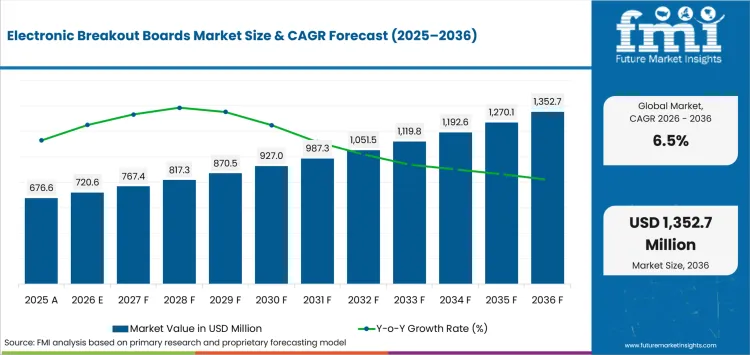
USD 720.6 million in 2026 and USD 1,352.7 million by 2036 at a 6.5% CAGR.
Demand for electronic breakout boards is projected to expand at a 6.5% CAGR between 2026 and 2036, increasing valuation from USD 720.6 million in 2026 to USD 1,352.7 million by 2036. Engineers use these boards to evaluate a component prior to final host-circuit and custom-PCB design. Seeed Studio surveyed 490 XIAO users in February 2026 and found nearly three-quarters had used expansion boards. The sample covers one developer community, so it indicates frequent plug-in hardware use without defining total market penetration.
Country conversion depends on the local depth of semiconductor design and prototyping infrastructure. NIST announced in January 2025 that Arizona State University Research Park was the planned site for a 300mm semiconductor manufacturing and advanced-packaging R&D facility. The facility is intended to bridge laboratory research with full-scale production. The USA therefore has a deeper shared research base than smaller electronics markets even though Canada's approved CAGR is higher.
Key Takeaways
- Short hardware iteration cycles increase demand by letting engineers test components ahead of custom-PCB commitment.
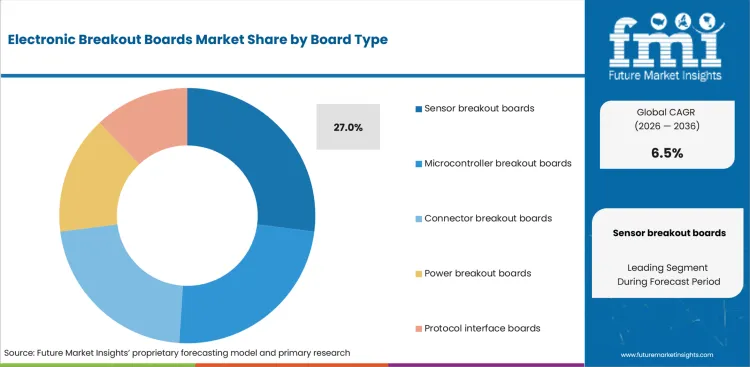
- By board type, sensor breakout boards are estimated to hold 27.0% in 2026 owing to repeated sensor evaluation ahead of final circuit integration.
- In 2026, GPIO is expected to lead the interface category with 26.0% share because direct pin access simplifies control and signal bring-up.
- The prototyping segment is likely to capture 31.0% share in 2026 attributable to component swaps while the production design is still open.
- Pinout differences and voltage-domain mismatches extend validation work once an engineering team changes host platforms or module families.
- Some of the key players in this market include Adafruit Industries, SparkFun Electronics, Arduino, Seeed Studio, DFRobot, MikroElektronika, Pololu, Waveshare, and Digilent.
Analyst Perspective
"Breakout boards earn repeat engineering revenue when engineers can reproduce a bench result without rebuilding the host interface. A broad catalog loses value if pin maps or code drift between revisions, because client designs must survive beyond the first prototype."
- Sudip saha, Principal Consultant, Future Market Insights
How is the electronic breakout boards market segmented?
The electronic breakout boards market is segmented by board type, interface, application, end use, sales channel and region.
Board type covers sensor breakout boards, microcontroller breakout boards, connector breakout boards, power breakout boards and protocol interface boards. Interface includes GPIO, I2C - SPI, USB, Ethernet and CAN - RS-485. Application covers prototyping, industrial testing, education - labs, IoT development and embedded system integration. End use includes electronics design firms, industrial automation, universities - maker labs, R&D departments and device OEMs. Sales channels are e-commerce - catalog, electronics distributors, direct manufacturer and OEM embedded supply.
What makes sensor breakout boards central to the board type category?
Sensor boards make fine-pitch devices easier to evaluate without redesigning the host circuit. The same need appears in sensor hub platforms as developers test several sensing functions until firmware and layout settle.
- By board type, sensor breakout boards are estimated to hold 27.0% in 2026 owing to repeated evaluation of sensors that need voltage regulation or level adaptation.
- Adafruit Industries introduced its SEN6x breakout in May 2025 with regulation and level shifting. STEMMA QT - Qwiic gives engineers a bench-ready connection to SEN6x sensor nodes.
Why does GPIO lead the interface category?
GPIO keeps host pins visible during first bring-up. Engineers can test interrupts and alternate pin functions ahead of higher-level connector selection. Direct pin control also supports microcontroller unit testing.
- Adafruit Industries released an ADS7128 breakout in June 2026 with eight configurable analog or digital channels. The board supports 3.3V and 5V logic through I2C.
- GPIO is set to lead the interface category with 26.0% share in 2026 due to its direct use in control and measurement tasks.
How does prototyping shape the application category?
Prototyping separates component choice from the cost of a full board spin. Engineers can validate hardware while electronic design automation work is still changing the layout. MIKROE reached 1,900 Click boards in December 2025. Half of its latest 100 boards used Click Snap for final-phase prototyping.
- By application, prototyping is forecast to represent 31.0% in 2026 driven by component evaluation ahead of design freeze.
- Breakout hardware is most useful during active component selection. Its advantage falls once a dedicated PCB becomes cheaper to repeat.
What supports electronics design firms in the end use category?
Electronics design firms test components for several client programs and gain more from reusable bench modules than single-project teams. The workflow can hand off into electronic manufacturing services once an approved prototype needs a repeatable build.
- Electronics design firms are projected to hold 27.0% share in 2026 owing to repeated component evaluation for several client programs.
- Arduino released three new Modulino modules in June 2026 for more I2C capacity and longer Qwiic cable runs plus motor control. The additions give professional development teams more functions on the same host interface ahead of custom carrier-board commitment.
What drives e-commerce - catalog in the sales channel category?
Breakout boards are low-ticket engineering items with many device and interface combinations. Digital discovery lets engineers compare stock and documentation prior to ordering connected sensor components. Direct sales become more useful once quantities are predictable.
- In 2026, e-commerce - catalog is expected to lead the sales channel category with 43.0% share because small-quantity orders move quickly through digital catalogs.
- DFRobot expanded its California warehouse in April 2025 to more than 900 products. The company stated delivery windows of two to seven business days for stocked USA orders.
What are the drivers, restraints and opportunities in the Electronic Breakout Boards Market?
Shorter bench trials raise breakout-board use, interface mismatches extend validation and standardized module families support repeat purchases.
- Driver: Short hardware cycles increase the value of boards that expose a new component ahead of custom PCB readiness.
- Restraint: Host pin layouts and interface limits can prevent a module from transferring cleanly between development platforms.
- Opportunity: A stable host interface lets standardized module families convert separate trials into repeat engineering purchases.
Faster Hardware Trials Keep Component Evaluation Ahead of Custom PCB Commitment
Printed circuit board revisions cost time during active component selection. SparkFun Electronics released its Qwiic-enabled BMV080 particulate sensor board in March 2025 following development with Bosch Sensortec. The board lets engineers test the sensor until the surrounding circuit is fixed and leaves production validation for the final design.
Host Limits Can Extend Validation Beyond the First Bench Test
An embedded system platform may fail to drive the same peripheral interface used by another controller. The module needs a fast parallel bus. Digilent introduced the Pmod VGA in July 2026 and therefore specifies FPGA hosts. The requirement can force a different host architecture to make a convenient bench test repeatable.
Standardized Module Families Can Turn Trials into Repeat Engineering Orders
A standardized socket can carry wireless connectivity technologies and other peripherals without changing the host connection. MIKROE announced in April 2026 that DigiKey stocked more than 1,950 Click boards spanning sensing and interface work. Common pin rules and maintained libraries let engineering teams reuse the host design for later trials instead of rebuilding the connection.
Which country CAGRs are profiled in the Electronic Breakout Boards Market?
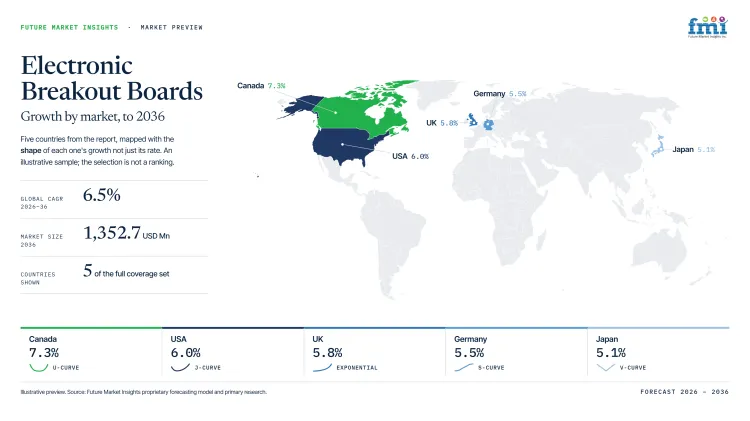
| Country | CAGR |
|---|---|
| Canada | 7.3% |
| Australia | 6.2% |
| USA | 6.0% |
| UK | 5.8% |
| Netherlands | 5.7% |
| Germany | 5.5% |
| Japan | 5.1% |
How do country-level CAGRs compare in the Electronic Breakout Boards Market?
The 2.2-point range separates smaller-base growth from mature electronics economies. Starting scale and commercialization speed explain more of the spread than current technical intensity.
- Canada combines a smaller photonics base with increasing local commercialization capacity.
- Australian buyers rely on imported specialist hardware for much of their development work.
- The USA pairs deep R&D capacity with broad component-distribution channels.
- UK demand clusters around university semiconductor centres and associated research programs.
- The Netherlands combines mechatronics depth with strict technical documentation requirements.
- German firms bring industrial qualification discipline into early electronics development work.
- Japanese designers expect longer lifecycle support from evaluation-hardware suppliers during trials.
Starting scale changes percentage growth without defining technical intensity. The full report provides country-level CAGR analysis for North America, Latin America, Western Europe, Eastern Europe, East Asia, South Asia and Pacific, and Middle East and Africa.
Country-wise Analysis
- Canadian photonics programs use test and measurement sensors as compound-semiconductor devices move through design and validation at a domestic fabrication centre. Electronic breakout board demand in Canada is forecast to rise at 7.3% CAGR through 2036 attributable to a smaller base gaining more local commercialisation capacity. In May 2026 the National Research Council announced a commercial spin-off for its 40,000-square-foot Canadian Photonics Fabrication Centre. Local fabrication gives development teams closer access to process expertise and test infrastructure during component evaluation. Volume production still requires production-qualified hardware, so breakout boards retain their strongest role during pre-production design and validation. commercially
- Australian electronics development is split between universities and specialist technology firms that depend on long supply routes for niche components. Electronic breakout board sales in Australia are projected to expand at 6.2% CAGR by 2036 driven by more locally developed hardware moving toward commercial production. The Department of Industry said in February 2026 that Spark3D would commercialise its Achyon semiconductor-packaging tool and move it toward production. Local programs can therefore qualify more hardware near domestic research teams. Imported breakout boards still face longer replenishment cycles, so distributors need accurate stock data and detailed technical notes prior to module standardisation for repeated work.
- USA design teams have broad access to semiconductor laboratories and specialist component channels. Electronic breakout board demand in USA is predicted to advance at 6.0% CAGR through 2036 as device and packaging research keeps new components in evaluation. NIST announced seven letters of intent in July 2026 for R&D covering integrated photonics and advanced packaging. Those programs keep bench-level component testing close to new device work. Large local inventory speeds first trials by shortening component delivery and replacement cycles. Professional teams still expect stable revisions and maintained code before a breakout board enters repeated client programs that can remain active for several product cycles and customer releases.
- UK hardware development is concentrated in university research and specialist semiconductor clusters with first-run electronics evaluated near laboratories. A new electron-beam semiconductor facility opened at the University of Southampton in April 2025 as the first facility of its kind in Europe. Electronic breakout board demand in UK is forecast to rise at 5.8% CAGR over the forecast period supported by chip-design and research activity that broadens the local user base. The government also linked the facility to outreach for 7,000 students. Local research access raises familiarity with development hardware, but imported module gaps can interrupt experiments when a selected board has no stocked replacement.
- Dutch electronics firms operate inside a dense semiconductor and mechatronics cluster with strict expectations for documentation. The Netherlands electronic breakout boards outlook is anticipated to advance at 5.7% CAGR over the assessment period owing to concentrated design and testing work that keeps evaluation hardware in use. In April 2026 the Dutch government published its National Semiconductor Vision 2035 with six priorities covering the sector's expansion. The plan treats talent and infrastructure as prerequisites, giving technically capable users a stronger domestic base for new hardware work. Power availability and specialist staffing can still delay projects, so clear electrical limits and revision histories carry more weight than a broad maker catalog.
- German electronics teams bring industrial qualification discipline into early board evaluation. Industrial automation systems require engineers to document interfaces prior to temporary hardware entering a machine or control design. Adoption of electronic breakout boards in Germany is projected to grow at 5.5% CAGR through 2036 as a large microelectronics base sustains frequent component work. The Federal Government reported in October 2025 that Germany held about 30% of European wafer capacity. That industrial base increases testing volume across semiconductor, automation, and embedded-system development programs. Stable pinouts and traceable hardware revisions carry more weight than catalog breadth once a module enters repeated validation inside long-lived industrial customer programs and field qualification cycles.
- Japanese electronics programs place strong weight on repeatability as temporary modules enter longer product-development cycles. Electronic breakout board sales in Japan are forecast to expand at 5.1% CAGR by 2036 attributable to advanced semiconductor design that keeps new devices moving through evaluation. METI stated in July 2025 that Rapidus had started its Chitose pilot line in April and expected semiconductor-design companies at a customer event. The pilot line keeps hardware evaluation close to new device development without shortening production qualification. Longer qualification cycles can stretch the interval between a bench trial and repeat order, so detailed electrical limits and lifecycle support outweigh rapid catalog expansion for many professional programs.
Who are the notable companies in the Electronic Breakout Boards Market?
Adafruit Industries, SparkFun Electronics, Arduino, Seeed Studio, DFRobot, MikroElektronika, Pololu, Waveshare, and Digilent are notable companies serving this market.
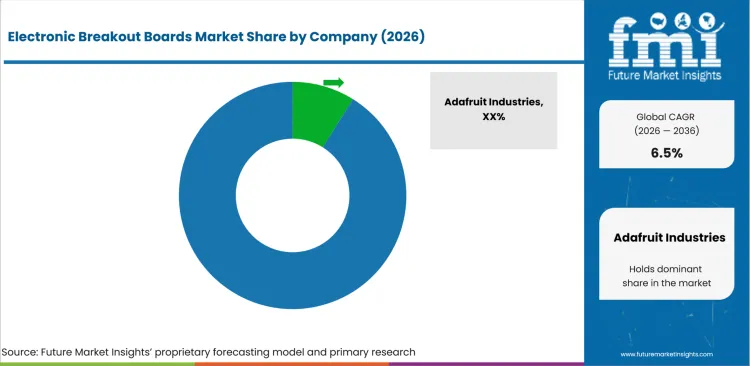
Competition is split between catalog-led breakout specialists and companies using repeatable module interfaces. Maintained connector rules and software examples raise entry barriers for professional use.
- Adafruit Industries and SparkFun Electronics join Seeed Studio and DFRobot in offering broad sensor and interface catalogs for rapid bench evaluation.
- MikroElektronika and Digilent use mikroBUS and Pmod interface rules to make host expansion more repeatable.
- Arduino, Pololu and Waveshare address host-platform expansion or specialised carrier functions that widen peripheral choice for embedded developers.
Competitive Benchmarking: Electronic Breakout Boards Market
| Company | Breakout and Add-on Breadth | Interface Standardisation | Developer Support | Geographic Reach |
|---|---|---|---|---|
| Adafruit Industries | High | High | High | North America with international direct sales |
| SparkFun Electronics | High | High | High | North America with international direct and distributor access |
| Arduino | Medium | High | High | Global direct and distributor network |
| Seeed Studio | High | High | High | Asia-Pacific with worldwide direct and distributor coverage |
| DFRobot | High | Medium | High | Asia-Pacific and North America with international direct sales |
| MikroElektronika | High | High | High | Europe with global distributor coverage |
| Pololu | Medium | Low | Medium | North America with international online sales |
| Waveshare | High | Medium | Medium | Asia-Pacific with worldwide online sales |
| Digilent | Medium | High | High | North America and Europe with global academic and embedded channels |
Scoring basis: High breadth requires three documented function groups, Medium two and Low one. High interface standardisation requires a published repeatable connector, Medium a recurring connector family and Low standalone carriers. High developer support requires current code and documentation for three groups, Medium two and Low one.
Key Developments in the Electronic Breakout Boards Market
- In July 2025, Pololu released JST SH-style connector breakout boards in 2-pin through 5-pin versions with top-entry and side-entry options for breadboard-compatible access.
- In June 2025, SparkFun Electronics launched the AS7343 Qwiic spectral sensor board for 14-channel visible and near-infrared light measurement.
- In January 2025, Seeed Studio released four XIAO add-on modules covering relay control and ePaper work plus power measurement and sensing functions.
Key Players in the Electronic Breakout Boards Market
Broad Breakout and Sensor Catalogs
- Adafruit Industries
- SparkFun Electronics
- Seeed Studio
- DFRobot
Standardized Add-on Platforms
- Arduino
- MikroElektronika
- Digilent
Specialised Interface and Expansion Suppliers
- Pololu
- Waveshare
Electronic Breakout Boards Market - Report Scope
| Coverage field | Report scope |
|---|---|
| Market breakdown | By board type, interface, application, end use, sales channel and region. |
| Quantitative Units | USD million. |
| Market Definition | Small electronic boards that expose a component, connector, protocol or peripheral function for evaluation, prototyping, testing or embedded integration. |
| Regions Covered | North America, Latin America, Western Europe, Eastern Europe, East Asia, South Asia and Pacific and Middle East and Africa. |
| Countries Covered | Canada, Australia, USA, UK, Netherlands, Germany, Japan, and 20+ countries included in the full report. |
| Key Companies Profiled | Adafruit Industries, SparkFun Electronics, Arduino, Seeed Studio, DFRobot, MikroElektronika, Pololu, Waveshare, and Digilent. |
| Forecast Period | 2026 to 2036. |
| Approach | Primary and secondary research with market triangulation. |
Electronic Breakout Boards Market - Research Methodology
| Method | Approach |
|---|---|
| Primary Research | FMI analysts gathered input from manufacturers, service providers, technology developers, distributors, end users, procurement teams, and subject-matter experts. Interviews examined purchasing decisions, product or service evaluation, adoption barriers, approval requirements, pricing considerations, and expectations for technical or commercial support. Respondents were also asked what evidence is required before a trial, pilot, or initial order develops into regular purchasing. |
| Desk Research | Desk research covered government statistics, regulatory publications, trade data, industry associations, technical literature, standards, company filings, product information, and official corporate announcements. Sources were reviewed for relevance, publication date, geographic coverage, and consistency with the defined market scope. Claims relating to performance, applications, approvals, capacity, investment, and commercial activity were retained only when supported by credible public evidence. |
| Market Sizing and Forecasting | The market model combined the baseline value with historical performance, segment structure, pricing and volume indicators, adoption levels, company participation, and country-level demand conditions. Forecast assumptions considered economic activity, investment trends, regulatory developments, technology adoption, purchasing cycles, supply availability, and barriers to wider market use. Segment and regional estimates were reconciled before the final market total was calculated. |
| Data Validation | Estimates were checked against multiple independent indicators, including public data, company activity, trade patterns, industry developments, and findings from primary interviews. Validation also tested whether products, services, applications, and company revenues fell within the defined market boundaries. Adjacent categories, unsupported claims, overlapping revenues, and activities without direct market relevance were excluded to reduce double counting and maintain consistency across segments and countries. |
Electronic Breakout Boards Market by SegmentsElectronic Breakout Boards Market segmented by Board Type: • Sensor breakout boards • Microcontroller breakout boards • Connector breakout boards • Power breakout boards • Protocol interface boards Electronic Breakout Boards Market segmented by Interface: • GPIO • I2C - SPI • USB • Ethernet • CAN - RS-485 Electronic Breakout Boards Market segmented by Application: • Prototyping • Industrial testing • Education - labs • IoT development • Embedded system integration Electronic Breakout Boards Market segmented by End Use: • Electronics design firms • Industrial automation • Universities - maker labs • R&D departments • Device OEMs Electronic Breakout Boards Market segmented by Sales Channel: • E-commerce - catalog • Electronics distributors • Direct manufacturer • OEM embedded supply Electronic Breakout Boards Market by Region: • North America • United States • Canada • Latin America • Brazil • Mexico • Argentina • Chile • Western Europe • Germany • France • United Kingdom • Italy • Spain • Benelux • Nordics • Eastern Europe • Poland • Czech Republic • Romania • Hungary • East Asia • China • Japan • South Korea • South Asia and Pacific • India • ASEAN • Australia and New Zealand • Middle East and Africa • GCC Countries • South Africa • Türkiye • Israel
Electronic Breakout Boards Market segmented by Board Type:
- Sensor breakout boards
- Microcontroller breakout boards
- Connector breakout boards
- Power breakout boards
- Protocol interface boards
Electronic Breakout Boards Market segmented by Interface:
- GPIO
- I2C - SPI
- USB
- Ethernet
- CAN - RS-485
Electronic Breakout Boards Market segmented by Application:
- Prototyping
- Industrial testing
- Education - labs
- IoT development
- Embedded system integration
Electronic Breakout Boards Market segmented by End Use:
- Electronics design firms
- Industrial automation
- Universities - maker labs
- R&D departments
- Device OEMs
Electronic Breakout Boards Market segmented by Sales Channel:
- E-commerce - catalog
- Electronics distributors
- Direct manufacturer
- OEM embedded supply
Electronic Breakout Boards Market by Region:
- North America
- United States
- Canada
- Latin America
- Brazil
- Mexico
- Argentina
- Chile
- Western Europe
- Germany
- France
- United Kingdom
- Italy
- Spain
- Benelux
- Nordics
- Eastern Europe
- Poland
- Czech Republic
- Romania
- Hungary
- East Asia
- China
- Japan
- South Korea
- South Asia and Pacific
- India
- ASEAN
- Australia and New Zealand
- Middle East and Africa
- GCC Countries
- South Africa
- Türkiye
- Israel
Research Sources and Bibliography
- Seeed Studio. (2026, February 11). XIAO 2025 in Review: Trends Shaping the XIAO Ecosystem
- National Institute of Standards and Technology. (2025, January 6). Biden-Harris Administration Announces Arizona State University Research Park as Planned Site for Third CHIPS for America R&D Flagship Facility
- Adafruit Industries. (2025, May 19). NEW PRODUCT - Adafruit SEN6x Breakout for Sensirion SEN66 - STEMMA QT / Qwiic
- Adafruit Industries. (2026, June 25). NEW PRODUCT - Adafruit ADS7128 8-Channel ADC and GPIO Expander - STEMMA QT / Qwiic
- MIKROE. (2025, December 9). We have reached 1900 Click boards!
- Arduino. (2026, June 26). Three new Arduino Modulino modules are here! Bigger ideas now come with zero added stress
- DFRobot. (2025, April 28). DFRobot US Warehouse Now Open! Shop Over 900 Popular Products with Zero Import Fees
- SparkFun Electronics. (2025, March 28). The World’s Smallest Particulate Matter Sensor
- Digilent. (2026, July 20). New Product Announcement - Pmod VGA
- MIKROE. (2026, April 20). Press Release: MIKROE’s entire portfolio of Click boards now in stock at DigiKey
- National Research Council Canada. (2026, May 4). Future spin-off of the NRC’s Canadian Photonics Fabrication Centre
- Department of Industry, Science and Resources. (2026, February 27). $6.9 million for manufacturing Printed Solar and a semiconductor packaging tool
- National Institute of Standards and Technology. (2026, July 29). Department of Commerce Announces Letters of Intent With 7 Companies for $874 Million to Accelerate Semiconductor R&D for the Compute Supply Chain
- Department for Science, Innovation and Technology. (2025, April 30). European-first semiconductor facility launches in Southampton
- Government of the Netherlands. (2026, April 1). National Semiconductor Vision 2035 - Ambitions for the Dutch semiconductor industry
- The Federal Government of Germany. (2025, October 15). Strengthening the business location for microelectronics
- Ministry of Economy, Trade and Industry. (2025, July 15). Press Conference by Minister Muto (Excerpt)
- Pololu. (2025, July 8). New products: JST SH-style connector boards
- SparkFun Electronics. (2025, June 6). It’s a Whole New Spectrum of Fun: Meet the SparkFun AS7343 Qwiic Sensor!
- Seeed Studio. (2025, January 20). Expanding the XIAO Ecosystem: New ePaper Driver, Relay, Power, and Sensor Add-on Modules Released
- Adafruit Industries. (2026, March 5). NEW PRODUCT - Adafruit AS7343 14-Channel Light / Color Sensor Breakout - STEMMA QT / Qwiic
- SparkFun Electronics. (2025, December 5). Stay Safe and Secure this Season
- Arduino. (2025, May 21). New arrivals: Nano Connector Carrier + 7 Modulino® nodes to supercharge your projects
- Seeed Studio. (2026, January 12). Seeed Studio 2025 AI Hardware Wrap-Up: Scaling Intelligence From Millimeters to Machines
- DFRobot. (2026, March 17). DFRobot at embedded world 2026 - Accelerating "From Idea to Prototype in Minutes"
- MIKROE. (2026, July 1). 11,000+ Embedded Projects, 22 New Products and NECTO Studio Daily Updates
- Pololu. (2025, April 18). More new current sensors!
- Waveshare. (n.d.). What's New Retrieved September 8, 2026.
- Digilent. (2025, July 21). Digilent Pmods Are Now More Accessible Than Ever!
- Seeed Studio. (2026, August 24). Seeed Studio XIAO Plus, More Castellation IOs for SMD Soldering
- SparkFun Electronics. (2026, July 24). Get In-Line with Our New Qwiic Current Sensors
- Adafruit Industries. (2026, August 20). NEW PRODUCT - Adafruit GP8403 Breakout Board I2C DAC with 12V Booster + NVM - STEMMA QT / qwiic
- MIKROE. (2026, July 14). Making History. Again. - We Have Reached 2,000 Click boards
- Arduino. (2025, December 3). More ways to prototype faster: four new Arduino Modulino are now available
- Adafruit Industries. (2026, September 3). NEW PRODUCT - Adafruit TMF8801 Time of Flight Distance Sensor - 20mm to 2.5m
- SparkFun Electronics. (2026, August 21). Digital-to-Analog-to-AI-to-LiDAR
- Arduino. (2026, March 27). We just announced SEVEN new products, ready to expand your Arduino UNO Q board
- Seeed Studio. (2025, March 5). New XIAO Add-on: Wio-SX1262 LoRa Module for Seeed Studio XIAO
- MIKROE. (2026, June 5). Press Release: Life Metrics Click provides all-in-one biomedical analog front-end for PPG, ECG, BioZ and EDA
- Digilent. (2026, July 20). Introducing the Arty S7 Pmod Pack
This bibliography is provided for reader reference and is not exhaustive. The full report contains the complete reference list and detailed citations
This Report Answers
- What values define electronic breakout boards in 2026 and 2036?
- Why do short hardware cycles support breakout-board purchases?
- Which board type holds the largest 2026 share?
- Why does GPIO lead the interface category?
- How does prototyping differ from production integration?
- Which sales channel leads small-quantity purchases?
- How do profiled country CAGRs compare through 2036?
- What limits module reuse between development platforms?
- Which companies supply breakout boards and standardized add-on modules?
Frequently Asked Questions
How big is the electronic breakout boards market in 2026?
The electronic breakout boards market is valued at USD 720.6 million in 2026 and is projected to reach USD 1,352.7 million by 2036. Repeated component evaluation raises purchases ahead of custom PCB commitment.
What is the CAGR of the electronic breakout boards market from 2026 to 2036?
The electronic breakout boards market is projected to grow at a CAGR of 6.5% between 2026 and 2036. Repeated prototyping work and standardized module interfaces support expansion.
Which board type leads the electronic breakout boards market?
The sensor breakout boards segment is expected to hold 27.0% of the electronic breakout boards market in 2026, attributable to repeated sensor evaluation. Onboard support circuitry shortens initial bench setup.
Which interface leads the electronic breakout boards market?
The GPIO segment is expected to hold 26.0% of the electronic breakout boards market in 2026, driven by direct host-pin access. Engineers retain flexibility ahead of higher-level connector selection.
Which countries are projected to record the highest growth in the electronic breakout boards market?
Canada is projected to grow at 7.3% CAGR followed by Australia at 6.2% and USA at 6.0% through 2036. Research scale and commercialisation capacity differ between these markets.
Which companies are active in the electronic breakout boards market?
Key companies operating in the market include Adafruit Industries, SparkFun Electronics, Arduino, Seeed Studio, DFRobot, MikroElektronika, Pololu, Waveshare, and Digilent. They compete through module breadth, interface rules, documentation and channel coverage.
Preview the report firsthand - request a free sample
Get SampleGet the brochure for pricing and purchase details.
Get PDFTable of Content
- Key Takeaways
- Market Size and CAGR
- Top Growth Driver
- Fastest Growing Segment
- Leading Region
- Key Companies
- Emerging Opportunities
- Executive Summary
- Global Market Outlook
- Demand-side Trends
- Supply-side Trends
- Technology Roadmap Analysis
- Analysis and Recommendations
- Analyst Perspective (What is happening? Why now? What should investors know?)
- Key Questions Answered
- How large is the market?
- What is the CAGR?
- What are key trends?
- Which region dominates?
- Who are the leaders?
- Market Overview
- Market Coverage / Taxonomy
- Market Definition / Scope / Limitations
- Research Methodology
- Chapter Orientation
- Analytical Lens and Working Hypotheses
- Market Structure, Signals, and Trend Drivers
- Benchmarking and Cross-market Comparability
- Market Sizing, Forecasting, and Opportunity Mapping
- Research Design and Evidence Framework
- Desk Research Programme (Secondary Evidence)
- Expert Input and Fieldwork (Primary Evidence)
- Tooling, Models, and Reference Databases
- Data Engineering and Model Build
- Quality Assurance and Audit Trail
- Market Background
- Market Dynamics (Drivers, Restraints, Opportunity, Trends)
- Scenario Forecast (Optimistic, Likely, Conservative)
- Impact Analysis
- AI Impact
- Sustainability Impact
- Regulatory Impact
- Technology Impact
- Consumer / Buyer Analysis
- Purchase Drivers
- Adoption Barriers
- Buyer Journey
- Opportunity Map Analysis
- Product Life Cycle Analysis
- Supply Chain Analysis
- Investment Feasibility Matrix
- Value Chain Analysis
- PESTLE and Porter's Analysis
- Regulatory Landscape
- Regional Parent Market Outlook
- Production and Consumption Statistics
- Import and Export Statistics
- Global Market Analysis and Forecast, 2021 to 2036
- Historical Market Size Value (USD Million) Analysis, 2021 to 2025
- Current and Future Market Size Value (USD Million) Projections, 2026 to 2036
- Y-o-Y Growth Trend Analysis
- Absolute $ Opportunity Analysis
- Global Market Pricing Analysis, 2021 to 2036
- Global Market Analysis and Forecast, By Board Type, 2021 to 2036
- Introduction / Key Findings
- Historical Market Size Value (USD Million) Analysis By Board Type, 2021 to 2025
- Current and Future Market Size Value (USD Million) Analysis and Forecast By Board Type, 2026 to 2036
- Sensor breakout boards
- Microcontroller breakout boards
- Connector breakout boards
- Power breakout boards
- Protocol interface boards
- Sensor breakout boards
- Y-o-Y Growth Trend Analysis By Board Type, 2021 to 2025
- Absolute $ Opportunity Analysis By Board Type, 2026 to 2036
- Global Market Analysis and Forecast, By Interface, 2021 to 2036
- Introduction / Key Findings
- Historical Market Size Value (USD Million) Analysis By Interface, 2021 to 2025
- Current and Future Market Size Value (USD Million) Analysis and Forecast By Interface, 2026 to 2036
- GPIO
- I2C/SPI
- USB
- Ethernet
- CAN / RS-485
- GPIO
- Y-o-Y Growth Trend Analysis By Interface, 2021 to 2025
- Absolute $ Opportunity Analysis By Interface, 2026 to 2036
- Global Market Analysis and Forecast, By Application, 2021 to 2036
- Introduction / Key Findings
- Historical Market Size Value (USD Million) Analysis By Application, 2021 to 2025
- Current and Future Market Size Value (USD Million) Analysis and Forecast By Application, 2026 to 2036
- Prototyping
- Industrial testing
- Education/labs
- IoT development
- Embedded system integration
- Prototyping
- Y-o-Y Growth Trend Analysis By Application, 2021 to 2025
- Absolute $ Opportunity Analysis By Application, 2026 to 2036
- Global Market Analysis and Forecast, By End Use, 2021 to 2036
- Introduction / Key Findings
- Historical Market Size Value (USD Million) Analysis By End Use, 2021 to 2025
- Current and Future Market Size Value (USD Million) Analysis and Forecast By End Use, 2026 to 2036
- Electronics design firms
- Industrial automation
- Universities / maker labs
- R&D departments
- Device OEMs
- Electronics design firms
- Y-o-Y Growth Trend Analysis By End Use, 2021 to 2025
- Absolute $ Opportunity Analysis By End Use, 2026 to 2036
- Global Market Analysis and Forecast, By Sales Channel, 2021 to 2036
- Introduction / Key Findings
- Historical Market Size Value (USD Million) Analysis By Sales Channel, 2021 to 2025
- Current and Future Market Size Value (USD Million) Analysis and Forecast By Sales Channel, 2026 to 2036
- E-commerce/catalog
- Electronics distributors
- Direct manufacturer
- OEM embedded supply
- E-commerce/catalog
- Y-o-Y Growth Trend Analysis By Sales Channel, 2021 to 2025
- Absolute $ Opportunity Analysis By Sales Channel, 2026 to 2036
- Global Market Analysis and Forecast, By Region, 2021 to 2036
- Introduction
- Historical Market Size Value (USD Million) Analysis By Region, 2021 to 2025
- Current Market Size Value (USD Million) Analysis and Forecast By Region, 2026 to 2036
- North America
- Latin America
- Western Europe
- Eastern Europe
- East Asia
- South Asia and Pacific
- Middle East & Africa
- Market Attractiveness Analysis By Region
- North America Market Analysis and Forecast, By Country, 2021 to 2036
- Historical Market Size Value (USD Million) Trend Analysis By Market Taxonomy, 2021 to 2025
- Market Size Value (USD Million) Forecast By Market Taxonomy, 2026 to 2036
- By Country
- USA
- Canada
- By Board Type
- By Interface
- By Application
- By End Use
- By Sales Channel
- By Country
- Market Attractiveness Analysis
- By Country
- By Board Type
- By Interface
- By Application
- By End Use
- By Sales Channel
- Key Takeaways
- Latin America Market Analysis and Forecast, By Country
- Historical Market Size Value (USD Million) Trend Analysis By Market Taxonomy, 2021 to 2025
- Market Size Value (USD Million) Forecast By Market Taxonomy, 2026 to 2036
- By Country
- Brazil
- Mexico
- Chile
- Rest of Latin America
- By Board Type
- By Interface
- By Application
- By End Use
- By Sales Channel
- By Country
- Market Attractiveness Analysis
- By Country
- By Board Type
- By Interface
- By Application
- By End Use
- By Sales Channel
- Key Takeaways
- Western Europe Market Analysis and Forecast, By Country
- Historical Market Size Value (USD Million) Trend Analysis By Market Taxonomy, 2021 to 2025
- Market Size Value (USD Million) Forecast By Market Taxonomy, 2026 to 2036
- By Country
- Germany
- UK
- Italy
- Spain
- France
- Nordic
- BENELUX
- Rest of Western Europe
- By Board Type
- By Interface
- By Application
- By End Use
- By Sales Channel
- By Country
- Market Attractiveness Analysis
- By Country
- By Board Type
- By Interface
- By Application
- By End Use
- By Sales Channel
- Key Takeaways
- Eastern Europe Market Analysis and Forecast, By Country
- Historical Market Size Value (USD Million) Trend Analysis By Market Taxonomy, 2021 to 2025
- Market Size Value (USD Million) Forecast By Market Taxonomy, 2026 to 2036
- By Country
- Russia
- Poland
- Hungary
- Balkan & Baltic
- Rest of Eastern Europe
- By Board Type
- By Interface
- By Application
- By End Use
- By Sales Channel
- By Country
- Market Attractiveness Analysis
- By Country
- By Board Type
- By Interface
- By Application
- By End Use
- By Sales Channel
- Key Takeaways
- East Asia Market Analysis and Forecast, By Country
- Historical Market Size Value (USD Million) Trend Analysis By Market Taxonomy, 2021 to 2025
- Market Size Value (USD Million) Forecast By Market Taxonomy, 2026 to 2036
- By Country
- China
- Japan
- South Korea
- By Board Type
- By Interface
- By Application
- By End Use
- By Sales Channel
- By Country
- Market Attractiveness Analysis
- By Country
- By Board Type
- By Interface
- By Application
- By End Use
- By Sales Channel
- Key Takeaways
- South Asia and Pacific Market Analysis and Forecast, By Country
- Historical Market Size Value (USD Million) Trend Analysis By Market Taxonomy, 2021 to 2025
- Market Size Value (USD Million) Forecast By Market Taxonomy, 2026 to 2036
- By Country
- India
- ASEAN
- Australia & New Zealand
- Rest of South Asia and Pacific
- By Board Type
- By Interface
- By Application
- By End Use
- By Sales Channel
- By Country
- Market Attractiveness Analysis
- By Country
- By Board Type
- By Interface
- By Application
- By End Use
- By Sales Channel
- Key Takeaways
- Middle East & Africa Market Analysis and Forecast, By Country
- Historical Market Size Value (USD Million) Trend Analysis By Market Taxonomy, 2021 to 2025
- Market Size Value (USD Million) Forecast By Market Taxonomy, 2026 to 2036
- By Country
- Kingdom of Saudi Arabia
- Other GCC Countries
- Türkiye
- South Africa
- Other African Union
- Rest of Middle East & Africa
- By Board Type
- By Interface
- By Application
- By End Use
- By Sales Channel
- By Country
- Market Attractiveness Analysis
- By Country
- By Board Type
- By Interface
- By Application
- By End Use
- By Sales Channel
- Key Takeaways
- Key Countries Market Analysis
- USA
- Pricing Analysis
- Market Share Analysis, 2025
- By Board Type
- By Interface
- By Application
- By End Use
- By Sales Channel
- Canada
- Pricing Analysis
- Market Share Analysis, 2025
- By Board Type
- By Interface
- By Application
- By End Use
- By Sales Channel
- Mexico
- Pricing Analysis
- Market Share Analysis, 2025
- By Board Type
- By Interface
- By Application
- By End Use
- By Sales Channel
- Brazil
- Pricing Analysis
- Market Share Analysis, 2025
- By Board Type
- By Interface
- By Application
- By End Use
- By Sales Channel
- Chile
- Pricing Analysis
- Market Share Analysis, 2025
- By Board Type
- By Interface
- By Application
- By End Use
- By Sales Channel
- Germany
- Pricing Analysis
- Market Share Analysis, 2025
- By Board Type
- By Interface
- By Application
- By End Use
- By Sales Channel
- UK
- Pricing Analysis
- Market Share Analysis, 2025
- By Board Type
- By Interface
- By Application
- By End Use
- By Sales Channel
- Italy
- Pricing Analysis
- Market Share Analysis, 2025
- By Board Type
- By Interface
- By Application
- By End Use
- By Sales Channel
- Spain
- Pricing Analysis
- Market Share Analysis, 2025
- By Board Type
- By Interface
- By Application
- By End Use
- By Sales Channel
- France
- Pricing Analysis
- Market Share Analysis, 2025
- By Board Type
- By Interface
- By Application
- By End Use
- By Sales Channel
- India
- Pricing Analysis
- Market Share Analysis, 2025
- By Board Type
- By Interface
- By Application
- By End Use
- By Sales Channel
- ASEAN
- Pricing Analysis
- Market Share Analysis, 2025
- By Board Type
- By Interface
- By Application
- By End Use
- By Sales Channel
- Australia & New Zealand
- Pricing Analysis
- Market Share Analysis, 2025
- By Board Type
- By Interface
- By Application
- By End Use
- By Sales Channel
- China
- Pricing Analysis
- Market Share Analysis, 2025
- By Board Type
- By Interface
- By Application
- By End Use
- By Sales Channel
- Japan
- Pricing Analysis
- Market Share Analysis, 2025
- By Board Type
- By Interface
- By Application
- By End Use
- By Sales Channel
- South Korea
- Pricing Analysis
- Market Share Analysis, 2025
- By Board Type
- By Interface
- By Application
- By End Use
- By Sales Channel
- Russia
- Pricing Analysis
- Market Share Analysis, 2025
- By Board Type
- By Interface
- By Application
- By End Use
- By Sales Channel
- Poland
- Pricing Analysis
- Market Share Analysis, 2025
- By Board Type
- By Interface
- By Application
- By End Use
- By Sales Channel
- Hungary
- Pricing Analysis
- Market Share Analysis, 2025
- By Board Type
- By Interface
- By Application
- By End Use
- By Sales Channel
- Kingdom of Saudi Arabia
- Pricing Analysis
- Market Share Analysis, 2025
- By Board Type
- By Interface
- By Application
- By End Use
- By Sales Channel
- Türkiye
- Pricing Analysis
- Market Share Analysis, 2025
- By Board Type
- By Interface
- By Application
- By End Use
- By Sales Channel
- South Africa
- Pricing Analysis
- Market Share Analysis, 2025
- By Board Type
- By Interface
- By Application
- By End Use
- By Sales Channel
- USA
- Market Structure Analysis
- Competition Dashboard
- Competition Benchmarking
- Market Share Analysis of Top Players
- By Regional
- By Board Type
- By Interface
- By Application
- By End Use
- By Sales Channel
- Emerging Startups
- Innovation Benchmarking
- Competition Analysis
- Competition Deep Dive
- Adafruit Industries
- Overview
- Product Portfolio
- Profitability by Market Segments
- Sales Footprint
- Strategy Overview
- Marketing Strategy
- Product Strategy
- Channel Strategy
- SparkFun Electronics
- Arduino
- Seeed Studio
- DFRobot
- MikroElektronika
- Pololu
- Waveshare
- Digilent
- Pi Supply
- Adafruit Industries
- Case Studies
- Success Stories
- Recent Developments
- Competition Deep Dive
- Assumptions & Acronyms Used


