

- Industry Size (2026)
- USD 1.1 Bn
- Forecast (2036)
- USD 2.4 Bn
- CAGR (2026 to 2036)
- 8.2%
Electronic Warfare Helicopter Decoys Market Forecast and Outlook 2026 to 2036
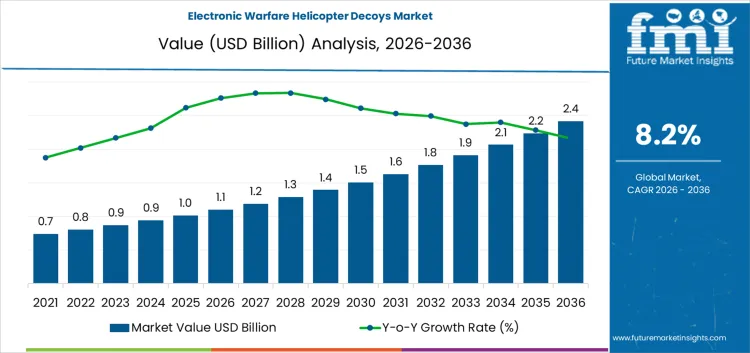
The electronic warfare helicopter decoys market is projected to reach USD 2.4 billion by 2036, growing at a CAGR of 8.2% from its 2026 value of USD 1.1 billion. The demand quality in this market is shaped by the critical, high-stakes nature of defense applications, where repeat usage and long-term buyer commitment are central to purchasing behavior. Stability in demand will be driven by the ongoing need for defense forces to maintain advanced countermeasure capabilities against evolving threats.
As these decoys are integral to military operations, buyer commitment levels are high, with long procurement cycles and stringent performance requirements. However, the specialized nature of these systems means that orders are often tied to specific contracts or defense budgets, leading to less frequent but highly strategic purchasing decisions. Vendors will need to demonstrate consistent performance and reliability to maintain relationships with defense buyers and ensure continued demand for their solutions.
Quick Stats for the Electronic Warfare Helicopter Decoys Market
- Electronic Warfare Helicopter Decoys Market Value (2026): USD 1.1 billion
- Electronic Warfare Helicopter Decoys Market Forecast Value (2036): USD 2.4 billion
- Electronic Warfare Helicopter Decoys Market Global Forecast CAGR (2026 to 2036): 8.2%
- Electronic Warfare Helicopter Decoys Market Leading Segment: Missile Countermeasures (44%)
- Key Growth Regions in Electronic Warfare Helicopter Decoys Market: India
- Top Players in Electronic Warfare Helicopter Decoys Market: BAE Systems, Northrop Grumman, Leonardo S.p.A., Thales Group, Elbit Systems
What is the Inflection Point Mapping for the Electronic Warfare Helicopter Decoys Market through 2036?
The electronic warfare helicopter decoys market is expected to follow a steady growth trajectory, with an inflection point likely occurring in the mid-2030s. Initially, the market will experience gradual annual increases, with values rising from USD 1.1 billion in 2026 to USD 1.6 billion in 2030. This early phase of growth is driven by the growing adoption of electronic warfare technologies in military fleets, reflecting the increasing emphasis on helicopter protection.
The inflection point is expected to occur around 2031, when the market will reach USD 2 billion. At this stage, a shift will occur from gradual growth to more accelerated market expansion, as the demand for electronic warfare decoys intensifies with evolving threats in military aviation. By 2036, the market will reach USD 2.4 billion, representing the peak of its growth. The inflection point indicates a transition from initial adoption to wider integration and increased reliance on these defense technologies, resulting in a more pronounced acceleration in market demand and a shift toward sustained expansion.
Electronic Warfare Helicopter Decoys Market Key Takeaways
| Metric | Value |
|---|---|
| Industry Sales Value (2026) | USD 1.1 billion |
| Industry Forecast Value (2036) | USD 2.4 billion |
| Industry Forecast CAGR 2026 to 2036 | 8.2% |
What Is Driving the Electronic Warfare Helicopter Decoys Market?
Historically, the electronic warfare helicopter decoys market developed from the evolving threat environment faced by rotorcraft operating in contested airspaces. Early helicopter missions in asymmetric conflicts relied largely on basic countermeasure dispensers for flares and chaff to defeat infrared and radar guided missiles. As air defense systems grew more sophisticated, with advanced surface-to-air missiles and man-portable air defense systems capable of multiple guidance modes, traditional decoy systems showed limitations in response complexity and adaptability. Research and development efforts focused on integrating electronic warfare (EW) capabilities onto helicopters to improve survivability against a broader spectrum of threats.
Early adoption was driven by military aviation units conducting operations where low-altitude flight exposed helicopters to dense threat arrays. These initiatives informed performance requirements for decoy systems capable of rapid signal modulation, multi-spectral emitter replication, and selective deployment logic. Testing on rotary-wing platforms provided data on integration challenges, power constraints, and the balance between decoy effectiveness and aircraft payload capacity. This formative phase shaped design parameters and procurement interest, particularly among defense forces operating in high-threat regions.
Future demand for electronic warfare helicopter decoys is expected to be shaped by continuing modernization of integrated air defense systems, growth in unmanned aerial threats, and the expanding role of helicopters in contested environments. As militaries emphasize operational readiness in near-peer and hybrid threat scenarios, decoy systems that can intelligently counter radar, infrared, and directed-energy threats will be sought. Advances in digital signal processing, real-time threat libraries, and autonomous countermeasure selection are likely to improve decoy responsiveness and reduce false engagements. Growth factors will include integration with onboard EW suites, improved sensor fusion that enhances threat detection, and networked battlefield awareness that informs decoy deployment.
Helicopter platforms engaged in troop transport, special operations, and armed reconnaissance will drive demand for decoys that provide layered protection with minimal impact on mission payload. Barriers include the technical complexity of integrating advanced EW decoys within tight power and space constraints of helicopters, cost pressures in defense procurement, and the need for rigorous testing against evolving missile guidance technologies. Long-term market growth will depend on how effectively suppliers demonstrate reliable decoy performance, interoperability with platform systems, and alignment with defense force survivability objectives.
What Are the Key Segments in the Electronic Warfare Helicopter Decoys Market?
The Electronic Warfare Helicopter Decoys market is segmented into applications and platform types. The application segments include missile countermeasures, ECM (Electronic Countermeasure) or EW (Electronic Warfare) support, training & simulation, intelligence & reconnaissance support, and others, with missile countermeasures leading the application segment at 44%. Platform types include attack helicopters, utility or transport helicopters, reconnaissance or surveillance helicopters, special mission aircraft, and others, with attack helicopters holding the largest share at 41%. The market growth is driven by the increasing focus on enhancing the survivability and effectiveness of helicopters in hostile environments, particularly in countering missile threats and providing electronic warfare support. The demand for electronic warfare systems and decoys is growing in response to evolving threats and the modernization of military fleets. Key regions driving this market include North America, Europe, and Asia Pacific, where defense spending and technological advancements in electronic warfare are major factors.
What is Driving Growth in the Missile Countermeasures Application?
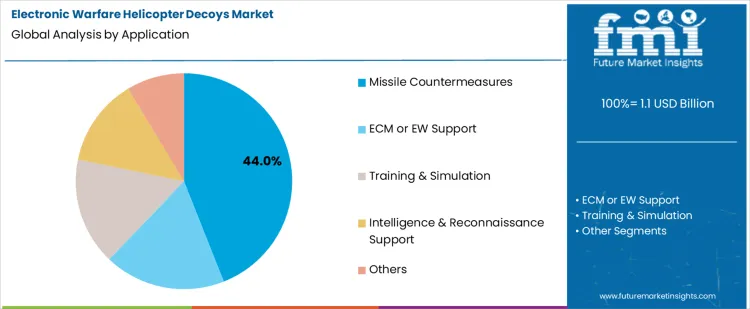
Missile countermeasures dominate the application segment in the Electronic Warfare Helicopter Decoys market, accounting for 44% of the market share. This growth is primarily driven by the increasing need for defense systems that protect helicopters from guided missile threats, which are a significant risk during military operations. Helicopters, particularly those used in attack, reconnaissance, and special mission roles, are highly vulnerable to missile attacks, and countermeasures are essential for ensuring their survivability in hostile environments. Electronic warfare decoys, such as those designed to mislead or deceive incoming missiles, are integral to modern helicopter defense systems. These decoys work by emitting signals or creating electromagnetic disturbances that interfere with the targeting and guidance systems of missiles, rendering them ineffective. As military forces upgrade their fleets and seek advanced solutions to counter modern missile threats, the demand for missile countermeasure decoys is expected to continue growing. This trend is particularly evident in regions with high geopolitical tensions, such as North America, Europe, and the Middle East, where military operations and helicopter deployments are increasingly reliant on advanced electronic warfare systems to protect assets.
What is Driving the Demand for Attack Helicopters in the Market?
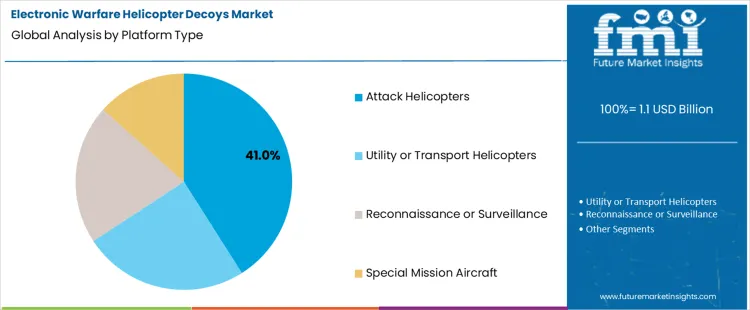
Attack helicopters represent the largest platform type in the Electronic Warfare Helicopter Decoys market, holding 41% of the market share. This growth is driven by the increasing use of attack helicopters in military operations, where they serve as a critical tool for close air support, precision strikes, and battlefield surveillance. Attack helicopters often operate in high-threat environments, making them prime targets for missile attacks. To ensure their operational effectiveness and survivability, these helicopters are equipped with advanced electronic warfare decoys, which help protect them from various threats, including guided missiles and radar-guided systems. The integration of electronic warfare decoys into attack helicopters enhances their defense capabilities by disrupting or deceiving incoming threats, enabling these helicopters to carry out their missions more effectively. As military operations become more complex and involve higher levels of precision and risk, the demand for electronic warfare systems, including decoys, in attack helicopters is expected to grow. Additionally, defense forces worldwide are increasingly modernizing their attack helicopter fleets to incorporate cutting-edge technologies that improve survivability and effectiveness in combat scenarios, further driving the demand for electronic warfare decoys in this segment.
What are the Key Dynamics in the Electronic Warfare Helicopter Decoys Market?
The electronic warfare (EW) helicopter decoys market is driven by the growing need for enhanced defense systems to protect helicopters from radar-guided and missile threats. Helicopter decoys are designed to confuse or deceive enemy radar and missile systems, thereby preventing the aircraft from being targeted. These decoys work by emitting electronic signals that mimic the helicopter's signature, allowing the helicopter to evade tracking and attacks. The market is primarily driven by the increasing adoption of advanced electronic warfare systems in military aircraft, the rising threat of missile and radar-guided attacks, and the growing importance of survivability in modern warfare. The development of more sophisticated decoy technologies, such as radar jammers, infrared countermeasures, and RF (radio frequency) decoys, is enhancing the effectiveness of EW helicopter decoys, further fueling market growth.
What are the Key Drivers of Growth in the Electronic Warfare Helicopter Decoys Market?
The key drivers of growth in the electronic warfare helicopter decoys market include the rising need for advanced defensive technologies to protect military helicopters from increasingly sophisticated threats. As missile technology and radar systems become more advanced, helicopters are becoming more vulnerable to long-range and precision-guided threats, increasing the demand for effective decoys. The ongoing development and modernization of military fleets are driving the integration of EW capabilities, including decoys, into helicopters to improve their survivability in hostile environments. Additionally, the increasing use of helicopters in combat zones, search and rescue operations, and reconnaissance missions, where they are exposed to enemy threats, contributes to the growing demand for helicopter decoys. The development of new EW technologies, such as more compact, lightweight, and efficient decoy systems, also drives market expansion by making these solutions more practical for a broader range of helicopter platforms. Furthermore, the increasing defense budgets of countries across the world, particularly in regions with high-security threats, are promoting the adoption of advanced defensive systems, including electronic warfare decoys.
What are the Key Restraints in the Electronic Warfare Helicopter Decoys Market?
Despite the growing demand, the electronic warfare helicopter decoys market faces several challenges. One key restraint is the high cost associated with developing and deploying advanced decoy systems. The integration of electronic warfare decoys into helicopter platforms requires significant investment in research, development, and testing, which can be financially challenging for some defense budgets. Additionally, the complexity of integrating decoy systems with existing helicopter avionics and defensive systems adds to the cost and operational challenges. Another restraint is the potential for countermeasures to be developed by adversaries, which could neutralize the effectiveness of EW helicopter decoys. As military technology advances, there is always a risk that enemy forces will develop counter-countermeasures, reducing the efficiency of decoy systems. Additionally, the maintenance and lifecycle management of electronic warfare decoys can be resource-intensive, requiring continuous upgrades to stay ahead of evolving threats. Lastly, the regulatory environment and restrictions on the export of certain electronic warfare technologies may limit market growth, particularly in certain regions or for non-allied nations.
What are the Key Trends in the Electronic Warfare Helicopter Decoys Market?
Key trends in the electronic warfare helicopter decoys market include the increasing miniaturization and integration of decoy systems. As military helicopters become smaller and more lightweight, there is a growing trend toward developing compact and efficient EW decoy systems that can be easily integrated into various helicopter platforms. Advances in digital signal processing and AI technologies are also being incorporated into decoys to enhance their capability to mimic complex enemy threats, making them more effective in confusing radar and missile tracking systems. Another trend is the increasing adoption of multi-spectral decoys that provide protection across multiple threat domains, such as radar, infrared, and laser-guided systems.
This multi-functionality is becoming critical as helicopters face a broader range of threats. Additionally, there is growing interest in the development of autonomous or semi-autonomous decoy systems that can actively respond to threats in real-time, enhancing the overall effectiveness of defense mechanisms. As electronic warfare capabilities evolve, the demand for integrated solutions that combine decoy technologies with other defensive measures, such as electronic countermeasures and active protection systems, is also on the rise. The growing importance of survivability in modern warfare and the increasing sophistication of anti-aircraft technologies will continue to drive innovation and demand for more advanced helicopter decoys.
What is the Country-Wise Analysis of the Electronic Warfare Helicopter Decoys Market?
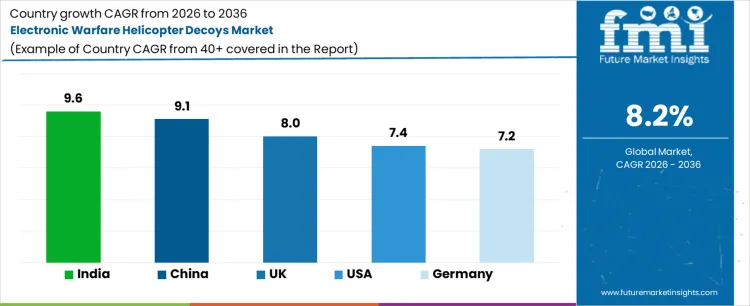
The electronic warfare (EW) helicopter decoys market is growing steadily as military forces worldwide seek advanced technologies to enhance the protection of their helicopters and aircraft. Electronic warfare decoys are critical for countering radar, infrared, and other missile threats by emitting signals to confuse and divert enemy targeting systems. As modern warfare evolves, countries such as the USA, China, the UK, Germany, and India are increasing their investments in electronic warfare systems, including decoys, to bolster the survivability of their air fleets. Each market is influenced by strategic military goals, defense budgets, and the need for advanced defense capabilities against sophisticated aerial threats.
| Country | CAGR (%) |
|---|---|
| USA | 7.4 |
| China | 9.1 |
| UK | 8 |
| Germany | 7.2 |
| India | 9.6 |
What is Driving the Growth of the Electronic Warfare Helicopter Decoys Market in the USA?
The electronic warfare helicopter decoys market in the USA is growing at a CAGR of 7.4%. The USA’s strong defense spending and focus on maintaining technological superiority in electronic warfare are key factors driving this market. The USA military, particularly the Army and Air Force, is investing heavily in EW systems to enhance the protection of helicopters in conflict zones. As the threat of advanced missile systems and radar-guided weapons increases, the need for electronic warfare decoys to protect rotary-wing aircraft is becoming more urgent. The market is also supported by the development of cutting-edge EW technologies and the integration of decoy systems into new helicopter platforms. The USA’s ongoing military modernization programs are expected to further drive the adoption of electronic warfare helicopter decoys.
How is the Electronic Warfare Helicopter Decoys Market Performing in China?
China’s electronic warfare helicopter decoys market is growing at a CAGR of 9.1%. As China continues to modernize its military and increase its focus on electronic warfare capabilities, the demand for EW decoys to protect helicopters from advanced missile and radar threats is rising. The Chinese military is investing in a wide range of electronic warfare systems, including decoys, to enhance the survivability of its air fleet. China’s strategic focus on countering advanced enemy technologies, particularly in regions with high potential for conflict, is driving the demand for more advanced decoy systems. Additionally, China’s rapid development of indigenous military technologies is accelerating the adoption of electronic warfare helicopter decoys in its defense operations.
What Factors are Shaping the Electronic Warfare Helicopter Decoys Market in the UK?
The electronic warfare helicopter decoys market in the UK is growing at a CAGR of 8%. The UK’s military is actively modernizing its helicopter fleets and increasing its capabilities in electronic warfare to counter the evolving threat landscape. The need to protect helicopters from anti-aircraft missiles, radar-guided weapons, and infrared threats is a driving factor behind the demand for EW decoys. As part of its defense strategy, the UK is investing in technologies that can safeguard its rotary-wing aircraft, particularly in high-risk environments. The UK’s participation in NATO operations and its focus on enhancing air defense capabilities further contribute to the growth of the electronic warfare helicopter decoys market.
How is the Electronic Warfare Helicopter Decoys Market Performing in Germany?
Germany’s electronic warfare helicopter decoys market is growing at a CAGR of 7.2%. Germany’s military is increasingly investing in advanced electronic warfare technologies to protect its helicopters and other assets from sophisticated missile and radar threats. The country’s strategic focus on air defense and modernization of its rotary-wing fleet has led to a rise in demand for EW decoys that can enhance helicopter survivability in contested environments. Germany’s active role in NATO defense initiatives and its commitment to enhancing military readiness have driven investments in electronic warfare systems, including helicopter decoys. As the global threat landscape evolves, Germany’s market for electronic warfare helicopter decoys is expected to continue growing steadily.
What is Contributing to the Growth of the Electronic Warfare Helicopter Decoys Market in India?
India’s electronic warfare helicopter decoys market is growing at a CAGR of 9.6%, the highest among the countries analyzed. As India modernizes its defense capabilities, the demand for advanced protection systems for helicopters is increasing. The Indian military is prioritizing the development of electronic warfare capabilities to defend against a growing array of missile threats, radar systems, and other modern weapons. The need to enhance the survivability of helicopters operating in high-conflict areas has made EW decoys a critical component of India’s defense strategy. India’s investments in indigenous defense technologies and its growing focus on countering regional security threats are contributing to the significant growth of the market for electronic warfare helicopter decoys.
What is the Competitive Landscape for the Electronic Warfare Helicopter Decoys Market?
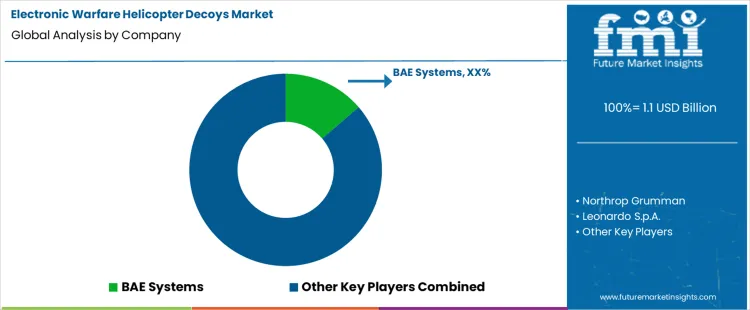
The electronic warfare helicopter decoys market is driven by the increasing demand for advanced defense technologies to protect military assets, particularly helicopters, from enemy radar and missile threats. BAE Systems leads the market with its cutting-edge electronic warfare decoy solutions, offering advanced infrared and radar-jamming systems that effectively counter a wide range of missile threats. BAE's expertise in developing electronic countermeasure systems for military helicopters positions it as a dominant player in the market. Northrop Grumman is another key competitor, known for its innovative electronic warfare systems that enhance helicopter survivability in complex combat environments.
Their decoy systems provide advanced signal manipulation to deceive adversary tracking and targeting systems. Leonardo S.p.A. offers a comprehensive range of electronic warfare decoy systems for helicopters, focusing on versatility and adaptability to various mission profiles. Thales Group is actively involved in the market, offering robust electronic warfare solutions that integrate seamlessly with helicopter systems, improving overall protection and operational effectiveness. Elbit Systems also plays a significant role, providing high-performance decoy solutions designed to counter emerging threats in dynamic battlefield conditions. These companies are advancing the capabilities of electronic warfare decoys, ensuring military helicopters can operate safely in hostile environments.
In this competitive landscape, companies focus on technological innovation, system integration, and defense partnerships to maintain their market positions. BAE Systems continues to innovate with its advanced electronic warfare decoy solutions, integrating cutting-edge technologies to improve jamming effectiveness and countermeasure versatility. Northrop Grumman is enhancing its decoy systems with autonomous features that allow for real-time adaptation to evolving threats.
Leonardo S.p.A. is advancing its decoy technologies by improving their efficiency in complex environments, ensuring that helicopters are well-equipped to evade modern missile systems. Thales Group focuses on developing integrated electronic warfare solutions that offer multi-layered protection for military helicopters, strengthening their defense against both radar and infrared-guided threats. Elbit Systems is focusing on customizable decoy systems that can be tailored to specific mission requirements, offering flexibility for military operators. These strategies, combined with the growing need for enhanced helicopter survivability, position these companies as key players in the expanding electronic warfare helicopter decoys market.
Key Players of the Electronic Warfare Helicopter Decoys Market
- BAE Systems
- Northrop Grumman
- Leonardo S.p.A.
- Thales Group
- Elbit Systems
- Others
Scope of the Report
| Items | Values |
|---|---|
| Quantitative Units (2026) | USD Billion |
| Decoy Type | Flares (Infrared), Chaff (Radar Decoys), DIRCM (Directed Infrared Countermeasure), Dispenser Systems, Others |
| Application | Missile Countermeasures, ECM / EW Support, Training & Simulation, Intelligence & Reconnaissance Support, Others |
| Platform Type | Attack Helicopters, Utility / Transport Helicopters, Reconnaissance / Surveillance, Special Mission Aircraft |
| Companies | BAE Systems, Northrop Grumman, Leonardo S.p.A., Thales Group, Elbit Systems, Others |
| Regions Covered | North America, Latin America, Western Europe, Eastern Europe, South Asia and Pacific, East Asia, Middle East & Africa |
| Countries Covered | United States, Canada, Mexico, Brazil, Argentina, Germany, France, United Kingdom, Italy, Spain, Netherlands, China, India, Japan, South Korea, ANZ, GCC Countries, South Africa |
| Additional Attributes | Dollar sales by decoy type, application, platform type, and region. Includes market trends towards advanced countermeasure systems, regulatory compliance, cost-effectiveness, and the role of decoy technologies in enhancing helicopter survivability in electronic warfare. |
Electronic Warfare Helicopter Decoys Market Segmentation
Decoy Type
- Flares (Infrared)
- Chaff (Radar Decoys)
- DIRCM (Directed Infrared Countermeasure)
- Dispenser Systems
- Others
Application
- Missile Countermeasures
- ECM / EW Support
- Training & Simulation
- Intelligence & Reconnaissance Support
- Others
Platform Type
- Attack Helicopters
- Utility / Transport Helicopters
- Reconnaissance / Surveillance
- Special Mission Aircraft
- Others
Region
- Asia Pacific
- China
- Japan
- India
- Australia & New Zealand
- ASEAN
- Rest of Asia Pacific
- Europe
- Germany
- United Kingdom
- France
- Italy
- Spain
- Nordic
- BENELUX
- Rest of Europe
- North America
- United States
- Canada
- Mexico
- Latin America
- Brazil
- Argentina
- Rest of Latin America
- Middle East & Africa
- Kingdom of Saudi Arabia
- Other GCC Countries
- South Africa
- Rest of Middle East & Africa
Bibliography
- U.S. Department of Defense. (2024). Defense Science Board Task Force Report on Aircraft Survivability and Electronic Warfare Systems. Office of the Secretary of Defense.
- European Defence Agency (EDA). (2023). Rotorcraft Survivability Enhancement Programs and Electronic Countermeasure Integration. European Defence Agency Publications.
- Ministry of Defence (U.K.). (2023). Air Platform Protection and Electronic Countermeasure Capabilities for Rotary-Wing Assets. U.K. Defence Equipment & Support Technical Papers.
- Federal Aviation Administration (FAA). (2024). Advisory Circular AC 150/5210-25: Aircraft Fire and Survivability Equipment in Defense Applications – Electronic Countermeasure Considerations. U.S. Department of Transportation.
- International Organization for Standardization (ISO). (2024). ISO 16495: Aircraft – Electronic Countermeasure and Threat-Simulation System Interfaces – Requirements and Testing. International Organization for Standardization.
Frequently Asked Questions
How big is the electronic warfare helicopter decoys market in 2026?
The global electronic warfare helicopter decoys market is estimated to be valued at USD 1.1 billion in 2026.
What will be the size of electronic warfare helicopter decoys market in 2036?
The market size for the electronic warfare helicopter decoys market is projected to reach USD 2.4 billion by 2036.
How much will be the electronic warfare helicopter decoys market growth between 2026 and 2036?
The electronic warfare helicopter decoys market is expected to grow at a 8.2% CAGR between 2026 and 2036.
What are the key product types in the electronic warfare helicopter decoys market?
The key product types in electronic warfare helicopter decoys market are flares (infrared), chaff (radar decoys), dircm (directed infrared countermeasure), dispenser systems and others.
Which application segment to contribute significant share in the electronic warfare helicopter decoys market in 2026?
In terms of application, missile countermeasures segment to command 44.0% share in the electronic warfare helicopter decoys market in 2026.
Preview the report firsthand - request a free sample
Get SampleGet the brochure for pricing and purchase details.
Get PDFTable of Content
- Executive Summary
- Global Market Outlook
- Demand-side Trends
- Supply-side Trends
- Technology Roadmap Analysis
- Analysis and Recommendations
- Market Overview
- Market Coverage / Taxonomy
- Market Definition / Scope / Limitations
- Market Background
- Market Dynamics
- Drivers
- Restraints
- Opportunity
- Trends
- Scenario Forecast
- Demand in Optimistic Scenario
- Demand in Likely Scenario
- Demand in Conservative Scenario
- Opportunity Map Analysis
- Product Life Cycle Analysis
- Supply Chain Analysis
- Investment Feasibility Matrix
- Value Chain Analysis
- PESTLE and Porter’s Analysis
- Regulatory Landscape
- Regional Parent Market Outlook
- Production and Consumption Statistics
- Import and Export Statistics
- Market Dynamics
- Global Market Analysis 2021 to 2025 and Forecast, 2026 to 2036
- Historical Market Size Value (USD Million) Analysis, 2021 to 2025
- Current and Future Market Size Value (USD Million) Projections, 2026 to 2036
- Y-o-Y Growth Trend Analysis
- Absolute $ Opportunity Analysis
- Global Market Pricing Analysis 2021 to 2025 and Forecast 2026 to 2036
- Global Market Analysis 2021 to 2025 and Forecast 2026 to 2036, By Decoy Type
- Introduction / Key Findings
- Historical Market Size Value (USD Million) Analysis By Decoy Type , 2021 to 2025
- Current and Future Market Size Value (USD Million) Analysis and Forecast By Decoy Type , 2026 to 2036
- Flares (Infrared)
- Chaff (Radar Decoys)
- DIRCM (Directed Infrared Countermeasure)
- Dispenser Systems
- Others
- Flares (Infrared)
- Y-o-Y Growth Trend Analysis By Decoy Type , 2021 to 2025
- Absolute $ Opportunity Analysis By Decoy Type , 2026 to 2036
- Global Market Analysis 2021 to 2025 and Forecast 2026 to 2036, By Application
- Introduction / Key Findings
- Historical Market Size Value (USD Million) Analysis By Application, 2021 to 2025
- Current and Future Market Size Value (USD Million) Analysis and Forecast By Application, 2026 to 2036
- Missile Countermeasures
- ECM or EW Support
- Training & Simulation
- Intelligence & Reconnaissance Support
- Others
- Missile Countermeasures
- Y-o-Y Growth Trend Analysis By Application, 2021 to 2025
- Absolute $ Opportunity Analysis By Application, 2026 to 2036
- Global Market Analysis 2021 to 2025 and Forecast 2026 to 2036, By Platform Type
- Introduction / Key Findings
- Historical Market Size Value (USD Million) Analysis By Platform Type, 2021 to 2025
- Current and Future Market Size Value (USD Million) Analysis and Forecast By Platform Type, 2026 to 2036
- Attack Helicopters
- Utility or Transport Helicopters
- Reconnaissance or Surveillance
- Special Mission Aircraft
- Attack Helicopters
- Y-o-Y Growth Trend Analysis By Platform Type, 2021 to 2025
- Absolute $ Opportunity Analysis By Platform Type, 2026 to 2036
- Global Market Analysis 2021 to 2025 and Forecast 2026 to 2036, By Region
- Introduction
- Historical Market Size Value (USD Million) Analysis By Region, 2021 to 2025
- Current Market Size Value (USD Million) Analysis and Forecast By Region, 2026 to 2036
- North America
- Latin America
- Western Europe
- Eastern Europe
- East Asia
- South Asia and Pacific
- Middle East & Africa
- Market Attractiveness Analysis By Region
- North America Market Analysis 2021 to 2025 and Forecast 2026 to 2036, By Country
- Historical Market Size Value (USD Million) Trend Analysis By Market Taxonomy, 2021 to 2025
- Market Size Value (USD Million) Forecast By Market Taxonomy, 2026 to 2036
- By Country
- USA
- Canada
- Mexico
- By Decoy Type
- By Application
- By Platform Type
- By Country
- Market Attractiveness Analysis
- By Country
- By Decoy Type
- By Application
- By Platform Type
- Key Takeaways
- Latin America Market Analysis 2021 to 2025 and Forecast 2026 to 2036, By Country
- Historical Market Size Value (USD Million) Trend Analysis By Market Taxonomy, 2021 to 2025
- Market Size Value (USD Million) Forecast By Market Taxonomy, 2026 to 2036
- By Country
- Brazil
- Chile
- Rest of Latin America
- By Decoy Type
- By Application
- By Platform Type
- By Country
- Market Attractiveness Analysis
- By Country
- By Decoy Type
- By Application
- By Platform Type
- Key Takeaways
- Western Europe Market Analysis 2021 to 2025 and Forecast 2026 to 2036, By Country
- Historical Market Size Value (USD Million) Trend Analysis By Market Taxonomy, 2021 to 2025
- Market Size Value (USD Million) Forecast By Market Taxonomy, 2026 to 2036
- By Country
- Germany
- UK
- Italy
- Spain
- France
- Nordic
- BENELUX
- Rest of Western Europe
- By Decoy Type
- By Application
- By Platform Type
- By Country
- Market Attractiveness Analysis
- By Country
- By Decoy Type
- By Application
- By Platform Type
- Key Takeaways
- Eastern Europe Market Analysis 2021 to 2025 and Forecast 2026 to 2036, By Country
- Historical Market Size Value (USD Million) Trend Analysis By Market Taxonomy, 2021 to 2025
- Market Size Value (USD Million) Forecast By Market Taxonomy, 2026 to 2036
- By Country
- Russia
- Poland
- Hungary
- Balkan & Baltic
- Rest of Eastern Europe
- By Decoy Type
- By Application
- By Platform Type
- By Country
- Market Attractiveness Analysis
- By Country
- By Decoy Type
- By Application
- By Platform Type
- Key Takeaways
- East Asia Market Analysis 2021 to 2025 and Forecast 2026 to 2036, By Country
- Historical Market Size Value (USD Million) Trend Analysis By Market Taxonomy, 2021 to 2025
- Market Size Value (USD Million) Forecast By Market Taxonomy, 2026 to 2036
- By Country
- China
- Japan
- South Korea
- By Decoy Type
- By Application
- By Platform Type
- By Country
- Market Attractiveness Analysis
- By Country
- By Decoy Type
- By Application
- By Platform Type
- Key Takeaways
- South Asia and Pacific Market Analysis 2021 to 2025 and Forecast 2026 to 2036, By Country
- Historical Market Size Value (USD Million) Trend Analysis By Market Taxonomy, 2021 to 2025
- Market Size Value (USD Million) Forecast By Market Taxonomy, 2026 to 2036
- By Country
- India
- ASEAN
- Australia & New Zealand
- Rest of South Asia and Pacific
- By Decoy Type
- By Application
- By Platform Type
- By Country
- Market Attractiveness Analysis
- By Country
- By Decoy Type
- By Application
- By Platform Type
- Key Takeaways
- Middle East & Africa Market Analysis 2021 to 2025 and Forecast 2026 to 2036, By Country
- Historical Market Size Value (USD Million) Trend Analysis By Market Taxonomy, 2021 to 2025
- Market Size Value (USD Million) Forecast By Market Taxonomy, 2026 to 2036
- By Country
- Kingdom of Saudi Arabia
- Other GCC Countries
- Turkiye
- South Africa
- Other African Union
- Rest of Middle East & Africa
- By Decoy Type
- By Application
- By Platform Type
- By Country
- Market Attractiveness Analysis
- By Country
- By Decoy Type
- By Application
- By Platform Type
- Key Takeaways
- Key Countries Market Analysis
- USA
- Pricing Analysis
- Market Share Analysis, 2025
- By Decoy Type
- By Application
- By Platform Type
- Canada
- Pricing Analysis
- Market Share Analysis, 2025
- By Decoy Type
- By Application
- By Platform Type
- Mexico
- Pricing Analysis
- Market Share Analysis, 2025
- By Decoy Type
- By Application
- By Platform Type
- Brazil
- Pricing Analysis
- Market Share Analysis, 2025
- By Decoy Type
- By Application
- By Platform Type
- Chile
- Pricing Analysis
- Market Share Analysis, 2025
- By Decoy Type
- By Application
- By Platform Type
- Germany
- Pricing Analysis
- Market Share Analysis, 2025
- By Decoy Type
- By Application
- By Platform Type
- UK
- Pricing Analysis
- Market Share Analysis, 2025
- By Decoy Type
- By Application
- By Platform Type
- Italy
- Pricing Analysis
- Market Share Analysis, 2025
- By Decoy Type
- By Application
- By Platform Type
- Spain
- Pricing Analysis
- Market Share Analysis, 2025
- By Decoy Type
- By Application
- By Platform Type
- France
- Pricing Analysis
- Market Share Analysis, 2025
- By Decoy Type
- By Application
- By Platform Type
- India
- Pricing Analysis
- Market Share Analysis, 2025
- By Decoy Type
- By Application
- By Platform Type
- ASEAN
- Pricing Analysis
- Market Share Analysis, 2025
- By Decoy Type
- By Application
- By Platform Type
- Australia & New Zealand
- Pricing Analysis
- Market Share Analysis, 2025
- By Decoy Type
- By Application
- By Platform Type
- China
- Pricing Analysis
- Market Share Analysis, 2025
- By Decoy Type
- By Application
- By Platform Type
- Japan
- Pricing Analysis
- Market Share Analysis, 2025
- By Decoy Type
- By Application
- By Platform Type
- South Korea
- Pricing Analysis
- Market Share Analysis, 2025
- By Decoy Type
- By Application
- By Platform Type
- Russia
- Pricing Analysis
- Market Share Analysis, 2025
- By Decoy Type
- By Application
- By Platform Type
- Poland
- Pricing Analysis
- Market Share Analysis, 2025
- By Decoy Type
- By Application
- By Platform Type
- Hungary
- Pricing Analysis
- Market Share Analysis, 2025
- By Decoy Type
- By Application
- By Platform Type
- Kingdom of Saudi Arabia
- Pricing Analysis
- Market Share Analysis, 2025
- By Decoy Type
- By Application
- By Platform Type
- Turkiye
- Pricing Analysis
- Market Share Analysis, 2025
- By Decoy Type
- By Application
- By Platform Type
- South Africa
- Pricing Analysis
- Market Share Analysis, 2025
- By Decoy Type
- By Application
- By Platform Type
- USA
- Market Structure Analysis
- Competition Dashboard
- Competition Benchmarking
- Market Share Analysis of Top Players
- By Regional
- By Decoy Type
- By Application
- By Platform Type
- Competition Analysis
- Competition Deep Dive
- BAE Systems
- Overview
- Product Portfolio
- Profitability by Market Segments (Product/Age /Sales Channel/Region)
- Sales Footprint
- Strategy Overview
- Marketing Strategy
- Product Strategy
- Channel Strategy
- Northrop Grumman
- Leonardo S.p.A.
- Thales Group
- Elbit Systems
- Others
- BAE Systems
- Competition Deep Dive
- Assumptions & Acronyms Used
- Research Methodology


