- Market Size (2026)
- USD 5.5 Bn
- Forecast (2036)
- USD 14.3 Bn
- CAGR (2026 to 2036)
- 10.0%
How Big Is the Email Security Market in 2026?
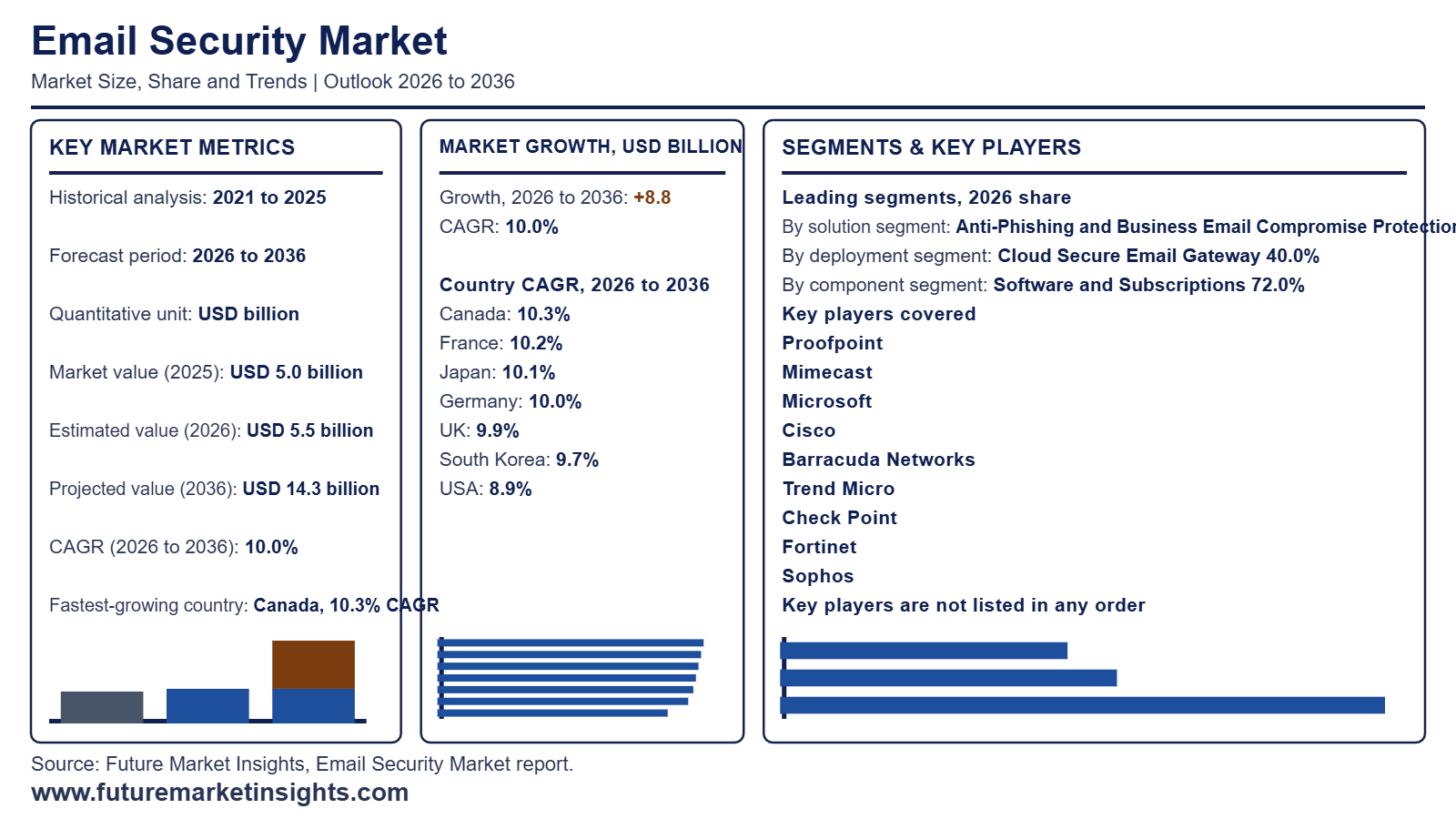
Following an initial market valuation of USD 5.0 billion in 2025 and moving to USD 5.5 billion in 2026, the email security market is projected by Future Market Insights to scale up to USD 14.3 billion by the end of 2036, maintaining a 10.0% CAGR and adding USD 8.8 billion in incremental opportunity.
| Market Metric | Valuation / Share / Forecast Benchmark |
|---|---|
| 2025 Market Size (Historical) | USD 5.0 billion |
| 2026 Market Size (Estimated) | USD 5.5 billion |
| 2036 Market Size (Projected) | USD 14.3 billion |
| Compound Annual Growth Rate (2026 to 2036) | 10.0% CAGR |
| Incremental Dollar Opportunity (2026 to 2036) | USD 8.8 billion |
| Dominant Solution Segment (2026 Share) | Anti-Phishing and Business Email Compromise Protection (34.1% share in 2026) | Other Segment Combined (65.9%) |
| Leading Deployment Segment (2026 Share) | Cloud Secure Email Gateway (40.0% share in 2026) | Other Segment Combined (60.0%) |
| Leading Component Segment (2026 Share) | Software and Subscriptions (72.0% share in 2026) | Other Segment Combined (28.0%) |
| Leading Organisation Size Segment (2026 Share) | Large Enterprises (52.0% share in 2026) | Other Segment Combined (48.0%) |
| Fastest-Growing Country Markets (2026 to 2036) | Canada (10.3% CAGR), France (10.2% CAGR), Japan (10.1% CAGR) |
| Leading Tier-1 Companies | Proofpoint, Mimecast, Microsoft, Cisco, Barracuda Networks, Trend Micro, Check Point, Fortinet, Sophos, Trellix |
Source: Future Market Insights analysis of the email security market, 2026.
Executive Market Overview
Corporate expenditure across the email security industry is expanding as chief information security officers (CISOs) combat generative AI spear-phishing attacks, automated executive impersonation, and vendor email compromise schemes. Threat research published by the Cybersecurity and Infrastructure Security Agency (CISA, 2025) reveals that over 84% of corporate network intrusions initiate via malicious email links and attachments, driving urgent demand for natural language content inspection. North America and Western Europe account for the highest enterprise software seat licensing, while corporate networks across Japan and South Korea post higher forecast CAGRs as enterprises complete cloud office productivity migrations across cybersecurity and cloud security.
Cybersecurity providers defend subscription gross margins by bundling API-based cloud email protection with automated employee security awareness training and zero-trust data loss prevention (DLP) modules rather than selling basic gateway appliances. Complex hybrid email server configurations and administrator concerns regarding false-positive email delivery delays act as ongoing deployment hurdles. FMI projects integrated cloud email security platforms (ICES) to advance faster than legacy secure email gateways (SEG) through 2036. Market sizing covers commercial software subscriptions for cloud and on-premise email security, inbound/outbound threat inspection, and anti-phishing software, while excluding generic firewall appliances, endpoint antivirus software, and consumer spam blockers.
Analyst Perspective
"Email security vendors will sustain subscription expansion by demonstrating rapid post-delivery message remediation inside existing cloud investigation consoles rather than adding isolated alert feeds. The primary commercial risk is license overlap with bundled office suites and false-positive mail delays, which can stall contract renewals."
- Sudip Saha, Co-founder, FMI
Major Market Trends and Insights
- API-Native Mailbox Remediation Integrates With Existing Cloud Consoles: In plain business terms, security teams do not want to reroute MX records just to catch missed phishing inside cloud mailboxes, which is why API-based add-ons are winning trials right now. Proofpoint (October 2026) joining Microsoft's Integrated Cloud Email Security ecosystem in October 2026 and Mimecast (March 2026) launching API-based deployment in March 2026 prove that shift. From these rollouts, analysts project faster identity threat detection and response software convergence, while gateways remain essential for perimeter routing; however, API adoption still requires strict permission reviews.
- Unified Workspace Suites Combine Email and Collaboration Defense: Attackers increasingly move from compromised emails into chat apps and SaaS accounts, pushing buyers toward correlated protection across communication channels. When Barracuda Networks (June 2026) launched Integrated Email Protection on BarracudaONE in June 2026 and Fortinet (June 2025) introduced FortiMail Workspace Security in June 2025, it meant administrators gained cross-domain quarantine visibility. The likelihood of broader security service edge bundling is rising as MSPs seek single-pane triage.
- Bundled Office Entitlements Reshape Incremental Buyer Evaluation: Baseline protections included inside cloud productivity suites force independent security vendors to prove measurable detection advantages during renewals. Microsoft (July 2026) confirming Defender for Office 365 Plan 1 inclusion within Microsoft 365 E3 in July 2026 proves that point. While bundled tools cover basic filtering for artificial intelligence in cybersecurity, it does not mean advanced impersonation threats disappear, keeping specialized third-party subscriptions relevant for growth.
What Are the Main Drivers, Restraints, and Opportunities?
Impersonation-driven payment fraud sustains demand for identity-aware filtering, while mail-routing complexity and license overlap restrain switching, and API-based layered protection opens an expansion path for incremental subscriptions.
Driver: Rising Financial Exposure From Business Email Compromise and Impersonation
Fraudulent payment requests that mimic trusted suppliers bypass attachment scanners completely, which is driving sales of linguistic and identity-aware email protection at present. To put it simply, finance teams cannot verify every invoice change manually when attackers spoof display names and vendor threads. The Federal Bureau of Investigation (April 2026) recording 24,768 business email compromise complaints totaling over USD 3.0 billion in 2025 losses, paired with updated Information-technology Promotion Agency of Japan (August 2026) impersonation countermeasures, proves that commercial urgency. On account of these losses, the likelihood of higher digital risk protection platforms adoption is rising through 2036.
Restraint: Mail-Flow Disruption, False Positives, and Bundled License Overlap
Even when phishing risk is clear, changing DNS routing for an inline gateway or granting broad mailbox API permissions slows down buyer sign-off. Stated in practical terms, false positives that quarantine real customer orders create immediate friction between IT security and business operations. Although the UK Department for Science, Innovation and Technology (April 2026) reported 38.0% phishing exposure across businesses, high incident rates do not eliminate budget resistance when Microsoft 365 E3 already bundles baseline filtering. Consequently, buyers hold back full deployments until quarantine ownership and rollback steps are settled.
Opportunity: Additive API Protection and Multi-Tenant MSP Remediation
Suppliers can capture incremental recurring revenue by layering mailbox-native detection and automated clawback over existing cloud filters without forcing a disruptive gateway swap. Proofpoint (July 2026) releasing Core Email Protection API in July 2026 and Check Point (February 2026) upgrading Microsoft 365 inline inspection in February 2026 prove vendors are targeting low-friction deployment. From these launches, analysts expect stronger endpoint protection platforms and MSP attach rates, while legacy on-premises appliances fade; however, vendors still need clear license boundaries to close deals.
How Is the Email Security Market Segmented?
Email Security Market is segmented by Solution, Deployment, Component, Organisation Size, and Region. Forecast period from 2026 to 2036.
| Segmentation Axis | Sub-Segments Covered | 2026 Leading Segment & Share | Other Segment Combined & Total |
|---|---|---|---|
| Solution | Anti-Phishing and Business Email Compromise Protection, Anti-Malware and Sandboxing, Data Loss Prevention and Encryption, Spam and Content Filtering, Archiving and Continuity | Anti-Phishing and Business Email Compromise Protection (34.1% share in 2026) | Other Segment Combined (65.9%) | Total (100.0%) |
| Deployment | Cloud Secure Email Gateway, API-based Cloud-Native, Hybrid, On-Premises | Cloud Secure Email Gateway (40.0% share in 2026) | Other Segment Combined (60.0%) | Total (100.0%) |
| Component | Software and Subscriptions, Managed Services, Professional Services, Support and Maintenance | Software and Subscriptions (72.0% share in 2026) | Other Segment Combined (28.0%) | Total (100.0%) |
| Organisation Size | Large Enterprises, Medium Enterprises, Small Enterprises, Government and Public Bodies | Large Enterprises (52.0% share in 2026) | Other Segment Combined (48.0%) | Total (100.0%) |
| Region | North America, Latin America, Western Europe, Eastern Europe, East Asia, South Asia and Pacific, Middle East and Africa | North America (led by USA at 8.9% CAGR) | Global Coverage Across 7 Core Countries (100.0%) |
Source: Future Market Insights analysis of the email security market, 2026.
Why Does Anti-Phishing and Business Email Compromise Protection Lead the Solution Category?
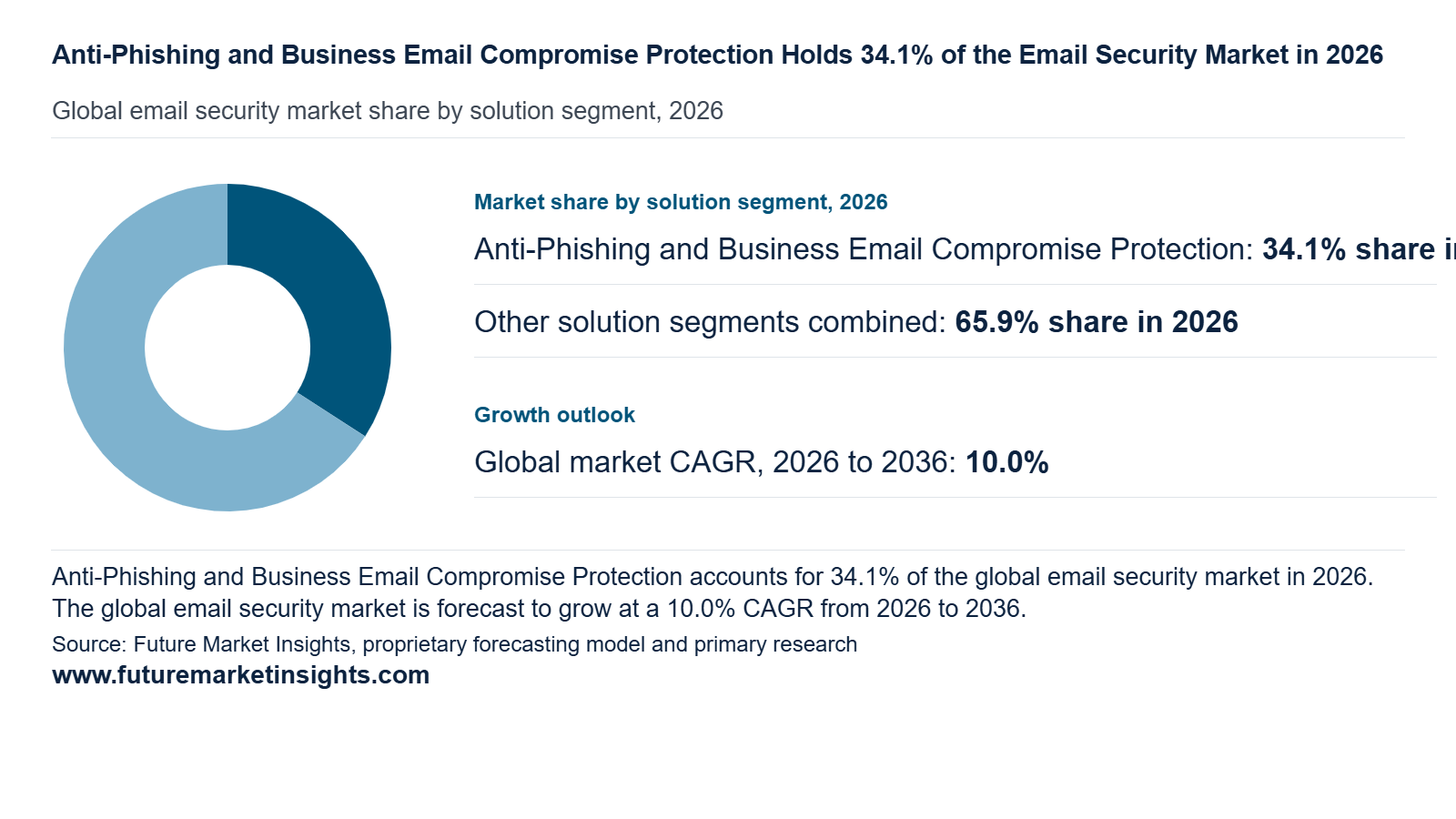
Anti-phishing and business email compromise protection captures 34.1% of solution revenue in 2026 because payload-free impersonation and credential harvesting evade standard malware scanners. Joint finance and security buyers prioritize filters that inspect linguistic intent and domain spoofing without delaying valid supplier invoices. The Federal Bureau of Investigation (April 2026) logging 24,768 business email compromise complaints in 2025, paired with the Information-technology Promotion Agency of Japan (January 2026) ranking business email compromise among its top ten 2026 threats, proves why this category commands top budgets. Increased demand for business email fraud controls will influence solution growth through 2036.
What Sustains Cloud Secure Email Gateway Leadership Within Deployment?
Cloud secure email gateway holds 40.0% of deployment revenue in 2026 because IT teams can enforce pre-delivery filtering and multi-domain routing policies without running physical hardware. While API-based cloud-native tools are expanding for post-delivery cleanup, many enterprises still prefer inspecting SMTP traffic before messages reach employee inboxes. To put that in plain terms, Proofpoint (March 2026) introducing an integrated gateway-plus-API architecture in March 2026 proves that hybrid control remains vital. Pre-delivery policy assurance is expected to anchor cloud secure email gateway adoption through 2036.
How Do Software and Subscriptions Anchor Component Revenue?
Software and subscriptions contribute 72.0% of component revenue in 2026 because per-mailbox recurring plans fund continuous threat intelligence and behavioral model updates. Static appliances cannot keep pace with rotating phishing kits, making annual SaaS licensing the default enterprise procurement model; however, that does not mean managed services lose relevance among lean IT teams. Microsoft (July 2026) updating Defender for Office 365 Plan 1 entitlements in July 2026 confirms how recurring microsegmentation software and cloud security licensing shape enterprise spending through 2036.
Why Do Large Enterprises Account for the Largest Organisation Size Category?
Large enterprises represent 52.0% of organisation size revenue in 2026, driven by complex domain structures, global supplier networks, and strict regulatory audit trails. These organizations require role-based investigation consoles and multilingual threat detection that smaller turnkey packages rarely provide. The UK Department for Science, Innovation and Technology (April 2026) reporting cyber breaches at 69.0% of large businesses versus 65.0% of medium businesses proves that heavy enterprise risk exposure. Consequently, large enterprises will continue anchoring category sales through 2036.
Email Security Market by Region and Country (2026 to 2036)
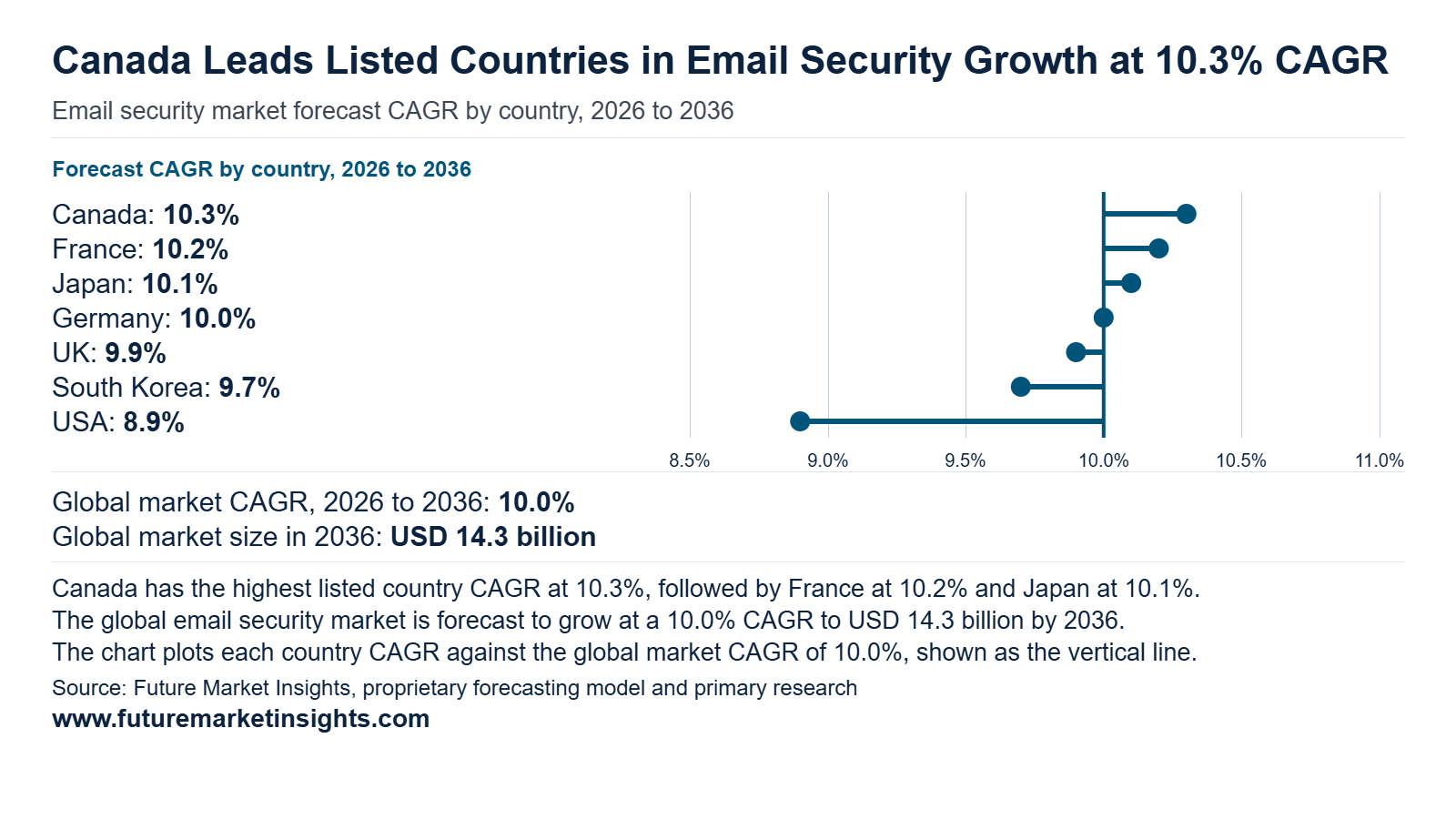
North America and Western Europe generate the largest share of global email security spending due to high cloud-mail adoption and strict compliance mandates, while Canada and Japan post the fastest growth rates. FMI projects Canada to lead national expansion at a 10.3% CAGR from 2026 to 2036, followed by France at 10.2% and Japan at 10.1%. Germany advances at 10.0%, the UK at 9.9%, South Korea at 9.7%, and the USA at 8.9%. That 1.4 percentage point spread reflects how local regulatory enforcement and existing suite consolidation affect new subscription sales.
| Country | 2026 Revenue | 2036 Revenue | 10-Year Addition | 2026 to 2036 CAGR | Global Share (2026 -> 2036) |
|---|---|---|---|---|---|
| USA | USD 1,925.0 million | USD 4,515.6 million | +USD 2,590.6 million | 8.9% | 35.0% -> 31.6% |
| UK | USD 550.0 million | USD 1,413.6 million | +USD 863.6 million | 9.9% | 10.0% -> 9.9% |
| Germany | USD 495.0 million | USD 1,283.9 million | +USD 788.9 million | 10.0% | 9.0% -> 9.0% |
| Japan | USD 440.0 million | USD 1,151.7 million | +USD 711.7 million | 10.1% | 8.0% -> 8.1% |
| France | USD 330.0 million | USD 871.7 million | +USD 541.7 million | 10.2% | 6.0% -> 6.1% |
| Canada | USD 275.0 million | USD 733.0 million | +USD 458.0 million | 10.3% | 5.0% -> 5.1% |
| South Korea | USD 220.0 million | USD 555.3 million | +USD 335.3 million | 9.7% | 4.0% -> 3.9% |
Source: Future Market Insights analysis of the email security market, 2026.
USA
USA email security demand is projected to advance at a 8.9% CAGR through 2036, spurred by steady retail demand and growing consumer preference for certified products. In FMI's view, the USA records a slower percentage rate than Canada or France because enterprise cloud-mail security is already widely deployed, shifting deals toward API add-ons; however, that does not reduce absolute spending volume. The Federal Bureau of Investigation (April 2026) recording over in 2025 business email compromise losses proves why U.S. CISOs keep funding impersonation defense. Continued investment in rapid post-delivery remediation will keep the USA as the largest market through 2036.
Canada
Canada email security demand is projected to advance at a 10.3% CAGR through 2036, anchored by expanding end-user adoption and recurring replenishment demand. FMI finds that persistent adversary-in-the-middle phishing campaigns push Canadian organizations to pair email filtering with stronger identity checks. In plain terms, the Canadian Centre for Cyber Security (October 2025) documenting over 100 adversary-in-the-middle campaigns targeting Microsoft Entra ID accounts means buyers need deeper session correlation and managed incident support. Strict data-residency expectations will sustain Canada's leading growth pace through 2036.
France
France email security demand is projected to advance at a 10.2% CAGR through 2036, supported by expanding procurement agreements across specialized commercial distribution channels. FMI observes that institutional oversight and European cyber-resilience mandates push French buyers toward auditable policy logs and sovereign hosting. Agence nationale de la securite des systemes d'information (March 2026) handling 3,586 cybersecurity events in 2025, paired with European Commission (July 2026) NIS2 enforcement action in July 2026, proves that regulatory pressure. Heightened accountability across finance and public administration will accelerate French procurement through 2036.
Japan
Japan email security demand is projected to advance at a 10.1% CAGR through 2036, driven by continuous technical modernization and shifting institutional buyer preferences. In FMI's assessment, Japanese enterprises reject generic English-trained spam filters in favor of accurate Japanese-language impersonation checks and supplier-workflow controls. Threat rankings from the Information-technology Promotion Agency of Japan (January 2026) keeping business email compromise in the top ten risks, reinforced by August 2026 countermeasures, confirm that buyer priority. Demand for localized fraud controls will drive steady Japanese market growth through 2036.
Germany
Germany email security demand is projected to advance at a 10.0% CAGR through 2036, reflecting sustained industrial usage and growing awareness of operational advantages. FMI notes that German procurement balances Mittelstand preparedness gaps against strict works-council privacy rules and hybrid mail servers. Official reports from the Bundesamt fur Sicherheit in der Informationstechnik (November 2025) showing preparedness shortcomings at smaller firms even with fewer daily malware emails in federal networks proves that dual reality. Vendors offering auditable policy logs and hybrid support will expand German enterprise adoption through 2036.
UK
UK email security demand is projected to advance at a 9.9% CAGR through 2036, sustained by long-term corporate supply contracts and resilient customer adoption. FMI finds that UK demand splits between large banks requiring granular forensics and smaller firms seeking low-maintenance cloud plans. Survey figures from the UK Department for Science, Innovation and Technology (April 2026) showing phishing hit 38.0% of businesses prove why impersonation detection stays essential. Suppliers that simplify quarantine decisions and complement Microsoft 365 licenses will sustain UK growth through 2036.
South Korea
South Korea email security demand is projected to advance at a 9.7% CAGR through 2036, strengthened by expanding regional network capabilities and favorable regulatory guidelines. FMI observes that rapid cloud-tenant adoption and AI-crafted social engineering are prompting South Korean CISOs to tighten mailbox access governance. Analysis from the Korea Internet & Security Agency (January 2026) flagging AI misuse and personal-data risks for 2026 confirms that focus. Clear regional data-processing terms will support steady South Korean adoption through 2036.
Competitive Environment and Notable Companies
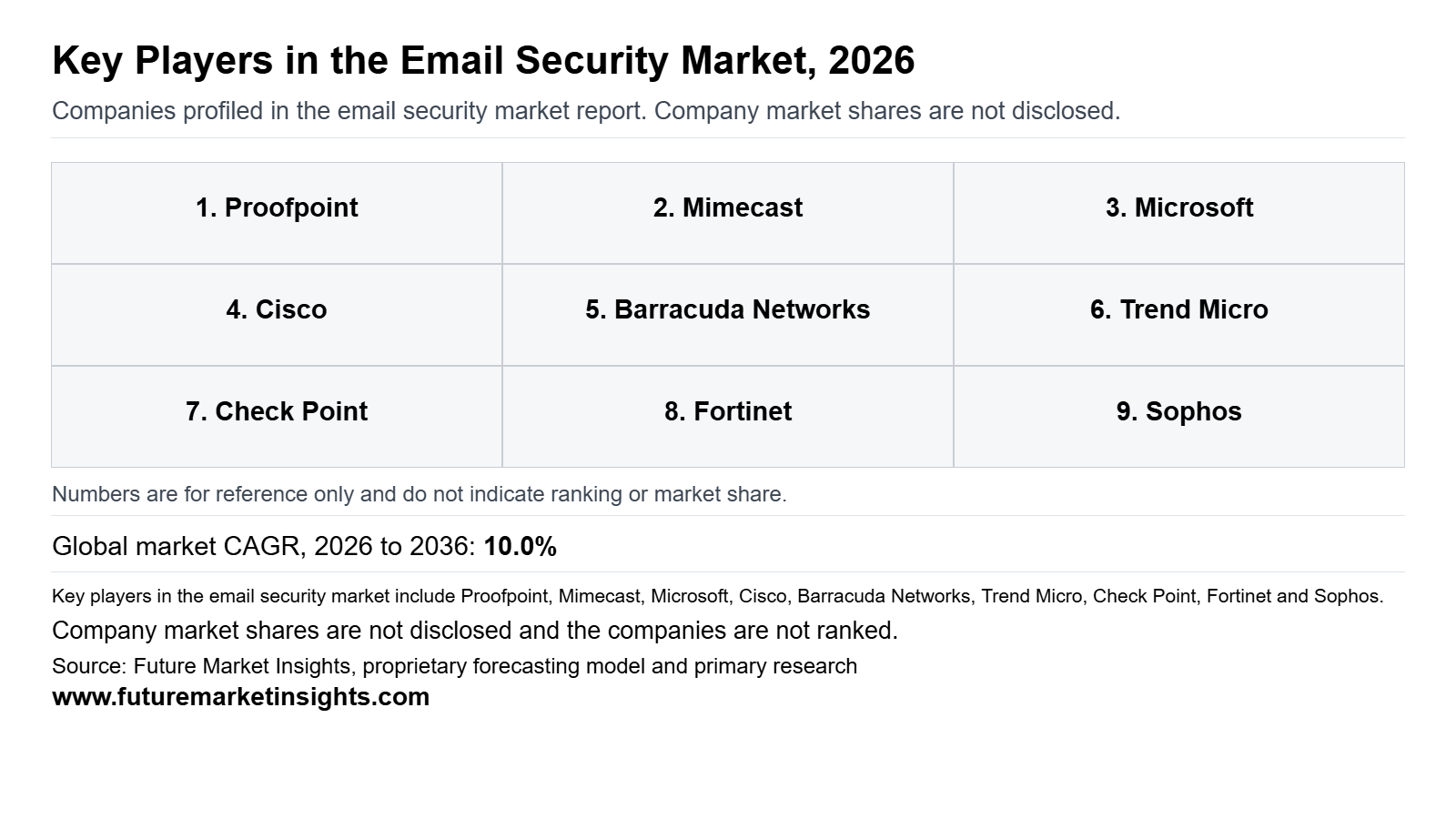
Competition in the global email security market spans specialist layered email protection vendors, suite-linked security operations platforms, and infrastructure-oriented mail security suppliers. Proofpoint, Mimecast, Barracuda Networks, Check Point, Microsoft, Trend Micro, Sophos, Cisco and Trellix compete on inspection placement, post-delivery remediation speed, and false-positive accuracy. Because cloud office suites bundle baseline filtering, third-party vendors differentiate through AI-driven impersonation detection, automated message clawback, and unified investigation consoles.
How Are Companies Positioned in the Email Security Market?
Proofpoint, Mimecast and Check Point specialize in layered email threat inspection combining gateway enforcement with API-based mailbox controls. Microsoft and Sophos connect email defense directly into broader endpoint and security-operations suites, whereas Cisco and Trellix emphasize mail-flow infrastructure, SMTP inline inspection, and hybrid server deployments.
What Matters When a Buyer Selects an Email Security Supplier?
Enterprise buyers evaluate vendors on mail-flow latency, MX-record change requirements, false-positive quarantine rates, and rollback speed for mistakenly blocked messages. Security teams also verify data-processing residency, Microsoft 365 or Google Workspace API permissions, and whether a third-party subscription duplicates existing office suite entitlements.
Which Capabilities Distinguish Product Offers?
Product differentiation centers on pre-delivery vs. post-delivery architecture, automated threat explanation, and outbound DLP controls. Proofpoint distinguishes its platform via Microsoft ICES console integration, Barracuda Networks offers single-pane quarantine management across Barracuda and Microsoft Defender, Sophos provides extended message history and DMARC management, and Trellix supports manager-approved release for DLP-blocked outbound mail.
How Does Geographic Reach Affect Competition?
Regional data-residency rules require vendors to maintain local cloud processing nodes and partner channels. Mimecast operates hosted regions across the United States, UK, Germany, and Canada, while Proofpoint, Fortinet, Cisco and Barracuda Networks serve international enterprise and MSP channels with region-specific tenant terms.
| Verified Company Evidence (2025 to 2026) | Commercial Effect | Buyer Action |
|---|---|---|
| October 2026: Proofpoint joined Microsoft's Integrated Cloud Email Security (ICES) ecosystem to surface Core Email Protection API alerts in Microsoft Defender (Proofpoint, October 2026). | Reduces console fragmentation between third-party detection and native Microsoft investigations. | Verify unified alert triage when layering API protection over Microsoft 365. |
| June 2026: Barracuda Networks launched Integrated Email Protection on BarracudaONE for Microsoft 365 and Google Workspace (Barracuda Networks, June 2026). | Combines pre- and post-delivery AI remediation with multitenant MSP quarantine oversight. | Evaluate single-pane quarantine controls to cut manual administrator triage. |
| March 2026: Mimecast introduced API-based deployment for deep URL inspection, sandboxing, and behavioral analysis (Mimecast, March 2026). | Eliminates MX-record rerouting barriers for buyers preferring rapid cloud API onboarding. | Test API-only deployment latency and clawback speed during pilot trials. |
| February 2026: Check Point announced enhanced inline-inspection infrastructure for Microsoft 365 emails (Check Point, February 2026). | Improves auditable connector governance and pre-delivery inspection reliability. | Audit connector permissions and failover routing before inline activation. |
Source: Verified corporate disclosures and Future Market Insights analysis, 2026.
| Company | Core Positioning | Verified Activity & Source Attribution |
|---|---|---|
| Proofpoint | Enterprise layered gateway and API email threat protection | Joined Microsoft ICES ecosystem in October 2026 and launched Core Email Protection API in July 2026 (Proofpoint, October 2026). |
| Mimecast | Cloud email security, API inspection, and collaboration defense | Introduced API-based deployment in March 2026 and updated service terms in October 2026 (Mimecast, March 2026). |
| Microsoft | Native cloud mail security embedded in Microsoft 365 | Updated Defender for Office 365 Plan 1 inclusion across E3 suites in July 2026 (Microsoft, July 2026). |
| Cisco | Mail-flow inline inspection and enterprise threat defense | Added inline deployment mode for Secure Email Threat Defense (Cisco, 2026). |
| Barracuda Networks | Integrated pre- and post-delivery email security for MSPs and enterprises | Launched Integrated Email Protection on BarracudaONE in June 2026 (Barracuda Networks, June 2026). |
| Trend Micro | Suite-linked email and collaboration security policies | Introduced centralized approved and blocked sender policy management in August 2025 (Trend Micro, August 2025). |
| Check Point | Cloud email inline inspection and anti-phishing controls | Enhanced Microsoft 365 inline-inspection infrastructure in February 2026 (Check Point, February 2026). |
| Fortinet | Workspace-integrated email, browser, and collaboration security | Launched FortiMail Workspace Security suite in June 2025 (Fortinet, June 2025). |
| Sophos | Subscription cloud email protection with DMARC and training | Expanded Sophos Email Plus with extended message history and replay in May 2026 (Sophos, May 2026). |
| Trellix | Cloud and server email security with outbound DLP controls | Released Email Security Cloud 2026.3 in October 2026 with manager DLP release approval (Trellix, October 2026). |
Source: Verified corporate disclosures and Future Market Insights analysis, 2026.
Email Security Market Report Scope and Research Methodology
FMI analysts size the global email security market through primary interviews with chief information security officers, messaging infrastructure architects, managed security service providers, and procurement leads, combined with desk research across national cyber agency threat reports and vendor release documentation. Core 2025 and 2026 valuations reconcile attributable email security software subscriptions, managed services, implementation fees, and maintenance contracts across all seven profiled countries and regional clusters. Segment shares across solution, deployment, component, and organisation size are validated against commercial product tiers while excluding general email hosting, unrelated endpoint tools, and downstream fraud losses to prevent double counting.
| Coverage Field | Report Scope |
|---|---|
| Market Definition | Revenue from email-specific threat protection, anti-malware filtering, email data controls, archiving, and continuity subscriptions and services. |
| Solution Segments | Anti-Phishing and Business Email Compromise Protection, Anti-Malware and Sandboxing, Data Loss Prevention and Encryption, Spam and Content Filtering, and Archiving and Continuity. |
| Deployment Segments | Cloud Secure Email Gateway, API-based Cloud-Native, Hybrid, and On-Premises. |
| Component Segments | Software and Subscriptions, Managed Services, Professional Services, and Support and Maintenance. |
| Organisation Size Segments | Large Enterprises, Medium Enterprises, Small Enterprises, and Government and Public Bodies. |
| Exclusions | Email hosting licenses, unrelated cybersecurity services, downstream financial fraud losses, and collaboration-only software. |
| Quantitative Units | USD Billion for global market sizing; USD Million for country-level breakdowns. |
| Historical & Base Years | 2025 (Historical) and 2026 (Estimated Base Year). |
| Forecast Period | 2026 to 2036 (10-Year Projection Window). |
| Regions Covered | North America, Latin America, Western Europe, Eastern Europe, East Asia, South Asia and Pacific, and Middle East and Africa. |
| Countries Profiled | USA, UK, Germany, Japan, France, Canada, and South Korea. |
| Companies Covered | Proofpoint, Mimecast, Microsoft, Cisco, Barracuda Networks, Trend Micro, Check Point, Fortinet, Sophos, and Trellix. |
| Research Approach | Primary buyer and vendor interviews combined with secondary cyber-agency, regulatory, and corporate disclosure triangulation. |
Source: Future Market Insights analysis of the email security market, 2026.
Research Sources and Bibliography
- Agence nationale de la securite des systemes d'information. (2026, March 11). Panorama de la cybermenace 2025.
- Barracuda Networks. (2026, June 17). Barracuda Unveils Integrated Email Protection.
- Bundesamt fur Sicherheit in der Informationstechnik. (2025, November 11). Die Lage der IT-Sicherheit in Deutschland 2025.
- Canadian Centre for Cyber Security. (2025, October 30). Defending against adversary-in-the-middle threats with phishing-resistant multi-factor authentication.
- Check Point. (2026, February 17). Enhanced Infrastructure to Support Inline Inspection for Microsoft 365 Emails. https://blog.checkpoint.com/product-updates/enhanced-infrastructure-to-support-inline-inspection-for-microsoft-365-emails/
- Cisco. (2026, n.d.). Secure Email Threat Defense Product Updates. https://docs.cmd.cisco.com/en/Content/secure-email-threat-defense-release-notes/Product_Updates.htm
- European Commission. (2026, July 8). Commission refers Ireland, Spain, France and the Netherlands to the Court of Justice for failing to transpose the rules on cybersecurity. https://digital-strategy.ec.europa.eu/en/news/commission-refers-ireland-spain-france-and-netherlands-court-justice-failing-transpose-rules
- Federal Bureau of Investigation. (2026, April 6). 2025 IC3 Annual Report. https://www.ic3.gov/AnnualReport/Reports/2025_IC3Report.pdf
- Fortinet. (2025, June 4). Fortinet Unveils New AI-Powered Workspace Security Suite to Protect the Modern Enterprise. https://www.fortinet.com/corporate/about-us/newsroom/press-releases/2025/fortinet-unveils-new-ai-powered-workspace-security-suite-to-protect-the-modern-enterprise
- Information-technology Promotion Agency of Japan. (2026, January 29). Information Security 10 Major Threats 2026. https://www.ipa.go.jp/security/10threats/10threats2026.html
- Information-technology Promotion Agency of Japan. (2026, August 3). Email-Based Attacks Targeting Organizations and Countermeasures. https://www.ipa.go.jp/security/support/abuse_email.html
- Korea Internet & Security Agency. (2026, January 27). Cyber Threat Trends in the Second Half of 2025 and Outlook for 2026. https://www.krcert.or.kr/kr/bbs/view.do?bbsId=B0000127&menuNo=205021&nttId=71951
- Microsoft. (2026, July 17). Microsoft Defender for Office 365 Service Description. https://learn.microsoft.com/en-us/office365/servicedescriptions/office-365-advanced-threat-protection-service-description
- Mimecast. (2026, March 10). Mimecast Eliminates the API Email Security Trade-Off with Complete Threat Detection. https://www.mimecast.com/newsroom/mimecast-api-email-security/
- Proofpoint. (2026, March 23). Proofpoint Redefines Email and Data Security for the Agentic Workspace. https://www.proofpoint.com/us/newsroom/press-releases/proofpoint-redefines-email-and-data-security-agentic-workspace
- Proofpoint. (2026, July 17). Unifying Email Protection. https://www.proofpoint.com/us/blog/threat-protection-unifying-email-protection
- Proofpoint. (2026, October 26). Proofpoint Joins Microsoft Integrated Cloud Email Security (ICES) Ecosystem. https://www.proofpoint.com/us/newsroom/press-releases/proofpoint-joins-microsoft-integrated-cloud-email-security-ices-ecosystem
- Sophos. (2026, May 15). Sophos Email Security Release Notes. https://docs.sophos.com/releasenotes/output/en-us/central/sc_email_rn.html
- Trellix. (2026, October 9). Trellix Email Security - Cloud 2026.3. https://docs.trellix.com/data-and-email/docs/2026-3-1
- Trend Micro. (2025, August 19). Centralized Policy Resource Management in Email and Collaboration Security. https://docs.trendmicro.com/en-US/documentation/article/trend-vision-one-policy-resources-ecs
- UK Department for Science, Innovation and Technology. (2026, April 30). Cyber security breaches survey 2025/2026. https://www.gov.uk/government/statistics/cyber-security-breaches-survey-20252026/cyber-security-breaches-survey-20252026
Table of Content
- Key Takeaways
- Market Size and CAGR
- Top Growth Driver
- Fastest Growing Segment
- Leading Region
- Key Companies
- Emerging Opportunities
- Executive Summary
- Global Market Outlook
- Demand-side Trends
- Supply-side Trends
- Technology Roadmap Analysis
- Analysis and Recommendations
- Analyst Perspective (What is happening? Why now? What should investors know?)
- Key Questions Answered
- How large is the market?
- What is the CAGR?
- What are key trends?
- Which region dominates?
- Who are the leaders?
Read More...
- Market Overview
- Market Coverage / Taxonomy
- Market Definition / Scope / Limitations
- Research Methodology
- Chapter Orientation
- Analytical Lens and Working Hypotheses
- Market Structure, Signals, and Trend Drivers
- Benchmarking and Cross-market Comparability
- Market Sizing, Forecasting, and Opportunity Mapping
- Research Design and Evidence Framework
- Desk Research Programme (Secondary Evidence)
- Expert Input and Fieldwork (Primary Evidence)
- Tooling, Models, and Reference Databases
- Data Engineering and Model Build
- Quality Assurance and Audit Trail
- Market Background
- Market Dynamics (Drivers, Restraints, Opportunity, Trends)
- Scenario Forecast (Optimistic, Likely, Conservative)
- Impact Analysis
- AI Impact
- Sustainability Impact
- Regulatory Impact
- Technology Impact
- Consumer / Buyer Analysis
- Purchase Drivers
- Adoption Barriers
- Buyer Journey
- Opportunity Map Analysis
- Product Life Cycle Analysis
- Supply Chain Analysis
- Investment Feasibility Matrix
- Value Chain Analysis
- PESTLE and Porter's Analysis
- Regulatory Landscape
- Regional Parent Market Outlook
- Production and Consumption Statistics
- Import and Export Statistics
- Global Market Analysis and Forecast, 2021 to 2036
- Historical Market Size Value (USD Billion) Analysis, 2021 to 2025
- Current and Future Market Size Value (USD Billion) Projections, 2026 to 2036
- Y-o-Y Growth Trend Analysis
- Absolute $ Opportunity Analysis
- Global Market Pricing Analysis, 2021 to 2036
- Global Market Analysis and Forecast, By Solution, 2021 to 2036
- Introduction / Key Findings
- Historical Market Size Value (USD Billion) Analysis By Solution, 2021 to 2025
- Current and Future Market Size Value (USD Billion) Analysis and Forecast By Solution, 2026 to 2036
- Anti-Phishing and Business Email Compromise Protection
- Anti-Malware and Sandboxing
- Data Loss Prevention and Encryption
- Spam and Content Filtering
- Archiving and Continuity
- Y-o-Y Growth Trend Analysis By Solution, 2021 to 2025
- Absolute $ Opportunity Analysis By Solution, 2026 to 2036
- Global Market Analysis and Forecast, By Deployment, 2021 to 2036
- Introduction / Key Findings
- Historical Market Size Value (USD Billion) Analysis By Deployment, 2021 to 2025
- Current and Future Market Size Value (USD Billion) Analysis and Forecast By Deployment, 2026 to 2036
- Cloud Secure Email Gateway
- API-based Cloud-Native
- Hybrid
- On-Premises
- Y-o-Y Growth Trend Analysis By Deployment, 2021 to 2025
- Absolute $ Opportunity Analysis By Deployment, 2026 to 2036
- Global Market Analysis and Forecast, By Component, 2021 to 2036
- Introduction / Key Findings
- Historical Market Size Value (USD Billion) Analysis By Component, 2021 to 2025
- Current and Future Market Size Value (USD Billion) Analysis and Forecast By Component, 2026 to 2036
- Software and Subscriptions
- Managed Services
- Professional Services
- Support and Maintenance
- Y-o-Y Growth Trend Analysis By Component, 2021 to 2025
- Absolute $ Opportunity Analysis By Component, 2026 to 2036
- Global Market Analysis and Forecast, By Organisation Size, 2021 to 2036
- Introduction / Key Findings
- Historical Market Size Value (USD Billion) Analysis By Organisation Size, 2021 to 2025
- Current and Future Market Size Value (USD Billion) Analysis and Forecast By Organisation Size, 2026 to 2036
- Large Enterprises
- Medium Enterprises
- Small Enterprises
- Government and Public Bodies
- Y-o-Y Growth Trend Analysis By Organisation Size, 2021 to 2025
- Absolute $ Opportunity Analysis By Organisation Size, 2026 to 2036
- Global Market Analysis and Forecast, By Region, 2021 to 2036
- Introduction
- Historical Market Size Value (USD Billion) Analysis By Region, 2021 to 2025
- Current Market Size Value (USD Billion) Analysis and Forecast By Region, 2026 to 2036
- North America
- Western Europe
- East Asia
- South Asia and Pacific
- Market Attractiveness Analysis By Region
- North America Market Analysis and Forecast, By Country, 2021 to 2036
- Historical Market Size Value (USD Billion) Trend Analysis By Market Taxonomy, 2021 to 2025
- Market Size Value (USD Billion) Forecast By Market Taxonomy, 2026 to 2036
- By Country
- United States
- Canada
- By Solution
- By Deployment
- By Component
- By Organisation Size
- By Country
- Market Attractiveness Analysis
- By Country
- By Solution
- By Deployment
- By Component
- By Organisation Size
- Key Takeaways
- Western Europe Market Analysis and Forecast, By Country
- Historical Market Size Value (USD Billion) Trend Analysis By Market Taxonomy, 2021 to 2025
- Market Size Value (USD Billion) Forecast By Market Taxonomy, 2026 to 2036
- By Country
- United Kingdom
- Germany
- France
- By Solution
- By Deployment
- By Component
- By Organisation Size
- By Country
- Market Attractiveness Analysis
- By Country
- By Solution
- By Deployment
- By Component
- By Organisation Size
- Key Takeaways
- East Asia Market Analysis and Forecast, By Country
- Historical Market Size Value (USD Billion) Trend Analysis By Market Taxonomy, 2021 to 2025
- Market Size Value (USD Billion) Forecast By Market Taxonomy, 2026 to 2036
- By Country
- China
- Japan
- South Korea
- By Solution
- By Deployment
- By Component
- By Organisation Size
- By Country
- Market Attractiveness Analysis
- By Country
- By Solution
- By Deployment
- By Component
- By Organisation Size
- Key Takeaways
- South Asia and Pacific Market Analysis and Forecast, By Country
- Historical Market Size Value (USD Billion) Trend Analysis By Market Taxonomy, 2021 to 2025
- Market Size Value (USD Billion) Forecast By Market Taxonomy, 2026 to 2036
- By Country
- India
- Australia
- Rest of world aggregate
- By Solution
- By Deployment
- By Component
- By Organisation Size
- By Country
- Market Attractiveness Analysis
- By Country
- By Solution
- By Deployment
- By Component
- By Organisation Size
- Key Takeaways
- Key Countries Market Analysis
- United States
- Pricing Analysis
- Market Share Analysis, 2025
- By Solution
- By Deployment
- By Component
- By Organisation Size
- Canada
- Pricing Analysis
- Market Share Analysis, 2025
- By Solution
- By Deployment
- By Component
- By Organisation Size
- Germany
- Pricing Analysis
- Market Share Analysis, 2025
- By Solution
- By Deployment
- By Component
- By Organisation Size
- United Kingdom
- Pricing Analysis
- Market Share Analysis, 2025
- By Solution
- By Deployment
- By Component
- By Organisation Size
- France
- Pricing Analysis
- Market Share Analysis, 2025
- By Solution
- By Deployment
- By Component
- By Organisation Size
- India
- Pricing Analysis
- Market Share Analysis, 2025
- By Solution
- By Deployment
- By Component
- By Organisation Size
- China
- Pricing Analysis
- Market Share Analysis, 2025
- By Solution
- By Deployment
- By Component
- By Organisation Size
- Japan
- Pricing Analysis
- Market Share Analysis, 2025
- By Solution
- By Deployment
- By Component
- By Organisation Size
- South Korea
- Pricing Analysis
- Market Share Analysis, 2025
- By Solution
- By Deployment
- By Component
- By Organisation Size
- Australia
- Pricing Analysis
- Market Share Analysis, 2025
- By Solution
- By Deployment
- By Component
- By Organisation Size
- United States
- Market Structure Analysis
- Competition Dashboard
- Competition Benchmarking
- Market Share Analysis of Top Players
- By Regional
- By Solution
- By Deployment
- By Component
- By Organisation Size
- Emerging Startups
- Innovation Benchmarking
- Competition Analysis
- Competition Deep Dive
- Proofpoint
- Overview
- Product Portfolio
- Profitability by Market Segments
- Sales Footprint
- Strategy Overview
- Marketing Strategy
- Product Strategy
- Channel Strategy
- Mimecast
- Microsoft
- Cisco
- Barracuda Networks
- Trend Micro
- Check Point
- Fortinet
- Sophos
- Trellix
- Proofpoint
- Case Studies
- Success Stories
- Recent Developments
- Competition Deep Dive
- Assumptions & Acronyms Used
List of Tables
- Table 1: Global Market Value (USD Billion) Forecast by Region, 2021 to 2036
- Table 2: Global Market Value (USD Billion) Forecast by Solution, 2021 to 2036
- Table 3: Global Market Value (USD Billion) Forecast by Deployment, 2021 to 2036
- Table 4: Global Market Value (USD Billion) Forecast by Component, 2021 to 2036
- Table 5: Global Market Value (USD Billion) Forecast by Organisation Size, 2021 to 2036
- Table 6: North America Market Value (USD Billion) Forecast by Country, 2021 to 2036
- Table 7: North America Market Value (USD Billion) Forecast by Solution, 2021 to 2036
- Table 8: North America Market Value (USD Billion) Forecast by Deployment, 2021 to 2036
- Table 9: North America Market Value (USD Billion) Forecast by Component, 2021 to 2036
- Table 10: North America Market Value (USD Billion) Forecast by Organisation Size, 2021 to 2036
- Table 11: Western Europe Market Value (USD Billion) Forecast by Country, 2021 to 2036
- Table 12: Western Europe Market Value (USD Billion) Forecast by Solution, 2021 to 2036
- Table 13: Western Europe Market Value (USD Billion) Forecast by Deployment, 2021 to 2036
- Table 14: Western Europe Market Value (USD Billion) Forecast by Component, 2021 to 2036
- Table 15: Western Europe Market Value (USD Billion) Forecast by Organisation Size, 2021 to 2036
- Table 16: East Asia Market Value (USD Billion) Forecast by Country, 2021 to 2036
- Table 17: East Asia Market Value (USD Billion) Forecast by Solution, 2021 to 2036
- Table 18: East Asia Market Value (USD Billion) Forecast by Deployment, 2021 to 2036
- Table 19: East Asia Market Value (USD Billion) Forecast by Component, 2021 to 2036
- Table 20: East Asia Market Value (USD Billion) Forecast by Organisation Size, 2021 to 2036
- Table 21: South Asia and Pacific Market Value (USD Billion) Forecast by Country, 2021 to 2036
- Table 22: South Asia and Pacific Market Value (USD Billion) Forecast by Solution, 2021 to 2036
- Table 23: South Asia and Pacific Market Value (USD Billion) Forecast by Deployment, 2021 to 2036
- Table 24: South Asia and Pacific Market Value (USD Billion) Forecast by Component, 2021 to 2036
- Table 25: South Asia and Pacific Market Value (USD Billion) Forecast by Organisation Size, 2021 to 2036
List of Figures
- Figure 1: Global Market Pricing Analysis
- Figure 2: Global Market Value (USD Billion) Forecast 2021-2036
- Figure 3: Global Market Value Share and BPS Analysis by Solution, 2026 and 2036
- Figure 4: Global Market Y-o-Y Growth Comparison by Solution, 2026-2036
- Figure 5: Global Market Attractiveness Analysis by Solution
- Figure 6: Global Market Value Share and BPS Analysis by Deployment, 2026 and 2036
- Figure 7: Global Market Y-o-Y Growth Comparison by Deployment, 2026-2036
- Figure 8: Global Market Attractiveness Analysis by Deployment
- Figure 9: Global Market Value Share and BPS Analysis by Component, 2026 and 2036
- Figure 10: Global Market Y-o-Y Growth Comparison by Component, 2026-2036
- Figure 11: Global Market Attractiveness Analysis by Component
- Figure 12: Global Market Value Share and BPS Analysis by Organisation Size, 2026 and 2036
- Figure 13: Global Market Y-o-Y Growth Comparison by Organisation Size, 2026-2036
- Figure 14: Global Market Attractiveness Analysis by Organisation Size
- Figure 15: Global Market Value (USD Billion) Share and BPS Analysis by Region, 2026 and 2036
- Figure 16: Global Market Y-o-Y Growth Comparison by Region, 2026-2036
- Figure 17: Global Market Attractiveness Analysis by Region
- Figure 18: North America Market Incremental Dollar Opportunity, 2026-2036
- Figure 19: Western Europe Market Incremental Dollar Opportunity, 2026-2036
- Figure 20: East Asia Market Incremental Dollar Opportunity, 2026-2036
- Figure 21: South Asia and Pacific Market Incremental Dollar Opportunity, 2026-2036
- Figure 22: North America Market Value Share and BPS Analysis by Country, 2026 and 2036
- Figure 23: North America Market Value Share and BPS Analysis by Solution, 2026 and 2036
- Figure 24: North America Market Y-o-Y Growth Comparison by Solution, 2026-2036
- Figure 25: North America Market Attractiveness Analysis by Solution
- Figure 26: North America Market Value Share and BPS Analysis by Deployment, 2026 and 2036
- Figure 27: North America Market Y-o-Y Growth Comparison by Deployment, 2026-2036
- Figure 28: North America Market Attractiveness Analysis by Deployment
- Figure 29: North America Market Value Share and BPS Analysis by Component, 2026 and 2036
- Figure 30: North America Market Y-o-Y Growth Comparison by Component, 2026-2036
- Figure 31: North America Market Attractiveness Analysis by Component
- Figure 32: North America Market Value Share and BPS Analysis by Organisation Size, 2026 and 2036
- Figure 33: North America Market Y-o-Y Growth Comparison by Organisation Size, 2026-2036
- Figure 34: North America Market Attractiveness Analysis by Organisation Size
- Figure 35: Western Europe Market Value Share and BPS Analysis by Country, 2026 and 2036
- Figure 36: Western Europe Market Value Share and BPS Analysis by Solution, 2026 and 2036
- Figure 37: Western Europe Market Y-o-Y Growth Comparison by Solution, 2026-2036
- Figure 38: Western Europe Market Attractiveness Analysis by Solution
- Figure 39: Western Europe Market Value Share and BPS Analysis by Deployment, 2026 and 2036
- Figure 40: Western Europe Market Y-o-Y Growth Comparison by Deployment, 2026-2036
- Figure 41: Western Europe Market Attractiveness Analysis by Deployment
- Figure 42: Western Europe Market Value Share and BPS Analysis by Component, 2026 and 2036
- Figure 43: Western Europe Market Y-o-Y Growth Comparison by Component, 2026-2036
- Figure 44: Western Europe Market Attractiveness Analysis by Component
- Figure 45: Western Europe Market Value Share and BPS Analysis by Organisation Size, 2026 and 2036
- Figure 46: Western Europe Market Y-o-Y Growth Comparison by Organisation Size, 2026-2036
- Figure 47: Western Europe Market Attractiveness Analysis by Organisation Size
- Figure 48: East Asia Market Value Share and BPS Analysis by Country, 2026 and 2036
- Figure 49: East Asia Market Value Share and BPS Analysis by Solution, 2026 and 2036
- Figure 50: East Asia Market Y-o-Y Growth Comparison by Solution, 2026-2036
- Figure 51: East Asia Market Attractiveness Analysis by Solution
- Figure 52: East Asia Market Value Share and BPS Analysis by Deployment, 2026 and 2036
- Figure 53: East Asia Market Y-o-Y Growth Comparison by Deployment, 2026-2036
- Figure 54: East Asia Market Attractiveness Analysis by Deployment
- Figure 55: East Asia Market Value Share and BPS Analysis by Component, 2026 and 2036
- Figure 56: East Asia Market Y-o-Y Growth Comparison by Component, 2026-2036
- Figure 57: East Asia Market Attractiveness Analysis by Component
- Figure 58: East Asia Market Value Share and BPS Analysis by Organisation Size, 2026 and 2036
- Figure 59: East Asia Market Y-o-Y Growth Comparison by Organisation Size, 2026-2036
- Figure 60: East Asia Market Attractiveness Analysis by Organisation Size
- Figure 61: South Asia and Pacific Market Value Share and BPS Analysis by Country, 2026 and 2036
- Figure 62: South Asia and Pacific Market Value Share and BPS Analysis by Solution, 2026 and 2036
- Figure 63: South Asia and Pacific Market Y-o-Y Growth Comparison by Solution, 2026-2036
- Figure 64: South Asia and Pacific Market Attractiveness Analysis by Solution
- Figure 65: South Asia and Pacific Market Value Share and BPS Analysis by Deployment, 2026 and 2036
- Figure 66: South Asia and Pacific Market Y-o-Y Growth Comparison by Deployment, 2026-2036
- Figure 67: South Asia and Pacific Market Attractiveness Analysis by Deployment
- Figure 68: South Asia and Pacific Market Value Share and BPS Analysis by Component, 2026 and 2036
- Figure 69: South Asia and Pacific Market Y-o-Y Growth Comparison by Component, 2026-2036
- Figure 70: South Asia and Pacific Market Attractiveness Analysis by Component
- Figure 71: South Asia and Pacific Market Value Share and BPS Analysis by Organisation Size, 2026 and 2036
- Figure 72: South Asia and Pacific Market Y-o-Y Growth Comparison by Organisation Size, 2026-2036
- Figure 73: South Asia and Pacific Market Attractiveness Analysis by Organisation Size
- Figure 74: Global Market - Tier Structure Analysis
- Figure 75: Global Market - Company Share Analysis
Frequently Asked Questions
What is the projected size and CAGR of the email security market through 2036?
Global email security revenue is projected to reach USD 14.3 billion by 2036, expanding at a 10.0% CAGR from 2026 to 2036 and adding USD 8.8 billion in new value.
Which Solution segment leads the email security market in 2026?
Anti-phishing and business email compromise protection leads the solution axis with a 34.1% share in 2026 because payload-free payment fraud bypasses traditional attachment scanners.
Which Deployment segment holds the largest email security market share?
Cloud secure email gateway accounts for 40.0% of deployment revenue in 2026 as organizations maintain centralized pre-delivery policy enforcement across cloud mail platforms.
How much share do Software and Subscriptions capture in 2026?
Software and subscriptions represent 72.0% of component revenue in 2026 because continuous threat intelligence updates and per-mailbox SaaS licensing anchor enterprise security budgets.
Why do Large Enterprises lead the Organisation Size category?
Large enterprises hold 52.0% of 2026 revenue due to multi-domain mail environments, higher executive impersonation exposure, and strict regulatory audit requirements.
Which countries are projected to grow fastest in the email security market?
Canada leads profiled growth at a 10.3% CAGR from 2026 to 2036, followed by France at 10.2% and Japan at 10.1% amid rising regulatory and impersonation pressures.
Which companies are profiled as key players in the email security market?
Key profiled companies include Proofpoint, Mimecast, Microsoft, Cisco, Barracuda Networks, Trend Micro, Check Point, Fortinet and Trellix across gateway and suite architectures.
Preview the report firsthand - request a free sample
Get SampleGet the brochure for pricing and purchase details.
Get PDF