

- Market Size (2026)
- USD 16.3 Bn
- Forecast (2036)
- USD 52.5 Bn
- CAGR (2026 to 2036)
- 12.4%
How big is Microsegmentation Software Market in 2026?
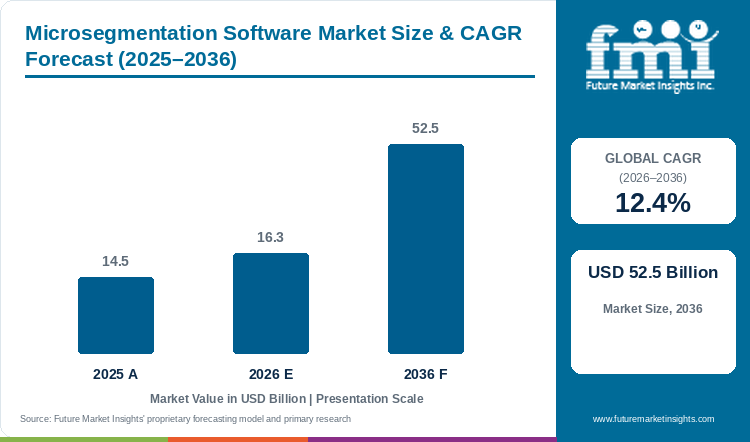
Enterprise microsegmentation software licensing is expected to expand at a 12.4% CAGR over the 2026-2036 decade, stepping up from USD 14.5 Billion in 2025 to a projected USD 16.3 Billion during 2026 and reaching an estimated USD 52.5 Billion by 2036.
Conventional perimeter firewalls inspect north-south boundary traffic yet leave internal east-west server communications flat and exposed once an intruder compromises a single edge credential. To block unauthorized lateral traversal without re-architecting physical switches, security teams embed eBPF packet filters inside guest operating-system kernels, positioning host-based microsegmentation for a projected 43.7% share of 2026 segmentation method spending. Future Market Insights field interviews indicate that total microsegmentation software spending grows beyond USD 14.5 Billion during 2025 to register an expected USD 16.3 Billion in 2026, compounding at an anticipated 12.4% CAGR until hitting a forecast USD 52.5 Billion for 2036 and raising annual software spending by an estimated USD 36.2 Billion from 2026 to 2036. In June 2025, the National Institute of Standards and Technology finalized NIST Special Publication 1800-35 (Implementing a Zero Trust Architecture), presenting 19 reference builds created with 24 industry collaborators to enforce granular Policy Enforcement Points and contain internal lateral movement [1]. Ten-year software growth across major countries is predicted to span 11.8% for Japan through 13.2% for Australia, although unmapped legacy application dependencies and kernel agent compatibility hurdles still slow active packet-blocking enforcement across brownfield mainframes.
Key Market Trends & Insights
- By segmentation method: Host-based microsegmentation (estimated at 43.7% for 2026) leads enterprise licensing because kernel-level agents isolate workloads across clouds without re-architecting physical VLAN switches.
- By environment: Data center deployments (projected at 42.5% for 2026) hold the top environment share as banks and hospitals ring-fence on-premises core databases and bare-metal clusters.
- By use case: Zero trust (anticipated at 44.3% for 2026) anchors procurement budgets through continuous process-identity validation and least-privilege east-west policy enforcement.
- By end use: BFSI (forecast at 43.0% for 2026) represents the primary vertical buyer due to mandatory payment-card enclave scoping and SWIFT gateway isolation audits.
Regional Highlights
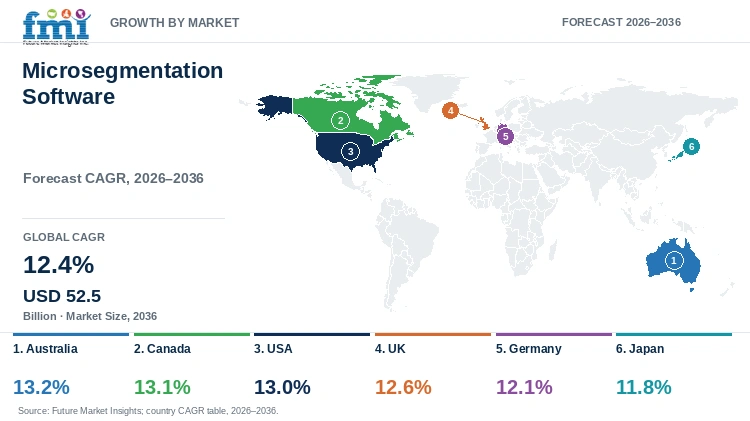
- Highest country growth rate: Australian enterprise deployments are anticipated to head major cybersecurity markets at 13.2% per annum between 2026 and 2036 under mandatory critical infrastructure network zoning rules.
- North American and Eurasian performance: Canadian cloud enclaves are expected to compound at 13.1% and United States federal workloads are projected to climb 13.0% ahead of forecast British bank spending at 12.6%, while German factories are predicted to register 12.1% and Japanese fabs are estimated to record 11.8%.
Market Size & Forecast
Table 1: Market Size and Forecast for the Microsegmentation Software Market (USD billion and CAGR percentage), 2025 to 2036
| Metric | Value |
|---|---|
| 2025 Market Size | USD 14.5 Billion |
| Estimated Market Size in 2026 | USD 16.3 Billion |
| Projected Market Size by 2036 | USD 52.5 Billion |
| CAGR, 2026 to 2036 | 12.4% |
| Added Revenue, 2026 to 2036 | USD 36.2 Billion |
Chief information security officers across financial clearing houses and healthcare networks face severe breach exposure when payment and patient databases sit on flat internal subnets. In February 2026, the Palo Alto Networks Unit 42 Global Incident Response Report covering more than 750 incidents revealed that AI accelerated attack speeds fourfold (compressing initial access to data exfiltration to 72 minutes in the fastest breaches) while 87% of attacks spanned two or more attack surfaces [2]. Security architects are therefore replacing static VLAN access control lists with identity-based policies inside broader network security policy management architectures to lock down east-west traffic.
Workload Endpoint Deployment and Kernel Agent Telemetry Sizing
Table 2: Technical & Operational Performance Sizing Indicators for the Microsegmentation Software Market (USD Billion and operational metrics), mixed historical and forecast years from 2025 to 2036
| Metric | 2025 | 2026 | 2036 |
|---|---|---|---|
| Market size (USD Billion) | 14.5 | 16.3 | 52.5 |
| Enterprise managed workload endpoints (million) | 28.5 to 34.0 | 32.0 to 38.5 | 115.0 to 135.0 |
| Kernel agent memory footprint band (megabytes) | 35 to 80 | 30 to 75 | 15 to 45 |
| Flow dependency mapping throughput (thousand flows/sec) | 120 to 250 | 140 to 300 | 450 to 900 |
Operational note: Endpoint figures cover active virtual machines and container pods running resident host agents or hypervisor filters across enterprise estates, paired with observed RAM overhead and telemetry ingestion rates.
Enterprise managed workload endpoints running microsegmentation agents expand off 28.5 to 34.0 million during 2025 to reach 32.0 to 38.5 million projected endpoints in 2026, before scaling toward 115.0 to 135.0 million estimated endpoints by 2036. Refined eBPF kernel hooks are simultaneously expected to compress agent memory footprints from 30 to 75 megabytes in 2026 toward 15 to 45 predicted megabytes by 2036 while flow dependency mapping throughput is anticipated to jump from 140 to 300 thousand flows per second up to 450 to 900 thousand.
Enterprise License Procurement and Contract Sizing
Table 3: Enterprise Deployment & Enterprise Procurement Indicators for the Microsegmentation Software Market (USD), mixed historical and forecast years from 2025 to 2036
| Metric | 2025 | 2026 | 2036 |
|---|---|---|---|
| Qualified enterprise organizations deploying software (thousand) | 18.2 | 20.5 | 58.0 |
| Average annual enterprise microsegmentation spend (USD) | 796,700 | 795,120 | 905,170 |
| Host agent annual license price band per workload (USD) | 85 to 190 | 80 to 180 | 55 to 130 |
| Managed cloud container enclave license band per cluster (USD) | 1,800 to 4,500 | 1,750 to 4,200 | 1,200 to 3,100 |
Table 4: End-Use Sector Revenue Indicators for the Microsegmentation Software Market (USD Billion and percentages), 2026
| Metric | Value | Basis |
|---|---|---|
| Market size, 2026 | USD 16.3 Billion | Report value |
| BFSI sector revenue, 2026 | USD 7.0 Billion | 43.0% share |
| Zero trust use case revenue, 2026 | USD 7.2 Billion | 44.3% share |
| Host-based segmentation revenue, 2026 | USD 7.1 Billion | 43.7% share |
Qualified enterprise organizations deploying microsegmentation software are expected to grow from 20.5 thousand estimated accounts in 2026 to 58.0 thousand projected accounts by 2036, lifting average annual enterprise spend from USD 795,120 to an anticipated USD 905,170 even as annual per-workload host agent licenses moderate between USD 80 to 180 in 2026 and USD 55 to 130 by 2036. Per-cluster managed cloud container enclave subscriptions are also forecast to adjust between USD 1,750 to 4,200 during 2026 and USD 1,200 to 3,100 predicted for 2036, aligning with 2026 revenue expectations of USD 7.2 Billion in zero trust alongside USD 7.1 Billion in host-based segmentation and USD 7.0 Billion in BFSI.
Analyst Perspective
"Security directors can no longer rely on static perimeter firewalls to protect dynamic multi-cloud server estates. Modern zero-trust architectures require host-level kernel telemetry and automated dependency mapping to block lateral adversary movement."
- Sudip Saha, Co-founder, FMI
How is the microsegmentation software market segmented?
The microsegmentation software market is segmented by segmentation method, environment, use case, end use, and region. In 2026, host-based is projected at 43.7%, data center is expected at 42.5%, zero trust is anticipated at 44.3%, and BFSI is estimated at 43.0%.
By segmentation method: Host-based, network-based, identity-based, and application-aware.
By environment: Data center, public cloud, hybrid cloud, and container & kubernetes.
By use case: Zero trust, ransomware containment, compliance, and workload protection.
By end use: BFSI, healthcare, government, and manufacturing.
Why Does Host-Based Microsegmentation Lead the Segmentation Method Category?
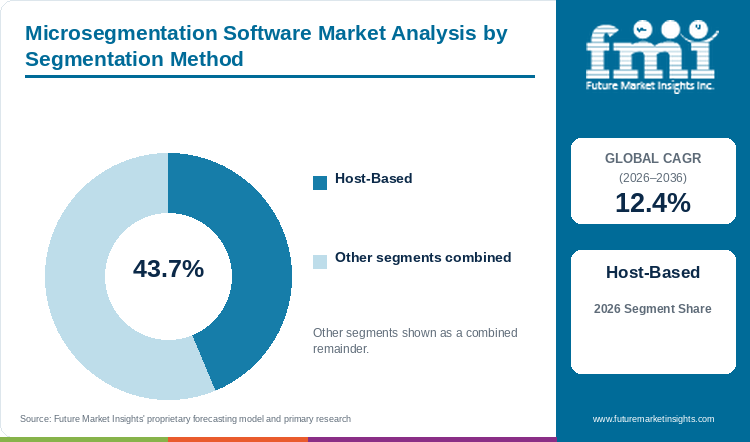
Host-based microsegmentation is projected to secure 43.7% of the segmentation method category in 2026, reflecting native kernel packet inspection.
Table 5: Segmentation Method Share for the Microsegmentation Software Market (percentage share), 2026
| Segmentation Method | Share (2026) |
|---|---|
| Host-Based | 43.7% |
| Other Segments Combined | 56.3%* |
| Total | 100.0% |
*Note: Residual 2026 licensing share across network-based and identity-based plus application-aware software.
Table 6: Segmentation Method Leadership and Market Growth for the Microsegmentation Software Market (segment and CAGR percentage), 2026 to 2036
| Metric | Value |
|---|---|
| Global CAGR (2026 to 2036) | 12.4% |
| Leading Segment | Host-Based |
Deploying lightweight software agents directly inside guest operating system kernels allows security teams to program Linux eBPF filters and Windows Filtering Platform hooks without touching physical network switches. Running isolation logic on the host provides portable server security that follows virtual machines during live migrations across private data centers and public clouds. Cloud architects favor host-centric enforcement because it eliminates traffic hairpinning through hardware firewall appliances.
- Native kernel hooks that decouple east-west filtering from switch hardware are anticipated to give host-based microsegmentation 43.7% of 2026 segmentation method spend (USD 7.1 Billion projected).
- In November 2025, VMware by Broadcom documented in its vDefend DFW 1-2-3-4 release on Security Services Platform 5.1 that internal east-west lateral traffic is roughly four times larger than north-south perimeter traffic [3].
What Drives Data Center Environments to Represent the Largest Deployment Share?
Data center environments are estimated to represent 42.5% of the environment category in 2026, aided by on-premises database containment.
Core banking ledgers and electronic health record databases reside on bare-metal and virtualized on-premises server clusters governed by strict data sovereignty laws. Upgrading data center security with software-defined micro-perimeters isolates production database tiers from internal development and testing subnets without costly VLAN re-IP projects. Enterprises prioritize on-premises data center segmentation to prevent compromised employee workstations from reaching crown-jewel database records.
- Forecasts assign data center environments 42.5% of 2026 deployment revenue as regulated enterprises isolate high-value bare-metal and virtual server estates.
- In November 2025, Cisco Systems introduced multi-customer Security Cloud Control for its Hybrid Mesh Firewall by combining eBPF workload agents and Smart Switches with Secure Firewall 7.7 (blocking 99.5% to 100% of threats in NetSecOPEN tests) [4].
How Does Zero Trust Maintain Its 44.3% Share in the Use Case Segment?
Zero trust is predicted to capture 44.3% of the use case category in 2026, benefiting from continuous least-privilege verification.
Zero-trust security architectures require continuous identity and process verification across every internal server-to-server session rather than assuming implicit trust inside the corporate LAN. Microsegmentation enforces least-privilege access by wrapping each application tier in a cryptographic micro-perimeter that pairs with authentication solution brokers to block unauthorized lateral connections. Automated policy engines validate workload certificates before permitting east-west database queries.
- Zero trust is expected to claim 44.3% of 2026 use case spending (USD 7.2 Billion estimated) as federal and financial auditors mandate continuous east-west policy verification.
- In April 2026, the Fortinet 2026 Global Threat Landscape Report from FortiGuard Labs documented 7,831 confirmed ransomware victims globally (a 389% year-over-year surge) alongside a 24-to-48-hour time-to-exploit window [5].
What Positions BFSI as the Leading End Use Category in 2026?
BFSI is forecast to hold 43.0% of the end use category in 2026, accompanied by payment card enclave isolation.
Commercial banks and card clearing networks face relentless ransomware extortion alongside mandatory regulatory audits covering interbank messaging gateways. Financial security engineering teams combine container security controls with host-level isolation policies to quarantine internet-facing web applications from core settlement ledgers in milliseconds. Ring-fencing cardholder data enclaves also narrows the audit scope of annual PCI DSS v4.0 compliance inspections.
- Mandatory cardholder enclave scoping and real-time payment gateway protection are projected to give BFSI 43.0% of 2026 end use spending (USD 7.0 Billion anticipated).
- In January 2026, the Zscaler 2026 AI Threat Report covering nearly 1 trillion AI/ML transactions across 9,000+ enterprises documented an 83% surge in AI traffic alongside 18,033 TB of data transfers and a 16-minute median time to critical failure [6].
What are the drivers, restraints, and opportunities in the microsegmentation software market?
Lateral ransomware containment and zero-trust audit mandates accelerate enterprise microsegmentation licensing, whereas unmapped legacy application dependencies slow blocking enforcement and eBPF container meshes create cloud growth.
- Driver: Rapid lateral ransomware propagation and strict zero-trust compliance directives compel enterprises to enforce software-defined workload microsegmentation across distributed server estates.
- Restraint: Unmapped legacy application dependencies and kernel agent compatibility friction delay switch-over from monitoring mode to active packet blocking.
- Opportunity: Machine-learning dependency discovery and sidecar-free eBPF container isolation open recurring subscription growth across multi-cloud Kubernetes clusters.
Growth Analysis and Future Potential: East-West Ransomware Confinement and Cloud Decoupling
Enterprise chief information security officers are replacing flat internal VLAN subnets with software-defined micro-perimeters to stop ransomware from encrypting adjacent servers after an initial phishing breach. In October 2025, the European Union Agency for Cybersecurity published its ENISA Threat Landscape 2025 report covering 4,875 cybersecurity incidents across the EU between July 2024 and June 2025, identifying ransomware and supply-chain lateral compromise as primary operational threats [7]. Pairing host-based micro-firewalls with cloud encryption controls terminates unauthorized east-west port scanning and isolates compromised virtual machines before domain controllers are reached.
Risk Assessment and Operational Hurdles: Dependency Mapping Friction and Legacy System Overhead
Fear of breaking undocumented production application flows in brownfield environments remains the primary operational barrier delaying active blocking enforcement. Security administrators must map every inter-server port and process dependency over 30-day flow windows before activating deny rules so legitimate ERP or database traffic is not dropped. In March 2025, VMware by Broadcom launched the vDefend Security Segmentation Report on Security Services Platform 5.0 to score brownfield segmentation gaps while citing a Forrester study showing 40% lower breach risk and 116% ROI [8]. Synchronizing host agent policies with an existing next gen firewall or network security firewalls estate also requires unified orchestration consoles.
Commercial Opportunity Analysis: Automated Policy Synthesis and Container Mesh Enclaves
Embedding machine-learning telemetry analytics that automatically draft least-privilege ring-fencing rules cuts policy validation timelines from months to days. At the same time, rapid enterprise migration toward AI-driven microservices creates strong demand for declarative pod-to-pod micro-firewalls inside Kubernetes clusters. In March 2026, the eighth annual Nutanix Enterprise Cloud Index of 1,600 IT executives reported that 85% say AI is accelerating container adoption and 83% build new applications in containers, while 80% rank data sovereignty a high priority [9]. Linking eBPF kernel inspection with artificial intelligence in cybersecurity platforms allows vendors to protect ephemeral container workloads without sidecar proxy latency.
Microsegmentation Software Market by Country (2026 to 2036)
Future Market Insights analysts project that Australian software licensing outpaces other national microsegmentation software markets at 13.2% annually through 2036, while Japanese enterprise spend is forecast to increase 11.8% annually. National growth variation reflects critical infrastructure cyber statutes and federal zero-trust deadlines alongside how rapidly enterprises automate dependency mapping.
Table 7: Country CAGR and Primary Growth Levers for the Microsegmentation Software Market (CAGR percentage and operational drivers), 2026 to 2036
| Country | CAGR (2026 to 2036) | Primary Growth Lever |
|---|---|---|
| Australia | 13.2% | ASD cybersecurity compliance and critical infrastructure network isolation mandates |
| Canada | 13.1% | Federal zero-trust modernization directives and healthcare patient database isolation |
| USA | 13.0% | Executive Order zero-trust architecture adoption and financial multi-cloud enclave defense |
| UK | 12.6% | Financial Conduct Authority operational resilience rules and NHS digital enclave segregation |
| Germany | 12.1% | BSI industrial cybersecurity standards and smart automotive OT network microsegmentation |
| Japan | 11.8% | Semiconductor supply chain defense and pre-enforcement traffic simulation deployments |
Source: Future Market Insights analysis
Australia Microsegmentation Software Market Outlook (2026 to 2036)
What sets Australia apart from the global microsegmentation software market is the Security of Critical Infrastructure Act Risk Management Program (CIRMP), under which designated asset classes adopt recognized cyber frameworks such as Essential Eight Level 1 or ISO 27001 alongside NIST CSF and AESCSF. Supported by these asset-class CIRMP governance obligations, Australian enterprise software licensing is anticipated to surge at a 13.2% compound annual pace through 2036. In October 2025, the Australian Signals Directorate's Annual Cyber Threat Report 2024-2025 documented 1,253 cyber incidents (up 11% with 34% of Category 3 incidents involving ransomware) alongside 190+ critical infrastructure notifications and a 219% jump in large-business cybercrime costs to AUD 202,700 [10]. Managed security providers consequently deliver cloud-hosted consoles that automate policy generation.
Key takeaway: In Australia, Security of Critical Infrastructure Act CIRMP framework obligations and multi-framework cyber resilience rules drive enterprise adoption of automated microsegmentation services.
Canada Microsegmentation Software Market Outlook (2026 to 2036)
Canadian microsegmentation software spending is forecast to rise at a 13.1% yearly growth clip over the 2026-2036 decade under federal cloud-sovereignty and provincial hospital privacy rules. Unlike global markets centered on private corporate data centers, on-the-ground Canadian procurement is uniquely shaped by federated provincial healthcare networks and bilingual public agencies isolating shared hybrid-cloud enclaves. In January 2026, the Canadian Centre for Cyber Security reported in its Ransomware Threat Outlook 2025-2027 that Canadian ransomware incidents rose 26% annually while recovery costs doubled to CAD 1.2 Billion across commercial and municipal networks [11]. To protect hospital imaging servers without clinical downtime, software vendors supply lightweight host agents paired with agentless hypervisor controls.
Key takeaway: In Canada, federal zero-trust security guidelines and healthcare data protection priorities sustain steady investment in lightweight host isolation software.
USA Microsegmentation Software Market Outlook (2026 to 2036)
In July 2025, the Cybersecurity and Infrastructure Security Agency published Microsegmentation in Zero Trust Part One: Introduction and Planning, outlining a four-phase implementation model using Policy Enforcement Points and Policy Decision Points across federal and enterprise networks [12]. Distinct from single-cloud international deployments, the United States market is uniquely characterized by sprawling Fortune 500 multi-cloud estates spanning AWS and Azure alongside on-premises mainframes and federal OMB M-22-09 compliance deadlines. Reinforced by federal zero-trust mandates and Wall Street clearing rules, American microsegmentation software revenue is projected to climb 13.0% per annum through 2036. To reconcile overlapping firewall policies across hybrid clusters, software vendors deploy unified orchestration engines that translate workload identity labels into kernel filters.
Key takeaway: In the USA, federal zero-trust architecture directives and sprawling hybrid cloud footprints sustain heavy enterprise procurement of centralized microsegmentation software.
UK Microsegmentation Software Market Outlook (2026 to 2036)
Financial Conduct Authority operational resilience tolerances in the City of London alongside National Health Service clinical subnet segregation differentiate the United Kingdom from broader European software markets. Because clearing banks and hospital trusts must prove lateral blast-radius containment during mandatory penetration audits, British microsegmentation software turnover is expected to increase 12.6% per year through 2036. In October 2025, the UK National Cyber Security Centre's Annual Review 2025 documented a record number of nationally significant cyber incidents, including disruptive retail ransomware attacks on Marks & Spencer and the Co-op (where data on 6.5 million members was stolen) [13]. Where legacy hospital and rail systems cannot run modern kernel agents, enterprises combine passive flow sensors with identity-aware switch enforcement.
Key takeaway: In the UK, financial regulatory scrutiny and critical infrastructure protection guidelines spur phased adoption of hybrid microsegmentation platforms.
Germany Microsegmentation Software Market Outlook (2026 to 2036)
German enterprise microsegmentation software spending is slated to climb by 12.1% compounded annually from 2026 through 2036 as statutory NIS2 enforcement converges with Industry 4.0 smart factory automation. Whereas global demand is led by cloud-native IT workloads, Germany stands apart through dense industrial cyber security zoning across automotive robotic assembly cells and chemical programmable logic controllers. In November 2025, the Federal Office for Information Security (BSI) reported in The State of IT Security in Germany in 2025 that 950 ransomware complaints were filed alongside rising critical-infrastructure and supply-chain vulnerabilities [14]. Because plant engineers prohibit third-party kernel agents on real-time industrial controllers, security vendors deploy agentless OT network enclaves.
Key takeaway: In Germany, industrial cybersecurity compliance and automotive supply chain protection mandate non-disruptive microsegmentation for operational technology networks.
Japan Microsegmentation Software Market Outlook (2026 to 2036)
Compared with Western enterprises that rapidly activate automated packet blocking, Japan is uniquely defined by zero-downtime manufacturing governance and multi-tier keiretsu supplier network interconnections. In September 2026, the JPCERT Coordination Center published its integrated FY2025-FY2026 Quarterly Report series combining incident handling data and TSUBAME internet threat monitoring across Japanese corporate subnets [15]. Driven by semiconductor wafer fab and megabank cloud modernization, Japanese microsegmentation software spending is estimated to grow on an 11.8% yearly path through 2036. To overcome strict enterprise caution toward false-positive production packet drops across interconnected factory and banking networks, cybersecurity software suppliers provide pre-enforcement traffic simulation engines that validate every policy rule before live activation.
Key takeaway: In Japan, semiconductor and automotive supply chain vulnerabilities encourage enterprises to adopt pre-enforcement simulation software before executing zero-trust policies.
Full report country CAGRs cover: North America; Latin America; Western Europe; Eastern Europe; East Asia; South Asia and Pacific; Middle East and Africa.
Who are the notable companies in the microsegmentation software market?
Illumio, Inc., VMware LLC (Broadcom Inc.), Cisco Systems, Inc. (Secure Workload), Palo Alto Networks, Inc., Akamai Technologies, Inc. (Guardicore), Zscaler, Inc., ColorTokens, Inc., and Nutanix, Inc. (Flow Network Security) are the notable companies in the microsegmentation software market.
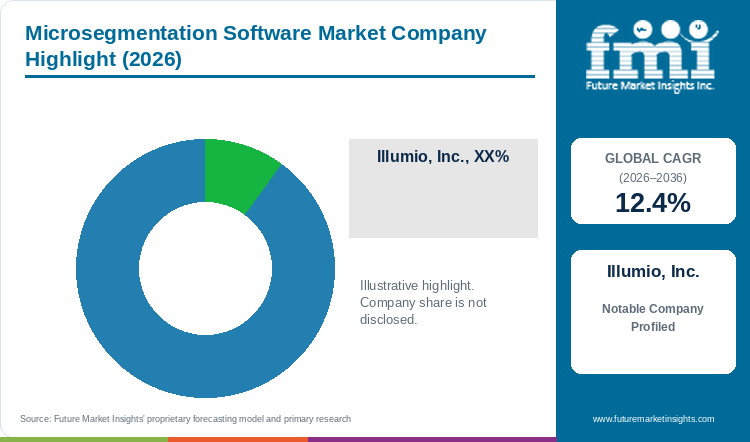
According to FMI analysts, vendor competition across the microsegmentation software sector separates into dedicated zero-trust segmentation specialists alongside enterprise virtualization and SASE cybersecurity platforms. Pure-play segmentation vendors including Illumio and Akamai Guardicore alongside ColorTokens focus on lightweight host kernel telemetry and visual application dependency mapping across heterogeneous clouds. Infrastructure leaders such as VMware LLC and Cisco Systems together with Nutanix embed micro-firewalls directly into hypervisors and software-defined data center fabrics. Enterprise security architects qualify suppliers on sub-50MB agent memory overhead and eBPF Kubernetes support alongside automated policy synthesis.
- Dedicated Zero-Trust Microsegmentation Specialists: Illumio and Akamai Technologies (Guardicore) alongside ColorTokens engineer host-based policy enforcement software and real-time application dependency visualization platforms.
- Enterprise Networking & Infrastructure Conglomerates: VMware LLC (Broadcom) and Cisco Systems (Secure Workload) together with Nutanix (Flow Network Security) deliver hypervisor-level microsegmentation and software-defined network boundary controls.
- Integrated SASE & Next-Generation Cybersecurity Platforms: Palo Alto Networks, Inc. and Zscaler, Inc. combine identity-aware microsegmentation with cloud-native workload protection and zero-trust exchange architectures.
Competitive Benchmarking: Microsegmentation Software Market
Table 8: Competitive Benchmarking for the Microsegmentation Software Market (qualitative capability ratings), 2026
| Company | Kernel Agent & eBPF Depth | Multi-Cloud & Hybrid Reach | Dependency Mapping Automation | Enterprise Adoption |
|---|---|---|---|---|
| Illumio, Inc. | High | High | High | High |
| VMware LLC (Broadcom Inc.) | High | High | Medium | High |
| Cisco Systems, Inc. (Secure Workload) | High | High | High | High |
| Palo Alto Networks, Inc. | High | High | High | High |
| Akamai Technologies, Inc. (Guardicore) | High | High | High | High |
| Zscaler, Inc. | Medium | High | High | High |
| ColorTokens, Inc. | High | Medium | High | Medium |
| Nutanix, Inc. (Flow Network Security) | High | Medium | Medium | Medium |
Scoring basis: Kernel Agent & eBPF Depth earns a High rating when the platform deploys sub-50MB host agents using native operating system packet inspection hooks without kernel recompilation. Multi-Cloud & Hybrid Reach is High when a vendor enforces unified policies across bare-metal servers and private hypervisors alongside public cloud Kubernetes pods. Dependency Mapping Automation and Enterprise Adoption measure automated process-level flow visualization and active production deployments across global Fortune 2000 accounts.
Key Developments in the Microsegmentation Software Market
- In August 2026, Illumio, Inc. was named a Leader and a Customer Favorite in The Forrester Wave for Q3 2026 Microsegmentation Solutions after earning top scores in Current Offering and Strategy across 10 vendors and deploying across Microsoft and BNP Paribas [16].
- In February 2026, Illumio, Inc. unveiled agentless hybrid visibility and breach containment in Illumio Insights by ingesting real-time telemetry and policy data from Check Point and Fortinet firewalls across data center and cloud environments [17].
- In March 2026, Akamai Technologies, Inc. launched AI-powered capabilities in Akamai Guardicore Segmentation built on insights from over 500 segmentation deployments to automate asset labeling alongside traffic simulation and proof-driven enforcement [18].
Key Players in the Microsegmentation Software Market
Dedicated Zero-Trust Microsegmentation Specialists
- Illumio, Inc.
- Akamai Technologies, Inc. (Guardicore)
- ColorTokens, Inc.
Enterprise Networking & Infrastructure Conglomerates
- VMware LLC (Broadcom Inc.)
- Cisco Systems, Inc. (Secure Workload)
- Nutanix, Inc. (Flow Network Security)
Integrated SASE & Next-Generation Cybersecurity Platforms
- Palo Alto Networks, Inc.
- Zscaler, Inc.
Microsegmentation Software Market - Report Scope
Table 9: Report Scope for the Microsegmentation Software Market (coverage fields and definitions), 2026 to 2036
| Coverage field | Report scope |
|---|---|
| Market breakdown | Segmentation Method; Environment; Use Case; End Use; Region |
| Quantitative Units | USD Billion |
| Market Definition | Includes vendor software license and SaaS subscription revenues from host-based, network-based, identity-based, and application-aware microsegmentation platforms deployed across data center, cloud, and container workloads. Category Scope Note: Captures enterprise east-west workload isolation software and hypervisor micro-firewall subscriptions, excluding physical north-south perimeter firewall appliances, network switches, and consumer anti-virus software. |
| Regions Covered | North America; Latin America; Western Europe; Eastern Europe; East Asia; South Asia and Pacific; Middle East and Africa |
| Countries Covered | Australia, Canada, USA, UK, Germany, Japan, and additional countries in the full report |
| Key Companies Covered | Illumio, Inc., VMware LLC (Broadcom Inc.), Cisco Systems, Inc. (Secure Workload), Palo Alto Networks, Inc., Akamai Technologies, Inc. (Guardicore), Zscaler, Inc., ColorTokens, Inc., Nutanix, Inc. (Flow Network Security) |
| Forecast Period | 2026 to 2036 |
| Approach | Primary and secondary research with market triangulation. |
Microsegmentation Software Market - Research Methodology
Table 10: Research Methodology for the Microsegmentation Software Market (research methods and approach), 2026 edition
| Method | Approach |
|---|---|
| Primary Research | Primary interviews were conducted with chief information security officers, enterprise cloud architects, network security directors, and DevSecOps practitioners to validate endpoint agent counts and policy deployment timelines. |
| Secondary Research | Secondary research included vendor annual reports, SEC regulatory filings, cybersecurity standards whitepapers, patent documents, and zero-trust framework audits relevant to the market. |
| Market Sizing and Forecasting | Market sizing and forecasting for the 2026 to 2036 forecast period were developed using top-down and bottom-up approaches to assess enterprise workload counts and annual license subscription bands. |
| Data Triangulation and Validation | Data is validated against enterprise cloud migration statistics, data center server refresh numbers, and enterprise cybersecurity spending reports without double counting hardware firewall appliances. |
| Country Forecasting Model | Country-level CAGRs are modeled around the 12.4% global baseline using national critical infrastructure cyber compliance deadlines, sovereign financial enclave rules, public-cloud container density, and SecOps automation adoption. |
| Country Forecasting Model | Country-level CAGRs are modeled around the 12.4% global baseline using national critical infrastructure cyber compliance deadlines, sovereign financial enclave rules, public-cloud container density, and SecOps automation adoption. |
| Operational Benchmark Traceability | Operational metrics in Tables 2, 3, and 4 (managed workload endpoints, kernel agent RAM footprint, flow mapping throughput, and per-workload license bands) trace to NIST SP 1800-35 and CISA zero-trust guidance, ENISA and ACSC threat reports, and vendor telemetry disclosures. |
Microsegmentation Software Market by Segments
Microsegmentation Software Market segmented by Segmentation Method:
- Host-Based
- Network-Based
- Identity-Based
- Application-Aware
Microsegmentation Software Market segmented by Environment:
- Data Center
- Public Cloud
- Hybrid Cloud
- Container & Kubernetes
Microsegmentation Software Market segmented by Use Case:
- Zero Trust
- Ransomware Containment
- Compliance
- Workload Protection
Microsegmentation Software Market segmented by End Use:
- BFSI
- Healthcare
- Government
- Manufacturing
Microsegmentation Software Market by Region
- North America
- United States
- Canada
- Latin America
- Brazil
- Mexico
- Argentina
- Chile
- Western Europe
- Germany
- France
- United Kingdom
- Italy
- Spain
- Benelux
- Nordics
- Eastern Europe
- Poland
- Czech Republic
- Romania
- Hungary
- East Asia
- China
- Japan
- South Korea
- South Asia and Pacific
- India
- ASEAN
- Australia and New Zealand
- Middle East and Africa
- GCC Countries
- South Africa
- Türkiye
- Israel
Research Sources and Bibliography
- [1] National Institute of Standards and Technology. (2025, June 11). NIST Offers 19 Ways to Build Zero Trust Architectures. U.S. Department of Commerce.
- [2] Palo Alto Networks, Inc. (2026, February 17). Unit 42 Report: AI and Attack Surface Complexity Fuel Majority of Breaches. Palo Alto Networks Press Releases.
- [3] VMware by Broadcom. (2025, November 24). vDefend DFW 1-2-3-4: Deploy Zero Trust Microsegmentation in a Few Weeks to Rapidly Secure VCF Workloads. VMware Security Blog.
- [4] Cisco Systems, Inc. (2025, November 3). Cisco Simplifies Security for Managed Service Providers, Accelerating Their Hybrid Mesh Firewall Deployments and Business Growth. Cisco Newsroom.
- [5] Fortinet, Inc. (2026, April 30). The Fortinet 2026 Global Threat Landscape Report Reveals a Surge in AI-Enabled Cybercrime, Contributing to a 389% Increase in Ransomware Victims Year-over-Year. Fortinet Newsroom.
- [6] Zscaler, Inc. (2026, January 27). Zscaler 2026 AI Threat Report: 83% Year-over-Year Surge in AI Activity Creates Growing Oversight Gap for Global Enterprises. Zscaler Press Releases.
- [7] European Union Agency for Cybersecurity. (2025, October 1). ENISA Threat Landscape 2025. ENISA.
- [8] VMware by Broadcom. (2025, March 26). VMware vDefend: Accelerate Enterprise's Zero Trust Private Cloud Journey with Microsegmentation and NDR Innovations. VMware Security Blog.
- [9] Nutanix, Inc. (2026, March 3). Nutanix Enterprise Cloud Index Finds AI Is Driving Rapid Container Adoption while Shadow IT and Organizational Silos Create AI Risks. Nutanix Press Releases.
- [10] Australian Signals Directorate. (2025, October 14). Annual Cyber Threat Report 2024-2025. Australian Cyber Security Centre.
- [11] Canadian Centre for Cyber Security. (2026, January 28). Ransomware Threat Outlook 2025-2027. Government of Canada.
- [12] Cybersecurity and Infrastructure Security Agency. (2025, July 29). The Journey to Zero Trust: Microsegmentation in Zero Trust Part One: Introduction and Planning. U.S. Department of Homeland Security.
- [13] National Cyber Security Centre. (2025, October 14). NCSC Annual Review 2025 | Chapter 01: Countering the cyber threat. UK NCSC.
- [14] Federal Office for Information Security. (2025, November 11). The State of IT Security in Germany in 2025. Bundesamt fur Sicherheit in der Informationstechnik (BSI).
- [15] JPCERT Coordination Center. (2026, September 18). Quarterly Report - JPCERT (FY2025-FY2026 Incident Handling and Threat Monitoring). JPCERT/CC.
- [16] Illumio, Inc. (2026, August 18). Illumio Named a Leader and a Customer Favorite in Microsegmentation by Leading Independent Research Firm. Illumio News.
- [17] Illumio, Inc. (2026, February 26). Illumio Delivers the First Platform to Combine Agentless Visibility and Breach Containment for Hybrid Environments. Illumio News.
- [18] Akamai Technologies, Inc. (2026, March 24). Akamai Guardicore Segmentation Transforms Zero Trust with New AI-Powered Capabilities. Akamai Newsroom.
- [19] Akamai Technologies, Inc. (2026, February 23). Akamai Secures Critical Infrastructure with Agentless Zero Trust Segmentation Powered by NVIDIA. Akamai Newsroom.
- [20] Cisco Systems, Inc. (2025, June 10). Cisco Transforms Security for the Agentic AI Era, Further Fusing Security into the Network. Cisco Newsroom.
- [21] Fortinet, Inc. (2026, September 10). Fortinet Named a Leader in the 2026 Gartner Magic Quadrant Report for Hybrid Mesh Firewall. Fortinet Newsroom.
This bibliography is provided for reader reference and is not exhaustive. The full report contains the complete reference list and detailed citations.
This Report Answers
- How large is the microsegmentation software market in 2026 and what is forecast for 2036?
- Which zero-trust compliance mandates and ransomware threats support demand for microsegmentation software?
- Why does host-based microsegmentation lead the segmentation method category?
- Why does data center environment lead the deployment category globally?
- How do software growth rates differ across Australia, Canada, the USA, the UK, Germany, and Japan?
- Which leading companies supply host agents, dependency mapping software, and hypervisor micro-firewalls today?
- What limits adoption or software replacement in the microsegmentation software market?
- What should chief information security officers evaluate before purchasing microsegmentation software?
Frequently Asked Questions
How big is the microsegmentation software market in 2026, and what is forecast for 2036?
Future Market Insights calculates that global microsegmentation software spending is estimated at USD 16.3 Billion in 2026 (up from USD 14.5 Billion in 2025) and is projected to scale to USD 52.5 Billion by 2036 under enterprise zero-trust and ransomware containment programs.
What is the CAGR for the microsegmentation software market from 2026 to 2036?
Enterprise software licensing is slated to climb at a 12.4% yearly rate through 2036, raising annual data center and cloud spending by an estimated USD 36.2 Billion when comparing 2036 against 2026.
Which segmentation method leads the microsegmentation software market?
Host-based microsegmentation is projected to command 43.7% of 2026 segmentation method revenue (an estimated USD 7.1 Billion) because native operating-system kernel hooks isolate workloads across clouds without physical switch changes.
Which environment segment leads the microsegmentation software market?
Data center environments are anticipated to represent 42.5% of 2026 deployment spending as banks and healthcare systems ring-fence on-premises core databases and bare-metal servers.
Which country has a notable growth outlook during the assessment period?
FMI projections show Australia pacing major national markets with a predicted 13.2% CAGR from 2026 to 2036 supported by Security of Critical Infrastructure Act CIRMP cyber framework obligations and critical infrastructure network zoning.
Who are the key players in the market?
Notable vendors include Illumio, Inc., VMware LLC (Broadcom Inc.), Cisco Systems, Inc. (Secure Workload), Palo Alto Networks, Inc., Akamai Technologies, Inc. (Guardicore), Zscaler, Inc., ColorTokens, Inc., and Nutanix, Inc. (Flow Network Security), delivering eBPF kernel telemetry and automated dependency mapping.
Preview the report firsthand - request a free sample
Get SampleGet the brochure for pricing and purchase details.
Get PDFTable of Content
- Key Takeaways
- Market Size and CAGR
- Top Growth Driver
- Fastest Growing Segment
- Leading Region
- Key Companies
- Emerging Opportunities
- Executive Summary
- Global Market Outlook
- Demand-side Trends
- Supply-side Trends
- Technology Roadmap Analysis
- Analysis and Recommendations
- Analyst Perspective (What is happening? Why now? What should investors know?)
- Key Questions Answered
- How large is the market?
- What is the CAGR?
- What are key trends?
- Which region dominates?
- Who are the leaders?
- Market Overview
- Market Coverage / Taxonomy
- Market Definition / Scope / Limitations
- Research Methodology
- Chapter Orientation
- Analytical Lens and Working Hypotheses
- Market Structure, Signals, and Trend Drivers
- Benchmarking and Cross-market Comparability
- Market Sizing, Forecasting, and Opportunity Mapping
- Research Design and Evidence Framework
- Desk Research Programme (Secondary Evidence)
- Expert Input and Fieldwork (Primary Evidence)
- Tooling, Models, and Reference Databases
- Data Engineering and Model Build
- Quality Assurance and Audit Trail
- Market Background
- Market Dynamics (Drivers, Restraints, Opportunity, Trends)
- Scenario Forecast (Optimistic, Likely, Conservative)
- Impact Analysis
- AI Impact
- Sustainability Impact
- Regulatory Impact
- Technology Impact
- Consumer / Buyer Analysis
- Purchase Drivers
- Adoption Barriers
- Buyer Journey
- Opportunity Map Analysis
- Product Life Cycle Analysis
- Supply Chain Analysis
- Investment Feasibility Matrix
- Value Chain Analysis
- PESTLE and Porter's Analysis
- Regulatory Landscape
- Regional Parent Market Outlook
- Production and Consumption Statistics
- Import and Export Statistics
- Global Market Analysis and Forecast, 2021 to 2036
- Historical Market Size Value (USD Billion) Analysis, 2021 to 2025
- Current and Future Market Size Value (USD Billion) Projections, 2026 to 2036
- Y-o-Y Growth Trend Analysis
- Absolute $ Opportunity Analysis
- Global Market Pricing Analysis, 2021 to 2036
- Global Market Analysis and Forecast, By Segmentation Method, 2021 to 2036
- Introduction / Key Findings
- Historical Market Size Value (USD Billion) Analysis By Segmentation Method, 2021 to 2025
- Current and Future Market Size Value (USD Billion) Analysis and Forecast By Segmentation Method, 2026 to 2036
- Host-Based
- Network-Based
- Identity-Based
- Application-Aware
- Y-o-Y Growth Trend Analysis By Segmentation Method, 2021 to 2025
- Absolute $ Opportunity Analysis By Segmentation Method, 2026 to 2036
- Global Market Analysis and Forecast, By Environment, 2021 to 2036
- Introduction / Key Findings
- Historical Market Size Value (USD Billion) Analysis By Environment, 2021 to 2025
- Current and Future Market Size Value (USD Billion) Analysis and Forecast By Environment, 2026 to 2036
- Data Center
- Public Cloud
- Hybrid Cloud
- Container & Kubernetes
- Y-o-Y Growth Trend Analysis By Environment, 2021 to 2025
- Absolute $ Opportunity Analysis By Environment, 2026 to 2036
- Global Market Analysis and Forecast, By Use Case, 2021 to 2036
- Introduction / Key Findings
- Historical Market Size Value (USD Billion) Analysis By Use Case, 2021 to 2025
- Current and Future Market Size Value (USD Billion) Analysis and Forecast By Use Case, 2026 to 2036
- Zero Trust
- Ransomware Containment
- Compliance
- Workload Protection
- Y-o-Y Growth Trend Analysis By Use Case, 2021 to 2025
- Absolute $ Opportunity Analysis By Use Case, 2026 to 2036
- Global Market Analysis and Forecast, By End Use, 2021 to 2036
- Introduction / Key Findings
- Historical Market Size Value (USD Billion) Analysis By End Use, 2021 to 2025
- Current and Future Market Size Value (USD Billion) Analysis and Forecast By End Use, 2026 to 2036
- BFSI
- Healthcare
- Government
- Manufacturing
- Y-o-Y Growth Trend Analysis By End Use, 2021 to 2025
- Absolute $ Opportunity Analysis By End Use, 2026 to 2036
- Global Market Analysis and Forecast, By Region, 2021 to 2036
- Introduction
- Historical Market Size Value (USD Billion) Analysis By Region, 2021 to 2025
- Current Market Size Value (USD Billion) Analysis and Forecast By Region, 2026 to 2036
- North America
- Latin America
- Western Europe
- Eastern Europe
- East Asia
- South Asia and Pacific
- Middle East and Africa
- Market Attractiveness Analysis By Region
- North America Market Analysis and Forecast, By Country, 2021 to 2036
- Historical Market Size Value (USD Billion) Trend Analysis By Market Taxonomy, 2021 to 2025
- Market Size Value (USD Billion) Forecast By Market Taxonomy, 2026 to 2036
- By Country
- United States
- Canada
- By Segmentation Method
- By Environment
- By Use Case
- By End Use
- By Country
- Market Attractiveness Analysis
- By Country
- By Segmentation Method
- By Environment
- By Use Case
- By End Use
- Key Takeaways
- Latin America Market Analysis and Forecast, By Country
- Historical Market Size Value (USD Billion) Trend Analysis By Market Taxonomy, 2021 to 2025
- Market Size Value (USD Billion) Forecast By Market Taxonomy, 2026 to 2036
- By Country
- Brazil
- Mexico
- Argentina
- Chile
- By Segmentation Method
- By Environment
- By Use Case
- By End Use
- By Country
- Market Attractiveness Analysis
- By Country
- By Segmentation Method
- By Environment
- By Use Case
- By End Use
- Key Takeaways
- Western Europe Market Analysis and Forecast, By Country
- Historical Market Size Value (USD Billion) Trend Analysis By Market Taxonomy, 2021 to 2025
- Market Size Value (USD Billion) Forecast By Market Taxonomy, 2026 to 2036
- By Country
- Germany
- France
- United Kingdom
- Italy
- Spain
- Benelux
- Nordics
- By Segmentation Method
- By Environment
- By Use Case
- By End Use
- By Country
- Market Attractiveness Analysis
- By Country
- By Segmentation Method
- By Environment
- By Use Case
- By End Use
- Key Takeaways
- Eastern Europe Market Analysis and Forecast, By Country
- Historical Market Size Value (USD Billion) Trend Analysis By Market Taxonomy, 2021 to 2025
- Market Size Value (USD Billion) Forecast By Market Taxonomy, 2026 to 2036
- By Country
- Poland
- Czech Republic
- Romania
- Hungary
- By Segmentation Method
- By Environment
- By Use Case
- By End Use
- By Country
- Market Attractiveness Analysis
- By Country
- By Segmentation Method
- By Environment
- By Use Case
- By End Use
- Key Takeaways
- East Asia Market Analysis and Forecast, By Country
- Historical Market Size Value (USD Billion) Trend Analysis By Market Taxonomy, 2021 to 2025
- Market Size Value (USD Billion) Forecast By Market Taxonomy, 2026 to 2036
- By Country
- China
- Japan
- South Korea
- By Segmentation Method
- By Environment
- By Use Case
- By End Use
- By Country
- Market Attractiveness Analysis
- By Country
- By Segmentation Method
- By Environment
- By Use Case
- By End Use
- Key Takeaways
- South Asia and Pacific Market Analysis and Forecast, By Country
- Historical Market Size Value (USD Billion) Trend Analysis By Market Taxonomy, 2021 to 2025
- Market Size Value (USD Billion) Forecast By Market Taxonomy, 2026 to 2036
- By Country
- India
- ASEAN
- Australia and New Zealand
- By Segmentation Method
- By Environment
- By Use Case
- By End Use
- By Country
- Market Attractiveness Analysis
- By Country
- By Segmentation Method
- By Environment
- By Use Case
- By End Use
- Key Takeaways
- Middle East and Africa Market Analysis and Forecast, By Country
- Historical Market Size Value (USD Billion) Trend Analysis By Market Taxonomy, 2021 to 2025
- Market Size Value (USD Billion) Forecast By Market Taxonomy, 2026 to 2036
- By Country
- GCC Countries
- South Africa
- Türkiye
- Israel
- By Segmentation Method
- By Environment
- By Use Case
- By End Use
- By Country
- Market Attractiveness Analysis
- By Country
- By Segmentation Method
- By Environment
- By Use Case
- By End Use
- Key Takeaways
- Key Countries Market Analysis
- United States
- Pricing Analysis
- Market Share Analysis, 2025
- By Segmentation Method
- By Environment
- By Use Case
- By End Use
- Canada
- Pricing Analysis
- Market Share Analysis, 2025
- By Segmentation Method
- By Environment
- By Use Case
- By End Use
- Mexico
- Pricing Analysis
- Market Share Analysis, 2025
- By Segmentation Method
- By Environment
- By Use Case
- By End Use
- Brazil
- Pricing Analysis
- Market Share Analysis, 2025
- By Segmentation Method
- By Environment
- By Use Case
- By End Use
- Chile
- Pricing Analysis
- Market Share Analysis, 2025
- By Segmentation Method
- By Environment
- By Use Case
- By End Use
- Germany
- Pricing Analysis
- Market Share Analysis, 2025
- By Segmentation Method
- By Environment
- By Use Case
- By End Use
- United Kingdom
- Pricing Analysis
- Market Share Analysis, 2025
- By Segmentation Method
- By Environment
- By Use Case
- By End Use
- Italy
- Pricing Analysis
- Market Share Analysis, 2025
- By Segmentation Method
- By Environment
- By Use Case
- By End Use
- Spain
- Pricing Analysis
- Market Share Analysis, 2025
- By Segmentation Method
- By Environment
- By Use Case
- By End Use
- France
- Pricing Analysis
- Market Share Analysis, 2025
- By Segmentation Method
- By Environment
- By Use Case
- By End Use
- India
- Pricing Analysis
- Market Share Analysis, 2025
- By Segmentation Method
- By Environment
- By Use Case
- By End Use
- ASEAN
- Pricing Analysis
- Market Share Analysis, 2025
- By Segmentation Method
- By Environment
- By Use Case
- By End Use
- Australia and New Zealand
- Pricing Analysis
- Market Share Analysis, 2025
- By Segmentation Method
- By Environment
- By Use Case
- By End Use
- China
- Pricing Analysis
- Market Share Analysis, 2025
- By Segmentation Method
- By Environment
- By Use Case
- By End Use
- Japan
- Pricing Analysis
- Market Share Analysis, 2025
- By Segmentation Method
- By Environment
- By Use Case
- By End Use
- South Korea
- Pricing Analysis
- Market Share Analysis, 2025
- By Segmentation Method
- By Environment
- By Use Case
- By End Use
- Poland
- Pricing Analysis
- Market Share Analysis, 2025
- By Segmentation Method
- By Environment
- By Use Case
- By End Use
- Hungary
- Pricing Analysis
- Market Share Analysis, 2025
- By Segmentation Method
- By Environment
- By Use Case
- By End Use
- Türkiye
- Pricing Analysis
- Market Share Analysis, 2025
- By Segmentation Method
- By Environment
- By Use Case
- By End Use
- South Africa
- Pricing Analysis
- Market Share Analysis, 2025
- By Segmentation Method
- By Environment
- By Use Case
- By End Use
- Australia
- Pricing Analysis
- Market Share Analysis, 2025
- By Segmentation Method
- By Environment
- By Use Case
- By End Use
- United States
- Market Structure Analysis
- Competition Dashboard
- Competition Benchmarking
- Market Share Analysis of Top Players
- By Regional
- By Segmentation Method
- By Environment
- By Use Case
- By End Use
- Emerging Startups
- Innovation Benchmarking
- Competition Analysis
- Competition Deep Dive
- Illumio, Inc.
- Overview
- Product Portfolio
- Profitability by Market Segments
- Sales Footprint
- Strategy Overview
- Marketing Strategy
- Product Strategy
- Channel Strategy
- VMware LLC (Broadcom Inc.)
- Cisco Systems, Inc. (Secure Workload)
- Palo Alto Networks, Inc.
- Akamai Technologies, Inc. (Guardicore)
- Zscaler, Inc.
- ColorTokens, Inc.
- Nutanix, Inc. (Flow Network Security)
- Illumio, Inc.
- Case Studies
- Success Stories
- Recent Developments
- Competition Deep Dive
- Assumptions & Acronyms Used


