

- Market Size (2026)
- USD 938.0 Mn
- Forecast (2036)
- USD 8736.0 Mn
- CAGR (2026 to 2036)
- 25.0%
How big is Endoluminal & Bronchoscopy Robots Market size?
USD 938.0 million in 2026 and USD 8736.0 million by 2036 at a 25.0% CAGR.
Demand for endoluminal and bronchoscopy robots is projected to expand at 25.0% CAGR between 2026 and 2036, increasing valuation from USD 938.0 million in 2026 to USD 8736.0 million by 2036. Modern hospitals increasingly adopt robotic lung biopsy, a robotic technology to improve lung diagnostics and bronchoscopy procedures. An Intuitive Surgical quarterly filing issued in April 2026 recorded approximately 42,700 Ion procedures during first-quarter 2026. An impressive procedure volume indicates sustained utilization across established robotic lung biopsy programs.
Regional healthcare priorities heavily influence how medical networks expand their endoluminal surgical capacities. United States and European hospital groups prioritize published yield evidence and specialist education during platform evaluations. China and India care networks value regional service capacity and flexible placement structures. An Intuitive Surgical filing issued in April 2026 documented 52 Ion placements during first-quarter 2026. Such consistent equipment installations point to continued capacity additions across global endoluminal programs.
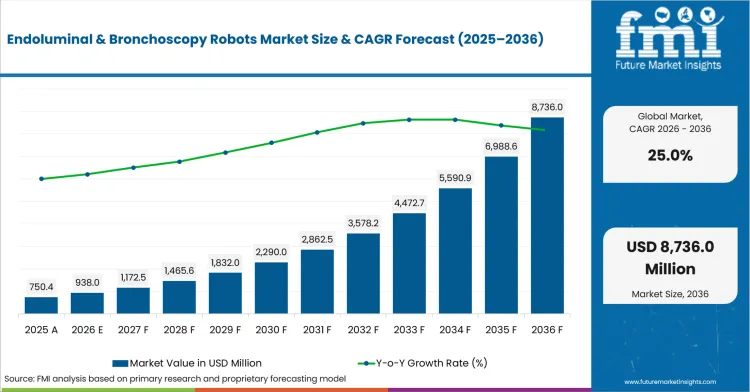
Key Takeaways of Endoluminal & Bronchoscopy Robots Market
- Demand for endoluminal and bronchoscopy robots is driven by hospitals connecting diagnostic confidence with coordinated oncology care, with program decisions reflecting published clinical evidence and specialist education.
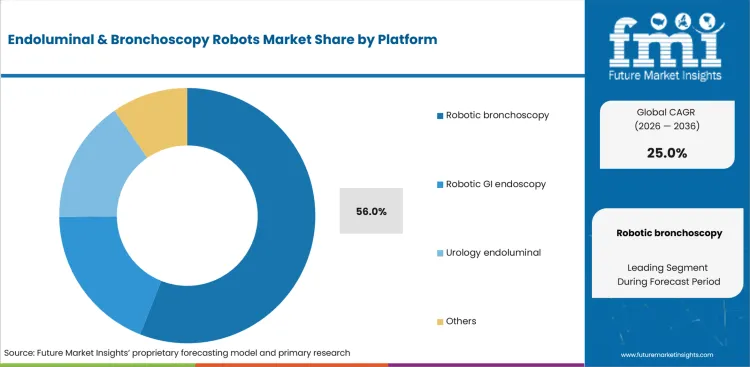
- By platform, robotic bronchoscopy holds the leading share at 56.0% in 2026, backed by established clinical use across lung nodule diagnosis.
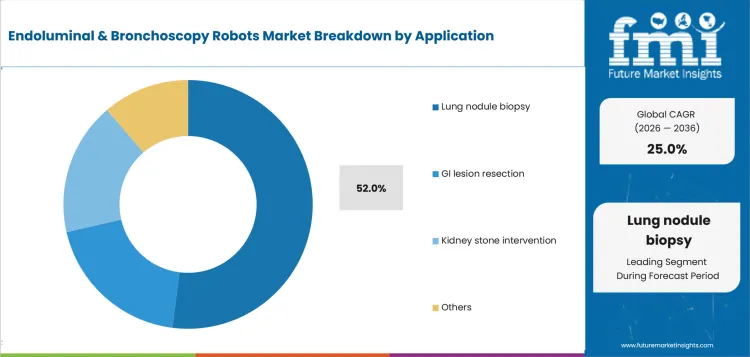
- Lung nodule biopsy is the dominant application segment, holding 52.0% share in 2026, owing to established bronchoscopy platforms and expanding screening-linked referrals.
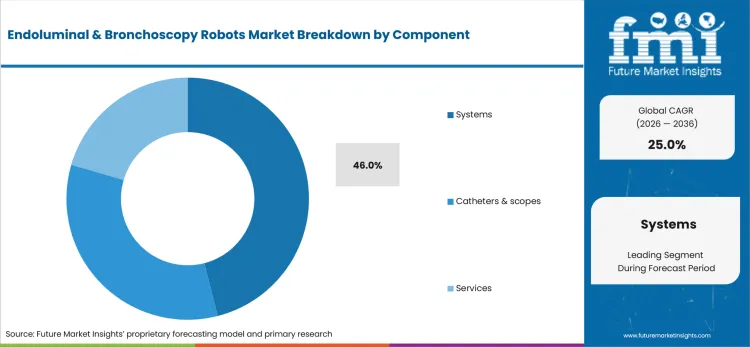
- Systems lead the component category at 46.0% share in 2026, reflecting robotic controls and navigation equipment driving platform value.
- Academic hospitals account for 44.0% end-user share in 2026, guided by clinical-study participation and specialist education infrastructure.
- China, the European Union, and the United States record CAGRs of 28.0%, 26.0%, and 24.0% respectively through 2036, shaped by tertiary-care expansion, coordinated oncology networks, and established platform access.
- Competition centers on Intuitive Surgical, Johnson & Johnson MedTech, Noah Medical, and EndoQuest Robotics, with vendors differentiating through established bronchoscopy platforms, imaging-led peripheral nodule confirmation, and investigational therapeutic endoluminal access.
Analyst Perspective
"Commercial adoption will depend on whether robotic bronchoscopy consistently improves diagnostic confidence for complex pulmonary lesions without disrupting established clinical workflows. Hospitals are prioritizing procedural accuracy, multidisciplinary integration, and physician training over technology novelty. Companies that demonstrate reproducible clinical outcomes and implementation expertise will strengthen long-term market acceptance."
- Anurag Sharma, Principal Consultant for Healthcare at Future Market Insights
Source: Future Market Insights analysis, 2026.
How is Endoluminal and Bronchoscopy Robots Market segmented?
The endoluminal and bronchoscopy robots industry is segmented by platform, application, component, end user, business model, and region.
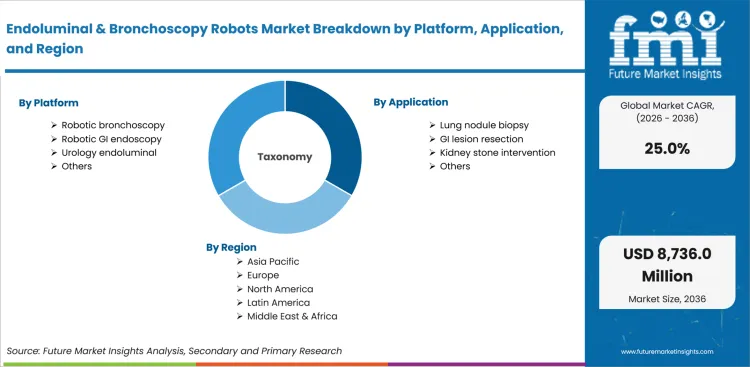
The endoluminal and bronchoscopy robots market is segmented by platform, application, component, end user, business model, and region. Platform coverage includes robotic bronchoscopy and robotic GI endoscopy followed by urology endoluminal systems and others. Application coverage addresses lung nodule biopsy and GI lesion resection with kidney stone intervention and other procedures. Component coverage encompasses systems and catheters & scopes supported by installation and continuing clinical services. End-user coverage spans academic hospitals and community hospitals with cancer centers offering specialist diagnostic programs. Business-model coverage includes capital purchase and per-procedure consumables through lease arrangements and placement programs. Regional coverage includes North America and Europe together with Asia Pacific. Latin America and Middle East and Africa complete geographic analysis across developing hospital systems.
Why does robotic bronchoscopy shape platform selection?
Zhang and colleagues reported in January 2024 a pooled robotic bronchoscopy diagnostic yield of 80.4%, impacting platform review for peripheral pulmonary lesion procedures requiring controlled reach. This clinical performance directs hospital attention toward navigation software and articulating catheters guiding clinicians along planned airway paths toward difficult nodules. Robotic gastrointestinal endoscopy extends the same minimally invasive principle into therapeutic digestive procedures requiring precise tissue access and controlled instrument movement.
- Robotic bronchoscopy is set to represent 56.0% share of platform revenue in 2026, backed by established clinical use across lung nodule diagnosis. Hospital teams assess navigation stability and lesion confirmation across complete procedures to evaluate performance beyond initial access.
- Robotic gastrointestinal endoscopy and urology endoluminal systems address therapeutic work involving flexible access based on natural openings. Procedure planning considers instrument reach and tissue control during carefully selected investigational cases.
How does lung nodule biopsy shape application demand?
Screening and imaging programs identify small nodules that frequently require tissue confirmation before clinicians can select an appropriate oncology pathway. It supports lung nodule biopsy as the principal application, and gastrointestinal lesion resection applies comparable robotic precision to therapeutic procedures across the digestive tract. World Health Organization reported in July 2026 approximately 2.6 million lung cancer cases worldwide during 2024, reinforcing diagnostic needs for precise access to suspicious peripheral lesions.
- Based on application, lung nodule biopsy is anticipated to secure 52.0% share in 2026 owing to established bronchoscopy platforms and expanding screening-linked referrals. Pulmonology teams examine lesion reach and tissue adequacy driven by endobronchial ultrasound biopsy pathways prior to adopting robotic support.
- Gastrointestinal lesion resection and kidney stone intervention create distinct procedural needs involving flexible access and precise instrument control. Lesion location and required instrument motion guide case assignment among participating specialist services.
Why do systems account for component leadership?
Intuitive Surgical reported in January 2026 an installed base of 995 Ion systems at year-end 2025, documenting continued capital-platform expansion across bronchoscopy programs. Each installed system combines robotic drive units and imaging integration to support planning and instrument guidance during procedures. Catheters and scopes operate within this system architecture as recurring procedural components, linking capital-equipment use with continuing supply and service requirements.
- By component, systems are forecast to garner 46.0% share in 2026 as platform value reflects robotic controls and navigation equipment. Hospital committees compare clinical workflow integration and service response through an endoscopy visualization system already used across interventional suites.
- Catheters and scopes support repeated procedural access through sterile or reprocessed instrument pathways across scheduled clinical cases. Procedure teams pair cytology brushes with service support selected for specimen collection and equipment readiness.
Why do academic hospitals lead end-user demand?
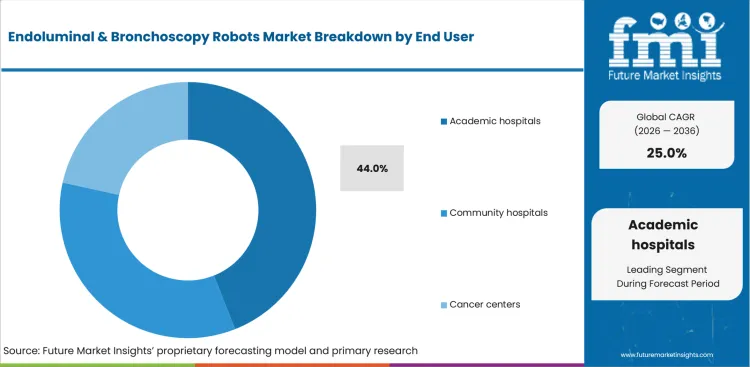
Johnson & Johnson MedTech reported in May 2025 a TARGET study spanning 21 global sites, illustrating academic and tertiary-center participation in robotic bronchoscopy evidence development. Such institutions combine thoracic surgery and advanced imaging expertise within coordinated programs supporting research and complex procedures. Leading community hospitals and cancer centers to extend access by managing referred cases as specialist training and procedural pathways become established.
- Academic hospitals are projected to hold 44.0% share in 2026, guided by clinical-study participation and specialist education infrastructure. Research teams evaluate platform performance across defined protocols involving biopsy guidance system support and pathology confirmation.
- Community hospitals and cancer centers extend access through regional oncology networks serving referred patients across several communities. Referral volume and clinician availability shape scheduling plans within regional oncology services.
How does capital purchase retain business model strength?
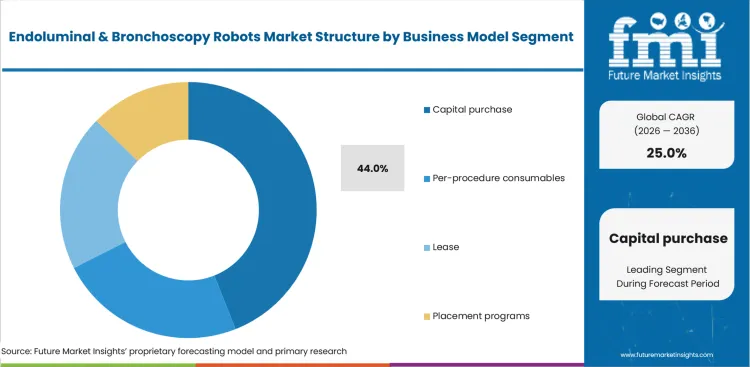
Capital purchase gives established hospitals direct control over equipment availability and operating schedules. Placement programs provide an alternative for developing services by connecting initial system access with recurring procedural inputs during gradual volume expansion. An Intuitive Surgical annual filing issued in February 2026 recorded 49% of Ion placements under operating leases during 2025, revealing material use of flexible access structures beside ownership.
- In 2026, capital purchase is estimated to hold 44.0% share since it is helped by hospital control over system availability and operating schedules. Organizations connect ownership with trained specialists and documented maintenance routines across established interventional programs serving scheduled patients.
- Per-procedure consumables and leases distribute payment across procedural activity without full ownership during system installation. Site committees review expected case flow and payment exposure during each staged evaluation.
What are drivers, restraints, and opportunities in Endoluminal & Bronchoscopy Robots Market?
Screening-linked diagnostic needs and clinical evidence support robotic platform evaluation. Capital intensity and specialist requirements may delay routine use across lower-volume hospitals.
- Driver: Pulmonology teams need controlled peripheral lesion access for dependable tissue diagnosis across oncology pathways. Multidisciplinary services favor tools supporting accurate sampling and coordinated treatment planning for referred patients entering specialist care.
- Restraint: High initial platform expense may challenge lower-volume hospitals lacking consistent procedure throughput across specialist services. Specialist education needs may extend implementation across new clinical teams during early procedural use and supervised case preparation.
- Opportunity: Therapeutic gastrointestinal and urology programs may extend procedural utility beyond lung biopsy into natural-opening surgery. Flexible service structures are expected to improve access across developing hospital networks establishing specialty programs.
American Cancer Society researchers reported in November 2025 screening participation of 18.7% among eligible United States adults during 2024, revealing substantial referral headroom for small-nodule workups. Diagnostic pathways are projected to combine lung biopsy systems with robotic navigation for difficult peripheral targets. Expanding screening access is expected to increase referrals for robotic assessment of peripheral lung nodules.
Capital exposure remains a constraint for hospitals building early robotic bronchoscopy volume across lower-throughput clinical services. An Intuitive Surgical annual filing submitted in January 2025 documented 153 Ion systems placed under operating leases during 2024, illustrating demand for structures reducing immediate ownership burden. Community hospitals are likely to favor staged access during early service development and specialist education.
Therapeutic procedures offer an opportunity for multi-specialty platform expansion beyond pulmonology into gastrointestinal treatment programs. National Cancer Institute figures updated in May 2025 estimated 107,320 United States colon cancer cases for 2025, supporting clinical needs for advanced colorectal diagnosis and oncology resection devices. Specialist evidence is anticipated to guide evaluation across gastrointestinal programs reviewing flexible robotic instruments for therapeutic procedures.
How are country CAGRs aligned in Endoluminal & Bronchoscopy Robots Market?
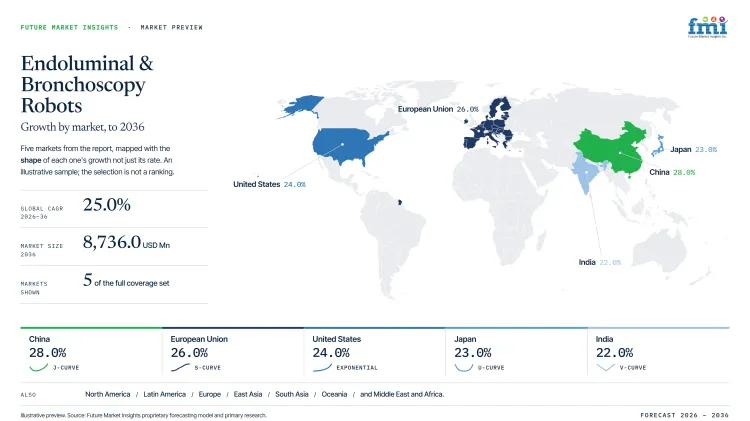
| Country or Market | CAGR |
|---|---|
| China | 28.0% |
| European Union | 26.0% |
| United States | 24.0% |
| Japan | 23.0% |
| India | 22.0% |
Source: Future Market Insights analysis, 2026.
How do country-level CAGRs compare in Endoluminal & Bronchoscopy Robots Market?
Country comparison shows a gradual step-down in growth across the markets covered. China sits at the upper end of the range, followed by the European Union. United States and Japan form a closely grouped middle tier. India remains at the lower end of the comparison. The six-point spread shows that these markets share a strong growth outlook, although their relative positions indicate different levels of market momentum. European Union figure represents a regional average, so individual member countries may record higher or lower growth.
- China leads the comparison and establishes East Asia as a notable growth cluster among the markets shown.
- European Union follows China and maintains a relatively small gap from the leading market.
- United States and Japan form the next growth band, which indicates that neither market falls far behind the upper group.
- India records the slowest growth among the listed markets, yet its forecast remains strong within the wider market context.
- The pattern resembles a gradual downward slope rather than a sharp separation between high-growth and low-growth markets.
Markets with broadly similar CAGRs can still present different entry conditions due to clinical infrastructure and robotic procedure readiness. The full report provides country-level analysis across North America, Latin America, Europe, East Asia, South Asia, Oceania and the Middle East and Africa.
Country-wise Analysis
- Endoluminal and bronchoscopy robot sales in China are anticipated to rise at 28.0% CAGR between 2026 and 2036, guided by tertiary-care expansion and domestic device development. Provincial hospital networks create practical settings for specialty-led evaluation and regional education. National Bureau of Statistics of China reported in February 2026 a total of 38,000 hospitals at year-end 2025, providing a substantial institutional base for advanced diagnostic equipment.
- Eurostat counted 99 million European Union residents aged 65 years or older at start of 2025 in its May 2026 publication, increasing pressure on oncology pathways serving older populations. Coordinated cancer networks support standardized review across university hospitals and referral centers. The market in European Union is projected to expand at 26.0% CAGR over the study period, aided by established interventional programs and cross-border clinical education.
- Established bronchoscopy installations support clinical familiarity across prominent United States thoracic centers and community referral networks. Sector in the United States is estimated to record 24.0% CAGR from 2026 to 2036, reflecting continued procedural expansion from an established installed base. American Cancer Society researchers projected in January 2024 about 234,580 new United States lung and bronchus cancer cases for 2024, sustaining need for timely tissue diagnosis across oncology programs.
- Endoluminal and bronchoscopy robot sector in Japan is forecast to grow at 23.0% CAGR during the forecast period, influenced by specialist concentration and measured capital-equipment review. Academic cancer centers offer structured settings for local evidence development and clinician education. Statistics Bureau of Japan reported in April 2025 a population of 36.24 million residents aged 65 years or older during 2024, increasing attention toward minimally invasive diagnostic access.
- Press Information Bureau announced in March 2026 approval of 297 additional district day-care cancer centres for fiscal 2025-2026, extending district-level oncology access. Metro hospital groups and public centers offer initial settings for advanced interventional platforms and specialist education. Industry in India is predicted to rise at 22.0% CAGR during the study period, aided by gradual service expansion and specialist-network development.
Who are notable companies in Endoluminal & Bronchoscopy Robots Market?
Intuitive Surgical supplies the Ion Endoluminal System for robotic bronchoscopy. Johnson & Johnson MedTech supports robotic bronchoscopy through MONARCH. Noah Medical adds Galaxy imaging-guided navigation. EndoQuest Robotics advances an investigational flexible endoluminal platform for therapeutic procedures.
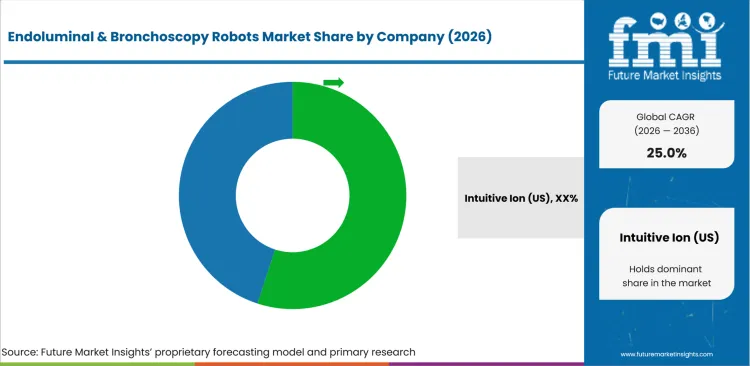
Competition in endoluminal and bronchoscopy robots is anticipated to center on clinical performance and procedural support. Hospital teams are likely to compare companies through lesion access evidence and staff education prior to platform selection. Intuitive Surgical is expected to receive attention through extensive Ion deployment across trained hospital programs. Johnson & Johnson MedTech is projected to add multicenter evidence supporting MONARCH evaluation across pulmonology services. Noah Medical is estimated to support platform review through integrated imaging and real-time lesion confirmation. EndoQuest Robotics is anticipated to compete across investigational gastrointestinal procedures requiring flexible endoluminal instrument control.
- Intuitive Surgical and Johnson & Johnson MedTech gain review attention based on established robotic bronchoscopy platforms. Clinical teams assess navigation consistency and education access across complete procedural pathways.
- Noah Medical competes due to real-time imaging integration and compact system configuration across bronchoscopy programs. Pulmonology programs compare lesion confirmation and procedural workflow across difficult peripheral targets.
- EndoQuest Robotics supports therapeutic endoluminal evaluation across gastrointestinal applications involving flexible instrument access. Trial progress influences hospital review across academic gastroenterology and surgery programs.
- Virtuoso Surgical receives specialist interest for robotically controlled rigid endoscopic surgery. Clinical development influences future review across urology and other endoscopic specialties.
Competitive Benchmarking: Endoluminal & Bronchoscopy Robots Market
| Company | Portfolio Depth | Clinical Match | Service Support | Service Reach |
|---|---|---|---|---|
| Intuitive Surgical | High | High | High | United States and selected global markets |
| Johnson & Johnson MedTech | High | High | High | United States and selected global markets |
| Noah Medical | Medium | High | Medium | United States |
| EndoQuest Robotics | Medium | Medium | Medium | United States development sites |
Source: Future Market Insights competitive analysis, 2026.
Key Developments in Endoluminal & Bronchoscopy Robots Market
- In March 2025, Johnson & Johnson MedTech announced United States clearance for MONARCH QUEST with AI-powered navigation and an interface supporting mobile cone-beam computed tomography. Company claims indicated increased real-time computational power of 260%, supporting more responsive navigation across difficult pulmonary targets.
- In September 2025, Virtuoso Surgical announced FDA Breakthrough Device Designation for its robotically controlled endoscopic system used in en bloc bladder lesion removal. Company information linked needle-sized robotic arms with improved instrument dexterity, strengthening future endoluminal procedure evaluation across specialist services.
- In March 2026, Noah Medical announced publication of MATCH 2 findings reporting 96.7% tool-in-lesion confirmation using embedded tomosynthesis. Company results supported Galaxy comparison for real-time targeting across peripheral pulmonary nodules requiring dependable biopsy guidance.
Key Players in Endoluminal & Bronchoscopy Robots Market
Established robotic bronchoscopy companies
- Intuitive Surgical
- Johnson & Johnson MedTech
Imaging-guided robotic bronchoscopy developer
- Noah Medical
Therapeutic endoluminal robotics developers
- EndoQuest Robotics
- Virtuoso Surgical
Endoluminal & Bronchoscopy Robots Market Report Scope
| Coverage field | Report scope |
|---|---|
| Market breakdown | Endoluminal & Bronchoscopy Robots Market breakdown by platform, application, component, end user, business model, and region |
| Market Definition | Endoluminal and bronchoscopy robots include navigated robotic systems supporting diagnostic or therapeutic procedures through natural body openings. |
| Regions Covered | North America, Latin America, Europe, East Asia, South Asia, Oceania, and Middle East and Africa. |
| Countries Covered | China, Japan, USA, South Korea, Germany, and India, with the European Union included as a regional benchmark. |
| Key Companies Profiled | Intuitive Surgical and Johnson & Johnson MedTech with Noah Medical and EndoQuest Robotics and Virtuoso Surgical |
| Forecast Period | 2026 to 2036 |
| Approach | Hybrid bottom-up and top-down methodology using segment share and country CAGR with procedural activity and company participation and clinical evidence and service coverage |
Source: Future Market Insights analysis, 2026.
Endoluminal & Bronchoscopy Robots Market - Research Methodology
| Method | Approach |
|---|---|
| Primary Research | FMI analysts gathered input from manufacturers, service providers, technology developers, distributors, end users, procurement teams, and subject-matter experts. Interviews examined purchasing decisions, product or service evaluation, adoption barriers, approval requirements, pricing considerations, and expectations for technical or commercial support. Respondents were also asked what evidence is required before a trial, pilot, or initial order develops into regular purchasing. |
| Desk Research | Desk research covered government statistics, regulatory publications, trade data, industry associations, technical literature, standards, company filings, product information, and official corporate announcements. Sources were reviewed for relevance, publication date, geographic coverage, and consistency with the defined market scope. Claims relating to performance, applications, approvals, capacity, investment, and commercial activity were retained only when supported by credible public evidence. |
| Market Sizing and Forecasting | The market model combined the baseline value with historical performance, segment structure, pricing and volume indicators, adoption levels, company participation, and country-level demand conditions. Forecast assumptions considered economic activity, investment trends, regulatory developments, technology adoption, purchasing cycles, supply availability, and barriers to wider market use. Segment and regional estimates were reconciled before the final market total was calculated. |
| Data Validation | Estimates were checked against multiple independent indicators, including public data, company activity, trade patterns, industry developments, and findings from primary interviews. Validation also tested whether products, services, applications, and company revenues fell within the defined market boundaries. Adjacent categories, unsupported claims, overlapping revenues, and activities without direct market relevance were excluded to reduce double counting and maintain consistency across segments and countries. |
Source: Future Market Insights analysis, 2026.
Endoluminal & Bronchoscopy Robots Market by Segments
Endoluminal & Bronchoscopy Robots Market segmented by Platform:
- Robotic Bronchoscopy
- Robotic GI Endoscopy
- Urology Endoluminal
- Others
Endoluminal & Bronchoscopy Robots Market segmented by Application:
- Lung Nodule Biopsy
- GI Lesion Resection
- Kidney Stone Intervention
- Others
Endoluminal & Bronchoscopy Robots Market segmented by Component:
- Systems
- Catheters & Scopes
- Services
Endoluminal & Bronchoscopy Robots Market segmented by End User:
- Academic Hospitals
- Community Hospitals
- Cancer Centers
Endoluminal & Bronchoscopy Robots Market segmented by Business Model:
- Capital Purchase
- Per-Procedure Consumables
- Lease
- Placement Programs
Endoluminal & Bronchoscopy Robots Market segmented by Region:
- North America
- Europe
- Asia Pacific
- Latin America
- Middle East and Africa
Research Sources and Bibliography
- Intuitive Surgical, Inc. (2026, April 22). Quarterly report for period ended March 31, 2026 (Form 10-Q).
- Intuitive Surgical, Inc. (2026, April 21). Intuitive announces first quarter earnings.
- Zhang, C., Xie, F., Li, R., Cui, N., Herth, F. J. F., & Sun, J. (2024). Robotic-assisted bronchoscopy for the diagnosis of peripheral pulmonary lesions: A systematic review and meta-analysis. Thoracic Cancer, 15(7), 505-512.
- World Health Organization. (2026, July 3). Cancer.
- Intuitive Surgical, Inc. (2026, January 22). Intuitive announces fourth quarter earnings.
- Johnson & Johnson MedTech. (2025, May 28). Johnson & Johnson MedTech announces new clinical data for the MONARCH platform for robotically-assisted bronchoscopy.
- Intuitive Surgical, Inc. (2026, February 3). Annual report for fiscal year ended December 31, 2025 (Form 10-K).
- American Cancer Society. (2025, November 19). Latest ACS lung cancer data: Only 1 in 5 eligible adults in USA screened for lung cancer; 62,000 lives over 5 years could be saved if all eligible screened.
- Intuitive Surgical, Inc. (2025, January 31). Annual report for fiscal year ended December 31, 2024 (Form 10-K).
- National Cancer Institute. (2025, May 6). Common cancer types.
- National Bureau of Statistics of China. (2026, February 28). Statistical communiqué of the People’s Republic of China on the 2025 national economic and social development.
- Eurostat. (2026, May 21). Demography of Europe - 2026 edition.
- Siegel, R. L., Giaquinto, A. N., & Jemal, A. (2024). Cancer statistics, 2024. CA: A Cancer Journal for Clinicians, 74(1), 12-49.
- Statistics Bureau of Japan. (2025, April 14). Current population estimates as of October 1, 2024.
- Press Information Bureau. (2026, March 13). Measures taken to prevent non-communicable diseases.
- Johnson & Johnson MedTech. (2025, March 12). Johnson & Johnson MedTech announces clearance of MONARCH QUEST for enhanced robotic-assisted bronchoscopy.
- Virtuoso Surgical, Inc. (2025, September 22). Virtuoso Surgical robotic system receives FDA Breakthrough Device Designation.
- Noah Medical. (2026, March 11). Respiratory Medicine publishes MATCH 2 study demonstrating reliability of real-time imaging guidance in robotic bronchoscopy.
This bibliography is provided for reader reference and is not exhaustive. The full report contains the complete reference list and detailed citations.
This Report Answers
- What segments influence demand across platform and application with component and end user and business model?
- How do pulmonology teams evaluate endoluminal and bronchoscopy robots prior to routine clinical use across hospital services?
- How do country CAGRs differ across profiled markets with distinct hospital capacity and specialist access?
- What companies compete through platform depth and clinical evidence and dependable regional service support across hospital networks?
- How are forecasts validated through hybrid bottom-up and top-down analysis using independent market indicators and company evidence?
- What evidence do hospital committees examine prior to multi-site platform expansion across clinical services and participating departments?
- How do navigation quality and lesion confirmation influence equipment selection across interventional pulmonology programs and hospital networks?
- What limits return on investment for hospitals adding endoluminal and bronchoscopy robots across specialist services?
- How do education records and specialist guidance influence hospital approval across multidisciplinary clinical teams and participating departments?
- What company capabilities improve long-term clinical confidence and continuing platform utilization across hospital networks and specialty services?
Frequently Asked Questions
How big is the Endoluminal & Bronchoscopy Robots Market in 2026?
The endoluminal and bronchoscopy robots market is valued at USD 938.0 million in 2026 and is forecast to reach USD 8736.0 million by 2036, as hospital programs expand robotic navigation and lesion confirmation across diagnostic and therapeutic procedures for pulmonary and gastrointestinal oncology pathways.
What is the CAGR of the Endoluminal & Bronchoscopy Robots Market from 2026 to 2036?
The endoluminal and bronchoscopy robots market grows at a 25.0% CAGR between 2026 and 2036, supported by expanding lung cancer screening programs and multidisciplinary hospital services requiring dependable tissue access for peripheral pulmonary lesions across coordinated oncology pathways.
Which platform leads the Endoluminal & Bronchoscopy Robots Market?
Robotic bronchoscopy holds 56.0% of the endoluminal and bronchoscopy robots market by platform in 2026, reflecting established clinical use across lung nodule diagnosis and navigation software supporting articulating catheters that guide clinicians toward difficult peripheral pulmonary lesions.
How much will the Endoluminal & Bronchoscopy Robots Market add between 2026 and 2036?
The endoluminal and bronchoscopy robots market will add USD 7,798.0 million between 2026 and 2036, rising from USD 938.0 million to USD 8736.0 million as robotic bronchoscopy platforms expand across trained hospital programs and screening-linked referrals increase demand for minimally invasive tissue confirmation.
Who are the leading companies in the Endoluminal & Bronchoscopy Robots Market?
Five companies lead the endoluminal and bronchoscopy robots market, including Intuitive Surgical, Johnson & Johnson MedTech, Noah Medical, EndoQuest Robotics, and Virtuoso Surgical, competing through established bronchoscopy platforms, imaging-led peripheral nodule confirmation, and investigational therapeutic endoluminal access across specialist hospital programs.
Preview the report firsthand - request a free sample
Get SampleGet the brochure for pricing and purchase details.
Get PDFTable of Content
- Key Takeaways
- Market Size and CAGR
- Top Growth Driver
- Fastest Growing Segment
- Leading Region
- Key Companies
- Emerging Opportunities
- Executive Summary
- Global Market Outlook
- Demand-side Trends
- Supply-side Trends
- Technology Roadmap Analysis
- Analysis and Recommendations
- Analyst Perspective (What is happening? Why now? What should investors know?)
- Key Questions Answered
- How large is the market?
- What is the CAGR?
- What are key trends?
- Which region dominates?
- Who are the leaders?
- Market Overview
- Market Coverage / Taxonomy
- Market Definition / Scope / Limitations
- Research Methodology
- Chapter Orientation
- Analytical Lens and Working Hypotheses
- Market Structure, Signals, and Trend Drivers
- Benchmarking and Cross-market Comparability
- Market Sizing, Forecasting, and Opportunity Mapping
- Research Design and Evidence Framework
- Desk Research Programme (Secondary Evidence)
- Expert Input and Fieldwork (Primary Evidence)
- Tooling, Models, and Reference Databases
- Data Engineering and Model Build
- Quality Assurance and Audit Trail
- Market Background
- Market Dynamics (Drivers, Restraints, Opportunity, Trends)
- Scenario Forecast (Optimistic, Likely, Conservative)
- Impact Analysis
- AI Impact
- Sustainability Impact
- Regulatory Impact
- Technology Impact
- Consumer / Buyer Analysis
- Purchase Drivers
- Adoption Barriers
- Buyer Journey
- Opportunity Map Analysis
- Product Life Cycle Analysis
- Supply Chain Analysis
- Investment Feasibility Matrix
- Value Chain Analysis
- PESTLE and Porter's Analysis
- Regulatory Landscape
- Regional Parent Market Outlook
- Production and Consumption Statistics
- Import and Export Statistics
- Global Market Analysis and Forecast, 2021 to 2036
- Historical Market Size Value (USD Mn) Analysis, 2021 to 2025
- Current and Future Market Size Value (USD Mn) Projections, 2026 to 2036
- Y-o-Y Growth Trend Analysis
- Absolute $ Opportunity Analysis
- Global Market Pricing Analysis, 2021 to 2036
- Global Market Analysis and Forecast, By Platform, 2021 to 2036
- Introduction / Key Findings
- Historical Market Size Value (USD Mn) Analysis By Platform, 2021 to 2025
- Current and Future Market Size Value (USD Mn) Analysis and Forecast By Platform, 2026 to 2036
- Robotic bronchoscopy
- Robotic GI endoscopy
- Urology endoluminal
- Others
- Robotic bronchoscopy
- Y-o-Y Growth Trend Analysis By Platform, 2021 to 2025
- Absolute $ Opportunity Analysis By Platform, 2026 to 2036
- Global Market Analysis and Forecast, By Application, 2021 to 2036
- Introduction / Key Findings
- Historical Market Size Value (USD Mn) Analysis By Application, 2021 to 2025
- Current and Future Market Size Value (USD Mn) Analysis and Forecast By Application, 2026 to 2036
- Lung nodule biopsy
- GI lesion resection
- Kidney stone intervention
- Others
- Lung nodule biopsy
- Y-o-Y Growth Trend Analysis By Application, 2021 to 2025
- Absolute $ Opportunity Analysis By Application, 2026 to 2036
- Global Market Analysis and Forecast, By Component, 2021 to 2036
- Introduction / Key Findings
- Historical Market Size Value (USD Mn) Analysis By Component, 2021 to 2025
- Current and Future Market Size Value (USD Mn) Analysis and Forecast By Component, 2026 to 2036
- Systems
- Catheters & scopes
- Services
- Systems
- Y-o-Y Growth Trend Analysis By Component, 2021 to 2025
- Absolute $ Opportunity Analysis By Component, 2026 to 2036
- Global Market Analysis and Forecast, By End User, 2021 to 2036
- Introduction / Key Findings
- Historical Market Size Value (USD Mn) Analysis By End User, 2021 to 2025
- Current and Future Market Size Value (USD Mn) Analysis and Forecast By End User, 2026 to 2036
- Academic hospitals
- Community hospitals
- Cancer centers
- Academic hospitals
- Y-o-Y Growth Trend Analysis By End User, 2021 to 2025
- Absolute $ Opportunity Analysis By End User, 2026 to 2036
- Global Market Analysis and Forecast, By Business Model, 2021 to 2036
- Introduction / Key Findings
- Historical Market Size Value (USD Mn) Analysis By Business Model, 2021 to 2025
- Current and Future Market Size Value (USD Mn) Analysis and Forecast By Business Model, 2026 to 2036
- Capital purchase
- Per-procedure consumables
- Lease
- Placement programs
- Capital purchase
- Y-o-Y Growth Trend Analysis By Business Model, 2021 to 2025
- Absolute $ Opportunity Analysis By Business Model, 2026 to 2036
- Global Market Analysis and Forecast, By Region, 2021 to 2036
- Introduction
- Historical Market Size Value (USD Mn) Analysis By Region, 2021 to 2025
- Current Market Size Value (USD Mn) Analysis and Forecast By Region, 2026 to 2036
- North America
- Latin America
- Western Europe
- Eastern Europe
- East Asia
- South Asia and Pacific
- Middle East & Africa
- Market Attractiveness Analysis By Region
- North America Market Analysis and Forecast, By Country, 2021 to 2036
- Historical Market Size Value (USD Mn) Trend Analysis By Market Taxonomy, 2021 to 2025
- Market Size Value (USD Mn) Forecast By Market Taxonomy, 2026 to 2036
- By Country
- USA
- Canada
- By Platform
- By Application
- By Component
- By End User
- By Business Model
- By Country
- Market Attractiveness Analysis
- By Country
- By Platform
- By Application
- By Component
- By End User
- By Business Model
- Key Takeaways
- Latin America Market Analysis and Forecast, By Country
- Historical Market Size Value (USD Mn) Trend Analysis By Market Taxonomy, 2021 to 2025
- Market Size Value (USD Mn) Forecast By Market Taxonomy, 2026 to 2036
- By Country
- Brazil
- Mexico
- Chile
- Rest of Latin America
- By Platform
- By Application
- By Component
- By End User
- By Business Model
- By Country
- Market Attractiveness Analysis
- By Country
- By Platform
- By Application
- By Component
- By End User
- By Business Model
- Key Takeaways
- Western Europe Market Analysis and Forecast, By Country
- Historical Market Size Value (USD Mn) Trend Analysis By Market Taxonomy, 2021 to 2025
- Market Size Value (USD Mn) Forecast By Market Taxonomy, 2026 to 2036
- By Country
- Germany
- UK
- Italy
- Spain
- France
- Nordic
- BENELUX
- Rest of Western Europe
- By Platform
- By Application
- By Component
- By End User
- By Business Model
- By Country
- Market Attractiveness Analysis
- By Country
- By Platform
- By Application
- By Component
- By End User
- By Business Model
- Key Takeaways
- Eastern Europe Market Analysis and Forecast, By Country
- Historical Market Size Value (USD Mn) Trend Analysis By Market Taxonomy, 2021 to 2025
- Market Size Value (USD Mn) Forecast By Market Taxonomy, 2026 to 2036
- By Country
- Russia
- Poland
- Hungary
- Balkan & Baltic
- Rest of Eastern Europe
- By Platform
- By Application
- By Component
- By End User
- By Business Model
- By Country
- Market Attractiveness Analysis
- By Country
- By Platform
- By Application
- By Component
- By End User
- By Business Model
- Key Takeaways
- East Asia Market Analysis and Forecast, By Country
- Historical Market Size Value (USD Mn) Trend Analysis By Market Taxonomy, 2021 to 2025
- Market Size Value (USD Mn) Forecast By Market Taxonomy, 2026 to 2036
- By Country
- China
- Japan
- South Korea
- By Platform
- By Application
- By Component
- By End User
- By Business Model
- By Country
- Market Attractiveness Analysis
- By Country
- By Platform
- By Application
- By Component
- By End User
- By Business Model
- Key Takeaways
- South Asia and Pacific Market Analysis and Forecast, By Country
- Historical Market Size Value (USD Mn) Trend Analysis By Market Taxonomy, 2021 to 2025
- Market Size Value (USD Mn) Forecast By Market Taxonomy, 2026 to 2036
- By Country
- India
- ASEAN
- Australia & New Zealand
- Rest of South Asia and Pacific
- By Platform
- By Application
- By Component
- By End User
- By Business Model
- By Country
- Market Attractiveness Analysis
- By Country
- By Platform
- By Application
- By Component
- By End User
- By Business Model
- Key Takeaways
- Middle East & Africa Market Analysis and Forecast, By Country
- Historical Market Size Value (USD Mn) Trend Analysis By Market Taxonomy, 2021 to 2025
- Market Size Value (USD Mn) Forecast By Market Taxonomy, 2026 to 2036
- By Country
- Kingdom of Saudi Arabia
- Other GCC Countries
- Türkiye
- South Africa
- Other African Union
- Rest of Middle East & Africa
- By Platform
- By Application
- By Component
- By End User
- By Business Model
- By Country
- Market Attractiveness Analysis
- By Country
- By Platform
- By Application
- By Component
- By End User
- By Business Model
- Key Takeaways
- Key Countries Market Analysis
- USA
- Pricing Analysis
- Market Share Analysis, 2025
- By Platform
- By Application
- By Component
- By End User
- By Business Model
- Canada
- Pricing Analysis
- Market Share Analysis, 2025
- By Platform
- By Application
- By Component
- By End User
- By Business Model
- Mexico
- Pricing Analysis
- Market Share Analysis, 2025
- By Platform
- By Application
- By Component
- By End User
- By Business Model
- Brazil
- Pricing Analysis
- Market Share Analysis, 2025
- By Platform
- By Application
- By Component
- By End User
- By Business Model
- Chile
- Pricing Analysis
- Market Share Analysis, 2025
- By Platform
- By Application
- By Component
- By End User
- By Business Model
- Germany
- Pricing Analysis
- Market Share Analysis, 2025
- By Platform
- By Application
- By Component
- By End User
- By Business Model
- UK
- Pricing Analysis
- Market Share Analysis, 2025
- By Platform
- By Application
- By Component
- By End User
- By Business Model
- Italy
- Pricing Analysis
- Market Share Analysis, 2025
- By Platform
- By Application
- By Component
- By End User
- By Business Model
- Spain
- Pricing Analysis
- Market Share Analysis, 2025
- By Platform
- By Application
- By Component
- By End User
- By Business Model
- France
- Pricing Analysis
- Market Share Analysis, 2025
- By Platform
- By Application
- By Component
- By End User
- By Business Model
- India
- Pricing Analysis
- Market Share Analysis, 2025
- By Platform
- By Application
- By Component
- By End User
- By Business Model
- ASEAN
- Pricing Analysis
- Market Share Analysis, 2025
- By Platform
- By Application
- By Component
- By End User
- By Business Model
- Australia & New Zealand
- Pricing Analysis
- Market Share Analysis, 2025
- By Platform
- By Application
- By Component
- By End User
- By Business Model
- China
- Pricing Analysis
- Market Share Analysis, 2025
- By Platform
- By Application
- By Component
- By End User
- By Business Model
- Japan
- Pricing Analysis
- Market Share Analysis, 2025
- By Platform
- By Application
- By Component
- By End User
- By Business Model
- South Korea
- Pricing Analysis
- Market Share Analysis, 2025
- By Platform
- By Application
- By Component
- By End User
- By Business Model
- Russia
- Pricing Analysis
- Market Share Analysis, 2025
- By Platform
- By Application
- By Component
- By End User
- By Business Model
- Poland
- Pricing Analysis
- Market Share Analysis, 2025
- By Platform
- By Application
- By Component
- By End User
- By Business Model
- Hungary
- Pricing Analysis
- Market Share Analysis, 2025
- By Platform
- By Application
- By Component
- By End User
- By Business Model
- Kingdom of Saudi Arabia
- Pricing Analysis
- Market Share Analysis, 2025
- By Platform
- By Application
- By Component
- By End User
- By Business Model
- Türkiye
- Pricing Analysis
- Market Share Analysis, 2025
- By Platform
- By Application
- By Component
- By End User
- By Business Model
- South Africa
- Pricing Analysis
- Market Share Analysis, 2025
- By Platform
- By Application
- By Component
- By End User
- By Business Model
- USA
- Market Structure Analysis
- Competition Dashboard
- Competition Benchmarking
- Market Share Analysis of Top Players
- By Regional
- By Platform
- By Application
- By Component
- By End User
- By Business Model
- Emerging Startups
- Innovation Benchmarking
- Competition Analysis
- Competition Deep Dive
- Intuitive Ion (US)
- Overview
- Product Portfolio
- Profitability by Market Segments
- Sales Footprint
- Strategy Overview
- Marketing Strategy
- Product Strategy
- Channel Strategy
- J&J Monarch (US)
- EndoQuest (US)
- Intuitive Ion (US)
- Case Studies
- Success Stories
- Recent Developments
- Competition Deep Dive
- Assumptions & Acronyms Used


