

- Market Size (2026)
- USD 45.6 Mn
- Forecast (2036)
- USD 92.2 Mn
- CAGR (2026 to 2036)
- 7.3%
How big is Endolymphatic Duct Shunts Market in 2026?
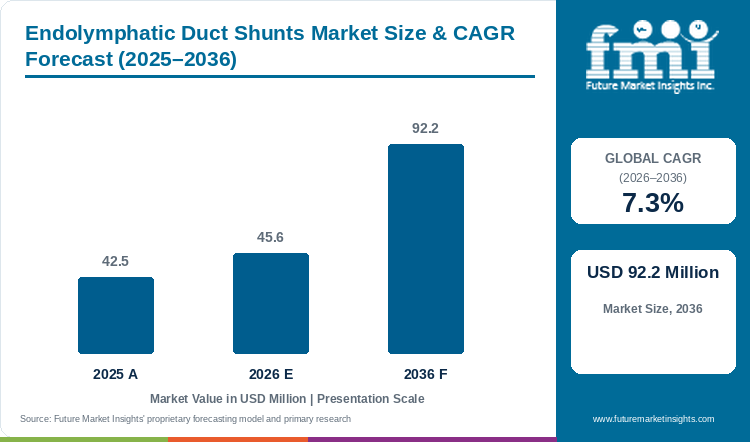
Worldwide market size for endolymphatic duct shunts totals USD 42.5 million during 2025 before rising to an estimated 2026 valuation of USD 45.6 million, with ten-year projections hitting USD 92.2 million by 2036 on a 7.3% CAGR.
Neurotologists treating patients who suffer disabling vertigo attacks despite intratympanic steroid injections prioritize non-destructive inner-ear decompression that spares residual cochlear hearing. In keeping with this surgical priority, Endolymphatic-Mastoid Cavity Silicone Shunt Tube is forecast to hold 63.4% of drainage destination valuation in 2026 across tertiary ear clinics that also implant cochlear and middle-ear hearing prostheses. In January 2026, a bicentric French cohort study of 45 definite refractory Ménière's disease patients treated at Aix-Marseille University and Rothschild Foundation Hospital published in Audiology Research reported 66.7% Class A/B vertigo control overall and 87.5% surgical success among patients with disease evolution exceeding five years [1]. Grounded in these hearing-sparing surgical volumes, FMI estimates that the global endolymphatic duct shunts industry valuation will grow from the 2025 mark of USD 42.5 million to a 2026 market size of USD 45.6 million and attain USD 92.2 million in 2036, progressing at a 7.3% annual pace and yielding USD 46.6 million of net annual market expansion. Perisaccular fibrosis and fibrous lumen occlusion nonetheless remain key clinical challenges during multi-year follow-up.
Key Market Trends & Insights
- By shunt drainage destination: Endolymphatic-Mastoid Cavity Silicone Shunt Tube is forecast to secure 63.4% of 2026 market size given that extradural mastoid drainage prevents subarachnoid meningitis and CSF leakage.
- By pressure-regulation valve mechanism: Capillary-Slit Unidirectional Pressure-Limiting Valve (Arenberg Class) accounts for an estimated 56.8% share in 2026 due to micro-slit silicone valves that vent hydrops pressure spikes while blocking perilymph reflux.
- By clinical otologic indication: Intractable Meniere's Disease (Endolymphatic Hydrops) is anticipated to account for 78.5% in 2026 attributable to 3-Tesla delayed gadolinium MRI protocols that confirm saccular hydrops before mastoidectomy.
Regional Highlights
- South Korean and Brazilian surgical expansion: South Korea leads evaluated national growth with an expected 8.5% compound annual expansion to 2036 above Brazil at 8.2%, aided by high-resolution inner-ear hydrops MRI screening and expanding neurotology fellowship centers.
- North American and Eurasian hospital demand: The United States is forecast to record a 6.9% yearly growth rate while Japan posts 6.8% and Germany registers 6.6%, fueled by university skull-base and otology surgical suites.
Market Size & Forecast
Table 1: Worldwide Endolymphatic Duct Shunts Valuation Progression, 2025 to 2036 (USD Million and Decade CAGR)
| Metric | Value |
|---|---|
| 2025 Market Size | USD 42.5 million |
| Estimated Market Size in 2026 | USD 45.6 million |
| Projected Market Size by 2036 | USD 92.2 million |
| CAGR, 2026 to 2036 | 7.3% |
| Added Annual Market Value, 2026 to 2036 | USD 46.6 million |
Comparative multi-year audiometric studies are prompting ear surgeons to weigh valved mastoid drainage tubes against selective titanium duct clips based on preoperative vestibular aqueduct morphology. In August 2025, otolaryngology investigators at Central South University's Second Xiangya Hospital reported a four-year follow-up study of 51 Ménière's disease patients in the European Archives of Oto-Rhino-Laryngology confirming that both endolymphatic duct blockage and endolymphatic sac drainage achieved significantly lower vertigo recurrence than simple sac decompression (p = 0.012 and p = 0.037) [2]. Prompted by these four-year outcomes, hospital skull-base teams pair preoperative video head impulse testing from clinical vestibular testing systems with precision silicone shunts and duct clips.
Otologic Procedure and Implant Unit Sizing
Table 2: Otologic Procedure Volume and Implant Unit Sizing Across Endolymphatic Duct Shunts (2025 to 2036 Operational Ranges)
| Metric | 2025 | 2026 | 2036 |
|---|---|---|---|
| Market size (USD million) | 42.5 | 45.6 | 92.2 |
| Refractory hydrops shunt & clip procedures worldwide (thousand cases) | 78.0 to 89.0 | 83.0 to 95.0 | 152.0 to 176.0 |
| Sterile silicone shunt tubes, valves & duct clips shipped (thousand units) | 96.0 to 112.0 | 103.0 to 120.0 | 190.0 to 222.0 |
| Average hospital implant price per sterile unit (USD) | 380 to 445 | 385 to 450 | 415 to 490 |
Operational note: Surgical procedure and implant unit ranges reconcile AAO-HNS Stage 3 and Stage 4 medically refractory Ménière's disease caseloads (roughly 15% to 20% of diagnosed patients failing diuretics and intratympanic steroids) against hospital sterile backup stocking ratios.
Otologic surgeons expose Donaldson's line through a cortical mastoidectomy under high-magnification optics before incising the outer dural leaf of the endolymphatic sac. Furthermore, operating rooms equip neurotology suites with 3D surgical microscope visualization systems so surgeons can insert radiopaque capillary-slit shunts into the tiny endolymphatic lumen without injuring the posterior semicircular canal.
Per Capita & Neurotology Center Sizing
Table 3: Per-Capita Otologic Spend and Neurotology Suite Benchmarks for Endolymphatic Duct Shunts (2025 to 2036 in USD)
| Metric | 2025 | 2026 | 2036 |
|---|---|---|---|
| World population (billion) | 8.2 | 8.3 | 9.0 |
| Market value per 1,000,000 people (USD) | 5,182.9 | 5,494.0 | 10,244.4 |
| Annual implant valuation per tertiary otology center (USD thousand) | 13.2 to 15.8 | 14.0 to 16.8 | 26.5 to 31.5 |
| Endolymphatic-mastoid silicone shunt & Arenberg valve share (%) | 56.0% to 63.0% | 56.8% to 63.4% | 58.5% to 65.0% |
Table 4: Tertiary Otology and Hydrops Implant Allocation Across Endolymphatic Duct Shunts (2026 USD and Share)
| Metric | Value | Institutional Reference Basis |
|---|---|---|
| Market size, 2026 | USD 45.6 million | 2026 global otologic shunt valuation baseline |
| Tertiary neurotology & skull-base centers worldwide | 2,950 hospitals | Global ENT & otologic microsurgery facility registry |
| Endolymphatic-mastoid silicone shunt value, 2026 | USD 28.9 million | 63.4% shunt drainage destination allocation |
| Intractable Meniere's disease implant value, 2026 | USD 35.8 million | 78.5% clinical otologic indication allocation |
Patients presenting with unilateral aural fullness, fluctuating low-frequency sensorineural hearing loss, and intractable tinnitus undergo comprehensive audiometric staging before surgical scheduling. When conservative therapy fails, multidisciplinary ear clinics pair endolymphatic sac shunt placement with clinical tinnitus management devices and vestibular rehabilitation.
Analyst Perspective
"Whereas chemical labyrinthectomy with intratympanic gentamicin risks permanent cochlear deafening, endolymphatic mastoid shunts and titanium duct clips preserve functional hearing in working-age Ménière's patients. Manufacturers supplying medical-grade 0.13-millimeter silicone sheeting and heparin-coated capillary valves as well as atraumatic titanium clip appliers will capture steady hospital tender renewals."
- Anurag Sharma, Principal Consultant, Future Market Insights.
How is the endolymphatic duct shunts market segmented?
The endolymphatic duct shunts market is segmented by shunt drainage destination, pressure-regulation valve mechanism, clinical otologic indication, and region. In 2026, Endolymphatic-Mastoid Cavity Silicone Shunt Tube is projected at 63.4%, Capillary-Slit Unidirectional Pressure-Limiting Valve (Arenberg Class) at 56.8%, and Intractable Meniere's Disease (Endolymphatic Hydrops) at 78.5%.
By shunt drainage destination: Endolymphatic-Mastoid Cavity Silicone Shunt Tube, Valved Endolymphatic-Subarachnoid Shunt, and Titanium / Silicone Endolymphatic Duct Clip (ELDC).
By pressure-regulation valve mechanism: Capillary-Slit Unidirectional Pressure-Limiting Valve (Arenberg Class), and Open-Lumen Silastic Sponge & Foil Sheet Shunt.
By clinical otologic indication: Intractable Meniere's Disease (Endolymphatic Hydrops), and Secondary Delayed Endolymphatic Hydrops & Vertigo.
Why does Endolymphatic-Mastoid Cavity Silicone Shunt Tube lead the shunt drainage destination category?
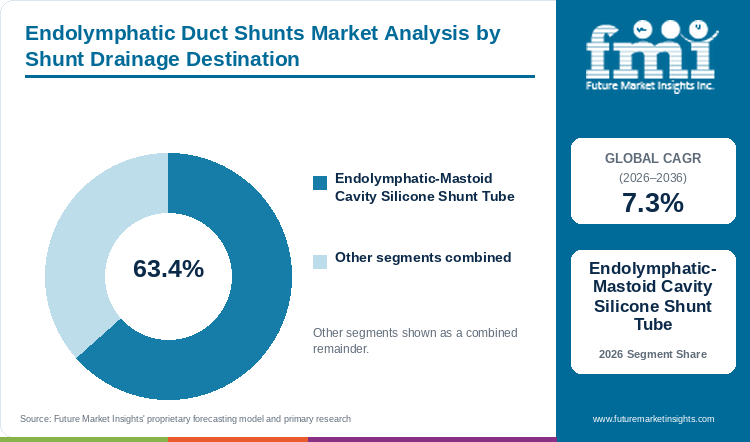
Endolymphatic-Mastoid Cavity Silicone Shunt Tube secures a forecast 63.4% share of drainage destination valuation in 2026, owing to extradural surgical safety.
Table 5: Shunt Drainage Destination Share for the Endolymphatic Duct Shunts Market (percentage share), 2026
| Shunt Drainage Destination | Share (2026) |
|---|---|
| Endolymphatic-Mastoid Cavity Silicone Shunt Tube | 63.4% |
| Other Segments Combined | 36.6%* |
| Total | 100.0% |
*Note: Remaining shunt drainage destination categories sum to 100.0% of 2026 market valuation.
Table 6: Shunt Drainage Destination Leadership and Market Growth for the Endolymphatic Duct Shunts Market (segment and CAGR percentage), 2026 to 2036
| Metric | Value |
|---|---|
| Global CAGR (2026 to 2036) | 7.3% |
| Leading Segment | Endolymphatic-Mastoid Cavity Silicone Shunt Tube |
Shunting excess endolymph directly into the aerated mastoid cavity avoids puncturing the posterior fossa dura, which eliminates cerebrospinal fluid leak and intracranial infection risks associated with subarachnoid shunts. Unlike large cranial cerebrospinal fluid hydrocephalus shunts, T-shaped and angled medical-grade silicone mastoid tubes fit entirely inside the petrous bone incision.
- Endolymphatic-Mastoid Cavity Silicone Shunt Tube is anticipated to generate 63.4% of drainage destination market size in 2026 aided by outpatient-compatible extradural mastoidectomy workflows.
- In July 2025, Emeritus Professor William P. R. Gibson at the University of Sydney published a comprehensive clinical review in Frontiers in Neurology tracing the evolution of endolymphatic-mastoid silastic shunts and Arenberg one-way valves in addition to duct clipping in Ménière's disease [3].
Why does Capillary-Slit Unidirectional Pressure-Limiting Valve (Arenberg Class) define the largest valve mechanism segment?
Capillary-Slit Unidirectional Pressure-Limiting Valve (Arenberg Class) captures an estimated 56.8% share of valve mechanism valuation in 2026, driven by anti-reflux pressure control.
Open-lumen silastic sheets and non-valved tubes can suffer from hypotonic collapse or retrograde fluid backflow when middle-ear and mastoid air pressures fluctuate. Arenberg-class unidirectional capillary-slit valves remain closed at normal physiological inner-ear pressure and open only when endolymphatic hydrops pressure exceeds preset micro-thresholds, preserving cochlear homeostasis under surgical operating microscopes.
- Capillary-Slit Unidirectional Pressure-Limiting Valve (Arenberg Class) is projected to hold 56.8% of valve mechanism market size in 2026 attributed to one-way micro-slit flow control that protects membranous labyrinth tension.
- In July 2026, Dutch otorhinolaryngology investigators led by Leiden University Medical Centre and Maastricht University Medical Centre published a multicenter double-blind randomized controlled trial in The Lancet Regional Health - Europe evaluating surgical endolymphatic duct and sac interventions across seven hospitals [4].
What keeps Intractable Meniere's Disease (Endolymphatic Hydrops) ahead by clinical otologic indication?
Intractable Meniere's Disease (Endolymphatic Hydrops) generates an expected 78.5% share of clinical indication valuation in 2026, backed by MRI-confirmed primary hydrops.
Primary idiopathic Ménière's disease accounts for the vast majority of surgical endolymphatic shunt and clip implantations because histological and 3T delayed post-contrast FLAIR MRI studies demonstrate endolymphatic hydrops in up to 97% of affected temporal bones. Meanwhile, patients with ipsilateral or contralateral delayed endolymphatic hydrops following childhood viral labyrinthitis or acoustic trauma represent a secondary surgical cohort managed in conjunction with digital hearing aid fittings.
- Intractable Meniere's Disease (Endolymphatic Hydrops) is forecast to represent 78.5% of clinical indication valuation in 2026 enabled by standardized AAO-HNS stepped surgical guidelines after medical failure.
- In February 2025, neurology and neurotology specialists published a clinical overview in Frontiers in Neurology distinguishing primary Ménière's disease from secondary endolymphatic hydrops caused by inner-ear trauma or meningitis [5].
What are the drivers, restraints, and opportunities in the endolymphatic duct shunts market?
In the endolymphatic duct shunts market, 3-Tesla gadolinium MRI hydrops staging and hearing-sparing surgical protocols are projected to sustain implant demand whereas placebo-controlled trial debates restrain rapid volume spikes and titanium duct clips create microsurgical opportunities.
- Driver: Widespread adoption of delayed intravenous gadolinium 3T MRI enables objective visualization of saccular and cochlear hydrops to qualify surgical shunt candidates.
- Restraint: Perisaccular granulation fibrosis around silicone tubes and ongoing clinical debate from blinded surgical trials limit universal otolaryngologist consensus.
- Opportunity: Endoscopic-assisted titanium endolymphatic duct clips and drug-eluting steroid-coated silicone shunts reduce lumen fibrosis and surgical bone drilling.
Growth Analysis and Future Potential: Qualitative Demand Catalysts
Historically, neurotologists diagnosed Ménière's disease purely from subjective vertigo diaries and audiograms, which delayed surgical referral until severe hair-cell loss had already occurred. Today, four-hour delayed intravenous gadolinium 3T MRI directly images distended endolymphatic spaces inside the vestibule and cochlea, allowing surgeons to intervene earlier with mastoid shunts or clips using high-speed neurosurgical bone drills. In July 2026, otolaryngology investigators at the Medical University of South Carolina noted in The Lancet Regional Health - Europe that combining objective hydrops imaging with prospective smartphone symptom capture refines patient selection for non-destructive endolymphatic surgery [6]. Consequently, tertiary skull-base centers maintain dedicated consignment inventories of valved shunts and titanium duct clips.
Risk Assessment of the Endolymphatic Duct Shunts Market: Operational and Formulation Friction
Postoperative arachnoid or mastoid fibrous encapsulation around implanted silicone sheets and capillary valves can obstruct fluid drainage within 18 to 36 months, triggering late vertigo recurrence in roughly 20% to 30% of operated ears. In addition, randomized comparisons between active duct/sac instrumentation and mastoid decompression continue to spark debate among conservative otologists who favor repeat intratympanic injections or craniofacial and temporal bone implants. To counter perisaccular scarring, Spiggle & Theis Medizintechnik GmbH engineered ultra-thin 0.13-millimeter medical-grade silicone otology folios designed to prevent tissue adhesion inside the incised mastoid cavity [7]. Because of this, hospital reimbursement committees require documented failure of six-month medical and intratympanic steroid therapy prior to approving shunt surgery.
Commercial Opportunity Analysis: Formulation Differentiation and Value-Add Formats
Implant manufacturers are differentiating their otology portfolios by combining 0.13-millimeter medical-grade silicone folios and dexamethasone-eluting shunt tubes with angled 4-millimeter rigid endoscopes and non-ferromagnetic titanium duct clips. Endoscopic visualization behind the posterior semicircular canal allows surgeons to clip the narrow endolymphatic duct or position a valved tube without wide retrofacial bone removal, complementing United States hearing implant procedures. In November 2025, Spiggle & Theis Medizintechnik GmbH expanded its Endoscopic Ear Surgery (EES) micro-instrument line across European and international ENT centers [8]. Suppliers offering bundled single-use insertion forceps with MRI-conditional titanium clips and valved silastic tubes capture higher per-case hospital valuation.
Endolymphatic Duct Shunts Market by Country (2026 to 2036)
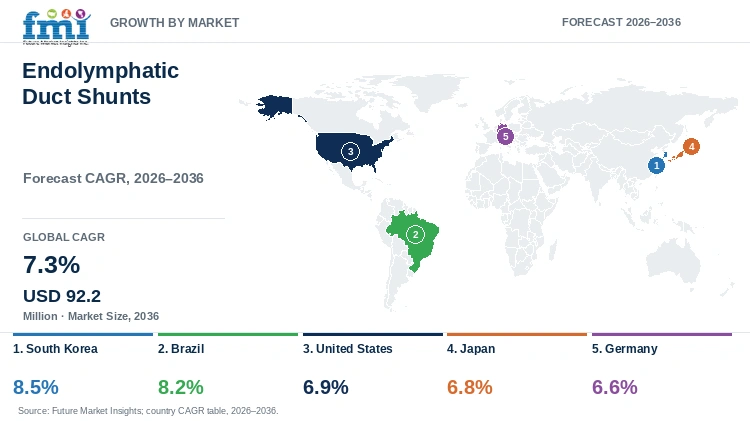
South Korea ranks as the fastest-growing country market for endolymphatic duct shunts with an 8.5% compound annual expansion to 2036, while Brazil records 8.2% and the United States posts 6.9%.
FMI country projections indicate that South Korea leads national endolymphatic duct shunts expansion on an 8.5% yearly growth trajectory to 2036 ahead of Brazil (8.2%) plus the United States (6.9%), while Japan records 6.8% and Germany posts 6.6%. National Health Insurance coverage for non-destructive vertigo microsurgery, 3-Tesla inner-ear hydrops MRI availability, and domestic titanium/silicone otologic manufacturing shape country-level growth.
Table 7: Five-Country Compound Growth Rates and Surgical Adoption Levers for Endolymphatic Duct Shunts (2026 to 2036)
| Country | CAGR (2026 to 2036) | Primary Growth Lever |
|---|---|---|
| South Korea | 8.5% | Routine 3T hydrops MRI staging at Seoul tertiary hospitals and NHIS coverage for sac drainage |
| Brazil | 8.2% | Private hospital neurotology expansion in Sao Paulo and ANS surgical coverage for refractory vertigo |
| United States | 6.9% | AAO-HNS stepped surgical guidelines, Grace Medical & Medtronic ENT reach, and ASC outpatient billing |
| Japan | 6.8% | Super-aging vertigo caseloads, Olympus ENT endoscopy, and PMDA-cleared steroid-infused sac drainage |
| Germany | 6.6% | Kurz Medical & Spiggle & Theis precision otology manufacturing and university HNO clinic volumes |
Source: Future Market Insights analysis
United States Endolymphatic Duct Shunts Market Outlook (2026 to 2036)
High procedural reimbursement across hospital outpatient departments and ambulatory surgical centers establishes the United States as the largest country market for endolymphatic mastoid shunts and Arenberg-class valves. Domestic otologic implant manufacturers led by Grace Medical, Inc. and Medtronic plc's ENT division in Jacksonville as well as Hood Laboratories supply silicone T-tubes and capillary-slit valves across academic neurotology fellowships. In January 2026, University of Miami and St. Marianna investigators characterized volumetric endolymphatic hydrops MRI signatures in Medical Sciences to guide surgical candidate selection [9]. United States industry valuation for endolymphatic duct shunts is projected to expand at a 6.9% yearly rate between 2026 and 2036, tempered only by office-based intratympanic steroid injections.
Key takeaway: In the United States, established ambulatory surgical center reimbursement and domestic manufacturing by Grace Medical and Medtronic ENT are projected to sustain steady implant demand.
Germany Endolymphatic Duct Shunts Market Outlook (2026 to 2036)
Germany serves as Western Europe's primary engineering and manufacturing hub for precision middle-ear and inner-ear implants, anchored by Heinz Kurz GmbH Medizintechnik in Dusslingen and Spiggle & Theis Medizintechnik GmbH in Overath. University HNO clinics in Hannover and Tübingen as well as Karlsruhe and Munich routinely perform delayed gadolinium MRI hydrops grading before scheduling endolymphatic sac mastoid shunting or titanium duct clipping. In April 2025, European neurotology investigators in Frontiers in Neurology defined early clinical and radiological predictors of severe endolymphatic hydrops [10]. In Germany, market value for endolymphatic duct shunts is anticipated to rise at a 6.6% annual rate over the 2026 to 2036 window under statutory DRG inpatient reimbursement.
Key takeaway: In Germany, indigenous precision otologic manufacturing by Kurz Medical and Spiggle & Theis paired with high-volume university HNO clinics is anticipated to anchor European market value.
Japan Endolymphatic Duct Shunts Market Outlook (2026 to 2036)
Japan's aging population and high diagnostic detection of bilateral and unilateral endolymphatic hydrops support consistent surgical volumes across university otorhinolaryngology departments in Tokyo and Nagoya as well as Osaka and Kyoto. Japanese ear surgeons frequently combine endolymphatic sac opening with intra-saccular high-dose dexamethasone instillation and silastic or gelatin film drainage to prevent lumen adhesion. In November 2025, Tokyo-headquartered Olympus Corporation unveiled its updated medical corporate strategy focusing on endoscopy-enabled surgical care across otolaryngology and minimally invasive specialties [11]. Within Japan, the endolymphatic duct shunts market size is forecast to progress at a 6.8% annual clip to 2036, backed by national health insurance coverage for inner-ear hydrops microsurgery.
Key takeaway: In Japan, widespread 3T hydrops MRI screening at university hospitals and steroid-coupled silastic sac drainage techniques are forecast to drive consistent surgical implant utilization.
South Korea Endolymphatic Duct Shunts Market Outlook (2026 to 2036)
Rapid adoption of four-hour post-contrast 3T FLAIR inner-ear MRI across tertiary medical centers in Seoul and Bundang as well as Busan places South Korea at the forefront of national growth for endolymphatic shunts and clips. South Korean neurotologists actively utilize both valved silicone mastoid shunts and endoscopic-assisted titanium duct clips to preserve serviceable hearing in working-age vertigo patients. In August 2026, Olympus Corporation reported first-quarter fiscal 2027 revenue of JPY 240.4 billion as Asian hospital capital and surgical disposable procurement expanded across specialty surgery [12]. Market size for endolymphatic duct shunts in South Korea is expected to advance at an 8.5% yearly clip between 2026 and 2036 under National Health Insurance Service surgical reimbursement.
Key takeaway: In South Korea, universal NHIS surgical reimbursement and routine 3T inner-ear MRI hydrops staging at Seoul university hospitals are expected to generate the fastest national CAGR.
Brazil Endolymphatic Duct Shunts Market Outlook (2026 to 2036)
Broader private health insurance coverage under Agencia Nacional de Saude Suplementar (ANS) guidelines and specialized neurotology fellowship training in Sao Paulo and Campinas as well as Porto Alegre fuel surgical hydrops treatment across Brazil. Brazilian otolaryngologists perform endolymphatic-mastoid silicone tube shunting and duct decompression for patients with intractable vertigo who cannot afford repeated imported biologics or destructive labyrinthectomy rehabilitation. In April 2026, a meta-analysis in the European Archives of Oto-Rhino-Laryngology confirmed strong correlation between endolymphatic hydrops grade and audio-vestibular progression [13]. Across Brazil, valuation for the endolymphatic duct shunts sector is predicted to climb at an 8.2% yearly trajectory to 2036, although ANVISA Class III registration timelines favor established distributors.
Key takeaway: In Brazil, private tertiary hospital neurotology expansion in Sao Paulo and ANS mandatory surgical coverage are predicted to propel Latin American shunt and clip adoption.
Full report country CAGRs cover: North America; Latin America; Western Europe; Eastern Europe; East Asia; South Asia and Pacific; Middle East and Africa.
Who are the notable companies in the endolymphatic duct shunts market?
Grace Medical, Inc., Medtronic plc (ENT / Otology Division), Hood Laboratories, Kurz Medical GmbH (Heinz Kurz GmbH Medizintechnik), Spiggle & Theis Medizintechnik GmbH, and Olympus Corporation (ENT Surgical Implants) are the notable companies in the endolymphatic duct shunts market.
FMI analysis indicates that the competitive landscape for endolymphatic duct shunts and clips divides between dedicated otologic micro-implant manufacturers and diversified global ENT surgical technology corporations. Specialized American and German otology device makers including Grace Medical, Inc. and Hood Laboratories along with Kurz Medical GmbH and Spiggle & Theis Medizintechnik GmbH craft medical-grade silicone mastoid shunt tubes and Arenberg-style capillary valves in addition to 0.13-millimeter silastic otology folios and MRI-conditional titanium micro-clips. Simultaneously, diversified surgical leaders Medtronic plc (through its Jacksonville ENT / Otology Division) and Olympus Corporation supply endolymphatic shunts and microsurgical burrs as well as electromagnetic skull-base navigation and 4-millimeter rigid oto-endoscopes across hospital operating rooms worldwide.
- Dedicated U.S. Otologic Shunt & Silicone Elastomer Specialists: Grace Medical, Inc. and Hood Laboratories manufacture valved and open-lumen endolymphatic-mastoid silicone shunt tubes and Arenberg-class pressure-limiting implants in addition to sterile silastic sheeting.
- German Precision Titanium & Silicone Micro-Implant Manufacturers: Kurz Medical GmbH (Heinz Kurz GmbH Medizintechnik) and Spiggle & Theis Medizintechnik GmbH engineer titanium micro-implants, 0.13 mm medical-grade silicone otology folios, and endoscopic ear surgery instrumentation.
- Global Multidisciplinary ENT & Skull-Base Surgical Platforms: Medtronic plc (ENT / Otology Division) and Olympus Corporation (ENT Surgical Implants) integrate otologic shunts and implants with powered mastoid drills and image-guided navigation as well as high-definition ENT endoscopy.
Competitive Benchmarking: Endolymphatic Duct Shunts Market
Table 8: Competitive Benchmarking for the Endolymphatic Duct Shunts Market (qualitative capability ratings), 2026
| Company | Silicone Shunt & Valve Engineering | Titanium Clip & Micro-Instrument Breadth | Hospital ENT / Otology Access | Geographic Reach |
|---|---|---|---|---|
| Grace Medical, Inc. | High | High | High | High |
| Medtronic plc (ENT / Otology Division) | High | High | High | High |
| Hood Laboratories | High | Medium | High | Medium |
| Kurz Medical GmbH (Heinz Kurz GmbH Medizintechnik) | Medium | High | High | High |
| Spiggle & Theis Medizintechnik GmbH | High | High | High | High |
| Olympus Corporation (ENT Surgical Implants) | Medium | High | High | High |
Evaluation basis: Capability ratings reflect documented portfolio coverage across unidirectional capillary-slit valves and radiopaque silicone mastoid shunt tubes as well as 0.13 mm silastic folios and non-ferromagnetic titanium clips. Hospital access and geographic scores evaluate direct GPO contracts and regulatory clearances across FDA and CE MDR in addition to PMDA and ANVISA jurisdictions.
Key Developments in the Endolymphatic Duct Shunts Market
- Medtronic plc updated its comprehensive Ear, Nose & Throat and Stealth AXiS cranial/skull-base surgical navigation portfolio in 2025 and 2026 to support high-precision transmastoid and lateral skull-base procedures [14].
- Spiggle & Theis Medizintechnik GmbH expanded its electronic Instructions for Use (e-IFU) and CE MDR compliant otology implant documentation portal across European hospital networks in 2025 [15].
- Olympus Corporation announced in December 2025 the United States launch of its newest surgical imaging platform and minimally invasive ENT visualization systems across hospital operating suites [16].
Key Players in the Endolymphatic Duct Shunts Market
Dedicated U.S. Otologic Shunt & Silicone Elastomer Specialists
- Grace Medical, Inc.
- Hood Laboratories
German Precision Titanium & Silicone Micro-Implant Manufacturers
- Kurz Medical GmbH (Heinz Kurz GmbH Medizintechnik)
- Spiggle & Theis Medizintechnik GmbH
Global Multidisciplinary ENT & Skull-Base Surgical Platforms
- Medtronic plc (ENT / Otology Division)
- Olympus Corporation (ENT Surgical Implants)
Endolymphatic Duct Shunts Market - Report Scope
Table 9: Report Scope for the Endolymphatic Duct Shunts Market (coverage fields and definitions), 2026 to 2036
| Coverage field | Report scope |
|---|---|
| Market breakdown | Shunt Drainage Destination; Pressure-Regulation Valve Mechanism; Clinical Otologic Indication; Region |
| Quantitative Units | USD Million |
| Market Definition | Includes commercial manufacturer market value from sterile implantable endolymphatic-mastoid silicone shunt tubes, valved endolymphatic-subarachnoid shunts, Arenberg-class capillary-slit unidirectional pressure-limiting valves, open-lumen silastic sponge/foil sac inserts, and titanium/silicone endolymphatic duct clips (ELDC). Category Scope Note: Excludes ventriculoperitoneal hydrocephalus CSF shunts, pediatric middle-ear tympanostomy grommets for otitis media, cochlear implant electrode arrays, and oral betahistine/diuretic pharmaceuticals. |
| Regions Covered | North America; Latin America; Western Europe; Eastern Europe; East Asia; South Asia and Pacific; Middle East and Africa |
| Countries Covered | United States, Germany, Japan, South Korea, Brazil, and additional countries in the full report |
| Key Companies Covered | Grace Medical, Inc., Medtronic plc (ENT / Otology Division), Hood Laboratories, Kurz Medical GmbH (Heinz Kurz GmbH Medizintechnik), Spiggle & Theis Medizintechnik GmbH, Olympus Corporation (ENT Surgical Implants) |
| Forecast Period | 2026 to 2036 |
| Approach | Primary and secondary research with top-down and bottom-up market triangulation. |
Endolymphatic Duct Shunts Market - Research Methodology
Table 10: Research Methodology for the Endolymphatic Duct Shunts Market (research methods and approach), 2026 edition
| Method | Approach |
|---|---|
| Primary Research | Structured interviews with neurotologists, lateral skull-base surgeons, hospital ENT operating room materials managers, and otologic implant engineers across the United States, Germany, Japan, South Korea, and Brazil. |
| Secondary Research | Analysis of clinical cohorts and randomized trials in The Lancet Regional Health - Europe, Audiology Research, European Archives of Oto-Rhino-Laryngology, and Frontiers in Neurology alongside product catalogs from Medtronic ENT, Spiggle & Theis, Grace Medical, Kurz Medical, Hood Laboratories, and Olympus. |
| Market Sizing and Forecasting | Top-down hospital otologic implant procurement budgets reconciled against bottom-up refractory Ménière's disease surgical caseloads and sterile shunt/clip unit consumption from 2026 to 2036. |
| Country Forecasting Model | Econometric country projections weight 3T delayed gadolinium inner-ear MRI capacity, AAO-HNS Stage 3/4 refractory hydrops prevalence, and national surgical DRG/CPT reimbursement rates across five profiled countries. |
| Operational Benchmark Traceability | Otologic procedure and center sizing indicators in Tables 2, 3, and 4 trace to French bicentric ELSS cohorts (PMC12921823), Central South University 4-year EDB/EDD comparisons (PMID 40836161), and Dutch multicenter RCT registries (PMC13355790). |
| Data Triangulation and Validation | Implant demand estimates are cross-checked against hospital mastoidectomy procedure codes and manufacturer sterile lot shipments without double counting middle-ear ventilation grommets or CSF shunts. |
Endolymphatic Duct Shunts Market by Segments
Endolymphatic Duct Shunts Market segmented by Shunt Drainage Destination:
- Endolymphatic-Mastoid Cavity Silicone Shunt Tube
- Valved Endolymphatic-Subarachnoid Shunt
- Titanium / Silicone Endolymphatic Duct Clip (ELDC)
Endolymphatic Duct Shunts Market segmented by Pressure-Regulation Valve Mechanism:
- Capillary-Slit Unidirectional Pressure-Limiting Valve (Arenberg Class)
- Open-Lumen Silastic Sponge & Foil Sheet Shunt
Endolymphatic Duct Shunts Market segmented by Clinical Otologic Indication:
- Intractable Meniere's Disease (Endolymphatic Hydrops)
- Secondary Delayed Endolymphatic Hydrops & Vertigo
Endolymphatic Duct Shunts Market by Region
- North America
- United States
- Canada
- Latin America
- Brazil
- Mexico
- Argentina
- Colombia
- Western Europe
- Germany
- France
- United Kingdom
- Italy
- Spain
- Netherlands
- Eastern Europe
- Poland
- Czech Republic
- Hungary
- East Asia
- South Korea
- Japan
- China
- South Asia and Pacific
- Australia
- India
- New Zealand
- Middle East and Africa
- GCC Countries
- Türkiye
- Israel
- South Africa
Research Sources and Bibliography
- [1] Lebelle, E., Tuset, M.-P., Haddad, R., Ebode, D., Levy, D., Ros, L., Mat, Q., Daval, M., Michel, J., De Charnace, L., & Gargula, S. (2026, January 20). Endolymphatic Sac Surgery in Refractory Ménière's Disease: Exploratory Associations and Postoperative Clinical Outcomes in a Bicentric Cohort. Audiology Research, 16(1), 15 (PMC12921823 / PMID 41718332).
- [2] Jiang, Y., Zeng, Y., Wang, Q., Hu, J., Li, W., Yang, T., Deng, K., Zhou, Z., Farah, C., Peng, A., & Zhang, Z. (2025, August 20). Long-term vestibular and audiometric results in meniere's patients following endolymphatic duct blockage, sac drainage or sac decompression. European Archives of Oto-Rhino-Laryngology, 283(1), 91-100 (PubMed PMID 40836161).
- [3] Gibson, W. P. R. (2025, July 28). Endolymphatic sac surgery: past and present controversies. Frontiers in Neurology, 16, 1635186 (PMC12336207).
- [4] Schenck, A. A., van de Berg, R., Peters, T. T. A., Smulders, Y. E., Winters, S. M., Bohringer, S., Holm, A. F., Waterval, J. J., Hammer, S., Hombergen, S. P. M., Munting, M. R., van Benthem, P. P. G., Kruyt, J. M., & Blom, H. M. (2026, July 06). Endolymphatic duct blockage for Ménière's disease: a double-blind, randomised controlled trial. The Lancet Regional Health - Europe, 68, 101765 (PMC13355790).
- [5] Venkatasamy, A., & Péporté, A. R. J. (2025, February 05). Secondary endolymphatic hydrops: a clinical and literature overview. Frontiers in Neurology, 15, 1525954.
- [6] Azmeh, O. W., Ma, R., & Nguyen, S. A. (2026, July 28). Endolymphatic duct blockage for Ménière's disease: insights from a double-blind randomised controlled trial. The Lancet Regional Health - Europe, 68, 101792 (PMC13446286 / PMID 42564938).
- [7] Spiggle & Theis Medizintechnik GmbH. (2025, October 10). Silicone Folios For Otology - SPIGGLE & THEIS Medizintechnik GmbH. Spiggle & Theis Official Product Catalog.
- [8] Spiggle & Theis Medizintechnik GmbH. (2025, November 14). Endoscopic Ear Surgery (EES) - SPIGGLE & THEIS Medizintechnik GmbH. Spiggle & Theis Official Product Catalog.
- [9] Sasano, Y., Mochizuki, F., Ito, Y., Williams, E., Koizuka, I., Hoffer, M. E., & Komori, M. (2026, January 07). Characterizing Differences in Endolymphatic Hydrops Signatures Among Meniere's Disease Patients with and Without Migraine. Medical Sciences, 14(1), 29 (PMC12821696 / PMID 41562919).
- [10] Lorente-Piera, J., Suárez-Vega, V., Blanco-Pareja, M., Liaño, G., Garaycochea, O., Dominguez, P., Manrique-Huarte, R., & Pérez-Fernández, N. (2025, April 28). Early and certain Ménière's disease characterization of predictors of endolymphatic hydrops. Frontiers in Neurology, 16, 1566438 (PMC12066312 / PMID 40356628).
- [11] Olympus Corporation. (2025, November 07). Olympus Unveils Corporate Strategy | Olympus America | Medical. Olympus Medical Systems Group.
- [12] Olympus Corporation. (2026, August 07). Olympus Reports First Quarter Fiscal 2027 Financial Results: 2026: News: Olympus. Olympus Global Investor Relations.
- [13] Elmoursy, M. M., & Aly, M. A. A. (2026, April 06). Association between endolymphatic hydrops severity and audio-vestibular outcomes in Ménière's disease: A systematic review and meta-analysis of correlation coefficients. European Archives of Oto-Rhino-Laryngology, 283(7), 4117-4130 (PMC13388643 / PMID 41940933).
- [14] Medtronic plc. (2026, March 12). Ear, Nose & Throat | Medtronic. Medtronic Healthcare Professionals.
- [15] Spiggle & Theis Medizintechnik GmbH. (2025, September 18). e-IFU - SPIGGLE & THEIS Medizintechnik GmbH. Spiggle & Theis Regulatory Portal.
- [16] Olympus Corporation. (2025, December 15). 2025 : All News : OLYMPUS. Olympus Global Newsroom.
- [17] Spiggle & Theis Medizintechnik GmbH. (2025, August 05). Middle Ear Implants - SPIGGLE & THEIS Medizintechnik GmbH. Spiggle & Theis Otology Portfolio.
- [18] Spiggle & Theis Medizintechnik GmbH. (2025, October 22). T-Tubes - SPIGGLE & THEIS Medizintechnik GmbH. Spiggle & Theis Otology Catalog.
This bibliography is provided for reader reference and is not exhaustive. The full report contains the complete reference list and detailed citations.
This Report Answers
- How large is the endolymphatic duct shunts market in 2026 and what is forecast for 2036?
- Which diagnostic imaging and otologic surgical factors drive demand for endolymphatic duct shunts and clips?
- Why does Endolymphatic-Mastoid Cavity Silicone Shunt Tube lead the shunt drainage destination category?
- Why does Capillary-Slit Unidirectional Pressure-Limiting Valve (Arenberg Class) lead the valve mechanism category?
- How do country-level growth rates compare across South Korea, Brazil, the United States, Japan, and Germany?
- Which medical device manufacturers supply silicone mastoid shunts, capillary valves, and titanium duct clips today?
- What clinical and histopathological factors challenge long-term shunt patency in Ménière's disease?
- What implant specifications should hospital ENT procurement teams evaluate before selecting endolymphatic shunts?
Frequently Asked Questions
How big is the endolymphatic duct shunts market in 2026, and what is forecast for 2036?
Global endolymphatic duct shunts market valuation is estimated by FMI at USD 45.6 million in 2026, up from USD 42.5 million in 2025, with ten-year projections reaching USD 92.2 million by 2036 across hospital neurotology suites.
What is the CAGR for the endolymphatic duct shunts market from 2026 to 2036?
Over the 2026 to 2036 forecast window, the market is anticipated to progress at a 7.3% compound annual expansion clip, yielding USD 46.6 million in added annual market value.
Which shunt drainage destination segment leads the endolymphatic duct shunts market?
Endolymphatic-Mastoid Cavity Silicone Shunt Tube accounts for a projected 63.4% share of drainage destination market value in 2026 because extradural mastoid drainage avoids intracranial CSF leak complications.
Which pressure-regulation valve mechanism segment leads the market?
Capillary-Slit Unidirectional Pressure-Limiting Valve (Arenberg Class) holds an estimated 56.8% share of valve mechanism valuation in 2026 by venting hydrops pressure surges while preventing retrograde fluid reflux.
Which country has a notable growth outlook during the assessment period?
South Korea is forecast to record the fastest national growth at an 8.5% CAGR through 2036, supported by routine 3T gadolinium hydrops MRI staging and NHIS surgical coverage.
Who are the key players in the market?
Leading suppliers of otologic shunts, valves, silastic folios, and duct clips include Grace Medical, Inc., Medtronic plc (ENT / Otology Division), Hood Laboratories, Kurz Medical GmbH (Heinz Kurz GmbH Medizintechnik), Spiggle & Theis Medizintechnik GmbH, and Olympus Corporation (ENT Surgical Implants).
Preview the report firsthand - request a free sample
Get SampleGet the brochure for pricing and purchase details.
Get PDFTable of Content
- Key Takeaways
- Market Size and CAGR
- Top Growth Driver
- Fastest Growing Segment
- Leading Region
- Key Companies
- Emerging Opportunities
- Executive Summary
- Global Market Outlook
- Demand-side Trends
- Supply-side Trends
- Technology Roadmap Analysis
- Analysis and Recommendations
- Analyst Perspective (What is happening? Why now? What should investors know?)
- Key Questions Answered
- How large is the market?
- What is the CAGR?
- What are key trends?
- Which region dominates?
- Who are the leaders?
- Market Overview
- Market Coverage / Taxonomy
- Market Definition / Scope / Limitations
- Research Methodology
- Chapter Orientation
- Analytical Lens and Working Hypotheses
- Market Structure, Signals, and Trend Drivers
- Benchmarking and Cross-market Comparability
- Market Sizing, Forecasting, and Opportunity Mapping
- Research Design and Evidence Framework
- Desk Research Programme (Secondary Evidence)
- Expert Input and Fieldwork (Primary Evidence)
- Tooling, Models, and Reference Databases
- Data Engineering and Model Build
- Quality Assurance and Audit Trail
- Market Background
- Market Dynamics (Drivers, Restraints, Opportunity, Trends)
- Scenario Forecast (Optimistic, Likely, Conservative)
- Impact Analysis
- AI Impact
- Sustainability Impact
- Regulatory Impact
- Technology Impact
- Consumer / Buyer Analysis
- Purchase Drivers
- Adoption Barriers
- Buyer Journey
- Opportunity Map Analysis
- Product Life Cycle Analysis
- Supply Chain Analysis
- Investment Feasibility Matrix
- Value Chain Analysis
- PESTLE and Porter's Analysis
- Regulatory Landscape
- Regional Parent Market Outlook
- Production and Consumption Statistics
- Import and Export Statistics
- Global Market Analysis and Forecast, 2021 to 2036
- Historical Market Size Value (USD Million) Analysis, 2021 to 2025
- Current and Future Market Size Value (USD Million) Projections, 2026 to 2036
- Y-o-Y Growth Trend Analysis
- Absolute $ Opportunity Analysis
- Global Market Pricing Analysis, 2021 to 2036
- Global Market Analysis and Forecast, By Shunt Drainage Destination, 2021 to 2036
- Introduction / Key Findings
- Historical Market Size Value (USD Million) Analysis By Shunt Drainage Destination, 2021 to 2025
- Current and Future Market Size Value (USD Million) Analysis and Forecast By Shunt Drainage Destination, 2026 to 2036
- Endolymphatic-Mastoid Cavity Silicone Shunt Tube
- Valved Endolymphatic-Subarachnoid Shunt
- Titanium / Silicone Endolymphatic Duct Clip (ELDC)
- Y-o-Y Growth Trend Analysis By Shunt Drainage Destination, 2021 to 2025
- Absolute $ Opportunity Analysis By Shunt Drainage Destination, 2026 to 2036
- Global Market Analysis and Forecast, By Pressure-Regulation Valve Mechanism, 2021 to 2036
- Introduction / Key Findings
- Historical Market Size Value (USD Million) Analysis By Pressure-Regulation Valve Mechanism, 2021 to 2025
- Current and Future Market Size Value (USD Million) Analysis and Forecast By Pressure-Regulation Valve Mechanism, 2026 to 2036
- Capillary-Slit Unidirectional Pressure-Limiting Valve (Arenberg Class)
- Open-Lumen Silastic Sponge & Foil Sheet Shunt
- Y-o-Y Growth Trend Analysis By Pressure-Regulation Valve Mechanism, 2021 to 2025
- Absolute $ Opportunity Analysis By Pressure-Regulation Valve Mechanism, 2026 to 2036
- Global Market Analysis and Forecast, By Clinical Otologic Indication, 2021 to 2036
- Introduction / Key Findings
- Historical Market Size Value (USD Million) Analysis By Clinical Otologic Indication, 2021 to 2025
- Current and Future Market Size Value (USD Million) Analysis and Forecast By Clinical Otologic Indication, 2026 to 2036
- Intractable Meniere's Disease (Endolymphatic Hydrops)
- Secondary Delayed Endolymphatic Hydrops & Vertigo
- Y-o-Y Growth Trend Analysis By Clinical Otologic Indication, 2021 to 2025
- Absolute $ Opportunity Analysis By Clinical Otologic Indication, 2026 to 2036
- Global Market Analysis and Forecast, By Region, 2021 to 2036
- Introduction
- Historical Market Size Value (USD Million) Analysis By Region, 2021 to 2025
- Current Market Size Value (USD Million) Analysis and Forecast By Region, 2026 to 2036
- North America
- Latin America
- Western Europe
- Eastern Europe
- East Asia
- South Asia and Pacific
- Middle East and Africa
- Market Attractiveness Analysis By Region
- North America Market Analysis and Forecast, By Country, 2021 to 2036
- Historical Market Size Value (USD Million) Trend Analysis By Market Taxonomy, 2021 to 2025
- Market Size Value (USD Million) Forecast By Market Taxonomy, 2026 to 2036
- By Country
- United States
- Canada
- By Shunt Drainage Destination
- By Pressure-Regulation Valve Mechanism
- By Clinical Otologic Indication
- By Country
- Market Attractiveness Analysis
- By Country
- By Shunt Drainage Destination
- By Pressure-Regulation Valve Mechanism
- By Clinical Otologic Indication
- Key Takeaways
- Latin America Market Analysis and Forecast, By Country
- Historical Market Size Value (USD Million) Trend Analysis By Market Taxonomy, 2021 to 2025
- Market Size Value (USD Million) Forecast By Market Taxonomy, 2026 to 2036
- By Country
- Brazil
- Mexico
- Argentina
- Colombia
- By Shunt Drainage Destination
- By Pressure-Regulation Valve Mechanism
- By Clinical Otologic Indication
- By Country
- Market Attractiveness Analysis
- By Country
- By Shunt Drainage Destination
- By Pressure-Regulation Valve Mechanism
- By Clinical Otologic Indication
- Key Takeaways
- Western Europe Market Analysis and Forecast, By Country
- Historical Market Size Value (USD Million) Trend Analysis By Market Taxonomy, 2021 to 2025
- Market Size Value (USD Million) Forecast By Market Taxonomy, 2026 to 2036
- By Country
- Germany
- France
- United Kingdom
- Italy
- Spain
- Netherlands
- By Shunt Drainage Destination
- By Pressure-Regulation Valve Mechanism
- By Clinical Otologic Indication
- By Country
- Market Attractiveness Analysis
- By Country
- By Shunt Drainage Destination
- By Pressure-Regulation Valve Mechanism
- By Clinical Otologic Indication
- Key Takeaways
- Eastern Europe Market Analysis and Forecast, By Country
- Historical Market Size Value (USD Million) Trend Analysis By Market Taxonomy, 2021 to 2025
- Market Size Value (USD Million) Forecast By Market Taxonomy, 2026 to 2036
- By Country
- Poland
- Czech Republic
- Hungary
- By Shunt Drainage Destination
- By Pressure-Regulation Valve Mechanism
- By Clinical Otologic Indication
- By Country
- Market Attractiveness Analysis
- By Country
- By Shunt Drainage Destination
- By Pressure-Regulation Valve Mechanism
- By Clinical Otologic Indication
- Key Takeaways
- East Asia Market Analysis and Forecast, By Country
- Historical Market Size Value (USD Million) Trend Analysis By Market Taxonomy, 2021 to 2025
- Market Size Value (USD Million) Forecast By Market Taxonomy, 2026 to 2036
- By Country
- South Korea
- Japan
- China
- By Shunt Drainage Destination
- By Pressure-Regulation Valve Mechanism
- By Clinical Otologic Indication
- By Country
- Market Attractiveness Analysis
- By Country
- By Shunt Drainage Destination
- By Pressure-Regulation Valve Mechanism
- By Clinical Otologic Indication
- Key Takeaways
- South Asia and Pacific Market Analysis and Forecast, By Country
- Historical Market Size Value (USD Million) Trend Analysis By Market Taxonomy, 2021 to 2025
- Market Size Value (USD Million) Forecast By Market Taxonomy, 2026 to 2036
- By Country
- Australia
- India
- New Zealand
- By Shunt Drainage Destination
- By Pressure-Regulation Valve Mechanism
- By Clinical Otologic Indication
- By Country
- Market Attractiveness Analysis
- By Country
- By Shunt Drainage Destination
- By Pressure-Regulation Valve Mechanism
- By Clinical Otologic Indication
- Key Takeaways
- Middle East and Africa Market Analysis and Forecast, By Country
- Historical Market Size Value (USD Million) Trend Analysis By Market Taxonomy, 2021 to 2025
- Market Size Value (USD Million) Forecast By Market Taxonomy, 2026 to 2036
- By Country
- GCC Countries
- Türkiye
- Israel
- South Africa
- By Shunt Drainage Destination
- By Pressure-Regulation Valve Mechanism
- By Clinical Otologic Indication
- By Country
- Market Attractiveness Analysis
- By Country
- By Shunt Drainage Destination
- By Pressure-Regulation Valve Mechanism
- By Clinical Otologic Indication
- Key Takeaways
- Key Countries Market Analysis
- United States
- Pricing Analysis
- Market Share Analysis, 2025
- By Shunt Drainage Destination
- By Pressure-Regulation Valve Mechanism
- By Clinical Otologic Indication
- Canada
- Pricing Analysis
- Market Share Analysis, 2025
- By Shunt Drainage Destination
- By Pressure-Regulation Valve Mechanism
- By Clinical Otologic Indication
- Mexico
- Pricing Analysis
- Market Share Analysis, 2025
- By Shunt Drainage Destination
- By Pressure-Regulation Valve Mechanism
- By Clinical Otologic Indication
- Brazil
- Pricing Analysis
- Market Share Analysis, 2025
- By Shunt Drainage Destination
- By Pressure-Regulation Valve Mechanism
- By Clinical Otologic Indication
- Germany
- Pricing Analysis
- Market Share Analysis, 2025
- By Shunt Drainage Destination
- By Pressure-Regulation Valve Mechanism
- By Clinical Otologic Indication
- United Kingdom
- Pricing Analysis
- Market Share Analysis, 2025
- By Shunt Drainage Destination
- By Pressure-Regulation Valve Mechanism
- By Clinical Otologic Indication
- Italy
- Pricing Analysis
- Market Share Analysis, 2025
- By Shunt Drainage Destination
- By Pressure-Regulation Valve Mechanism
- By Clinical Otologic Indication
- Spain
- Pricing Analysis
- Market Share Analysis, 2025
- By Shunt Drainage Destination
- By Pressure-Regulation Valve Mechanism
- By Clinical Otologic Indication
- France
- Pricing Analysis
- Market Share Analysis, 2025
- By Shunt Drainage Destination
- By Pressure-Regulation Valve Mechanism
- By Clinical Otologic Indication
- India
- Pricing Analysis
- Market Share Analysis, 2025
- By Shunt Drainage Destination
- By Pressure-Regulation Valve Mechanism
- By Clinical Otologic Indication
- China
- Pricing Analysis
- Market Share Analysis, 2025
- By Shunt Drainage Destination
- By Pressure-Regulation Valve Mechanism
- By Clinical Otologic Indication
- Japan
- Pricing Analysis
- Market Share Analysis, 2025
- By Shunt Drainage Destination
- By Pressure-Regulation Valve Mechanism
- By Clinical Otologic Indication
- South Korea
- Pricing Analysis
- Market Share Analysis, 2025
- By Shunt Drainage Destination
- By Pressure-Regulation Valve Mechanism
- By Clinical Otologic Indication
- Poland
- Pricing Analysis
- Market Share Analysis, 2025
- By Shunt Drainage Destination
- By Pressure-Regulation Valve Mechanism
- By Clinical Otologic Indication
- Hungary
- Pricing Analysis
- Market Share Analysis, 2025
- By Shunt Drainage Destination
- By Pressure-Regulation Valve Mechanism
- By Clinical Otologic Indication
- Türkiye
- Pricing Analysis
- Market Share Analysis, 2025
- By Shunt Drainage Destination
- By Pressure-Regulation Valve Mechanism
- By Clinical Otologic Indication
- South Africa
- Pricing Analysis
- Market Share Analysis, 2025
- By Shunt Drainage Destination
- By Pressure-Regulation Valve Mechanism
- By Clinical Otologic Indication
- United States
- Market Structure Analysis
- Competition Dashboard
- Competition Benchmarking
- Market Share Analysis of Top Players
- By Regional
- By Shunt Drainage Destination
- By Pressure-Regulation Valve Mechanism
- By Clinical Otologic Indication
- Emerging Startups
- Innovation Benchmarking
- Competition Analysis
- Competition Deep Dive
- Grace Medical, Inc.
- Overview
- Product Portfolio
- Profitability by Market Segments
- Sales Footprint
- Strategy Overview
- Marketing Strategy
- Product Strategy
- Channel Strategy
- Medtronic plc (ENT / Otology Division)
- Hood Laboratories
- Kurz Medical GmbH (Heinz Kurz GmbH Medizintechnik)
- Spiggle & Theis Medizintechnik GmbH
- Olympus Corporation (ENT Surgical Implants)
- Grace Medical, Inc.
- Case Studies
- Success Stories
- Recent Developments
- Competition Deep Dive
- Assumptions & Acronyms Used


