

- Market Size (2026)
- USD 356.3 Mn
- Forecast (2036)
- USD 638.1 Mn
- CAGR (2026 to 2036)
- 6.0%
How big is EPP Transport Containers Market in 2026?
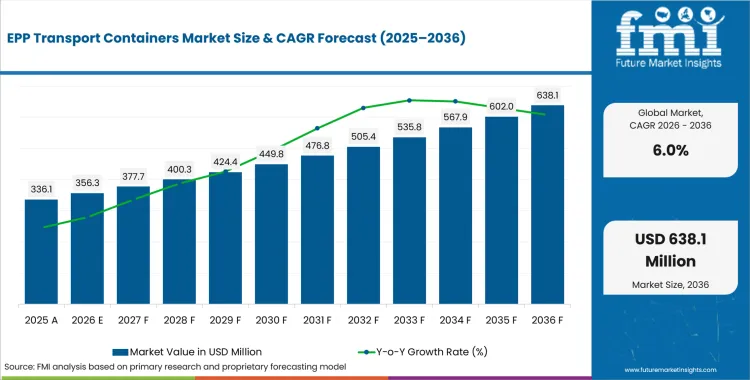
USD 356.3 million in 2026 and USD 638.1 million by 2036 at a 6.0% CAGR.
Demand for EPP transport container is projected to rise from USD 356.3 million in 2026 to USD 638.1 million by 2036 at a 6.0% CAGR. Reusable packaging systems become economic on lanes that recover the same asset repeatedly. In February 2026, the European Commission confirmed a 40% PPWR reuse target from January 1, 2030 for specified transport packaging. Low weight, impact recovery or insulation lowers cost per trip on repeated routes.
California made conversion economics jurisdiction-specific when SB 54 permanent regulations took effect May 1, 2026 and required 25% source reduction for single-use plastic packaging by 2032. The rule broadens comparisons with returnable transport packaging without requiring EPP. Dense routes recover durable-container premiums, whereas dispersed networks face higher collection and washing costs.
Key Takeaways
- Repeated lanes raise purchase priority for reusable transport systems by making recovery, cleaning and redeployment economic without excessive empty-return cost.
- Based on product type, foldable EPP boxes are projected to account for 34.0% in 2026 due to lower empty-return cube on closed-loop routes.
- By material, corrugated & fiber is estimated to hold 31.0% in 2026 owing to mature converting capacity and familiar recovery systems.
- In 2026, the 200-1,000 L range is expected to lead capacity with 43.0% share because standard dimensions fit common warehouse handling equipment.
- Cleaning expense, asset loss and imbalanced backhaul can delay conversion even on routes with reusable-container protection over repeated trips.
- Some of the key players in this market include BEWI, Smurfit Westrock, Mondi Group, Signode, SCHÜTZ, Greif, Mauser Packaging Solutions, and Nefab.
Analyst Perspective
"EPP transport containers earn a premium on routes with enough returns to spread moulding, cleaning and recovery cost over repeated trips. The strongest offers pair low empty-return volume with documented shock or thermal performance and an asset-recovery plan."
- Nandini Roy Choudhury, Principal Consultant, Future Market Insights
How is the epp transport containers market segmented?
The epp transport containers market is segmented by product type, material, capacity, end use, sales channel and region.
Analysis covers five segment axes plus region, with product type including foldable EPP boxes, fixed transport boxes, dunnage & dividers and temperature EPP. Material includes corrugated & fiber, rigid plastics, steel & metal and flexible bulk. Capacity covers 200-1,000 L, below 200 L and above 1,000 L. End use covers food ingredients, chemicals, agriculture, construction & auto and energy & other. Sales channel includes direct industrial accounts, distributors and rental & pooling.
What makes foldable EPP boxes central to the product type category?
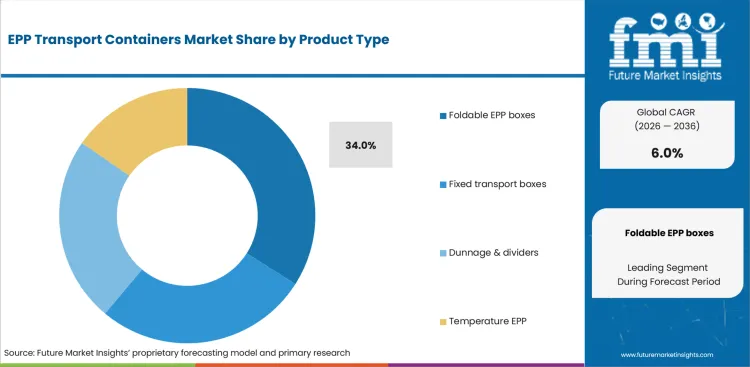
Collapsing foldable EPP boxes reduces empty-return cube by cutting the vehicle and storage volume assigned to empty assets. They also protect sensitive components from repeated shocks and vibration during closed-loop transport.
- Foldable EPP boxes are set to lead the product type category with 34.0% share in 2026 due to lower empty-return cube and impact resilience.
- JSP completed the HAPP and GHEPI acquisitions in July 2025, expanding injection-moulding capacity beside its ARPRO EPP business. Its 2025 corporate report identifies reusable automotive-part containers and packaging among active EPP applications. The added moulding base supports programs requiring repeatable dimensions on closed-loop automotive routes at scale.
Why does corrugated & fiber lead the material category?
Corrugated & fiber fits familiar packing lines and recovery systems, so it competes strongly for structural outers and partitions on dry routes that also use mature corrugated boxes supply. Mondi started its Duino recycled-containerboard machine in April 2025 and expects 420,000 tonnes of annual output after ramp-up.
- By material, corrugated & fiber is forecast to represent 31.0% in 2026 driven by installed conversion capacity and familiar structural transport formats on dry routes.
- Fiber outers retain volume on routes with existing collection and baling, and EPP must justify its premium with multi-trip protection or insulation on demanding lanes.
How does 200-1,000 L anchor the capacity category?
The 200-1,000 L band fits common forklifts, warehouse lanes and vehicle footprints without requiring very large bulk infrastructure or special loading frames. Its upper end overlaps with standard intermediate bulk containers used in industrial flows.
- The 200-1,000 L range is likely to capture 43.0% share in 2026 attributable to payload efficiency and compatibility with common material-handling equipment.
- SCHÜTZ signed a Saudi licence agreement in January 2025 covering 1,000-litre ECOBULK IBC production for Saudi Arabia and the GCC. The action shows why standard handling dimensions attract regional investment in this capacity band.
What supports food ingredients as the leading end use?
Thermal food shipments follow cold-chain packaging specifications, so reusable systems need contamination control, temperature protection and damage resistance before they displace single-trip packaging. Mauser Packaging Solutions introduced stainless steel IBCs in May 2025 for food, beverage and hygiene-sensitive fluids that require cleanable reusable transport assets.
- By end use, the food ingredients segment is estimated to hold 23.0% in 2026 owing to repeat processor-to-customer lanes that support reliable asset recovery.
- Processors approve reusable containers once sanitation, material-compatibility and cleaning records stay consistent during repeated cycles, especially on food routes with asset returns under documented schedules.
What are the drivers, restraints and opportunities in the EPP Transport Containers Market?
Reuse policy and repeated-route economics support demand, while recovery costs limit adoption and regional service capacity broadens the addressable route base.
- Driver: Packaging-waste policy raises the value of transport systems that can replace repeated purchases of disposable formats on recoverable lanes.
- Restraint: Cleaning, collection and asset replacement can erase lifecycle savings on sparse routes or programs with unclear return ownership.
- Opportunity: Regional production, tracking and recovery services can lower the operating burden for companies that lack their own return infrastructure.
Reuse Policy Changes the Procurement Comparison
The UK joint EPR policy statement published in February 2025 lists higher packaging reuse and waste prevention among intended outcomes. The policy direction shifts packaging reviews toward lifetime cost, documented recovery and auditable reuse records. EPP fits returnable packaging routes that replace disposable protection on predictable lanes, but conversion weakens if collection cost exceeds the avoided single-use spend per trip.
Recovery Infrastructure Sets the Economic Ceiling
Reusable containers recover their higher purchase cost once inspection and return systems maintain enough assets in circulation for repeated customer trips. In April 2026, Greif disclosed that its network collected more than 3.7 million containers for reconditioning, remanufacturing or recycling during 2025. Sparse lanes spread collection, repair and washing costs over too few turns to protect lifecycle economics at account level.
Regional Capacity Reduces Service Distance
Regional service capacity reduces the distance between reusable assets and facilities that repair or replace them during normal operations. ORBIS opened a 420,000-square-foot manufacturing plant in Greenville, Texas in February 2025 for reusable totes and pallets. EPP providers can use nearby moulding, tracking or pooling partners once commercial route volume supports fixed service capacity in regional industrial transport packaging recovery programs.
Which country CAGRs are profiled in the EPP Transport Containers Market?
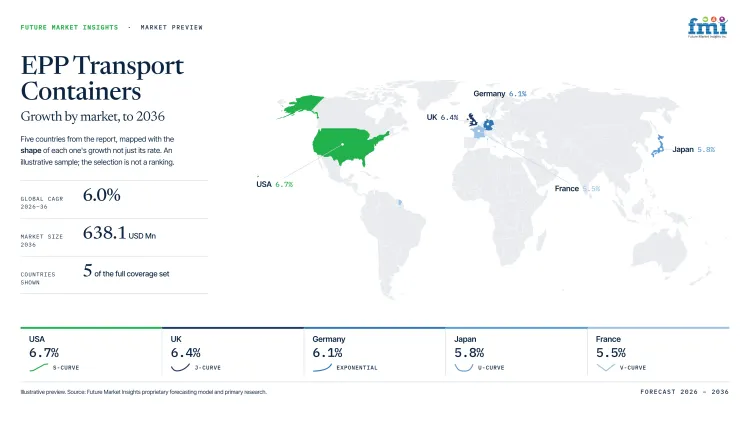
| Country | CAGR |
|---|---|
| UAE | 7.6% |
| Saudi Arabia | 7.3% |
| South Korea | 7.0% |
| USA | 6.7% |
| UK | 6.4% |
| Germany | 6.1% |
| Japan | 5.8% |
| France | 5.5% |
How do country-level CAGRs compare in the EPP Transport Containers Market?
The 2.1-point spread separates a Gulf and South Korean group from European and Japanese markets. UAE, Saudi Arabia and South Korea exceed 7.0%, while USA, UK and Germany form the middle. Japan and France grow more slowly because established packaging routes raise the proof needed for reusable systems.
- The UAE leverages free-zone ecosystems to keep reusable containers moving efficiently through key trade gateways.
- Saudi Arabia is accelerating reusable container adoption through growing industrial standardization.
- South Korea’s electronics export strength drives demand for reliable, repeat-use protective packaging.
- The USA benefits from warehouse networks designed around pallet-compatible reusable container systems.
- The UK supports reusable transport loops through its highly consolidated grocery supply chain.
- Germany’s machinery export sector prioritizes reusable containers that deliver precision-grade protection.
- Japan favors compact, standardized reusable assets that align with tightly scheduled production flows.
- France’s manufacturing clusters enhance reusable container economics by shortening return-logistics routes.
Route density and service access can produce different margins even under similar CAGRs. The full report provides country-level CAGR analysis across North America, Latin America, Western Europe, Eastern Europe, East Asia, South Asia and Pacific, and Middle East and Africa.
Country-wise Analysis
- UAE: Dubai's trade and food-distribution corridors circulate reusable assets frequently enough for route-level tracking and thermal protection to carry economic value. EPP transport container sales in UAE are forecast to expand at 7.6% CAGR by 2036, owing to dense urban routes that return assets with fewer empty kilometres. Dubai Municipality confirmed on December 24, 2025 that polystyrene cups, plates and containers had already entered the ban during 2025 before the final 2026 phase. The rule does not mandate EPP, and recovery becomes harder outside concentrated city accounts as return distances lengthen. Entrants need closed-loop customers that can document collection, cleaning and repeat turns.
- Saudi Arabia: Dammam's port, filling plants and industrial estates shorten supply distance for reusable bulk containers serving chemical and food processors near major users. The Saudi Food and Drug Authority published and applied its Requirements for Food Transport on June 2, 2025, reinforcing controlled handling for food shipments. Saudi Arabia's epp transport containers outlook is anticipated to advance at 7.3% CAGR over the assessment period, attributable to regional packaging investment and demand for controlled transport. High ambient temperatures and long intercity lanes raise validation and recovery costs. Local service networks can respond faster to cleaning, replacement and route-specific operating needs than distant supply models.
- South Korea: Seoul's dense delivery network gives reusable boxes a practical recovery base with collection tied to retail and fulfillment points. On April 12, 2026, the Ministry of Climate, Energy and Environment reported 3.83 million tonnes of household plastic waste in 2023 and listed reusable containers among nine action rules. Cleaning labor and consumer return compliance add operating cost to each reuse cycle. Adoption of epp transport containers in South Korea is estimated to expand at 7.0% CAGR through 2036, aided by national plastic-reduction pressure and short urban backhauls. Programs scale more credibly once one operator owns asset identification, collection and washing.
- USA: Large automotive and manufacturing corridors can sustain regional return loops, but nationwide programs lose efficiency once empty assets enter unrelated long-distance lanes. EPP transport container demand in USA is forecast to rise at 6.7% CAGR over the forecast period, tied to regional reusable-asset programs and state packaging pressure. EPA announced on January 13, 2025 that Bold Reuse received Phase I SBIR funding to develop inventory management for reusable packaging transitions. The federal action supports tracking technology instead of EPP demand itself, while fragmented state rules complicate national standardization. Providers should qualify dense regional lanes before extending the same asset pool to distant accounts.
- UK: Large producers now work inside a national reporting system that makes packaging quantities and disposal obligations visible during procurement reviews. The Defra and PackUK EPR collection, published July 11, 2025 and updated August 25, 2026, requires large producers to report every six months and retain records for seven years. In the UK, epp transport container sales are predicted to advance at 6.4% CAGR through 2036, helped by stronger reuse incentives and shorter national haul distances. Reporting does not guarantee reuse, and compliance work can reinforce familiar packaging formats. Returnable offers need records that tie container turns, losses and end-of-life handling to each account.
- Germany: German industrial sites operate beside mature paper, plastic and metal recovery systems, raising the economic proof required from a reusable EPP route. Dense automotive supply networks give durable dunnage frequent plant-to-plant turns within major manufacturing corridors. Umweltbundesamt reported on March 5, 2026 that Germany generated 17.9 million tonnes of packaging waste in 2023 and recycled 69.4%. Germany is estimated to post 6.1% CAGR over the forecast period, reflecting PPWR reuse requirements and a strong base for documented material recovery. Higher-cost returnable systems must beat efficient incumbent recycling routes on repeated-use economics and cleaning reliability on high-frequency plant routes.
- Japan: Japanese automotive and electronics manufacturers use tightly specified material handling, raising the value of protective containers for expensive components. By 2036, Japan is projected to grow at 5.8% CAGR, given formal plastic-circulation trials and demand for documented reuse performance. On August 19, 2025, the Ministry of the Environment selected eight advanced social-implementation projects covering collection, reuse and recycling models. The projects test operating models without guaranteeing broad adoption, and return routes differ by industry and prefecture. EPP providers need application evidence plus local collection partners before scaling beyond defined customer loops in regional manufacturing networks that can support scheduled returns.
- France: French industrial packaging programs focus on design and operating barriers that prevent reusable systems from moving beyond controlled trials. ADEME opened a national call on March 3, 2025 to remove functional and operational barriers and support reusable industrial and commercial packaging. The French epp transport containers sector is projected to record 5.5% CAGR during the assessment period, driven by public support for reusable EIC formats and route redesign. Fiber systems and familiar packaging habits remain strong competitors in many one-way flows. Entry depends on a transport advantage customers can measure in thermal control, damage reduction or lower empty-return volume.
Who are the notable companies in the EPP Transport Containers Market?
BEWI, Smurfit Westrock, Mondi Group, Signode, SCHÜTZ, Greif, Mauser Packaging Solutions, and Nefab are the notable companies serving this market.
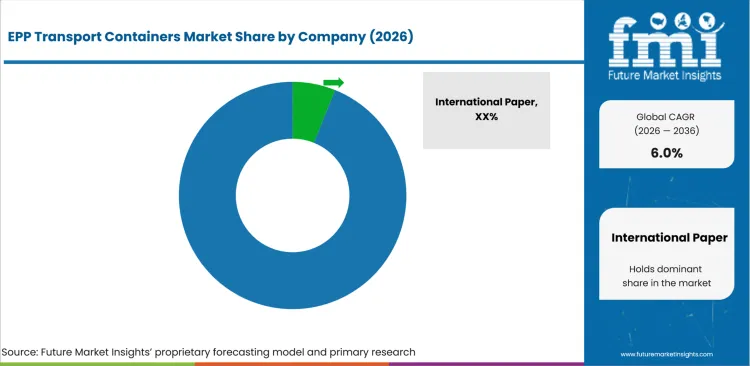
Competition splits among EPP moulders, fiber converters, industrial-container networks and transit-protection specialists. Tooling, sanitation validation and asset recovery raise entry costs for returnable programs. Adjacent insulated shipping boxes compete for thermal routes, and SCHÜTZ, Greif and Mauser Packaging Solutions also serve rigid industrial packaging.
- BEWI, Signode and Nefab cover engineered transit protection with moulded foams, load securement or custom protective systems.
- Smurfit Westrock and Mondi Group bring large fiber-conversion networks that compete for structural outers, partitions and pallet-load functions.
- SCHÜTZ, Greif and Mauser Packaging Solutions operate industrial container and lifecycle networks that can include return, inspection or reconditioning in customer programs.
Competitive Benchmarking: EPP Transport Containers Market
| Company | Transport-Format Breadth | Protection Engineering | Circularity Integration | Geographic Reach |
|---|---|---|---|---|
| BEWI | Medium | High | Medium | Europe and selected international markets |
| Smurfit Westrock | High | High | Medium | 40 countries |
| Mondi Group | High | High | Medium | Europe and selected global markets |
| Signode | Medium | High | Low | Six continents |
| SCHÜTZ | High | High | High | More than 70 global sites |
| Greif | High | High | High | More than 35 countries |
| Mauser Packaging Solutions | High | High | High | More than 20 countries |
| Nefab | High | High | Medium | 39 countries |
Scoring basis: Transport-format breadth rates High at three routes, Medium at two and Low at one. Protection engineering uses the same thresholds. Circularity rates High with recovery plus recycled-content routes, Medium with a reuse or recycled-material program and Low with one circular-design route. Geographic reach is descriptive.
Key Developments in the EPP Transport Containers Market
- In March 2026, SCHÜTZ and BASF signed a location agreement for highly automated IBC production and storage at Ludwigshafen, with construction scheduled from the third quarter.
- In June 2025, Mauser Packaging Solutions opened an on-site BASF Tarragona facility that reconditions IBCs and recycles end-of-life industrial plastic packaging into post-consumer resin.
- In January 2025, Smurfit Westrock introduced a 100% paper-based pallet wrap to replace polyethylene stretch wrap used for pallet stabilization during transport.
Key Players in the EPP Transport Containers Market
Material-Led Transport Packaging
- BEWI
- Smurfit Westrock
- Mondi Group
Load Securement
- Signode
Reusable Industrial and Engineered Packaging
- SCHÜTZ
- Greif
- Mauser Packaging Solutions
- Nefab
EPP Transport Containers Market - Report Scope
| Coverage field | Report scope |
|---|---|
| Market breakdown | By product type, material, capacity, end use, sales channel and region. |
| Quantitative Units | USD million. |
| Market Definition | Revenue covers EPP boxes, dunnage, temperature-protection formats and competing structural transport-container families within the defined taxonomy, excluding carried goods and unrelated consumer packaging. |
| Regions Covered | North America, Latin America, Western Europe, Eastern Europe, East Asia, South Asia and Pacific, and Middle East and Africa. |
| Countries Covered | UAE, Saudi Arabia, South Korea, USA, UK, Germany, Japan, France, and 20+ countries included in the full report. |
| Key Companies Profiled | BEWI, Smurfit Westrock, Mondi Group, Signode, SCHÜTZ, Greif, Mauser Packaging Solutions, Nefab. |
| Forecast Period | 2026 to 2036. |
| Approach | Primary and secondary research with market triangulation. |
EPP Transport Containers Market - Research Methodology
| Method | Approach |
|---|---|
| Primary Research | FMI analysts gathered input from manufacturers, service providers, technology developers, distributors, end users, procurement teams, and subject-matter experts. Interviews examined purchasing decisions, product or service evaluation, adoption barriers, approval requirements, pricing considerations, and expectations for technical or commercial support. Respondents were also asked what evidence is required before a trial, pilot, or initial order develops into regular purchasing. |
| Desk Research | Desk research covered government statistics, regulatory publications, trade data, industry associations, technical literature, standards, company filings, product information, and official corporate announcements. Sources were reviewed for relevance, publication date, geographic coverage, and consistency with the defined market scope. Claims relating to performance, applications, approvals, capacity, investment, and commercial activity were retained only when supported by credible public evidence. |
| Market Sizing and Forecasting | The market model combined the baseline value with historical performance, segment structure, pricing and volume indicators, adoption levels, company participation, and country-level demand conditions. Forecast assumptions considered economic activity, investment trends, regulatory developments, technology adoption, purchasing cycles, supply availability, and barriers to wider market use. Segment and regional estimates were reconciled before the final market total was calculated. |
| Data Validation | Estimates were checked against multiple independent indicators, including public data, company activity, trade patterns, industry developments, and findings from primary interviews. Validation also tested whether products, services, applications, and company revenues fell within the defined market boundaries. Adjacent categories, unsupported claims, overlapping revenues, and activities without direct market relevance were excluded to reduce double counting and maintain consistency across segments and countries. |
EPP Transport Containers Market by Segments
EPP Transport Containers Market segmented by Product Type:
- Foldable EPP boxes
- Fixed transport boxes
- Dunnage & dividers
- Temperature EPP
EPP Transport Containers Market segmented by Material:
- Corrugated & fiber
- Rigid plastics
- Steel & metal
- Flexible bulk
EPP Transport Containers Market segmented by Capacity:
- 200-1,000 L
- Below 200 L
- Above 1,000 L
EPP Transport Containers Market segmented by End Use:
- Food ingredients
- Chemicals
- Agriculture
- Construction & auto
- Energy & other
EPP Transport Containers Market segmented by Sales Channel:
- Direct industrial accounts
- Distributors
- Rental & pooling
EPP Transport Containers Market by Region:
- North America
- United States
- Canada
- Latin America
- Brazil
- Mexico
- Chile
- Rest of Latin America
- Western Europe
- Germany
- United Kingdom
- Italy
- Spain
- France
- Nordics
- Benelux
- Rest of Western Europe
- Eastern Europe
- Russia
- Poland
- Hungary
- Balkan and Baltic States
- Rest of Eastern Europe
- East Asia
- China
- Japan
- South Korea
- South Asia and Pacific
- India
- ASEAN
- Australia and New Zealand
- Rest of South Asia and Pacific
- Middle East and Africa
- Kingdom of Saudi Arabia
- Other GCC Countries
- Türkiye
- South Africa
- Other African Union Countries
- Rest of Middle East and Africa
Research Sources and Bibliography
- European Commission, Directorate-General for Environment. (2026, February 25). Pallet wrapping and straps exempt from 100% reuse requirement under Packaging and Packaging Waste Regulation.
- California Department of Resources Recycling and Recovery. (2026, May 1). SB 54 Plastic Pollution Prevention and Packaging Producer Responsibility Act permanent regulations.
- JSP Corporation. (2025). JSP Corporate Report 2025.
- Mondi. (2025, April 30). Mondi successfully starts up recycled containerboard machine in Duino, Italy.
- SCHÜTZ. (2025, January). IBC production in Saudi Arabia: SCHÜTZ and National Plastic Factory Company have signed a licence agreement for a long-term partnership.
- Mauser Packaging Solutions. (2025, May 7). Mauser Packaging Solutions expands product range with new line of stainless steel IBCs.
- Department for Environment, Food & Rural Affairs. (2025, February 27). UK joint policy statement on extended producer responsibility for packaging.
- Greif, Inc. (2026, April 22). Greif commits to Science Based Targets initiative and releases 17th annual sustainability report.
- ORBIS Corporation. (2025, February 3). ORBIS Corporation opens new manufacturing plant in Greenville, Texas.
- Dubai Municipality. (2025, December 24). Dubai to enforce final phase of single-use plastic ban from 2026.
- Saudi Food and Drug Authority. (2025, June 2). Requirements for Food Transport.
- Ministry of Climate, Energy and Environment, Republic of Korea. (2026, April 12). Nationwide Public Action Campaign to Reduce Plastic Use.
- USA Environmental Protection Agency. (2025, January 13). EPA announces $2.4M in funding for small businesses to develop environmental technologies.
- Department for Environment, Food & Rural Affairs & PackUK. (2025, July 11; updated 2026, August 25). Extended producer responsibility for packaging.
- Umweltbundesamt. (2026, March 5). Verpackungsabfälle.
- Ministry of the Environment, Japan. (2025, August 19). 令和7年度プラスチック資源循環に関する先進的社会実装モデル形成支援事業の公募採択事業について.
- ADEME. (2025, March 3). Développement d'emballages industriels et commerciaux réemployables.
- BEWI. (2026, March 26). Annual report 2025.
- Smurfit Westrock. (n.d.). About Smurfit Westrock. Retrieved September 1, 2026.
- Mondi. (2026, March 5). Mondi launches its 2025 Integrated and Sustainable Development reporting suite.
- Signode. (n.d.). About us. Retrieved September 1, 2026.
- Nefab Group. (n.d.). Sustainability Report 2025. Retrieved September 1, 2026.
- Greif, Inc. (2025, November 19). Form 10-KT.
- SCHÜTZ. (2026, March 13). SCHÜTZ invests in a state-of-the-art IBC production facility at BASF's main plant in Ludwigshafen.
- Mauser Packaging Solutions. (2025, June 4). Mauser Packaging Solutions opens new reconditioning & recycling facility at BASF site in Tarragona, Spain.
- Smurfit Westrock. (2025, January 9). Smurfit Westrock's paper pallet wrap set to drive down supply chain emissions.
- Nefab Group. (2026, May 15). Nefab opens manufacturing and engineering center to scale returnable packaging across North America.
- SCHÜTZ. (2026, May). CircularOne by Schütz: The new all-in-one solution for highly efficient packaging cycles.
- Mondi. (2026, June 1). Mondi strengthens corrugated solutions operations in Germany through targeted site upgrades.
- Nefab Group. (2025, November 12). Nefab Group acquires Jase Packaging B.V. and Heuman Verpakkingen B.V. in the Netherlands.
- SCHÜTZ. (2025, March). Cleanliness and transport safety: Schütz presents a new IBC pallet solution at the ECS.
- Mauser Packaging Solutions. (2025, January 21). Mauser Packaging Solutions expands capabilities at Haiyan, China, facility to include IBCs.
- SCHÜTZ. (2025, September). Cleancert and Foodcert jerrycans protect sensitive filling products along the supply chain.
- BEWI. (2026, June 16). Aquaculture company Flatlantic transports fresh seafood in boxes made with Certified Recycled EPS from BEWI, reducing CO2 footprint by 30 per cent.
- Nefab Group. (2025, October 23). Nefab Group partners with TSK to expand its offering of complete packaging solutions in Japan.
- BEWI. (2025, July 10). BEWI completes raw material and traded food packaging transactions.
- Smurfit Westrock. (2026, June 1). Smurfit Westrock announces €600 million investment ahead of Choose France summit.
- Mondi. (2025, April 1). Mondi expands packaging portfolio and capacity by completing acquisition of Schumacher Packaging's Western Europe operations.
- Signode. (2026, May 7). Signode launches BXT Go at Interpack 2026.
- SCHÜTZ. (2026, May). Schütz's new IBC combines maximum fire protection with easy discharge from below.
- Greif, Inc. (2025, September 2). Greif completes sale of containerboard business.
- Mauser Packaging Solutions. (2025, December 4). Mauser Packaging Solutions acquires Siena Plastics LLC.
- Nefab Group. (2025, July 2). Nefab Group acquires Plasticos Flome.
This bibliography is provided for reader reference and is not exhaustive. The full report contains the complete reference list and detailed citations
This Report Answers
- What are the 2026 and 2036 market values?
- Which route conditions make reusable EPP systems economic?
- Why do foldable EPP boxes hold 34.0% share?
- How do material and capacity shares shape design?
- How do the eight country CAGRs compare through 2036?
- Which companies cover the main transport-packaging routes?
- Which recovery and asset-loss conditions delay adoption?
- How much value is added between 2026 and 2036?
Frequently Asked Questions
How big is the EPP Transport Containers Market in 2026?
The epp transport containers market is valued at USD 356.3 million in 2026 and is projected to reach USD 638.1 million by 2036. Repeated turns offset cleaning and recovery costs on suitable return routes.
What is the CAGR of the EPP Transport Containers Market from 2026 to 2036?
The epp transport containers market is projected to grow at 6.0% CAGR between 2026 and 2036. Packaging-reuse rules, damage avoidance and route economics support repeated asset recovery on closed-loop routes.
Which product type leads the EPP Transport Containers Market?
The foldable EPP boxes segment is expected to hold 34.0% of the epp transport containers market in 2026, driven by lower empty-return cube and impact resilience. Repeated trips spread moulding, cleaning and recovery costs over each asset cycle.
Which capacity range leads the EPP Transport Containers Market?
The 200-1,000 L segment is expected to hold 43.0% of the epp transport containers market in 2026, supported by standard warehouse and vehicle handling dimensions. Familiar equipment reduces handling changes during warehouse and vehicle adoption.
Which countries are projected to record the highest growth in the EPP Transport Containers Market?
UAE is projected to grow at 7.6% CAGR, followed by Saudi Arabia at 7.3% and South Korea at 7.0% through 2036. Logistics density, controlled transport requirements and reuse policy shape their growth paths differently.
Which companies are active in the EPP Transport Containers Market?
Key companies operating in the market include BEWI, Smurfit Westrock, Mondi Group, Signode, SCHÜTZ, Greif, Mauser Packaging Solutions, and Nefab. Their positions span EPP processing, fiber transport packaging, load protection, industrial containers and lifecycle services.
Preview the report firsthand - request a free sample
Get SampleGet the brochure for pricing and purchase details.
Get PDFTable of Content
- Key Takeaways
- Market Size and CAGR
- Top Growth Driver
- Fastest Growing Segment
- Leading Region
- Key Companies
- Emerging Opportunities
- Executive Summary
- Global Market Outlook
- Demand-side Trends
- Supply-side Trends
- Technology Roadmap Analysis
- Analysis and Recommendations
- Analyst Perspective (What is happening? Why now? What should investors know?)
- Key Questions Answered
- How large is the market?
- What is the CAGR?
- What are key trends?
- Which region dominates?
- Who are the leaders?
- Market Overview
- Market Coverage / Taxonomy
- Market Definition / Scope / Limitations
- Research Methodology
- Chapter Orientation
- Analytical Lens and Working Hypotheses
- Market Structure, Signals, and Trend Drivers
- Benchmarking and Cross-market Comparability
- Market Sizing, Forecasting, and Opportunity Mapping
- Research Design and Evidence Framework
- Desk Research Programme (Secondary Evidence)
- Expert Input and Fieldwork (Primary Evidence)
- Tooling, Models, and Reference Databases
- Data Engineering and Model Build
- Quality Assurance and Audit Trail
- Market Background
- Market Dynamics (Drivers, Restraints, Opportunity, Trends)
- Scenario Forecast (Optimistic, Likely, Conservative)
- Impact Analysis
- AI Impact
- Sustainability Impact
- Regulatory Impact
- Technology Impact
- Consumer / Buyer Analysis
- Purchase Drivers
- Adoption Barriers
- Buyer Journey
- Opportunity Map Analysis
- Product Life Cycle Analysis
- Supply Chain Analysis
- Investment Feasibility Matrix
- Value Chain Analysis
- PESTLE and Porter's Analysis
- Regulatory Landscape
- Regional Parent Market Outlook
- Production and Consumption Statistics
- Import and Export Statistics
- Global Market Analysis and Forecast, 2021 to 2036
- Historical Market Size Value (USD Million) Analysis, 2021 to 2025
- Current and Future Market Size Value (USD Million) Projections, 2026 to 2036
- Y-o-Y Growth Trend Analysis
- Absolute $ Opportunity Analysis
- Global Market Pricing Analysis, 2021 to 2036
- Global Market Analysis and Forecast, By Product Type, 2021 to 2036
- Introduction / Key Findings
- Historical Market Size Value (USD Million) Analysis By Product Type, 2021 to 2025
- Current and Future Market Size Value (USD Million) Analysis and Forecast By Product Type, 2026 to 2036
- Foldable EPP boxes
- Fixed transport boxes
- Dunnage & dividers
- Temperature EPP
- Foldable EPP boxes
- Y-o-Y Growth Trend Analysis By Product Type, 2021 to 2025
- Absolute $ Opportunity Analysis By Product Type, 2026 to 2036
- Global Market Analysis and Forecast, By Material, 2021 to 2036
- Introduction / Key Findings
- Historical Market Size Value (USD Million) Analysis By Material, 2021 to 2025
- Current and Future Market Size Value (USD Million) Analysis and Forecast By Material, 2026 to 2036
- Corrugated & fiber
- Rigid plastics
- Steel & metal
- Flexible bulk
- Corrugated & fiber
- Y-o-Y Growth Trend Analysis By Material, 2021 to 2025
- Absolute $ Opportunity Analysis By Material, 2026 to 2036
- Global Market Analysis and Forecast, By Capacity, 2021 to 2036
- Introduction / Key Findings
- Historical Market Size Value (USD Million) Analysis By Capacity, 2021 to 2025
- Current and Future Market Size Value (USD Million) Analysis and Forecast By Capacity, 2026 to 2036
- 200-1,000 L
- Below 200 L
- Above 1,000 L
- 200-1,000 L
- Y-o-Y Growth Trend Analysis By Capacity, 2021 to 2025
- Absolute $ Opportunity Analysis By Capacity, 2026 to 2036
- Global Market Analysis and Forecast, By End Use, 2021 to 2036
- Introduction / Key Findings
- Historical Market Size Value (USD Million) Analysis By End Use, 2021 to 2025
- Current and Future Market Size Value (USD Million) Analysis and Forecast By End Use, 2026 to 2036
- Food ingredients
- Chemicals
- Agriculture
- Construction & auto
- Energy & other
- Food ingredients
- Y-o-Y Growth Trend Analysis By End Use, 2021 to 2025
- Absolute $ Opportunity Analysis By End Use, 2026 to 2036
- Global Market Analysis and Forecast, By Sales Channel, 2021 to 2036
- Introduction / Key Findings
- Historical Market Size Value (USD Million) Analysis By Sales Channel, 2021 to 2025
- Current and Future Market Size Value (USD Million) Analysis and Forecast By Sales Channel, 2026 to 2036
- Direct industrial accounts
- Distributors
- Rental & pooling
- Direct industrial accounts
- Y-o-Y Growth Trend Analysis By Sales Channel, 2021 to 2025
- Absolute $ Opportunity Analysis By Sales Channel, 2026 to 2036
- Global Market Analysis and Forecast, By Region, 2021 to 2036
- Introduction
- Historical Market Size Value (USD Million) Analysis By Region, 2021 to 2025
- Current Market Size Value (USD Million) Analysis and Forecast By Region, 2026 to 2036
- North America
- Latin America
- Western Europe
- Eastern Europe
- East Asia
- South Asia and Pacific
- Middle East & Africa
- Market Attractiveness Analysis By Region
- North America Market Analysis and Forecast, By Country, 2021 to 2036
- Historical Market Size Value (USD Million) Trend Analysis By Market Taxonomy, 2021 to 2025
- Market Size Value (USD Million) Forecast By Market Taxonomy, 2026 to 2036
- By Country
- USA
- Canada
- By Product Type
- By Material
- By Capacity
- By End Use
- By Sales Channel
- By Country
- Market Attractiveness Analysis
- By Country
- By Product Type
- By Material
- By Capacity
- By End Use
- By Sales Channel
- Key Takeaways
- Latin America Market Analysis and Forecast, By Country
- Historical Market Size Value (USD Million) Trend Analysis By Market Taxonomy, 2021 to 2025
- Market Size Value (USD Million) Forecast By Market Taxonomy, 2026 to 2036
- By Country
- Brazil
- Mexico
- Chile
- Rest of Latin America
- By Product Type
- By Material
- By Capacity
- By End Use
- By Sales Channel
- By Country
- Market Attractiveness Analysis
- By Country
- By Product Type
- By Material
- By Capacity
- By End Use
- By Sales Channel
- Key Takeaways
- Western Europe Market Analysis and Forecast, By Country
- Historical Market Size Value (USD Million) Trend Analysis By Market Taxonomy, 2021 to 2025
- Market Size Value (USD Million) Forecast By Market Taxonomy, 2026 to 2036
- By Country
- Germany
- UK
- Italy
- Spain
- France
- Nordic
- BENELUX
- Rest of Western Europe
- By Product Type
- By Material
- By Capacity
- By End Use
- By Sales Channel
- By Country
- Market Attractiveness Analysis
- By Country
- By Product Type
- By Material
- By Capacity
- By End Use
- By Sales Channel
- Key Takeaways
- Eastern Europe Market Analysis and Forecast, By Country
- Historical Market Size Value (USD Million) Trend Analysis By Market Taxonomy, 2021 to 2025
- Market Size Value (USD Million) Forecast By Market Taxonomy, 2026 to 2036
- By Country
- Russia
- Poland
- Hungary
- Balkan & Baltic
- Rest of Eastern Europe
- By Product Type
- By Material
- By Capacity
- By End Use
- By Sales Channel
- By Country
- Market Attractiveness Analysis
- By Country
- By Product Type
- By Material
- By Capacity
- By End Use
- By Sales Channel
- Key Takeaways
- East Asia Market Analysis and Forecast, By Country
- Historical Market Size Value (USD Million) Trend Analysis By Market Taxonomy, 2021 to 2025
- Market Size Value (USD Million) Forecast By Market Taxonomy, 2026 to 2036
- By Country
- China
- Japan
- South Korea
- By Product Type
- By Material
- By Capacity
- By End Use
- By Sales Channel
- By Country
- Market Attractiveness Analysis
- By Country
- By Product Type
- By Material
- By Capacity
- By End Use
- By Sales Channel
- Key Takeaways
- South Asia and Pacific Market Analysis and Forecast, By Country
- Historical Market Size Value (USD Million) Trend Analysis By Market Taxonomy, 2021 to 2025
- Market Size Value (USD Million) Forecast By Market Taxonomy, 2026 to 2036
- By Country
- India
- ASEAN
- Australia & New Zealand
- Rest of South Asia and Pacific
- By Product Type
- By Material
- By Capacity
- By End Use
- By Sales Channel
- By Country
- Market Attractiveness Analysis
- By Country
- By Product Type
- By Material
- By Capacity
- By End Use
- By Sales Channel
- Key Takeaways
- Middle East & Africa Market Analysis and Forecast, By Country
- Historical Market Size Value (USD Million) Trend Analysis By Market Taxonomy, 2021 to 2025
- Market Size Value (USD Million) Forecast By Market Taxonomy, 2026 to 2036
- By Country
- Kingdom of Saudi Arabia
- Other GCC Countries
- Türkiye
- South Africa
- Other African Union
- Rest of Middle East & Africa
- By Product Type
- By Material
- By Capacity
- By End Use
- By Sales Channel
- By Country
- Market Attractiveness Analysis
- By Country
- By Product Type
- By Material
- By Capacity
- By End Use
- By Sales Channel
- Key Takeaways
- Key Countries Market Analysis
- USA
- Pricing Analysis
- Market Share Analysis, 2025
- By Product Type
- By Material
- By Capacity
- By End Use
- By Sales Channel
- Canada
- Pricing Analysis
- Market Share Analysis, 2025
- By Product Type
- By Material
- By Capacity
- By End Use
- By Sales Channel
- Mexico
- Pricing Analysis
- Market Share Analysis, 2025
- By Product Type
- By Material
- By Capacity
- By End Use
- By Sales Channel
- Brazil
- Pricing Analysis
- Market Share Analysis, 2025
- By Product Type
- By Material
- By Capacity
- By End Use
- By Sales Channel
- Chile
- Pricing Analysis
- Market Share Analysis, 2025
- By Product Type
- By Material
- By Capacity
- By End Use
- By Sales Channel
- Germany
- Pricing Analysis
- Market Share Analysis, 2025
- By Product Type
- By Material
- By Capacity
- By End Use
- By Sales Channel
- UK
- Pricing Analysis
- Market Share Analysis, 2025
- By Product Type
- By Material
- By Capacity
- By End Use
- By Sales Channel
- Italy
- Pricing Analysis
- Market Share Analysis, 2025
- By Product Type
- By Material
- By Capacity
- By End Use
- By Sales Channel
- Spain
- Pricing Analysis
- Market Share Analysis, 2025
- By Product Type
- By Material
- By Capacity
- By End Use
- By Sales Channel
- France
- Pricing Analysis
- Market Share Analysis, 2025
- By Product Type
- By Material
- By Capacity
- By End Use
- By Sales Channel
- India
- Pricing Analysis
- Market Share Analysis, 2025
- By Product Type
- By Material
- By Capacity
- By End Use
- By Sales Channel
- ASEAN
- Pricing Analysis
- Market Share Analysis, 2025
- By Product Type
- By Material
- By Capacity
- By End Use
- By Sales Channel
- Australia & New Zealand
- Pricing Analysis
- Market Share Analysis, 2025
- By Product Type
- By Material
- By Capacity
- By End Use
- By Sales Channel
- China
- Pricing Analysis
- Market Share Analysis, 2025
- By Product Type
- By Material
- By Capacity
- By End Use
- By Sales Channel
- Japan
- Pricing Analysis
- Market Share Analysis, 2025
- By Product Type
- By Material
- By Capacity
- By End Use
- By Sales Channel
- South Korea
- Pricing Analysis
- Market Share Analysis, 2025
- By Product Type
- By Material
- By Capacity
- By End Use
- By Sales Channel
- Russia
- Pricing Analysis
- Market Share Analysis, 2025
- By Product Type
- By Material
- By Capacity
- By End Use
- By Sales Channel
- Poland
- Pricing Analysis
- Market Share Analysis, 2025
- By Product Type
- By Material
- By Capacity
- By End Use
- By Sales Channel
- Hungary
- Pricing Analysis
- Market Share Analysis, 2025
- By Product Type
- By Material
- By Capacity
- By End Use
- By Sales Channel
- Kingdom of Saudi Arabia
- Pricing Analysis
- Market Share Analysis, 2025
- By Product Type
- By Material
- By Capacity
- By End Use
- By Sales Channel
- Türkiye
- Pricing Analysis
- Market Share Analysis, 2025
- By Product Type
- By Material
- By Capacity
- By End Use
- By Sales Channel
- South Africa
- Pricing Analysis
- Market Share Analysis, 2025
- By Product Type
- By Material
- By Capacity
- By End Use
- By Sales Channel
- USA
- Market Structure Analysis
- Competition Dashboard
- Competition Benchmarking
- Market Share Analysis of Top Players
- By Regional
- By Product Type
- By Material
- By Capacity
- By End Use
- By Sales Channel
- Emerging Startups
- Innovation Benchmarking
- Competition Analysis
- Competition Deep Dive
- International Paper
- Overview
- Product Portfolio
- Profitability by Market Segments
- Sales Footprint
- Strategy Overview
- Marketing Strategy
- Product Strategy
- Channel Strategy
- Sonoco
- Smurfit Westrock
- Signode
- Schutz
- Greif
- Mondi Group
- Berry Global
- Mauser Packaging
- Nefab
- International Paper
- Case Studies
- Success Stories
- Recent Developments
- Competition Deep Dive
- Assumptions & Acronyms Used


