

- Market Size (2026)
- USD 3.3 Bn
- Forecast (2036)
- USD 5.6 Bn
- CAGR (2026 to 2036)
- 5.5%
Transportation Condensing Units Market Size, Market Forecast and Outlook By FMI
The transportation condensing units market was valued at USD 3.1 billion in 2025. The market is set to reach USD 3.3 billion by 2026-end and grow at a CAGR of 5.5% between 2026-2036 to reach USD 5.6 billion by 2036. Air Cooled Condensing Units will dominate with a 60.0% share, while Refrigerated Transport will lead with a 65.0% share.
Summary of the Transportation Condensing Units Market
- Demand and Growth Drivers
- Sustainability-led cold chain expansion is generating procurement cycles for transportation condensing units as logistics operators expand temperature-controlled networks across perishable food and pharmaceutical distribution corridors.
- Refrigerant transition mandates under the Kigali Amendment and EU F-gas regulations are compressing replacement timelines, creating demand for units compatible with natural and low-GWP refrigerants.
- Electrification of last-mile delivery fleets is shifting specifications toward electric and hybrid powered condensing units, particularly for urban distribution in regulated emission zones.
- Product and Segment View
- Air cooled condensing units are expected to account for 60.0% of product demand, supported by lower maintenance costs and compatibility with standard truck and trailer configurations.
- Refrigerated transport accounts for 65.0% of application demand, reflecting the dominance of food and pharmaceutical cold chain logistics in total condensing unit procurement.
- Logistics and transportation companies represent 60.0% of end-use demand, with food and beverage companies and pharmaceutical companies making up the balance.
- Geography and Competitive Outlook
- China (7.21%) leads global growth, supported by the scale of cold chain infrastructure investment and food logistics modernization programs.
- North America and Europe sustain demand through fleet replacement cycles and regulatory-driven transitions to low-GWP refrigerant systems.
- Carrier Transicold and Thermo King hold dominant positions through integrated manufacturing and global aftermarket service networks.
- Analyst Opinion
- Nikhil Kaitwade, Principal Consultant at FMI says, 'Companies that invest in dual-refrigerant platform capability and expand electric unit portfolios for urban logistics are likely to gain structural share advantages as regulatory timelines for fluorocarbon phasedown and emission zone enforcement accelerate across major markets.'
- The transportation condensing units market is evolving from a diesel-dominated, commodity replacement cycle into a specification-intensive procurement environment shaped by refrigerant regulation and fleet electrification.
- Adoption of electric powered units is accelerating in urban logistics, supported by municipal emission zone regulations in Europe and parts of East Asia.
- Demand is concentrated in food logistics and pharmaceutical cold chain, where temperature integrity during transit is a regulatory and commercial requirement.
Key Takeaways, Market Size, and Forecast
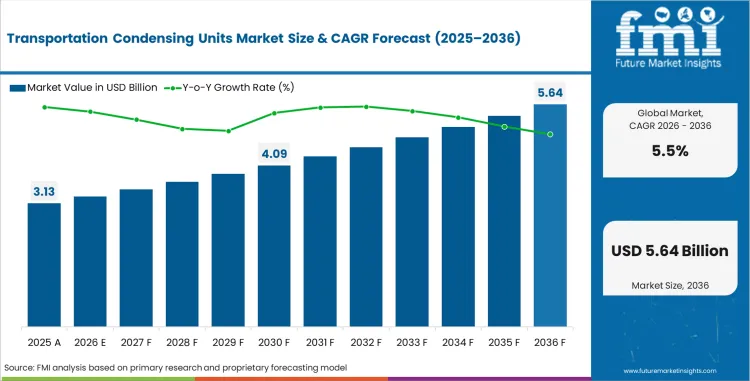
- The transportation condensing units market was valued at USD 3.13 billion in 2025.
- By 2036, the Transportation Condensing Units Market is expected to be worth USD 5.64 billion.
- From 2026 to 2036, the market is projected to expand at a CAGR of 5.5%.
- The market is projected to create an incremental opportunity of USD 2.34 billion between 2026 and 2036.
- In 2026, refrigerated transport is expected to account for 65% of the application segment, driven by demand for temperature-controlled perishable food and pharmaceutical logistics.
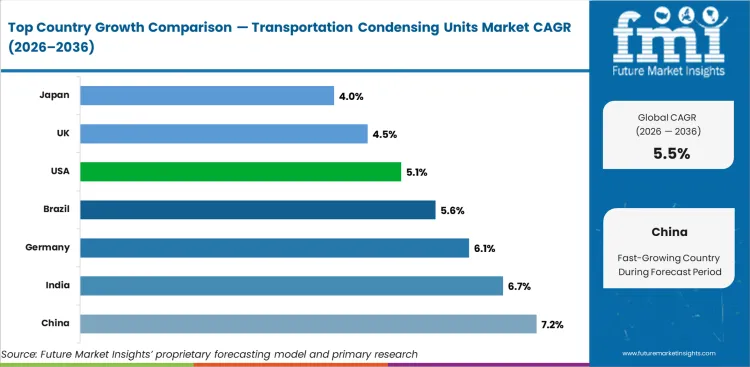
- China (7.21%) and India (6.68%) are two of the fastest growing markets in the world.
Transportation Condensing Units Market Definition
The transportation condensing units market includes refrigeration and cooling systems designed for temperature-controlled transport of perishable goods, pharmaceuticals, and temperature-sensitive materials. Products include air cooled and water cooled condensing units for trucks, trailers, vans, and other commercial vehicles used in cold chain logistics.
Transportation Condensing Units Market Inclusions
Market scope encompasses all commercially traded transportation condensing units categorized by product (air cooled condensing units, water cooled condensing units), application (refrigerated transport, non-refrigerated cooling), end use (logistics and transportation companies, food and beverage companies, pharmaceutical companies), distribution channel (direct sales, distributors), refrigerant type (fluorocarbon refrigerants, natural refrigerants), and power source (diesel powered units, electric powered units). Revenue estimates cover the period from 2026 to 2036.
Transportation Condensing Units Market Exclusions
The scope does not include stationary condensing units for cold storage warehouses, residential or commercial HVAC condensing units, or industrial refrigeration systems not designed for transportation applications.
Transportation Condensing Units Market Research Methodology
- Primary Research: FMI analysts conducted interviews with cold chain logistics providers, fleet operators, condensing unit OEMs, and refrigerant system engineers across North America, Europe, and Asia.
- Desk Research: Combined data from transport refrigeration industry associations, refrigerant regulation databases, and fleet procurement records.
- Market sizing and forecasting: Bottom-up aggregation from refrigerated transport fleet data across food, pharmaceutical, and specialty logistics segments, with regional adoption curves for refrigerant transition and electrification.
- Data validation: Cross-checked quarterly against global cold chain fleet statistics, manufacturer shipment data, and regulatory compliance records.
Why is the Transportation Condensing Units Market Growing?
- The growth of cold chain in perishable food logistics and pharmaceutical distribution, particularly in markets with growing investment in cold storage infrastructure, is creating sustained procurement cycles.
- Kigali Amendment and EU F-gas regulations mandates for refrigerant transition are accelerating the replacement of old fluorocarbon systems, driving demand for units suitable for natural and low-GWP refrigerants.
Transportation condensing units are in demand primarily in the food logistics and pharmaceutical cold chain operations where temperature integrity during transit is a regulatory and commercial requirement. Growth mirrors structural growth in cold chain infrastructure across East Asia and South Asia, where rising organized retail penetration and food safety enforcement are increasing the share of refrigerated transport in total freight movement. Air cooled condensing units represent 60.0% of product demand due to lower maintenance needs and suitability for standard truck and trailer configurations.
Refrigerant regulation is changing purchasing specifications on all markets. The phasedown of hydrofluorocarbons under the Kigali Amendment and EU F-gas Regulation is compelling fleet operators and logistics providers to switch to natural refrigerant systems, including carbon dioxide and ammonia based units. This change in regulation is resulting in shorter replacement cycles and higher average unit costs, especially for operators that operate mixed fleets under different regulatory regimes.
Diversification of power sources is becoming a structural theme. Diesel powered units remain dominant with a 60.0% share, but electric powered and hybrid systems are gaining traction in urban logistics and last-mile delivery. Municipal low-emission zones in Europe and parts of East Asia are setting a floor for adoption of electric units, particularly for light commercial vehicle applications where plug-in charging infrastructure is available.
Market Segmentation Analysis
- Air cooled condensing units, with a product share of 60.0%, are roof mounted units and under chassis units that meet the distinct vehicle configuration requirements across light and heavy commercial vehicle fleets.
- 65.0% of application demand is from refrigerated transport. Major sub-segments of temperature-controlled logistics are food transportation and pharmaceutical transport.
- Direct sales dominate distribution at 65.0%, reflecting the specification-driven procurement process in which OEMs and fleet operators negotiate directly with condensing unit manufacturers.
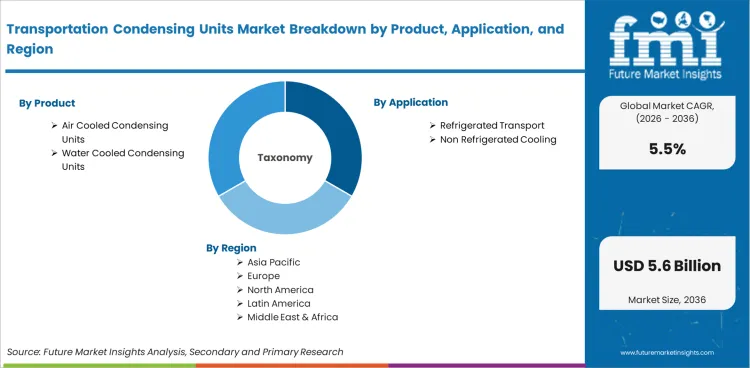
The transportation condensing units market is segmented on the basis of product, application, end-use, distribution channel, refrigerant type and power source. Demand trends reflect cold chain infrastructure maturity, the regulatory environment and fleet modernization timing across regions.
Insights into the Refrigerated Transport Application Segment
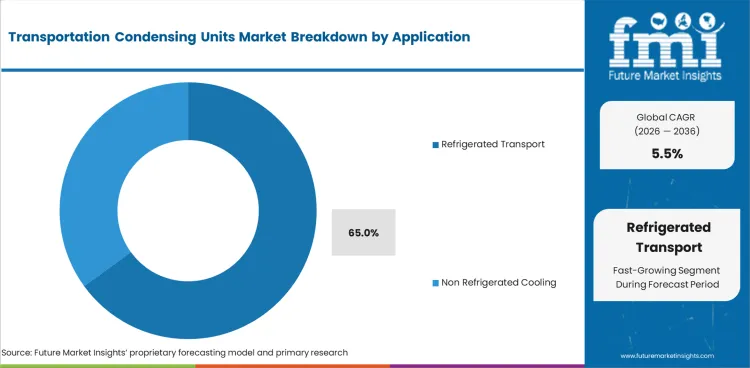
The application segment is projected to have a 65.0% share in refrigerated transport in 2026. Food transportation remains the largest sub-segment, followed by pharmaceutical transportation and then chemical transportation.
Pharmaceutical transport applications require validated temperature control with continuous monitoring, increasing unit specification requirements and average selling prices, . Compatibility with specialized containment and ventilation requirements is necessary for chemical transport applications.
Insights into the Air Cooled Condensing Units Product Segment
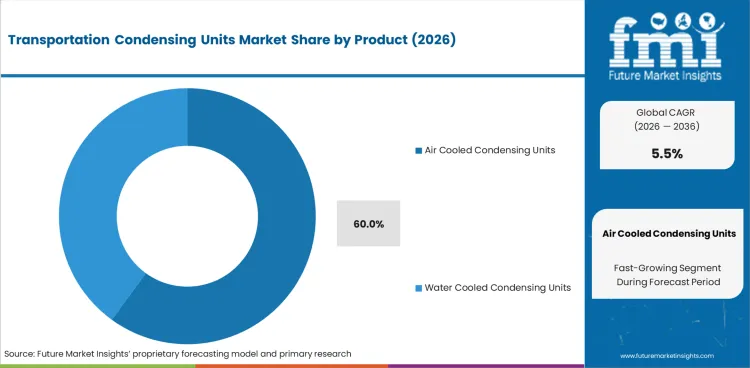
Air cooled condensing units represent 60.0% of the product demand. The largest sub segment is roof mounted units, used in both light and heavy commercial vehicles for long-haul and regional distribution. Chassis units below are for use with trailers and containers.
The other 40.0% are water cooled condensing units, used in specialized applications where air cooling is not sufficient, such as high-ambient-temperature environments and heavy-duty continuous operation.
Transportation Condensing Units Market Drivers, Restraints, and Opportunities
- Structured demand for refrigerant transition and cold chain compliance is being driven by regulatory requirements, insulating procurement from short-term economic cycles.
- High upfront costs for electric powered and natural refrigerant units limit adoption in price sensitive markets confining growth to premium and compliance driven segments.
- Pharmaceutical cold chain and food safety enforcement expansions are creating new demand corridors beyond traditional food logistics applications.
The transportation condensing units market is being driven by the regulatory mandates, fleet modernization requirements and the structural expansion of cold chain logistics. Demand drivers include refrigerant transition timelines and emission zone enforcement, while supply constraints include component costs and limited aftermarket coverage in emerging markets.
Cold Chain Infrastructure Expansion
Investment in cold chain in China, India and Southeast Asia is creating multi-year procurement pipelines. Government programs to reduce food waste and ensure pharmaceutical distribution integrity are turning once-unrefrigerated logistics lanes into temperature-controlled corridors.
Refrigerant Transition and Fleet Replacement
In regulated markets, the phasedown timeline for high-GWP refrigerants is reducing replacement cycles from the typical 8 to 12 year range to 5 to 7 years. In Europe and North America, fleet operators are accelerating unit replacements in a bid to avoid stranded assets.
Electrification of Urban Logistics
Structural demand for electric and hybrid condensing units is being created by urban emission zone regulations. The cost premium for electric units remains 25% to 40% over diesel equivalents, but total cost of ownership parity is closing in markets with high diesel fuel costs.
Pharmaceutical Cold Chain Compliance
GDP and WHO guidelines are increasing the qualification standards for condensing units in vaccine and biopharmaceutical distribution. Validated temperature controls and continuous monitoring provide opportunities for premium pricing for compliant equipment.
Analysis of Transportation Condensing Units Market By Key Countries
.webp "Top Country Growth Comparison Transportation Condensing Units Market Cagr (2026 2036)")
| Country | CAGR |
|---|---|
| China | 7.21% |
| India | 6.68% |
| Germany | 6.14% |
| Brazil | 5.61% |
| USA | 5.07% |
| UK | 4.54% |
| Japan | 4.01% |
- China is in the first position with a CAGR of 7.21%, supported by the expansion of cold chain infrastructure and the largest food logistics network in the world.
- India at 6.68% shows strong demand supported by cold chain logistics development, food safety enforcement and organized retail expansion.
Sales Analysis of Transportation Condensing Units Market in China
China will drive global demand growth at a CAGR of 7.21% through 2036, powered by the world's largest cold chain expansion program. Steady procurement pipelines are being created for air-cooled and water-cooled condensing units through government-supported investment in cold-chain logistics infrastructure, food safety enforcement, and pharmaceutical distribution modernization.
- Government food safety programs are creating multi-year procurement cycles for air cooled roof mounted units through investment in cold chain infrastructure.
- Pharmaceutical GDP compliance fuels demand for validated condensing units in vaccine and biopharmaceutical distribution networks.
- Regulations on urban emission zones in tier-one cities are driving the use of electric powered condensing units for last-mile delivery.
Demand Outlook for Transportation Condensing Units Market in India
India is expected to grow at 6.68% CAGR till 2036. Cold chain logistics is moving out of metropolitan corridors and into secondary distribution networks due to organised retail penetration and government food waste reduction programs. The market is leaning towards cost competitive air cooled diesel units
- National Logistics Policy and food safety enforcement are extending refrigerated transport requirements beyond tier-one cities.
- Fleet expansion by third-party cold chain logistics providers is driving standardized condensing unit specifications.
- Demand for validated temperature-controlled transport systems is driven by pharmaceutical cold chain compliance requirements.
Opportunity Analysis of Transportation Condensing Units Market in Germany
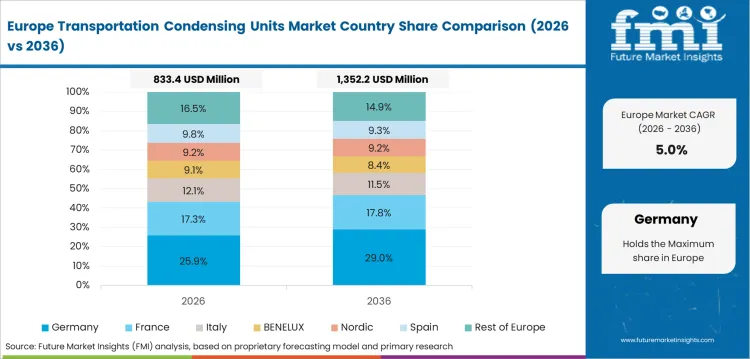
Germany is expected to achieve a 6.14% CAGR by 2036. Demand is driven by compliance with the EU F-gas Regulation and stringent emission zone standards forcing fleet operators to speed up unit replacements. The market wants energy efficiency and lifecycle cost optimization.
- EU F-gas phase-down timelines are shortening replacement cycles and driving procurement toward natural refrigerant compatible units.• Harsh implementation of urban emission zones in big cities are pushing the adoption of electric and hybrid powered condensing systems.
- High qualification barriers for new market entrants due to DIN and EU CE compliance requirements.
Future Outlook for Transportation Condensing Units Market in Brazil
Brazil is expected to grow at a CAGR of 5.61% through 2036. Growth in cold chain logistics supported by organised retail and growth in protein export infrastructure. The demand is mainly for food transport applications with the main procurement being diesel powered air cooled units.
- The export of protein products requires validated cold chain transport, hence the need for highly reliable condensing units.
- The expansion of organized retail is raising the importance of refrigerated transport in the nation’s food distribution networks.
- National infrastructure programs to develop cold chains in the north are creating new demand corridors.
In-depth Analysis of Transportation Condensing Units Market in the United States
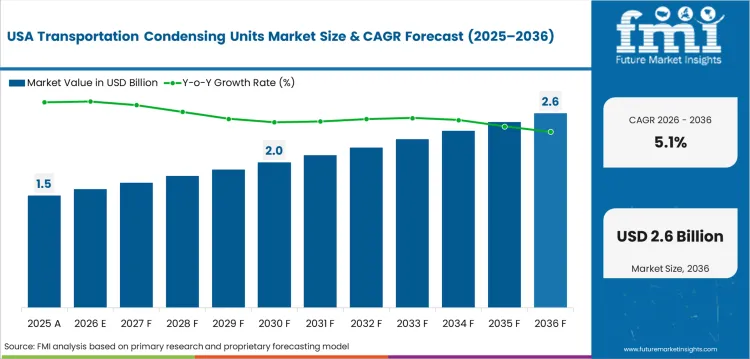
The USA is projected to increase at a CAGR of 5.07% through 2036. A well-established cold chain infrastructure for food retail, food service distribution, and pharmaceutical logistics supports demand. Main growth drivers are fleet replacement cycles and transition to low-GWP refrigerants.
- EPA refrigerant rules are driving fleet operators to consider low-GWP alternatives as part of their scheduled replacement programs.
- Large-scale food distribution networks of integrated logistics providers provide stable aftermarket and replacement demand.
- More demand for validated condensing systems due to the expansion of the pharmaceutical cold chain for specialty drug distribution.
Growth Analysis of Transportation Condensing Units Market in the United Kingdom
UK is expected to grow at a CAGR of 4.54% through 2036. The key demand drivers are the post-Brexit regulatory alignment and the enforcement of urban emission zones in London and other large cities. The urban distribution market is for compact, energy-efficient units.
- With the expansion of urban emission zones, more electric condensing units are being adopted for food and pharmaceutical delivery in inner cities.
- Procurement activity for compliant transport equipment is being sustained due to post-Brexit food safety and cold chain compliance requirements.
- National Grid ESO energy programs are helping to fund infrastructure for electric vehicle charging to support adoption of electric condensing units.
Market Landscape for Transportation Condensing Units Market in Japan
Japan is projected to expand at a 4.01% CAGR through 2036. Market is dominated by high specification standards, long qualification cycles and the need for compact and energy efficient condensing units which fit within the domestic logistics environment.
- High quality demands and compliance with JIS are the key to the high qualification standards of condensing unit manufacturers.
- Moderate overall market growth is supported by aging fleet replacement cycles providing stable procurement volumes.
- Specification premium for compact unit designs optimized for Japanese commercial vehicle configurations.
Competitive Landscape and Strategic Positioning
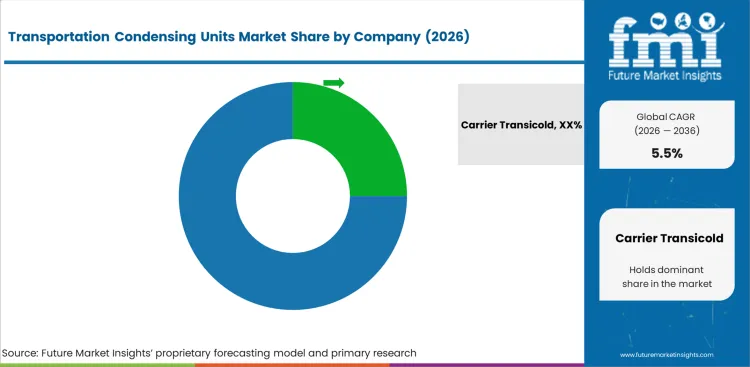
- Carrier Transicold leads with integrated manufacturing and global aftermarket networks across cold chain logistics.
- Thermo King and Daikin Industries maintain strong positions through broad product portfolios and regional service infrastructure.
- New entrants from Asia are targeting price-sensitive segments with cost-competitive air cooled units.
Key Companies in the Transportation Condensing Units Market
Key global companies leading the transportation condensing units market include:
- Carrier Transicold, Thermo King, Daikin Industries maintain leading positions through established manufacturing infrastructure, distribution networks, and product breadth.
- Guchen Industry, Kingtec hold strong regional or segment-specific positions with specialized capabilities.
- Zanotti S.p.A., MHI Thermal Systems, Hubbard Products represent emerging players expanding through technology innovation and niche market positioning.
Competitive Benchmarking: Transportation Condensing Units Market
| Company | Cold Chain Coverage | Refrigerant Platform Range | Aftermarket Network | Geographic Reach |
|---|---|---|---|---|
| Carrier Transicold | Strong | High | Strong | Global |
| Thermo King | Strong | High | Strong | Global |
| Daikin Industries | Moderate | Medium | Moderate | Asia, Global |
| Guchen Industry | Moderate | Medium | Low | Asia |
| Kingtec | Low | Medium | Low | Asia |
Source: Future Market Insights competitive analysis, 2026.
Key Developments in Transportation Condensing Units Market
- In 2025, Thermo King expanded its range of fully electric E-Series transport refrigeration and condensing units for vans and light commercial vehicles to address the needs of urban cold chain logistics and low-emission delivery operations across Europe.
- In 2025, Daikin Industries Ltd. expanded its portfolio of solutions for refrigerated transport, promoting energy-efficient and low global warming potential cooling technologies for commercial cold chain and logistics applications.
Key Players in the Transportation Condensing Units Market
Major Global Players
- Carrier Transicold
- Thermo King
- Daikin Industries
- Guchen Industry
- Kingtec
Emerging Players/Startups
- Zanotti S.p.A.
- MHI Thermal Systems
- Hubbard Products
- Klinge Corporation
- ShinMaywa Industries
Report Scope and Coverage
| Parameter | Details |
|---|---|
| Quantitative Units | USD 3.30 billion to USD 5.64 billion, at a CAGR of 5.5% |
| Market Definition | The transportation condensing units market includes refrigeration and cooling systems designed for temperature-controlled transport of perishable goods, pharmaceuticals, and temperature-sensitive materials. Products include air cooled and water cooled condensing units for trucks, trailers, vans, and other commercial vehicles used in cold chain logistics. |
| Regions Covered | North America, Latin America, Europe, East Asia, South Asia and Pacific, Middle East and Africa |
| Countries Covered | China, India, Germany, Brazil, USA, UK, Japan, 30 plus countries |
| Key Companies Profiled | Carrier Transicold, Thermo King, Daikin Industries, Guchen Industry, Kingtec |
| Forecast Period | 2026 to 2036 |
| Approach | Hybrid bottom-up and top-down methodology starting with verified transaction data, projecting adoption velocity across segments and regions. |
Market Segmentation Analysis
Transportation Condensing Units Market Segmented by Product:
- Air Cooled Condensing Units
- Roof Mounted Units
- Truck Applications
- Trailer Applications
- Under Chassis Units
- Light Commercial Vehicles
- Medium Duty Vehicles
- Roof Mounted Units
- Water Cooled Condensing Units
- Integrated Systems
- Closed Loop Systems
- Central Cooling Systems
- Standalone Units
- Industrial Transport Use
- Specialty Transport Applications
- Integrated Systems
Transportation Condensing Units Market Segmented by Application:
- Refrigerated Transport
- Food Transportation
- Frozen Food Transport
- Fresh Produce Transport
- Pharmaceutical Transport
- Vaccine Distribution
- Temperature Sensitive Drugs
- Chemical Transport
- Hazardous Materials
- Temperature Controlled Chemicals
- Food Transportation
- Non Refrigerated Cooling
- Electronics Transport
- Sensitive Equipment
- Component Logistics
- Specialty Cargo
- Art And Antiques
- Precision Instruments
- Electronics Transport
Transportation Condensing Units Market Segmented by End Use:
- Logistics And Transportation Companies
- Cold Chain Logistics Providers
- Third Party Logistics
- Integrated Logistics Providers
- Fleet Operators
- Truck Fleet Owners
- Trailer Operators
- Cold Chain Logistics Providers
- Food And Beverage Companies
- Food Processors
- Frozen Food Manufacturers
- Dairy Producers
- Retail Chains
- Supermarket Chains
- Food Delivery Networks
- Food Processors
- Pharmaceutical Companies
- Drug Manufacturers
- Biopharmaceutical Companies
- Vaccine Producers
- Drug Manufacturers
Transportation Condensing Units Market Segmented by Distribution Channel:
- Direct Sales
- Original Equipment Manufacturers
- Vehicle Integrated Systems
- Factory Installed Units
- Aftermarket Sales
- Replacement Units
- Upgrade Installations
- Original Equipment Manufacturers
- Distributors
- Equipment Distributors
- Regional Distributors
- Global Distributors
- Online Platforms
- B2B Marketplaces
- Industrial E Commerce
- Equipment Distributors
Transportation Condensing Units Market Segmented by Refrigerant Type:
- Fluorocarbon Refrigerants
- Hydrofluorocarbon Refrigerants
- Common Industrial Refrigerants
- Low Emission Variants
- Hydrochlorofluorocarbon Refrigerants
- Legacy Systems
- Transitional Refrigerants
- Hydrofluorocarbon Refrigerants
- Natural Refrigerants
- Carbon Dioxide Systems
- Transcritical Systems
- Low Temperature Applications
- Ammonia Systems
- Industrial Cooling
- High Efficiency Systems
- Carbon Dioxide Systems
Transportation Condensing Units Market Segmented by Power Source:
- Diesel Powered Units
- Standalone Diesel Units
- Truck Mounted Systems
- Trailer Mounted Systems
- Hybrid Diesel Units
- Electric Assist Systems
- Fuel Efficient Systems
- Standalone Diesel Units
- Electric Powered Units
- Battery Powered Systems
- Fully Electric Units
- Short Distance Transport
- Plug In Systems
- Shore Power Units
- Depot Charging Systems
- Battery Powered Systems
Transportation Condensing Units Market by Region:
- North America
- USA
- Canada
- Mexico
- Latin America
- Brazil
- Chile
- Rest of Latin America
- Western Europe
- Germany
- UK
- Italy
- Spain
- France
- Nordic
- BENELUX
- Rest of Western Europe
- Eastern Europe
- Russia
- Poland
- Hungary
- Balkan & Baltic
- Rest of Eastern Europe
- East Asia
- China
- Japan
- South Korea
- South Asia and Pacific
- India
- ASEAN
- Australia & New Zealand
- Rest of South Asia and Pacific
- Middle East & Africa
- Kingdom of Saudi Arabia
- Other GCC Countries
- Turkiye
- South Africa
- Other African Union
- Rest of Middle East & Africa
Research Sources and Bibliography
- 1. International Institute of Refrigeration. (2025). IIR Global Cold Chain Report: Transportation Refrigeration Systems. IIR.
- 2. European Commission. (2024). EU F-gas Regulation: Hydrofluorocarbon Phasedown Schedule. EC.
- 3. United Nations Environment Programme. (2025). Kigali Amendment Implementation Progress Report. UNEP.
- 4. International Transport Forum. (2025). ITF Cold Chain Logistics and Infrastructure Investment Review. OECD/ITF.
- 5. USA Environmental Protection Agency. (2024). EPA SNAP Program: Acceptable Refrigerants for Transport Refrigeration. EPA.
This bibliography is provided for reader reference. The full Future Market Insights report contains the complete reference list with publication dates, URLs, and supporting data for all cited works.
This Report Answers
- Estimating the size of the market and revenue projections from 2026 to 2036.
- Segmentation by product, application, end use, distribution channel, refrigerant type, and power source.
- Insights about more than 30 country markets.
- Analysis of refrigerant transition impact and electrification trends.
- Assessment of the competitive landscape and strategic positioning.
- Finding investment opportunities in cold chain logistics and pharmaceutical transport.
- Tracking supply chain developments and fleet modernization trends.
- Delivery of data in PDF and Excel formats.
Frequently Asked Questions
How big is the transportation condensing units market in 2026?
The global transportation condensing units market is estimated to be valued at USD 3.30 billion in 2026.
What will be the size of transportation condensing units market in 2036?
The market size for the transportation condensing units market is projected to reach USD 5.64 billion by 2036.
How much will be the transportation condensing units market growth between 2026 and 2036?
The transportation condensing units market is expected to grow at a 5.5% CAGR between 2026 and 2036.
What are the key product types in the transportation condensing units market?
The key product types in transportation condensing units market are air cooled condensing units and water cooled condensing units.
Which application segment is expected to contribute significant share in the transportation condensing units market in 2026?
In terms of application, refrigerated transport segment is expected to command 65.0% share in the transportation condensing units market in 2026.
Preview the report firsthand - request a free sample
Get SampleGet the brochure for pricing and purchase details.
Get PDFTable of Content
- Executive Summary
- Global Market Outlook
- Demand-side Trends
- Supply-side Trends
- Technology Roadmap Analysis
- Analysis and Recommendations
- Market Overview
- Market Coverage / Taxonomy
- Market Definition / Scope / Limitations
- Research Methodology
- Chapter Orientation
- Analytical Lens and Working Hypotheses
- Market Structure, Signals, and Trend Drivers
- Benchmarking and Cross-market Comparability
- Market Sizing, Forecasting, and Opportunity Mapping
- Research Design and Evidence Framework
- Desk Research Programme (Secondary Evidence)
- Company Annual and Sustainability Reports
- Peer-reviewed Journals and Academic Literature
- Corporate Websites, Product Literature, and Technical Notes
- Earnings Decks and Investor Briefings
- Statutory Filings and Regulatory Disclosures
- Technical White Papers and Standards Notes
- Trade Journals, Industry Magazines, and Analyst Briefs
- Conference Proceedings, Webinars, and Seminar Materials
- Government Statistics Portals and Public Data Releases
- Press Releases and Reputable Media Coverage
- Specialist Newsletters and Curated Briefings
- Sector Databases and Reference Repositories
- FMI Internal Proprietary Databases and Historical Market Datasets
- Subscription Datasets and Paid Sources
- Social Channels, Communities, and Digital Listening Inputs
- Additional Desk Sources
- Expert Input and Fieldwork (Primary Evidence)
- Primary Modes
- Qualitative Interviews and Expert Elicitation
- Quantitative Surveys and Structured Data Capture
- Blended Approach
- Why Primary Evidence is Used
- Field Techniques
- Interviews
- Surveys
- Focus Groups
- Observational and In-context Research
- Social and Community Interactions
- Stakeholder Universe Engaged
- C-suite Leaders
- Board Members
- Presidents and Vice Presidents
- R&D and Innovation Heads
- Technical Specialists
- Domain Subject-matter Experts
- Scientists
- Physicians and Other Healthcare Professionals
- Governance, Ethics, and Data Stewardship
- Research Ethics
- Data Integrity and Handling
- Primary Modes
- Tooling, Models, and Reference Databases
- Desk Research Programme (Secondary Evidence)
- Data Engineering and Model Build
- Data Acquisition and Ingestion
- Cleaning, Normalisation, and Verification
- Synthesis, Triangulation, and Analysis
- Quality Assurance and Audit Trail
- Market Background
- Market Dynamics
- Drivers
- Restraints
- Opportunity
- Trends
- Scenario Forecast
- Demand in Optimistic Scenario
- Demand in Likely Scenario
- Demand in Conservative Scenario
- Opportunity Map Analysis
- Product Life Cycle Analysis
- Supply Chain Analysis
- Investment Feasibility Matrix
- Value Chain Analysis
- PESTLE and Porter’s Analysis
- Regulatory Landscape
- Regional Parent Market Outlook
- Production and Consumption Statistics
- Import and Export Statistics
- Market Dynamics
- Global Market Analysis 2021 to 2025 and Forecast, 2026 to 2036
- Historical Market Size Value (USD Million) Analysis, 2021 to 2025
- Current and Future Market Size Value (USD Million) Projections, 2026 to 2036
- Y-o-Y Growth Trend Analysis
- Absolute $ Opportunity Analysis
- Global Market Pricing Analysis 2021 to 2025 and Forecast 2026 to 2036
- Global Market Analysis 2021 to 2025 and Forecast 2026 to 2036, By Product
- Introduction / Key Findings
- Historical Market Size Value (USD Million) Analysis By Product , 2021 to 2025
- Current and Future Market Size Value (USD Million) Analysis and Forecast By Product , 2026 to 2036
- Air Cooled Condensing Value (USD Million)s
- Roof Mounted Value (USD Million)s
- Truck Applications
- Trailer Applications
- Under Chassis Value (USD Million)s
- Light Commercial Vehicles
- Medium Duty Vehicles
- Water Cooled Condensing Value (USD Million)s
- Integrated Systems
- Closed Loop Systems
- Central Cooling Systems
- Standalone Value (USD Million)s
- Industrial Transport Use
- Air Cooled Condensing Value (USD Million)s
- Y-o-Y Growth Trend Analysis By Product , 2021 to 2025
- Absolute $ Opportunity Analysis By Product , 2026 to 2036
- Global Market Analysis 2021 to 2025 and Forecast 2026 to 2036, By Application
- Introduction / Key Findings
- Historical Market Size Value (USD Million) Analysis By Application, 2021 to 2025
- Current and Future Market Size Value (USD Million) Analysis and Forecast By Application, 2026 to 2036
- Refrigerated Transport
- Food Transportation
- Frozen Food Transport
- Fresh Produce Transport
- Pharmaceutical Transport
- Vaccine Distribution
- Temperature Sensitive Drugs
- Chemical Transport
- Hazardous Materials
- Temperature Controlled Chemicals
- Non Refrigerated Cooling
- Electronics Transport
- Sensitive Equipment
- Component Logistics
- Specialty Cargo
- Art And Antiques
- Refrigerated Transport
- Y-o-Y Growth Trend Analysis By Application, 2021 to 2025
- Absolute $ Opportunity Analysis By Application, 2026 to 2036
- Global Market Analysis 2021 to 2025 and Forecast 2026 to 2036, By End Use
- Introduction / Key Findings
- Historical Market Size Value (USD Million) Analysis By End Use, 2021 to 2025
- Current and Future Market Size Value (USD Million) Analysis and Forecast By End Use, 2026 to 2036
- Logistics And Transportation Companies
- Cold Chain Logistics Providers
- Third Party Logistics
- Integrated Logistics Providers
- Fleet Operators
- Truck Fleet Owners
- Trailer Operators
- Food And Beverage Companies
- Food Processors
- Frozen Food Manufacturers
- Dairy Producers
- Retail Chains
- Supermarket Chains
- Pharmaceutical Companies
- Drug Manufacturers
- Biopharmaceutical Companies
- Vaccine Producers
- Logistics And Transportation Companies
- Y-o-Y Growth Trend Analysis By End Use, 2021 to 2025
- Absolute $ Opportunity Analysis By End Use, 2026 to 2036
- Global Market Analysis 2021 to 2025 and Forecast 2026 to 2036, By Distribution Channel
- Introduction / Key Findings
- Historical Market Size Value (USD Million) Analysis By Distribution Channel, 2021 to 2025
- Current and Future Market Size Value (USD Million) Analysis and Forecast By Distribution Channel, 2026 to 2036
- Direct Sales
- Original Equipment Manufacturers
- Vehicle Integrated Systems
- Factory Installed Value (USD Million)s
- Aftermarket Sales
- Replacement Value (USD Million)s
- Upgrade Installations
- Distributors
- Equipment Distributors
- Regional Distributors
- Global Distributors
- Online Platforms
- B2B Marketplaces
- Direct Sales
- Y-o-Y Growth Trend Analysis By Distribution Channel, 2021 to 2025
- Absolute $ Opportunity Analysis By Distribution Channel, 2026 to 2036
- Global Market Analysis 2021 to 2025 and Forecast 2026 to 2036, By Refrigerant Type
- Introduction / Key Findings
- Historical Market Size Value (USD Million) Analysis By Refrigerant Type, 2021 to 2025
- Current and Future Market Size Value (USD Million) Analysis and Forecast By Refrigerant Type, 2026 to 2036
- Fluorocarbon Refrigerants
- Hydrofluorocarbon Refrigerants
- Common Industrial Refrigerants
- Low Emission Variants
- Hydrochlorofluorocarbon Refrigerants
- Legacy Systems
- Transitional Refrigerants
- Natural Refrigerants
- Carbon Dioxide Systems
- Transcritical Systems
- Low Temperature Applications
- Ammonia Systems
- Industrial Cooling
- Fluorocarbon Refrigerants
- Y-o-Y Growth Trend Analysis By Refrigerant Type, 2021 to 2025
- Absolute $ Opportunity Analysis By Refrigerant Type, 2026 to 2036
- Global Market Analysis 2021 to 2025 and Forecast 2026 to 2036, By Power Source
- Introduction / Key Findings
- Historical Market Size Value (USD Million) Analysis By Power Source, 2021 to 2025
- Current and Future Market Size Value (USD Million) Analysis and Forecast By Power Source, 2026 to 2036
- Diesel Powered Value (USD Million)s
- Standalone Diesel Value (USD Million)s
- Truck Mounted Systems
- Trailer Mounted Systems
- Hybrid Diesel Value (USD Million)s
- Electric Assist Systems
- Fuel Efficient Systems
- Electric Powered Value (USD Million)s
- Battery Powered Systems
- Fully Electric Value (USD Million)s
- Short Distance Transport
- Plug In Systems
- Shore Power Value (USD Million)s
- Diesel Powered Value (USD Million)s
- Y-o-Y Growth Trend Analysis By Power Source, 2021 to 2025
- Absolute $ Opportunity Analysis By Power Source, 2026 to 2036
- Global Market Analysis 2021 to 2025 and Forecast 2026 to 2036, By Region
- Introduction
- Historical Market Size Value (USD Million) Analysis By Region, 2021 to 2025
- Current Market Size Value (USD Million) Analysis and Forecast By Region, 2026 to 2036
- North America
- Latin America
- Western Europe
- Eastern Europe
- East Asia
- South Asia and Pacific
- Middle East & Africa
- Market Attractiveness Analysis By Region
- North America Market Analysis 2021 to 2025 and Forecast 2026 to 2036, By Country
- Historical Market Size Value (USD Million) Trend Analysis By Market Taxonomy, 2021 to 2025
- Market Size Value (USD Million) Forecast By Market Taxonomy, 2026 to 2036
- By Country
- USA
- Canada
- Mexico
- By Product
- By Application
- By End Use
- By Distribution Channel
- By Refrigerant Type
- By Power Source
- By Country
- Market Attractiveness Analysis
- By Country
- By Product
- By Application
- By End Use
- By Distribution Channel
- By Refrigerant Type
- By Power Source
- Key Takeaways
- Latin America Market Analysis 2021 to 2025 and Forecast 2026 to 2036, By Country
- Historical Market Size Value (USD Million) Trend Analysis By Market Taxonomy, 2021 to 2025
- Market Size Value (USD Million) Forecast By Market Taxonomy, 2026 to 2036
- By Country
- Brazil
- Chile
- Rest of Latin America
- By Product
- By Application
- By End Use
- By Distribution Channel
- By Refrigerant Type
- By Power Source
- By Country
- Market Attractiveness Analysis
- By Country
- By Product
- By Application
- By End Use
- By Distribution Channel
- By Refrigerant Type
- By Power Source
- Key Takeaways
- Western Europe Market Analysis 2021 to 2025 and Forecast 2026 to 2036, By Country
- Historical Market Size Value (USD Million) Trend Analysis By Market Taxonomy, 2021 to 2025
- Market Size Value (USD Million) Forecast By Market Taxonomy, 2026 to 2036
- By Country
- Germany
- UK
- Italy
- Spain
- France
- Nordic
- BENELUX
- Rest of Western Europe
- By Product
- By Application
- By End Use
- By Distribution Channel
- By Refrigerant Type
- By Power Source
- By Country
- Market Attractiveness Analysis
- By Country
- By Product
- By Application
- By End Use
- By Distribution Channel
- By Refrigerant Type
- By Power Source
- Key Takeaways
- Eastern Europe Market Analysis 2021 to 2025 and Forecast 2026 to 2036, By Country
- Historical Market Size Value (USD Million) Trend Analysis By Market Taxonomy, 2021 to 2025
- Market Size Value (USD Million) Forecast By Market Taxonomy, 2026 to 2036
- By Country
- Russia
- Poland
- Hungary
- Balkan & Baltic
- Rest of Eastern Europe
- By Product
- By Application
- By End Use
- By Distribution Channel
- By Refrigerant Type
- By Power Source
- By Country
- Market Attractiveness Analysis
- By Country
- By Product
- By Application
- By End Use
- By Distribution Channel
- By Refrigerant Type
- By Power Source
- Key Takeaways
- East Asia Market Analysis 2021 to 2025 and Forecast 2026 to 2036, By Country
- Historical Market Size Value (USD Million) Trend Analysis By Market Taxonomy, 2021 to 2025
- Market Size Value (USD Million) Forecast By Market Taxonomy, 2026 to 2036
- By Country
- China
- Japan
- South Korea
- By Product
- By Application
- By End Use
- By Distribution Channel
- By Refrigerant Type
- By Power Source
- By Country
- Market Attractiveness Analysis
- By Country
- By Product
- By Application
- By End Use
- By Distribution Channel
- By Refrigerant Type
- By Power Source
- Key Takeaways
- South Asia and Pacific Market Analysis 2021 to 2025 and Forecast 2026 to 2036, By Country
- Historical Market Size Value (USD Million) Trend Analysis By Market Taxonomy, 2021 to 2025
- Market Size Value (USD Million) Forecast By Market Taxonomy, 2026 to 2036
- By Country
- India
- ASEAN
- Australia & New Zealand
- Rest of South Asia and Pacific
- By Product
- By Application
- By End Use
- By Distribution Channel
- By Refrigerant Type
- By Power Source
- By Country
- Market Attractiveness Analysis
- By Country
- By Product
- By Application
- By End Use
- By Distribution Channel
- By Refrigerant Type
- By Power Source
- Key Takeaways
- Middle East & Africa Market Analysis 2021 to 2025 and Forecast 2026 to 2036, By Country
- Historical Market Size Value (USD Million) Trend Analysis By Market Taxonomy, 2021 to 2025
- Market Size Value (USD Million) Forecast By Market Taxonomy, 2026 to 2036
- By Country
- Kingdom of Saudi Arabia
- Other GCC Countries
- Turkiye
- South Africa
- Other African Union
- Rest of Middle East & Africa
- By Product
- By Application
- By End Use
- By Distribution Channel
- By Refrigerant Type
- By Power Source
- By Country
- Market Attractiveness Analysis
- By Country
- By Product
- By Application
- By End Use
- By Distribution Channel
- By Refrigerant Type
- By Power Source
- Key Takeaways
- Key Countries Market Analysis
- USA
- Pricing Analysis
- Market Share Analysis, 2025
- By Product
- By Application
- By End Use
- By Distribution Channel
- By Refrigerant Type
- By Power Source
- Canada
- Pricing Analysis
- Market Share Analysis, 2025
- By Product
- By Application
- By End Use
- By Distribution Channel
- By Refrigerant Type
- By Power Source
- Mexico
- Pricing Analysis
- Market Share Analysis, 2025
- By Product
- By Application
- By End Use
- By Distribution Channel
- By Refrigerant Type
- By Power Source
- Brazil
- Pricing Analysis
- Market Share Analysis, 2025
- By Product
- By Application
- By End Use
- By Distribution Channel
- By Refrigerant Type
- By Power Source
- Chile
- Pricing Analysis
- Market Share Analysis, 2025
- By Product
- By Application
- By End Use
- By Distribution Channel
- By Refrigerant Type
- By Power Source
- Germany
- Pricing Analysis
- Market Share Analysis, 2025
- By Product
- By Application
- By End Use
- By Distribution Channel
- By Refrigerant Type
- By Power Source
- UK
- Pricing Analysis
- Market Share Analysis, 2025
- By Product
- By Application
- By End Use
- By Distribution Channel
- By Refrigerant Type
- By Power Source
- Italy
- Pricing Analysis
- Market Share Analysis, 2025
- By Product
- By Application
- By End Use
- By Distribution Channel
- By Refrigerant Type
- By Power Source
- Spain
- Pricing Analysis
- Market Share Analysis, 2025
- By Product
- By Application
- By End Use
- By Distribution Channel
- By Refrigerant Type
- By Power Source
- France
- Pricing Analysis
- Market Share Analysis, 2025
- By Product
- By Application
- By End Use
- By Distribution Channel
- By Refrigerant Type
- By Power Source
- India
- Pricing Analysis
- Market Share Analysis, 2025
- By Product
- By Application
- By End Use
- By Distribution Channel
- By Refrigerant Type
- By Power Source
- ASEAN
- Pricing Analysis
- Market Share Analysis, 2025
- By Product
- By Application
- By End Use
- By Distribution Channel
- By Refrigerant Type
- By Power Source
- Australia & New Zealand
- Pricing Analysis
- Market Share Analysis, 2025
- By Product
- By Application
- By End Use
- By Distribution Channel
- By Refrigerant Type
- By Power Source
- China
- Pricing Analysis
- Market Share Analysis, 2025
- By Product
- By Application
- By End Use
- By Distribution Channel
- By Refrigerant Type
- By Power Source
- Japan
- Pricing Analysis
- Market Share Analysis, 2025
- By Product
- By Application
- By End Use
- By Distribution Channel
- By Refrigerant Type
- By Power Source
- South Korea
- Pricing Analysis
- Market Share Analysis, 2025
- By Product
- By Application
- By End Use
- By Distribution Channel
- By Refrigerant Type
- By Power Source
- Russia
- Pricing Analysis
- Market Share Analysis, 2025
- By Product
- By Application
- By End Use
- By Distribution Channel
- By Refrigerant Type
- By Power Source
- Poland
- Pricing Analysis
- Market Share Analysis, 2025
- By Product
- By Application
- By End Use
- By Distribution Channel
- By Refrigerant Type
- By Power Source
- Hungary
- Pricing Analysis
- Market Share Analysis, 2025
- By Product
- By Application
- By End Use
- By Distribution Channel
- By Refrigerant Type
- By Power Source
- Kingdom of Saudi Arabia
- Pricing Analysis
- Market Share Analysis, 2025
- By Product
- By Application
- By End Use
- By Distribution Channel
- By Refrigerant Type
- By Power Source
- Turkiye
- Pricing Analysis
- Market Share Analysis, 2025
- By Product
- By Application
- By End Use
- By Distribution Channel
- By Refrigerant Type
- By Power Source
- South Africa
- Pricing Analysis
- Market Share Analysis, 2025
- By Product
- By Application
- By End Use
- By Distribution Channel
- By Refrigerant Type
- By Power Source
- USA
- Market Structure Analysis
- Competition Dashboard
- Competition Benchmarking
- Market Share Analysis of Top Players
- By Regional
- By Product
- By Application
- By End Use
- By Distribution Channel
- By Refrigerant Type
- By Power Source
- Competition Analysis
- Competition Deep Dive
- Carrier Transicold
- Overview
- Product Portfolio
- Profitability by Market Segments (Product/Age /Sales Channel/Region)
- Sales Footprint
- Strategy Overview
- Marketing Strategy
- Product Strategy
- Channel Strategy
- Thermo King
- Daikin Industries
- Guchen Industry
- Kingtec
- Carrier Transicold
- Competition Deep Dive
- Assumptions & Acronyms Used


