

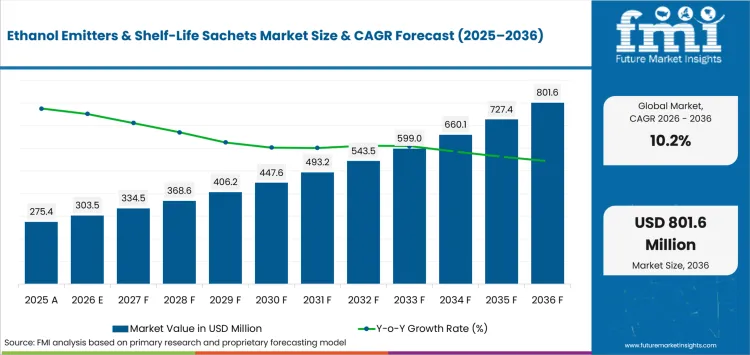
- Market Size (2026)
- USD 303.5 Mn
- Forecast (2036)
- USD 801.6 Mn
- CAGR (2026 to 2036)
- 10.2%
How big is Ethanol Emitters & Shelf-Life Sachets Market in 2026?
USD 303.5 million in 2026 and USD 801.6 million by 2036 at a 10.2% CAGR.
Demand for ethanol emitters & shelf-life sachets is forecast to push valuation from USD 303.5 million in 2026 to USD 801.6 million by 2036 at 10.2% CAGR. Bakery operators purchase active packaging if in-pack control protects additional sellable days without reformulating the food or slowing routine production. In June 2026 ProAmpac announced successful commercialization of MP-1000 with Ozzi after its active film replaced loose desiccant packets by controlling residual moisture. The commercial deployment strengthens the purchasing case for formats that survive normal production conditions while reducing handling steps during distribution.
Germany and Japan follow different qualification routes because German packaging teams work inside a mature recovery system while Japanese teams emphasize exact food-pack fit. Germany’s Environment Agency reported in May 2026 that 69.4% of packaging waste generated in 2023 was recycled. Germany’s high-recovery food packaging system therefore places extra pressure on small in-pack components to justify their material footprint. Ethanol emitters retain a stronger position where documented shelf-life gains offset the additional qualification work.
Key Takeaways
- Demand increases where bakery operators can convert longer validated shelf life into fewer write-offs and a wider distribution window.
- By product type, standard formats are estimated to hold 42.0% in 2026 owing to fixed dimensions that simplify dosing and line setup.
- Paper & board is projected to represent 39.0% of material demand in 2026 as brands reduce conventional plastic in visible in-pack components.
- In 2026, bread & rolls are expected to lead bakery application with 37.0% share because moist products require repeatable mold control after sealing.
- Qualification is the main restraint because release rate, package barrier and sensory performance must stay acceptable during actual storage and distribution.
- Some of the key players in this market include Freund Corporation, Mitsubishi Gas Chemical, Multisorb Technologies, Desiccare, Sealed Air, Amcor, ProAmpac, and Novolex.
Analyst Perspective
“Packaging teams should compare validated sellable days and line performance before they compare sachet unit prices. Commercial value is earned where the emitter and host pack pass qualification together without slowing routine production.”
- Nandini Roy Choudhury, Principal Consultant, Future Market Insights
How is the Ethanol Emitters & Shelf-Life Sachets Market segmented?
The market is assessed by product type, material, bakery application, function and end use.
Product type covers standard, printed or branded, resealable or functional and sustainable formats. Material includes paper & board, plastic films, compostable or bio-based structures and aluminium or specialty structures. Bakery application covers bread & rolls, cakes & pastry, cookies & biscuits and frozen bakery. Function includes primary, secondary, transit or returnable and active shelf-life extension packaging. End use covers industrial bakeries, in-store bakery and retail, and artisan or foodservice operations.
What makes Standard formats central to the Product Type category?
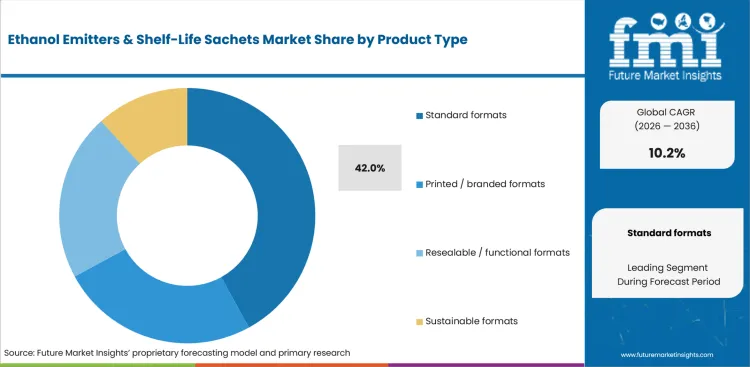
Standard formats reduce qualification variables for bakeries running several SKUs on one sachet packaging platform. Fixed packet dimensions make dose selection and automatic insertion easier to document while giving large bakeries one repeatable setting for high-volume runs with similar package geometry.
- Based on product type, standard formats are projected to account for 42.0% in 2026 owing to familiar dimensions that reduce changeover work and simplify repeat ordering.
- Freund Corporation renewed its food-preservative packaging in October 2025 without changing product quality or function, with rollout beginning from that month’s production. The action shows why buyers value a stable technical format despite external presentation changes.
Why does Paper & Board lead the Material category?
Paper & board attracts brands seeking less conventional plastic in paper-based sachet packaging while retaining controlled transfer and a printable outer surface. Tetra Pak extended paper-based barriers to high-speed A3/Speed lines in February 2026 while retaining comparable shelf life under industrial filling conditions.
- By material, paper & board is estimated to hold 39.0% in 2026 because its visible surface supports material-reduction goals while preserving printable pack area.
- Barrier performance is the purchase gate because ethanol release or moisture control fails if the web passes vapor too quickly, so material changes require package-level trials before conversion on high-speed bakery lines.
How do Bread & Rolls anchor the Bakery Application category?
Bread and rolls pair regular production volume with a mold risk that appears after sealing. In-pack preservation can protect softness and appearance without changing the dough formula, which makes fresh food packaging performance commercially relevant.
- In 2026, bread & rolls are expected to lead bakery application with 37.0% share attributable to moist crumb and repeated production runs that require ongoing mold control.
- Amcor partnered with Tip Top in February 2025 on bread bags containing 30% recycled plastic under a mass-balance approach. The conversion was expected to remove 160 tons of virgin plastic by December 2025 while maintaining bread quality and safety.
What supports Primary Packaging within the Function category?
Active sachets perform inside the sealed consumer pack where vapor, oxygen and moisture conditions directly affect product stability. Primary placement therefore gives barrier packaging engineers the clearest route to validate headspace control against the host film.
- Primary packaging is set to lead the function category with 53.0% share in 2026 due to direct in-pack placement that controls the atmosphere surrounding each product.
- Sealed Air documented in February 2025 that Bradburys Cheese extended average shelf life from 40 to 100 days after industrial primary-pack trials. The case shows why line validation and sellable-life evidence carry more weight than component claims alone.
What are the drivers, restraints and opportunities in the Ethanol Emitters & Shelf-Life Sachets Market?
Food-waste economics support demand, package-specific validation limits adoption and lower-plastic formats offer the clearest commercial route.
- Driver: Bakeries adopt in-pack control once longer validated shelf life reduces write-offs and preserves a planned retail or distribution window.
- Restraint: Release rate and barrier behavior must match the food because excess moisture, oxygen or ethanol exposure can undermine finished-product quality.
- Opportunity: Paper webs and easier insertion can reduce packaging friction if the active format keeps its required transfer behavior on production lines.
Food-Waste Economics Keep Shelf-Life Control on the Purchase List
Bakery operators can justify an emitter if spoilage reduction has a visible cost against discarded product and missed sales. The USA EPA updated its Wasted Food Scale in January 2026 and estimated that food represents 24% of material in municipal solid-waste landfills. The landfill share keeps prevention ahead of disposal, so shelf-life projects gain credibility once trials record avoided waste instead of packaging performance alone.
Package Fit Extends Qualification Work
Shelf-life sachets must match the spoilage route and package conditions rather than substitute one preservation method for another. USDA ARS published an April 2025 study in which an absorbed-paper film achieved more than 99.999% microbial reduction and preserved tomato quality after 21 days at 10 degrees Celsius. The test design makes package-specific storage validation directly relevant before quality teams approve recurring orders.
Paper Webs and Easier Insertion Define the Next Revenue Route
Material changes become commercially useful if they reduce plastic without creating new line or disposal problems. The American Forest & Paper Association reported in August 2025 that 60%-64% of USA paper available for recovery was recycled during 2024. The 2024 recovery rate strengthens the case for lower-plastic flexible packaging formats, provided the active chemistry still passes sealing and release-rate tests plus food-contact and line-speed checks.
Which country CAGRs are profiled in the Ethanol Emitters & Shelf-Life Sachets Market?
| Country | CAGR |
|---|---|
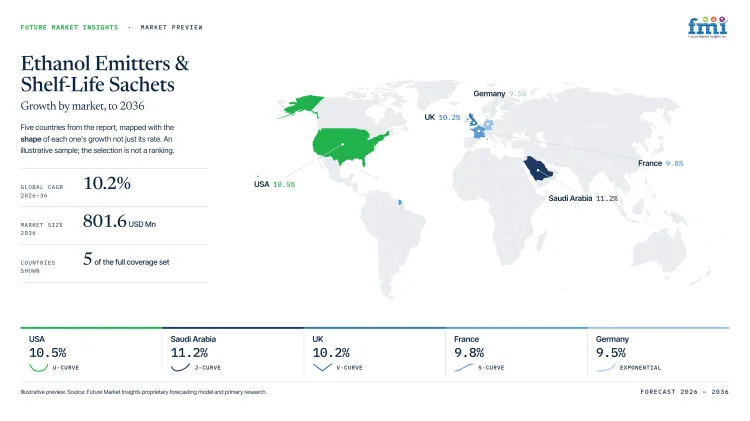
| Saudi Arabia | 11.2% |
| USA | 10.5% |
| UK | 10.2% |
| France | 9.8% |
| Germany | 9.5% |
How do country-level CAGRs compare in the Ethanol Emitters & Shelf-Life Sachets Market?
The five-country range spans 1.7 percentage points, from Saudi Arabia at 11.2% to Germany at 9.5%. Saudi Arabia, USA, and UK form the upper group at 11.2%, 10.5%, and 10.2%. The narrow spread means multilayer flexible packaging qualification and route economics can outweigh small forecast differences.
- Saudi Arabia experiences strong demand for ethanol emitters as high temperatures and extended distribution conditions increase the need for freshness protection.
- USA benefits from ethanol emitter adoption as long-distance bakery shipments require consistent freshness across warehouses and retail networks.
- UK demand is supported by growing attention to food-contact compliance and reliable controlled-release performance in packaged foods.
- France sees opportunities for shelf-life sachets that help maintain bakery quality across supermarket distribution without requiring formulation changes.
- Germany favors dependable sachet performance that can integrate smoothly into automated bakery production and high-volume packaging operations.
Similar CAGRs can produce different economics because local qualification costs vary materially. The full report provides country-level CAGR analysis across North America, Latin America, Europe, East Asia, South Asia, Oceania and the Middle East and Africa.
Country-wise Analysis
- Saudi Arabia’s bakery producers increasingly evaluate ethanol emitters against hot-climate storage conditions, packaging compatibility, and required shelf-life before introducing them across retail programs. Demand for ethanol emitters and shelf-life sachets in Saudi Arabia is forecast to expand at 11.2% CAGR from 2026 to 2036, supported by packaged bakery distribution that benefits from longer freshness periods without changing established formulations. High ambient temperatures and extended transport routes make release consistency and sachet performance important considerations when suppliers qualify products for large retail bakery programs.
- Large industrial bakeries in the USA assess active components against production-line speeds, sensory requirements, and retailer shelf-life targets before wider adoption. Demand for ethanol emitters and shelf-life sachets in the USA is projected to grow at 10.5% CAGR from 2026 to 2036, supported by extensive packaged-bakery distribution that values additional sellable days without formulation changes. Regulatory scrutiny of food-contact materials also encourages manufacturers to document compliant barrier and packaging choices before scaling sachet applications across national bakery networks.
- UK bakery groups increasingly assess in-pack active components alongside packaging recyclability, material requirements, and targeted shelf-life performance during retailer reviews. Demand is expected to rise at 10.2% CAGR from 2026 to 2036, as longer distribution windows strengthen the commercial case for freshness-extending solutions. Suppliers therefore need to demonstrate that ethanol emitters maintain product quality while remaining compatible with the recycling attributes and packaging specifications required across high-volume bakery lines.
- French bakery manufacturers evaluate ethanol emitters as part of broader packaging decisions that balance shelf-life extension, material use, and retailer sustainability expectations. Demand for ethanol emitters and shelf-life sachets is forecast to increase at 9.8% CAGR from 2026 to 2036, supported by the economics of preserving quality across dense supermarket and regional distribution networks. Successful suppliers need to demonstrate sachet-to-pack compatibility, reliable release performance, and measurable freshness benefits before active components are adopted across national bakery programs.
- German bakery and packaging teams typically assess active sachets alongside primary-pack recyclability and automated production requirements during packaging changes. Demand for ethanol emitters and shelf-life sachets in Germany is projected to record 9.5% CAGR through 2036, driven by demand for verified shelf-life performance across mature packaged-food channels. The key requirement for suppliers is to demonstrate consistent emitter performance and compatibility with design-for-recycling objectives during requalification on automated bakery production lines.
Who are the notable companies in the Ethanol Emitters & Shelf-Life Sachets Market?
Freund Corporation, Mitsubishi Gas Chemical, Multisorb Technologies, Desiccare, Sealed Air, Amcor, ProAmpac, and Novolex are the notable companies serving this market.
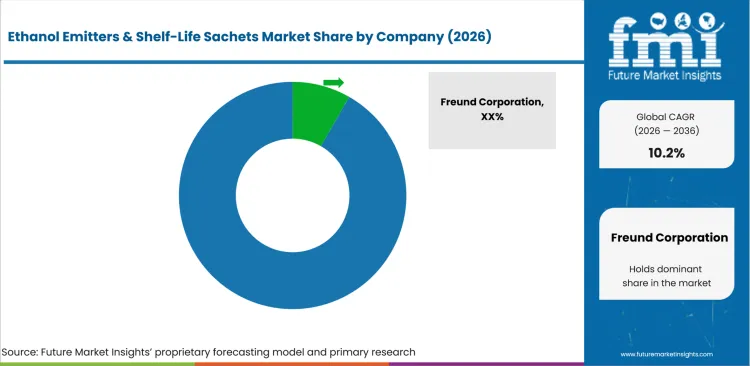
Competition separates specialist atmosphere-control companies from large packaging groups that sell the host pack, automation or adjacent freshness-indicating packaging technology. Direct emitter suppliers face the highest application burden because they must size the active component to food mass, barrier loss and storage conditions. Large converters enter from flexible plastic packaging and paper converting expertise that already serves industrial food lines. Qualification strength and bakery relationships determine how much adjacent shelf-life business these converters can capture from active-component specialists.
- Freund Corporation, Mitsubishi Gas Chemical, Multisorb Technologies and Desiccare compete on absorber chemistry, sizing knowledge and pack-atmosphere control.
- Sealed Air and ProAmpac bring food-package engineering and line-integration experience that can reduce conversion work during commercial qualification.
- Amcor and Novolex compete from high-volume food-packaging positions where bakery scale and material conversion broaden access to large accounts.
Competitive Benchmarking: Ethanol Emitters & Shelf-Life Sachets Market
| Company | Active-Control Proximity | Food Packaging Fit | Production Integration | Geographic Reach |
|---|---|---|---|---|
| Freund Corporation | High | High | Medium | Japan |
| Mitsubishi Gas Chemical | High | Medium | Medium | Japan and international operations |
| Multisorb Technologies | High | Medium | Medium | North America |
| Desiccare | High | Medium | Medium | North America |
| Sealed Air | Medium | High | High | North America and Europe |
| Amcor | Low | High | High | Global |
| ProAmpac | High | Medium | High | Global |
| Novolex | Low | Medium | Medium | North America |
Scoring basis: High active-control proximity requires a current direct absorber, emitter or active-film route while Medium covers atmosphere-control packaging or equipment and Low identifies a documented host-pack role without active chemistry. High food-packaging fit requires a current bakery or named shelf-life application while Medium requires other documented food packaging and Low identifies only adjacent foodservice packaging. High production integration requires a documented line deployment or active-film integration while Medium requires current manufacturing plus application support and Low identifies material supply without line evidence. Geographic reach records regions supported by current corporate operations or official commercial activity instead of a numerical score.
Key Developments in the Ethanol Emitters & Shelf-Life Sachets Market
- In September 2025, Sealed Air installed its 4,000th CRYOVAC rotary vacuum chamber system at Cargill’s Dodge City facility to expand automated food-packaging capacity.
- In June 2025, Amcor supplied Woolworths with sliced-bread bags containing 30% recycled plastic. The change was expected to save about 50,000 kilograms of virgin plastic annually.
- In April 2025, Novolex completed its combination with Pactiv Evergreen to expand its food-packaging portfolio and manufacturing base.
Key Players in the Ethanol Emitters & Shelf-Life Sachets Market
Atmosphere-Control and Preservation Specialists
- Freund Corporation
- Mitsubishi Gas Chemical
- Multisorb Technologies
- Desiccare
Integrated Food-Packaging Platforms
- Sealed Air
- Amcor
- ProAmpac
- Novolex
Ethanol Emitters & Shelf-Life Sachets Market - Report Scope
| Coverage field | Report scope |
|---|---|
| Market breakdown | By product type, material, bakery application, function, end use and region. |
| Quantitative Units | USD Million. |
| Market Definition | Ethanol-releasing emitters and in-pack shelf-life sachets used to manage mold, oxygen or moisture in packaged foods, with bakery as the core application boundary. |
| Regions Covered | North America, Latin America, Europe, East Asia, South Asia and Pacific, and Middle East and Africa. |
| Countries Covered | USA, UK, France, Germany, Japan, and 20+ countries included in the full report. |
| Key Companies Profiled | Freund Corporation, Mitsubishi Gas Chemical, Multisorb Technologies, Desiccare, Sealed Air, Amcor, ProAmpac, Novolex. |
| Forecast Period | 2026 to 2036. |
| Approach | Primary and secondary research with market triangulation. |
Ethanol Emitters & Shelf-Life Sachets Market - Research Methodology
| Method | Approach |
|---|---|
| Primary Research | FMI analysts gathered input from manufacturers, service providers, technology developers, distributors, end users, procurement teams, and subject-matter experts. Interviews examined purchasing decisions, product or service evaluation, adoption barriers, approval requirements, pricing considerations, and expectations for technical or commercial support. Respondents were also asked what evidence is required before a trial, pilot, or initial order develops into regular purchasing. |
| Desk Research | Desk research covered government statistics, regulatory publications, trade data, industry associations, technical literature, standards, company filings, product information, and official corporate announcements. Sources were reviewed for relevance, publication date, geographic coverage, and consistency with the defined market scope. Claims relating to performance, applications, approvals, capacity, investment, and commercial activity were retained only when supported by credible public evidence. |
| Market Sizing and Forecasting | The market model combined the baseline value with historical performance, segment structure, pricing and volume indicators, adoption levels, company participation, and country-level demand conditions. Forecast assumptions considered economic activity, investment trends, regulatory developments, technology adoption, purchasing cycles, supply availability, and barriers to wider market use. Segment and regional estimates were reconciled before the final market total was calculated. |
| Data Validation | Estimates were checked against multiple independent indicators, including public data, company activity, trade patterns, industry developments, and findings from primary interviews. Validation also tested whether products, services, applications, and company revenues fell within the defined market boundaries. Adjacent categories, unsupported claims, overlapping revenues, and activities without direct market relevance were excluded to reduce double counting and maintain consistency across segments and countries. |
Ethanol Emitters & Shelf-Life Sachets Market by Segments
Ethanol Emitters & Shelf-Life Sachets Market segmented by Product Type:
- Standard formats
- Printed / branded formats
- Resealable / functional formats
- Sustainable formats
Ethanol Emitters & Shelf-Life Sachets Market segmented by Material:
- Paper & board
- Plastic films
- Compostable / bio-based
- Aluminium & specialty
Ethanol Emitters & Shelf-Life Sachets Market segmented by Bakery Application:
- Bread & rolls
- Cakes & pastry
- Cookies & biscuits
- Frozen bakery
Ethanol Emitters & Shelf-Life Sachets Market segmented by Function:
- Primary packaging
- Secondary packaging
- Transit & returnable
- Active / shelf-life extension
Ethanol Emitters & Shelf-Life Sachets Market segmented by End Use:
- Industrial bakeries
- In-store bakery & retail
- Artisan & foodservice
Ethanol Emitters & Shelf-Life Sachets Market by Region:
- North America
- United States
- Canada
- Latin America
- Brazil
- Mexico
- Chile
- Rest of Latin America
- Western Europe
- Germany
- United Kingdom
- Italy
- Spain
- France
- Nordics
- Benelux
- Rest of Western Europe
- Eastern Europe
- Russia
- Poland
- Hungary
- Balkan and Baltic States
- Rest of Eastern Europe
- East Asia
- China
- Japan
- South Korea
- South Asia and Pacific
- India
- ASEAN
- Australia and New Zealand
- Rest of South Asia and Pacific
- Middle East and Africa
- Kingdom of Saudi Arabia
- Other GCC Countries
- Türkiye
- South Africa
- Other African Union Countries
- Rest of Middle East and Africa
Research Sources and Bibliography
- ProAmpac. (2026, June 4). Dry by Design: ProAmpac and Ozzi Tackle Moisture at the Source
- Umweltbundesamt. (2026, May 13). Verpackungsverbrauch 2023 gesunken, Recyclingquote gestiegen
- Freund Corporation. (2025, October 15).
- Tetra Pak. (2026, February 10). Tetra Pak extends paper-based barrier packaging to high-speed packaging lines in Asia
- Amcor. (2025, February 12). Amcor partners with Tip Top to introduce bread bags with 30% recycled plastic
- Sealed Air. (2025, February 26). Bradburys Cheese
- USA Environmental Protection Agency. (2026, January 20). Wasted Food Scale
- USA Department of Agriculture, Agricultural Research Service. (2025, April 26). In-package release of gaseous chlorine dioxide for improving the safety and shelf-life of grape tomatoes
- Desiccare. (2026, February 4). Desiccant vs Oxygen Absorbers: What’s the Difference?
- American Forest & Paper Association. (2025, August 12). Paper Industry Announces 2024 USA Paper Recycling Rates
- USA Food and Drug Administration. (2025, January 3). FDA Determines Authorization for 35 Food Contact Notifications Related to PFAS Are No Longer Effective
- Department for Environment, Food & Rural Affairs. (2025, July 23). UK statistics on waste
- ADEME. (2026, April 7). Emballages ménagers et papiers graphiques : données 2024
- Umweltbundesamt and ZSVR. (2026, January 27). Facts against myths: Packaging waste recycling in Germany is working
- Ministry of Agriculture, Forestry and Fisheries of Japan. (2026, June 30).
- Sealed Air. (2025, September 9). CRYOVAC Brand Food Packaging Installs 4,000th Rotary Vacuum Packaging System
- Amcor. (2025, September 30). Circularity in motion: Woolworths rolls out more sustainable bread bags with 30% recycled plastic
- Novolex. (2025, April 1). Novolex and Pactiv Evergreen Inc. Complete Combination, Creating a Leading Manufacturer in Food, Beverage and Specialty Packaging
- Multisorb Technologies. (2025, March 19). Food Safety System Certification FSSC 22000 Certificate US24/00000334
- Mitsubishi Gas Chemical Company, Inc. (2025, June 24). Annual Securities Report 2025
- Coveris. (2025, November 20). Coveris Announces Centre of Excellence for Wicketted Bags
- Stora Enso. (2026, April 30). Stora Enso launches Performa Natura Aqua, a dispersion-coated board for foodservice and bakery packaging
- Mondi. (2025, August 14). Mondi ramps up FunctionalBarrier Paper Ultimate to meet growing demand for sustainable high-barrier paper-based packaging
- Tetra Pak. (2026, April 22). Tetra Pak and Sterilgarda Alimenti launch industry-first 1-litre aseptic carton with paper-based barrier
- Amcor. (2025, May 12). Amcor and Metsä Group partner to develop molded fiber-based food packaging solutions
- Huhtamaki. (2025, February 28). Huhtamaki launches recyclable single coated paper cups for yogurt and dairy
- Huhtamaki Flexible Packaging Germany GmbH & Co KG. (2025, June 10). BRCGS Global Standard Packaging Materials Issue 7 Certificate
- Koehler Paper. (2025, September 11). High Gloss for Paper Packaging with Koehler Paper Barrier Paper
- Novolex. (2025, May 1). Eco-Products and DNO Produce Help Bring Environmental Sustainability to K-12 School Cafeterias
This bibliography is provided for reader reference and is not exhaustive. The full report contains the complete reference list and detailed citations
This Report Answers
- How large is the ethanol emitters & shelf-life sachets market in 2026 and 2036?
- Which operating conditions make in-pack shelf-life control commercially worthwhile for packaged bakery products?
- Why do standard formats, paper & board, bread & rolls and primary packaging lead their categories?
- Which qualification steps delay adoption on industrial bakery packaging lines?
- How do profiled country CAGRs change entry priorities and commercial requirements?
- Which companies compete in preservation chemistry, package engineering and bakery conversion?
- How do notable companies compare on preservation depth and production integration?
- Which recent company actions show investment in food shelf-life packaging capability?
Frequently Asked Questions
How big is the ethanol emitters & shelf-life sachets market in 2026?
The ethanol emitters & shelf-life sachets market is valued at USD 303.5 million in 2026 and is projected to reach USD 801.6 million by 2036. Bakery operators support growth by buying validated shelf-life control that limits write-offs without reformulating products.
What is the CAGR of the ethanol emitters & shelf-life sachets market from 2026 to 2036?
The ethanol emitters & shelf-life sachets market is projected to grow at a CAGR of 10.2% between 2026 and 2036. Food-waste economics and longer distribution windows support repeat purchases of validated in-pack preservation formats from industrial bakeries.
Which product type leads the ethanol emitters & shelf-life sachets market?
The standard formats segment is expected to hold 42.0% of the ethanol emitters & shelf-life sachets market in 2026, attributable to fixed dimensions that simplify dosing. Familiar packet sizes also reduce line-change work during repeated industrial bakery production runs on automated packaging equipment.
Which countries are projected to record the highest growth in the ethanol emitters & shelf-life sachets market?
The USA is projected to grow at 10.5% CAGR, followed by the UK at 10.2% and France at 9.8% through 2036. Packaged-bakery distribution and persistent food-loss economics support those growth rates in markets with established retail channels.
Which companies are active in the ethanol emitters & shelf-life sachets market?
Key companies operating in the market include Freund Corporation, Mitsubishi Gas Chemical, Multisorb Technologies, Desiccare, Sealed Air, Amcor, ProAmpac, and Novolex. Their positions reflect preservation chemistry and package engineering alongside large-scale food-packaging conversion capabilities for bakery accounts.
Preview the report firsthand - request a free sample
Get SampleGet the brochure for pricing and purchase details.
Get PDFTable of Content
- Key Takeaways
- Market Size and CAGR
- Top Growth Driver
- Fastest Growing Segment
- Leading Region
- Key Companies
- Emerging Opportunities
- Executive Summary
- Global Market Outlook
- Demand-side Trends
- Supply-side Trends
- Technology Roadmap Analysis
- Analysis and Recommendations
- Analyst Perspective (What is happening? Why now? What should investors know?)
- Key Questions Answered
- How large is the market?
- What is the CAGR?
- What are key trends?
- Which region dominates?
- Who are the leaders?
- Market Overview
- Market Coverage / Taxonomy
- Market Definition / Scope / Limitations
- Research Methodology
- Chapter Orientation
- Analytical Lens and Working Hypotheses
- Market Structure, Signals, and Trend Drivers
- Benchmarking and Cross-market Comparability
- Market Sizing, Forecasting, and Opportunity Mapping
- Research Design and Evidence Framework
- Desk Research Programme (Secondary Evidence)
- Expert Input and Fieldwork (Primary Evidence)
- Tooling, Models, and Reference Databases
- Data Engineering and Model Build
- Quality Assurance and Audit Trail
- Market Background
- Market Dynamics (Drivers, Restraints, Opportunity, Trends)
- Scenario Forecast (Optimistic, Likely, Conservative)
- Impact Analysis
- AI Impact
- Sustainability Impact
- Regulatory Impact
- Technology Impact
- Consumer / Buyer Analysis
- Purchase Drivers
- Adoption Barriers
- Buyer Journey
- Opportunity Map Analysis
- Product Life Cycle Analysis
- Supply Chain Analysis
- Investment Feasibility Matrix
- Value Chain Analysis
- PESTLE and Porter's Analysis
- Regulatory Landscape
- Regional Parent Market Outlook
- Production and Consumption Statistics
- Import and Export Statistics
- Global Market Analysis and Forecast, 2021 to 2036
- Historical Market Size Value (USD Million) Analysis, 2021 to 2025
- Current and Future Market Size Value (USD Million) Projections, 2026 to 2036
- Y-o-Y Growth Trend Analysis
- Absolute $ Opportunity Analysis
- Global Market Pricing Analysis, 2021 to 2036
- Global Market Analysis and Forecast, By Product Type, 2021 to 2036
- Introduction / Key Findings
- Historical Market Size Value (USD Million) Analysis By Product Type, 2021 to 2025
- Current and Future Market Size Value (USD Million) Analysis and Forecast By Product Type, 2026 to 2036
- Standard formats
- Printed / branded formats
- Resealable / functional formats
- Sustainable formats
- Standard formats
- Y-o-Y Growth Trend Analysis By Product Type, 2021 to 2025
- Absolute $ Opportunity Analysis By Product Type, 2026 to 2036
- Global Market Analysis and Forecast, By Material, 2021 to 2036
- Introduction / Key Findings
- Historical Market Size Value (USD Million) Analysis By Material, 2021 to 2025
- Current and Future Market Size Value (USD Million) Analysis and Forecast By Material, 2026 to 2036
- Paper & board
- Plastic films
- Compostable / bio-based
- Aluminium & specialty
- Paper & board
- Y-o-Y Growth Trend Analysis By Material, 2021 to 2025
- Absolute $ Opportunity Analysis By Material, 2026 to 2036
- Global Market Analysis and Forecast, By Bakery Application, 2021 to 2036
- Introduction / Key Findings
- Historical Market Size Value (USD Million) Analysis By Bakery Application, 2021 to 2025
- Current and Future Market Size Value (USD Million) Analysis and Forecast By Bakery Application, 2026 to 2036
- Bread & rolls
- Cakes & pastry
- Cookies & biscuits
- Frozen bakery
- Bread & rolls
- Y-o-Y Growth Trend Analysis By Bakery Application, 2021 to 2025
- Absolute $ Opportunity Analysis By Bakery Application, 2026 to 2036
- Global Market Analysis and Forecast, By Function, 2021 to 2036
- Introduction / Key Findings
- Historical Market Size Value (USD Million) Analysis By Function, 2021 to 2025
- Current and Future Market Size Value (USD Million) Analysis and Forecast By Function, 2026 to 2036
- Primary packaging
- Secondary packaging
- Transit & returnable
- Active / shelf-life extension
- Primary packaging
- Y-o-Y Growth Trend Analysis By Function, 2021 to 2025
- Absolute $ Opportunity Analysis By Function, 2026 to 2036
- Global Market Analysis and Forecast, By End Use, 2021 to 2036
- Introduction / Key Findings
- Historical Market Size Value (USD Million) Analysis By End Use, 2021 to 2025
- Current and Future Market Size Value (USD Million) Analysis and Forecast By End Use, 2026 to 2036
- Industrial bakeries
- In-store bakery & retail
- Artisan & foodservice
- Industrial bakeries
- Y-o-Y Growth Trend Analysis By End Use, 2021 to 2025
- Absolute $ Opportunity Analysis By End Use, 2026 to 2036
- Global Market Analysis and Forecast, By Region, 2021 to 2036
- Introduction
- Historical Market Size Value (USD Million) Analysis By Region, 2021 to 2025
- Current Market Size Value (USD Million) Analysis and Forecast By Region, 2026 to 2036
- North America
- Latin America
- Western Europe
- Eastern Europe
- East Asia
- South Asia and Pacific
- Middle East & Africa
- Market Attractiveness Analysis By Region
- North America Market Analysis and Forecast, By Country, 2021 to 2036
- Historical Market Size Value (USD Million) Trend Analysis By Market Taxonomy, 2021 to 2025
- Market Size Value (USD Million) Forecast By Market Taxonomy, 2026 to 2036
- By Country
- USA
- Canada
- By Product Type
- By Material
- By Bakery Application
- By Function
- By End Use
- By Country
- Market Attractiveness Analysis
- By Country
- By Product Type
- By Material
- By Bakery Application
- By Function
- By End Use
- Key Takeaways
- Latin America Market Analysis and Forecast, By Country
- Historical Market Size Value (USD Million) Trend Analysis By Market Taxonomy, 2021 to 2025
- Market Size Value (USD Million) Forecast By Market Taxonomy, 2026 to 2036
- By Country
- Brazil
- Mexico
- Chile
- Rest of Latin America
- By Product Type
- By Material
- By Bakery Application
- By Function
- By End Use
- By Country
- Market Attractiveness Analysis
- By Country
- By Product Type
- By Material
- By Bakery Application
- By Function
- By End Use
- Key Takeaways
- Western Europe Market Analysis and Forecast, By Country
- Historical Market Size Value (USD Million) Trend Analysis By Market Taxonomy, 2021 to 2025
- Market Size Value (USD Million) Forecast By Market Taxonomy, 2026 to 2036
- By Country
- Germany
- UK
- Italy
- Spain
- France
- Nordic
- BENELUX
- Rest of Western Europe
- By Product Type
- By Material
- By Bakery Application
- By Function
- By End Use
- By Country
- Market Attractiveness Analysis
- By Country
- By Product Type
- By Material
- By Bakery Application
- By Function
- By End Use
- Key Takeaways
- Eastern Europe Market Analysis and Forecast, By Country
- Historical Market Size Value (USD Million) Trend Analysis By Market Taxonomy, 2021 to 2025
- Market Size Value (USD Million) Forecast By Market Taxonomy, 2026 to 2036
- By Country
- Russia
- Poland
- Hungary
- Balkan & Baltic
- Rest of Eastern Europe
- By Product Type
- By Material
- By Bakery Application
- By Function
- By End Use
- By Country
- Market Attractiveness Analysis
- By Country
- By Product Type
- By Material
- By Bakery Application
- By Function
- By End Use
- Key Takeaways
- East Asia Market Analysis and Forecast, By Country
- Historical Market Size Value (USD Million) Trend Analysis By Market Taxonomy, 2021 to 2025
- Market Size Value (USD Million) Forecast By Market Taxonomy, 2026 to 2036
- By Country
- China
- Japan
- South Korea
- By Product Type
- By Material
- By Bakery Application
- By Function
- By End Use
- By Country
- Market Attractiveness Analysis
- By Country
- By Product Type
- By Material
- By Bakery Application
- By Function
- By End Use
- Key Takeaways
- South Asia and Pacific Market Analysis and Forecast, By Country
- Historical Market Size Value (USD Million) Trend Analysis By Market Taxonomy, 2021 to 2025
- Market Size Value (USD Million) Forecast By Market Taxonomy, 2026 to 2036
- By Country
- India
- ASEAN
- Australia & New Zealand
- Rest of South Asia and Pacific
- By Product Type
- By Material
- By Bakery Application
- By Function
- By End Use
- By Country
- Market Attractiveness Analysis
- By Country
- By Product Type
- By Material
- By Bakery Application
- By Function
- By End Use
- Key Takeaways
- Middle East & Africa Market Analysis and Forecast, By Country
- Historical Market Size Value (USD Million) Trend Analysis By Market Taxonomy, 2021 to 2025
- Market Size Value (USD Million) Forecast By Market Taxonomy, 2026 to 2036
- By Country
- Kingdom of Saudi Arabia
- Other GCC Countries
- Türkiye
- South Africa
- Other African Union
- Rest of Middle East & Africa
- By Product Type
- By Material
- By Bakery Application
- By Function
- By End Use
- By Country
- Market Attractiveness Analysis
- By Country
- By Product Type
- By Material
- By Bakery Application
- By Function
- By End Use
- Key Takeaways
- Key Countries Market Analysis
- USA
- Pricing Analysis
- Market Share Analysis, 2025
- By Product Type
- By Material
- By Bakery Application
- By Function
- By End Use
- Canada
- Pricing Analysis
- Market Share Analysis, 2025
- By Product Type
- By Material
- By Bakery Application
- By Function
- By End Use
- Mexico
- Pricing Analysis
- Market Share Analysis, 2025
- By Product Type
- By Material
- By Bakery Application
- By Function
- By End Use
- Brazil
- Pricing Analysis
- Market Share Analysis, 2025
- By Product Type
- By Material
- By Bakery Application
- By Function
- By End Use
- Chile
- Pricing Analysis
- Market Share Analysis, 2025
- By Product Type
- By Material
- By Bakery Application
- By Function
- By End Use
- Germany
- Pricing Analysis
- Market Share Analysis, 2025
- By Product Type
- By Material
- By Bakery Application
- By Function
- By End Use
- UK
- Pricing Analysis
- Market Share Analysis, 2025
- By Product Type
- By Material
- By Bakery Application
- By Function
- By End Use
- Italy
- Pricing Analysis
- Market Share Analysis, 2025
- By Product Type
- By Material
- By Bakery Application
- By Function
- By End Use
- Spain
- Pricing Analysis
- Market Share Analysis, 2025
- By Product Type
- By Material
- By Bakery Application
- By Function
- By End Use
- France
- Pricing Analysis
- Market Share Analysis, 2025
- By Product Type
- By Material
- By Bakery Application
- By Function
- By End Use
- India
- Pricing Analysis
- Market Share Analysis, 2025
- By Product Type
- By Material
- By Bakery Application
- By Function
- By End Use
- ASEAN
- Pricing Analysis
- Market Share Analysis, 2025
- By Product Type
- By Material
- By Bakery Application
- By Function
- By End Use
- Australia & New Zealand
- Pricing Analysis
- Market Share Analysis, 2025
- By Product Type
- By Material
- By Bakery Application
- By Function
- By End Use
- China
- Pricing Analysis
- Market Share Analysis, 2025
- By Product Type
- By Material
- By Bakery Application
- By Function
- By End Use
- Japan
- Pricing Analysis
- Market Share Analysis, 2025
- By Product Type
- By Material
- By Bakery Application
- By Function
- By End Use
- South Korea
- Pricing Analysis
- Market Share Analysis, 2025
- By Product Type
- By Material
- By Bakery Application
- By Function
- By End Use
- Russia
- Pricing Analysis
- Market Share Analysis, 2025
- By Product Type
- By Material
- By Bakery Application
- By Function
- By End Use
- Poland
- Pricing Analysis
- Market Share Analysis, 2025
- By Product Type
- By Material
- By Bakery Application
- By Function
- By End Use
- Hungary
- Pricing Analysis
- Market Share Analysis, 2025
- By Product Type
- By Material
- By Bakery Application
- By Function
- By End Use
- Kingdom of Saudi Arabia
- Pricing Analysis
- Market Share Analysis, 2025
- By Product Type
- By Material
- By Bakery Application
- By Function
- By End Use
- Türkiye
- Pricing Analysis
- Market Share Analysis, 2025
- By Product Type
- By Material
- By Bakery Application
- By Function
- By End Use
- South Africa
- Pricing Analysis
- Market Share Analysis, 2025
- By Product Type
- By Material
- By Bakery Application
- By Function
- By End Use
- USA
- Market Structure Analysis
- Competition Dashboard
- Competition Benchmarking
- Market Share Analysis of Top Players
- By Regional
- By Product Type
- By Material
- By Bakery Application
- By Function
- By End Use
- Emerging Startups
- Innovation Benchmarking
- Competition Analysis
- Competition Deep Dive
- Freund Corporation
- Overview
- Product Portfolio
- Profitability by Market Segments
- Sales Footprint
- Strategy Overview
- Marketing Strategy
- Product Strategy
- Channel Strategy
- Mitsubishi Gas Chemical
- Multisorb Technologies
- Desiccare
- Sealed Air
- Amcor
- ProAmpac
- Novolex
- Freund Corporation
- Case Studies
- Success Stories
- Recent Developments
- Competition Deep Dive
- Assumptions & Acronyms Used


