

- Market Size (2026)
- USD 230.2 Mn
- Forecast (2036)
- USD 457.1 Mn
- CAGR (2026 to 2036)
- 7.1%
How big is Europe Deposit Return Containers Market in 2026?
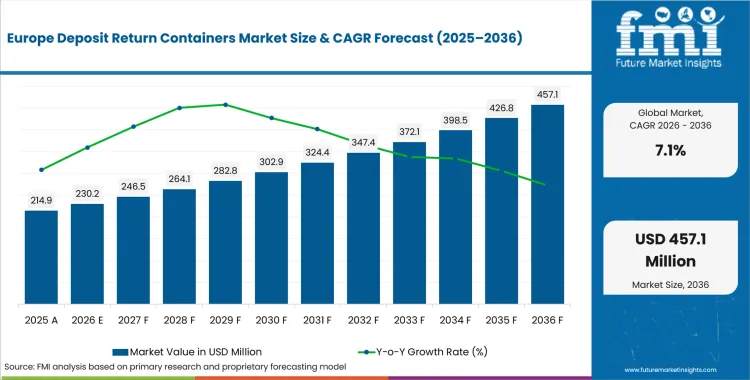
USD 230.2 million in 2026 and USD 457.1 million by 2036 at a 7.1% CAGR.
Demand for deposit return containers in Europe is projected to expand at a 7.1% CAGR between 2026 and 2036, lifting valuation from USD 230.2 million to USD 457.1 million. Foodservice operators increasingly need packaging that performs during service and fits a return network once handed over. The European Commission confirmed on 11 August 2026 that the PPWR would start applying on 12 August 2026. The common rules increase the value of formats that can be identified and reconditioned without slowing outlet operations.
Material recovery affects commercial design choices in deposit-backed and take-back formats operating inside a large European packaging stream. Eurostat published on 22 October 2025 that the EU generated 79.7 million tonnes of packaging waste during 2023. Large end-of-life volumes make recovery economics central to container design as operators need a credible route once final retirement occurs. Container makers therefore compete on circulation performance and the material pathway used once repeated service is no longer practical.
Key Takeaways
- Demand for Europe deposit return containers rises as foodservice operators translate reuse rules into container specifications and collection routines that outlets can operate repeatedly.
- By format type, standard formats are estimated to hold 37.0% in 2026 owing to common footprints that simplify pooled return handling.
- In 2026, paperboard is expected to lead the material category with 32.0% share because familiar converting routes support foodservice sourcing.
- Standard meal formats are set to lead the format size category with 39.0% share in 2026 due to dimensions suited to takeaway portions and return equipment.
- Weak return rates erode project economics by raising replacement spending and handling cost per completed rotation.
- Key players in the Europe deposit return containers market include TOMRA, Amcor, Duni Group, Novolex, Sabert Corporation Europe, Graphic Packaging International, Greiner Packaging, Vytal Global, and RECUP.
Analyst Perspective
"Return-ready containers should be judged by completed rotations because losses and washing can erase a low unit price. Commercial value comes from formats that fit return hardware and cleaning capacity while preserving foodservice speed."
- Nandini Roy Choudhury, Principal Consultant, Future Market Insights
How is the Europe deposit return containers market segmented?
The Europe deposit return containers market is segmented by format type, material, format size, end use, sales channel and region.
Market taxonomy covers five commercial axes. Format type includes standard formats, recyclable-optimized formats, premium & branded formats and custom-engineered formats. Material includes paperboard, molded fiber & bagasse, rPET & PP, compostable polymers and aluminium. Format size covers standard meal, single-serve and family & catering. End use includes delivery platforms, QSR chains, coffee & beverage, institutional catering and retail deli. Sales channels include broadline foodservice distributors, direct chain contracts, packaging distributors and online sales.
Why do delivery platforms lead the end use category?
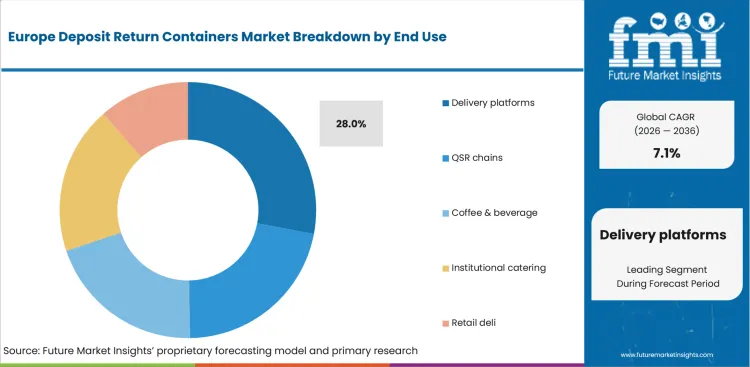
Delivery orders separate the customer from the restaurant once the meal leaves the outlet, so deposit terms and return instructions must travel with the digital order. Foodservice disposable demand already passes through platform checkouts, giving reusable deposits a natural point for identification during ordering.
- Delivery platforms are projected to hold 28.0% share in 2026 owing to digital checkout that can carry borrowing terms and return information.
- Vytal documented a March 2025 integration with qnips that incorporated reusable packaging into digital ordering and payment workflows. The integration removes a separate registration step during borrowing and places deposit terms inside checkout.
Why do standard formats lead the format type category?
Pooled crates and wash racks require predictable container dimensions to accept stock from many outlets without manual resorting. Specifications used in reusable packing systems become stricter once a container must pass through common collection apertures and standardized lid inventories during daily operations.
- By format type, standard formats are estimated to hold 37.0% in 2026 owing to simpler pooling and repeatable handling at return points at scale.
- In March 2025, Amcor's Berry business documented standardized reusable cups selected for Glasgow's Borrow Cup initiative. Common sizes and one universal lid reduce component variation in a shared network.
Why does paperboard lead the material category?
Paperboard enters foodservice purchasing through converters and packing lines that already handle printed meal packs, so qualification can start from familiar commercial forming and printing processes. Paperboard packaging remains relevant to take-back programmes that recover material after use instead of circulating the same pack repeatedly.
- By material, paperboard is forecast to represent 32.0% in 2026 owing to familiar converting routes that support branded foodservice formats.
- Graphic Packaging launched a European paperboard sushi portfolio in May 2025 for foodservice operators facing packaging rules. The range covered trays and clamshells with recyclable design options for busy takeaway counters.
Why do standard meal formats lead the format size category?
A reusable meal box must protect a full portion without consuming excessive space in delivery bags or commercial wash racks. Food packaging formats used for full meals face tighter dimensional limits. Reverse logistics must handle food volume and container nesting without wasting wash-rack capacity.
- By format size, standard meal formats are forecast to represent 39.0% in 2026 driven by common takeaway portions that fit high-frequency collection routines.
- TOMRA unveiled its Reuse Collection Point in May 2025 with acceptance extending from cups to food boxes and salad bowls. Automated acceptance gives standard meal containers a route into shared return infrastructure.
Why do broadline foodservice distributors lead the sales channel category?
Foodservice operators often want replacement stock and compatible lids inside the same purchasing route used for routine kitchen supplies each week. Clamshell packaging and return-ready meal boxes can share distributor routes, which reduces ordering changes for chains standardizing containers at multiple locations.
- Broadline foodservice distributors are set to lead the sales channel with 38.0% share in 2026 due to consolidated replenishment for multi-site operators.
- Duni Group launched Relevo in Sweden with distributor Carepa in August 2025. The arrangement placed a digital reusable takeaway system inside a familiar foodservice distribution relationship and existing account network for routine replenishment.
What are the drivers, restraints and opportunities in the Europe Deposit Return Containers Market?
Binding reuse rules raise procurement activity, reverse logistics limit total-cycle economics and shared washing capacity offers the clearest route to scalable circulation.
- Driver: EU foodservice obligations convert reuse policy into specific container and return-system requirements for takeaway operators.
- Restraint: Collection losses and washing requirements can raise cost per rotation enough to delay expansion beyond controlled locations.
- Opportunity: Shared washing and interoperable return infrastructure can spread fixed handling costs over more outlets and container rotations.
Binding foodservice obligations turn policy into operating requirements
PPWR converts reuse targets into foodservice operating requirements tied to customer-owned and reusable options. Regulation (EU) 2025/40 requires covered takeaway operators to accept customer containers from February 2027 and offer reusable packaging from February 2028. Compliance therefore depends on containers that pass food-contact requirements and fit a circulation process the outlet can run repeatedly.
Return-system qualification exposes cost beyond the point of sale
Return economics weaken beyond the counter as every rotation must recover a usable container and document cleaning. Umweltbundesamt published revised Blue Angel criteria in June 2025 requiring reuse systems to document logistics and rotation records. The reporting burden pushes operators to test collection performance prior to expanding inventory beyond controlled pilots.
Shared washing capacity gives reuse operators a practical expansion route
Shared washing lowers the need for each restaurant chain to build separate cleaning infrastructure. ADEME's 2025 survey identified 45 shared packaging washing centres in France. That installed base lets container providers add outlets with compatible formats while avoiding a dedicated wash operation for every account.
Which country CAGRs are profiled in the Europe Deposit Return Containers Market?
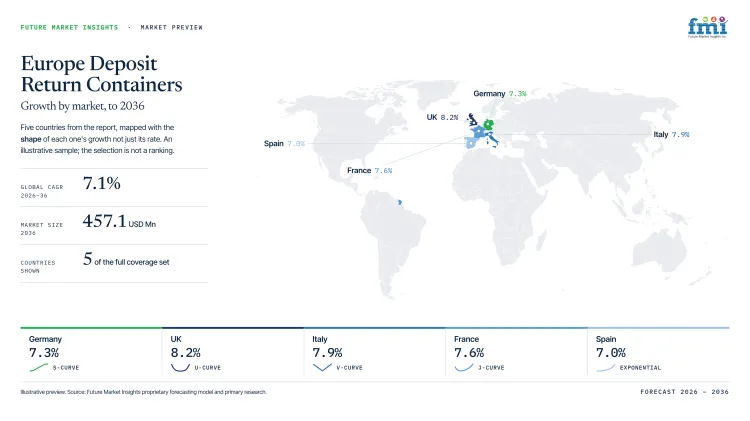
| Country | CAGR |
|---|---|
| UK | 8.2% |
| Italy | 7.9% |
| France | 7.6% |
| Germany | 7.3% |
| Spain | 7.0% |
How do country-level CAGRs compare in the Europe Deposit Return Containers Market?
The 1.2 percentage-point spread between the UK and Spain signals a concentrated forecast rather than separate growth tiers. The UK and Italy form the upper pair above 7.8% while France and Germany occupy the middle band. Spain follows at 7.0%. Conversion speed depends mainly on return infrastructure and service economics.
- The UK gains from return-point investment that speeds retailer learning on deposits.
- Italy concentrates reusable volumes in institutional locations with repeat collection patterns nationally.
- France has shared washing capacity that lowers handling costs for pooled programmes.
- Germany's mature takeaway rules make return convenience a stronger commercial purchasing test.
- Spain's fragmented hospitality base makes collection density harder outside major urban cities.
Collection density and washing access make comparable CAGRs produce different operating economics. The full report provides country-level CAGR analysis across North America, Latin America, Western Europe, Eastern Europe, East Asia, South Asia and Pacific, and the Middle East and Africa.
Country-wise Analysis
- German foodservice operators already manage reusable takeaway offers in a dense restaurant base in which return convenience matters more than product novelty. Germany is expected to maintain 7.3% CAGR during the assessment period, tied to pressure for better reuse performance and simpler collection. Umweltbundesamt reported in July 2026 that reusable beverage packaging represented 34.5% of 2024 beverage volume against a 70% statutory target. The gap leaves room for return-ready formats but independent outlets can raise collection costs. Manufacturers gain an advantage by reducing container variants and using compatible recyclable cups that can return beyond the original outlet without extra sorting work.
- French operators face a national reuse programme that requires containers to circulate reliably between collection points and commercial washing facilities. ADEME published in October 2025 that 2.75 billion reused packages entered the French market during 2024 while the recorded reuse rate reached 1.82%. Europe deposit return container demand in France is forecast to grow at 7.6% CAGR over the forecast period, driven by the shift from targets into routine circulation. Shared washing can lower entry costs for regional chains but thin return density limits rotation economics, leaving molded fiber packaging relevant for occasions that cannot justify a dedicated reuse loop.
- UK retailers and drinks producers are preparing national return infrastructure that will make refundable deposits a routine part of consumer packaging behavior. The UK is set to post 8.2% CAGR through 2036, attributable to investment in return points and wider familiarity with container refunds. The government confirmed in May 2025 that the scheme will begin in October 2027 for PET and metal drinks containers from 150 millilitres to 3 litres. Foodservice reuse requires separate local washing and redistribution, so packaging manufacturers can benefit from greater deposit familiarity without assuming beverage hardware will accept meal boxes or other PET packaging formats.
- Environmental criteria inside Italian public catering contracts can define reusable container handling prior to an order being placed. A decree published in the Gazzetta Ufficiale on 26 April 2025 updated minimum environmental criteria for catering services and potable-water distribution. Institutional volumes give reusable formats predictable demand although cleaning responsibility stays contract-specific and can slow qualification for operators with limited washing access. Italy is positioned to record 7.9% CAGR during the assessment period, aided by tender-led purchasing for stackable formats with clear hygiene documentation. Sustainable packaging alternatives remain relevant if an operator cannot run a reliable return route in smaller venues.
- Spanish hospitality operators must build return routines through a fragmented national base of restaurants and beverage outlets that do not share one collection model. Spain is projected to expand at 7.0% CAGR over the forecast period, propelled by a national deposit route that increases attention to standardized return behavior. MITECO stated in December 2025 that separate collection of single-use plastic bottles reached 42.3% in 2023 and missed the statutory 70% threshold. Meal containers require washing and take-back contracts beyond beverage infrastructure, so common footprints can reduce handling variation while disposable cups remain practical for venues without dependable local return density.
Who are the notable companies in the Europe Deposit Return Containers Market?
TOMRA, Amcor, Duni Group, Novolex, Sabert Corporation Europe, Graphic Packaging International, Greiner Packaging, Vytal Global and RECUP are notable companies active in this market.
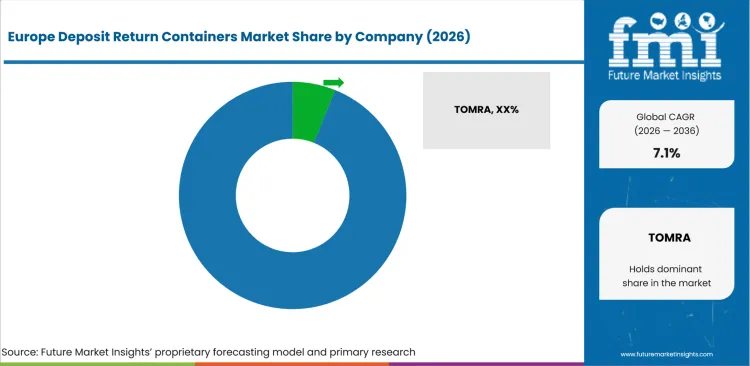
Competition separates into return-system operators, reusable foodservice platforms and broad packaging manufacturers with different commercial strengths. TOMRA, Vytal Global and RECUP manage deposit or circulation infrastructure that makes returns visible to users and outlets. Duni Group, Greiner Packaging and Amcor pair reusable formats with foodservice execution. Novolex and Sabert Corporation Europe broaden sourcing options for accounts that still purchase conventional packaging beside reusable formats. Graphic Packaging International competes at the recovery-focused edge of scope through paperboard foodservice formats. Entry barriers therefore depend on documented circulation performance and channel access more than corporate scale alone.
- Return-system and circulation specialists: TOMRA, Vytal Global and RECUP operate digital or deposit-backed return networks with visible collection infrastructure.
- Reusable foodservice platforms: Duni Group, Greiner Packaging and Amcor bring reusable cups or containers into active foodservice programmes and venues.
- Broad packaging manufacturers: Novolex, Sabert Corporation Europe and Graphic Packaging International serve foodservice accounts that need conventional and recovery-focused formats during the transition.
Competitive Benchmarking: Europe Deposit Return Containers Market
| Company | Return-loop integration | Foodservice format breadth | European deployment depth | Geographic Reach |
|---|---|---|---|---|
| TOMRA | High | High | High | Europe and selected global markets |
| Amcor | Medium | Medium | Medium | Europe and global packaging markets |
| Duni Group | High | High | High | Europe and international foodservice markets |
| Novolex | High | High | Medium | North America and selected European markets |
| Sabert Corporation Europe | Medium | High | High | Western Europe and wider European sales |
| Graphic Packaging International | Low | High | High | Europe and global packaging markets |
| Greiner Packaging | Medium | Medium | High | Europe and international packaging markets |
| Vytal Global | High | High | High | Europe and selected international programmes |
| RECUP | High | High | High | Germany, Austria and partner networks |
Scoring basis: High return-loop integration requires a documented deposit, tracking or managed reuse system. Medium identifies reusable formats deployed inside another operator's return programme. Low identifies an officially documented foodservice route focused on recovery without reusable-loop operation. High foodservice format breadth requires cups plus meal containers or comparable foodservice families. Medium identifies one major reusable family. High European deployment depth requires multi-country or scaled national evidence. Medium requires a narrower multi-site presence and Low identifies a limited deployment route.
Key Developments in the Europe Deposit Return Containers Market
- In March 2025, Novolex brand Eco-Products partnered with OZZI to expand access to reusable foodservice containers and tracking systems for institutional and commercial operators.
- Greiner Packaging deployed reusable drinking cups with Hänig's at the DEKRA Lausitzring in June 2025 during a race weekend attended by about 52,000 fans.
- In February 2026, RECUP expanded its reusable cup system to all 120 Tchibo coffee bars in Austria following an earlier deployment in 50 locations.
Key Players in the Europe Deposit Return Containers Market
Return-System and Circulation Platforms
- TOMRA
- Vytal Global
- RECUP
Reusable Foodservice Packaging Platforms
- Amcor
- Duni Group
- Greiner Packaging
Broad Foodservice Packaging Manufacturers
- Novolex
- Sabert Corporation Europe
- Graphic Packaging International
Europe Deposit Return Containers Market - Report Scope
| Coverage field | Report scope |
|---|---|
| Market breakdown | By format type, material, format size, end use, sales channel and region. |
| Quantitative Units | USD million. |
| Market Definition | Revenue includes food and beverage container products sold in Europe for deposit-backed return, take-back or reuse programs within the defined segmentation. Return equipment, washing services, software revenue, food and beverage revenue and packaging sold outside these programs are excluded. |
| Regions Covered | Western Europe, Eastern Europe |
| Countries Covered | Germany, France, UK, Italy, Spain |
| Key Companies Profiled | TOMRA, Amcor, Duni Group, Novolex, Sabert Corporation Europe, Graphic Packaging International, Greiner Packaging, Vytal Global, RECUP. |
| Forecast Period | 2026 to 2036. |
| Approach | Primary and secondary research with market triangulation. |
Europe Deposit Return Containers Market - Research Methodology
| Method | Approach |
|---|---|
| Primary Research | FMI analysts gathered input from manufacturers, service providers, technology developers, distributors, end users, procurement teams, and subject-matter experts. Interviews examined purchasing decisions, product or service evaluation, adoption barriers, approval requirements, pricing considerations, and expectations for technical or commercial support. Respondents were also asked what evidence is required before a trial, pilot, or initial order develops into regular purchasing. |
| Desk Research | Desk research covered government statistics, regulatory publications, trade data, industry associations, technical literature, standards, company filings, product information, and official corporate announcements. Sources were reviewed for relevance, publication date, geographic coverage, and consistency with the defined market scope. Claims relating to performance, applications, approvals, capacity, investment, and commercial activity were retained only when supported by credible public evidence. |
| Market Sizing and Forecasting | The market model combined the baseline value with historical performance, segment structure, pricing and volume indicators, adoption levels, company participation, and country-level demand conditions. Forecast assumptions considered economic activity, investment trends, regulatory developments, technology adoption, purchasing cycles, supply availability, and barriers to wider market use. Segment and regional estimates were reconciled before the final market total was calculated. |
| Data Validation | Estimates were checked against multiple independent indicators, including public data, company activity, trade patterns, industry developments, and findings from primary interviews. Validation also tested whether products, services, applications, and company revenues fell within the defined market boundaries. Adjacent categories, unsupported claims, overlapping revenues, and activities without direct market relevance were excluded to reduce double counting and maintain consistency across segments and countries. |
Europe Deposit Return Containers Market by Segments
Europe Deposit Return Containers Market segmented by Format Type:
- Standard formats
- Recyclable-optimized formats
- Premium & branded formats
- Custom-engineered formats
Europe Deposit Return Containers Market segmented by Material:
- Paperboard
- Molded fiber & bagasse
- rPET & PP
- Compostable polymers
- Aluminium
Europe Deposit Return Containers Market segmented by Format Size:
- Standard meal
- Single-serve
- Family & catering
Europe Deposit Return Containers Market segmented by End Use:
- Delivery platforms
- QSR chains
- Coffee & beverage
- Institutional catering
- Retail deli
Europe Deposit Return Containers Market segmented by Sales Channel:
- Broadline foodservice distributors
- Direct chain contracts
- Packaging distributors
- Online
Europe Deposit Return Containers Market by Region:
- Western Europe
- Germany
- France
- United Kingdom
- Italy
- Spain
- Benelux
- Nordics
- Rest of Western Europe
- Eastern Europe
- Poland
- Czech Republic
- Romania
- Hungary
- Balkan and Baltic States
- Rest of Eastern Europe
Research Sources and Bibliography
- European Commission. (2026, August 11). New EU rules on packaging enter into application, including restrictions on PFAS in food-contact packaging.
- Eurostat. (2025, October 22). Plastic packaging waste in the EU: 35.3 kg per person.
- European Parliament and Council of the European Union. (2025, January 22). Regulation (EU) 2025/40 on packaging and packaging waste.
- Umweltbundesamt. (2025, June). Umweltzeichen Blauer Engel für Mehrwegsysteme beim Außerhausverkauf von Speisen und Getränken.
- ADEME. (2026, May 12). Les centres de lavage d'emballages en France.
- Umweltbundesamt. (2026, July 8). Mehrwegquote bei Getränken verfehlt gesetzliches Ziel.
- ADEME. (2025, October 27). Réemploi des emballages : données 2024.
- Department for Environment, Food & Rural Affairs. (2025, May 7). Deposit Return Scheme for drinks containers: policy statement.
- Ministero dell'Ambiente e della Sicurezza Energetica. (2025, April 26). Decreto 9 aprile 2025: Aggiornamento dei criteri ambientali minimi per i servizi di ristoro e la distribuzione di acqua di rete.
- Ministerio para la Transición Ecológica y el Reto Demográfico. (2025, December). El Gobierno aprueba el Plan Estatal Marco de Gestión de Residuos 2025-2035.
- Amcor. (2025, March 6). Berry's reusable cups support returnable cup initiative.
- Graphic Packaging International. (2025, May 14). Graphic Packaging launches new portfolio of paperboard sushi packaging to support the regulatory compliance of European foodservice operators.
- TOMRA. (2025, May 27). TOMRA unveils automated collection point for reusable takeaway food packaging.
- Vytal Global. (2025, March). Sustainable. Digital. Effortless: Vytal and qnips are shaping the future of reusables.
- Duni Group. (2025, August 19). Duni Group launches Relevo reusable system in Sweden.
- Novolex. (2025, March 4). Eco-Products and OZZI join forces to expand access to reusable containers and systems.
- Greiner Packaging. (2025, June 17). Greiner's reusable drinking cup drives change at major motorsport event in Germany.
- RECUP. (2026, February 10). Tchibo rollt RECUP österreichweit in allen Coffeebars aus.
- Amcor. (2025, April 30). Amcor completes combination with Berry Global.
- Vytal Global. (2025, July). Vytal Global acquires Catalan company Bumerang to lead reusable packaging in Spain.
- Duni Group. (2026, January 15). Duni Group and Relevo behind Munich's circular initiative.
- TOMRA. (2025, June 30). Lisbon becomes first European capital with city-wide reusable cup system.
- Greiner Packaging. (2026, April 28). ESC 2026: Reusable cups made from 100% recycled material show Austrian circular economy in action.
- RECUP. (2026, May 28). Jetzt am Viktualienmarkt dahoam: einheitliches Mehrwegsystem von RECUP.
- TOMRA. (2025, December 11). TOMRA Reuse keeps the beats clean at FAIRGROUND Festival 2025.
- Amcor. (2025, February 10). Smart & Intelligent: Berry's Reusable Cup Range Gains Renewed Attention.
- Duni Group. (2026, June 2). Duni Group introduces on-site composting at this year's Sweden Rock Festival.
- Novolex. (2025, April 1). Novolex and Pactiv Evergreen Inc. complete combination, creating a leading manufacturer in food, beverage and specialty packaging.
- Sabert Corporation Europe. (2025, August 5). Sabert acquires Colpac Limited.
- Graphic Packaging International. (2025, August 20). Graphic Packaging adds PaperSeal Pressed MAP tray to award-winning food packaging portfolio.
- Greiner Packaging. (2025, September 30). Greiner Reuse Cups: Driving Circular Economy Across Events in Croatia and Slovenia.
- Vytal Global. (2025, April). 100% reusables at the OMR Festival: Vytal and OMR expand reusable concept through long-term partnership.
- RECUP. (2026, June 3). Mehrweg im Reisealltag: Janova und HBB starten mit RECUP an Deutschlands Verkehrsknotenpunkten.
This Report Answers
- How large is the Europe deposit return containers market in 2026 and 2036?
- Which operating conditions are increasing demand for return-ready foodservice containers?
- Why do standard formats hold the leading position within format type?
- How does paperboard fit the material mix for return-oriented foodservice procurement?
- Why do standard meal formats lead the format size category?
- How do country growth rates differ among the five profiled European markets?
- Which companies provide containers, return infrastructure or reuse services in this market?
- Which collection and washing frictions can weaken total-cycle economics?
- What should foodservice operators test before expanding a reusable container programme?
Frequently Asked Questions
How big is the Europe deposit return containers market in 2026?
The Europe deposit return containers market is valued at USD 230.2 million in 2026 and is projected to reach USD 457.1 million by 2036. Growth depends on foodservice reuse obligations and practical return infrastructure.
What is the CAGR of the Europe deposit return containers market from 2026 to 2036?
The Europe deposit return containers market is projected to grow at a CAGR of 7.1% between 2026 and 2036. Expansion is tied to reusable takeaway requirements and wider investment in collection and washing routes.
Which format type leads the Europe deposit return containers market?
The standard formats segment is expected to hold 37.0% of the Europe deposit return containers market in 2026, driven by simpler pooling and handling. Common footprints also reduce sorting changes in shared return systems.
Which material has a leading share in the Europe deposit return containers market?
The paperboard segment is projected to hold 32.0% of the Europe deposit return containers market in 2026, attributable to familiar converting and printing routes. Its role is strongest in take-back and recovery-oriented foodservice formats.
Which countries are projected to record the highest growth in the Europe deposit return containers market?
The UK is projected to grow at 8.2% CAGR, followed by Italy at 7.9% and France at 7.6% through 2036. National deposit infrastructure and reusable-foodservice purchasing develop on separate schedules, producing different growth routes.
Which companies are active in the Europe deposit return containers market?
Key companies operating in the market include TOMRA, Amcor, Duni Group, Novolex, Sabert Corporation Europe, Graphic Packaging International, Greiner Packaging, Vytal Global and RECUP. Their positions differ by return infrastructure, reusable formats, distribution and material coverage.
Preview the report firsthand - request a free sample
Get SampleGet the brochure for pricing and purchase details.
Get PDFTable of Content
- Key Takeaways
- Market Size and CAGR
- Top Growth Driver
- Fastest Growing Segment
- Leading Region
- Key Companies
- Emerging Opportunities
- Executive Summary
- Europe Market Outlook
- Demand-side Trends
- Supply-side Trends
- Technology Roadmap Analysis
- Analysis and Recommendations
- Analyst Perspective (What is happening? Why now? What should investors know?)
- Key Questions Answered
- How large is the market?
- What is the CAGR?
- What are key trends?
- Which region dominates?
- Who are the leaders?
- Market Overview
- Market Coverage / Taxonomy
- Market Definition / Scope / Limitations
- Research Methodology
- Chapter Orientation
- Analytical Lens and Working Hypotheses
- Market Structure, Signals, and Trend Drivers
- Benchmarking and Cross-market Comparability
- Market Sizing, Forecasting, and Opportunity Mapping
- Research Design and Evidence Framework
- Desk Research Programme (Secondary Evidence)
- Expert Input and Fieldwork (Primary Evidence)
- Tooling, Models, and Reference Databases
- Data Engineering and Model Build
- Quality Assurance and Audit Trail
- Market Background
- Market Dynamics (Drivers, Restraints, Opportunity, Trends)
- Scenario Forecast (Optimistic, Likely, Conservative)
- Impact Analysis
- AI Impact
- Sustainability Impact
- Regulatory Impact
- Technology Impact
- Consumer / Buyer Analysis
- Purchase Drivers
- Adoption Barriers
- Buyer Journey
- Opportunity Map Analysis
- Product Life Cycle Analysis
- Supply Chain Analysis
- Investment Feasibility Matrix
- Value Chain Analysis
- PESTLE and Porter's Analysis
- Regulatory Landscape
- Regional Parent Market Outlook
- Production and Consumption Statistics
- Import and Export Statistics
- Europe Market Analysis and Forecast, 2021 to 2036
- Historical Market Size Value (USD Million) Analysis, 2021 to 2025
- Current and Future Market Size Value (USD Million) Projections, 2026 to 2036
- Y-o-Y Growth Trend Analysis
- Absolute $ Opportunity Analysis
- Europe Market Pricing Analysis, 2021 to 2036
- Europe Market Analysis and Forecast, By Format Type, 2021 to 2036
- Introduction / Key Findings
- Historical Market Size Value (USD Million) Analysis By Format Type, 2021 to 2025
- Current and Future Market Size Value (USD Million) Analysis and Forecast By Format Type, 2026 to 2036
- Standard formats
- Recyclable-optimized formats
- Premium & branded formats
- Custom-engineered formats
- Standard formats
- Y-o-Y Growth Trend Analysis By Format Type, 2021 to 2025
- Absolute $ Opportunity Analysis By Format Type, 2026 to 2036
- Europe Market Analysis and Forecast, By Material, 2021 to 2036
- Introduction / Key Findings
- Historical Market Size Value (USD Million) Analysis By Material, 2021 to 2025
- Current and Future Market Size Value (USD Million) Analysis and Forecast By Material, 2026 to 2036
- Paperboard
- Molded fiber & bagasse
- rPET & PP
- Compostable polymers
- Aluminium
- Paperboard
- Y-o-Y Growth Trend Analysis By Material, 2021 to 2025
- Absolute $ Opportunity Analysis By Material, 2026 to 2036
- Europe Market Analysis and Forecast, By Format Size, 2021 to 2036
- Introduction / Key Findings
- Historical Market Size Value (USD Million) Analysis By Format Size, 2021 to 2025
- Current and Future Market Size Value (USD Million) Analysis and Forecast By Format Size, 2026 to 2036
- Standard meal
- Single-serve
- Family & catering
- Standard meal
- Y-o-Y Growth Trend Analysis By Format Size, 2021 to 2025
- Absolute $ Opportunity Analysis By Format Size, 2026 to 2036
- Europe Market Analysis and Forecast, By End Use, 2021 to 2036
- Introduction / Key Findings
- Historical Market Size Value (USD Million) Analysis By End Use, 2021 to 2025
- Current and Future Market Size Value (USD Million) Analysis and Forecast By End Use, 2026 to 2036
- Delivery platforms
- QSR chains
- Coffee & beverage
- Institutional catering
- Retail deli
- Delivery platforms
- Y-o-Y Growth Trend Analysis By End Use, 2021 to 2025
- Absolute $ Opportunity Analysis By End Use, 2026 to 2036
- Europe Market Analysis and Forecast, By Sales Channel, 2021 to 2036
- Introduction / Key Findings
- Historical Market Size Value (USD Million) Analysis By Sales Channel, 2021 to 2025
- Current and Future Market Size Value (USD Million) Analysis and Forecast By Sales Channel, 2026 to 2036
- Broadline foodservice distributors
- Direct chain contracts
- Packaging distributors
- Online
- Broadline foodservice distributors
- Y-o-Y Growth Trend Analysis By Sales Channel, 2021 to 2025
- Absolute $ Opportunity Analysis By Sales Channel, 2026 to 2036
- Europe Market Analysis and Forecast, By Region, 2021 to 2036
- Introduction
- Historical Market Size Value (USD Million) Analysis By Region, 2021 to 2025
- Current Market Size Value (USD Million) Analysis and Forecast By Region, 2026 to 2036
- Western Europe
- Eastern Europe
- Market Attractiveness Analysis By Region
- Western Europe Market Analysis and Forecast, By Country
- Historical Market Size Value (USD Million) Trend Analysis By Market Taxonomy, 2021 to 2025
- Market Size Value (USD Million) Forecast By Market Taxonomy, 2026 to 2036
- By Country
- Germany
- UK
- Italy
- Spain
- France
- Nordic
- BENELUX
- Rest of Western Europe
- By Format Type
- By Material
- By Format Size
- By End Use
- By Sales Channel
- By Country
- Market Attractiveness Analysis
- By Country
- By Format Type
- By Material
- By Format Size
- By End Use
- By Sales Channel
- Key Takeaways
- Eastern Europe Market Analysis and Forecast, By Country
- Historical Market Size Value (USD Million) Trend Analysis By Market Taxonomy, 2021 to 2025
- Market Size Value (USD Million) Forecast By Market Taxonomy, 2026 to 2036
- By Country
- Russia
- Poland
- Hungary
- Balkan & Baltic
- Rest of Eastern Europe
- By Format Type
- By Material
- By Format Size
- By End Use
- By Sales Channel
- By Country
- Market Attractiveness Analysis
- By Country
- By Format Type
- By Material
- By Format Size
- By End Use
- By Sales Channel
- Key Takeaways
- Key Countries Market Analysis
- Germany
- Pricing Analysis
- Market Share Analysis, 2025
- By Format Type
- By Material
- By Format Size
- By End Use
- By Sales Channel
- UK
- Pricing Analysis
- Market Share Analysis, 2025
- By Format Type
- By Material
- By Format Size
- By End Use
- By Sales Channel
- Italy
- Pricing Analysis
- Market Share Analysis, 2025
- By Format Type
- By Material
- By Format Size
- By End Use
- By Sales Channel
- Spain
- Pricing Analysis
- Market Share Analysis, 2025
- By Format Type
- By Material
- By Format Size
- By End Use
- By Sales Channel
- France
- Pricing Analysis
- Market Share Analysis, 2025
- By Format Type
- By Material
- By Format Size
- By End Use
- By Sales Channel
- Germany
- Market Structure Analysis
- Competition Dashboard
- Competition Benchmarking
- Market Share Analysis of Top Players
- By Regional
- By Format Type
- By Material
- By Format Size
- By End Use
- By Sales Channel
- Emerging Startups
- Innovation Benchmarking
- Competition Analysis
- Competition Deep Dive
- TOMRA
- Overview
- Product Portfolio
- Profitability by Market Segments
- Sales Footprint
- Strategy Overview
- Marketing Strategy
- Product Strategy
- Channel Strategy
- Berry Europe
- Duni
- Genpak
- Novolex
- Pactiv Evergreen
- Sabert
- Dart Container
- Graphic Packaging
- Detmold Group
- TOMRA
- Case Studies
- Success Stories
- Recent Developments
- Competition Deep Dive
- Assumptions & Acronyms Used


