

- Industry Size (2026)
- USD 15.8 Bn
- Forecast (2036)
- USD 22.5 Bn
- CAGR (2026 to 2036)
- 3.6%
Europe Pouch Market Size, Market Forecast and Outlook By FMI
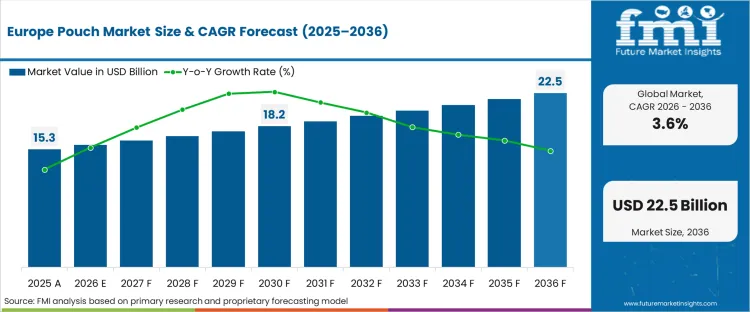
In 2025, the Europe pouch market was valued at USD 15.2 billion. Based on Future Market Insights' analysis, demand for pouch packaging is estimated to grow to USD 15.8 billion in 2026 and USD 22.5 billion by 2036. FMI projects a CAGR of 3.6% during the forecast period.
The market is expected to generate an absolute dollar growth of USD 6.7 billion between 2026 and 2036. This reflects steady substitution-led expansion as flexible pouches continue replacing rigid packaging across food, beverages, home care, and personal care applications. Growth is supported by lightweighting benefits, shelf-life extension through high-barrier laminates, and increasing adoption of recyclable mono-PE and mono-PP structures. However, recycling infrastructure gaps, multilayer material complexity, and regulatory scrutiny on plastic waste continue to moderate long-term growth acceleration.
Summary of Europe Pouch Market
- Europe Pouch Market Definition
- The Europe pouch market includes flexible packaging solutions such as stand-up, flat, retort, and spouted pouches designed for food, beverage, personal care, healthcare, and industrial applications.
- Demand Drivers in the Market
- Increasing demand for convenient, lightweight, and resealable packaging in food and beverage categories is driving steady adoption of stand-up and flat-bottom pouches.
- Sustainability regulations across Europe are accelerating the shift toward mono-material recyclable structures and PCR-based film laminates.
- Growth in ready-to-eat meals, baby food, and liquid refills is strengthening demand for retort, aseptic, and spouted pouch technologies.
- Key Segments Analyzed in the FMI Report
- By Pouch Type: Stand-up (Doypack) pouches lead the market due to strong shelf presence, portability, and compatibility with zipper and spout closures.
- By Material Structure: PET/PE multilayers and emerging mono-PE recyclable formats represent significant usage across food and home care sectors.
- By Geography: Germany, the United Kingdom, and France account for major demand supported by advanced retail networks and food processing industries.
- Analyst Opinion at FMI
- Ismail Sutaria, Principal Consultant for Packaging Industry at Future Market Insights, opines, ‘CXOs will find in this report strategic clarity on how recyclability mandates, high-barrier innovation, and filling technology advancements are shaping investment priorities in the European pouch market.’
- Strategic Implications / Executive Takeaways
- Invest in mono-material and recyclable film technologies to align with EU circular economy directives.
- Expand capabilities in retort and aseptic pouch systems to capture growth in ready-meal and baby food segments.
- Strengthen partnerships with FMCG and private-label brands to secure long-term supply contracts.
- Methodology
- Market estimates were validated through interviews with pouch converters and brand owners.
- Secondary research included trade statistics and packaging regulation analysis.
- Forecasts were developed using end-use demand modeling and material transition trends.
Mr Ashok Chaturvedi, chairman and managing director of Uflex Limited said, “Given our end-to-end expertise in the field of flexible packaging we can bring out very many variants of these retortable spout pouches that are aesthetically unique; functionally more agile; counterfeiting proof (with the help of myriad holographic solutions) and have optimised barrier properties.”
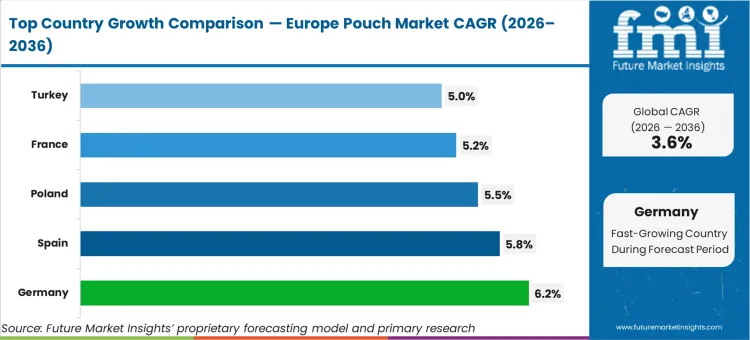
Germany (6.2%) is projected to register the fastest growth, supported by strong packaged food exports and innovation in recyclable pouch formats. Spain (5.8%) follows with rising demand for ready-to-eat meals and beverage refills. Poland (5.5%) benefits from manufacturing expansion and private-label production growth. France (5.2%) and Turkey (5.0%) show steady expansion linked to food processing and home care demand, while mature Western European markets overall remain replacement-driven and shaped by sustainability compliance rather than rapid volume escalation.
Europe Pouch Market Definition
The Europe pouch market refers to the production and supply of flexible packaging pouches used for storing and protecting liquid, semi-liquid, and dry products. These pouches are manufactured in formats such as stand-up, flat, gusseted, retort, stickpacks, and spouted variants. They are produced using mono-material films, multilayer laminates, recyclable structures, foil-based barriers, and bio-based materials. The primary function of pouch packaging is to provide product protection, sealing integrity, extended shelf life, and efficient storage while reducing material usage compared to rigid packaging. Key end users include food and beverage companies, home and personal care brands, healthcare producers, pet food manufacturers, and industrial product suppliers across Europe.
Europe Pouch Market Inclusions
The report provides Europe market size estimates for 2025 and 2026, with forecasts through 2036 and CAGR analysis. It includes segmentation by pouch type, content form, packaging and filling process, closure type, material structure, capacity range, end-use industry, and country. The study covers value-based sizing, sustainability trends, recyclable material adoption, high-barrier technology developments, and country-level demand comparisons.
Europe Pouch Market Exclusions
The scope excludes rigid packaging formats such as bottles, jars, metal cans, and glass containers. It does not include packaging machinery revenue unless directly linked to pouch manufacturing. Bulk industrial containers and non-flexible paper packaging are excluded. Finished consumer goods are outside the scope, as the analysis focuses strictly on pouch materials, structures, formats, and regional supply within Europe.
Europe Pouch Market Research Methodology
- Primary Research: Interviews were conducted with flexible film manufacturers, pouch converters, barrier film suppliers, filling line operators, and brand owners across Europe. Material suppliers clarified pricing trends for PE, PP, EVOH, and PCR films, while converters validated shifts toward recyclable mono-material structures and retort-compatible formats.
- Desk Research: Eurostat trade statistics, European packaging association reports, company annual disclosures, and regulatory publications were reviewed to benchmark production volumes and country-level demand patterns.
- Market-Sizing and Forecasting: A hybrid top-down and bottom-up approach was applied. Demand was reconstructed from food, beverage, and personal care output and validated against pouch converter capacity and trade flows.
- Data Validation and Update Cycle: Data was cross-verified across trade datasets, production statistics, and stakeholder inputs, followed by structured expert review prior to final release.
Segmentation Analysis
Europe Pouch Market Analysis by Pouch Type
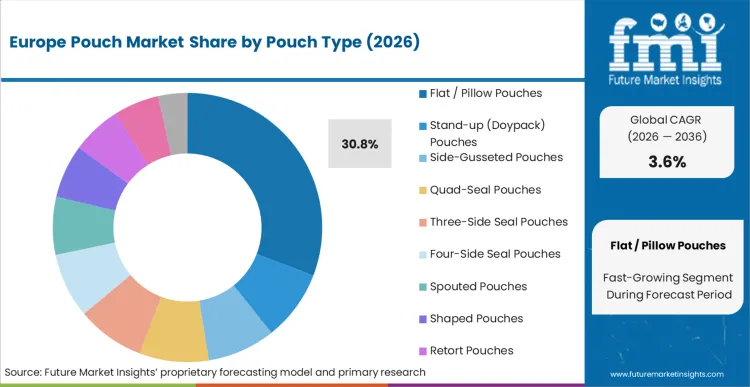
Based on FMI's Europe Pouch market report, consumption of Flat / Pillow Pouches is estimated to hold 30.8% share in 2026. Flat and pillow pouches dominate due to their simplicity, high-speed machinability, and cost efficiency across food, snack, and commodity packaging applications. They address manufacturer priorities including optimized film usage, compatibility with VFFS and HFFS systems, and suitability for high-volume SKUs. The format is widely used for snacks, dry foods, bakery items, and powdered products where structural complexity is not required but sealing consistency and throughput are critical.
- High-Speed Production: Flat pouch formats are easily integrated into automated vertical and horizontal packaging lines, enabling large-scale output across European FMCG facilities.
- Material Efficiency: Reduced structural components lower packaging material cost per unit compared to stand-up or specialty pouch formats.
- Retail Standardization: Widespread adoption across private label and value-tier food products reinforces their continued dominance in mass-market retail channels.
Europe Pouch Market Analysis by End-use Industry
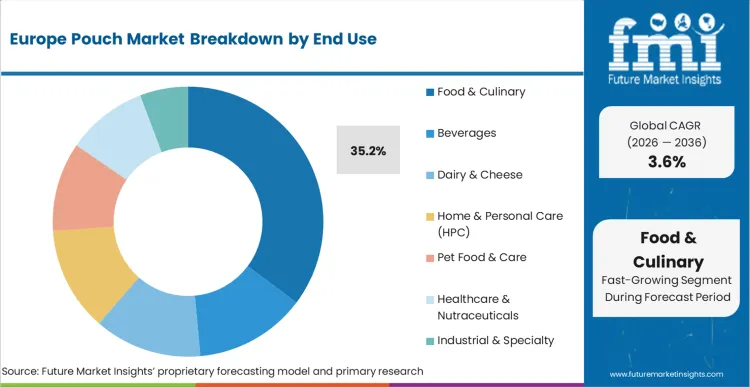
Based on FMI's Europe Pouch market report, consumption of Food & Culinary applications is estimated to hold 35.2% share in 2026. The segment leads due to strong demand for flexible packaging across snacks, sauces, ready meals, grains, and dry ingredients. Pouch formats address key buyer needs including shelf-life extension, moisture barrier protection, and lightweight transport efficiency.
- Convenience Consumption: Rising demand for ready-to-cook and ready-to-eat products supports continued pouch adoption in European households.
- Sustainability Compliance: EU circular economy regulations are encouraging mono-material and recyclable pouch structures within food categories.
- Private Label Growth: Expansion of supermarket private brands across Europe strengthens demand for cost-efficient pouch packaging solutions in food distribution.
Europe Pouch Market: Drivers, Restraints, and Opportunities
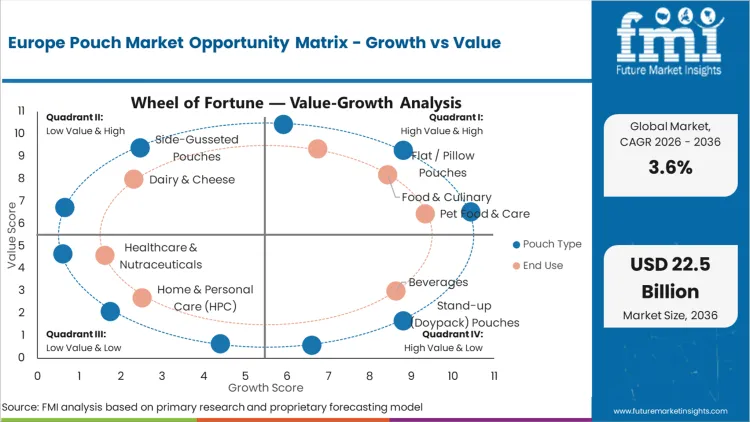
Future Market Insights analysis indicates that the Europe pouch market is structurally expanding within the broader flexible packaging industry, supported by strong demand in food, beverage, pet food, homecare, and personal care applications. The market exists at its current scale because pouches offer lightweight construction, material efficiency, and high shelf visibility compared to rigid alternatives. Historically, growth has followed modernization of retail supply chains and rising consumption of packaged and convenience foods across Western and Central Europe. In recent years, sustainability-driven redesign and regulatory alignment have become central forces shaping pouch material selection and structural configuration.
FMI analysts observe a transition from multi-layer, difficult-to-recycle laminates toward mono-material and recyclable pouch formats. While traditional PET/PE and aluminum-based laminates continue to dominate high-barrier applications such as coffee and sauces, growth is increasingly concentrated in polyethylene and polypropylene mono-material structures designed to meet recyclability targets. These next-generation pouches often involve higher development and conversion costs, particularly during initial scale-up. However, brand compliance with the EU Packaging and Packaging Waste Regulation (PPWR) and retailer sustainability commitments supports premium pricing, enabling value growth even where volume gains remain moderate.
- Recyclability Mandates: The EU Packaging and Packaging Waste Regulation (PPWR) is accelerating the shift toward recyclable pouch designs. Brands are redesigning laminate structures to meet recyclability and recycled content requirements.
- Convenience Food Demand: Growth in ready meals, baby food, pet food, and snack products across Germany, France, and Italy continues to support stand-up and resealable pouch adoption.
- Private Label Expansion: European supermarket chains are increasing private label offerings, driving demand for cost-efficient yet visually differentiated pouch packaging across mid-tier consumer segments.
Regional Analysis
The Europe pouch market is segmented across Germany, Spain, Poland, France, and Turkey. Growth variations reflect differences in flexible packaging adoption, food processing expansion, sustainability regulation, and private label retail penetration. The full report provides detailed country-level market attractiveness analysis.
.webp "Top Country Growth Comparison Europe Pouch Market Cagr (2026 2036)")
| Country | CAGR (2026 to 2036) |
|---|---|
| Germany | 6.2% |
| Spain | 5.8% |
| Poland | 5.5% |
| France | 5.2% |
| Turkey | 5.0% |
Source: Future Market Insights (FMI) analysis, based on proprietary forecasting model and primary research
Continental Europe - Flexible Packaging Innovation Core
Continental Europe functions as the flexible packaging innovation core, supported by strong food manufacturing, private label expansion, and sustainability-driven material transition. Key regional players include Constantia Flexibles, Amcor, Mondi Group, and Coveris Group, all operating advanced pouch converting facilities across multiple European countries. Competitive positioning is shaped by recyclable mono-material structures, retort pouch development, and regulatory compliance alignment.
Germany
Demand for pouches in Germany is projected to rise at 6.2% CAGR through 2036. Growth is driven by expansion in convenience foods, pet food, and liquid packaging applications. Germany’s Packaging Act mandates producer registration and recycling reporting, with reinforced compliance monitoring continuing through 2024. This has encouraged brands to shift toward lightweight, recyclable pouch structures. Progress under the European Union’s Packaging and Packaging Waste Regulation is further supporting mono-material flexible packaging adoption. Germany’s strong private label retail sector continues expanding stand-up pouch usage for ready meals, sauces, and dairy products. Industrial efficiency programs and advanced converting capabilities support innovation in high-barrier pouch formats.
Spain
Demand for pouches in Spain is projected to rise at 5.8% CAGR through 2036. Growth is supported by expansion in food exports, particularly sauces, olive oil-based products, and ready meals. Spain continues enforcement of its Waste and Contaminated Soils Law, aligning with EU circular economy objectives and encouraging recyclable packaging solutions. In 2024, packaging waste reduction measures increased brand focus on downgauged and flexible alternatives to rigid formats. Growth in tourism and foodservice packaging also supports demand for portion-controlled pouch formats. Rising supermarket penetration and private label product launches sustain steady consumption.
Poland
Demand for pouches in Poland is projected to rise at 5.5% CAGR through 2036. Poland’s expanding food processing and export manufacturing base drives packaging demand. In 2024, continued implementation of EU packaging waste directives reinforced recyclable packaging requirements across retail channels. Poland’s strong meat, dairy, and frozen food export industries support growth in high-barrier flexible pouch formats. Investments in local converting capacity and modernization of food production facilities further strengthen demand for vertical and horizontal form-fill-seal compatible pouch materials. Competitive labor and production costs continue attracting flexible packaging investments.
France
Demand for pouches in France is projected to rise at 5.2% CAGR through 2036. Growth is influenced by enforcement of France’s Anti-Waste for a Circular Economy Law, which restricts certain single-use plastics and encourages recyclable flexible packaging. Extended Producer Responsibility requirements increase accountability for packaging recyclability and material efficiency. Expansion in ready-to-eat meals, baby food, and beverage concentrate packaging supports pouch adoption. Supermarket sustainability commitments and organic product growth further encourage lightweight flexible packaging formats. While regulatory compliance costs are increasing, brand owners continue investing in recyclable and reduced-material pouch solutions.
Turkey
Demand for pouches in Turkey is projected to rise at 5.0% CAGR through 2036. Growth is supported by expansion in food exports and domestic FMCG production. Turkey continues alignment with European Union packaging and waste management standards, strengthening recycling and packaging compliance requirements. In 2024, ongoing modernization of food processing infrastructure increased adoption of flexible packaging technologies. Turkey’s strong snack, confectionery, and dairy sectors drive demand for cost-efficient stand-up pouch formats. Export-oriented production and competitive manufacturing costs sustain steady growth in flexible pouch applications.
FMI's analysis of Europe pouch market consists of country-wise assessment that includes Germany, Spain, Poland, France, and Turkey. Readers can find insights on regulatory harmonization, mono-material innovation, food export packaging demand, and retail-driven pouch adoption trends.
Competitive Aligners for Market Players
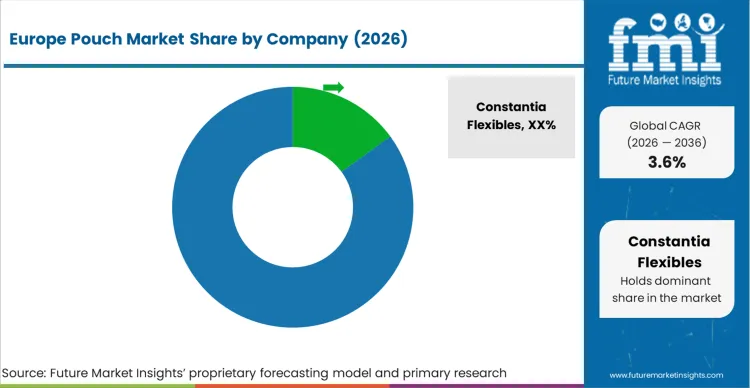
The Europe pouch market is moderately consolidated, led by multinational flexible packaging groups with strong barrier film technology and pan-European converting networks. Companies such as Amcor, Constantia Flexibles, Mondi Group, Sealed Air, Sonoco, Coveris Group, Bischof + Klein, ProAmpac, Huhtamaki Flexible Packaging, and Wipak Group hold significant share across food, beverage, pet food, pharmaceutical, and personal care pouch applications. These players benefit from advanced lamination capabilities, retort pouch expertise, recyclable mono-material innovations, and integrated supply relationships with major FMCG brands. Regional specialists such as Gualapack SpA, KM Packaging Services, Pouch Europe, ePack Flexibles, and Flexpack Europe compete through niche offerings including spouted pouches, small-batch production, and custom high-barrier formats. Competition in this market is primarily driven by material innovation, sustainability compliance, print quality, and production efficiency.
Structural advantages are concentrated among companies with vertically integrated film extrusion, coating, lamination, and printing operations. Amcor, Constantia, Mondi, and Sealed Air leverage global material science capabilities and large-scale European manufacturing footprints to optimize cost structures and innovation cycles. Companies investing in recyclable mono-PE and mono-PP pouch solutions gain strategic positioning as the European Union advances packaging waste regulations and extended producer responsibility frameworks. Firms with in-house R&D centers and strong customer co-development programs retain stronger long-term contracts, particularly in high-barrier retort and pharmaceutical pouch applications. Geographic diversification across Western, Central, and Eastern Europe also enhances resilience against regional demand volatility.
Buyer leverage in the Europe pouch market is significant, particularly among multinational food and personal care brands. Large customers typically operate dual-sourcing strategies and negotiate multi-year supply agreements linked to resin and aluminum price indices. However, once a pouch structure is validated for performance, shelf life, and regulatory compliance, switching suppliers can require requalification, limiting immediate substitution flexibility. Sustainability targets and retailer packaging scorecards increasingly influence procurement decisions, favoring suppliers capable of delivering recyclable, lightweight, and lower-carbon pouch solutions. This dynamic supports pricing stability for technologically advanced converters.
Recent Developments
- Amcor completed its combination with Berry Global in April 2025, creating one of the world’s largest packaging companies. The transaction significantly strengthens Amcor’s flexible packaging and pouch capabilities across Europe, particularly in food, healthcare, and personal care applications.
- In November 2025, Sealed Air Corporation entered into a definitive agreement to be acquired by Clayton, Dubilier & Rice (CD&R) in a transaction valued at approximately USD 10.3 billion. The transaction is expected to close in 2026 and may influence strategic investment across its flexible and protective pouch portfolio in Europe.
Key Players
- Constantia Flexibles
- Amcor
- Mondi Group
- Fuji Seal
- Coveris Group
- Bischof + Klein
- Gualapack SpA
- Sealed Air
- Sonoco
- Wipak Group
- Huhtamaki Flexible Packaging
- ProAmpac
Scope of Report
| Metric | Value |
|---|---|
| Quantitative Units | USD 15.2 billion (2025); USD 15.8 billion (2026) to USD 22.5 billion (2036), at a CAGR of 3.6% |
| Market Definition | The Europe pouch market comprises the manufacturing and conversion of flexible pouch packaging solutions, including recyclable mono-material and high-barrier laminated structures, designed for liquid, semi-liquid, and dry applications across food, beverage, home care, healthcare, and industrial sectors under evolving EU sustainability regulations. |
| Form Segmentation | Stand-up (Doypack) Pouches; Flat / Pillow Pouches; Side-Gusseted & Quad-Seal Pouches; Spouted Pouches; Retort Pouches; Stickpacks & Sachets; Flat-Bottom / Box Pouches |
| End Use Segmentation | Food & Culinary; Beverages; Dairy; Home & Personal Care; Pet Food & Care; Healthcare & Nutraceuticals; Industrial & Specialty |
| Application Coverage | Baby Food & Ready Meals; Sauces & Condiments; Soups & Broths; Functional Beverages; Dairy Drinks & Cheese Sauces; Liquid Detergents & Personal Care Refills; Energy Gels & Supplements; Automotive & Industrial Liquids |
| Regions Covered | Europe |
| Countries Covered | Germany; United Kingdom; France; Italy; Spain; Nordics; Benelux; Austria; Russia; Hungary; Rest of Europe |
| Key Companies Profiled | Amcor; Constantia Flexibles; Mondi Group; Coveris Group; ProAmpac; Others |
| Forecast Period | 2026 to 2036 |
| Approach | Hybrid top-down and bottom-up market modeling validated through primary interviews with pouch converters, film producers, filling technology providers, and brand owners, supported by recycling infrastructure benchmarking, EU PPWR compliance assessment, multilayer-to-mono-material transition analysis, and country-level demand mapping across Europe. |
Europe Pouch Market by Segments
By Pouch Type
- Stand-up (Doypack) Pouches
- Flat / Pillow Pouches
- Side-Gusseted Pouches
- Quad-Seal Pouches
- Three-Side Seal Pouches
- Four-Side Seal Pouches
- Spouted Pouches
- Shaped Pouches
- Retort Pouches
- Stickpacks & Sachets
- Box / Flat-Bottom Pouches
By Content Form
- Liquid / Semi-liquid
- Dry / Particulate
By Packaging & Filling Process
- Premade Pouch Fill-Seal Systems
- Form Fill Seal (FFS) System
- Vertical Form-Fill-Seal (VFFS)
- Horizontal Form-Fill-Seal (HFFS)
- Multilane Stickpack / Sachet Systems
- Product Filling / Preservation Technology
- Hot Fill
- Cold Fill
- Pasteurized Fill
- Retort Sterilization
- Aseptic Fill
- Modified Atmosphere Packaging (MAP)
- Vacuum / Gas Flush
- High-Pressure Processing (HPP)
By Closure Type
- Heat Seal
- Zipper / Slider
- Spout with Screw Cap
- Tear Notch / Easy-Tear
- Valve (One-Way / Degassing)
- Hook-to-Hook / Velcro Closure
- Adhesive Reseal Strip
By Material Type and Structure
- Mono-PE recyclable structures
- Mono-PP recyclable structures
- PET/PE multilayers
- PA/PE coextrusions
- PET/PA/PE high-barrier
- EVOH coextruded barrier films
- Foil-based barrier laminates
- Paper-film laminates
- Paper-PE/EVOH recyclable laminates
- PCR-based PE films
- PCR-based PP & PET films
- Bio-Based (PLA, PBAT, PBS)
By Capacity
- less than 50 ml
- 50-100 ml
- 100-200 ml
- 200-500 ml
- 500 ml- 1 L
By End-use Industry
- Food & Culinary
- Baby food & toddler nutrition
- Sauces, dips, and condiments
- Ready-to-cook and heat-and-eat meals
- Soups & broths
- Frozen & chilled prepared foods
- Cooking oils & purees
- Bakery, Breakfast & Snack Products
- Instant & dehydrated meals
- Seasonings, herbs, and spice blends
- Beverages
- Juice & nectar refills
- Smoothies & functional beverages
- Energy gels & liquid supplements
- Dairy & plant-based drinks
- Flavored waters & enhancers
- Alcoholic mixers & RTDs (limited regional use)
- Dairy & Cheese
- Yogurt drinks & ambient yogurts
- Creams & dessert toppings
- Soft cheese spreads & refills
- Melted or ready cheese sauces
- Home & Personal Care (HPC)
- Shampoo, conditioner, hair treatments
- Liquid soaps & shower gels
- Laundry detergents (liquid & pods)
- Fabric softeners & starch sprays
- Surface cleaners & disinfectants
- Dishwashing liquids & concentrates
- Hand sanitizers, gels, and lotions
- Pet Food & Care
- Wet pet food (gravy, jelly)
- Semi-moist treats
- Dry pet treats / training snacks
- Refill & bulk pet packaging
- Healthcare & Nutraceuticals
- Energy gels & medical nutrition
- Oral rehydration & dietary supplements
- Herbal extracts & functional gels
- Cosmetic refills (lotions, creams)
- Industrial & Specialty
- Automotive liquids (additives, lubricants)
- Industrial cleaners & concentrates
- Gardening & agro-chemicals (pesticides, nutrients)
By Country
- Germany
- United Kingdom
- France
- Italy
- Spain
- Nordics
- Benelux
- Austria
- Russia
- Hungary
- Rest of Europe
Bibliography
- Flexible Packaging Europe (FPE), Facts & Figures 2023 - The European Flexible Packaging Industry, September 2024.
- European Parliament and Council, Regulation (EU) 2024/1781 on Packaging and Packaging Waste (PPWR), April 2024.
- PlasticsEurope, Plastics - The Facts 2024: An Analysis of European Plastics Production, Demand and Waste Data, October 2024.
- Eurostat, Packaging Waste Statistics - Recycling and Recovery Rates (Updated 2024 Dataset), November 2024.
- European Committee for Standardization (CEN), EN 13430: Packaging - Requirements for Packaging Recoverable by Material Recycling, Active Edition 2023.
- International Organization for Standardization (ISO), ISO 22000:2018 Food Safety Management Systems - Requirements for Any Organization in the Food Chain (Confirmed 2023 Review), September 2023.
- ASTM International, ASTM F88/F88M-23 - Standard Test Method for Seal Strength of Flexible Barrier Materials, April 2023.
- European Food Safety Authority (EFSA), Scientific Guidance on the Safety Assessment of Substances in Food Contact Materials, Updated 2023.
This Report Addresses
- Strategic market intelligence supporting investment, capacity planning, and material transition decisions across Europe’s flexible pouch ecosystem.
- Europe market size estimation with 2026 to 2036 revenue forecasts validated through converter capacity, resin demand, and trade flow benchmarking.
- Growth opportunity mapping across stand-up, flat, spouted, retort, and stickpack formats aligned with food, beverage, and home care demand.
- Material transition assessment covering mono-PE, mono-PP, PCR-based films, and high-barrier multilayers under PPWR recyclability requirements.
- Filling and preservation technology analysis including retort, aseptic, MAP, HPP, and form-fill-seal system compatibility trends.
- End-use demand evaluation across food, beverages, dairy, pet food, healthcare, home and personal care, and industrial liquids.
- Regulatory impact analysis addressing EU Packaging and Packaging Waste Regulation, recyclability thresholds, and extended producer responsibility obligations.
- Competitive benchmarking of leading European converters based on barrier innovation, mono-material expertise, sustainability compliance, and pan-European manufacturing footprint.
Frequently Asked Questions
How large is the Europe Pouch Market in 2026?
The Europe Pouch Market is valued at 15.8 Billion in 2026.
What was the market size of the Europe Pouch Market in 2025?
The market was valued at 15.2 Billion in 2025.
What will be the market size of the Europe Pouch Market by 2036?
The market is projected to reach 22.5 Billion by 2036.
What is the expected CAGR of the Europe Pouch Market between 2026 and 2036?
The market is expected to grow at a CAGR of 3.6% during the forecast period.
Which pouch type holds the largest share in the Europe Pouch Market?
Flat / Pillow Pouches lead the market with a 30.8% share, followed by Stand-up (Doypack) Pouches at 27.2%.
Which content form dominates pouch demand in Europe?
Dry / Particulate content dominates with a 61.1% share, compared to Liquid / Semi-liquid at 38.9%.
How significant is the Food & Culinary segment in the Europe Pouch Market?
Food & Culinary is the leading end-use segment, accounting for 35.2% of total demand.
Which countries are projected to grow the fastest in the Europe Pouch Market?
Germany leads with a 6.2% CAGR, followed by Spain at 5.8%, Poland at 5.5%, France at 5.2%, and Turkey at 5.0% between 2026 and 2036.
Preview the report firsthand - request a free sample
Get SampleGet the brochure for pricing and purchase details.
Get PDFTable of Content
"
- Global Market Outlook
- Demand-side Trends
- Supply-side Trends
- Market Coverage / Taxonomy
- Market Definition / Scope / Limitations
- Research Methodology
- Chapter Orientation
- Analytical Lens and Working Hypotheses
- Market Structure, Signals, and Trend Drivers
- Benchmarking and Cross-market Comparability
- Market Sizing, Forecasting, and Opportunity Mapping
- Research Design and Evidence Framework
- Desk Research Programme (Secondary Evidence)
- Company Annual and Sustainability Reports
- Peer-reviewed Journals and Academic Literature
- Corporate Websites, Product Literature, and Technical Notes
- Earnings Decks and Investor Briefings
- Statutory Filings and Regulatory Disclosures
- Technical White Papers and Standards Notes
- Sector Databases and Reference Repositories
- FMI Internal Proprietary Databases and Historical Market Datasets
- Subscription Datasets and Paid Sources
- Social Channels, Communities, and Digital Listening Inputs
- Additional Desk Sources
- Expert Input and Fieldwork (Primary Evidence)
- Primary Modes
- Qualitative Interviews and Expert Elicitation
- Quantitative Surveys and Structured Data Capture
- Blended Approach
- Why Primary Evidence is Used
- Field Techniques
- Interviews
- Surveys
- Focus Groups
- Observational and In-context Research
- Social and Community Interactions
- Stakeholder Universe Engaged
- C-suite Leaders
- Board Members
- Presidents and Vice Presidents
- R&D and Innovation Heads
- Technical Specialists
- Domain Subject-matter Experts
- Scientists
- Physicians and Other Healthcare Professionals
- Governance, Ethics, and Data Stewardship
- Research Ethics
- Data Integrity and Handling
- Primary Modes
- Tooling, Models, and Reference Databases
- Desk Research Programme (Secondary Evidence)
- Data Engineering and Model Build
- Data Acquisition and Ingestion
- Cleaning, Normalisation, and Verification
- Synthesis, Triangulation, and Analysis
- Quality Assurance and Audit Trail
- Market Background
- Market Dynamics
- Drivers
- Restraints
- Opportunity
- Trends
- Scenario Forecast
- Demand in Optimistic Scenario
- Demand in Likely Scenario
- Demand in Conservative Scenario
- Opportunity Map Analysis
- Product Life Cycle Analysis
- Supply Chain Analysis
- Investment Feasibility Matrix
- Value Chain Analysis
- PESTLE and Porter’s Analysis
- Regulatory Landscape
- Regional Parent Market Outlook
- Production and Consumption Statistics
- Import and Export Statistics
- Market Dynamics
- Global Market Analysis 2021 to 2025 and Forecast, 2026 to 2036
- Historical Market Size Value (USD Million) Analysis, 2021 to 2025
- Current and Future Market Size Value (USD Million) Projections, 2026 to 2036
- Y-o-Y Growth Trend Analysis
- Absolute $ Opportunity Analysis
- Global Market Pricing Analysis 2021 to 2025 and Forecast 2026 to 2036
- Global Market Analysis 2021 to 2025 and Forecast 2026 to 2036, By Pouch Type
- Introduction / Key Findings
- Historical Market Size Value (USD Million) Analysis By Pouch Type , 2021 to 2025
- Current and Future Market Size Value (USD Million) Analysis and Forecast By Pouch Type , 2026 to 2036
- Flat / Pillow Pouches
- Stand-up (Doypack) Pouches
- Side-Gusseted Pouches
- Quad-Seal Pouches
- Three-Side Seal Pouches
- Four-Side Seal Pouches
- Spouted Pouches
- Shaped Pouches
- Retort Pouches
- Stickpacks & Sachets
- Box / Flat-Bottom Pouches
- Flat / Pillow Pouches
- Y-o-Y Growth Trend Analysis By Pouch Type , 2021 to 2025
- Absolute $ Opportunity Analysis By Pouch Type , 2026 to 2036
- Global Market Analysis 2021 to 2025 and Forecast 2026 to 2036, By End Use
- Introduction / Key Findings
- Historical Market Size Value (USD Million) Analysis By End Use, 2021 to 2025
- Current and Future Market Size Value (USD Million) Analysis and Forecast By End Use, 2026 to 2036
- Food & Culinary
- Beverages
- Dairy & Cheese
- Home & Personal Care (HPC)
- Pet Food & Care
- Healthcare & Nutraceuticals
- Industrial & Specialty
- Food & Culinary
- Y-o-Y Growth Trend Analysis By End Use, 2021 to 2025
- Absolute $ Opportunity Analysis By End Use, 2026 to 2036
- Global Market Analysis 2021 to 2025 and Forecast 2026 to 2036, By Region
- Introduction
- Historical Market Size Value (USD Million) Analysis By Region, 2021 to 2025
- Current Market Size Value (USD Million) Analysis and Forecast By Region, 2026 to 2036
- North America
- Latin America
- Western Europe
- Eastern Europe
- East Asia
- South Asia and Pacific
- Middle East & Africa
- Market Attractiveness Analysis By Region
- North America Market Analysis 2021 to 2025 and Forecast 2026 to 2036, By Country
- Historical Market Size Value (USD Million) Trend Analysis By Market Taxonomy, 2021 to 2025
- Market Size Value (USD Million) Forecast By Market Taxonomy, 2026 to 2036
- By Country
- USA
- Canada
- Mexico
- By Pouch Type
- By End Use
- By Country
- Market Attractiveness Analysis
- By Country
- By Pouch Type
- By End Use
- Key Takeaways
- Latin America Market Analysis 2021 to 2025 and Forecast 2026 to 2036, By Country
- Historical Market Size Value (USD Million) Trend Analysis By Market Taxonomy, 2021 to 2025
- Market Size Value (USD Million) Forecast By Market Taxonomy, 2026 to 2036
- By Country
- Brazil
- Chile
- Rest of Latin America
- By Pouch Type
- By End Use
- By Country
- Market Attractiveness Analysis
- By Country
- By Pouch Type
- By End Use
- Key Takeaways
- Western Europe Market Analysis 2021 to 2025 and Forecast 2026 to 2036, By Country
- Historical Market Size Value (USD Million) Trend Analysis By Market Taxonomy, 2021 to 2025
- Market Size Value (USD Million) Forecast By Market Taxonomy, 2026 to 2036
- By Country
- Germany
- UK
- Italy
- Spain
- France
- Nordic
- BENELUX
- Rest of Western Europe
- By Pouch Type
- By End Use
- By Country
- Market Attractiveness Analysis
- By Country
- By Pouch Type
- By End Use
- Key Takeaways
- Eastern Europe Market Analysis 2021 to 2025 and Forecast 2026 to 2036, By Country
- Historical Market Size Value (USD Million) Trend Analysis By Market Taxonomy, 2021 to 2025
- Market Size Value (USD Million) Forecast By Market Taxonomy, 2026 to 2036
- By Country
- Russia
- Poland
- Hungary
- Balkan & Baltic
- Rest of Eastern Europe
- By Pouch Type
- By End Use
- By Country
- Market Attractiveness Analysis
- By Country
- By Pouch Type
- By End Use
- Key Takeaways
- East Asia Market Analysis 2021 to 2025 and Forecast 2026 to 2036, By Country
- Historical Market Size Value (USD Million) Trend Analysis By Market Taxonomy, 2021 to 2025
- Market Size Value (USD Million) Forecast By Market Taxonomy, 2026 to 2036
- By Country
- China
- Japan
- South Korea
- By Pouch Type
- By End Use
- By Country
- Market Attractiveness Analysis
- By Country
- By Pouch Type
- By End Use
- Key Takeaways
- South Asia and Pacific Market Analysis 2021 to 2025 and Forecast 2026 to 2036, By Country
- Historical Market Size Value (USD Million) Trend Analysis By Market Taxonomy, 2021 to 2025
- Market Size Value (USD Million) Forecast By Market Taxonomy, 2026 to 2036
- By Country
- India
- ASEAN
- Australia & New Zealand
- Rest of South Asia and Pacific
- By Pouch Type
- By End Use
- By Country
- Market Attractiveness Analysis
- By Country
- By Pouch Type
- By End Use
- Key Takeaways
- Middle East & Africa Market Analysis 2021 to 2025 and Forecast 2026 to 2036, By Country
- Historical Market Size Value (USD Million) Trend Analysis By Market Taxonomy, 2021 to 2025
- Market Size Value (USD Million) Forecast By Market Taxonomy, 2026 to 2036
- By Country
- Kingdom of Saudi Arabia
- Other GCC Countries
- Turkiye
- South Africa
- Other African Union
- Rest of Middle East & Africa
- By Pouch Type
- By End Use
- By Country
- Market Attractiveness Analysis
- By Country
- By Pouch Type
- By End Use
- Key Takeaways
- Key Countries Market Analysis
- USA
- Pricing Analysis
- Market Share Analysis, 2025
- By Pouch Type
- By End Use
- Canada
- Pricing Analysis
- Market Share Analysis, 2025
- By Pouch Type
- By End Use
- Mexico
- Pricing Analysis
- Market Share Analysis, 2025
- By Pouch Type
- By End Use
- Brazil
- Pricing Analysis
- Market Share Analysis, 2025
- By Pouch Type
- By End Use
- Chile
- Pricing Analysis
- Market Share Analysis, 2025
- By Pouch Type
- By End Use
- Germany
- Pricing Analysis
- Market Share Analysis, 2025
- By Pouch Type
- By End Use
- UK
- Pricing Analysis
- Market Share Analysis, 2025
- By Pouch Type
- By End Use
- Italy
- Pricing Analysis
- Market Share Analysis, 2025
- By Pouch Type
- By End Use
- Spain
- Pricing Analysis
- Market Share Analysis, 2025
- By Pouch Type
- By End Use
- France
- Pricing Analysis
- Market Share Analysis, 2025
- By Pouch Type
- By End Use
- India
- Pricing Analysis
- Market Share Analysis, 2025
- By Pouch Type
- By End Use
- ASEAN
- Pricing Analysis
- Market Share Analysis, 2025
- By Pouch Type
- By End Use
- Australia & New Zealand
- Pricing Analysis
- Market Share Analysis, 2025
- By Pouch Type
- By End Use
- China
- Pricing Analysis
- Market Share Analysis, 2025
- By Pouch Type
- By End Use
- Japan
- Pricing Analysis
- Market Share Analysis, 2025
- By Pouch Type
- By End Use
- South Korea
- Pricing Analysis
- Market Share Analysis, 2025
- By Pouch Type
- By End Use
- Russia
- Pricing Analysis
- Market Share Analysis, 2025
- By Pouch Type
- By End Use
- Poland
- Pricing Analysis
- Market Share Analysis, 2025
- By Pouch Type
- By End Use
- Hungary
- Pricing Analysis
- Market Share Analysis, 2025
- By Pouch Type
- By End Use
- Kingdom of Saudi Arabia
- Pricing Analysis
- Market Share Analysis, 2025
- By Pouch Type
- By End Use
- Turkiye
- Pricing Analysis
- Market Share Analysis, 2025
- By Pouch Type
- By End Use
- South Africa
- Pricing Analysis
- Market Share Analysis, 2025
- By Pouch Type
- By End Use
- USA
- Market Structure Analysis
- Competition Dashboard
- Competition Benchmarking
- Market Share Analysis of Top Players
- By Regional
- By Pouch Type
- By End Use
- Competition Analysis
- Competition Deep Dive
- Constantia Flexibles
- Overview
- Product Portfolio
- Profitability by Market Segments (Product/Age /Sales Channel/Region)
- Sales Footprint
- Strategy Overview
- Marketing Strategy
- Product Strategy
- Channel Strategy
- Amcor
- Mondi Group
- Fuji Seal
- Coveris Group
- Bischof + Klein
- Gualapack SpA
- Sealed Air
- Sonoco
- Wipak Group
- Huhtamaki Flexible Packaging
- ProAmpac
- Constantia Flexibles
- Competition Deep Dive
- Assumptions & Acronyms Used
- "


