

- Market Size (2026)
- USD 19.7 Mn
- Forecast (2036)
- USD 33.4 Mn
- CAGR (2026 to 2036)
- 5.4%
How big is the ezetimibe market in 2026?
USD 19.7 million in 2026 and USD 33.4 million by 2036 at a 5.4% CAGR.
The ezetimibe API market was valued at USD 18.7 million in 2025 and is expected to reach USD 33.4 million by 2036 at a 5.4% CAGR. Clinical use creates a stable demand base and combination therapy further propels the market growth. Powder is forecast to represent 74.0% share in 2026. The ≥99.5% purity grade is projected to secure 64.0% share in 2026 through stronger impurity files and faster document exchange.
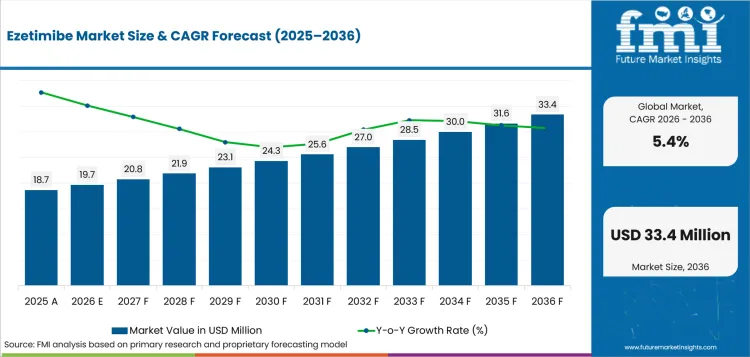
| Metric | Value |
|---|---|
| 2026 Market Size | USD 19.7 million |
| 2036 Market Size | USD 33.4 million |
| Forecast CAGR (2026-2036) | 5.4% |
| Leading Form | Powder |
| Powder Share (2026) | 74.0% |
| Leading Purity Grade | ≥99.5% |
| ≥99.5% Purity Grade Share (2026) | 64.0% |
| Fastest-growing Country | India |
| India CAGR by 2036 | 6.7% |
| Market Signal | Commercial Impact |
|---|---|
| Demand and Growth Drivers | Long-term cholesterol management and combination lipid therapies continue to drive demand for ezetimibe.
|
| Product and Segment View | Powder formulations, high-purity APIs, hypercholesterolemia applications, and direct sales dominate their respective market segments.
|
| Geography and Growth Outlook | India and China remain the principal growth markets for ezetimibe API manufacturing and supply.
|
| Competitive Landscape | Competition increasingly centers on regulatory compliance, supplier reliability, and manufacturing transparency.
|
| Analyst Perspective | Ezetimibe has evolved into a reliability-driven API market where documentation and supply consistency determine long-term success.
- Anurag Sharma, Principal Analyst at Future Market Insights |
The industry outlook is shaped by prescription confidence in local estrogen therapy rather than broad hormone demand alone. FDA reported in February 2026 that about 41 million U.S. women were ages 45 to 64 in 2020, yet only about 2 million women ages 46 to 65 received a hormone-therapy prescription. This gap shows why physician comfort and label clarity remain major sales influences in estrogen products. Aspen’s Estriol 1mg/g cream product information was last updated on eMC in June 2026 and identifies estriol as an estrogen-only intravaginal therapy for vaginal estrogen deficiency symptoms. Comparable qualification behavior appears across the small molecule API market where standard APIs remain the main input for commercial manufacturing.
Which factors support value growth in the ezetimibe market?
Combination therapy and regulated sourcing support recurring orders while generic competition moderates value per kilogram.
- Market value is supported by commercial API revenue before distributor margins and finished-dose revenue are added.
- Supplier pricing reflects impurity control and release reliability before particle-size requirements affect selective orders.
- Revenue growth is moderated when approved buyers renegotiate repeat contracts across several qualified sources.
- Retail and public-payer price pressure can move upstream into API sourcing budgets.
Why is the ezetimibe market growing?
The market is growing due to repeat lipid therapy use and fixed-dose combination demand. Mature generic sourcing still keeps buyer leverage high.
Combination lipid therapy is the main demand support. FDA labeling for NEXLIZET identifies a fixed-dose product with 180 mg bempedoic acid and 10 mg ezetimibe. That format keeps ezetimibe attached to newer oral LDL-C pathways and supports repeat sourcing for combination formulations. This behavior overlaps with the cholesterol API market where lipid-related manufacturing value depends on validated supply instead of drug novelty.
Generic pressure is the main growth limiter. FDA stated in 2025 that greater generic competition is associated with lower prices. That pricing pattern is visible in ezetimibe API where buyers compare qualified suppliers before placing repeat contracts.
How is the ezetimibe market segmented?
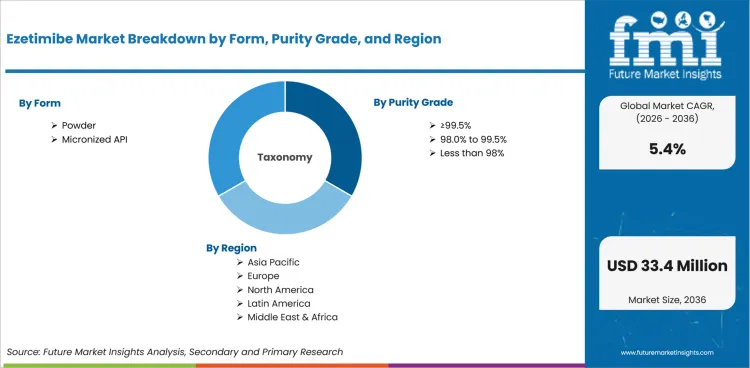
The ezetimibe industry is segmented by segmented by form, purity grade, application, sales channel.
- Powder is projected to secure 74.0% share in 2026 through its use in oral solid dosage production.
- ≥99.5% purity grade is anticipated to hold 64.0% share in 2026 through cleaner impurity profiles for regulated dossiers.
- Hypercholesterolemia applications are estimated to represent 67.0% share in 2026 with repeat use in LDL-C treatment.
- Direct sales are forecast to hold 58.0% share in 2026 with supplier audits shaping formulation-buyer screening.
- East Asia is projected to account for 32.0% regional share in 2026 with API chemistry scale and intermediate access.
Why does powder lead by form?
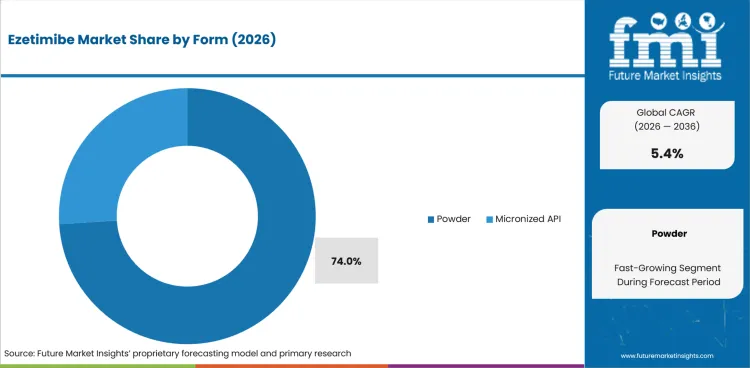
- Powder is projected to account for 74.0% of form demand in 2026 through conventional blending and compression use.
- Micronized API demand is more selective through dissolution-control needs during formulation transfer or reformulation work.
Which purity grade leads the ezetimibe market?
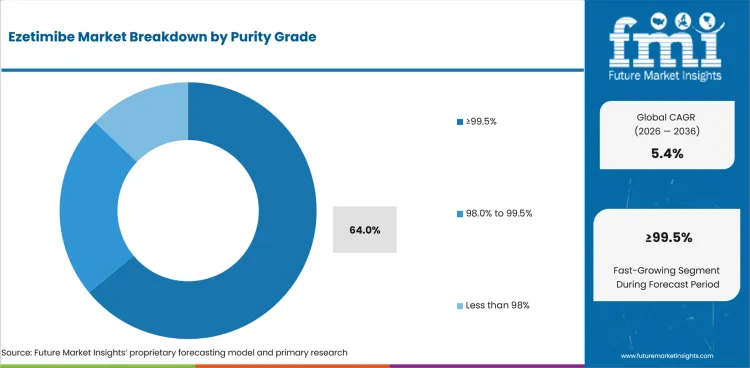
- ≥99.5% purity grade is estimated to represent 64.0% of purity-grade demand in 2026 with tighter impurity needs.
- Buyers compare certificates of analysis and residual solvent data before switching suppliers for commercial batches.
Which application leads the ezetimibe market?
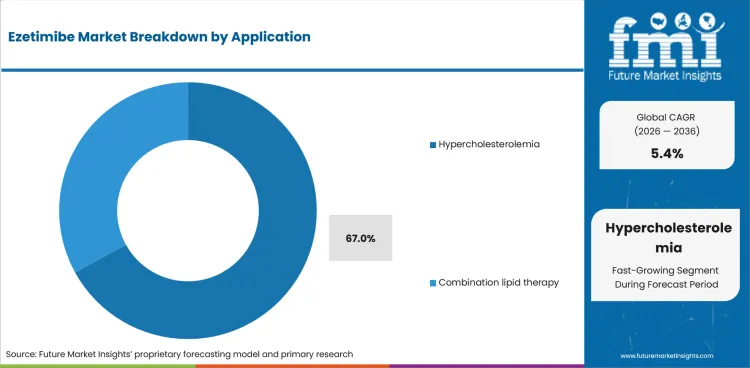
- Hypercholesterolemia is anticipated to account for 67.0% of application demand in 2026 with standalone ezetimibe use.
- Combination lipid therapy purchases often involve deeper formulation checks to align ezetimibe with another active ingredient.
Which sales channel leads the ezetimibe market?
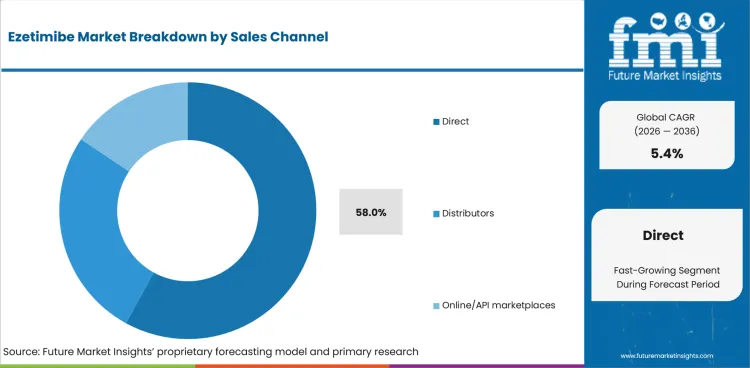
- Direct sales are expected to hold 58.0% of channel demand in 2026 through audited supplier relationships.
- Distributors serve smaller formulation buyers but direct contracts gain priority when drug makers need faster quality responses.
What drives and restrains the ezetimibe market?
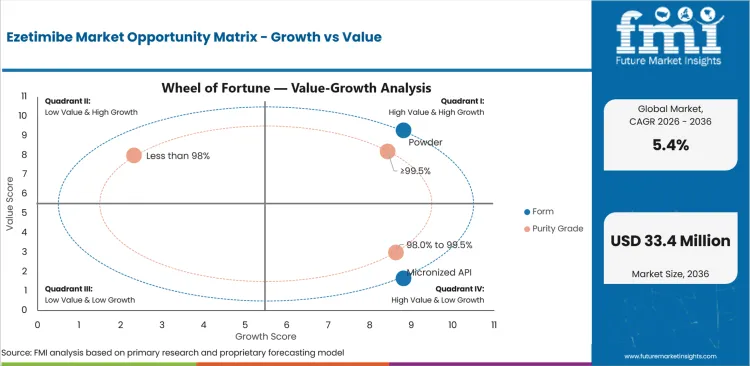
Fixed-dose therapy and strict documentation support demand. Generic price pressure moderates revenue growth.
- Driver: Fixed-dose lipid therapy keeps ezetimibe API in newer oral LDL-C treatment pathways.
- Restraint: Generic price pressure can narrow API margins when buyers compare several qualified suppliers.
- Opportunity: Micronized API can support formulation teams that need tighter dissolution control.
- Opportunity: Compliance support can differentiate suppliers during variation filings and customer audits.
Ezetimibe API Demand Outlook
Demand outlook is expected to be driven by qualified generic programs and fixed-dose lipid therapy. FDA reported 689 ANDA approvals in FY 2025. That review volume keeps buyer attention on price and documentation speed for mature oral APIs. This behavior overlaps with the specialty active pharmaceutical ingredients sourcing where purity documentation can decide repeat qualification.
Generic API Buyer Segmentation and Purchase Behavior Analysis
Regulated formulation companies form the main buyer group for ezetimibe API. FDA’s April 2026 DMF list was current through DMF 044003. The list shows why document depth matters before buyers approve a new source. Synthesis economics in the pharmaceutical intermediates affect upstream continuity for generic APIs.
Regulatory Cost and Decision-driver Analysis
Supplier choice is expected to be driven by filing cost and audit response. FDA listed the FY 2026 DMF fee at USD 102,584. That cost makes complete files more valuable during supplier screening. The same document burden is visible in the healthcare regulatory affairs outsourcing market where life sciences companies pay for faster filing support.
Which countries are growing fastest in the ezetimibe market?
India 6.7% CAGR, China 6.1% CAGR, South Korea 5.8% CAGR, United States 5.4% CAGR, France 5.1% CAGR, Germany 5.0% CAGR, Japan 4.8% CAGR, and United Kingdom 4.6% CAGR through 2036.
.webp "Top Country Growth Comparison Ezetimibe Market Cagr (2026 2036)")
| Country | CAGR |
|---|---|
| India | 6.7% |
| China | 6.1% |
| South Korea | 5.8% |
| United States | 5.4% |
| France | 5.1% |
| Germany | 5.0% |
| Japan | 4.8% |
| United Kingdom | 4.6% |
Source: Future Market Insights, 2026.
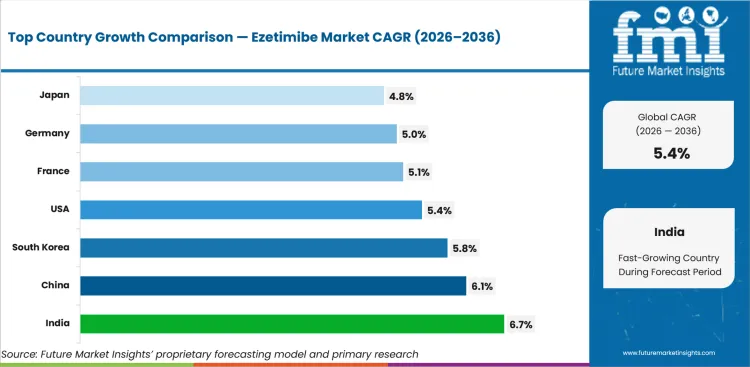
How do country-level CAGRs compare in the ezetimibe market?
India is estimated to record steady outlook while the United Kingdom shows a cautious growth path among countries.
- India is projected to grow at a 6.7% CAGR by 2036, supported by its expanding demand base and favorable supplier cost structures.
- China is expected to register a 6.1% CAGR by 2036, reflecting its dual role as a large consumption market and a competitive supply hub.
- South Korea is forecast to achieve a 5.8% CAGR by 2036, driven by steady domestic demand and efficient production economics.
- The United States is projected to expand at a 5.4% CAGR by 2036, underpinned by stable demand trends and distributor‑led sourcing models.
- France is expected to post a 5.1% CAGR by 2036, supported by regulated demand patterns and selective procurement practices.
- Germany is forecast to record a 5.0% CAGR by 2036, reflecting mature market demand and disciplined supplier engagement.
- Japan is projected to grow at a 4.8% CAGR by 2036, supported by consistent consumption and long‑established supplier relationships.
- The United Kingdom is expected to expand at a 4.6% CAGR by 2036, influenced by moderate demand growth and conservative sourcing behavior.
How fast is the ezetimibe market growing in United States?
A 5.4% CAGR by 2036 reflects strict document review and steady oral lipid therapy demand.
Country Market Snapshot Table
| Parameter | Value |
|---|---|
| Market Size in 2025 (Value) | USD 2.2 million |
| Market Size in 2026 (Value) | USD 2.3 million |
| Market Forecast in 2036 (Value) | USD 3.9 million |
| CAGR (2026 to 2036) | 5.4% |
| Years Considered | 2021 to 2036 |
| Base Year | 2025 |
| Forecast Period | 2026 to 2036 |
| Units Considered | Value (USD million) |
| Leading Sub-Region | New Jersey and Midwest formulation corridors |
United States Ezetimibe Market Outlook
United States ezetimibe API demand is shaped by a mature generic medicine channel and strict document review. Buyers keep approved suppliers active when impurity history and drug master file support reduce filing risk.
The country is projected to grow when combination labels and recurring lipid therapy use support API replenishment. Generic price pressure still keeps margin discipline central.
Key Growth Drivers
- High cholesterol treatment creates a steady finished-dose base. CDC reported that about 86 million U.S. adults aged 20 years and older had total cholesterol above 200 mg/dL in 2024.
- Population aging supports repeat cardiovascular therapy demand. The U.S. Census Bureau reported that the 65-and-older population reached 61.2 million in 2024.
- Combination lipid therapy keeps ezetimibe inside newer oral treatment pathways. FDA labeling for NEXLIZET lists 180 mg bempedoic acid and 10 mg ezetimibe per tablet.
- Direct API sourcing is preferred by regulated formulation buyers. Supplier selection depends on document speed and batch-release history.
Key Restraints
- Generic competition limits pricing upside. FDA estimated that 773 generic applications approved in 2023 generated USD 18.6 billion in savings during the first 12 months.
- Supplier switching remains difficult when impurity files and stability packages are incomplete. Buyers reject low-cost offers that create filing delays.
- Standalone ezetimibe API has limited value upside when buyers compare several approved sources. Margin defense depends on service quality instead of volume alone.
What makes United States unique
The United States is unique due to FDA document expectations and their influence on supplier approval standards across export markets.
Key Companies
- Teva API
- Dr. Reddy’s Laboratories
- Aurobindo Pharma USA
- Esperion Therapeutics
- Glenmark Pharmaceuticals USA
Sales & Marketing Channels
- Direct API sales to formulation manufacturers
- DMF-supported supplier qualification
- Distributor supply for smaller buyers
- Regulatory affairs driven sourcing
- CMO purchasing for finished-dose programs
Country Segment Breakdown Table
| Segment | Sub-Segments |
|---|---|
| By Form | Powder · Micronized API |
| By Purity Grade | ≥99.5% · 98.0%-99.5% · <98% |
| By Application | Hypercholesterolemia · Combination Lipid Therapy |
| By Sales Channel | Direct · Distributors · Online/API Marketplaces |
| Key Sub-Regions Covered | North America · Europe · East Asia · South Asia & Pacific · Latin America · Middle East & Africa |
Frequently Asked Questions
How fast is United States ezetimibe market growing?
Sales in United States are projected to record 5.4% CAGR from 2026 to 2036.
Who leads United States ezetimibe market?
Teva API and Dr. Reddy’s Laboratories lead United States supplier relevance. Aurobindo Pharma USA adds cardiovascular supply reach.
What is driving adoption in United States ezetimibe market?
Ezetimibe adoption in United States is supported by lipid therapy use and buyer demand for qualified API supply.
How fast is the ezetimibe market growing in United Kingdom?
The United Kingdom is projected at 4.6% CAGR by 2036 with NHS cost discipline moderating API value growth.
Country Market Snapshot Table
| Parameter | Value |
|---|---|
| Market Size in 2025 (Value) | USD 0.7 million |
| Market Size in 2026 (Value) | USD 0.7 million |
| Market Forecast in 2036 (Value) | USD 1.1 million |
| CAGR (2026 to 2036) | 4.6% |
| Years Considered | 2021 to 2036 |
| Base Year | 2025 |
| Forecast Period | 2026 to 2036 |
| Units Considered | Value (USD million) |
| Leading Sub-Region | England community pharmacy and generic supply corridors |
United Kingdom Ezetimibe Market Outlook
United Kingdom demand is governed by NHS prescribing discipline and community pharmacy visibility. Ezetimibe remains relevant where statin intolerance or add-on LDL-C control drives prescription demand.
API suppliers face a margin-sensitive market due to public purchasing systems that track medicine cost closely. Buyers reward reliable dossiers and stable delivery over broad catalog claims.
Key Growth Drivers
- Primary-care use keeps lipid-lowering medicines visible in public data. NHSBSA reported that cardiovascular system medicines accounted for 30% of prescription items in England during 2024 to 2025.
- Population aging is expected to widen the treated cardiovascular pool. ONS projected a 14.6% increase in the United Kingdom population of pensionable age by mid-2034.
- NHS guidance keeps ezetimibe in routine clinical explanation for high blood cholesterol. That supports repeat finished-dose demand through generic channels.
- Community pharmacy dispensing supports regular replenishment. API buyers therefore place weight on continuity and release timelines.
Key Restraints
- Public cost controls restrict supplier margin flexibility. GOV.UK set the 2025 payment rate for newer branded medicines at 22.9%.
- Country-specific API manufacturing evidence is limited in public sources. Local buyers often rely on imported qualified material instead of domestic API claims.
- Price concessions can disrupt planning for generic formulation holders. API suppliers must absorb cost pressure when finished-dose reimbursement tightens.
What makes United Kingdom unique
The United Kingdom is unique due to public dispensing transparency and visible generic medicine cost control.
Key Companies
- Accord Healthcare UK
- Teva UK
- Aurobindo Pharma UK
- Glenmark Pharmaceuticals Europe
- Mylan UK
Sales & Marketing Channels
- NHS-aligned generic medicine supply
- Community pharmacy dispensing channels
- Direct sales to UK formulation holders
- Distributor supply for generic portfolios
- Regulatory documentation led buyer qualification
Country Segment Breakdown Table
| Segment | Sub-Segments |
|---|---|
| By Form | Powder · Micronized API |
| By Purity Grade | ≥99.5% · 98.0%-99.5% · <98% |
| By Application | Hypercholesterolemia · Combination Lipid Therapy |
| By Sales Channel | Direct · Distributors · Online/API Marketplaces |
| Key Sub-Regions Covered | North America · Europe · East Asia · South Asia & Pacific · Latin America · Middle East & Africa |
Frequently Asked Questions
How fast is United Kingdom ezetimibe market growing?
Sales in United Kingdom are projected to record 4.6% CAGR from 2026 to 2036.
Who leads United Kingdom ezetimibe market?
Accord Healthcare UK and Teva UK lead local relevance. Aurobindo Pharma UK adds cardiovascular supply reach.
What is driving adoption in United Kingdom ezetimibe market?
Ezetimibe adoption in United Kingdom is supported by lipid therapy use and buyer demand for qualified API supply.
How fast is the ezetimibe market growing in Germany?
Germany is forecast at 5.0% CAGR by 2036 with regulated therapy demand and reference-price discipline shaping API sourcing.
Country Market Snapshot Table
| Parameter | Value |
|---|---|
| Market Size in 2025 (Value) | USD 1.0 million |
| Market Size in 2026 (Value) | USD 1.0 million |
| Market Forecast in 2036 (Value) | USD 1.6 million |
| CAGR (2026 to 2036) | 5.0% |
| Years Considered | 2021 to 2036 |
| Base Year | 2025 |
| Forecast Period | 2026 to 2036 |
| Units Considered | Value (USD million) |
| Leading Sub-Region | North Rhine-Westphalia and Bavaria pharmaceutical corridors |
Germany Ezetimibe Market Outlook
Germany demand reflects a regulated European market with clinical standardization and strict payer review. Ezetimibe suppliers need EU-ready documentation before buyers consider supply changes.
Germany demand reflects a regulated European market with clinical standardization and strict payer review. Ezetimibe suppliers need EU-ready documentation before buyers consider supply changes.
The market is projected to grow at a measured pace with reimbursement controls limiting pricing upside. Batch traceability and impurity control remain central to supplier screening.
- Older population structure supports repeat cardiovascular therapy demand. Destatis reported that people aged 60 to 80 represented 22.6% of Germany’s population in 2024.
- Retail pharmaceutical intensity keeps medicine sourcing under active budget review. The OECD reported that Germany spent EUR 743 per capita on retail pharmaceuticals in 2023.
- European dyslipidemia guidance keeps ezetimibe relevant in combination lipid therapy. This supports continued formulation work for statin add-on products.
- EU dossier expectations support demand for ≥99.5% purity material. Buyers place weight on impurity trend files before approving repeat orders.
Key Restraints
- Reference pricing restricts value upside. The Federal Joint Committee stated in 2025 that around 80% of German pharmaceutical prescriptions are for reference-price drugs.
- Reference-price pressure limits the ability to pass API cost changes into finished generic drugs. Suppliers must compete through reliability and documentation speed.
- German buyers avoid suppliers with weak EU document history. Lower quoted prices do not compensate for variation risk.
What makes Germany unique
Germany is unique due to strict payer discipline and high expectations for EU pharmaceutical documentation.
Key Companies
- Hexal
- Ratiopharm
- STADA Arzneimittel
- Teva API
- Lek Pharmaceuticals
Sales & Marketing Channels
- Direct sales to EU formulation manufacturers
- Wholesaler channels for generic finished products
- Statutory tender influenced purchasing
- Distributor supply for smaller generic firms
- EU variation and dossier support channels
Country Segment Breakdown Table
| Segment | Sub-Segments |
|---|---|
| By Form | Powder · Micronized API |
| By Purity Grade | ≥99.5% · 98.0%–99.5% · <98% |
| By Application | Hypercholesterolemia · Combination Lipid Therapy |
| By Sales Channel | Direct · Distributors · Online/API Marketplaces |
| Key Sub-Regions Covered | North America · Europe · East Asia · South Asia & Pacific · Latin America · Middle East & Africa |
Frequently Asked Questions
How fast is Germany ezetimibe market growing?
Sales in Germany are projected to record 5.0% CAGR from 2026 to 2036.
Who leads Germany ezetimibe market?
Hexal and Ratiopharm lead local relevance. STADA Arzneimittel adds cardiovascular supply reach.
What is driving adoption in Germany ezetimibe market?
Ezetimibe adoption in Germany is supported by lipid therapy use and buyer demand for qualified API supply.
How fast is the ezetimibe market growing in France?
France is projected at 5.1% CAGR by 2036 with reimbursement pressure moderating steady lipid therapy demand.
Country Market Snapshot Table
| Parameter | Value |
|---|---|
| Market Size in 2025 (Value) | USD 0.8 million |
| Market Size in 2026 (Value) | USD 0.8 million |
| Market Forecast in 2036 (Value) | USD 1.3 million |
| CAGR (2026 to 2036) | 5.1% |
| Years Considered | 2021 to 2036 |
| Base Year | 2025 |
| Forecast Period | 2026 to 2036 |
| Units Considered | Value (USD million) |
| Leading Sub-Region | Île-de-France and Auvergne-Rhône-Alpes formulation corridors |
France Ezetimibe Market Outlook
France demand is shaped by regulated European prescribing and payer pressure on generic medicines. Ezetimibe remains useful in hypercholesterolemia and combination lipid pathways.
Suppliers must balance pricing limits with EU-compliant documentation. Buyers favor vendors that can answer variation and quality questions without delaying supply.
Key Growth Drivers
- Aging supports lipid therapy demand. INSEE reported that people aged 65 and older represented 22% of the French population in 2025.
- Cardiovascular burden keeps lipid control clinically relevant. The France Country Health Profile 2025 stated that cancer and cardiovascular diseases together accounted for 45% of deaths in 2022.
- EMA records keep ezetimibe-containing combination products active in European regulatory pathways. This supports qualified API supply for formulation programs.
- EU quality expectations favor suppliers with clean impurity files. French buyers use those files to reduce dossier and batch-release risk.
Key Restraints
- Medicine spending pressure narrows room for API price recovery. DREES reported that ambulatory medicine spending reached EUR 34.5 billion in 2024.
- Generic substitution policy keeps finished-dose prices under pressure. API suppliers must protect margins through production discipline.
- Country-specific ezetimibe API supplier evidence is limited in public sources. Buyers rely on EU-approved supply history instead of local company claims.
What makes France unique
France is unique due to national reimbursement discipline and supplier documentation needs.
Key Companies
- Sanofi
- Servier
- Biogaran
- Viatris France
- Teva Santé
Sales & Marketing Channels
- Reimbursement-led generic procurement
- Hospital and pharmacy wholesaler channels
- Direct supply to formulation holders
- EU dossier support channels
- Distributor supply for smaller portfolios
Country Segment Breakdown Table
| Segment | Sub-Segments |
|---|---|
| By Form | Powder · Micronized API |
| By Purity Grade | ≥99.5% · 98.0%-99.5% · <98% |
| By Application | Hypercholesterolemia · Combination Lipid Therapy |
| By Sales Channel | Direct · Distributors · Online/API Marketplaces |
| Key Sub-Regions Covered | North America · Europe · East Asia · South Asia & Pacific · Latin America · Middle East & Africa |
Frequently Asked Questions
How fast is France ezetimibe market growing?
Sales in France are projected to record 5.1% CAGR from 2026 to 2036.
Who leads France ezetimibe market?
Sanofi and Servier lead local relevance. Biogaran adds cardiovascular supply reach.
What is driving adoption in France ezetimibe market?
Ezetimibe adoption in France is supported by lipid therapy use and buyer demand for qualified API supply.
How fast is the ezetimibe market growing in Japan?
Japan is expected to record 4.8% CAGR by 2036 with slow supplier switching and repeat chronic therapy demand.
Country Market Snapshot Table
| Parameter | Value |
|---|---|
| Market Size in 2025 (Value) | USD 1.3 million |
| Market Size in 2026 (Value) | USD 1.4 million |
| Market Forecast in 2036 (Value) | USD 2.2 million |
| CAGR (2026 to 2036) | 4.8% |
| Years Considered | 2021 to 2036 |
| Base Year | 2025 |
| Forecast Period | 2026 to 2036 |
| Units Considered | Value (USD million) |
| Leading Sub-Region | Kanto and Kansai pharmaceutical clusters |
Japan Ezetimibe Market Outlook
Japan demand is shaped by an older patient base and conservative supplier qualification. Buyers expect stable quality packages before changing API sources.
The market is projected to grow with chronic therapy demand and PMDA-aligned supplier discipline. Suppliers with complete documentation can defend preferred positions.
Key Growth Drivers
- Japan’s aging base supports continued cardiovascular medicine use. The Cabinet Office reported that the population aged 65 and older reached 36.24 million in 2024.
- Population structure strengthens chronic therapy needs. The Statistics Bureau reported that people aged 65 and older represented 29.3% of Japan’s population in 2024.
- PMDA-aligned filings favor suppliers with reliable data packages. API buyers place weight on impurity files and change-control discipline.
- Combination lipid therapy supports selected ezetimibe demand. Formulators need stable physical properties when ezetimibe is paired with another active ingredient.
Key Restraints
- Demographic pressure shapes long-term therapy planning. The Statistics Bureau reported that Japan’s child population fell to 13.83 million in 2024.
- National price revisions keep mature generic medicines under margin pressure. API suppliers have limited ability to recover higher input costs.
- Supplier changes move slowly when local documentation is incomplete. Lower-cost offers face resistance if quality packages are not ready.
What makes Japan unique
Japan is unique due to its older patient base and strict local review discipline for supplier changes.
Key Companies
- Nipro Pharma
- Nichi-Iko Pharmaceutical
- Towa Pharmaceutical
- Sawai Pharmaceutical
- Meiji Seika Pharma
Sales & Marketing Channels
- Direct API supply to formulation manufacturers
- Japanese generic company sourcing
- Distributor support for smaller buyers
- PMDA documentation support channels
- Contract manufacturing partnerships
Country Segment Breakdown Table
| Segment | Sub-Segments |
|---|---|
| By Form | Powder · Micronized API |
| By Purity Grade | ≥99.5% · 98.0%–99.5% · <98% |
| By Application | Hypercholesterolemia · Combination Lipid Therapy |
| By Sales Channel | Direct · Distributors · Online/API Marketplaces |
| Key Sub-Regions Covered | North America · Europe · East Asia · South Asia & Pacific · Latin America · Middle East & Africa |
Frequently Asked Questions
How fast is Japan ezetimibe market growing?
Sales in Japan are projected to record 4.8% CAGR from 2026 to 2036.
Who leads Japan ezetimibe market?
Nipro Pharma and Nichi-Iko Pharmaceutical lead local relevance. Towa Pharmaceutical adds cardiovascular supply reach.
What is driving adoption in Japan ezetimibe market?
Ezetimibe adoption in Japan is supported by lipid therapy use and buyer demand for qualified API supply.
How fast is the ezetimibe market growing in China?
China is forecast at 6.1% CAGR by 2036 with manufacturing depth supporting API value expansion.
Country Market Snapshot Table
| Parameter | Value |
|---|---|
| Market Size in 2025 (Value) | USD 2.9 million |
| Market Size in 2026 (Value) | USD 3.1 million |
| Market Forecast in 2036 (Value) | USD 5.6 million |
| CAGR (2026 to 2036) | 6.1% |
| Years Considered | 2021 to 2036 |
| Base Year | 2025 |
| Forecast Period | 2026 to 2036 |
| Units Considered | Value (USD million) |
| Leading Sub-Region | Zhejiang and Jiangsu chemical synthesis corridors |
China Ezetimibe Market Outlook
China demand is influenced by API chemistry scale and intermediate availability. The country affects global ezetimibe pricing through cost-competitive supply options.
The market is projected to grow faster than several mature demand countries. Manufacturing depth supports order retention despite intense local competition.
Key Growth Drivers
- Large-scale chemical output supports API and intermediate availability. NBS reported that industrial value added increased 5.9% in 2025.
- Aging supports chronic therapy needs. UNDP China cited national data showing that people aged 65 and older reached 223 million by the end of 2025.
- Export-oriented suppliers can serve buyers seeking secondary supply. Cost control remains central to customer qualification for mature generic molecules.
- Combination lipid therapy creates selected demand for consistent ezetimibe quality. Buyers screen Chinese options for international registration support.
Key Restraints
- Demographic pressure may slow domestic volume expansion. NBS reported a natural population growth rate of minus 2.41 per thousand in 2025.
- Local supplier competition limits price recovery across mature API contracts. Export sellers must compete on documentation and batch consistency.
- International buyers require stronger dossiers than some domestic-only suppliers can provide. That narrows the pool for regulated-market orders.
What makes China unique
China is unique due to manufacturing scale that anchors global price expectations for ezetimibe API.
Key Companies
- Zhejiang Hisun Pharmaceutical
- Zhejiang Huahai Pharmaceutical
- Zhejiang Medicine
- Jiangsu Hengrui Pharmaceuticals
- Zhejiang Jiuzhou Pharmaceutical
Sales & Marketing Channels
- Direct export API sales
- Intermediate supplier networks
- Distributor channels for smaller buyers
- International registration support teams
- Contract supply discussions with generic manufacturers
Country Segment Breakdown Table
| Segment | Sub-Segments |
|---|---|
| By Form | Powder · Micronized API |
| By Purity Grade | ≥99.5% · 98.0%-99.5% · <98% |
| By Application | Hypercholesterolemia · Combination Lipid Therapy |
| By Sales Channel | Direct · Distributors · Online/API Marketplaces |
| Key Sub-Regions Covered | North America · Europe · East Asia · South Asia & Pacific · Latin America · Middle East & Africa |
Frequently Asked Questions
How fast is China ezetimibe market growing?
Sales in China are projected to record 6.1% CAGR from 2026 to 2036.
Who leads China ezetimibe market?
Zhejiang Hisun Pharmaceutical and Zhejiang Huahai Pharmaceutical lead local relevance. Zhejiang Medicine adds cardiovascular supply reach.
What is driving adoption in China ezetimibe market?
Ezetimibe adoption in China is supported by lipid therapy use and buyer demand for qualified API supply.
How fast is the ezetimibe market growing in South Korea?
South Korea is projected at 5.8% CAGR by 2036 with smaller demand keeping buyer screening strict.
Country Market Snapshot Table
| Parameter | Value |
|---|---|
| Market Size in 2025 (Value) | USD 0.6 million |
| Market Size in 2026 (Value) | USD 0.6 million |
| Market Forecast in 2036 (Value) | USD 1.1 million |
| CAGR (2026 to 2036) | 5.8% |
| Years Considered | 2021 to 2036 |
| Base Year | 2025 |
| Forecast Period | 2026 to 2036 |
| Units Considered | Value (USD million) |
| Leading Sub-Region | Seoul-Gyeonggi and Chungcheong pharmaceutical corridors |
South Korea Ezetimibe Market Outlook
South Korea demand reflects a compact and quality-sensitive generic medicine channel. Buyers evaluate supplier reliability more closely due to smaller national volume.
The market is projected to grow with documentation discipline supporting repeat sourcing. Supplier selection depends on local regulatory fit and stable pricing.
Key Growth Drivers
- Aging supports cardiovascular medicine demand. Statistics Korea reported that people aged 65 and older represented 20.3% of the population in 2025.
- Insurance coverage creates a structured pathway for reimbursed medicines. NHIS reported that national health insurance covered 97.1% of health security beneficiaries in its latest English yearbook.
- Regulated generic demand supports repeat sourcing for cardiovascular formulation portfolios. Buyers need suppliers that can support Korean filing requirements.
- Combination lipid therapy creates selected formulation needs for ezetimibe API. Suppliers with stable data packages can retain approved positions.
Key Restraints
- Administrative review burden can slow supplier changes. HIRA stated in April 2025 that required review data items were cut from 430 to 221.
- Smaller national volume limits supplier pricing flexibility and stocking depth. This reduces local leverage in global API allocation.
- Public evidence for country-specific ezetimibe API suppliers is limited. Buyers rely on documentation history instead of broad domestic capacity claims.
What makes South Korea unique
South Korea is unique due to smaller scale and the commercial value of documentation review speed.
Key Companies
- Yuhan Corporation
- Chong Kun Dang
- Hanmi Pharmaceutical
- Daewoong Pharmaceutical
- Celltrion Pharm
Sales & Marketing Channels
- Direct sales to formulation companies
- Distributor supply for API buyers
- Regulatory documentation support channels
- Generic finished-dose supply networks
- Contract manufacturing partnerships
Country Segment Breakdown Table
| Segment | Sub-Segments |
|---|---|
| By Form | Powder · Micronized API |
| By Purity Grade | ≥99.5% · 98.0%–99.5% · <98% |
| By Application | Hypercholesterolemia · Combination Lipid Therapy |
| By Sales Channel | Direct · Distributors · Online/API Marketplaces |
| Key Sub-Regions Covered | North America · Europe · East Asia · South Asia & Pacific · Latin America · Middle East & Africa |
Frequently Asked Questions
How fast is South Korea ezetimibe market growing?
Sales in South Korea are projected to record 5.8% CAGR from 2026 to 2036.
Who leads South Korea ezetimibe market?
Yuhan Corporation and Chong Kun Dang lead local relevance. Hanmi Pharmaceutical adds cardiovascular supply reach.
What is driving adoption in South Korea ezetimibe market?
Ezetimibe adoption in South Korea is supported by lipid therapy use and buyer demand for qualified API supply.
How fast is the ezetimibe market growing in India?
India is forecast at 6.7% CAGR by 2036 with export formulation demand supporting API volume expansion.
Country Market Snapshot Table
| Parameter | Value |
|---|---|
| Market Size in 2025 (Value) | USD 2.7 million |
| Market Size in 2026 (Value) | USD 2.9 million |
| Market Forecast in 2036 (Value) | USD 5.5 million |
| CAGR (2026 to 2036) | 6.7% |
| Years Considered | 2021 to 2036 |
| Base Year | 2025 |
| Forecast Period | 2026 to 2036 |
| Units Considered | Value (USD million) |
| Leading Sub-Region | Hyderabad and Gujarat API manufacturing corridors |
India Ezetimibe Market Outlook
India demand is shaped by API production and export-oriented generic formulation manufacturing. The country can build volume faster than most mature demand markets.
The market is projected to expand due to manufacturing depth and global export demand. Suppliers need strong impurity files to win regulated-market orders.
Key Growth Drivers
- Export strength supports repeat API and formulation demand. PIB reported that India’s pharmaceutical exports reached USD 30.5 billion in 2024 to 2025.
- Policy support is strengthening upstream production. PIB reported cumulative investment of INR 4,814 crore under the bulk-drug PLI scheme by December 2025.
- Local API capacity supports repeat supply to domestic and export formulation manufacturers. Buyers compare cost with document readiness before awarding volume.
- CDSCO cardiovascular reviews show active regulatory attention to lipid therapy combinations. This supports formulation pathways that can include ezetimibe.
Key Restraints
- API import exposure remains a policy issue. PIB stated that 48 greenfield projects were approved under the bulk drug scheme to reduce dependence on critical starting materials.
- High supplier competition pressures mature generic API prices. Indian producers must defend margins through release consistency and filing support.
- Buyers may reject lower-cost offers if impurity files or stability data are incomplete. Export-market orders require stronger evidence than basic local supply.
What makes India unique
India is unique due to API manufacturing depth and export formulation demand operating together.
Key Companies
- Dr. Reddy’s Laboratories
- Hetero Drugs
- MSN Laboratories
- Aurobindo Pharma
- Glenmark Life Sciences
Sales & Marketing Channels
- Direct API sales to formulation exporters
- Domestic distributor channels
- Contract manufacturing networks
- Regulatory document supported exports
- Online/API marketplace discovery for early screening
Country Segment Breakdown Table
| Segment | Sub-Segments |
|---|---|
| By Form | Powder · Micronized API |
| By Purity Grade | ≥99.5% · 98.0%-99.5% · <98% |
| By Application | Hypercholesterolemia · Combination Lipid Therapy |
| By Sales Channel | Direct · Distributors · Online/API Marketplaces |
| Key Sub-Regions Covered | North America · Europe · East Asia · South Asia & Pacific · Latin America · Middle East & Africa |
Frequently Asked Questions
How fast is India ezetimibe market growing?
Sales in India are projected to record 6.7% CAGR from 2026 to 2036.
Who leads India ezetimibe market?
Dr. Reddy’s Laboratories and Hetero Drugs lead local relevance. MSN Laboratories adds cardiovascular supply reach.
What is driving adoption in India ezetimibe market?
Ezetimibe adoption in India is supported by lipid therapy use and buyer demand for qualified API supply.
Who are the leading companies in the ezetimibe market?
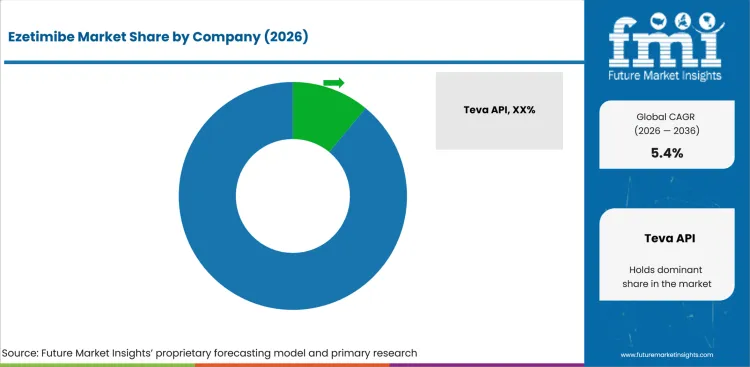
Verified API visibility and regulated-document strength define competition in a 5.4% CAGR ezetimibe supply market.
- Teva API and Dr. Reddy’s Laboratories have verified ezetimibe API pages that support buyer screening.
- MSN Laboratories and Hetero Drugs add India-based supply options for buyers needing secondary sourcing.
- Buyer preference is expected to be driven by impurity history and response speed during supplier audits.
- Regional producers can win repeat consideration through stable release records and micronized API support.
Competition is concentrated around suppliers that can prove molecule availability and regulatory support. Official Teva API and Dr. Reddy’s pages confirm direct ezetimibe API visibility. Indian producers gain buyer interest when documentation fits regulated-market filing needs. This buyer screen also overlaps with the small molecule CMO/CDMO market.
Market growth at 5.4% shifts competition toward suppliers that can protect repeat orders. Buyers compare release history before moving approved API orders. Suppliers with faster file support are better placed to win repeat contracts. The CMO/CDMO demand outlook shows similar reliance on filing support.
How do top ezetimibe companies compare?
Teva API and Dr. Reddy’s Laboratories score strongest on molecule visibility. Indian suppliers hold ground through cost control and regulated-market filing support.
Competitive Benchmarking Table
| Company | Relevant Positioning | Evidence Basis |
|---|---|---|
| Teva API | Large API supplier with direct ezetimibe product visibility. | Official Teva API page lists ezetimibe. |
| Dr. Reddy’s Laboratories | Indian API supplier with ezetimibe API visibility. | Official product page lists ezetimibe API. |
| MSN Laboratories | Indian API producer with broad facility depth. | Company API page confirms portfolio scale. |
| Hetero Drugs | Indian generic and API group with supply relevance. | Company materials confirm API activity. |
| Aurobindo Pharma | Generic formulation and API supplier for regulated markets. | Company portfolio supports buyer relevance. |
| Zhejiang Hisun Pharmaceutical | Chinese supplier candidate with manufacturing relevance. | Public company evidence supports Chinese pharmaceutical production. |
Source: Future Market Insights competitive analysis, 2026.
Which companies are active in the ezetimibe market?
Teva API and Dr. Reddy’s Laboratories are listed with MSN Laboratories and Hetero Drugs among other suppliers.
Key global companies leading the ezetimibe market include:
- Teva API
- Dr. Reddy’s Laboratories
- Hetero Drugs
- MSN Laboratories
- Aurobindo Pharma
- Glenmark Life Sciences
- Zhejiang Hisun Pharmaceutical
- Lek Pharmaceuticals
- Cambrex
- Hikal
Key Developments in Ezetimibe Market
- In March 2026, Merck presented Phase 3 CORALreef AddOn results for enlicitide against oral non-statin therapies including ezetimibe. This matters because ezetimibe buyers may face new competitive pressure if oral PCSK9 options move into LDL-C treatment pathways.
- In March 2026, Esperion presented new CLEAR Outcomes analyses at ACC.26 for bempedoic acid in high-risk patient groups. This matters because NEXLIZET contains ezetimibe and needs continued clinical evidence to support payer and prescriber confidence.
Active Suppliers in the Ezetimibe Market
Global API Groups
- Teva API
- Lek Pharmaceuticals
- Cambrex
Indian API Producers
- Dr. Reddy’s Laboratories
- Hetero Drugs
- MSN Laboratories
- Aurobindo Pharma
- Glenmark Life Sciences
- Hikal
China and Regional Suppliers
- Zhejiang Hisun Pharmaceutical
- Zhejiang Huahai Pharmaceutical
- Zhejiang Medicine
Ezetimibe Market - Report Scope
| Parameter | Details |
|---|---|
| Forecast period | 2026 to 2036 |
| Historical period | 2021 to 2025 |
| Quantitative unit | Revenue in USD million |
| By form | Powder, micronized API |
| By purity grade | ≥99.5%, 98.0% to 99.5%, less than 98% |
| By application | Hypercholesterolemia, combination lipid therapy |
| By sales channel | Direct, distributors, online/API marketplaces |
| Regions covered | North America, Latin America, Europe, East Asia, South Asia and Pacific, Middle East and Africa |
| Countries covered | India, China, South Korea, United States, France, Germany, Japan, United Kingdom |
| Key companies profiled | Teva API, Dr. Reddy’s Laboratories, Hetero Drugs, MSN Laboratories, Aurobindo Pharma, Glenmark Life Sciences, Zhejiang Hisun Pharmaceutical, Lek Pharmaceuticals, Cambrex, Hikal |
| Approach | Bottom-up API revenue approach using molecule demand, price erosion, country supply depth, buyer qualification behavior, and supplier documentation strength |
| Source | Future Market Insights, 2026. |
Ezetimibe Market - Scope & Definition
| Attribute | Detail |
|---|---|
| Market Definition | Commercially traded ezetimibe active pharmaceutical ingredient for oral lipid-lowering drug formulations |
| Functions Covered | LDL-C lowering support in standalone and fixed-dose oral formulations |
| Applications Covered | Hypercholesterolemia and combination lipid therapy |
| End-Use Industries | Generic pharmaceutical manufacturing and contract formulation manufacturing |
| Grades Covered | ≥99.5% purity, 98.0% to 99.5% purity and less than 98% purity |
| Inclusions | Powder and micronized ezetimibe API sold through direct channels and distributors |
| Exclusions | Finished tablets, branded retail drugs and non-ezetimibe lipid-lowering APIs |
Ezetimibe Market - Research Methodology
| Method | Description |
|---|---|
| Primary Research | FMI analyst checks with API buyers, formulation companies and distributors active in lipid therapy supply. |
| Desk Research | Review of FDA labels and DailyMed records. Country statistics and official company API pages supported source checks. |
| Market Sizing & Forecasting | Bottom-up API revenue approach using molecule demand, price erosion and country supply depth. |
| Data Validation | Cross-checks using regulatory records, supplier evidence and buyer qualification behavior. |
Ezetimibe Market Breakdown by Form and Purity Grade with Application and Sales Channel by Region
Ezetimibe Market Segmented by Form:
- Powder
- Micronized API
Ezetimibe Market Segmented by Purity Grade:
- ≥99.5%
- 98.0% to 99.5%
- Less than 98%
Ezetimibe Market Segmented by Application:
- Hypercholesterolemia
- Combination lipid therapy
Ezetimibe Market Segmented by Sales Channel:
- Direct
- Distributors
- Online/API marketplaces
Ezetimibe Market by Region:
- North America
- Latin America
- Europe
- East Asia
- South Asia and Pacific
- Middle East and Africa
Research Sources and Bibliography
- Centers for Disease Control and Prevention. (2024, October 24). High cholesterol facts.
- DailyMed. (2026). Ezetimibe tablet label. National Library of Medicine.
- Esperion Therapeutics. (2024, March 22). U.S. FDA approves broad new labels for NEXLETOL and NEXLIZET.
- Federal Joint Committee. (2025, November 27). The Federal Joint Committee.
- Federal Statistical Office of Germany. (2026, May 20). Germany statistical country profile.
- Health Insurance Review & Assessment Service. (2025, April 23). HIRA easing administrative load of hospitals via streamlined review data.
- INSEE. (2026, January 13). Demographic report 2025.
- Japan Cabinet Office. (2025, June 5). Annual report on the ageing society FY2025.
- National Bureau of Statistics of China. (2026, February 28). Statistical communiqué of the PRC on 2025 national economic and social development.
- National Health Insurance Service. (2025). 2024 National Health Insurance and long-term care statistical yearbook.
- NHS Business Services Authority. (2025, June 5). Prescription Cost Analysis England 2024/25.
- Office for National Statistics. (2026, April 28). National population projections: 2024-based.
- OECD and European Observatory on Health Systems and Policies. (2025, December). France Country Health Profile 2025.
- Press Information Bureau. (2026, March 10). APIs imports from China. Government of India.
- Press Information Bureau. (2026, March 21). India’s pharmaceuticals in global healthcare. Government of India.
- Press Information Bureau. (2026, March 27). Production Linked Incentive Scheme for Pharmaceuticals. Government of India.
- Statistics Bureau of Japan. (2025). Statistical handbook of Japan 2025. Ministry of Internal Affairs and Communications.
- Statistics Korea. (2025). 2025 statistics on the aged.
- U.S. Census Bureau. (2025, June 26). Older adults outnumber children in 11 states.
- U.S. Food and Drug Administration. (2025, November 17). Generic competition and drug prices.
- U.S. Food and Drug Administration. (2025, October 23). Tentative approval letter for bempedoic acid and ezetimibe tablets.
- U.S. Food and Drug Administration. (2025, December 19). Untitled letter for NEXLIZET promotion.
- Dr. Reddy’s Laboratories. (2026). Ezetimibe API manufacturer and supplier.
- U.S. Food and Drug Administration. (2026). FY 2025 GDUFA performance report.
- U.S. Food and Drug Administration. (2026, April 22). List of Drug Master Files (DMFs).
- Merck & Co., Inc. March 30, 2026. Merck’s Enlicitide Decanoate, an Investigational Oral PCSK9 Inhibitor, Demonstrated Significantly Greater LDL-C Reductions at Eight Weeks Compared to Guideline-Recommended Oral Non-Statin Therapies When Added to Background Statins. Merck.
- Esperion Therapeutics, Inc. March 30, 2026. Esperion Showcases New Data from CLEAR Outcomes Highlighting Value of NEXLETOL® (bempedoic acid) at the American College of Cardiology’s Annual Scientific Session 2026. Esperion Therapeutics.
- U.S. Food and Drug Administration. (2026, June 18). Generic Drug User Fee Amendments.
This bibliography is provided for reader reference. The full report contains the complete reference list and detailed citations.
This Report Answers
- Market size estimates for 2026 and forecasts through 2036 for the ezetimibe market.
- Insights across regional and country-level ezetimibe API demand.
- Analysis of buyer qualification behavior and supplier selection.
- Evaluation of form and purity-grade demand across regulated API sourcing.
- Assessment of pricing pressure and generic competition effects.
- Identification of opportunities across micronized API and document support.
- Evaluation of supply chain dynamics and manufacturer visibility.
- Country-level analysis covering the United States and India. Other profiled countries are also included.
- Assessment of leading API suppliers and comparable regional manufacturers.
- Regional outlooks across North America, Europe and Asia Pacific.
- Delivery of market data and supporting analysis in report-ready format.
Frequently Asked Questions
How large is the Ezetimibe Market expected to be in the near term?
The market is expanding steadily as ezetimibe remains a routine component of long term lipid lowering therapy.
What is the long term outlook for the Ezetimibe Market?
The outlook remains stable as repeat cardiovascular treatment and combination products sustain ongoing API demand.
How fast is the Ezetimibe Market expected to grow?
Growth is supported by chronic therapy use and fixed dose combination demand, with pricing discipline moderating expansion.
What is the main driver of ezetimibe demand?
Demand is driven by its continued role in cholesterol management and use in combination lipid lowering therapies.
Which countries are key markets for ezetimibe?
India, China, the United States, Germany, France, South Korea, Japan, and the United Kingdom are key markets.
What supports India’s growth momentum in ezetimibe supply?
Export oriented formulation manufacturing and strong API production capacity support higher growth.
Why is China important to the ezetimibe market?
Large scale API chemistry and cost competitive manufacturing anchor global ezetimibe supply chains.
What shapes demand in the United States?
Strict regulatory documentation standards and repeat lipid therapy prescribing support stable API sourcing.
Why does supplier documentation matter in this market?
Supplier documentation matters due to impurity files and release history requirements before repeat supply approval.
How does combination therapy affect ezetimibe API demand?
Combination therapy supports continued API demand by keeping ezetimibe inside oral LDL-C treatment pathways.
Why does micronized API create selective value?
Micronized API creates selective value when formulation teams need better control over dissolution behavior.
Preview the report firsthand - request a free sample
Get SampleGet the brochure for pricing and purchase details.
Get PDFTable of Content
- Key Takeaways
- Market Size and CAGR
- Top Growth Driver
- Fastest Growing Segment
- Leading Region
- Key Companies
- Emerging Opportunities
- Executive Summary
- Global Market Outlook
- Demand-side Trends
- Supply-side Trends
- Technology Roadmap Analysis
- Analysis and Recommendations
- Analyst Perspective (What is happening? Why now? What should investors know?)
- Key Questions Answered
- How large is the market?
- What is the CAGR?
- What are key trends?
- Which region dominates?
- Who are the leaders?
- Market Overview
- Market Coverage / Taxonomy
- Market Definition / Scope / Limitations
- Research Methodology
- Chapter Orientation
- Analytical Lens and Working Hypotheses
- Market Structure, Signals, and Trend Drivers
- Benchmarking and Cross-market Comparability
- Market Sizing, Forecasting, and Opportunity Mapping
- Research Design and Evidence Framework
- Desk Research Programme (Secondary Evidence)
- Expert Input and Fieldwork (Primary Evidence)
- Tooling, Models, and Reference Databases
- Data Engineering and Model Build
- Quality Assurance and Audit Trail
- Market Background
- Market Dynamics (Drivers, Restraints, Opportunity, Trends)
- Scenario Forecast (Optimistic, Likely, Conservative)
- Impact Analysis
- AI Impact
- Sustainability Impact
- Regulatory Impact
- Technology Impact
- Consumer / Buyer Analysis
- Purchase Drivers
- Adoption Barriers
- Buyer Journey
- Opportunity Map Analysis
- Product Life Cycle Analysis
- Supply Chain Analysis
- Investment Feasibility Matrix
- Value Chain Analysis
- PESTLE and Porter's Analysis
- Regulatory Landscape
- Regional Parent Market Outlook
- Production and Consumption Statistics
- Import and Export Statistics
- Global Market Analysis and Forecast, 2021 to 2036
- Historical Market Size Value (USD Million) Analysis, 2021 to 2025
- Current and Future Market Size Value (USD Million) Projections, 2026 to 2036
- Y-o-Y Growth Trend Analysis
- Absolute $ Opportunity Analysis
- Global Market Pricing Analysis, 2021 to 2036
- Global Market Analysis and Forecast, By Form, 2021 to 2036
- Introduction / Key Findings
- Historical Market Size Value (USD Million) Analysis By Form, 2021 to 2025
- Current and Future Market Size Value (USD Million) Analysis and Forecast By Form, 2026 to 2036
- Powder
- Micronized API
- Powder
- Y-o-Y Growth Trend Analysis By Form, 2021 to 2025
- Absolute $ Opportunity Analysis By Form, 2026 to 2036
- Global Market Analysis and Forecast, By Purity Grade, 2021 to 2036
- Introduction / Key Findings
- Historical Market Size Value (USD Million) Analysis By Purity Grade, 2021 to 2025
- Current and Future Market Size Value (USD Million) Analysis and Forecast By Purity Grade, 2026 to 2036
- ≥99.5%
- 98.0% to 99.5%
- Less than 98%
- ≥99.5%
- Y-o-Y Growth Trend Analysis By Purity Grade, 2021 to 2025
- Absolute $ Opportunity Analysis By Purity Grade, 2026 to 2036
- Global Market Analysis and Forecast, By Application, 2021 to 2036
- Introduction / Key Findings
- Historical Market Size Value (USD Million) Analysis By Application, 2021 to 2025
- Current and Future Market Size Value (USD Million) Analysis and Forecast By Application, 2026 to 2036
- Hypercholesterolemia
- Combination lipid therapy
- Hypercholesterolemia
- Y-o-Y Growth Trend Analysis By Application, 2021 to 2025
- Absolute $ Opportunity Analysis By Application, 2026 to 2036
- Global Market Analysis and Forecast, By Sales Channel, 2021 to 2036
- Introduction / Key Findings
- Historical Market Size Value (USD Million) Analysis By Sales Channel, 2021 to 2025
- Current and Future Market Size Value (USD Million) Analysis and Forecast By Sales Channel, 2026 to 2036
- Direct
- Distributors
- Online/API marketplaces
- Direct
- Y-o-Y Growth Trend Analysis By Sales Channel, 2021 to 2025
- Absolute $ Opportunity Analysis By Sales Channel, 2026 to 2036
- Global Market Analysis and Forecast, By Region, 2021 to 2036
- Introduction
- Historical Market Size Value (USD Million) Analysis By Region, 2021 to 2025
- Current Market Size Value (USD Million) Analysis and Forecast By Region, 2026 to 2036
- North America
- Latin America
- Western Europe
- Eastern Europe
- East Asia
- South Asia and Pacific
- Middle East & Africa
- Market Attractiveness Analysis By Region
- North America Market Analysis and Forecast, By Country, 2021 to 2036
- Historical Market Size Value (USD Million) Trend Analysis By Market Taxonomy, 2021 to 2025
- Market Size Value (USD Million) Forecast By Market Taxonomy, 2026 to 2036
- By Country
- USA
- Canada
- Mexico
- By Form
- By Purity Grade
- By Application
- By Sales Channel
- By Country
- Market Attractiveness Analysis
- By Country
- By Form
- By Purity Grade
- By Application
- By Sales Channel
- Key Takeaways
- Latin America Market Analysis and Forecast, By Country
- Historical Market Size Value (USD Million) Trend Analysis By Market Taxonomy, 2021 to 2025
- Market Size Value (USD Million) Forecast By Market Taxonomy, 2026 to 2036
- By Country
- Brazil
- Chile
- Rest of Latin America
- By Form
- By Purity Grade
- By Application
- By Sales Channel
- By Country
- Market Attractiveness Analysis
- By Country
- By Form
- By Purity Grade
- By Application
- By Sales Channel
- Key Takeaways
- Western Europe Market Analysis and Forecast, By Country
- Historical Market Size Value (USD Million) Trend Analysis By Market Taxonomy, 2021 to 2025
- Market Size Value (USD Million) Forecast By Market Taxonomy, 2026 to 2036
- By Country
- Germany
- UK
- Italy
- Spain
- France
- Nordic
- BENELUX
- Rest of Western Europe
- By Form
- By Purity Grade
- By Application
- By Sales Channel
- By Country
- Market Attractiveness Analysis
- By Country
- By Form
- By Purity Grade
- By Application
- By Sales Channel
- Key Takeaways
- Eastern Europe Market Analysis and Forecast, By Country
- Historical Market Size Value (USD Million) Trend Analysis By Market Taxonomy, 2021 to 2025
- Market Size Value (USD Million) Forecast By Market Taxonomy, 2026 to 2036
- By Country
- Russia
- Poland
- Hungary
- Balkan & Baltic
- Rest of Eastern Europe
- By Form
- By Purity Grade
- By Application
- By Sales Channel
- By Country
- Market Attractiveness Analysis
- By Country
- By Form
- By Purity Grade
- By Application
- By Sales Channel
- Key Takeaways
- East Asia Market Analysis and Forecast, By Country
- Historical Market Size Value (USD Million) Trend Analysis By Market Taxonomy, 2021 to 2025
- Market Size Value (USD Million) Forecast By Market Taxonomy, 2026 to 2036
- By Country
- China
- Japan
- South Korea
- By Form
- By Purity Grade
- By Application
- By Sales Channel
- By Country
- Market Attractiveness Analysis
- By Country
- By Form
- By Purity Grade
- By Application
- By Sales Channel
- Key Takeaways
- South Asia and Pacific Market Analysis and Forecast, By Country
- Historical Market Size Value (USD Million) Trend Analysis By Market Taxonomy, 2021 to 2025
- Market Size Value (USD Million) Forecast By Market Taxonomy, 2026 to 2036
- By Country
- India
- ASEAN
- Australia & New Zealand
- Rest of South Asia and Pacific
- By Form
- By Purity Grade
- By Application
- By Sales Channel
- By Country
- Market Attractiveness Analysis
- By Country
- By Form
- By Purity Grade
- By Application
- By Sales Channel
- Key Takeaways
- Middle East & Africa Market Analysis and Forecast, By Country
- Historical Market Size Value (USD Million) Trend Analysis By Market Taxonomy, 2021 to 2025
- Market Size Value (USD Million) Forecast By Market Taxonomy, 2026 to 2036
- By Country
- Kingdom of Saudi Arabia
- Other GCC Countries
- Türkiye
- South Africa
- Other African Union
- Rest of Middle East & Africa
- By Form
- By Purity Grade
- By Application
- By Sales Channel
- By Country
- Market Attractiveness Analysis
- By Country
- By Form
- By Purity Grade
- By Application
- By Sales Channel
- Key Takeaways
- Key Countries Market Analysis
- USA
- Pricing Analysis
- Market Share Analysis, 2025
- By Form
- By Purity Grade
- By Application
- By Sales Channel
- Canada
- Pricing Analysis
- Market Share Analysis, 2025
- By Form
- By Purity Grade
- By Application
- By Sales Channel
- Mexico
- Pricing Analysis
- Market Share Analysis, 2025
- By Form
- By Purity Grade
- By Application
- By Sales Channel
- Brazil
- Pricing Analysis
- Market Share Analysis, 2025
- By Form
- By Purity Grade
- By Application
- By Sales Channel
- Chile
- Pricing Analysis
- Market Share Analysis, 2025
- By Form
- By Purity Grade
- By Application
- By Sales Channel
- Germany
- Pricing Analysis
- Market Share Analysis, 2025
- By Form
- By Purity Grade
- By Application
- By Sales Channel
- UK
- Pricing Analysis
- Market Share Analysis, 2025
- By Form
- By Purity Grade
- By Application
- By Sales Channel
- Italy
- Pricing Analysis
- Market Share Analysis, 2025
- By Form
- By Purity Grade
- By Application
- By Sales Channel
- Spain
- Pricing Analysis
- Market Share Analysis, 2025
- By Form
- By Purity Grade
- By Application
- By Sales Channel
- France
- Pricing Analysis
- Market Share Analysis, 2025
- By Form
- By Purity Grade
- By Application
- By Sales Channel
- India
- Pricing Analysis
- Market Share Analysis, 2025
- By Form
- By Purity Grade
- By Application
- By Sales Channel
- ASEAN
- Pricing Analysis
- Market Share Analysis, 2025
- By Form
- By Purity Grade
- By Application
- By Sales Channel
- Australia & New Zealand
- Pricing Analysis
- Market Share Analysis, 2025
- By Form
- By Purity Grade
- By Application
- By Sales Channel
- China
- Pricing Analysis
- Market Share Analysis, 2025
- By Form
- By Purity Grade
- By Application
- By Sales Channel
- Japan
- Pricing Analysis
- Market Share Analysis, 2025
- By Form
- By Purity Grade
- By Application
- By Sales Channel
- South Korea
- Pricing Analysis
- Market Share Analysis, 2025
- By Form
- By Purity Grade
- By Application
- By Sales Channel
- Russia
- Pricing Analysis
- Market Share Analysis, 2025
- By Form
- By Purity Grade
- By Application
- By Sales Channel
- Poland
- Pricing Analysis
- Market Share Analysis, 2025
- By Form
- By Purity Grade
- By Application
- By Sales Channel
- Hungary
- Pricing Analysis
- Market Share Analysis, 2025
- By Form
- By Purity Grade
- By Application
- By Sales Channel
- Kingdom of Saudi Arabia
- Pricing Analysis
- Market Share Analysis, 2025
- By Form
- By Purity Grade
- By Application
- By Sales Channel
- Türkiye
- Pricing Analysis
- Market Share Analysis, 2025
- By Form
- By Purity Grade
- By Application
- By Sales Channel
- South Africa
- Pricing Analysis
- Market Share Analysis, 2025
- By Form
- By Purity Grade
- By Application
- By Sales Channel
- USA
- Market Structure Analysis
- Competition Dashboard
- Competition Benchmarking
- Market Share Analysis of Top Players
- By Regional
- By Form
- By Purity Grade
- By Application
- By Sales Channel
- Emerging Startups
- Innovation Benchmarking
- Competition Analysis
- Competition Deep Dive
- Teva API
- Overview
- Product Portfolio
- Profitability by Market Segments (Product/Region/Sales Channel)
- Sales Footprint
- Strategy Overview
- Marketing Strategy
- Product Strategy
- Channel Strategy
- Dr. Reddy’s Laboratories
- Hetero Drugs
- MSN Laboratories
- Aurobindo Pharma
- Glenmark Life Sciences
- Zhejiang Hisun Pharmaceutical
- Teva API
- Case Studies
- Success Stories
- Recent Developments
- Competition Deep Dive
- Assumptions & Acronyms Used


