

- Market Size (2026)
- USD 2.2 Bn
- Forecast (2036)
- USD 5.8 Bn
- CAGR (2026 to 2036)
- 10.2%
How big is the Familial Amyloid Polyneuropathy Market in 2026?
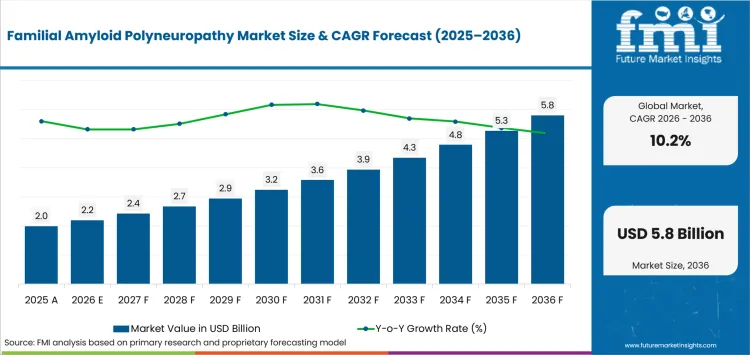
USD 2.2 billion in 2026 and USD 5.8 billion by 2036 at a 10.2% CAGR.
Sales in the familial amyloid polyneuropathy market are projected to grow at 10.2% CAGR through 2036. Global valuation is expected to reach USD 5.8 billion from USD 2.2 billion in 2026. Growth is being driven by increasing adoption of disease-modifying therapies that target transthyretin production and slow neuropathy progression in hereditary amyloidosis patients. The European Medicines Agency authorized Wainzua (eplontersen) in March 2025 for adults with stage 1 or stage 2 hereditary transthyretin-mediated amyloidosis with polyneuropathy, expanding treatment options for patients in earlier disease stages.
Referral pathways must connect molecular diagnostics with neurologic and cardiac assessment before clinicians select an administration route. Japan's jRCT registry listed a 25-participant ACT-EARLY target for asymptomatic pathogenic TTR carriers in December 2025. The prevention study illustrates how national research pathways can differ from reimbursement systems centered on diagnosed disease.
Key Takeaways of Familial Amyloid Polyneuropathy Market
- Earlier genetic confirmation increases demand for disease-modifying treatment during ambulatory stages that preserve mobility and daily function.
- Gene silencing therapies are projected to represent 46.0% by therapy type in 2026 owing to established RNA-targeted treatment pathways.
- Hereditary transthyretin amyloidosis with polyneuropathy is estimated to account for 58.0% by disease type in 2026 due to approved stage-specific indications.
- Intravenous administration is forecast to capture 42.0% by route in 2026 supported by established specialist infusion protocols.
- Specialist capacity and country-specific value assessment restrict treatment access despite broader route choice and continuing therapeutic development.
- Alnylam Pharmaceuticals, Inc., Ionis Pharmaceuticals, Inc., AstraZeneca plc, Intellia Therapeutics, Inc., Regeneron Pharmaceuticals, Inc., BridgeBio Pharma, Inc., Pfizer Inc. and Purpose Pharma International AB serve distinct commercial and development roles.
Analyst Perspective
"Delayed genetic confirmation allows irreversible nerve damage to narrow the function that familial amyloid polyneuropathy therapy can preserve. The strongest access model links TTR testing to a specialist referral route and an administration plan matched to each country’s reimbursement sequence."
- Anurag Sharma, Principal Consultant, Future Market Insights
How is the Familial Amyloid Polyneuropathy Market segmented?
The familial amyloid polyneuropathy market is segmented by therapy type, disease type, route of administration, end user, distribution channel and region.
Therapy type covers gene silencing therapies, transthyretin stabilizers, gene editing and cell therapies, and supportive therapies. Disease type distinguishes hereditary polyneuropathy, mixed polyneuropathy with cardiomyopathy, and advanced or multisystem disease. Administration routes include intravenous, subcutaneous, and oral treatment across hospitals, specialty clinics, and home care settings. Distribution channels include hospital pharmacies, specialty pharmacies, and online pharmacies within the final regional taxonomy.
What supports gene silencing therapies within the therapy type category?
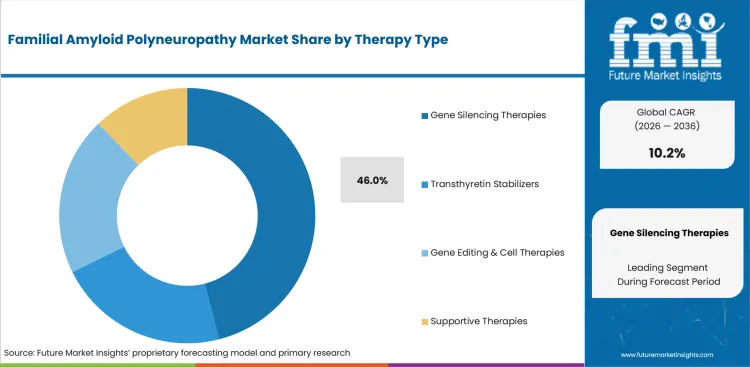
Gene silencing therapies reduce hepatic transthyretin production with RNA interference or antisense mechanisms that act before amyloid deposition progresses. Monthly and quarterly subcutaneous schedules also reduce recurring infusion demand for eligible adults under specialist oversight.
- By therapy type, gene silencing therapies are estimated to hold 46.0% share in 2026 owing to several approved dosing schedules.
- NICE estimated 90 fewer commissioned homecare nurse administrations in England during 2025 to 2026 under its eplontersen uptake assumptions. Lower service burden supports monthly self-administration within amyloidosis treatment pathways but does not remove neurologic review or cardiac surveillance for mixed disease.
How does hereditary transthyretin amyloidosis with polyneuropathy shape disease type demand?
Hereditary transthyretin amyloidosis with polyneuropathy defines the diagnosed population receiving targeted therapy during ambulatory stages that retain useful neurologic function. Mixed phenotypes also require cardiac assessment before specialists select one treatment sequence for coordinated long-term monitoring.
- Hereditary transthyretin amyloidosis with polyneuropathy is projected to hold 58.0% share in 2026 owing to stage-specific approved indications.
- EMA authorized Attrogy for adults with stage 1 or stage 2 polyneuropathy in July 2025. Early referral improves treatment value within transthyretin amyloidosis treatment pathways that preserve sensory and motor function before advanced disease narrows practical route selection and monitoring.
What role does intravenous administration play within the route category?
Intravenous administration retains an established role with patisiran infusion inside amyloidosis centers that manage complex hereditary disease for recurrent weight-based dosing. Specialist teams coordinate premedication and infusion monitoring with trained nursing services and documented escalation support across established reimbursement pathways.
- Based on route of administration, intravenous administration is projected to account for 42.0% in 2026 due to established monitoring protocols.
- EMA permits home infusion after three uncomplicated hospital doses and a physician evaluation of treatment tolerance. Home infusion therapy reduces repeat travel for suitable patients but continues to require professional administration and specialist oversight.
Why do hospitals remain central within the end user category?
Hospitals combine genetic confirmation with neurologic staging and cardiac review inside multidisciplinary rare-disease services nationally. Hospital pharmacies also coordinate infusion safety and route switching for patients with changing clinical manifestations. Centralized teams can manage adverse reactions and confirm vitamin A supplementation safely across RNA-targeted treatment.
- Hospitals are likely to capture 44.0% share in 2026 attributable to integrated diagnosis and administration across specialist services.
- Home healthcare expands follow-up capacity for stable patients receiving self-administered treatment under documented monitoring plans. Progressive neuropathy continues to require periodic hospital assessment and treatment adjustment across neurologic or cardiac complications.
What are the drivers, restraints and opportunities in the Familial Amyloid Polyneuropathy Market?
Earlier genetic confirmation supports demand despite comparative value assessment, and lower-burden routes expand practical delivery options.
- Driver: Molecular confirmation directs symptomatic adults toward disease-modifying therapy during stages that preserve useful nerve function.
- Restraint: Comparative value assessment and concentrated specialist capacity delay treatment initiation across several national health systems.
- Opportunity: Self-administered dosing and oral stabilization reduce recurring service burdens within carefully selected patient pathways.
Molecular confirmation directs symptomatic adults toward disease-modifying therapy during stages that preserve useful nerve function. Specialists compare RNA-targeted schedules within rare neurological disease treatment pathways that require repeated monitoring and coordinated pharmacy support.
National assessment bodies compare clinical benefit with treatment costs across established therapy sequences and reimbursement budgets. Convenient dosing strengthens an access case but cannot replace direct comparative evidence against a reimbursed alternative.
Oral stabilization lets specialists match treatment burden with disease stage and local service capacity. The European Commission authorized Attrogy in July 2025 for adults with stage 1 or stage 2 polyneuropathy. Specialty pharma home delivery supports repeat supply after experienced services confirm that oral treatment fits each monitoring plan.
Which country CAGRs are profiled in the Familial Amyloid Polyneuropathy Market?
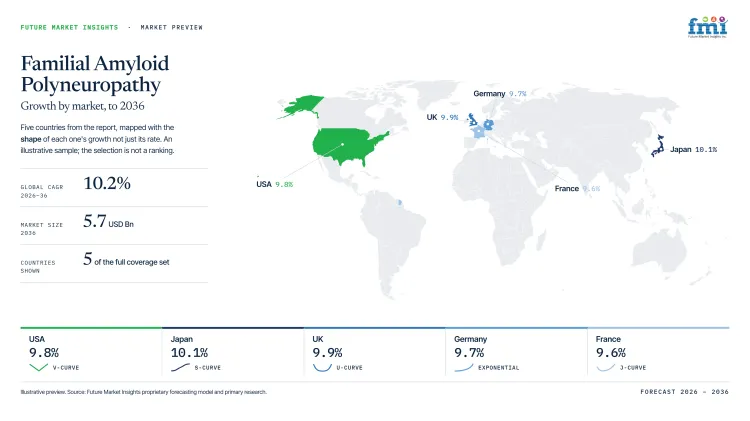
| Country | CAGR |
|---|---|
| Japan | 10.1% |
| United Kingdom | 9.9% |
| United States | 9.8% |
| Germany | 9.7% |
| France | 9.6% |
How do country-level CAGRs compare in the Familial Amyloid Polyneuropathy Market?
The five displayed CAGRs span 0.5 percentage point and describe forecast pace instead of current market size. Close spacing reflects shared therapeutic innovation across national approval and reimbursement systems that create different entry conditions.
- Japan combines established specialist experience with prevention research that screens pathogenic carriers during presymptomatic family evaluation and counseling.
- The United Kingdom combines national technology appraisal with centralized amyloidosis services that coordinate funded treatment access and specialist monitoring.
- The United States offers several approved RNA-targeted schedules across specialist centers with distinct payer authorization and specialty pharmacy requirements.
- Germany connects commercial entry with formal benefit assessment and negotiated treatment costs under statutory insurance rules and hospital formularies.
- France uses multidisciplinary reference centers but reimbursement sequencing preserves a defined therapeutic hierarchy for approved administration routes nationally.
Comparable CAGRs can produce different market entry conditions. The full report provides country-level CAGR analysis across North America, Latin America, Europe, East Asia, South Asia and Pacific, and the Middle East and Africa.
Country-wise Analysis
- Japan’s university amyloidosis centers connect genetic testing with neurologic and cardiac review across regional referral networks that support pathogenic TTR carriers and affected relatives across distant prefectures with coordinated multidisciplinary assessment and family counseling. Adoption of familial amyloid polyneuropathy treatment in Japan is estimated to expand at 10.1% CAGR through 2036, supported by specialist experience and coordinated follow-up for adults with mixed neurologic or cardiac manifestations. PMDA updated Amvuttra prescribing information in June 2025, although families outside major cities still face repeated travel for genetic counseling and specialist assessment before treatment initiation or route changes within concentrated metropolitan specialist networks.
- The United Kingdom routes molecular diagnosis and funded therapy via the National Amyloidosis Centre, which connects regional referrals with multidisciplinary review and treatment initiation for adults with hereditary neurologic or mixed disease. In the United Kingdom, familial amyloid polyneuropathy demand is predicted to advance at 9.9% CAGR through 2036, aided by monthly self-administration and nationally funded specialist monitoring across established referral services for eligible adults. NICE recommended eplontersen under a commercial arrangement in November 2024. Access remains shaped by centralized care, which can lengthen referral timelines and travel requirements for patients far from specialist amyloidosis services.
- The United States combines academic amyloidosis centers with monthly and quarterly subcutaneous therapies across referral networks that support treatment initiation and long-term neurologic or cardiac surveillance across large multistate catchments and route switching decisions. Familial amyloid polyneuropathy demand in the United States is forecast to rise at 9.8% CAGR over the forecast period, influenced by route choice and experienced specialist infrastructure with coordinated pharmacy support services. DailyMed revised the Wainua label in April 2025 to list monthly autoinjector use; even so, payer authorization steps and long travel distances can postpone treatment for rural patients who need sustained specialist monitoring and specialty pharmacy coordination.
- Germany applies formal benefit assessment to newly authorized hereditary amyloidosis medicines seeking routine statutory funding via university hospitals and specialist neurology services for adults with stage-specific impairment across regional care networks and hospital formularies. The German familial amyloid polyneuropathy sector is projected to record 9.7% CAGR during the assessment period, reinforced by specialist expertise and structured reimbursement decisions across university treatment networks with coordinated pharmacy support services. Following the G-BA’s eplontersen benefit resolution in October 2025, comparative evidence requirements may still narrow prescribing and influence price negotiations under statutory insurance across specialist hospital pathways and regional formularies for adults.
- France routes hereditary amyloidosis treatment via reference centers that combine neurologic review with cardiology and genetic expertise across a national rare-disease network serving adults with documented neurologic or mixed cardiac manifestations using coordinated referrals. France’s familial amyloid polyneuropathy outlook is anticipated to advance at 9.6% CAGR over the assessment period, supported by multidisciplinary follow-up and public reimbursement review within defined treatment sequences across established specialist hospital networks. HAS maintained Amvuttra reimbursement in April 2026 and retained Onpattro as first-line therapy, meaning quarterly administration convenience has not fully displaced existing route sequencing across public hospital prescribing and pharmacy pathways for eligible adults in France.
Who are the notable companies in the Familial Amyloid Polyneuropathy Market?
Alnylam Pharmaceuticals, Inc., Ionis Pharmaceuticals, Inc., AstraZeneca plc, Intellia Therapeutics, Inc., Regeneron Pharmaceuticals, Inc., BridgeBio Pharma, Inc., Pfizer Inc. and Purpose Pharma International AB.
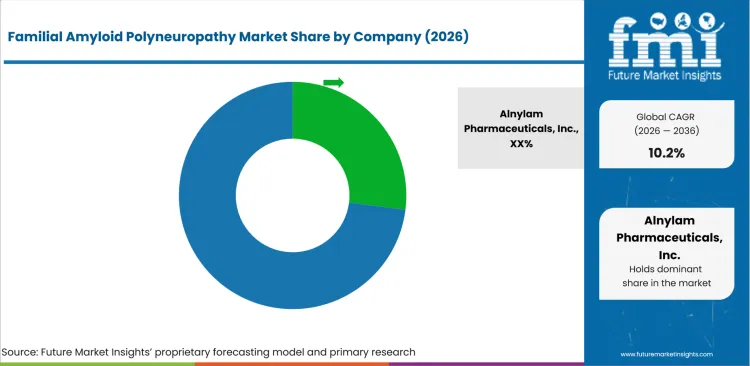
Competition is concentrated among companies with approved RNA silencers or transthyretin stabilizers for diagnosed polyneuropathy. Phase 3 prevention and gene-editing programs broaden participation but specialized gene therapy manufacturing and long follow-up requirements restrict entry.
- Alnylam Pharmaceuticals competes with approved intravenous and quarterly subcutaneous RNA interference therapies across specialist treatment pathways. Ionis Pharmaceuticals and AstraZeneca offer a monthly antisense medicine designed for patient or caregiver administration.
- Pfizer and Purpose Pharma International compete with oral transthyretin stabilization for defined polyneuropathy stages across separate European reimbursement pathways.
- Intellia Therapeutics and Regeneron develop one-time gene editing within rare disease clinical trials. BridgeBio evaluates oral acoramidis in pathogenic TTR carriers without symptomatic hereditary disease.
Competitive Benchmarking: Familial Amyloid Polyneuropathy Market
| Company | Clinical Maturity | Target Specificity | Dosing Logistics | Geographic Reach |
|---|---|---|---|---|
| Alnylam Pharmaceuticals | High | High | High | United States and European Union |
| Ionis Pharmaceuticals | High | High | High | United States and European Union through AstraZeneca |
| AstraZeneca | High | High | High | United States and European Union |
| Intellia Therapeutics | Medium | High | Low | Multinational Phase 3 development |
| Regeneron Pharmaceuticals | Medium | High | Low | Global collaboration with Intellia |
| BridgeBio Pharma | Medium | Medium | Medium | Global Phase 3 prevention study |
| Pfizer | High | Medium | Medium | European Union |
| Purpose Pharma International | High | Medium | Medium | European Union |
Key Developments in the Familial Amyloid Polyneuropathy Market
- In January 2026, Intellia Therapeutics announced that FDA lifted the MAGNITUDE-2 clinical hold and permitted Phase 3 ATTRv-PN enrollment to resume. The decision restored a one-time gene-editing route beside recurring RNA silencing and oral stabilization.
- In May 2025, BridgeBio Pharma dosed the first ACT-EARLY participant within a Phase 3 prevention study for asymptomatic pathogenic TTR variant carriers. The program extends competition from diagnosed treatment toward intervention before clinical polyneuropathy develops.
- In March 2025, Ionis Pharmaceuticals announced European approval of Wainzua for adults with stage 1 or stage 2 hereditary ATTR polyneuropathy. Monthly self-administration added another approved RNA-targeted schedule for national reimbursement assessment and specialist treatment planning.
Key Players in the Familial Amyloid Polyneuropathy Market
Commercial RNA-Silencing Companies
- Alnylam Pharmaceuticals, Inc.
- Ionis Pharmaceuticals, Inc.
- AstraZeneca plc
Gene-Editing and Prevention Developers
- Intellia Therapeutics, Inc.
- Regeneron Pharmaceuticals, Inc.
- BridgeBio Pharma, Inc.
Transthyretin Stabilization Companies
- Pfizer Inc.
- Purpose Pharma International AB
Familial Amyloid Polyneuropathy Market - Report Scope
| Coverage field | Report scope |
|---|---|
| Market breakdown | By therapy type, disease type, route of administration, end user, distribution channel and region. |
| Quantitative Units | Revenue in USD billion and CAGR in %. |
| Market Definition | The market covers approved and investigational therapies used to slow progression or manage familial amyloid polyneuropathy. |
| Regions Covered | North America, Latin America, Europe, East Asia, South Asia and Pacific, and Middle East and Africa. |
| Countries Covered | Japan, United Kingdom, United States, Germany, France, and 20+ countries included in the full report. |
| Key Companies Profiled | Alnylam Pharmaceuticals, Inc., Ionis Pharmaceuticals, Inc., AstraZeneca plc, Intellia Therapeutics, Inc., Regeneron Pharmaceuticals, Inc., BridgeBio Pharma, Inc., Pfizer Inc. and Purpose Pharma International AB. |
| Forecast Period | 2026 to 2036. |
| Approach | Primary and secondary research with market triangulation. |
Familial Amyloid Polyneuropathy Market - Research Methodology
| Method | Approach |
|---|---|
| Primary Research | FMI analysts gathered input from manufacturers, service providers, technology developers, distributors, end users, procurement teams, and subject-matter experts. Interviews examined purchasing decisions, product or service evaluation, adoption barriers, approval requirements, pricing considerations, and expectations for technical or commercial support. Respondents were also asked what evidence is required before a trial, pilot, or initial order develops into regular purchasing. |
| Desk Research | Desk research covered government statistics, regulatory publications, trade data, industry associations, technical literature, standards, company filings, product information, and official corporate announcements. Sources were reviewed for relevance, publication date, geographic coverage, and consistency with the defined market scope. Claims relating to performance, applications, approvals, capacity, investment, and commercial activity were retained only when supported by credible public evidence. |
| Market Sizing and Forecasting | The market model combined the baseline value with historical performance, segment structure, pricing and volume indicators, adoption levels, company participation, and country-level demand conditions. Forecast assumptions considered economic activity, investment trends, regulatory developments, technology adoption, purchasing cycles, supply availability, and barriers to wider market use. Segment and regional estimates were reconciled before the final market total was calculated. |
| Data Validation | Estimates were checked against multiple independent indicators, including public data, company activity, trade patterns, industry developments, and findings from primary interviews. Validation also tested whether products, services, applications, and company revenues fell within the defined market boundaries. Adjacent categories, unsupported claims, overlapping revenues, and activities without direct market relevance were excluded to reduce double counting and maintain consistency across segments and countries. |
Familial Amyloid Polyneuropathy Market by Segments
Familial Amyloid Polyneuropathy Market segmented by Therapy Type:
- Gene Silencing Therapies
- siRNA Therapeutics
- Antisense Oligonucleotides
- RNA Interference Therapies
- Transthyretin Stabilizers
- Tafamidis
- Acoramidis
- Diflunisal
- Gene Editing and Cell Therapies
- CRISPR-Based Gene Editing
- In Vivo Gene Editing
- Cell-Based Therapies
- Supportive Therapies
- Neuropathic Pain Management
- Nutritional Support
- Cardiac Support
Familial Amyloid Polyneuropathy Market segmented by Disease Type:
- Hereditary Transthyretin Amyloidosis with Polyneuropathy
- Early-Stage Polyneuropathy
- Stage I Polyneuropathy
- Stage II Polyneuropathy
- Mixed Polyneuropathy and Cardiomyopathy
- Neurologic-Predominant Disease
- Cardiac-Predominant Disease
- Mixed Phenotype
- Advanced or Multisystem Disease
- Stage III Polyneuropathy
- Severe Autonomic Dysfunction
- Multiorgan Involvement
Familial Amyloid Polyneuropathy Market segmented by Route of Administration:
- Intravenous
- Infusion-Center Administration
- Weight-Based Infusion
- Specialist Monitoring
- Subcutaneous
- Prefilled Syringe
- Autoinjector
- Home Administration
- Oral
- Once-Daily Capsules
- Transthyretin Stabilization
- Long-Term Maintenance
Familial Amyloid Polyneuropathy Market segmented by End User:
- Hospitals
- Tertiary Care Hospitals
- University Hospitals
- Rare Disease Centers
- Specialty Clinics
- Neurology Clinics
- Amyloidosis Clinics
- Genetic Disease Centers
- Home Care Settings
- Self-Administration
- Home Nursing Support
- Remote Monitoring
Familial Amyloid Polyneuropathy Market segmented by Distribution Channel:
- Hospital Pharmacies
- Institutional Purchasing
- Infusion Supply
- Protocol Management
- Specialty Pharmacies
- Benefit Verification
- Patient Support
- Refill Coordination
- Online Pharmacies
- E-Prescription Fulfillment
- Home Delivery
- Digital Patient Coordination
Familial Amyloid Polyneuropathy Market by Region:
- North America
- United States
- Canada
- Mexico
- Latin America
- Brazil
- Chile
- Rest of Latin America
- Western Europe
- Germany
- United Kingdom
- Italy
- Spain
- France
- Nordics
- Benelux
- Rest of Western Europe
- Eastern Europe
- Russia
- Poland
- Hungary
- Balkan and Baltic States
- Rest of Eastern Europe
- East Asia
- China
- Japan
- South Korea
- South Asia and Pacific
- India
- ASEAN
- Australia and New Zealand
- Rest of South Asia and Pacific
- Middle East and Africa
- Kingdom of Saudi Arabia
- Other GCC Countries
- Türkiye
- South Africa
- Other African Union Countries
- Rest of Middle East and Africa
Research Sources and Bibliography
- European Medicines Agency. (2025, March 12). Wainzua.
- Ministry of Health, Labour and Welfare. (2026, June 10). Acoramidis Transthyretin Amyloidosis Prevention Trial in the Young (ACT-EARLY) Study in Asymptomatic Carriers of a Pathogenic TTR Variant.
- National Institute for Health and Care Excellence. (2024, November 27). Resource impact summary report.
- European Medicines Agency. (2025, August 28). Attrogy.
- European Medicines Agency. (2026, July 7). Onpattro: EPAR - Product information.
- Purpose Pharma International AB. (2025, July 31). Purpose Pharma receives European Commission approval of ATTROGY® (diflunisal) for the treatment of hereditary transthyretin-mediated amyloidosis.
- Pharmaceuticals and Medical Devices Agency. (2025, June 24). アムヴトラ皮下注25mgシリンジ.
- National Institute for Health and Care Excellence. (2024, November 27). Eplontersen for treating hereditary transthyretin-related amyloidosis.
- National Library of Medicine. (2025, April). WAINUA - eplontersen injection, solution.
- Gemeinsamer Bundesausschuss. (2025, October 16). Nutzenbewertungsverfahren zum Wirkstoff Eplontersen (Hereditäre Transthyretin-Amyloidose mit Polyneuropathie (Stadium 1 oder 2)).
- Haute Autorité de Santé. (2026, April 1). AMVUTTRA (vutrisiran sodique) - Amylose héréditaire à transthyrétine avec polyneuropathie.
- European Medicines Agency. (2025, June 12). Amvuttra.
- European Medicines Agency. (2026, April 22). Vyndaqel: EPAR - Product information.
- Intellia Therapeutics. (2026, January 27). Intellia Therapeutics Announces FDA Lift of Clinical Hold on MAGNITUDE-2 Phase 3 Clinical Trial in ATTRv-PN.
- BridgeBio Pharma. (2025, May 13). First Participant Dosed with Acoramidis in ACT-EARLY, the First Ever ATTR Primary Prevention Study.
- Ionis Pharmaceuticals. (2025, March 10). WAINZUA (eplontersen) approved in the EU for the treatment of hereditary transthyretin-mediated amyloidosis in adults with stage 1 or stage 2 polyneuropathy.
- Intellia Therapeutics. (2026, May 11). Intellia Therapeutics Announces First Quarter 2026 Financial Results and Business Updates.
- Alnylam Pharmaceuticals. (2025, December 17). Alnylam to Invest $250 Million to Add Enzymatic Ligation Platform to U.S. Manufacturing Facility to Meet Growing Global Demand for RNAi Therapeutics.
- Purpose Pharma International AB. (2025, November 17). Purpose Pharma launches ATTROGY® (diflunisal) for the treatment of hereditary transthyretin-mediated amyloidosis in Germany.
This bibliography is provided for reader reference and is not exhaustive. The full report contains the complete reference list and detailed citations.
This Report Answers
- How large is the familial amyloid polyneuropathy market in 2026 and 2036?
- Which operating conditions support demand for disease-modifying familial amyloid polyneuropathy treatment?
- Which therapy type accounts for the largest approved 2026 share?
- How do disease type and administration route shape treatment selection?
- Which end user category supports coordinated diagnosis and treatment administration?
- How do country growth rates differ across five profiled healthcare systems?
- Which companies provide marketed therapies and advanced development programs?
- What limits treatment access across specialist and reimbursement pathways?
Frequently Asked Questions
How big is the Familial Amyloid Polyneuropathy Market in 2026?
In 2026, the familial amyloid polyneuropathy market is valued at USD 2.2 billion across disease-modifying and supportive treatment pathways. Earlier genetic confirmation directs eligible adults toward treatment during ambulatory neurologic stages and helps specialist teams preserve mobility with coordinated monitoring.
What is the CAGR of the Familial Amyloid Polyneuropathy Market from 2026 to 2036?
The familial amyloid polyneuropathy market is projected to expand at 10.2% CAGR from 2026 to 2036 across major treatment regions. Forecast growth depends on specialist referral and funded access to RNA-targeted medicines with distinct administration requirements across national health systems.
Which therapy type is projected to account for 46.0% of the Familial Amyloid Polyneuropathy Market?
Gene silencing therapies are projected to account for 46.0% of the familial amyloid polyneuropathy market by therapy type in 2026. Approved RNA interference and antisense medicines reduce transthyretin production with established schedules that support specialist selection across intravenous and subcutaneous routes.
How much will the Familial Amyloid Polyneuropathy Market add between 2026 and 2036?
USD 3.56 billion is expected to be added to the familial amyloid polyneuropathy market between 2026 and 2036. The increase depends on earlier diagnosis and funded access to disease-modifying therapies across administration routes that require different specialist and pharmacy resources.
Which companies are active in the Familial Amyloid Polyneuropathy Market?
Eight companies are active in the familial amyloid polyneuropathy market across approved treatment and advanced development routes. Alnylam Pharmaceuticals, Ionis Pharmaceuticals, AstraZeneca, Intellia Therapeutics, Regeneron Pharmaceuticals, BridgeBio Pharma, Pfizer and Purpose Pharma International represent RNA silencing, gene editing, prevention research and oral stabilization.
Preview the report firsthand - request a free sample
Get SampleGet the brochure for pricing and purchase details.
Get PDFTable of Content
- Key Takeaways
- Market Size and CAGR
- Top Growth Driver
- Fastest Growing Segment
- Leading Region
- Key Companies
- Emerging Opportunities
- Executive Summary
- Global Market Outlook
- Demand-side Trends
- Supply-side Trends
- Technology Roadmap Analysis
- Analysis and Recommendations
- Analyst Perspective (What is happening? Why now? What should investors know?)
- Key Questions Answered
- How large is the market?
- What is the CAGR?
- What are key trends?
- Which region dominates?
- Who are the leaders?
- Market Overview
- Market Coverage / Taxonomy
- Market Definition / Scope / Limitations
- Research Methodology
- Chapter Orientation
- Analytical Lens and Working Hypotheses
- Market Structure, Signals, and Trend Drivers
- Benchmarking and Cross-market Comparability
- Market Sizing, Forecasting, and Opportunity Mapping
- Research Design and Evidence Framework
- Desk Research Programme (Secondary Evidence)
- Expert Input and Fieldwork (Primary Evidence)
- Tooling, Models, and Reference Databases
- Data Engineering and Model Build
- Quality Assurance and Audit Trail
- Market Background
- Market Dynamics (Drivers, Restraints, Opportunity, Trends)
- Scenario Forecast (Optimistic, Likely, Conservative)
- Impact Analysis
- AI Impact
- Sustainability Impact
- Regulatory Impact
- Technology Impact
- Consumer / Buyer Analysis
- Purchase Drivers
- Adoption Barriers
- Buyer Journey
- Opportunity Map Analysis
- Product Life Cycle Analysis
- Supply Chain Analysis
- Investment Feasibility Matrix
- Value Chain Analysis
- PESTLE and Porter's Analysis
- Regulatory Landscape
- Regional Parent Market Outlook
- Production and Consumption Statistics
- Import and Export Statistics
- Global Market Analysis and Forecast, 2021 to 2036
- Historical Market Size Value (USD Billion) Analysis, 2021 to 2025
- Current and Future Market Size Value (USD Billion) Projections, 2026 to 2036
- Y-o-Y Growth Trend Analysis
- Absolute $ Opportunity Analysis
- Global Market Pricing Analysis, 2021 to 2036
- Global Market Analysis and Forecast, By Therapy Type, 2021 to 2036
- Introduction / Key Findings
- Historical Market Size Value (USD Billion) Analysis By Therapy Type, 2021 to 2025
- Current and Future Market Size Value (USD Billion) Analysis and Forecast By Therapy Type, 2026 to 2036
- Gene Silencing Therapies
- siRNA Therapeutics
- Antisense Oligonucleotides
- RNA Interference Therapies
- Transthyretin Stabilizers
- Tafamidis
- Acoramidis
- Diflunisal
- Gene Editing & Cell Therapies
- CRISPR-based Therapies
- In Vivo Gene Editing
- Investigational Cell Therapies
- Supportive Therapies
- Pain Management
- Nutritional Support
- Cardiac Support Therapy
- Gene Silencing Therapies
- Y-o-Y Growth Trend Analysis By Therapy Type, 2021 to 2025
- Absolute $ Opportunity Analysis By Therapy Type, 2026 to 2036
- Global Market Analysis and Forecast, By Disease Type, 2021 to 2036
- Introduction / Key Findings
- Historical Market Size Value (USD Billion) Analysis By Disease Type, 2021 to 2025
- Current and Future Market Size Value (USD Billion) Analysis and Forecast By Disease Type, 2026 to 2036
- Hereditary Transthyretin Amyloidosis with Polyneuropathy
- Early-stage Disease
- Stage I Polyneuropathy
- Stage II Polyneuropathy
- Mixed Polyneuropathy & Cardiomyopathy
- Neurological Manifestations
- Cardiac Manifestations
- Multisystem Disease
- Advanced Familial Amyloid Polyneuropathy
- Stage III Disease
- Mobility Impairment
- Severe Neurological Disease
- Hereditary Transthyretin Amyloidosis with Polyneuropathy
- Y-o-Y Growth Trend Analysis By Disease Type, 2021 to 2025
- Absolute $ Opportunity Analysis By Disease Type, 2026 to 2036
- Global Market Analysis and Forecast, By Route of Administration, 2021 to 2036
- Introduction / Key Findings
- Historical Market Size Value (USD Billion) Analysis By Route of Administration, 2021 to 2025
- Current and Future Market Size Value (USD Billion) Analysis and Forecast By Route of Administration, 2026 to 2036
- Intravenous
- Hospital Infusion
- Outpatient Infusion
- Infusion Center Administration
- Oral
- Once-daily Tablets
- Capsules
- Long-term Maintenance Therapy
- Subcutaneous
- Prefilled Syringes
- Autoinjectors
- Home Administration
- Intravenous
- Y-o-Y Growth Trend Analysis By Route of Administration, 2021 to 2025
- Absolute $ Opportunity Analysis By Route of Administration, 2026 to 2036
- Global Market Analysis and Forecast, By End User, 2021 to 2036
- Introduction / Key Findings
- Historical Market Size Value (USD Billion) Analysis By End User, 2021 to 2025
- Current and Future Market Size Value (USD Billion) Analysis and Forecast By End User, 2026 to 2036
- Hospitals
- Tertiary Care Hospitals
- Neurology Departments
- Rare Disease Centers
- Specialty Clinics
- Neurology Clinics
- Cardiology Clinics
- Genetic Disease Centers
- Home Care
- Home Infusion
- Self-administration
- Remote Patient Monitoring
- Hospitals
- Y-o-Y Growth Trend Analysis By End User, 2021 to 2025
- Absolute $ Opportunity Analysis By End User, 2026 to 2036
- Global Market Analysis and Forecast, By Distribution Channel, 2021 to 2036
- Introduction / Key Findings
- Historical Market Size Value (USD Billion) Analysis By Distribution Channel, 2021 to 2025
- Current and Future Market Size Value (USD Billion) Analysis and Forecast By Distribution Channel, 2026 to 2036
- Hospital Pharmacies
- Inpatient Pharmacies
- Outpatient Pharmacies
- Specialty Hospital Supply
- Specialty Pharmacies
- Rare Disease Pharmacies
- Biologic Drug Distribution
- Patient Assistance Programs
- Online Pharmacies
- E-prescription Services
- Home Delivery
- Digital Pharmacy Platforms
- Hospital Pharmacies
- Y-o-Y Growth Trend Analysis By Distribution Channel, 2021 to 2025
- Absolute $ Opportunity Analysis By Distribution Channel, 2026 to 2036
- Global Market Analysis and Forecast, By Region, 2021 to 2036
- Introduction
- Historical Market Size Value (USD Billion) Analysis By Region, 2021 to 2025
- Current Market Size Value (USD Billion) Analysis and Forecast By Region, 2026 to 2036
- North America
- Latin America
- Western Europe
- Eastern Europe
- East Asia
- South Asia and Pacific
- Middle East & Africa
- Market Attractiveness Analysis By Region
- North America Market Analysis and Forecast, By Country, 2021 to 2036
- Historical Market Size Value (USD Billion) Trend Analysis By Market Taxonomy, 2021 to 2025
- Market Size Value (USD Billion) Forecast By Market Taxonomy, 2026 to 2036
- By Country
- USA
- Canada
- By Therapy Type
- By Disease Type
- By Route of Administration
- By End User
- By Distribution Channel
- By Country
- Market Attractiveness Analysis
- By Country
- By Therapy Type
- By Disease Type
- By Route of Administration
- By End User
- By Distribution Channel
- Key Takeaways
- Latin America Market Analysis and Forecast, By Country
- Historical Market Size Value (USD Billion) Trend Analysis By Market Taxonomy, 2021 to 2025
- Market Size Value (USD Billion) Forecast By Market Taxonomy, 2026 to 2036
- By Country
- Brazil
- Mexico
- Chile
- Rest of Latin America
- By Therapy Type
- By Disease Type
- By Route of Administration
- By End User
- By Distribution Channel
- By Country
- Market Attractiveness Analysis
- By Country
- By Therapy Type
- By Disease Type
- By Route of Administration
- By End User
- By Distribution Channel
- Key Takeaways
- Western Europe Market Analysis and Forecast, By Country
- Historical Market Size Value (USD Billion) Trend Analysis By Market Taxonomy, 2021 to 2025
- Market Size Value (USD Billion) Forecast By Market Taxonomy, 2026 to 2036
- By Country
- Germany
- UK
- Italy
- Spain
- France
- Nordic
- BENELUX
- Rest of Western Europe
- By Therapy Type
- By Disease Type
- By Route of Administration
- By End User
- By Distribution Channel
- By Country
- Market Attractiveness Analysis
- By Country
- By Therapy Type
- By Disease Type
- By Route of Administration
- By End User
- By Distribution Channel
- Key Takeaways
- Eastern Europe Market Analysis and Forecast, By Country
- Historical Market Size Value (USD Billion) Trend Analysis By Market Taxonomy, 2021 to 2025
- Market Size Value (USD Billion) Forecast By Market Taxonomy, 2026 to 2036
- By Country
- Russia
- Poland
- Hungary
- Balkan & Baltic
- Rest of Eastern Europe
- By Therapy Type
- By Disease Type
- By Route of Administration
- By End User
- By Distribution Channel
- By Country
- Market Attractiveness Analysis
- By Country
- By Therapy Type
- By Disease Type
- By Route of Administration
- By End User
- By Distribution Channel
- Key Takeaways
- East Asia Market Analysis and Forecast, By Country
- Historical Market Size Value (USD Billion) Trend Analysis By Market Taxonomy, 2021 to 2025
- Market Size Value (USD Billion) Forecast By Market Taxonomy, 2026 to 2036
- By Country
- China
- Japan
- South Korea
- By Therapy Type
- By Disease Type
- By Route of Administration
- By End User
- By Distribution Channel
- By Country
- Market Attractiveness Analysis
- By Country
- By Therapy Type
- By Disease Type
- By Route of Administration
- By End User
- By Distribution Channel
- Key Takeaways
- South Asia and Pacific Market Analysis and Forecast, By Country
- Historical Market Size Value (USD Billion) Trend Analysis By Market Taxonomy, 2021 to 2025
- Market Size Value (USD Billion) Forecast By Market Taxonomy, 2026 to 2036
- By Country
- India
- ASEAN
- Australia & New Zealand
- Rest of South Asia and Pacific
- By Therapy Type
- By Disease Type
- By Route of Administration
- By End User
- By Distribution Channel
- By Country
- Market Attractiveness Analysis
- By Country
- By Therapy Type
- By Disease Type
- By Route of Administration
- By End User
- By Distribution Channel
- Key Takeaways
- Middle East & Africa Market Analysis and Forecast, By Country
- Historical Market Size Value (USD Billion) Trend Analysis By Market Taxonomy, 2021 to 2025
- Market Size Value (USD Billion) Forecast By Market Taxonomy, 2026 to 2036
- By Country
- Kingdom of Saudi Arabia
- Other GCC Countries
- Türkiye
- South Africa
- Other African Union
- Rest of Middle East & Africa
- By Therapy Type
- By Disease Type
- By Route of Administration
- By End User
- By Distribution Channel
- By Country
- Market Attractiveness Analysis
- By Country
- By Therapy Type
- By Disease Type
- By Route of Administration
- By End User
- By Distribution Channel
- Key Takeaways
- Key Countries Market Analysis
- USA
- Pricing Analysis
- Market Share Analysis, 2025
- By Therapy Type
- By Disease Type
- By Route of Administration
- By End User
- By Distribution Channel
- Canada
- Pricing Analysis
- Market Share Analysis, 2025
- By Therapy Type
- By Disease Type
- By Route of Administration
- By End User
- By Distribution Channel
- Mexico
- Pricing Analysis
- Market Share Analysis, 2025
- By Therapy Type
- By Disease Type
- By Route of Administration
- By End User
- By Distribution Channel
- Brazil
- Pricing Analysis
- Market Share Analysis, 2025
- By Therapy Type
- By Disease Type
- By Route of Administration
- By End User
- By Distribution Channel
- Chile
- Pricing Analysis
- Market Share Analysis, 2025
- By Therapy Type
- By Disease Type
- By Route of Administration
- By End User
- By Distribution Channel
- Germany
- Pricing Analysis
- Market Share Analysis, 2025
- By Therapy Type
- By Disease Type
- By Route of Administration
- By End User
- By Distribution Channel
- UK
- Pricing Analysis
- Market Share Analysis, 2025
- By Therapy Type
- By Disease Type
- By Route of Administration
- By End User
- By Distribution Channel
- Italy
- Pricing Analysis
- Market Share Analysis, 2025
- By Therapy Type
- By Disease Type
- By Route of Administration
- By End User
- By Distribution Channel
- Spain
- Pricing Analysis
- Market Share Analysis, 2025
- By Therapy Type
- By Disease Type
- By Route of Administration
- By End User
- By Distribution Channel
- France
- Pricing Analysis
- Market Share Analysis, 2025
- By Therapy Type
- By Disease Type
- By Route of Administration
- By End User
- By Distribution Channel
- India
- Pricing Analysis
- Market Share Analysis, 2025
- By Therapy Type
- By Disease Type
- By Route of Administration
- By End User
- By Distribution Channel
- ASEAN
- Pricing Analysis
- Market Share Analysis, 2025
- By Therapy Type
- By Disease Type
- By Route of Administration
- By End User
- By Distribution Channel
- Australia & New Zealand
- Pricing Analysis
- Market Share Analysis, 2025
- By Therapy Type
- By Disease Type
- By Route of Administration
- By End User
- By Distribution Channel
- China
- Pricing Analysis
- Market Share Analysis, 2025
- By Therapy Type
- By Disease Type
- By Route of Administration
- By End User
- By Distribution Channel
- Japan
- Pricing Analysis
- Market Share Analysis, 2025
- By Therapy Type
- By Disease Type
- By Route of Administration
- By End User
- By Distribution Channel
- South Korea
- Pricing Analysis
- Market Share Analysis, 2025
- By Therapy Type
- By Disease Type
- By Route of Administration
- By End User
- By Distribution Channel
- Russia
- Pricing Analysis
- Market Share Analysis, 2025
- By Therapy Type
- By Disease Type
- By Route of Administration
- By End User
- By Distribution Channel
- Poland
- Pricing Analysis
- Market Share Analysis, 2025
- By Therapy Type
- By Disease Type
- By Route of Administration
- By End User
- By Distribution Channel
- Hungary
- Pricing Analysis
- Market Share Analysis, 2025
- By Therapy Type
- By Disease Type
- By Route of Administration
- By End User
- By Distribution Channel
- Kingdom of Saudi Arabia
- Pricing Analysis
- Market Share Analysis, 2025
- By Therapy Type
- By Disease Type
- By Route of Administration
- By End User
- By Distribution Channel
- Türkiye
- Pricing Analysis
- Market Share Analysis, 2025
- By Therapy Type
- By Disease Type
- By Route of Administration
- By End User
- By Distribution Channel
- South Africa
- Pricing Analysis
- Market Share Analysis, 2025
- By Therapy Type
- By Disease Type
- By Route of Administration
- By End User
- By Distribution Channel
- USA
- Market Structure Analysis
- Competition Dashboard
- Competition Benchmarking
- Market Share Analysis of Top Players
- By Regional
- By Therapy Type
- By Disease Type
- By Route of Administration
- By End User
- By Distribution Channel
- Emerging Startups
- Innovation Benchmarking
- Competition Analysis
- Competition Deep Dive
- Alnylam Pharmaceuticals, Inc.
- Overview
- Product Portfolio
- Profitability by Market Segments
- Sales Footprint
- Strategy Overview
- Marketing Strategy
- Product Strategy
- Channel Strategy
- AstraZeneca plc
- BridgeBio Pharma, Inc.
- Ionis Pharmaceuticals, Inc.
- Pfizer Inc.
- Novo Nordisk A/S
- Intellia Therapeutics, Inc.
- Arrowhead Pharmaceuticals, Inc.
- Eidos Therapeutics
- Prothena Corporation plc
- Alnylam Pharmaceuticals, Inc.
- Case Studies
- Success Stories
- Recent Developments
- Competition Deep Dive
- Assumptions & Acronyms Used


