

- Market Size (2026)
- USD 0.9 billion
- Forecast (2036)
- USD 1.4 billion
- CAGR (2026 to 2036)
- 5.1%
How big is the famotidine market in 2026?
USD 0.9 billion in 2026 and USD 1.4 billion by 2036 at a 5.1% CAGR.
The famotidine market is expected to move from USD 0.8 billion in 2025 to USD 1.4 billion by 2036. Generic tablet programs and oral suspension filings are expected to keep repeat API demand steady. Above 98% purity is forecast to represent 72.0% share in 2026 with impurity records guiding buyer approval.
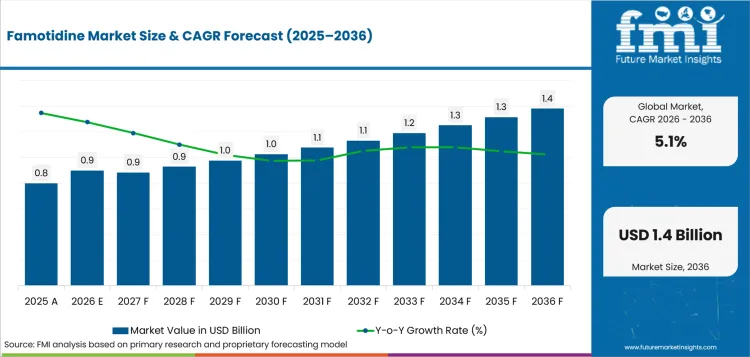
| Metric | Value |
|---|---|
| 2026 Market Size | USD 0.9 billion |
| 2036 Market Size | USD 1.4 billion |
| Forecast CAGR (2026-2036) | 5.1% |
| Leading Purity Grade | Above 98% purity |
| Above 98% Purity Share (2026) | 72.0% |
| Leading Form | Tablets |
| Tablets Share (2026) | 63.0% |
| Fastest-growing Country | India |
| India CAGR by 2036 | 5.9% |
| Market Signal | Commercial Impact |
|---|---|
| Demand and Growth Drivers | Stable gastrointestinal treatment demand and OTC availability continue to support the famotidine market.
|
| Product and Segment View | High-purity APIs, tablets, OTC formulations, and direct sales lead their respective market segments.
|
| Geography and Growth Outlook | India and China remain key API production centers, while the United States continues to expand through generic drug development.
|
| Competitive Landscape | Competition is increasingly based on regulatory reliability, API quality, and documentation support.
|
| Analyst Perspective | Famotidine remains a mature API market where supply continuity and regulatory readiness are more valuable than aggressive pricing.
- Anurag Sharma, Principal Analyst at Future Market Insights |
Famotidine demand is anticipated to be driven by acid-control use across retail and inpatient channels. For instance, CDC FastStats lists 35.4 million U.S. physician office visits with digestive diseases as the primary diagnosis, which gives H2 blockers a broad clinical and OTC demand base. Lupin’s May 2026 U.S. FDA approval for Famotidine Injection USP 20 mg/2 mL single-dose vials adds a hospital-channel supply move. The quality bar remains high after Fresenius Kabi recalled three lots of Famotidine Injection in November 2025 due to out-of-specification endotoxin results. Buyers are therefore expected to weigh price against approved dosage forms and supplier continuity before API or finished-dose awards scale.
Which factors support expansion in the famotidine market?
Market value is supported by repeat active ingredient use across regulated oral formulations.
- Revenue expansion is expected to come from repeat generic use in acid-suppression products.
- API buyers place more weight on impurity data when release limits affect batch acceptance.
- OTC products support larger repeat lots through private-label and branded generic programs.
- Direct manufacturer sales reduce friction when pharma firms need change-control files.
- The broader drug formulation market shows the same buyer need for stable dosage inputs.
Why is the famotidine market growing?
Tablet demand is expected to remain the main anchor for famotidine API buying. FDA guidance covers 10 mg and 20 mg tablet strengths. The 40 mg strength adds another filing route. That makes dissolution consistency central to filing quality. Audited suppliers should hold a stronger position with generic firms. The oral solid dosage pharmaceutical formulation market shows the same preference for repeatable manufacturing control.
Oral suspension gives suppliers a second demand pool with different handling needs. FDA guidance covers a 40 mg per 5 mL suspension. DailyMed labeling also lists the 40 mg per 5 mL prepared strength. Buyers should review reconstitution behavior before accepting a commercial lot.
How is the famotidine market segmented?
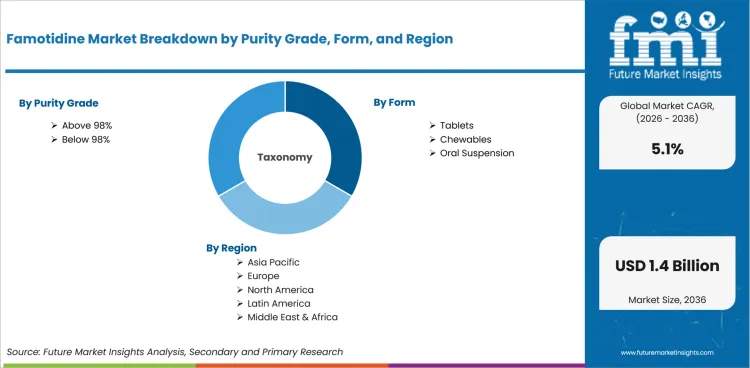
The famotidine industry is segmented by product quality and dosage form. Therapeutic focus and sales channel complete the view. Region adds the final segmentation layer.
- Above 98% purity is projected to secure 72.0% share in 2026 with USP assay limits guiding supplier approval.
- Tablets are expected to hold 63.0% share in 2026 due to established 20 mg and 40 mg programs.
- OTC formulations are forecast to represent 58.0% share in 2026 supported by retail heartburn repeat lots.
- Direct Sales is estimated to account for 46.0% share in 2026 due to faster access to supplier documents.
- East Asia is projected to hold 31.0% share in 2026 led by China and Japan supply activity.
Why does above 98% purity lead the famotidine market?
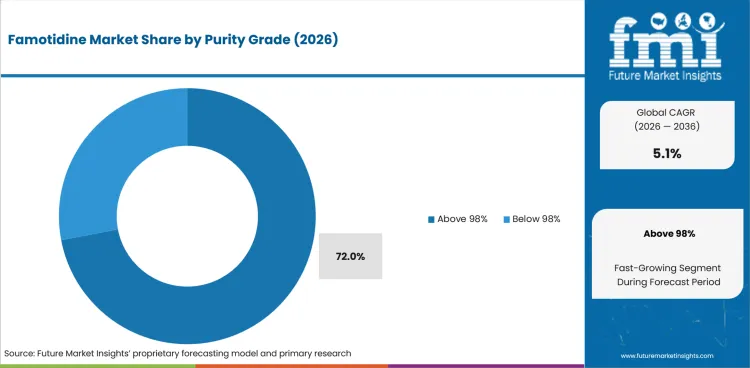
- Above 98% purity is projected to account for 72.0% share in 2026 with assay evidence supporting buyer approval.
- Below 98% purity is expected to stay limited where product files allow a lighter document burden.
Which form leads the famotidine market?
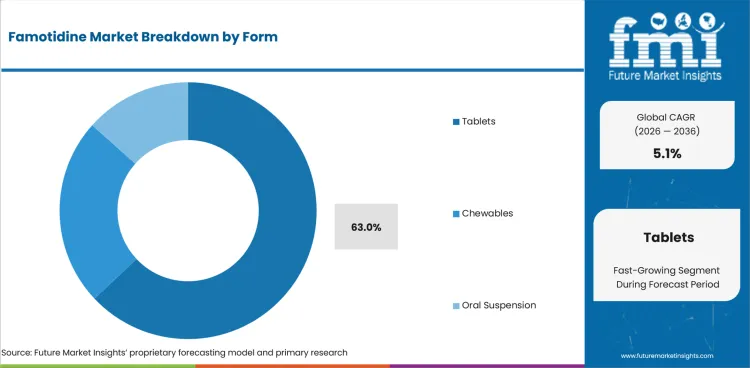
- Tablets are estimated to hold 63.0% share in 2026 due to repeat lots across prescription and OTC programs.
- Oral suspension gains use as pediatric dosing and swallowing limits require a liquid format.
Which therapeutic focus leads the famotidine market?
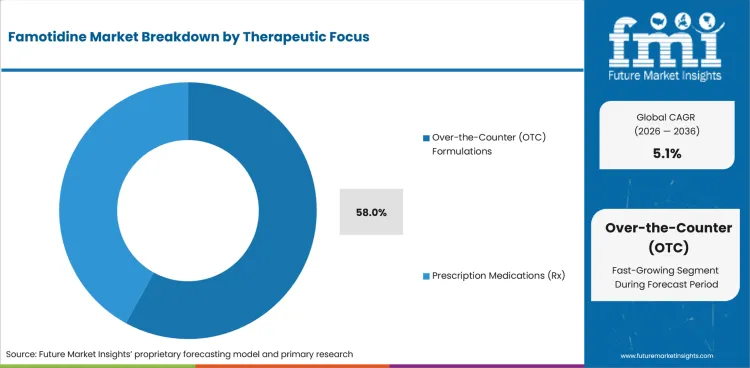
- OTC formulations are expected to hold 58.0% share in 2026 led by heartburn relief products in retail channels.
- Prescription products support stable demand core through ulcer and GERD treatment programs.
Which sales channel leads the famotidine market?
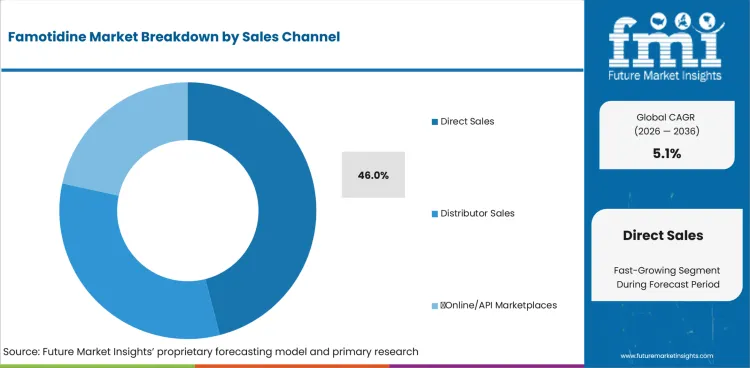
- Direct Sales is projected to account for 46.0% share in 2026 with audited buyers prioritizing supplier document access.
- Distributor sales keep value for smaller formulation firms that need shorter order cycles.
Which region leads the famotidine market?
- East Asia is anticipated to hold 31.0% share in 2026 supported by API production in China and Japan.
- South Asia and Pacific grow steadily due to India’s API supply and formulation export base.
What drives and restricts the famotidine market?
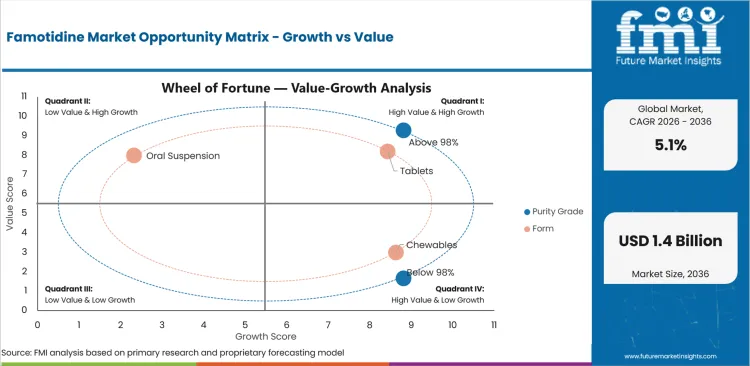
Bioequivalence discipline and OTC retail pull support demand. Off-patent pricing restricts supplier margins.
- Driver: FDA bioequivalence guidance keeps generic developers focused on suppliers with reliable dissolution evidence.
- Driver: OTC heartburn positioning supports repeat API demand through retail packs and private-label planning.
- Restraint: Price pressure limits margin expansion due to off-patent generic competition.
- Restraint: Supplier switches need document review before buyers approve new commercial lots.
- Opportunity: The specialty active pharmaceutical ingredients market favors suppliers that combine scale with verified regulatory files.
Bioequivalence Review and API Demand Outlook
Demand outlook is expected to depend on guidance-ready API supply. FDA’s March 2026 GDUFA Science and Research report identified 8 priority areas for FY 2025. That range makes generic research tracking a routine part of supplier qualification. Suppliers that answer data requests quickly should gain preference in regulated tenders. The pharmaceutical excipients market outlook shows why oral products rely on stable ingredient performance.
Retail Prescription Spending and Oral-Form Buying
Oral-form buying is shaped by pharmacy spending and dose-format familiarity. CMS reported prescription drug spending increased 7.9% to USD 467.0 billion in 2024. Tablet buyers need predictable dissolution behavior. Suspension buyers need API that behaves reliably after reconstitution.
Supplier Qualification and Filing-Risk Controls
Customers prefer suppliers that reduce filing risk and answer technical questions quickly. FDA’s FY 2025 activities report listed 1,281 complete responses across the generic drugs program. That figure shows how incomplete files can slow approvals. Batch traceability and impurity history are reviewed before larger lots are approved.
Which countries are growing fastest in the famotidine market?
India 5.9% CAGR, China 5.7% CAGR, South Korea 5.0% CAGR, United States 4.8% CAGR, Germany 4.4% CAGR, United Kingdom 4.2% CAGR, France 4.1% CAGR, and Japan 3.9% CAGR through 2036.
.webp "Top Country Growth Comparison Famotidine Market Cagr (2026 2036)")
| Country | CAGR |
|---|---|
| India | 5.9% |
| China | 5.7% |
| South Korea | 5.0% |
| United States | 4.8% |
| Germany | 4.4% |
| United Kingdom | 4.2% |
| France | 4.1% |
| Japan | 3.9% |
Source: Future Market Insights, 2026.
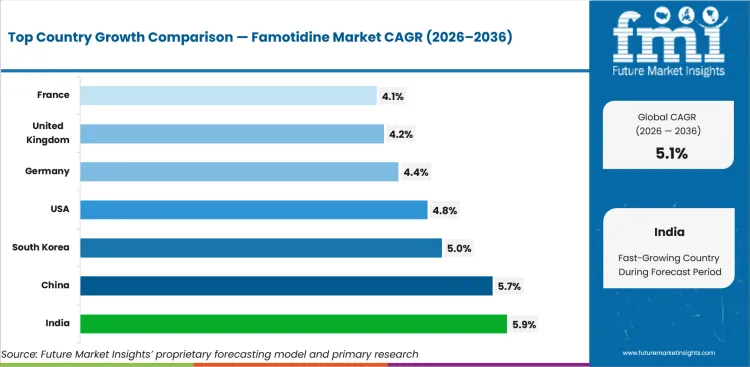
How do country-level CAGRs compare in the famotidine market?
India leads country growth. Japan records the most cautious expansion among profiled markets.
- India is projected to record a 5.9% CAGR by 2036 due to API scale and formulation exports.
- China is expected to expand at a 5.7% CAGR by 2036 supported by local bulk-drug capacity.
- South Korea is forecast to grow at a 5.0% CAGR by 2036 with regulated generics supporting demand.
- The United States is estimated to rise at a 4.8% CAGR by 2036 under FDA-guided generic development.
- Germany is projected to post a 4.4% CAGR by 2036 with authorisation discipline slowing supplier churn.
- The United Kingdom is anticipated to grow at a 4.2% CAGR by 2036 with pharmacy use supporting steady demand.
- France is forecast to expand at a 4.1% CAGR by 2036 supported by regulated pharmacy channels.
- Japan is projected to advance at a 3.9% CAGR by 2036 with price revisions moderating value growth.
How fast is the famotidine market growing in India?
A 5.9% CAGR by 2036 reflects regulated generic demand and country-specific pharmaceutical supply conditions.
Country Market Snapshot Table
| Parameter | Value |
|---|---|
| Market Size in 2025 (Value) | USD 109.2 million |
| Market Size in 2026 (Value) | USD 115.6 million |
| Market Forecast in 2036 (Value) | USD 205.0 million |
| CAGR (2026 to 2036) | 5.9% |
| Years Considered | 2021 to 2036 |
| Base Year | 2025 |
| Forecast Period | 2026 to 2036 |
| Units Considered | Value (USD million) |
| Leading Sub-Region | Telangana and Gujarat API corridors |
India Famotidine Market Outlook
India famotidine demand is expected to track API capacity and formulation export programs. Buyers should favor suppliers that can answer DMF and CEP questions without long delays.
Direct manufacturer sales should remain central for export buyers. Distributors are expected to serve domestic formulation firms with smaller lot needs.
Key Growth Drivers
- Domestic API capability gives famotidine buyers more local sourcing options. The bulk-drug PLI scheme covers 41 products and supports domestic API supply capability.
- Export formulation demand keeps API qualification important for Indian suppliers. The Department of Pharmaceuticals reported pharmaceutical exports of INR 2.46 trillion in 2024/25.
- Large generic manufacturers are expected to use direct API contracts when export files need supplier evidence.
- Audit-ready domestic suppliers should gain share when buyers compare impurity history and batch traceability.
Key Restraints
- Domestic price control limits room to recover documentation costs. NPPA fixed ceiling prices for 928 scheduled formulations in March 2025.
- Commodity API competition can pressure suppliers that lack stronger regulatory support.
- Export customers may request extra documents when changing suppliers for regulated markets.
What makes India unique
India is unique due to API capacity and export formulation scale within one sourcing base.
Key Companies
- Dr. Reddy’s Laboratories
- Aurobindo Pharma
- Lupin
- Granules India
- SMS Pharmaceuticals
- Hetero Labs
Sales & Marketing Channels
- Direct manufacturer sales
- Export formulation buyers
- Domestic distributors
- Online API marketplaces
- Hospital tenders
- Contract manufacturing channels
Country Segment Breakdown Table
| Segment | Sub-Segments |
|---|---|
| By Purity Grade | Above 98% · Below 98% |
| By Form | Tablets · Chewables · Oral Suspension |
| By Therapeutic Focus | Prescription Medications (Rx) · Over-the-Counter (OTC) Formulations |
| By Sales Channel | Direct Sales · Distributor Sales · Online/API Marketplaces · Others |
| Key Sub-Regions Covered, Pharma Corridors | Telangana · Gujarat · Maharashtra · Andhra Pradesh · Himachal Pradesh · Karnataka |
Frequently Asked Questions
How fast is India famotidine market growing?
Sales in India are projected to grow at 5.9% CAGR from 2026 to 2036.
Who leads India famotidine market?
Local generic and API firms compete with multinational suppliers through regulated product access.
What is driving adoption in India famotidine market?
Tablet demand and audit-ready API sourcing are expected to support market adoption.
What is the famotidine market outlook in China?
A 5.7% CAGR by 2036 reflects regulated generic demand and country-specific pharmaceutical supply conditions.
Country Market Snapshot Table
| Parameter | Value |
|---|---|
| Market Size in 2025 (Value) | USD 133.6 million |
| Market Size in 2026 (Value) | USD 141.2 million |
| Market Forecast in 2036 (Value) | USD 245.7 million |
| CAGR (2026 to 2036) | 5.7% |
| Years Considered | 2021 to 2036 |
| Base Year | 2025 |
| Forecast Period | 2026 to 2036 |
| Units Considered | Value (USD million) |
| Leading Sub-Region | Jiangsu and Zhejiang chemical-pharma corridors |
China Famotidine Market Outlook
China famotidine demand is expected to follow bulk-drug capability and local formulation capacity. Buyers should favor suppliers with verified change-control evidence.
Direct API exports should remain central for larger suppliers. Online API marketplaces are expected to support early buyer discovery before audit review.
Key Growth Drivers
- Technical manufacturing depth supports regulated API and formulation input supply. China reported CNY 18.0381 trillion in patent-intensive industry value added for 2024.
- Active review pathways keep documentation quality important for drug-file planning. NMPA completed 110 drug approval applications under priority review in 2024.
- Domestic API registration activity is expected to support supplier depth for famotidine sourcing.
- Large formulation capacity should sustain demand for tablet and suspension inputs.
Key Restraints
- Factory-cycle softness can affect supplier confidence and batch planning. China’s official manufacturing PMI fell to 49.3 in January 2026.
- Bulk-drug price competition can reduce margin headroom for suppliers with weak document support.
- Export buyers are expected to require stronger impurity evidence before accepting new lots.
What makes China unique
China is unique due to bulk-drug depth and export discovery channels operating together.
Key Companies
- Tianjin Pharmaceutical Holdings
- Zhejiang Huahai Pharmaceutical
- Zhejiang Jingxin Pharmaceutical
- Hubei Zhongmu Anda Pharmaceutical
- Zhejiang Apeloa Pharmaceutical
- Sinopharm Group
Sales & Marketing Channels
- Direct API exports
- Domestic formulation buyers
- Distributor sales
- Online API marketplaces
- Contract manufacturing channels
- Regional pharma clusters
Country Segment Breakdown Table
| Segment | Sub-Segments |
|---|---|
| By Purity Grade | Above 98% · Below 98% |
| By Form | Tablets · Chewables · Oral Suspension |
| By Therapeutic Focus | Prescription Medications (Rx) · Over-the-Counter (OTC) Formulations |
| By Sales Channel | Direct Sales · Distributor Sales · Online/API Marketplaces · Others |
| Key Sub-Regions Covered, Pharma Corridors | Zhejiang · Jiangsu · Shandong · Guangdong · Tianjin · Hubei |
Frequently Asked Questions
How fast is China famotidine market growing?
Sales in China are projected to grow at 5.7% CAGR from 2026 to 2036.
Who leads China famotidine market?
Local generic and API firms compete with multinational suppliers through regulated product access.
What is driving adoption in China famotidine market?
Tablet demand and audit-ready API sourcing are expected to support market adoption.
What is driving famotidine market growth in South Korea?
A 5.0% CAGR by 2036 reflects regulated generic demand and country-specific pharmaceutical supply conditions.
Country Market Snapshot Table
| Parameter | Value |
|---|---|
| Market Size in 2025 (Value) | USD 42.9 million |
| Market Size in 2026 (Value) | USD 45.0 million |
| Market Forecast in 2036 (Value) | USD 73.3 million |
| CAGR (2026 to 2036) | 5.0% |
| Years Considered | 2021 to 2036 |
| Base Year | 2025 |
| Forecast Period | 2026 to 2036 |
| Units Considered | Value (USD million) |
| Leading Sub-Region | Seoul Capital Area and Gyeonggi pharma networks |
South Korea Famotidine Market Outlook
South Korea famotidine demand is expected to follow regulated generic product planning and regional sourcing access. Buyers should favor suppliers with responsive quality teams.
Direct procurement should remain relevant for regulated product files. Domestic distributors are expected to support hospital and pharmacy replenishment.
Key Growth Drivers
- Biopharma export scale helps Korean suppliers serve regulated overseas buyers. Korea.net reported biopharma exports reached USD 7.4 billion in H1 2024.
- Domestic bio output gives local formulators a stronger supplier ecosystem. Invest Korea reported bio industry production of KRW 23 trillion in 2024.
- Korean generic manufacturers are expected to support steady demand for documented H2 antagonist API.
- Regional proximity to China and Japan should improve sourcing options for formulation firms.
Key Restraints
- Frequent DMF updates can add document work for finished-dose teams. MFDS reported 3,411 DMF amendments in 2024.
- Smaller production scale than India and China can limit bargaining power in bulk API purchases.
- Supplier substitution remains cautious when finished-dose teams need stability confirmation.
What makes South Korea unique
South Korea is unique due to MFDS oversight and regional sourcing proximity in regulated generic planning.
Key Companies
- Celltrion Pharm
- Daewoong Pharmaceutical
- Hanmi Pharmaceutical
- Yuhan Corporation
- Chong Kun Dang
- Dong-A ST
Sales & Marketing Channels
- Hospital wholesalers
- Domestic distributors
- Direct manufacturer sales
- Online procurement portals
- Export formulation buyers
- Pharmacy wholesalers
Country Segment Breakdown Table
| Segment | Sub-Segments |
|---|---|
| By Purity Grade | Above 98% · Below 98% |
| By Form | Tablets · Chewables · Oral Suspension |
| By Therapeutic Focus | Prescription Medications (Rx) · Over-the-Counter (OTC) Formulations |
| By Sales Channel | Direct Sales · Distributor Sales · Online/API Marketplaces · Others |
| Key Sub-Regions Covered, Pharma Corridors | Seoul · Gyeonggi · Incheon · Daejeon · Chungcheong · Busan |
Frequently Asked Questions
How fast is South Korea famotidine market growing?
Sales in South Korea are projected to grow at 5.0% CAGR from 2026 to 2036.
Who leads South Korea famotidine market?
Local generic and API firms compete with multinational suppliers through regulated product access.
What is driving adoption in South Korea famotidine market?
Tablet demand and audit-ready API sourcing are expected to support market adoption.
How is the famotidine market performing in the United States?
A 4.8% CAGR by 2036 reflects regulated generic demand and country-specific pharmaceutical supply conditions.
Country Market Snapshot Table
| Parameter | Value |
|---|---|
| Market Size in 2025 (Value) | USD 162.2 million |
| Market Size in 2026 (Value) | USD 170.0 million |
| Market Forecast in 2036 (Value) | USD 271.5 million |
| CAGR (2026 to 2036) | 4.8% |
| Years Considered | 2021 to 2036 |
| Base Year | 2025 |
| Forecast Period | 2026 to 2036 |
| Units Considered | Value (USD million) |
| Leading Sub-Region | Northeast and Midwest generic hubs |
United States Famotidine Market Outlook
United States famotidine demand is expected to track regulated tablet and suspension requirements across generic channels. Buyers should favor suppliers that support release testing and ANDA documentation.
Direct procurement should remain relevant where formulation firms need audit-ready API lots. Distributor sales are expected to serve smaller firms with verified stock.
Key Growth Drivers
- Generic tablet files keep dissolution behavior central to API selection. FDA tablet guidance calls for comparative dissolution testing on 12 dosage units.
- Suspension products create a smaller but technical demand pool. DailyMed lists famotidine powder for suspension at 40 mg per 5 mL.
- OTC heartburn shelves should support repeat tablet lots for private-label and branded generic buyers.
- DMF-backed supplier relationships should shorten document exchange during ANDA support.
Key Restraints
- Tight assay rules make weak documentation harder to accept during supplier review. USP assay limits begin at 98.5% on a dried basis.
- Off-patent competition keeps API buyers focused on audit evidence before supplier premiums.
- Supplier changes can slow purchasing when buyer files need fresh technical review.
What makes United States unique
The United States is unique due to FDA product guidance that shapes generic filing work.
Key Companies
- Teva USA
- Dr. Reddy’s Laboratories
- Aurobindo Pharma USA
- Lupin Pharmaceuticals
- Amneal Pharmaceuticals
- Granules USA
Sales & Marketing Channels
- National pharmacy chains
- Mass retailers
- Generic pharma procurement teams
- Hospital distributors
- Direct API contracting
- Online pharmaceutical sourcing
Country Segment Breakdown Table
| Segment | Sub-Segments |
|---|---|
| By Purity Grade | Above 98% · Below 98% |
| By Form | Tablets · Chewables · Oral Suspension |
| By Therapeutic Focus | Prescription Medications (Rx) · Over-the-Counter (OTC) Formulations |
| By Sales Channel | Direct Sales · Distributor Sales · Online/API Marketplaces · Others |
| Key Sub-Regions Covered, Pharma Corridors | California · New Jersey · Pennsylvania · North Carolina · Texas · Illinois |
Frequently Asked Questions
How fast is United States famotidine market growing?
Sales in United States are projected to grow at 4.8% CAGR from 2026 to 2036.
Who leads United States famotidine market?
Local generic and API firms compete with multinational suppliers through regulated product access.
What is driving adoption in United States famotidine market?
Tablet demand and audit-ready API sourcing are expected to support market adoption.
What is the famotidine market forecast for Germany?
A 4.4% CAGR by 2036 reflects regulated generic demand and country-specific pharmaceutical supply conditions.
Country Market Snapshot Table
| Parameter | Value |
|---|---|
| Market Size in 2025 (Value) | USD 41.9 million |
| Market Size in 2026 (Value) | USD 43.7 million |
| Market Forecast in 2036 (Value) | USD 67.2 million |
| CAGR (2026 to 2036) | 4.4% |
| Years Considered | 2021 to 2036 |
| Base Year | 2025 |
| Forecast Period | 2026 to 2036 |
| Units Considered | Value (USD million) |
| Leading Sub-Region | North Rhine-Westphalia and Bavaria pharmacy networks |
Germany Famotidine Market Outlook
Germany famotidine demand is expected to follow pharmacy and wholesaler needs for authorised generic products. Buyers should favor suppliers with complete quality files.
Direct procurement should remain relevant for audited formulation programs. Distributor sales are expected to support smaller generic buyers.
Key Growth Drivers
- Authorisation complexity keeps quality files central to generic product planning. Germany uses 2 national authorities for human medicinal product authorisation.
- Regulatory scale gives buyers a clear authority path for medicine review. BfArM is the largest drug approval authority in Europe.
- Regional pharmacy access makes wholesaler coverage important for generic medicine supply. Germany has 16 states.
- EU pharmacopoeial practice should favor suppliers with consistent impurity and assay evidence.
Key Restraints
- Manufacturing weakness can pressure supplier planning and working capital. Destatis reported industrial production fell 1.9% in June 2025.
- Reference pricing and tender pressure are expected to limit premium pricing for off-patent API suppliers.
- Supplier changes can require added verification before finished-dose firms approve commercial lots.
What makes Germany unique
Germany is unique due to formal medicine authorisation and pharmacy reimbursement discipline.
Key Companies
- STADA Arzneimittel
- Ratiopharm
- Hexal
- 1A Pharma
- Zentiva Germany
- Aristo Pharma
Sales & Marketing Channels
- Pharmacy wholesalers
- Hospital procurement
- Direct API contracts
- Tender-based distributors
- Online medicine channels
- Regional pharmacy groups
Country Segment Breakdown Table
| Segment | Sub-Segments |
|---|---|
| By Purity Grade | Above 98% · Below 98% |
| By Form | Tablets · Chewables · Oral Suspension |
| By Therapeutic Focus | Prescription Medications (Rx) · Over-the-Counter (OTC) Formulations |
| By Sales Channel | Direct Sales · Distributor Sales · Online/API Marketplaces · Others |
| Key Sub-Regions Covered, Pharma Corridors | North Rhine-Westphalia · Bavaria · Baden-Wuerttemberg · Hesse · Saxony · Berlin |
Frequently Asked Questions
How fast is Germany famotidine market growing?
Sales in Germany are projected to grow at 4.4% CAGR from 2026 to 2036.
Who leads Germany famotidine market?
Local generic and API firms compete with multinational suppliers through regulated product access.
What is driving adoption in Germany famotidine market?
Tablet demand and audit-ready API sourcing are expected to support market adoption.
How is the famotidine market performing in the United Kingdom?
A 4.2% CAGR by 2036 reflects regulated generic demand and country-specific pharmaceutical supply conditions.
Country Market Snapshot Table
| Parameter | Value |
|---|---|
| Market Size in 2025 (Value) | USD 36.5 million |
| Market Size in 2026 (Value) | USD 38.0 million |
| Market Forecast in 2036 (Value) | USD 57.4 million |
| CAGR (2026 to 2036) | 4.2% |
| Years Considered | 2021 to 2036 |
| Base Year | 2025 |
| Forecast Period | 2026 to 2036 |
| Units Considered | Value (USD million) |
| Leading Sub-Region | England pharmacy and hospital procurement corridors |
United Kingdom Famotidine Market Outlook
United Kingdom famotidine demand is expected to follow pharmacy and NHS-based generic purchasing. Buyers should favor suppliers that support label evidence and storage records.
Direct API contracts should stay useful for larger generic firms. Wholesalers are expected to serve pharmacy-based demand with shorter order cycles.
Key Growth Drivers
- Community pharmacy volume keeps generic medicine demand visible for API buyers. NHSBSA reported 1.16 billion prescription items dispensed by community pharmacies in 2024/25.
- Current label evidence supports buyer confidence in routine tablet supply. The eMC lists Famotidine 20 mg Tablets with current product information.
- Generic formulators should retain tablet demand through stable retail and prescription channel needs.
- Direct sourcing should gain preference where buyers need manufacturer documents for supplier approval.
Key Restraints
- Limited registered options can slow substitution planning for buyers. MHRA product search shows 4 results for Famotidine 20 mg Tablets.
- Smaller buyers may rely on distributors when direct audit cycles take too long for routine orders.
- Price discipline in pharmacy supply can reduce API margin room for routine generic products.
What makes United Kingdom unique
The United Kingdom is unique due to eMC label transparency and NHS pharmacy data.
Key Companies
- Rosemont Pharmaceuticals
- Teva UK
- Morningside Pharmaceuticals
- Accord Healthcare UK
- Crescent Pharma
- Tillomed Laboratories
Sales & Marketing Channels
- Community pharmacies
- Hospital procurement
- NHS wholesalers
- Generic manufacturer direct sales
- Online pharmacies
- Distributor sales
Country Segment Breakdown Table
| Segment | Sub-Segments |
|---|---|
| By Purity Grade | Above 98% · Below 98% |
| By Form | Tablets · Chewables · Oral Suspension |
| By Therapeutic Focus | Prescription Medications (Rx) · Over-the-Counter (OTC) Formulations |
| By Sales Channel | Direct Sales · Distributor Sales · Online/API Marketplaces · Others |
| Key Sub-Regions Covered, Pharma Corridors | England · Scotland · Wales · Northern Ireland · London · Greater Manchester |
Frequently Asked Questions
How fast is United Kingdom famotidine market growing?
Sales in United Kingdom are projected to grow at 4.2% CAGR from 2026 to 2036.
Who leads United Kingdom famotidine market?
Local generic and API firms compete with multinational suppliers through regulated product access.
What is driving adoption in United Kingdom famotidine market?
Tablet demand and audit-ready API sourcing are expected to support market adoption.
What is the famotidine market outlook in France?
A 4.1% CAGR by 2036 reflects regulated generic demand and country-specific pharmaceutical supply conditions.
Country Market Snapshot Table
| Parameter | Value |
|---|---|
| Market Size in 2025 (Value) | USD 33.5 million |
| Market Size in 2026 (Value) | USD 34.9 million |
| Market Forecast in 2036 (Value) | USD 52.1 million |
| CAGR (2026 to 2036) | 4.1% |
| Years Considered | 2021 to 2036 |
| Base Year | 2025 |
| Forecast Period | 2026 to 2036 |
| Units Considered | Value (USD million) |
| Leading Sub-Region | Ile-de-France and Auvergne-Rhone-Alpes pharmacy corridors |
France Famotidine Market Outlook
France famotidine demand is expected to track public medicine listings and regulated pharmacy channels. Buyers should favor suppliers that support French documentation.
Direct sourcing should matter where firms need batch records for regulated filings. Distributor channels are expected to support pharmacy-based replenishment.
Key Growth Drivers
- Public product listings keep approved famotidine products visible in regulated channels. The French public medicines database lists FAMOTIDINE EG 40 mg.
- Medicine spending gives pharmacy buyers a broad reimbursed drug base. DREES reported medicine consumption of €34.5 billion in 2024.
- Pharmacy-centered distribution should sustain steady demand for approved generic acid-suppression products.
- Buyer preference should favor suppliers that can support French-language files and batch records.
Key Restraints
- Stock disruption pressure makes supplier continuity a higher buyer concern. ANSM reported a 33% increase in urgent measures for stock disruptions.
- Price control in reimbursed channels is expected to restrict margin gains for commodity API suppliers.
- Supplier replacement can stay slow when finished-dose firms must update quality documents.
What makes France unique
France is unique due to public medicine listings and ANSM availability work.
Key Companies
- EG Labo
- Biogaran
- Viatris France
- Zentiva France
- Sandoz France
- Arrow Generiques
Sales & Marketing Channels
- Community pharmacies
- Hospital pharmacies
- Wholesaler distributors
- Direct API contracts
- Public procurement
- Online pharmacy channels
Country Segment Breakdown Table
| Segment | Sub-Segments |
|---|---|
| By Purity Grade | Above 98% · Below 98% |
| By Form | Tablets · Chewables · Oral Suspension |
| By Therapeutic Focus | Prescription Medications (Rx) · Over-the-Counter (OTC) Formulations |
| By Sales Channel | Direct Sales · Distributor Sales · Online/API Marketplaces · Others |
| Key Sub-Regions Covered, Pharma Corridors | Ile-de-France · Auvergne-Rhone-Alpes · Occitanie · Nouvelle-Aquitaine · Hauts-de-France · Provence-Alpes-Cote d Azur |
Frequently Asked Questions
How fast is France famotidine market growing?
Sales in France are projected to grow at 4.1% CAGR from 2026 to 2036.
Who leads France famotidine market?
Local generic and API firms compete with multinational suppliers through regulated product access.
What is driving adoption in France famotidine market?
Tablet demand and audit-ready API sourcing are expected to support market adoption.
What is the famotidine market forecast for Japan?
A 3.9% CAGR by 2036 reflects regulated generic demand and country-specific pharmaceutical supply conditions.
Country Market Snapshot Table
| Parameter | Value |
|---|---|
| Market Size in 2025 (Value) | USD 45.8 million |
| Market Size in 2026 (Value) | USD 47.6 million |
| Market Forecast in 2036 (Value) | USD 69.8 million |
| CAGR (2026 to 2036) | 3.9% |
| Years Considered | 2021 to 2036 |
| Base Year | 2025 |
| Forecast Period | 2026 to 2036 |
| Units Considered | Value (USD million) |
| Leading Sub-Region | Kanto and Kansai hospital pharmacy networks |
Japan Famotidine Market Outlook
Japan famotidine demand is expected to follow older-patient therapy needs and cautious generic purchasing. Buyers should favor suppliers with local quality alignment.
Direct sourcing should remain selective when document alignment matters. Distributor sales are expected to support established hospital and pharmacy routes.
Key Growth Drivers
- Age-linked therapy needs support steady acid-suppression use in pharmacy channels. Japan’s Statistics Bureau reported that people aged 65 and over represented 29.3% of the population in 2024.
- A large older-patient market keeps generic gastrointestinal medicines relevant to buyers. The Cabinet Office reported Japan’s total population at 123.80 million on October 1, 2024.
- Hospital and community pharmacy demand should sustain tablet use across older patient groups.
- Local quality expectations should favor API suppliers with clear pharmacopoeial support.
Key Restraints
- Price revision pressure limits value growth for off-patent products. FY2025 price revision rules applied cuts to 43% of patented medicines.
- Slow supplier qualification can limit rapid substitution when buyers need local document alignment.
- Competition from other acid-suppression options keeps the growth profile cautious.
What makes Japan unique
Japan is unique due to older demographics supporting use. Price revisions keep value growth measured.
Key Companies
- Nichi-Iko Pharmaceutical
- Towa Pharmaceutical
- Sawai Group
- Meiji Seika Pharma
- Nipro Pharma
- Kobayashi Kako
Sales & Marketing Channels
- Hospital pharmacies
- Community pharmacies
- Pharmaceutical wholesalers
- Direct formulation buyers
- Regional distributors
- Long-term care pharmacy channels
Country Segment Breakdown Table
| Segment | Sub-Segments |
|---|---|
| By Purity Grade | Above 98% · Below 98% |
| By Form | Tablets · Chewables · Oral Suspension |
| By Therapeutic Focus | Prescription Medications (Rx) · Over-the-Counter (OTC) Formulations |
| By Sales Channel | Direct Sales · Distributor Sales · Online/API Marketplaces · Others |
| Key Sub-Regions Covered, Pharma Corridors | Kanto · Kansai · Chubu · Kyushu · Tohoku · Hokkaido |
Frequently Asked Questions
How fast is Japan famotidine market growing?
Sales in Japan are projected to grow at 3.9% CAGR from 2026 to 2036.
Who leads Japan famotidine market?
Local generic and API firms compete with multinational suppliers through regulated product access.
What is driving adoption in Japan famotidine market?
Tablet demand and audit-ready API sourcing are expected to support market adoption.
Who are the leading companies in the famotidine market?
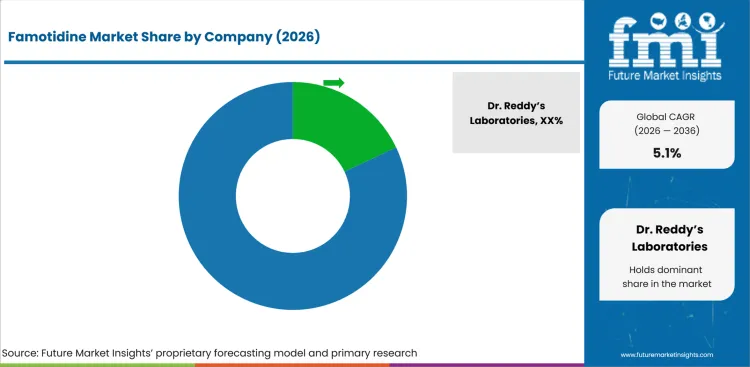
API documentation and finished-dose evidence define supplier position in famotidine.
- API competition is led by Dr. Reddy’s and Aurobindo through DMF support and regulated oral-dose supply.
- Generic formulation competition is shaped by Teva and Lupin through visible tablet and suspension product evidence.
- Capacity support is expected to come from CDMO suppliers that can add backup API production for qualified buyers.
- Buyer preference is expected to be driven by impurity history and change-control response speed.
Established generic firms hold an advantage when regulatory files and repeat oral-dose manufacturing are already in place. API specialists gain buyer attention when impurity history is easy to review. FDA’s FY 2025 GDUFA report recorded 689 ANDA approvals. That review volume keeps suppliers focused on document speed and filing support. The fine chemicals market analysis gives upstream context for API cost and batch consistency.
Indian suppliers are better placed for export buyers that need DMF and CEP support. Chinese suppliers can compete on bulk capacity if technical files pass buyer review. Formulation buyers are expected to approve lower-cost suppliers after quality teams confirm assay records.
Contract manufacturers add capacity support when formulation firms need backup supply. Cambrex remains relevant through its March 2026 API expansion update. The expansion work gives buyers another route for supplier continuity. The plant based API market offers a wider view of active ingredient sourcing shifts.
How do top famotidine companies compare?
Dr. Reddy’s and Aurobindo focus on API regulatory depth and export support, while Teva and Lupin stand out for finished-dose product presence. Cambrex is differentiated by contract manufacturing and API capacity expansion.
| Company | API Documentation & Regulatory Support | Finished-Dose Portfolio Presence | Manufacturing / Supply Capability | Geographic Footprint |
|---|---|---|---|---|
| Dr. Reddy’s Laboratories | Very Strong | Strong | Strong | Global, with strong India and U.S. presence |
| Aurobindo Pharma | Very Strong | Very Strong | Very Strong | Global |
| Teva Pharmaceutical Industries | Strong | Very Strong | Strong | Global |
| Lupin | Strong | Strong | Strong | India, U.S., and global exports |
| Granules India | Strong | Moderate | Strong | India and export markets |
| Hetero Labs | Strong | Moderate | Strong | India and international markets |
| Tianjin Pharmaceutical Holdings | Moderate | Moderate | Very Strong | China and export markets |
| Zhejiang Huahai Pharmaceutical | Strong | Strong | Very Strong | China and global exports |
| SMS Pharmaceuticals | Strong | Limited | Moderate | India-focused with exports |
| Cambrex | Very Strong (CDMO/API) | Limited | Very Strong | North America and Europe |
Source: Future Market Insights competitive analysis, 2026.
Which companies compete in the famotidine market?
Dr. Reddy’s Laboratories and Aurobindo Pharma are listed with Teva. Lupin and Granules remain other visible suppliers.
Companies covered in the famotidine market include:
- Dr. Reddy’s Laboratories
- Aurobindo Pharma
- Teva Pharmaceutical Industries
- Lupin
- Granules India
- Hetero Labs
- SMS Pharmaceuticals
- Tianjin Pharmaceutical Holdings
- Zhejiang Huahai Pharmaceutical
- Cambrex
Key Developments in Famotidine Market
- In October 2024, FDA revised product-specific guidance for famotidine oral tablets and oral suspension.
- In July 2025, Aurobindo Pharma received FDA approval for Famotidine for Oral Suspension USP at 40 mg per 5 mL.
- In March 2026, Cambrex completed initial engineering studies for a large-scale API plant in Charles City.
Companies in the Famotidine Market
Indian API and Generic Suppliers
- Dr. Reddy’s Laboratories
- Aurobindo Pharma
- Lupin
- Granules India
- SMS Pharmaceuticals
Global Generic Formulation Companies
- Teva Pharmaceutical Industries
- Amneal Pharmaceuticals
- Viatris
- Zentiva
- Sandoz
API and CDMO Suppliers
- Cambrex
- Tianjin Pharmaceutical Holdings
- Zhejiang Huahai Pharmaceutical
- Hetero Labs
- Zhejiang Apeloa Pharmaceutical
Famotidine Market - Report Scope
| Parameter | Details |
|---|---|
| Forecast period | 2026 to 2036 |
| Historical period | 2021 to 2025 |
| Quantitative unit | Revenue in USD billion |
| By purity grade | Above 98%, below 98% |
| By form | Tablets, chewables, oral suspension |
| By therapeutic focus | Prescription medications (Rx), over-the-counter (OTC) formulations |
| By sales channel | Direct sales, distributor sales, online/API marketplaces, others |
| Regions covered | North America, Latin America, Europe, East Asia, South Asia and Pacific, Middle East and Africa |
| Countries covered | India, China, South Korea, United States, Germany, United Kingdom, France, Japan |
| Key companies profiled | Dr. Reddy’s Laboratories, Aurobindo Pharma, Teva Pharmaceutical Industries, Lupin, Granules India, Hetero Labs, SMS Pharmaceuticals, Tianjin Pharmaceutical Holdings, Zhejiang Huahai Pharmaceutical, Cambrex |
| Approach | Bottom-up API revenue approach using formulation demand, procurement pricing, country manufacturing activity, sales-channel structure, and supplier documentation evidence |
Source: Future Market Insights, 2026.
Famotidine Market - Scope & Definition
| Parameter | Coverage |
|---|---|
| Market Definition | Bulk famotidine API used for tablets and chewables. Oral suspension products are also included. |
| Included Revenue | API revenue from Rx and OTC famotidine formulation manufacturing. |
| Excluded Revenue | Finished retail packs and pharmacy services. Unrelated acid-suppression APIs and packaging components are excluded. |
| Unit of Analysis | Value in USD billion. |
| Base Year | 2025. |
| Regional Coverage | North America and Latin America. East Asia and South Asia Pacific. Europe and Middle East Africa. |
Famotidine Market - Research Methodology
| Methodology Step | How It Was Applied |
|---|---|
| Primary Research | Inputs from API suppliers and generic formulation firms were reviewed. Sourcing teams and regulatory affairs teams added buyer context. |
| Desk Research | Regulatory guidance and public labels were checked. Pharmacopoeial requirements and company disclosures were also reviewed. |
| Market Sizing | Forecasts combined formulation demand and procurement pricing. Country manufacturing activity and sales-channel structure were also reviewed. |
| Data Validation | Figures were reconciled against finished-dose availability and H2 antagonist use patterns. Supplier evidence added a final check. |
Famotidine Market Breakdown by Core Segments
Famotidine Market Segmented by Purity Grade:
- Above 98%
- Below 98%
Famotidine Market Segmented by Form:
- Tablets
- Chewables
- Oral Suspension
Famotidine Market Segmented by Therapeutic Focus:
- Prescription Medications (Rx)
- Over-the-Counter (OTC) Formulations
Famotidine Market Segmented by Sales Channel:
- Direct Sales (Manufacturer to Pharma)
- Distributor Sales
- Online/API Marketplaces
- Others
Famotidine Market by Region:
- North America
- Latin America
- Europe
- East Asia
- South Asia and Pacific
- Middle East and Africa
Research Sources and Bibliography
- Korea.net. (2024). Lotte Biologics' biopharma plant breaks ground in Songdo.
- National Medical Products Administration. (2025, March 21). Measures facilitate approval of 48 first-in-class innovative drugs.
- Federal Statistical Office. (2025, August 7). Production in June 2025: -1.9% on the previous month.
- Aurobindo USA. (2025, July 9). Aurobindo receives FDA approval for Famotidine for Oral Suspension USP, 40 mg/5 mL.
- Agence nationale de sécurité du médicament et des produits de santé. (2024, September 11). Annual report 2023.
- Base de données publique des médicaments. (2026). FAMOTIDINE EG 40 mg.
- Cabinet Office, Government of Japan. (2025, June 5). Annual report on the ageing society 2025.
- Cambrex. (2026, March 23). Cambrex advances US and European expansions.
- DailyMed. (2025, July). Famotidine powder, for suspension. U.S. National Library of Medicine.
- Department of Pharmaceuticals, Government of India. (2026). Annual report 2025-26.
- DREES. (2025, October 27). Health expenditure in 2024: Results of the health accounts.
- Federal Institute for Drugs and Medical Devices. (2026). Medicinal products.
- Invest Korea. (2026, June 16). Industry deep dive: Bio industry.
- Japan Pharmaceutical Manufacturers Association. (2024, December 25). NHI drug price revisions for fiscal 2025.
- Medicines.org.uk. (2024, October 14). Famotidine 20mg tablets: Summary of product characteristics.
- MHRA. (2026). FAMOTIDINE 20MG tablets product results.
- Ministry of Food and Drug Safety. (2025, July 1). 2024 Drug Approval Report.
- National Bureau of Statistics of China and China National Intellectual Property Administration. (2025, December 31). Announcement on the value-added data of national patent-intensive industries in 2024.
- NHS Business Services Authority. (2025, October 16). General Pharmaceutical Services in England 2015/16 to 2024/25.
- Paul-Ehrlich-Institut. (2024, August 28). Marketing authorisation for human medicinal products.
- Press Information Bureau, Government of India. (2025, March 28). NPPA fixes ceiling prices for 928 scheduled formulations.
- Press Information Bureau, Government of India. (2026, March 10). Self reliance in APIs.
- Statistics Bureau of Japan. (2025). Current population estimates as of October 1, 2024.
- United States Food and Drug Administration. (2024, October). Famotidine oral tablet product-specific guidance.
- United States Food and Drug Administration. (2024, October). Famotidine oral suspension product-specific guidance.
- United States Pharmacopeia. (2026). Famotidine. USP-NF.
- Centers for Medicare & Medicaid Services. (2026, January 14). NHE Fact Sheet.
- United States Food and Drug Administration. (2025, November 24). Generic Drugs Program Activities Report - FY 2025 Monthly Performance.
- United States Food and Drug Administration. (2026, March 25). FY 2025 GDUFA Science and Research Report.
This bibliography is provided for reader reference and is not exhaustive. The full report contains detailed citations and supporting analysis.
This Report Answers
- Market size estimates for 2026 and forecasts through 2036 for the famotidine market.
- Insights across more than 30 regional and country-level markets.
- Analysis of demand drivers and buyer sourcing patterns. Product use trends and purchasing behavior are also covered.
- Evaluation of purity grades and dosage forms including tablets and oral suspension.
- Assessment of regulatory frameworks and product guidance. Pharmacopoeial standards are also reviewed.
- Identification of growth opportunities across purity grade and form. Therapeutic focus and sales channels are also assessed.
- Evaluation of supply chain structure and API documentation needs. Distributor structures are also reviewed.
- Country-level growth analysis covers India and China with South Korea and the United States. Germany and the United Kingdom are also assessed. France and Japan complete the country view.
- Assessment of supplier competition across API suppliers and generic formulation companies.
- Delivery of market data and forecasts in PDF and Excel formats. Supporting analysis is included for buyer review.
Frequently Asked Questions
What is the growth prospect for famotidine?
Demand for famotidine is expected to rise at a measured pace with generic tablet and suspension programs buying audited API.
Which companies are expected to shape the famotidine market?
Dr. Reddy’s Laboratories and Aurobindo Pharma are expected to shape API competition. Teva, Lupin and Cambrex add finished-dose and CDMO relevance.
Why are API suppliers investing in documentation support?
API suppliers are investing in documentation support due to bioequivalence files and USP assay limits affecting buyer approval.
Why are direct sales important in the famotidine market?
Direct sales support faster file exchange between API manufacturers and formulation buyers during supplier qualification.
Which forms are gaining attention in famotidine?
Tablets lead demand. Oral suspension gains attention for users who need liquid dosing.
How do regulations influence famotidine API buying?
Regulations influence buying through FDA product guidance and pharmacopoeial limits. National medicine authorisation rules add another review layer.
Why is purity important for famotidine API?
Purity is important for regulated buyers that need assay evidence before approving API lots.
What role do distributors play in famotidine supply?
Distributors support smaller buyers that need verified stock without a full direct manufacturer contract.
How do country conditions affect famotidine demand?
Country demand differs by API capacity and pharmacy structure. Medicine pricing rules and regulator expectations add further variation.
Preview the report firsthand - request a free sample
Get SampleGet the brochure for pricing and purchase details.
Get PDFTable of Content
- Key Takeaways
- Market Size and CAGR
- Top Growth Driver
- Fastest Growing Segment
- Leading Region
- Key Companies
- Emerging Opportunities
- Executive Summary
- Global Market Outlook
- Demand-side Trends
- Supply-side Trends
- Technology Roadmap Analysis
- Analysis and Recommendations
- Analyst Perspective (What is happening? Why now? What should investors know?)
- Key Questions Answered
- How large is the market?
- What is the CAGR?
- What are key trends?
- Which region dominates?
- Who are the leaders?
- Market Overview
- Market Coverage / Taxonomy
- Market Definition / Scope / Limitations
- Research Methodology
- Chapter Orientation
- Analytical Lens and Working Hypotheses
- Market Structure, Signals, and Trend Drivers
- Benchmarking and Cross-market Comparability
- Market Sizing, Forecasting, and Opportunity Mapping
- Research Design and Evidence Framework
- Desk Research Programme (Secondary Evidence)
- Expert Input and Fieldwork (Primary Evidence)
- Tooling, Models, and Reference Databases
- Data Engineering and Model Build
- Quality Assurance and Audit Trail
- Market Background
- Market Dynamics (Drivers, Restraints, Opportunity, Trends)
- Scenario Forecast (Optimistic, Likely, Conservative)
- Impact Analysis
- AI Impact
- Sustainability Impact
- Regulatory Impact
- Technology Impact
- Consumer / Buyer Analysis
- Purchase Drivers
- Adoption Barriers
- Buyer Journey
- Opportunity Map Analysis
- Product Life Cycle Analysis
- Supply Chain Analysis
- Investment Feasibility Matrix
- Value Chain Analysis
- PESTLE and Porter's Analysis
- Regulatory Landscape
- Regional Parent Market Outlook
- Production and Consumption Statistics
- Import and Export Statistics
- Global Market Analysis and Forecast, 2021 to 2036
- Historical Market Size Value (USD Million) Analysis, 2021 to 2025
- Current and Future Market Size Value (USD Million) Projections, 2026 to 2036
- Y-o-Y Growth Trend Analysis
- Absolute $ Opportunity Analysis
- Global Market Pricing Analysis, 2021 to 2036
- Global Market Analysis and Forecast, By Purity Grade, 2021 to 2036
- Introduction / Key Findings
- Historical Market Size Value (USD Million) Analysis By Purity Grade, 2021 to 2025
- Current and Future Market Size Value (USD Million) Analysis and Forecast By Purity Grade, 2026 to 2036
- Above 98%
- Below 98%
- Above 98%
- Y-o-Y Growth Trend Analysis By Purity Grade, 2021 to 2025
- Absolute $ Opportunity Analysis By Purity Grade, 2026 to 2036
- Global Market Analysis and Forecast, By Form, 2021 to 2036
- Introduction / Key Findings
- Historical Market Size Value (USD Million) Analysis By Form, 2021 to 2025
- Current and Future Market Size Value (USD Million) Analysis and Forecast By Form, 2026 to 2036
- Tablets
- Chewables
- Oral Suspension
- Tablets
- Y-o-Y Growth Trend Analysis By Form, 2021 to 2025
- Absolute $ Opportunity Analysis By Form, 2026 to 2036
- Global Market Analysis and Forecast, By Therapeutic Focus, 2021 to 2036
- Introduction / Key Findings
- Historical Market Size Value (USD Million) Analysis By Therapeutic Focus, 2021 to 2025
- Current and Future Market Size Value (USD Million) Analysis and Forecast By Therapeutic Focus, 2026 to 2036
- Over-the-Counter (OTC) Formulations
- Prescription Medications (Rx)
- Over-the-Counter (OTC) Formulations
- Y-o-Y Growth Trend Analysis By Therapeutic Focus, 2021 to 2025
- Absolute $ Opportunity Analysis By Therapeutic Focus, 2026 to 2036
- Global Market Analysis and Forecast, By Sales Channel, 2021 to 2036
- Introduction / Key Findings
- Historical Market Size Value (USD Million) Analysis By Sales Channel, 2021 to 2025
- Current and Future Market Size Value (USD Million) Analysis and Forecast By Sales Channel, 2026 to 2036
- Direct Sales
- Distributor Sales
- Online/API Marketplaces
- Direct Sales
- Y-o-Y Growth Trend Analysis By Sales Channel, 2021 to 2025
- Absolute $ Opportunity Analysis By Sales Channel, 2026 to 2036
- Global Market Analysis and Forecast, By Region, 2021 to 2036
- Introduction
- Historical Market Size Value (USD Million) Analysis By Region, 2021 to 2025
- Current Market Size Value (USD Million) Analysis and Forecast By Region, 2026 to 2036
- North America
- Latin America
- Western Europe
- Eastern Europe
- East Asia
- South Asia and Pacific
- Middle East & Africa
- Market Attractiveness Analysis By Region
- North America Market Analysis and Forecast, By Country, 2021 to 2036
- Historical Market Size Value (USD Million) Trend Analysis By Market Taxonomy, 2021 to 2025
- Market Size Value (USD Million) Forecast By Market Taxonomy, 2026 to 2036
- By Country
- USA
- Canada
- Mexico
- By Purity Grade
- By Form
- By Therapeutic Focus
- By Sales Channel
- By Country
- Market Attractiveness Analysis
- By Country
- By Purity Grade
- By Form
- By Therapeutic Focus
- By Sales Channel
- Key Takeaways
- Latin America Market Analysis and Forecast, By Country
- Historical Market Size Value (USD Million) Trend Analysis By Market Taxonomy, 2021 to 2025
- Market Size Value (USD Million) Forecast By Market Taxonomy, 2026 to 2036
- By Country
- Brazil
- Chile
- Rest of Latin America
- By Purity Grade
- By Form
- By Therapeutic Focus
- By Sales Channel
- By Country
- Market Attractiveness Analysis
- By Country
- By Purity Grade
- By Form
- By Therapeutic Focus
- By Sales Channel
- Key Takeaways
- Western Europe Market Analysis and Forecast, By Country
- Historical Market Size Value (USD Million) Trend Analysis By Market Taxonomy, 2021 to 2025
- Market Size Value (USD Million) Forecast By Market Taxonomy, 2026 to 2036
- By Country
- Germany
- UK
- Italy
- Spain
- France
- Nordic
- BENELUX
- Rest of Western Europe
- By Purity Grade
- By Form
- By Therapeutic Focus
- By Sales Channel
- By Country
- Market Attractiveness Analysis
- By Country
- By Purity Grade
- By Form
- By Therapeutic Focus
- By Sales Channel
- Key Takeaways
- Eastern Europe Market Analysis and Forecast, By Country
- Historical Market Size Value (USD Million) Trend Analysis By Market Taxonomy, 2021 to 2025
- Market Size Value (USD Million) Forecast By Market Taxonomy, 2026 to 2036
- By Country
- Russia
- Poland
- Hungary
- Balkan & Baltic
- Rest of Eastern Europe
- By Purity Grade
- By Form
- By Therapeutic Focus
- By Sales Channel
- By Country
- Market Attractiveness Analysis
- By Country
- By Purity Grade
- By Form
- By Therapeutic Focus
- By Sales Channel
- Key Takeaways
- East Asia Market Analysis and Forecast, By Country
- Historical Market Size Value (USD Million) Trend Analysis By Market Taxonomy, 2021 to 2025
- Market Size Value (USD Million) Forecast By Market Taxonomy, 2026 to 2036
- By Country
- China
- Japan
- South Korea
- By Purity Grade
- By Form
- By Therapeutic Focus
- By Sales Channel
- By Country
- Market Attractiveness Analysis
- By Country
- By Purity Grade
- By Form
- By Therapeutic Focus
- By Sales Channel
- Key Takeaways
- South Asia and Pacific Market Analysis and Forecast, By Country
- Historical Market Size Value (USD Million) Trend Analysis By Market Taxonomy, 2021 to 2025
- Market Size Value (USD Million) Forecast By Market Taxonomy, 2026 to 2036
- By Country
- India
- ASEAN
- Australia & New Zealand
- Rest of South Asia and Pacific
- By Purity Grade
- By Form
- By Therapeutic Focus
- By Sales Channel
- By Country
- Market Attractiveness Analysis
- By Country
- By Purity Grade
- By Form
- By Therapeutic Focus
- By Sales Channel
- Key Takeaways
- Middle East & Africa Market Analysis and Forecast, By Country
- Historical Market Size Value (USD Million) Trend Analysis By Market Taxonomy, 2021 to 2025
- Market Size Value (USD Million) Forecast By Market Taxonomy, 2026 to 2036
- By Country
- Kingdom of Saudi Arabia
- Other GCC Countries
- Türkiye
- South Africa
- Other African Union
- Rest of Middle East & Africa
- By Purity Grade
- By Form
- By Therapeutic Focus
- By Sales Channel
- By Country
- Market Attractiveness Analysis
- By Country
- By Purity Grade
- By Form
- By Therapeutic Focus
- By Sales Channel
- Key Takeaways
- Key Countries Market Analysis
- USA
- Pricing Analysis
- Market Share Analysis, 2025
- By Purity Grade
- By Form
- By Therapeutic Focus
- By Sales Channel
- Canada
- Pricing Analysis
- Market Share Analysis, 2025
- By Purity Grade
- By Form
- By Therapeutic Focus
- By Sales Channel
- Mexico
- Pricing Analysis
- Market Share Analysis, 2025
- By Purity Grade
- By Form
- By Therapeutic Focus
- By Sales Channel
- Brazil
- Pricing Analysis
- Market Share Analysis, 2025
- By Purity Grade
- By Form
- By Therapeutic Focus
- By Sales Channel
- Chile
- Pricing Analysis
- Market Share Analysis, 2025
- By Purity Grade
- By Form
- By Therapeutic Focus
- By Sales Channel
- Germany
- Pricing Analysis
- Market Share Analysis, 2025
- By Purity Grade
- By Form
- By Therapeutic Focus
- By Sales Channel
- UK
- Pricing Analysis
- Market Share Analysis, 2025
- By Purity Grade
- By Form
- By Therapeutic Focus
- By Sales Channel
- Italy
- Pricing Analysis
- Market Share Analysis, 2025
- By Purity Grade
- By Form
- By Therapeutic Focus
- By Sales Channel
- Spain
- Pricing Analysis
- Market Share Analysis, 2025
- By Purity Grade
- By Form
- By Therapeutic Focus
- By Sales Channel
- France
- Pricing Analysis
- Market Share Analysis, 2025
- By Purity Grade
- By Form
- By Therapeutic Focus
- By Sales Channel
- India
- Pricing Analysis
- Market Share Analysis, 2025
- By Purity Grade
- By Form
- By Therapeutic Focus
- By Sales Channel
- ASEAN
- Pricing Analysis
- Market Share Analysis, 2025
- By Purity Grade
- By Form
- By Therapeutic Focus
- By Sales Channel
- Australia & New Zealand
- Pricing Analysis
- Market Share Analysis, 2025
- By Purity Grade
- By Form
- By Therapeutic Focus
- By Sales Channel
- China
- Pricing Analysis
- Market Share Analysis, 2025
- By Purity Grade
- By Form
- By Therapeutic Focus
- By Sales Channel
- Japan
- Pricing Analysis
- Market Share Analysis, 2025
- By Purity Grade
- By Form
- By Therapeutic Focus
- By Sales Channel
- South Korea
- Pricing Analysis
- Market Share Analysis, 2025
- By Purity Grade
- By Form
- By Therapeutic Focus
- By Sales Channel
- Russia
- Pricing Analysis
- Market Share Analysis, 2025
- By Purity Grade
- By Form
- By Therapeutic Focus
- By Sales Channel
- Poland
- Pricing Analysis
- Market Share Analysis, 2025
- By Purity Grade
- By Form
- By Therapeutic Focus
- By Sales Channel
- Hungary
- Pricing Analysis
- Market Share Analysis, 2025
- By Purity Grade
- By Form
- By Therapeutic Focus
- By Sales Channel
- Kingdom of Saudi Arabia
- Pricing Analysis
- Market Share Analysis, 2025
- By Purity Grade
- By Form
- By Therapeutic Focus
- By Sales Channel
- Türkiye
- Pricing Analysis
- Market Share Analysis, 2025
- By Purity Grade
- By Form
- By Therapeutic Focus
- By Sales Channel
- South Africa
- Pricing Analysis
- Market Share Analysis, 2025
- By Purity Grade
- By Form
- By Therapeutic Focus
- By Sales Channel
- USA
- Market Structure Analysis
- Competition Dashboard
- Competition Benchmarking
- Market Share Analysis of Top Players
- By Regional
- By Purity Grade
- By Form
- By Therapeutic Focus
- By Sales Channel
- Emerging Startups
- Innovation Benchmarking
- Competition Analysis
- Competition Deep Dive
- Dr. Reddy’s Laboratories
- Overview
- Product Portfolio
- Profitability by Market Segments (Product/Region/Sales Channel)
- Sales Footprint
- Strategy Overview
- Marketing Strategy
- Product Strategy
- Channel Strategy
- Aurobindo Pharma
- Teva Pharmaceutical Industries
- Lupin
- Granules India
- Hetero Labs
- SMS Pharmaceuticals
- Dr. Reddy’s Laboratories
- Case Studies
- Success Stories
- Recent Developments
- Competition Deep Dive
- Assumptions & Acronyms Used


