

- Market Size (2026)
- : USD 210.0 Mn
- Forecast (2036)
- USD 732.0 Mn
- CAGR (2026 to 2036)
- 13.3%
Fava Bean Pasta Market Size, Market Forecast and Outlook By FMI
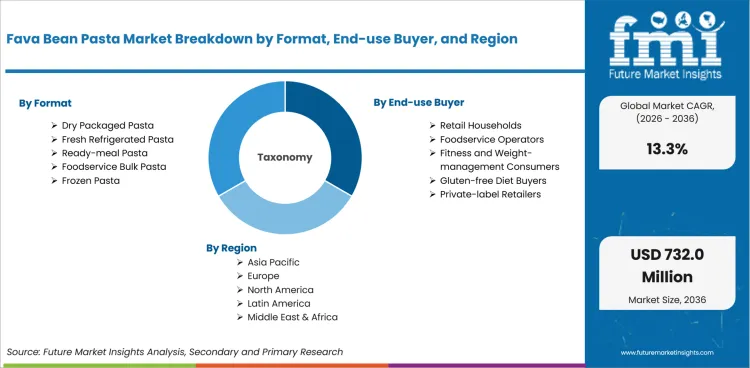
USD 210.0 million in 2026 and USD 732.0 million by 2036 at a 13.3% CAGR.
The fava bean pasta industry value is predicted to grow from USD 185.3 million in 2025 to USD 732.0 million by 2036 at 13.3% CAGR, influenced by high-protein dry pasta packs and foodservice pasta bowls using fava flour or fava protein. Dry packaged pasta is anticipated to represent 58.6% share in 2026, led by shelf-stable fusilli and penne formats reducing handling risk for retailers. Retail households are likely to secure 54.4% share in 2026, guided by pantry stocking and protein-per-serving comparison during routine grocery trips.
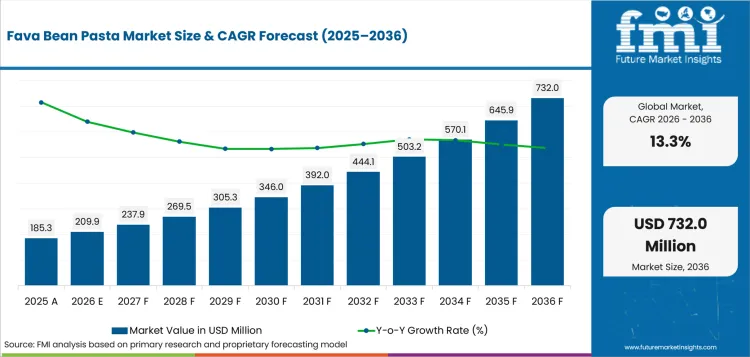
Fava Bean Pasta Market Overview: Size and Forecast
- 2026 Market Size: USD 210.0 million
- 2036 Market Size: USD 732.0 million
- Forecast CAGR: 13.3% from 2026 to 2036
- Leading Format: Dry Packaged Pasta
- Dry Packaged Pasta Share in 2026: 58.6%
- Leading End-use Buyer: Retail Households
- Retail Households Share in 2026: 54.4%
- Fastest-growing Country: Saudi Arabia
- Saudi Arabia CAGR: 15.4% by 2036
What are the key takeaways for the fava bean pasta market?
- Demand and Growth Drivers
- Protein pasta gives fava bean pasta a clear meal role across pantry dinners and pasta bowls.
- Retail pasta aisles can place fava bean pasta beside chickpea and lentil formats for direct pack comparison.
- Foodservice kitchens can test fava bean pasta through dry packs requiring limited process change.
- Product and Segment View
- Dry packaged pasta is forecast to represent 58.6% share in 2026, led by shelf-stable packs and easier stock control.
- Retail households are projected to hold 54.4% share in 2026, influenced by weekly pantry meals and familiar pasta preparation.
- Supermarkets and hypermarkets are expected to secure 46.3% share in 2026, reflected by pasta aisle access and mainstream grocery traffic.
- Geography and Competitive Outlook
- Saudi Arabia is projected to record 15.4% CAGR by 2036, backed by premium foodservice imports and specialty grocery testing.
- Australia is expected to expand at 13.9% CAGR by 2036 through faba bean supply and café pasta bowl trials.
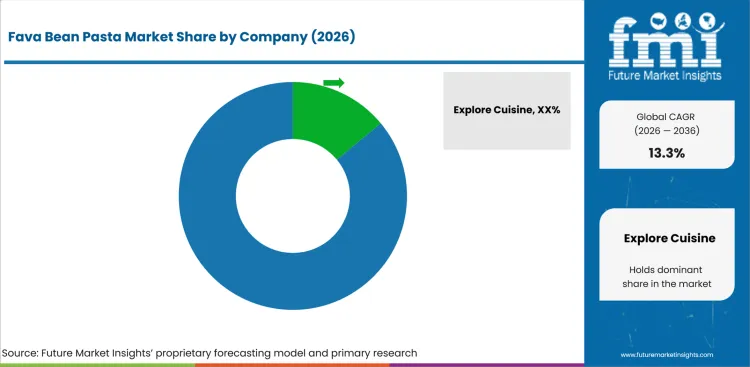
- Explore Cuisine competes through finished fava bean fusilli, while BENEO and Burcon support formulation through fava ingredients.
- Faba Canada, Griffith Foods, Ebro Ingredients and Seedea focus on fava flour or protein inputs for pasta and other foods.
- Analyst Opinion
- Nandini Roy Choudhury, Principal Consultant for Food and Beverage at FMI, observes, “Fava bean pasta has a practical route into high-protein meals. Shoppers already understand cooking time and sauce pairing. Brands need mild flavour and clean bite before retailers expand shelf space. Fava and rice blends can protect protein claims while reducing earthy notes often weakening repeat purchase.”
Boiling texture remains the main reason buyers reject fava bean pasta after trial. A 2025 pasta study found, 20.0% fava bean flour gave the best balance between nutrition and sensory quality, which gives formulators a practical limit for improving gluten-free pasta without hurting taste. Protein enrichment is also moving beyond whole fava flour. Roquette’s May 2024 NUTRALYS® Fava S900M launch introduced a fava protein isolate across Europe and North America, giving plant-based protein suppliers another ingredient route for pasta brands targeting higher protein levels. Supply planning is also improving through crop quality work. GRDC’s April 2026 faba breeding program included a 2.5-year USD 9.5 million commitment focused on yield and quality traits. Ingredient buyers can use such programs to support origin claims and reduce formulation risk in dry packaged high-protein pasta sold through established retail programs.
What supports value in the fava bean pasta market?
Finished dry pasta SKU revenue and foodservice protein pasta packs support value across retail and pasta-led channels.
- Market value is supported by finished fava bean pasta revenue before retailer margin and foodservice markups add incremental sales.
- Supplier pricing reflects fava protein concentration and milling quality.
- Revenue improves as brands convert legume pasta trial into routine pantry use.
- Retail confidence rises as pack labels make protein grams and cooking time easier to compare.
Why is the fava bean pasta market growing?
Retail buyers are giving fava bean pasta stronger review as brands improve protein content and gluten-free claim control.
Growth outlook is moving toward measured fava and rice blends rather than heavy whole-flour loading. A 2025 gluten-free pasta study found protein increased from 8.64% in the rice-flour control to 18.20% at 30.0% fava bean flour. Fiber also increased from 1.74% to 6.44% across the same comparison. Higher fava inclusion raised cooking loss, so formulators need balanced blends improving nutrition without weakening bite after boiling. This creates a practical route for gluten-free pasta brands seeking stronger protein and fiber claims.
Claim reliability is also becoming important for retail shelf approval. FDA’s 2024 gluten-free surveillance page reported 702 tested samples and more than 99.5% compliance against the 20 ppm gluten limit. This is important for fava bean pasta since buyers need confidence in flour sourcing and cross-contact controls. Suppliers that combine tested gluten controls with clear protein claims are likely to gain stronger placement across high-protein pasta and plant-based protein retail programs.
How is the fava bean pasta market segmented?
Fava bean pasta industry is segmented by product type, ingredient system, format, sales channel and end-use buyer.
- Dry packaged pasta is projected to secure 58.6% share in 2026, led by shelf-stable packs and lower spoilage risk across grocery pasta aisles.
- Retail households are anticipated to hold 54.4% share in 2026, since pantry pasta meals support trial inside routine grocery trips.
- Supermarkets and hypermarkets are forecast to represent 46.3% share in 2026, guided by pasta aisle comparison against chickpea and lentil packs.
- Fava bean fusilli and penne are expected to capture 42.9% share in 2026, due to sauce holding and lower breakage risk during boiling.
- Fava bean and rice blends are projected to account for 38.5% share in 2026, reflected by milder cooked colour and softer texture.
Why does dry packaged pasta lead the fava bean pasta market?
Dry packaged pasta holds 58.6% share in 2026 due to shelf-stable packs and simple household storage.
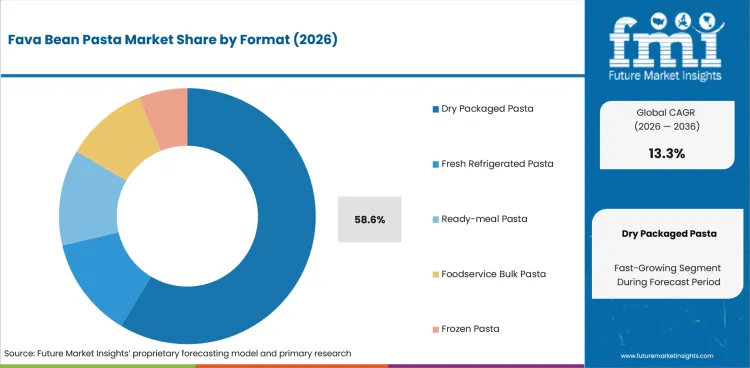
- Dry packaged pasta is projected to account for 58.6% share in 2026, influenced by lower cold-chain needs and easier stock control.
- Fresh fava bean pasta gains selective use as foodservice kitchens test premium protein pasta bowls before retail expansion.
Which end-use buyer leads the fava bean pasta market?
Retail households hold 54.4% share in 2026, led by pantry buying and familiar home pasta meals.
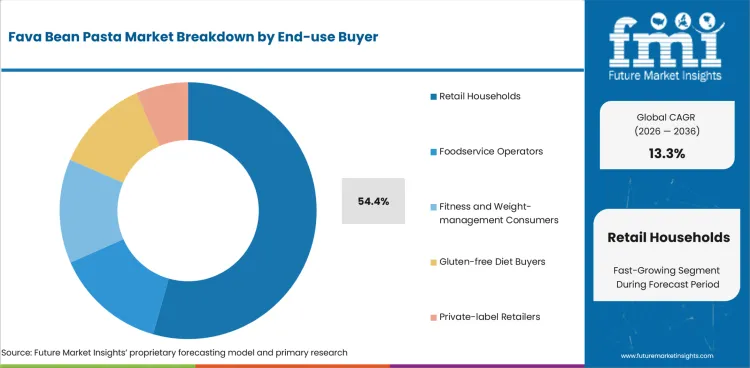
- Retail households are anticipated to hold 54.4% share in 2026 through repeat pasta dinners and high-protein meal planning.
- Foodservice operators gain value through controlled portions and pasta bowl concepts requiring minimal kitchen change.
Which sales channel leads the fava bean pasta market?
Supermarkets and hypermarkets hold 46.3% share in 2026 through pasta aisle access and weekly grocery trips.
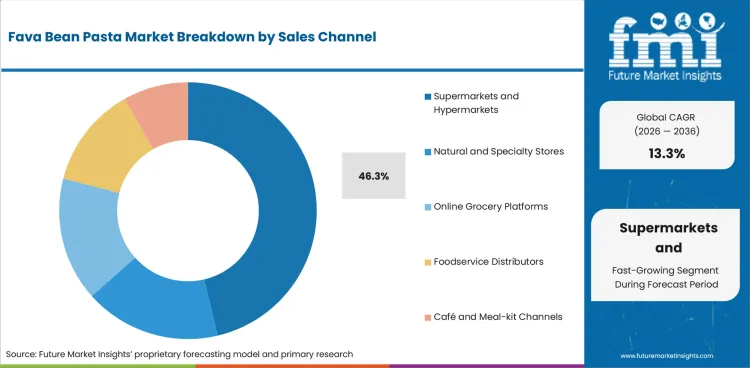
- Supermarkets and hypermarkets are forecast to secure 46.3% share in 2026, shaped by direct pack comparison against chickpea and lentil pasta.
- Online grocery platforms gain value among repeat buyers who already know cooking time and flavour profile.
Which product type leads the fava bean pasta market?
Fava bean fusilli and penne lead at 42.9% share in 2026, influenced by sauce holding and cooking stability.
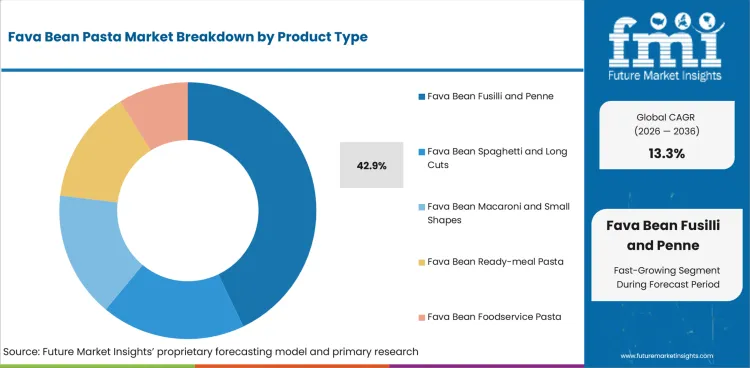
- Fava bean fusilli and penne are expected to account for 42.9% share in 2026, driven by short-shape durability and familiar meal use.
- Fava bean spaghetti and long cuts gain selective value in premium packs, although strand breakage requires tighter extrusion control.
Which ingredient system leads the fava bean pasta market?
Fava bean and rice blends lead at 38.5% share in 2026, reflected by texture balance and milder flavour.
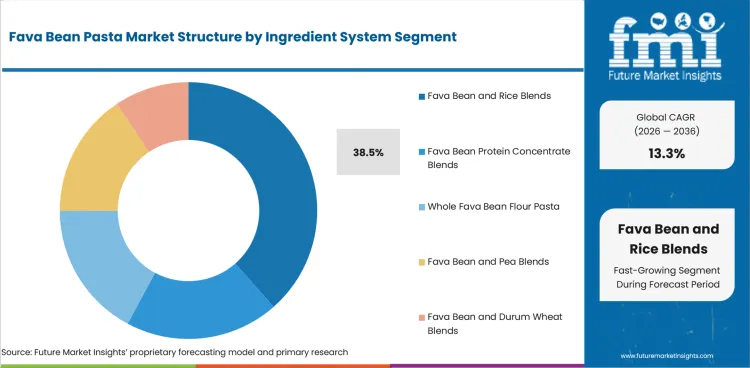
- Fava bean and rice blends are projected to hold 38.5% share in 2026, led by lighter colour and lower earthy notes.
- Fava protein concentrate blends gain attention among brands seeking stronger protein declarations and improved amino acid balance.
What are the drivers, restraints and opportunities in the fava bean pasta market?
Protein positioning supports growth and taste scrutiny limits conversion, while ingredient work creates openings for better dry pasta formats.
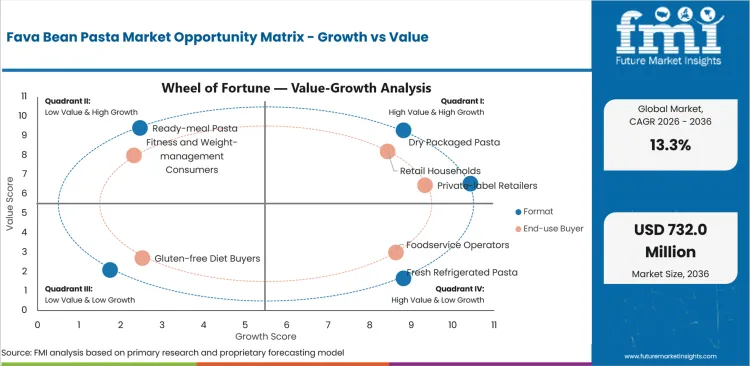
- Driver: High-protein positioning keeps fava bean pasta useful for buyers seeking familiar pantry meals with stronger nutrition claims.
- Restraint: Higher shelf prices and earthy flavour can slow repeat purchase among shoppers comparing wheat and chickpea pasta.
- Opportunity: Pasta makers can use fava and rice blends to improve bite while keeping gluten-free and protein claims clear.
Demand is moving toward fava bean pasta with better protein quality and cleaner flavour control. BENEO’s 2025 faba bean protein leaflet lists faba bean protein concentrate at 61.0g protein per 100.0g and faba bean flour at 29.0g protein per 100.0g. It also says faba bean protein supports mild taste and emulsification. Suppliers serving the functional food ingredients market can use such ingredient systems to improve pasta texture without relying only on chickpea or lentil flour.
Who buys fava bean pasta?
Retail households and foodservice operators form the main buyer base for dry and prepared fava bean pasta.
Buyer targeting should reflect both grocery shelves and pasta bowl menus. USA Census Bureau reported in June 2026, retail and food services sales reached USD 763.7 billion in May 2026. Grocery stores increased 2.3% from May 2025, while food services and drinking places increased 2.7%. Retail packs need clear protein and serving cues. Foodservice packs need yield control and lower breakage during preparation. Suppliers aligned to the ready-to-eat food market can position fava bean pasta for prepared meals and café pasta bowls.
What influences fava bean pasta purchase decisions?
Label control and flour consistency shape repeat purchase across retail and foodservice channels.
Purchase decisions are expected to track how well fava bean pasta supports safe labels and reliable cooking. FDA stated in March 2026 that packaged foods must list ingredients and identify major food allergens. AGT Foods’ Faba Bean Protein 60 - Deflavored technical sheet lists 58.0% to 62.0% protein on dry matter, soy flour below 2.5 ppm. It also describes bland flavour and no off-odor. Producers serving the clean label ingredients market can use such specifications to support pasta brands seeking cleaner labels and more predictable processing.
Which countries are growing fastest in the fava bean pasta market?
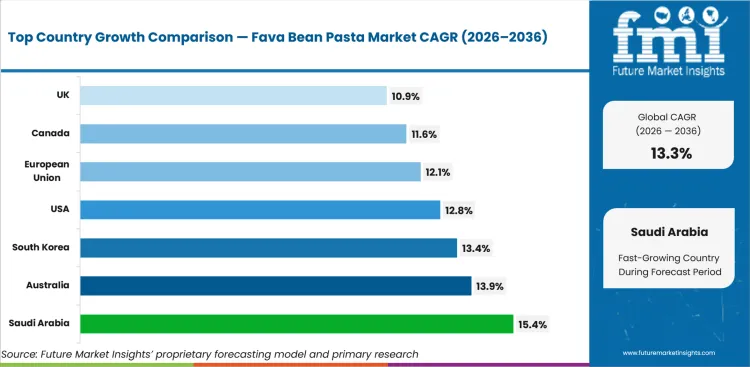
Saudi Arabia reaches 15.4% CAGR followed by Australia at 13.9% through 2036.
.webp "Top Country Growth Comparison Fava Bean Pasta Market Cagr (2026 2036)")
| Country | CAGR |
|---|---|
| Saudi Arabia | 15.4% |
| Australia | 13.9% |
| South Korea | 13.4% |
| United States | 12.8% |
| European Union | 12.1% |
| Canada | 11.6% |
| United Kingdom | 10.9% |
| Japan | 10.2% |
Source: Future Market Insights, 2026.
How do country-level CAGRs compare in the fava bean pasta market?
Saudi Arabia leads country growth while Japan records the most cautious expansion outlook among profiled markets.
- Saudi Arabia is forecast to record 15.4% CAGR by 2036, driven by imported premium pantry foods and hotel menu testing.
- Australia is expected to expand at 13.9% CAGR from 2026 to 2036 due to local faba supply and café pasta bowl use.
- South Korea is projected to grow at 13.4% CAGR through 2036 since compact retail and processed food manufacturing support small-pack testing.
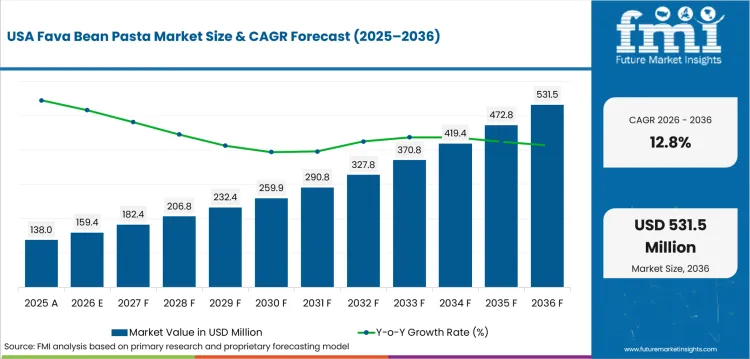
- United States is estimated to rise at 12.8% CAGR by 2036 through grocery access and high-protein pasta comparison.
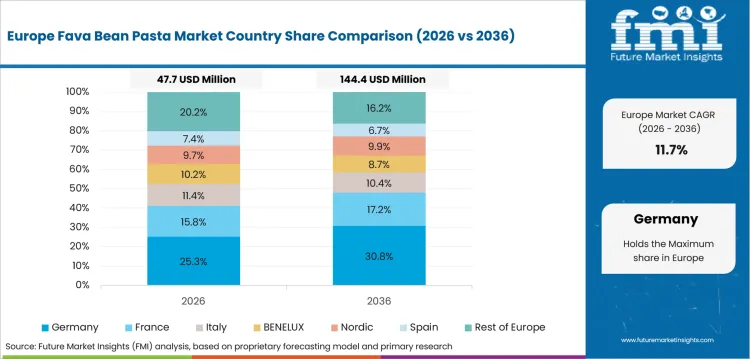
- European Union is expected to advance at 12.1% CAGR over the forecast period, led by plant-protein policy and pasta manufacturing depth.
- Canada is forecast to grow at 11.6% CAGR through 2036, influenced by pulse supply and ingredient development.
- United Kingdom is projected to post 10.9% CAGR by 2036, backed by bean campaigns and retail protein pasta trials.
- Japan is expected to increase at 10.2% CAGR by 2036, owing to convenience meal formats and small-pack discipline.
How fast is the fava bean pasta market growing in Saudi Arabia?
Industry in Saudi Arabia is set to record 15.4% CAGR by 2036 as foodservice distributors test high-protein imported pasta with halal documentation.
Country Market Snapshot Table
| Parameter | Value |
|---|---|
| Market Size in 2025 (Value) | USD 7.2 million |
| Market Size in 2026 (Value) | USD 8.3 million |
| Market Forecast in 2036 (Value) | USD 34.8 million |
| CAGR (2026 to 2036) | 15.4% |
| Years Considered | 2021 to 2036 |
| Base Year | 2025 |
| Forecast Period | 2026 to 2036 |
| Units Considered | Value (USD million) |
| Leading Sub-Region | Riyadh and Jeddah premium retail corridors |
Saudi Arabia Fava Bean Pasta Market Outlook
Saudi Arabia fava bean pasta sector is influenced by premium grocery imports and hotel dining. Riyadh and Jeddah provide the strongest launch base for high-protein dry pasta packs.
Retailers are expected to support products with halal documentation and dependable dry grocery distribution. Brands with mild flavour and foodservice packs should gain stronger trial in cafés and hotel menus.
Key Growth Drivers
- Hotel and restaurant buyers are testing high-protein pasta through imported premium menus. USDA FAS reported Saudi foodservice sales of USD 30.0 billion in 2024.
- Tourism traffic gives premium cafés and hotels a larger customer pool for differentiated pasta meals. Saudi Arabia welcomed around 116.0 million tourists in 2024.
- Modern grocery chains can position fava bean pasta beside gluten-free and protein pasta packs to support meal planning.
- Café operators can introduce fava pasta in warm pasta bowls without adding complex preparation steps.
Key Restraints
- Imported dry grocery items can carry higher freight and listing costs, limiting mainstream grocery trial beyond premium stores.
- Halal documents and Arabic pack claims can slow product approval before retailer onboarding.
- Retail pricing remains sensitive for premium foods. GASTAT reported annual average CPI at 2.0% in 2025 and food and beverage prices up 1.1%.
What makes Saudi Arabia unique
Saudi Arabia differs through hotel-led menu testing and specialized imported pantry-food routes before mass grocery rollout.
Key Companies
- Explore Cuisine through imported fava bean fusilli
- BENEO through fava ingredient systems
- Burcon NutraScience through high-purity fava protein
- Specialty food importers serving premium grocery
Sales & Marketing Channels
- Modern grocery pasta aisles
- Hotel and restaurant distributors
- Café suppliers
- Online premium grocery platforms
- Specialty food importers
- Foodservice wholesalers
Country Segment Breakdown Table
| Segment | Sub-Segments |
|---|---|
| By Product Type | Fava Bean Fusilli and Penne · Fava Bean Spaghetti and Long Cuts · Fava Bean Macaroni and Small Shapes · Fava Bean Ready-meal Pasta · Fava Bean Foodservice Pasta |
| By Ingredient System | Fava Bean and Rice Blends · Fava Bean Protein Concentrate Blends · Whole Fava Bean Flour Pasta · Fava Bean and Pea Blends · Fava Bean and Durum Wheat Blends |
| By Format | Dry Packaged Pasta · Fresh Refrigerated Pasta · Ready-meal Pasta · Foodservice Bulk Pasta · Frozen Pasta |
| By Sales Channel | Supermarkets and Hypermarkets · Natural and Specialty Stores · Online Grocery Platforms · Foodservice Distributors · Café and Meal-kit Channels |
| By End-use Buyer | Retail Households · Foodservice Operators · Fitness and Weight-management Consumers · Gluten-free Diet Buyers · Private-label Retailers |
| Key Sub-Regions Covered, Premium Retail Corridors | Riyadh · Jeddah · Dammam · Khobar · Makkah · Madinah |
Frequently Asked Questions
How fast is Saudi Arabia fava bean pasta market growing?
Sales in Saudi Arabia are forecast to scale at 15.4% CAGR from 2026 to 2036, guided by premium foodservice imports.
Who leads Saudi Arabia fava bean pasta market?
Explore Cuisine, BENEO, Burcon and premium food importers compete due to finished pasta and fava ingredient access.
What is driving adoption in Saudi Arabia fava bean pasta market?
Specialized café menus and imported pantry-food distribution are moving buyers toward high-protein fava pasta.
What is driving fava bean pasta growth in Australia?
Australia is projected to grow at 13.9% CAGR by 2036, backed by faba bean supply and café pasta bowl testing.
Country Market Snapshot Table
| Parameter | Value |
|---|---|
| Market Size in 2025 (Value) | USD 14.4 million |
| Market Size in 2026 (Value) | USD 16.4 million |
| Market Forecast in 2036 (Value) | USD 60.4 million |
| CAGR (2026 to 2036) | 13.9% |
| Years Considered | 2021 to 2036 |
| Base Year | 2025 |
| Forecast Period | 2026 to 2036 |
| Units Considered | Value (USD million) |
| Leading Sub-Region | New South Wales and Victoria café corridors |
Australia Fava Bean Pasta Market Outlook
Australia fava bean pasta demand is influenced by local pulse supply and café meal culture. Sydney and Melbourne provide early retail and foodservice routes for protein pasta packs.
Domestic faba bean credentials help brands explain crop origin and protein value. Suppliers with short-shape pasta and reliable cooking texture should gain stronger buyer review.
Key Growth Drivers
- Local supply supports ingredient storytelling. GRDC states Australia ranks 4th worldwide for average annual faba bean production.
- Export-scale production supports ingredient planning. GRDC reported Australia exports approximately 400,000.0 tonnes of faba beans per year.
- Cafés can test fava pasta bowls and warm salads before supermarkets commit to larger dry pasta ranges.
- Retailers can trial small packs to reduce entry price for households comparing legume pasta.
Key Restraints
- Export orientation can limit flexible local food-grade supply for pasta processors.
- Weather and crop quality variation can affect flour consistency for extrusion.
- Egypt accounts for approximately 70.0% of Australian faba bean exports, which can limit supply optionality for local processors.
What makes Australia unique
Australia stands apart through local faba bean supply and café-led protein pasta testing.
Key Companies
- Explore Cuisine through imported organic fava bean fusilli
- BENEO through fava ingredient systems
- Seedea through faba bean extruded flour
- Specialty food distributors serving cafés
Sales & Marketing Channels
- Supermarket pasta aisles
- Independent grocery stores
- Café distributors
- Online grocery platforms
- Meal delivery platforms
- Foodservice wholesalers
Country Segment Breakdown Table
| Segment | Sub-Segments |
|---|---|
| By Product Type | Fava Bean Fusilli and Penne · Fava Bean Spaghetti and Long Cuts · Fava Bean Macaroni and Small Shapes · Fava Bean Ready-meal Pasta · Fava Bean Foodservice Pasta |
| By Ingredient System | Fava Bean and Rice Blends · Fava Bean Protein Concentrate Blends · Whole Fava Bean Flour Pasta · Fava Bean and Pea Blends · Fava Bean and Durum Wheat Blends |
| By Format | Dry Packaged Pasta · Fresh Refrigerated Pasta · Ready-meal Pasta · Foodservice Bulk Pasta · Frozen Pasta |
| By Sales Channel | Supermarkets and Hypermarkets · Natural and Specialty Stores · Online Grocery Platforms · Foodservice Distributors · Café and Meal-kit Channels |
| By End-use Buyer | Retail Households · Foodservice Operators · Fitness and Weight-management Consumers · Gluten-free Diet Buyers · Private-label Retailers |
| Key Sub-Regions Covered, Café Retail Corridors | Sydney · Melbourne · Brisbane · Perth · Adelaide · Canberra |
Frequently Asked Questions
How fast is Australia fava bean pasta market growing?
Australia is projected to grow at 13.9% CAGR from 2026 to 2036, guided by local faba supply and café testing.
Who leads Australia fava bean pasta market?
Explore Cuisine, BENEO, Seedea and specialty distributors compete led by imported packs and ingredient systems.
What is driving adoption in Australia fava bean pasta market?
Faba bean supply and café pasta bowl use are supporting high-protein fava pasta placement.
What is the fava bean pasta market outlook in South Korea?
Sector in South Korea is anticipated to rise at 13.4% CAGR by 2036, supported by convenience retail testing and processed food manufacturing.
Country Market Snapshot Table
| Parameter | Value |
|---|---|
| Market Size in 2025 (Value) | USD 10.7 million |
| Market Size in 2026 (Value) | USD 12.1 million |
| Market Forecast in 2036 (Value) | USD 42.6 million |
| CAGR (2026 to 2036) | 13.4% |
| Years Considered | 2021 to 2036 |
| Base Year | 2025 |
| Forecast Period | 2026 to 2036 |
| Units Considered | Value (USD million) |
| Leading Sub-Region | Seoul Capital Area |
South Korea Fava Bean Pasta Market Outlook
Industry in South Korea is shaped by compact retail and processed food development. Seoul-based retailers can test small fava pasta packs before wider grocery expansion.
Food processors give suppliers access to sauce adaptation and ready-meal development. Brands with Korean flavour pairing and clear cooking instructions should gain stronger buyer review.
Key Growth Drivers
- Retail food scale gives specialty pasta a testing base. USDA FAS reported Korean retail food sales of USD 132.0 billion in 2024.
- Convenience retail gives compact pasta formats dense access. Korean Culture and Information Service stated that four major chains reached 53,266.0 stores at end-2025.
- Ready-meal producers can test fava pasta in small packs for single-person households.
- Korean sauces can help reduce earthy notes across first-time pasta trials.
Key Restraints
- Imported ingredient costs can push fava pasta above wheat noodles and conventional pasta options.
- Retailers may restrict range expansion until repeat sales develop beyond Seoul test stores.
- Health-positioned shelf competition is intense. USA International Trade Administration valued South Korea’s health supplement market at USD 4.7 billion in 2023.
What makes South Korea unique
South Korea’s distinction comes from dense convenience retail and fast metro-level product testing.
Key Companies
- BENEO through fava ingredient systems
- Burcon NutraScience through high-purity fava protein
- Ebro Ingredients through fava protein concentrates
- Korean private-label pasta makers
Sales & Marketing Channels
- Convenience meal platforms
- Online grocery platforms
- Supermarket pasta aisles
- Natural food stores
- Café distributors
- Meal-kit platforms
Country Segment Breakdown Table
| Segment | Sub-Segments |
|---|---|
| By Product Type | Fava Bean Fusilli and Penne · Fava Bean Spaghetti and Long Cuts · Fava Bean Macaroni and Small Shapes · Fava Bean Ready-meal Pasta · Fava Bean Foodservice Pasta |
| By Ingredient System | Fava Bean and Rice Blends · Fava Bean Protein Concentrate Blends · Whole Fava Bean Flour Pasta · Fava Bean and Pea Blends · Fava Bean and Durum Wheat Blends |
| By Format | Dry Packaged Pasta · Fresh Refrigerated Pasta · Ready-meal Pasta · Foodservice Bulk Pasta · Frozen Pasta |
| By Sales Channel | Supermarkets and Hypermarkets · Natural and Specialty Stores · Online Grocery Platforms · Foodservice Distributors · Café and Meal-kit Channels |
| By End-use Buyer | Retail Households · Foodservice Operators · Fitness and Weight-management Consumers · Gluten-free Diet Buyers · Private-label Retailers |
| Key Sub-Regions Covered, Convenience Retail Areas | Seoul · Incheon · Busan · Daegu · Daejeon · Gwangju |
Frequently Asked Questions
How fast is South Korea fava bean pasta market growing?
South Korea is expected to expand at 13.4% CAGR from 2026 to 2036, reflected by convenience retail tests.
Who leads South Korea fava bean pasta market?
BENEO, Burcon, Ebro Ingredients and local private-label makers compete depending on ingredient and processing access.
What is driving adoption in South Korea fava bean pasta market?
Convenience retail and ready-meal development are supporting fava bean pasta testing.
How is the fava bean pasta market performing in the United States?
Fava bean pasta sector in the United States is estimated to rise at 12.8% CAGR by 2036, driven by high-protein pasta trial and national grocery access.
Country Market Snapshot Table
| Parameter | Value |
|---|---|
| Market Size in 2025 (Value) | USD 55.9 million |
| Market Size in 2026 (Value) | USD 63.0 million |
| Market Forecast in 2036 (Value) | USD 210.1 million |
| CAGR (2026 to 2036) | 12.8% |
| Years Considered | 2021 to 2036 |
| Base Year | 2025 |
| Forecast Period | 2026 to 2036 |
| Units Considered | Value (USD million) |
| Leading Sub-Region | California and Northeast grocery corridors |
United States Fava Bean Pasta Market Outlook
Demand in the United States is promoted by high-protein pasta comparison and national grocery access. Shoppers compare fava bean pasta against chickpea and lentil pasta during weekly trips.
Retailers need evidence of repeat purchase before adding more specialty pasta facings. Brands with dependable cooking texture and clear protein claims should gain better placement.
Key Growth Drivers
- Grocery and foodservice channels give fava pasta dual routes. USDA ERS reported total USA food spending reached USD 2.5 trillion in 2025.
- Grocery stores remain a strong in-store discovery route. JLL reported grocery store foot traffic reached nearly 17.2 billion visits in 2024.
- High-protein shoppers can compare fava pasta against chickpea and lupin pasta on grams of protein.
- Private-label retailers can use fava and rice blends to add a differentiated legume pasta line.
Key Restraints
- Pasta aisle space remains contested by wheat, chickpea, lentil and gluten-free rice products.
- Earthy taste can limit repeat purchase if cooking instructions and sauce pairing are weak.
- Price sensitivity remains active. USDA ERS reported food prices in April 2026 were 3.2% higher than April 2025.
What makes the United States unique
United States conditions are distinct for national grocery scale and high-protein pasta shelf comparison.
Key Companies
- Explore Cuisine
- BENEO
- Burcon NutraScience
- Faba Canada
- Griffith Foods
- Private-label pasta manufacturers
Sales & Marketing Channels
- Supermarket pasta aisles
- Natural food stores
- Online grocery platforms
- Club retailers
- Foodservice distributors
- Regional grocery chains
Country Segment Breakdown Table
| Segment | Sub-Segments |
|---|---|
| By Product Type | Fava Bean Fusilli and Penne · Fava Bean Spaghetti and Long Cuts · Fava Bean Macaroni and Small Shapes · Fava Bean Ready-meal Pasta · Fava Bean Foodservice Pasta |
| By Ingredient System | Fava Bean and Rice Blends · Fava Bean Protein Concentrate Blends · Whole Fava Bean Flour Pasta · Fava Bean and Pea Blends · Fava Bean and Durum Wheat Blends |
| By Format | Dry Packaged Pasta · Fresh Refrigerated Pasta · Ready-meal Pasta · Foodservice Bulk Pasta · Frozen Pasta |
| By Sales Channel | Supermarkets and Hypermarkets · Natural and Specialty Stores · Online Grocery Platforms · Foodservice Distributors · Café and Meal-kit Channels |
| By End-use Buyer | Retail Households · Foodservice Operators · Fitness and Weight-management Consumers · Gluten-free Diet Buyers · Private-label Retailers |
| Key Sub-Regions Covered, Grocery Retail Networks | California · Northeast Corridor · Pacific Northwest · Texas · Midwest · South Atlantic |
Frequently Asked Questions
How fast is United States fava bean pasta market growing?
Sector in the United States is anticipated to grow at 12.8% CAGR from 2026 to 2036, reflecting high-protein pasta access.
Who leads United States fava bean pasta market?
Explore Cuisine, BENEO, Burcon and private-label manufacturers compete with finished pasta and ingredient access.
What is driving adoption in United States fava bean pasta market?
High-protein pantry buying and grocery shelf comparison are moving shoppers toward fava bean pasta.
What is the fava bean pasta market forecast for the European Union?
Sector in the European Union is expected to scale at 12.1% CAGR by 2036, backed by plant-protein policy and pasta manufacturing depth.
Country Market Snapshot Table
| Parameter | Value |
|---|---|
| Market Size in 2025 (Value) | USD 41.7 million |
| Market Size in 2026 (Value) | USD 46.8 million |
| Market Forecast in 2036 (Value) | USD 146.7 million |
| CAGR (2026 to 2036) | 12.1% |
| Years Considered | 2021 to 2036 |
| Base Year | 2025 |
| Forecast Period | 2026 to 2036 |
| Units Considered | Value (USD million) |
| Leading Sub-Region | Germany and France retail networks |
European Union Fava Bean Pasta Market Outlook
Industry in the European Union reflects pasta manufacturing depth and plant-protein policy interest. Germany, France and Italy offer strong retail scale for legume pasta placement.
Ingredient suppliers can support fava pasta through fava protein and flour systems. Suppliers need country-specific recipes and gluten-free certification discipline.
Key Growth Drivers
- Germany provides large grocery scale for legume pasta. USDA FAS reported German food retail sales of USD 293.1 billion in 2024.
- France gives fava pasta a foodservice route. USDA FAS reported French HRI sales revenue of USD 126.0 billion in 2024.
- European pasta makers can adapt short shapes to fava and rice blends for better cooking performance.
- Ingredient suppliers can support dry pasta brands through fava protein concentrates and starch-rich fava flours.
Key Restraints
- Country performance remains uneven, raising costs for brands entering multiple EU markets.
- Recipe expectations differ across pasta-heavy countries and requiring separate flavour.
- German food retail concentration can make shelf entry harder. USDA FAS reported the top five retail groups account for around 76.0% of total revenue.
What makes the European Union unique
European Union conditions differ through multi-country pasta scale and localized taste expectations.
Key Companies
- BENEO
- Ebro Ingredients
- Seedea
- Explore Cuisine
- European private-label pasta producers
- Pulse ingredient processors
Sales & Marketing Channels
- Supermarket pasta aisles
- Discounters
- Online grocery platforms
- Foodservice distributors
- Specialty food retailers
- Private-label retail programs
Country Segment Breakdown Table
| Segment | Sub-Segments |
|---|---|
| By Product Type | Fava Bean Fusilli and Penne · Fava Bean Spaghetti and Long Cuts · Fava Bean Macaroni and Small Shapes · Fava Bean Ready-meal Pasta · Fava Bean Foodservice Pasta |
| By Ingredient System | Fava Bean and Rice Blends · Fava Bean Protein Concentrate Blends · Whole Fava Bean Flour Pasta · Fava Bean and Pea Blends · Fava Bean and Durum Wheat Blends |
| By Format | Dry Packaged Pasta · Fresh Refrigerated Pasta · Ready-meal Pasta · Foodservice Bulk Pasta · Frozen Pasta |
| By Sales Channel | Supermarkets and Hypermarkets · Natural and Specialty Stores · Online Grocery Platforms · Foodservice Distributors · Café and Meal-kit Channels |
| By End-use Buyer | Retail Households · Foodservice Operators · Fitness and Weight-management Consumers · Gluten-free Diet Buyers · Private-label Retailers |
| Key Sub-Regions Covered, Pasta Retail Corridors | Germany · France · Italy · Spain · Netherlands · Austria |
Frequently Asked Questions
How fast is European Union fava bean pasta market growing?
Demand in European Union is expected to rise at 12.1% CAGR from 2026 to 2036 with pulse ingredient support.
Who leads European Union fava bean pasta market?
BENEO, Ebro Ingredients, Seedea and private-label pasta producers compete based on ingredient and manufacturing depth.
What is driving adoption in European Union fava bean pasta market?
Plant-protein policy and pasta manufacturing depth are supporting fava bean pasta development.
What is the fava bean pasta market outlook in Canada?
Industry in Canada is likely to grow at 11.6% CAGR by 2036, helped by pulse supply and foodservice expansion.
Country Market Snapshot Table
| Parameter | Value |
|---|---|
| Market Size in 2025 (Value) | USD 15.7 million |
| Market Size in 2026 (Value) | USD 17.5 million |
| Market Forecast in 2036 (Value) | USD 52.5 million |
| CAGR (2026 to 2036) | 11.6% |
| Years Considered | 2021 to 2036 |
| Base Year | 2025 |
| Forecast Period | 2026 to 2036 |
| Units Considered | Value (USD million) |
| Leading Sub-Region | Ontario and Western Canada grocery corridors |
Canada Fava Bean Pasta Market Outlook
Canada combines pulse crop supply with ingredient-processing projects. Ontario and Western Canada provide early retail and ingredient routes for fava bean pasta.
Foodservice expansion gives pasta brands another route through cafés and prepared meals. Brands with local pulse messaging and stable dry-pack quality should gain stronger grocery access.
Key Growth Drivers
- Foodservice growth creates a route for pasta bowls. Statistics Canada reported annual foodservice and drinking-place sales of CAD 101.4 billion in 2025.
- Canadian foodservice breadth supports distributor targeting. ISED listed 105,169.0 foodservice and drinking-place establishments in 2025.
- Canadian processors can use dry-processed fava ingredients to support local private-label pasta.
- Retailers can position fava pasta beside lentil and chickpea pasta already familiar to shoppers.
Key Restraints
- Crop availability can tighten if food-grade fava volumes move toward export and feed channels.
- Smaller domestic pasta scale can raise unit cost versus imported legume pasta brands.
- Canadian faba bean production has ranged from 70,000.0 to 125,000.0 tonnes from 2019 to 2023, which limits large-scale input planning.
What makes Canada unique
Canada’s route is shaped by pulse supply depth and dispersed grocery distribution lanes.
Key Companies
- Faba Canada
- Griffith Foods
- Burcon NutraScience
- BENEO
- Explore Cuisine
- Canadian private-label pasta makers
Sales & Marketing Channels
- National supermarket chains
- Natural and specialty stores
- Online grocery platforms
- Foodservice distributors
- Café suppliers
- Meal-kit providers
Country Segment Breakdown Table
| Segment | Sub-Segments |
|---|---|
| By Product Type | Fava Bean Fusilli and Penne · Fava Bean Spaghetti and Long Cuts · Fava Bean Macaroni and Small Shapes · Fava Bean Ready-meal Pasta · Fava Bean Foodservice Pasta |
| By Ingredient System | Fava Bean and Rice Blends · Fava Bean Protein Concentrate Blends · Whole Fava Bean Flour Pasta · Fava Bean and Pea Blends · Fava Bean and Durum Wheat Blends |
| By Format | Dry Packaged Pasta · Fresh Refrigerated Pasta · Ready-meal Pasta · Foodservice Bulk Pasta · Frozen Pasta |
| By Sales Channel | Supermarkets and Hypermarkets · Natural and Specialty Stores · Online Grocery Platforms · Foodservice Distributors · Café and Meal-kit Channels |
| By End-use Buyer | Retail Households · Foodservice Operators · Fitness and Weight-management Consumers · Gluten-free Diet Buyers · Private-label Retailers |
| Key Sub-Regions Covered, Grocery and Café Areas | Ontario · Quebec · British Columbia · Alberta · Manitoba · Saskatchewan |
Frequently Asked Questions
How fast is Canada fava bean pasta market growing?
Sector in Canada is forecast at 11.6% CAGR from 2026 to 2036 with foodservice and grocery support.
Who leads Canada fava bean pasta market?
Faba Canada, Griffith Foods, Burcon, BENEO and Explore Cuisine compete through ingredient and retail access.
What is driving adoption in Canada fava bean pasta market?
Foodservice growth and fava ingredient work are moving fava bean pasta into retail and prepared meals.
How is the fava bean pasta market performing in the United Kingdom?
Market in United Kingdom is projected to post 10.9% CAGR by 2036, supported by bean campaigns and retail protein pasta trials.
Country Market Snapshot Table
| Parameter | Value |
|---|---|
| Market Size in 2025 (Value) | USD 19.9 million |
| Market Size in 2026 (Value) | USD 22.1 million |
| Market Forecast in 2036 (Value) | USD 62.2 million |
| CAGR (2026 to 2036) | 10.9% |
| Years Considered | 2021 to 2036 |
| Base Year | 2025 |
| Forecast Period | 2026 to 2036 |
| Units Considered | Value (USD million) |
| Leading Sub-Region | London and Southeast England |
United Kingdom Fava Bean Pasta Market Outlook
United Kingdom fava bean pasta sales are centered on grocery protein pasta and bean awareness campaigns. Discounters and mainstream supermarkets shape price expectations for specialty dry pasta packs.
Retail buyers need stronger repeat purchase evidence after recent plant-based volume pressure. Brands with affordable packs and clear cooking cues should gain stronger listings.
Key Growth Drivers
- Bean consumption promotion helps shopper education. Food Foundation’s 2026 campaign aims to double UK bean consumption by 2028.
- Local bean awareness supports product communication. PGRO reported national bean crop production near 400,000.0 tonnes in 2025.
- Retailers can test fava pasta beside gluten-free and high-protein pasta in premium grocery aisles.
- Foodservice operators can use fava pasta in warm salads and meal-deal pasta pots.
Key Restraints
- Conventional wheat pasta keeps strong price pressure during weekly grocery trips.
- Retailers may limit slower-moving protein pasta packs during shelf reviews.
- Pulse acreage tightened in 2025. PGRO stated DEFRA-declared cropped area for pulses was below 200,000.0 hectares.
What makes the United Kingdom unique
United Kingdom stands out through bean promotion campaigns and established retail testing for protein pasta.
Key Companies
- Explore Cuisine
- BENEO
- Ebro Ingredients
- Seedea
- UK private-label pasta manufacturers
- Specialty grocery importers
Sales & Marketing Channels
- Supermarket pasta aisles
- Discounters
- Natural food stores
- Online grocery platforms
- Foodservice distributors
- Café suppliers
Country Segment Breakdown Table
| Segment | Sub-Segments |
|---|---|
| By Product Type | Fava Bean Fusilli and Penne · Fava Bean Spaghetti and Long Cuts · Fava Bean Macaroni and Small Shapes · Fava Bean Ready-meal Pasta · Fava Bean Foodservice Pasta |
| By Ingredient System | Fava Bean and Rice Blends · Fava Bean Protein Concentrate Blends · Whole Fava Bean Flour Pasta · Fava Bean and Pea Blends · Fava Bean and Durum Wheat Blends |
| By Format | Dry Packaged Pasta · Fresh Refrigerated Pasta · Ready-meal Pasta · Foodservice Bulk Pasta · Frozen Pasta |
| By Sales Channel | Supermarkets and Hypermarkets · Natural and Specialty Stores · Online Grocery Platforms · Foodservice Distributors · Café and Meal-kit Channels |
| By End-use Buyer | Retail Households · Foodservice Operators · Fitness and Weight-management Consumers · Gluten-free Diet Buyers · Private-label Retailers |
| Key Sub-Regions Covered, Grocery Retail Areas | London · Manchester · Birmingham · Leeds · Glasgow · Bristol |
Frequently Asked Questions
How fast is United Kingdom fava bean pasta market growing?
Industry in United Kingdom is projected to increase at 10.9% CAGR from 2026 to 2036 through protein pasta retail.
Who leads United Kingdom fava bean pasta market?
Explore Cuisine, BENEO, Ebro Ingredients and private-label pasta makers compete depending on imported packs and ingredients.
What is driving adoption in United Kingdom fava bean pasta market?
Bean campaigns and high-protein pasta trials are supporting fava bean pasta demand.
What is the fava bean pasta market forecast for Japan?
Sector in Japan is expected to rise at 10.2% CAGR by 2036, guided by small packs and mild flavour profiles suited to metro trial.
Country Market Snapshot Table
| Parameter | Value |
|---|---|
| Market Size in 2025 (Value) | USD 6.2 million |
| Market Size in 2026 (Value) | USD 6.8 million |
| Market Forecast in 2036 (Value) | USD 18.0 million |
| CAGR (2026 to 2036) | 10.2% |
| Years Considered | 2021 to 2036 |
| Base Year | 2025 |
| Forecast Period | 2026 to 2036 |
| Units Considered | Value (USD million) |
| Leading Sub-Region | Kanto and Kansai convenience corridors |
Japan Fava Bean Pasta Market Outlook
Demand in Japan is influenced by convenience meals and careful product testing. Buyers compare mild flavour and texture against familiar noodles and wheat pasta before repeat purchase.
Small pack size and clear preparation cues can support early adoption. Suppliers need portion control and packaging suited to compact household storage.
Key Growth Drivers
- Convenience stores provide a dense meal-testing route. USDA FAS reported convenience stores increased by 208.0 between January 2024 and January 2025.
- Food processors can test health-oriented pasta formats. USDA FAS reported Japan’s food processing sector reached USD 174.0 billion in 2025.
- Convenience meals can introduce fava bean pasta through small prepared packs and café lunch sets.
- Mild sauce pairings can help reduce fava flavour intensity for first-time buyers.
Key Restraints
- Consumer testing remains cautious for products lacking familiar mouthfeel or clean aroma.
- Retailers may limit shelf trials to metropolitan outlets before national expansion.
- Convenience-store share within food retail decreased by 0.9% in 2024, which can limit rapid specialty food expansion.
What makes Japan unique
Japan’s distinct path comes from small-pack discipline and mild-flavour expectations.
Key Companies
- Explore Cuisine through imported specialty pasta
- BENEO through fava ingredient systems
- Ebro Ingredients through fava protein concentrate
- Seedea through pasta-suitable faba flour
- Japanese private-label pasta makers
- Convenience meal suppliers
Sales & Marketing Channels
- Convenience store meal programs
- Supermarket pasta shelves
- Department store grocery halls
- Online grocery platforms
- Café distributors
- Meal-kit platforms
Country Segment Breakdown Table
| Segment | Sub-Segments |
|---|---|
| By Product Type | Fava Bean Fusilli and Penne · Fava Bean Spaghetti and Long Cuts · Fava Bean Macaroni and Small Shapes · Fava Bean Ready-meal Pasta · Fava Bean Foodservice Pasta |
| By Ingredient System | Fava Bean and Rice Blends · Fava Bean Protein Concentrate Blends · Whole Fava Bean Flour Pasta · Fava Bean and Pea Blends · Fava Bean and Durum Wheat Blends |
| By Format | Dry Packaged Pasta · Fresh Refrigerated Pasta · Ready-meal Pasta · Foodservice Bulk Pasta · Frozen Pasta |
| By Sales Channel | Supermarkets and Hypermarkets · Natural and Specialty Stores · Online Grocery Platforms · Foodservice Distributors · Café and Meal-kit Channels |
| By End-use Buyer | Retail Households · Foodservice Operators · Fitness and Weight-management Consumers · Gluten-free Diet Buyers · Private-label Retailers |
| Key Sub-Regions Covered, Convenience Retail Areas | Tokyo · Osaka · Yokohama · Nagoya · Fukuoka · Sapporo |
Frequently Asked Questions
How fast is Japan fava bean pasta market growing?
Industry in Japan is projected at 10.2% CAGR from 2026 to 2036 as convenience retail tests high-protein meal options.
Who leads Japan fava bean pasta market?
Explore Cuisine, BENEO, Ebro Ingredients and local private-label makers compete through specialty retail and ingredient access.
What is driving adoption in Japan fava bean pasta market?
Convenience meals and small-pack formats are supporting measured fava bean pasta trial.
Who are the leading companies in the fava bean pasta market?
Explore Cuisine, BENEO, Burcon NutraScience, Faba Canada, Griffith Foods, Ebro Ingredients and Seedea are listed.
- Finished pasta brands hold an advantage due to direct retail proof and consumer cooking feedback.
- Ingredient suppliers gain access through better fava taste and protein concentration.
- Private-label manufacturers build placement led by price control and pasta aisle relationships.
- Foodservice suppliers gain acceptance by providing predictable cooking yield and portion cost.
Fava bean pasta companies compete by combining protein claims with familiar pasta shapes. Retailers assess pack price and repeat purchase evidence before assigning more shelf space. Foodservice buyers review cooking time and sauce holding. Brands making product use simple are likely to move beyond one-time trial.
Manufacturing depth has become a competitive separator as legume pasta requires consistent milling and extrusion control. Explore Cuisine provides finished-product proof through organic fava bean fusilli. BENEO, Ebro Ingredients and Seedea support flour and concentrate systems. Burcon adds high-purity fava protein, while Faba Canada and Griffith Foods support dry-processed fava ingredient development.
Smaller and regional players can win through independent grocery and online grocery platforms. Larger suppliers gain advantage through ingredient quality and private-label manufacturing relationships. Companies with clean flavour, stable cooking texture and defendable pack pricing should gain stronger listing decisions.
How do top fava bean pasta companies compare?
Explore Cuisine scores strongest on direct finished pasta fit, while BENEO and Burcon lead ingredient-side formulation depth.
| Company | Alignment to Market Title | Finished Pasta Portfolio Depth | Fava Ingredient Capability | Protein and Texture Capability | Channel Reach | Geographic Footprint |
|---|---|---|---|---|---|---|
| Explore Cuisine | Very High | Very Strong | Moderate | Strong | Strong | North America, Europe and Australia |
| BENEO | High | Low | Very Strong | Very Strong | Strong | Europe and global food manufacturers |
| Burcon NutraScience | High | Low | Very Strong | Very Strong | Moderate | North America and ingredient customers |
| Faba Canada | High | Low | Strong | Strong | Moderate | Canada and export ingredient channels |
| Griffith Foods | Moderate | Low | Strong | Moderate | Strong | North America and international |
| Ebro Ingredients | High | Low | Strong | Strong | Moderate | Europe and global ingredient channels |
| Seedea | High | Low | Strong | Moderate | Moderate | Europe |
Source: Future Market Insights competitive analysis, 2026.
Who are the key players in the fava bean pasta market?
Explore Cuisine and BENEO are listed with Burcon NutraScience, Faba Canada, Griffith Foods, Ebro Ingredients and Seedea among other suppliers.
Key global companies leading the fava bean pasta market include:
- Explore Cuisine
- BENEO
- Burcon NutraScience
- Faba Canada
- Griffith Foods
- Ebro Ingredients
- Seedea
Key Developments in Fava Bean Pasta Market
- In June 2024, Phytokana Ingredients launched F70 LVC Faba Protein Concentrate.
- In January 2025, Nuttee Bean Co. launched fava bean pasta under its Favalicious brand.
- In August 2025, the Government of Canada announced CAD 1.5 million in funding for Prairie Fava Ltd. to optimize processing and expand its grower network.
Key Players in the Fava Bean Pasta Market
Finished Fava Bean Pasta Producers
- Explore Cuisine
- Nuttee Bean Co. / Favalicious
- Private-label legume pasta manufacturers
Fava Ingredient and Protein Suppliers
- BENEO
- Burcon NutraScience
- Ebro Ingredients
- Seedea
- Faba Canada
Formulation and Foodservice Specialists
- Griffith Foods
- Regional co-packers
- Café and meal-kit suppliers
- Specialty grocery importers
Fava Bean Pasta Market - Report Scope
| Parameter | Details |
|---|---|
| Market size by 2036 | USD 732.0 million |
| Growth rate | 13.3% CAGR from 2026 to 2036 |
| Forecast period | 2026 to 2036 |
| Base year value (2025) | USD 185.3 million |
| By product type | Fava bean fusilli and penne, fava bean spaghetti and long cuts, fava bean macaroni and small shapes, fava bean ready-meal pasta, fava bean foodservice pasta |
| By ingredient system | Fava bean and rice blends, fava bean protein concentrate blends, whole fava bean flour pasta, fava bean and pea blends, fava bean and durum wheat blends |
| By format | Dry packaged pasta, fresh refrigerated pasta, ready-meal pasta, foodservice bulk pasta, frozen pasta |
| By sales channel | Supermarkets and hypermarkets, natural and specialty stores, online grocery platforms, foodservice distributors, café and meal-kit channels |
| By end-use buyer | Retail households, foodservice operators, fitness and weight-management consumers, gluten-free diet buyers, private-label retailers |
| Regions covered | North America, Europe, GCC, East Asia, South Asia and Pacific, Middle East and Africa |
| Countries covered | United States, Canada, European Union, United Kingdom, Saudi Arabia, South Korea, Japan, Australia |
| Key companies profiled | Explore Cuisine, BENEO, Burcon NutraScience, Faba Canada, Griffith Foods, Ebro Ingredients, Seedea |
| Approach | Bottom-up product-boundary approach using eligible SKU revenue, channel presence, retail pricing, product positioning and country-level adoption |
Source: Future Market Insights, 2026.
Fava Bean Pasta Market Breakdown by Product Type, Ingredient System, Format, Sales Channel, End-use Buyer, and Region
Fava Bean Pasta Market Segmented by Product Type
- Fava Bean Fusilli and Penne
- Fava Bean Spaghetti and Long Cuts
- Fava Bean Macaroni and Small Shapes
- Fava Bean Ready-meal Pasta
- Fava Bean Foodservice Pasta
Fava Bean Pasta Market Segmented by Ingredient System
- Fava Bean and Rice Blends
- Fava Bean Protein Concentrate Blends
- Whole Fava Bean Flour Pasta
- Fava Bean and Pea Blends
- Fava Bean and Durum Wheat Blends
Fava Bean Pasta Market Segmented by Format
- Dry Packaged Pasta
- Fresh Refrigerated Pasta
- Ready-meal Pasta
- Foodservice Bulk Pasta
- Frozen Pasta
Fava Bean Pasta Market Segmented by Sales Channel
- Supermarkets and Hypermarkets
- Natural and Specialty Stores
- Online Grocery Platforms
- Foodservice Distributors
- Café and Meal-kit Channels
Fava Bean Pasta Market Segmented by End-use Buyer
- Retail Households
- Foodservice Operators
- Fitness and Weight-management Consumers
- Gluten-free Diet Buyers
- Private-label Retailers
Fava Bean Pasta Market by Region
- North America
- Latin America
- Europe
- East Asia
- South Asia and Pacific
- Middle East and Africa
Research Sources and Bibliography
- Australian Bureau of Statistics. (2025, July 31). Retail trade, Australia, June 2025.
- AGT Foods. (2025, October 21). Technical specification data sheet: Faba Bean Protein 60 - Deflavored.
- BENEO. (2025, November). Faba bean protein.
- Burcon NutraScience Corporation. (2025, August 5). Burcon achieves first commercial production of fava protein and officially launches FavaPro™ 90.0%+ pure plant protein.
- Ebro Ingredients. (2024, December 12). FabaFood project.
- Food Foundation. (2026, February 24). Food industry giants sign up to the Bang in Some Beans campaign aiming to double UK bean consumption.
- Government of Canada, Prairies Economic Development Canada. (2025, August 28). Minister Olszewski announced federal investment to boost innovation, grow and create jobs in Manitoba’s manufacturing sector.
- Grains Research and Development Corporation. (2025, September 1). Faba Bean Crop Improvement Plan.
- Grains Research and Development Corporation. (2026, April 15). Renewed effort to supercharge faba bean breeding and expansion.
- Korean Culture and Information Service. (2026, April). Beyond the corner store: How Korea transformed convenience retail.
- Nuttee Bean Co. (2025, January 7). Nuttee Bean Co. debuts fava bean pasta. Food Business News.
- Phytokana Ingredients Inc. (2024, June 12). Phytokana Ingredients Inc. announces F70 LVC Faba Protein Concentrate.
- Processors and Growers Research Organisation. (2026, March). Pulse market update.
- Roquette. (2024, May 28). Roquette launches its first fava bean protein isolate.
- Saudi General Authority for Statistics. (2026, February). Annual average consumer price index 2025.
- Saudi Ministry of Tourism. (2025, June 22). Saudi Arabia tops 100 million tourist mark for second year.
- Statistics Canada. (2026, February 25). Food services and drinking places, December 2025.
- Stoin, D., Jianu, C., Alexa, E., Poiana, M.-A., Velciov, A., Megyesi, C., Radu, F., Moigradean, D., Mihaela, L., & Cozma, A. (2025). Faba bean flour: An alternative source for developing gluten-free pasta with functional properties. In 31st International Symposium on Analytical and Environmental Problems (pp. 226–231).
- USA Census Bureau. (2026, June 17). Advance monthly sales for retail and food services, May 2026.
- USA Department of Agriculture, Economic Research Service. (2026, May 22). Food Price Outlook: Summary findings.
- USA Department of Agriculture, Economic Research Service. (2026, June 1). Total food spending reached USD 2.5 trillion in 2025.
- USA Department of Agriculture, Foreign Agricultural Service. (2025, September 24). Retail Foods Annual: Germany.
- USA Department of Agriculture, Foreign Agricultural Service. (2025, September 24). Retail Foods Annual: Saudi Arabia.
- USA Department of Agriculture, Foreign Agricultural Service. (2025, November 19). Retail Foods Annual: France.
- USA Department of Agriculture, Foreign Agricultural Service. (2025, November 19). Retail Foods Annual: Japan.
- USA Department of Agriculture, Foreign Agricultural Service. (2025, November 19). Retail Foods Annual: Korea.
- USA Department of Agriculture, Foreign Agricultural Service. (2025, December 30). Food Service - Hotel Restaurant Institutional Annual: Saudi Arabia.
- USA Food and Drug Administration. (2024, March 5). Gluten-free food product surveillance sampling.
- USA Food and Drug Administration. (2026, March 11). Food allergies.
This bibliography is provided for reader reference and is not exhaustive. The full report contains the complete reference list and detailed citations.
This Report Answers
- What is the 2026 value and 2036 forecast for fava bean pasta market?
- What format is projected to hold the leading share during the forecast period?
- What end-use buyer is expected to account for the leading 2026 share?
- How do protein claims and cooking texture affect adoption?
- What companies compete in fava bean pasta?
Frequently Asked Questions
What is the fava bean pasta market size in 2026?
The fava bean pasta market size is expected to cross USD 210.0 million in 2026.
What is the fava bean pasta market forecast for 2036?
The fava bean pasta industry revenue is anticipated to reach USD 732.0 million by 2036 as high-protein dry pasta formats expand.
What is the fava bean pasta market CAGR?
The fava bean pasta sector is projected to expand at 13.3% CAGR from 2026 to 2036.
What segment leads the fava bean pasta market?
Dry packaged pasta is likely to capture 58.6% share in 2026 due to shelf-stable storage and household pantry convenience.
What country grows fastest in the fava bean pasta market?
Saudi Arabia is forecast to record 15.4% CAGR by 2036, driven by premium foodservice imports and specialty grocery trials.
Preview the report firsthand - request a free sample
Get SampleGet the brochure for pricing and purchase details.
Get PDFTable of Content
- Executive Summary
- Global Market Outlook
- Demand to side Trends
- Supply to side Trends
- Technology Roadmap Analysis
- Analysis and Recommendations
- Market Overview
- Market Coverage / Taxonomy
- Market Definition / Scope / Limitations
- Research Methodology
- Chapter Orientation
- Analytical Lens and Working Hypotheses
- Market Structure, Signals, and Trend Drivers
- Benchmarking and Cross-market Comparability
- Market Sizing, Forecasting, and Opportunity Mapping
- Research Design and Evidence Framework
- Desk Research Programme (Secondary Evidence)
- Company Annual and Sustainability Reports
- Peer-reviewed Journals and Academic Literature
- Corporate Websites, Product Literature, and Technical Notes
- Earnings Decks and Investor Briefings
- Statutory Filings and Regulatory Disclosures
- Technical White Papers and Standards Notes
- Trade Journals, Industry Magazines, and Analyst Briefs
- Conference Proceedings, Webinars, and Seminar Materials
- Government Statistics Portals and Public Data Releases
- Press Releases and Reputable Media Coverage
- Specialist Newsletters and Curated Briefings
- Sector Databases and Reference Repositories
- FMI Internal Proprietary Databases and Historical Market Datasets
- Subscription Datasets and Paid Sources
- Social Channels, Communities, and Digital Listening Inputs
- Additional Desk Sources
- Expert Input and Fieldwork (Primary Evidence)
- Primary Modes
- Qualitative Interviews and Expert Elicitation
- Quantitative Surveys and Structured Data Capture
- Blended Approach
- Why Primary Evidence is Used
- Field Techniques
- Interviews
- Surveys
- Focus Groups
- Observational and In-context Research
- Social and Community Interactions
- Stakeholder Universe Engaged
- C-suite Leaders
- Board Members
- Presidents and Vice Presidents
- R&D and Innovation Heads
- Technical Specialists
- Domain Subject-matter Experts
- Scientists
- Physicians and Other Healthcare Professionals
- Governance, Ethics, and Data Stewardship
- Research Ethics
- Data Integrity and Handling
- Primary Modes
- Tooling, Models, and Reference Databases
- Desk Research Programme (Secondary Evidence)
- Data Engineering and Model Build
- Data Acquisition and Ingestion
- Cleaning, Normalisation, and Verification
- Synthesis, Triangulation, and Analysis
- Quality Assurance and Audit Trail
- Market Background
- Market Dynamics
- Drivers
- Restraints
- Opportunity
- Trends
- Scenario Forecast
- Demand in Optimistic Scenario
- Demand in Likely Scenario
- Demand in Conservative Scenario
- Opportunity Map Analysis
- Product Life Cycle Analysis
- Supply Chain Analysis
- Investment Feasibility Matrix
- Value Chain Analysis
- PESTLE and Porter’s Analysis
- Regulatory Landscape
- Regional Parent Market Outlook
- Production and Consumption Statistics
- Import and Export Statistics
- Market Dynamics
- Global Market Analysis 2021 to 2025 and Forecast, 2026 to 2036
- Historical Market Size Value (USD Million) Analysis, 2021 to 2025
- Current and Future Market Size Value (USD Million) Projections, 2026 to 2036
- Y to o to Y Growth Trend Analysis
- Absolute $ Opportunity Analysis
- Global Market Pricing Analysis 2021 to 2025 and Forecast 2026 to 2036
- Global Market Analysis 2021 to 2025 and Forecast 2026 to 2036, By Format
- Introduction / Key Findings
- Historical Market Size Value (USD Million) Analysis By Format , 2021 to 2025
- Current and Future Market Size Value (USD Million) Analysis and Forecast By Format , 2026 to 2036
- Dry Packaged Pasta
- Fresh Refrigerated Pasta
- Ready-meal Pasta
- Foodservice Bulk Pasta
- Frozen Pasta
- Dry Packaged Pasta
- Y to o to Y Growth Trend Analysis By Format , 2021 to 2025
- Absolute $ Opportunity Analysis By Format , 2026 to 2036
- Global Market Analysis 2021 to 2025 and Forecast 2026 to 2036, By End-use Buyer
- Introduction / Key Findings
- Historical Market Size Value (USD Million) Analysis By End-use Buyer, 2021 to 2025
- Current and Future Market Size Value (USD Million) Analysis and Forecast By End-use Buyer, 2026 to 2036
- Retail Households
- Foodservice Operators
- Fitness and Weight-management Consumers
- Gluten-free Diet Buyers
- Private-label Retailers
- Retail Households
- Y to o to Y Growth Trend Analysis By End-use Buyer, 2021 to 2025
- Absolute $ Opportunity Analysis By End-use Buyer, 2026 to 2036
- Global Market Analysis 2021 to 2025 and Forecast 2026 to 2036, By Sales Channel
- Introduction / Key Findings
- Historical Market Size Value (USD Million) Analysis By Sales Channel, 2021 to 2025
- Current and Future Market Size Value (USD Million) Analysis and Forecast By Sales Channel, 2026 to 2036
- Supermarkets and Hypermarkets
- Natural and Specialty Stores
- Online Grocery Platforms
- Foodservice Distributors
- Café and Meal-kit Channels
- Supermarkets and Hypermarkets
- Y to o to Y Growth Trend Analysis By Sales Channel, 2021 to 2025
- Absolute $ Opportunity Analysis By Sales Channel, 2026 to 2036
- Global Market Analysis 2021 to 2025 and Forecast 2026 to 2036, By Product Type
- Introduction / Key Findings
- Historical Market Size Value (USD Million) Analysis By Product Type, 2021 to 2025
- Current and Future Market Size Value (USD Million) Analysis and Forecast By Product Type, 2026 to 2036
- Fava Bean Fusilli and Penne
- Fava Bean Spaghetti and Long Cuts
- Fava Bean Macaroni and Small Shapes
- Fava Bean Ready-meal Pasta
- Fava Bean Foodservice Pasta
- Fava Bean Fusilli and Penne
- Y to o to Y Growth Trend Analysis By Product Type, 2021 to 2025
- Absolute $ Opportunity Analysis By Product Type, 2026 to 2036
- Global Market Analysis 2021 to 2025 and Forecast 2026 to 2036, By Ingredient System
- Introduction / Key Findings
- Historical Market Size Value (USD Million) Analysis By Ingredient System, 2021 to 2025
- Current and Future Market Size Value (USD Million) Analysis and Forecast By Ingredient System, 2026 to 2036
- Fava Bean and Rice Blends
- Fava Bean Protein Concentrate Blends
- Whole Fava Bean Flour Pasta
- Fava Bean and Pea Blends
- Fava Bean and Durum Wheat Blends
- Fava Bean and Rice Blends
- Y to o to Y Growth Trend Analysis By Ingredient System, 2021 to 2025
- Absolute $ Opportunity Analysis By Ingredient System, 2026 to 2036
- Global Market Analysis 2021 to 2025 and Forecast 2026 to 2036, By Region
- Introduction
- Historical Market Size Value (USD Million) Analysis By Region, 2021 to 2025
- Current Market Size Value (USD Million) Analysis and Forecast By Region, 2026 to 2036
- North America
- Latin America
- Western Europe
- Eastern Europe
- East Asia
- South Asia and Pacific
- Middle East & Africa
- Market Attractiveness Analysis By Region
- North America Market Analysis 2021 to 2025 and Forecast 2026 to 2036, By Country
- Historical Market Size Value (USD Million) Trend Analysis By Market Taxonomy, 2021 to 2025
- Market Size Value (USD Million) Forecast By Market Taxonomy, 2026 to 2036
- By Country
- USA
- Canada
- Mexico
- By Format
- By End-use Buyer
- By Sales Channel
- By Product Type
- By Ingredient System
- By Country
- Market Attractiveness Analysis
- By Country
- By Format
- By End-use Buyer
- By Sales Channel
- By Product Type
- By Ingredient System
- Key Takeaways
- Latin America Market Analysis 2021 to 2025 and Forecast 2026 to 2036, By Country
- Historical Market Size Value (USD Million) Trend Analysis By Market Taxonomy, 2021 to 2025
- Market Size Value (USD Million) Forecast By Market Taxonomy, 2026 to 2036
- By Country
- Brazil
- Chile
- Rest of Latin America
- By Format
- By End-use Buyer
- By Sales Channel
- By Product Type
- By Ingredient System
- By Country
- Market Attractiveness Analysis
- By Country
- By Format
- By End-use Buyer
- By Sales Channel
- By Product Type
- By Ingredient System
- Key Takeaways
- Western Europe Market Analysis 2021 to 2025 and Forecast 2026 to 2036, By Country
- Historical Market Size Value (USD Million) Trend Analysis By Market Taxonomy, 2021 to 2025
- Market Size Value (USD Million) Forecast By Market Taxonomy, 2026 to 2036
- By Country
- Germany
- UK
- Italy
- Spain
- France
- Nordic
- BENELUX
- Rest of Western Europe
- By Format
- By End-use Buyer
- By Sales Channel
- By Product Type
- By Ingredient System
- By Country
- Market Attractiveness Analysis
- By Country
- By Format
- By End-use Buyer
- By Sales Channel
- By Product Type
- By Ingredient System
- Key Takeaways
- Eastern Europe Market Analysis 2021 to 2025 and Forecast 2026 to 2036, By Country
- Historical Market Size Value (USD Million) Trend Analysis By Market Taxonomy, 2021 to 2025
- Market Size Value (USD Million) Forecast By Market Taxonomy, 2026 to 2036
- By Country
- Russia
- Poland
- Hungary
- Balkan & Baltic
- Rest of Eastern Europe
- By Format
- By End-use Buyer
- By Sales Channel
- By Product Type
- By Ingredient System
- By Country
- Market Attractiveness Analysis
- By Country
- By Format
- By End-use Buyer
- By Sales Channel
- By Product Type
- By Ingredient System
- Key Takeaways
- East Asia Market Analysis 2021 to 2025 and Forecast 2026 to 2036, By Country
- Historical Market Size Value (USD Million) Trend Analysis By Market Taxonomy, 2021 to 2025
- Market Size Value (USD Million) Forecast By Market Taxonomy, 2026 to 2036
- By Country
- China
- Japan
- South Korea
- By Format
- By End-use Buyer
- By Sales Channel
- By Product Type
- By Ingredient System
- By Country
- Market Attractiveness Analysis
- By Country
- By Format
- By End-use Buyer
- By Sales Channel
- By Product Type
- By Ingredient System
- Key Takeaways
- South Asia and Pacific Market Analysis 2021 to 2025 and Forecast 2026 to 2036, By Country
- Historical Market Size Value (USD Million) Trend Analysis By Market Taxonomy, 2021 to 2025
- Market Size Value (USD Million) Forecast By Market Taxonomy, 2026 to 2036
- By Country
- India
- ASEAN
- Australia & New Zealand
- Rest of South Asia and Pacific
- By Format
- By End-use Buyer
- By Sales Channel
- By Product Type
- By Ingredient System
- By Country
- Market Attractiveness Analysis
- By Country
- By Format
- By End-use Buyer
- By Sales Channel
- By Product Type
- By Ingredient System
- Key Takeaways
- Middle East & Africa Market Analysis 2021 to 2025 and Forecast 2026 to 2036, By Country
- Historical Market Size Value (USD Million) Trend Analysis By Market Taxonomy, 2021 to 2025
- Market Size Value (USD Million) Forecast By Market Taxonomy, 2026 to 2036
- By Country
- Kingdom of Saudi Arabia
- Other GCC Countries
- Turkiye
- South Africa
- Other African Union
- Rest of Middle East & Africa
- By Format
- By End-use Buyer
- By Sales Channel
- By Product Type
- By Ingredient System
- By Country
- Market Attractiveness Analysis
- By Country
- By Format
- By End-use Buyer
- By Sales Channel
- By Product Type
- By Ingredient System
- Key Takeaways
- Key Countries Market Analysis
- USA
- Pricing Analysis
- Market Share Analysis, 2025
- By Format
- By End-use Buyer
- By Sales Channel
- By Product Type
- By Ingredient System
- Canada
- Pricing Analysis
- Market Share Analysis, 2025
- By Format
- By End-use Buyer
- By Sales Channel
- By Product Type
- By Ingredient System
- Mexico
- Pricing Analysis
- Market Share Analysis, 2025
- By Format
- By End-use Buyer
- By Sales Channel
- By Product Type
- By Ingredient System
- Brazil
- Pricing Analysis
- Market Share Analysis, 2025
- By Format
- By End-use Buyer
- By Sales Channel
- By Product Type
- By Ingredient System
- Chile
- Pricing Analysis
- Market Share Analysis, 2025
- By Format
- By End-use Buyer
- By Sales Channel
- By Product Type
- By Ingredient System
- Germany
- Pricing Analysis
- Market Share Analysis, 2025
- By Format
- By End-use Buyer
- By Sales Channel
- By Product Type
- By Ingredient System
- UK
- Pricing Analysis
- Market Share Analysis, 2025
- By Format
- By End-use Buyer
- By Sales Channel
- By Product Type
- By Ingredient System
- Italy
- Pricing Analysis
- Market Share Analysis, 2025
- By Format
- By End-use Buyer
- By Sales Channel
- By Product Type
- By Ingredient System
- Spain
- Pricing Analysis
- Market Share Analysis, 2025
- By Format
- By End-use Buyer
- By Sales Channel
- By Product Type
- By Ingredient System
- France
- Pricing Analysis
- Market Share Analysis, 2025
- By Format
- By End-use Buyer
- By Sales Channel
- By Product Type
- By Ingredient System
- India
- Pricing Analysis
- Market Share Analysis, 2025
- By Format
- By End-use Buyer
- By Sales Channel
- By Product Type
- By Ingredient System
- ASEAN
- Pricing Analysis
- Market Share Analysis, 2025
- By Format
- By End-use Buyer
- By Sales Channel
- By Product Type
- By Ingredient System
- Australia & New Zealand
- Pricing Analysis
- Market Share Analysis, 2025
- By Format
- By End-use Buyer
- By Sales Channel
- By Product Type
- By Ingredient System
- China
- Pricing Analysis
- Market Share Analysis, 2025
- By Format
- By End-use Buyer
- By Sales Channel
- By Product Type
- By Ingredient System
- Japan
- Pricing Analysis
- Market Share Analysis, 2025
- By Format
- By End-use Buyer
- By Sales Channel
- By Product Type
- By Ingredient System
- South Korea
- Pricing Analysis
- Market Share Analysis, 2025
- By Format
- By End-use Buyer
- By Sales Channel
- By Product Type
- By Ingredient System
- Russia
- Pricing Analysis
- Market Share Analysis, 2025
- By Format
- By End-use Buyer
- By Sales Channel
- By Product Type
- By Ingredient System
- Poland
- Pricing Analysis
- Market Share Analysis, 2025
- By Format
- By End-use Buyer
- By Sales Channel
- By Product Type
- By Ingredient System
- Hungary
- Pricing Analysis
- Market Share Analysis, 2025
- By Format
- By End-use Buyer
- By Sales Channel
- By Product Type
- By Ingredient System
- Kingdom of Saudi Arabia
- Pricing Analysis
- Market Share Analysis, 2025
- By Format
- By End-use Buyer
- By Sales Channel
- By Product Type
- By Ingredient System
- Turkiye
- Pricing Analysis
- Market Share Analysis, 2025
- By Format
- By End-use Buyer
- By Sales Channel
- By Product Type
- By Ingredient System
- South Africa
- Pricing Analysis
- Market Share Analysis, 2025
- By Format
- By End-use Buyer
- By Sales Channel
- By Product Type
- By Ingredient System
- USA
- Market Structure Analysis
- Competition Dashboard
- Competition Benchmarking
- Market Share Analysis of Top Players
- By Regional
- By Format
- By End-use Buyer
- By Sales Channel
- By Product Type
- By Ingredient System
- Competition Analysis
- Competition Deep Dive
- Explore Cuisine
- Overview
- Product Portfolio
- Profitability by Market Segments (Product/Age /Sales Channel/Region)
- Sales Footprint
- Strategy Overview
- Marketing Strategy
- Product Strategy
- Channel Strategy
- BENEO
- Burcon NutraScience
- Faba Canada
- Griffith Foods
- Ebro Ingredients
- Seedea
- Explore Cuisine
- Competition Deep Dive
- Assumptions & Acronyms Used


