

- Market Size (2026)
- USD 985.5 Mn
- Forecast (2036)
- USD 1592.4 Mn
- CAGR (2026 to 2036)
- 4.9%
How big is Finger Jointing Machines Market in 2026?
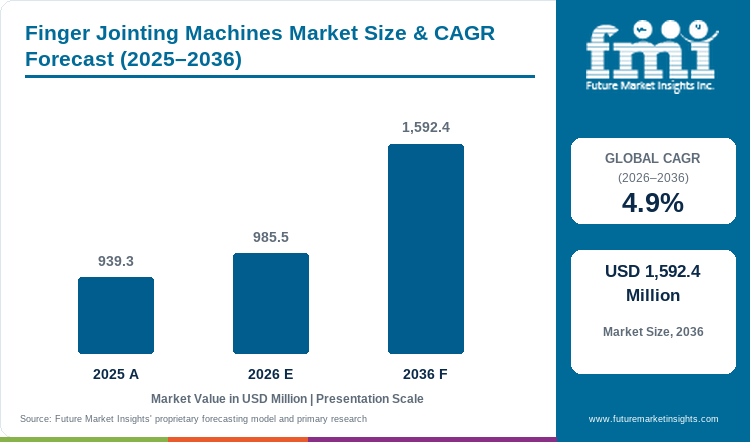
Finger jointing machines market value increased from USD 939.3 million in 2025 to USD 985.5 million in 2026 and is estimated to reach USD 1,592.4 million by 2036.
Sales of finger jointing machines are estimated to rise at 4.9% CAGR through 2036. Mills are using finger jointing to turn defect-cut short pieces into longer blanks for sale. Plants are comparing recovered wood value with equipment, glue, maintenance and service costs during line approval. Poor feeding is creating waste from pieces already saved during grading, making steady transfer as important as stated machine speed. In August 2026, Statistics Canada reported May lumber production of 3,869.8 thousand cubic meters. That output shows the scale of lumber moving through Canadian mills, where recovery equipment can protect usable wood. Mills are prioritizing fast service because one jointing-line stoppage can interrupt later planing, pressing or lamination work.
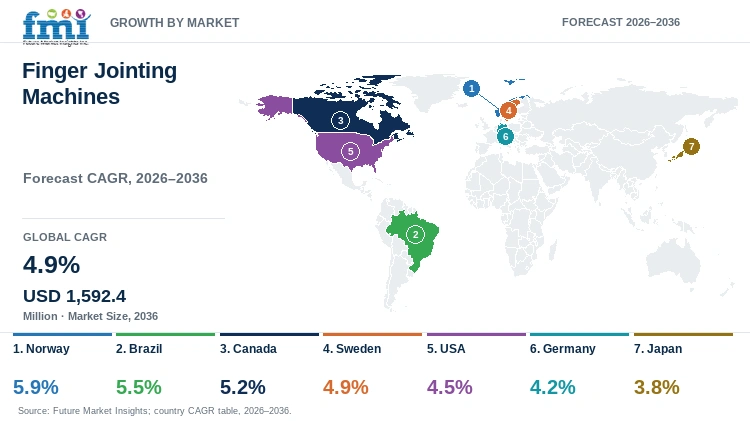
U.S. and German buyers are following different paths for finger-joint equipment. U.S. demand is projected to grow at 4.5% CAGR through 2036, while German demand is projected at 4.2% CAGR. U.S. timber construction and engineered-wood projects are creating more chances to install production lines that use finger-jointed blanks. German plants are working within older layouts, making retrofit space, safety checks and service access more important during approval. In July 2025, the U.S. Forest Service reported that thirteen mass-timber plants had opened since 2015. The added CLT and glulam capacity is creating more sites where mills can use finger-jointed blanks and lamination stock. German buyers are managing a different problem because new machines must connect with existing saws, scanners and presses. Buyers in both countries are looking for sound joints, stable glue control and smooth transfer during daily production.
Key Takeaways
- Mills are recovering usable length by joining short wood left by grading and defect cutting.
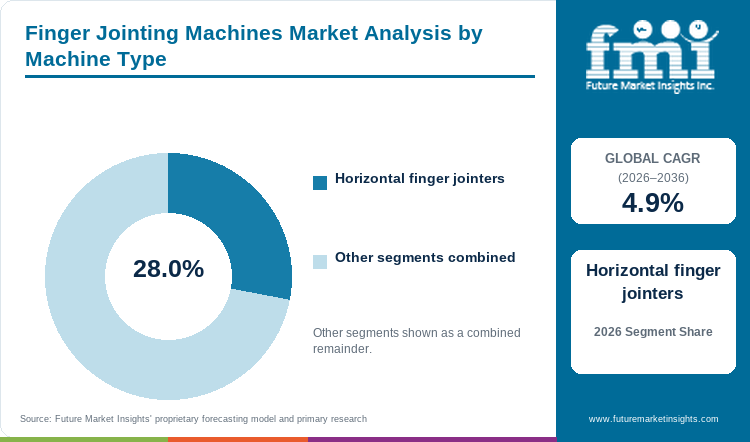
- Horizontal finger jointers are leading machine type at 28.0% in 2026. Their straight material path is keeping short pieces moving through continuous production.
- Softwood accounts for 36.0% of wood type demand in 2026. Structural and millwork plants are using large volumes of similar stock in long production runs.
- The finger jointing machines market automation category is led by fully automatic systems, which account for 39.0% in 2026. Linked feeding and pressing are reducing hand work between production steps.
- Buyers are using plant trials to confirm strong joints, stable glue control and reliable transfer during normal production.
- Key players include WEINIG Group, Weinig Grecon GmbH & Co. KG, Ledinek Engineering and Mereen-Johnson. Furnimate Wood Working Machinery Co., Ltd., Fulpow Industrial Corp. and SCM Group are supplying direct or nearby process equipment. Cantek America Inc., Holytek Industrial Corp. and James L. Taylor Manufacturing are serving plants with finger-joint systems or machines around the jointing cell.
Analyst Perspective
"Mills are favoring finger-joint lines that recover more wood without forcing a full plant rebuild. Suppliers are facing longer approval work as buyers are testing joint strength, controls, service and line fit."
- Nikhil Kaitwade, Principal Consultant, Future Market Insights
How is the finger jointing machines market segmented?
The finger jointing machines market is segmented by Machine Type, Wood Type, Automation, End Use, Sales Channel, and Region.
The report groups the market by machine type, wood type, automation, end use, sales channel and region. Machine type includes horizontal, vertical, end-matching, high-speed and compact finger jointers. Wood type includes softwood, hardwood, engineered wood blanks, reclaimed wood and laminated timber. Automation includes manual feed, semi-automatic, fully automatic and CNC-controlled systems. End use includes furniture parts, doors and windows, glulam/LVL production, mouldings and millwork and packaging pallets. Sales channel shows whether buyers are purchasing from equipment makers, project suppliers, dealers or service providers.
How do horizontal finger jointers shape machine type selection?
Horizontal systems are moving short wood through shaping and gluing into the press along one straight path. Mills are using saw blades and fixed finger profiles to keep defect-cut pieces moving without slowing the line. WEINIG is offering horizontal joints for furniture work with manual or automatic feeding.
- Horizontal finger jointers are leading the machine type category at 28.0% in 2026. Their straight path is keeping wood moving through shaping, gluing and pressing during long mill runs.
- Buyers are choosing manual or automatic loading based on staff levels and the amount of wood moving through the line.
What supports softwood demand within the wood type category?
Wood plants are using softwood in cross-laminated timber and glulam lines that need long runs at set lengths. In May 2026, the Swedish Forest Agency reported 4.6 million cubic meters of coniferous sawlog stocks. Those stocks give mills more softwood to process, but each batch requires moisture and bond checks.
- Softwood is leading the wood type category with 36.0% share in 2026. Structural and millwork plants are using large volumes of similar stock while keeping feed rates steady.
- Mills are checking moisture and finger shape on each batch because a large wood supply does not guarantee a strong bond.
How does full automation change the automation decision?
Fully automatic lines are reducing hand work during setup, transfer and stacking. Plants are using industrial robotics to feed and stack wood with less hand work. Furnimate’s UCT-J2 is combining compact finger jointing with CLT and GLT production. Operators are watching process data beside line speed and spotting control problems during each run.
- Fully automatic systems are leading automation with 39.0% share in 2026. Linked feeding and pressing are keeping wood moving at a steady rate and reducing hand work.
- Semi-automatic lines cost less than full systems and keep workers involved during frequent size changes.
Why do furniture components lead the end use category?
Furniture plants need long straight blanks, and defect cutting is leaving short offcuts during normal work. Finger jointing is returning those offcuts to furniture manufacturing by turning them into usable lengths. ASTM D5572 covers glue used for nonstructural finger joints in furniture, mouldings, windows and doors.
- Furniture components are leading the end use category with 27.0% share in 2026. Regular part sizes are creating similar cuts, and finger jointing is recovering the short pieces.
- Visible parts require careful joint placement because recovered wood must match the required size and finish.
Why do woodworking machinery OEMs lead the sales channel category?
Finger-joint lines need shaping, gluing, pressing and wood transfer to stay in step. Woodworking machinery suppliers are linking saws, wood adhesives, scanners and stacking equipment in one line. Cantek is offering an automatic stacker for its finger-joint line, extending control beyond shaping and pressing.
- Woodworking machinery OEMs are leading the sales channel category with 41.0% in 2026. Buyers are using one supplier to set up, test and start the connected machines.
- Dealers are handling standard machines with simple line connections and basic setup needs. Larger projects are using one supplier to set up, test and start several connected machines.
What are the drivers, restraints and opportunities in the Finger Jointing Machines Market?
In finger jointing machines market, recovered wood value is supporting investment, plant trials are delaying approval, and staged automation is giving medium-size mills a lower-disruption upgrade path.
- Driver: Mills are recovering more usable wood by joining short pieces into longer blanks for sale or further processing.
- Restraint: Buyers are delaying approval because plant trials must prove strong joints and stable line operation.
- Opportunity: Medium-size mills are adding feeders, sensors and controls in stages while keeping useful machines in service.
Grading and defect cutting are leaving useful lumber too short for the main product. Finger jointing is turning those pieces into longer blanks for engineered wood, furniture and millwork. Plants are comparing recovered wood value with the machine, glue, upkeep and service needed for recovery. Reliable material handling equipment is keeping short pieces moving through shaping, gluing and pressing without creating more waste. Poor feeding is twisting, misaligning or dropping pieces that workers already saved from scrap. Buyers are focusing on usable output from each load instead of the advertised speed alone.
Buyers are delaying orders while line trials prove joint strength with the plant’s actual wood, moisture range and glue. ASTM D4688/D4688M gives plants a production-line method for testing structural finger-joint adhesives. Existing industrial automation is creating another problem if scanners, saws and transfer controls cannot exchange the right signals. Plant teams are setting acceptable limits for finger shape, glue spread and press action during normal work. Service teams are assigning clear responsibility for each machine connection during startup. Buyers are holding approval if reject rates remain outside the plant’s limits. Clear test records are helping maintenance teams judge whether the system is ready for daily use.
Medium-size mills are adding automation while keeping useful machines in service. Plants are installing feed controls, motor-driven transfer systems, sensors and remote support beside existing shapers and presses. In June 2026, Natural Resources Canada announced 56 projects covering low-carbon wood, mass timber and value-added production. The program is supporting wider wood-processing upgrades without implying that every project includes finger jointing. Suppliers are adding factory automation controls to existing equipment and giving each module one clear job. Training teams are measuring wood recovery and downtime during normal production. Staged upgrades are reducing disruption because plants are testing one change at a time. Smaller mills are gaining more automation without rebuilding the full line.
Which country CAGRs are included in the Finger Jointing Machines Market?
| Country | CAGR |
|---|---|
| Norway | 5.9% |
| Brazil | 5.5% |
| Canada | 5.2% |
| Sweden | 4.9% |
| USA | 4.5% |
| Germany | 4.2% |
| Japan | 3.8% |
How do country-level CAGRs compare in the Finger Jointing Machines Market?
Country sales conditions differ because mills are operating with different plant ages, service distances and investment needs. The same machine can support a new production line in one country and a retrofit project in another.
- Norwegian mills are using automation to raise log value and reduce manual handling under domestic wood-processing programs.
- Brazilian mills are linking machine spending to wood-products output and local credit costs across furniture production centers.
- Manufacturers in Canada are relying on dependable remote service because forest-processing plants operate across wide regional distances.
- Sweden’s mature sawmills are favoring staged replacement and retrofit controls that protect output during softwood stock changes.
- Across the USA, mass-timber plant expansion is supporting lamination lines that need local startup help and machine service.
- German plants are prioritizing retrofit planning because furniture and structural-wood sites are operating within established layouts.
- Japanese mills are favoring compact machines and clear process records because floor area and qualification steps are shaping equipment approval.
Service reach, plant age and production mix are changing how buyers evaluate the same equipment. The full report covers North America, Latin America, Western Europe, Eastern Europe, East Asia, South Asia and Pacific. The full report also covers the Middle East and Africa.
Country-wise Analysis
- Norway’s finger jointing demand is projected at 5.9% CAGR through 2036. Norwegian mills are using automation to get more value from each log and reduce manual handling. In September 2025, the Ministry of Agriculture and Food described the Wood Based Innovation program as a way to create more value from wood. Automated feeding is moving short pieces through shaping, gluing and pressing with fewer hand steps. Remote support is solving smaller faults without requiring long service trips. Larger breakdowns require local technicians, spare parts and longer service visits. Buyers are choosing compact systems that fit existing mills and are easy to maintain. Suppliers are easing approval by matching controls to the plant’s actual output and avoiding features the mill does not need.
- Finger jointing machine demand in Brazil is projected at 5.5% CAGR through 2036. Brazilian mills are balancing wood recovery needs with changing credit costs and plant conditions. In June 2026, IBGE reported that wood-products output rose 8.5% from March to April. Higher output is increasing wood throughput and the volume of short pieces available for recovery. High credit costs are delaying imported machines even as mills need more capacity. Heat, dust and uneven feedstock are making imported-machine startup harder for plant teams. Local spare parts and trained technicians are reducing the risk of long stoppages. Buyers are adding capacity in stages so they can test each increase. Clear service plans are helping plants move from trials into steady daily production.
- Canada’s finger jointing demand is projected at 5.2% CAGR through 2036. Engineered-wood plants are using finger jointing inside larger lines that turn lumber into laminated wood products. In April 2026, Natural Resources Canada said the forest sector supports close to 200,000 workers and nearly 300 forest-dependent communities. The wide operating base is supporting more wood processing across long service distances. Large projects require simple controls, startup help and operator training from the first production runs. Remote checks are solving smaller faults without requiring long service trips. Major failures require local technicians, spare parts and longer service visits. Buyers value suppliers that can support the full line after installation. Stable joints during normal shifts remain the final test for each system.
- Sweden’s finger jointing demand is expected at 4.9% CAGR through 2036. Swedish sawmills are processing large softwood volumes and replacing equipment in planned stages. In August 2026, the Swedish Forest Agency reported 3.5 million cubic meters of coniferous sawlog stocks for June. The agency said stocks were 23% lower than the previous quarter. Stock changes are altering mill schedules while plants continue recovering usable wood. Buyers are comparing a new line with machines that have known service records. New controls are helping plants add equipment without rebuilding the whole mill. Planned maintenance is giving managers more predictable downtime during installation. Buyers are approving upgrades more easily as new controls work with the mill’s current production routine.
- Finger jointing machine demand in the USA is estimated at 4.5% CAGR through 2036. U.S. buyers are using these machines in mass-timber, furniture and other wood-product lines. In March 2026, USDA announced $115.2 million in loan guarantees for sawmills and wood-processing plants across eight states. The program is helping plants open, reopen, expand or improve operations. Growing plants are adding cutting, joining and lamination equipment as output needs rise. Older scanners and saws are making new lines harder to connect. Buyers are testing joint strength, glue control and material flow with their own wood. Local service and spare parts are limiting downtime across later production steps. Suppliers are easing approval by defining startup work, control links and service duties during project planning.
- Germany’s finger jointing demand is projected at 4.2% CAGR through 2036. German buyers are adding new equipment inside established furniture, window and structural-wood plants. In April 2026, Destatis reported 57.3 million cubic meters of timber logged during 2025. That supply is feeding many wood processors, while older plants are favoring upgrades over complete new lines. Floor space and safety rules are limiting machine placement inside older plants. New controls must work with older saws, planers and presses without stopping daily production. Buyers are asking for clear connection plans and simple startup tests. Buyers are approving retrofit projects more easily as maintenance routines stay familiar. Large changes are becoming harder to justify if installation creates long production stops.
- Finger jointing machine demand in Japan is predicted at 3.8% CAGR through 2036. Japanese mills are favoring compact equipment because many plants have limited floor space. In June 2026, the Forestry Agency published its fiscal 2025 report on wood use and the domestic forest industry. The report linked wider domestic timber use with more investment in wood processing. Compact or CNC-controlled machines are helping plants add capacity without rebuilding a full work area. Buyers are maintaining steady moisture, glue and joint control during product changes. Short trials are reducing lost output during machine approval for plant operators. Suppliers are matching line size to the wood each plant can process. Clear service records and simple controls are making upgrades easier for maintenance teams.
Who are the notable companies in the Finger Jointing Machines Market?
WEINIG Group, Weinig Grecon GmbH & Co. KG, Ledinek Engineering, Mereen-Johnson, Furnimate Wood Working Machinery Co., Ltd., Fulpow Industrial Corp., SCM Group, Cantek America Inc., Holytek Industrial Corp., and James L. Taylor Manufacturing.
Companies are serving the market through full solid-wood lines, direct finger-joint systems and equipment around the jointing cell. WEINIG Group and Weinig Grecon are covering several connected wood-processing steps within the same corporate group. Ledinek is combining finger jointing with larger engineered-timber lines for engineered-wood plants. Furnimate, Fulpow, Cantek and Holytek are focusing on direct or modular systems. Mereen-Johnson, SCM Group and James L. Taylor are supporting cutting, machining or clamping around the jointing process. Buyers are comparing how much of the line each supplier can handle, how well controls connect and how quickly service teams solve plant problems.
- WEINIG Group and Weinig Grecon GmbH & Co. KG are selling full solid-wood lines for large mill projects. Ledinek Engineering is combining finger jointing with complete engineered-timber production lines.
- Furnimate, Fulpow, Cantek and Holytek are selling direct or modular finger-joint systems for mills with different output needs and plant sizes.
- Mereen-Johnson and SCM Group are selling cutting, machining and control equipment around finger-joint cells. James L. Taylor Manufacturing is supplying clamping equipment for panel and door production.
Competitive Benchmarking: Finger Jointing Machines Market
| Company | Direct Finger-Joint Scope | Automation Integration | Process Support | Geographic Reach |
|---|---|---|---|---|
| WEINIG Group | High | High | High | Global |
| Weinig Grecon GmbH & Co. KG | High | High | High | WEINIG global network |
| Ledinek Engineering | High | High | High | 56 countries |
| Mereen-Johnson | Low | High | High | North America and exports |
| Furnimate Wood Working Machinery Co., Ltd. | High | High | Medium | Taiwan and export markets |
| Fulpow Industrial Corp. | High | High | High | Taiwan and export markets |
| SCM Group | Low | High | High | Global |
| Cantek America Inc. | High | High | High | USA and Canada |
| Holytek Industrial Corp. | High | Medium | Medium | Taiwan and distributor markets |
| James L. Taylor Manufacturing | Low | High | High | North America and export markets |
A High direct finger-joint scope rating means the supplier sells several finger-joint systems or manages full line projects. Medium means one direct system. Low means the company mainly sells machines used near the finger-joint process. High automation means the supplier connects feeding, robots or controls across several steps. High process support means the supplier provides nearby machines, startup help or line service.
Key Developments in the Finger Jointing Machines Market
- In June 2026, Ledinek Engineering presented a CLT and GLT combi line using X-Cut and Kontizink finger jointing.
- In April 2026, Furnimate presented the UCT-J2 compact finger-jointing machine for CLT and GLT production.
- In February 2025, WEINIG announced HS 200 robot loading for continuous finger-jointing lines ahead of LIGNA 2025.
Key Players in the Finger Jointing Machines Market
Group-integrated finger-joint platforms
- WEINIG Group
- Weinig Grecon GmbH & Co. KG
Direct finger-joint and engineered-timber line suppliers
- Ledinek Engineering
- Furnimate Wood Working Machinery Co., Ltd.
- Fulpow Industrial Corp.
- Cantek America Inc.
- Holytek Industrial Corp.
Adjacent solid-wood process integration
- Mereen-Johnson
- SCM Group
- James L. Taylor Manufacturing
Finger Jointing Machines Market - Report Scope
| Coverage field | Report scope |
|---|---|
| Market breakdown | By machine type, wood type, automation, end use, sales channel and region. |
| Quantitative Units | USD million. |
| Market Definition | Commercial finger-jointing machinery used to shape, glue, align and press solid-wood or engineered-wood pieces into longer blanks is included. Adjacent saws, planers and clamps are excluded unless sold as part of the jointing system. |
| Regions Covered | North America, Latin America, Western Europe, Eastern Europe, East Asia, South Asia and Pacific, and Middle East and Africa. |
| Countries Covered | Norway, Brazil, Canada, Sweden, USA, Germany, Japan, and 20+ countries included in the full report. |
| Key Companies Profiled | WEINIG Group, Weinig Grecon GmbH & Co. KG, Ledinek Engineering, Mereen-Johnson, Furnimate Wood Working Machinery Co., Ltd., Fulpow Industrial Corp., SCM Group, Cantek America Inc., Holytek Industrial Corp., and James L. Taylor Manufacturing. |
| Forecast Period | 2026 to 2036. |
| Approach | Primary and secondary research with market triangulation. |
Finger Jointing Machines Market - Research Methodology
| Method | Approach |
|---|---|
| Primary Research | FMI analysts gathered input from manufacturers, service providers, technology developers, distributors, end users, procurement teams, and subject-matter experts. Interviews examined purchasing decisions, product or service evaluation, adoption barriers, approval requirements, pricing considerations, and expectations for technical or commercial support. Respondents were also asked what evidence is required before a trial, pilot, or initial order develops into regular purchasing. |
| Desk Research | Desk research covered government statistics, regulatory publications, trade data, industry associations, technical literature, standards, company filings, product information, and official corporate announcements. Sources were reviewed for relevance, publication date, geographic coverage, and consistency with the defined market scope. Claims relating to performance, applications, approvals, capacity, investment, and commercial activity were retained only when supported by credible public evidence. |
| Market Sizing and Forecasting | The market model combined the baseline value with historical performance, segment structure, pricing and volume indicators, adoption levels, company participation, and country-level demand conditions. Forecast assumptions considered economic activity, investment trends, regulatory developments, technology adoption, purchasing cycles, supply availability, and barriers to wider market use. Segment and regional estimates were reconciled before the final market total was calculated. |
| Data Validation | Estimates were checked against multiple independent indicators, including public data, company activity, trade patterns, industry developments, and findings from primary interviews. Validation also tested whether products, services, applications, and company revenues fell within the defined market boundaries. Adjacent categories, unsupported claims, overlapping revenues, and activities without direct market relevance were excluded to reduce double counting and maintain consistency across segments and countries. |
Finger Jointing Machines Market by Segments
Finger Jointing Machines Market segmented by Machine Type:
- Horizontal finger jointers
- Vertical finger jointers
- End-matching lines
- High-speed finger joint lines
- Compact finger joint machines
Finger Jointing Machines Market segmented by Wood Type:
- Softwood
- Hardwood
- Engineered wood blanks
- Reclaimed wood
- Laminated timber
Finger Jointing Machines Market segmented by Automation:
- Fully automatic
- Semi-automatic
- Manual feed
- CNC-controlled
Finger Jointing Machines Market segmented by End Use:
- Furniture components
- Doors and windows
- Glulam/LVL production
- Mouldings and millwork
- Packaging pallets
Finger Jointing Machines Market segmented by Sales Channel:
- Woodworking machinery OEMs
- Sawmill projects
- Dealer/distributor network
- Aftermarket/service
Finger Jointing Machines Market by Region:
- North America
- United States
- Canada
- Latin America
- Brazil
- Mexico
- Chile
- Rest of Latin America
- Western Europe
- Germany
- United Kingdom
- Italy
- Spain
- France
- Nordics
- Benelux
- Rest of Western Europe
- Eastern Europe
- Russia
- Poland
- Hungary
- Balkan and Baltic States
- Rest of Eastern Europe
- East Asia
- China
- Japan
- South Korea
- South Asia and Pacific
- India
- ASEAN
- Australia and New Zealand
- Rest of South Asia and Pacific
- Middle East and Africa
- Kingdom of Saudi Arabia
- Other GCC Countries
- Türkiye
- South Africa
- Other African Union Countries
- Rest of Middle East and Africa
Research Sources and Bibliography
- Food and Agriculture Organization of the United Nations. (2025, December 24). Global forest products trade and production show signs of recovery in 2024. https://www.fao.org/newsroom/detail/global-forest-products-trade-and-production-show-signs-of-recovery-in-2024/ [fao.org]
- WoodWorks. (n.d.). Mapping Mass Timber. Retrieved September 21, 2026.
- WEINIG Group. (n.d.). Finger jointing with WEINIG: for a strong connection. Retrieved September 21, 2026.
- Swedish Forest Agency. (2026, May 7). Increasing stocks of coniferous sawlogs and pulpwood. https://www.skogsstyrelsen.se/en/news/increasing-stocks-of-coniferous-sawlogs-and-pulpwood/
- Taiwan External Trade Development Council. (2026, March 12). WOOD TAIWAN 2026 | Preview of Highlights in the Machinery & Equipment Zone.
- ASTM International. (2019). D5572-95(2019) Standard Specification for Adhesives Used for Finger Joints in Nonstructural Lumber Products.
- Cantek America Inc. (n.d.). Cantek F-K01 Automatic Stacker. Retrieved September 21, 2026.
- Cantek America Inc. (n.d.). Finger Jointers. Retrieved September 24, 2026.
- Food and Agriculture Organization of the United Nations. (2024, December 10). Global forest products facts and figures 2023 shows fall in global trade in wood and paper products.
- ASTM International. (2021, April 20). D4688/D4688M-14(2021)e1 Standard Test Method for Evaluating Structural Adhesives for Finger Jointing Lumber.
- Natural Resources Canada. (2026, June 3). Canada advances forest sector transformation to protect jobs and strengthen communities nationwide.
- Statistics Canada. (2026, August 6). Sawmills, May 2026.
- Norwegian Ministry of Agriculture and Food. (2025, September 10). Use of wood.
- Brazilian Institute of Geography and Statistics. (2026, June 3). Brazilian industrial production changed 0.7% in April.
- Natural Resources Canada. (2026, April 16). Statement by the Minister of Energy and Natural Resources on the conclusion of the Canadian Forest Sector Transformation Task Force’s mandate.
- Swedish Forest Agency. (2026, August 18). Coniferous sawlogs decreased in three out of four timber balance regions.
- U.S. Forest Service. (2025, July 2). Scaling up mass timber: Closing gaps, fueling innovation.
- U.S. Department of Agriculture, Rural Development. (2026, March 23). USDA Announces $115.2 Million Investment to Expand Timber Production and Enhance Forest Health in Eight States.
- Federal Statistical Office of Germany. (2026, April 15). Amount of damaged timber logged dropped to 12.7 million cubic metres in 2025.
- Forestry Agency of Japan. (2026, June 2). Annual Report on Forest and Forestry in Japan Fiscal Year 2025.
- Ledinek Engineering. (2026, June 8). Opportunities like this do not come along every day.
- WEINIG Group. (2026, February 20). After investment offensive: WEINIG consolidates production.
- WEINIG Group. (n.d.). Finger jointing lines. Retrieved September 21, 2026.
- Ledinek Engineering. (n.d.). Finger jointing. Retrieved September 21, 2026.
- Furnimate Wood Working Machinery Co., Ltd. (n.d.). FAH series - Horizontal finger joint system. Retrieved September 21, 2026.
- Fulpow Industrial Corp. (n.d.). Finger Joint System. Retrieved September 21, 2026.
- SCM Group. (n.d.). SCM woodworking machines and systems. Retrieved September 21, 2026.
- Mereen-Johnson. (2026). Join Mereen-Johnson at IWF 2026.
- James L. Taylor Manufacturing. (2026). IWF 2026: James L. Taylor Manufacturing - Next-Generation Woodworking Equipment.
- Ledinek Engineering. (2026, May 26). Highly complex, high-performance line.
- SCM Group. (2026, March 16). SCM Open House Rimini 2026.
- SCM Group. (2026, September 8). SCM’s new Accord 500 Edge awarded at IWF 2026.
- Ledinek Engineering. (2026, March 30). Spearhead builds a new GL line.
- SCM Group. (2026, August 6). Great solutions for large-format constructions: SCM at Mass Timber+.
- WEINIG Group. (2025, February 20). WEINIG at LIGNA 2025: Innovation meets tradition.
The bibliography lists selected sources used in this article. The full report contains the complete reference list and detailed citations.
This Report Answers
- How large is the finger jointing machines market in 2026 and 2036?
- How does wood recovery support a finger jointing machine purchase?
- Which machine type holds 28.0% of machine type revenue in 2026?
- Why does softwood hold 36.0% of wood type demand in 2026?
- How does full automation change labor and process control?
- Which end-use and sales-channel categories hold leading shares?
- Why do local conditions create different buying conditions across the seven countries?
- Which companies supply finger-joint or nearby process equipment?
- Which testing and line-fit issues delay equipment approval?
Frequently Asked Questions
How big is the finger jointing machines market in 2026?
The finger jointing machines market is valued at USD 985.5 million in 2026. The value is projected to reach USD 1,592.4 million by 2036 as mills are using finger jointing to recover more usable wood.
What is the CAGR of the finger jointing machines market from 2026 to 2036?
The finger jointing machines market is projected to grow at 4.9% CAGR between 2026 and 2036. Wood recovery and staged automation are supporting investment as mills are measuring usable output from each load.
Which machine type leads the finger jointing machines market in 2026?
The finger jointing machines market is led by horizontal finger jointers, which account for 28.0% of machine type revenue in 2026. Their straight material path is keeping short pieces moving through shaping, gluing and pressing.
Which automation segment leads the finger jointing machines market in 2026?
The finger jointing machines market automation category is led by fully automatic systems, which account for 39.0% in 2026. Linked feeding and pressing are reducing hand work and variation across long production runs.
Which companies are active in the finger jointing machines market?
Active companies include WEINIG Group, Weinig Grecon, Ledinek, Furnimate, Fulpow, Cantek and Holytek, which are selling finger-joint systems or full lines. Mereen-Johnson, SCM Group and James L. Taylor Manufacturing are supplying cutting, machining or clamping equipment around the jointing cell.
Preview the report firsthand - request a free sample
Get SampleGet the brochure for pricing and purchase details.
Get PDFTable of Content
- Key Takeaways
- Market Size and CAGR
- Top Growth Driver
- Fastest Growing Segment
- Leading Region
- Key Companies
- Emerging Opportunities
- Executive Summary
- Global Market Outlook
- Demand-side Trends
- Supply-side Trends
- Technology Roadmap Analysis
- Analysis and Recommendations
- Analyst Perspective (What is happening? Why now? What should investors know?)
- Key Questions Answered
- How large is the market?
- What is the CAGR?
- What are key trends?
- Which region dominates?
- Who are the leaders?
- Market Overview
- Market Coverage / Taxonomy
- Market Definition / Scope / Limitations
- Research Methodology
- Chapter Orientation
- Analytical Lens and Working Hypotheses
- Market Structure, Signals, and Trend Drivers
- Benchmarking and Cross-market Comparability
- Market Sizing, Forecasting, and Opportunity Mapping
- Research Design and Evidence Framework
- Desk Research Programme (Secondary Evidence)
- Expert Input and Fieldwork (Primary Evidence)
- Tooling, Models, and Reference Databases
- Data Engineering and Model Build
- Quality Assurance and Audit Trail
- Market Background
- Market Dynamics (Drivers, Restraints, Opportunity, Trends)
- Scenario Forecast (Optimistic, Likely, Conservative)
- Impact Analysis
- AI Impact
- Sustainability Impact
- Regulatory Impact
- Technology Impact
- Consumer / Buyer Analysis
- Purchase Drivers
- Adoption Barriers
- Buyer Journey
- Opportunity Map Analysis
- Product Life Cycle Analysis
- Supply Chain Analysis
- Investment Feasibility Matrix
- Value Chain Analysis
- PESTLE and Porter's Analysis
- Regulatory Landscape
- Regional Parent Market Outlook
- Production and Consumption Statistics
- Import and Export Statistics
- Global Market Analysis and Forecast, 2021 to 2036
- Historical Market Size Value (USD Million) Analysis, 2021 to 2025
- Current and Future Market Size Value (USD Million) Projections, 2026 to 2036
- Y-o-Y Growth Trend Analysis
- Absolute $ Opportunity Analysis
- Global Market Pricing Analysis, 2021 to 2036
- Global Market Analysis and Forecast, By Machine Type, 2021 to 2036
- Introduction / Key Findings
- Historical Market Size Value (USD Million) Analysis By Machine Type, 2021 to 2025
- Current and Future Market Size Value (USD Million) Analysis and Forecast By Machine Type, 2026 to 2036
- Horizontal finger jointers
- Vertical finger jointers
- End-matching lines
- High-speed finger joint lines
- Compact finger joint machines
- Y-o-Y Growth Trend Analysis By Machine Type, 2021 to 2025
- Absolute $ Opportunity Analysis By Machine Type, 2026 to 2036
- Global Market Analysis and Forecast, By Wood Type, 2021 to 2036
- Introduction / Key Findings
- Historical Market Size Value (USD Million) Analysis By Wood Type, 2021 to 2025
- Current and Future Market Size Value (USD Million) Analysis and Forecast By Wood Type, 2026 to 2036
- Softwood
- Hardwood
- Engineered wood blanks
- Reclaimed wood
- Laminated timber
- Y-o-Y Growth Trend Analysis By Wood Type, 2021 to 2025
- Absolute $ Opportunity Analysis By Wood Type, 2026 to 2036
- Global Market Analysis and Forecast, By Automation, 2021 to 2036
- Introduction / Key Findings
- Historical Market Size Value (USD Million) Analysis By Automation, 2021 to 2025
- Current and Future Market Size Value (USD Million) Analysis and Forecast By Automation, 2026 to 2036
- Fully automatic
- Semi-automatic
- Manual feed
- CNC-controlled
- Y-o-Y Growth Trend Analysis By Automation, 2021 to 2025
- Absolute $ Opportunity Analysis By Automation, 2026 to 2036
- Global Market Analysis and Forecast, By End Use, 2021 to 2036
- Introduction / Key Findings
- Historical Market Size Value (USD Million) Analysis By End Use, 2021 to 2025
- Current and Future Market Size Value (USD Million) Analysis and Forecast By End Use, 2026 to 2036
- Furniture components
- Doors and windows
- Glulam/LVL production
- Mouldings and millwork
- Packaging pallets
- Y-o-Y Growth Trend Analysis By End Use, 2021 to 2025
- Absolute $ Opportunity Analysis By End Use, 2026 to 2036
- Global Market Analysis and Forecast, By Sales Channel, 2021 to 2036
- Introduction / Key Findings
- Historical Market Size Value (USD Million) Analysis By Sales Channel, 2021 to 2025
- Current and Future Market Size Value (USD Million) Analysis and Forecast By Sales Channel, 2026 to 2036
- Woodworking machinery OEMs
- Sawmill projects
- Dealer/distributor network
- Aftermarket/service
- Y-o-Y Growth Trend Analysis By Sales Channel, 2021 to 2025
- Absolute $ Opportunity Analysis By Sales Channel, 2026 to 2036
- Global Market Analysis and Forecast, By Region, 2021 to 2036
- Introduction
- Historical Market Size Value (USD Million) Analysis By Region, 2021 to 2025
- Current Market Size Value (USD Million) Analysis and Forecast By Region, 2026 to 2036
- North America
- Latin America
- Western Europe
- Eastern Europe
- East Asia
- South Asia and Pacific
- Middle East and Africa
- Market Attractiveness Analysis By Region
- North America Market Analysis and Forecast, By Country, 2021 to 2036
- Historical Market Size Value (USD Million) Trend Analysis By Market Taxonomy, 2021 to 2025
- Market Size Value (USD Million) Forecast By Market Taxonomy, 2026 to 2036
- By Country
- United States
- Canada
- By Machine Type
- By Wood Type
- By Automation
- By End Use
- By Sales Channel
- By Country
- Market Attractiveness Analysis
- By Country
- By Machine Type
- By Wood Type
- By Automation
- By End Use
- By Sales Channel
- Key Takeaways
- Latin America Market Analysis and Forecast, By Country
- Historical Market Size Value (USD Million) Trend Analysis By Market Taxonomy, 2021 to 2025
- Market Size Value (USD Million) Forecast By Market Taxonomy, 2026 to 2036
- By Country
- Brazil
- Mexico
- Chile
- Rest of Latin America
- By Machine Type
- By Wood Type
- By Automation
- By End Use
- By Sales Channel
- By Country
- Market Attractiveness Analysis
- By Country
- By Machine Type
- By Wood Type
- By Automation
- By End Use
- By Sales Channel
- Key Takeaways
- Western Europe Market Analysis and Forecast, By Country
- Historical Market Size Value (USD Million) Trend Analysis By Market Taxonomy, 2021 to 2025
- Market Size Value (USD Million) Forecast By Market Taxonomy, 2026 to 2036
- By Country
- Germany
- United Kingdom
- Italy
- Spain
- France
- Nordics
- Benelux
- Rest of Western Europe
- By Machine Type
- By Wood Type
- By Automation
- By End Use
- By Sales Channel
- By Country
- Market Attractiveness Analysis
- By Country
- By Machine Type
- By Wood Type
- By Automation
- By End Use
- By Sales Channel
- Key Takeaways
- Eastern Europe Market Analysis and Forecast, By Country
- Historical Market Size Value (USD Million) Trend Analysis By Market Taxonomy, 2021 to 2025
- Market Size Value (USD Million) Forecast By Market Taxonomy, 2026 to 2036
- By Country
- Russia
- Poland
- Hungary
- Balkan and Baltic States
- Rest of Eastern Europe
- By Machine Type
- By Wood Type
- By Automation
- By End Use
- By Sales Channel
- By Country
- Market Attractiveness Analysis
- By Country
- By Machine Type
- By Wood Type
- By Automation
- By End Use
- By Sales Channel
- Key Takeaways
- East Asia Market Analysis and Forecast, By Country
- Historical Market Size Value (USD Million) Trend Analysis By Market Taxonomy, 2021 to 2025
- Market Size Value (USD Million) Forecast By Market Taxonomy, 2026 to 2036
- By Country
- China
- Japan
- South Korea
- By Machine Type
- By Wood Type
- By Automation
- By End Use
- By Sales Channel
- By Country
- Market Attractiveness Analysis
- By Country
- By Machine Type
- By Wood Type
- By Automation
- By End Use
- By Sales Channel
- Key Takeaways
- South Asia and Pacific Market Analysis and Forecast, By Country
- Historical Market Size Value (USD Million) Trend Analysis By Market Taxonomy, 2021 to 2025
- Market Size Value (USD Million) Forecast By Market Taxonomy, 2026 to 2036
- By Country
- India
- ASEAN
- Australia and New Zealand
- Rest of South Asia and Pacific
- By Machine Type
- By Wood Type
- By Automation
- By End Use
- By Sales Channel
- By Country
- Market Attractiveness Analysis
- By Country
- By Machine Type
- By Wood Type
- By Automation
- By End Use
- By Sales Channel
- Key Takeaways
- Middle East and Africa Market Analysis and Forecast, By Country
- Historical Market Size Value (USD Million) Trend Analysis By Market Taxonomy, 2021 to 2025
- Market Size Value (USD Million) Forecast By Market Taxonomy, 2026 to 2036
- By Country
- Kingdom of Saudi Arabia
- Other GCC Countries
- Türkiye
- South Africa
- Other African Union Countries
- Rest of Middle East and Africa
- By Machine Type
- By Wood Type
- By Automation
- By End Use
- By Sales Channel
- By Country
- Market Attractiveness Analysis
- By Country
- By Machine Type
- By Wood Type
- By Automation
- By End Use
- By Sales Channel
- Key Takeaways
- Key Countries Market Analysis
- United States
- Pricing Analysis
- Market Share Analysis, 2025
- By Machine Type
- By Wood Type
- By Automation
- By End Use
- By Sales Channel
- Canada
- Pricing Analysis
- Market Share Analysis, 2025
- By Machine Type
- By Wood Type
- By Automation
- By End Use
- By Sales Channel
- Mexico
- Pricing Analysis
- Market Share Analysis, 2025
- By Machine Type
- By Wood Type
- By Automation
- By End Use
- By Sales Channel
- Brazil
- Pricing Analysis
- Market Share Analysis, 2025
- By Machine Type
- By Wood Type
- By Automation
- By End Use
- By Sales Channel
- Chile
- Pricing Analysis
- Market Share Analysis, 2025
- By Machine Type
- By Wood Type
- By Automation
- By End Use
- By Sales Channel
- Germany
- Pricing Analysis
- Market Share Analysis, 2025
- By Machine Type
- By Wood Type
- By Automation
- By End Use
- By Sales Channel
- United Kingdom
- Pricing Analysis
- Market Share Analysis, 2025
- By Machine Type
- By Wood Type
- By Automation
- By End Use
- By Sales Channel
- Italy
- Pricing Analysis
- Market Share Analysis, 2025
- By Machine Type
- By Wood Type
- By Automation
- By End Use
- By Sales Channel
- Spain
- Pricing Analysis
- Market Share Analysis, 2025
- By Machine Type
- By Wood Type
- By Automation
- By End Use
- By Sales Channel
- France
- Pricing Analysis
- Market Share Analysis, 2025
- By Machine Type
- By Wood Type
- By Automation
- By End Use
- By Sales Channel
- India
- Pricing Analysis
- Market Share Analysis, 2025
- By Machine Type
- By Wood Type
- By Automation
- By End Use
- By Sales Channel
- ASEAN
- Pricing Analysis
- Market Share Analysis, 2025
- By Machine Type
- By Wood Type
- By Automation
- By End Use
- By Sales Channel
- Australia and New Zealand
- Pricing Analysis
- Market Share Analysis, 2025
- By Machine Type
- By Wood Type
- By Automation
- By End Use
- By Sales Channel
- China
- Pricing Analysis
- Market Share Analysis, 2025
- By Machine Type
- By Wood Type
- By Automation
- By End Use
- By Sales Channel
- Japan
- Pricing Analysis
- Market Share Analysis, 2025
- By Machine Type
- By Wood Type
- By Automation
- By End Use
- By Sales Channel
- South Korea
- Pricing Analysis
- Market Share Analysis, 2025
- By Machine Type
- By Wood Type
- By Automation
- By End Use
- By Sales Channel
- Russia
- Pricing Analysis
- Market Share Analysis, 2025
- By Machine Type
- By Wood Type
- By Automation
- By End Use
- By Sales Channel
- Poland
- Pricing Analysis
- Market Share Analysis, 2025
- By Machine Type
- By Wood Type
- By Automation
- By End Use
- By Sales Channel
- Hungary
- Pricing Analysis
- Market Share Analysis, 2025
- By Machine Type
- By Wood Type
- By Automation
- By End Use
- By Sales Channel
- Kingdom of Saudi Arabia
- Pricing Analysis
- Market Share Analysis, 2025
- By Machine Type
- By Wood Type
- By Automation
- By End Use
- By Sales Channel
- Türkiye
- Pricing Analysis
- Market Share Analysis, 2025
- By Machine Type
- By Wood Type
- By Automation
- By End Use
- By Sales Channel
- South Africa
- Pricing Analysis
- Market Share Analysis, 2025
- By Machine Type
- By Wood Type
- By Automation
- By End Use
- By Sales Channel
- Norway
- Pricing Analysis
- Market Share Analysis, 2025
- By Machine Type
- By Wood Type
- By Automation
- By End Use
- By Sales Channel
- Sweden
- Pricing Analysis
- Market Share Analysis, 2025
- By Machine Type
- By Wood Type
- By Automation
- By End Use
- By Sales Channel
- United States
- Market Structure Analysis
- Competition Dashboard
- Competition Benchmarking
- Market Share Analysis of Top Players
- By Regional
- By Machine Type
- By Wood Type
- By Automation
- By End Use
- By Sales Channel
- Emerging Startups
- Innovation Benchmarking
- Competition Analysis
- Competition Deep Dive
- WEINIG Group
- Overview
- Product Portfolio
- Profitability by Market Segments
- Sales Footprint
- Strategy Overview
- Marketing Strategy
- Product Strategy
- Channel Strategy
- Weinig Grecon GmbH & Co. KG
- Ledinek Engineering
- Mereen-Johnson
- Furnimate Wood Working Machinery Co., Ltd.
- Fulpow Industrial Corp.
- SCM Group
- Cantek America Inc.
- Holytek Industrial Corp.
- James L. Taylor Manufacturing
- WEINIG Group
- Case Studies
- Success Stories
- Recent Developments
- Competition Deep Dive
- Assumptions & Acronyms Used


