

- Market Size (2026)
- USD 860.7 Mn
- Forecast (2036)
- USD 1428.9 Mn
- CAGR (2026 to 2036)
- 5.2%
How big is Finger-Joint Adhesives Market in 2026?
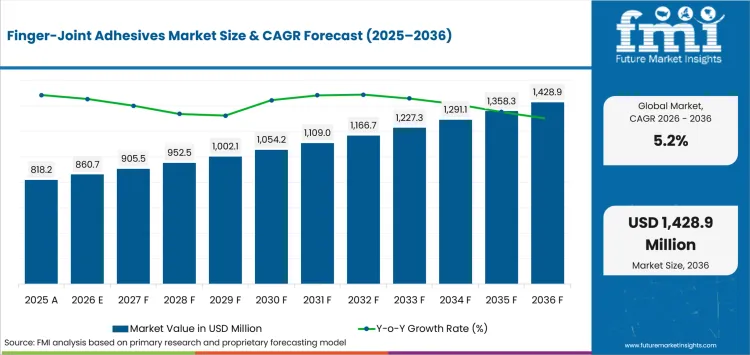
USD 860.7 million in 2026 and USD 1,428.9 million by 2036 at a 5.2% CAGR.
Demand for finger-joint adhesives is projected to expand at 5.2% CAGR between 2026 and 2036, increasing valuation from USD 860.7 million in 2026 to USD 1,428.9 million by 2036. Mills buy more wood adhesives when finger jointing recovers saleable length without sacrificing line yield or bond qualification. By the end of 2025, the American Wood Council counted 44 states or adopting jurisdictions using 2021 or 2024 IBC mass-timber provisions. Each mill still validates species, spread rate and press conditions before changing adhesive.
Mexico's 6.0% CAGR exceeds Canada's 4.6%, with fragmented conversion accounts raising the value of local stock and technical service. Data México recorded 38,586 wood-product manufacturing economic units in May 2026. That account density makes regional wood adhesives and binders distributors more relevant, although mill-level species, press and cure validation still controls formulation changes.
Key Takeaways
- Finger-joint adhesive demand rises when mills convert defect-trimmed lumber into saleable lengths without sacrificing press throughput or qualified bond performance.
- Based on chemistry, PVAc adhesives are projected to account for 31.0% in 2026 due to familiar water-based handling on nonstructural lines.
- In 2026, softwood is expected to lead wood type with 48.0% share because coniferous lumber feeds many industrial finger-joint lines.
- By cure method, cold press is forecast to represent 38.0% in 2026 driven by plants that retain existing press assets.
- Species, moisture, finger geometry, spread rate and cure conditions can extend qualification following a mill change to chemistry or operating parameters.
- Some of the key players in this market include Franklin International, AkzoNobel, Dynea, Henkel, Jowat, Kleiberit, Kiilto, and H.B. Fuller.
Analyst Perspective
"Finger-joint adhesive economics are decided at the press line, not at the price list. A formulation earns repeat orders by holding bond strength within the mill's species, moisture, spread-rate and cure window."
- Nikhil Kaitwade, Principal Consultant, Future Market Insights
How is the finger-joint adhesives market segmented?
The finger-joint adhesives market is segmented by chemistry, wood type, cure method, end use, sales channel and region.
Chemistry includes PVAc, EPI, PUR, MUF and PRF adhesives. Wood type covers softwood, hardwood, engineered lumber and reclaimed wood. Cure method separates cold press, radio-frequency cure, hot press and moisture cure. End use covers millwork, furniture components, structural lumber, mouldings and door or window components. Sales channel includes lumber mills, woodworking distributors, direct adhesive producers and equipment-linked supply. Region completes the taxonomy.
What makes PVAc adhesives central to the chemistry category?
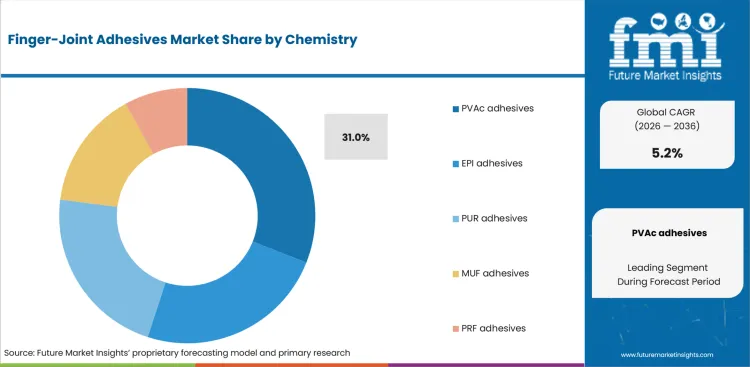
PVAc systems fit nonstructural lines since water-based handling works with familiar pumps and spreaders. In May 2025, Kiilto documented a D4-class PVAc route for finger-jointed windows and doors through WRD 4700 UV. Plants can raise moisture resistance without shifting every job into structural chemistry.
- Based on chemistry, PVAc adhesives are projected to account for 31.0% in 2026 due to familiar application practice on regular nonstructural production.
- Industrial adhesives still have to maintain joint strength at the plant's actual spread rate, temperature and finishing sequence before a mill approves the formulation.
Why does softwood lead the wood type category?
Softwood gives finger-joint lines a steady feedstock stream once defects are removed from graded coniferous lumber. ISO completed its 2025 review on April 11 and confirmed ISO 10983:2014, which states that most structural finger joints use coniferous species. That production base keeps recovery economics visible at sawmills and component plants.
- By wood type, softwood is estimated to hold 48.0% in 2026 owing to routine conifer processing near existing finger-joint capacity.
- Species-specific bonding evidence is required for timber construction plants to transfer a softwood specification to another wood type.
How does cold press anchor the cure method category?
Cold pressing suits mills meeting output targets without radio-frequency equipment. Dynea documented in November 2025 that Prefere 4546/5096 can switch between cold-press and radio-frequency processing through hardener control. Plants gain that flexibility if open time and press time stay inside the operating window.
- In 2026, cold press is expected to lead cure method with 38.0% share because plants can retain familiar press assets and tune cycle time through chemistry.
- The adoption decision compares polyurethane adhesives and other chemistries against line speed, wood moisture and the cost of extending a press cycle during regular production.
What supports millwork in the end use category?
Millwork plants use finger joints to extend clear stock once defects are removed. ISO reconfirmed ISO 17087:2006 on July 18, 2025, covering nonstructural finger-jointed mouldings plus window and door components. Adhesive selection follows the exposure class and finishing sequence.
- By end use, millwork is forecast to represent 27.0% in 2026 driven by repeated conversion of shorter wood into longer visible components with defined bond requirements.
- Manufacturers serving residential interior wood doors gain more from stable cure and finishing compatibility than from a lower adhesive price that raises rework exposure.
What are the drivers, restraints and opportunities in the Finger-Joint Adhesives Market?
Mill value recovery supports demand, process requalification limits switching, and certified structural systems widen higher-value applications.
- Driver: Mills recover usable value from shorter wood sections while protecting throughput through longer specified components.
- Restraint: Species, moisture, joint geometry and cure conditions can extend qualification work following an adhesive or process change.
- Opportunity: Certified systems covering more species and press routes can shorten the path from plant trial to repeat structural production.
Finger jointing improves mill economics if recovered material leaves the press at production speed. Natural Resources Canada announced on March 20, 2025 that Chantiers Chibougamau would modernize finger-jointed lumber, glulam, I-joist and cross-laminated timber production. Higher throughput increases adhesive use once spread accuracy and cure control preserve qualified bond performance.
Switching becomes harder once an adhesive is tied to a certified product and a known plant recipe. Natural Resources Canada's March 19, 2025 project record says Tolko's finger-jointed panel study included testing required for final product certification. The same friction applies to adhesives and sealants as requalification can erase the apparent saving from a cheaper formulation.
Structural timber expands the revenue pool for systems that can pass project and mill qualification beyond conventional lumber dimensions. WoodWorks counted 2,833 USA multifamily, commercial or institutional mass-timber projects in progress or built as of June 2026. Construction adhesives that reduce trial work for new species or press routes can reach repeat specifications faster.
Which country CAGRs are profiled in the Finger-Joint Adhesives Market?
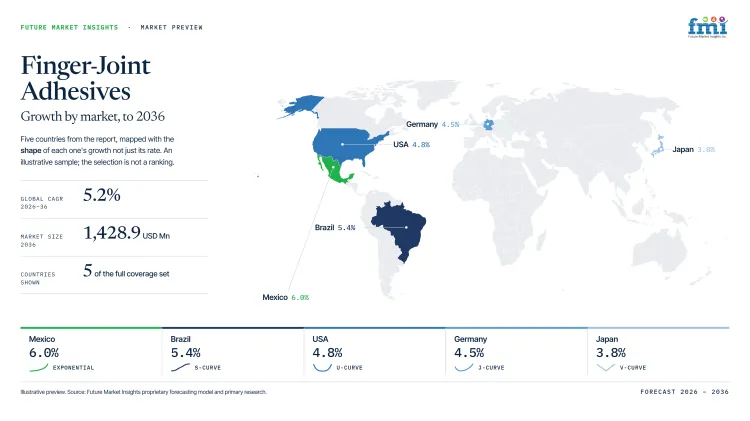
| Country | CAGR |
|---|---|
| Mexico | 6.0% |
| Brazil | 5.4% |
| Poland | 5.2% |
| USA | 4.8% |
| Canada | 4.6% |
| Germany | 4.5% |
| Japan | 3.8% |
How do country-level CAGRs compare in the Finger-Joint Adhesives Market?
The seven country forecasts split into a faster Latin American and Polish group, a middle band spanning the USA through Germany, and a slower Japanese outlook. The 2.2-point gap between Mexico at 6.0% and Japan at 3.8% reflects different mill structures and replacement conditions, not a ranking of present market size.
- Mexico's fragmented mills increase the value of local stock.
- Brazil's plantation base requires species-specific bonding trials.
- Polish export joinery rewards stable press schedules.
- USA housing cycles shift component-line utilization quickly.
- Canada's softwood clusters shorten feedstock routes.
- German automation exposes press-window losses immediately.
- Japanese pre-cut routines favor dimensional consistency.
Similar CAGRs can therefore produce different entry costs and service requirements. The full report provides country-level CAGR analysis across North America, Latin America, Western Europe, Eastern Europe, East Asia, South Asia and Pacific, and Middle East and Africa.
Country-wise Analysis
- Mexico's finger-joint accounts are scattered among small sawmills, so plant trials depend on nearby distributor stock and technicians who can reach processors without costly repeat visits. In May 2026, Data México counted 1,199 sawmilling and wood-preservation units including 464 in Michoacán, while local demand is forecast to grow at 6.0% CAGR through 2036 since short-stock recovery can raise saleable output at these smaller mills. Fragmented order volumes make direct producer coverage expensive, leaving regional distributors best placed to turn successful trials into repeat orders while keeping dosing support and replacement inventory close to each mill during each qualification cycle.
- Brazilian mills process plantation timber under species and moisture conditions that vary materially by region, so a formulation proven at one site cannot transfer without local bonding trials. IBGE documented forestry activity in 4,921 municipalities in September 2025, while species variation and long service routes raise qualification costs outside the main timber-processing clusters. Given the scale of value-added wood processing, finger-joint adhesive sales in Brazil are projected to rise at 5.4% CAGR through 2036, favoring companies that run trials near major processors and prove stable bond performance under local conditions before a mill replaces its qualified incumbent adhesive.
- Polish finger-joint lines serve furniture, joinery and construction exporters whose missed press windows can disrupt scheduled outbound production and quality claims. Statistics Poland reported in July 2026 that 2025 sold production of wood products excluding furniture rose 10.5%, while energy costs and qualification work can delay chemistry changes at tightly scheduled plants. Tied to material-yield pressure in export production, Poland is estimated to post 5.2% CAGR through 2036, so challengers need measurable press-time or reject-rate gains that survive audits and justify revalidation instead of relying on price discounts that cannot offset production risk at export plants during peak schedules.
- USA component mills separate structural and nonstructural finger-joint routes, which makes qualification evidence more important than broad woodworking coverage during a formulation change or line expansion. The USA Census Bureau published July 2026 single-family starts at an annualized 808,000 units following a 9.9% monthly decline, and demand is likely to register 4.8% CAGR through 2036 aided by the country's large furniture and wood-component production base. Housing volatility can change line loading quickly, so new adhesive programs need mill-level trial data and flexible supply planning before plants trade known yield for lower formulation cost or unfamiliar service arrangements.
- Canadian finger-joint production operates near a large softwood-processing base, reducing raw-material distance for mills that convert shorter lumber into engineered components and keeping technical trials close to western and Quebec wood clusters. Statistics Canada recorded 2,905.2 thousand cubic metres of December 2025 lumber output in its March 2026 release, down 12.8% from a year earlier, which makes variable inventory commitments a practical service constraint. Reflecting continued engineered-wood investment, Canada is positioned to record 4.6% CAGR through 2036, but field coverage must contract with mill output so service costs do not burden plants during weaker lumber cycles.
- German wood processors run automated lines where small changes in cure time or reject rate affect throughput quickly, making repeatable process data central to adhesive qualification and line-change decisions. Destatis measured 57.3 million cubic metres of timber logging in 2025, and finger-joint adhesive demand in Germany may progress at 4.5% CAGR through 2036 attributable to mature mills' continued pressure on yield recovery from available wood. Formal qualification slows chemistry changes, so challengers must prove a better press window or lower reject exposure on audited lines to win a new specification or broader account coverage at mature German plants.
- Japanese component plants work within mature pre-cut housing routines that tolerate little dimensional variation, so local application evidence carries more weight than a broad international product record. A November 2025 Forestry Agency table put 2024 wood self-sufficiency at 42.5% and building-use wood at 52.9%, while mixed domestic and imported feedstock raises species-control requirements and protects long-standing mill specifications. Supported by continued domestic wood-use policy, sales are on track to deliver 3.8% CAGR through 2036, yet companies need local proof and steady supply to displace established chemistry in a market replacing specifications more slowly than faster-growth countries during production trials.
Who are the notable companies in the Finger-Joint Adhesives Market?
Franklin International, AkzoNobel, Dynea, Henkel, Jowat, Kleiberit, Kiilto, and H.B. Fuller.
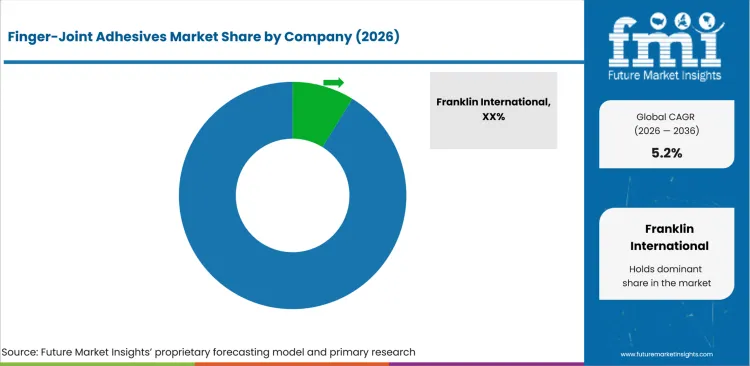
Competition separates first by qualification depth and then by plant support. Structural finger-jointing raises the entry barrier. Any adhesive used there must fit documented bond requirements and the mill's press process. Nonstructural work offers more chemistry choices, but changing an established specification still requires line-level proof.
- Franklin International, Jowat, Kleiberit and Kiilto cover wood assembly through finger-joint, engineered-wood, millwork or factory-bonding routes supported by current technical records.
- AkzoNobel, Dynea and Henkel carry stronger structural-timber approval records covering EPI, MUF, PRF or polyurethane systems used in load-bearing wood production.
- H.B. Fuller brings broader woodworking and building-adhesive coverage, with finger-joint relevance concentrated in wood and composite accounts inside its Building Adhesive Solutions business.
Competitive Benchmarking: Finger-Joint Adhesives Market
| Company | Wood-Bonding Route Breadth | Qualification Depth | Production-Process Evidence | Geographic Reach |
|---|---|---|---|---|
| Franklin International | Medium | High | High | North America with international distribution |
| AkzoNobel | Medium | High | Medium | Europe, Asia and international wood-product markets |
| Dynea | High | High | High | Europe with global industrial wood accounts |
| Henkel | Medium | High | High | Europe, North America and Asia-Pacific |
| Jowat | High | High | High | Europe, Americas and Asia-Pacific |
| Kleiberit | High | Medium | High | Europe with worldwide distributor coverage |
| Kiilto | Medium | High | High | Nordics, Europe and selected international wood markets |
| H.B. Fuller | Medium | Low | Medium | Global woodworking and building-adhesive reach |
Scoring basis: High route breadth requires at least three current wood-bonding chemistry or application routes, Medium requires two and Low identifies one narrow route. High qualification depth requires current finger-joint or load-bearing timber approval, Medium covers narrower documented approval and Low identifies adjacent woodworking evidence. High process evidence requires multiple application or press routes, Medium covers one documented industrial route and Low identifies a narrow process record. Geographic Reach describes evidenced commercial access and is not a score.
Key Developments in the Finger-Joint Adhesives Market
- In September 2025, Jowat received KOMO product certificate 33458/25 for Jowacoll 102.27 and Jowapur 685.59/61, including exterior non-load-bearing finger-joint applications.
- In February 2025, Henkel introduced the Loctite HB XE polyurethane line for CLT and glulam, with fire-performance testing intended for structural timber applications.
- In January 2025, Kiilto launched the Kiilto Pro SW polyurethane line for load-bearing wood structures, including structural finger-jointing under EN 15425:2023.
Key Players in the Finger-Joint Adhesives Market
Finger-Joint and Wood-Assembly Specialists
- Franklin International
- Jowat
- Kleiberit
- Kiilto
Structural Timber Adhesive Platforms
- AkzoNobel
- Dynea
- Henkel
Broader Woodworking and Building Adhesives
- H.B. Fuller
Finger-Joint Adhesives Market - Report Scope
| Coverage field | Report scope |
|---|---|
| Market breakdown | By chemistry, wood type, cure method, end use, sales channel and region. |
| Quantitative Units | USD million. |
| Market Definition | Revenue from formulated adhesive systems sold for finger jointing within the defined chemistry, wood, cure, end-use and sales-channel scope. |
| Regions Covered | North America, Latin America, Western Europe, Eastern Europe, East Asia, South Asia and Pacific, and Middle East and Africa. |
| Countries Covered | Mexico, Brazil, Poland, USA, Canada, Germany, Japan, and 20+ countries included in the full report. |
| Key Companies Profiled | Franklin International, AkzoNobel, Dynea, Henkel, Jowat, Kleiberit, Kiilto, H.B. Fuller |
| Forecast Period | 2026 to 2036 |
| Approach | Primary and secondary research with market triangulation. |
Finger-Joint Adhesives Market - Research Methodology
| Method | Approach |
|---|---|
| Primary Research | FMI analysts gathered input from manufacturers, service providers, technology developers, distributors, end users, procurement teams, and subject-matter experts. Interviews examined purchasing decisions, product or service evaluation, adoption barriers, approval requirements, pricing considerations, and expectations for technical or commercial support. Respondents were also asked what evidence is required before a trial, pilot, or initial order develops into regular purchasing. |
| Desk Research | Desk research covered government statistics, regulatory publications, trade data, industry associations, technical literature, standards, company filings, product information, and official corporate announcements. Sources were reviewed for relevance, publication date, geographic coverage, and consistency with the defined market scope. Claims relating to performance, applications, approvals, capacity, investment, and commercial activity were retained only when supported by credible public evidence. |
| Market Sizing and Forecasting | The market model combined the baseline value with historical performance, segment structure, pricing and volume indicators, adoption levels, company participation, and country-level demand conditions. Forecast assumptions considered economic activity, investment trends, regulatory developments, technology adoption, purchasing cycles, supply availability, and barriers to wider market use. Segment and regional estimates were reconciled before the final market total was calculated. |
| Data Validation | Estimates were checked against multiple independent indicators, including public data, company activity, trade patterns, industry developments, and findings from primary interviews. Validation also tested whether products, services, applications, and company revenues fell within the defined market boundaries. Adjacent categories, unsupported claims, overlapping revenues, and activities without direct market relevance were excluded to reduce double counting and maintain consistency across segments and countries. |
Finger-Joint Adhesives Market by Segments
Finger-Joint Adhesives Market segmented by Chemistry:
- PVAc adhesives
- EPI adhesives
- PUR adhesives
- MUF adhesives
- PRF adhesives
Finger-Joint Adhesives Market segmented by Wood Type:
- Softwood
- Hardwood
- Engineered lumber
- Reclaimed wood
Finger-Joint Adhesives Market segmented by Cure Method:
- Cold press
- Radio-frequency cure
- Hot press
- Moisture cure
Finger-Joint Adhesives Market segmented by End Use:
- Millwork
- Furniture components
- Structural lumber
- Mouldings
- Door and window components
Finger-Joint Adhesives Market segmented by Sales Channel:
- Lumber mills
- Woodworking distributors
- Direct adhesive producers
- Equipment-linked supply
Finger-Joint Adhesives Market by Region:
- North America
- United States
- Canada
- Latin America
- Brazil
- Mexico
- Argentina
- Chile
- Rest of Latin America
- Western Europe
- Germany
- France
- United Kingdom
- Italy
- Spain
- Benelux
- Nordics
- Rest of Western Europe
- Eastern Europe
- Poland
- Czech Republic
- Romania
- Hungary
- Rest of Eastern Europe
- East Asia
- China
- Japan
- South Korea
- South Asia and Pacific
- India
- ASEAN
- Australia and New Zealand
- Rest of South Asia and Pacific
- Middle East and Africa
- GCC Countries
- Türkiye
- South Africa
- Israel
- Rest of Middle East and Africa
Research Sources and Bibliography
- American Wood Council. (2026). 2025 annual report: Expanding mass timber adoption.
- Secretariat of Economy, Mexico. (2026, May). Data Mexico: Wood product manufacturing.
- Secretariat of Economy, Mexico. (2026, May). Data Mexico: Sawmills and wood preservation.
- International Organization for Standardization. (2025, April 11). ISO 10983:2014 Timber - Finger joints - Minimum production requirements and testing methods.
- International Organization for Standardization. (2025, July 18). ISO 17087:2006 Specifications for adhesives used for finger joints in non-structural lumber products.
- Kiilto. (2025, May 20). How the right adhesive partner can transform your window and door manufacturing.
- Dynea. (2025, November 19). MUF adhesive opens new perspectives for hardwood construction.
- Natural Resources Canada. (2025, March 20). Canada and Quebec invest in sustainable wood construction.
- Natural Resources Canada. (2025, March 19). Canada announces support for British Columbia's forest sector.
- WoodWorks - Wood Products Council. (2026, June). Mapping mass timber.
- Brazilian Institute of Geography and Statistics. (2025, September 25). Production value of silviculture and wild-crop harvesting grows 16.7%.
- Statistics Poland. (2026, July 13). Production of industrial products in 2025.
- USA Census Bureau. (2026, August 18). Monthly new residential construction, July 2026.
- Statistics Canada. (2026, March 4). Sawmills, December 2025.
- Federal Statistical Office of Germany. (2026, April 15). Timber logging in 2025 down 6.4% from the previous year.
- Forestry Agency, Japan. (2025, November 21). Publication of the 2024 wood supply and demand table.
- Henkel. (2025, February 25). Setting new standards for sustainable timber construction.
- SKH / KOMO. (2025, September 24). Product certificate 33458/25: Adhesives for non-load bearing applications - Jowat SE.
- Kiilto. (2025, January 17). A new adhesive line with further improved quality and efficiency in bonding of load-bearing wooden structures.
- Franklin Adhesives & Polymers. (2026, March). Mass Timber 2026 Product Guide.
- Deutsches Institut für Bautechnik. (2026). Adhesives and glued connections in timber construction.
- KLEIBERIT SE & Co. KG. (2026, July 7). ISCC PLUS Certificate ISCC-PLUS-Cert-DE102-26070163.
- Kiilto. (2025, November 29). Streamlined CLT production with one adhesive - HOISKO CLT partners with Kiilto.
- Kiilto. (2025, June 30). Kiilto pioneers the use of bio-based and recycled-carbon raw material in wood adhesives production.
- Deutsches Institut für Bautechnik. (2025, May 22). Z-9.1-802.
- Deutsches Institut für Bautechnik. (2025, May 19). Z-9.1-622.
- Deutsches Institut für Bautechnik. (2025, May 22). Z-9.1-840.
- AkzoNobel. (2025, May 26). AkzoNobel signs power purchase agreement with Alight to build solar park in Sweden.
- Dynea. (2025, October 31). Successful ISCC PLUS & ISO45001 audits.
- LIGNA. (2025). LIGNA.SUSTAINABLE PRODUCTION: Auf guten Zusammenhalt!
- Kiilto. (2026, January 29). Key challenges in solid wood production - and how Kiilto's new D3 adhesive tackles them.
- H.B. Fuller. (2026, January 22). Form 10-K annual report for fiscal 2025.
- Franklin Adhesives & Polymers. (2025). FIMMA Brazil 2025.
- Deutsches Institut für Bautechnik. (2025, July 21). Z-9.1-896.
This bibliography is provided for reader reference and is not exhaustive. The full report contains the complete reference list and detailed citations.
This Report Answers
- What is the finger-joint adhesives market size in 2026 and what value is forecast for 2036?
- Which mill economics support recurring demand for finger-joint adhesives?
- Why do PVAc adhesives hold the leading chemistry position in 2026?
- Why does softwood account for the largest wood-type share?
- How does cold press retain its position within cure methods?
- How do country growth rates differ across Mexico, Brazil, Poland, USA, Canada, Germany and Japan?
- Which companies provide finger-joint, structural timber or broader woodworking adhesive capabilities?
- What qualification and process conditions can slow adhesive switching at a mill?
Frequently Asked Questions
How big is the finger-joint adhesives market in 2026?
The finger-joint adhesives market is valued at USD 860.7 million in 2026 and is projected to reach USD 1,428.9 million by 2036. Growth follows mill investment in material recovery, engineered wood production and higher-throughput joining lines.
What is the CAGR of the finger-joint adhesives market from 2026 to 2036?
The finger-joint adhesives market is projected to grow at a CAGR of 5.2% between 2026 and 2036. Expansion follows value recovery from shorter lumber sections and continued investment in wood-component production.
Which chemistry leads the finger-joint adhesives market?
The PVAc adhesives segment is expected to hold 31.0% of the finger-joint adhesives market by chemistry in 2026, driven by familiar water-based handling. Regular nonstructural production also reduces changeover work on established mill lines.
Which wood type leads the finger-joint adhesives market?
The softwood segment is expected to hold 48.0% of the finger-joint adhesives market by wood type in 2026, attributable to coniferous lumber throughput. Existing finger-joint capacity therefore stays close to regular softwood processing.
Which companies are active in the finger-joint adhesives market?
Key companies operating in the market include Franklin International, AkzoNobel, Dynea, Henkel, Jowat, Kleiberit, Kiilto, and H.B. Fuller. These companies compete through chemistry breadth, qualification records, press compatibility, technical service and distribution reach.
Preview the report firsthand - request a free sample
Get SampleGet the brochure for pricing and purchase details.
Get PDFTable of Content
- Key Takeaways
- Market Size and CAGR
- Top Growth Driver
- Fastest Growing Segment
- Leading Region
- Key Companies
- Emerging Opportunities
- Executive Summary
- Global Market Outlook
- Demand-side Trends
- Supply-side Trends
- Technology Roadmap Analysis
- Analysis and Recommendations
- Analyst Perspective (What is happening? Why now? What should investors know?)
- Key Questions Answered
- How large is the market?
- What is the CAGR?
- What are key trends?
- Which region dominates?
- Who are the leaders?
- Market Overview
- Market Coverage / Taxonomy
- Market Definition / Scope / Limitations
- Research Methodology
- Chapter Orientation
- Analytical Lens and Working Hypotheses
- Market Structure, Signals, and Trend Drivers
- Benchmarking and Cross-market Comparability
- Market Sizing, Forecasting, and Opportunity Mapping
- Research Design and Evidence Framework
- Desk Research Programme (Secondary Evidence)
- Expert Input and Fieldwork (Primary Evidence)
- Tooling, Models, and Reference Databases
- Data Engineering and Model Build
- Quality Assurance and Audit Trail
- Market Background
- Market Dynamics (Drivers, Restraints, Opportunity, Trends)
- Scenario Forecast (Optimistic, Likely, Conservative)
- Impact Analysis
- AI Impact
- Sustainability Impact
- Regulatory Impact
- Technology Impact
- Consumer / Buyer Analysis
- Purchase Drivers
- Adoption Barriers
- Buyer Journey
- Opportunity Map Analysis
- Product Life Cycle Analysis
- Supply Chain Analysis
- Investment Feasibility Matrix
- Value Chain Analysis
- PESTLE and Porter's Analysis
- Regulatory Landscape
- Regional Parent Market Outlook
- Production and Consumption Statistics
- Import and Export Statistics
- Global Market Analysis and Forecast, 2021 to 2036
- Historical Market Size Value (USD Million) Analysis, 2021 to 2025
- Current and Future Market Size Value (USD Million) Projections, 2026 to 2036
- Y-o-Y Growth Trend Analysis
- Absolute $ Opportunity Analysis
- Global Market Pricing Analysis, 2021 to 2036
- Global Market Analysis and Forecast, By Chemistry, 2021 to 2036
- Introduction / Key Findings
- Historical Market Size Value (USD Million) Analysis By Chemistry, 2021 to 2025
- Current and Future Market Size Value (USD Million) Analysis and Forecast By Chemistry, 2026 to 2036
- PVAc adhesives
- EPI adhesives
- PUR adhesives
- MUF adhesives
- PRF adhesives
- PVAc adhesives
- Y-o-Y Growth Trend Analysis By Chemistry, 2021 to 2025
- Absolute $ Opportunity Analysis By Chemistry, 2026 to 2036
- Global Market Analysis and Forecast, By Wood Type, 2021 to 2036
- Introduction / Key Findings
- Historical Market Size Value (USD Million) Analysis By Wood Type, 2021 to 2025
- Current and Future Market Size Value (USD Million) Analysis and Forecast By Wood Type, 2026 to 2036
- Softwood
- Hardwood
- Engineered lumber
- Reclaimed wood
- Softwood
- Y-o-Y Growth Trend Analysis By Wood Type, 2021 to 2025
- Absolute $ Opportunity Analysis By Wood Type, 2026 to 2036
- Global Market Analysis and Forecast, By Cure Method, 2021 to 2036
- Introduction / Key Findings
- Historical Market Size Value (USD Million) Analysis By Cure Method, 2021 to 2025
- Current and Future Market Size Value (USD Million) Analysis and Forecast By Cure Method, 2026 to 2036
- Cold press
- Radio-frequency cure
- Hot press
- Moisture cure
- Cold press
- Y-o-Y Growth Trend Analysis By Cure Method, 2021 to 2025
- Absolute $ Opportunity Analysis By Cure Method, 2026 to 2036
- Global Market Analysis and Forecast, By End Use, 2021 to 2036
- Introduction / Key Findings
- Historical Market Size Value (USD Million) Analysis By End Use, 2021 to 2025
- Current and Future Market Size Value (USD Million) Analysis and Forecast By End Use, 2026 to 2036
- Millwork
- Furniture components
- Structural lumber
- Mouldings
- Door/window components
- Millwork
- Y-o-Y Growth Trend Analysis By End Use, 2021 to 2025
- Absolute $ Opportunity Analysis By End Use, 2026 to 2036
- Global Market Analysis and Forecast, By Sales Channel, 2021 to 2036
- Introduction / Key Findings
- Historical Market Size Value (USD Million) Analysis By Sales Channel, 2021 to 2025
- Current and Future Market Size Value (USD Million) Analysis and Forecast By Sales Channel, 2026 to 2036
- Lumber mills
- Woodworking distributors
- Direct adhesive producers
- Equipment-linked supply
- Lumber mills
- Y-o-Y Growth Trend Analysis By Sales Channel, 2021 to 2025
- Absolute $ Opportunity Analysis By Sales Channel, 2026 to 2036
- Global Market Analysis and Forecast, By Region, 2021 to 2036
- Introduction
- Historical Market Size Value (USD Million) Analysis By Region, 2021 to 2025
- Current Market Size Value (USD Million) Analysis and Forecast By Region, 2026 to 2036
- North America
- Latin America
- Western Europe
- Eastern Europe
- East Asia
- South Asia and Pacific
- Middle East & Africa
- Market Attractiveness Analysis By Region
- North America Market Analysis and Forecast, By Country, 2021 to 2036
- Historical Market Size Value (USD Million) Trend Analysis By Market Taxonomy, 2021 to 2025
- Market Size Value (USD Million) Forecast By Market Taxonomy, 2026 to 2036
- By Country
- USA
- Canada
- By Chemistry
- By Wood Type
- By Cure Method
- By End Use
- By Sales Channel
- By Country
- Market Attractiveness Analysis
- By Country
- By Chemistry
- By Wood Type
- By Cure Method
- By End Use
- By Sales Channel
- Key Takeaways
- Latin America Market Analysis and Forecast, By Country
- Historical Market Size Value (USD Million) Trend Analysis By Market Taxonomy, 2021 to 2025
- Market Size Value (USD Million) Forecast By Market Taxonomy, 2026 to 2036
- By Country
- Brazil
- Mexico
- Chile
- Rest of Latin America
- By Chemistry
- By Wood Type
- By Cure Method
- By End Use
- By Sales Channel
- By Country
- Market Attractiveness Analysis
- By Country
- By Chemistry
- By Wood Type
- By Cure Method
- By End Use
- By Sales Channel
- Key Takeaways
- Western Europe Market Analysis and Forecast, By Country
- Historical Market Size Value (USD Million) Trend Analysis By Market Taxonomy, 2021 to 2025
- Market Size Value (USD Million) Forecast By Market Taxonomy, 2026 to 2036
- By Country
- Germany
- UK
- Italy
- Spain
- France
- Nordic
- BENELUX
- Rest of Western Europe
- By Chemistry
- By Wood Type
- By Cure Method
- By End Use
- By Sales Channel
- By Country
- Market Attractiveness Analysis
- By Country
- By Chemistry
- By Wood Type
- By Cure Method
- By End Use
- By Sales Channel
- Key Takeaways
- Eastern Europe Market Analysis and Forecast, By Country
- Historical Market Size Value (USD Million) Trend Analysis By Market Taxonomy, 2021 to 2025
- Market Size Value (USD Million) Forecast By Market Taxonomy, 2026 to 2036
- By Country
- Russia
- Poland
- Hungary
- Balkan & Baltic
- Rest of Eastern Europe
- By Chemistry
- By Wood Type
- By Cure Method
- By End Use
- By Sales Channel
- By Country
- Market Attractiveness Analysis
- By Country
- By Chemistry
- By Wood Type
- By Cure Method
- By End Use
- By Sales Channel
- Key Takeaways
- East Asia Market Analysis and Forecast, By Country
- Historical Market Size Value (USD Million) Trend Analysis By Market Taxonomy, 2021 to 2025
- Market Size Value (USD Million) Forecast By Market Taxonomy, 2026 to 2036
- By Country
- China
- Japan
- South Korea
- By Chemistry
- By Wood Type
- By Cure Method
- By End Use
- By Sales Channel
- By Country
- Market Attractiveness Analysis
- By Country
- By Chemistry
- By Wood Type
- By Cure Method
- By End Use
- By Sales Channel
- Key Takeaways
- South Asia and Pacific Market Analysis and Forecast, By Country
- Historical Market Size Value (USD Million) Trend Analysis By Market Taxonomy, 2021 to 2025
- Market Size Value (USD Million) Forecast By Market Taxonomy, 2026 to 2036
- By Country
- India
- ASEAN
- Australia & New Zealand
- Rest of South Asia and Pacific
- By Chemistry
- By Wood Type
- By Cure Method
- By End Use
- By Sales Channel
- By Country
- Market Attractiveness Analysis
- By Country
- By Chemistry
- By Wood Type
- By Cure Method
- By End Use
- By Sales Channel
- Key Takeaways
- Middle East & Africa Market Analysis and Forecast, By Country
- Historical Market Size Value (USD Million) Trend Analysis By Market Taxonomy, 2021 to 2025
- Market Size Value (USD Million) Forecast By Market Taxonomy, 2026 to 2036
- By Country
- Kingdom of Saudi Arabia
- Other GCC Countries
- Türkiye
- South Africa
- Other African Union
- Rest of Middle East & Africa
- By Chemistry
- By Wood Type
- By Cure Method
- By End Use
- By Sales Channel
- By Country
- Market Attractiveness Analysis
- By Country
- By Chemistry
- By Wood Type
- By Cure Method
- By End Use
- By Sales Channel
- Key Takeaways
- Key Countries Market Analysis
- USA
- Pricing Analysis
- Market Share Analysis, 2025
- By Chemistry
- By Wood Type
- By Cure Method
- By End Use
- By Sales Channel
- Canada
- Pricing Analysis
- Market Share Analysis, 2025
- By Chemistry
- By Wood Type
- By Cure Method
- By End Use
- By Sales Channel
- Mexico
- Pricing Analysis
- Market Share Analysis, 2025
- By Chemistry
- By Wood Type
- By Cure Method
- By End Use
- By Sales Channel
- Brazil
- Pricing Analysis
- Market Share Analysis, 2025
- By Chemistry
- By Wood Type
- By Cure Method
- By End Use
- By Sales Channel
- Chile
- Pricing Analysis
- Market Share Analysis, 2025
- By Chemistry
- By Wood Type
- By Cure Method
- By End Use
- By Sales Channel
- Germany
- Pricing Analysis
- Market Share Analysis, 2025
- By Chemistry
- By Wood Type
- By Cure Method
- By End Use
- By Sales Channel
- UK
- Pricing Analysis
- Market Share Analysis, 2025
- By Chemistry
- By Wood Type
- By Cure Method
- By End Use
- By Sales Channel
- Italy
- Pricing Analysis
- Market Share Analysis, 2025
- By Chemistry
- By Wood Type
- By Cure Method
- By End Use
- By Sales Channel
- Spain
- Pricing Analysis
- Market Share Analysis, 2025
- By Chemistry
- By Wood Type
- By Cure Method
- By End Use
- By Sales Channel
- France
- Pricing Analysis
- Market Share Analysis, 2025
- By Chemistry
- By Wood Type
- By Cure Method
- By End Use
- By Sales Channel
- India
- Pricing Analysis
- Market Share Analysis, 2025
- By Chemistry
- By Wood Type
- By Cure Method
- By End Use
- By Sales Channel
- ASEAN
- Pricing Analysis
- Market Share Analysis, 2025
- By Chemistry
- By Wood Type
- By Cure Method
- By End Use
- By Sales Channel
- Australia & New Zealand
- Pricing Analysis
- Market Share Analysis, 2025
- By Chemistry
- By Wood Type
- By Cure Method
- By End Use
- By Sales Channel
- China
- Pricing Analysis
- Market Share Analysis, 2025
- By Chemistry
- By Wood Type
- By Cure Method
- By End Use
- By Sales Channel
- Japan
- Pricing Analysis
- Market Share Analysis, 2025
- By Chemistry
- By Wood Type
- By Cure Method
- By End Use
- By Sales Channel
- South Korea
- Pricing Analysis
- Market Share Analysis, 2025
- By Chemistry
- By Wood Type
- By Cure Method
- By End Use
- By Sales Channel
- Russia
- Pricing Analysis
- Market Share Analysis, 2025
- By Chemistry
- By Wood Type
- By Cure Method
- By End Use
- By Sales Channel
- Poland
- Pricing Analysis
- Market Share Analysis, 2025
- By Chemistry
- By Wood Type
- By Cure Method
- By End Use
- By Sales Channel
- Hungary
- Pricing Analysis
- Market Share Analysis, 2025
- By Chemistry
- By Wood Type
- By Cure Method
- By End Use
- By Sales Channel
- Kingdom of Saudi Arabia
- Pricing Analysis
- Market Share Analysis, 2025
- By Chemistry
- By Wood Type
- By Cure Method
- By End Use
- By Sales Channel
- Türkiye
- Pricing Analysis
- Market Share Analysis, 2025
- By Chemistry
- By Wood Type
- By Cure Method
- By End Use
- By Sales Channel
- South Africa
- Pricing Analysis
- Market Share Analysis, 2025
- By Chemistry
- By Wood Type
- By Cure Method
- By End Use
- By Sales Channel
- USA
- Market Structure Analysis
- Competition Dashboard
- Competition Benchmarking
- Market Share Analysis of Top Players
- By Regional
- By Chemistry
- By Wood Type
- By Cure Method
- By End Use
- By Sales Channel
- Emerging Startups
- Innovation Benchmarking
- Competition Analysis
- Competition Deep Dive
- Franklin International
- Overview
- Product Portfolio
- Profitability by Market Segments
- Sales Footprint
- Strategy Overview
- Marketing Strategy
- Product Strategy
- Channel Strategy
- Henkel
- H.B. Fuller
- Jowat
- Kleiberit
- AkzoNobel
- Sika
- Bostik / Arkema
- Dynea
- Prefere Resins
- Franklin International
- Case Studies
- Success Stories
- Recent Developments
- Competition Deep Dive
- Assumptions & Acronyms Used


