

- Market Size (2026)
- USD 27.8 Bn
- Forecast (2036)
- USD 48.4 Bn
- CAGR (2026 to 2036)
- 5.7%
Fire Alarm Systems Market Size, Market Forecast and Outlook By FMI
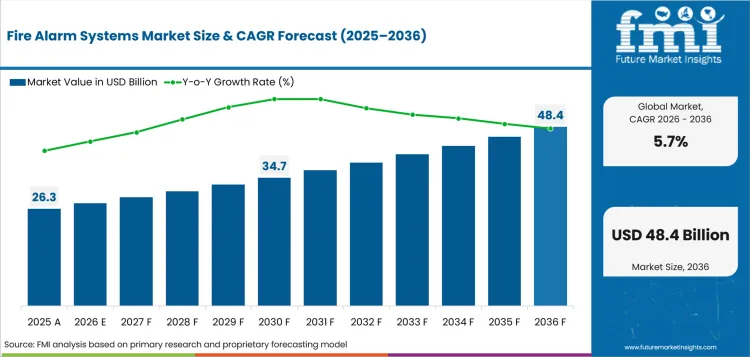
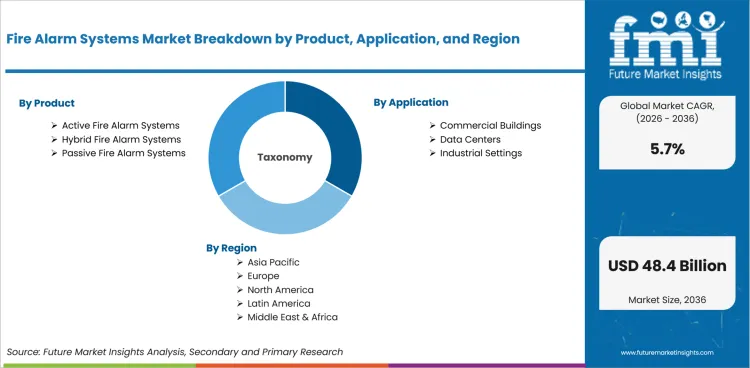
The fire alarm systems market was valued at USD 26.3 billion in 2025. The market is set to reach USD 27.8 billion by 2026-end and grow at a CAGR of 5.7% between 2026-2036 to reach USD 48.4 billion by 2036. Active Fire Alarm Systems will dominate with a 49.0% share, while Commercial Buildings will lead with a 30.0% share.
Key Takeaways, Market Size, and Forecast
- 2025 Market Size: USD 26.32 billion
- 2036 Market Size: USD 48.43 billion
- Forecast CAGR: 5.7% from 2026 to 2036
- Incremental Opportunity (2026–2036): USD 20.61 billion
- Leading Product: Active Fire Alarm Systems
- Active Fire Alarm Systems Share in 2026: 49.0%
- Fastest-growing Markets: India (8.9%) and China (7.6%)
| Parameter | Details |
|---|---|
| Market Size in 2025 (Value) | USD 26.3 billion |
| Market Forecast in 2036 (Value) | USD 48.4 billion |
| CAGR (2026-2036) | 5.7% |
| Years Considered | 2021-2036 |
| Base Year | 2025 |
| Forecast Period | 2026-2036 |
| Units Considered | Value (USD Bn) |
| Leading Sub-Region |
Summary of the Fire Alarm Systems Market
- Demand and Growth Drivers
- Active Fire Alarm Systems demand is concentrated in end-use procurement standards and specification alignment across India and China.
- Commercial Buildings growth is accelerating on account of buyer diversification and evolving application requirements during the forecast period.
- Wireless Systems procurement is gaining share as specification upgrades and performance benchmarks raise quality thresholds.
- Product and Segment View
- Active Fire Alarm Systems holds 49.0% of Product demand, anchored by established supply agreements and buyer specification lock-in.
- Commercial Buildings at 30.0% of Application volume reflects production volume requirements and cost-performance optimization.
- Wireless Systems at 34.0% of Technology demand signals application diversification beyond core use cases.
- Geography and Competitive Outlook
- India leads growth at 8.9%, supported by industrial scale, policy support, and capacity development.
- North America and Europe maintain significant installed base, with procurement shaped by compliance standards and lifecycle cost priorities.
- Honeywell International Inc. and Siemens AG hold the strongest positions, with competitive advantage rooted in manufacturing scale and distribution infrastructure.
- Analyst Opinion
- The fire alarm systems market is transitioning from a volume-driven category toward one where product specification depth and supply reliability define competitive outcomes.
- Active Fire Alarm Systems demand is expected to remain the largest revenue contributor, though New Installation are closing the gap.
- Regional growth divergence between India (8.9%) and mature markets creates a dual-track strategy requirement for global participants.
- Companies that combine cost discipline with specification compliance in India and China are positioned to outperform market averages through 2036.
Fire Alarm Systems Market Definition
The fire alarm systems market covers commercially available products segmented by product, application, technology, end user, installation. The market is sized from 2026 to 2036 using a hybrid bottom-up methodology.
Fire Alarm Systems Market Inclusions
Scope includes all revenue-generating fire alarm systems market products across product, application, technology, end user, installation. Geographic coverage spans North America, Latin America, Europe, East Asia, South Asia and Pacific, and Middle East and Africa. Revenue estimates are denominated in USD Billion at constant exchange rates.
Fire Alarm Systems Market Exclusions
The scope excludes consumer-grade products without industrial specification, component-level trading outside OEM channels, and non-commercial research equipment.
Fire Alarm Systems Market Research Methodology
- Primary Research: FMI analysts interviewed OEM procurement teams, system integrators, and component/platform manufacturers across key markets.
- Desk Research: Synthesized patent filings, trade association data, and manufacturer technology roadmaps.
- Market Sizing and Forecasting: Bottom-up aggregation from product, application, technology, end user, installation with technology adoption S-curves and replacement cycle modeling.
- Data Validation: Quarterly reconciliation against production data, trade flows, and manufacturer order backlogs.
Why is the Fire Alarm Systems Market Growing?
- Growth in Active Fire Alarm Systems demand correlates with industry emphasis on performance, durability, and total cost of ownership.
- Input cost volatility from input cost volatility and qualification expenses moderate adoption velocity in price-sensitive segments.
Demand in the fire alarm systems market is concentrated in procurement patterns where Active Fire Alarm Systems accounts for 49.0% of Product volume. Buyers in India and China structure procurement around Commercial Buildings and Wireless Systems, with contract lengths and qualification requirements varying by end-use application. Active Fire Alarm Systems and Hybrid Fire Alarm Systems represent the primary demand categories. Smaller buyers face barriers through minimum volumes and compliance costs that consolidate procurement toward established channels.
Pricing across the fire alarm systems market is accelerating on account of competitive intensity at each value chain stage. Commercial Buildings at 30.0% of Application demand carries margin profiles shaped by input costs, processing complexity, and regional competition. Producers in India benefit from proximity to demand centers and lower operating costs, while suppliers in Europe and North America compete on quality certification and specification compliance. Margin compression is most acute in commodity-grade categories where multiple qualified suppliers compete.
Market Segmentation Analysis
- Active Fire Alarm Systems at 49.0% of Product demand reflects entrenched buyer preferences and high switching costs.
- Commercial Buildings at 30.0% of Application demand is gaining incremental share from specification upgrades.
The fire alarm systems market is organized by product, application, technology, end user, installation. Active Fire Alarm Systems dominates Product demand at 49.0%, while Commercial Buildings holds 30.0% of Application volume.
Active Fire Alarm Systems Product Insights
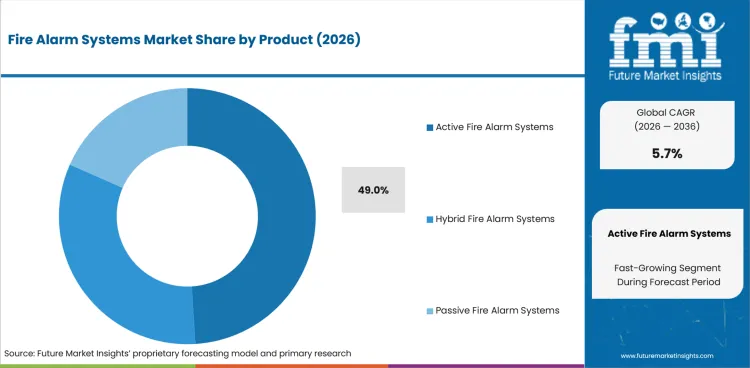
Active Fire Alarm Systems at 49.0% share is sustained by established buyer specifications, volume-based contract structures, and qualification incumbency. Active Fire Alarm Systems and Hybrid Fire Alarm Systems form the core demand categories within this segment.
Commercial Buildings Application Insights
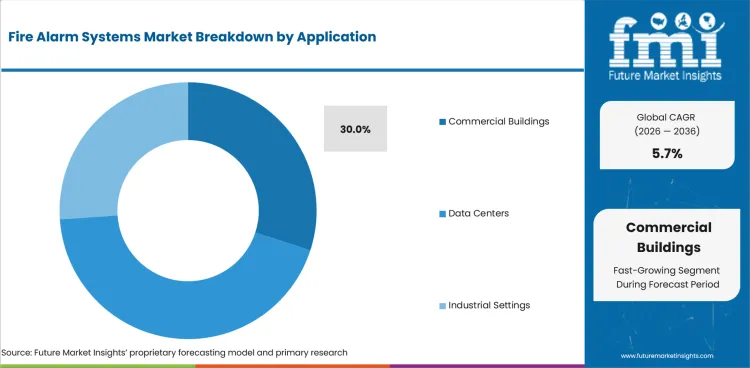
Commercial Buildings holds 30.0% of Application demand. Growth during the forecast period is accelerating on account of evolving end-use requirements, specification modernization, and buyer portfolio diversification. Commercial Buildings and Data Centers are the primary contributors.
Fire Alarm Systems Market Drivers, Restraints, and Opportunities
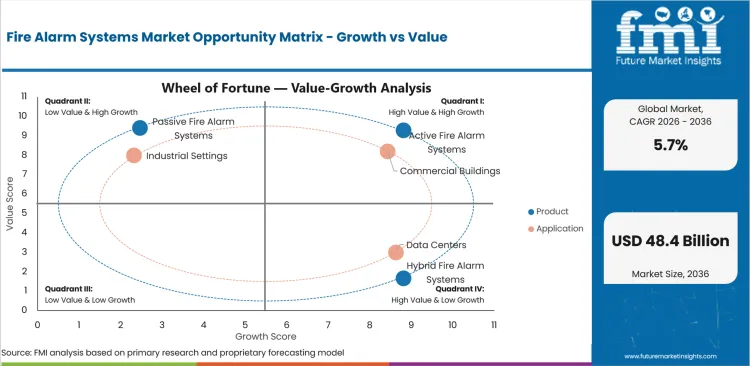
- Capacity gaps in India and China where demand growth exceeds installed capacity.
- Scalability constraints related to competitive intensity and buyer consolidation constrain margin expansion for mid-tier players.
Growth in the fire alarm systems market is shaped by the interplay between structural demand drivers, cost-side constraints, and selective entry opportunities. Product and Application segment dynamics reflect distinct competitive pressures.
Technology Sourcing and Supply Exposure
Supply chains serving the fire alarm systems market face concentration in Wireless Systems, which represents 34.0% of Technology demand. Honeywell International Inc. holds a vertically integrated position that provides supply security but limits availability for competing channels. Regional capacity in China and Japan is expanding to reduce single-geography dependency. Penetration is deepening as procurement teams are increasingly mandating dual-source qualification to mitigate disruption risk, adding 6 to 12 months to new supplier onboarding timelines.
Regulatory Landscape and Compliance Cost Structures
Compliance frameworks governing the fire alarm systems market differ materially across jurisdictions. End User applications involving Manufacturing face regional certification, environmental standards, and product safety testing that extend time-to-market and add per-unit costs. India regulatory evolution is tightening quality thresholds that narrow the field of qualified importers. Companies with pre-existing multi-jurisdiction certifications hold 12 to 18 month time advantages over new entrants seeking equivalent market access.
Installation Growth Trajectories and White Space
New Installation within Installation account for 45.0% of segment demand, with growth supported by evolving end-use specifications and buyer premiumization trends. White space exists in India and China where demand growth outpaces local supply capabilities. Companies positioned in both Active Fire Alarm Systems and New Installation categories can capture cross-selling efficiencies as buyer portfolios expand during the forecast period.
Analysis of Fire Alarm Systems Market by Key Countries
.webp "Top Country Growth Comparison Fire Alarm Systems Market Cagr (2026 2036)")
| Country | CAGR |
|---|---|
| India | 8.9% |
| China | 7.6% |
| Japan | 6.2% |
| USA | 5.0% |
| Germany | 4.2% |
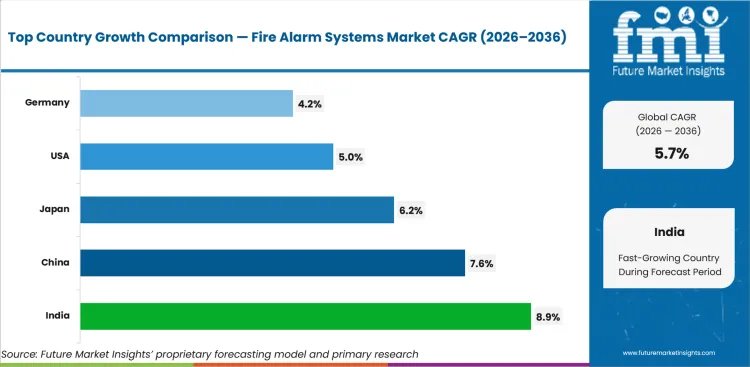
- India at 8.9% leads with the highest growth rate through 2036.
- China at 7.6% sustains strong expansion through 2036.
- Japan at 6.2% maintains above-average growth through 2036.
- USA at 5.0% shows steady demand trajectory through 2036.
The fire alarm systems market is estimated at USD 27.82 billion in 2026, expanding to USD 48.43 billion by 2036 at a CAGR of 5.7%.
Demand Outlook for Fire Alarm Systems Market in India
India is estimated to expand at 8.9% through 2036. Technology infrastructure investment and digital transformation programs in India are sustaining procurement of Active Fire Alarm Systems systems. Technology demand is concentrated in Wireless Systems, representing 34.0% of segment demand.
- Government procurement programs and healthcare infrastructure expansion are broadening the institutional buyer base for Active Fire Alarm Systems products.
- Tier-2 and tier-3 market penetration is accelerating as organized distribution networks extend reach beyond metropolitan centers.
- PLI schemes and domestic manufacturing incentives are attracting capacity investment that reduces import dependency for standard-grade products.
Future Outlook for Fire Alarm Systems Market in China
Growth in China is projected at 7.6% over the forecast period. Technology infrastructure investment and digital transformation programs in China are sustaining procurement of Active Fire Alarm Systems systems. Technology demand is concentrated in Wireless Systems, representing 34.0% of segment demand.
- Scale of domestic Product capacity and government industrial policy create sustained procurement volumes for Active Fire Alarm Systems.
- Domestic manufacturers are expanding capabilities in Commercial Buildings, intensifying price competition while raising quality benchmarks.
- Antibiotic reduction mandates and environmental compliance programs are shifting buyer specifications toward certified and functional product categories.
Opportunity Analysis of Fire Alarm Systems Market in Japan
Japan represents a 6.2% growth trajectory through 2036. Technology infrastructure investment and digital transformation programs in Japan are sustaining procurement of Active Fire Alarm Systems systems. Technology demand is concentrated in Wireless Systems, representing 34.0% of segment demand.
- Mature installed base and aging infrastructure drive replacement cycles that sustain procurement of Active Fire Alarm Systems products.
- JIS compliance requirements and extended qualification timelines create barriers that protect incumbent supplier positions.
- Domestic OEM partnerships and co-development arrangements define long-term procurement relationships in Commercial Buildings segments.
In-depth Analysis of Fire Alarm Systems Market in USA
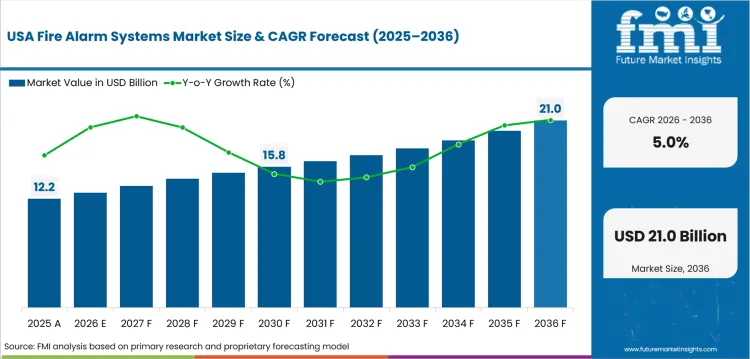
Demand in USA is forecast to rise at 5.0% from 2026 to 2036. Technology infrastructure investment and digital transformation programs in USA are sustaining procurement of Active Fire Alarm Systems systems. Technology demand is concentrated in Wireless Systems, representing 34.0% of segment demand.
- Federal regulatory frameworks and institutional procurement standards sustain demand for Active Fire Alarm Systems products with established compliance credentials.
- Supply chain diversification mandates are creating dual-sourcing requirements that expand the qualified supplier base.
- Consumer and institutional premiumization trends support pricing power for Commercial Buildings product categories.
Sales Analysis of Fire Alarm Systems Market in Germany
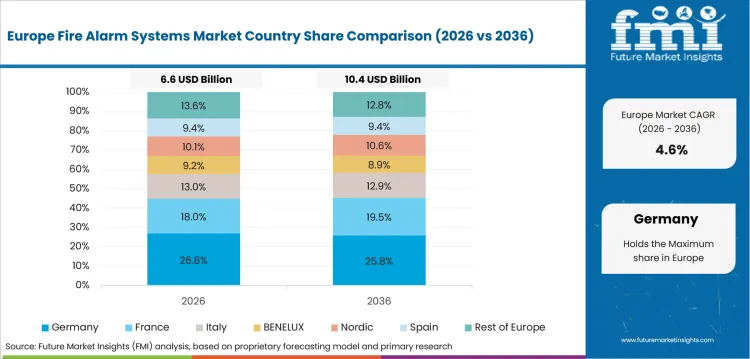
The Germany market is set to grow at 4.2% through the forecast period. Technology infrastructure investment and digital transformation programs in Germany are sustaining procurement of Active Fire Alarm Systems systems. Technology demand is concentrated in Wireless Systems, representing 34.0% of segment demand.
- EU regulatory alignment and DIN standards define procurement specifications that favor Active Fire Alarm Systems suppliers with established certification.
- Industrie 4.0 integration priorities are shifting demand toward digitally enabled and efficiency-optimized Commercial Buildings products.
- Energy cost pressures and sustainability mandates influence material and product specification choices across end-use sectors.
Competitive Landscape and Strategic Positioning
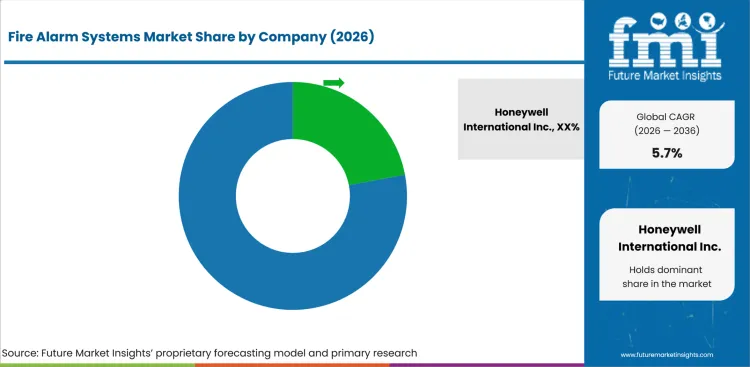
- Honeywell International Inc. holds the strongest position through manufacturing scale, OEM integration, and multi-market logistics.
- Mid-tier participants compete through cost optimization and application-specific technical depth.
Honeywell International Inc. anchors the competitive landscape in the fire alarm systems market with 22.0% estimated share, supported by broad manufacturing capabilities and established customer networks. Siemens AG and Johnson Controls International plc maintain positions through product range and regional manufacturing presence.
Entry barriers include product qualification cycles, minimum production scale thresholds, and established supply chain relationships. Strategic priorities through 2036 center on capacity development in high-growth markets, cost structure optimization, and specification capability upgrades.
Key Companies in the Fire Alarm Systems Market
Key global companies leading the fire alarm systems market include:
- Honeywell International Inc., Siemens AG, Johnson Controls International plc, Bosch Security Systems hold leading positions through established manufacturing capacity, product breadth, and customer relationships.
- Schneider Electric SE, Other Companies (combined) maintain regional strength through application expertise and cost-competitive operations.
Competitive Benchmarking: Fire Alarm Systems Market
| Company | Product Breadth | Technology Depth | Customer Access | Geographic Footprint |
|---|---|---|---|---|
| Honeywell International Inc. | High | High | Strong | Global |
| Siemens AG | High | High | Strong | Global |
| Johnson Controls International plc | High | High | Strong | Global |
| Bosch Security Systems | Medium | Medium | Moderate | Regional |
| Schneider Electric SE | Medium | Medium | Moderate | Regional |
| Other Companies (combined) | Medium | Medium | Moderate | Regional |
Source: Future Market Insights competitive analysis, 2026.
Key Developments in Fire Alarm Systems Market
- In 2025, Honeywell International Inc. expanded its Active Fire Alarm Systems product line to address growing specification demand in India and North America.
- In 2026, Siemens AG announced capacity investment targeting Commercial Buildings production to meet rising demand in China and Europe.
Key Players in the Fire Alarm Systems Market
Major Global Players
- Honeywell International Inc.
- Siemens AG
- Johnson Controls International plc
- Bosch Security Systems
- Schneider Electric SE
- Other Companies (combined)
Emerging Players/Startups
- Bosch Security Systems
- Schneider Electric SE
- Other Companies (combined)
Report Scope and Coverage
| Parameter | Details |
|---|---|
| Market size by 2036 | USD 48.43 billion |
| Growth rate | 5.7% CAGR (2026-2036) |
| Forecast period | 2026 to 2036 |
| Base year value (2026) | USD 27.82 billion |
| By product | Active Fire Alarm Systems, Hybrid Fire Alarm Systems, Passive Fire Alarm Systems |
| By application | Commercial Buildings, Data Centers, Industrial Settings |
| By technology | Wireless Systems, Wired Systems, Smart Connected Systems |
| By end user | Manufacturing, Healthcare, Government Buildings |
| By installation | New Installation, Retrofit, Replacement |
| Regions covered | North America, Latin America, Europe, East Asia, South Asia and Pacific, Middle East and Africa |
| Countries covered | India, China, Japan, USA, Germany, 30 plus countries |
| Key companies profiled | Honeywell International Inc., Siemens AG, Johnson Controls International plc, Bosch Security Systems, Schneider Electric SE, Other Companies (combined) |
| Approach | Hybrid bottom-up and top-down methodology starting with verified transaction data, projecting adoption velocity across segments and regions. |
Segmentation
Fire Alarm Systems Market Segmented by Product:
- Active Fire Alarm Systems
- Addressable Systems
- Conventional Systems
- Hybrid Fire Alarm Systems
- Integrated Detection Systems
- Multi Sensor Systems
- Passive Fire Alarm Systems
- Manual Alarm Systems
- Basic Detection Systems
Fire Alarm Systems Market Segmented by Application:
- Commercial Buildings
- Office Buildings
- Retail Complexes
- Data Centers
- Enterprise Data Centers
- Cloud Facilities
- Industrial Settings
- Manufacturing Units
- Warehouses
Fire Alarm Systems Market Segmented by Technology:
- Wireless Systems
- Radio Frequency Systems
- Mesh Network Systems
- Wired Systems
- Hardwired Systems
- Loop Systems
- Smart Connected Systems
- IoT Enabled Systems
- Cloud Integrated Systems
Fire Alarm Systems Market Segmented by End User:
- Manufacturing
- Heavy Industry
- Light Industry
- Healthcare
- Hospitals
- Clinics
- Government Buildings
- Administrative Buildings
- Public Infrastructure
Fire Alarm Systems Market Segmented by Installation:
- New Installation
- Greenfield Projects
- New Infrastructure
- Retrofit
- System Upgrades
- Modernization Projects
- Replacement
- Component Replacement
- Full System Replacement
Fire Alarm Systems Market by Region:
- North America
- USA
- Canada
- Mexico
- Latin America
- Brazil
- Chile
- Rest of Latin America
- Western Europe
- Germany
- UK
- Italy
- Spain
- France
- Nordic
- BENELUX
- Rest of Western Europe
- Eastern Europe
- Russia
- Poland
- Hungary
- Balkan & Baltic
- Rest of Eastern Europe
- East Asia
- China
- Japan
- South Korea
- South Asia and Pacific
- India
- ASEAN
- Australia & New Zealand
- Rest of South Asia and Pacific
- Middle East & Africa
- Kingdom of Saudi Arabia
- Other GCC Countries
- Turkiye
- South Africa
- Other African Union
- Rest of Middle East & Africa
Research Sources and Bibliography
- 1. International Telecommunication Union. (2025). ITU Global Technology Standards Report. ITU.
- 2. National Institute of Standards and Technology. (2025). NIST Technology Framework Updates. NIST.
- 3. World Trade Organization. (2025). WTO Technology Trade Statistics. WTO.
- 4. Honeywell International Inc.. (2025). Annual Report and Technology Roadmap.
- 5. International Electrotechnical Commission. (2025). IEC Product Standards and Certification. IEC.
This bibliography is provided for reader reference. The full Future Market Insights report contains the complete reference list with publication dates, URLs, and supporting data for all cited works.
This Report Answers
- Estimating the size of the fire alarm systems market and revenue forecast from 2026 to 2036.
- Segmentation analysis by product, application, technology, end user, installation.
- Regional insights across more than 30 markets globally.
- Technology and End User analysis across key product categories.
- Competitive landscape assessment with company benchmarking.
- Investment opportunity identification in Active Fire Alarm Systems and Commercial Buildings segments.
- Supply chain tracking and procurement pattern analysis.
- Data delivery in PDF and Excel formats.
Frequently Asked Questions
How big is the fire alarm systems market in 2026?
The global fire alarm systems market is estimated to be valued at USD 27.8 billion in 2026.
What will be the size of fire alarm systems market in 2036?
The market size for the fire alarm systems market is projected to reach USD 48.4 billion by 2036.
How much will be the fire alarm systems market growth between 2026 and 2036?
The fire alarm systems market is expected to grow at a 5.7% CAGR between 2026 and 2036.
What are the key product types in the fire alarm systems market?
The key product types in fire alarm systems market are active fire alarm systems, hybrid fire alarm systems and passive fire alarm systems
Which application segment is expected to contribute significant share in the fire alarm systems market in 2026?
In terms of application, commercial buildings segment is expected to command 30.0% share in the fire alarm systems market in 2026.
Preview the report firsthand - request a free sample
Get SampleGet the brochure for pricing and purchase details.
Get PDFTable of Content
- Executive Summary
- Global Market Outlook
- Demand-side Trends
- Supply-side Trends
- Technology Roadmap Analysis
- Analysis and Recommendations
- Market Overview
- Market Coverage / Taxonomy
- Market Definition / Scope / Limitations
- Research Methodology
- Chapter Orientation
- Analytical Lens and Working Hypotheses
- Market Structure, Signals, and Trend Drivers
- Benchmarking and Cross-market Comparability
- Market Sizing, Forecasting, and Opportunity Mapping
- Research Design and Evidence Framework
- Desk Research Programme (Secondary Evidence)
- Company Annual and Sustainability Reports
- Peer-reviewed Journals and Academic Literature
- Corporate Websites, Product Literature, and Technical Notes
- Earnings Decks and Investor Briefings
- Statutory Filings and Regulatory Disclosures
- Technical White Papers and Standards Notes
- Trade Journals, Industry Magazines, and Analyst Briefs
- Conference Proceedings, Webinars, and Seminar Materials
- Government Statistics Portals and Public Data Releases
- Press Releases and Reputable Media Coverage
- Specialist Newsletters and Curated Briefings
- Sector Databases and Reference Repositories
- FMI Internal Proprietary Databases and Historical Market Datasets
- Subscription Datasets and Paid Sources
- Social Channels, Communities, and Digital Listening Inputs
- Additional Desk Sources
- Expert Input and Fieldwork (Primary Evidence)
- Primary Modes
- Qualitative Interviews and Expert Elicitation
- Quantitative Surveys and Structured Data Capture
- Blended Approach
- Why Primary Evidence is Used
- Field Techniques
- Interviews
- Surveys
- Focus Groups
- Observational and In-context Research
- Social and Community Interactions
- Stakeholder Universe Engaged
- C-suite Leaders
- Board Members
- Presidents and Vice Presidents
- R&D and Innovation Heads
- Technical Specialists
- Domain Subject-matter Experts
- Scientists
- Physicians and Other Healthcare Professionals
- Governance, Ethics, and Data Stewardship
- Research Ethics
- Data Integrity and Handling
- Primary Modes
- Tooling, Models, and Reference Databases
- Desk Research Programme (Secondary Evidence)
- Data Engineering and Model Build
- Data Acquisition and Ingestion
- Cleaning, Normalisation, and Verification
- Synthesis, Triangulation, and Analysis
- Quality Assurance and Audit Trail
- Market Background
- Market Dynamics
- Drivers
- Restraints
- Opportunity
- Trends
- Scenario Forecast
- Demand in Optimistic Scenario
- Demand in Likely Scenario
- Demand in Conservative Scenario
- Opportunity Map Analysis
- Product Life Cycle Analysis
- Supply Chain Analysis
- Investment Feasibility Matrix
- Value Chain Analysis
- PESTLE and Porter’s Analysis
- Regulatory Landscape
- Regional Parent Market Outlook
- Production and Consumption Statistics
- Import and Export Statistics
- Market Dynamics
- Global Market Analysis 2021 to 2025 and Forecast, 2026 to 2036
- Historical Market Size Value (USD billion) Analysis, 2021 to 2025
- Current and Future Market Size Value (USD billion) Projections, 2026 to 2036
- Y-o-Y Growth Trend Analysis
- Absolute $ Opportunity Analysis
- Global Market Pricing Analysis 2021 to 2025 and Forecast 2026 to 2036
- Global Market Analysis 2021 to 2025 and Forecast 2026 to 2036, By Product
- Introduction / Key Findings
- Historical Market Size Value (USD billion) Analysis By Product, 2021 to 2025
- Current and Future Market Size Value (USD billion) Analysis and Forecast By Product, 2026 to 2036
- Active Fire Alarm Systems
- Addressable Systems
- Conventional Systems
- Hybrid Fire Alarm Systems
- Integrated Detection Systems
- Multi Sensor Systems
- Passive Fire Alarm Systems
- Manual Alarm Systems
- Basic Detection Systems
- Active Fire Alarm Systems
- Y-o-Y Growth Trend Analysis By Product, 2021 to 2025
- Absolute $ Opportunity Analysis By Product, 2026 to 2036
- Global Market Analysis 2021 to 2025 and Forecast 2026 to 2036, By Application
- Introduction / Key Findings
- Historical Market Size Value (USD billion) Analysis By Application, 2021 to 2025
- Current and Future Market Size Value (USD billion) Analysis and Forecast By Application, 2026 to 2036
- Commercial Buildings
- Office Buildings
- Retail Complexes
- Data Centers
- Enterprise Data Centers
- Cloud Facilities
- Industrial Settings
- Manufacturing Value (USD billion)s
- Warehouses
- Commercial Buildings
- Y-o-Y Growth Trend Analysis By Application, 2021 to 2025
- Absolute $ Opportunity Analysis By Application, 2026 to 2036
- Global Market Analysis 2021 to 2025 and Forecast 2026 to 2036, By Technology
- Introduction / Key Findings
- Historical Market Size Value (USD billion) Analysis By Technology, 2021 to 2025
- Current and Future Market Size Value (USD billion) Analysis and Forecast By Technology, 2026 to 2036
- Wireless Systems
- Radio Frequency Systems
- Mesh Network Systems
- Wired Systems
- Hardwired Systems
- Loop Systems
- Smart Connected Systems
- IoT Enabled Systems
- Cloud Integrated Systems
- Wireless Systems
- Y-o-Y Growth Trend Analysis By Technology, 2021 to 2025
- Absolute $ Opportunity Analysis By Technology, 2026 to 2036
- Global Market Analysis 2021 to 2025 and Forecast 2026 to 2036, By End User
- Introduction / Key Findings
- Historical Market Size Value (USD billion) Analysis By End User, 2021 to 2025
- Current and Future Market Size Value (USD billion) Analysis and Forecast By End User, 2026 to 2036
- Manufacturing
- Heavy Industry
- Light Industry
- Healthcare
- Hospitals
- Clinics
- Government Buildings
- Administrative Buildings
- Public Infrastructure
- Manufacturing
- Y-o-Y Growth Trend Analysis By End User, 2021 to 2025
- Absolute $ Opportunity Analysis By End User, 2026 to 2036
- Global Market Analysis 2021 to 2025 and Forecast 2026 to 2036, By Installation
- Introduction / Key Findings
- Historical Market Size Value (USD billion) Analysis By Installation, 2021 to 2025
- Current and Future Market Size Value (USD billion) Analysis and Forecast By Installation, 2026 to 2036
- New Installation
- Greenfield Projects
- New Infrastructure
- Retrofit
- System Upgrades
- Modernization Projects
- Replacement
- Component Replacement
- Full System Replacement
- New Installation
- Y-o-Y Growth Trend Analysis By Installation, 2021 to 2025
- Absolute $ Opportunity Analysis By Installation, 2026 to 2036
- Global Market Analysis 2021 to 2025 and Forecast 2026 to 2036, By Region
- Introduction
- Historical Market Size Value (USD billion) Analysis By Region, 2021 to 2025
- Current Market Size Value (USD billion) Analysis and Forecast By Region, 2026 to 2036
- North America
- Latin America
- Western Europe
- Eastern Europe
- East Asia
- South Asia and Pacific
- Middle East & Africa
- Market Attractiveness Analysis By Region
- North America Market Analysis 2021 to 2025 and Forecast 2026 to 2036, By Country
- Historical Market Size Value (USD billion) Trend Analysis By Market Taxonomy, 2021 to 2025
- Market Size Value (USD billion) Forecast By Market Taxonomy, 2026 to 2036
- By Country
- USA
- Canada
- Mexico
- By Product
- By Application
- By Technology
- By End User
- By Installation
- By Country
- Market Attractiveness Analysis
- By Country
- By Product
- By Application
- By Technology
- By End User
- By Installation
- Key Takeaways
- Latin America Market Analysis 2021 to 2025 and Forecast 2026 to 2036, By Country
- Historical Market Size Value (USD billion) Trend Analysis By Market Taxonomy, 2021 to 2025
- Market Size Value (USD billion) Forecast By Market Taxonomy, 2026 to 2036
- By Country
- Brazil
- Chile
- Rest of Latin America
- By Product
- By Application
- By Technology
- By End User
- By Installation
- By Country
- Market Attractiveness Analysis
- By Country
- By Product
- By Application
- By Technology
- By End User
- By Installation
- Key Takeaways
- Western Europe Market Analysis 2021 to 2025 and Forecast 2026 to 2036, By Country
- Historical Market Size Value (USD billion) Trend Analysis By Market Taxonomy, 2021 to 2025
- Market Size Value (USD billion) Forecast By Market Taxonomy, 2026 to 2036
- By Country
- Germany
- UK
- Italy
- Spain
- France
- Nordic
- BENELUX
- Rest of Western Europe
- By Product
- By Application
- By Technology
- By End User
- By Installation
- By Country
- Market Attractiveness Analysis
- By Country
- By Product
- By Application
- By Technology
- By End User
- By Installation
- Key Takeaways
- Eastern Europe Market Analysis 2021 to 2025 and Forecast 2026 to 2036, By Country
- Historical Market Size Value (USD billion) Trend Analysis By Market Taxonomy, 2021 to 2025
- Market Size Value (USD billion) Forecast By Market Taxonomy, 2026 to 2036
- By Country
- Russia
- Poland
- Hungary
- Balkan & Baltic
- Rest of Eastern Europe
- By Product
- By Application
- By Technology
- By End User
- By Installation
- By Country
- Market Attractiveness Analysis
- By Country
- By Product
- By Application
- By Technology
- By End User
- By Installation
- Key Takeaways
- East Asia Market Analysis 2021 to 2025 and Forecast 2026 to 2036, By Country
- Historical Market Size Value (USD billion) Trend Analysis By Market Taxonomy, 2021 to 2025
- Market Size Value (USD billion) Forecast By Market Taxonomy, 2026 to 2036
- By Country
- China
- Japan
- South Korea
- By Product
- By Application
- By Technology
- By End User
- By Installation
- By Country
- Market Attractiveness Analysis
- By Country
- By Product
- By Application
- By Technology
- By End User
- By Installation
- Key Takeaways
- South Asia and Pacific Market Analysis 2021 to 2025 and Forecast 2026 to 2036, By Country
- Historical Market Size Value (USD billion) Trend Analysis By Market Taxonomy, 2021 to 2025
- Market Size Value (USD billion) Forecast By Market Taxonomy, 2026 to 2036
- By Country
- India
- ASEAN
- Australia & New Zealand
- Rest of South Asia and Pacific
- By Product
- By Application
- By Technology
- By End User
- By Installation
- By Country
- Market Attractiveness Analysis
- By Country
- By Product
- By Application
- By Technology
- By End User
- By Installation
- Key Takeaways
- Middle East & Africa Market Analysis 2021 to 2025 and Forecast 2026 to 2036, By Country
- Historical Market Size Value (USD billion) Trend Analysis By Market Taxonomy, 2021 to 2025
- Market Size Value (USD billion) Forecast By Market Taxonomy, 2026 to 2036
- By Country
- Kingdom of Saudi Arabia
- Other GCC Countries
- Turkiye
- South Africa
- Other African Union
- Rest of Middle East & Africa
- By Product
- By Application
- By Technology
- By End User
- By Installation
- By Country
- Market Attractiveness Analysis
- By Country
- By Product
- By Application
- By Technology
- By End User
- By Installation
- Key Takeaways
- Key Countries Market Analysis
- USA
- Pricing Analysis
- Market Share Analysis, 2025
- By Product
- By Application
- By Technology
- By End User
- By Installation
- Canada
- Pricing Analysis
- Market Share Analysis, 2025
- By Product
- By Application
- By Technology
- By End User
- By Installation
- Mexico
- Pricing Analysis
- Market Share Analysis, 2025
- By Product
- By Application
- By Technology
- By End User
- By Installation
- Brazil
- Pricing Analysis
- Market Share Analysis, 2025
- By Product
- By Application
- By Technology
- By End User
- By Installation
- Chile
- Pricing Analysis
- Market Share Analysis, 2025
- By Product
- By Application
- By Technology
- By End User
- By Installation
- Germany
- Pricing Analysis
- Market Share Analysis, 2025
- By Product
- By Application
- By Technology
- By End User
- By Installation
- UK
- Pricing Analysis
- Market Share Analysis, 2025
- By Product
- By Application
- By Technology
- By End User
- By Installation
- Italy
- Pricing Analysis
- Market Share Analysis, 2025
- By Product
- By Application
- By Technology
- By End User
- By Installation
- Spain
- Pricing Analysis
- Market Share Analysis, 2025
- By Product
- By Application
- By Technology
- By End User
- By Installation
- France
- Pricing Analysis
- Market Share Analysis, 2025
- By Product
- By Application
- By Technology
- By End User
- By Installation
- India
- Pricing Analysis
- Market Share Analysis, 2025
- By Product
- By Application
- By Technology
- By End User
- By Installation
- ASEAN
- Pricing Analysis
- Market Share Analysis, 2025
- By Product
- By Application
- By Technology
- By End User
- By Installation
- Australia & New Zealand
- Pricing Analysis
- Market Share Analysis, 2025
- By Product
- By Application
- By Technology
- By End User
- By Installation
- China
- Pricing Analysis
- Market Share Analysis, 2025
- By Product
- By Application
- By Technology
- By End User
- By Installation
- Japan
- Pricing Analysis
- Market Share Analysis, 2025
- By Product
- By Application
- By Technology
- By End User
- By Installation
- South Korea
- Pricing Analysis
- Market Share Analysis, 2025
- By Product
- By Application
- By Technology
- By End User
- By Installation
- Russia
- Pricing Analysis
- Market Share Analysis, 2025
- By Product
- By Application
- By Technology
- By End User
- By Installation
- Poland
- Pricing Analysis
- Market Share Analysis, 2025
- By Product
- By Application
- By Technology
- By End User
- By Installation
- Hungary
- Pricing Analysis
- Market Share Analysis, 2025
- By Product
- By Application
- By Technology
- By End User
- By Installation
- Kingdom of Saudi Arabia
- Pricing Analysis
- Market Share Analysis, 2025
- By Product
- By Application
- By Technology
- By End User
- By Installation
- Turkiye
- Pricing Analysis
- Market Share Analysis, 2025
- By Product
- By Application
- By Technology
- By End User
- By Installation
- South Africa
- Pricing Analysis
- Market Share Analysis, 2025
- By Product
- By Application
- By Technology
- By End User
- By Installation
- USA
- Market Structure Analysis
- Competition Dashboard
- Competition Benchmarking
- Market Share Analysis of Top Players
- By Regional
- By Product
- By Application
- By Technology
- By End User
- By Installation
- Competition Analysis
- Competition Deep Dive
- Honeywell International Inc.
- Overview
- Product Portfolio
- Profitability by Market Segments (Product/Age /Sales Channel/Region)
- Sales Footprint
- Strategy Overview
- Marketing Strategy
- Product Strategy
- Channel Strategy
- Siemens AG
- Johnson Controls International plc
- Bosch Security Systems
- Schneider Electric SE
- Other Companies (combined)
- Honeywell International Inc.
- Competition Deep Dive
- Assumptions & Acronyms Used


