

- Market Size (2026)
- USD 312.2 Mn
- Forecast (2036)
- USD 528.2 Mn
- CAGR (2026 to 2036)
- 5.4%
How big is Flexitank Liners Market in 2026?
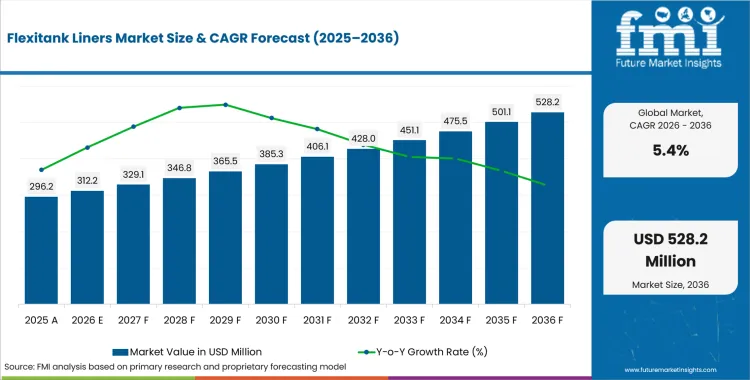
USD 312.2 million in 2026 and USD 528.2 million by 2036 at a 5.4% CAGR.
Demand for flexitank liners is projected to expand at 5.4% CAGR between 2026 and 2036, lifting value from USD 312.2 million to USD 528.2 million. The market was valued at USD 296.2 million in 2025. UNCTAD reported in September 2025 that vessel rerouting lifted seaborne trade ton-miles by 5.9% during 2024. Longer routes raise the cost of a leak or delayed discharge. Liner qualification therefore becomes part of the freight-risk decision instead of a stand-alone packaging purchase.
Bulk-liquid exposure also differs sharply by cargo. The OIV reported in May 2026 that bulk wine represented 34.0% of global wine export volume during 2025. That flow gives one-way liquid packaging a repeatable shipping base without proving adoption by itself. Food oils and chemical liquids impose different barrier and fitting tests. Producers therefore approve liners against the cargo and filling process before placing regular lane orders.
Key Takeaways
- Bulk-liquid exporters buy flexitank liners to protect cargo contact surfaces and reduce the cleaning or return work tied to dedicated tanks.
- Single-use flexitanks are projected to hold 45.0% of product type in 2026 because one-way deployment avoids a return cycle for the liner.
- Rigid plastics are estimated at 30.0% of material in 2026 where a durable outer container carries a replaceable product-contact component.
- The 200-1,000 L range is expected to represent 37.0% of capacity in 2026 because it fits common forklift and intermediate-bulk handling routines.
- Cargo compatibility and leak exposure slow supplier changes because a lower liner price cannot offset product loss or a contaminated shipment.
- Key players in the flexitank liners market include Amcor, MAUSER Packaging Solutions, Mondi Group, Greif, Signode, Smurfit Westrock, SCHÜTZ, Sonoco, Nefab, and International Paper.
Analyst Perspective
"Flexitank liners earn account retention after the pack survives the shipper's real filling and discharge conditions. Manufacturers should compare barrier performance with installation control and recovery support because a failure can erase the freight saving from several successful loads."
- Nandini Roy Choudhury, Principal Consultant, Future Market Insights
How is the flexitank liners market segmented?
The flexitank liners market is segmented by product type, material, capacity, end use, sales channel and region.
Market taxonomy covers product type, material, capacity, end use, sales channel and region. Product types include single-use flexitanks, multilayer barrier tanks, heating-pad systems and fittings. Materials cover rigid plastics, steel and metal, corrugated and fiber and flexible bulk. Capacity includes 200-1,000 L, below 200 L and above 1,000 L. End uses cover chemicals, food ingredients, agriculture, construction and auto and energy and other uses. Sales channels comprise direct industrial accounts, distributors and rental and pooling.
What makes single-use flexitanks central to the product type category?
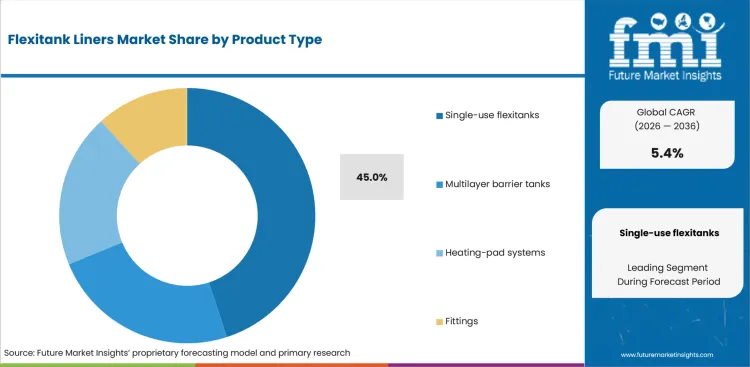
Single-use flexitanks suit export lanes that need a fresh product-contact layer without returning a dedicated tank. The Container Owners Association quality list requires design-specific audits and independent tests before a listed flexitank receives quality conformance.
- Single-use flexitanks account for 45.0% of product type in 2026 owing to one-way use and lower cleaning exposure on many export movements.
- Current COA listings attach qualification to each design and manufacturing site. Shippers therefore compare test records before approving high-barrier packaging films for oxygen-sensitive cargo.
Why do rigid plastics lead the material category?
Rigid plastics fit plants that want a stable outer handling structure with a replaceable inner bottle or liner. Forklift movement and stacking remain familiar to facilities already using composite IBCs.
- Rigid plastics represent 30.0% of material in 2026 because the outer package can absorb handling loads and the contact component can be replaced.
- MAUSER Packaging Solutions expanded its Haiyan facility in January 2025 with a new UN-certified IBC line for chemicals and food. That investment keeps intermediate bulk containers close to regional filling operations.
How does 200-1,000 L fit the capacity category?
Intermediate 200-1,000 L formats give processors more volume per handling unit than drums without committing a full freight container to one liquid. Plants can stage consumption and control discharge at the receiving line.
- The 200-1,000 L segment holds 37.0% of capacity in 2026 because intermediate volumes fit pallet movement and warehouse storage at many industrial sites.
- MAUSER introduced stainless steel IBCs from 125 to 550 gallons in May 2025. The range confirms continued investment in intermediate formats beside bag-in-box formats for lower-volume liquid programs.
What supports chemicals in the end use category?
Chemical shippers approve liners against permeability and stress-cracking risk because a compatibility error can damage both cargo and transport equipment. Cost pressure also raises attention to residue and pack life.
- Chemicals account for 29.0% of end use in 2026 due to frequent bulk-liquid movement and stricter material compatibility checks before routine purchasing.
- Cefic reported 74.6% EU27 chemical capacity utilisation in the first half of 2025. Weak plant utilisation makes loss control important for industrial chemical packaging because packaging failures consume scarce operating margin.
What drives direct industrial accounts in the sales channel category?
Direct industrial accounts lead where approval requires filling trials and traceability before a liner becomes a standard packaging component. One accountable commercial contact also shortens the route between plant engineers and packaging specialists.
- Direct industrial accounts represent 52.0% of sales channel in 2026 because application support and specification control influence repeat orders more than simple order size.
- Mondi presented a corrugated and flexible bag-in-box concept in August 2026 from one supplier. Direct account teams can coordinate both components before filling trials. Returnable transport packaging follows a separate route for programs that specify reusable outer assets.
What are the drivers, restraints and opportunities in the Flexitank Liners Market?
Bulk-liquid export activity sustains repeat liner demand, qualification limits rapid switching and higher-barrier systems provide room for more technical offers.
- Driver: Exporters use liner-based bulk formats to reduce return handling without dedicating a tank to every liquid shipment.
- Restraint: Design qualification and cargo compatibility can extend approval because leaks or contamination can erase the saving from lower packaging cost.
- Opportunity: Barrier films and integrated discharge components can raise revenue per shipment for sensitive liquids that need more than basic containment.
Export Routes Sustain Repeat Packaging Demand
Bulk exporters reorder packaging as each shipping program consumes or recycles its product-contact component. MAUSER Packaging Solutions opened an on-site IBC reconditioning and recycling facility at BASF Tarragona in June 2025. The location reduces empty-pack transport between the chemical plant and recovery operation. Flexitank liner manufacturers face a similar commercial test because service distance affects delivered transport economics, not export volume alone.
Qualification Raises the Cost of Supplier Switching
A liner change introduces a new design into a transport process that carries product-loss exposure. COA flexitank guidance assigns cargo risk assessment plus installation and removal duties to the operator. Plant teams must also confirm compatibility before loading. Approval work slows switching and gives qualified incumbents an advantage even if another manufacturer quotes a lower unit price.
Higher-Barrier Systems Expand Technical Revenue
Sensitive food ingredients and chemicals give manufacturers room to sell more than commodity film. Greif stated in its November 2025 filing that its industrial packaging operations include rigid IBCs and container life-cycle services. That model shows how packaging revenue can extend beyond the first container sale. Companies that qualify barrier packaging for a defined liquid can defend a higher-value specification.
Which country CAGRs are profiled in the Flexitank Liners Market?
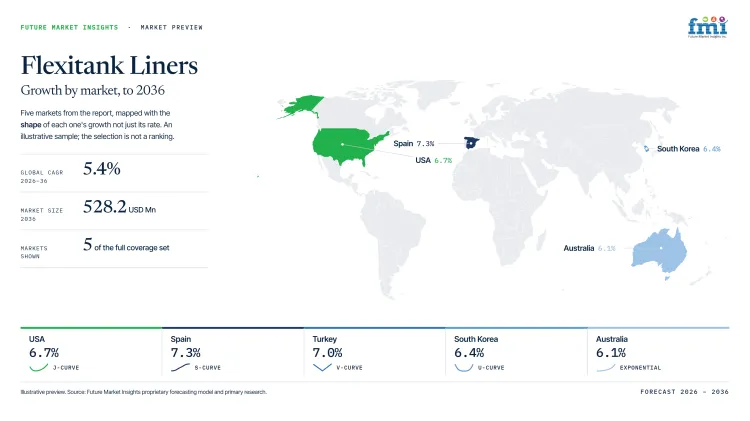
| Country | CAGR |
|---|---|
| Spain | 7.3% |
| Turkey | 7.0% |
| USA | 6.7% |
| South Korea | 6.4% |
| Australia | 6.1% |
| Italy | 5.8% |
How do country-level CAGRs compare in the Flexitank Liners Market?
The profiled forecasts span 1.5 percentage points from Spain at 7.3% to Italy at 5.8%. Spain and Turkey form the upper group above 7.0%. USA and South Korea occupy the middle range. Australia and Italy expand more moderately. The spread is wide enough to influence channel timing but does not identify the largest national revenue base.
- Spain gains pace from food-liquid exports and port access that make barrier selection important for long-distance bulk movements.
- Turkey pairs export manufacturing with domestic flexitank operators whose current COA listings include locally manufactured designs.
- USA carries a large industrial customer base where liability controls and plant approval can outweigh small differences in forecast pace.
- South Korea faces tighter packaging cost discipline during petrochemical downturns because export prices and volumes can change quickly.
- Australia uses long export routes for wine and other liquids, which raises the commercial cost of puncture or oxygen-control failures.
- Italy has strong wine flows but a lower forecast rate, so local account density can matter more than headline expansion for near-term selling.
CAGR measures expansion pace and does not rank market size. Commercial access also depends on cargo mix and the cost of supporting approved accounts. Technical qualification can keep a slower-growing national account commercially attractive.
Country-wise Analysis
- USA chemical and food plants often qualify liquid packaging at site or enterprise level because transport liability can sit above unit-price savings. Flexitank liner demand in USA is forecast to rise at 6.7% CAGR over the assessment period due to a large export base and mature bulk-handling routines. In May 2026 the USA Census Bureau reported that year-to-date goods and services exports were 12.0% higher than a year earlier. Export plants using flexible plastic packaging face similar pressure to document material performance. The main friction is approval time for compatibility and sanitary controls. Regional technical response can shorten trials without reducing the evidence needed before repeat orders.
- Turkish exporters operate inside a manufacturing-heavy trade base where packaging availability and landed cost can decide whether a liquid program ships on time. TurkStat stated in January 2026 that manufacturing products represented 94.3% of national exports during 2025. Turkey is projected to record 7.0% CAGR through 2036 because export production supports repeated industrial packaging demand. Local flexitank manufacturing gives shippers a practical supply option close to ports. Customs administration and qualification paperwork remain material frictions for imported components and fittings. Manufacturers with local stock and direct application support are better placed to hold programs that cannot absorb long replenishment delays.
- Spanish olive-oil and wine exporters need clean bulk formats that protect product quality before bottling or further processing at destination. MAPA recorded 633,786 tonnes of olive-oil exports from October 2024 through May 2025. Exporters also compare food packaging films against oxygen exposure and hygiene needs for sensitive cargo. Spain is anticipated to advance at 7.3% CAGR during the forecast period owing to dense food-liquid export activity and Mediterranean port access. Long transport chains increase the penalty from leakage or excess residue. Local stock near producing regions can improve response time without treating barrier claims as a substitute for qualification.
- Australian wineries frequently ship wine in bulk for packaging closer to destination markets because the country serves distant export routes. Wine Australia reported in January 2026 that unpackaged wine exports reached 416 million litres during 2025. Adoption of flexitank liners in Australia is estimated to expand at 6.1% CAGR by 2036 aided by that bulk flow. Long transit times raise the cost of leakage and oxygen exposure. Exporters compare puncture control with packaging films that match the cargo. A manufacturer can gain account depth by providing container preparation guidance to wineries and consolidators before the loading window.
- South Korean petrochemical exporters tighten packaging budgets during weak spreads because transport incidents cannot be passed easily into product pricing. MOTIE reported in July 2025 that June petrochemical exports fell 15.5% year on year. The decline increases pressure on total delivered packaging cost without reducing leak tolerance. Flexitank liner demand in South Korea is predicted to advance at 6.4% CAGR over the forecast period given its industrial export base and disciplined plant procurement. Local service capacity becomes useful during trials because discharge and valve choices vary by liquid. Companies that document performance clearly can protect technical value even during a weak chemical cycle.
- Italian wine exporters work with mature bottling and logistics networks that can support bulk movement if destination packaging economics justify it. Italy is forecast to post 5.8% CAGR through 2036 tied to steady food-liquid trade and mature packaging infrastructure. ISMEA stated in 2026 that Italian wine exports were about 21 million hectolitres during 2025. The slower forecast does not remove the need for aseptic packaging where sensitive liquids require tighter hygiene control. Account conversion can be slower because incumbent routes already serve many established customers. Manufacturers should target applications where lower residue or barrier performance changes delivered economics materially.
Who are the notable companies in the Flexitank Liners Market?
Amcor, MAUSER Packaging Solutions, Mondi Group, Greif, Signode, Smurfit Westrock, SCHÜTZ, Sonoco, Nefab and International Paper are the notable companies serving this market.
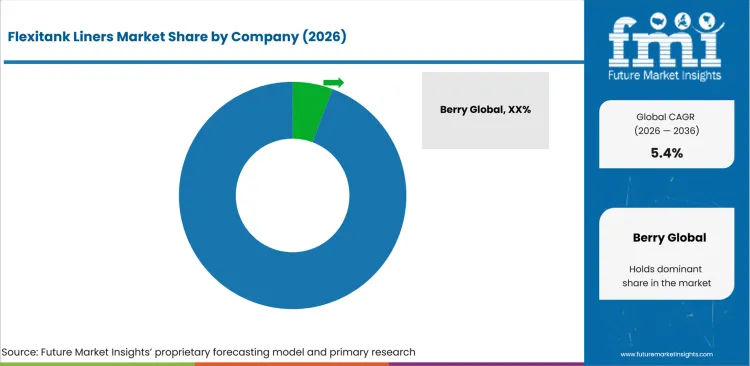
Competition includes flexible-material producers, integrated IBC manufacturers and industrial packaging groups with corrugated or load-protection assets. Entry depends on more than scale because a liner or liner-integrated pack must fit the liquid and the filling process. Direct flexitank specialists can compete beside larger groups where qualification records and local technical service are stronger than portfolio breadth alone.
- Amcor and Mondi Group bring flexible-material engineering that can support barrier and liner structures for sensitive liquid applications.
- MAUSER Packaging Solutions, Greif and SCHÜTZ have stronger positions in integrated IBC platforms with production or recovery infrastructure.
- Signode, Smurfit Westrock, Sonoco, Nefab and International Paper compete mainly through adjacent transit, corrugated, fiber or industrial packaging capabilities.
Competitive Benchmarking: Flexitank Liners Market
| Company | Liquid-Packaging Breadth | Bulk-System Integration | Recovery / Service Depth | Geographic Reach |
|---|---|---|---|---|
| Amcor | High | Medium | Medium | Global |
| MAUSER Packaging Solutions | High | High | High | North America, Europe and Asia |
| Mondi Group | High | Medium | Medium | Europe and international sales |
| Greif | High | High | High | Americas, Europe and Asia |
| Signode | Low | Medium | Medium | Americas, EMEA and Asia-Pacific |
| Smurfit Westrock | High | Medium | Medium | North America, Europe and Latin America |
| SCHÜTZ | High | High | High | Europe, Americas, Asia and Middle East |
| Sonoco | Low | Medium | Medium | Americas, Europe and Asia |
| Nefab | Low | Medium | Medium | Europe, Americas and Asia |
| International Paper | Low | Medium | Medium | North America and EMEA |
Scoring basis: High liquid-packaging breadth requires at least three documented liquid-container or liner routes, Medium identifies two and Low identifies one adjacent route. High bulk-system integration requires owned production plus component or filling support, Medium reflects one integrated route and Low reflects an adjacent packaging role. High recovery or service depth requires collection or reconditioning in multiple regions, Medium identifies a documented service layer and Low marks a narrower route. Ratings reflect current official company announcements and filings not corporate size.
Key Developments in the Flexitank Liners Market
- In April 2025, Amcor completed its combination with Berry Global. The transaction placed Berry’s former flexible-material operations inside the current Amcor company structure.
- In January 2025, Smurfit Westrock documented a WorldStar-winning bag-in-box solution for cleaning products. The award confirms active development of liner-based liquid packaging within its corrugated portfolio.
- SCHÜTZ signed a licence agreement with National Plastic Factory Company in January 2025 for 1,000 L ECOBULK IBC production in Saudi Arabia. First local deliveries were scheduled for 2026.
Key Players in the Flexitank Liners Market
Flexible Materials and Barrier Platforms
- Amcor
- Mondi Group
Integrated IBC and Industrial Bulk Platforms
- MAUSER Packaging Solutions
- Greif
- SCHÜTZ
Transit, Fiber and Industrial Packaging Platforms
- Signode
- Smurfit Westrock
- Sonoco
- Nefab
- International Paper
Flexitank Liners Market - Report Scope
| Coverage field | Report scope |
|---|---|
| Market breakdown | By product type, material, capacity, end use, sales channel and region. |
| Quantitative Units | USD million. |
| Market Definition | Revenue from flexitank liners and liner-integrated bulk-liquid packaging sold within the stated segmentation boundary. Transported liquid value and freight revenue are excluded. |
| Regions Covered | North America, Latin America, Western Europe, Eastern Europe, East Asia, South Asia and Pacific, and Middle East and Africa. |
| Countries Covered | USA, Turkey, Spain, Australia, South Korea, Italy, and 20+ countries included in the full report. |
| Key Companies Profiled | Amcor, MAUSER Packaging Solutions, Mondi Group, Greif, Signode, Smurfit Westrock, SCHÜTZ, Sonoco, Nefab, and International Paper. |
| Forecast Period | 2026 to 2036. |
| Approach | Primary and secondary research with market triangulation. |
Flexitank Liners Market - Research Methodology
| Method | Approach |
|---|---|
| Primary Research | FMI analysts gathered input from manufacturers, service providers, technology developers, distributors, end users, procurement teams, and subject-matter experts. Interviews examined purchasing decisions, product or service evaluation, adoption barriers, approval requirements, pricing considerations, and expectations for technical or commercial support. Respondents were also asked what evidence is required before a trial, pilot, or initial order develops into regular purchasing. |
| Desk Research | Desk research covered government statistics, regulatory publications, trade data, industry associations, technical literature, standards, company filings, product information, and official corporate announcements. Sources were reviewed for relevance, publication date, geographic coverage, and consistency with the defined market scope. Claims relating to performance, applications, approvals, capacity, investment, and commercial activity were retained only when supported by credible public evidence. |
| Market Sizing and Forecasting | The market model combined the baseline value with historical performance, segment structure, pricing and volume indicators, adoption levels, company participation, and country-level demand conditions. Forecast assumptions considered economic activity, investment trends, regulatory developments, technology adoption, purchasing cycles, supply availability, and barriers to wider market use. Segment and regional estimates were reconciled before the final market total was calculated. |
| Data Validation | Estimates were checked against multiple independent indicators, including public data, company activity, trade patterns, industry developments, and findings from primary interviews. Validation also tested whether products, services, applications, and company revenues fell within the defined market boundaries. Adjacent categories, unsupported claims, overlapping revenues, and activities without direct market relevance were excluded to reduce double counting and maintain consistency across segments and countries. |
Flexitank Liners Market by Segments
Flexitank Liners Market segmented by Product Type:
- Single-use flexitanks
- Multilayer barrier tanks
- Heating-pad systems
- Fittings
Flexitank Liners Market segmented by Material:
- Rigid plastics
- Steel & metal
- Corrugated & fiber
- Flexible bulk
Flexitank Liners Market segmented by Capacity:
- 200-1,000 L
- Below 200 L
- Above 1,000 L
Flexitank Liners Market segmented by End Use:
- Chemicals
- Food ingredients
- Agriculture
- Construction & auto
- Energy & other
Flexitank Liners Market segmented by Sales Channel:
- Direct industrial accounts
- Distributors
- Rental & pooling
Flexitank Liners Market by Region:
- North America
- United States
- Canada
- Latin America
- Brazil
- Mexico
- Argentina
- Chile
- Western Europe
- Germany
- France
- United Kingdom
- Italy
- Spain
- Benelux
- Nordics
- Eastern Europe
- Poland
- Czech Republic
- Romania
- Hungary
- East Asia
- China
- Japan
- South Korea
- South Asia and Pacific
- India
- ASEAN
- Australia and New Zealand
- Middle East and Africa
- GCC Countries
- South Africa
- Türkiye
- Israel
Research Sources and Bibliography
- UN Trade and Development. (2025, September 24). Review of Maritime Transport 2025: Staying the course in turbulent waters.
- International Organisation of Vine and Wine. (2026, May 12). State of the world wine sector in 2025.
- Container Owners Association. (2026). Flexitank Quality List.
- MAUSER Packaging Solutions. (2025, January 21). Mauser Packaging Solutions expands capabilities at Haiyan, China, facility to include IBCs.
- MAUSER Packaging Solutions. (2025, May 7). Mauser Packaging Solutions expands product range with new line of stainless steel IBCs.
- Cefic. (2025, September 2). Cefic Chemical Trends Report Q2 2025.
- Mondi. (2026, August 5). Mondi unveils award-winning packaging concept that simplifies eCommerce packaging through laser marking.
- USA Census Bureau & USA Bureau of Economic Analysis. (2026, May 5). USA International Trade in Goods and Services, March 2026.
- Turkish Statistical Institute. (2026, January 30). Foreign Trade Statistics, December 2025.
- Ministry of Agriculture, Fisheries and Food, Spain. (2025). Boletín de comercio exterior de aceite de oliva: Campaña 2024/25.
- Wine Australia. (2026, January 28). Export Report December 2025.
- Ministry of Trade, Industry and Energy, Republic of Korea. (2025, July 1). Korea’s exports grow 4.3 percent in June.
- ISMEA. (2026). Il vino italiano conferma la sua leadership e guarda ai mercati internazionali.
- Amcor. (2025, April 30). Amcor completes combination with Berry Global.
- Smurfit Westrock. (2025, January 22). Smurfit Westrock showcases innovation expertise at WorldStar 2025.
- SCHÜTZ. (2025, January 7). IBC production in Saudi Arabia: SCHÜTZ and National Plastic Factory Company have signed a licence agreement.
- Greif, Inc. (2025, November 19). Form 10-KT for the transition period ended September 30, 2025.
- Signode. (2025, September 29). Signode to feature new stretch wrapper and complete packaging solutions at PACK EXPO 2025.
- Sonoco Products Company. (2025, April 1). Sonoco completes sale of thermoformed and flexibles packaging business to TOPPAN Holdings, Inc.
- Nefab Group. (2025, August 12). Nefab Group acquires FARUSA Emballage.
- International Paper. (2025, January 31). About the IP + DS Smith combination.
- MAUSER Packaging Solutions. (2025, June 5). Mauser Packaging Solutions opens new reconditioning & recycling facility at BASF site in Tarragona, Spain.
- Greif, Inc. (2025, September 2). Greif completes sale of containerboard business.
- Container Owners Association. (2026). Flexitanks technical resource.
This bibliography is provided for reader reference and is not exhaustive. The full report contains the complete reference list and detailed citations.
This Report Answers
- How large is the flexitank liners market in 2026 and 2036?
- Which operating conditions support repeat flexitank liner demand?
- Why do single-use flexitanks account for 45.0% of product type in 2026?
- How do material and capacity choices alter bulk-liquid handling?
- Which country growth rates are highest among the profiled markets?
- What slows qualification and supplier switching in liquid transport programs?
- Which companies provide liner, IBC, fiber and transit-packaging capabilities?
- How do barrier performance and discharge control affect commercial positioning?
Frequently Asked Questions
How big is the flexitank liners market in 2026?
The flexitank liners market is valued at USD 312.2 million in 2026 and is projected to reach USD 528.2 million by 2036. Qualified barrier performance supports repeat bulk-liquid shipments.
What is the CAGR of the flexitank liners market from 2026 to 2036?
The flexitank liners market is projected to grow at 5.4% CAGR between 2026 and 2036. Expansion depends on shipping economics plus specifications that control leakage and contamination.
Which product type leads the flexitank liners market?
Single-use flexitanks are expected to hold 45.0% in 2026 due to one-way deployment on export lanes. Qualified shippers can avoid returning the liner after discharge.
Which material category leads the flexitank liners market?
Rigid plastics are estimated at 30.0% in 2026 because durable outer systems fit routine industrial handling. Replaceable contact components separate handling durability from cargo compatibility.
Which countries are projected to record the highest growth in the flexitank liners market?
Spain is projected at 7.3% CAGR followed by Turkey at 7.0% and USA at 6.7% through 2036. Food-liquid exports and industrial shipping impose different qualification needs.
Which companies are active in the flexitank liners market?
Key companies operating in the flexitank liners market include Amcor, MAUSER Packaging Solutions, Mondi Group, Greif, Signode, Smurfit Westrock, SCHÜTZ, Sonoco, Nefab, and International Paper. They compete through flexible-material engineering, IBC production, recovery services and adjacent transit-packaging support.
Preview the report firsthand - request a free sample
Get SampleGet the brochure for pricing and purchase details.
Get PDFTable of Content
- Key Takeaways
- Market Size and CAGR
- Top Growth Driver
- Fastest Growing Segment
- Leading Region
- Key Companies
- Emerging Opportunities
- Executive Summary
- Global Market Outlook
- Demand-side Trends
- Supply-side Trends
- Technology Roadmap Analysis
- Analysis and Recommendations
- Analyst Perspective (What is happening? Why now? What should investors know?)
- Key Questions Answered
- How large is the market?
- What is the CAGR?
- What are key trends?
- Which region dominates?
- Who are the leaders?
- Market Overview
- Market Coverage / Taxonomy
- Market Definition / Scope / Limitations
- Research Methodology
- Chapter Orientation
- Analytical Lens and Working Hypotheses
- Market Structure, Signals, and Trend Drivers
- Benchmarking and Cross-market Comparability
- Market Sizing, Forecasting, and Opportunity Mapping
- Research Design and Evidence Framework
- Desk Research Programme (Secondary Evidence)
- Expert Input and Fieldwork (Primary Evidence)
- Tooling, Models, and Reference Databases
- Data Engineering and Model Build
- Quality Assurance and Audit Trail
- Market Background
- Market Dynamics (Drivers, Restraints, Opportunity, Trends)
- Scenario Forecast (Optimistic, Likely, Conservative)
- Impact Analysis
- AI Impact
- Sustainability Impact
- Regulatory Impact
- Technology Impact
- Consumer / Buyer Analysis
- Purchase Drivers
- Adoption Barriers
- Buyer Journey
- Opportunity Map Analysis
- Product Life Cycle Analysis
- Supply Chain Analysis
- Investment Feasibility Matrix
- Value Chain Analysis
- PESTLE and Porter's Analysis
- Regulatory Landscape
- Regional Parent Market Outlook
- Production and Consumption Statistics
- Import and Export Statistics
- Global Market Analysis and Forecast, 2021 to 2036
- Historical Market Size Value (USD Million) Analysis, 2021 to 2025
- Current and Future Market Size Value (USD Million) Projections, 2026 to 2036
- Y-o-Y Growth Trend Analysis
- Absolute $ Opportunity Analysis
- Global Market Pricing Analysis, 2021 to 2036
- Global Market Analysis and Forecast, By Product Type, 2021 to 2036
- Introduction / Key Findings
- Historical Market Size Value (USD Million) Analysis By Product Type, 2021 to 2025
- Current and Future Market Size Value (USD Million) Analysis and Forecast By Product Type, 2026 to 2036
- Single-use flexitanks
- Multilayer barrier tanks
- Heating-pad systems
- Fittings
- Single-use flexitanks
- Y-o-Y Growth Trend Analysis By Product Type, 2021 to 2025
- Absolute $ Opportunity Analysis By Product Type, 2026 to 2036
- Global Market Analysis and Forecast, By Material, 2021 to 2036
- Introduction / Key Findings
- Historical Market Size Value (USD Million) Analysis By Material, 2021 to 2025
- Current and Future Market Size Value (USD Million) Analysis and Forecast By Material, 2026 to 2036
- Rigid plastics
- Steel & metal
- Corrugated & fiber
- Flexible bulk
- Rigid plastics
- Y-o-Y Growth Trend Analysis By Material, 2021 to 2025
- Absolute $ Opportunity Analysis By Material, 2026 to 2036
- Global Market Analysis and Forecast, By Capacity, 2021 to 2036
- Introduction / Key Findings
- Historical Market Size Value (USD Million) Analysis By Capacity, 2021 to 2025
- Current and Future Market Size Value (USD Million) Analysis and Forecast By Capacity, 2026 to 2036
- 200-1,000 L
- Below 200 L
- Above 1,000 L
- 200-1,000 L
- Y-o-Y Growth Trend Analysis By Capacity, 2021 to 2025
- Absolute $ Opportunity Analysis By Capacity, 2026 to 2036
- Global Market Analysis and Forecast, By End Use, 2021 to 2036
- Introduction / Key Findings
- Historical Market Size Value (USD Million) Analysis By End Use, 2021 to 2025
- Current and Future Market Size Value (USD Million) Analysis and Forecast By End Use, 2026 to 2036
- Chemicals
- Food ingredients
- Agriculture
- Construction & auto
- Energy & other
- Chemicals
- Y-o-Y Growth Trend Analysis By End Use, 2021 to 2025
- Absolute $ Opportunity Analysis By End Use, 2026 to 2036
- Global Market Analysis and Forecast, By Sales Channel, 2021 to 2036
- Introduction / Key Findings
- Historical Market Size Value (USD Million) Analysis By Sales Channel, 2021 to 2025
- Current and Future Market Size Value (USD Million) Analysis and Forecast By Sales Channel, 2026 to 2036
- Direct industrial accounts
- Distributors
- Rental & pooling
- Direct industrial accounts
- Y-o-Y Growth Trend Analysis By Sales Channel, 2021 to 2025
- Absolute $ Opportunity Analysis By Sales Channel, 2026 to 2036
- Global Market Analysis and Forecast, By Region, 2021 to 2036
- Introduction
- Historical Market Size Value (USD Million) Analysis By Region, 2021 to 2025
- Current Market Size Value (USD Million) Analysis and Forecast By Region, 2026 to 2036
- North America
- Latin America
- Western Europe
- Eastern Europe
- East Asia
- South Asia and Pacific
- Middle East & Africa
- Market Attractiveness Analysis By Region
- North America Market Analysis and Forecast, By Country, 2021 to 2036
- Historical Market Size Value (USD Million) Trend Analysis By Market Taxonomy, 2021 to 2025
- Market Size Value (USD Million) Forecast By Market Taxonomy, 2026 to 2036
- By Country
- USA
- Canada
- By Product Type
- By Material
- By Capacity
- By End Use
- By Sales Channel
- By Country
- Market Attractiveness Analysis
- By Country
- By Product Type
- By Material
- By Capacity
- By End Use
- By Sales Channel
- Key Takeaways
- Latin America Market Analysis and Forecast, By Country
- Historical Market Size Value (USD Million) Trend Analysis By Market Taxonomy, 2021 to 2025
- Market Size Value (USD Million) Forecast By Market Taxonomy, 2026 to 2036
- By Country
- Brazil
- Mexico
- Chile
- Rest of Latin America
- By Product Type
- By Material
- By Capacity
- By End Use
- By Sales Channel
- By Country
- Market Attractiveness Analysis
- By Country
- By Product Type
- By Material
- By Capacity
- By End Use
- By Sales Channel
- Key Takeaways
- Western Europe Market Analysis and Forecast, By Country
- Historical Market Size Value (USD Million) Trend Analysis By Market Taxonomy, 2021 to 2025
- Market Size Value (USD Million) Forecast By Market Taxonomy, 2026 to 2036
- By Country
- Germany
- UK
- Italy
- Spain
- France
- Nordic
- BENELUX
- Rest of Western Europe
- By Product Type
- By Material
- By Capacity
- By End Use
- By Sales Channel
- By Country
- Market Attractiveness Analysis
- By Country
- By Product Type
- By Material
- By Capacity
- By End Use
- By Sales Channel
- Key Takeaways
- Eastern Europe Market Analysis and Forecast, By Country
- Historical Market Size Value (USD Million) Trend Analysis By Market Taxonomy, 2021 to 2025
- Market Size Value (USD Million) Forecast By Market Taxonomy, 2026 to 2036
- By Country
- Russia
- Poland
- Hungary
- Balkan & Baltic
- Rest of Eastern Europe
- By Product Type
- By Material
- By Capacity
- By End Use
- By Sales Channel
- By Country
- Market Attractiveness Analysis
- By Country
- By Product Type
- By Material
- By Capacity
- By End Use
- By Sales Channel
- Key Takeaways
- East Asia Market Analysis and Forecast, By Country
- Historical Market Size Value (USD Million) Trend Analysis By Market Taxonomy, 2021 to 2025
- Market Size Value (USD Million) Forecast By Market Taxonomy, 2026 to 2036
- By Country
- China
- Japan
- South Korea
- By Product Type
- By Material
- By Capacity
- By End Use
- By Sales Channel
- By Country
- Market Attractiveness Analysis
- By Country
- By Product Type
- By Material
- By Capacity
- By End Use
- By Sales Channel
- Key Takeaways
- South Asia and Pacific Market Analysis and Forecast, By Country
- Historical Market Size Value (USD Million) Trend Analysis By Market Taxonomy, 2021 to 2025
- Market Size Value (USD Million) Forecast By Market Taxonomy, 2026 to 2036
- By Country
- India
- ASEAN
- Australia & New Zealand
- Rest of South Asia and Pacific
- By Product Type
- By Material
- By Capacity
- By End Use
- By Sales Channel
- By Country
- Market Attractiveness Analysis
- By Country
- By Product Type
- By Material
- By Capacity
- By End Use
- By Sales Channel
- Key Takeaways
- Middle East & Africa Market Analysis and Forecast, By Country
- Historical Market Size Value (USD Million) Trend Analysis By Market Taxonomy, 2021 to 2025
- Market Size Value (USD Million) Forecast By Market Taxonomy, 2026 to 2036
- By Country
- Kingdom of Saudi Arabia
- Other GCC Countries
- Türkiye
- South Africa
- Other African Union
- Rest of Middle East & Africa
- By Product Type
- By Material
- By Capacity
- By End Use
- By Sales Channel
- By Country
- Market Attractiveness Analysis
- By Country
- By Product Type
- By Material
- By Capacity
- By End Use
- By Sales Channel
- Key Takeaways
- Key Countries Market Analysis
- USA
- Pricing Analysis
- Market Share Analysis, 2025
- By Product Type
- By Material
- By Capacity
- By End Use
- By Sales Channel
- Canada
- Pricing Analysis
- Market Share Analysis, 2025
- By Product Type
- By Material
- By Capacity
- By End Use
- By Sales Channel
- Mexico
- Pricing Analysis
- Market Share Analysis, 2025
- By Product Type
- By Material
- By Capacity
- By End Use
- By Sales Channel
- Brazil
- Pricing Analysis
- Market Share Analysis, 2025
- By Product Type
- By Material
- By Capacity
- By End Use
- By Sales Channel
- Chile
- Pricing Analysis
- Market Share Analysis, 2025
- By Product Type
- By Material
- By Capacity
- By End Use
- By Sales Channel
- Germany
- Pricing Analysis
- Market Share Analysis, 2025
- By Product Type
- By Material
- By Capacity
- By End Use
- By Sales Channel
- UK
- Pricing Analysis
- Market Share Analysis, 2025
- By Product Type
- By Material
- By Capacity
- By End Use
- By Sales Channel
- Italy
- Pricing Analysis
- Market Share Analysis, 2025
- By Product Type
- By Material
- By Capacity
- By End Use
- By Sales Channel
- Spain
- Pricing Analysis
- Market Share Analysis, 2025
- By Product Type
- By Material
- By Capacity
- By End Use
- By Sales Channel
- France
- Pricing Analysis
- Market Share Analysis, 2025
- By Product Type
- By Material
- By Capacity
- By End Use
- By Sales Channel
- India
- Pricing Analysis
- Market Share Analysis, 2025
- By Product Type
- By Material
- By Capacity
- By End Use
- By Sales Channel
- ASEAN
- Pricing Analysis
- Market Share Analysis, 2025
- By Product Type
- By Material
- By Capacity
- By End Use
- By Sales Channel
- Australia & New Zealand
- Pricing Analysis
- Market Share Analysis, 2025
- By Product Type
- By Material
- By Capacity
- By End Use
- By Sales Channel
- China
- Pricing Analysis
- Market Share Analysis, 2025
- By Product Type
- By Material
- By Capacity
- By End Use
- By Sales Channel
- Japan
- Pricing Analysis
- Market Share Analysis, 2025
- By Product Type
- By Material
- By Capacity
- By End Use
- By Sales Channel
- South Korea
- Pricing Analysis
- Market Share Analysis, 2025
- By Product Type
- By Material
- By Capacity
- By End Use
- By Sales Channel
- Russia
- Pricing Analysis
- Market Share Analysis, 2025
- By Product Type
- By Material
- By Capacity
- By End Use
- By Sales Channel
- Poland
- Pricing Analysis
- Market Share Analysis, 2025
- By Product Type
- By Material
- By Capacity
- By End Use
- By Sales Channel
- Hungary
- Pricing Analysis
- Market Share Analysis, 2025
- By Product Type
- By Material
- By Capacity
- By End Use
- By Sales Channel
- Kingdom of Saudi Arabia
- Pricing Analysis
- Market Share Analysis, 2025
- By Product Type
- By Material
- By Capacity
- By End Use
- By Sales Channel
- Türkiye
- Pricing Analysis
- Market Share Analysis, 2025
- By Product Type
- By Material
- By Capacity
- By End Use
- By Sales Channel
- South Africa
- Pricing Analysis
- Market Share Analysis, 2025
- By Product Type
- By Material
- By Capacity
- By End Use
- By Sales Channel
- USA
- Market Structure Analysis
- Competition Dashboard
- Competition Benchmarking
- Market Share Analysis of Top Players
- By Regional
- By Product Type
- By Material
- By Capacity
- By End Use
- By Sales Channel
- Emerging Startups
- Innovation Benchmarking
- Competition Analysis
- Competition Deep Dive
- Berry Global
- Overview
- Product Portfolio
- Profitability by Market Segments
- Sales Footprint
- Strategy Overview
- Marketing Strategy
- Product Strategy
- Channel Strategy
- Mauser Packaging
- Mondi Group
- Greif
- Signode
- Smurfit Westrock
- Schutz
- Sonoco
- Nefab
- International Paper
- Berry Global
- Case Studies
- Success Stories
- Recent Developments
- Competition Deep Dive
- Assumptions & Acronyms Used


