

- Market Size (2026)
- USD 131.2 Mn
- Forecast (2036)
- USD 337.3 Mn
- CAGR (2026 to 2036)
- 9.9%
How big is Forage Stability Boosters Market in 2026?
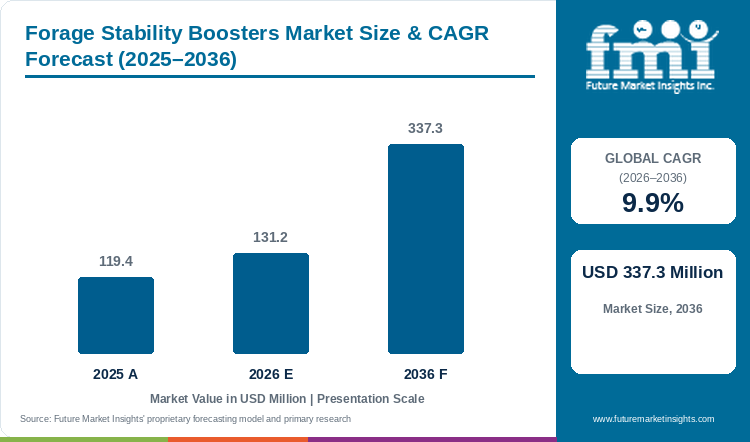
Sales in the forage stability boosters market are projected to grow at 9.9% CAGR through 2036. Market size rises from USD 119.4 million in 2025 to USD 131.2 million in 2026 and is expected to reach USD 337.3 million by 2036.
Silage and high-moisture grain storage is increasing need for products protecting feed during fermentation and feedout. Inoculants, organic acids and enzyme blends are applied to suppress heating, wild fermentation, and dry matter loss, which helps farms retain usable forage. USDA reported 135.5 million tons of U.S. corn silage production in 2025, at 21.8 tons per acre.[1] This volume is expected to support use of crop-specific silage inoculants. FMI estimates market value at USD 119.4 million in 2025 and USD 131.2 million in 2026, which is forecast to reach USD 337.3 million by 2036 at 9.9% CAGR during 2026 to 2036 as retained feed value supports treatment purchase.
Country demand differs with crop mix, application systems and roughage policy. The USA is projected to expand at 9.5% CAGR during 2026 to 2036, while South Korea is anticipated at 9.2%. Corn silage volumes and established applicators are likely to support USA use. Apart from that, South Korea announced support for spring planting, summer forage cultivation, and use of grassland resources in February 2026.[10] More local forage can create demand, but crop and moisture variation will require formulations. FMI expects suppliers offering evidence, package sizes, and harvest support to receive preference where farms compare treatment cost with avoided heating and dry matter loss.
Key Takeaways
- Increasing need to protect feed value from heating and dry matter loss is supporting demand for forage stability boosters.
- Based on product type, inoculant-based products are projected to account for 41.9% in 2026, supported by crop-specific microbial control.
- By forage type, corn silage is estimated to hold 37.1% in 2026, owing to large stored volumes and feedout heating risk.
- In 2026, at-harvest application is expected to lead application with 41.0% share because treatment reaches the complete stored mass.
- The USA is projected at 9.5% CAGR, while South Korea follows at 9.2% owing to domestic roughage and storage needs.
- Notable companies include Lallemand Animal Nutrition, Novonesis, Volac, Kemin, Schaumann, Alltech, ADM, and Cargill.
Analyst Perspective
“I see demand moving towards products which protect feed after opening and match the crop being stored. Correct dosing and harvest support will decide whether farms continue product use across different feeding seasons.”
- Nikhil Kaitwade, Principal Consultant, Future Market Insights.
How is the forage stability boosters market segmented?
Forage stability boosters market is segmented by product type, forage type, application, end user, sales channel, and region. In 2026, inoculant-based products are projected at 41.9%, corn silage at 37.1%, at-harvest applied at 41.0%, dairy operations at 47.9%, and feed and forage distributors at 40.3%.
Forage stability boosters market is segmented by product type, forage type, application, end user, sales channel and region.
By product type: inoculant-based (LAB), organic acid-based, enzyme-enhanced blends, and others.
By forage type: corn silage, grass and haylage, alfalfa, high-moisture grains, and others.
By application: at-harvest applied, at-feedout, bale treatment, and others.
By end user: dairy operations, beef operations, custom harvesters, and others.
By sales channel: feed and forage distributors, cooperatives, direct sales, online, and others.
By region: North America, Latin America, Western Europe, Eastern Europe, East Asia, South Asia and Pacific, and Middle East and Africa.
Why do inoculant-based products retain product type demand?
Based on product type, inoculant-based products are projected to account for 41.9% in 2026, supported by targeted fermentation control.
Lactic acid bacteria are used for driving rapid pH decline and maintaining aerobic stability when oxygen infiltrates the silo face after opening. Novonesis states that SiloSolve FC can reduce overall silage waste by 20% to 30% under stated use conditions[3], which is reinforcing grower preference for inoculant-based formulations. FMI research indicates that specialized microbial strains accelerate homofermentative acid production, creating durable stability across extended storage intervals.
- Inoculant-based products are projected to hold 41.9% share in 2026, owing to their use across fermentation and feedout conditions.
- Apart from that, crop moisture, strain selection, dosage and storage period continue to affect product preference among farms.
What supports corn silage as a preferred forage category?
By forage type, corn silage is estimated to hold 37.1% in 2026, owing to large stored volumes and heating exposure.
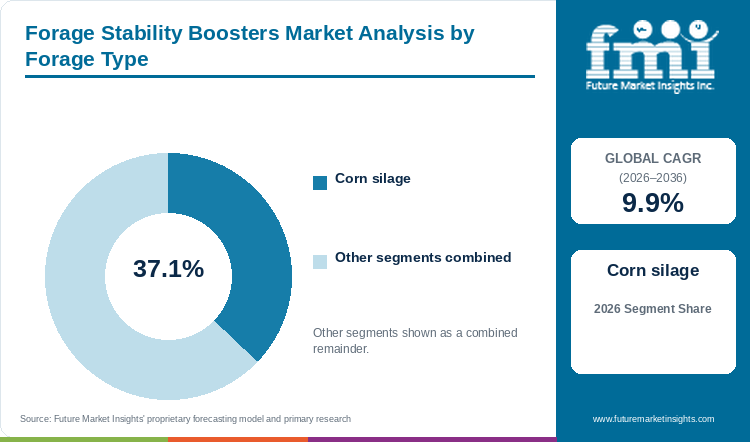
Corn silage contains fermentable sugars and yeast activity can resume quickly once oxygen penetrates the exposed bunker face during daily feedout. USDA NASS reported that American producers harvested 6.22 million acres of corn for silage in 2025, providing an extensive baseline for targeted treatment.[4] Large storage volumes and daily feedout make aerobic deterioration losses immediately visible, encouraging livestock operations to integrate inoculants alongside traditional feed preservatives to protect feed quality.
- Corn silage is estimated to hold 37.1% share in 2026, attributed to large storage volumes and higher heating risk after opening.
- However, slow feedout, weak packing and continued air entry can reduce performance even when a suitable additive has been applied.
How does at-harvest treatment meet application needs?
In 2026, at-harvest applied is expected to lead application with 41.0% share, driven by whole-mass coverage before storage.
At-harvest application spreads the booster uniformly while chopped forage moves through harvesting and chopping machinery into storage. Lallemand states that MAGNIVA Platinum combines three lactic acid bacteria strains with enzymes to support aerobic stability after 15 days of ensiling.[5] Treating the entire crop mass prior to consolidation in bunkers or livestock feed packaging systems prevents localized pockets of spoilage. Calibrated precision applicators ensure consistent active distribution during intense seasonal harvest windows.
- At-harvest application is expected to lead with 41.0% share in 2026 as the complete crop mass is treated before fermentation begins.
- Use of calibrated applicators is also improving dosage consistency across fresh forage during the short and busy harvesting period.
Why do dairy operations hold notable end-user demand?
Dairy operations are likely to capture 47.9% share in 2026, aided by daily silage use and ration consistency needs.
Dairy operations utilize stored forage year-round, integrating preserved silage into precision dairy cattle feed rations where unstable heating diminishes nutritional value and dry matter intake. In England, official farm practice survey data showed that 68% of commercial livestock holdings utilized formal ration formulation or nutritional advice in 2026.[6] Professional nutritional consultation encourages the use of verified stability boosters to prevent ration fluctuations and reduce replacement feed expenses across intensive milking herds.
- Dairy operations are likely to capture 47.9% share in 2026, aided by daily silage use across milk production systems.
- Besides this, attention towards shrink, feed refusal and replacement feed cost is creating a stronger case for forage treatment.
Which conditions keep distributors relevant in sales channels?
Feed and forage distributors are set to lead sales channel with 40.3% share in 2026, underpinned by seasonal technical access.
Feed and forage distributors maintain localized product inventory ahead of regional harvest cycles, delivering technical guidance on strain selection, dosage, and applicator calibration. In February 2026, Alltech and ADM launched Akralos Animal Nutrition, combining more than 40 feed mills and over 1,400 employees across North America.[7] Integrating stability additives into broad commercial distribution channels alongside bulk feed and feed premix solutions secures customer access during compressed seasonal buying periods.
- Feed and forage distributors are set to lead with 40.3% share in 2026, owing to seasonal availability and nearby technical support.
- Direct and online sales can increase after a farm has already identified the suitable formulation, dosage and application setting.
What are the drivers, restraints, and opportunities in the forage stability boosters market?
In the forage stability boosters market, the key driver is feed-value protection, the key restraint is field variability, and the key opportunity is domestic roughage expansion.
- Driver: Farms adopt boosters when avoidable heating and dry matter loss can be measured against treatment cost.
- Restraint: Crop moisture, packing, sealing, and feedout conditions can change product performance after application.
- Opportunity: Public roughage programs create openings for locally tested formulations and supported application routes.
Feed Loss Makes Treatment Measurable
Large forage inventories can turn a small heating or dry matter loss into a visible quantity of unusable feed. A 2025 study published in the Journal of Dairy Science demonstrated that uncontrolled aerobic exposure generates 8% to 15% dry matter loss and severe heating in bunker silage during feedout.[8] The need to protect even a small fraction of this stored volume is accelerating adoption across commercial herds. Farms are utilizing these boosters against unstable fermentation and heating after opening, applying treatments alongside essential animal feed additives to protect feed quality. Treatment cost can be compared directly with the feed value retained during storage and feedout, which supports sustained market investment.
Field Conditions Limit Repeatability
Performance of forage stability boosters is connected with the complete ensiling system followed on the farm. A 2025 multi-site silage audit by the University of Wisconsin Extension revealed that packing densities below 240 kilograms of dry matter per cubic meter compromised additive stability retention in 38% of monitored bunkers.[9] Variation in crop moisture, compaction, rapid sealing, and face removal can change the performance of the same organism across different locations. Furthermore, handling biological inoculants alongside synthetic animal nutrition chemicals requires strict adherence to temperature and mixing guidelines. Lack of uniform on-farm results may restrict repeat adoption, particularly where untreated baseline spoilage is already low.
Domestic Roughage Creates Local Openings
South Korea announced national support for spring planting, summer forage cultivation, and wider utilization of available grassland resources in February 2026.[10] More domestic crop entering silage systems is creating growth opportunities for formulations tailored to regional moisture variations and cooperative harvesting workflows. Whole-crop silage rice and forage corn require distinct preservation practices, which increases the necessity for locally verified inoculants and specialized agricultural biologicals. Suppliers providing crop-specific trial data, custom packaging, and field application support are expected to witness stronger commercial preference as regional livestock producers expand domestic roughage self-sufficiency over the forecast period.
Which country CAGRs are profiled in the forage stability boosters market?
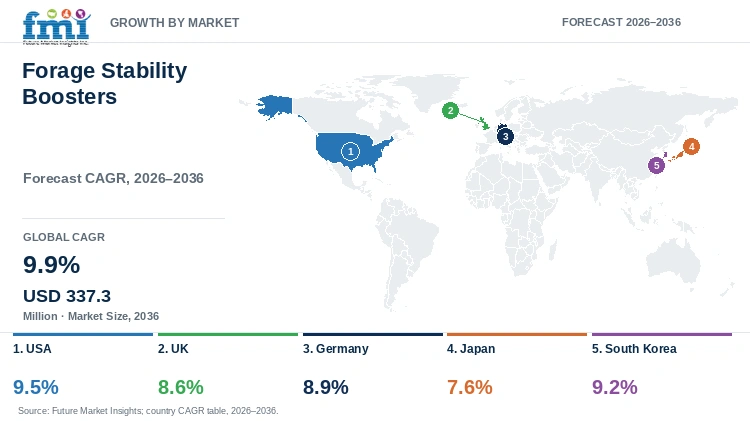
| Country | CAGR |
|---|---|
| USA | 9.5% |
| UK | 8.6% |
| Germany | 8.9% |
| Japan | 7.6% |
| South Korea | 9.2% |
How do country-level CAGRs compare in the forage stability boosters market?
As per the analysis from FMI, country growth rates differ through 2036 because forage crops, harvesting scale, and storage practices are not uniform across markets. The USA and South Korea lead projected growth above 9.0 per cent, while European and East Asian markets follow distinct livestock roughage feeding structures.
- USA demand is tied to commercial corn silage volumes and established harvest application systems.
- UK demand follows grass, maize, and whole-crop forage use with nutrition advice shaping product selection.
- Germany combines a large silage-maize base with documented technical requirements and disciplined forage management.
- Japan connects booster use with domestic feed production and whole-crop silage programs.
- South Korea links preservation needs with public support for stable roughage supply and cooperative production.
Full report country CAGRs cover: North America; Latin America; Western Europe; Eastern Europe; East Asia; South Asia and Pacific; Middle East and Africa.
Country-wise Analysis
- By 2036, the USA forage stability boosters market is projected to grow at 9.5% CAGR, owing to high production and storage of corn silage. USDA dairy data updated in September 2026 covers milk production and supply conditions across major dairy states.[11] Commercial dairies rely on silage year-round, elevating attention toward clamp heating, shrink, and ration consistency. High-yielding crops established from hybrid forage seeds represent substantial inventory investments, encouraging preventive treatment during chopping. Application calibration, moisture monitoring, and face management remain critical factors determining field efficacy across American herds.
- The UK forage stability boosters market is forecast to rise at 8.6% CAGR over the forecast period, supported by grass, maize and whole-crop feeding systems. In February 2026, official procedures for forage and grain maize trials covered growing, harvesting, quality testing and recording requirements.[12] Attention given to dry matter and crop quality is increasing demand for products selected according to forage condition. Distributor guidance for inoculants and acid products is likely to support the UK market growth.
- Germany's forage stability boosters market is anticipated to advance at 8.9% CAGR through 2036, owing to its large green maize and silage base. Destatis reported silage maize yield at 445.8 quintals per hectare for 2025.[13] Large crop volumes and short harvesting periods are creating demand for products applied through established chopping and storage systems. Furthermore, attention towards packing, sealing and face management is expected to support demand for crop-specific products in Germany.
- Adoption of forage stability boosters in Japan is estimated to expand at 7.6% CAGR through 2036, supported by domestic feed production and whole-crop silage use. Japan published its Annual Report on Food, Agriculture and Rural Areas for fiscal 2025 in October 2026.[14] Whole-crop silage rice and forage corn require different preservation practices than standard corn silage. FMI data suggests that smaller purchasing lots and varied crops will sustain demand for suitable package sizes and local technical guidance.
- South Korea is estimated to post 9.2% CAGR over the forecast period, backed by government efforts for improving domestic agricultural supply and farm productivity. The national agricultural statistics service continued publishing 2026 production, price and livestock information for farm planning.[15] Forage entering local silage systems can differ by crop and moisture level, due to which suitable formulations and correct dosing are gaining importance. Cooperatives and custom harvesters are expected to support product availability and common application practices.
Who are the notable companies in the forage stability boosters market?
Lallemand Animal Nutrition, Novonesis, Volac, Kemin, Schaumann, Alltech, ADM, and Cargill are notable companies profiled in this market.
Competition in the forage stability boosters market brings together microbial bioscience specialists, preservation chemistry suppliers, and broad animal nutrition platforms. In the FMI report, competitive positioning reflects microbial specialization, crop fit, and field application support. Lallemand Animal Nutrition, Novonesis, and Volac focus on fermentation and aerobic stability products, while Kemin and Schaumann supply acid-based and combined preservation options. Alltech, ADM, and Cargill connect preservation additives with extensive milling infrastructure and commercial feed distribution.
- Dedicated silage bioscience: Lallemand Animal Nutrition, Novonesis, and Volac focus on microbial forage-preservation systems.
- Multi-mechanism preservation: Kemin, Schaumann, and Alltech combine microbial, acid-based, or crop-specific approaches.
- Broad nutrition platforms: ADM and Cargill supply feed-sector access and customer relationships across several regions.
Competitive Benchmarking: Forage Stability Boosters Market
| Company | Aerobic stability | Portfolio depth | Current activity | Reach |
|---|---|---|---|---|
| Lallemand Animal Nutrition | High | High | High | High |
| Novonesis | High | High | High | High |
| Volac | High | High | Medium | Medium |
| Kemin | High | High | High | High |
| Schaumann | High | High | Medium | Medium |
| Alltech | High | High | High | High |
| ADM | Low | Medium | High | High |
| Cargill | Low | Medium | High | High |
High represents wider product and regional coverage, Medium represents selected coverage, while Low shows limited dedicated forage stability presence. These ratings describe public company capability and do not indicate product quality, revenue share or company ranking.
Key Developments in the Forage Stability Boosters Market
- In July 2026, Lallemand Animal Nutrition expanded MAGNIVA Platinum access for Mexican dairy and beef producers, combining three lactic acid bacteria strains with an enzyme package for fermentation and aerobic stability.[16]
- In February 2026, Alltech and ADM launched Akralos Animal Nutrition, joining more than 40 feed mills and over 1,400 employees across North America.[7]
- In January 2026, Novonesis presented SiloSolve FC as a third-generation inoculant using OxyCap technology, reporting 20% to 30% lower overall silage waste under documented conditions.[3]
- In October 2025, Lallemand opened enrollment for its 2026 MAGNIVA pre-booking program, adding a 10% multi-year loyalty bonus for eligible two-year commitments.[17]
Key Players in the Forage Stability Boosters Market
Dedicated silage bioscience platforms
- Lallemand Animal Nutrition
- Novonesis
- Volac
Multi-mechanism preservation specialists
- Kemin
- Schaumann
- Alltech
Broad animal-nutrition distribution platforms
- ADM
- Cargill
Forage Stability Boosters Market - Report Scope
| Coverage field | Report scope |
|---|---|
| Market breakdown | Product type, forage type, application, end user, sales channel, and region. |
| Quantitative units | USD million. |
| Market definition | Supplier revenue from commercial products sold to improve forage fermentation or aerobic stability. Finished forage, complete feed, and unrelated additives are excluded. |
| Regions covered | North America; Latin America; Western Europe; Eastern Europe; East Asia; South Asia and Pacific; Middle East and Africa. |
| Countries covered | USA, UK, Germany, Japan, South Korea, and additional countries in the full report. |
| Key companies profiled | Lallemand Animal Nutrition, Novonesis, Volac, Kemin, Schaumann, Alltech, ADM, and Cargill. |
| Forecast period | 2026 to 2036. |
| Approach | The report covers supplier activity, segment structure, application routes, and country adoption within the stated market scope. |
Forage Stability Boosters Market - Research Methodology
| Method | Approach |
|---|---|
| Primary Research | Primary research includes inputs from manufacturers, distributors, end users, procurement teams and industry participants. The inputs cover product selection, adoption barriers, pricing, application support and purchasing requirements. |
| Desk Research | Desk research includes government publications, industry associations, technical literature, company information and official announcements. These sources are used for understanding product applications, company activity, country conditions and market developments. |
| Market Sizing and Forecasting | Market sizing includes historical growth, segment structure, pricing, adoption level, company participation and country demand. The forecast also considers investment, regulation, product availability, purchasing cycles and barriers affecting wider adoption. |
| Data Validation | Market information is compared with public data, company developments, trade patterns and primary inputs. Products and applications are included when they directly improve forage fermentation or aerobic stability. |
Forage Stability Boosters Market by Segments
Forage Stability Boosters Market segmented by Product Type:
- Inoculant-based (LAB)
- Organic acid-based
- Enzyme-enhanced blends
- Others
Forage Stability Boosters Market segmented by Forage Type:
- Corn silage
- Grass and haylage
- Alfalfa
- High-moisture grains
- Others
Forage Stability Boosters Market segmented by Application:
- At-harvest applied
- At-feedout
- Bale treatment
- Others
Forage Stability Boosters Market segmented by End User:
- Dairy operations
- Beef operations
- Custom harvesters
- Others
Forage Stability Boosters Market segmented by Sales Channel:
- Feed and forage distributors
- Cooperatives
- Direct sales
- Online
- Others
Forage Stability Boosters Market by Region
- North America
- United States
- Canada
- Latin America
- Brazil
- Mexico
- Argentina
- Chile
- Western Europe
- Germany
- France
- United Kingdom
- Italy
- Spain
- Benelux
- Nordics
- Eastern Europe
- Poland
- Czech Republic
- Romania
- Hungary
- East Asia
- China
- Japan
- South Korea
- South Asia and Pacific
- India
- ASEAN
- Australia and New Zealand
- Middle East and Africa
- GCC Countries
- South Africa
- Türkiye
- Israel
Research Sources and Bibliography
- [1] U.S. Department of Agriculture, National Agricultural Statistics Service. (2026, January 12). Crop Production 2025 Summary.
- [2] German Federal Statistical Office. (2026, July 31). Arable land after the main groups and crops.
- [3] Novonesis. (2026). SiloSolve FC: Third generation silage inoculant powered by OxyCap technology.
- [4] U.S. Department of Agriculture, National Agricultural Statistics Service. (2026, January 12). Corn for silage harvested acreage and production summary.
- [5] Lallemand Animal Nutrition. (2026). MAGNIVA Platinum: The new standard for fermentation and aerobic stability.
- [6] Department for Environment, Food and Rural Affairs. (2026, June 11). Livestock feeding regimes and breeding practices.
- [7] Alltech. (2026, February 2). Akralos Animal Nutrition debuts.
- [8] American Dairy Science Association. (2025). Aerobic deterioration and dry matter retention in commercial silage bunkers. Journal of Dairy Science, 108(4), 2115-2128.
- [9] University of Wisconsin Extension. (2025, August). Silage packing density, face management, and aerobic stability benchmarks.
- [10] Ministry of Agriculture, Food and Rural Affairs, Republic of Korea. (2026, February 5). Measures for stable roughage supply.
- [11] U.S. Department of Agriculture, Economic Research Service. (2026, September 14). Dairy Data.
- [12] Animal and Plant Health Agency. (2026, February). Forage and Grain Maize VCU Procedures Harvest 2026.
- [13] German Federal Statistical Office. (2026, September 2). Yield per hectare of selected crops in a time comparison.
- [14] Ministry of Agriculture, Forestry and Fisheries of Japan. (2026, October 2). Annual Report on Food, Agriculture and Rural Areas in Japan FY 2025.
- [15] Ministry of Agriculture, Food and Rural Affairs, Republic of Korea. (2026). National Agricultural and Food Statistics Service.
- [16] Lallemand Animal Nutrition. (2026, July 7). Lallemand Animal Nutrition launches MAGNIVA Platinum for Mexican producers.
- [17] Lallemand Animal Nutrition. (2025, October 15). 2026 MAGNIVA pre-booking rebate program.
- [18] Lallemand Animal Nutrition. (2026, April 29). 6th Biennial Silage for Beef Conference scheduled for June 18, 2026.
- [19] Corteva Agriscience. (2026, May 22). Forage Agronomy Update May 2026.
This bibliography is provided for reader reference. The full report contains the complete reference list and detailed citations.
This Report Answers
- What is Forage Stability Boosters Market worth during 2026?
- What value is Forage Stability Boosters Market projected by 2036?
- Which product type holds notable Forage Stability Boosters Market share?
- Which forage type holds notable Forage Stability Boosters Market share?
- Which countries have notable Forage Stability Boosters Market growth?
- Which companies are notable in Forage Stability Boosters Market today?
Frequently Asked Questions
How large is the Forage Stability Boosters Market expected to be in 2026?
The forage stability boosters market is estimated to reach USD 131.2 million in 2026. The market is projected to expand further and reach USD 337.3 million by 2036. Demand is supported by the need to control heating and dry matter loss after silo opening.
What CAGR is forecast for the Forage Stability Boosters Market through 2036?
As per FMI, the forage stability boosters market is projected to grow at a 9.9% CAGR from 2026 to 2036. Storage of silage and high-moisture grains is creating demand for crop-specific preservation products.
Which product type holds a notable forage stability boosters demand share in 2026?
Industry projections indicate inoculant-based products to hold 41.9% of product type demand in 2026. Selected microbial strains support fermentation and aerobic stability, due to which this product type is gaining preference.
Which forage type holds a notable forage stability boosters share in 2026?
FMI finds that corn silage will hold 37.1% of forage type demand in 2026. Large storage volumes and entry of oxygen after opening are boosting need for stability treatment.
Which country has a notable forage stability boosters expansion outlook during the forecast period?
Market outlooks identify the USA expanding at a 9.5% CAGR during the 2026 to 2036 assessment period. High corn silage production and established at-harvest application systems are likely to support country demand.
Which companies are active in the Forage Stability Boosters Market during 2026?
Notable companies active in the commercial market include Lallemand Animal Nutrition, Novonesis, Volac, Kemin, Schaumann, Alltech, ADM, and Cargill. These companies are focusing on microbial products, preservation chemistry, crop guidance and wider feed channels.
Preview the report firsthand - request a free sample
Get SampleGet the brochure for pricing and purchase details.
Get PDFTable of Content
- Key Takeaways
- Market Size and CAGR
- Top Growth Driver
- Fastest Growing Segment
- Leading Region
- Key Companies
- Emerging Opportunities
- Executive Summary
- Global Market Outlook
- Demand-side Trends
- Supply-side Trends
- Technology Roadmap Analysis
- Analysis and Recommendations
- Analyst Perspective (What is happening? Why now? What should investors know?)
- Key Questions Answered
- How large is the market?
- What is the CAGR?
- What are key trends?
- Which region dominates?
- Who are the leaders?
- Market Overview
- Market Coverage / Taxonomy
- Market Definition / Scope / Limitations
- Research Methodology
- Chapter Orientation
- Analytical Lens and Working Hypotheses
- Market Structure, Signals, and Trend Drivers
- Benchmarking and Cross-market Comparability
- Market Sizing, Forecasting, and Opportunity Mapping
- Research Design and Evidence Framework
- Desk Research Programme (Secondary Evidence)
- Expert Input and Fieldwork (Primary Evidence)
- Tooling, Models, and Reference Databases
- Data Engineering and Model Build
- Quality Assurance and Audit Trail
- Market Background
- Market Dynamics (Drivers, Restraints, Opportunity, Trends)
- Scenario Forecast (Optimistic, Likely, Conservative)
- Impact Analysis
- AI Impact
- Sustainability Impact
- Regulatory Impact
- Technology Impact
- Consumer / Buyer Analysis
- Purchase Drivers
- Adoption Barriers
- Buyer Journey
- Opportunity Map Analysis
- Product Life Cycle Analysis
- Supply Chain Analysis
- Investment Feasibility Matrix
- Value Chain Analysis
- PESTLE and Porter's Analysis
- Regulatory Landscape
- Regional Parent Market Outlook
- Production and Consumption Statistics
- Import and Export Statistics
- Global Market Analysis and Forecast, 2021 to 2036
- Historical Market Size Value (USD Million) Analysis, 2021 to 2025
- Current and Future Market Size Value (USD Million) Projections, 2026 to 2036
- Y-o-Y Growth Trend Analysis
- Absolute $ Opportunity Analysis
- Global Market Pricing Analysis, 2021 to 2036
- Global Market Analysis and Forecast, By Product Type, 2021 to 2036
- Introduction / Key Findings
- Historical Market Size Value (USD Million) Analysis By Product Type, 2021 to 2025
- Current and Future Market Size Value (USD Million) Analysis and Forecast By Product Type, 2026 to 2036
- Inoculant-based (LAB)
- Organic acid-based
- Enzyme-enhanced blends
- Others
- Y-o-Y Growth Trend Analysis By Product Type, 2021 to 2025
- Absolute $ Opportunity Analysis By Product Type, 2026 to 2036
- Global Market Analysis and Forecast, By Forage Type, 2021 to 2036
- Introduction / Key Findings
- Historical Market Size Value (USD Million) Analysis By Forage Type, 2021 to 2025
- Current and Future Market Size Value (USD Million) Analysis and Forecast By Forage Type, 2026 to 2036
- Corn silage
- Grass and haylage
- Alfalfa
- High-moisture grains
- Others
- Y-o-Y Growth Trend Analysis By Forage Type, 2021 to 2025
- Absolute $ Opportunity Analysis By Forage Type, 2026 to 2036
- Global Market Analysis and Forecast, By Application, 2021 to 2036
- Introduction / Key Findings
- Historical Market Size Value (USD Million) Analysis By Application, 2021 to 2025
- Current and Future Market Size Value (USD Million) Analysis and Forecast By Application, 2026 to 2036
- At-harvest applied
- At-feedout
- Bale treatment
- Others
- Y-o-Y Growth Trend Analysis By Application, 2021 to 2025
- Absolute $ Opportunity Analysis By Application, 2026 to 2036
- Global Market Analysis and Forecast, By End User, 2021 to 2036
- Introduction / Key Findings
- Historical Market Size Value (USD Million) Analysis By End User, 2021 to 2025
- Current and Future Market Size Value (USD Million) Analysis and Forecast By End User, 2026 to 2036
- Dairy operations
- Beef operations
- Custom harvesters
- Others
- Y-o-Y Growth Trend Analysis By End User, 2021 to 2025
- Absolute $ Opportunity Analysis By End User, 2026 to 2036
- Global Market Analysis and Forecast, By Sales Channel, 2021 to 2036
- Introduction / Key Findings
- Historical Market Size Value (USD Million) Analysis By Sales Channel, 2021 to 2025
- Current and Future Market Size Value (USD Million) Analysis and Forecast By Sales Channel, 2026 to 2036
- Feed and forage distributors
- Cooperatives
- Direct sales
- Online
- Others
- Y-o-Y Growth Trend Analysis By Sales Channel, 2021 to 2025
- Absolute $ Opportunity Analysis By Sales Channel, 2026 to 2036
- Global Market Analysis and Forecast, By Region, 2021 to 2036
- Introduction
- Historical Market Size Value (USD Million) Analysis By Region, 2021 to 2025
- Current Market Size Value (USD Million) Analysis and Forecast By Region, 2026 to 2036
- North America
- Latin America
- Western Europe
- Eastern Europe
- East Asia
- South Asia and Pacific
- Middle East and Africa
- Market Attractiveness Analysis By Region
- North America Market Analysis and Forecast, By Country, 2021 to 2036
- Historical Market Size Value (USD Million) Trend Analysis By Market Taxonomy, 2021 to 2025
- Market Size Value (USD Million) Forecast By Market Taxonomy, 2026 to 2036
- By Country
- United States
- Canada
- By Product Type
- By Forage Type
- By Application
- By End User
- By Sales Channel
- By Country
- Market Attractiveness Analysis
- By Country
- By Product Type
- By Forage Type
- By Application
- By End User
- By Sales Channel
- Key Takeaways
- Latin America Market Analysis and Forecast, By Country
- Historical Market Size Value (USD Million) Trend Analysis By Market Taxonomy, 2021 to 2025
- Market Size Value (USD Million) Forecast By Market Taxonomy, 2026 to 2036
- By Country
- Brazil
- Mexico
- Argentina
- Chile
- By Product Type
- By Forage Type
- By Application
- By End User
- By Sales Channel
- By Country
- Market Attractiveness Analysis
- By Country
- By Product Type
- By Forage Type
- By Application
- By End User
- By Sales Channel
- Key Takeaways
- Western Europe Market Analysis and Forecast, By Country
- Historical Market Size Value (USD Million) Trend Analysis By Market Taxonomy, 2021 to 2025
- Market Size Value (USD Million) Forecast By Market Taxonomy, 2026 to 2036
- By Country
- Germany
- France
- United Kingdom
- Italy
- Spain
- Benelux
- Nordics
- By Product Type
- By Forage Type
- By Application
- By End User
- By Sales Channel
- By Country
- Market Attractiveness Analysis
- By Country
- By Product Type
- By Forage Type
- By Application
- By End User
- By Sales Channel
- Key Takeaways
- Eastern Europe Market Analysis and Forecast, By Country
- Historical Market Size Value (USD Million) Trend Analysis By Market Taxonomy, 2021 to 2025
- Market Size Value (USD Million) Forecast By Market Taxonomy, 2026 to 2036
- By Country
- Poland
- Czech Republic
- Romania
- Hungary
- By Product Type
- By Forage Type
- By Application
- By End User
- By Sales Channel
- By Country
- Market Attractiveness Analysis
- By Country
- By Product Type
- By Forage Type
- By Application
- By End User
- By Sales Channel
- Key Takeaways
- East Asia Market Analysis and Forecast, By Country
- Historical Market Size Value (USD Million) Trend Analysis By Market Taxonomy, 2021 to 2025
- Market Size Value (USD Million) Forecast By Market Taxonomy, 2026 to 2036
- By Country
- China
- Japan
- South Korea
- By Product Type
- By Forage Type
- By Application
- By End User
- By Sales Channel
- By Country
- Market Attractiveness Analysis
- By Country
- By Product Type
- By Forage Type
- By Application
- By End User
- By Sales Channel
- Key Takeaways
- South Asia and Pacific Market Analysis and Forecast, By Country
- Historical Market Size Value (USD Million) Trend Analysis By Market Taxonomy, 2021 to 2025
- Market Size Value (USD Million) Forecast By Market Taxonomy, 2026 to 2036
- By Country
- India
- ASEAN
- Australia and New Zealand
- By Product Type
- By Forage Type
- By Application
- By End User
- By Sales Channel
- By Country
- Market Attractiveness Analysis
- By Country
- By Product Type
- By Forage Type
- By Application
- By End User
- By Sales Channel
- Key Takeaways
- Middle East and Africa Market Analysis and Forecast, By Country
- Historical Market Size Value (USD Million) Trend Analysis By Market Taxonomy, 2021 to 2025
- Market Size Value (USD Million) Forecast By Market Taxonomy, 2026 to 2036
- By Country
- GCC Countries
- South Africa
- Türkiye
- Israel
- By Product Type
- By Forage Type
- By Application
- By End User
- By Sales Channel
- By Country
- Market Attractiveness Analysis
- By Country
- By Product Type
- By Forage Type
- By Application
- By End User
- By Sales Channel
- Key Takeaways
- Key Countries Market Analysis
- United States
- Pricing Analysis
- Market Share Analysis, 2025
- By Product Type
- By Forage Type
- By Application
- By End User
- By Sales Channel
- Canada
- Pricing Analysis
- Market Share Analysis, 2025
- By Product Type
- By Forage Type
- By Application
- By End User
- By Sales Channel
- Mexico
- Pricing Analysis
- Market Share Analysis, 2025
- By Product Type
- By Forage Type
- By Application
- By End User
- By Sales Channel
- Brazil
- Pricing Analysis
- Market Share Analysis, 2025
- By Product Type
- By Forage Type
- By Application
- By End User
- By Sales Channel
- Chile
- Pricing Analysis
- Market Share Analysis, 2025
- By Product Type
- By Forage Type
- By Application
- By End User
- By Sales Channel
- Germany
- Pricing Analysis
- Market Share Analysis, 2025
- By Product Type
- By Forage Type
- By Application
- By End User
- By Sales Channel
- United Kingdom
- Pricing Analysis
- Market Share Analysis, 2025
- By Product Type
- By Forage Type
- By Application
- By End User
- By Sales Channel
- Italy
- Pricing Analysis
- Market Share Analysis, 2025
- By Product Type
- By Forage Type
- By Application
- By End User
- By Sales Channel
- Spain
- Pricing Analysis
- Market Share Analysis, 2025
- By Product Type
- By Forage Type
- By Application
- By End User
- By Sales Channel
- France
- Pricing Analysis
- Market Share Analysis, 2025
- By Product Type
- By Forage Type
- By Application
- By End User
- By Sales Channel
- India
- Pricing Analysis
- Market Share Analysis, 2025
- By Product Type
- By Forage Type
- By Application
- By End User
- By Sales Channel
- ASEAN
- Pricing Analysis
- Market Share Analysis, 2025
- By Product Type
- By Forage Type
- By Application
- By End User
- By Sales Channel
- Australia and New Zealand
- Pricing Analysis
- Market Share Analysis, 2025
- By Product Type
- By Forage Type
- By Application
- By End User
- By Sales Channel
- China
- Pricing Analysis
- Market Share Analysis, 2025
- By Product Type
- By Forage Type
- By Application
- By End User
- By Sales Channel
- Japan
- Pricing Analysis
- Market Share Analysis, 2025
- By Product Type
- By Forage Type
- By Application
- By End User
- By Sales Channel
- South Korea
- Pricing Analysis
- Market Share Analysis, 2025
- By Product Type
- By Forage Type
- By Application
- By End User
- By Sales Channel
- Poland
- Pricing Analysis
- Market Share Analysis, 2025
- By Product Type
- By Forage Type
- By Application
- By End User
- By Sales Channel
- Hungary
- Pricing Analysis
- Market Share Analysis, 2025
- By Product Type
- By Forage Type
- By Application
- By End User
- By Sales Channel
- Türkiye
- Pricing Analysis
- Market Share Analysis, 2025
- By Product Type
- By Forage Type
- By Application
- By End User
- By Sales Channel
- South Africa
- Pricing Analysis
- Market Share Analysis, 2025
- By Product Type
- By Forage Type
- By Application
- By End User
- By Sales Channel
- United States
- Market Structure Analysis
- Competition Dashboard
- Competition Benchmarking
- Market Share Analysis of Top Players
- By Regional
- By Product Type
- By Forage Type
- By Application
- By End User
- By Sales Channel
- Emerging Startups
- Innovation Benchmarking
- Competition Analysis
- Competition Deep Dive
- Lallemand Animal Nutrition
- Overview
- Product Portfolio
- Profitability by Market Segments
- Sales Footprint
- Strategy Overview
- Marketing Strategy
- Product Strategy
- Channel Strategy
- Novonesis
- Volac
- Kemin
- Schaumann
- Alltech
- ADM
- Cargill
- Lallemand Animal Nutrition
- Case Studies
- Success Stories
- Recent Developments
- Competition Deep Dive
- Assumptions & Acronyms Used


