

- Market Size (2026)
- USD 501.8 Mn
- Forecast (2036)
- USD 1155.6 Mn
- CAGR (2026 to 2036)
- 8.7%
How big is Frozen Muffin Batter Market in 2026?
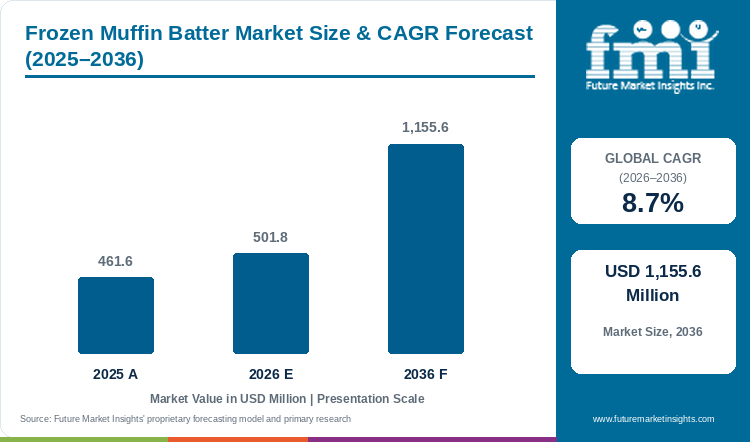
Standing at USD 461.6 million in 2025, the global frozen muffin batter market is slated to reach USD 501.8 million in 2026 and ascend to USD 1,155.6 million by 2036, registering a CAGR of 8.7% over the ten-year period.
Shifting flour weighing and bowl mixing out of store kitchens while keeping fresh-from-the-oven muffin aroma is the core purchasing driver across supermarket in-store bakeries and institutional dining halls. Instead of assigning early-morning staff to measure dry ingredients and liquid eggs from scratch, bakery managers order ready-to-portion frozen muffin batter where chocolate chip batters hold a 37.0% product type share in 2026. Three-pound pipeable batter tubes cut refrigerator thawing time from thirty-six hours down to three. According to FMI, the global frozen muffin batter market is projected to expand from USD 461.6 million in 2025 to USD 501.8 million in 2026 and reach USD 1,155.6 million by 2036 at an 8.7% CAGR, outpacing the 6.3% CAGR in dry batter premixes. In August 2025, General Mills documented in its fiscal 2025 proxy filing that its North America Foodservice unit is expanding portion-controlled Pillsbury bakery and batter programs across schools and supermarkets [1]. Even so, strict zero-refreeze rules and walk-in cooler space limits still slow adoption at small convenience kiosks.
Key Market Trends & Insights
- By product type: Chocolate chip batters are estimated to hold a 37.0% share in 2026, linked to steady batter thickness that keeps chocolate chips from sinking during panning.
- By claim / nature: Conventional formulations are projected to account for a 59.0% share in 2026, supported by reliable baking-powder lift across store ovens.
- By format: Frozen batter systems are expected to hold a 28.0% share in 2026, driven by central plant mixing and fresh store-baked presentation.
- By packaging format: Multipack six-count pipeable tube cases are predicted to record a 31.0% share in 2026, owing to three-hour rapid thawing and 86% less plastic than rigid pails.
- By sales channel: Supermarkets & hypermarkets are anticipated to capture a 39.0% share in 2026, reinforced by in-store bakery tables converting unbaked batter into fresh-domed muffins.
Regional Highlights
- Top national expansion: High-volume hotel breakfast buffets and hypermarket bake-off commissaries drive the UAE to a leading 10.0% CAGR from 2026 to 2036.
- Broader country progression: Hospitality catering rollouts propel Saudi Arabia at a 9.7% CAGR while compact cafe piping tubes lift South Korea to 9.4% and in-store bakery conversion sustains a 9.1% CAGR in the USA ahead of France at 7.8%.
Market Size & Forecast
Table 1: Market Size and Forecast for the Frozen Muffin Batter Market (USD million and CAGR percentage), 2025 to 2036
| Metric | Value |
|---|---|
| 2025 Market Size | USD 461.6 million |
| Estimated Market Size in 2026 | USD 501.8 million |
| Projected Market Size by 2036 | USD 1,155.6 million |
| CAGR, 2026 to 2036 | 8.7% |
| Added Revenue, 2026 to 2036 | USD 653.8 million |
Supermarket in-store bakeries and hotel breakfast kitchens face persistent early-shift baker shortages that make weighing flour and sugar with oil and liquid eggs at 4:00 AM too costly. Pre-mixed frozen muffin batter removes bowl mixing and pan scraping while preserving high muffin domes and warm oven aroma across morning bake cycles. A commercial grocery case study published by CraftMark Bakery showed that switching from scoop-and-bake buckets to pre-deposited frozen muffin batter saved millions of dollars in store labor and cut expired batter waste across hundreds of U.S. grocery bakeries [2]. Retail bakery directors are therefore shifting staff hours from scratch mixing toward higher-margin finishing across frozen batters and ambient packaged muffins.
Bakery-Counter and Batter-Pail Sizing
Table 2: Bakery-Counter and Batter-Pail Sizing for the Frozen Muffin Batter Market (USD million and operational ranges), 2025 to 2036
| Metric | 2025 | 2026 | 2036 |
|---|---|---|---|
| Market size (USD million) | 461.6 | 501.8 | 1,155.6 |
| Commercial frozen batter volume (thousand metric tons) | 148.0 to 165.0 | 160.0 to 178.0 | 345.0 to 385.0 |
| 18-lb pails & 6x3-lb tube cases shipped (million) | 18.2 to 20.2 | 19.6 to 21.8 | 42.3 to 47.2 |
| Average wholesale price per 18-lb case/pail (USD) | 22.8 to 25.4 | 23.0 to 25.6 | 24.5 to 27.3 |
Operational note: Tonnage and case ranges reflect commercial 18-pound (8.16 kg) bulk pails, six-count 3-pound (8.16 kg case) pipeable BatterPro tube sets, and pre-deposited frozen muffin pucks across retail and foodservice bakeries.
In-store bakery operators weigh the lower per-pound price of 18-pound plastic pails against the 24-hour to 36-hour walk-in cooler thawing window required before scooping. Commissaries serving coffee chains pair sweet pipeable muffin tubes with savory muffins and scones to maximize morning convection-oven cycles.
Per Capita & Bakery Facility Sizing
Table 3: Per Capita and Facility Spending Indicators for the Frozen Muffin Batter Market (USD), 2025 to 2036
| Metric | 2025 | 2026 | 2036 |
|---|---|---|---|
| Global commercial bakery & cafeteria pool (thousand) | 310.0 | 318.0 | 395.0 |
| Spend per 1,000 foodservice & retail outlets (USD) | 1,489.0 | 1,578.0 | 2,925.6 |
| Annual spend per active in-store bakery (USD) | 1,380.0 to 1,620.0 | 1,460.0 to 1,710.0 | 2,650.0 to 3,120.0 |
| Pipeable tube & pre-deposited puck share (%) | 52.0% to 56.0% | 54.0% to 58.0% | 64.0% to 68.0% |
Table 4: Facility & In-Store Bakery Spending Indicators for the Frozen Muffin Batter Market (USD and percentages), 2026
| Metric | Value | Institutional Reference Basis |
|---|---|---|
| Market size, 2026 | USD 501.8 million | 2026 global frozen muffin batter revenue baseline |
| Supermarket bakeries & institutional kitchens | 318,000 outlets | Global grocery in-store bakery, hotel & school kitchen registry |
| Market spend per commercial outlet | USD 1,578.0 | Annualized wholesale frozen muffin batter procurement |
| Supermarkets & hypermarkets allocation, 2026 | USD 195.7 million | 39.0% sales channel segment allocation |
Keeping batter frozen at or below minus 18 degrees Celsius (-0 degrees Fahrenheit) prevents oil separation and early baking-powder gas loss before baking. Foodservice distributors bundle frozen batter cases with vegan muffin mixes so institutional kitchens satisfy both standard breakfast lines and allergen-free meal requests.
Analyst Perspective
"The commercial tipping point in frozen muffin batter is no longer price per pound against dry mix, but usable thawed yield and labor minutes saved per tray. Suppliers that replace 36-hour bulk pails with three-hour pipeable tubes and pre-deposited pucks cut unused batter throwaways and win multi-site supermarket and school-nutrition contracts."
- Nandini Roy Choudhury, Principal Consultant, Future Market Insights.
How is the frozen muffin batter market segmented?
The frozen muffin batter market is segmented by product type, claim / nature, format, packaging format, and sales channel. In 2026, Chocolate Chip Batters are estimated at 37.0%, Conventional at 59.0%, Frozen at 28.0%, Multipack at 31.0%, and Supermarkets & Hypermarkets at 39.0%.
By product type: Chocolate chip batters, blueberry & fruit batters, multigrain & millet batters, and organic batters.
By claim / nature: Conventional, clean label, organic, and gluten-free & fortified.
By format: Frozen, fresh & chilled, and ambient & par-baked.
By packaging format: Multipack, single-serve, family / loaf pack, and bulk foodservice.
By sales channel: Supermarkets & hypermarkets, artisan & specialty bakeries, convenience & forecourt, online & DTC, and foodservice distributors.
Why do Chocolate Chip Batters lead the product type category?
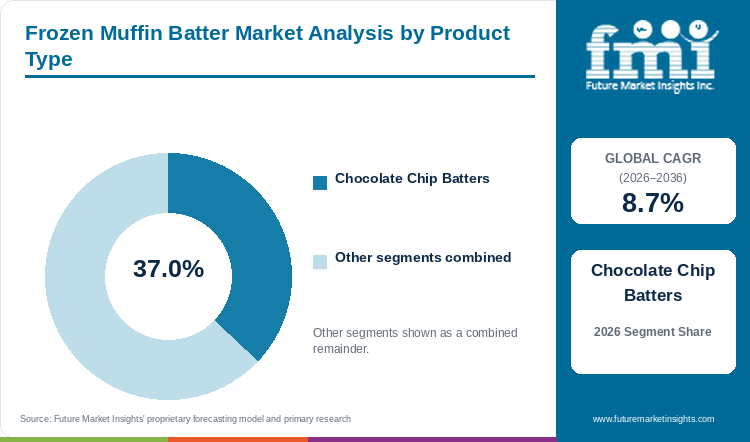
Chocolate chip batters are estimated to hold a 37.0% share of the product type segment in 2026, supported by uniform inclusion suspension.
Table 5: Product Type Share for the Frozen Muffin Batter Market (percentage share), 2026
| Product Type | Share (2026) |
|---|---|
| Chocolate Chip Batters | 37.0% |
| Other Segments Combined* | 63.0% |
| Total | 100.0% |
*Calculated as the balance remaining after deducting the leading segment's reported share from 100.0%.
Table 6: Product Type Leadership and Market Growth for the Frozen Muffin Batter Market (segment and CAGR percentage), 2026 to 2036
| Metric | Value |
|---|---|
| Global CAGR (2026 to 2036) | 8.7% |
| Leading Segment | Chocolate Chip Batters |
Grocery in-store bakeries and school commissaries anchor batter orders around chocolate chip recipes because semi-sweet chocolate chips hold their shape and do not bleed color during freezing and tube piping. Whole berries can release juice and sink during long refrigerator thawing, whereas chocolate chip batters bake to a uniform crumb beside commercial frozen dough lines.
- Chocolate chip batters are estimated to hold a 37.0% share of the product type segment in 2026, driven by stable chip suspension and year-round breakfast and snack sales.
- General Mills Foodservice's commercial specification for its 18-pound Pillsbury chocolate chip frozen muffin batter pail documents a 96-muffin yield using a #12 three-ounce scoop or 72 muffins using a #10 four-ounce scoop [3].
Why does Conventional define the largest claim / nature segment?
Conventional formulations are projected to account for a 59.0% share of the claim / nature segment in 2026, driven by double-acting leavening repeatability.
Multi-store supermarket bakeries order conventional wheat, whole egg, and vegetable oil batters because standard baking-powder formulas give a predictable high-crown dome across different store ovens. Switching to organic or gluten-free claims requires separate ingredient verification and line washdowns compared with standard prepared bakery mixes.
- Conventional batters are projected to account for a 59.0% share of the claim / nature segment in 2026, reinforced by consistent oven rise and lower cost per baked muffin.
- In May 2025, the U.S. Food and Drug Administration issued an allergy alert after a commercial bakery shipped products with undeclared eggs and milk, which shows why buyers audit allergen labels closely [4].
What keeps Frozen ahead by format?
Frozen batter is expected to hold a 28.0% share of the format segment in 2026, owing to 180-day sub-zero emulsion stability and fresh store baking.
Freezing unbaked muffin batter lets a central factory handle ingredient weighing and mixing while local stores bake fresh trays on demand. Compared with pre-baked thaw-and-serve muffins that lack fresh oven aroma, frozen raw batter lets supermarkets bake warm muffins right beside refrigerated dough products.
- Frozen batter is expected to hold a 28.0% share of the format segment in 2026, supported by central formula control and zero store-level ingredient weighing.
- General Mills Foodservice's Pillsbury BatterPro specification contrasts a three-hour refrigerator thaw for three-pound pipeable tubes against a 24-to-36 hour thaw for 18-pound pails, giving operators a clear choice between bulk price and preparation speed [5].
Why does Multipack lead the packaging format category?
Multipack six-count tube cases are predicted to record a 31.0% share of the packaging format segment in 2026, reinforced by three-hour rapid thawing.
Six-count cases of three-pound pipeable plastic batter tubes and multi-tray pre-deposited frozen puck cartons let smaller stores thaw one three-pound tube in three hours instead of opening a full 18-pound bucket. Pipeable tube multipacks also remove metal scoop washing and cut rigid plastic bucket waste by 86%.
- Multipack formats are predicted to record a 31.0% share of the packaging format segment in 2026, owing to rapid three-hour tube thawing and lower refrigerator throwaway loss.
- Sara Lee Frozen Bakery's commercial specification for its Chef Pierre four-tray 48-count muffin case documents a 365-day frozen shelf life across 60 cases per pallet for foodservice buyers [6].
What gives Supermarkets & Hypermarkets the leading position in sales channel?
Supermarkets & hypermarkets are anticipated to capture a 39.0% share of the sales channel segment in 2026, enabled by perimeter fresh-baked muffin tables.
Supermarket and hypermarket in-store bakeries turn centrally mixed frozen batter into four-count and six-count fresh-baked clamshell muffin packs that drive perimeter bakery traffic. Retailers use pre-deposited frozen pucks and pipeable tubes to refill morning and afternoon bakery tables without hiring trained scratch mixers.
- Supermarkets & hypermarkets are anticipated to capture a 39.0% share of the sales channel segment in 2026, enabled by private-label clamshell programs and existing frozen warehouse deliveries.
- A November 2025 policy review in Nutrients confirmed that U.S. school meal programs serve nearly 30 million lunches daily and operate institutional breakfast lines that depend on portion-consistent bakery items [7].
What are the drivers, restraints, and opportunities in the frozen muffin batter market?
In the frozen muffin batter market, store-level baker shortages and three-hour pipeable tubes are projected to expand adoption whereas 36-hour bulk-pail thawing and zero-refreeze rules restrain conversion and pre-deposited pucks create kiosk opportunities.
- Driver: Store-level baker shortages and three-hour pipeable tube formats shift mixing upstream while preserving fresh-baked counter aroma.
- Restraint: Strict zero-refreeze rules, 36-hour bulk-pail thaw bottlenecks, and multi-allergen declaration obligations constrain operator conversion.
- Opportunity: Pre-deposited frozen batter pucks and reduced-sugar whole-grain batters open new sales in forecourt kiosks and school cafeterias.
Growth Analysis and Future Potential: Qualitative Demand Catalysts
When store staff measure flour and sugar with baking powder by hand at 4:00 AM, small mixing mistakes cause flat muffin tops and uneven tray weights that stores must write off as waste. Supermarket chains, hotel breakfast kitchens, and school commissaries are therefore switching to factory-mixed frozen batters that keep portion weights consistent across every bake. Pipeable three-pound frozen batter tubes and pre-deposited pucks beat dough-based premixes whenever kitchens lack floor mixers and washdown sinks. In July 2026, General Mills Foodservice expanded its K-12 school bakery lineup with reduced-sugar whole-grain Pillsbury muffins and bakery solutions built to meet upcoming 2027-2028 school nutrition rules [8]. Pre-portioned batters let staff bake fresh trays in 22 minutes with no bowl cleanup.
Risk Assessment of the Frozen Muffin Batter Market: Operational and Formulation Friction
Cold-chain discipline and thawing schedules are the main operational hurdles slowing buyer conversion. Once frozen muffin batter thaws in a walk-in cooler, baking powder begins reacting and refreezing a thawed pail ruins the batter's oven rise. The U.S. Food and Drug Administration's Food Code sets national retail temperature-control standards and requires written allergen disclosures for unpackaged bakery foods sold across over one million retail and foodservice establishments [9]. Because conventional muffin batters contain wheat and egg with soy and dairy on lines shared with pregelatinized wheat flour blends, stores must train staff on strict thaw-and-discard dates and allergen labeling. High freezer freight rates also squeeze margins on small deliveries.
Commercial Opportunity Analysis: Formulation Differentiation and Value-Add Formats
Convenience-store forecourts, hospital cafeterias, and airport coffee kiosks without pastry prep tables are adopting pre-deposited paper-cupped frozen batter pucks. Each frozen puck arrives pre-portioned inside a paper baking liner on a plastic tray, so a clerk can move pucks straight from the freezer into the oven with no thawing or scooping. Bakers blending fruit and streusel toppings with specialty bakery ingredients at the factory also save store staff from hand-topping pans. Cérélia Group's commercial dough portfolio documents how industrial prepared-dough and batter plants across Europe and North America supply ready-to-bake portions to over 50 countries [10]. Suppliers that prove clean freezer-to-oven puck rise win high-margin convenience and healthcare catering accounts.
Frozen Muffin Batter Market by Country (2026 to 2036)
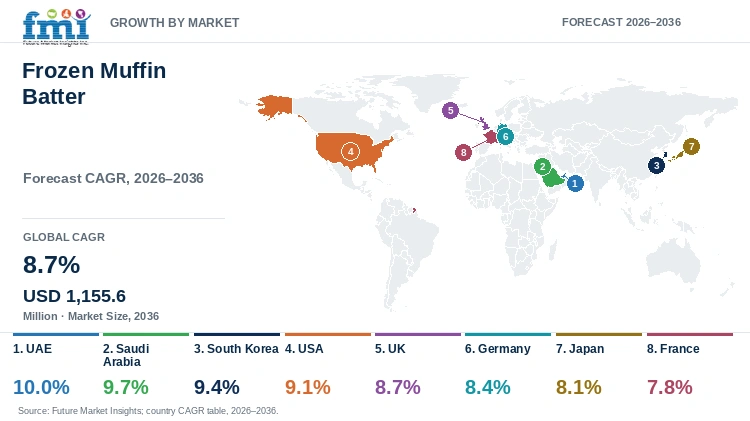
As per FMI, the UAE is projected to lead frozen muffin batter expansion across evaluated national markets at a 10.0% CAGR through 2036, whereas France is forecast to register a 7.8% CAGR. Commercial adoption across Middle Eastern hospitality hubs, East Asian convenience networks, and Western supermarket bakeries depends on sub-zero cold-chain reliability and rapid thaw-to-oven execution.
Table 7: Country CAGR and Primary Growth Levers for the Frozen Muffin Batter Market (CAGR percentage and operational drivers), 2026 to 2036
| Country | CAGR (2026 to 2036) | Primary Growth Lever |
|---|---|---|
| UAE | 10.0% | Hotel breakfast buffet commissaries and hypermarket bake-off expansion |
| Saudi Arabia | 9.7% | Hotel breakfast catering and international cafe rollouts |
| South Korea | 9.4% | High daily coffee consumption and compact cafe tube formats |
| USA | 9.1% | In-store bakery conversion from 18-lb pails to 3-lb BatterPro tubes |
| UK | 8.7% | PPDS allergen-locked recipes and forecourt bake-off programs |
| Germany | 8.4% | Supermarket Backstationen oven standardization and clean-label batters |
| Japan | 8.1% | Micro-bakery space savings via spouted batter pouches and pucks |
| France | 7.8% | Travel-retail cafe chains and palm-oil-free contract catering specs |
Source: Future Market Insights analysis
UAE Frozen Muffin Batter Market Outlook (2026 to 2036)
International hotel breakfast buffets and aviation catering commissaries with hypermarket in-store bakeries propel frozen muffin batter demand in the UAE at a leading 10.0% CAGR from 2026 to 2036. Instead of mixing scratch batters on site, UAE hospitality operators import frozen pails and pre-deposited pucks to serve high-volume morning tourist buffets without adding early-shift kitchen staff. In February 2026, the Dubai Department of Economy and Tourism reported that Dubai welcomed 19.59 million international overnight visitors in 2025, with occupied hotel room nights rising 4% to 44.85 million [11]. Cold-chain distributors in Dubai and Abu Dhabi must maintain minus 18 degrees Celsius delivery and provide Arabic-English ingredient sheets for hypermarket counters.
Key takeaway: In the UAE, high-volume hotel breakfast buffets and hypermarket in-store bakeries are projected to drive imports of pipeable and pre-deposited frozen muffin batters.
Saudi Arabia Frozen Muffin Batter Market Outlook (2026 to 2036)
Luxury resort hotel openings and corporate catering commissaries across Riyadh and Jeddah as well as Makkah hospitality corridors are scaling commercial frozen muffin batter procurement in Saudi Arabia. Wholesale frozen batter sales in Saudi Arabia are expected to advance at a 9.7% CAGR between 2026 and 2036 as international coffee chains and supermarkets expand morning bakery menus across major cities. Saudi Food and Drug Authority shelf-life regulations SFDA.FD 150-1 and SFDA.FD/GSO 150-2 require imported frozen bakery products to carry verified expiration dates and storage temperature instructions [12]. Foreign bakery exporters must also provide halal emulsifier documentation and complete Arabic ingredient declarations before clearing Saudi ports.
Key takeaway: In Saudi Arabia, expanding hotel breakfast service and international cafe rollouts are expected to accelerate foodservice adoption of pre-portioned frozen muffin batters.
South Korea Frozen Muffin Batter Market Outlook (2026 to 2036)
Compact urban cafe galleys and digital B2B foodservice ordering platforms across South Korea prioritize three-pound pipeable batter tubes and pre-deposited pucks that fit under-counter chillers instead of bulky 18-pound pails. In February 2026, a population study in Nutrients from Seoul National University documented widespread thrice-daily coffee consumption among urban adults in South Korea, sustaining espresso-bar demand for fresh-baked morning muffins [13]. Franchise bakery cafes and convenience stores use small-case frozen batters to bake blueberry and chocolate chip muffins on demand without installing floor mixers. Commercial frozen muffin batter demand across metropolitan South Korea is therefore forecast to register a 9.4% CAGR from 2026 to 2036.
Key takeaway: In South Korea, compact cafe kitchen footprints and high daily coffee traffic are forecast to favor small-case pipeable frozen muffin batter tubes.
USA Frozen Muffin Batter Market Outlook (2026 to 2036)
Nationwide foodservice distributors and supermarket in-store bakeries in the USA anchor global volume through standardized 18-pound pails and six-count three-pound piping tube cases. An August 2026 national policy review in Nutrients examined state-level school meal initiatives across the USA that support scratch-reduced, whole-grain-rich, and plant-forward institutional breakfast items [14]. Supermarket bakery managers directly compare the 24-hour to 36-hour refrigerator thaw time of bulk pails against the three-hour thaw of Pillsbury BatterPro tubes to cut mid-week throwaway losses across regional grocery divisions. Commercial frozen muffin batter demand in the USA is anticipated to record a 9.1% CAGR between 2026 and 2036 across grocery perimeter counters and school cafeterias.
Key takeaway: In the USA, supermarket in-store bakery conversion from bulk pails to three-hour pipeable tubes and pre-deposited pucks is anticipated to sustain volume growth.
UK Frozen Muffin Batter Market Outlook (2026 to 2036)
Supermarket in-store bakeries and travel-hub forecourt coffee counters propel the UK frozen muffin batter market at an 8.7% CAGR from 2026 to 2036. Retail bake-off counters across the UK operate under strict legal accountability governed by the Food Standards Agency's Prepacked for Direct Sale (`Natasha's Law`) allergen regime. Food Standards Agency PPDS guidance requires any muffin baked from frozen batter and packed on store premises before sale to display a full ingredient list with wheat and egg plus milk and soy allergens emphasized [15]. National grocery chains in the UK therefore require frozen batter suppliers to lock recipe specifications and provide automated digital ingredient updates to store label printers.
Key takeaway: In the UK, strict Prepacked for Direct Sale allergen rules and forecourt bake-off expansion are projected to reward suppliers with locked clean-label batter specs.
Germany Frozen Muffin Batter Market Outlook (2026 to 2036)
Supermarket bake-off stations (`Backstationen`) and discount grocers in Germany evaluate frozen unbaked muffin batter against fully baked thaw-and-serve muffins on total freezer space and oven-cycle efficiency. Frozen muffin batter sales in Germany are estimated to grow at an 8.4% CAGR between 2026 and 2036 across retail bakery counters and university cafeterias as well as highway service stations. In April 2024, Bridor (Groupe LE DUFF) acquired organic and artisan bake-off producer Pandriks with high-capacity production plants in Fulda in Germany and Meppel in the Netherlands supplying European retail chains [16]. Grocery and institutional foodservice buyers across Germany favor clean-label unbleached-wheat and fruit-filled frozen muffin batters that bake beside morning bread rolls.
Key takeaway: In Germany, supermarket Backstationen oven standardization and European bake-off network expansion are estimated to guide demand for pre-deposited frozen muffin batters.
Japan Frozen Muffin Batter Market Outlook (2026 to 2036)
Space-constrained retail prep rooms and high cold-storage electricity rates shape procurement in Japan, setting it apart from bulk-pail U.S. commissaries. In May 2025, the Ministry of Agriculture and Forestry and Fisheries (MAFF) in Japan reported in its FY2024 Annual Report that domestic frozen food production value reached a record JPY 779,900 million as commercial kitchens shifted toward labor-saving prepared foods [17]. Tokyo and Osaka specialty cafes and station micro-bakeries favor one-kilogram and three-pound spouted piping bags or pre-cupped frozen batter pucks over 18-pound open pails to eliminate bowl waste. Accordingly, the frozen muffin batter market in Japan is predicted to expand at an 8.1% CAGR from 2026 to 2036.
Key takeaway: In Japan, micro-bakery prep-space constraints and rising frozen-food adoption are predicted to drive demand for compact pipeable batter pouches and pucks.
France Frozen Muffin Batter Market Outlook (2026 to 2036)
Independent artisanal boulangeries in France prioritize laminated viennoiserie, concentrating frozen muffin batter growth in chain coffee shops and travel-retail kiosks at a 7.8% CAGR from 2026 to 2036. An August 2026 international e-Delphi consensus published in the World Allergy Organization Journal established standardized precautionary allergen labeling protocols for shared commercial food-manufacturing lines [18]. Chain bakeries and contract caterers across France require pure-butter or high-oleic sunflower oil muffin batters free from palm oil and artificial preservatives to satisfy national Eco-Score and Nutri-Score procurement grids. Suppliers that validate clean-label ingredient declarations in France and deliver crisp sugar-topped dome rise secure recurring foodservice distributor listings across urban transit hubs.
Key takeaway: In France, travel-retail cafe chains and Nutri-Score-aligned contract caterers are slated to anchor demand for palm-oil-free frozen muffin batters.
Full report country CAGRs cover: North America; Latin America; Western Europe; Eastern Europe; East Asia; South Asia and Pacific; Middle East and Africa.
Who are the notable companies in the frozen muffin batter market?
General Mills, Rich Products, Cerelia, Aryzta, Europastry, Vandemoortele, Lantmannen Unibake, and Sara Lee Frozen Bakery are the notable companies in the frozen muffin batter market.
FMI analysis indicates that the competitive arena separates into documented commercial frozen muffin batter manufacturers, multinational frozen bake-off networks, and prepared-dough and finished-muffin specialists. Direct batter producers supply foodservice pails, pipeable tubes, and pre-deposited pucks with validated refrigerator thaw curves. Broader frozen bakery groups deploy sub-zero distribution fleets and in-store bakery relationships across Europe and North America.
- Documented Frozen Batter and Prepared Dough Leaders: General Mills (Pillsbury Foodservice) and Rich Products with Cerelia supply commercial frozen muffin batters and prepared chilled or frozen doughs to grocery and foodservice accounts.
- European and International Frozen Bake-Off Networks: Aryzta and Europastry with Vandemoortele operate multi-country sub-zero bakery manufacturing and in-store bakery distribution networks across Europe and North America.
- Commercial Bakery and Foodservice Muffin Platforms: Lantmannen Unibake and Sara Lee Frozen Bakery combine automated industrial bakery lines with nationwide foodservice and supermarket in-store bakery fulfillment.
Competitive Benchmarking: Frozen Muffin Batter Market
Table 8: Competitive Benchmarking for the Frozen Muffin Batter Market (qualitative capability ratings), 2026
| Company | Frozen Muffin Batter SKUs | Frozen Bake-Off Portfolio | Foodservice / In-Store Bakery | Geographic Reach |
|---|---|---|---|---|
| General Mills | High | High | High | High |
| Rich Products | High | High | High | High |
| Cerelia | High | Medium | High | High |
| Aryzta | Medium | High | High | High |
| Europastry | Medium | High | High | High |
| Vandemoortele | Medium | High | High | High |
| Lantmannen Unibake | Medium | High | High | High |
| Sara Lee Frozen Bakery | Medium | High | High | Medium |
Scoring basis: Capability tiers evaluate documented commercial frozen unbaked muffin batter SKUs (pails and pipeable tubes) as well as frozen bake-off portfolio breadth and foodservice distributor access.
Key Developments in the Frozen Muffin Batter Market
- B&G Foods reported in its March 2026 Form 10-K filing that its commercial shortening, baking oil, and frozen foodservice operations support North America industrial and retail bakery customers [19].
- Flowers Foods detailed in its February 2026 Form 10-K filing that its Warehouse and Foodservice bakery operations distribute frozen breads and sweet bakery items through national cold-chain warehouse networks [20].
- In May 2026, the U.S. Food and Drug Administration convened a virtual public meeting on food allergen thresholds to evaluate risk-based cross-contact controls in commercial bakery manufacturing [21].
Key Players in the Frozen Muffin Batter Market
Documented Frozen Batter and Prepared Dough Leaders
- General Mills
- Rich Products
- Cerelia
European and International Frozen Bake-Off Networks
- Aryzta
- Europastry
- Vandemoortele
Commercial Bakery and Foodservice Muffin Platforms
- Lantmannen Unibake
- Sara Lee Frozen Bakery
Frozen Muffin Batter Market - Report Scope
Table 9: Report Scope for the Frozen Muffin Batter Market (coverage fields and definitions), 2026 to 2036
| Coverage field | Report scope |
|---|---|
| Market breakdown | Product Type; Claim / Nature; Format; Packaging Format; Sales Channel |
| Quantitative Units | USD Million |
| Market Definition | Includes commercial wholesale revenue from unbaked muffin batter sold in frozen pails, pipeable tubes, and pre-deposited frozen pucks across retail in-store bakeries and foodservice kitchens. Category Scope Note: Excludes finished thaw-and-serve baked muffins, dry flour-and-sugar premixes sold unhydrated, and downstream retail markups on store-baked muffins. |
| Regions Covered | North America; Latin America; Western Europe; Eastern Europe; East Asia; South Asia and Pacific; Middle East and Africa |
| Countries Covered | UAE, Saudi Arabia, South Korea, USA, UK, Germany, Japan, France, and additional countries in the full report |
| Key Companies Covered | General Mills, Rich Products, Cerelia, Aryzta, Europastry, Vandemoortele, Lantmannen Unibake, Sara Lee Frozen Bakery |
| Forecast Period | 2026 to 2036 |
| Approach | Primary and secondary research with top-down and bottom-up market triangulation. |
Frozen Muffin Batter Market - Research Methodology
Table 10: Research Methodology for the Frozen Muffin Batter Market (research methods and approach), 2026 edition
| Method | Approach |
|---|---|
| Primary Research | Structured interviews with supermarket in-store bakery directors, K-12 school nutrition procurement officers, hotel executive chefs, and cold-chain foodservice distributors to validate pail-versus-tube thaw economics. |
| Secondary Research | Analysis of SEC Form 10-K and Schedule 14A filings, FDA 2022 Food Code and allergen enforcement alerts, MAFF Japan frozen food statistics, and commercial product specifications. |
| Market Sizing and Forecasting | Top-down commercial bake-off expenditure models reconciled against bottom-up 18-pound pail and 6x3-pound tube case shipments across grocery and foodservice accounts from 2026 to 2036. |
| Country Forecasting Model | Econometric national projections weight supermarket in-store bakery door counts, hotel breakfast cover volumes, cold-storage freight rates, and PPDS/FDA allergen compliance costs across eight countries. |
| Operational Benchmark Traceability | Batter tonnage, case shipments, and outlet spending indicators in Tables 2, 3, and 4 trace to General Mills Foodservice specifications, CraftMark Bakery time-and-labor studies, and Nutrients school-meal cohorts. |
| Data Triangulation and Validation | Demand estimates are cross-checked against commercial batter-depositing line capacities and distributor cold-chain volumes without double counting dry premixes or finished thaw-and-serve muffins. |
Frozen Muffin Batter Market by Segments
Frozen Muffin Batter Market segmented by Product Type:
- Chocolate Chip Batters
- Blueberry & Fruit Batters
- Multigrain & Millet Batters
- Organic Batters
Frozen Muffin Batter Market segmented by Claim / Nature:
- Conventional
- Clean Label & Organic
- Gluten-Free & Fortified
Frozen Muffin Batter Market segmented by Format:
- Frozen
- Fresh & Chilled
- Ambient & Par-Baked
Frozen Muffin Batter Market segmented by Packaging Format:
- Multipack
- Single-Serve
- Family / Loaf Pack
- Bulk Foodservice
Frozen Muffin Batter Market segmented by Sales Channel:
- Supermarkets & Hypermarkets
- Artisan & Specialty Bakeries
- Convenience & Forecourt
- Online & DTC
- Foodservice Distributors
Frozen Muffin Batter Market by Region
- North America
- United States
- Canada
- Latin America
- Brazil
- Mexico
- Argentina
- Chile
- Western Europe
- Germany
- France
- United Kingdom
- Italy
- Spain
- Benelux
- Nordics
- Eastern Europe
- Poland
- Czech Republic
- Romania
- Hungary
- East Asia
- China
- Japan
- South Korea
- South Asia and Pacific
- India
- ASEAN
- Australia and New Zealand
- Middle East and Africa
- GCC Countries
- South Africa
- Türkiye
- Israel
Research Sources and Bibliography
- [1] General Mills, Inc. (2025, August 11). Definitive Proxy Statement (Schedule 14A) for Fiscal 2025: North America Foodservice Bakery and Pillsbury Commercial Platforms. U.S. Securities and Exchange Commission EDGAR.
- [2] CraftMark Bakery, LLC. (2025, November 15). Muffin R&D Process Innovation Case Study: How a National Grocery Brand Simplified In-Store Bakery Operations with Pre-Deposited Muffin Batter. CraftMark Bakery Commercial Case Studies.
- [3] General Mills Foodservice. (2026, January 10). Pillsbury Frozen Muffin Batter Pail Chocolate Chip 1/18 LB (SKU 108012000): Thaw, Scoop, and Bake Specifications. General Mills Foodservice Product Catalog.
- [4] U.S. Food and Drug Administration. (2025, May 8). New Grains Gluten Free Bakery Issues Allergy Alert on Undeclared Eggs, Soy, and Milk in Commercial Bakery Products. FDA Enforcement Recalls Database.
- [5] General Mills Foodservice. (2026, January 10). Pillsbury BatterPro Frozen Muffin Batter TubeSet Chocolate Chip 6/3 LB (SKU 208011000): Three-Hour Thaw and Pipe Specifications. General Mills Foodservice Product Catalog.
- [6] Sara Lee Frozen Bakery, LLC. (2026, January 15). Chef Pierre Large Muffin Bran 4 Trays/12ct/4oz (SKU 08608): Commercial Foodservice and In-Store Bakery Specifications. Sara Lee Frozen Bakery Foodservice Catalog.
- [7] Dunn, C. G., & Fleischhacker, S. E. (2025, November 25). From Policy to Plate: Implications of 2025 U.S. Federal Policy Changes on Institutional School Meals and Bakery Procurement. Nutrients, 17(23), 3696 (PubMed PMID 41373987).
- [8] General Mills, Inc. (2026, July 29). General Mills Foodservice Serves Up New and Renovated K-12 Solutions for a Tasty Start to the School Year. General Mills Corporate Newsroom.
- [9] U.S. Food and Drug Administration. (2022, December 28). FDA Releases 2022 Food Code: Retail Temperature Control and Unpackaged Food Allergen Disclosure Standards. U.S. Department of Health and Human Services.
- [10] Cérélia Group. (2026, February 10). Genesis and Prepared Dough Portfolio: European and North American Refrigerated and Frozen Bakery Operations. Cérélia Corporate Publications.
- [11] Dubai Department of Economy and Tourism. (2026, February 9). Dubai Welcomes 19.59 Million International Overnight Visitors in Third Record Year. Government of Dubai Media Office.
- [12] Saudi Food and Drug Authority (SFDA). (2024, July 18). Technical Regulations and Standards for the Shelf Life of Food Products (SFDA.FD 150-1 and 150-2). Saudi Food and Drug Authority Regulatory Portal.
- [13] Kim, H. J., & Park, J. H. (2026, February 27). Association of Coffee Consumption Frequency and Body Composition Indices Among Adults in South Korea. Nutrients, 18(5), 714 (PubMed PMID 41765138).
- [14] Pelletier, J. E., & Laska, M. N. (2026, August 5). State-Level Promotion of Plant-Based and Scratch-Reduced School Meals in the United States: A National Policy Review. Nutrients, 18(15), 2556 (PubMed PMID 42588178).
- [15] UK Food Standards Agency. (2025, October 4). Labelling Guidance for Prepacked for Direct Sale (PPDS) Food Products in Retail Bakeries. Food Standards Agency Regulatory Guidance.
- [16] Groupe LE DUFF / Bridor. (2024, April 15). Bridor Announces the Acquisition of Pandriks with Bakery Production Plants in the Netherlands and Fulda, Germany. Groupe LE DUFF Corporate Releases.
- [17] Ministry of Agriculture, Forestry and Fisheries of Japan (MAFF). (2025, May 30). FY2024 Annual Report on Food, Agriculture and Rural Areas in Japan: Trends in Food Consumption and Record Domestic Frozen Food Output. MAFF Japan Official White Paper.
- [18] Turner, P. J., & Eigenmann, P. A. (2026, August 5). World Allergy Organization (WAO) Consensus on the Use and Practice of Precautionary Allergen Labelling in Commercial Bakery Supply Chains. World Allergy Organization Journal, 19(8), 101436 (PubMed PMID 42598065).
- [19] B&G Foods, Inc. (2026, March 3). Form 10-K Annual Report for the Fiscal Year Ended January 3, 2026: Commercial Shortening, Baking Oils, and Frozen Foodservice Operations. U.S. Securities and Exchange Commission EDGAR.
- [20] Flowers Foods, Inc. (2026, February 25). Form 10-K Annual Report Pursuant to Section 13 or 15(d) for the Fiscal Year Ended January 3, 2026: Warehouse and Foodservice Bakery Operations. U.S. Securities and Exchange Commission EDGAR.
- [21] U.S. Food and Drug Administration. (2026, May 20). Virtual Public Meeting and Listening Session on Food Allergen Thresholds and Multi-Unit Commercial Packaging Controls. U.S. Department of Health and Human Services.
- [22] Cal-Maine Foods, Inc., & Sara Lee Frozen Bakery, LLC. (2026, May 12). Cal-Maine Foods and Sara Lee Frozen Bakery Announce Acquisition of Van's Foods Brand and Core Bakery Portfolio Focus. Cal-Maine Foods Investor Releases.
- [23] U.S. Food and Drug Administration. (2026, March 11). Food Allergies and Commercial Bakery Labeling Compliance: Major Allergen Controls for Wheat, Egg, Milk, Soy, and Sesame. U.S. Department of Health and Human Services.
This bibliography is provided for reader reference and is not exhaustive. The full report contains the complete reference list and detailed citations.
This Report Answers
- How large is the frozen muffin batter market in 2026 and what is forecast for 2036?
- Which preparation-labor and thaw-schedule pressures support frozen muffin batter demand?
- Why do Chocolate Chip Batters lead the product type category in 2026?
- Why does Conventional lead the claim / nature category globally?
- How do growth rates differ across the UAE and Saudi Arabia versus North America?
- Which leading companies supply frozen muffin batter and adjacent bake-off categories today?
- What limits adoption or supplier switching in the frozen muffin batter market?
- What should buyers evaluate before purchasing commercial frozen muffin batter?
Frequently Asked Questions
How big is the frozen muffin batter market in 2026, and what is forecast for 2036?
According to FMI, the global frozen muffin batter market size is estimated to reach USD 501.8 million in 2026 from USD 461.6 million in 2025. Valuation is forecast to hit USD 1,155.6 million by 2036 as grocery in-store bakeries and foodservice kitchens shift mixing upstream.
What is the CAGR for the frozen muffin batter market from 2026 to 2036?
Future Market Insights projects an 8.7% compound annual growth rate between 2026 and 2036, generating USD 653.8 million in incremental market value across retail and institutional bakery channels.
Which product type segment leads the frozen muffin batter market?
Chocolate chip batters are estimated to hold a 37.0% share of the product type segment in 2026 because stabilized batter thickness suspends chocolate chips evenly without fruit-moisture bleeding.
Which claim / nature segment leads the frozen muffin batter market?
Conventional formulations are projected to account for a 59.0% share of the claim / nature segment in 2026 as commercial bakeries prioritize predictable double-acting leavening and uniform dome height.
Which country has a notable growth outlook during the assessment period?
The UAE is projected to lead evaluated national growth at a 10.0% CAGR through 2036, supported by hotel breakfast buffets and hypermarket in-store bakery expansion.
Who are the key players in the market?
General Mills, Rich Products, Cerelia, Aryzta, Europastry, Vandemoortele, Lantmannen Unibake, and Sara Lee Frozen Bakery represent the notable commercial suppliers evaluated in this market.
Preview the report firsthand - request a free sample
Get SampleGet the brochure for pricing and purchase details.
Get PDFTable of Content
- Key Takeaways
- Market Size and CAGR
- Top Growth Driver
- Fastest Growing Segment
- Leading Region
- Key Companies
- Emerging Opportunities
- Executive Summary
- Global Market Outlook
- Demand-side Trends
- Supply-side Trends
- Technology Roadmap Analysis
- Analysis and Recommendations
- Analyst Perspective (What is happening? Why now? What should investors know?)
- Key Questions Answered
- How large is the market?
- What is the CAGR?
- What are key trends?
- Which region dominates?
- Who are the leaders?
- Market Overview
- Market Coverage / Taxonomy
- Market Definition / Scope / Limitations
- Research Methodology
- Chapter Orientation
- Analytical Lens and Working Hypotheses
- Market Structure, Signals, and Trend Drivers
- Benchmarking and Cross-market Comparability
- Market Sizing, Forecasting, and Opportunity Mapping
- Research Design and Evidence Framework
- Desk Research Programme (Secondary Evidence)
- Expert Input and Fieldwork (Primary Evidence)
- Tooling, Models, and Reference Databases
- Data Engineering and Model Build
- Quality Assurance and Audit Trail
- Market Background
- Market Dynamics (Drivers, Restraints, Opportunity, Trends)
- Scenario Forecast (Optimistic, Likely, Conservative)
- Impact Analysis
- AI Impact
- Sustainability Impact
- Regulatory Impact
- Technology Impact
- Consumer / Buyer Analysis
- Purchase Drivers
- Adoption Barriers
- Buyer Journey
- Opportunity Map Analysis
- Product Life Cycle Analysis
- Supply Chain Analysis
- Investment Feasibility Matrix
- Value Chain Analysis
- PESTLE and Porter's Analysis
- Regulatory Landscape
- Regional Parent Market Outlook
- Production and Consumption Statistics
- Import and Export Statistics
- Global Market Analysis and Forecast, 2021 to 2036
- Historical Market Size Value (USD Million) Analysis, 2021 to 2025
- Current and Future Market Size Value (USD Million) Projections, 2026 to 2036
- Y-o-Y Growth Trend Analysis
- Absolute $ Opportunity Analysis
- Global Market Pricing Analysis, 2021 to 2036
- Global Market Analysis and Forecast, By Product Type, 2021 to 2036
- Introduction / Key Findings
- Historical Market Size Value (USD Million) Analysis By Product Type, 2021 to 2025
- Current and Future Market Size Value (USD Million) Analysis and Forecast By Product Type, 2026 to 2036
- Chocolate Chip Batters
- Blueberry & Fruit Batters
- Multigrain & Millet Batters
- Organic Batters
- Y-o-Y Growth Trend Analysis By Product Type, 2021 to 2025
- Absolute $ Opportunity Analysis By Product Type, 2026 to 2036
- Global Market Analysis and Forecast, By Claim / Nature, 2021 to 2036
- Introduction / Key Findings
- Historical Market Size Value (USD Million) Analysis By Claim / Nature, 2021 to 2025
- Current and Future Market Size Value (USD Million) Analysis and Forecast By Claim / Nature, 2026 to 2036
- Conventional
- Clean Label & Organic
- Gluten-Free & Fortified
- Y-o-Y Growth Trend Analysis By Claim / Nature, 2021 to 2025
- Absolute $ Opportunity Analysis By Claim / Nature, 2026 to 2036
- Global Market Analysis and Forecast, By Format, 2021 to 2036
- Introduction / Key Findings
- Historical Market Size Value (USD Million) Analysis By Format, 2021 to 2025
- Current and Future Market Size Value (USD Million) Analysis and Forecast By Format, 2026 to 2036
- Frozen
- Fresh & Chilled
- Ambient & Par-Baked
- Y-o-Y Growth Trend Analysis By Format, 2021 to 2025
- Absolute $ Opportunity Analysis By Format, 2026 to 2036
- Global Market Analysis and Forecast, By Packaging Format, 2021 to 2036
- Introduction / Key Findings
- Historical Market Size Value (USD Million) Analysis By Packaging Format, 2021 to 2025
- Current and Future Market Size Value (USD Million) Analysis and Forecast By Packaging Format, 2026 to 2036
- Multipack
- Single-Serve
- Family / Loaf Pack
- Bulk Foodservice
- Y-o-Y Growth Trend Analysis By Packaging Format, 2021 to 2025
- Absolute $ Opportunity Analysis By Packaging Format, 2026 to 2036
- Global Market Analysis and Forecast, By Sales Channel, 2021 to 2036
- Introduction / Key Findings
- Historical Market Size Value (USD Million) Analysis By Sales Channel, 2021 to 2025
- Current and Future Market Size Value (USD Million) Analysis and Forecast By Sales Channel, 2026 to 2036
- Supermarkets & Hypermarkets
- Artisan & Specialty Bakeries
- Convenience & Forecourt
- Online & DTC
- Foodservice Distributors
- Y-o-Y Growth Trend Analysis By Sales Channel, 2021 to 2025
- Absolute $ Opportunity Analysis By Sales Channel, 2026 to 2036
- Global Market Analysis and Forecast, By Region, 2021 to 2036
- Introduction
- Historical Market Size Value (USD Million) Analysis By Region, 2021 to 2025
- Current Market Size Value (USD Million) Analysis and Forecast By Region, 2026 to 2036
- North America
- Latin America
- Western Europe
- Eastern Europe
- East Asia
- South Asia and Pacific
- Middle East and Africa
- Market Attractiveness Analysis By Region
- North America Market Analysis and Forecast, By Country, 2021 to 2036
- Historical Market Size Value (USD Million) Trend Analysis By Market Taxonomy, 2021 to 2025
- Market Size Value (USD Million) Forecast By Market Taxonomy, 2026 to 2036
- By Country
- United States
- Canada
- By Product Type
- By Claim / Nature
- By Format
- By Packaging Format
- By Sales Channel
- By Country
- Market Attractiveness Analysis
- By Country
- By Product Type
- By Claim / Nature
- By Format
- By Packaging Format
- By Sales Channel
- Key Takeaways
- Latin America Market Analysis and Forecast, By Country
- Historical Market Size Value (USD Million) Trend Analysis By Market Taxonomy, 2021 to 2025
- Market Size Value (USD Million) Forecast By Market Taxonomy, 2026 to 2036
- By Country
- Brazil
- Mexico
- Argentina
- Chile
- By Product Type
- By Claim / Nature
- By Format
- By Packaging Format
- By Sales Channel
- By Country
- Market Attractiveness Analysis
- By Country
- By Product Type
- By Claim / Nature
- By Format
- By Packaging Format
- By Sales Channel
- Key Takeaways
- Western Europe Market Analysis and Forecast, By Country
- Historical Market Size Value (USD Million) Trend Analysis By Market Taxonomy, 2021 to 2025
- Market Size Value (USD Million) Forecast By Market Taxonomy, 2026 to 2036
- By Country
- Germany
- France
- United Kingdom
- Italy
- Spain
- Benelux
- Nordics
- By Product Type
- By Claim / Nature
- By Format
- By Packaging Format
- By Sales Channel
- By Country
- Market Attractiveness Analysis
- By Country
- By Product Type
- By Claim / Nature
- By Format
- By Packaging Format
- By Sales Channel
- Key Takeaways
- Eastern Europe Market Analysis and Forecast, By Country
- Historical Market Size Value (USD Million) Trend Analysis By Market Taxonomy, 2021 to 2025
- Market Size Value (USD Million) Forecast By Market Taxonomy, 2026 to 2036
- By Country
- Poland
- Czech Republic
- Romania
- Hungary
- By Product Type
- By Claim / Nature
- By Format
- By Packaging Format
- By Sales Channel
- By Country
- Market Attractiveness Analysis
- By Country
- By Product Type
- By Claim / Nature
- By Format
- By Packaging Format
- By Sales Channel
- Key Takeaways
- East Asia Market Analysis and Forecast, By Country
- Historical Market Size Value (USD Million) Trend Analysis By Market Taxonomy, 2021 to 2025
- Market Size Value (USD Million) Forecast By Market Taxonomy, 2026 to 2036
- By Country
- China
- Japan
- South Korea
- By Product Type
- By Claim / Nature
- By Format
- By Packaging Format
- By Sales Channel
- By Country
- Market Attractiveness Analysis
- By Country
- By Product Type
- By Claim / Nature
- By Format
- By Packaging Format
- By Sales Channel
- Key Takeaways
- South Asia and Pacific Market Analysis and Forecast, By Country
- Historical Market Size Value (USD Million) Trend Analysis By Market Taxonomy, 2021 to 2025
- Market Size Value (USD Million) Forecast By Market Taxonomy, 2026 to 2036
- By Country
- India
- ASEAN
- Australia and New Zealand
- By Product Type
- By Claim / Nature
- By Format
- By Packaging Format
- By Sales Channel
- By Country
- Market Attractiveness Analysis
- By Country
- By Product Type
- By Claim / Nature
- By Format
- By Packaging Format
- By Sales Channel
- Key Takeaways
- Middle East and Africa Market Analysis and Forecast, By Country
- Historical Market Size Value (USD Million) Trend Analysis By Market Taxonomy, 2021 to 2025
- Market Size Value (USD Million) Forecast By Market Taxonomy, 2026 to 2036
- By Country
- GCC Countries
- South Africa
- Türkiye
- Israel
- By Product Type
- By Claim / Nature
- By Format
- By Packaging Format
- By Sales Channel
- By Country
- Market Attractiveness Analysis
- By Country
- By Product Type
- By Claim / Nature
- By Format
- By Packaging Format
- By Sales Channel
- Key Takeaways
- Key Countries Market Analysis
- United States
- Pricing Analysis
- Market Share Analysis, 2025
- By Product Type
- By Claim / Nature
- By Format
- By Packaging Format
- By Sales Channel
- Canada
- Pricing Analysis
- Market Share Analysis, 2025
- By Product Type
- By Claim / Nature
- By Format
- By Packaging Format
- By Sales Channel
- Mexico
- Pricing Analysis
- Market Share Analysis, 2025
- By Product Type
- By Claim / Nature
- By Format
- By Packaging Format
- By Sales Channel
- Brazil
- Pricing Analysis
- Market Share Analysis, 2025
- By Product Type
- By Claim / Nature
- By Format
- By Packaging Format
- By Sales Channel
- Chile
- Pricing Analysis
- Market Share Analysis, 2025
- By Product Type
- By Claim / Nature
- By Format
- By Packaging Format
- By Sales Channel
- Germany
- Pricing Analysis
- Market Share Analysis, 2025
- By Product Type
- By Claim / Nature
- By Format
- By Packaging Format
- By Sales Channel
- United Kingdom
- Pricing Analysis
- Market Share Analysis, 2025
- By Product Type
- By Claim / Nature
- By Format
- By Packaging Format
- By Sales Channel
- Italy
- Pricing Analysis
- Market Share Analysis, 2025
- By Product Type
- By Claim / Nature
- By Format
- By Packaging Format
- By Sales Channel
- Spain
- Pricing Analysis
- Market Share Analysis, 2025
- By Product Type
- By Claim / Nature
- By Format
- By Packaging Format
- By Sales Channel
- France
- Pricing Analysis
- Market Share Analysis, 2025
- By Product Type
- By Claim / Nature
- By Format
- By Packaging Format
- By Sales Channel
- India
- Pricing Analysis
- Market Share Analysis, 2025
- By Product Type
- By Claim / Nature
- By Format
- By Packaging Format
- By Sales Channel
- ASEAN
- Pricing Analysis
- Market Share Analysis, 2025
- By Product Type
- By Claim / Nature
- By Format
- By Packaging Format
- By Sales Channel
- Australia and New Zealand
- Pricing Analysis
- Market Share Analysis, 2025
- By Product Type
- By Claim / Nature
- By Format
- By Packaging Format
- By Sales Channel
- China
- Pricing Analysis
- Market Share Analysis, 2025
- By Product Type
- By Claim / Nature
- By Format
- By Packaging Format
- By Sales Channel
- Japan
- Pricing Analysis
- Market Share Analysis, 2025
- By Product Type
- By Claim / Nature
- By Format
- By Packaging Format
- By Sales Channel
- South Korea
- Pricing Analysis
- Market Share Analysis, 2025
- By Product Type
- By Claim / Nature
- By Format
- By Packaging Format
- By Sales Channel
- Poland
- Pricing Analysis
- Market Share Analysis, 2025
- By Product Type
- By Claim / Nature
- By Format
- By Packaging Format
- By Sales Channel
- Hungary
- Pricing Analysis
- Market Share Analysis, 2025
- By Product Type
- By Claim / Nature
- By Format
- By Packaging Format
- By Sales Channel
- Türkiye
- Pricing Analysis
- Market Share Analysis, 2025
- By Product Type
- By Claim / Nature
- By Format
- By Packaging Format
- By Sales Channel
- South Africa
- Pricing Analysis
- Market Share Analysis, 2025
- By Product Type
- By Claim / Nature
- By Format
- By Packaging Format
- By Sales Channel
- UAE
- Pricing Analysis
- Market Share Analysis, 2025
- By Product Type
- By Claim / Nature
- By Format
- By Packaging Format
- By Sales Channel
- Saudi Arabia
- Pricing Analysis
- Market Share Analysis, 2025
- By Product Type
- By Claim / Nature
- By Format
- By Packaging Format
- By Sales Channel
- United States
- Market Structure Analysis
- Competition Dashboard
- Competition Benchmarking
- Market Share Analysis of Top Players
- By Regional
- By Product Type
- By Claim / Nature
- By Format
- By Packaging Format
- By Sales Channel
- Emerging Startups
- Innovation Benchmarking
- Competition Analysis
- Competition Deep Dive
- General Mills
- Overview
- Product Portfolio
- Profitability by Market Segments
- Sales Footprint
- Strategy Overview
- Marketing Strategy
- Product Strategy
- Channel Strategy
- Rich Products
- Cerelia
- Aryzta
- Europastry
- Vandemoortele
- Lantmannen Unibake
- Sara Lee Frozen Bakery
- General Mills
- Case Studies
- Success Stories
- Recent Developments
- Competition Deep Dive
- Assumptions & Acronyms Used


