

- Market Size (2026)
- USD 542.3 Mn
- Forecast (2036)
- USD 971.2 Mn
- CAGR (2026 to 2036)
- 6.0%
How big is Pregelatinized Flour Market in 2026?
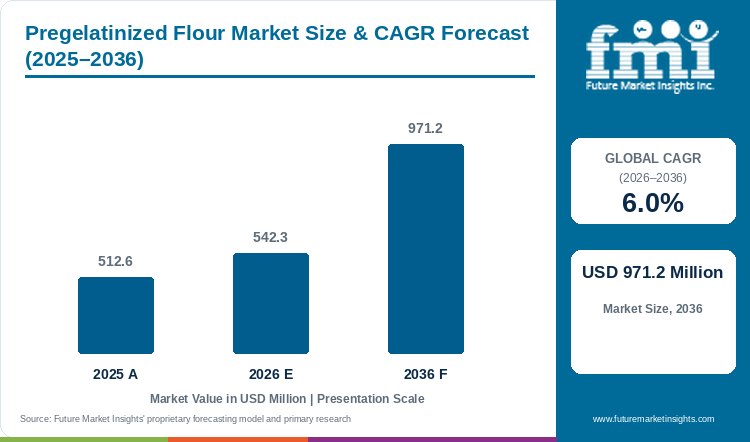
Assessed at USD 512.6 million in 2025 and progressing to USD 542.3 million in 2026, the global pregelatinized flour market valuation is on course to reach USD 971.2 million by 2036, supported by a forecast-period CAGR of 6.0%.
Supermarket retailer bans on chemically modified starches and synthetic gums are pushing high-speed bakeries and culinary sauce plants to adopt hydrothermally precooked cereal flours that build instant cold-water viscosity. Specifically, in its January 2026 wholesale milling catalog, ADM documents pregelatinized wheat and corn flours as clean-label water binders that prevent moisture syneresis in cake batters and dry bakery mixes [1]. Because of this clean-label substitution wave, standard hydrothermal wheat grade holds an estimated 41.8% share within Grade segmentation in 2026 while formulators specify modified flour systems that retain simple wheat-flour ingredient statements. Commercial adoption patterns show global pregelatinized flour market value moving past its 2025 level of USD 512.6 million to record USD 542.3 million in 2026. Across the ten-year horizon, global industry valuation is projected to hit a 2036 target of USD 971.2 million under a 6.0% CAGR, yielding USD 428.9 million in net decadal expansion. Even so, strict Rapid Visco Analyzer qualification tests and mandatory wheat allergen disclosures still restrain rapid vendor switching.
Key Market Trends & Insights
- By grade: Standard hydrothermal wheat grade is estimated at 41.8% of 2026 grade volume, linked to routine water-binding in pan breads and sweet goods.
- By form: Across product forms, fine drum-dried & extruded powder is projected at 49.4% in 2026, resulting from pneumatic silo compatibility and zero liquid freight weight.
- By application: Bread, rolls & frozen dough conditioning is forecast at 36.4% of Application volume in 2026 because cold-swelling flour controls starch retrogradation during cold storage.
- By claim: By claim, Conventional is expected to reach 53.8% in 2026, due to lower raw grain costs across standard wheat and maize mills.
- By sales channel: Among sales channels, direct to food & bakery processors is anticipated at 51.2% in 2026, reinforced by custom viscosity-curve matching.
Regional Highlights
- Europe clean-label leadership: Germany heads the eight evaluated processing nations at a 6.8% compound yearly expansion rate to 2036 via hydrothermal wheat flour replacement of E-number hydrocolloids.
- Broader country progression: Industrial boulangeries in France post a 6.5% yearly expansion rate followed by USA mills at 6.2% and UK bakeries at 5.9%, while convenience-store suppliers in Japan record a 4.6% CAGR.
Market Size & Forecast
Table 1: Market Size and Forecast for the Pregelatinized Flour Market (USD million and CAGR percentage), 2025 to 2036
| Metric | Value |
|---|---|
| 2025 Market Size | USD 512.6 million |
| Estimated Market Size in 2026 | USD 542.3 million |
| Projected Market Size by 2036 | USD 971.2 million |
| CAGR, 2026 to 2036 | 6.0% |
| Added Revenue, 2026 to 2036 | USD 428.9 million |
High stale-bread return rates and freezer-burn losses in par-baked dough distribution are forcing packaged bakery brands to rethink how they bind free water during dough mixing. When bakers remove synthetic emulsifiers and carboxymethylcellulose to satisfy clean-label grocery audits, unstabilized loaves lose crumb softness within 48 hours. To solve this shelf-life bottleneck, in November 2025, GoodMills Innovation documented how its PURAFARIN C 300 W hydrothermally treated wheat flour immobilizes free dough water and retards starch retrogradation across extended distribution windows [2]. As a result, bakery R&D teams incorporate functional flour ingredients at 2.0% to 5.0% dough inclusion to lift water yield and keep sliced loaves soft without E-number declarations.
Hydrothermal Processing Volume and Dough-Hydration Sizing
Table 2: Hydrothermal Processing Volume and Dough-Hydration Sizing for the Pregelatinized Flour Market (USD million and operational ranges), 2025 to 2036
| Metric | 2025 | 2026 | 2036 |
|---|---|---|---|
| Market size (USD million) | 512.6 | 542.3 | 971.2 |
| Pregelatinized flour volume (thousand MT) | 442.0 to 458.0 | 467.6 to 484.0 | 748.0 to 775.0 |
| Clean-label bakery & culinary batch pool (million MT) | 14.5 to 15.8 | 15.4 to 16.7 | 24.2 to 26.5 |
| Average industrial contract price (USD/kg) | 1.1 to 1.2 | 1.1 to 1.2 | 1.2 to 1.3 |
Operational note: Volume ranges reflect 2.0% to 5.0% hydrothermal flour inclusion in industrial bread and cake doughs and 6.0% to 12.0% binder dosing in culinary sauces and batter coatings.
Higher effluent treatment charges and protein-separation losses at wet-starch extraction plants are shifting cost economics in favor of whole-matrix pregelatinized flours. Because drum-drying and twin-screw extrusion gelatinize starch granules directly inside the native cereal protein and fiber matrix, processors avoid the water-intensive washing steps required for isolated starches. Through this whole-grain yield advantage, culinary brands reviewing physically modified starches are switching to pregelatinized wheat and maize flours to achieve lower-cost clean-label thickening in dry soup sachets and batters. Besides this cost saving, native cereal proteins improve batter adhesion on fried poultry and fish coatings.
Per Capita & Food Plant Sizing
Table 3: Per Capita and Food-Processing Plant Indicators for the Pregelatinized Flour Market (USD), 2025 to 2036
| Metric | 2025 | 2026 | 2036 |
|---|---|---|---|
| Global population (billion) | 8.2 | 8.3 | 9.0 |
| Market value per 1,000 people (USD) | 62.5 | 65.3 | 107.9 |
| Annual procurement per food processing plant (USD) | 18,400 to 21,200 | 19,500 to 22,400 | 31,800 to 36,500 |
| Clean-label hydrocolloid replacement share (%) | 44.0% to 48.0% | 46.5% to 50.5% | 58.0% to 62.0% |
Table 4: Industrial Bakery & Food Plant Indicators for the Pregelatinized Flour Market (USD and percentages), 2026
| Metric | Value | Institutional Reference Basis |
|---|---|---|
| Market size, 2026 | USD 542.3 million | 2026 global valuation baseline |
| Global bakery & culinary processing plants | 27,800 facilities | Industrial bakery & prepared-food plant registry |
| Average value per facility | USD 19,507.2 | Annualized pregelatinized flour procurement |
| Direct to food & bakery processors allocation | USD 277.7 million | 51.2% sales-channel segment share |
Broader allergen-free retail shelf space and co-packing line consolidation are driving demand for non-wheat hydrothermal binders that run on shared extrusion equipment. When snack and bakery co-packers eliminate wheat gluten from a facility to prevent cross-contact recalls, ungelatinized rice or corn meal crumbles on high-speed sheeting rollers. This generates a need for hydrothermally precooked gluten-free cereal flours calibrated between 60% and 95% starch gelatinization to restore cohesive dough elasticity. However, higher steam-boiler energy consumption during twin-screw cooking still elevates per-kilogram conversion costs.
Analyst Perspective
"Industrial bakeries and prepared-food manufacturers qualify pregelatinized flour on cold-water absorption stability and predictable Brabender viscosity curves across raw-grain harvests. Millers that pair drum-dried and extruded flour engineering with low-dust particle classification capture long-term clean-label binder contracts."
- Nandini Roy Choudhury, Principal Consultant, Future Market Insights.
How is the pregelatinized flour market segmented?
The pregelatinized flour market is segmented by grade, form, application, claim, and sales channel. In 2026, standard hydrothermal wheat grade is projected at 41.8%, fine drum-dried & extruded powder at 49.4%, bread, rolls & frozen dough conditioning at 36.4%, conventional at 53.8%, and direct to food & bakery processors at 51.2%.
By grade: Standard hydrothermal wheat grade, high-viscosity patisserie & batter grade, pregelatinized corn & rice gluten-free grade, and organic & identity-preserved specialty grade.
By form: Fine drum-dried & extruded powder, agglomerated instant-dispersible granules, coarse textured crumb & flake, and pre-hydrated functional slurry / paste.
By application: Bread, rolls & frozen dough conditioning, cakes, muffins & high-ratio batters, instant soups, gravies & culinary sauces, extruded snacks & batter coatings, and infant & clinical nutrition cereals.
By claim: Conventional grades, clean-label additive replacement, gluten-free certified options, and organic & non-GMO preserved flours.
By sales channel: Direct to food & bakery processors, specialty ingredient distributors, foodservice & bakery premix blenders, and online B2B ingredient platforms.
Why does Standard hydrothermal wheat grade lead grade demand?
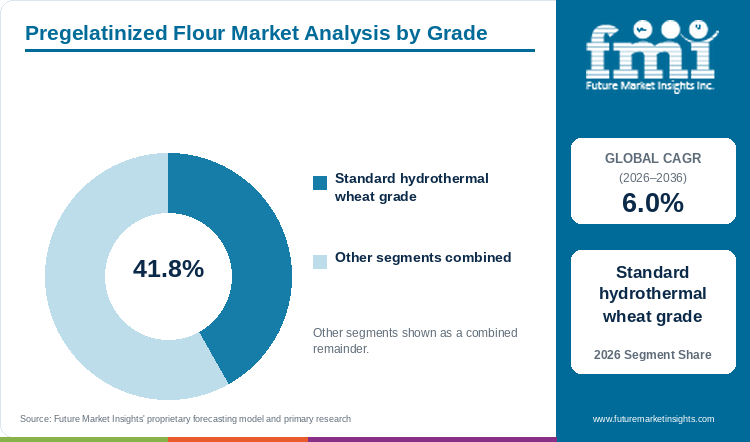
Within Grade segmentation, standard hydrothermal wheat grade holds an estimated 41.8% share in 2026, supported by broad compatibility with wheat bread and batter lines.
Table 5: Grade Share for the Pregelatinized Flour Market (percentage share), 2026
| Grade | Share (2026) |
|---|---|
| Standard hydrothermal wheat grade | 41.8% |
| Other Segments Combined | 58.2%* |
| Total | 100.0% |
*Calculated as the balance remaining after deducting the leading segment's reported share from 100.0%.
Table 6: Grade Leadership and Market Growth for the Pregelatinized Flour Market (segment and CAGR percentage), 2026 to 2036
| Metric | Value |
|---|---|
| Global CAGR (2026 to 2036) | 6.0% |
| Leading Segment | Standard hydrothermal wheat grade |
Wholesale bread and cake plants face margin pressure from fluctuating flour-to-water dough yields and retail demands for shorter ingredient lists. Because hydrothermally precooked wheat flour integrates directly into existing wheat recipes without introducing foreign cereal notes, dosing 3.0% pregelatinized wheat grade into commercial flour mixes lifts water absorption by up to 4.5% while preserving machinable dough handling.
- Standard hydrothermal wheat grade is estimated at 41.8% of 2026 grade volume, driven by clean wheat-flour label declarations in mainstream bread and donut mixes.
- Specifically, technical literature published by Limagrain Ingredients in October 2025 for its INNOSENSE texturizing functional flours confirmed that heat-treated wheat flours deliver reliable cold and hot viscosity across bakery and culinary formulations [3].
What keeps Fine drum-dried & extruded powder ahead among forms?
Across product forms, fine drum-dried & extruded powder is projected at 49.4% in 2026, enabled by pneumatic silo handling and dry blending.
Bulk freight surcharges on liquid ingredients and occupational respiratory limits on airborne bakery dust are shaping physical form selection across large food plants. When hydrothermally gelatinized flour is milled and classified into controlled powder fractions, it meters smoothly through existing flour silos and blends into cereal flour matrices without shipping water weight or forming unmixed lumps.
- Across product forms, fine drum-dried & extruded powder is projected at 49.4% in 2026, owing to 12-month ambient shelf stability in multi-wall paper sacks and bulk totes.
- As a matter of fact, independent laboratory testing published by the UK Health and Safety Executive in July 2026 demonstrated that hydrothermally refined low-dust wheat flour cut airborne dust exposure by 47% to 86% during manual sieving and 67% to 78% during flour tipping [4].
How do Bread, rolls & frozen dough conditioning generate the largest application share?
Bread, rolls & frozen dough conditioning is forecast at 36.4% of Application volume in 2026 due to ice-crystal control and crumb softness.
Expansion of centralized par-baked and frozen dough commissaries creates a severe technical challenge because free water migrates out of gluten networks and forms sharp ice crystals during blast freezing. By incorporating cold-swelling flour into laminated pastries and pizza crust mixes, dough processors lock free moisture inside pre-gelatinized starch granules and extend wrapped loaf softness by two to three days after thawing.
- Bread, rolls & frozen dough conditioning is forecast at 36.4% of Application volume in 2026 owing to reduced stale returns across supermarket and foodservice distribution.
- To support this cold-chain requirement, in February 2026, Ingredion Incorporated's technical portfolio for HOMECRAFT multi-functional clean-label flours demonstrated that hydrothermally processed wheat and rice flours stabilize freeze-thaw texture in baked goods and sauces [5].
Why does Conventional remain the leading claim segment?
By claim, Conventional is expected to reach 53.8% in 2026, resulting from cost-efficient grain procurement and broad allergen compliance.
High-volume batter blenders and commercial bread plants prioritize conventional pregelatinized wheat and maize flours because non-organic grain streams keep raw material costs low while still replacing chemical E-numbers on package labels. At the same time, whether a plant buys conventional or organic wheat flour, quality teams must still enforce identical allergen cross-contact controls across shared mixing lines.
- By claim, Conventional is expected to reach 53.8% in 2026, associated with high-volume cost discipline in packaged bread and batter manufacturing.
- Specifically, Edition 5 of the FDA Food Allergen Labeling guidance released in January 2025 reinforces mandatory wheat allergen disclosures across all hydrothermally treated wheat flours sold in the USA [6].
What makes Direct to food & bakery processors the preferred sales channel?
Among sales channels, direct to food & bakery processors is anticipated at 51.2% in 2026, reinforced by pilot-plant rheology trials.
Substitution of xanthan gum or chemically cross-linked starch with pregelatinized flour alters batter pump pressure and mixer torque, which prevents industrial bakeries from buying uncalibrated bags through general wholesalers. Instead, food processors work directly with the miller's cereal chemists to match Farinograph water absorption curves and lock in multi-quarter bulk tote deliveries.
- Among sales channels, direct to food & bakery processors is anticipated at 51.2% in 2026, supported by custom hydrothermal gelatinization curves and bulk silo shipments.
- For example, technical innovation documentation released by Ardent Mills in January 2026 highlights how its R&D culinary and milling specialists partner directly with food manufacturers to customize functional grain and flour solutions [7].
What are the drivers, restraints, and opportunities in the pregelatinized flour market?
In the pregelatinized flour market, clean-label replacement of chemically modified starches and industrial dough hydration stability drive adoption, whereas thermal energy costs and wheat allergen rules restrain switching and cocoa-extending or masa functional flours create new growth.
- Driver: Retail clean-label mandates push bakery and sauce formulators to replace chemically modified starches and synthetic hydrocolloids with precooked functional flours.
- Restraint: High steam-drum and extruder energy consumption and wheat-allergen cross-contact rules plus batch viscosity drift across grain harvests slow plant re-qualification.
- Opportunity: Hydrothermally engineered wheat-based cocoa extenders and traceable nixtamalized masa flours open high-margin snack and sweet-bakery reformulation contracts.
Growth Analysis and Future Potential: Clean-Label Hydrocolloid Substitution and Industrial Dough Yield Optimization
Industrial bread and cake manufacturers face dual commercial pressure to remove unfamiliar E-number emulsifiers from package labels while increasing dough water absorption to protect unit margins. Because hydrothermally pregelatinized wheat and maize flours absorb five to eight times their weight in cold water, bakeries can replace carboxymethylcellulose beside whole-wheat bakery flours without changing mixer cycle times. As a matter of fact, annual milling statistics released by USDA NASS in May 2026 placed commercial USA wheat flour output at 918 million hundredweight, providing a massive domestic grain base for value-added hydrothermal side streams [8]. Through this domestic milling scale, suppliers that guarantee narrow cold-viscosity specifications convert pilot trials into multi-year plant supply agreements.
Risk Assessment of the Pregelatinized Flour Market: Rheological Qualification Hurdles and Allergen Compliance
Higher dosage requirements compared with pure chemical hydrocolloids and strict food-allergen labeling rules represent the principal commercial barriers restraining rapid substitution. Whereas xanthan gum or chemically cross-linked starch builds target viscosity at 0.2% to 0.5% inclusion, pregelatinized flour requires 2.0% to 5.0% dosing and remains sensitive to extreme retort acid or shear conditions. Under European Union Regulation No 1169/2011 and USA FDA Edition 5 allergen rules, introducing pregelatinized wheat flour into culinary sauces triggers mandatory wheat allergen declarations that many sauce brands avoid by pairing high-protein specialty flours or non-wheat starches with gluten-free lines. In addition to this regulatory hurdle, Manildra Group documented in August 2025 how its GemGel 100 pregelatinized native wheat starch competes directly for pure starch-binding applications outside the flour boundary [9].
Commercial Opportunity Analysis: Cocoa-Replacement Functional Flours and Traceable Extruded Snack Binders
Elevated cocoa powder prices and rising global demand for sheeted tortilla chips and extruded snacks are expanding commercial opportunities for thermally modified specialty flours. Through controlled hydrothermal gelatinization paired with precision roasting and particle milling, specialty millers engineer wheat-based ingredients that replicate the water-binding and fat-emulsifying properties of cocoa powder in chocolate cakes and brownies. To capture this cost-saving demand, Ardent Mills launched Cocoa Replace in May 2025 as a thermally treated wheat-based ingredient that replaces up to 25% of cocoa powder while maintaining batter viscosity and cake volume [10]. As a result, combining hydrothermal extrusion with sourdough functional ingredients allows Europe and North America millers to win high-margin sweet-goods and snack seasoning accounts.
Pregelatinized Flour Market by Country (2026 to 2036)
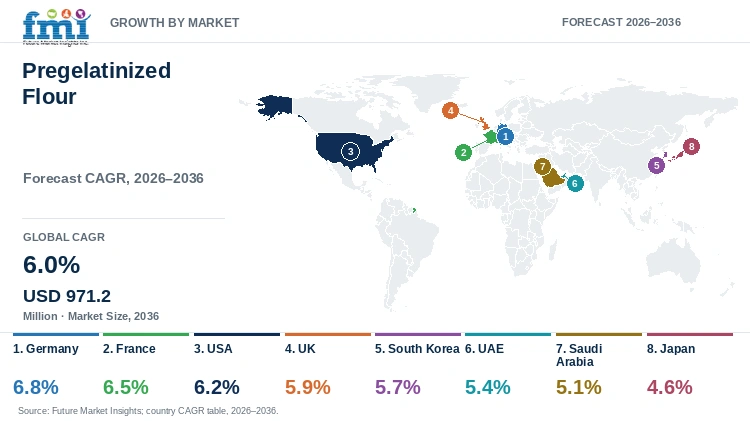
Adoption analysis indicates that hydrothermal milling in Germany leads evaluated country expansion at a 6.8% compound yearly rate to 2036, followed by France at 6.5% and the USA at 6.2%, while Japan records a 4.6% CAGR. Country demand patterns depend on clean-label retail reformulation speed and industrial versus artisan bakery concentration.
Table 7: Country CAGR and Primary Growth Levers for the Pregelatinized Flour Market (CAGR percentage and operational drivers), 2026 to 2036
| Country | CAGR (2026 to 2036) | Primary Growth Lever |
|---|---|---|
| Germany | 6.8% | Hydrothermal PURAFARIN wheat flour replacement of E-number gums across chain bakeries |
| France | 6.5% | Industrial bakery procurement and INNOSENSE texturizing flour uptake across boulangeries |
| USA | 6.2% | High-speed pan-bread moisture retention and hydrothermal wheat-based cocoa extension |
| UK | 5.9% | Cold-swelling flour dosing to stabilize dough hydration across variable UK wheat harvests |
| South Korea | 5.7% | Imported pregelatinized wheat and rice flour adoption in frozen doughs and tempura batters |
| UAE | 5.4% | Dubai Food District processing investments and dry binder demand across regional premixers |
| Saudi Arabia | 5.1% | Modernized domestic flour-milling capacity and automated bun hydration control |
| Japan | 4.6% | Chilled convenience-store bakery moisture stabilization across 5.6M MT food-wheat demand |
Source: Future Market Insights analysis
Germany Pregelatinized Flour Market Outlook (2026 to 2036)
Ongoing consolidation of craft bakeries into multi-branch retail chains in Germany is accelerating demand for freeze-thaw-stable dough systems that eliminate E-number hydrocolloids. Because central bake-off commissaries in Germany ship par-baked rolls and multigrain loaves to dozens of satellite shops, formulators dose hydrothermally treated wheat flours to prevent moisture loss during cold transit. In fact, annual sector data released in March 2026 by Zentralverband des Deutschen Bäckerhandwerks (ZDB) in Germany shows 8,659 operating bakery enterprises generating EUR 18.14 billion in 2025 turnover through larger multi-outlet production [11]. Domestic pregelatinized flour valuation in Germany is projected to compound at 6.8% annually between 2026 and 2036, although high steam-drying electricity tariffs pressure miller margins.
Key takeaway: In Germany, bakery branch consolidation and strict clean-label retail standards are projected to drive industrial uptake of hydrothermally modified wheat flours.
France Pregelatinized Flour Market Outlook (2026 to 2036)
Out-of-home lunch demand and grocery clean-label charters in France are pushing industrial viennoiserie and packaged pain de mie manufacturers to replace chemically modified starches with heat-treated functional flours. When brioche and soft sandwich loaves undergo multi-day supermarket distribution, cold-swelling wheat and maize flours keep the crumb tender without requiring E-number emulsifiers on retail packs. In July 2025, FranceAgriMer published its economic study on out-of-home activity and ingredient procurement modes across bakeries and patisseries in France, detailing how operators balance raw flour and functional mixes [12]. Sales of pregelatinized flour in France are estimated to climb at a 6.5% annual rate to 2036, whereas traditional baguette decrees restrict additives.
Key takeaway: In France, expanding industrial boulangerie output and clean-label brioche reformulation are estimated to sustain domestic demand for heat-treated texturizing flours.
USA Pregelatinized Flour Market Outlook (2026 to 2036)
Coast-to-coast frozen dough shipping distances and cocoa price inflation in sweet bakery goods are reshaping pregelatinized flour procurement across the USA. Because wholesale bakeries and foodservice batter plants in the USA seek to cut modified food starch from ingredient panels while stabilizing moisture across long freezer chains, buyers contract precooked wheat and corn flours in bulk totes. In February 2026, ADM expanded its HarvestEdge regeneratively sourced commercial flour program milled with 100% renewable electricity across USA facilities [13]. Turnover in the USA is forecast to post a 6.2% compound rate from 2026 to 2036 owing to commercial bakeries adopting hydrothermal cocoa-replacement flours, while FDA wheat allergen labeling remains mandatory.
Key takeaway: In the USA, clean-label supermarket bakery standards and frozen dough distribution are forecast to support bulk tote contracts for precooked wheat and corn flours.
UK Pregelatinized Flour Market Outlook (2026 to 2036)
Fluctuations in domestic wheat protein content after wet autumn planting seasons create a strong operational need for dough-hydration stabilizers across plant bakeries in the UK. When commercial millers in the UK adjust the ratio of domestic soft wheat to imported high-protein bread wheat, high-speed Chorleywood bread and crumpet lines experience water-absorption drift unless stabilized with cold-swelling flour. Specifically, DEFRA agricultural crop statistics published in June 2026 document 2025 UK wheat harvest output and increased miller reliance on imported milling wheat across domestic bread grists [14]. Functional pregelatinized flour volume across the UK posts an expected 5.9% yearly gain through 2036, balanced against industrial steam-drying energy costs and port grain testing.
Key takeaway: In the UK, shifting domestic wheat harvest rheology and high-speed Chorleywood bread production are expected to reinforce functional pregelatinized flour dosing.
South Korea Pregelatinized Flour Market Outlook (2026 to 2036)
Booming demand for crispy coated fried chicken and frozen bakery snacks in South Korea is driving imports of pregelatinized wheat and glutinous rice flours. When industrial batter plants in South Korea coat poultry or seafood for frozen export and delivery, dosing pregelatinized flour suspends seasoning particulates in cold water and blocks excess oil penetration during frying. According to retail food market assessments released by USDA FAS economists in October 2026, strong consumer demand for convenient meal replacements and bakery snacks continues to expand across urban retail formats in South Korea [15]. Commercial pregelatinized flour turnover across South Korea is anticipated to increase by 5.7% per year over 2026 to 2036.
Key takeaway: In South Korea, rapid convenience-store bakery turnover and industrial frying batter production are anticipated to expand imports of cold-swelling functional flours.
UAE Pregelatinized Flour Market Outlook (2026 to 2036)
Major state-backed food-processing zone investments and Gulf re-export logistics are turning the UAE into a regional formulation hub for dry pregelatinized flour binders. Because culinary sauce processors and bakery premix blenders in Dubai face high electricity costs for refrigerated storage, they favor ambient-stable drum-dried wheat and corn flours over liquid hydrocolloid emulsions. In practice, ingredient trade data released by USDA FAS analysts in August 2026 details how food manufacturers in the UAE import specialty grain intermediates for domestic hospitality and Gulf retail distribution [16], following Dubai's January 2026 unveiling of the 29-million-square-foot Dubai Food District [17]. UAE pregelatinized flour volume is projected to record a 5.4% compound annual rate to 2036.
Key takeaway: In the UAE, the Dubai Food District expansion and regional bakery premix blending are projected to accelerate imports of ambient-stable pregelatinized flours.
Saudi Arabia Pregelatinized Flour Market Outlook (2026 to 2036)
Extreme summer ambient temperatures across inland highway distribution routes in Saudi Arabia cause rapid crumb drying in packaged burger buns and filled pastries unless doughs contain water-binding functional flours. While privatized domestic flour mills grind conventional bread wheat at scale, industrial bakeries in Riyadh and Jeddah plus Dammam import pregelatinized wheat and maize flours to lock moisture inside baked goods during desert transit. For instance, grain market assessments from USDA FAS in April 2026 document Saudi Arabia wheat import tenders and commercial flour milling expansion serving domestic bakeries [18]. Volume in Saudi Arabia records an estimated 5.1% compound annual gain through 2036 due to domestic bakery premix localization and halal compliance.
Key takeaway: In Saudi Arabia, rising industrial milling throughput and arid-climate bread shelf-life requirements are estimated to sustain demand for water-binding pregelatinized flours.
Japan Pregelatinized Flour Market Outlook (2026 to 2036)
Strict 4-degree-Celsius chilled display cabinets inside metropolitan convenience stores in Japan cause untreated bread and steamed-bun starches to retrograde and harden within hours. To keep chilled katsu sandwiches and cream buns plus tempura batters soft without synthetic gums, food processors in Japan blend precision-milled pregelatinized wheat and rice flours into commercial doughs. As a matter of fact, policy council deliberations at MAFF in March 2026 reviewed national food-wheat supply-and-demand balances covering roughly 5.6 million tonnes of annual food-wheat consumption under state-managed import tenders [19]. National pregelatinized flour turnover in Japan is forecast to post a 4.6% yearly expansion rate between 2026 and 2036, constrained by multi-quarter plant qualification protocols.
Key takeaway: In Japan, strict chilled-display softness standards across convenience-store bakeries are forecast to support precision-milled pregelatinized wheat and rice flours.
Full report country CAGRs cover: North America; Latin America; Western Europe; Eastern Europe; East Asia; South Asia and Pacific; Middle East and Africa.
Who are the notable companies in the pregelatinized flour market?
ADM, GoodMills Group, Limagrain Ingredients, Ingredion Incorporated, Cargill Incorporated, Ardent Mills, Bay State Milling, King Arthur Baking, Manildra Group, and Scoular are the notable companies in the pregelatinized flour market.
Supplier competition divides between hydrothermal functional-flour specialists that operate steam-drum and extrusion lines and multinational texturizer corporations that market clean-label flours beside modified starches. Because food manufacturers want drop-in replacements for E-number gums and costly cocoa powder, leading millers are expanding application labs to customize viscosity curves for each bakery account.
- Hydrothermal & Cold-Swelling Flour Specialists: ADM and GoodMills Group plus Limagrain Ingredients and Ingredion Incorporated manufacture documented pregelatinized and hydrothermally treated wheat and rice flours.
- Global Texturizer & Industrial Milling Platforms: Cargill Incorporated and Ardent Mills plus Bay State Milling and Manildra Group supply industrial bakery flours and cocoa-replacement wheat ingredients.
- Specialty Bakery Blend & B2B Ingredient Supply Platforms: Scoular and King Arthur Baking provide functional pulse and grain ingredients as well as specialty bakery flour blends.
Competitive Benchmarking: Pregelatinized Flour Market
Table 8: Competitive Benchmarking for the Pregelatinized Flour Market (qualitative capability ratings), 2026
| Company | Cold-Swelling Flour Portfolio | Bakery & Culinary Rheology Support | Clean-Label & Traceable Grain Range | Geographic Reach |
|---|---|---|---|---|
| ADM | High | High | High | USA, Europe, and global ingredient network |
| GoodMills Group | High | High | High | Germany, Poland, Austria, and Europe bakery channels |
| Limagrain Ingredients | High | High | High | France, Western Europe, and international B2B export |
| Ingredion Incorporated | High | High | High | North America, Europe, Asia-Pacific, and Latin America |
| Cargill Incorporated | High | High | Medium | Global food and bakery texturizer distribution |
| Ardent Mills | Medium | High | High | USA, Canada, and Puerto Rico milling network |
| Bay State Milling | Medium | High | High | USA commercial bakery and foodservice channels |
| Manildra Group | Medium | High | Medium | Australia, USA, and Asia-Pacific export |
| Scoular | Medium | Medium | High | North America and Asia-Pacific B2B ingredient trade |
| King Arthur Baking | Medium | Medium | High | USA professional bakery and foodservice supply |
Scoring basis: Cold-Swelling Flour Portfolio evaluates documented drum-dried and extruded or hydrothermally precooked flour SKUs. Bakery & Culinary Rheology Support and Clean-Label Range reflect pilot-scale Viscoamylograph testing and non-GMO or organic grain identity preservation across bulk tote logistics.
Key Developments in the Pregelatinized Flour Market
- GoodMills Innovation introduced SNACKMAXX hydrothermally processed masa corn flours in May 2026, pairing traceable Europe corn varieties with controlled gelatinization for sheeted tortilla chips and extruded snacks [20].
- Bay State Milling expanded its commercial formulation program in November 2025 for HealthSense High-Fiber Wheat Flour to deliver clean-label endosperm fiber and water-binding functionality in bread and tortillas [21].
- Limagrain Ingredients rolled out INNOSENSE Masa Plus functional corn flour in January 2025 to support clean-label viscosity and cohesive dough sheetability in commercial snack plants [22].
Key Players in the Pregelatinized Flour Market
Hydrothermal & Cold-Swelling Flour Specialists
- ADM
- GoodMills Group
- Limagrain Ingredients
- Ingredion Incorporated
Global Texturizer & Industrial Milling Platforms
- Cargill Incorporated
- Ardent Mills
- Bay State Milling
- Manildra Group
Specialty Bakery Blend & B2B Ingredient Supply Platforms
- Scoular
- King Arthur Baking
Pregelatinized Flour Market - Report Scope
Table 9: Report Scope for the Pregelatinized Flour Market (coverage fields and definitions), 2026 to 2036
| Coverage field | Report scope |
|---|---|
| Market breakdown | Grade; Form; Application; Claim; Sales Channel |
| Quantitative Units | USD Million |
| Market Definition | Commercial supplier revenue from hydrothermally precooked (drum-dried, extruded, and spray-cooked) cereal and pulse flours sold as cold-swelling water binders and texturizers across bakery, snack, culinary, and nutrition applications. Excludes untreated native flour, isolated pregelatinized starch (such as GemGel wheat starch), enzyme-active malted flour, pet-food extrudates, and finished baked goods. |
| Regions Covered | North America; Latin America; Western Europe; Eastern Europe; East Asia; South Asia and Pacific; Middle East and Africa |
| Countries Covered | Germany, France, USA, UK, South Korea, UAE, Saudi Arabia, Japan, and additional countries in the full report |
| Key Companies Covered | ADM, GoodMills Group, Limagrain Ingredients, Ingredion Incorporated, Cargill Incorporated, Ardent Mills, Bay State Milling, Manildra Group, Scoular, King Arthur Baking |
| Forecast Period | 2026 to 2036 |
| Approach | Primary and secondary research with top-down and bottom-up market triangulation. |
Pregelatinized Flour Market - Research Methodology
Table 10: Research Methodology for the Pregelatinized Flour Market (research methods and approach), 2026 edition
| Method | Approach |
|---|---|
| Primary Research | Structured interviews with hydrothermal milling engineers, industrial bakery R&D directors, culinary sauce formulators, and B2B ingredient distributors to validate cold-viscosity dosing and contract pricing. |
| Secondary Research | Analysis of USDA NASS Flour Milling Products releases, FranceAgriMer and UK DEFRA crop reports, FDA Edition 5 and EU 1169/2011 allergen regulations, and supplier technical data sheets. |
| Market Sizing and Forecasting | Top-down functional flour and clean-label texturizer budgets reconciled against bottom-up drum-drying and extrusion tonnage across bakery and culinary lines from 2026 to 2036. |
| Country Forecasting Model | Econometric country models weight industrial versus artisan bakery flour deliveries, retail E-number replacement speed, and domestic hydrothermal milling capacity across eight national markets. |
| Operational Benchmark Traceability | Processing volume and plant spending indicators in Tables 2, 3, and 4 trace to USDA NASS, FranceAgriMer, ZDB bakery statistics in Germany, and Dubai Food District registries. |
| Data Triangulation and Validation | Revenue estimates are cross-checked against commercial hydrothermal line capacities while excluding isolated modified starches, untreated flours, and non-food or pet-treat extrudates. |
Pregelatinized Flour Market by Segments
Pregelatinized Flour Market segmented by Grade:
- Standard hydrothermal wheat grade
- High-viscosity patisserie & batter grade
- Pregelatinized corn & rice gluten-free grade
- Organic & identity-preserved specialty grade
Pregelatinized Flour Market segmented by Form:
- Fine drum-dried & extruded powder
- Agglomerated instant-dispersible granules
- Coarse textured crumb & flake
- Pre-hydrated functional slurry / paste
Pregelatinized Flour Market segmented by Application:
- Bread, rolls & frozen dough conditioning
- Cakes, muffins & high-ratio batters
- Instant soups, gravies & culinary sauces
- Extruded snacks & batter coatings
- Infant & clinical nutrition cereals
Pregelatinized Flour Market segmented by Claim:
- Conventional
- Clean-label additive replacement
- Gluten-free certified
- Organic & non-GMO preserved
Pregelatinized Flour Market segmented by Sales Channel:
- Direct to food & bakery processors
- Specialty ingredient distributors
- Foodservice & bakery premix blenders
- Online B2B ingredient platforms
Pregelatinized Flour Market by Region
- North America
- United States
- Canada
- Latin America
- Brazil
- Mexico
- Argentina
- Chile
- Western Europe
- Germany
- France
- United Kingdom
- Italy
- Spain
- Benelux
- Nordics
- Eastern Europe
- Poland
- Czech Republic
- Romania
- Hungary
- East Asia
- China
- Japan
- South Korea
- South Asia and Pacific
- India
- ASEAN
- Australia and New Zealand
- Middle East and Africa
- GCC Countries
- South Africa
- Türkiye
- Israel
Research Sources and Bibliography
- [1] Archer Daniels Midland Company (ADM). (2026, January 18). Bulk Flours & Milling | Explore Wholesale Commercial Flours | ADM. ADM Human Nutrition Technical Literature.
- [2] GoodMills Innovation GmbH. (2025, November 10). PURAFARIN® C 300 W - GoodMills Innovation. GoodMills Innovation Functional Flours.
- [3] Limagrain Ingredients. (2025, October 18). Texturising functional flours | Limagrain Ingredients. Limagrain Ingredients INNOSENSE Range.
- [4] UK Health and Safety Executive (HSE). (2026, July 28). Flour dust and risks to bakers - HSE. GOV.UK / Health and Safety Executive.
- [5] Ingredion Incorporated. (2026, February 12). Flours - Ingredion. Ingredion North America Ingredient Catalog.
- [6] U.S. Food and Drug Administration (FDA). (2025, January 6). Guidance for Industry: Questions and Answers Regarding Food Allergen Labeling (Edition 5) | FDA. U.S. Department of Health and Human Services / FDA.
- [7] Ardent Mills. (2026, January 14). Product & Ingredient Innovation Solutions | Ardent Mills. Ardent Mills Technical Solutions.
- [8] USDA National Agricultural Statistics Service (NASS). (2026, May 1). Flour Milling Products 2025 Summary 05/01/2026. United States Department of Agriculture (USDA NASS).
- [9] Manildra Group USA. (2025, August 10). GemGel® 100 | Pregelatinized Native Wheat Starch - Manildra USA. Manildra Group Technical Publications.
- [10] Ardent Mills. (2025, May 14). Cocoa Replacements & Substitutes | Ardent Mills. Ardent Mills Product Portfolio.
- [11] Zentralverband des Deutschen Bäckerhandwerks e.V. (2026, March 15). Zahlen rund ums Bäckerhandwerks - Zentralverband des Deutschen Bäckerhandwerks. Deutsches Bäckerhandwerk Official Statistics.
- [12] FranceAgriMer. (2025, July 15). Activité hors domicile et modes d'approvisionnement des boulangeries pâtisseries | FranceAgriMer. République Française / FranceAgriMer.
- [13] Archer Daniels Midland Company (ADM). (2026, February 4). Regeneratively Sourced Flours in Bulk | ADM. ADM Commercial Milling Solutions.
- [14] UK Department for Environment, Food & Rural Affairs (DEFRA). (2026, June 18). Chapter 7: Crops - GOV.UK. GOV.UK Official Statistics.
- [15] USDA Foreign Agricultural Service. (2026, October 5). South Korea: Retail Foods Annual | USDA Foreign Agricultural Service. United States Department of Agriculture (USDA FAS).
- [16] USDA Foreign Agricultural Service. (2026, August 12). United Arab Emirates: Food Processing Ingredients Annual | USDA Foreign Agricultural Service. United States Department of Agriculture (USDA FAS).
- [17] Government of Dubai Media Office. (2026, January 22). DP World officially unveils the Dubai Food District. Government of Dubai Media Office.
- [18] USDA Foreign Agricultural Service. (2026, April 10). Saudi Arabia: Grain and Feed Annual | USDA Foreign Agricultural Service. United States Department of Agriculture (USDA FAS).
- [19] Japan Ministry of Agriculture, Forestry and Fisheries (MAFF). (2026, March 23). MAFF Japan Policy Council.
- [20] GoodMills Innovation GmbH. (2026, May 22). SNACKMAXX® Masa Flours: Authentic Corn Flavour and Process Reliability for Snack Applications - GoodMills Innovation. GoodMills Innovation Newsroom.
- [21] Bay State Milling Company. (2025, November 18). Designing Products for the GLP-1 Era - HealthSense® Flour. Bay State Milling Newsroom.
- [22] Limagrain Group. (2025, January 22). Discover the Limagrain Highlights. Limagrain Corporate News.
This bibliography is provided for reader reference and is not exhaustive. The full report contains the complete reference list and detailed citations.
This Report Answers
- How large is the pregelatinized flour market in 2026 and what valuation is projected by 2036?
- Which clean-label and freeze-thaw pressures drive industrial bakeries toward pregelatinized flours?
- Why does standard hydrothermal wheat grade hold the largest grade share?
- Why does fine drum-dried and extruded powder lead product forms?
- How do national growth rates compare across Germany, France, the USA, and the UK?
- Which ingredient manufacturers document hydrothermal flour lines versus isolated starches?
- Why do wheat allergen rules and viscosity calibration delay supplier switching?
- What Rapid Visco Analyzer and moisture tests should buyers run before qualifying a supplier?
Frequently Asked Questions
How big is the pregelatinized flour market in 2026, and what is forecast for 2036?
Global pregelatinized flour valuation climbs from a 2025 baseline of USD 512.6 million to USD 542.3 million in 2026. Total turnover is forecast to hit USD 971.2 million by 2036 as bakeries replace chemical hydrocolloids.
What is the CAGR for the pregelatinized flour market from 2026 to 2036?
The global sector is projected to compound at a 6.0% annual rate over the 2026-2036 decade, creating USD 428.9 million in added yearly revenue for hydrothermal millers.
Which grade segment leads the pregelatinized flour market?
Standard hydrothermal wheat grade is estimated at 41.8% of 2026 grade volume, supported by direct compatibility with wheat bread and cake batter formulations.
Which form segment leads the pregelatinized flour market?
Across product forms, fine drum-dried & extruded powder is projected at 49.4% in 2026, enabled by pneumatic silo handling and zero liquid freight cost.
Which country has a notable growth outlook during the assessment period?
Germany is forecast to head major processing nations with a 6.8% CAGR to 2036, driven by clean-label PURAFARIN wheat flour adoption across consolidated bakery chains.
Who are the key players in the market?
Notable market participants include ADM, GoodMills Group, Limagrain Ingredients, Ingredion Incorporated, Cargill Incorporated, Ardent Mills, Bay State Milling, Manildra Group, Scoular, and King Arthur Baking across B2B ingredient channels.
Preview the report firsthand - request a free sample
Get SampleGet the brochure for pricing and purchase details.
Get PDFTable of Content
- Key Takeaways
- Market Size and CAGR
- Top Growth Driver
- Fastest Growing Segment
- Leading Region
- Key Companies
- Emerging Opportunities
- Executive Summary
- Global Market Outlook
- Demand-side Trends
- Supply-side Trends
- Technology Roadmap Analysis
- Analysis and Recommendations
- Analyst Perspective (What is happening? Why now? What should investors know?)
- Key Questions Answered
- How large is the market?
- What is the CAGR?
- What are key trends?
- Which region dominates?
- Who are the leaders?
- Market Overview
- Market Coverage / Taxonomy
- Market Definition / Scope / Limitations
- Research Methodology
- Chapter Orientation
- Analytical Lens and Working Hypotheses
- Market Structure, Signals, and Trend Drivers
- Benchmarking and Cross-market Comparability
- Market Sizing, Forecasting, and Opportunity Mapping
- Research Design and Evidence Framework
- Desk Research Programme (Secondary Evidence)
- Expert Input and Fieldwork (Primary Evidence)
- Tooling, Models, and Reference Databases
- Data Engineering and Model Build
- Quality Assurance and Audit Trail
- Market Background
- Market Dynamics (Drivers, Restraints, Opportunity, Trends)
- Scenario Forecast (Optimistic, Likely, Conservative)
- Impact Analysis
- AI Impact
- Sustainability Impact
- Regulatory Impact
- Technology Impact
- Consumer / Buyer Analysis
- Purchase Drivers
- Adoption Barriers
- Buyer Journey
- Opportunity Map Analysis
- Product Life Cycle Analysis
- Supply Chain Analysis
- Investment Feasibility Matrix
- Value Chain Analysis
- PESTLE and Porter's Analysis
- Regulatory Landscape
- Regional Parent Market Outlook
- Production and Consumption Statistics
- Import and Export Statistics
- Global Market Analysis and Forecast, 2021 to 2036
- Historical Market Size Value (USD Million) Analysis, 2021 to 2025
- Current and Future Market Size Value (USD Million) Projections, 2026 to 2036
- Y-o-Y Growth Trend Analysis
- Absolute $ Opportunity Analysis
- Global Market Pricing Analysis, 2021 to 2036
- Global Market Analysis and Forecast, By Grade, 2021 to 2036
- Introduction / Key Findings
- Historical Market Size Value (USD Million) Analysis By Grade, 2021 to 2025
- Current and Future Market Size Value (USD Million) Analysis and Forecast By Grade, 2026 to 2036
- Standard hydrothermal wheat grade
- High-viscosity patisserie & batter grade
- Pregelatinized corn & rice gluten-free grade
- Organic & identity-preserved specialty grade
- Y-o-Y Growth Trend Analysis By Grade, 2021 to 2025
- Absolute $ Opportunity Analysis By Grade, 2026 to 2036
- Global Market Analysis and Forecast, By Form, 2021 to 2036
- Introduction / Key Findings
- Historical Market Size Value (USD Million) Analysis By Form, 2021 to 2025
- Current and Future Market Size Value (USD Million) Analysis and Forecast By Form, 2026 to 2036
- Fine drum-dried & extruded powder
- Agglomerated instant-dispersible granules
- Coarse textured crumb & flake
- Pre-hydrated functional slurry / paste
- Y-o-Y Growth Trend Analysis By Form, 2021 to 2025
- Absolute $ Opportunity Analysis By Form, 2026 to 2036
- Global Market Analysis and Forecast, By Application, 2021 to 2036
- Introduction / Key Findings
- Historical Market Size Value (USD Million) Analysis By Application, 2021 to 2025
- Current and Future Market Size Value (USD Million) Analysis and Forecast By Application, 2026 to 2036
- Bread, rolls & frozen dough conditioning
- Cakes, muffins & high-ratio batters
- Instant soups, gravies & culinary sauces
- Extruded snacks & batter coatings
- Infant & clinical nutrition cereals
- Y-o-Y Growth Trend Analysis By Application, 2021 to 2025
- Absolute $ Opportunity Analysis By Application, 2026 to 2036
- Global Market Analysis and Forecast, By Claim, 2021 to 2036
- Introduction / Key Findings
- Historical Market Size Value (USD Million) Analysis By Claim, 2021 to 2025
- Current and Future Market Size Value (USD Million) Analysis and Forecast By Claim, 2026 to 2036
- Conventional
- Clean-label additive replacement
- Gluten-free certified
- Organic & non-GMO preserved
- Y-o-Y Growth Trend Analysis By Claim, 2021 to 2025
- Absolute $ Opportunity Analysis By Claim, 2026 to 2036
- Global Market Analysis and Forecast, By Sales Channel, 2021 to 2036
- Introduction / Key Findings
- Historical Market Size Value (USD Million) Analysis By Sales Channel, 2021 to 2025
- Current and Future Market Size Value (USD Million) Analysis and Forecast By Sales Channel, 2026 to 2036
- Direct to food & bakery processors
- Specialty ingredient distributors
- Foodservice & bakery premix blenders
- Online B2B ingredient platforms
- Y-o-Y Growth Trend Analysis By Sales Channel, 2021 to 2025
- Absolute $ Opportunity Analysis By Sales Channel, 2026 to 2036
- Global Market Analysis and Forecast, By Region, 2021 to 2036
- Introduction
- Historical Market Size Value (USD Million) Analysis By Region, 2021 to 2025
- Current Market Size Value (USD Million) Analysis and Forecast By Region, 2026 to 2036
- North America
- Latin America
- Western Europe
- Eastern Europe
- East Asia
- South Asia and Pacific
- Middle East and Africa
- Market Attractiveness Analysis By Region
- North America Market Analysis and Forecast, By Country, 2021 to 2036
- Historical Market Size Value (USD Million) Trend Analysis By Market Taxonomy, 2021 to 2025
- Market Size Value (USD Million) Forecast By Market Taxonomy, 2026 to 2036
- By Country
- United States
- Canada
- By Grade
- By Form
- By Application
- By Claim
- By Sales Channel
- By Country
- Market Attractiveness Analysis
- By Country
- By Grade
- By Form
- By Application
- By Claim
- By Sales Channel
- Key Takeaways
- Latin America Market Analysis and Forecast, By Country
- Historical Market Size Value (USD Million) Trend Analysis By Market Taxonomy, 2021 to 2025
- Market Size Value (USD Million) Forecast By Market Taxonomy, 2026 to 2036
- By Country
- Brazil
- Mexico
- Argentina
- Chile
- By Grade
- By Form
- By Application
- By Claim
- By Sales Channel
- By Country
- Market Attractiveness Analysis
- By Country
- By Grade
- By Form
- By Application
- By Claim
- By Sales Channel
- Key Takeaways
- Western Europe Market Analysis and Forecast, By Country
- Historical Market Size Value (USD Million) Trend Analysis By Market Taxonomy, 2021 to 2025
- Market Size Value (USD Million) Forecast By Market Taxonomy, 2026 to 2036
- By Country
- Germany
- France
- United Kingdom
- Italy
- Spain
- Benelux
- Nordics
- By Grade
- By Form
- By Application
- By Claim
- By Sales Channel
- By Country
- Market Attractiveness Analysis
- By Country
- By Grade
- By Form
- By Application
- By Claim
- By Sales Channel
- Key Takeaways
- Eastern Europe Market Analysis and Forecast, By Country
- Historical Market Size Value (USD Million) Trend Analysis By Market Taxonomy, 2021 to 2025
- Market Size Value (USD Million) Forecast By Market Taxonomy, 2026 to 2036
- By Country
- Poland
- Czech Republic
- Romania
- Hungary
- By Grade
- By Form
- By Application
- By Claim
- By Sales Channel
- By Country
- Market Attractiveness Analysis
- By Country
- By Grade
- By Form
- By Application
- By Claim
- By Sales Channel
- Key Takeaways
- East Asia Market Analysis and Forecast, By Country
- Historical Market Size Value (USD Million) Trend Analysis By Market Taxonomy, 2021 to 2025
- Market Size Value (USD Million) Forecast By Market Taxonomy, 2026 to 2036
- By Country
- China
- Japan
- South Korea
- By Grade
- By Form
- By Application
- By Claim
- By Sales Channel
- By Country
- Market Attractiveness Analysis
- By Country
- By Grade
- By Form
- By Application
- By Claim
- By Sales Channel
- Key Takeaways
- South Asia and Pacific Market Analysis and Forecast, By Country
- Historical Market Size Value (USD Million) Trend Analysis By Market Taxonomy, 2021 to 2025
- Market Size Value (USD Million) Forecast By Market Taxonomy, 2026 to 2036
- By Country
- India
- ASEAN
- Australia and New Zealand
- By Grade
- By Form
- By Application
- By Claim
- By Sales Channel
- By Country
- Market Attractiveness Analysis
- By Country
- By Grade
- By Form
- By Application
- By Claim
- By Sales Channel
- Key Takeaways
- Middle East and Africa Market Analysis and Forecast, By Country
- Historical Market Size Value (USD Million) Trend Analysis By Market Taxonomy, 2021 to 2025
- Market Size Value (USD Million) Forecast By Market Taxonomy, 2026 to 2036
- By Country
- GCC Countries
- South Africa
- Türkiye
- Israel
- By Grade
- By Form
- By Application
- By Claim
- By Sales Channel
- By Country
- Market Attractiveness Analysis
- By Country
- By Grade
- By Form
- By Application
- By Claim
- By Sales Channel
- Key Takeaways
- Key Countries Market Analysis
- United States
- Pricing Analysis
- Market Share Analysis, 2025
- By Grade
- By Form
- By Application
- By Claim
- By Sales Channel
- Canada
- Pricing Analysis
- Market Share Analysis, 2025
- By Grade
- By Form
- By Application
- By Claim
- By Sales Channel
- Mexico
- Pricing Analysis
- Market Share Analysis, 2025
- By Grade
- By Form
- By Application
- By Claim
- By Sales Channel
- Brazil
- Pricing Analysis
- Market Share Analysis, 2025
- By Grade
- By Form
- By Application
- By Claim
- By Sales Channel
- Chile
- Pricing Analysis
- Market Share Analysis, 2025
- By Grade
- By Form
- By Application
- By Claim
- By Sales Channel
- Germany
- Pricing Analysis
- Market Share Analysis, 2025
- By Grade
- By Form
- By Application
- By Claim
- By Sales Channel
- United Kingdom
- Pricing Analysis
- Market Share Analysis, 2025
- By Grade
- By Form
- By Application
- By Claim
- By Sales Channel
- Italy
- Pricing Analysis
- Market Share Analysis, 2025
- By Grade
- By Form
- By Application
- By Claim
- By Sales Channel
- Spain
- Pricing Analysis
- Market Share Analysis, 2025
- By Grade
- By Form
- By Application
- By Claim
- By Sales Channel
- France
- Pricing Analysis
- Market Share Analysis, 2025
- By Grade
- By Form
- By Application
- By Claim
- By Sales Channel
- India
- Pricing Analysis
- Market Share Analysis, 2025
- By Grade
- By Form
- By Application
- By Claim
- By Sales Channel
- ASEAN
- Pricing Analysis
- Market Share Analysis, 2025
- By Grade
- By Form
- By Application
- By Claim
- By Sales Channel
- Australia and New Zealand
- Pricing Analysis
- Market Share Analysis, 2025
- By Grade
- By Form
- By Application
- By Claim
- By Sales Channel
- China
- Pricing Analysis
- Market Share Analysis, 2025
- By Grade
- By Form
- By Application
- By Claim
- By Sales Channel
- Japan
- Pricing Analysis
- Market Share Analysis, 2025
- By Grade
- By Form
- By Application
- By Claim
- By Sales Channel
- South Korea
- Pricing Analysis
- Market Share Analysis, 2025
- By Grade
- By Form
- By Application
- By Claim
- By Sales Channel
- Poland
- Pricing Analysis
- Market Share Analysis, 2025
- By Grade
- By Form
- By Application
- By Claim
- By Sales Channel
- Hungary
- Pricing Analysis
- Market Share Analysis, 2025
- By Grade
- By Form
- By Application
- By Claim
- By Sales Channel
- Türkiye
- Pricing Analysis
- Market Share Analysis, 2025
- By Grade
- By Form
- By Application
- By Claim
- By Sales Channel
- South Africa
- Pricing Analysis
- Market Share Analysis, 2025
- By Grade
- By Form
- By Application
- By Claim
- By Sales Channel
- UAE
- Pricing Analysis
- Market Share Analysis, 2025
- By Grade
- By Form
- By Application
- By Claim
- By Sales Channel
- Saudi Arabia
- Pricing Analysis
- Market Share Analysis, 2025
- By Grade
- By Form
- By Application
- By Claim
- By Sales Channel
- United States
- Market Structure Analysis
- Competition Dashboard
- Competition Benchmarking
- Market Share Analysis of Top Players
- By Regional
- By Grade
- By Form
- By Application
- By Claim
- By Sales Channel
- Emerging Startups
- Innovation Benchmarking
- Competition Analysis
- Competition Deep Dive
- ADM
- Overview
- Product Portfolio
- Profitability by Market Segments
- Sales Footprint
- Strategy Overview
- Marketing Strategy
- Product Strategy
- Channel Strategy
- GoodMills Group
- Limagrain Ingredients
- Ingredion Incorporated
- Cargill Incorporated
- Ardent Mills
- Bay State Milling
- Manildra Group
- Scoular
- King Arthur Baking
- ADM
- Case Studies
- Success Stories
- Recent Developments
- Competition Deep Dive
- Assumptions & Acronyms Used


