

- Market Size (2026)
- USD 214.1 Mn
- Forecast (2036)
- USD 433.1 Mn
- CAGR (2026 to 2036)
- 7.3%
How big is Hazelnut Flour & Meal Market in 2026?
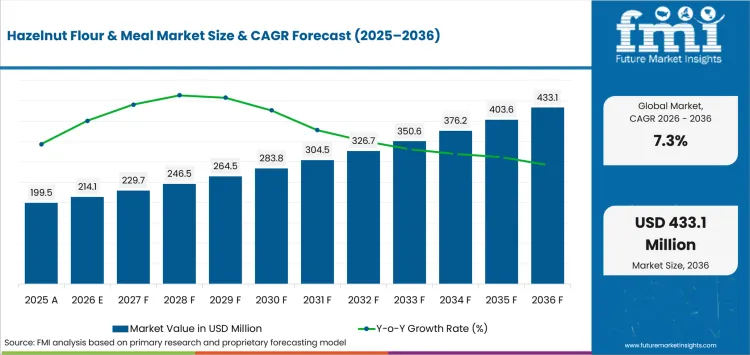
USD 214.1 million in 2026 and USD 433.1 million by 2036 at a 7.3% CAGR.
Demand for hazelnut flour & meal is forecast to rise from USD 214.1 million in 2026 to USD 433.1 million by 2036 at a 7.3% CAGR. Bakery manufacturers use it for nut flavor and texture within approved flour systems. In July 2026 NIST published RM 8405 hazelnut flour research to standardize allergen detection and quantification. The work raises the value of repeatable composition and cross-contact records during technical qualification.
Raw-hazelnut availability sets milling cost and the origins that can hold an approved flour specification. USDA NASS recorded 121,500 tons of utilized Oregon hazelnut production in 2025. Domestic crop access shortens replenishment for US mills, though storage conditions still affect flour consistency. Mills reduce repeat approval work by holding origin and particle-size specifications steady.
Key Takeaways
- Bakery manufacturers use hazelnut flour to add nut flavor and texture without replacing the complete flour system.
- By grade, standard milling grade is estimated to hold 38.0% in 2026 owing to broad recipe fit and simpler milling requirements.
- Powder - dry is set to lead the form category with 47.0% share in 2026 due to straightforward dry dosing and bulk packaging.
- In 2026, bread & rolls are expected to lead application with 37.0% share because frequent bakery production supports controlled inclusion.
- Crop volatility and tree-nut controls raise qualification cost during approval of a new flour.
- Some of the key players in this market include Yavuz Gıda, Ahmet Ak Gıda, SABIRLAR, SEP Gıda, Şenocak Hazelnut Company, Gürsoy, Arslantürk, Balsu Gıda, Olam Progıda, and Karimex Hazelnut Industry.
Analyst Perspective
"Hazelnut flour earns repeat business when particle size and roasted flavor stay inside the bakery's approved range. Unit price matters less if origin or allergen records send the same formula back through review next crop year."
- Nandini Roy Choudhury, Principal Consultant, Future Market Insights
How is the hazelnut flour & meal market segmented?
The hazelnut flour & meal market is segmented by grade, form, application, claim, sales channel and region.
Grade covers standard milling grade, fine - patisserie grade, organic certified and identity-preserved specialty. Form includes powder - dry, liquid, paste - semi-solid and granules - pieces. Application includes bread & rolls, cakes & muffins, biscuits & cookies, viennoiserie & pastry and other bakery & snacks. Claim includes conventional, clean label, organic and Non-GMO - identity preserved. Sales channel includes direct to industrial bakeries, ingredient distributors, foodservice & artisan supply and online B2B.
What makes standard milling grade central to the grade category?
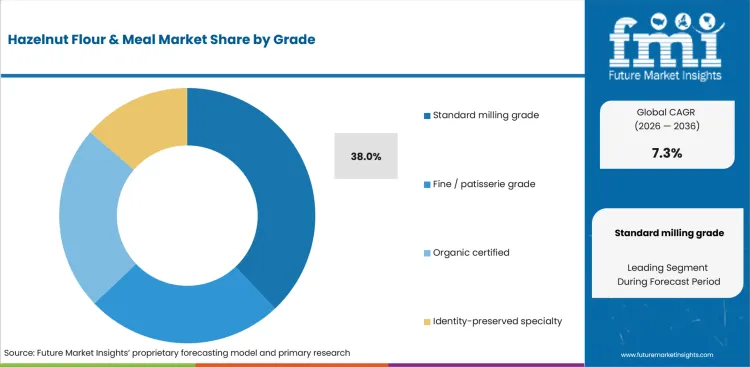
Standard milling grade suits bakeries that need a flour-like input without a fine patisserie specification. Adjacent almond flour programs use particle size as a similar selection point. In March 2026 Yavuz Gıda received BRC Food Safety Issue 9 certification for grinding hazelnuts and packing hazelnut meal.
- By grade, standard milling grade is forecast to represent 38.0% in 2026 driven by broad formulation use and a less restrictive specification than specialty grades.
- Yavuz Gıda places grinding and meal packing inside one BRC-audited process. The certificate gives industrial bakeries a current basis for technical qualification.
Why does powder - dry lead the form category?
Powder - dry fits weighing systems used for flour and premixes. It gives formulators direct control over inclusion rate without a liquid carrier. The same handling logic appears in gluten-free flours. In November 2025 SABIRLAR received FSSC 22000 certification for hazelnut meal - powder production.
- Powder - dry is set to lead the form category with 47.0% share in 2026 due to straightforward dry dosing and bulk packaging.
- SABIRLAR's FSSC scope names raw and processed hazelnut meal - powder. The certification gives industrial users a current food-safety basis for approving the dry form.
How do bread & rolls lead the application category?
Bread and roll lines run frequent batches that can hold a controlled hazelnut inclusion against stable base flour. Industrial bakery ingredients are judged on dough handling and finished quality. In July 2025 SEP Gıda received BRCGS Issue 9 certification for hazelnut flour production and vacuum packing.
- In 2026, bread & rolls are expected to lead application with 37.0% share because frequent batching supports controlled hazelnut inclusion in standard formulas.
- SEP Gıda's certified scope covers roasting and grinding prior to packing. Industrial bakeries can qualify that sequence before fixing routine inclusion levels.
What supports conventional supply within the claim category?
Conventional supply keeps the raw-material pool wider because it avoids organic or identity-preserved chain controls. clean-label ingredients still require strong allergen documentation in premium bakery programs. Food Standards Agency research published in October 2025 found that 94% of surveyed food businesses provided allergen information in writing.
- The claim category is forecast to be led by conventional at 49.0% share in 2026 due to fewer certification limits on raw-hazelnut sourcing.
- Organic and identity-preserved claims require certification plus traceable lot records. Conventional supply avoids those extra chain controls while still carrying allergen documentation.
What drives direct to industrial bakeries in the sales channel category?
Large bakery accounts need technical files to commit volume to a new nut flour. industrial bakery mixes follow a similar direct-account model. Business Oregon documented in 2025 that Hazelnut Growers of Oregon processes about 75% of the state crop and received support for equipment and facility upgrades.
- By sales channel, direct to industrial bakeries is estimated to hold 48.0% in 2026 owing to repeat volume and account-specific technical review.
- Large processing programs suit direct accounts when lot data travels with the ingredient. Distributors remain useful for smaller mixed orders and regional service.
What are the drivers, restraints and opportunities in the Hazelnut Flour & Meal Market?
Targeted bakery formulation supports repeat demand. Crop concentration and tree-nut controls raise supply risk. Documentation-ready ingredients provide the clearest route to premium accounts.
- Driver: Repeat bakery formulas turn an approved hazelnut flour specification into scheduled ingredient purchases.
- Restraint: Crop shocks can narrow approved raw-hazelnut supply and raise continuity risk for fixed bakery formulas.
- Opportunity: Complete origin and allergen files can shorten local review between bakery trials and regular supply.
Repeat bakery programs turn technical fit into repeat purchasing
Industrial bakeries reorder hazelnut flour once a formula holds particle size and flavor under normal line conditions. bakery flour improvers face a similar repeat-performance test during plant trials. USDA NASS recorded an Oregon hazelnut yield of 1.32 tons per bearing acre in 2025. A usable crop base supports repeat programs, but mills still need stable grind and storage controls to keep an approved formula consistent.
Crop concentration raises continuity risk at the mill
Crop concentration reaches the flour program at the raw-material stage. food allergen testing adds a separate control once hazelnuts enter mixed-ingredient plants. TurkStat recorded a 38.5% decline in Türkiye's hazelnut production in 2025. A smaller crop can narrow approved-origin choices and raise the value of prequalified alternatives. Each origin change still needs sensory and allergen review before routine use.
Complete documentation reduces avoidable delay during ingredient approval
Hazelnut flour moves through commercial review faster with origin records and allergen files that local teams can use directly. Dubai Municipality reported in February 2025 that its Unified Permit System cut food-permit service time by 75%. Faster public processing cannot repair an incomplete dossier. Ingredient companies gain time by preparing specifications and registration data before a distributor submits the product.
Which country CAGRs are profiled in the Hazelnut Flour & Meal Market?
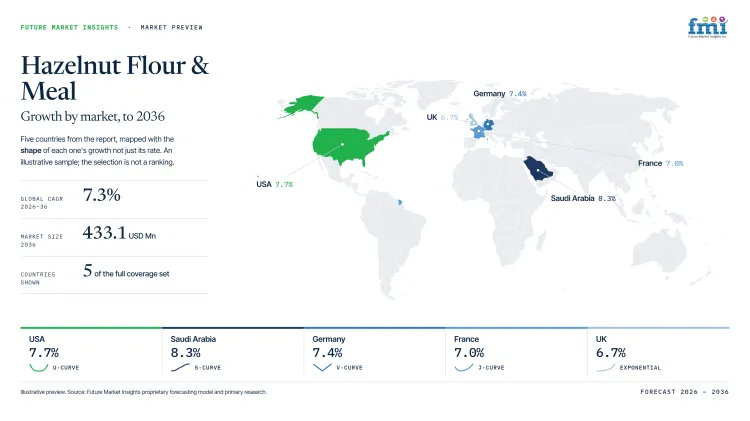
| Country | CAGR |
|---|---|
| UAE | 8.6% |
| Saudi Arabia | 8.3% |
| South Korea | 8.0% |
| USA | 7.7% |
| Germany | 7.4% |
| France | 7.0% |
| UK | 6.7% |
| Japan | 6.4% |
How do country-level CAGRs compare in the Hazelnut Flour & Meal Market?
Growth spans 2.2 percentage points from the UAE at 8.6% to Japan at 6.4%. UAE, Saudi Arabia and South Korea form the upper group as import execution or label preparation shortens onboarding. USA, Germany and France form the middle band because crop or origin exposure offsets established bakery demand. UK and Japan advance more slowly.
- The UAE uses rapid digital registration for imported food and ingredient products.
- Saudi Arabia links menu compliance to documented ingredient and allergen records.
- South Korea relies on disciplined local label preparation for imported food products.
- The USA benefits from nearby Oregon supply for hazelnut flour processors.
- Germany manages heavy dependence on Turkish hazelnut imports for ingredient supply.
- France faces uneven domestic crop quality when local processors source hazelnuts.
- UK operators translate allergen files into practical foodservice records and controls.
- Japan gives greater weight to formulation review before new hazelnut products launch.
Rate differences reflect execution burden as much as bakery demand. The full report provides country-level CAGR analysis for North America, Latin America, Western Europe, Eastern Europe, East Asia, South Asia and Pacific, Middle East and Africa.
Country-wise Analysis
- USA bakery manufacturers can source hazelnuts from Oregon instead of depending entirely on imports or the broader edible nuts trade. Hazelnut flour & meal demand in the USA is forecast to rise at 7.7% CAGR over the forecast period, driven by shorter replenishment routes for domestic-origin lots. USDA NASS recorded 92,000 bearing hazelnut acres in Oregon for 2025. Domestic crop access can simplify replenishment for approved bakery formulas, but mills still need oxidation controls and cross-contact records prior to routine production. Companies with origin-linked specifications can protect flavor consistency through crop changes and reduce repeated checks during routine orders each crop year.
- German bakery manufacturers secure most hazelnut supply through imports to lock a flour specification. Germany is estimated to post 7.4% CAGR over the forecast period, attributable to bakery demand and deep ingredient distribution for industrial use. Destatis reported in December 2025 that Germany imported 70,900 tonnes of hazelnuts in 2024 and Türkiye supplied 71%. Local grinders therefore compete with the processed nuts for the same Turkish crop, which can expose approved formulas to shifts in crop quality. Mills that qualify more than one origin can protect continuity while keeping sensory and fat-profile checks inside the approval plan.
- French premium pastry programs use hazelnut ingredients even as domestic production remains vulnerable to crop damage. In April 2026 the agriculture ministry documented a major decline in the 2024 hazelnut harvest that reduced yield and quality. The French hazelnut flour & meal sector is projected to record 7.0% CAGR during the assessment period, driven by premium bakery applications and specialist ingredient channels. The broader hazelnut category therefore depends more on import diversification in weak domestic crop years. Processors with multi-origin sourcing and lot-level sensory specifications can hold recipe performance through weak crop years and reduce repeated sample review for export-grade pastry accounts.
- UK bakery and foodservice operators need allergen information that can pass from ingredient files into menus and staff records. Hazelnut flour & meal demand in the UK is forecast to rise at 6.7% CAGR over the forecast period, supported by mature specialty-bakery channels. The Food Standards Agency issued updated guidance in March 2025 that recommends written allergen information for non-prepacked foods. Clear specification packs reduce repeated clarification between distributors and operators, but incomplete ingredient records can delay adoption despite a successful bakery trial. Distributors that keep current allergen files can shorten account review and make repeat ordering easier for smaller foodservice customers.
- Saudi bakery and cafe operators buy most specialty nut ingredients through importers that also handle local documentation. In September 2025 the Saudi Food and Drug Authority reiterated policies requiring restaurants to label allergens alongside nutrition information. Saudi Arabia's hazelnut flour & meal outlook is anticipated to advance at 8.3% CAGR over the assessment period, driven by foodservice expansion and formal menu-information requirements. Arabic-ready technical files let distributors transfer ingredient data into operator records, but weak documentation can prolong onboarding after recipe trials. Companies that align lot records with local menu requirements can reduce repeated technical queries and protect continuity for multi-site foodservice accounts.
- The UAE handles specialty food ingredients through import-heavy channels where product registration affects the time between samples and commercial orders. Hazelnut flour & meal sales in the UAE are forecast to expand at 8.6% CAGR by 2036, driven by bakery growth and efficient import workflows. Dubai Municipality reported in February 2025 that Montaji+ contained more than 1.7 million registered products. Prepared dossiers let local distributors move suitable flour through registration faster, but missing records can delay an ingredient despite technical acceptance. Companies that align specifications with the registered product before shipment can reduce rework and preserve faster trial-to-order cycles for industrial and foodservice customers in Dubai.
- Japanese packaged-food manufacturers expect localized ingredient records for each new nut flour entering routine production. The Consumer Affairs Agency updated its processed-food allergy labeling material in April 2026 as Japan revised the mandatory allergen list. Adoption of hazelnut flour & meal in Japan is estimated to expand at 6.4% CAGR through 2036, supported by specialty bakery applications and mature imported-ingredient channels. Hazelnut does not carry the same mandatory status as every listed nut, but importers still need accurate composition data for finished-label decisions during each product review. Slower growth reflects a mature formulation environment where flavor balance and documentation quality can outweigh rapid channel expansion.
- South Korean bakery and packaged-food formulators rely on local label review as imported ingredients enter commercial recipes. South Korea is estimated to post 8.0% CAGR over the forecast period, driven by premium bakery demand and structured import channels. MFDS amended the Food Labeling Standards on April 21 2025 and set a current rule base for packaged-food labeling. Complete composition data lets local partners prepare Korean labels without repeated clarification, but missing technical details can hold up distributor onboarding despite a successful formulation trial. Ingredient companies that provide stable specifications and local-language records can move from sample approval to repeat supply with fewer administrative loops for national accounts.
Who are the notable companies in the Hazelnut Flour & Meal Market?
Yavuz Gıda, Ahmet Ak Gıda, SABIRLAR, SEP Gıda, Şenocak Hazelnut Company, Gürsoy, Arslantürk, Balsu Gıda, Olam Progıda, and Karimex Hazelnut Industry are the notable companies profiled in this market.
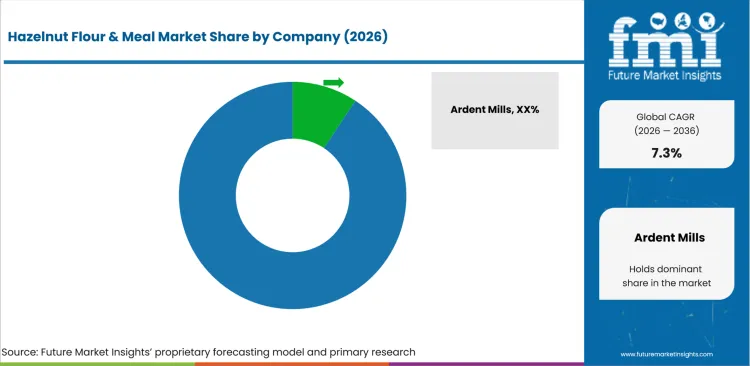
Türkiye concentrates most verified flour and meal capability. Yavuz Gıda and Ahmet Ak Gıda directly document flour or meal scope. SABIRLAR and SEP do the same. Şenocak and Gürsoy also document meal production.
- Direct flour and meal processors include Yavuz Gıda and Ahmet Ak Gıda. SABIRLAR and SEP Gıda share this role. Şenocak Hazelnut Company and Gürsoy also document meal production.
- Broader processed-hazelnut platforms include Arslantürk and Balsu Gıda. Olam Progıda and Karimex Hazelnut Industry complete this group.
Competitive Benchmarking: Hazelnut Flour & Meal Market
| Company | Hazelnut flour - meal specificity | Food-safety qualification | Traceability & claims | Geographic reach |
|---|---|---|---|---|
| Yavuz Gıda | High | High | High | Türkiye, exports |
| Ahmet Ak Gıda | High | Medium | Medium | Türkiye, export markets |
| SABIRLAR | High | High | High | Türkiye, exports |
| SEP Gıda | High | High | High | Türkiye, international B2B |
| Şenocak Hazelnut Company | High | High | High | Türkiye, exports |
| Gürsoy | High | High | Medium | Türkiye, exports |
| Arslantürk | High | High | High | Europe, North America, Asia Pacific, MEA |
| Balsu Gıda | Medium | High | High | Türkiye, global food manufacturers |
| Olam Progıda | Medium | High | Medium | Türkiye, European ingredient customers |
| Karimex Hazelnut Industry | Medium | High | High | Europe, Middle East, North Africa, South Asia |
Scoring basis: High specificity requires direct flour or meal evidence. Medium reflects broader processed-hazelnut participation. High food-safety qualification requires current recognized certification. High traceability requires several audited chain or claim programs.
Key Developments in the Hazelnut Flour & Meal Market
- In March 2026, Ahmet Ak Gıda received BRC Food Safety Issue 9 certification for grinding and packing hazelnut flour. The certificate supports plant approval, though account-specific allergen and sensory checks still apply.
- In July 2025, SEP Gıda completed a four-pillar SMETA audit at its Düzce site. Multinational food companies can use the audit in responsible-sourcing review. It does not establish flour performance on a bakery line.
- In February 2025, Balsu Gıda shares began trading on Borsa İstanbul after its public offering. The listing broadens funding options for storage and processing investment. Crop-price risk remains.
Key Players in the Hazelnut Flour & Meal Market
Direct Flour and Meal Processors
- Yavuz Gıda
- Ahmet Ak Gıda
- SABIRLAR
- SEP Gıda
- Şenocak Hazelnut Company
- Gürsoy
Integrated Hazelnut Processing and Export Platforms
- Arslantürk
- Balsu Gıda
- Olam Progıda
- Karimex Hazelnut Industry
Hazelnut Flour & Meal Market - Report Scope
| Coverage field | Report scope |
|---|---|
| Market breakdown | By grade, form, application, claim, sales channel and region. |
| Quantitative Units | USD million. |
| Market Definition | Revenue from hazelnut flour and meal sold as food ingredients within the listed taxonomy. Finished bakery products, spreads, confectionery, whole hazelnuts and substitute flours are excluded. |
| Regions Covered | North America, Latin America, Western Europe, Eastern Europe, East Asia, South Asia and Pacific, Middle East and Africa. |
| Countries Covered | USA, Germany, France, UK, Saudi Arabia, UAE, Japan, South Korea, and more than twenty-five additional countries in the full report. |
| Key Companies Profiled | Yavuz Gıda, Ahmet Ak Gıda, SABIRLAR, SEP Gıda, Şenocak Hazelnut Company, Gürsoy, Arslantürk, Balsu Gıda, Olam Progıda, and Karimex Hazelnut Industry. |
| Forecast Period | 2026 to 2036. |
| Approach | Primary and secondary research with market triangulation. |
Hazelnut Flour & Meal Market - Research Methodology
| Method | Approach |
|---|---|
| Primary Research | FMI analysts gathered input from manufacturers, service providers, technology developers, distributors, end users, procurement teams, and subject-matter experts. Interviews examined purchasing decisions, product or service evaluation, adoption barriers, approval requirements, pricing considerations, and expectations for technical or commercial support. Respondents were also asked what evidence is required before a trial, pilot, or initial order develops into regular purchasing. |
| Desk Research | Desk research covered government statistics, regulatory publications, trade data, industry associations, technical literature, standards, company filings, product information, and official corporate announcements. Sources were reviewed for relevance, publication date, geographic coverage, and consistency with the defined market scope. Claims relating to performance, applications, approvals, capacity, investment, and commercial activity were retained only when supported by credible public evidence. |
| Market Sizing and Forecasting | The market model combined the baseline value with historical performance, segment structure, pricing and volume indicators, adoption levels, company participation, and country-level demand conditions. Forecast assumptions considered economic activity, investment trends, regulatory developments, technology adoption, purchasing cycles, supply availability, and barriers to wider market use. Segment and regional estimates were reconciled before the final market total was calculated. |
| Data Validation | Estimates were checked against multiple independent indicators, including public data, company activity, trade patterns, industry developments, and findings from primary interviews. Validation also tested whether products, services, applications, and company revenues fell within the defined market boundaries. Adjacent categories, unsupported claims, overlapping revenues, and activities without direct market relevance were excluded to reduce double counting and maintain consistency across segments and countries. |
Hazelnut Flour & Meal Market by Segments
Hazelnut Flour & Meal Market segmented by Grade:
- Standard milling grade
- Fine - patisserie grade
- Organic certified
- Identity-preserved specialty
Hazelnut Flour & Meal Market segmented by Form:
- Powder - dry
- Liquid
- Paste - semi-solid
- Granules - pieces
Hazelnut Flour & Meal Market segmented by Application:
- Bread & rolls
- Cakes & muffins
- Biscuits & cookies
- Viennoiserie & pastry
- Other bakery & snacks
Hazelnut Flour & Meal Market segmented by Claim:
- Conventional
- Clean label
- Organic
- Non-GMO - identity preserved
Hazelnut Flour & Meal Market segmented by Sales Channel:
- Direct to industrial bakeries
- Ingredient distributors
- Foodservice & artisan supply
- Online B2B
Hazelnut Flour & Meal Market by Region:
- North America
- United States
- Canada
- Latin America
- Brazil
- Mexico
- Argentina
- Chile
- Western Europe
- Germany
- France
- United Kingdom
- Italy
- Spain
- Benelux
- Nordics
- Eastern Europe
- Poland
- Czech Republic
- Romania
- Hungary
- East Asia
- China
- Japan
- South Korea
- South Asia and Pacific
- India
- ASEAN
- Australia and New Zealand
- Middle East and Africa
- GCC Countries
- South Africa
- Türkiye
- Israel
Research Sources and Bibliography
- National Institute of Standards and Technology. (2026, July 24). Evaluation of almond and hazelnut reference materials for standardizing allergenic protein detection and quantification
- USDA National Agricultural Statistics Service. (2026, May 1). Noncitrus Fruits and Nuts 2025 Summary
- DQS. (2026, March 25). Certifications issued for Yavuz Gıda San. Ve Tic. A.Ş.
- SGS. (2025, November 11). Food Safety System Certification FSSC 22000, certificate TR25/00000062
- CSI S.p.A.. (2025, July 9). BRCGS Global Standard for Food Safety certificate 3952 for SEP Gıda San. Ve Tic. A.Ş.
- Food Standards Agency, Ipsos UK, & Opinium. (2025, October 7). Allergen Information for Non-Prepacked Foods: Key Findings From Consumers and Food Service Workers
- Business Oregon. (2025). Oregon Hazelnut Industry Receives Local and International Support
- Turkish Statistical Institute. (2025). Crop Production Statistics - 2025
- Dubai Municipality. (2025, February 17). Latest digital food safety services showcased at Gulfood 2025
- Statistisches Bundesamt. (2025, December 23). Advent und Weihnachten - Zahlen, Daten, Fakten
- Ministère de l’Agriculture, de l’Agro-alimentaire et de la Souveraineté alimentaire. (2026, April 13). Filière noisette : une aide de crise exceptionnelle de 3 M€ pour aider les producteurs
- Food Standards Agency. (2025, March 5). Updated industry guidance issued for food allergen information in the out-of-home sector
- Saudi Food and Drug Authority. (2025, September 29). The SFDA and Cultural Houses Host Workshop on Balanced Nutrition and Consumer Rights
- Consumer Affairs Agency, Japan. (2026, April). Food allergy labeling information
- Ministry of Food and Drug Safety, Republic of Korea. (2025, April 21). Partial Amendment to Food Labeling Standards, Notice No. 2025-27
- DQS. (2026, March 18). Certifications issued for Ahmet Ak Gıda Ve Tüketim Mad. San. Ve Paz. Ltd. Şti.
- S.E.P. Gıda Sanayi ve Ticaret A.Ş.. (2025, July 23). Sedex SMETA Corrective Action Plan Report (CAPR) - LRQ
- Public Disclosure Platform. (2025). Balsu Gıda Sanayi ve Ticaret A.Ş. company information
- Şenocak Hazelnut Company. (2026). Our Quality
- Gürsoy. (2026). Facilities
- Arslantürk. (2026). Certificates
- Olam Progıda. (2026). Quality
- ECOCERT. (2025, December 3). USDA organic certification documents for SABIRLAR FINDIK İHRACAT LTD. ŞTİ.
- S.E.P. Gıda Sanayi ve Ticaret A.Ş.. (2025, November 16). Rainforest Alliance Certificate
- Public Disclosure Platform. (2025, March 25). Evaluation Report About the Assumptions Used in Public Offering Price Determination
- Borsa İstanbul. (2025, February 20). Borsa İstanbul’s Opening Bell Rang for Balsu Gıda San. ve Tic. A.Ş.
- Fair for Life. (2025, November 27). SENOCAK GIDA FINDIK ENTEGRE TUR. NAK. INS.SAN. TIC. LTD. STI.
- Public Disclosure Platform. (2026, May 11). 1 Temmuz 2025-31 Mart 2026 ara hesap dönemine ait özet konsolide finansal sonuçlarımıza ilişkin açıklama Hk.
This Report Answers
- What is the hazelnut flour & meal market size in 2026 and 2036?
- Which conditions turn a flour trial into repeat purchasing?
- Why does standard milling grade lead grade demand?
- Why does powder - dry lead form demand?
- How do country growth rates differ?
- Which companies document flour or meal processing?
- How do crop concentration and allergen controls affect qualification?
- What should industrial bakeries verify before approval?
Frequently Asked Questions
How big is the hazelnut flour & meal market in 2026?
The hazelnut flour & meal market is valued at USD 214.1 million in 2026 and is projected to reach USD 433.1 million by 2036. Growth is driven by repeat bakery formulations and controlled inclusion in industrial recipes.
What is the CAGR of the hazelnut flour & meal market from 2026 to 2036?
The hazelnut flour & meal market is projected to grow at a CAGR of 7.3% between 2026 and 2036. Expansion is supported by bakery fit and more consistent technical qualification for repeat orders.
Which grade leads the hazelnut flour & meal market?
The standard milling grade segment is expected to hold 38.0% of the hazelnut flour & meal market in 2026, attributable to broad recipe use and simpler milling requirements. It suits routine bakery formulations that do not need patisserie-grade fineness.
Which form leads the hazelnut flour & meal market?
The powder - dry segment is expected to hold 47.0% of the hazelnut flour & meal market in 2026, driven by compatibility with flour-room weighing and premixing systems. Dry dosing also gives formulators direct control over inclusion rates.
Which companies are active in the hazelnut flour & meal market?
Key companies operating in the hazelnut flour & meal market include Yavuz Gıda, Ahmet Ak Gıda, SABIRLAR, SEP Gıda, Şenocak Hazelnut Company, Gürsoy, Arslantürk, Balsu Gıda, Olam Progıda, and Karimex Hazelnut Industry. They differ in flour scope and export reach.
Preview the report firsthand - request a free sample
Get SampleGet the brochure for pricing and purchase details.
Get PDFTable of Content
- Key Takeaways
- Market Size and CAGR
- Top Growth Driver
- Fastest Growing Segment
- Leading Region
- Key Companies
- Emerging Opportunities
- Executive Summary
- Global Market Outlook
- Demand-side Trends
- Supply-side Trends
- Technology Roadmap Analysis
- Analysis and Recommendations
- Analyst Perspective (What is happening? Why now? What should investors know?)
- Key Questions Answered
- How large is the market?
- What is the CAGR?
- What are key trends?
- Which region dominates?
- Who are the leaders?
- Market Overview
- Market Coverage / Taxonomy
- Market Definition / Scope / Limitations
- Research Methodology
- Chapter Orientation
- Analytical Lens and Working Hypotheses
- Market Structure, Signals, and Trend Drivers
- Benchmarking and Cross-market Comparability
- Market Sizing, Forecasting, and Opportunity Mapping
- Research Design and Evidence Framework
- Desk Research Programme (Secondary Evidence)
- Expert Input and Fieldwork (Primary Evidence)
- Tooling, Models, and Reference Databases
- Data Engineering and Model Build
- Quality Assurance and Audit Trail
- Market Background
- Market Dynamics (Drivers, Restraints, Opportunity, Trends)
- Scenario Forecast (Optimistic, Likely, Conservative)
- Impact Analysis
- AI Impact
- Sustainability Impact
- Regulatory Impact
- Technology Impact
- Consumer / Buyer Analysis
- Purchase Drivers
- Adoption Barriers
- Buyer Journey
- Opportunity Map Analysis
- Product Life Cycle Analysis
- Supply Chain Analysis
- Investment Feasibility Matrix
- Value Chain Analysis
- PESTLE and Porter's Analysis
- Regulatory Landscape
- Regional Parent Market Outlook
- Production and Consumption Statistics
- Import and Export Statistics
- Global Market Analysis and Forecast, 2021 to 2036
- Historical Market Size Value (USD Million) Analysis, 2021 to 2025
- Current and Future Market Size Value (USD Million) Projections, 2026 to 2036
- Y-o-Y Growth Trend Analysis
- Absolute $ Opportunity Analysis
- Global Market Pricing Analysis, 2021 to 2036
- Global Market Analysis and Forecast, By Grade, 2021 to 2036
- Introduction / Key Findings
- Historical Market Size Value (USD Million) Analysis By Grade, 2021 to 2025
- Current and Future Market Size Value (USD Million) Analysis and Forecast By Grade, 2026 to 2036
- Standard milling grade
- Fine / patisserie grade
- Organic certified
- Identity-preserved specialty
- Standard milling grade
- Y-o-Y Growth Trend Analysis By Grade, 2021 to 2025
- Absolute $ Opportunity Analysis By Grade, 2026 to 2036
- Global Market Analysis and Forecast, By Form, 2021 to 2036
- Introduction / Key Findings
- Historical Market Size Value (USD Million) Analysis By Form, 2021 to 2025
- Current and Future Market Size Value (USD Million) Analysis and Forecast By Form, 2026 to 2036
- Powder / dry
- Liquid
- Paste / semi-solid
- Granules / pieces
- Powder / dry
- Y-o-Y Growth Trend Analysis By Form, 2021 to 2025
- Absolute $ Opportunity Analysis By Form, 2026 to 2036
- Global Market Analysis and Forecast, By Application, 2021 to 2036
- Introduction / Key Findings
- Historical Market Size Value (USD Million) Analysis By Application, 2021 to 2025
- Current and Future Market Size Value (USD Million) Analysis and Forecast By Application, 2026 to 2036
- Bread & rolls
- Cakes & muffins
- Biscuits & cookies
- Viennoiserie & pastry
- Other bakery & snacks
- Bread & rolls
- Y-o-Y Growth Trend Analysis By Application, 2021 to 2025
- Absolute $ Opportunity Analysis By Application, 2026 to 2036
- Global Market Analysis and Forecast, By Claim, 2021 to 2036
- Introduction / Key Findings
- Historical Market Size Value (USD Million) Analysis By Claim, 2021 to 2025
- Current and Future Market Size Value (USD Million) Analysis and Forecast By Claim, 2026 to 2036
- Conventional
- Clean label
- Organic
- Non-GMO / identity preserved
- Conventional
- Y-o-Y Growth Trend Analysis By Claim, 2021 to 2025
- Absolute $ Opportunity Analysis By Claim, 2026 to 2036
- Global Market Analysis and Forecast, By Sales Channel, 2021 to 2036
- Introduction / Key Findings
- Historical Market Size Value (USD Million) Analysis By Sales Channel, 2021 to 2025
- Current and Future Market Size Value (USD Million) Analysis and Forecast By Sales Channel, 2026 to 2036
- Direct to industrial bakeries
- Ingredient distributors
- Foodservice & artisan supply
- Online B2B
- Direct to industrial bakeries
- Y-o-Y Growth Trend Analysis By Sales Channel, 2021 to 2025
- Absolute $ Opportunity Analysis By Sales Channel, 2026 to 2036
- Global Market Analysis and Forecast, By Region, 2021 to 2036
- Introduction
- Historical Market Size Value (USD Million) Analysis By Region, 2021 to 2025
- Current Market Size Value (USD Million) Analysis and Forecast By Region, 2026 to 2036
- North America
- Latin America
- Western Europe
- Eastern Europe
- East Asia
- South Asia and Pacific
- Middle East & Africa
- Market Attractiveness Analysis By Region
- North America Market Analysis and Forecast, By Country, 2021 to 2036
- Historical Market Size Value (USD Million) Trend Analysis By Market Taxonomy, 2021 to 2025
- Market Size Value (USD Million) Forecast By Market Taxonomy, 2026 to 2036
- By Country
- USA
- Canada
- By Grade
- By Form
- By Application
- By Claim
- By Sales Channel
- By Country
- Market Attractiveness Analysis
- By Country
- By Grade
- By Form
- By Application
- By Claim
- By Sales Channel
- Key Takeaways
- Latin America Market Analysis and Forecast, By Country
- Historical Market Size Value (USD Million) Trend Analysis By Market Taxonomy, 2021 to 2025
- Market Size Value (USD Million) Forecast By Market Taxonomy, 2026 to 2036
- By Country
- Brazil
- Mexico
- Chile
- Rest of Latin America
- By Grade
- By Form
- By Application
- By Claim
- By Sales Channel
- By Country
- Market Attractiveness Analysis
- By Country
- By Grade
- By Form
- By Application
- By Claim
- By Sales Channel
- Key Takeaways
- Western Europe Market Analysis and Forecast, By Country
- Historical Market Size Value (USD Million) Trend Analysis By Market Taxonomy, 2021 to 2025
- Market Size Value (USD Million) Forecast By Market Taxonomy, 2026 to 2036
- By Country
- Germany
- UK
- Italy
- Spain
- France
- Nordic
- BENELUX
- Rest of Western Europe
- By Grade
- By Form
- By Application
- By Claim
- By Sales Channel
- By Country
- Market Attractiveness Analysis
- By Country
- By Grade
- By Form
- By Application
- By Claim
- By Sales Channel
- Key Takeaways
- Eastern Europe Market Analysis and Forecast, By Country
- Historical Market Size Value (USD Million) Trend Analysis By Market Taxonomy, 2021 to 2025
- Market Size Value (USD Million) Forecast By Market Taxonomy, 2026 to 2036
- By Country
- Russia
- Poland
- Hungary
- Balkan & Baltic
- Rest of Eastern Europe
- By Grade
- By Form
- By Application
- By Claim
- By Sales Channel
- By Country
- Market Attractiveness Analysis
- By Country
- By Grade
- By Form
- By Application
- By Claim
- By Sales Channel
- Key Takeaways
- East Asia Market Analysis and Forecast, By Country
- Historical Market Size Value (USD Million) Trend Analysis By Market Taxonomy, 2021 to 2025
- Market Size Value (USD Million) Forecast By Market Taxonomy, 2026 to 2036
- By Country
- China
- Japan
- South Korea
- By Grade
- By Form
- By Application
- By Claim
- By Sales Channel
- By Country
- Market Attractiveness Analysis
- By Country
- By Grade
- By Form
- By Application
- By Claim
- By Sales Channel
- Key Takeaways
- South Asia and Pacific Market Analysis and Forecast, By Country
- Historical Market Size Value (USD Million) Trend Analysis By Market Taxonomy, 2021 to 2025
- Market Size Value (USD Million) Forecast By Market Taxonomy, 2026 to 2036
- By Country
- India
- ASEAN
- Australia & New Zealand
- Rest of South Asia and Pacific
- By Grade
- By Form
- By Application
- By Claim
- By Sales Channel
- By Country
- Market Attractiveness Analysis
- By Country
- By Grade
- By Form
- By Application
- By Claim
- By Sales Channel
- Key Takeaways
- Middle East & Africa Market Analysis and Forecast, By Country
- Historical Market Size Value (USD Million) Trend Analysis By Market Taxonomy, 2021 to 2025
- Market Size Value (USD Million) Forecast By Market Taxonomy, 2026 to 2036
- By Country
- Kingdom of Saudi Arabia
- Other GCC Countries
- Türkiye
- South Africa
- Other African Union
- Rest of Middle East & Africa
- By Grade
- By Form
- By Application
- By Claim
- By Sales Channel
- By Country
- Market Attractiveness Analysis
- By Country
- By Grade
- By Form
- By Application
- By Claim
- By Sales Channel
- Key Takeaways
- Key Countries Market Analysis
- USA
- Pricing Analysis
- Market Share Analysis, 2025
- By Grade
- By Form
- By Application
- By Claim
- By Sales Channel
- Canada
- Pricing Analysis
- Market Share Analysis, 2025
- By Grade
- By Form
- By Application
- By Claim
- By Sales Channel
- Mexico
- Pricing Analysis
- Market Share Analysis, 2025
- By Grade
- By Form
- By Application
- By Claim
- By Sales Channel
- Brazil
- Pricing Analysis
- Market Share Analysis, 2025
- By Grade
- By Form
- By Application
- By Claim
- By Sales Channel
- Chile
- Pricing Analysis
- Market Share Analysis, 2025
- By Grade
- By Form
- By Application
- By Claim
- By Sales Channel
- Germany
- Pricing Analysis
- Market Share Analysis, 2025
- By Grade
- By Form
- By Application
- By Claim
- By Sales Channel
- UK
- Pricing Analysis
- Market Share Analysis, 2025
- By Grade
- By Form
- By Application
- By Claim
- By Sales Channel
- Italy
- Pricing Analysis
- Market Share Analysis, 2025
- By Grade
- By Form
- By Application
- By Claim
- By Sales Channel
- Spain
- Pricing Analysis
- Market Share Analysis, 2025
- By Grade
- By Form
- By Application
- By Claim
- By Sales Channel
- France
- Pricing Analysis
- Market Share Analysis, 2025
- By Grade
- By Form
- By Application
- By Claim
- By Sales Channel
- India
- Pricing Analysis
- Market Share Analysis, 2025
- By Grade
- By Form
- By Application
- By Claim
- By Sales Channel
- ASEAN
- Pricing Analysis
- Market Share Analysis, 2025
- By Grade
- By Form
- By Application
- By Claim
- By Sales Channel
- Australia & New Zealand
- Pricing Analysis
- Market Share Analysis, 2025
- By Grade
- By Form
- By Application
- By Claim
- By Sales Channel
- China
- Pricing Analysis
- Market Share Analysis, 2025
- By Grade
- By Form
- By Application
- By Claim
- By Sales Channel
- Japan
- Pricing Analysis
- Market Share Analysis, 2025
- By Grade
- By Form
- By Application
- By Claim
- By Sales Channel
- South Korea
- Pricing Analysis
- Market Share Analysis, 2025
- By Grade
- By Form
- By Application
- By Claim
- By Sales Channel
- Russia
- Pricing Analysis
- Market Share Analysis, 2025
- By Grade
- By Form
- By Application
- By Claim
- By Sales Channel
- Poland
- Pricing Analysis
- Market Share Analysis, 2025
- By Grade
- By Form
- By Application
- By Claim
- By Sales Channel
- Hungary
- Pricing Analysis
- Market Share Analysis, 2025
- By Grade
- By Form
- By Application
- By Claim
- By Sales Channel
- Kingdom of Saudi Arabia
- Pricing Analysis
- Market Share Analysis, 2025
- By Grade
- By Form
- By Application
- By Claim
- By Sales Channel
- Türkiye
- Pricing Analysis
- Market Share Analysis, 2025
- By Grade
- By Form
- By Application
- By Claim
- By Sales Channel
- South Africa
- Pricing Analysis
- Market Share Analysis, 2025
- By Grade
- By Form
- By Application
- By Claim
- By Sales Channel
- USA
- Market Structure Analysis
- Competition Dashboard
- Competition Benchmarking
- Market Share Analysis of Top Players
- By Regional
- By Grade
- By Form
- By Application
- By Claim
- By Sales Channel
- Emerging Startups
- Innovation Benchmarking
- Competition Analysis
- Competition Deep Dive
- Ardent Mills
- Overview
- Product Portfolio
- Profitability by Market Segments
- Sales Footprint
- Strategy Overview
- Marketing Strategy
- Product Strategy
- Channel Strategy
- ADM
- Bay State Milling
- Limagrain Ingredients
- GoodMills Group
- King Arthur Baking
- Bob's Red Mill
- Doves Farm
- Manildra Group
- Scoular
- Ardent Mills
- Case Studies
- Success Stories
- Recent Developments
- Competition Deep Dive
- Assumptions & Acronyms Used


