

- Market Size (2026)
- USD 97.5 Mn
- Forecast (2036)
- USD 214.4 Mn
- CAGR (2026 to 2036)
- 8.2%
How big is Hemp Flour Market in 2026?
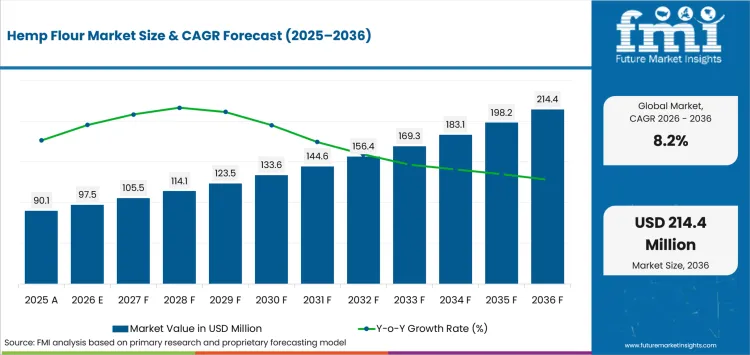
USD 97.5 million in 2026 and USD 214.4 million by 2036 at an 8.2% CAGR.
Demand for hemp flour is projected to expand at 8.2% CAGR between 2026 and 2036, increasing valuation from USD 97.5 million in 2026 to USD 214.4 million by 2036. Repeatable particle size lets mills support wider bakery use. USDA NASS reported 7.26 million pounds of USA grain hemp production for 2025 in April 2026. The larger grain base gives domestic processors more seed material although it does not measure hemp flour sales.
Regulatory treatment can narrow that supply route quickly. EFSA set a safe intake level for combined delta-8 and delta-9 THC at 1 microgram per kilogram of body weight in November 2025. The assessment does not change existing hemp-seed limits. It does reinforce cannabinoid scrutiny for food processors. USA seed-derived food use follows a separate federal pathway. That split makes laboratory evidence part of the commercial offer rather than a back-office check.
Key Takeaways
- Bakery reformulation supports hemp flour where mills hold particle size and bakeries preserve dough handling at the chosen inclusion rate.
- Based on grade, standard milling grade is projected to account for 40.0% in 2026 due to its baseline specification for industrial trials.
- By form, powder - dry is estimated to hold 42.0% in 2026 owing to compatibility with standard flour handling equipment.
- In 2026, the bread & rolls segment is expected to lead application with 29.0% share because partial substitution fits routine bakery production.
- Cannabinoid limits and batch variation can extend qualification because legal release and dough performance must both remain repeatable.
- Some of the key players in this market include Ardent Mills, ADM, Bay State Milling, Limagrain Ingredients, GoodMills Group, King Arthur Baking, Bob's Red Mill, Doves Farm, Manildra Group, and Scoular.
Analyst Perspective
"Hemp flour earns a place in industrial bakery formulas after mills prove lawful seed-derived status and repeatable dough behavior. Unit price matters less than a failed production run caused by changing particle size or cannabinoid records."
- Nandini Roy Choudhury, Principal Consultant, Future Market Insights
How is the hemp flour market segmented?
The hemp flour market is segmented by grade, form, application, claim, sales channel and region.
Grade covers standard milling grade, fine - patisserie grade, organic certified and identity-preserved specialty. Form includes powder - dry, liquid, paste - semi-solid and granules - pieces. Application includes bread & rolls, cakes & muffins, biscuits & cookies, viennoiserie & pastry and other bakery & snacks. Claim covers conventional, clean label, organic and non-GMO - identity preserved. Sales channel includes direct to industrial bakeries, ingredient distributors, foodservice & artisan supply and online B2B.
What makes standard milling grade central to the grade category?
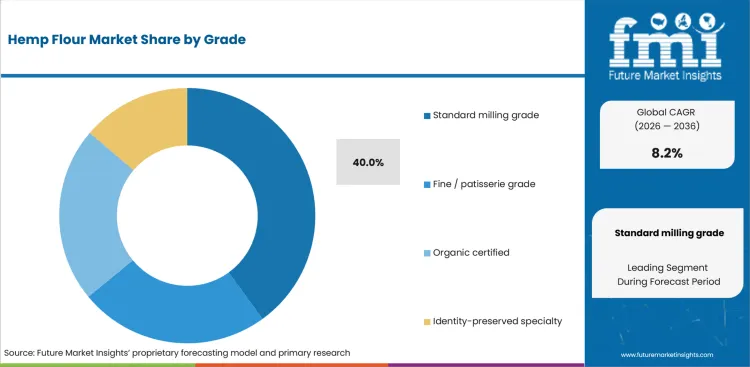
Industrial bakeries use standard milling grade as the first qualification point because moisture and particle size are easier to compare between mills. A fixed baseline reduces trial variables before premium claims are added. Comparable functional flours are also evaluated against process behavior.
- By grade, standard milling grade is forecast to represent 40.0% in 2026 driven by its baseline specification for industrial trials.
- USDA AMS issued a Bakery Flour Mix specification effective December 2025. The document reinforces specification-led purchasing for commercial flour systems.
Why does powder - dry lead the form category?
Powder - dry fits flour storage and metering equipment without introducing cold storage or emulsion stability. Particle size can also be adjusted inside a familiar dry process. Similar flour mixes depend on consistent handling.
- The powder - dry form is likely to capture 42.0% share in 2026 attributable to compatibility with normal flour receiving and batching.
- BfR published a 2025 proficiency test for cannabinoids in hemp flour in September 2026. Nineteen laboratories participated which makes test repeatability a real release issue.
How do bread & rolls anchor the application category?
Bread and rolls give hemp flour a repeat-use base because partial substitution works inside an established staple. Higher inclusion changes hydration and gluten strength. Industrial bakery ingredients are therefore judged on line behavior as well as label value.
- Bread & rolls is set to lead the application category with 29.0% share in 2026 due to frequent production and partial substitution.
- King Arthur Baking launched Buttermilk Biscuit Flour Blend in March 2025. The action shows how a defined flour application can reduce formulation uncertainty.
What supports conventional in the claim category?
Conventional flour reaches more bakery programs because safety and performance can be qualified without organic chain-of-custody work. Premium claims become useful after the flour passes release checks. Clean-label ingredients can raise documentation expectations without changing that sequence.
- Conventional is projected to hold 53.0% share in 2026 owing to broad bakery use without the added organic certification layer.
- DGCCRF reported a 32% anomaly rate in its 2023-2024 organic controls in July 2025, and cereals and flours were among products selected for higher-risk sampling.
What drives direct to industrial bakeries in the sales channel category?
Direct industrial selling shortens the trial loop when a flour must be checked against plant conditions before routine supply. Mills can align particle size and certificates with production tests. Flour improver systems use the same technical-contact logic.
- By sales channel, direct to industrial bakeries is estimated to hold 51.0% in 2026 because joint trials support repeat contracted volumes.
- ADM expanded its Erlanger reformulation site in January 2026 and increased raw-material handling capability by 40%. The site also supports customer formulation work.
What are the drivers, restraints and opportunities in the Hemp Flour Market?
Bakery reformulation raises demand. Cannabinoid controls and dough variability slow qualification. Bakery-ready grades with documented testing provide the clearest commercial opening.
- Driver: Hemp flour can add seed-derived protein and fiber to familiar bakery products without requiring a new product format.
- Restraint: Legal cannabinoid limits and variable dough behavior can lengthen trials or prevent sale in a destination market.
- Opportunity: Mills can sell bakery-ready grades with controlled particle size and destination-specific analytical records.
Bakery reformulation is the growth driver because hemp flour can enter products that already have stable eating occasions. Plant-based protein gives the nutrition claim a familiar commercial frame. USDA NASS reported 7,515 acres harvested for grain hemp in 2025. More grain availability gives mills a wider input base for repeat bakery programs.
Legal release is the binding restraint limiting the market growth. Japan sets a 10 mg/kg residual delta-9-THC limit for oils and powders under rules implemented in 2025. Standardized bakery mixes do not carry that cannabinoid gate. Hemp flour also changes dough behavior as inclusion rises. A batch can therefore pass legal testing and fail the bakery trial.
The opportunity lies in bakery-ready specifications that reduce work between sample approval and routine production. Mills can pair particle-size limits with destination-specific cannabinoid records. Plant-based ingredients already compete on specification and application fit. USDA NASS reported 2.03 million pounds of hemp seed production in 2025. That seed base gives processors more material to convert into controlled food-grade flour.
Which country CAGRs are profiled in the Hemp Flour Market?
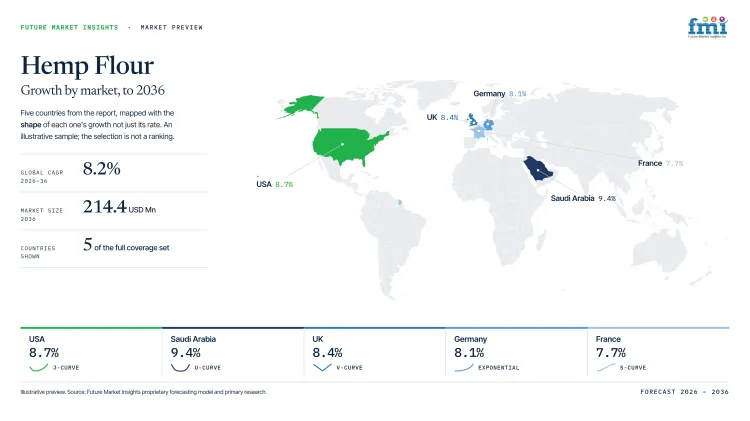
| Country | CAGR |
|---|---|
| UAE | 9.7% |
| Saudi Arabia | 9.4% |
| South Korea | 9.0% |
| USA | 8.7% |
| UK | 8.4% |
| Germany | 8.1% |
| France | 7.7% |
| Japan | 7.4% |
How do country-level CAGRs compare in the Hemp Flour Market?
Forecast rates split into three groups. UAE and Saudi Arabia form the upper tier above 9.0%, South Korea and USA follow near the global pace. UK and Germany form the middle band. The 2.3-point spread means access conditions matter more than headline CAGR alone.
- The UAE begins from a smaller addressable base for specialized hemp flour.
- Saudi Arabia outpaces mature European flour markets as plant-based food interest grows.
- South Korea has a developed plant-protein channel for new hemp-based flour products.
- The USA trades faster percentage growth for scale in hemp flour distribution.
- UK demand tracks close to the global rate across established flour channels.
- Germany follows a mature industrial bakery base with established ingredient sourcing.
- France posts slower expansion through established food and bakery channels.
- Japan records the lowest growth rate among the countries compared here.
Comparable CAGRs can still produce different revenue pools because starting scale and legal access differ. The full report covers North America, Latin America, Western Europe, Eastern Europe, East Asia, South Asia and Pacific, and Middle East and Africa.
Country-wise Analysis
- USA millers can source from a measured domestic grain-hemp base and sell seed-derived ingredients under an established federal food pathway. The USA also has a mature specialty-flour channel that gives hemp flour a familiar bakery route. Hemp flour demand in USA is forecast to rise at 8.7% CAGR over the forecast period, supported by domestic grain availability. USDA NASS reported 3.41 million pounds of grain hemp production for 2024 in April 2025. The figure measures raw grain and does not measure flour sales. Lot-to-lot variation can delay ingredient qualification across repeated commercial bakery trials. Mills with seed traceability and stable particle size can shorten plant trials.
- German food companies can use domestic hemp cultivation and a laboratory system that treats hemp flour as a defined testing matrix. The German hemp flour sector is projected to record 8.1% CAGR during the assessment period, supported by local milling and analytical capacity. Destatis recorded 1,700 hectares of organic hemp for 2025. The acreage provides an upstream base without proving food-grade flour output. Local laboratory testing supports cannabinoid verification closer to the importing bakery customer. Harvest contamination and batch variation can delay commercial release of imported hemp flour. Mills with controlled cleaning and stable particle specifications can compete on release reliability. Nearby laboratory capacity also supports release work for local bakery trials.
- French specialty-food channels give hemp seed ingredients a credible route into premium bakery products. Hemp flour demand in France is forecast to rise at 7.7% CAGR over the forecast period, attributable to specialty-food distribution and controlled claims. DGCCRF reported a 32% anomaly rate in its 2023-2024 organic controls in July 2025. Cereals and flours were among products selected for higher-risk sampling. Clean-label flour programs can widen the addressable range when origin records are complete. Seed-level traceability remains the main local friction for compliant commercial supply. Mills need batch specifications that separate seed-derived flour from cannabinoid extract categories before scaling distribution. Complete origin records also support documented regional distribution agreements with larger ingredient buyers.
- UK hemp cultivation operates under a licensing system that gives seed supply a longer planning horizon than annual permit renewal. Hemp flour sales in the UK are forecast to expand at 8.4% CAGR by 2036, driven by longer licence periods for lawful seed cultivation. Home Office guidance updated in December 2025 states that licences from the 2026 season generally cover six growing seasons. Flowers and leaves fall outside the industrial hemp licence used for lawful food supply. Food mills therefore need seed-only traceability throughout processing, storage, and final shipment. The commercial edge comes from pairing lawful domestic seed with a bakery specification that holds reliably between production lots.
- Saudi food importers use a formal clearance system before unfamiliar specialty ingredients reach bakery customers. Hemp flour sales in Saudi Arabia are forecast to expand at 9.4% CAGR by 2036, supported by formal import controls. SFDA food-clearance requirements published in 2025 require imported foods to be registered and cleared through authority systems. Licensed storage and complete import records support that route across commercial volumes. Hemp-specific eligibility is the friction because general food clearance does not itself authorize hemp flour. Exporters should resolve product classification before shipping commercial samples to local distributors. That sequence reduces the risk of commercial interest forming ahead of lawful release.
- Federal law currently blocks a normal food route for industrial hemp products even though the UAE carries the highest forecast rate in the profiled set. UAE's hemp flour outlook is anticipated to advance at 9.7% CAGR over the assessment period, subject to a lawful food route emerging. Decree-Law No. 24 of 2025 was announced in December 2025 and prohibits industrial hemp products related to food and dietary supplements. The restriction blocks current food-market execution for conventional hemp-flour import programs. A written change in product status is the main enabler. Companies should not commit food inventory until the intended flour is expressly confirmed as lawful for sale.
- Japan's revised cannabis-control regime gives industrial hemp operators a clearer legal basis than the previous framework. Hemp flour demand in Japan is projected to rise at 7.4% CAGR over the forecast period, supported by clearer industrial-hemp rules. The Ministry of Agriculture states that the amended law took effect in December 2024 and March 2025. Imported food powders still need compliant cannabinoid records before commercial market release. Testing can therefore delay release even when seed sourcing is lawful. Mills with stable cleaning and validated certificates have a clearer path to repeat orders as domestic industrial hemp activity develops. Validated analytical certificates reduce rework and repeated testing during distributor qualification.
- South Korean importers face a tighter documentary route for hemp seed foods than for ordinary cereal flour. Hemp flour sales in South Korea are forecast to expand at 9.0% CAGR by 2036, driven by defined import documentation. An MFDS interpretation dated August 6, 2025 requires official THC and CBD compliance evidence for relevant hemp seed products. It also requires documented proof of complete dehulling wherever that requirement applies. A familiar plant-protein channel supports product positioning with established health-food retailers. Shipment-specific analytical evidence can slow release of individual commercial consignments materially. Exporters with repeatable dehulling records and batch certificates are better placed to support distributor reorders. Consistent batch files shorten regulatory review for repeat commercial shipments across approved channels.
Who are the notable companies in the Hemp Flour Market?
Ardent Mills, ADM, Bay State Milling, Limagrain Ingredients, GoodMills Group, King Arthur Baking, Bob's Red Mill, Doves Farm, Manildra Group, and Scoular are the notable companies serving this market.
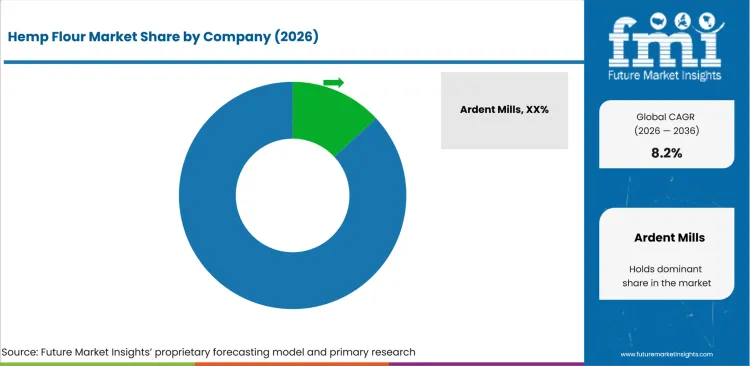
Competition is fragmented because grain sourcing and bakery application support are handled by different business models. Food-grade seed control and repeatable flour specifications set the main entry barriers.
- Ardent Mills, ADM and Scoular bring grain sourcing or specialty ingredient networks.
- Bay State Milling and Limagrain Ingredients join GoodMills Group and Manildra Group on industrial milling or ingredient platforms.
- King Arthur Baking, Bob's Red Mill and Doves Farm provide adjacent specialty flour and bakery channels.
Competitive Benchmarking: Hemp Flour Market
| Company | Seed & Alternative-Flour Access | Bakery Formulation Support | Traceability & Claim Readiness | Geographic Reach |
|---|---|---|---|---|
| Ardent Mills | High | High | High | North America with specialty grain sourcing |
| ADM | High | High | High | Global ingredient sourcing and customer support |
| Bay State Milling | Medium | High | High | United States and Canada |
| Limagrain Ingredients | High | High | High | Europe with international ingredient sales |
| GoodMills Group | High | High | Medium | Central and Eastern Europe |
| King Arthur Baking | Low | High | High | United States retail and professional baking |
| Bob's Red Mill | Medium | Medium | High | United States retail with international distribution |
| Doves Farm | Low | Medium | High | United Kingdom specialty flour channels |
| Manildra Group | High | High | Medium | Australia with North American and Asian reach |
| Scoular | High | Medium | High | Global grain and ingredient network |
Scoring basis: High seed access requires controlled grain or seed processing with broad sourcing reach. Medium reflects direct milling or ingredient access at narrower scale. Low applies to companies whose documented role is downstream baking without seed handling. High formulation support requires documented customer development resources. Medium reflects documented application guidance. Low applies where activity is mainly retail flour supply. High traceability requires identity-preserved or certified programs. Medium reflects standard quality systems. Low applies where traceability is not a core part of the documented offer.
Key Developments in the Hemp Flour Market
- In August 2026, Scoular announced a soybean dehuller for its Covington food-grade facility. The project expands identity-preserved seed processing for food and beverage customers.
- In October 2025, Limagrain announced a textured plant-protein line and an expanded wheat mill in Auvergne. The work increases cereal and nutrition ingredient processing capacity.
- In August 2026, Bob's Red Mill introduced a perfected Gluten Free 1-to-1 Baking Flour formula with improved taste and texture. The update targeted a high-use specialty flour format.
Key Players in the Hemp Flour Market
Seed and Specialty Ingredient Platforms
- ADM
- Ardent Mills
- Scoular
Industrial Milling and Bakery Formulation Specialists
- Bay State Milling
- Limagrain Ingredients
- GoodMills Group
- Manildra Group
Retail and Artisan Baking Gateways
- King Arthur Baking
- Bob's Red Mill
- Doves Farm
Hemp Flour Market - Report Scope
| Coverage field | Report scope |
|---|---|
| Market breakdown | By grade, form, application, claim, sales channel and region. |
| Quantitative Units | USD million. |
| Market Definition | Food-grade hemp flour produced from milled hemp seed or defatted hemp seed material. The scope includes flour preparations where hemp flour remains the named primary functional ingredient. Whole seeds, standalone hemp seed oil, cannabinoid extracts, animal feed and non-food industrial hemp are excluded. |
| Regions Covered | North America, Latin America, Western Europe, Eastern Europe, East Asia, South Asia and Pacific, and Middle East and Africa. |
| Countries Covered | USA, Germany, France, UK, Saudi Arabia, UAE, Japan, South Korea, and more than twenty-two additional countries in the full report. |
| Key Companies Profiled | Ardent Mills, ADM, Bay State Milling, Limagrain Ingredients, GoodMills Group, King Arthur Baking, Bob's Red Mill, Doves Farm, Manildra Group, Scoular. |
| Forecast Period | 2026 to 2036. |
| Approach | Primary and secondary research with market triangulation. |
Hemp Flour Market - Research Methodology
| Method | Approach |
|---|---|
| Primary Research | FMI analysts gathered input from manufacturers, service providers, technology developers, distributors, end users, procurement teams, and subject-matter experts. Interviews examined purchasing decisions, product or service evaluation, adoption barriers, approval requirements, pricing considerations, and expectations for technical or commercial support. Respondents were also asked what evidence is required before a trial, pilot, or initial order develops into regular purchasing. |
| Desk Research | Desk research covered government statistics, regulatory publications, trade data, industry associations, technical literature, standards, company filings, product information, and official corporate announcements. Sources were reviewed for relevance, publication date, geographic coverage, and consistency with the defined market scope. Claims relating to performance, applications, approvals, capacity, investment, and commercial activity were retained only when supported by credible public evidence. |
| Market Sizing and Forecasting | The market model combined the baseline value with historical performance, segment structure, pricing and volume indicators, adoption levels, company participation, and country-level demand conditions. Forecast assumptions considered economic activity, investment trends, regulatory developments, technology adoption, purchasing cycles, supply availability, and barriers to wider market use. Segment and regional estimates were reconciled before the final market total was calculated. |
| Data Validation | Estimates were checked against multiple independent indicators, including public data, company activity, trade patterns, industry developments, and findings from primary interviews. Validation also tested whether products, services, applications, and company revenues fell within the defined market boundaries. Adjacent categories, unsupported claims, overlapping revenues, and activities without direct market relevance were excluded to reduce double counting and maintain consistency across segments and countries. |
Hemp Flour Market by Segments
Hemp Flour Market segmented by Grade:
- Standard milling grade
- Fine - patisserie grade
- Organic certified
- Identity-preserved specialty
Hemp Flour Market segmented by Form:
- Powder - dry
- Liquid
- Paste - semi-solid
- Granules - pieces
Hemp Flour Market segmented by Application:
- Bread & rolls
- Cakes & muffins
- Biscuits & cookies
- Viennoiserie & pastry
- Other bakery & snacks
Hemp Flour Market segmented by Claim:
- Conventional
- Clean label
- Organic
- Non-GMO - identity preserved
Hemp Flour Market segmented by Sales Channel:
- Direct to industrial bakeries
- Ingredient distributors
- Foodservice & artisan supply
- Online B2B
Hemp Flour Market by Region:
- North America
- United States
- Canada
- Latin America
- Brazil
- Mexico
- Argentina
- Chile
- Western Europe
- Germany
- France
- United Kingdom
- Italy
- Spain
- Benelux
- Nordics
- Rest of Western Europe
- Eastern Europe
- Poland
- Czech Republic
- Romania
- Hungary
- Rest of Eastern Europe
- East Asia
- China
- Japan
- South Korea
- South Asia and Pacific
- India
- ASEAN
- Australia and New Zealand
- Rest of South Asia and Pacific
- Middle East and Africa
- Kingdom of Saudi Arabia
- Other GCC Countries
- Türkiye
- South Africa
- Israel
- Rest of Middle East and Africa
Research Sources and Bibliography
- USA Department of Agriculture, National Agricultural Statistics Service. (2026, April 16). National Hemp Report.
- USA Department of Agriculture, National Agricultural Statistics Service. (2025, April 17). National Hemp Report.
- USA Department of Agriculture, Agricultural Marketing Service. (2025, December). Bakery Flour Mix for Use in Domestic Programs.
- German Federal Institute for Risk Assessment. (2026, September 3). Determination of cannabinoids in hemp flour, hemp oil cake, hemp tea, and hemp seed pesto.
- Federal Statistical Office of Germany. (2025, December 5). Organic farming in Germany: Arable land and permanent grassland.
- Direction générale de la concurrence, de la consommation et de la répression des fraudes. (2025, July 7). Le label sans la preuve : fraudes et manquements dans le marché du bio.
- UK Home Office. (2025, December 17). Industrial hemp licensing.
- Saudi Food and Drug Authority. (2025). Mandatory General Requirements for Food Clearance.
- United Arab Emirates Government. (2025, December 18). UAE Government Issues a Federal Decree-Law Regulating Industrial and Medical Uses of Industrial Hemp.
- Ministry of Health, Labour and Welfare, Japan. (2025, March 1). Implementation of amendments to the Cannabis Control Act and Narcotics and Psychotropics Control Act.
- Ministry of Food and Drug Safety, Republic of Korea. (2025, August 6). Required documents for import of hemp seed products.
- Ardent Mills. (2025, July 31). Ardent Mills Enters Agreement to Acquire Stone Mill in North Dakota, Expanding Emerging Nutrition Portfolio.
- ADM. (2026, January 15). ADM’s $26M Investment in Erlanger Facility Strengthens Capabilities for Growing Reformulation Demand.
- King Arthur Baking. (2025, March 5). King Arthur Baking Company Expands Flour Line with the Launch of Buttermilk Biscuit Flour Blend.
- GoodMills Group. (2025, June 20). GoodMills Group Expands Operations in Poland, Reinforcing European Market Leadership.
- Limagrain. (2025, October 6). Limagrain investit 27 millions d’euros pour renforcer ses capacités industrielles en Auvergne.
- Scoular. (2026, August 3). Growing demand drives Scoular soybean dehuller expansion in Ohio.
- Manildra Group. (2025, July 9). Towards Net Zero with Heat Recovery.
- Bay State Milling. (n.d.). Who We Are.
- Bob's Red Mill Natural Foods. (2026, August 19). Bob's Red Mill Introduces Perfected Formula for Gluten Free 1-to-1 Baking Flour with Improved Taste and Texture.
- Doves Farm. (n.d.). Our Story.
- King Arthur Baking. (2026, April 21). King Arthur Baking Taps Celebrations, Gluten-Free Demand, and Everyday Ease with Five New Mixes This Spring.
- Ministry of Agriculture, Forestry and Fisheries, Japan. (2026). Other regional specialty crops: Industrial hemp cultivation information.
- European Food Safety Authority. (2025, November 18). Delta-8 THC: EFSA sets safe intake level.
- ADM. (2025, October 9). ADM Continues to Support Customer Needs and Supply Chain Resilience with Expansion of Electric Truck Fleet for UK Flour Deliveries.
- ADM. (2025, October 14). ADM Advances Quality Capabilities with opening of New Central Lab-Milling.
This bibliography supports the retained public claims and is not exhaustive. The full report contains the complete reference list and detailed source notes.
This Report Answers
- How large is the hemp flour market in 2026 and 2036?
- What makes bakery reformulation a repeat-use route?
- Why does standard milling grade hold 40.0% in 2026?
- Why does powder - dry hold 42.0% in 2026?
- Why do bread & rolls hold 29.0% in 2026?
- Why do the eight country CAGRs differ?
- Which companies cover sourcing, milling and bakery support?
- How do cannabinoid limits change qualification?
- Where can mills earn value beyond unit price?
Frequently Asked Questions
How big is the hemp flour market in 2026?
The hemp flour market is valued at USD 97.5 million in 2026 and is projected to reach USD 214.4 million by 2036. Bakery reformulation provides the principal demand route.
What is the CAGR of the hemp flour market from 2026 to 2036?
The hemp flour market is projected to grow at a CAGR of 8.2% between 2026 and 2036. Expansion depends on repeatable milling and lawful seed-derived food use.
Which grade leads the hemp flour market?
The standard milling grade segment is expected to hold 40.0% of the hemp flour market in 2026, attributable to its baseline specification for bakery trials. Mills use that specification to compare moisture and particle size during qualification.
Which form leads the hemp flour market?
The powder - dry segment is estimated to hold 42.0% of the hemp flour market in 2026. The format fits normal flour storage and dosing equipment in bakery plants.
Which application leads the hemp flour market?
The bread & rolls segment is anticipated to hold 29.0% of the hemp flour market in 2026. Partial substitution gives bakers a repeat-use route in familiar products.
Which countries are projected to record the highest growth in the hemp flour market?
UAE is projected to grow at 9.7% CAGR followed by Saudi Arabia at 9.4% and South Korea at 9.0% through 2036. Actual access still depends on local food rules.
Which companies are active in the hemp flour market?
Key companies operating in the market include Ardent Mills, ADM, Bay State Milling, Limagrain Ingredients, GoodMills Group, King Arthur Baking, Bob's Red Mill, Doves Farm, Manildra Group, and Scoular. These companies compete through grain sourcing and milling scale plus bakery application support.
Preview the report firsthand - request a free sample
Get SampleGet the brochure for pricing and purchase details.
Get PDFTable of Content
- Key Takeaways
- Market Size and CAGR
- Top Growth Driver
- Fastest Growing Segment
- Leading Region
- Key Companies
- Emerging Opportunities
- Executive Summary
- Global Market Outlook
- Demand-side Trends
- Supply-side Trends
- Technology Roadmap Analysis
- Analysis and Recommendations
- Analyst Perspective (What is happening? Why now? What should investors know?)
- Key Questions Answered
- How large is the market?
- What is the CAGR?
- What are key trends?
- Which region dominates?
- Who are the leaders?
- Market Overview
- Market Coverage / Taxonomy
- Market Definition / Scope / Limitations
- Research Methodology
- Chapter Orientation
- Analytical Lens and Working Hypotheses
- Market Structure, Signals, and Trend Drivers
- Benchmarking and Cross-market Comparability
- Market Sizing, Forecasting, and Opportunity Mapping
- Research Design and Evidence Framework
- Desk Research Programme (Secondary Evidence)
- Expert Input and Fieldwork (Primary Evidence)
- Tooling, Models, and Reference Databases
- Data Engineering and Model Build
- Quality Assurance and Audit Trail
- Market Background
- Market Dynamics (Drivers, Restraints, Opportunity, Trends)
- Scenario Forecast (Optimistic, Likely, Conservative)
- Impact Analysis
- AI Impact
- Sustainability Impact
- Regulatory Impact
- Technology Impact
- Consumer / Buyer Analysis
- Purchase Drivers
- Adoption Barriers
- Buyer Journey
- Opportunity Map Analysis
- Product Life Cycle Analysis
- Supply Chain Analysis
- Investment Feasibility Matrix
- Value Chain Analysis
- PESTLE and Porter's Analysis
- Regulatory Landscape
- Regional Parent Market Outlook
- Production and Consumption Statistics
- Import and Export Statistics
- Global Market Analysis and Forecast, 2021 to 2036
- Historical Market Size Value (USD Million) Analysis, 2021 to 2025
- Current and Future Market Size Value (USD Million) Projections, 2026 to 2036
- Y-o-Y Growth Trend Analysis
- Absolute $ Opportunity Analysis
- Global Market Pricing Analysis, 2021 to 2036
- Global Market Analysis and Forecast, By Grade, 2021 to 2036
- Introduction / Key Findings
- Historical Market Size Value (USD Million) Analysis By Grade, 2021 to 2025
- Current and Future Market Size Value (USD Million) Analysis and Forecast By Grade, 2026 to 2036
- Standard milling grade
- Fine / patisserie grade
- Organic certified
- Identity-preserved specialty
- Standard milling grade
- Y-o-Y Growth Trend Analysis By Grade, 2021 to 2025
- Absolute $ Opportunity Analysis By Grade, 2026 to 2036
- Global Market Analysis and Forecast, By Form, 2021 to 2036
- Introduction / Key Findings
- Historical Market Size Value (USD Million) Analysis By Form, 2021 to 2025
- Current and Future Market Size Value (USD Million) Analysis and Forecast By Form, 2026 to 2036
- Powder / dry
- Liquid
- Paste / semi-solid
- Granules / pieces
- Powder / dry
- Y-o-Y Growth Trend Analysis By Form, 2021 to 2025
- Absolute $ Opportunity Analysis By Form, 2026 to 2036
- Global Market Analysis and Forecast, By Application, 2021 to 2036
- Introduction / Key Findings
- Historical Market Size Value (USD Million) Analysis By Application, 2021 to 2025
- Current and Future Market Size Value (USD Million) Analysis and Forecast By Application, 2026 to 2036
- Bread & rolls
- Cakes & muffins
- Biscuits & cookies
- Viennoiserie & pastry
- Other bakery & snacks
- Bread & rolls
- Y-o-Y Growth Trend Analysis By Application, 2021 to 2025
- Absolute $ Opportunity Analysis By Application, 2026 to 2036
- Global Market Analysis and Forecast, By Claim, 2021 to 2036
- Introduction / Key Findings
- Historical Market Size Value (USD Million) Analysis By Claim, 2021 to 2025
- Current and Future Market Size Value (USD Million) Analysis and Forecast By Claim, 2026 to 2036
- Conventional
- Clean label
- Organic
- Non-GMO / identity preserved
- Conventional
- Y-o-Y Growth Trend Analysis By Claim, 2021 to 2025
- Absolute $ Opportunity Analysis By Claim, 2026 to 2036
- Global Market Analysis and Forecast, By Sales Channel, 2021 to 2036
- Introduction / Key Findings
- Historical Market Size Value (USD Million) Analysis By Sales Channel, 2021 to 2025
- Current and Future Market Size Value (USD Million) Analysis and Forecast By Sales Channel, 2026 to 2036
- Direct to industrial bakeries
- Ingredient distributors
- Foodservice & artisan supply
- Online B2B
- Direct to industrial bakeries
- Y-o-Y Growth Trend Analysis By Sales Channel, 2021 to 2025
- Absolute $ Opportunity Analysis By Sales Channel, 2026 to 2036
- Global Market Analysis and Forecast, By Region, 2021 to 2036
- Introduction
- Historical Market Size Value (USD Million) Analysis By Region, 2021 to 2025
- Current Market Size Value (USD Million) Analysis and Forecast By Region, 2026 to 2036
- North America
- Latin America
- Western Europe
- Eastern Europe
- East Asia
- South Asia and Pacific
- Middle East & Africa
- Market Attractiveness Analysis By Region
- North America Market Analysis and Forecast, By Country, 2021 to 2036
- Historical Market Size Value (USD Million) Trend Analysis By Market Taxonomy, 2021 to 2025
- Market Size Value (USD Million) Forecast By Market Taxonomy, 2026 to 2036
- By Country
- USA
- Canada
- By Grade
- By Form
- By Application
- By Claim
- By Sales Channel
- By Country
- Market Attractiveness Analysis
- By Country
- By Grade
- By Form
- By Application
- By Claim
- By Sales Channel
- Key Takeaways
- Latin America Market Analysis and Forecast, By Country
- Historical Market Size Value (USD Million) Trend Analysis By Market Taxonomy, 2021 to 2025
- Market Size Value (USD Million) Forecast By Market Taxonomy, 2026 to 2036
- By Country
- Brazil
- Mexico
- Chile
- Rest of Latin America
- By Grade
- By Form
- By Application
- By Claim
- By Sales Channel
- By Country
- Market Attractiveness Analysis
- By Country
- By Grade
- By Form
- By Application
- By Claim
- By Sales Channel
- Key Takeaways
- Western Europe Market Analysis and Forecast, By Country
- Historical Market Size Value (USD Million) Trend Analysis By Market Taxonomy, 2021 to 2025
- Market Size Value (USD Million) Forecast By Market Taxonomy, 2026 to 2036
- By Country
- Germany
- UK
- Italy
- Spain
- France
- Nordic
- BENELUX
- Rest of Western Europe
- By Grade
- By Form
- By Application
- By Claim
- By Sales Channel
- By Country
- Market Attractiveness Analysis
- By Country
- By Grade
- By Form
- By Application
- By Claim
- By Sales Channel
- Key Takeaways
- Eastern Europe Market Analysis and Forecast, By Country
- Historical Market Size Value (USD Million) Trend Analysis By Market Taxonomy, 2021 to 2025
- Market Size Value (USD Million) Forecast By Market Taxonomy, 2026 to 2036
- By Country
- Russia
- Poland
- Hungary
- Balkan & Baltic
- Rest of Eastern Europe
- By Grade
- By Form
- By Application
- By Claim
- By Sales Channel
- By Country
- Market Attractiveness Analysis
- By Country
- By Grade
- By Form
- By Application
- By Claim
- By Sales Channel
- Key Takeaways
- East Asia Market Analysis and Forecast, By Country
- Historical Market Size Value (USD Million) Trend Analysis By Market Taxonomy, 2021 to 2025
- Market Size Value (USD Million) Forecast By Market Taxonomy, 2026 to 2036
- By Country
- China
- Japan
- South Korea
- By Grade
- By Form
- By Application
- By Claim
- By Sales Channel
- By Country
- Market Attractiveness Analysis
- By Country
- By Grade
- By Form
- By Application
- By Claim
- By Sales Channel
- Key Takeaways
- South Asia and Pacific Market Analysis and Forecast, By Country
- Historical Market Size Value (USD Million) Trend Analysis By Market Taxonomy, 2021 to 2025
- Market Size Value (USD Million) Forecast By Market Taxonomy, 2026 to 2036
- By Country
- India
- ASEAN
- Australia & New Zealand
- Rest of South Asia and Pacific
- By Grade
- By Form
- By Application
- By Claim
- By Sales Channel
- By Country
- Market Attractiveness Analysis
- By Country
- By Grade
- By Form
- By Application
- By Claim
- By Sales Channel
- Key Takeaways
- Middle East & Africa Market Analysis and Forecast, By Country
- Historical Market Size Value (USD Million) Trend Analysis By Market Taxonomy, 2021 to 2025
- Market Size Value (USD Million) Forecast By Market Taxonomy, 2026 to 2036
- By Country
- Kingdom of Saudi Arabia
- Other GCC Countries
- Türkiye
- South Africa
- Other African Union
- Rest of Middle East & Africa
- By Grade
- By Form
- By Application
- By Claim
- By Sales Channel
- By Country
- Market Attractiveness Analysis
- By Country
- By Grade
- By Form
- By Application
- By Claim
- By Sales Channel
- Key Takeaways
- Key Countries Market Analysis
- USA
- Pricing Analysis
- Market Share Analysis, 2025
- By Grade
- By Form
- By Application
- By Claim
- By Sales Channel
- Canada
- Pricing Analysis
- Market Share Analysis, 2025
- By Grade
- By Form
- By Application
- By Claim
- By Sales Channel
- Mexico
- Pricing Analysis
- Market Share Analysis, 2025
- By Grade
- By Form
- By Application
- By Claim
- By Sales Channel
- Brazil
- Pricing Analysis
- Market Share Analysis, 2025
- By Grade
- By Form
- By Application
- By Claim
- By Sales Channel
- Chile
- Pricing Analysis
- Market Share Analysis, 2025
- By Grade
- By Form
- By Application
- By Claim
- By Sales Channel
- Germany
- Pricing Analysis
- Market Share Analysis, 2025
- By Grade
- By Form
- By Application
- By Claim
- By Sales Channel
- UK
- Pricing Analysis
- Market Share Analysis, 2025
- By Grade
- By Form
- By Application
- By Claim
- By Sales Channel
- Italy
- Pricing Analysis
- Market Share Analysis, 2025
- By Grade
- By Form
- By Application
- By Claim
- By Sales Channel
- Spain
- Pricing Analysis
- Market Share Analysis, 2025
- By Grade
- By Form
- By Application
- By Claim
- By Sales Channel
- France
- Pricing Analysis
- Market Share Analysis, 2025
- By Grade
- By Form
- By Application
- By Claim
- By Sales Channel
- India
- Pricing Analysis
- Market Share Analysis, 2025
- By Grade
- By Form
- By Application
- By Claim
- By Sales Channel
- ASEAN
- Pricing Analysis
- Market Share Analysis, 2025
- By Grade
- By Form
- By Application
- By Claim
- By Sales Channel
- Australia & New Zealand
- Pricing Analysis
- Market Share Analysis, 2025
- By Grade
- By Form
- By Application
- By Claim
- By Sales Channel
- China
- Pricing Analysis
- Market Share Analysis, 2025
- By Grade
- By Form
- By Application
- By Claim
- By Sales Channel
- Japan
- Pricing Analysis
- Market Share Analysis, 2025
- By Grade
- By Form
- By Application
- By Claim
- By Sales Channel
- South Korea
- Pricing Analysis
- Market Share Analysis, 2025
- By Grade
- By Form
- By Application
- By Claim
- By Sales Channel
- Russia
- Pricing Analysis
- Market Share Analysis, 2025
- By Grade
- By Form
- By Application
- By Claim
- By Sales Channel
- Poland
- Pricing Analysis
- Market Share Analysis, 2025
- By Grade
- By Form
- By Application
- By Claim
- By Sales Channel
- Hungary
- Pricing Analysis
- Market Share Analysis, 2025
- By Grade
- By Form
- By Application
- By Claim
- By Sales Channel
- Kingdom of Saudi Arabia
- Pricing Analysis
- Market Share Analysis, 2025
- By Grade
- By Form
- By Application
- By Claim
- By Sales Channel
- Türkiye
- Pricing Analysis
- Market Share Analysis, 2025
- By Grade
- By Form
- By Application
- By Claim
- By Sales Channel
- South Africa
- Pricing Analysis
- Market Share Analysis, 2025
- By Grade
- By Form
- By Application
- By Claim
- By Sales Channel
- USA
- Market Structure Analysis
- Competition Dashboard
- Competition Benchmarking
- Market Share Analysis of Top Players
- By Regional
- By Grade
- By Form
- By Application
- By Claim
- By Sales Channel
- Emerging Startups
- Innovation Benchmarking
- Competition Analysis
- Competition Deep Dive
- Ardent Mills
- Overview
- Product Portfolio
- Profitability by Market Segments
- Sales Footprint
- Strategy Overview
- Marketing Strategy
- Product Strategy
- Channel Strategy
- ADM
- Bay State Milling
- Limagrain Ingredients
- GoodMills Group
- King Arthur Baking
- Bob's Red Mill
- Doves Farm
- Manildra Group
- Scoular
- Ardent Mills
- Case Studies
- Success Stories
- Recent Developments
- Competition Deep Dive
- Assumptions & Acronyms Used


