

- Market Size (2026)
- USD 1.4 Bn
- Forecast (2036)
- USD 4.6 Bn
- CAGR (2026 to 2036)
- 12.4%
How big is Frozen Samosas Market in 2026?
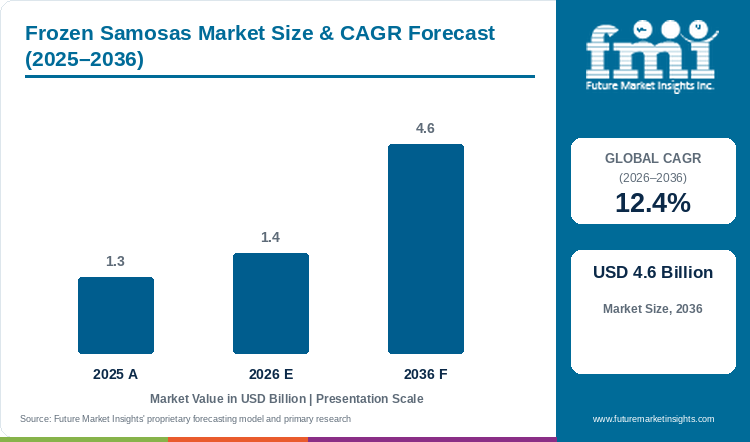
Registering a value of USD 1.3 billion in 2025, the frozen samosas market expanded to USD 1.4 billion in 2026 and is anticipated to achieve USD 4.6 billion by 2036, driven by a 12.4% CAGR.
Household demand for quick heat-and-eat savory snacks and wider international freezer sections in mainstream grocery chains are turning frozen samosas into a routine weekly purchase. Rapid growth in urban grocery delivery and retail freezer assortments highlighted in the October 2026 Foreign Agricultural Service (FAS) New Delhi India Retail Foods Annual report shows how modern retail networks are scaling prepared snack distribution [1]. Busy families want crisp filled snacks that heat in home air fryers in under ten minutes. Vegetable samosas are estimated to capture 34.0% within product type demand for 2026, driven by spiced potato-and-pea fillings that suit vegetarian shoppers and expand faster than the 5.5% CAGR recorded for frozen snacks. FMI estimates indicate that global frozen samosas industry valuation rose from USD 1.3 billion in 2025 to USD 1.4 billion in 2026 and will reach USD 4.6 billion by 2036, advancing at a 12.4% CAGR. Still, pastry wrapper cracking during freezer temperature swings and high supermarket slotting fees remain major hurdles for suppliers.
Key Market Trends & Insights
- By product type: Vegetable samosas are expected to hold a 34.0% share in 2026 because spiced potato-and-pea fillings bypass meat-export veterinary clearance and suit vegetarian households.
- By claim / nature: Conventional recipes are estimated to hold a 52.0% share in 2026 owing to standard wheat-gluten wrapper elasticity during automated triangular folding.
- By format: Fresh counter presentations are projected to account for a 27.0% share in 2026 attributable to supermarket deli counters frying thawed stock for immediate grab-and-go consumption.
- By packaging format: Multipack pouches are predicted to record a 32.0% share in 2026 supported by resealable pillow bags that prevent freezer burn across multi-session family snacking.
- By sales channel: Supermarkets and hypermarkets are anticipated to hold a 38.0% share in 2026 enabled by multi-door glass freezer cabinets and Ramadan promotional end-caps.
Regional Highlights
- Top national expansion: The UAE is forecast to lead profiled countries at a 13.6% CAGR through 2036 due to high expatriate household penetration and Ramadan hypermarket promotions.
- Broader country progression: Saudi Arabia is projected to expand at a 13.3% CAGR ahead of South Korea at 13.0% and the USA at 12.6%, while Japan is estimated to register an 11.3% CAGR.
Market Size & Forecast
Table 1: Market Size and Forecast for the Frozen Samosas Market (USD billion and CAGR percentage), 2025 to 2036
| Metric | Value |
|---|---|
| 2025 Market Size | USD 1.3 billion |
| Estimated Market Size in 2026 | USD 1.4 billion |
| Projected Market Size by 2036 | USD 4.6 billion |
| CAGR, 2026 to 2036 | 12.4% |
| Added Revenue, 2026 to 2036 | USD 3.2 billion |
Grocery freezer buyers and quick-service café chains require par-fried savory snacks that crisp evenly in home air fryers or commercial ovens within eight minutes. Manual folding of triangular pastry pockets in restaurant kitchens creates uneven seam thickness and excess oil absorption during batch frying. In March 2025, an X-ray imaging study published in Nature Communications showed that frying wheat dough at 180 degrees Celsius brings crust oil content to 14.4% through surface pores [2]. As a result, snack processors pair par-fried low-porosity wrappers with spring roll and samosa pastry sheets engineering to keep excess frying oil out of the crust.
Freezer-Door and Portion-Requirement Sizing
Table 2: Freezer-Door and Portion-Requirement Sizing for the Frozen Samosas Market (USD billion and operational ranges), 2025 to 2036
| Metric | 2025 | 2026 | 2036 |
|---|---|---|---|
| Market size (USD billion) | 1.3 | 1.4 | 4.6 |
| Retail freezer & foodservice outlets (million) | 0.6 to 0.7 | 0.7 to 0.8 | 1.2 to 1.4 |
| Samosa portions consumed per day (million) | 22.0 to 25.0 | 24.0 to 27.5 | 68.0 to 76.0 |
| Average retail pack weight (grams) | 240 to 400 | 240 to 450 | 300 to 600 |
Operational note: Freezer-door and portion ranges reflect supermarket frozen snack cabinets and quick-service food-to-go counters across daily retail and catering replenishment.
Supermarket category managers allocate shelf facings based on weekly unit velocity per freezer door and post-heating crust crunch. Regional co-packers match samosa carton dimensions with broader savory snacks case packs to speed up automated warehouse palletizing.
Per Capita & Retail Outlet Sizing
Table 3: Per Capita and Retail Outlet Spending Indicators for the Frozen Samosas Market (USD), 2025 to 2036
| Metric | 2025 | 2026 | 2036 |
|---|---|---|---|
| World population (billion) | 8.2 | 8.3 | 9.0 |
| Spend per 1,000 people (USD) | 158.5 | 168.7 | 511.1 |
| Annual spend per stocked retail outlet (USD) | 1,850.0 to 2,100.0 | 1,950.0 to 2,200.0 | 3,300.0 to 3,800.0 |
| Retail supermarket & hypermarket share (%) | 37.0% to 39.0% | 38.0% to 40.0% | 41.0% to 44.0% |
Table 4: Retail & Foodservice Channel Spending Indicators for the Frozen Samosas Market (USD and percentages), 2026
| Metric | Value | Institutional Reference Basis |
|---|---|---|
| Market size, 2026 | USD 1.4 billion | 2026 global valuation baseline |
| Stocked grocery & foodservice outlets | 0.7 million | Global frozen ethnic and savory snack outlet base |
| Market spend per outlet | USD 2,000.0 | Annualized samosa wholesale turnover |
| Supermarket & hypermarket allocation, 2026 | USD 0.5 billion | 38.0% primary sales channel share |
Moisture control between spiced potato fillings and thin wheat wrappers prevents seam splitting during home oven or air-fryer reheating. Industrial snack lines use moisture-binding wrappers developed across the frozen ready meal supply chain to keep seams intact through six-month freezer storage.
Analyst Perspective
"Grocery freezer buyers evaluate frozen samosas on air-fryer crust blister uniformity and zero seam rupture after minus 18 degrees Celsius distribution. Manufacturers that combine low-oil par-fried pastry wrappers with cross-border halal and allergen certifications will capture mainstream supermarket listings."
- Nandini Roy Choudhury, Principal Consultant, Future Market Insights.
How is the frozen samosas market segmented?
The frozen samosas market is segmented by product type, claim / nature, format, packaging format, and sales channel. In 2026, vegetable samosas are projected at 34.0%, conventional at 52.0%, fresh counter formats at 27.0%, multipack at 32.0%, and supermarkets & hypermarkets at 38.0%.
By product type: Vegetable samosas, meat samosas, cocktail / mini, and baked formats.
By claim / nature: Conventional, clean label, organic, and gluten-free.
By format: Fresh, frozen, and ambient packaged.
By packaging format: Multipack, single-serve, and bulk foodservice.
By sales channel: Supermarkets & hypermarkets, artisan & specialty bakeries, convenience & forecourt, online & DTC, and foodservice distributors.
Why do Vegetable samosas lead the product type category?
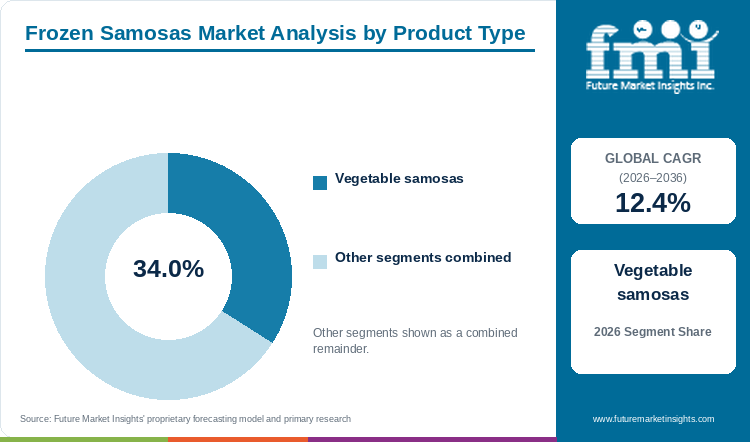
Vegetable samosas are expected to hold a 34.0% share of the product type segment in 2026, driven by plant-based menu versatility.
Table 5: Product Type Share for the Frozen Samosas Market (percentage share), 2026
| Product Type | Share (2026) |
|---|---|
| Vegetable samosas | 34.0% |
| Other Segments Combined* | 66.0% |
| Total | 100.0% |
*Calculated as the balance remaining after deducting the leading segment's reported share from 100.0%.
Table 6: Product Type Leadership and Market Growth for the Frozen Samosas Market (segment and CAGR percentage), 2026 to 2036
| Metric | Value |
|---|---|
| Global CAGR (2026 to 2036) | 12.4% |
| Leading Segment | Vegetable samosas |
Diced potato and green pea fillings anchor global samosa volume because vegetable recipes bypass strict meat-import veterinary inspections across USA and European ports. Moisture retention inside spiced potato fillings prevents internal water migration into the pastry shell while competing with United States empanadas in grocery appetizer doors.
- Vegetable samosas are expected to hold a 34.0% share in 2026 because meat-free fillings lower raw-material cost volatility and appeal to vegetarian and flexitarian households.
- A June 2026 deep-frying study in Food Chemistry confirmed that adding 1.0% cellulose gum and potato granulates to potato fillings cuts deep-frying oil absorption by 45% [3].
Why does Conventional define the largest claim / nature segment?
Conventional formulations are estimated to hold a 52.0% share of the claim / nature segment in 2026, owing to gluten sheet elasticity.
High-speed rotary samosa-forming machines require stretchy wheat-flour dough sheets that fold over angular potato fillings without tearing at the corners. Standard wheat-flour wrappers maintain lower unit production costs than certified allergen-free formulations and share supply lines with Latin America empanadas across multinational snack plants.
- Conventional recipes are estimated to hold a 52.0% share in 2026 resulting from reliable dough strength and broad consumer familiarity with classic fried pastry texture.
- In March 2026, the U.S. Food and Drug Administration updated its Food Allergies regulatory guidance replacing prior 2022 drafts to enforce strict major-allergen wheat and sesame declarations [4].
What keeps Fresh ahead by format?
Fresh presentations are projected to account for a 27.0% share of the format segment in 2026, attributable to hot-counter slack-out merchandising.
Within the commercial samosa format taxonomy, fresh counter sales represent 27.0% where supermarket delis and convenience forecourts fry or bake thawed samosas on-site for immediate hot consumption. Clear boundary separation between freshly finished counter units and factory-sealed freezer packs mirrors merchandising structures across frozen baked goods and chilled deli cabinets.
- Fresh formats are projected to account for a 27.0% share in 2026 linked to higher per-piece retail margins at supermarket hot-food counters and railway station kiosks.
- A February 2025 study in the International Journal of Biological Macromolecules showed that adding 1% potato protein and xanthan gum to pastry wrappers reduces freeze-thaw cooking loss and protects dough elasticity [5].
Why does Multipack lead the packaging format category?
Multipack configurations are predicted to record a 32.0% share of the packaging format segment in 2026, supported by household sharing occasions.
Retail shoppers purchase 6-piece to 20-piece samosa multipacks for family tea-time and festive entertaining, spreading sub-zero carton and barrier-film costs across multiple portions. Nitrogen-flushed inner trays prevent individual frozen triangles from sticking together before cooking and complement global convenience foods in household freezers.
- Multipack pouches are predicted to record a 32.0% share in 2026 associated with higher basket value per freezer door and repeatable portion control for home air-frying.
- In March 2026, a study in the International Journal of Biological Macromolecules confirmed that starch nanoparticles reduce freezable water from 52.86% to 48.21% and prevent ice-crystal cracking in frozen fried dough [6].
What gives Supermarkets & hypermarkets the leading position in sales channel?
Supermarkets and hypermarkets are anticipated to hold a 38.0% share of the sales channel segment in 2026, enabled by multi-deck freezer reach.
Mainstream supermarket chains drive volume expansion by relocating frozen samosas from niche international aisles into primary party-food and appetizer freezer doors. National grocery chains run multi-buy promotional end-caps during Ramadan and year-end holidays paired with ready-to-eat food assortments.
- Supermarkets and hypermarkets are anticipated to hold a 38.0% share in 2026 stemming from centralized cold-chain warehousing and private-label appetizer tiering.
- In January 2026, Bikaji Foods International released its updated International Product Catalogue detailing export-ready frozen vegetable and cocktail samosa multipacks for supermarket chains [7].
What are the drivers, restraints, and opportunities in the frozen samosas market?
In the frozen samosas market, household air-fryer adoption and cross-cultural snacking drive repeat freezer orders whereas wrapper oil logging and cold-chain import inspections restrain margins and high-protein fillings create retail growth opportunities.
- Driver: Widespread household air-fryer adoption and café grab-and-go demand convert pre-crisped frozen samosas into an everyday eight-minute savory snack.
- Restraint: Wrapper blistering during freeze-thaw excursions and strict halal and allergen import clearances increase landed distributor costs.
- Opportunity: Ultrasound-treated low-acrylamide potato fillings and high-protein paneer or plant-mince recipes open health-conscious retail and c-store programs.
Growth Analysis and Future Potential: Qualitative Demand Catalysts
Consumer shift toward rapid home air-frying and cross-cultural finger foods is expanding frozen samosa sales across mainstream grocery chains. Scratch preparation of spiced potato fillings and hand-sealed triangular pastry wrappers requires over 45 minutes of kitchen labor, pushing urban households toward ready-to-heat freezer packs. Future Market Insights notes that par-fried samosas formulated for convection ovens capture shelf space next to United States frozen food appetizer leaders. In February 2025, a frying study published in Food Chemistry confirmed that adding 1.0% flaxseed gum to wheat dough reduces frying oil absorption by 30.27% while keeping internal moisture 11.67% higher [8]. Supermarket category buyers therefore expand private-label and branded samosa facings across year-round entertaining sets.
Risk Assessment of the Frozen Samosas Market: Operational and Formulation Friction
Cold-chain temperature compliance and consumer scrutiny over fried snack fat quality represent the primary friction points restraining commercial expansion. When frozen samosa cartons experience warming above minus 18 degrees Celsius during port transit, internal filling moisture forms ice pockets that split the pastry seam upon frying. In November 2025, a lipid risk survey of industrial and retail ready-to-eat foods including samosas published in the International Journal of Preventive Medicine evaluated saturated and trans fatty acid ratios across commercial snacks [9]. Simultaneously, policy limits on fried school and institutional catering items push manufacturers to formulate baked or air-fried crusts. Exporters failing temperature-log audits or allergen labeling inspections face immediate container rejection at customs and lose shelf space to refrigerated snacks competitors.
Commercial Opportunity Analysis: Formulation Differentiation and Value-Add Formats
Snack formulators capture premium retail tiers by reducing frying acrylamide formation and introducing high-protein cheese and plant-based fillings in bite-sized cocktail formats. Traditional deep-fried potato samosas face scrutiny from health-conscious shoppers over saturated fat and high-heat frying contaminants. Ultrasound pre-treatment and controlled par-frying protocols preserve fresh spice aroma while cutting oil absorption. In April 2026, a frying study in the International Journal of Food Science demonstrated that ultrasound pre-treatment prior to 180-degree frying reduced acrylamide levels in prefried potatoes to 19 micrograms per kilogram while maintaining 7.50 Newtons crust firmness [10]. Brands that pair low-oil par-baked wrappers with clean-label chutney sachets secure high-margin placement in convenience forecourts and online grocery baskets.
Frozen Samosas Market by Country (2026 to 2036)
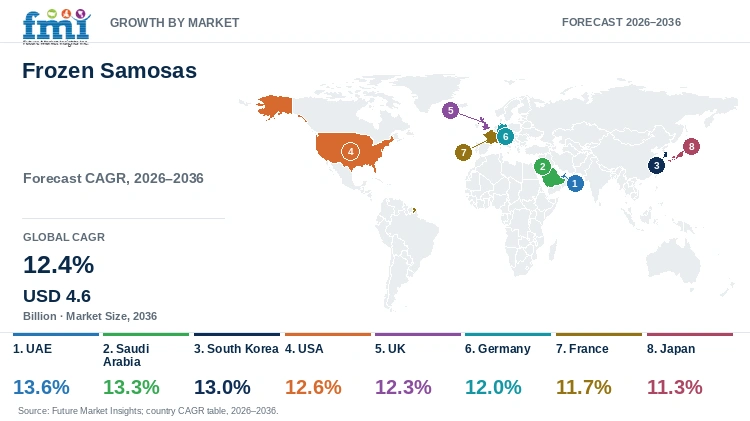
As per FMI, the UAE is projected to lead frozen samosas expansion across profiled countries at a 13.6% CAGR through 2036, whereas Japan is forecast to progress at an 11.3% CAGR. Regional growth across Gulf hypermarkets and Western supermarket chains depends on cold-chain fulfillment density and local flavor calibration.
Table 7: Country CAGR and Primary Growth Levers for the Frozen Samosas Market (CAGR percentage and operational drivers), 2026 to 2036
| Country | CAGR (2026 to 2036) | Primary Growth Lever |
|---|---|---|
| UAE | 13.6% | High South Asian and Arab household penetration plus Ramadan hypermarket promotions |
| Saudi Arabia | 13.3% | Mandatory SFDA halal import accreditation and family multipack Ramadan stocking |
| South Korea | 13.0% | Rapid online food e-commerce fulfillment and convenience-store hot snack adoption |
| USA | 12.6% | Mainstream supermarket freezer door expansion and household air-fryer preparation |
| UK | 12.3% | Established Indian savory pastry familiarity and chilled-to-frozen grocery tiering |
| Germany | 12.0% | Strict EU allergen labeling compliance and discount supermarket private-label trials |
| France | 11.7% | Growing ethnic appetizer demand in hypermarkets and quick-service takeaway outlets |
| Japan | 11.3% | Mature household frozen snack consumption and convenience-store single-serve trials |
Source: Future Market Insights analysis
UAE Frozen Samosas Market Outlook (2026 to 2036)
Demand in the UAE is projected to expand at a 13.6% CAGR from 2026 to 2036, representing the fastest growth rate among all eight profiled countries. Unlike Western markets where samosas remain an occasional ethnic side dish, the UAE features year-round daily consumption across South Asian and Arab households plus large Ramadan hypermarket promotions. In August 2026, the USDA Foreign Agricultural Service reported that the UAE operates over 570 domestic food and beverage processing plants supported by modern cold-chain re-export ports [11]. Intense freezer-aisle price competition during Ramadan requires brands to bundle 1,200-gram family value packs with branded cream-cheese or vegetable fillings to defend shelf space.
Key takeaway: In the UAE, year-round multicultural household demand and over 570 domestic food plants are projected to anchor rapid family-multipack frozen samosa turnover.
Saudi Arabia Frozen Samosas Market Outlook (2026 to 2036)
Pre-Ramadan retail stockpiling and expanding domestic poultry and pastry processing capacity distinguish Saudi Arabia from import-only snack markets across the Middle East. Market value in Saudi Arabia is estimated to advance at a 13.3% CAGR between 2026 and 2036 due to modern hypermarkets replacing street-vendor frying with branded freezer packs. In October 2026, the USDA Foreign Agricultural Service documented mandatory food authority halal certification and accredited certifying-body rules for all imported meat and pastry products entering Saudi Arabia [12]. Exporters shipping beef or chicken samosas into Jeddah and Dammam ports must maintain audited halal slaughter certificates and minus 18 degrees Celsius container logs to avoid customs holds.
Key takeaway: In Saudi Arabia, mandatory halal accreditation and pre-Ramadan hypermarket stockpiling are estimated to govern commercial frozen samosa growth.
South Korea Frozen Samosas Market Outlook (2026 to 2036)
Whereas Gulf demand centers on large family bags, South Korea is propelled by single-person households ordering small-count air-fryer snacks through overnight e-commerce grocery platforms. In October 2026, the USDA Foreign Agricultural Service reported in its South Korea Retail Foods Annual that domestic food retailers continue expanding frozen convenience assortments for time-pressed urban shoppers [13]. Sales in South Korea are forecast to register a 13.0% CAGR from 2026 to 2036 owing to convenience stores and online platforms introducing curry-spiced and cheese-filled mini samosas. Because urban shoppers in South Korea expect crisp textures from countertop air fryers without oil spraying, commercial snack suppliers pre-coat pastry wrappers with vegetable oil.
Key takeaway: In South Korea, overnight e-commerce grocery delivery and household air-fryer usage are forecast to accelerate adoption of pre-crisped mini samosa packs.
USA Frozen Samosas Market Outlook (2026 to 2036)
In the USA, frozen samosas have moved out of specialty South Asian grocers into mainstream warehouse clubs and conventional supermarket freezer doors across metropolitan suburbs. In July 2026, the USDA Economic Research Service documented in its Food Expenditure Series interactive data that warehouse clubs and supercenters continue capturing a growing share of household food-at-home spending [14]. However, slotting fees for national supermarket freezer doors and strict FDA sesame and wheat allergen controls create high entry barriers for smaller regional co-packers. Industry valuation in the USA is anticipated to record a 12.6% CAGR over 2026 to 2036 attributable to club-store multipack rotations and private-label grocery assortments.
Key takeaway: In the USA, warehouse club and supermarket appetizer merchandising is anticipated to drive mainstream household trial of frozen vegetable and tikka samosas.
UK Frozen Samosas Market Outlook (2026 to 2036)
Valuation in the UK is predicted to grow at a 12.3% CAGR from 2026 to 2036 resulting from deep consumer familiarity with Indian cuisine across both chilled deli and frozen grocery aisles. What sets the UK apart from continental Europe is the direct competition between supermarket chilled Indian meal deals and lower-priced frozen sharing boxes. According to the USDA Foreign Agricultural Service in December 2025, the UK foodservice sector reached USD 133.0 billion in 2025 on strong demand across coffee shops and quick-service bakeries [15]. At the same time, UK Food Standards Agency allergen recording rules require food businesses to maintain written allergen ingredient records across both prepacked and non-prepacked hot counter snacks.
Key takeaway: In the UK, a USD 133.0 billion foodservice sector and entrenched Indian snacking habits are predicted to sustain dual frozen-retail and hot-counter samosa demand.
Germany Frozen Samosas Market Outlook (2026 to 2036)
Unlike the UK where Indian snacks are mainstream staples, Germany relies on hard-discount grocery chains running limited-time international theme weeks that introduce frozen samosas to value-conscious households. Market size in Germany is expected to rise at a 12.0% CAGR through 2036 supported by vegan and vegetarian product positioning across urban supermarkets. In December 2025, the USDA Foreign Agricultural Service reported that the hospitality and institutional sector in Germany faced a 19% VAT rate and rising personnel costs, pushing caterers toward pre-prepared frozen finger foods [16]. European Union rules mandating clear declaration across 14 priority allergens also require strict wheat and mustard seed labeling on retail cartons in Germany.
Key takeaway: In Germany, discount-grocery international promotions and restaurant labor cost pressures are expected to expand frozen vegetarian samosa listings.
France Frozen Samosas Market Outlook (2026 to 2036)
Consumer purchasing in France splits between hypermarket world-food freezer cabinets and halal butcher-delicatessen shops serving major metropolitan suburbs and university districts. In September 2026, the USDA Foreign Agricultural Service documented in its France Retail Foods Annual that consumer inflation moderated to 0.9% while general food retailers captured 58.6% of retail food sales [17]. Because shoppers in France differentiate sharply between fresh delicatessen counter snacks and frozen boxes, frozen samosa brands emphasize thin brick-pastry crunch instead of thick bready crusts. Demand in France is slated to advance at an 11.7% CAGR between 2026 and 2036 linked to hypermarket private-label world-appetizer ranges and urban quick-service takeaway menus across major regional grocery chains.
Key takeaway: In France, hypermarket private-label appetizer tiering and preference for thin brick-pastry wrappers are slated to support steady frozen samosa growth.
Japan Frozen Samosas Market Outlook (2026 to 2036)
Japan operates an advanced retail frozen-food network where microwave and toaster-oven crispness performance governs consumer repeat buying across urban supermarkets. In September 2026, the USDA Foreign Agricultural Service reported in its Japan Retail Foods Annual that retail food sales reached USD 286.0 billion in 2025 as supermarkets and convenience stores expanded frozen and ready-to-eat foods [18]. While mild curry bread is popular across Japan, spiced samosas require localized seasoning adjustments and compact tray-in-pouch packaging that fits narrow domestic freezer drawers. In turn, the market in Japan is likely to progress at an 11.3% CAGR from 2026 to 2036 associated with convenience-store hot-case trials and specialty import grocers.
Key takeaway: In Japan, a USD 286.0 billion retail food sector and single-serve convenience-store merchandising are likely to support steady adoption of mild-spiced frozen samosas.
Full report country CAGRs cover: North America; Latin America; Western Europe; Eastern Europe; East Asia; South Asia and Pacific; Middle East and Africa.
Who are the notable companies in the frozen samosas market?
Samworth Brothers, The Compleat Food Group, Pukka Pies, Patties Foods, Goya Foods, Ruiz Foods, Greggs, Wewalka, Aryzta, and Vandemoortele are the notable companies profiled in the frozen samosas market.
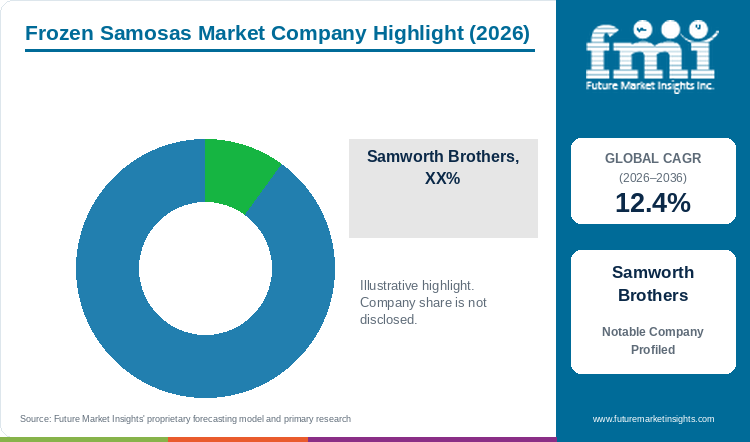
FMI analysis indicates that the competitive arena divides between savory pastry and food-to-go producers, frozen international snack platforms, and industrial pastry-dough manufacturers. While export specialists such as Bikaji Foods and ITC (Prasuma) expand dedicated Indian frozen snack capacity, UK and Western savory pastry leaders like Samworth Brothers and The Compleat Food Group command supermarket savory-pastry shelf space. Frozen international snack operators such as Goya Foods and Ruiz Foods provide benchmark cold-chain distribution across USA grocery freezers.
- Savory Pastry & Food-to-Go Operators: Samworth Brothers and The Compleat Food Group plus Pukka Pies and Greggs manage high-throughput savory pastry baking and retail distribution.
- Frozen International Snack Platforms: Goya Foods and Ruiz Foods plus Patties Foods operate multi-region freezer-aisle distribution for filled handheld snacks across grocery and c-store channels.
- Pastry Wrapper & Frozen Bakery Suppliers: Wewalka and Aryzta plus Vandemoortele manufacture laminated and thin-sheet pastry bases used in commercial snack assembly.
Competitive Benchmarking: Frozen Samosas Market
Table 8: Competitive Benchmarking for the Frozen Samosas Market (qualitative capability ratings), 2026
| Company | Savory Pastry Capability | Frozen Cold-Chain Depth | Retail / Foodservice Route | Geographic Reach |
|---|---|---|---|---|
| Samworth Brothers | High | Medium | High | United Kingdom grocery and convenience channels |
| The Compleat Food Group | High | Medium | High | United Kingdom retail and foodservice savory pastry |
| Pukka Pies | High | High | High | United Kingdom grocery and takeaway foodservice |
| Patties Foods | High | High | High | Australia and New Zealand retail and petrol-convenience |
| Goya Foods | Medium | High | High | United States and international ethnic grocery freezers |
| Ruiz Foods | Medium | High | High | United States supermarket and convenience-store foodservice |
| Aryzta | High | High | High | European and Asia-Pacific bake-off and foodservice |
| Vandemoortele | High | High | High | Pan-European and North American frozen bakery channels |
Scoring basis: Capability tiers evaluate documented savory filled-pastry manufacturing, sub-zero freezer logistics infrastructure, and multichannel supermarket and convenience-store distribution access.
Key Developments in the Frozen Samosas Market
- In February 2025, ITC Limited signed definitive agreements to acquire ready-to-cook frozen snack specialist Prasuma with an initial INR 131 crore investment to scale frozen and chilled snack distribution [19].
- In May 2025, The Compleat Food Group expanded its Wall's Pastry savory range in Tesco stores across the UK with plant-based savory pastry slices catering to flexitarian grab-and-go shoppers [20].
- In October 2025, The Compleat Food Group unveiled a refreshed retail bakery shop design for Wrights ahead of its 2026 centenary while supplying savory pastries to UK restaurants and independent bakeries [21].
Key Players in the Frozen Samosas Market
Prepared Savory Pastry & Food-to-Go Leaders
- Samworth Brothers
- The Compleat Food Group
- Pukka Pies
Frozen International Snack & Appetizer Platforms
- Patties Foods
- Goya Foods
- Ruiz Foods
Pastry Wrapper & Frozen Bake-Off Suppliers
- Aryzta
- Vandemoortele
Frozen Samosas Market - Report Scope
Table 9: Report Scope for the Frozen Samosas Market (coverage fields and definitions), 2026 to 2036
| Coverage field | Report scope |
|---|---|
| Market breakdown | Product Type; Claim / Nature; Format; Packaging Format; Sales Channel |
| Quantitative Units | USD Billion |
| Market Definition | Commercial first-sale revenue from pre-formed samosa products sold across retail and foodservice channels within the defined five-axis taxonomy, with frozen samosas as the core commercial focus. Category Scope Note: Excludes empanadas, spring rolls, meat pies, and unmolded bulk flour. |
| Regions Covered | North America; Latin America; Western Europe; Eastern Europe; East Asia; South Asia and Pacific; Middle East and Africa |
| Countries Covered | UAE, Saudi Arabia, South Korea, USA, UK, Germany, France, Japan, and additional countries in the full report |
| Key Companies Covered | Samworth Brothers, The Compleat Food Group, Pukka Pies, Patties Foods, Goya Foods, Ruiz Foods, Greggs, Wewalka, Aryzta, Vandemoortele |
| Forecast Period | 2026 to 2036 |
| Approach | Primary and secondary research with top-down and bottom-up market triangulation. |
Frozen Samosas Market - Research Methodology
Table 10: Research Methodology for the Frozen Samosas Market (research methods and approach), 2026 edition
| Method | Approach |
|---|---|
| Primary Research | Structured interviews with supermarket frozen-food category buyers, ethnic snack importers, quick-service catering managers, and industrial par-fried snack process engineers to validate freezer door velocity and case margins. |
| Secondary Research | Analysis of corporate M&A disclosures (ITC/Prasuma, Bikaji, Compleat Food Group), USDA ERS and FAS GAIN country reports, regulatory allergen notices, and PubMed deep-frying and freeze-thaw studies. |
| Market Sizing and Forecasting | Top-down retail frozen snack expenditure models reconciled against bottom-up freezer cabinet door allocations and daily samosa portion throughput from 2026 to 2036. |
| Country Forecasting Model | Econometric country projections weight diaspora population share, Ramadan retail promotional uplift, household air-fryer penetration, and cold-chain e-commerce delivery coverage across eight countries. |
| Operational Benchmark Traceability | Freezer-door and outlet spending indicators in Tables 2, 3, and 4 trace to USDA ERS Food Expenditure Series data, USDA FAS retail food reports, and PubMed frying oil-uptake metrics. |
| Data Triangulation and Validation | Demand estimates are cross-checked against exporter container shipments and supermarket scanner turnover while excluding adjacent empanada, spring roll, and savory pie revenues. |
Frozen Samosas Market by Segments
Frozen Samosas Market segmented by Product Type:
- Vegetable samosas
- Meat samosas
- Cocktail / mini
- Baked formats
Frozen Samosas Market segmented by Claim / Nature:
- Conventional
- Clean label
- Gluten-free
Frozen Samosas Market segmented by Format:
- Fresh
- Frozen
- Ambient packaged
Frozen Samosas Market segmented by Packaging Format:
- Multipack
- Single-serve
- Bulk foodservice
- Others
Frozen Samosas Market segmented by Sales Channel:
- Supermarkets & hypermarkets
- Artisan & specialty bakeries
- Convenience & forecourt
- Online & DTC
- Foodservice distributors
Frozen Samosas Market by Region
- North America
- United States
- Canada
- Latin America
- Brazil
- Mexico
- Argentina
- Chile
- Western Europe
- Germany
- France
- United Kingdom
- Italy
- Spain
- Benelux
- Nordics
- Eastern Europe
- Poland
- Czech Republic
- Romania
- Hungary
- East Asia
- China
- Japan
- South Korea
- South Asia and Pacific
- India
- ASEAN
- Australia and New Zealand
- Middle East and Africa
- GCC Countries
- South Africa
- Türkiye
- Israel
Research Sources and Bibliography
- [1] United States Department of Agriculture, Foreign Agricultural Service. (2026, October 2). India: Retail Foods Annual (Attaché Report IN2026-0050). USDA Foreign Agricultural Service GAIN.
- [2] Verma, U., Riley, I. M., Lukic, B., Broche, L., Verboven, P., Delcour, J. A., & Nicolai, B. M. (2025, March 16). High-speed computed tomography to visualise the 3D microstructural dynamics of oil uptake in deep-fried foods. Nature Communications, 16(1), 2600 (PubMed PMID 40091051).
- [3] Hooyberghs, K., Houben, L., Riley, I. M., Cardinaels, R., Moldenaers, P., Brijs, K., Goderis, B., Schrevens, E., & Delcour, J. A. (2026, June 16). Impact of dry starchy ingredients and hydroxypropyl methylcellulose on the properties of (deep-fried) potato mashes. Food Chemistry, 524, 150101 (PubMed PMID 42372537).
- [4] United States Food and Drug Administration. (2026, March 11). Food Allergies: Final Guidance for Industry and Labeling Requirements. U.S. Department of Health and Human Services.
- [5] Liu, X., Ren, C., Yu, B., Yang, L., Wang, H., Zhang, Y., Li, S., & Zhang, H. (2025, February 8). Elucidation on the quality improvement of dumpling wrappers by glycosylated potato protein under freeze-thaw cycle treatment. International Journal of Biological Macromolecules, 304(Pt 2), 140359 (PubMed PMID 39929461).
- [6] Zha, W., Fan, X., Wang, Y., Zheng, Z., Luo, S., Zhao, Y., & Zhong, X. (2026, March 9). Cryoprotective effects of amylopectin nanoparticles in frozen dough: Mechanism and application in fried dough production. International Journal of Biological Macromolecules, 353, 151288 (PubMed PMID 41806625).
- [7] Bikaji Foods International Limited. (2026, January 12). Bikaji International Product Catalogue: Frozen Snacks and Samosas Export Range. Bikaji Foods International.
- [8] Li, Z., Wang, Q., Zhang, Y., Li, M., Xiao, J., Liu, Y., & Li, X. (2025, February 15). The impact of flaxseed gum addition on oil absorption of deep-fried dough sticks and its underlying mechanism. Food Chemistry, 465(Pt 1), 141966 (PubMed PMID 39522335).
- [9] Moslemi, M., Abedi, A. S., Shahbazpour, N., Bahramian, G., Ferdousi, R., & Beladian Behbahan, S. E. (2025, November 27). Fatty Acid Profile and Hazard Index of Ready-to-Eat Foods Available in the Market: A Risk Survey. International Journal of Preventive Medicine, 16, 66 (PubMed PMID 41409791).
- [10] Vargas-Finaflor, P. G., Obispo-Gavino, E. O., Contreras-Liza, S. E., Huaita Acha, D. M., Macavilca, E. A., Ygnacio Santa Cruz, A. G., & Lozada-Urbano, M. (2026, April 24). Effect of Ultrasonic Waves and Other Technological Treatments on the Reduction of Acrylamide and Glycoalkaloids in Frozen Prefried Potatoes. International Journal of Food Science, 2026, 5685019 (PubMed PMID 42039231).
- [11] United States Department of Agriculture, Foreign Agricultural Service. (2026, August 4). United Arab Emirates: Food Processing Ingredients Annual (Attaché Report TC2026-0009). USDA Foreign Agricultural Service GAIN.
- [12] United States Department of Agriculture, Foreign Agricultural Service. (2026, October 21). Saudi Arabia Halal Regulations and Certification Body Accreditation (Attaché Report SA2026-0014). USDA Foreign Agricultural Service GAIN.
- [13] United States Department of Agriculture, Foreign Agricultural Service. (2026, October 5). South Korea: Retail Foods Annual (Attaché Report KS2026-0041). USDA Foreign Agricultural Service GAIN.
- [14] United States Department of Agriculture, Economic Research Service. (2026, July 31). Food Expenditure Series - Interactive Charts: Food Expenditures. USDA Economic Research Service.
- [15] United States Department of Agriculture, Foreign Agricultural Service. (2025, December 31). United Kingdom: Food Service - Hotel Restaurant Institutional Annual. USDA Foreign Agricultural Service GAIN.
- [16] United States Department of Agriculture, Foreign Agricultural Service. (2025, December 30). Germany: Food Service - Hotel Restaurant Institutional Annual. USDA Foreign Agricultural Service GAIN.
- [17] United States Department of Agriculture, Foreign Agricultural Service. (2026, September 30). France: Retail Foods Annual (Attaché Report FR2026-0010). USDA Foreign Agricultural Service GAIN.
- [18] United States Department of Agriculture, Foreign Agricultural Service. (2026, September 28). Japan: Retail Foods Annual (Attaché Report JA2026-0056). USDA Foreign Agricultural Service GAIN.
- [19] ITC Limited. (2025, February 6). ITC to acquire Prasuma: Building a Full Stack Frozen, Chilled and Ready to Cook Foods Portfolio. ITC Corporate Media Releases.
- [20] The Compleat Food Group. (2025, May 21). Wall's Pastry Brings Plant Power to Slices with New Launch. The Compleat Food Group Corporate Updates.
- [21] The Compleat Food Group. (2025, October 21). Wrights unveils refreshed shop design ahead of 100-year celebrations. The Compleat Food Group Corporate Updates.
- [22] The Compleat Food Group. (2026, September 22). Wall's launches first ever High Protein Scotch Egg and expands savoury snacking range. The Compleat Food Group Corporate Updates.
- [23] United Kingdom Food Standards Agency. (2026, July 17). Allergen guidance for food businesses. GOV.UK Food Standards Agency.
This bibliography is provided for reader reference and is not exhaustive. The full report contains the complete reference list and detailed citations.
This Report Answers
- How large is the frozen samosas market in 2026 and what is forecast for 2036?
- Which household air-fryer and retail freezer pressures support demand for frozen samosas?
- Why do Vegetable samosas lead the product type category globally?
- Why does Conventional hold the leading position within claim / nature?
- How do growth rates differ across the UAE and Saudi Arabia versus Western Europe?
- Which companies supply prepared savory pastries and frozen international snacks?
- How do cold-chain seam splitting and allergen labeling rules constrain market entry?
- What operational tests should supermarket buyers apply before authorizing samosa SKUs?
Frequently Asked Questions
How big is the frozen samosas market in 2026, and what is forecast for 2036?
According to FMI, global frozen samosas market valuation is estimated to reach USD 1.4 billion in 2026 from USD 1.3 billion in 2025. The market is projected to reach USD 4.6 billion by 2036 as supermarkets expand cross-cultural freezer doors.
What is the CAGR for the frozen samosas market from 2026 to 2036?
Future Market Insights projects a 12.4% compound annual growth rate between 2026 and 2036, generating USD 3.2 billion in incremental market value across grocery and foodservice channels.
Which product type segment leads the frozen samosas market?
Vegetable samosas are expected to hold a 34.0% share of the product type segment in 2026 because spiced potato-and-pea fillings bypass meat veterinary border checks and suit broad dietary preferences.
Which claim / nature segment leads the frozen samosas market?
Conventional formulations are estimated to hold a 52.0% share in 2026 owing to extensible wheat-gluten dough sheets that resist corner tearing during automated folding.
Which country has a notable growth outlook during the assessment period?
The UAE is projected to lead national expansion at a 13.6% CAGR through 2036, driven by year-round multicultural household snacking and high-volume Ramadan hypermarket promotions.
Who are the key players in the market?
Samworth Brothers and The Compleat Food Group lead savory pastry benchmarking with Pukka Pies and Patties Foods plus Goya Foods and Ruiz Foods across frozen snack and bakery channels.
Preview the report firsthand - request a free sample
Get SampleGet the brochure for pricing and purchase details.
Get PDFTable of Content
- Key Takeaways
- Market Size and CAGR
- Top Growth Driver
- Fastest Growing Segment
- Leading Region
- Key Companies
- Emerging Opportunities
- Executive Summary
- Global Market Outlook
- Demand-side Trends
- Supply-side Trends
- Technology Roadmap Analysis
- Analysis and Recommendations
- Analyst Perspective (What is happening? Why now? What should investors know?)
- Key Questions Answered
- How large is the market?
- What is the CAGR?
- What are key trends?
- Which region dominates?
- Who are the leaders?
- Market Overview
- Market Coverage / Taxonomy
- Market Definition / Scope / Limitations
- Research Methodology
- Chapter Orientation
- Analytical Lens and Working Hypotheses
- Market Structure, Signals, and Trend Drivers
- Benchmarking and Cross-market Comparability
- Market Sizing, Forecasting, and Opportunity Mapping
- Research Design and Evidence Framework
- Desk Research Programme (Secondary Evidence)
- Expert Input and Fieldwork (Primary Evidence)
- Tooling, Models, and Reference Databases
- Data Engineering and Model Build
- Quality Assurance and Audit Trail
- Market Background
- Market Dynamics (Drivers, Restraints, Opportunity, Trends)
- Scenario Forecast (Optimistic, Likely, Conservative)
- Impact Analysis
- AI Impact
- Sustainability Impact
- Regulatory Impact
- Technology Impact
- Consumer / Buyer Analysis
- Purchase Drivers
- Adoption Barriers
- Buyer Journey
- Opportunity Map Analysis
- Product Life Cycle Analysis
- Supply Chain Analysis
- Investment Feasibility Matrix
- Value Chain Analysis
- PESTLE and Porter's Analysis
- Regulatory Landscape
- Regional Parent Market Outlook
- Production and Consumption Statistics
- Import and Export Statistics
- Global Market Analysis and Forecast, 2021 to 2036
- Historical Market Size Value (USD Billion) Analysis, 2021 to 2025
- Current and Future Market Size Value (USD Billion) Projections, 2026 to 2036
- Y-o-Y Growth Trend Analysis
- Absolute $ Opportunity Analysis
- Global Market Pricing Analysis, 2021 to 2036
- Global Market Analysis and Forecast, By Product Type, 2021 to 2036
- Introduction / Key Findings
- Historical Market Size Value (USD Billion) Analysis By Product Type, 2021 to 2025
- Current and Future Market Size Value (USD Billion) Analysis and Forecast By Product Type, 2026 to 2036
- Vegetable samosas
- Meat samosas
- Cocktail / mini
- Baked formats
- Y-o-Y Growth Trend Analysis By Product Type, 2021 to 2025
- Absolute $ Opportunity Analysis By Product Type, 2026 to 2036
- Global Market Analysis and Forecast, By Claim / Nature, 2021 to 2036
- Introduction / Key Findings
- Historical Market Size Value (USD Billion) Analysis By Claim / Nature, 2021 to 2025
- Current and Future Market Size Value (USD Billion) Analysis and Forecast By Claim / Nature, 2026 to 2036
- Conventional
- Clean label
- Gluten-free
- Y-o-Y Growth Trend Analysis By Claim / Nature, 2021 to 2025
- Absolute $ Opportunity Analysis By Claim / Nature, 2026 to 2036
- Global Market Analysis and Forecast, By Format, 2021 to 2036
- Introduction / Key Findings
- Historical Market Size Value (USD Billion) Analysis By Format, 2021 to 2025
- Current and Future Market Size Value (USD Billion) Analysis and Forecast By Format, 2026 to 2036
- Fresh
- Frozen
- Ambient packaged
- Y-o-Y Growth Trend Analysis By Format, 2021 to 2025
- Absolute $ Opportunity Analysis By Format, 2026 to 2036
- Global Market Analysis and Forecast, By Packaging Format, 2021 to 2036
- Introduction / Key Findings
- Historical Market Size Value (USD Billion) Analysis By Packaging Format, 2021 to 2025
- Current and Future Market Size Value (USD Billion) Analysis and Forecast By Packaging Format, 2026 to 2036
- Multipack
- Single-serve
- Bulk foodservice
- Others
- Y-o-Y Growth Trend Analysis By Packaging Format, 2021 to 2025
- Absolute $ Opportunity Analysis By Packaging Format, 2026 to 2036
- Global Market Analysis and Forecast, By Sales Channel, 2021 to 2036
- Introduction / Key Findings
- Historical Market Size Value (USD Billion) Analysis By Sales Channel, 2021 to 2025
- Current and Future Market Size Value (USD Billion) Analysis and Forecast By Sales Channel, 2026 to 2036
- Supermarkets & hypermarkets
- Artisan & specialty bakeries
- Convenience & forecourt
- Online & DTC
- Foodservice distributors
- Y-o-Y Growth Trend Analysis By Sales Channel, 2021 to 2025
- Absolute $ Opportunity Analysis By Sales Channel, 2026 to 2036
- Global Market Analysis and Forecast, By Region, 2021 to 2036
- Introduction
- Historical Market Size Value (USD Billion) Analysis By Region, 2021 to 2025
- Current Market Size Value (USD Billion) Analysis and Forecast By Region, 2026 to 2036
- North America
- Latin America
- Western Europe
- Eastern Europe
- East Asia
- South Asia and Pacific
- Middle East and Africa
- Market Attractiveness Analysis By Region
- North America Market Analysis and Forecast, By Country, 2021 to 2036
- Historical Market Size Value (USD Billion) Trend Analysis By Market Taxonomy, 2021 to 2025
- Market Size Value (USD Billion) Forecast By Market Taxonomy, 2026 to 2036
- By Country
- United States
- Canada
- By Product Type
- By Claim / Nature
- By Format
- By Packaging Format
- By Sales Channel
- By Country
- Market Attractiveness Analysis
- By Country
- By Product Type
- By Claim / Nature
- By Format
- By Packaging Format
- By Sales Channel
- Key Takeaways
- Latin America Market Analysis and Forecast, By Country
- Historical Market Size Value (USD Billion) Trend Analysis By Market Taxonomy, 2021 to 2025
- Market Size Value (USD Billion) Forecast By Market Taxonomy, 2026 to 2036
- By Country
- Brazil
- Mexico
- Argentina
- Chile
- By Product Type
- By Claim / Nature
- By Format
- By Packaging Format
- By Sales Channel
- By Country
- Market Attractiveness Analysis
- By Country
- By Product Type
- By Claim / Nature
- By Format
- By Packaging Format
- By Sales Channel
- Key Takeaways
- Western Europe Market Analysis and Forecast, By Country
- Historical Market Size Value (USD Billion) Trend Analysis By Market Taxonomy, 2021 to 2025
- Market Size Value (USD Billion) Forecast By Market Taxonomy, 2026 to 2036
- By Country
- Germany
- France
- United Kingdom
- Italy
- Spain
- Benelux
- Nordics
- By Product Type
- By Claim / Nature
- By Format
- By Packaging Format
- By Sales Channel
- By Country
- Market Attractiveness Analysis
- By Country
- By Product Type
- By Claim / Nature
- By Format
- By Packaging Format
- By Sales Channel
- Key Takeaways
- Eastern Europe Market Analysis and Forecast, By Country
- Historical Market Size Value (USD Billion) Trend Analysis By Market Taxonomy, 2021 to 2025
- Market Size Value (USD Billion) Forecast By Market Taxonomy, 2026 to 2036
- By Country
- Poland
- Czech Republic
- Romania
- Hungary
- By Product Type
- By Claim / Nature
- By Format
- By Packaging Format
- By Sales Channel
- By Country
- Market Attractiveness Analysis
- By Country
- By Product Type
- By Claim / Nature
- By Format
- By Packaging Format
- By Sales Channel
- Key Takeaways
- East Asia Market Analysis and Forecast, By Country
- Historical Market Size Value (USD Billion) Trend Analysis By Market Taxonomy, 2021 to 2025
- Market Size Value (USD Billion) Forecast By Market Taxonomy, 2026 to 2036
- By Country
- China
- Japan
- South Korea
- By Product Type
- By Claim / Nature
- By Format
- By Packaging Format
- By Sales Channel
- By Country
- Market Attractiveness Analysis
- By Country
- By Product Type
- By Claim / Nature
- By Format
- By Packaging Format
- By Sales Channel
- Key Takeaways
- South Asia and Pacific Market Analysis and Forecast, By Country
- Historical Market Size Value (USD Billion) Trend Analysis By Market Taxonomy, 2021 to 2025
- Market Size Value (USD Billion) Forecast By Market Taxonomy, 2026 to 2036
- By Country
- India
- ASEAN
- Australia and New Zealand
- By Product Type
- By Claim / Nature
- By Format
- By Packaging Format
- By Sales Channel
- By Country
- Market Attractiveness Analysis
- By Country
- By Product Type
- By Claim / Nature
- By Format
- By Packaging Format
- By Sales Channel
- Key Takeaways
- Middle East and Africa Market Analysis and Forecast, By Country
- Historical Market Size Value (USD Billion) Trend Analysis By Market Taxonomy, 2021 to 2025
- Market Size Value (USD Billion) Forecast By Market Taxonomy, 2026 to 2036
- By Country
- GCC Countries
- South Africa
- Türkiye
- Israel
- By Product Type
- By Claim / Nature
- By Format
- By Packaging Format
- By Sales Channel
- By Country
- Market Attractiveness Analysis
- By Country
- By Product Type
- By Claim / Nature
- By Format
- By Packaging Format
- By Sales Channel
- Key Takeaways
- Key Countries Market Analysis
- United States
- Pricing Analysis
- Market Share Analysis, 2025
- By Product Type
- By Claim / Nature
- By Format
- By Packaging Format
- By Sales Channel
- Canada
- Pricing Analysis
- Market Share Analysis, 2025
- By Product Type
- By Claim / Nature
- By Format
- By Packaging Format
- By Sales Channel
- Mexico
- Pricing Analysis
- Market Share Analysis, 2025
- By Product Type
- By Claim / Nature
- By Format
- By Packaging Format
- By Sales Channel
- Brazil
- Pricing Analysis
- Market Share Analysis, 2025
- By Product Type
- By Claim / Nature
- By Format
- By Packaging Format
- By Sales Channel
- Chile
- Pricing Analysis
- Market Share Analysis, 2025
- By Product Type
- By Claim / Nature
- By Format
- By Packaging Format
- By Sales Channel
- Germany
- Pricing Analysis
- Market Share Analysis, 2025
- By Product Type
- By Claim / Nature
- By Format
- By Packaging Format
- By Sales Channel
- United Kingdom
- Pricing Analysis
- Market Share Analysis, 2025
- By Product Type
- By Claim / Nature
- By Format
- By Packaging Format
- By Sales Channel
- Italy
- Pricing Analysis
- Market Share Analysis, 2025
- By Product Type
- By Claim / Nature
- By Format
- By Packaging Format
- By Sales Channel
- Spain
- Pricing Analysis
- Market Share Analysis, 2025
- By Product Type
- By Claim / Nature
- By Format
- By Packaging Format
- By Sales Channel
- France
- Pricing Analysis
- Market Share Analysis, 2025
- By Product Type
- By Claim / Nature
- By Format
- By Packaging Format
- By Sales Channel
- India
- Pricing Analysis
- Market Share Analysis, 2025
- By Product Type
- By Claim / Nature
- By Format
- By Packaging Format
- By Sales Channel
- ASEAN
- Pricing Analysis
- Market Share Analysis, 2025
- By Product Type
- By Claim / Nature
- By Format
- By Packaging Format
- By Sales Channel
- Australia and New Zealand
- Pricing Analysis
- Market Share Analysis, 2025
- By Product Type
- By Claim / Nature
- By Format
- By Packaging Format
- By Sales Channel
- China
- Pricing Analysis
- Market Share Analysis, 2025
- By Product Type
- By Claim / Nature
- By Format
- By Packaging Format
- By Sales Channel
- Japan
- Pricing Analysis
- Market Share Analysis, 2025
- By Product Type
- By Claim / Nature
- By Format
- By Packaging Format
- By Sales Channel
- South Korea
- Pricing Analysis
- Market Share Analysis, 2025
- By Product Type
- By Claim / Nature
- By Format
- By Packaging Format
- By Sales Channel
- Poland
- Pricing Analysis
- Market Share Analysis, 2025
- By Product Type
- By Claim / Nature
- By Format
- By Packaging Format
- By Sales Channel
- Hungary
- Pricing Analysis
- Market Share Analysis, 2025
- By Product Type
- By Claim / Nature
- By Format
- By Packaging Format
- By Sales Channel
- Türkiye
- Pricing Analysis
- Market Share Analysis, 2025
- By Product Type
- By Claim / Nature
- By Format
- By Packaging Format
- By Sales Channel
- South Africa
- Pricing Analysis
- Market Share Analysis, 2025
- By Product Type
- By Claim / Nature
- By Format
- By Packaging Format
- By Sales Channel
- UAE
- Pricing Analysis
- Market Share Analysis, 2025
- By Product Type
- By Claim / Nature
- By Format
- By Packaging Format
- By Sales Channel
- Saudi Arabia
- Pricing Analysis
- Market Share Analysis, 2025
- By Product Type
- By Claim / Nature
- By Format
- By Packaging Format
- By Sales Channel
- United States
- Market Structure Analysis
- Competition Dashboard
- Competition Benchmarking
- Market Share Analysis of Top Players
- By Regional
- By Product Type
- By Claim / Nature
- By Format
- By Packaging Format
- By Sales Channel
- Emerging Startups
- Innovation Benchmarking
- Competition Analysis
- Competition Deep Dive
- Samworth Brothers
- Overview
- Product Portfolio
- Profitability by Market Segments
- Sales Footprint
- Strategy Overview
- Marketing Strategy
- Product Strategy
- Channel Strategy
- The Compleat Food Group
- Pukka Pies
- Patties Foods
- Goya Foods
- Ruiz Foods
- Aryzta
- Vandemoortele
- Samworth Brothers
- Case Studies
- Success Stories
- Recent Developments
- Competition Deep Dive
- Assumptions & Acronyms Used


