

- Market Size (2026)
- USD 302.4 Mn
- Forecast (2036)
- USD 715.9 Mn
- CAGR (2026 to 2036)
- 9.0%
How big is Fruit-Based Sweetening Systems Market in 2026?
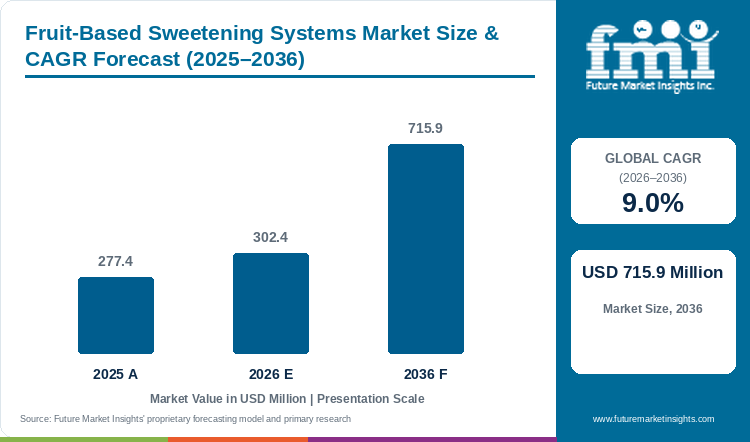
Registering a value of USD 277.4 million in 2025, the fruit-based sweetening systems market expanded to USD 302.4 million in 2026 and is anticipated to achieve USD 715.9 million by 2036, driven by a 9.0% CAGR. Standard Grade leads product type with a 42.0% share in 2026, Powder / Dry commands 43.0% in form, and Bread & Rolls account for 31.0% of application.
The global fruit-based sweetening systems market was valued at USD 277.4 million in 2025 and is estimated to reach USD 302.4 million in 2026. The market is projected to reach USD 715.9 million by 2036, expanding at a compound annual growth rate (CAGR) of 9.0% between 2026 and 2036. Standard grade systems are projected to capture 42.0% of 2026 demand on consistent 70-degree Brix and neutral pH specifications that prevent batch-to-batch variation in commercial doughs. Qualification of these systems hinges on two hard numbers, the front-of-pack added-sugars threshold and the 160-degree Maillard browning ceiling that fruit concentrates hit before sucrose does [9]. Demand is therefore supported by regulation and process chemistry together, with juice-concentrate sugars entering the FDA added-sugars line and forcing formulators to blend enzymatic monk fruit systems into the base [3]. That blending premium puts the category above the date syrup market at 6.5% CAGR, since single-ingredient syrups sell flavor while systems sell label compliance [2]. Segment scale already signals conviction, as Tate & Lyle reported GBP 1,736 million in revenue for 2026 after the CP Kelco combination expanded its sweetening and fruit fiber platform [19], and Sudzucker's AGRANA fruit division booked EUR 1,646 million in the same reporting year [20]. Bakeries pay for the supplier who can document sweetness equivalence through the audit year, and not for the one offering only fruit on the panel.
Key Market Trends & Insights
- By product type: Standard Grade systems are projected to capture 42.0% in 2026 because consistent 70° Brix and neutral pH specifications prevent batch-to-batch dough slackening.
- By form: Powder / Dry formats are estimated to command 43.0% in 2026 as industrial dry-mix blenders favor free-flowing date and monk fruit powders that eliminate heated tanker pipework.
- By application: Bread & Rolls are expected to concentrate 31.0% in 2026 because yeast-fermentable fruit monosaccharides support rapid proof oven-spring and natural crust coloration.
- By claim: Conventional claims are forecast to generate 52.0% in 2026 owing to high-volume pan bread and biscuit contracts that prioritize cost-in-use over organic audit premia.
- By sales channel: Direct to Industrial Bakeries is anticipated to account for 44.0% in 2026 through multi-quarter bulk tanker and FIBC tote contracts paired with application-lab co-development.
Regional Highlights
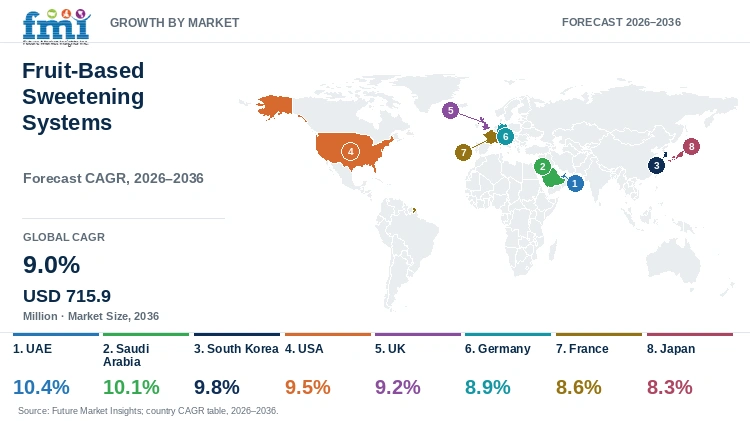
- Top national expansion: The UAE is projected to lead evaluated national markets at a 10.4% CAGR through 2036 as domestic Phoenix dactylifera date valorization converges with industrial bakery expansion.
- Broader country progression: Saudi Arabia is expected to expand at a 10.1% CAGR ahead of South Korea at 9.8% and the USA at 9.5%, while Japan is forecast to advance at an 8.3% CAGR.
Market Size & Forecast
Table 1: Market Size and Forecast for the Fruit-Based Sweetening Systems Market (USD million and CAGR percentage), 2025 to 2036
| Metric | Value |
|---|---|
| 2025 Market Size | USD 277.4 million |
| Estimated Market Size in 2026 | USD 302.4 million |
| Projected Market Size by 2036 | USD 715.9 million |
| CAGR, 2026 to 2036 | 9.0% |
| Added Revenue, 2026 to 2036 | USD 413.5 million |
Commercial bakery R&D directors confront a technical gap when attempting to replace bulk crystalline sucrose with high-potency natural extracts alone. While pure mogroside extracts deliver intense sweetness, removing sucrose mass strips away the water-activity depression and starch-plasticizing bulk required for soft crumb shelf life. In July 2026, a comprehensive review in Foods documented that ultrasound- and microwave-extracted Phoenix dactylifera date syrups retain bioactive polyphenols and invert monosaccharides that act as natural humectants in baked matrices [2]. so ingredient formulators are pairing bulk whole-fruit date and apple systems with monk fruit ingredients so automated bakeries achieve 30% to 50% sugar reduction without sacrificing loaf volume.
Bakery-Batch and Dry-Solids Volume Sizing
Table 2: Bakery-Batch and Dry-Solids Sizing for the Fruit-Based Sweetening Systems Market (USD million and operational ranges), 2025 to 2036
| Metric | 2025 | 2026 | 2036 |
|---|---|---|---|
| Market size (USD million) | 277.4 | 302.4 | 715.9 |
| Commercial bakery fruit sweetener volume (thousand MT) | 75.0 to 76.0 | 79.5 to 81.0 | 158.0 to 163.0 |
| Sweetened commercial bakery output (million MT) | 1.8 to 2.1 | 1.9 to 2.2 | 3.6 to 4.1 |
| Average blended system price per kilogram (USD) | 3.6 to 3.7 | 3.7 to 3.8 | 4.4 to 4.5 |
Operational note: Volume and price ranges normalize liquid concentrates (70° Brix), whole-fruit date pastes, and co-dried fruit-and-monk-fruit powders across commercial bread and biscuit lines.
Industrial dough mixers require de-acidified and mineral-buffered fruit concentrates so fruit malic and citric acids do not prematurely trigger chemical leavening or weaken wheat gluten networks. Ingredient processors co-formulate buffered fruit syrups with clean-label ingredients such as native tapioca starch and soluble plant fibers to standardize dough viscosity prior to oven baking.
Per Capita & Industrial Bakery Plant Sizing
Table 3: Per Capita and Bakery Plant Spending Indicators for the Fruit-Based Sweetening Systems Market (USD), 2025 to 2036
| Metric | 2025 | 2026 | 2036 |
|---|---|---|---|
| Global population base (million) | 8,200.0 | 8,300.0 | 9,000.0 |
| Spend per 1,000 people (USD) | 33.8 | 36.4 | 79.5 |
| Annual spend per qualified industrial bakery plant (USD) | 14,200 to 16,500 | 15,100 to 17,600 | 29,500 to 34,000 |
| Direct industrial bakery contract share (%) | 42.5% to 44.5% | 43.0% to 45.0% | 46.0% to 49.0% |
Table 4: Bakery & Ingredient Procurement Indicators for the Fruit-Based Sweetening Systems Market (USD and percentages), 2026
| Metric | Value | Institutional Reference Basis |
|---|---|---|
| Market size, 2026 | USD 302.4 million | 2026 global commercial bakery baseline |
| Direct to industrial bakeries revenue, 2026 | USD 133.1 million | 44.0% leading sales channel allocation |
| Powder / Dry form revenue, 2026 | USD 130.0 million | 43.0% leading form allocation |
| Standard Grade product revenue, 2026 | USD 127.0 million | 42.0% leading product type allocation |
Procurement of fruit-derived sweeteners for multi-plant bakery runs requires strict authentication against synthetic invert-sugar adulteration and seasonal Brix drift. Global baking groups combine de-ionized fruit syrups with naturally derived sweeteners to lock in repeatable sweetness equivalence and clean front-of-pack declarations.
Analyst Perspective
"Industrial bakeries qualify a fruit-based sweetening system only when it replicates the water-activity depression, yeast fermentation kinetics, and Maillard crust color of sucrose on continuous oven bands. Suppliers that pair whole-fruit date or apple solids with bioconverted monk fruit extracts will win multi-year reformulation contracts across Europe, North America, and the Gulf."
- Nandini Roy Choudhury, Principal Analyst at Future Market Insights
How is the fruit-based sweetening systems market segmented?
The fruit-based sweetening systems market is segmented by product type, form, application, claim, and sales channel. Standard Grade leads product type at 42.0% in 2026, while Powder / Dry captures 43.0% of form and Bread & Rolls hold 31.0% of application.
By product type: Standard Grade, Premium / Specialty Grade, Organic Certified, and Clean Label Grade.
By form: Powder / Dry, Liquid, Paste / Semi-Solid, and Granules / Pieces.
By application: Bread & Rolls, Cakes & Muffins, Biscuits & Cookies, Viennoiserie & Pastry, and Other Bakery & Snacks.
By claim: Conventional, Clean Label, Organic, and Non-GMO / Identity Preserved.
By sales channel: Direct to Industrial Bakeries, Ingredient Distributors, Foodservice & Artisan Supply, and Online B2B.
What keeps Standard Grade central to Product Type demand?
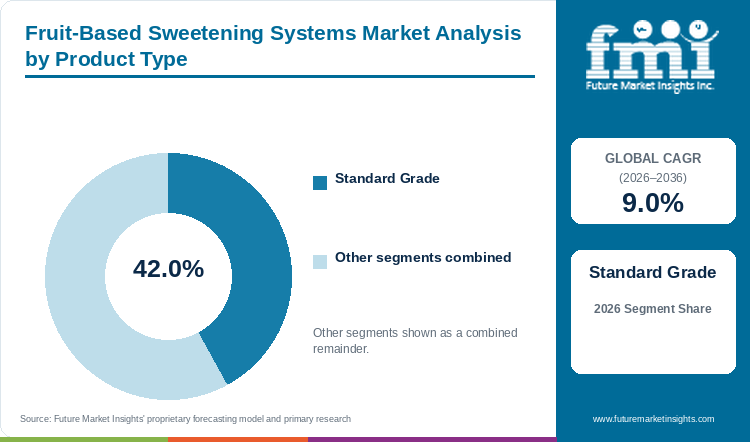
Standard Grade formulations are projected to capture 42.0% of product type revenue in 2026 (USD 127.0 million) by delivering repeatable Brix, color, and cost-in-use across high-volume bakery runs.
Table 5: Product Type Share for the Fruit-Based Sweetening Systems Market (percentage share), 2026
| Product Type | Share (2026) |
|---|---|
| Standard Grade | 42.0% |
| Other Segments Combined | 58.0%* |
| Total | 100.0% |
*Note: Remaining product type categories sum to 100.0% of 2026 commercial bakery fruit-sweetener volume.
Table 6: Product Type Leadership and Market Growth for the Fruit-Based Sweetening Systems Market (segment and CAGR percentage), 2026 to 2036
| Metric | Value |
|---|---|
| Global CAGR (2026 to 2036) | 9.0% |
| Leading Segment | Standard Grade |
High-speed pan bread and biscuit plants prioritize standard grade 70° Brix de-acidified apple, pear, and date concentrates because tight ICUMSA color and pH tolerances prevent unexpected dough stickiness or premature crust charring. Standardized fruit blends allow procurement teams to substitute refined sugar at predictable batch cost while blending smoothly with clean-label syrups across continuous mixing lines.
- Standard Grade is projected to secure 42.0% of product type revenue in 2026 by providing uniform carbohydrate composition and neutral acidity for automated dough batching.
- A PRISMA-guided systematic review of randomized controlled trials published in Nutrients in April 2025 confirmed that monk fruit extracts safely modulate postprandial glucose responses without gastrointestinal side effects, supporting their inclusion in standard bakery sweetening blends [3].
Why does Powder / Dry set the pace in Form?
Powder / Dry systems are estimated to command 43.0% of the form segment in 2026 (USD 130.0 million) because free-flowing powders integrate directly into automated dry premix silos.
Commercial cake-mix blenders and industrial bakeries favor drum-dried whole-date powders, co-dried apple-fiber sweeteners, and spray-dried monk fruit blends because dry particulates meter cleanly through loss-in-weight screw feeders. Removal of viscous liquid totes eliminates heated pipework maintenance and CIP-cleaning water waste while complementing high-potency monk fruit sugar in dry bakery premixes.
- Powder / Dry options are estimated to command 43.0% of the form segment in 2026 as centralized premix plants standardize dry micro-ingredient dosing across cake, muffin, and cookie lines.
- Biotechnology research published in Food Chemistry X in September 2026 demonstrated that an optimized recombinant SgUGT94CG1 glycosyltransferase efficiently converts bitter mogrosides from immature Siraitia grosvenorii into sweet mogroside V for spray-dried bakery powders [4].
How does Bread & Rolls retain the Application lead?
Bread & Rolls are expected to hold 31.0% of application sales in 2026 (USD 93.7 million) because yeast-fermentable fruit sugars accelerate proof volume and retard crumb staling.
In pan loaves and multigrain rolls, 2% to 6% flour-weight additions of date syrup or de-acidified apple concentrate supply glucose and fructose that Saccharomyces cerevisiae ferments rapidly during proofing. Residual fruit pectins and reducing sugars bind moisture and generate warm golden crust color across commercial packaged bread lines without synthetic caramel dyes.
- Bread & Rolls are expected to hold 31.0% of application sales in 2026 because daily staple loaf production consumes steady bulk tonnage for yeast substrate and crumb humectancy.
- A human clinical trial published in Food Science & Nutrition in December 2025 proved that fortifying white bread with carob molasses pulp flour and wheat germ significantly lowers postprandial glycemic response and elevates serum antioxidant capacity in healthy adults [5].
What explains Conventional leadership within Claim?
Conventional claims are forecast to account for 52.0% of claim demand in 2026 (USD 157.2 million) as mainstream bakeries prioritize functional humectancy and cost parity.
Large plant bakeries specify conventional de-ionized pear and apple or date concentrates primarily for water-activity control and clean fruit-origin ingredient statements rather than certified organic seals. Independence from segregated organic orchard chains keeps raw material costs aligned with supermarket private-label price ceilings while clean-label (22.0%) and organic (14.5%) tiers serve premium artisan launches.
- Conventional is forecast to account for 52.0% of claim demand in 2026 as high-throughput biscuit and roll plants prioritize functional repeatability and uninterrupted multi-origin fruit supply.
- Metabolomic profiling via GC-MS and UHPLC/MS published in Scientific Reports in September 2025 characterized seven date syrup varieties from Egypt and Saudi Arabia, identifying distinct phenolic antioxidant and volatile caramel markers for targeted bakery grading [6].
Why is Direct to Industrial Bakeries the leading Sales Channel?
Direct to Industrial Bakeries is anticipated to capture 44.0% of sales channel revenue in 2026 (USD 133.1 million) through custom Brix calibration and bulk tanker or FIBC fulfillment.
Qualification of a fruit sweetening system for continuous tunnel ovens requires partner rheology trials between the ingredient manufacturer's bakery application lab and the customer's plant engineers. Direct B2B contracting enables 25-ton heated road tanker deliveries and 1,000-kilogram FIBC bulk bags supported by rapid chemometric purity verification.
- Direct to Industrial Bakeries is anticipated to capture 44.0% of sales channel revenue in 2026 because multinational baking groups require custom-buffered blends and guaranteed multi-quarter supply locks.
- Research published in Food Chemistry X in July 2026 combined visible-near infrared hyperspectral imaging with machine-learning models to non-destructively verify chemical solids and purity in commercial date syrup shipments prior to factory acceptance [7].
What are the drivers, restraints, and opportunities in the fruit-based sweetening systems market?
In the fruit-based sweetening systems market, front-of-pack sugar regulations and enzymatic monk fruit bioconversion drive bakery reformulation, while FDA Added Sugars labeling on juice concentrates and thermal HMF formation restrain unbuffered syrups.
- Driver: Revised European Nutri-Score algorithms, UK HFSS promotional bans, and consumer preference for recognizable fruit origins compel bakeries to replace refined sucrose and artificial sweeteners.
- Restraint: High free-fructose reactivity in unmodified fruit syrups accelerates Maillard browning above 160°C and triggers FDA Added Sugars declarations when juice concentrates are used.
- Opportunity: Combining whole-fruit date and carob powders that retain intrinsic dietary fiber with bioconverted mogroside V monk fruit extracts unlocks clean-label sugar reduction.
Growth Analysis and Future Potential: Qualitative Demand Catalysts
Commercial baking companies are accelerating sucrose replacement because front-of-pack nutrition grading and retail health pledges directly govern supermarket shelf placement and promotional eligibility. When shoppers reject chemical high-intensity sweeteners and experience digestive discomfort from high-dosage polyol sweeteners, bakery developers turn to date and monk fruit systems. Whole-fruit date pastes and carob powders simultaneously contribute natural humectancy and intrinsic dietary fiber points that improve nutritional profiling scores. In March 2025, a ten-year policy evaluation published in Nature Food documented how Nutri-Score front-of-pack labeling across Europe systematically drives food manufacturers to reduce free sugars and boost fiber density [8]. Ingredient suppliers that deliver drop-in fruit-and-fiber sweetening systems consequently capture multi-brand reformulation briefs across European and North American grocery chains.
Risk Assessment of the Fruit-Based Sweetening Systems Market: Operational and Formulation Friction
Regulatory classification of concentrated fruit juices as Added Sugars and the risk of economically motivated syrup adulteration represent the primary commercial hurdles facing bakery buyers. In March 2026, updated U.S. Food and Drug Administration Nutrition Facts guidance reaffirmed that fruit juice concentrates added for sweetening must be declared under Added Sugars, preventing brands from claiming 'no added sugar' with standard apple or pear concentrates alone [9]. also high fructose levels in unbuffered fruit syrups lower starch gelatinization temperatures in bakery products, causing premature crust darkening and fragile cookie spread. In June 2026, analytical chemists writing in Food Science & Nutrition demonstrated that multivariate profiling of organic acids and minerals is required to detect illicit sugar adulteration in commercial apple juice concentrates [10]. Bakery procurement teams therefore enforce strict isotopic and chemometric incoming inspection protocols before approving bulk concentrate vendors.
Commercial Opportunity Analysis: Formulation Differentiation and Value-Add Formats
Bakery ingredient economics strongly favor hybrid sweetening systems that decouple bulk structural humectancy from high-potency sweetness intensity. Rather than overdosing liquid fruit concentrate and risking sticky crumb or excess caloric sugars, formulators pair low-inclusion whole-fruit date or carob powders with clean-tasting mogroside V extracts and sugar substitutes. This modular architecture preserves whole-fruit fiber declarations while cutting net sugar grams by 35% to 50% in soft-baked bars, muffins, and sandwich breads. Recent toxicology and enzyme-marker studies have further validated the metabolic safety profile of high-purity monk fruit sweeteners across reduced-sugar food applications. Suppliers that pre-blend de-acidified fruit solids with bioconverted monk fruit and soluble prebiotic fibers capture high-margin turnkey premix contracts with mid-sized and multinational bakeries.
Fruit-Based Sweetening Systems Market by Country (2026 to 2036)
As per FMI, the UAE is projected to lead fruit-based sweetening systems expansion across evaluated national markets at a 10.4% CAGR through 2036, whereas Japan is forecast to progress at an 8.3% CAGR. Commercial adoption across Middle Eastern date-refining hubs and East Asian functional bakeries and North American or European plant bakeries depends on front-of-pack sugar rules and local fruit-concentrate supply.
Table 7: Country CAGR and Primary Growth Levers for the Fruit-Based Sweetening Systems Market (CAGR percentage and operational drivers), 2026 to 2036
| Country | CAGR (2026 to 2036) | Primary Growth Lever |
|---|---|---|
| UAE | 10.4% | 570+ food processors, domestic Phoenix dactylifera date valorization, and UAE Food Cluster investments |
| Saudi Arabia | 10.1% | USD 57 billion food retail market, SFDA added-sugar limits, and domestic Khalas/Sukkari date refining |
| South Korea | 9.8% | KRW 111.9 trillion food processing industry and high-import demand for fruit juice concentrates |
| USA | 9.5% | FDA Added Sugars label compliance, USDA sugar price dynamics, and monk-fruit-plus-date bakery blends |
| UK | 9.2% | DHSC less-healthy food (HFSS) advertising restrictions and retail cake & biscuit reformulation |
| Germany | 8.9% | BMEL National Reduction Strategy and Nutri-Score breakfast pastry & cereal-bar reformulation |
| France | 8.6% | Santé publique France March 2026 Nutri-Score algorithm enforcement across industrial viennoiserie |
| Japan | 8.3% | High APAC consumer trust in botanical monk fruit and apple sweeteners across senior bakery lines |
Source: Future Market Insights analysis
UAE Fruit-Based Sweetening Systems Market Outlook (2026 to 2036)
The UAE fruit-based sweetening systems market is projected to expand at a leading 10.4% CAGR from 2026 to 2036, propelled by domestic date-syrup refining and clean-label hotel bakery production. Unlike European markets that rely on apple and pear orchards, the UAE use indigenous Phoenix dactylifera harvests to manufacture vacuum-evaporated date syrups and drum-dried date powders for more than 570 local food and beverage processors [11]. An August 2026 USDA Foreign Agricultural Service report confirmed that the UAE Food Cluster initiative and National Food Security Strategy 2051 are accelerating capital investment in value-added ingredient manufacturing. High summer ambient warehouse temperatures still require anticaking carriers in dry date powders.
Key takeaway: In the UAE, domestic date-syrup valorization and UAE Food Cluster bakery investments are projected to anchor a 10.4% CAGR.
Saudi Arabia Fruit-Based Sweetening Systems Market Outlook (2026 to 2036)
Whereas North American bakers primarily import monk fruit and apple concentrates, Saudi Arabia integrates domestic Khalas and Sukkari date pastes directly into industrial pan breads and maamoul biscuits. Commercial ingredient demand in Saudi Arabia is forecast to grow at a 10.1% CAGR between 2026 and 2036. In August 2026, the USDA Foreign Agricultural Service reported that food retail sales in Saudi Arabia reached USD 57 billion in 2025 across major hypermarket chains while domestic food processing investment hit USD 60 billion [12]. Strict Saudi Food and Drug Authority upper limits on added sugars still compel commercial bakeries across the Kingdom to blend whole-date powders with prebiotic fibers.
Key takeaway: In Saudi Arabia, USD 60 billion in domestic food-processing capacity and SFDA sugar-reduction mandates are forecast to sustain a 10.1% CAGR.
South Korea Fruit-Based Sweetening Systems Market Outlook (2026 to 2036)
In contrast to Middle Eastern date-paste dominance, South Korea relies on imported de-acidified apple and pear juice concentrates paired with monk fruit mogrosides to sweeten cafe pastries and functional convenience snacks. In April 2026, the USDA Foreign Agricultural Service reported that Indonesia supports a USD 101 billion food processing industry that relies heavily on imported ingredients and sweetener inputs [24]. Accordingly, the South Korea fruit-based sweetening systems market will register a 9.8% CAGR from 2026 through 2036. Elevated foreign-exchange shipping costs for liquid bulk drums still push commercial bakery premix blenders in South Korea toward concentrated spray-dried fruit and monk fruit powders.
Key takeaway: In South Korea, strong import demand for fruit juice concentrates and low-sugar cafe bakery innovation are projected to drive a 9.8% CAGR.
USA Fruit-Based Sweetening Systems Market Outlook (2026 to 2036)
What distinguishes the USA from European Nutri-Score markets is the sharp regulatory boundary drawn by FDA Nutrition Facts labeling between concentrated fruit juices and whole-fruit pastes or GRAS monk fruit extracts. In June 2026, the USDA Economic Research Service Sugar and Sweeteners Outlook documented firm domestic refined beet and cane sugar pricing under federal tariff-rate quota management, narrowing the cost premium of specialty fruit sweetening systems [14]. Because FDA rules classify de-ionized pear or apple juice concentrate as Added Sugars, U.S. bread and snack-bar brands co-formulate whole-date powders with high-purity monk fruit mogrosides. Commercial sales in the USA are projected to advance at a 9.5% CAGR through 2036.
Key takeaway: In the USA, FDA Added Sugars label compliance and co-processed whole-date-plus-monk-fruit systems are forecast to support a 9.5% CAGR.
UK Fruit-Based Sweetening Systems Market Outlook (2026 to 2036)
The UK fruit-based sweetening systems market will expand at a 9.2% CAGR from 2026 to 2036, driven by supermarket private-label cake and biscuit reformulation. What sets the UK apart from continental European markets is the statutory enforcement of Department of Health and Social Care restrictions on television and online advertising for less-healthy food products [15]. Under the June 2025 DHSC guidance defining bakery items in scope of the promotional ban, UK Nutrient Profiling Model scores penalize total sugars while awarding offsetting points for whole fruit and fiber content. so UK bakers substitute refined cane sugar with whole-fruit date pastes and carob pulp flours to retain promotional eligibility.
Key takeaway: In the UK, statutory DHSC advertising restrictions on high-sugar baked goods are estimated to propel fruit-paste and fiber reformulation at a 9.2% CAGR.
Germany Fruit-Based Sweetening Systems Market Outlook (2026 to 2036)
Germany diverges from import-dependent bakery markets because Central European beet-and-fruit groups operate domestic apple, pear, and berry concentration plants integrated directly with industrial baking customers. Commercial bakery and snack ingredient revenue across Germany is forecast to expand at an 8.9% CAGR between 2026 and 2036. In January 2025, public health research published in BMC Public Health demonstrated how food manufacturers in Germany actively use Nutri-Score threshold modeling to reformulate cereal and bakery items into A and B front-of-pack tiers [16]. Strict price ceilings at discount supermarket chains across Germany still create commercial pushback against expensive single-origin syrups and favor standardized apple-and-date blends from domestic Central European processors.
Key takeaway: In Germany, Nutri-Score threshold optimization and domestic Central European fruit-concentrate refining are forecast to underpin an 8.9% CAGR.
France Fruit-Based Sweetening Systems Market Outlook (2026 to 2036)
Whereas bakery demand in Germany concentrates in whole-grain breads and muesli bars, France centers fruit-based sweetening adoption in industrial viennoiserie and fruit-filled biscuits. In March 2026, Santé publique France updated its official Nutri-Score governance framework, reinforcing stricter point penalties on free sugars in packaged sweet bakery goods sold across domestic hypermarkets in France [17]. so commercial revenue in the France fruit-based sweetening systems market is projected to grow at an 8.6% CAGR over the 2026 to 2036 forecast period. Because patisserie consumers across France reject metallic off-notes and pale crusts, ingredient suppliers pair de-acidified apple and date syrups with soluble wheat dextrins to preserve golden Maillard crust color.
Key takeaway: In France, revised Nutri-Score sugar penalties and clean-label viennoiserie reformulation are projected to sustain an 8.6% CAGR.
Japan Fruit-Based Sweetening Systems Market Outlook (2026 to 2036)
Unlike Western markets that use heavy date pastes in dense snack bars, Japan prioritizes light apple and monk fruit (Luo Han Guo) sweetening systems tailored for soft milk breads and senior-friendly confections. In November 2025, Cargill's APAC IngredienTracker survey across 91 food ingredients confirmed that consumers in Japan and Asia-Pacific rank recognizable fruit- and plant-derived sweeteners ahead of artificial chemical alternatives [18]. Because aging households in Japan demand small-portion baked goods with gentle glycemic impact and zero lingering bitterness, local bakeries blend bioconverted mogroside V extracts with de-colored apple syrups. Commercial sales in Japan's fruit-based sweetening systems market will progress at an 8.3% CAGR through 2036.
Key takeaway: In Japan, strong consumer preference for botanical monk fruit and apple sweeteners in soft bakery lines is forecast to drive an 8.3% CAGR.
Full report country CAGRs cover: North America; Latin America; Western Europe; Eastern Europe; East Asia; South Asia and Pacific; Middle East and Africa.
Who are the notable companies in the fruit-based sweetening systems market?
Tate & Lyle, Ingredion, Roquette, BENEO, Sudzucker, Nordzucker, ASR Group, Cargill, Ragus, and ADM are the notable companies in the market.
FMI analysis indicates that the competitive arena divides between global fruit-origin and high-potency sweetener formulators, integrated European carbohydrate and fruit-processing groups, and industrial liquid syrup refiners. Major ingredient suppliers combine upstream fruit juice concentration, date paste milling, or monk fruit extraction with downstream bakery rheology and Maillard browning application labs.
- Fruit-Origin Sweetening and Fruit-Ingredient Channels: Tate & Lyle and Sudzucker (through AGRANA and AUSTRIA JUICE) along with Cargill and ADM supply monk fruit extracts, apple/pear concentrates, and fruit-derived sweetening syrups.
- Bakery Reformulation and Functional Build-Back: Ingredion, Roquette, and BENEO provide functional fibres and low-glycemic carbohydrates that restore dough bulk with fruit sweeteners.
- Industrial Sugar and Syrup Functional Benchmarks: Nordzucker, ASR Group, and Ragus supply liquid invert syrups and blended bakery syrups that benchmark moisture retention and crust color.
Competitive Benchmarking: Fruit-Based Sweetening Systems Market
Table 8: Competitive Benchmarking for the Fruit-Based Sweetening Systems Market (qualitative capability ratings), 2026
| Company | Fruit-Origin Ingredient Evidence | Bakery Formulation Fit | Technical Specification Support | Geographic Reach |
|---|---|---|---|---|
| Tate & Lyle | High | High | High | High |
| Ingredion | Medium | High | High | High |
| Roquette | Medium | High | Medium | High |
| BENEO | Medium | High | Medium | High |
| Sudzucker | High | High | High | High |
| Nordzucker | Medium | High | Medium | Medium |
| ASR Group | Medium | Medium | Medium | High |
| Cargill | Medium | High | High | High |
| Ragus | Medium | High | Medium | Medium |
| ADM | High | High | High | High |
Scoring basis: Capability tiers evaluate documented fruit-derived sweetening portfolios (monk fruit extracts, apple/pear/date concentrates, and carob/fruit blends) and bakery rheology application fit. Technical specification support and geographic reach reflect verified B2B application labs and multi-region industrial bakery supply.
Key Developments in the Fruit-Based Sweetening Systems Market
- Südzucker Group reported in its Annual Report 2025/26 in May 2026 that its Fruit segment (AGRANA fruit preparations and AUSTRIA JUICE concentrates) generated EUR 1,646 million in revenue and EUR 146 million in operating EBITDA with a 14.9% return on capital employed [20].
- Ingredion shows integrated sugar-reduction and bakery texture solutions at IFT FIRST in July 2025, demonstrating clean-label sweetening and hydrocolloid build-back systems for soft-baked goods [21].
Key Players in the Fruit-Based Sweetening Systems Market
Fruit-Origin Sweetening and Fruit-Ingredient Channels
- Tate & Lyle
- Sudzucker
- Cargill
- ADM
Bakery Reformulation and Functional Build-Back
- Ingredion
- Roquette
- BENEO
Industrial Sugar and Syrup Functional Benchmarks
- Nordzucker
- ASR Group
- Ragus
Fruit-Based Sweetening Systems Market - Report Scope
Table 9: Report Scope for the Fruit-Based Sweetening Systems Market (coverage fields and definitions), 2026 to 2036
| Coverage field | Report scope |
|---|---|
| Market breakdown | Product Type; Form; Application; Claim; Sales Channel |
| Quantitative Units | USD Million |
| Market Definition | Includes commercial B2B revenue from formulated fruit-based sweetening systems (date, apple, pear, carob, grape, fig, and monk fruit powders, syrups, pastes, and granules) sold into industrial and artisan bakery and snack applications. Category Scope Note: Excludes beverage-only fruit juice concentrates, retail table-top date syrup bottles, and whole dried fruit pieces used as visible inclusions. |
| Regions Covered | North America; Latin America; Western Europe; Eastern Europe; East Asia; South Asia and Pacific; Middle East and Africa |
| Countries Covered | UAE, Saudi Arabia, South Korea, USA, UK, Germany, France, Japan, and additional countries in the full report |
| Key Companies Covered | Tate & Lyle, Ingredion, Roquette, BENEO, Sudzucker, Nordzucker, ASR Group, Cargill, Ragus, ADM |
| Forecast Period | 2026 to 2036 |
| Approach | Primary and secondary research with top-down and bottom-up market triangulation. |
Fruit-Based Sweetening Systems Market - Research Methodology
Table 10: Research Methodology for the Fruit-Based Sweetening Systems Market (research methods and approach), 2026 edition
| Method | Approach |
|---|---|
| Primary Research | Structured interviews with industrial bakery R&D directors, fruit juice concentrate evaporators, Middle Eastern date-syrup refiners, and monk fruit extract formulators. |
| Secondary Research | Analysis of corporate annual reports (Tate & Lyle, Südzucker Group), PubMed food-chemistry and clinical trials, USDA ERS and FAS GAIN reports, and FDA/EFSA/SFDA labeling directives. |
| Market Sizing and Forecasting | Top-down clean-label and natural sweetener models reconciled against bottom-up bakery usage rates normalized to a 70° Brix liquid or >=95% dry-solids powder basis. |
| Country Forecasting Model | Econometric country projections weight front-of-pack sugar penalties (Nutri-Score, HFSS, FDA Added Sugars), domestic date/fruit processing capacity, and industrial bakery output. |
| Operational Benchmark Traceability | Bakery-batch and plant spending indicators in Tables 2, 3, and 4 trace directly to USDA ERS sweetener price series and commercial bakery flour-to-sweetener dosing ratios. |
| Data Triangulation and Validation | Demand estimates are cross-checked against fruit-segment operating disclosures, customs concentrate shipments, and B2B bakery premix contracts. |
Fruit-Based Sweetening Systems Market by Segments
Fruit-Based Sweetening Systems Market segmented by Product Type:
- Standard Grade
- Premium / Specialty Grade
- Organic Certified
- Clean Label Grade
Fruit-Based Sweetening Systems Market segmented by Form:
- Powder / Dry
- Liquid
- Paste / Semi-Solid
- Granules / Pieces
Fruit-Based Sweetening Systems Market segmented by Application:
- Bread & Rolls
- Cakes & Muffins
- Biscuits & Cookies
- Viennoiserie & Pastry
- Other Bakery & Snacks
Fruit-Based Sweetening Systems Market segmented by Claim:
- Conventional
- Clean Label
- Organic
- Non-GMO / Identity Preserved
Fruit-Based Sweetening Systems Market segmented by Sales Channel:
- Direct to Industrial Bakeries
- Ingredient Distributors
- Foodservice & Artisan Supply
- Online B2B
Fruit-Based Sweetening Systems Market by Region
- North America
- United States
- Canada
- Latin America
- Brazil
- Mexico
- Argentina
- Chile
- Western Europe
- Germany
- France
- United Kingdom
- Italy
- Spain
- Benelux
- Nordics
- Eastern Europe
- Poland
- Czech Republic
- Romania
- Hungary
- East Asia
- China
- Japan
- South Korea
- South Asia and Pacific
- India
- ASEAN
- Australia and New Zealand
- Middle East and Africa
- GCC Countries
- South Africa
- Türkiye
- Israel
Research Sources and Bibliography
- [1] Akder, R. N., Çağındı, Ö., & Çakıroğlu, F. P. (2025, March 21). Do sugar substitutes affect quality characteristics and HMF levels of cakes?. Journal of the Science of Food and Agriculture, 105(9), 5020-5029 (PubMed PMID 40116182).
- [2] Noutfia, Y., Ropelewska, E., Silva, S., & Mieszczakowska-Frąc, M. (2026, July 7). A Comprehensive Review on Date (Phoenix dactylifera L.) Syrup: Functional Properties, Innovative Extraction Approaches, and Main Applications in the Food Industry. Foods, 15(13), 2400 (PubMed PMID 42450518).
- [3] Kaim, U., & Labus, K. (2025, April 24). Monk Fruit Extract and Sustainable Health: A PRISMA-Guided Systematic Review of Randomized Controlled Trials. Nutrients, 17(9), 1433 (PubMed PMID 40362742).
- [4] Liang, L., Wang, C., Tang, R., Meng, X., Mao, W., & Li, H. (2026, September 16). Optimization of recombinant SgUGT94CG1 glycosyltransferase enables efficient bioconversion of bitter mogrosides into sweet mogrosides from immature Siraitia grosvenorii. Food Chemistry: X, 39, 104486 (PubMed PMID 42787981).
- [5] Tuşat, E., Parlak, E., Yıldırım, G., Öztop, K., Gülşen, B., Özdemir, Y., & Uysal, Y. (2025, December 4). Impact of White Bread Fortified With Carob Molasses Pulp Flour and Wheat Germ on Glycemic Response and Antioxidant Capacity in Healthy Subjects. Food Science & Nutrition, 13(12), e71046 (PubMed PMID 41356220).
- [6] Abdou, R. M., Fahmy, H. A., Khattab, A. R., & Farag, M. A. (2025, September 18). Metabolomic and antioxidant characterization of seven Egyptian and Saudi date syrups via GC-MS and UHPLC/MS with sensory bioactive insights. Scientific Reports, 15(1), 32604 (PubMed PMID 40968168).
- [7] Nargesi, M. H., & Kheiralipour, K. (2026, July 8). Rapid and non-destructive estimation of chemical properties of date syrup using visible-near infrared hyperspectral imaging combined with machine learning predictive models. Food Chemistry: X, 38, 104193 (PubMed PMID 42502869).
- [8] Julia, C., Gokani, N., Hercberg, S., & Garde, A. (2025, March 13). Ten years of Nutri-Score front-of-pack nutrition labelling in Europe. Nature Food, 6(3), 239-243 (PubMed PMID 40082656).
- [9] U.S. Food and Drug Administration. (2026, March 4). Added Sugars on the Nutrition Facts Label. U.S. Department of Health and Human Services.
- [10] Yeganeh-Zare, S., Farhadi, K., & Amiri, S. (2026, June 16). Detection of Adulterants in Apple Juice Concentrate by Physicochemical Properties, Organic Acids Profile, Minerals, and Multivariate Classification Strategies. Food Science & Nutrition, 14(6), e72035 (PubMed PMID 42317498).
- [11] U.S. Department of Agriculture, Foreign Agricultural Service. (2026, August 4). United Arab Emirates: Food Processing Ingredients Annual. USDA GAIN Report TC2026-0009.
- [12] U.S. Department of Agriculture, Foreign Agricultural Service. (2026, August 31). Saudi Arabia: Retail Foods Annual. USDA GAIN Report SA2026-0013.
- [13] U.S. Department of Agriculture, Foreign Agricultural Service. (2026, May 27). South Korea: Food Processing Ingredients Annual. USDA GAIN Report KS2026-0013.
- [14] Abadam, V., Yeh, D. A., Weber, C., Champetier, A., & Sumner, D. (2026, June 17). Sugar and Sweeteners Outlook: June 2026. U.S. Department of Agriculture, Economic Research Service (Report SSS-M-454).
- [15] UK Department of Health and Social Care. (2025, June 4). Restricting advertising of less healthy food or drink on TV and online: products in scope. GOV.UK Official Guidance.
- [16] Gréa, C., Dittmann, A., Wolff, D., Haidar, H., Roser, S., Merz, B., & Storcksdieck Genannt Bonsmann, S. (2025, January 4). Using the Nutri-Score to visualise food reformulation in Germany: the case of breakfast cereals. BMC Public Health, 25(1), 36 (PubMed PMID 39755628).
- [17] Santé publique France. (2026, March 19). Nutri-Score. French National Public Health Agency.
- [18] Cargill, Incorporated. (2025, November 14). Cargill APAC IngredienTracker™ 2025 assessed consumer attitudes towards 91 ingredients across four groups: Chocolate & Cocoa, Sweeteners, Texturizers, and Fats & Oils. Cargill APAC Insights.
- [19] Tate & Lyle PLC. (2026, June 1). Tate & Lyle Annual Report 2026. Tate & Lyle Investor Publications.
- [20] Südzucker AG. (2026, May 15). Annual Report 2025/26 - Südzucker Group. Südzucker Investor Relations Publications.
- [21] Ingredion Incorporated. (2025, July 22). Ingredion at IFT FIRST 2025: Connecting texture, health and innovation. Ingredion Technical Insights.
- [22] Yusuf, I., Umar, S. M., & Fage, R. I. (2026, June 5). Impact of monk fruit sweetener on liver architecture, oxidative stress, and enzyme markers in adult Wistar rats. Journal of Complementary and Integrative Medicine (PubMed PMID 42242754).
- [23] Belo, I. (2025, April 10). Black treacle in baking. Ragus Sugars Manufacturing Limited.
- [24] U.S. Department of Agriculture, Foreign Agricultural Service. (2026, April). Indonesia: Food Processing Ingredients Annual. Global Agriculture Information Network
This bibliography is provided for reader reference and is not exhaustive. The full report contains the complete reference list and detailed citations.
This Report Answers
- How large is the fruit-based sweetening systems market in 2026 and what is forecast for 2036?
- Which front-of-pack sugar regulations and clean-label pressures support bakery reformulation?
- Why does Standard Grade lead the product type category?
- Why does Powder / Dry lead the form category globally?
- How do growth rates differ across the UAE, Saudi Arabia, and the USA?
- Which leading companies supply fruit concentrates, monk fruit extracts, and bakery build-back systems today?
- What limits adoption or supplier switching in the fruit-based sweetening systems market?
- What should industrial bakers evaluate before qualifying a fruit-based sweetening system?
Frequently Asked Questions
How big is the fruit-based sweetening systems market in 2026, and what is forecast for 2036?
According to FMI, global fruit-based sweetening systems market value is estimated to reach USD 302.4 million in 2026 from USD 277.4 million in 2025. Valuation is forecast to hit USD 715.9 million by 2036 as industrial bakeries reformulate away from refined white sugar.
What is the CAGR for the fruit-based sweetening systems market from 2026 to 2036?
Future Market Insights projects a 9.0% compound annual growth rate between 2026 and 2036, representing an anticipated USD 413.5 million increase in annual market value across commercial baking and snack lines.
Which product type segment leads the fruit-based sweetening systems market?
Standard Grade is projected to capture 42.0% of product type demand in 2026 because standardized 70° Brix and de-acidified specifications ensure repeatable dough handling across high-volume bread and biscuit runs.
Which form segment leads the fruit-based sweetening systems market?
Powder / Dry systems are estimated to secure 43.0% of the form category in 2026 as drum-dried date powders and spray-dried monk fruit blends integrate cleanly into automated premix silos.
Which country has a notable growth outlook during the assessment period?
The UAE is projected to lead national growth at a 10.4% CAGR through 2036, supported by domestic Phoenix dactylifera date valorization and over 570 local food processors.
Who are the key players in the market?
Tate & Lyle, Ingredion, Roquette, BENEO, Sudzucker, Nordzucker, ASR Group, Cargill, Ragus, and ADM lead commercial supply across fruit concentrates, monk fruit extracts, and functional bakery sweetening systems.
Preview the report firsthand - request a free sample
Get SampleGet the brochure for pricing and purchase details.
Get PDFTable of Content
- Key Takeaways
- Market Size and CAGR
- Top Growth Driver
- Fastest Growing Segment
- Leading Region
- Key Companies
- Emerging Opportunities
- Executive Summary
- Global Market Outlook
- Demand-side Trends
- Supply-side Trends
- Technology Roadmap Analysis
- Analysis and Recommendations
- Analyst Perspective (What is happening? Why now? What should investors know?)
- Key Questions Answered
- How large is the market?
- What is the CAGR?
- What are key trends?
- Which region dominates?
- Who are the leaders?
- Market Overview
- Market Coverage / Taxonomy
- Market Definition / Scope / Limitations
- Research Methodology
- Chapter Orientation
- Analytical Lens and Working Hypotheses
- Market Structure, Signals, and Trend Drivers
- Benchmarking and Cross-market Comparability
- Market Sizing, Forecasting, and Opportunity Mapping
- Research Design and Evidence Framework
- Desk Research Programme (Secondary Evidence)
- Expert Input and Fieldwork (Primary Evidence)
- Tooling, Models, and Reference Databases
- Data Engineering and Model Build
- Quality Assurance and Audit Trail
- Market Background
- Market Dynamics (Drivers, Restraints, Opportunity, Trends)
- Scenario Forecast (Optimistic, Likely, Conservative)
- Impact Analysis
- AI Impact
- Sustainability Impact
- Regulatory Impact
- Technology Impact
- Consumer / Buyer Analysis
- Purchase Drivers
- Adoption Barriers
- Buyer Journey
- Opportunity Map Analysis
- Product Life Cycle Analysis
- Supply Chain Analysis
- Investment Feasibility Matrix
- Value Chain Analysis
- PESTLE and Porter's Analysis
- Regulatory Landscape
- Regional Parent Market Outlook
- Production and Consumption Statistics
- Import and Export Statistics
- Global Market Analysis and Forecast, 2021 to 2036
- Historical Market Size Value (USD Million) Analysis, 2021 to 2025
- Current and Future Market Size Value (USD Million) Projections, 2026 to 2036
- Y-o-Y Growth Trend Analysis
- Absolute $ Opportunity Analysis
- Global Market Pricing Analysis, 2021 to 2036
- Global Market Analysis and Forecast, By Product Type, 2021 to 2036
- Introduction / Key Findings
- Historical Market Size Value (USD Million) Analysis By Product Type, 2021 to 2025
- Current and Future Market Size Value (USD Million) Analysis and Forecast By Product Type, 2026 to 2036
- Standard Grade
- Premium / Specialty Grade
- Organic Certified
- Clean Label Grade
- Y-o-Y Growth Trend Analysis By Product Type, 2021 to 2025
- Absolute $ Opportunity Analysis By Product Type, 2026 to 2036
- Global Market Analysis and Forecast, By Form, 2021 to 2036
- Introduction / Key Findings
- Historical Market Size Value (USD Million) Analysis By Form, 2021 to 2025
- Current and Future Market Size Value (USD Million) Analysis and Forecast By Form, 2026 to 2036
- Powder / Dry
- Liquid
- Paste / Semi-Solid
- Granules / Pieces
- Y-o-Y Growth Trend Analysis By Form, 2021 to 2025
- Absolute $ Opportunity Analysis By Form, 2026 to 2036
- Global Market Analysis and Forecast, By Application, 2021 to 2036
- Introduction / Key Findings
- Historical Market Size Value (USD Million) Analysis By Application, 2021 to 2025
- Current and Future Market Size Value (USD Million) Analysis and Forecast By Application, 2026 to 2036
- Bread & Rolls
- Cakes & Muffins
- Biscuits & Cookies
- Viennoiserie & Pastry
- Other Bakery & Snacks
- Y-o-Y Growth Trend Analysis By Application, 2021 to 2025
- Absolute $ Opportunity Analysis By Application, 2026 to 2036
- Global Market Analysis and Forecast, By Claim, 2021 to 2036
- Introduction / Key Findings
- Historical Market Size Value (USD Million) Analysis By Claim, 2021 to 2025
- Current and Future Market Size Value (USD Million) Analysis and Forecast By Claim, 2026 to 2036
- Conventional
- Clean Label
- Organic
- Non-GMO / Identity Preserved
- Y-o-Y Growth Trend Analysis By Claim, 2021 to 2025
- Absolute $ Opportunity Analysis By Claim, 2026 to 2036
- Global Market Analysis and Forecast, By Sales Channel, 2021 to 2036
- Introduction / Key Findings
- Historical Market Size Value (USD Million) Analysis By Sales Channel, 2021 to 2025
- Current and Future Market Size Value (USD Million) Analysis and Forecast By Sales Channel, 2026 to 2036
- Direct to Industrial Bakeries
- Ingredient Distributors
- Foodservice & Artisan Supply
- Online B2B
- Y-o-Y Growth Trend Analysis By Sales Channel, 2021 to 2025
- Absolute $ Opportunity Analysis By Sales Channel, 2026 to 2036
- Global Market Analysis and Forecast, By Region, 2021 to 2036
- Introduction
- Historical Market Size Value (USD Million) Analysis By Region, 2021 to 2025
- Current Market Size Value (USD Million) Analysis and Forecast By Region, 2026 to 2036
- North America
- Latin America
- Western Europe
- Eastern Europe
- East Asia
- South Asia and Pacific
- Middle East and Africa
- Market Attractiveness Analysis By Region
- North America Market Analysis and Forecast, By Country, 2021 to 2036
- Historical Market Size Value (USD Million) Trend Analysis By Market Taxonomy, 2021 to 2025
- Market Size Value (USD Million) Forecast By Market Taxonomy, 2026 to 2036
- By Country
- United States
- Canada
- By Product Type
- By Form
- By Application
- By Claim
- By Sales Channel
- By Country
- Market Attractiveness Analysis
- By Country
- By Product Type
- By Form
- By Application
- By Claim
- By Sales Channel
- Key Takeaways
- Latin America Market Analysis and Forecast, By Country
- Historical Market Size Value (USD Million) Trend Analysis By Market Taxonomy, 2021 to 2025
- Market Size Value (USD Million) Forecast By Market Taxonomy, 2026 to 2036
- By Country
- Brazil
- Mexico
- Argentina
- Chile
- By Product Type
- By Form
- By Application
- By Claim
- By Sales Channel
- By Country
- Market Attractiveness Analysis
- By Country
- By Product Type
- By Form
- By Application
- By Claim
- By Sales Channel
- Key Takeaways
- Western Europe Market Analysis and Forecast, By Country
- Historical Market Size Value (USD Million) Trend Analysis By Market Taxonomy, 2021 to 2025
- Market Size Value (USD Million) Forecast By Market Taxonomy, 2026 to 2036
- By Country
- Germany
- France
- United Kingdom
- Italy
- Spain
- Benelux
- Nordics
- By Product Type
- By Form
- By Application
- By Claim
- By Sales Channel
- By Country
- Market Attractiveness Analysis
- By Country
- By Product Type
- By Form
- By Application
- By Claim
- By Sales Channel
- Key Takeaways
- Eastern Europe Market Analysis and Forecast, By Country
- Historical Market Size Value (USD Million) Trend Analysis By Market Taxonomy, 2021 to 2025
- Market Size Value (USD Million) Forecast By Market Taxonomy, 2026 to 2036
- By Country
- Poland
- Czech Republic
- Romania
- Hungary
- By Product Type
- By Form
- By Application
- By Claim
- By Sales Channel
- By Country
- Market Attractiveness Analysis
- By Country
- By Product Type
- By Form
- By Application
- By Claim
- By Sales Channel
- Key Takeaways
- East Asia Market Analysis and Forecast, By Country
- Historical Market Size Value (USD Million) Trend Analysis By Market Taxonomy, 2021 to 2025
- Market Size Value (USD Million) Forecast By Market Taxonomy, 2026 to 2036
- By Country
- China
- Japan
- South Korea
- By Product Type
- By Form
- By Application
- By Claim
- By Sales Channel
- By Country
- Market Attractiveness Analysis
- By Country
- By Product Type
- By Form
- By Application
- By Claim
- By Sales Channel
- Key Takeaways
- South Asia and Pacific Market Analysis and Forecast, By Country
- Historical Market Size Value (USD Million) Trend Analysis By Market Taxonomy, 2021 to 2025
- Market Size Value (USD Million) Forecast By Market Taxonomy, 2026 to 2036
- By Country
- India
- ASEAN
- Australia and New Zealand
- By Product Type
- By Form
- By Application
- By Claim
- By Sales Channel
- By Country
- Market Attractiveness Analysis
- By Country
- By Product Type
- By Form
- By Application
- By Claim
- By Sales Channel
- Key Takeaways
- Middle East and Africa Market Analysis and Forecast, By Country
- Historical Market Size Value (USD Million) Trend Analysis By Market Taxonomy, 2021 to 2025
- Market Size Value (USD Million) Forecast By Market Taxonomy, 2026 to 2036
- By Country
- GCC Countries
- South Africa
- Türkiye
- Israel
- By Product Type
- By Form
- By Application
- By Claim
- By Sales Channel
- By Country
- Market Attractiveness Analysis
- By Country
- By Product Type
- By Form
- By Application
- By Claim
- By Sales Channel
- Key Takeaways
- Key Countries Market Analysis
- United States
- Pricing Analysis
- Market Share Analysis, 2025
- By Product Type
- By Form
- By Application
- By Claim
- By Sales Channel
- Canada
- Pricing Analysis
- Market Share Analysis, 2025
- By Product Type
- By Form
- By Application
- By Claim
- By Sales Channel
- Mexico
- Pricing Analysis
- Market Share Analysis, 2025
- By Product Type
- By Form
- By Application
- By Claim
- By Sales Channel
- Brazil
- Pricing Analysis
- Market Share Analysis, 2025
- By Product Type
- By Form
- By Application
- By Claim
- By Sales Channel
- Chile
- Pricing Analysis
- Market Share Analysis, 2025
- By Product Type
- By Form
- By Application
- By Claim
- By Sales Channel
- Germany
- Pricing Analysis
- Market Share Analysis, 2025
- By Product Type
- By Form
- By Application
- By Claim
- By Sales Channel
- United Kingdom
- Pricing Analysis
- Market Share Analysis, 2025
- By Product Type
- By Form
- By Application
- By Claim
- By Sales Channel
- Italy
- Pricing Analysis
- Market Share Analysis, 2025
- By Product Type
- By Form
- By Application
- By Claim
- By Sales Channel
- Spain
- Pricing Analysis
- Market Share Analysis, 2025
- By Product Type
- By Form
- By Application
- By Claim
- By Sales Channel
- France
- Pricing Analysis
- Market Share Analysis, 2025
- By Product Type
- By Form
- By Application
- By Claim
- By Sales Channel
- India
- Pricing Analysis
- Market Share Analysis, 2025
- By Product Type
- By Form
- By Application
- By Claim
- By Sales Channel
- ASEAN
- Pricing Analysis
- Market Share Analysis, 2025
- By Product Type
- By Form
- By Application
- By Claim
- By Sales Channel
- Australia and New Zealand
- Pricing Analysis
- Market Share Analysis, 2025
- By Product Type
- By Form
- By Application
- By Claim
- By Sales Channel
- China
- Pricing Analysis
- Market Share Analysis, 2025
- By Product Type
- By Form
- By Application
- By Claim
- By Sales Channel
- Japan
- Pricing Analysis
- Market Share Analysis, 2025
- By Product Type
- By Form
- By Application
- By Claim
- By Sales Channel
- South Korea
- Pricing Analysis
- Market Share Analysis, 2025
- By Product Type
- By Form
- By Application
- By Claim
- By Sales Channel
- Poland
- Pricing Analysis
- Market Share Analysis, 2025
- By Product Type
- By Form
- By Application
- By Claim
- By Sales Channel
- Hungary
- Pricing Analysis
- Market Share Analysis, 2025
- By Product Type
- By Form
- By Application
- By Claim
- By Sales Channel
- Türkiye
- Pricing Analysis
- Market Share Analysis, 2025
- By Product Type
- By Form
- By Application
- By Claim
- By Sales Channel
- South Africa
- Pricing Analysis
- Market Share Analysis, 2025
- By Product Type
- By Form
- By Application
- By Claim
- By Sales Channel
- UAE
- Pricing Analysis
- Market Share Analysis, 2025
- By Product Type
- By Form
- By Application
- By Claim
- By Sales Channel
- Saudi Arabia
- Pricing Analysis
- Market Share Analysis, 2025
- By Product Type
- By Form
- By Application
- By Claim
- By Sales Channel
- United States
- Market Structure Analysis
- Competition Dashboard
- Competition Benchmarking
- Market Share Analysis of Top Players
- By Regional
- By Product Type
- By Form
- By Application
- By Claim
- By Sales Channel
- Emerging Startups
- Innovation Benchmarking
- Competition Analysis
- Competition Deep Dive
- Tate & Lyle
- Overview
- Product Portfolio
- Profitability by Market Segments
- Sales Footprint
- Strategy Overview
- Marketing Strategy
- Product Strategy
- Channel Strategy
- Ingredion
- Roquette
- BENEO
- Sudzucker
- Nordzucker
- ASR Group
- Cargill
- Ragus
- ADM
- Tate & Lyle
- Case Studies
- Success Stories
- Recent Developments
- Competition Deep Dive
- Assumptions & Acronyms Used


