

- Market Size (2026)
- USD 1.1 Bn
- Forecast (2036)
- USD 2.0 Bn
- CAGR (2026 to 2036)
- 5.7%
How big is Fuel Viscosity Meters Market in 2026?
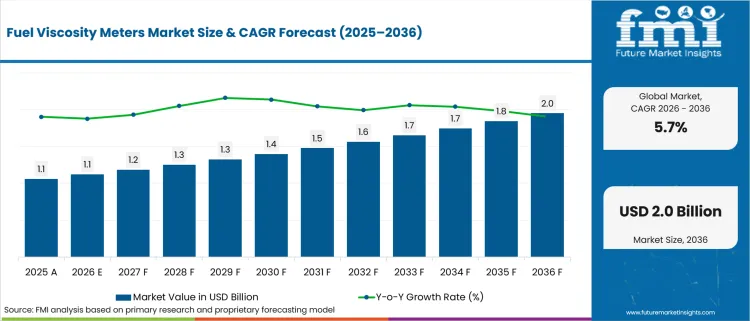
USD 1.1 billion in 2026 and USD 2.0 billion by 2036 at a 5.7% CAGR.
Demand for fuel viscosity meters is projected to expand at 5.7% CAGR between 2026 and 2036, increasing valuation from USD 1.1 billion in 2026 to USD 2.0 billion by 2036. Laboratories require faster viscosity measurement to remain comparable with accepted petroleum methods before readings enter routine quality control. ASTM International updated D7042 in May 2025 for concurrent viscosity and density measurement of liquid petroleum products and crude oils. Instrument manufacturers therefore need documented method correlation to convert faster measurement into accepted laboratory use across recurring petroleum testing.
Port fuel mixes change how often laboratories and vessels compare viscosity readings across products during acceptance and preparation. Singapore’s 5.6% forecast pace exceeds Japan’s 4.1% across ports with very different multi-fuel operating conditions. MPA reported 1.95 million tonnes of alternative marine-fuel sales in Singapore during 2025 compared with 1.35 million tonnes in 2024. More alternative-fuel deliveries increase the need for comparable property records and local service around fuel measuring devices.
Key Takeaways of Fuel Viscosity Meters Market
- Demand for fuel viscosity meters rises as laboratories and marine operators need comparable viscosity readings across conventional fuels and newer blends.
- In 2026, heavy fuel oil is expected to lead fuel type with 36.0% share because heating and atomization depend directly on controlled viscosity.
- By installation, laboratory benchtop is forecast to represent 34.0% in 2026 driven by controlled temperature handling and documented sample preparation.
- Temperature sensitivity and method correlation lengthen deployment timelines as operators must validate readings across laboratory and continuous process conditions.
- Anton Paar, PAC / Advanced Sensors, Koehler Instrument, Cannon Instrument, Bartec Benke, Sofraser, Hydramotion and VAF Instruments are the eight companies profiled across laboratory and process-measurement roles.
Analyst Perspective
“Fuel viscosity meters are easiest to justify when one traceable reading remains useful from bunker acceptance to engine conditioning. Method correlation, local calibration and control-system integration determine whether operators can use that reading without building a second validation path.”
- Nikhil Kaitwade , Principal Consultant, Future Market Insights
How is the Fuel Viscosity Meters Market segmented?
The fuel viscosity meters market is segmented by meter type, fuel type, installation, application, end use and region.
By meter type, the market covers capillary viscometers, vibrational viscometers, rotational viscometers, in-line process viscometers and portable fuel viscometers. Fuel type includes heavy fuel oil, marine gas oil, biofuels / blends, lubricating oils and alternative marine fuels, and installation covers laboratory benchtop, portable field and in-line / process mounted systems. Applications include engine fuel conditioning, bunker fuel testing, fuel quality control, refinery / terminal testing and shipboard monitoring, and end users include marine operators, fuel testing labs, refineries / terminals, power plants and OEM / service firms.
What makes In-line process viscometers central to the meter type category?
Capillary viscometers provide a reference path for laboratories that must defend a kinematic-viscosity result across fuel batches and locations. ASTM International updated D445 in July 2026 and retained calibrated glass-capillary testing across 0.2 to 300,000 mm²/s for petroleum liquids. The retained procedure gives quality teams a common comparison point for evaluating faster instruments entering laboratory workflows.
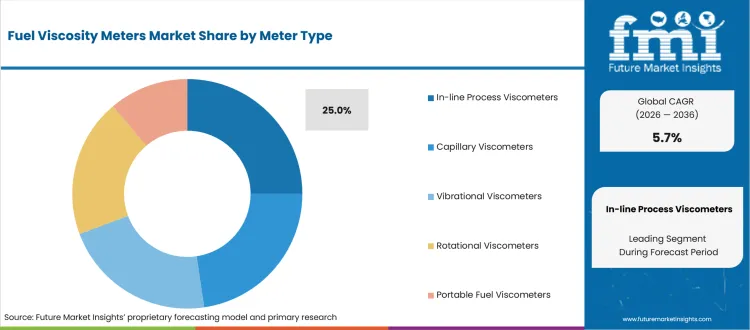
- By meter type, In-line process viscometers are estimated to hold 25.0% in 2026 owing to their established role in traceable petroleum testing.
- Fuel laboratories retain capillary methods as comparison tools whenever automated readings require correlation before acceptance decisions or recurring quality-control use.
Why does heavy fuel oil lead the fuel type category?
Heavy fuel oil makes viscosity measurement operational as heating determines whether fuel remains pumpable ahead of engine preparation. Temperature changes can alter fuel handling requirements across shipboard transfers and connected fuel-conditioning systems during operation. The measurement therefore helps engineering teams set heating conditions without treating viscosity as a static laboratory descriptor.
- In 2026, heavy fuel oil is expected to lead fuel type with 36.0% share because residual-fuel handling spans laboratory acceptance and onboard conditioning.
- The German Environment Agency stated in August 2025 that shipboard heavy fuel oil must be heated to remain pumpable, connecting viscosity measurement with marine fuel injection and transfer settings.
How does laboratory benchtop shape demand within the installation category?
Laboratory benchtop instruments concentrate sample conditioning and documentation in fuel-acceptance workflows that depend on controlled test conditions. PAC introduced the 70Xe Series in March 2026 with viscosity-and-density configurations for jet-fuel and diesel flow-property testing. The platform places controlled viscosity measurement beside other fuel properties in one documented laboratory workflow used for recurring fuel-acceptance decisions.
- By installation, laboratory benchtop is forecast to represent 34.0% in 2026 driven by controlled temperature handling and documented sample preparation.
- Flow measurement systems complement laboratory testing during bunkering but benchtop results remain necessary for traceable property records used in commercial fuel acceptance.
What supports marine operators within the end use category?
Marine operators encounter viscosity during bunker acceptance and fuel preparation so readings influence operating decisions. Alternative fuels expand the handling conditions crews must routinely evaluate across ports and vessel systems. Fleet engineering teams therefore compare traceable laboratory records with onboard measurements before adopting one operating workflow across changing bunker fuels.
- The marine operators segment is likely to capture 31.0% share in 2026 attributable to responsibility for bunker acceptance and onboard fuel conditioning.
- Singapore’s MPA requires supplied biofuel to meet density and kinematic-viscosity conditions in the relevant mass-flow-meter approval letter, linking bunker acceptance records with fuel preparation for marine engines.
What are the drivers, restraints and opportunities in the Fuel Viscosity Meters Market?
Fuel diversification increases measurement demand as temperature dependence raises validation cost while connected bunker records reward instruments that preserve accepted property data across delivery and engine workflows.
- Driver: Marine fuel diversification increases the viscosity and temperature conditions that laboratories and engine systems need to measure reliably.
- Restraint: Temperature dependence and method correlation extend qualification work as laboratory results must remain credible beside continuous process readings.
- Opportunity: Connected measurement records link laboratory acceptance with bunker documentation and engine control across one traceable fuel-quality workflow.
Fuel Diversity Expands the Measurement Burden
Marine operators plan fuel handling across conventional fuel oil and a wider set of alternative liquids with different measurement conditions. The broader mix increases demand for marine fuel filters and viscosity meters whose readings must remain comparable across changing fuel properties and accepted test methods. The March 2026 IMO GreenVoyage2050 update maps conventional fuel oil plus nine alternative fuel categories, defining the wider fuel set that instruments must measure consistently.
Temperature Correlation Extends Validation Work
Temperature changes complicate qualification because a viscosity reading at one condition cannot be transferred directly to another operating temperature. ASTM International reapproved D341 in December 2025 and requires known kinematic viscosities at two temperatures to estimate values across a limited range. Laboratory and process teams therefore document correlation before continuous instruments enter routine fuel-quality control decisions.
Connected Bunkering Strengthens the Data Route
Digital bunker records let viscometer manufacturers connect property measurements with the verified delivery record used by port and vessel teams. Intelligent flow meters already structure transaction data, while calibrated viscosity records fit the same electronic documentation path for fuel-quality review. MPA quantified the operating case in August 2026 by estimating close to 40,000 man-days of annual savings after electronic bunker delivery notes became the default in April 2025.
Which country CAGRs are profiled in the Fuel Viscosity Meters Market?
| Country | CAGR |
|---|---|
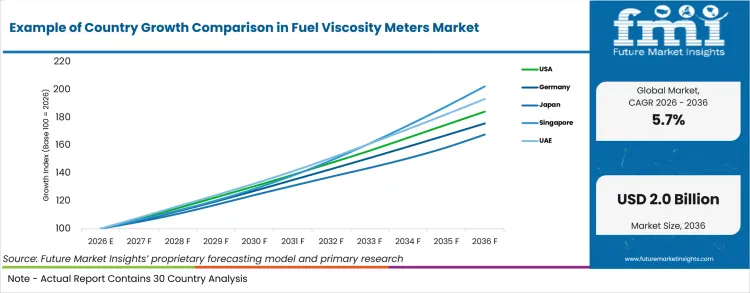
| Singapore | 5.6% |
| United Arab Emirates | 5.4% |
| United States | 4.8% |
| Germany | 4.4% |
| Japan | 4.1% |
How do country-level CAGRs compare in the Fuel Viscosity Meters Market?
A 1.5-percentage-point range separates the five profiled countries into an upper bunkering pair and three mature markets. Singapore and the United Arab Emirates combine concentrated port activity with expanding marine fuel-quality workflows. The United States, Germany and Japan progress more moderately as qualification cycles and installed equipment shape replacement timing.
- Singapore links digital bunker records with fuel-quality checks across high-volume delivery workflows.
- United Arab Emirates terminals prioritize certificate-of-quality turnaround and nearby calibration capacity.
- United States operators spread qualification across ports so regional service coverage shapes replacement timing.
- German laboratories require documented method correlation before changing accepted residual-fuel measurement platforms.
- Japan’s staged biofuel use concentrates technical learning around limited fuel-supply points.
Comparable forecast rates produce different entry conditions as method approval and local service needs vary. The full report provides country-level CAGR analysis across North America, Latin America, Europe, East Asia, South Asia, Oceania and the Middle East and Africa.
Country-wise Analysis
- Singapore’s bunkering system combines digital documentation with local testing capacity across a port where MPA reported 56.77 million tonnes of marine fuel sales during 2025 for frequent commercial bunker calls. Singapore’s fuel viscosity meters outlook is anticipated to advance at 5.6% CAGR over the assessment period supported by recurring acceptance checks across conventional and alternative bunker fuels that require comparable property records across delivery and onboard preparation. Nearby calibration and digital integration give vessel operators faster access to usable readings during short port stays but instrument manufacturers without local support face longer qualification inside approved bunker-quality procedures that govern commercial transfer documentation.
- United Arab Emirates terminal operators work within certificate-of-quality procedures that require rapid property checks before scheduled fuel transfers across major bunkering facilities serving repeated commercial vessel calls and varied fuel profiles. The United Arab Emirates fuel viscosity meters sector is projected to record 5.4% CAGR during the assessment period supported by concentrated marine service capacity and approved-laboratory workflows that tie viscosity measurements to transfer documentation. Port of Fujairah set a 500 cSt viscosity limit at 50 degrees Celsius for fuel oils and crude in May 2025 and short transfer windows leave little tolerance for instruments requiring lengthy offsite calibration before returning to service.
- United States fuel laboratories work across a broad petroleum network where EIA recorded average residual fuel oil product supplied at 315 thousand barrels per day in 2025 across national distribution and consumption channels. Adoption of fuel viscosity meters in the United States is estimated to expand at 4.8% CAGR through 2036 supported by recurring fuel-quality work across coastal ports and inland laboratories that operate far from centralized service hubs. Established fuel handling sustains testing and condition monitoring systems active across regions but instrument manufacturers need dependable calibration coverage before replacement projects convert into repeat orders across distant sites with different maintenance schedules.
- Germany combines established petroleum testing with mature shipping networks where residual fuels remain part of marine operations and laboratory quality control at major ports serving commercial vessels and terminal operators. The German Environment Agency recorded 27,221 terajoules of heavy fuel oil delivered to maritime bunkers in 2024 within its 2026 inventory and confirms a continuing residual-fuel testing base used by commercial operators across domestic ports. Germany is estimated to post 4.4% CAGR over the forecast period supported by recurring residual-fuel testing, yet mature installed equipment makes replacement during planned platform changes depend on documented method correlation and dependable regional calibration support.
- Japanese fleet operators use staged engineering evaluation for alternative-fuel trials because limited supply points make repeatable testing and dependable service necessary across domestic and international routes with long-distance fleet support requirements. Fuel viscosity meter demand in Japan is forecast to rise at 4.1% CAGR over the forecast period supported by growing operating experience across B24 and B30 plus B100 grades in staged commercial vessel trials. A July 2025 MLIT-hosted K Line presentation recorded 77 biofuel bunkering operations since 2021 but limited supply ports increase reliance on marine electronics integration and service coverage for vessels operating across Asia and Europe beyond established fueling locations.
Who are the notable companies in the Fuel Viscosity Meters Market?
Anton Paar, PAC / Advanced Sensors, Koehler Instrument, Cannon Instrument, Bartec Benke, Sofraser, Hydramotion and VAF Instruments are the notable companies serving this market.
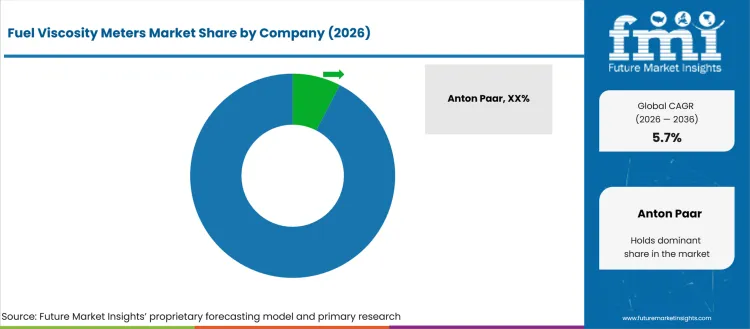
Competition is fragmented between laboratory viscometry specialists and continuous process-measurement companies serving different fuel-control tasks. Entry depends on recognized method correlation and stable temperature performance across the intended fuel range. Marine accounts also require local calibration and control-system integration, while laboratory specialists compete across lubricant testing and petroleum-method coverage.
- Anton Paar, Koehler Instrument and Cannon Instrument focus on laboratory viscometry with standards-based petroleum testing and comparison workflows.
- PAC / Advanced Sensors and Bartec Benke combine viscosity with broader petroleum analysis across laboratory and process-control workflows.
- Sofraser, Hydramotion and VAF Instruments emphasize continuous marine and process measurement tied to operating adjustments.
Competitive Benchmarking: Fuel Viscosity Meters Market
| Company | Reference-Method Compatibility | Measurement Mode Breadth | Fuel-Specific Workflow Depth | Geographic Reach |
|---|---|---|---|---|
| Anton Paar | High | Medium | High | Global |
| PAC / Advanced Sensors | High | High | High | Global |
| Koehler Instrument | High | Low | High | North America and international markets |
| Cannon Instrument | High | Low | High | North America and international markets |
| Bartec Benke | High | High | High | Europe and international markets |
| Sofraser | Medium | High | High | Global distributor markets |
| Hydramotion | Medium | High | High | Global industrial markets |
| VAF Instruments | Medium | High | High | Global marine markets |
Key Developments in the Fuel Viscosity Meters Market
- In June 2026, VAF Instruments signed a 12-vessel newbuild package with Au Lac at Korea Yanase Shipyard. The package combines viscosity, flow and shaft-power measurement with ship-performance monitoring across the newbuild series.
- In March 2026, PAC introduced the 70Xe Series, an integrated analyzer platform combining viscosity and density measurement for jet-fuel and diesel flow-property testing.
- In March 2025, Sofraser trained six distributor representatives at its headquarters on real-time viscometry and correlation workflows. The two-day program covered installation and commissioning for regional process-viscosity deployments.
Key Players in the Fuel Viscosity Meters Market
Reference-Oriented Laboratory Viscometry
- Anton Paar
- Koehler Instrument
- Cannon Instrument
Integrated Petroleum and Process Analysis
- PAC / Advanced Sensors
- Bartec Benke
Continuous Marine and Process Measurement
- Sofraser
- Hydramotion
- VAF Instruments
Fuel Viscosity Meters Market - Report Scope
| Coverage field | Report scope |
|---|---|
| Market breakdown | By meter type, fuel type, installation, application, end use and region. |
| Quantitative Units | Revenue in USD billion and CAGR in % |
| Market Definition | Commercial instruments used to measure fuel viscosity in laboratory, field, in-line process and shipboard workflows across defined fuel types and applications. |
| Regions Covered | North America, Latin America, Europe, East Asia, South Asia and Pacific and Middle East and Africa. |
| Countries Covered | Singapore, United Arab Emirates, United States, Germany, Japan, and 20+ countries included in the full report. |
| Key Companies Profiled | Anton Paar, PAC / Advanced Sensors, Koehler Instrument, Cannon Instrument, Bartec Benke, Sofraser, Hydramotion, VAF Instruments. |
| Forecast Period | 2026 to 2036. |
| Approach | Primary and secondary research with market triangulation. |
Fuel Viscosity Meters Market - Research Methodology
| Method | Approach |
|---|---|
| Primary Research | FMI analysts gathered input from manufacturers, service providers, technology developers, distributors, end users, procurement teams, and subject-matter experts. Interviews examined purchasing decisions, product or service evaluation, adoption barriers, approval requirements, pricing considerations, and expectations for technical or commercial support. Respondents were also asked what evidence is required before a trial, pilot, or initial order develops into regular purchasing. |
| Desk Research | Desk research covered government statistics, regulatory publications, trade data, industry associations, technical literature, standards, company filings, product information, and official corporate announcements. Sources were reviewed for relevance, publication date, geographic coverage, and consistency with the defined market scope. Claims relating to performance, applications, approvals, capacity, investment, and commercial activity were retained only when supported by credible public evidence. |
| Market Sizing and Forecasting | The market model combined the baseline value with historical performance, segment structure, pricing and volume indicators, adoption levels, company participation, and country-level demand conditions. Forecast assumptions considered economic activity, investment trends, regulatory developments, technology adoption, purchasing cycles, supply availability, and barriers to wider market use. Segment and regional estimates were reconciled before the final market total was calculated. |
| Data Validation | Estimates were checked against multiple independent indicators, including public data, company activity, trade patterns, industry developments, and findings from primary interviews. Validation also tested whether products, services, applications, and company revenues fell within the defined market boundaries. Adjacent categories, unsupported claims, overlapping revenues, and activities without direct market relevance were excluded to reduce double counting and maintain consistency across segments and countries. |
Fuel Viscosity Meters Market by Segments
Fuel Viscosity Meters Market segmented by Meter Type:
- Capillary Viscometers
- Vibrational Viscometers
- Rotational Viscometers
- In-line Process Viscometers
- Portable Fuel Viscometers
Fuel Viscosity Meters Market segmented by Fuel Type:
- Heavy Fuel Oil
- Marine Gas Oil
- Biofuels / Blends
- Lubricating Oils
- Alternative Marine Fuels
Fuel Viscosity Meters Market segmented by Installation:
- Laboratory Benchtop
- Portable Field
- In-line / Process Mounted
Fuel Viscosity Meters Market segmented by Application:
- Engine Fuel Conditioning
- Bunker Fuel Testing
- Fuel Quality Control
- Refinery / Terminal Testing
- Shipboard Monitoring
Fuel Viscosity Meters Market segmented by End Use:
- Marine Operators
- Fuel Testing Labs
- Refineries / Terminals
- Power Plants
- OEM / Service Firms
Fuel Viscosity Meters Market by Region:
- North America
- United States
- Canada
- Latin America
- Brazil
- Mexico
- Chile
- Rest of Latin America
- Western Europe
- Germany
- United Kingdom
- Italy
- Spain
- France
- Nordics
- Benelux
- Rest of Western Europe
- Eastern Europe
- Russia
- Poland
- Hungary
- Balkan and Baltic States
- Rest of Eastern Europe
- East Asia
- China
- Japan
- South Korea
- South Asia and Pacific
- India
- ASEAN
- Australia and New Zealand
- Rest of South Asia and Pacific
- Middle East and Africa
- Kingdom of Saudi Arabia
- Other GCC Countries
- Türkiye
- South Africa
- Other African Union Countries
- Rest of Middle East and Africa
Research Sources and Bibliography
- ASTM International. (2025, May 21). Standard Test Method for Dynamic Viscosity and Density of Liquids by Stabinger Viscometer (and the Calculation of Kinematic Viscosity).
- Maritime and Port Authority of Singapore. (2026, January 13). Singapore Posts Record Port Performance in 2025 and Develops Future Readiness through Industry Collaborations for 2026.
- ASTM International. (2026, July 9). Standard Test Method for Kinematic Viscosity of Transparent and Opaque Liquids (and Calculation of Dynamic Viscosity).
- German Environment Agency. (2025, August 5). Seeverkehr - Luftschadstoffe, Treibhausgase und Energieeffizienz.
- Port of Fujairah. (2025, May 21). NTM 364 - REVISED REQUIREMENTS FOR COQ.
- Maritime and Port Authority of Singapore. (2026, August 6). Biofuel Bunkering.
- International Maritime Organization. (2026, March 4). Maritime Alternative fuel regulatory status updated.
- ASTM International. (2025, December 24). Standard Practice for Viscosity-Temperature Equations and Charts for Liquid Petroleum or Hydrocarbon Products.
- Maritime and Port Authority of Singapore. (2026, August 6). Digital Bunkering.
- USA Energy Information Administration. (2026, May 29). Product Supplied for Residual Fuel Oil.
- German Environment Agency. (2026, April). 1.A.3.d - Navigation.
- Kawasaki Kisen Kaisha, Ltd. (2025, July).
- VAF Instruments. (2026, June 16). VAF makes an exciting step forward for the Vietnamese maritime industry.
- PAC. (2026, March 31). PAC Introduces 70Xe Series: The Ultimate Performance in Flow Properties Testing.
- PAC. (2026, April 6). PAC Acquires Emcee Electronics to Expand Jet Fuel Testing Capabilities.
- Sofraser. (2025, March 21). Distributor Training: Enhancing Viscosity Expertise and Sofraser Product Knowledge.
- Sofraser. (2026, April 27). Temperature Compensated Viscosity & Correlation: the key to process control.
- VAF Instruments. (2025, April 22). Harnessing the wind, Measuring the impact.
- Sofraser. (2025, November 18). Mastering viscosity: the key to high quality lubricants.
This bibliography is provided for reader reference and is not exhaustive. The full report contains the complete reference list and detailed citations
This Report Answers
- What are the 2026 and 2036 values for the fuel viscosity meters market?
- Which operating conditions connect fuel viscosity measurement with laboratory acceptance and engine preparation?
- Why do capillary viscometers retain the leading meter-type share?
- How does heavy fuel oil change temperature-control requirements for viscosity measurement?
- Why do laboratory benchtop systems remain central to fuel-quality workflows?
- How do market conditions differ across Singapore, the UAE, the United States, Germany and Japan?
- Which companies compete across laboratory testing and continuous process measurement?
- Which validation and service frictions delay fuel viscosity meter adoption?
- Where do connected bunker records increase the commercial value of viscosity data?
Frequently Asked Questions
How big is the Fuel Viscosity Meters Market in 2026?
The fuel viscosity meters market is expected to be valued at USD 1.1 billion in 2026. Fuel-quality testing and engine-conditioning work sustain demand because both require controlled viscosity information across laboratory and shipboard use.
What is the CAGR of the Fuel Viscosity Meters Market from 2026 to 2036?
The fuel viscosity meters market is projected to grow at a 5.7% CAGR from 2026 to 2036. Wider fuel matrices increase the need to reconcile laboratory measurements with continuous fuel handling across changing temperatures.
Which end-use segment leads the Fuel Viscosity Meters Market in 2026?
The fuel viscosity meters market is estimated to receive 31.0% of 2026 end-use demand from marine operators. Fleet teams control bunker acceptance and onboard fuel preparation, so their measurements must remain useful across changing fuel properties and temperatures.
Which companies are active in the Fuel Viscosity Meters Market?
The fuel viscosity meters market includes Anton Paar, PAC / Advanced Sensors, Koehler Instrument, Cannon Instrument, Bartec Benke, Sofraser, Hydramotion and VAF Instruments. Their roles cover reference laboratory testing, petroleum analysis and continuous marine or process measurement across fuel applications.
Preview the report firsthand - request a free sample
Get SampleGet the brochure for pricing and purchase details.
Get PDFTable of Content
- Key Takeaways
- Market Size and CAGR
- Top Growth Driver
- Fastest Growing Segment
- Leading Region
- Key Companies
- Emerging Opportunities
- Executive Summary
- Global Market Outlook
- Demand-side Trends
- Supply-side Trends
- Technology Roadmap Analysis
- Analysis and Recommendations
- Analyst Perspective (What is happening? Why now? What should investors know?)
- Key Questions Answered
- How large is the market?
- What is the CAGR?
- What are key trends?
- Which region dominates?
- Who are the leaders?
- Market Overview
- Market Coverage / Taxonomy
- Market Definition / Scope / Limitations
- Research Methodology
- Chapter Orientation
- Analytical Lens and Working Hypotheses
- Market Structure, Signals, and Trend Drivers
- Benchmarking and Cross-market Comparability
- Market Sizing, Forecasting, and Opportunity Mapping
- Research Design and Evidence Framework
- Desk Research Programme (Secondary Evidence)
- Expert Input and Fieldwork (Primary Evidence)
- Tooling, Models, and Reference Databases
- Data Engineering and Model Build
- Quality Assurance and Audit Trail
- Market Background
- Market Dynamics (Drivers, Restraints, Opportunity, Trends)
- Scenario Forecast (Optimistic, Likely, Conservative)
- Impact Analysis
- AI Impact
- Sustainability Impact
- Regulatory Impact
- Technology Impact
- Consumer / Buyer Analysis
- Purchase Drivers
- Adoption Barriers
- Buyer Journey
- Opportunity Map Analysis
- Product Life Cycle Analysis
- Supply Chain Analysis
- Investment Feasibility Matrix
- Value Chain Analysis
- PESTLE and Porter's Analysis
- Regulatory Landscape
- Regional Parent Market Outlook
- Production and Consumption Statistics
- Import and Export Statistics
- Global Market Analysis and Forecast, 2021 to 2036
- Historical Market Size Value (USD Million) Analysis, 2021 to 2025
- Current and Future Market Size Value (USD Million) Projections, 2026 to 2036
- Y-o-Y Growth Trend Analysis
- Absolute $ Opportunity Analysis
- Global Market Pricing Analysis, 2021 to 2036
- Global Market Analysis and Forecast, By Meter Type, 2021 to 2036
- Introduction / Key Findings
- Historical Market Size Value (USD Million) Analysis By Meter Type, 2021 to 2025
- Current and Future Market Size Value (USD Million) Analysis and Forecast By Meter Type, 2026 to 2036
- In-line Process Viscometers
- Capillary Viscometers
- Vibrational Viscometers
- Rotational Viscometers
- Portable Fuel Viscometers
- In-line Process Viscometers
- Y-o-Y Growth Trend Analysis By Meter Type, 2021 to 2025
- Absolute $ Opportunity Analysis By Meter Type, 2026 to 2036
- Global Market Analysis and Forecast, By Fuel Type, 2021 to 2036
- Introduction / Key Findings
- Historical Market Size Value (USD Million) Analysis By Fuel Type, 2021 to 2025
- Current and Future Market Size Value (USD Million) Analysis and Forecast By Fuel Type, 2026 to 2036
- Heavy Fuel Oil
- Marine Gas Oil
- Biofuels / Blends
- Lubricating Oils
- Alternative Marine Fuels
- Heavy Fuel Oil
- Y-o-Y Growth Trend Analysis By Fuel Type, 2021 to 2025
- Absolute $ Opportunity Analysis By Fuel Type, 2026 to 2036
- Global Market Analysis and Forecast, By Installation, 2021 to 2036
- Introduction / Key Findings
- Historical Market Size Value (USD Million) Analysis By Installation, 2021 to 2025
- Current and Future Market Size Value (USD Million) Analysis and Forecast By Installation, 2026 to 2036
- In-line / Process Mounted
- Laboratory Benchtop
- Portable Field
- In-line / Process Mounted
- Y-o-Y Growth Trend Analysis By Installation, 2021 to 2025
- Absolute $ Opportunity Analysis By Installation, 2026 to 2036
- Global Market Analysis and Forecast, By Application, 2021 to 2036
- Introduction / Key Findings
- Historical Market Size Value (USD Million) Analysis By Application, 2021 to 2025
- Current and Future Market Size Value (USD Million) Analysis and Forecast By Application, 2026 to 2036
- Engine Fuel Conditioning
- Bunker Fuel Testing
- Fuel Quality Control
- Refinery / Terminal Testing
- Shipboard Monitoring
- Engine Fuel Conditioning
- Y-o-Y Growth Trend Analysis By Application, 2021 to 2025
- Absolute $ Opportunity Analysis By Application, 2026 to 2036
- Global Market Analysis and Forecast, By End Use, 2021 to 2036
- Introduction / Key Findings
- Historical Market Size Value (USD Million) Analysis By End Use, 2021 to 2025
- Current and Future Market Size Value (USD Million) Analysis and Forecast By End Use, 2026 to 2036
- Marine Operators
- Fuel Testing Labs
- Refineries / Terminals
- Power Plants
- OEM / Service Firms
- Marine Operators
- Y-o-Y Growth Trend Analysis By End Use, 2021 to 2025
- Absolute $ Opportunity Analysis By End Use, 2026 to 2036
- Global Market Analysis and Forecast, By Region, 2021 to 2036
- Introduction
- Historical Market Size Value (USD Million) Analysis By Region, 2021 to 2025
- Current Market Size Value (USD Million) Analysis and Forecast By Region, 2026 to 2036
- North America
- Latin America
- Western Europe
- Eastern Europe
- East Asia
- South Asia and Pacific
- Middle East & Africa
- Market Attractiveness Analysis By Region
- North America Market Analysis and Forecast, By Country, 2021 to 2036
- Historical Market Size Value (USD Million) Trend Analysis By Market Taxonomy, 2021 to 2025
- Market Size Value (USD Million) Forecast By Market Taxonomy, 2026 to 2036
- By Country
- USA
- Canada
- By Meter Type
- By Fuel Type
- By Installation
- By Application
- By End Use
- By Country
- Market Attractiveness Analysis
- By Country
- By Meter Type
- By Fuel Type
- By Installation
- By Application
- By End Use
- Key Takeaways
- Latin America Market Analysis and Forecast, By Country
- Historical Market Size Value (USD Million) Trend Analysis By Market Taxonomy, 2021 to 2025
- Market Size Value (USD Million) Forecast By Market Taxonomy, 2026 to 2036
- By Country
- Brazil
- Mexico
- Chile
- Rest of Latin America
- By Meter Type
- By Fuel Type
- By Installation
- By Application
- By End Use
- By Country
- Market Attractiveness Analysis
- By Country
- By Meter Type
- By Fuel Type
- By Installation
- By Application
- By End Use
- Key Takeaways
- Western Europe Market Analysis and Forecast, By Country
- Historical Market Size Value (USD Million) Trend Analysis By Market Taxonomy, 2021 to 2025
- Market Size Value (USD Million) Forecast By Market Taxonomy, 2026 to 2036
- By Country
- Germany
- UK
- Italy
- Spain
- France
- Nordic
- BENELUX
- Rest of Western Europe
- By Meter Type
- By Fuel Type
- By Installation
- By Application
- By End Use
- By Country
- Market Attractiveness Analysis
- By Country
- By Meter Type
- By Fuel Type
- By Installation
- By Application
- By End Use
- Key Takeaways
- Eastern Europe Market Analysis and Forecast, By Country
- Historical Market Size Value (USD Million) Trend Analysis By Market Taxonomy, 2021 to 2025
- Market Size Value (USD Million) Forecast By Market Taxonomy, 2026 to 2036
- By Country
- Russia
- Poland
- Hungary
- Balkan & Baltic
- Rest of Eastern Europe
- By Meter Type
- By Fuel Type
- By Installation
- By Application
- By End Use
- By Country
- Market Attractiveness Analysis
- By Country
- By Meter Type
- By Fuel Type
- By Installation
- By Application
- By End Use
- Key Takeaways
- East Asia Market Analysis and Forecast, By Country
- Historical Market Size Value (USD Million) Trend Analysis By Market Taxonomy, 2021 to 2025
- Market Size Value (USD Million) Forecast By Market Taxonomy, 2026 to 2036
- By Country
- China
- Japan
- South Korea
- By Meter Type
- By Fuel Type
- By Installation
- By Application
- By End Use
- By Country
- Market Attractiveness Analysis
- By Country
- By Meter Type
- By Fuel Type
- By Installation
- By Application
- By End Use
- Key Takeaways
- South Asia and Pacific Market Analysis and Forecast, By Country
- Historical Market Size Value (USD Million) Trend Analysis By Market Taxonomy, 2021 to 2025
- Market Size Value (USD Million) Forecast By Market Taxonomy, 2026 to 2036
- By Country
- India
- ASEAN
- Australia & New Zealand
- Rest of South Asia and Pacific
- By Meter Type
- By Fuel Type
- By Installation
- By Application
- By End Use
- By Country
- Market Attractiveness Analysis
- By Country
- By Meter Type
- By Fuel Type
- By Installation
- By Application
- By End Use
- Key Takeaways
- Middle East & Africa Market Analysis and Forecast, By Country
- Historical Market Size Value (USD Million) Trend Analysis By Market Taxonomy, 2021 to 2025
- Market Size Value (USD Million) Forecast By Market Taxonomy, 2026 to 2036
- By Country
- Kingdom of Saudi Arabia
- Other GCC Countries
- Türkiye
- South Africa
- Other African Union
- Rest of Middle East & Africa
- By Meter Type
- By Fuel Type
- By Installation
- By Application
- By End Use
- By Country
- Market Attractiveness Analysis
- By Country
- By Meter Type
- By Fuel Type
- By Installation
- By Application
- By End Use
- Key Takeaways
- Key Countries Market Analysis
- USA
- Pricing Analysis
- Market Share Analysis, 2025
- By Meter Type
- By Fuel Type
- By Installation
- By Application
- By End Use
- Canada
- Pricing Analysis
- Market Share Analysis, 2025
- By Meter Type
- By Fuel Type
- By Installation
- By Application
- By End Use
- Mexico
- Pricing Analysis
- Market Share Analysis, 2025
- By Meter Type
- By Fuel Type
- By Installation
- By Application
- By End Use
- Brazil
- Pricing Analysis
- Market Share Analysis, 2025
- By Meter Type
- By Fuel Type
- By Installation
- By Application
- By End Use
- Chile
- Pricing Analysis
- Market Share Analysis, 2025
- By Meter Type
- By Fuel Type
- By Installation
- By Application
- By End Use
- Germany
- Pricing Analysis
- Market Share Analysis, 2025
- By Meter Type
- By Fuel Type
- By Installation
- By Application
- By End Use
- UK
- Pricing Analysis
- Market Share Analysis, 2025
- By Meter Type
- By Fuel Type
- By Installation
- By Application
- By End Use
- Italy
- Pricing Analysis
- Market Share Analysis, 2025
- By Meter Type
- By Fuel Type
- By Installation
- By Application
- By End Use
- Spain
- Pricing Analysis
- Market Share Analysis, 2025
- By Meter Type
- By Fuel Type
- By Installation
- By Application
- By End Use
- France
- Pricing Analysis
- Market Share Analysis, 2025
- By Meter Type
- By Fuel Type
- By Installation
- By Application
- By End Use
- India
- Pricing Analysis
- Market Share Analysis, 2025
- By Meter Type
- By Fuel Type
- By Installation
- By Application
- By End Use
- ASEAN
- Pricing Analysis
- Market Share Analysis, 2025
- By Meter Type
- By Fuel Type
- By Installation
- By Application
- By End Use
- Australia & New Zealand
- Pricing Analysis
- Market Share Analysis, 2025
- By Meter Type
- By Fuel Type
- By Installation
- By Application
- By End Use
- China
- Pricing Analysis
- Market Share Analysis, 2025
- By Meter Type
- By Fuel Type
- By Installation
- By Application
- By End Use
- Japan
- Pricing Analysis
- Market Share Analysis, 2025
- By Meter Type
- By Fuel Type
- By Installation
- By Application
- By End Use
- South Korea
- Pricing Analysis
- Market Share Analysis, 2025
- By Meter Type
- By Fuel Type
- By Installation
- By Application
- By End Use
- Russia
- Pricing Analysis
- Market Share Analysis, 2025
- By Meter Type
- By Fuel Type
- By Installation
- By Application
- By End Use
- Poland
- Pricing Analysis
- Market Share Analysis, 2025
- By Meter Type
- By Fuel Type
- By Installation
- By Application
- By End Use
- Hungary
- Pricing Analysis
- Market Share Analysis, 2025
- By Meter Type
- By Fuel Type
- By Installation
- By Application
- By End Use
- Kingdom of Saudi Arabia
- Pricing Analysis
- Market Share Analysis, 2025
- By Meter Type
- By Fuel Type
- By Installation
- By Application
- By End Use
- Türkiye
- Pricing Analysis
- Market Share Analysis, 2025
- By Meter Type
- By Fuel Type
- By Installation
- By Application
- By End Use
- South Africa
- Pricing Analysis
- Market Share Analysis, 2025
- By Meter Type
- By Fuel Type
- By Installation
- By Application
- By End Use
- USA
- Market Structure Analysis
- Competition Dashboard
- Competition Benchmarking
- Market Share Analysis of Top Players
- By Regional
- By Meter Type
- By Fuel Type
- By Installation
- By Application
- By End Use
- Emerging Startups
- Innovation Benchmarking
- Competition Analysis
- Competition Deep Dive
- Anton Paar
- Overview
- Product Portfolio
- Profitability by Market Segments
- Sales Footprint
- Strategy Overview
- Marketing Strategy
- Product Strategy
- Channel Strategy
- PAC / Advanced Sensors
- Koehler Instrument
- Brookfield AMETEK
- Cannon Instrument
- Bartec Benke
- Sofraser
- Hydramotion
- Emerson
- VAF Instruments
- Anton Paar
- Case Studies
- Success Stories
- Recent Developments
- Competition Deep Dive
- Assumptions & Acronyms Used


