

- Market Size (2026)
- USD 91.0 Mn
- Forecast (2036)
- USD 185.8 Mn
- CAGR (2026 to 2036)
- 7.4%
How big is Germany Stollen Market in 2026?
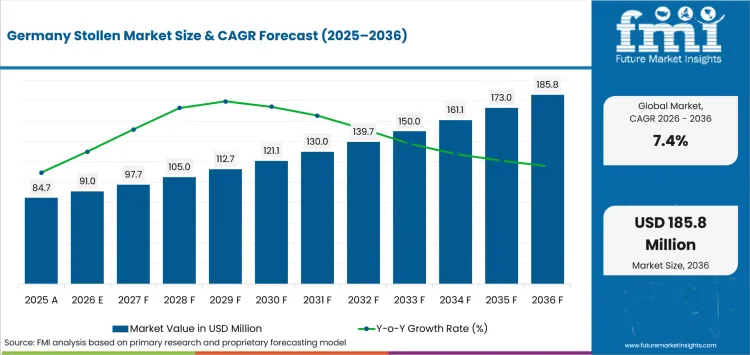
USD 91.0 million in 2026 and USD 185.8 million by 2036 at a 7.4% CAGR.
Sales of stollen in Germany are estimated to rise at a 7.4% CAGR through 2036 from USD 91.0 million in 2026 to USD 185.8 million by 2036. Retailers concentrate orders before Christmas because protected origin and familiar recipes give the category a repeat seasonal buying trigger. In October 2025, the Schutzverband Dresdner Stollen said roughly 100 protected-area producers entered its 17-day annual inspection cycle. The qualification process gives premium listings a visible authenticity test before the main selling period.
Different channel economics determine how forecast demand becomes orders in grocery and specialist bakery routes. Destatis reported in June 2025 that May sales at supermarkets and mixed-goods food retailers rose 1.5% year over year in real terms. National grocery gives seasonal lines broad access whereas Dresden specialists seek higher unit realization from provenance. The modeled increase between 2026 and 2036 is USD 94.8 million.
Key Takeaways
- Christmas ritual and protected Dresden provenance tie stollen to a repeat seasonal purchase instead of a routine year-round bakery cycle.
- Classic - original is estimated to hold 36.0% of product type demand in 2026 owing to its role as the familiar category reference point.
- Conventional is projected at 56.0% of claim - nature demand in 2026 supported by mainstream preference for familiar taste and seasonal recipes.
- Frozen is anticipated to represent 29.0% of format demand in 2026 attributable to inventory that can be prepared ahead of the narrow retail peak.
- Butter and dried-fruit exposure can compress seasonal margins as producers commit key inputs ahead of final Christmas sell-through.
- Some of the key players in this market include Kuchenmeister, Lambertz, Dr. Quendt, Emil Reimann, Dresdner Backhaus, Bäckerei Wippler, Ottendorfer Mühlenbäcker, and Bäckerei Siemank.
Analyst Perspective
"Germany stollen should be judged on post-Christmas margin because gross seasonal sell-in can hide markdown losses after the peak. Protected Dresden origin earns more when packaging and replenishment preserve the provenance premium through the final Advent weeks."
- Nandini Roy Choudhury, Principal Consultant, Future Market Insights
How is the Germany stollen market segmented?
The Germany stollen market is segmented by product type, claim - nature, format, packaging format, sales channel, and region.
Product type covers classic - original, whole grain & seeded, flavored & filled, mini & snacking formats, and premium - artisan. Claim - nature separates conventional, clean label, organic, gluten-free, and high-protein - fortified products. Format covers frozen, fresh, ambient packaged, chilled, and par-baked - thaw-and-serve. Packaging format includes multipack, single-serve, family - loaf pack, and bulk foodservice. Sales channel includes supermarkets & hypermarkets, artisan & specialty bakeries, convenience & forecourt, online - DTC, and foodservice distributors.
What makes classic - original central to the product type category?
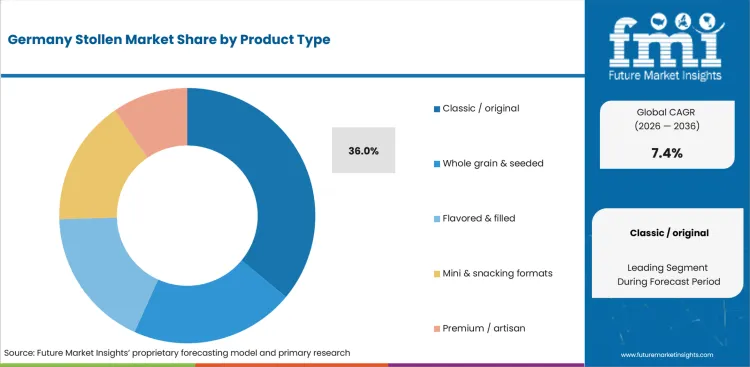
Classic - original stollen is the familiar Christmas reference shoppers use to judge newer formats and adjacent bakery products. In September 2025, the Schutzverband introduced Johanna Worm as the 31st Dresdner Stollenmädchen during her training at Ottendorfer Mühlenbäcker.
- Classic - original is estimated to hold a 36.0% share in 2026 owing to familiarity that lowers choice risk for household and gifting purchases.
- Licensed Dresden producers reinforce the format through protected recipe and quality rules that make the traditional loaf a clear benchmark for flavored or mini variants.
Why does conventional lead the claim - nature category?
Conventional stollen follows the familiar butter-and-fruit profile used in mainstream seasonal buying. Standard bakery ingredients avoid the claim-specific certification carried by organic lines during high-volume Christmas grocery planning.
- Conventional is forecast to account for 56.0% in 2026 as familiar recipes cover household and gifting purchases in mainstream grocery channels.
- Dr. Quendt received an organic operator certificate on May 30, 2025 for processed-food activity covering organic and non-organic production. The certificate documents the extra control route attached to certified organic foods and separates that route from conventional production.
How does frozen lead the format category?
Frozen stollen lets producers finish stock earlier and release it closer to Christmas demand. The Deutsches Tiefkühlinstitut reported in April 2026 that German frozen bakery sales rose 3.9% in 2025 and frozen bread and rolls increased 6.8%. Germany’s established cold-chain base lowers operational novelty for manufacturers planning inventory before the Christmas peak.
- Frozen is projected to hold 29.0% of format demand in 2026 because planned stock gives operators more control over the seasonal service window.
- Cold-storage operators can separate oven scheduling from the final selling week by holding finished stock closer to dispatch. frozen dough handling still depends on disciplined storage and thaw timing before seasonal stock reaches customers.
What supports multipack leadership in packaging format?
Multipacks suit gifting and shared consumption by splitting several portions inside one seasonal presentation unit. Gift packaging must protect freshness at shelf and give producers room to vary flavors or gifting tiers.
- Multipack is anticipated to hold 37.0% in 2026 attributable to portioned units that raise basket value and preserve a clear Christmas presentation.
- The European Commission said the Packaging and Packaging Waste Regulation entered into force on February 11, 2025. food packaging for stollen must meet the EU rule set without sacrificing shelf life. The rule increases documentation work for materials used in premium gift presentations.
Why do supermarkets & hypermarkets lead the sales channel category?
Supermarkets & hypermarkets put stollen inside the wider Christmas food basket and support seasonal displays at scale. Destatis reported in August 2025 that July sales at supermarkets and similar mixed-goods retailers rose 0.6% year over year in real terms. food-grade packaging must withstand concentrated store handling during the promotional weeks that carry most seasonal volume.
- Supermarkets & hypermarkets are estimated at 34.0% of channel demand in 2026 given the broad seasonal access provided by one-stop holiday shopping.
- National listings favor repeatable case sizes and dependable delivery during the short Christmas merchandising window. The channel advantage is strongest where seasonal replenishment can cover multiple stores without fragmenting stock.
What are the drivers, restraints and opportunities in the Germany Stollen Market?
Protected festive tradition anchors recurring demand, ingredient exposure raises margin risk, and smaller premium or direct-order formats widen the revenue routes available during the Christmas season.
- Driver: Protected Dresden provenance and a repeat Advent ritual give retailers a recognizable seasonal product with a clear reason for annual re-purchase.
- Restraint: Butter and dried-fruit commitments expose producers to input changes ahead of the short selling window that reveals final demand.
- Opportunity: Smaller gifting formats and direct ordering can lift value per buyer without depending on additional full-size loaf purchases.
Protected origin gives German shoppers a quality cue they can verify before Christmas stock peaks. On November 13, 2025 the Schutzverband documented its annual campaign after Dresden stollen bakers prepared seasonal brand material and Striezelmarkt activity. Retailers can defend a provenance premium more effectively if the origin seal stays visible on shelf and online during final Advent comparisons.
Traditional stollen requires butter and dried fruit before Christmas sell-through reveals final volume, leaving bakeries exposed to ingredient cost changes. Destatis reported in March 2025 that producer prices tracked by the butter market were 37.7% higher year over year in February. Industrial producers need firm purchasing terms and conservative batch plans because protected recipes leave little room to remove core ingredients.
Direct ordering gives Dresden bakeries a gifting route that does not depend on supermarket volume. Destatis estimated in January 2026 that German internet and mail-order retail sales rose 10.8% in real terms during January to November 2025. Smaller loaves can convert remote gifting if patisserie packaging protects freshness and parcel carriers meet the promised Christmas delivery date.
Who are the notable companies in the Germany Stollen Market?
Kuchenmeister, Lambertz, Dr. Quendt, Emil Reimann, Dresdner Backhaus, Bäckerei Wippler, Ottendorfer Mühlenbäcker, and Bäckerei Siemank are notable companies active in this market.
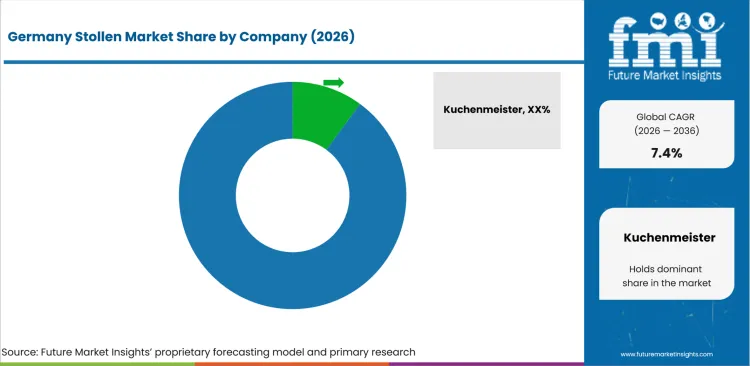
Competition separates industrial stollen scale from protected-origin bakery specialization, so entry barriers depend on the route each company serves. Kuchenmeister's corporate quality page lists stollen in its current assortment and states that all production sites are IFS certified. Lambertz identifies Dr. Quendt as the group's largest Dresdner Stollen provider within its protected-origin portfolio. The Schutzverband register confirms the six Dresden-based companies in this article as licensed producers. Companies outside that protected route must compete through volume, shelf access or gifting service without using the Dresden-origin claim.
- Scaled seasonal production: Kuchenmeister and Lambertz serve high-volume Christmas bakery programs, with Lambertz also reaching the protected Dresden segment through Dr. Quendt.
- Protected-origin specialists: Dr. Quendt and Emil Reimann pair Dresden provenance with documented food-safety controls for stollen production.
- Local craft depth: Dresdner Backhaus and Bäckerei Wippler compete alongside Ottendorfer Mühlenbäcker and Bäckerei Siemank within the licensed Dresden producer network.
Competitive Benchmarking: Germany Stollen Market
| Company | Documented Stollen Scale | Origin / Quality Qualification | Route-to-Market Breadth | Geographic Reach |
|---|---|---|---|---|
| Kuchenmeister | High | Medium | High | Germany and export markets |
| Lambertz | High | Medium | High | Germany and international markets |
| Dr. Quendt | High | High | High | Germany |
| Emil Reimann | Medium | High | Medium | Germany |
| Dresdner Backhaus | Medium | Medium | Medium | Dresden region |
| Bäckerei Wippler | Medium | Medium | Medium | Dresden region |
| Ottendorfer Mühlenbäcker | Medium | Medium | Medium | Dresden region |
| Bäckerei Siemank | Medium | Medium | Medium | Dresden region |
High documented stollen scale requires public evidence of broad production or a dedicated high-volume seasonal line. Medium requires licensed production or a narrower certified stollen operation serving a regional or specialist route. High origin and quality qualification requires protected-origin participation plus current food-safety certification. Medium requires one verified origin or quality-control route. High route breadth requires national or international channels plus direct access, while Medium reflects a verified local or regional route.
Key Developments in the Germany Stollen Market
- In April 2026, Bäckerei Wippler offered hands-on stollen baking classes listed by the Schutzverband for visitors and private groups in Dresden. The service turns protected-origin knowledge into paid customer contact and can feed later seasonal gifting purchases.
- In September 2025, Dr. Quendt received IFS Food certification covering Dresdner Christstollen and other stollen types after an August audit. The certificate gives retail programs current production-control evidence without replacing the separate protected-origin qualification.
- In July 2025, Emil Reimann received an IFS Food certificate covering stollen and stollen specialties after a May audit. The 97.20% Higher Level score gives seasonal retail programs a current production-control record during the manufacturing ramp.
Key Players in the Germany Stollen Market
Industrial and Multi-Brand Seasonal Platforms
- Kuchenmeister
- Lambertz
Scaled Dresden-Origin Specialists
- Dr. Quendt
- Emil Reimann
Dresden Craft and Direct-Sale Specialists
- Dresdner Backhaus
- Bäckerei Wippler
- Ottendorfer Mühlenbäcker
- Bäckerei Siemank
Germany Stollen Market - Report Scope
| Coverage field | Report scope |
|---|---|
| Market breakdown | By product type, claim - nature, format, packaging format, sales channel, and region. |
| Quantitative Units | USD million. |
| Market Definition | Commercial stollen sold in Germany through industrial, protected-origin, bakery, grocery, direct, and foodservice routes within the defined product taxonomy. |
| Countries Covered | Germany. |
| Key Companies Profiled | Kuchenmeister, Lambertz, Dr. Quendt, Emil Reimann, Dresdner Backhaus, Bäckerei Wippler, Ottendorfer Mühlenbäcker, Bäckerei Siemank |
| Forecast Period | 2026 to 2036. |
| Approach | Primary and secondary research with market triangulation. |
Germany Stollen Market - Research Methodology
| Method | Approach |
|---|---|
| Primary Research | FMI analysts gathered input from manufacturers, service providers, technology developers, distributors, end users, procurement teams, and subject-matter experts. Interviews examined purchasing decisions, product or service evaluation, adoption barriers, approval requirements, pricing considerations, and expectations for technical or commercial support. Respondents were also asked what evidence is required before a trial, pilot, or initial order develops into regular purchasing. |
| Desk Research | Desk research covered government statistics, regulatory publications, trade data, industry associations, technical literature, standards, company filings, product information, and official corporate announcements. Sources were reviewed for relevance, publication date, geographic coverage, and consistency with the defined market scope. Claims relating to performance, applications, approvals, capacity, investment, and commercial activity were retained only when supported by credible public evidence. |
| Market Sizing and Forecasting | The market model combined the baseline value with historical performance, segment structure, pricing and volume indicators, adoption levels, company participation, and country-level demand conditions. Forecast assumptions considered economic activity, investment trends, regulatory developments, technology adoption, purchasing cycles, supply availability, and barriers to wider market use. Segment and regional estimates were reconciled before the final market total was calculated. |
| Data Validation | Estimates were checked against multiple independent indicators, including public data, company activity, trade patterns, industry developments, and findings from primary interviews. Validation also tested whether products, services, applications, and company revenues fell within the defined market boundaries. Adjacent categories, unsupported claims, overlapping revenues, and activities without direct market relevance were excluded to reduce double counting and maintain consistency across segments and countries. |
Germany Stollen Market by Segments
Germany Stollen Market segmented by Product Type:
- Classic - original
- Whole grain & seeded
- Flavored & filled
- Mini & snacking formats
- Premium - artisan
Germany Stollen Market segmented by Claim - Nature:
- Conventional
- Clean label
- Organic
- Gluten-free
- High-protein - fortified
Germany Stollen Market segmented by Format:
- Frozen
- Fresh
- Ambient packaged
- Chilled
- Par-baked - thaw-and-serve
Germany Stollen Market segmented by Packaging Format:
- Multipack
- Single-serve
- Family - loaf pack
- Bulk foodservice
Germany Stollen Market segmented by Sales Channel:
- Supermarkets & hypermarkets
- Artisan & specialty bakeries
- Convenience & forecourt
- Online - DTC
- Foodservice distributors
Research Sources and Bibliography
- Schutzverband Dresdner Stollen e.V. (2025, October 28). A First on Board: Stollen Inspection on the Elbe.
- Statistisches Bundesamt. (2025, June 30). Einzelhandelsumsatz im Mai 2025 real um 1,6 % niedriger als im Vormonat.
- Schutzverband Dresdner Stollen e.V. (2025, September 22). Welcome, Johanna Worm!.
- Grünstempel Ökoprüfstelle e.V. (2025, May 30). Zertifikat DE-ÖKO-021.276-0018985.2025.001.
- Deutsches Tiefkühlinstitut e.V. (2026, April 23). dti-Absatzstatistik 2025: Tiefkühlkost weiter auf Wachstumskurs.
- European Commission, Directorate-General for Environment. (2025, February 11). New rules enter into force for a more sustainable and competitive packaging economy.
- Statistisches Bundesamt. (2025, August 29). Einzelhandelsumsatz im Juli 2025 real um 1,5 % niedriger als im Vormonat.
- Schutzverband Dresdner Stollen e.V. (2025, November 13). Welcome to Santa’s Home. 2025 Annual Campaign.
- German Federal Statistical Office. (2025, March 20). Producer prices in February 2025: +0.7% on February 2024.
- Statistisches Bundesamt. (2026, January 7). Einzelhandelsumsatz im Jahr 2025 real voraussichtlich um 2,4 % höher als im Vorjahr.
- Zentralverband des Deutschen Bäckerhandwerks e.V. (2026, June 9). Bäckerhandwerk zeigt Stabilität, doch Betriebe zunehmend unter Druck.
- Kuchenmeister GmbH. (n.d.). Unser Qualitätsversprechen. Retrieved September 6, 2026.
- Aachener Printen- und Schokoladenfabrik Henry Lambertz GmbH & Co. KG. (n.d.). The Lambertz group. Retrieved September 6, 2026.
- Schutzverband Dresdner Stollen e.V. (n.d.). Stollenbäcker in Dresden. Retrieved September 6, 2026.
- ARS PROBATA GmbH. (2025, September 19). IFS Food Certificate IFS-2440/2025.
- TÜV SÜD Management Service GmbH. (2025, July 14). IFS Food Certificate 12 024 60171 TMS.
- Aachener Printen- und Schokoladenfabrik Henry Lambertz GmbH & Co. KG. (2025, April 10). Ein neuer Blickfang in Aachen: Lambertz Flagship-Store eröffnet.
- Kuchenmeister GmbH. (2025, July). KuchenMeister veröffentlicht neuen Nachhaltigkeitsbericht 2025.
- Ottendorfer Mühlenbäcker. (2026, June 12). Neueröffnung Café Hamburger Straße, Dresden.
- Aachener Printen- und Schokoladenfabrik Henry Lambertz GmbH & Co. KG. (2026, July 9). #LambertzImGespräch: Videoreihe mit der RUNDSCHAU für den Lebensmittelhandel.
- Schutzverband Dresdner Stollen e.V. (2026, April 1). Like being in 7th Stollen Heaven: Stollen-Baking Classes in Dresden.
- Control Union Certifications B.V. (2025, July 10). RSPO Supply Chain Certificate CU-RSPO SCC-839882.
- ARS PROBATA GmbH. (2025, September 11). IFS Broker Certificate IFS-B-2441/2025.
- Ottendorfer Mühlenbäcker. (2025, May 22). Neueröffnung im Kaufland Heidenau.
- Kuchenmeister GmbH. (2026, May 20). Höchste Qualitätsauszeichnung: KuchenMeister erneut mit dem Bundesehrenpreis in Gold geehrt.
This bibliography is provided for reader reference and is not exhaustive. The full report contains the complete reference list and detailed citations.
This Report Answers
- How large is the Germany stollen market in 2026 and what value is projected for 2036?
- Which operating conditions explain the 7.4% headline CAGR through 2036?
- Why does classic - original hold the largest approved product type share?
- How do conventional and frozen positions differ from multipack and supermarket roles?
- Which ingredient and inventory risks can weaken seasonal margins?
- How should the 6.9% Germany country CAGR be interpreted against the headline market forecast?
- Which companies compete through industrial scale versus protected origin and local craft routes?
- What evidence separates higher and lower competitive benchmarking ratings?
- Which current company actions affect qualification and distribution as well as direct seasonal access?
Frequently Asked Questions
How big is the Germany stollen market in 2026?
The Germany stollen market is valued at USD 91.0 million in 2026 and is projected to reach USD 185.8 million by 2036. Protected seasonal purchasing and wider retail access provide the main commercial route behind that forecast.
What is the CAGR of the Germany stollen market from 2026 to 2036?
Growth in the Germany stollen market is projected at a CAGR of 7.4% between 2026 and 2036. Repeat Christmas purchasing and protected Dresden provenance support the forecast as producers manage a concentrated seasonal inventory cycle.
Which product type leads the Germany stollen market?
The classic - original segment is expected to hold 36.0% of the Germany stollen market in 2026, attributable to familiar recipe cues and strong seasonal recognition. Protected Dresden origin reinforces that reference position during premium household and gifting purchases.
Which claim - nature segment leads the Germany stollen market?
The conventional segment is expected to hold 56.0% of the Germany stollen market in 2026, supported by mainstream preference for familiar festive recipes. Organic and other claim-led alternatives require extra formulation controls or certification before seasonal listings scale.
How much value will the Germany stollen market add between 2026 and 2036?
The modeled increase for the Germany stollen market is USD 94.8 million between 2026 and 2036. Higher value per seasonal purchase and broader format choice account for the modeled increase.
What country CAGR is profiled for the Germany stollen market?
Germany is projected to record a 6.9% CAGR from 2026 to 2036 within the country profile. Local performance depends on grocery reach and protected Dresden demand as bakeries manage a concentrated seasonal inventory cycle.
Which companies are active in the Germany stollen market?
Key companies operating in the market include Kuchenmeister, Lambertz, Dr. Quendt, Emil Reimann, Dresdner Backhaus, Bäckerei Wippler, Ottendorfer Mühlenbäcker, and Bäckerei Siemank. These companies compete through production scale, protected-origin credentials and documented quality controls tied to seasonal channel reach.
Preview the report firsthand - request a free sample
Get SampleGet the brochure for pricing and purchase details.
Get PDFTable of Content
- Key Takeaways
- Market Size and CAGR
- Top Growth Driver
- Fastest Growing Segment
- Leading Region
- Key Companies
- Emerging Opportunities
- Executive Summary
- Germany Market Outlook
- Demand-side Trends
- Supply-side Trends
- Technology Roadmap Analysis
- Analysis and Recommendations
- Analyst Perspective (What is happening? Why now? What should investors know?)
- Key Questions Answered
- How large is the market?
- What is the CAGR?
- What are key trends?
- Which region dominates?
- Who are the leaders?
- Market Overview
- Market Coverage / Taxonomy
- Market Definition / Scope / Limitations
- Research Methodology
- Chapter Orientation
- Analytical Lens and Working Hypotheses
- Market Structure, Signals, and Trend Drivers
- Benchmarking and Cross-market Comparability
- Market Sizing, Forecasting, and Opportunity Mapping
- Research Design and Evidence Framework
- Desk Research Programme (Secondary Evidence)
- Expert Input and Fieldwork (Primary Evidence)
- Tooling, Models, and Reference Databases
- Data Engineering and Model Build
- Quality Assurance and Audit Trail
- Market Background
- Market Dynamics (Drivers, Restraints, Opportunity, Trends)
- Scenario Forecast (Optimistic, Likely, Conservative)
- Impact Analysis
- AI Impact
- Sustainability Impact
- Regulatory Impact
- Technology Impact
- Consumer / Buyer Analysis
- Purchase Drivers
- Adoption Barriers
- Buyer Journey
- Opportunity Map Analysis
- Product Life Cycle Analysis
- Supply Chain Analysis
- Investment Feasibility Matrix
- Value Chain Analysis
- PESTLE and Porter's Analysis
- Regulatory Landscape
- Regional Parent Market Outlook
- Production and Consumption Statistics
- Import and Export Statistics
- Germany Market Analysis and Forecast, 2021 to 2036
- Historical Market Size Value (USD Million) Analysis, 2021 to 2025
- Current and Future Market Size Value (USD Million) Projections, 2026 to 2036
- Y-o-Y Growth Trend Analysis
- Absolute $ Opportunity Analysis
- Germany Market Pricing Analysis, 2021 to 2036
- Germany Market Analysis and Forecast, By Product Type, 2021 to 2036
- Introduction / Key Findings
- Historical Market Size Value (USD Million) Analysis By Product Type, 2021 to 2025
- Current and Future Market Size Value (USD Million) Analysis and Forecast By Product Type, 2026 to 2036
- Classic / original
- Whole grain & seeded
- Flavored & filled
- Mini & snacking formats
- Premium / artisan
- Classic / original
- Y-o-Y Growth Trend Analysis By Product Type, 2021 to 2025
- Absolute $ Opportunity Analysis By Product Type, 2026 to 2036
- Germany Market Analysis and Forecast, By Claim / Nature, 2021 to 2036
- Introduction / Key Findings
- Historical Market Size Value (USD Million) Analysis By Claim / Nature, 2021 to 2025
- Current and Future Market Size Value (USD Million) Analysis and Forecast By Claim / Nature, 2026 to 2036
- Conventional
- Clean label
- Organic
- Gluten-free
- High-protein / fortified
- Conventional
- Y-o-Y Growth Trend Analysis By Claim / Nature, 2021 to 2025
- Absolute $ Opportunity Analysis By Claim / Nature, 2026 to 2036
- Germany Market Analysis and Forecast, By Format, 2021 to 2036
- Introduction / Key Findings
- Historical Market Size Value (USD Million) Analysis By Format, 2021 to 2025
- Current and Future Market Size Value (USD Million) Analysis and Forecast By Format, 2026 to 2036
- Frozen
- Fresh
- Ambient packaged
- Chilled
- Par-baked / thaw-and-serve
- Frozen
- Y-o-Y Growth Trend Analysis By Format, 2021 to 2025
- Absolute $ Opportunity Analysis By Format, 2026 to 2036
- Germany Market Analysis and Forecast, By Packaging Format, 2021 to 2036
- Introduction / Key Findings
- Historical Market Size Value (USD Million) Analysis By Packaging Format, 2021 to 2025
- Current and Future Market Size Value (USD Million) Analysis and Forecast By Packaging Format, 2026 to 2036
- Multipack
- Single-serve
- Family / loaf pack
- Bulk foodservice
- Multipack
- Y-o-Y Growth Trend Analysis By Packaging Format, 2021 to 2025
- Absolute $ Opportunity Analysis By Packaging Format, 2026 to 2036
- Germany Market Analysis and Forecast, By Sales Channel, 2021 to 2036
- Introduction / Key Findings
- Historical Market Size Value (USD Million) Analysis By Sales Channel, 2021 to 2025
- Current and Future Market Size Value (USD Million) Analysis and Forecast By Sales Channel, 2026 to 2036
- Supermarkets & hypermarkets
- Artisan & specialty bakeries
- Convenience & forecourt
- Online & DTC
- Foodservice distributors
- Supermarkets & hypermarkets
- Y-o-Y Growth Trend Analysis By Sales Channel, 2021 to 2025
- Absolute $ Opportunity Analysis By Sales Channel, 2026 to 2036
- Germany Market Analysis and Forecast, By Region, 2021 to 2036
- Introduction
- Historical Market Size Value (USD Million) Analysis By Region, 2021 to 2025
- Current Market Size Value (USD Million) Analysis and Forecast By Region, 2026 to 2036
- Germany
- Market Attractiveness Analysis By Region
- Germany Market Analysis and Forecast, By Country, 2021 to 2036
- Historical Market Size Value (USD Million) Trend Analysis By Market Taxonomy, 2021 to 2025
- Market Size Value (USD Million) Forecast By Market Taxonomy, 2026 to 2036
- By Country
- By Product Type
- By Claim / Nature
- By Format
- By Packaging Format
- By Sales Channel
- By Country
- Market Attractiveness Analysis
- By Country
- By Product Type
- By Claim / Nature
- By Format
- By Packaging Format
- By Sales Channel
- Key Takeaways
- Key Countries Market Analysis
- Germany
- Pricing Analysis
- Market Share Analysis, 2025
- By Product Type
- By Claim / Nature
- By Format
- By Packaging Format
- By Sales Channel
- Germany
- Market Structure Analysis
- Competition Dashboard
- Competition Benchmarking
- Market Share Analysis of Top Players
- By Regional
- By Product Type
- By Claim / Nature
- By Format
- By Packaging Format
- By Sales Channel
- Emerging Startups
- Innovation Benchmarking
- Competition Analysis
- Competition Deep Dive
- Kuchenmeister
- Overview
- Product Portfolio
- Profitability by Market Segments
- Sales Footprint
- Strategy Overview
- Marketing Strategy
- Product Strategy
- Channel Strategy
- Lambertz
- Dr. Quendt
- Emil Reimann
- Dresdner Backhaus
- Bahlsen
- Dr. Oetker
- Bauli
- Kuchenmeister
- Case Studies
- Success Stories
- Recent Developments
- Competition Deep Dive
- Assumptions & Acronyms Used


