

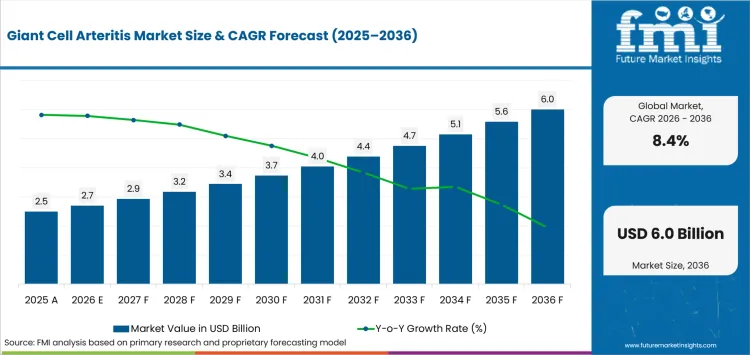
- Market Size (2026)
- USD 2.7 Bn
- Forecast (2036)
- USD 6.0 Bn
- CAGR (2026 to 2036)
- 8.4%
How big is the Giant Cell Arteritis Market in 2026?
USD 2.7 billion in 2026 and USD 6.0 billion by 2036 at an 8.4% CAGR.
Demand in the giant cell arteritis market is anticipated to push valuation from USD 2.7 billion in 2026 to USD 6.0 billion by 2036 at 8.4% CAGR. Adoption is being supported by increasing adoption of targeted therapies that improve disease control while reducing reliance on long-term corticosteroid treatment. Data from the Phase 3 SELECT-GCA trial showed sustained remission in 46% of 428 Rinvoq participants compared with 29% receiving placebo, demonstrating the potential of newer therapies to deliver improved clinical outcomes. The remission advantage provides clinicians with a clear efficacy basis for evaluating targeted treatment options against prolonged corticosteroid exposure.
Japan is forecast to expand at an 8.6% CAGR compared with 7.5% CAGR for Germany over the forecast period. The Japanese Circulation Society's March 2026 guideline reported sustained remission in 56% of patients receiving weekly subcutaneous tocilizumab compared with 14% under a 26-week placebo taper in a 251-patient trial. This strong clinical evidence, combined with formal inclusion in treatment guidance, supports greater physician confidence and more consistent use of advanced therapies in Japan. Reimbursement policies and monitoring requirements remain important determinants of funded treatment uptake.
Key Takeaways of Giant Cell Arteritis Market
- Urgent treatment and relapse management sustain medicine demand and specialist monitoring across extended care pathways.
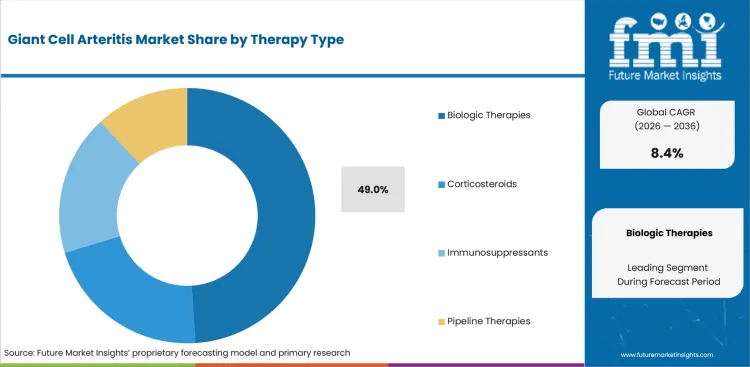
- Biologic therapies are projected at 49.0% share in 2026 due to established steroid-sparing treatment and targeted development.
- Newly diagnosed giant cell arteritis is estimated to hold 43.0% in 2026, owing to immediate treatment decisions.
- Injectable treatment is forecast at 58.0% of route demand in 2026 supported by subcutaneous biologics and monitored infusion care.
- Infection screening, cardiovascular assessment and national reimbursement criteria restrict targeted treatment use across older patient groups.
- F. Hoffmann-La Roche Ltd., AbbVie Inc., Fresenius Kabi AG, Celltrion Inc., Organon & Co., Gedeon Richter Plc., Bio-Thera Solutions, Ltd. and Novartis AG are some notable players.
Analyst Perspective
"Commercial planning in giant cell arteritis must separate emergency corticosteroid use from the later steroid-sparing decision. Oral and injectable competitors need durable remission evidence that fits taper schedules and national safety and reimbursement thresholds."
- Anurag Sharma, Principal Consultant, Future Market Insights
How is the Giant Cell Arteritis Market segmented?
The Giant Cell Arteritis Market is segmented by therapy type, disease stage, route of administration, end user, distribution channel and region.
The giant cell arteritis market is segmented by therapy type, disease stage, route of administration, end user, distribution channel and region. Therapy type covers biologics, corticosteroids, immunosuppressants and pipeline therapies, while disease stage distinguishes newly diagnosed, relapsing and complicated disease. Routes include injectable, oral and hospital-administered treatment, while end users and distribution channels distinguish hospitals, specialty clinics, infusion centers and pharmacy supply.
Why do Biologic Therapies lead the therapy type category?
Biologic therapies offer a steroid-sparing route for patients facing relapse or cumulative corticosteroid toxicity. Rheumatologists compare taper durability against administration burden and infection risk as they shift maintenance treatment away from corticosteroids. Hospital teams also need protocols for monoclonal antibodies that connect screening results with taper changes during maintenance.
- Based on therapy type, biologic therapies are projected to account for 49.0% in 2026 due to established interleukin-6 inhibition and steroid-sparing use.
- Biologic entrants must demonstrate sustained remission with a practical taper before hospital formularies compare them against approved interleukin-6 inhibition. Evidence packages also need infection-risk data and corticosteroid-exposure outcomes for older patients.
Why does Newly Diagnosed Giant Cell Arteritis lead the disease stage category?
Newly diagnosed disease carries the first urgent treatment decision as cranial ischemia can threaten vision ahead of complete vascular documentation. Autoimmune disease testing combines inflammatory markers with imaging to guide immediate treatment decisions and define taper needs.
- In 2026, newly diagnosed giant cell arteritis is expected to lead disease stage with 43.0% share because immediate treatment precedes reliable relapse history.
- Hospitals require rapid corticosteroid access and vascular imaging during the first treatment decision. Targeted treatment then depends on confirmed disease activity and a practical follow-up plan for tapering and relapse surveillance throughout specialist care.
Why does Injectable lead the route of administration category?
The European Medicines Agency product overview current in April 2026 lists adult giant cell arteritis within RoActemra’s authorized use. Injectable treatment combines subcutaneous biologic use with intravenous administration for monitored initiation or selected complications.
- By route of administration, injectable treatment is estimated to hold 58.0% in 2026 owing to subcutaneous biologics and monitored intravenous care.
- Outpatient use depends on training that preserves dosing accuracy beyond the infusion unit. Hospital pharmacies connect screening records with cold-chain supply and laboratory follow-up across maintenance treatment. Patient-support teams must preserve adherence during weekly or every-other-week dosing across extended maintenance.
Why do Hospitals lead the end user category?
Hospitals connect rheumatology with ophthalmology and vascular imaging for patients needing urgent diagnosis or monitored therapy across emergency referrals nationwide. Pharmacy automation supports controlled dispensing across initial medicine supply within hospital pharmacies and specialist departments.
- The end user category is forecast to be led by hospitals at 46.0% share in 2026 due to multidisciplinary diagnosis and monitored treatment initiation.
- Hospital formularies coordinate corticosteroid supply with biologic screening and infusion capacity during initiation. Specialist teams use one controlled setting for complex cases requiring treatment escalation and adverse-event review. Concentrated care can shorten escalation decisions during vision-threatening presentations and relapses requiring multidisciplinary review.
What are the drivers, restraints and opportunities in the Giant Cell Arteritis Market?
Approved steroid-sparing medicines increase treatment choice, while safety review and national access rules restrict use as oral therapy and biosimilars widen commercial routes.
- Driver: Approved steroid-sparing therapies provide measurable remission routes that reduce dependence on prolonged high-dose corticosteroid treatment.
- Restraint: Safety screening and national health technology assessment narrow the patients who receive targeted medicines across routine care pathways.
- Opportunity: Oral targeted medicines and tocilizumab biosimilars broaden treatment choice across relapse control, route preference and national access decisions.
Approved oral JAK inhibitors complement established biologics for adults needing a steroid-sparing route. Uptake depends on sustained-remission evidence and payer comparisons as tocilizumab biosimilars widen route and price choices.
Targeted immunomodulator therapies require infection screening and risk review in older patients with frequent comorbidities. National assessments can narrow reimbursement despite approval and delay repeat prescribing across hospital or specialty pharmacies.
Research sponsors are testing shorter prednisone tapers with tocilizumab during sustained disease control. ClinicalTrials.gov listed a 178-participant Swiss phase III study in May 2026 that compares eight-week and twenty-six-week schedules. Reported outcomes could inform future protocols, while small molecule inhibitors require exact-market evidence and reimbursement acceptance.
Which country CAGRs are profiled in the Giant Cell Arteritis Market?
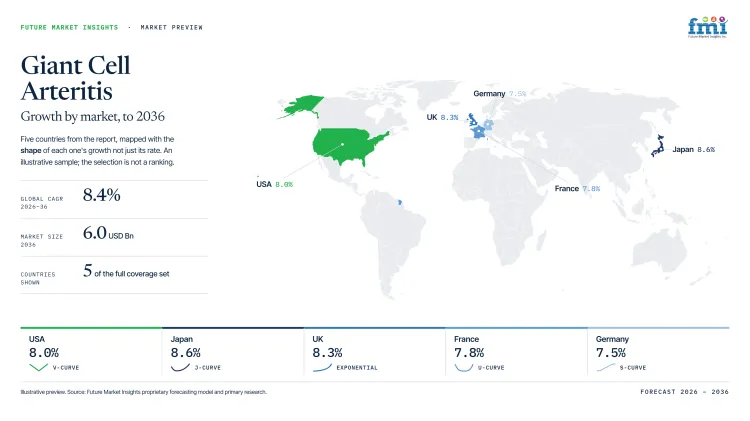
| Country | CAGR |
|---|---|
| Japan | 8.6% |
| United Kingdom | 8.3% |
| United States | 8.0% |
| France | 7.8% |
| Germany | 7.5% |
How do country-level CAGRs compare in the Giant Cell Arteritis Market?
The five approved country CAGRs span 1.1 percentage points across the complete displayed forecast comparison. The narrow range describes expected pace rather than current revenue, present treatment access or existing patient volumes.
- Japan reflects formal treatment guidance and designated-disease administration across specialist care pathways.
- The United Kingdom remains close despite unsettled NHS access for newer steroid-sparing medicines.
- The United States reaches 8.0% CAGR as broad specialist networks operate within varied insurance requirements.
- France records 7.8% CAGR as national reimbursement limits targeted treatment to defined steroid-sparing circumstances.
- Germany reaches 7.5% CAGR amid formal benefit assessment and negotiated national reimbursement requirements for new medicines.
Comparable CAGRs can produce different market entry conditions. The full report provides country-level CAGR analysis across North America, Latin America, Europe, East Asia, South Asia and Pacific, and the Middle East and Africa.
Country-wise Analysis
- Japan routes giant cell arteritis care through designated-disease administration and regional hospitals that combine rheumatology with vascular imaging for urgent treatment and prolonged follow-up among older patients across prefectural referral networks. In April 2026 the Ministry of Health, Labour and Welfare listed giant cell arteritis as designated disease number 41 and maintained national diagnosis records and medical expense support routes for eligible patients. In Japan, giant cell arteritis demand is predicted to advance at 8.6% CAGR through 2036 supported by formal recognition but constrained by rheumatology shortages and referral distance outside major cities that slow diagnosis and reimbursed medicine orders.
- United Kingdom access depends on national NHS rheumatology pathways that connect urgent corticosteroid treatment with assessed steroid-sparing medicines across specialist hospitals and devolved health systems serving older patients nationwide with vascular imaging access. NICE issued draft guidance in January 2026 that did not recommend routine upadacitinib use and retained an October 2026 expected publication date following further evidence review and a second committee meeting. The United Kingdom’s giant cell arteritis outlook is anticipated to advance at 8.3% CAGR over the assessment period, shaped by coordinated review but limited by uncertain formulary timing and travel to specialist centers outside major referral networks.
- United States rheumatology centers and hospital pharmacies support injectable biologics and oral targeted treatment across commercial insurance networks with varied benefit designs and authorization rules serving urban and rural patients through specialist referral systems nationwide. The Food and Drug Administration approved upadacitinib for adults with giant cell arteritis in April 2025 and added an oral route beside approved tocilizumab products and biosimilars. Giant cell arteritis sales in the United States are forecast to expand at 8.0% CAGR by 2036, reinforced by broad specialist capacity but constrained by prior authorization and cost sharing that delay specialty-pharmacy access during extended treatment.
- France channels giant cell arteritis treatment through hospital rheumatology teams and centralized national reimbursement review that define eligibility for newer steroid-sparing medicines across regional referral systems serving older patients nationwide with vascular imaging access. HAS stated in December 2025 that upadacitinib received a favorable opinion for corticosteroid dependence at 7.5 mg daily or greater with repeated relapses and no appropriate alternative available within hospital care. Adoption of targeted treatment in France is estimated to expand at 7.8% CAGR through 2036, influenced by defined eligibility but constrained by documentation and specialist authorization requirements that govern routine regional formulary access.
- Germany combines university rheumatology centers with formal benefit assessment that compares new medicines against defined alternatives before national price negotiations and regional formulary decisions across statutory insurance networks with established vascular imaging capacity. IQWiG reported in November 2025 that added benefit for upadacitinib was not proven across two assessed adult populations despite legal market access and specialist prescribing availability for routine care. The German giant cell arteritis sector is projected to record 7.5% CAGR during the assessment period, led by specialist capacity but constrained by comparator-aligned evidence requirements that shape national negotiations and repeat prescribing across regional formularies nationally.
Who are the notable companies in the Giant Cell Arteritis Market?
F. Hoffmann-La Roche Ltd., AbbVie Inc., Fresenius Kabi AG, Celltrion Inc., Organon & Co., Gedeon Richter Plc., Bio-Thera Solutions, Ltd. and Novartis AG are the notable companies serving this market.
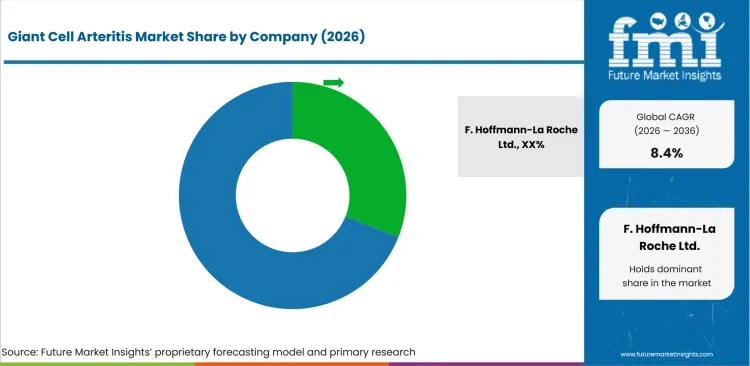
Competition is moderately concentrated as two originator medicines define targeted treatment and several tocilizumab biosimilars compete on route and regional access. Autoimmune disease therapeutics require indication-specific evidence, taper design and payer acceptance that limit entry beyond manufacturing scale.
- F. Hoffmann-La Roche Ltd. and AbbVie Inc. hold approved targeted positions through tocilizumab and upadacitinib.
- Fresenius Kabi AG, Celltrion Inc. and Organon & Co. commercialize tocilizumab biosimilars across distinct regional or administration channels.
- Gedeon Richter Plc. holds a European tocilizumab biosimilar position, Bio-Thera Solutions, Ltd. developed TOFIDENCE and Novartis AG has completed phase III evidence.
Competitive Benchmarking: Giant Cell Arteritis Market
| Company | Current GCA Position | Route Breadth | Evidence Maturity | Geographic Reach |
|---|---|---|---|---|
| F. Hoffmann-La Roche Ltd. | High | High | High | Global |
| AbbVie Inc. | High | Medium | High | Global |
| Fresenius Kabi AG | High | High | High | North America and Europe |
| Celltrion Inc. | High | High | High | North America, Europe and Asia |
| Organon & Co. | High | Medium | High | United States |
| Gedeon Richter Plc. | High | High | High | Europe |
| Bio-Thera Solutions, Ltd. | Medium | Medium | High | United States manufacturing |
| Novartis AG | Medium | Low | Medium | Global trial footprint |
Scoring basis: Current GCA Position is High for an approved marketed medicine, Medium for approved-product development or completed phase III evidence and Low for earlier exact-market evidence. Route Breadth is High for two approved routes, Medium for one route and Low for development without an approved route. Evidence Maturity is High for regulatory approval, Medium for completed phase III evidence and Low for earlier clinical evidence. Geographic Reach records verified commercial or active trial regions rather than treatment performance.
Key Developments in the Giant Cell Arteritis Market
- In April 2026, Gedeon Richter Plc. received European Commission authorization for Tuyory across tocilizumab indications including adult giant cell arteritis. The decision added intravenous and subcutaneous biosimilar routes across the European Economic Area.
- In March 2026, Celltrion Inc. made AVTOZMA subcutaneous commercially available in the United States for adult giant cell arteritis and other approved indications. The launch added home-injection supply beside intravenous treatment across specialist pharmacy and patient-support channels.
- In July 2025, Novartis AG reported that the phase III GCAptAIN study of secukinumab did not meet its sustained-remission primary endpoint in newly diagnosed or relapsing giant cell arteritis. The result reduced near-term competitive pressure from another biologic mechanism.
Key Players in the Giant Cell Arteritis Market
Approved Originator and Biosimilar Suppliers
- F. Hoffmann-La Roche Ltd.
- Fresenius Kabi AG
- Celltrion Inc.
- Organon & Co.
Oral and European Biosimilar Positions
- AbbVie Inc.
- Gedeon Richter Plc.
Development and Clinical Evidence
- Bio-Thera Solutions, Ltd.
- Novartis AG
Giant Cell Arteritis Market - Report Scope
| Coverage field | Report scope |
|---|---|
| Market breakdown | By therapy type, disease stage, route of administration, end user, distribution channel and region. |
| Quantitative Units | USD billion. |
| Market Definition | Medicines and treatment-linked supply across conventional, biologic, immunosuppressive and emerging giant cell arteritis pathways. |
| Regions Covered | North America, Latin America, Europe, East Asia, South Asia and Pacific, and Middle East and Africa. |
| Countries Covered | Japan, United Kingdom, United States, France, Germany and 20+ countries included in the full report. |
| Key Companies Profiled | F. Hoffmann-La Roche Ltd., AbbVie Inc., Fresenius Kabi AG, Celltrion Inc., Organon & Co., Gedeon Richter Plc., Bio-Thera Solutions, Ltd. and Novartis AG. |
| Forecast Period | 2026 to 2036. |
| Approach | Primary and secondary research with market triangulation. |
Giant Cell Arteritis Market - Research Methodology
| Method | Approach |
|---|---|
| Primary Research | FMI analysts gathered input from manufacturers, service providers, technology developers, distributors, end users, procurement teams, and subject-matter experts. Interviews examined purchasing decisions, product or service evaluation, adoption barriers, approval requirements, pricing considerations, and expectations for technical or commercial support. Respondents were also asked what evidence is required before a trial, pilot, or initial order develops into regular purchasing. |
| Desk Research | Desk research covered government statistics, regulatory publications, trade data, industry associations, technical literature, standards, company filings, product information, and official corporate announcements. Sources were reviewed for relevance, publication date, geographic coverage, and consistency with the defined market scope. Claims relating to performance, applications, approvals, capacity, investment, and commercial activity were retained only when supported by credible public evidence. |
| Market Sizing and Forecasting | The market model combined the baseline value with historical performance, segment structure, pricing and volume indicators, adoption levels, company participation, and country-level demand conditions. Forecast assumptions considered economic activity, investment trends, regulatory developments, technology adoption, purchasing cycles, supply availability, and barriers to wider market use. Segment and regional estimates were reconciled before the final market total was calculated. |
| Data Validation | Estimates were checked against multiple independent indicators, including public data, company activity, trade patterns, industry developments, and findings from primary interviews. Validation also tested whether products, services, applications, and company revenues fell within the defined market boundaries. Adjacent categories, unsupported claims, overlapping revenues, and activities without direct market relevance were excluded to reduce double counting and maintain consistency across segments and countries. |
Giant Cell Arteritis Market by Segments
Giant Cell Arteritis Market segmented by Therapy Type:
- Biologic Therapies
- Interleukin-6 Inhibitors
- Monoclonal Antibody Therapies
- Targeted Immunotherapies
- Corticosteroids
- Oral Corticosteroids
- Intravenous Corticosteroids
- Low-dose Maintenance Therapy
- Immunosuppressants
- Methotrexate
- Azathioprine
- Mycophenolate Mofetil
- Pipeline Therapies
- JAK Inhibitors
- GM-CSF Inhibitors
- Novel Small Molecules
Giant Cell Arteritis Market segmented by Disease Stage:
- Newly Diagnosed Giant Cell Arteritis
- Cranial Giant Cell Arteritis
- Large-vessel Giant Cell Arteritis
- Early-stage Disease
- Relapsing Giant Cell Arteritis
- Recurrent Disease
- Steroid-dependent Disease
- Refractory Disease
- Complicated Giant Cell Arteritis
- Vision-threatening Disease
- Aortic Involvement
- Systemic Vasculitis
Giant Cell Arteritis Market segmented by Route of Administration:
- Injectable
- Subcutaneous Injection
- Intravenous Infusion
- Biologic Administration
- Oral
- Tablets
- Capsules
- Maintenance Therapy
- Hospital-administered Therapy
- Day-care Infusion Centers
- Specialty Clinics
- Inpatient Treatment
Giant Cell Arteritis Market segmented by End User:
- Hospitals
- Tertiary Care Hospitals
- Rheumatology Departments
- Multispecialty Hospitals
- Specialty Clinics
- Rheumatology Clinics
- Immunology Centers
- Vasculitis Clinics
- Ambulatory Surgical & Infusion Centers
- Outpatient Infusion Centers
- Day-care Treatment Centers
- Specialty Infusion Facilities
Giant Cell Arteritis Market segmented by Distribution Channel:
- Hospital Pharmacies
- Inpatient Pharmacies
- Outpatient Hospital Pharmacies
- Specialty Drug Supply
- Retail Pharmacies
- Chain Pharmacies
- Independent Pharmacies
- Specialty Retail Pharmacies
- Online Pharmacies
- E-prescription Platforms
- Home Delivery Services
- Digital Pharmacy Networks
Giant Cell Arteritis Market by Region:
- North America
- United States
- Canada
- Mexico
- Latin America
- Brazil
- Chile
- Rest of Latin America
- Western Europe
- Germany
- United Kingdom
- Italy
- Spain
- France
- Nordics
- Benelux
- Rest of Western Europe
- Eastern Europe
- Russia
- Poland
- Hungary
- Balkan and Baltic States
- Rest of Eastern Europe
- East Asia
- China
- Japan
- South Korea
- South Asia and Pacific
- India
- ASEAN
- Australia and New Zealand
- Rest of South Asia and Pacific
- Middle East and Africa
- Kingdom of Saudi Arabia
- Other GCC Countries
- Türkiye
- South Africa
- Other African Union Countries
- Rest of Middle East and Africa
Research Sources and Bibliography
- European Medicines Agency. (2025, April 14). Rinvoq.
- Japanese Circulation Society. (2026, March 20). JCS 2026 Guideline on Management of Large Vessel Vasculitis.
- European Medicines Agency. (2026, April 1). RoActemra.
- ClinicalTrials.gov. (2026, May 1). Treatment for Giant Cell Arteritis With Tocilizumab and 8 as Compared to 26 Weeks of Prednisone.
- Ministry of Health, Labour and Welfare. (2026, April). 令和8年4月時点の指定難病(告示番号1~348) [Designated intractable diseases as of April 2026].
- National Institute for Health and Care Excellence. (2026, January 14). Upadacitinib for treating giant cell arteritis [ID6299]: Draft guidance.
- USA Food and Drug Administration. (2025, April 28). Search Orphan Drug Designations and Approvals: Upadacitinib.
- Haute Autorité de Santé. (2025, December 1). RINVOQ (upadacitinib) - Giant cell arteritis.
- Institute for Quality and Efficiency in Health Care. (2025, November 6). [A25-66] Upadacitinib (giant cell arteritis) - Benefit assessment according to §35a Social Code Book V.
- Fresenius Kabi. (2024, October 29). CMS Grants Fresenius Kabi Permanent, Product-Specific Q-Code and Pass-Through Payment Status for Tyenne® (tocilizumab-aazg).
- Celltrion Inc. (2026, March 16). Celltrion announces USA availability of AVTOZMA® (tocilizumab-anoh) subcutaneous (SC) formulation.
- Organon & Co. (2025, April 1). Organon Acquires TOFIDENCE™ (tocilizumab-bavi), a Commercialized Biosimilar to ACTEMRA® (tocilizumab) Injection, for Intravenous Infusion in the USA
- Gedeon Richter Plc. (2026, April 28). Richter receives European Commission approval for Tuyory®, its biosimilar tocilizumab in multiple indications.
- Novartis AG. (2025, July 3). Novartis provides update on Phase III GCAptAIN study of Cosentyx® in giant cell arteritis (GCA).
This bibliography is provided for reader reference and is not exhaustive. The full report contains the complete reference list and detailed citations
This Report Answers
- How large is the giant cell arteritis market in 2026 and 2036?
- What evidence supports steroid-sparing treatment demand?
- Which therapy type accounts for the largest 2026 share?
- How do disease stage and administration route affect treatment demand?
- How do forecast rates differ across the five profiled countries?
- Which companies hold approved or completed clinical positions?
- What limits targeted treatment uptake across national pathways?
- Which recent developments are changing commercial access routes?
Frequently Asked Questions
How big is the giant cell arteritis market in 2026?
The giant cell arteritis market is valued at USD 2.7 billion in 2026 across conventional and targeted treatment pathways. Demand reflects urgent treatment initiation and repeated specialist management of corticosteroid tapering, relapse and treatment-related risks across coordinated care settings.
What is the CAGR of the giant cell arteritis market from 2026 to 2036?
The giant cell arteritis market is projected to expand at 8.4% CAGR from 2026 to 2036 across major assessed countries. Forecast realization depends on fast diagnosis, steroid-sparing outcomes and national reimbursement decisions across dependable hospital and specialty pharmacy supply.
Which therapy type is projected to account for 49.0% of the giant cell arteritis market?
Biologic therapies are projected to account for 49.0% of the giant cell arteritis market by therapy type in 2026. Approved interleukin-6 inhibition supports current use as newer targeted antibodies require comparative remission, taper and safety evidence before reimbursement expands.
How much value is the giant cell arteritis market projected to add by 2036?
The giant cell arteritis market is expected to add USD 3.3 billion between 2026 and 2036. Wider targeted treatment use supports expansion, although safety monitoring and country-specific access rules influence how modeled demand becomes realized sales across national pathways.
Which companies are active in the giant cell arteritis market?
Key companies active in the giant cell arteritis market include F. Hoffmann-La Roche Ltd., AbbVie Inc., Fresenius Kabi AG and Celltrion Inc. across approved routes. Organon & Co., Gedeon Richter Plc., Bio-Thera Solutions, Ltd. and Novartis AG complete the reconciled set across commercial and clinical positions.
Preview the report firsthand - request a free sample
Get SampleGet the brochure for pricing and purchase details.
Get PDFTable of Content
- Key Takeaways
- Market Size and CAGR
- Top Growth Driver
- Fastest Growing Segment
- Leading Region
- Key Companies
- Emerging Opportunities
- Executive Summary
- Global Market Outlook
- Demand-side Trends
- Supply-side Trends
- Technology Roadmap Analysis
- Analysis and Recommendations
- Analyst Perspective (What is happening? Why now? What should investors know?)
- Key Questions Answered
- How large is the market?
- What is the CAGR?
- What are key trends?
- Which region dominates?
- Who are the leaders?
- Market Overview
- Market Coverage / Taxonomy
- Market Definition / Scope / Limitations
- Research Methodology
- Chapter Orientation
- Analytical Lens and Working Hypotheses
- Market Structure, Signals, and Trend Drivers
- Benchmarking and Cross-market Comparability
- Market Sizing, Forecasting, and Opportunity Mapping
- Research Design and Evidence Framework
- Desk Research Programme (Secondary Evidence)
- Expert Input and Fieldwork (Primary Evidence)
- Tooling, Models, and Reference Databases
- Data Engineering and Model Build
- Quality Assurance and Audit Trail
- Market Background
- Market Dynamics (Drivers, Restraints, Opportunity, Trends)
- Scenario Forecast (Optimistic, Likely, Conservative)
- Impact Analysis
- AI Impact
- Sustainability Impact
- Regulatory Impact
- Technology Impact
- Consumer / Buyer Analysis
- Purchase Drivers
- Adoption Barriers
- Buyer Journey
- Opportunity Map Analysis
- Product Life Cycle Analysis
- Supply Chain Analysis
- Investment Feasibility Matrix
- Value Chain Analysis
- PESTLE and Porter's Analysis
- Regulatory Landscape
- Regional Parent Market Outlook
- Production and Consumption Statistics
- Import and Export Statistics
- Global Market Analysis and Forecast, 2021 to 2036
- Historical Market Size Value (USD Billion) Analysis, 2021 to 2025
- Current and Future Market Size Value (USD Billion) Projections, 2026 to 2036
- Y-o-Y Growth Trend Analysis
- Absolute $ Opportunity Analysis
- Global Market Pricing Analysis, 2021 to 2036
- Global Market Analysis and Forecast, By Therapy Type, 2021 to 2036
- Introduction / Key Findings
- Historical Market Size Value (USD Billion) Analysis By Therapy Type, 2021 to 2025
- Current and Future Market Size Value (USD Billion) Analysis and Forecast By Therapy Type, 2026 to 2036
- Biologic Therapies
- Interleukin-6 Inhibitors
- Monoclonal Antibody Therapies
- Targeted Immunotherapies
- Corticosteroids
- Oral Corticosteroids
- Intravenous Corticosteroids
- Low-dose Maintenance Therapy
- Immunosuppressants
- Methotrexate
- Azathioprine
- Mycophenolate Mofetil
- Pipeline Therapies
- JAK Inhibitors
- GM-CSF Inhibitors
- Novel Small Molecules
- Biologic Therapies
- Y-o-Y Growth Trend Analysis By Therapy Type, 2021 to 2025
- Absolute $ Opportunity Analysis By Therapy Type, 2026 to 2036
- Global Market Analysis and Forecast, By Disease Stage, 2021 to 2036
- Introduction / Key Findings
- Historical Market Size Value (USD Billion) Analysis By Disease Stage, 2021 to 2025
- Current and Future Market Size Value (USD Billion) Analysis and Forecast By Disease Stage, 2026 to 2036
- Newly Diagnosed Giant Cell Arteritis
- Cranial Giant Cell Arteritis
- Large-vessel Giant Cell Arteritis
- Early-stage Disease
- Relapsing Giant Cell Arteritis
- Recurrent Disease
- Steroid-dependent Disease
- Refractory Disease
- Complicated Giant Cell Arteritis
- Vision-threatening Disease
- Aortic Involvement
- Systemic Vasculitis
- Newly Diagnosed Giant Cell Arteritis
- Y-o-Y Growth Trend Analysis By Disease Stage, 2021 to 2025
- Absolute $ Opportunity Analysis By Disease Stage, 2026 to 2036
- Global Market Analysis and Forecast, By Route of Administration, 2021 to 2036
- Introduction / Key Findings
- Historical Market Size Value (USD Billion) Analysis By Route of Administration, 2021 to 2025
- Current and Future Market Size Value (USD Billion) Analysis and Forecast By Route of Administration, 2026 to 2036
- Injectable
- Subcutaneous Injection
- Intravenous Infusion
- Biologic Administration
- Oral
- Tablets
- Capsules
- Maintenance Therapy
- Hospital-administered Therapy
- Day-care Infusion Centers
- Specialty Clinics
- Inpatient Treatment
- Injectable
- Y-o-Y Growth Trend Analysis By Route of Administration, 2021 to 2025
- Absolute $ Opportunity Analysis By Route of Administration, 2026 to 2036
- Global Market Analysis and Forecast, By End User, 2021 to 2036
- Introduction / Key Findings
- Historical Market Size Value (USD Billion) Analysis By End User, 2021 to 2025
- Current and Future Market Size Value (USD Billion) Analysis and Forecast By End User, 2026 to 2036
- Hospitals
- Tertiary Care Hospitals
- Rheumatology Departments
- Multispecialty Hospitals
- Specialty Clinics
- Rheumatology Clinics
- Immunology Centers
- Vasculitis Clinics
- Ambulatory Surgical & Infusion Centers
- Outpatient Infusion Centers
- Day-care Treatment Centers
- Specialty Infusion Facilities
- Hospitals
- Y-o-Y Growth Trend Analysis By End User, 2021 to 2025
- Absolute $ Opportunity Analysis By End User, 2026 to 2036
- Global Market Analysis and Forecast, By Distribution Channel, 2021 to 2036
- Introduction / Key Findings
- Historical Market Size Value (USD Billion) Analysis By Distribution Channel, 2021 to 2025
- Current and Future Market Size Value (USD Billion) Analysis and Forecast By Distribution Channel, 2026 to 2036
- Hospital Pharmacies
- Inpatient Pharmacies
- Outpatient Hospital Pharmacies
- Specialty Drug Supply
- Retail Pharmacies
- Chain Pharmacies
- Independent Pharmacies
- Specialty Retail Pharmacies
- Online Pharmacies
- E-prescription Platforms
- Home Delivery Services
- Digital Pharmacy Networks
- Hospital Pharmacies
- Y-o-Y Growth Trend Analysis By Distribution Channel, 2021 to 2025
- Absolute $ Opportunity Analysis By Distribution Channel, 2026 to 2036
- Global Market Analysis and Forecast, By Region, 2021 to 2036
- Introduction
- Historical Market Size Value (USD Billion) Analysis By Region, 2021 to 2025
- Current Market Size Value (USD Billion) Analysis and Forecast By Region, 2026 to 2036
- North America
- Latin America
- Western Europe
- Eastern Europe
- East Asia
- South Asia and Pacific
- Middle East & Africa
- Market Attractiveness Analysis By Region
- North America Market Analysis and Forecast, By Country, 2021 to 2036
- Historical Market Size Value (USD Billion) Trend Analysis By Market Taxonomy, 2021 to 2025
- Market Size Value (USD Billion) Forecast By Market Taxonomy, 2026 to 2036
- By Country
- USA
- Canada
- By Therapy Type
- By Disease Stage
- By Route of Administration
- By End User
- By Distribution Channel
- By Country
- Market Attractiveness Analysis
- By Country
- By Therapy Type
- By Disease Stage
- By Route of Administration
- By End User
- By Distribution Channel
- Key Takeaways
- Latin America Market Analysis and Forecast, By Country
- Historical Market Size Value (USD Billion) Trend Analysis By Market Taxonomy, 2021 to 2025
- Market Size Value (USD Billion) Forecast By Market Taxonomy, 2026 to 2036
- By Country
- Brazil
- Mexico
- Chile
- Rest of Latin America
- By Therapy Type
- By Disease Stage
- By Route of Administration
- By End User
- By Distribution Channel
- By Country
- Market Attractiveness Analysis
- By Country
- By Therapy Type
- By Disease Stage
- By Route of Administration
- By End User
- By Distribution Channel
- Key Takeaways
- Western Europe Market Analysis and Forecast, By Country
- Historical Market Size Value (USD Billion) Trend Analysis By Market Taxonomy, 2021 to 2025
- Market Size Value (USD Billion) Forecast By Market Taxonomy, 2026 to 2036
- By Country
- Germany
- UK
- Italy
- Spain
- France
- Nordic
- BENELUX
- Rest of Western Europe
- By Therapy Type
- By Disease Stage
- By Route of Administration
- By End User
- By Distribution Channel
- By Country
- Market Attractiveness Analysis
- By Country
- By Therapy Type
- By Disease Stage
- By Route of Administration
- By End User
- By Distribution Channel
- Key Takeaways
- Eastern Europe Market Analysis and Forecast, By Country
- Historical Market Size Value (USD Billion) Trend Analysis By Market Taxonomy, 2021 to 2025
- Market Size Value (USD Billion) Forecast By Market Taxonomy, 2026 to 2036
- By Country
- Russia
- Poland
- Hungary
- Balkan & Baltic
- Rest of Eastern Europe
- By Therapy Type
- By Disease Stage
- By Route of Administration
- By End User
- By Distribution Channel
- By Country
- Market Attractiveness Analysis
- By Country
- By Therapy Type
- By Disease Stage
- By Route of Administration
- By End User
- By Distribution Channel
- Key Takeaways
- East Asia Market Analysis and Forecast, By Country
- Historical Market Size Value (USD Billion) Trend Analysis By Market Taxonomy, 2021 to 2025
- Market Size Value (USD Billion) Forecast By Market Taxonomy, 2026 to 2036
- By Country
- China
- Japan
- South Korea
- By Therapy Type
- By Disease Stage
- By Route of Administration
- By End User
- By Distribution Channel
- By Country
- Market Attractiveness Analysis
- By Country
- By Therapy Type
- By Disease Stage
- By Route of Administration
- By End User
- By Distribution Channel
- Key Takeaways
- South Asia and Pacific Market Analysis and Forecast, By Country
- Historical Market Size Value (USD Billion) Trend Analysis By Market Taxonomy, 2021 to 2025
- Market Size Value (USD Billion) Forecast By Market Taxonomy, 2026 to 2036
- By Country
- India
- ASEAN
- Australia & New Zealand
- Rest of South Asia and Pacific
- By Therapy Type
- By Disease Stage
- By Route of Administration
- By End User
- By Distribution Channel
- By Country
- Market Attractiveness Analysis
- By Country
- By Therapy Type
- By Disease Stage
- By Route of Administration
- By End User
- By Distribution Channel
- Key Takeaways
- Middle East & Africa Market Analysis and Forecast, By Country
- Historical Market Size Value (USD Billion) Trend Analysis By Market Taxonomy, 2021 to 2025
- Market Size Value (USD Billion) Forecast By Market Taxonomy, 2026 to 2036
- By Country
- Kingdom of Saudi Arabia
- Other GCC Countries
- Türkiye
- South Africa
- Other African Union
- Rest of Middle East & Africa
- By Therapy Type
- By Disease Stage
- By Route of Administration
- By End User
- By Distribution Channel
- By Country
- Market Attractiveness Analysis
- By Country
- By Therapy Type
- By Disease Stage
- By Route of Administration
- By End User
- By Distribution Channel
- Key Takeaways
- Key Countries Market Analysis
- USA
- Pricing Analysis
- Market Share Analysis, 2025
- By Therapy Type
- By Disease Stage
- By Route of Administration
- By End User
- By Distribution Channel
- Canada
- Pricing Analysis
- Market Share Analysis, 2025
- By Therapy Type
- By Disease Stage
- By Route of Administration
- By End User
- By Distribution Channel
- Mexico
- Pricing Analysis
- Market Share Analysis, 2025
- By Therapy Type
- By Disease Stage
- By Route of Administration
- By End User
- By Distribution Channel
- Brazil
- Pricing Analysis
- Market Share Analysis, 2025
- By Therapy Type
- By Disease Stage
- By Route of Administration
- By End User
- By Distribution Channel
- Chile
- Pricing Analysis
- Market Share Analysis, 2025
- By Therapy Type
- By Disease Stage
- By Route of Administration
- By End User
- By Distribution Channel
- Germany
- Pricing Analysis
- Market Share Analysis, 2025
- By Therapy Type
- By Disease Stage
- By Route of Administration
- By End User
- By Distribution Channel
- UK
- Pricing Analysis
- Market Share Analysis, 2025
- By Therapy Type
- By Disease Stage
- By Route of Administration
- By End User
- By Distribution Channel
- Italy
- Pricing Analysis
- Market Share Analysis, 2025
- By Therapy Type
- By Disease Stage
- By Route of Administration
- By End User
- By Distribution Channel
- Spain
- Pricing Analysis
- Market Share Analysis, 2025
- By Therapy Type
- By Disease Stage
- By Route of Administration
- By End User
- By Distribution Channel
- France
- Pricing Analysis
- Market Share Analysis, 2025
- By Therapy Type
- By Disease Stage
- By Route of Administration
- By End User
- By Distribution Channel
- India
- Pricing Analysis
- Market Share Analysis, 2025
- By Therapy Type
- By Disease Stage
- By Route of Administration
- By End User
- By Distribution Channel
- ASEAN
- Pricing Analysis
- Market Share Analysis, 2025
- By Therapy Type
- By Disease Stage
- By Route of Administration
- By End User
- By Distribution Channel
- Australia & New Zealand
- Pricing Analysis
- Market Share Analysis, 2025
- By Therapy Type
- By Disease Stage
- By Route of Administration
- By End User
- By Distribution Channel
- China
- Pricing Analysis
- Market Share Analysis, 2025
- By Therapy Type
- By Disease Stage
- By Route of Administration
- By End User
- By Distribution Channel
- Japan
- Pricing Analysis
- Market Share Analysis, 2025
- By Therapy Type
- By Disease Stage
- By Route of Administration
- By End User
- By Distribution Channel
- South Korea
- Pricing Analysis
- Market Share Analysis, 2025
- By Therapy Type
- By Disease Stage
- By Route of Administration
- By End User
- By Distribution Channel
- Russia
- Pricing Analysis
- Market Share Analysis, 2025
- By Therapy Type
- By Disease Stage
- By Route of Administration
- By End User
- By Distribution Channel
- Poland
- Pricing Analysis
- Market Share Analysis, 2025
- By Therapy Type
- By Disease Stage
- By Route of Administration
- By End User
- By Distribution Channel
- Hungary
- Pricing Analysis
- Market Share Analysis, 2025
- By Therapy Type
- By Disease Stage
- By Route of Administration
- By End User
- By Distribution Channel
- Kingdom of Saudi Arabia
- Pricing Analysis
- Market Share Analysis, 2025
- By Therapy Type
- By Disease Stage
- By Route of Administration
- By End User
- By Distribution Channel
- Türkiye
- Pricing Analysis
- Market Share Analysis, 2025
- By Therapy Type
- By Disease Stage
- By Route of Administration
- By End User
- By Distribution Channel
- South Africa
- Pricing Analysis
- Market Share Analysis, 2025
- By Therapy Type
- By Disease Stage
- By Route of Administration
- By End User
- By Distribution Channel
- USA
- Market Structure Analysis
- Competition Dashboard
- Competition Benchmarking
- Market Share Analysis of Top Players
- By Regional
- By Therapy Type
- By Disease Stage
- By Route of Administration
- By End User
- By Distribution Channel
- Emerging Startups
- Innovation Benchmarking
- Competition Analysis
- Competition Deep Dive
- F. Hoffmann-La Roche Ltd.
- Overview
- Product Portfolio
- Profitability by Market Segments
- Sales Footprint
- Strategy Overview
- Marketing Strategy
- Product Strategy
- Channel Strategy
- GlaxoSmithKline plc
- AbbVie Inc.
- Sanofi S.A.
- Novartis AG
- Pfizer Inc.
- Bristol Myers Squibb
- Amgen Inc.
- Eli Lilly and Company
- AstraZeneca PLC
- F. Hoffmann-La Roche Ltd.
- Case Studies
- Success Stories
- Recent Developments
- Competition Deep Dive
- Assumptions & Acronyms Used


