

- Market Size (2026)
- USD 145.8 Mn
- Forecast (2036)
- USD 306.1 Mn
- CAGR (2026 to 2036)
- 7.7%
How big is Glace Cherries Market in 2026?
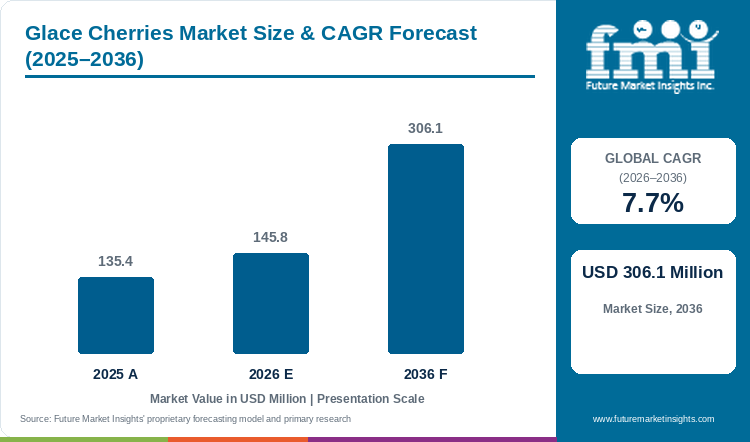
Starting from USD 135.4 million in 2025, the glace cherries market valuation advanced to USD 145.8 million in 2026, with projections pointing toward USD 306.1 million by 2036 at a CAGR of 7.7%.
Commercial bakeries in the United States and Western Europe are reformulating fruitcakes and holiday breads with natural-colorant candied cherries before federal synthetic-dye bans take effect. Valued at USD 135.4 million in 2025, the global glace cherries market is estimated to reach USD 145.8 million in 2026 and USD 306.1 million by 2036, expanding at a 7.7% CAGR to add USD 160.3 million in industry value. Compliance deadlines and clean-label grocery standards are driving this shift toward bleed-resistant whole fruit pieces. Standard grade is expected to hold a 42.0% share of the product type segment in 2026, supported by its steady 68-Brix sugar balance on high-speed dough dividers. Because natural-red fruit commands a higher price per kilogram, the category is growing faster than confectionery fillings at 4.8% CAGR. According to the U.S. Food and Drug Administration (FDA), food producers were urged in July 2025 to phase out FD&C Red No. 3 ahead of the January 15, 2027 deadline [1]. To expand fruit-inclusion supply, Puratos and Dawn Foods signed a merger agreement in March 2026 uniting Royal Steensma candied-fruit plants with global bakery innovation centers, although sulphite allergen labeling rules still slow supplier switching.
Key Market Trends & Insights
- By product type: Standard grade is expected to hold a 42.0% share in 2026 because multi-plant panettone and fruitcake lines purchase calibrated 68-to-72 Brix inclusions with consistent fruit piece sizing.
- By form: Powder / dry is estimated to hold a 39.0% share in 2026 because low-moisture candied cherry particulates prevent moisture weeping in dry premixes and automated rotary depositors.
- By application: Bread & rolls is projected to account for a 36.0% share in 2026 because festive sweet breads and brioche loaves incorporate high-density candied fruit pieces directly into fermented doughs.
- By claim: Conventional is predicted to record a 54.0% share in 2026 because European Union Regulation (EC) No 1333/2008 continues to permit E127 erythrosine in cocktail and candied cherries.
- By sales channel: Direct industrial bakeries is forecast to register a 50.0% share in 2026 through annual specification contracts that lock in osmotic Brix targets and pitted-fruit tolerances.
Regional Highlights
- Top national expansion: The UAE is projected to lead profiled national markets at a 9.2% CAGR through 2036 under automated Dubai Municipality Montaji import registration and luxury hotel patisserie demand.
- Broader country progression: Saudi Arabia is expected to expand at an 8.9% CAGR ahead of South Korea at 8.6% and the USA at 8.2%, while Japan is forecast to advance at a 6.9% CAGR.
Market Size & Forecast
Table 1: Market Size and Forecast for the Glace Cherries Market (USD million and CAGR percentage), 2025 to 2036
| Metric | Value |
|---|---|
| 2025 Market Size | USD 135.4 million |
| Estimated Market Size in 2026 | USD 145.8 million |
| Projected Market Size by 2036 | USD 306.1 million |
| CAGR, 2026 to 2036 | 7.7% |
| Added Revenue, 2026 to 2036 | USD 160.3 million |
Industrial sweet-bakery producers face strict synthetic-dye phase-out timelines and fluctuating raw sweet-cherry harvests across major growing regions. During commercial dough mixing, high-speed spiral arms expose fruit inclusions to mechanical stress that can tear weakly candied cherry skins and stain surrounding batter. In October 2025, a regulatory compliance study published in BMC Nutrition examined 51 commercial confectionery items and highlighted the growing gap around erythrosine food colorants between United States bans and European Union allowances [2]. In response, bakery procurement managers are shifting from simple syrup-soaked cherries to slow-infused osmotic glacé cherries that hold their color during proofing and baking.
Orchard-Pool and Osmotic-Batch Sizing
Table 2: Orchard-Pool and Osmotic-Batch Sizing for the Glace Cherries Market (USD million and operational ranges), 2025 to 2036
| Metric | 2025 | 2026 | 2036 |
|---|---|---|---|
| Market size (USD million) | 135.4 | 145.8 | 306.1 |
| Commercial candied cherry volume (thousand MT) | 29.5 to 32.8 | 31.2 to 34.7 | 58.0 to 64.5 |
| Osmotic sucrose infusion target (degrees Brix) | 66.0 to 70.0 | 67.0 to 71.0 | 68.0 to 72.5 |
| Bulk industrial contract price (USD per kg) | 4.10 to 4.60 | 4.20 to 4.70 | 4.75 to 5.25 |
Operational note: Volume and price ranges reconcile bulk B2B candied-cherry carton contracts (10-kilogram poly-lined boxes at 66 to 72 degrees Brix) against commercial sweet-cherry brining allocations and European industrial patisserie inclusion usage.
Retention of whole-fruit plumpness during multi-day sugar infusion requires gradual concentration step-ups from 35 degrees Brix to 70 degrees Brix in heated stainless-steel tanks. Global suppliers of industrial bakery ingredients combine calcium-salt firming with vacuum osmotic syruping to shorten tank processing cycles without wrinkling the fruit skin.
Per Capita & Commercial Bakery Line Sizing
Table 3: Per Capita and Bakery Line Spending Indicators for the Glace Cherries Market (USD), 2025 to 2036
| Metric | 2025 | 2026 | 2036 |
|---|---|---|---|
| World population (billion) | 8.2 | 8.3 | 9.0 |
| Spend per 1,000 people (USD) | 16.5 | 17.6 | 34.0 |
| Annual spend per industrial bakery plant (USD) | 4,500 to 5,200 | 4,800 to 5,550 | 8,900 to 10,400 |
| Natural-colorant reformulated share (%) | 31.0% to 35.0% | 34.5% to 38.5% | 58.0% to 63.0% |
Table 4: Bakery Plant & Inclusion Spending Indicators for the Glace Cherries Market (USD and percentages), 2026
| Metric | Value | Institutional Reference Basis |
|---|---|---|
| Market size, 2026 | USD 145.8 million | 2026 global revenue baseline |
| Commercial bakery plants globally | 28,500 plants | Industrial & large artisan sweet-bakery registry |
| Market spend per bakery plant | USD 5,115.8 | Annualized candied-fruit inclusion procurement |
| Direct industrial bakery revenue, 2026 | USD 72.9 million | 50.0% sales channel segment allocation |
Control of water activity below 0.65 allows candied cherry inclusions to last through six-month ambient stollen and fruitcake shelf cycles without mold growth or sugar graining. Formulation teams frequently pair whole glacé cherries with bake-stable pastry fillings so decorative fruit toppings retain their surface shine after leaving the tunnel oven.
Analyst Perspective
"Industrial bakery buyers no longer evaluate glacé cherries on visual brightness alone because the January 2027 U.S. FD&C Red No. 3 ban and strict European sulphite thresholds govern cross-border recipe approval. Suppliers that prove zero carmine or anthocyanin color bleed at 68-Brix osmotic equilibrium will lock in multi-year panettone and enriched-bread contracts."
- Nandini Roy Choudhury, Principal Analyst at Future Market Insights
How is the glace cherries market segmented?
The glace cherries market is segmented by product type, form, application, claim, and sales channel. In 2026, Standard grade is expected to hold 42.0%, powder / dry 39.0%, bread & rolls 36.0%, conventional 54.0%, and direct industrial bakeries 50.0%.
By product type: Standard grade, premium / specialty grade, organic certified, and clean-label grade.
By form: Powder / dry, liquid, paste / semi-solid, and granules / pieces.
By application: Bread & rolls, cakes & muffins, biscuits & cookies, viennoiserie & pastry, and other bakery & snacks.
By claim: Conventional, clean label, organic, and non-GMO / identity preserved.
By sales channel: Direct industrial bakeries, ingredient distributors, foodservice & artisan supply, and online B2B.
Why does Standard Grade lead the product type category?
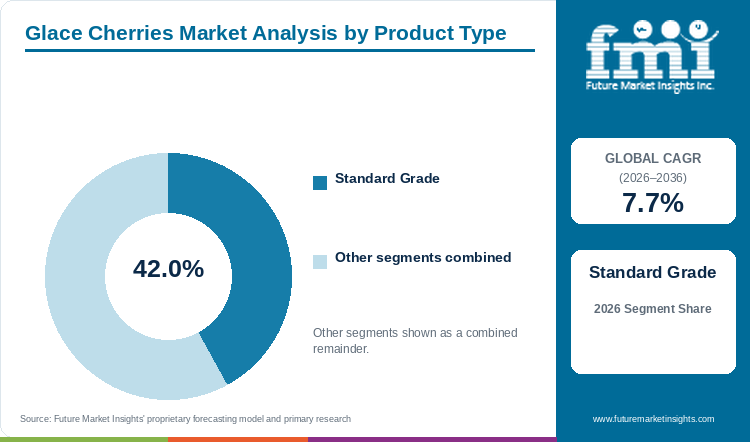
Standard grade is expected to hold a 42.0% share of the product type segment in 2026, supported by uniform industrial baking specifications.
Table 5: Product Type Share for the Glace Cherries Market (percentage share), 2026
| Product Type | Share (2026) |
|---|---|
| Standard Grade | 42.0% |
| Other Segments Combined* | 58.0% |
| Total | 100.0% |
*Calculated as the balance remaining after deducting the leading segment's reported share from 100.0%.
Table 6: Product Type Leadership and Market Growth for the Glace Cherries Market (segment and CAGR percentage), 2026 to 2036
| Metric | Value |
|---|---|
| Global CAGR (2026 to 2036) | 7.7% |
| Leading Segment | Standard Grade |
Large commercial bakeries favor Standard grade glacé cherries because automated dough dividers require consistent 16-to-18 millimeter fruit sizing and steady 68-Brix sugar content. Unlike ordinary fruit jams and preserves that blend into cake batter, calibrated whole and halved candied cherries provide clean visual contrast in sliced holiday loaves while clean-label grade lines capture new retail reformulation projects.
- Standard grade is expected to hold a 42.0% share of the product type segment in 2026, driven by multi-ton seasonal procurement across sweet-bread factories in Europe and North America.
- In August 2025, an extraction and upcycling study published in Antioxidants demonstrated that valorizing tart-cherry processing sidestreams yields high-stability anthocyanin fractions suitable for clean-label bakery coloring [3].
What makes Powder / Dry the largest form segment?
Powder / dry is estimated to hold a 39.0% share of the form segment in 2026, driven by low-moisture dosing stability in commercial premixes.
Commercial dry-mix blenders rely on Powder / dry candied cherry forms because low moisture levels prevent flour caking inside multi-wall paper bags during warehouse storage. Formulators pair drum-dried candied cherry pieces with freeze-dried fruit powders so high-speed depositors meter exact fruit weights without sticky syrup residue building up on hopper walls.
- Powder / dry is estimated to hold a 39.0% share of the form segment in 2026, owing to zero-syrup pneumatic conveying and extended ambient storage stability.
- A May 2025 encapsulation study published in Foods confirmed that copigmenting sour-cherry anthocyanins with tannic acid prior to spray-drying preserves red chroma during elevated thermal storage [4].
How does Bread & Rolls anchor the application segment?
Bread & rolls is projected to account for a 36.0% share of the application segment in 2026, due to high-volume stollen and panettone production.
Enriched yeast breads such as panettone from Italy and stollen from Germany represent the largest volume outlet for glacé cherries because fruit inclusions make up nearly one-fifth of total dough weight. Industrial plants baking commercial dinner rolls and seasonal fruit loaves specify calcium-firmed cherry tissue that resists crushing during twin-arm kneading and oven baking.
- Bread & rolls is projected to account for a 36.0% share of the application segment in 2026, attributable to year-round enriched sweet-roll lines and fourth-quarter festive bread manufacturing.
- Post-harvest trials published in Foods in October 2025 established that combined calcium chloride and modified-atmosphere treatments cut sweet-cherry storage weight loss to 7.14% and preserve fruit firmness prior to osmotic candying [5].
Why does Conventional retain leadership in the claim category?
Conventional is predicted to record a 54.0% share of the claim segment in 2026, enabled by continued European E127 authorization and cost-efficient sucrose syrups.
European and Asian candied-fruit exporters continue to ship high volumes of Conventional glacé cherries because Regulation (EC) No 1333/2008 retains specific permission for E127 erythrosine in candied and cocktail cherries. At the same time, grocery retailers adopting clean-label flavor formulations are expanding clean-label and organic cherry trials ahead of the January 2027 United States FD&C Red No. 3 ban.
- Conventional is predicted to record a 54.0% share of the claim segment in 2026, supported by heat-stable red pigmentation and lower raw-material cost in jurisdictions permitting E127.
- The European Union consolidated text of Regulation (EC) No 1333/2008 updated in July 2025 maintains specific maximum permitted levels for erythrosine in candied cherries while strict purity rules govern residual sulphites [6].
Why do Direct Industrial Bakeries lead the sales channel segment?
Direct industrial bakeries is forecast to register a 50.0% share of the sales channel segment in 2026, reinforced by plant-to-plant specification audits.
Large automated cake and sweet-bread manufacturers contract directly with primary fruit candiers so quality teams can enforce strict sulfur-dioxide limits and custom Brix targets. Producers of industrial bakery mixes bypass regional brokers to lock in full-year harvest allocations from cherry processors in Europe and North America.
- Direct industrial bakeries is forecast to register a 50.0% share of the sales channel segment in 2026, linked to multi-plant forward contracting and custom clean-label batch certifications.
- In May 2026, Puratos reported in its 2025 Sustainability GRI update that 37.3% of its fruit procurement now operates through its transparent Field to Fork grower-traceability program for industrial bakery customers [7].
What are the drivers, restraints, and opportunities in the glace cherries market?
In the glace cherries market, festive sweet-bakery production and FDA Red No. 3 reformulation mandates drive supplier requalification, whereas sulphite allergen rules restrain rapid vendor switching and low-water-activity natural-red inclusions enable clean-label contracts.
- Driver: Mandatory FD&C Red No. 3 phase-out deadlines in the USA and expanding European artisan sweet-bread output compel bakeries to contract pre-qualified candied cherry inclusions.
- Restraint: Stringent 10-milligram-per-kilogram sulphite allergen declarations and seasonal sweet-cherry crop price volatility increase batch requalification costs.
- Opportunity: Osmotic dehydration using alternative humectants and encapsulated anthocyanin pigments enables non-bleeding clean-label glacé cherries for premium retail bakeries.
Growth Analysis and Future Potential: Qualitative Demand Catalysts
Demand for glacé cherries is sustained by consumer appetite for traditional holiday breads and rich fruitcakes where whole candied fruit provides signature texture and visual appeal. Unlike wet fruit compotes that bleed into dough, sugar-infused cherries balanced at 68 to 72 degrees Brix hold a firm bite and bright shine during 45-minute bake cycles. Future Market Insights notes that commercial bakeries are pairing candied cherries with freeze-dried fruit inclusions to refresh seasonal supermarket bakery assortments. In August 2026, a two-season phytochemical study of Morello and Amarelle cherry cultivars published in Foods confirmed that cultivar choice determines baseline anthocyanin stability across harvest years [8]. As a result, bakery purchasing teams sign cultivar-specific supply contracts with integrated fruit candiers to maintain consistent crumb appearance across national retail programs.
Risk Assessment of the Glace Cherries Market: Operational and Formulation Friction
Differing food-colorant and preservative rules across export markets create inventory complexity for international candied-fruit processors. Harvested sweet cherries are traditionally bleached and firmed in sulfur-dioxide calcium bisulfite brines prior to sugar infusion, leaving trace sulphites that require mandatory allergen bolding above 10 milligrams per kilogram. In addition, replacing synthetic FD&C Red No. 3 with carmine or radish anthocyanins can lead to purple color shifts or pigment bleeding in alkaline cake batters. In August 2025, orchard nutrition research published in Frontiers in Plant Science showed that pre-harvest potassium and magnesium imbalances directly affect sweet-cherry skin cracking and sugar levels before brining [9]. When spring frosts reduce cherry harvests in Europe or North America, spot brine-cherry prices climb and squeeze fixed-price bakery supplier margins.
Commercial Opportunity Analysis: Formulation Differentiation and Value-Add Formats
Fruit processors that combine zero-sulphite enzymatic firming with polyol-assisted osmotic dehydration are winning clean-label bakery tenders in North America and Western Europe. Substitution of standard corn syrup with trehalose or maltitol syrups reduces water activity while preventing white sugar crystals from forming inside clear retail packs. In July 2026, osmotic-dehydration trials published in Foods showed that ternary glycerol-amino-acid solutions lower water activity to 0.906 and depress freezing points to minus 7.55 degrees Celsius without splitting fruit skins [10]. Adaptation of these gentle osmotic infusion curves to semi-candied cherries lets pastry suppliers offer soft-bite fruit pieces for frozen thaw-and-serve viennoiserie. Suppliers that deliver validated 12-month shelf-life data for natural-red glacé cherries earn 15% to 22% price premiums over standard E127 grades.
Glace Cherries Market by Country (2026 to 2036)
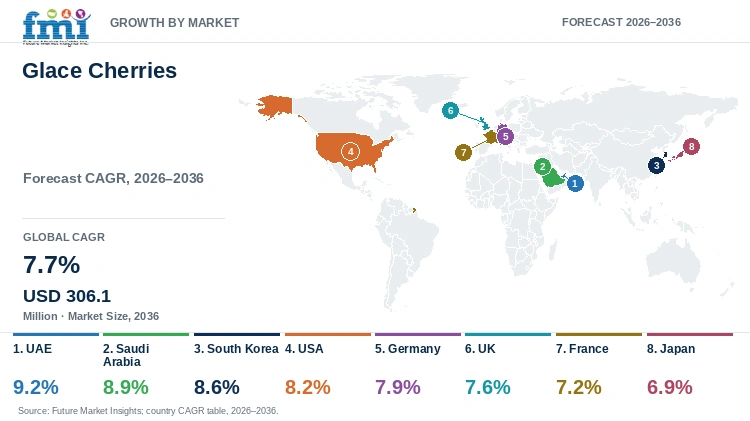
As per FMI, the UAE is projected to lead glacé cherries demand growth across profiled national markets at a 9.2% CAGR through 2036, whereas Japan is forecast to progress at a 6.9% CAGR. Commercial performance across Gulf hospitality hubs and European industrial bakeries depends on digital customs registration and additive positive-list compliance.
Table 7: Country CAGR and Primary Growth Levers for the Glace Cherries Market (CAGR percentage and operational drivers), 2026 to 2036
| Country | CAGR (2026 to 2036) | Primary Growth Lever |
|---|---|---|
| UAE | 9.2% | Dubai Montaji digital import registration and five-star hotel patisserie inclusion procurement |
| Saudi Arabia | 8.9% | SFDA Arabic-label food clearance standardization and commercial bakery commissary expansion |
| South Korea | 8.6% | MFDS foreign-facility pre-registration compliance and premium bakery-café seasonal cake launches |
| USA | 8.2% | Mandatory January 2027 FDA FD&C Red No. 3 reformulation and natural-colorant inclusion conversion |
| Germany | 7.9% | Consolidated industrial stollen and artisan bakery procurement totaling EUR 17,920 million |
| UK | 7.6% | Traditional festive fruitcake manufacturing and strict >10 mg/kg PPDS sulphite allergen control |
| France | 7.2% | High-volume artisan boulangerie-pâtisserie retail growth and Apt candied-cherry heritage supply |
| Japan | 6.9% | Positive-list food additive verification and precision gift-bakery inclusion sizing |
Source: Future Market Insights analysis
UAE Glace Cherries Market Outlook (2026 to 2036)
Commercial glacé cherries demand in the UAE is projected to expand at a 9.2% CAGR from 2026 to 2036, supported by five-star hotel pastry kitchens and regional re-export commissaries. Unlike European markets anchored by domestic orchard brining, the UAE relies entirely on air- and sea-freighted candied fruit cleared through Dubai Municipality digital food-safety portals. In June 2025, an Emirates consumer safety and preservation investigation published on PubMed Central highlighted strict municipal inspection oversight across imported specialty products in the UAE [11]. Hotel executive chefs and airline caterers in Dubai require kosher- and halal-certified natural-red candied cherries packed in moisture-barrier cartons that prevent syrup weeping under 40-degree-Celsius warehouse transit.
Key takeaway: In the UAE, digital Montaji import clearance and luxury hospitality patisserie programs are projected to drive 9.2% CAGR expansion.
Saudi Arabia Glace Cherries Market Outlook (2026 to 2036)
Unlike Western retail markets dominated by seasonal Christmas fruitcakes, Saudi Arabia channels candied cherry inclusions into year-round hotel banquet pastries and celebratory layer cakes. The glace cherries market in Saudi Arabia is estimated to grow at an 8.9% CAGR between 2026 and 2036 following hospitality and commercial bakery licensing expansion. In April 2025, the Saudi Food and Drug Authority updated its mandatory Conditions and Requirements for Food Clearance, enforcing verified Arabic ingredient declarations and additive certificates at kingdom entry ports [12]. European fruit candiers that pre-verify alcohol-free carrier syrups and compliant natural red pigments secure multi-year supply agreements with Riyadh and Jeddah industrial bakeries across central commissary networks.
Key takeaway: In Saudi Arabia, SFDA port clearance compliance and expanding central café commissaries are estimated to sustain an 8.9% CAGR.
South Korea Glace Cherries Market Outlook (2026 to 2036)
What sets South Korea apart from traditional European fruit-bread markets is the rapid rotation of visual holiday cakes and retro-styled pastry toppings across more than 100,000 domestic coffee shops. In February 2026, a multi-city epidemiological investigation by the Korea Disease Control and Prevention Agency published in Osong Public Health and Research Perspectives traced 323 cases across seven cities to manufactured bakery products, prompting stricter factory hygiene audits [13]. Demand for glacé cherries in South Korea is forecast to rise at an 8.6% CAGR from 2026 to 2036 under tightened import hygiene verification. Foreign candied-fruit plants must maintain active Ministry of Food and Drug Safety facility registration and microbiological batch certificates to supply Seoul franchise bakery chains.
Key takeaway: In South Korea, strict MFDS facility registration and franchise bakery-café cake rotation are forecast to support an 8.6% CAGR.
USA Glace Cherries Market Outlook (2026 to 2036)
In the USA, mandatory federal synthetic-dye phase-out schedules govern commercial procurement of glacé and maraschino-style bakery cherries. Unlike European Union rules that retain E127 for candied cherries, the U.S. Food and Drug Administration issued a constituent update in January 2025 revoking FD&C Red No. 3 authorization in food with a final compliance deadline of January 15, 2027 [14]. The agency noted that FD&C Red No. 3 has been primarily used in cherry-red candy and seasonal bakery cakes that now require natural pigment reformulation across commercial lines. Accordingly, the glace cherries market in the USA is anticipated to progress at an 8.2% CAGR through 2036 behind higher-value natural-red inclusion contracts.
Key takeaway: In the USA, the January 2027 FD&C Red No. 3 ban is anticipated to drive an 8.2% CAGR via higher-priced natural-colorant cherry reformulations.
Germany Glace Cherries Market Outlook (2026 to 2036)
Sales of glacé cherries in Germany are predicted to advance at a 7.9% CAGR between 2026 and 2036, anchored by industrial Christstollen and Florentiner biscuit production. Germany differs from fragmented southern European markets because continuing bakery enterprise consolidation concentrates candied-fruit purchasing inside large regional cooperative buying groups. In July 2026, a one-year ambient storage study published in Foods demonstrated that encapsulating tart-cherry phenolics in 2.5% cellulose carriers preserves natural cherry pigments and red color stability across extended room-temperature holding [15]. Because discount supermarkets in Germany enforce strict clean-label private-label charters, industrial stollen bakers specify non-bleeding black-carrot and carmine-colored candied cherries over synthetic E127 grades across national holiday assortments.
Key takeaway: In Germany, consolidated EUR 17,920 million craft-bakery scale and clean-label stollen charters are predicted to sustain a 7.9% CAGR.
UK Glace Cherries Market Outlook (2026 to 2036)
Unlike continental European markets where candied citrus peel dominates holiday bread, the UK maintains a distinct year-round retail and industrial grocery category for whole glacé cherries in Cherry Bakewell tarts and fruit scones. The glace cherries market in the UK is projected to register a 7.6% CAGR from 2026 to 2036 across supermarket own-label cake manufacturers and home-baking aisles. In May 2026, Premier Foods reported a 7.3% revenue increase across its Sweet Treats branded cake division for the 52 weeks ending March 28, 2026 with 25% higher capital investment [16]. Even so, UK Food Standards Agency rules requiring allergen bolding for sulphur dioxide above 10 milligrams per kilogram compel suppliers to wash residual brining sulphites below detection limits.
Key takeaway: In the UK, branded sweet-treat cake expansion and strict <10 mg/kg sulphite de-brining specifications are projected to support a 7.6% CAGR.
France Glace Cherries Market Outlook (2026 to 2036)
France stands apart in the global glacé cherries market as the historical processing center of whole candied Bigarreau Napoléon cherries in the Luberon and Apt basin. In May 2026, a cultivar-profiling study published in Antioxidants demonstrated pronounced tissue-specific anthocyanin and polyphenol differences between sweet-cherry skin and flesh matrices that affect processing color retention [17]. Commercial glacé cherries valuation in France is expected to grow at a 7.2% CAGR over the 2026 to 2036 forecast period across industrial brioche Des Rois and artisan patisserie channels. Although spring orchard frosts periodically tighten domestic Bigarreau supply in Provence, protected regional origin branding allows candiers in France to pass raw-fruit cost increases through to luxury patisserie buyers.
Key takeaway: In France, Apt-basin Bigarreau cherry provenance and Brioche des Rois crown applications are expected to anchor a 7.2% CAGR.
Japan Glace Cherries Market Outlook (2026 to 2036)
In contrast to high-volume Western fruitcake blocks, Japan employs precision-graded glacé cherries primarily as high-margin visual centerpieces on wrapped gift cookies and nostalgic kissaten parfaits. In April 2025, an 18-year analysis of 37,072 participants from Japan's National Health and Nutrition Survey published in Nutrients documented shifting domestic fruit and confectionery intake patterns that favor portion-controlled specialty formats [18]. The glace cherries market in Japan is slated to record a 6.9% CAGR from 2026 to 2036, representing the most mature growth profile among the eight evaluated countries. Foreign ingredient exporters must satisfy Japan Consumer Affairs Agency positive-list food additive limits and provide millimeter-exact fruit sorting to pass department-store bakery quality inspections across Tokyo and Osaka.
Key takeaway: In Japan, strict positive-list additive screening and department-store gift-cookie visual tolerances are slated to govern a 6.9% CAGR.
Full report country CAGRs cover: North America; Latin America; Western Europe; Eastern Europe; East Asia; South Asia and Pacific; Middle East and Africa.
Who are the notable companies in the glace cherries market?
Dawn Foods, CSM Ingredients, Irca Group, Fabbri 1905, Puratos, Zeelandia, Bakels, AGRANA, Zentis, and Barry Callebaut are the notable companies profiled in the glace cherries market.
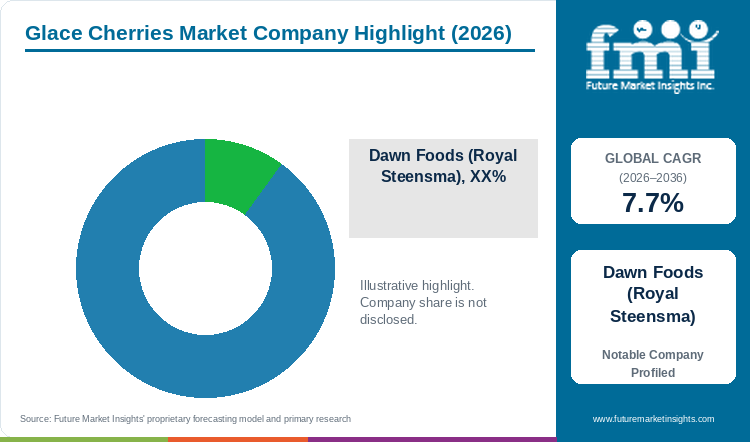
FMI analysis indicates that commercial competition divides between vertically integrated candied-fruit processors and multinational bakery-formulation groups. Dedicated fruit candiers operate multi-stage osmotic syruping vats across Europe and Southeast Asia to supply whole and diced glacé cherries with verified Brix stability. Global bakery-ingredient conglomerates acquire specialist candied-fruit manufacturers and pair solid inclusions with bake-stable fillings across direct industrial bakery accounts.
- Candied and Syrup-Preserved Cherry Specialists: Dawn Foods (Royal Steensma) and CSM Ingredients (Italcanditi) paired with Irca Group (Cesarin) and Fabbri 1905 operate dedicated cherry-candying and syrup-preservation facilities.
- Industrial Bakery Fruit-Preparation Platforms: Puratos and Zeelandia with Bakels and AGRANA as well as Zentis supply calibrated fruit inclusions and bake-stable cherry preparations to commercial bakeries.
- Confectionery and Patisserie Inclusion Systems: Barry Callebaut delivers low-water-activity fruit inclusions and decorative confectionery components for global chocolate and pastry brands.
Competitive Benchmarking: Glace Cherries Market
Table 8: Competitive Benchmarking for the Glace Cherries Market (qualitative capability ratings), 2026
| Company | Osmotic Candied-Fruit Scale | Natural-Colorant Reformulation | Industrial Bakery B2B Reach | Geographic Reach |
|---|---|---|---|---|
| Dawn Foods (Royal Steensma) | High | High | High | High |
| CSM Ingredients (Italcanditi) | High | High | High | High |
| Irca Group (Cesarin) | High | High | High | High |
| Fabbri 1905 | High | Medium | High | High |
| Puratos | Medium | High | High | High |
| Zeelandia | Medium | Medium | High | High |
| Bakels | Medium | Medium | High | High |
| AGRANA | Medium | High | High | High |
| Zentis | Medium | High | High | Medium |
| Barry Callebaut | Medium | High | Medium | High |
Scoring basis: Capability tiers evaluate documented osmotic cherry-candying vat capacity and natural red colorant bake-stability validation ahead of the 2027 FDA Red No. 3 deadline as well as direct B2B supply contracts with industrial sweet-bread and cake plants.
Key Developments in the Glace Cherries Market
- Puratos and Dawn Foods announced a definitive merger agreement in March 2026 to combine Dawn's bakery footprint in North America and Royal Steensma candied-fruit operations with Puratos' global patisserie network [19].
- AGRANA reported in May 2026 that its Food & Beverage Solutions division—including fruit preparations and Mercator-Emba fruit-processing operations—boosted operating profit before exceptionals to EUR 106.7 million in fiscal 2025/26 [20].
- Fabbri 1905 published its sustainability and circular-economy processing update in June 2025, documenting a 50-ton annual reduction in Amarena cherry processing waste across its Bologna operations [21].
Key Players in the Glace Cherries Market
Candied and Syrup-Preserved Cherry Specialists
- Dawn Foods
- CSM Ingredients
- Irca Group
- Fabbri 1905
Industrial Fruit Fillings and Bakery Formulation Partners
- Puratos
- Zeelandia
- Bakels
- AGRANA
- Zentis
Confectionery Formulation and Adjacent Fruit Systems
- Barry Callebaut
Glace Cherries Market - Report Scope
Table 9: Report Scope for the Glace Cherries Market (coverage fields and definitions), 2026 to 2036
| Coverage field | Report scope |
|---|---|
| Market breakdown | Product Type; Form; Application; Claim; Sales Channel |
| Quantitative Units | USD Million |
| Market Definition | Includes commercial B2B and retail ingredient revenue from osmotically candied glacé cherries and qualifying low-moisture candied-cherry particulates across the stated segments. Excludes downstream finished bakery product prices and fresh orchard cherries as well as non-candied cherry jams or syrups. |
| Regions Covered | North America; Latin America; Western Europe; Eastern Europe; East Asia; South Asia and Pacific; Middle East and Africa |
| Countries Covered | UAE, Saudi Arabia, South Korea, USA, Germany, UK, France, Japan, and additional countries in the full report |
| Key Companies Covered | Dawn Foods, CSM Ingredients, Irca Group, Fabbri 1905, Puratos, Zeelandia, Bakels, AGRANA, Zentis, Barry Callebaut |
| Forecast Period | 2026 to 2036 |
| Approach | Primary and secondary research with top-down and bottom-up market triangulation. |
Glace Cherries Market - Research Methodology
Table 10: Research Methodology for the Glace Cherries Market (research methods and approach), 2026 edition
| Method | Approach |
|---|---|
| Primary Research | Structured interviews with industrial sweet-bread formulators and osmotic candied-fruit plant managers as well as bakery ingredient distributors to validate per-kilogram contract pricing and Brix specifications. |
| Secondary Research | Analysis of U.S. FDA color-additive dockets and EU Regulation (EC) No 1333/2008 consolidated texts as well as European fruit-preparation filings and PubMed food-science studies. |
| Market Sizing and Forecasting | Top-down industrial bakery fruit-inclusion budgets reconciled against bottom-up brined and osmotically candied cherry tonnage from 2025 to 2036. |
| Country Forecasting Model | Econometric national projections weight commercial bakery enterprise counts and holiday sweet-bread consumption as well as synthetic-dye reformulation timelines across eight major countries. |
| Operational Benchmark Traceability | Orchard-pool and per-bakery spending indicators in Tables 2, 3, and 4 trace to commercial cherry-brining allocations and European bakery enterprise registries. |
| Data Triangulation and Validation | Demand estimates are cross-checked against candied-fruit processor vat capacities and industrial bakery procurement volumes to exclude non-candied cherry purees and finished pastry retail markups. |
Glace Cherries Market by Segments
Glace Cherries Market segmented by Product Type:
- Standard Grade
- Premium / Specialty Grade
- Organic Certified
- Clean-Label Grade
Glace Cherries Market segmented by Form:
- Powder / Dry
- Liquid
- Paste / Semi-Solid
- Granules / Pieces
Glace Cherries Market segmented by Application:
- Bread & Rolls
- Cakes & Muffins
- Biscuits & Cookies
- Viennoiserie & Pastry
- Other Bakery & Snacks
Glace Cherries Market segmented by Claim:
- Conventional
- Clean Label
- Organic
- Non-GMO / Identity Preserved
Glace Cherries Market segmented by Sales Channel:
- Direct Industrial Bakeries
- Ingredient Distributors
- Foodservice & Artisan Supply
- Online B2B
Glace Cherries Market by Region
- North America
- United States
- Canada
- Latin America
- Brazil
- Mexico
- Argentina
- Chile
- Western Europe
- Germany
- France
- United Kingdom
- Italy
- Spain
- Benelux
- Nordics
- Eastern Europe
- Poland
- Czech Republic
- Romania
- Hungary
- East Asia
- China
- Japan
- South Korea
- South Asia and Pacific
- India
- ASEAN
- Australia and New Zealand
- Middle East and Africa
- GCC Countries
- South Africa
- Türkiye
- Israel
Research Sources and Bibliography
- [1] U.S. Food and Drug Administration. (2025, July 14). FDA Encourages Food Manufacturers to Accelerate Phasing Out the Use of FD&C Red No. 3 in Foods Before 2027 Deadline. U.S. Department of Health and Human Services.
- [2] Maurya, P., & Kumar, S. (2025, October 1). Color additives in chewing gum products sold through Indian online marketplaces: variances and compliance with food safety norms in India, the EU, and the USA. BMC Nutrition, 11(1), 178 (PubMed PMID 41035020).
- [3] Kent, G., et al. (2025, August 13). Upcycling of Waste Cherries Produces an Anthocyanin-Rich Powder That Protects Against Amyloid-Beta Toxicity in C. elegans. Antioxidants, 14(8), 995 (PubMed PMID 40867891).
- [4] Oancea, A. M., et al. (2025, May 30). Enhanced Stability of Extracted Sour Cherry Anthocyanins Copigmented With Tannic Acid and Encapsulated by Spray-Drying. Foods, 14(11), 1912 (PubMed PMID 40452791).
- [5] Aglar, E., et al. (2025, October 10). Physiological effects of MAP and calcium chloride treatments on postharvest quality of sweet cherry fruit. Foods, 14(20), 3481 (PubMed PMID 41073907).
- [6] European Parliament and Council of the European Union. (2025, July 31). Consolidated Text: Regulation (EC) No 1333/2008 of the European Parliament and of the Council on Food Additives. Official Journal of the European Union.
- [7] Puratos Group. (2026, May 28). Puratos Achieves Carbon Neutrality for Scope 1 and Scope 2 Operations and Expands Field to Fork Fruit Traceability to 37.3%. Puratos 2025 Sustainability GRI Report Release.
- [8] Sokół-Łętowska, A., et al. (2026, August 18). Polyphenol and Flavonoid Levels of Selected Morello and Amarelle Sour Cherry Cultivars Across Growing Seasons. Foods, 15(16), 2890 (PubMed PMID 42653962).
- [9] Zhang, Y., et al. (2025, August 30). Enhancing sweet cherry quality: magnesium and potassium foliar applications modulate sugar transport and fruit firmness. Frontiers in Plant Science, 16, 1584210 (PubMed PMID 40243129).
- [10] Giannakourou, M. C., et al. (2026, July 22). Osmotic Dehydration with Alternative Humectants for the Production of Ultrachilled Cherry Tomatoes and Fruit Matrices. Foods, 15(14), 2569 (PubMed PMID 42511315).
- [11] Al Suwaidi, A., et al. (2025, June 15). Regulatory Compliance and Consumer Safety Assessment of Imported Products in the United Arab Emirates. International Journal of Biological Macromolecules (PubMed PMID 40383573).
- [12] Saudi Food and Drug Authority. (2025, April 15). Conditions and Requirements for Food Clearance at Saudi Arabian Entry Ports. SFDA Official Regulatory Guidance.
- [13] Kim, J., et al. (2026, February 10). A multi-city outbreak of Salmonella Enteritidis infections linked to manufactured bakery products in the Republic of Korea. Osong Public Health and Research Perspectives (PubMed PMID 41664243).
- [14] U.S. Food and Drug Administration. (2025, January 15). FDA to Revoke Authorization for the Use of Red No. 3 in Food and Ingested Drugs: Constituent Update. U.S. Department of Health and Human Services.
- [15] Kopjar, M., et al. (2026, July 13). Stability of Polyphenols and Antioxidant Activity of Cellulose-Based Tart Cherry Encapsulates During One-Year Storage. Foods, 15(14), 2510 (PubMed PMID 42513133).
- [16] Premier Foods plc. (2026, May 18). Full Year Results for the 52 Weeks Ending 28 March 2026: Sweet Treats and International Bakery Performance. Premier Foods Investor Relations.
- [17] Di Matteo, A., et al. (2026, May 19). Tissue-Specific Anthocyanin and Polyphenol Content in Sweet Cherry Cultivars for Industrial Processing. Antioxidants, 15(5), 612 (PubMed PMID 42197286).
- [18] Murakami, K., et al. (2025, April 17). Food Consumption Trends in Japanese Children and Adolescents: Analysis of the National Health and Nutrition Survey. Nutrients, 17(8), 1365 (PubMed PMID 40282793).
- [19] Dawn Foods & Puratos Group. (2026, March 10). Puratos to Acquire Dawn Foods, Bringing Together Complementary Capabilities in Professional Bakery. Dawn Foods Official Corporate Release.
- [20] AGRANA Beteiligungs-AG. (2026, May 12). EQS-News: AGRANA Achieves Solid 2025/26 Operating Profit of EUR 81.2 Million and Expands Food & Beverage Solutions with Mercator-Emba. Deutsche Börse EQS Corporate Disclosure.
- [21] Fabbri 1905 S.p.A. (2025, June 26). Economia circolare e lotta agli sprechi al centro delle strategie Fabbri 1905 nello stabilimento di Bologna. Fabbri 1905 Official Press Communication.
- [22] Puratos Group. (2025, May 12). Puratos Brings a Trio of Innovations to iba 2025 Across Fruit Fillings and Sustainable Bakery Improvers. Puratos Official Newsroom.
- [23] Barry Callebaut Group. (2026, April 16). Barry Callebaut Group Half-Year Results, Fiscal Year 2025/26: Specialties and Decorations Performance. Barry Callebaut Ad Hoc Announcement.
This bibliography is provided for reader reference and is not exhaustive. The full report contains the complete reference list and detailed citations.
This Report Answers
- How large is the glace cherries market in 2026 and what is forecast for 2036?
- Which regulatory and bakery production pressures support demand for glacé cherries?
- Why does Standard grade lead the product type category?
- Why does powder / dry lead the form category globally?
- How do growth rates differ between the UAE and Saudi Arabia versus European markets?
- Which leading companies supply osmotic candied cherries and bakery fruit preparations today?
- What limits supplier switching in the glace cherries market?
- What should industrial bakery buyers evaluate before qualifying a glacé cherry supplier?
Frequently Asked Questions
How big is the glace cherries market in 2026, and what is forecast for 2036?
According to FMI, global glace cherries market value is estimated to reach USD 145.8 million in 2026 from USD 135.4 million in 2025. The industry valuation is forecast to hit USD 306.1 million by 2036 as commercial bakeries lock in compliant candied-fruit inclusions.
What is the CAGR for the glace cherries market from 2026 to 2036?
Future Market Insights projects a 7.7% compound annual growth rate between 2026 and 2036, generating USD 160.3 million in incremental market value across industrial bakery and foodservice channels.
Which product type segment leads the glace cherries market?
Standard grade is expected to hold a 42.0% share of the product type segment in 2026 because high-speed sweet-bread and fruitcake lines require uniform 16-to-18 millimeter fruit pieces equilibrated to 68 degrees Brix.
Which form segment leads the glace cherries market?
Powder / dry is estimated to hold a 39.0% share of the form segment in 2026 as commercial dry-mix blenders specify low-moisture candied cherry particulates that prevent caking and syneresis.
Which country has the fastest growth outlook during the assessment period?
The UAE is projected to lead profiled national growth at a 9.2% CAGR through 2036, supported by Dubai Montaji digital import registration and luxury hotel patisserie procurement.
Who are the leading players in the glace cherries market?
Major companies include Dawn Foods (Royal Steensma) and CSM Ingredients (Italcanditi) as well as Irca Group (Cesarin) and Fabbri 1905. Additional major suppliers include Puratos and Zeelandia along with Bakels and AGRANA as well as Zentis and Barry Callebaut.
Preview the report firsthand - request a free sample
Get SampleGet the brochure for pricing and purchase details.
Get PDFTable of Content
- Key Takeaways
- Market Size and CAGR
- Top Growth Driver
- Fastest Growing Segment
- Leading Region
- Key Companies
- Emerging Opportunities
- Executive Summary
- Global Market Outlook
- Demand-side Trends
- Supply-side Trends
- Technology Roadmap Analysis
- Analysis and Recommendations
- Analyst Perspective (What is happening? Why now? What should investors know?)
- Key Questions Answered
- How large is the market?
- What is the CAGR?
- What are key trends?
- Which region dominates?
- Who are the leaders?
- Market Overview
- Market Coverage / Taxonomy
- Market Definition / Scope / Limitations
- Research Methodology
- Chapter Orientation
- Analytical Lens and Working Hypotheses
- Market Structure, Signals, and Trend Drivers
- Benchmarking and Cross-market Comparability
- Market Sizing, Forecasting, and Opportunity Mapping
- Research Design and Evidence Framework
- Desk Research Programme (Secondary Evidence)
- Expert Input and Fieldwork (Primary Evidence)
- Tooling, Models, and Reference Databases
- Data Engineering and Model Build
- Quality Assurance and Audit Trail
- Market Background
- Market Dynamics (Drivers, Restraints, Opportunity, Trends)
- Scenario Forecast (Optimistic, Likely, Conservative)
- Impact Analysis
- AI Impact
- Sustainability Impact
- Regulatory Impact
- Technology Impact
- Consumer / Buyer Analysis
- Purchase Drivers
- Adoption Barriers
- Buyer Journey
- Opportunity Map Analysis
- Product Life Cycle Analysis
- Supply Chain Analysis
- Investment Feasibility Matrix
- Value Chain Analysis
- PESTLE and Porter's Analysis
- Regulatory Landscape
- Regional Parent Market Outlook
- Production and Consumption Statistics
- Import and Export Statistics
- Global Market Analysis and Forecast, 2021 to 2036
- Historical Market Size Value (USD Million) Analysis, 2021 to 2025
- Current and Future Market Size Value (USD Million) Projections, 2026 to 2036
- Y-o-Y Growth Trend Analysis
- Absolute $ Opportunity Analysis
- Global Market Pricing Analysis, 2021 to 2036
- Global Market Analysis and Forecast, By Product Type, 2021 to 2036
- Introduction / Key Findings
- Historical Market Size Value (USD Million) Analysis By Product Type, 2021 to 2025
- Current and Future Market Size Value (USD Million) Analysis and Forecast By Product Type, 2026 to 2036
- Standard Grade
- Premium / Specialty Grade
- Organic Certified
- Clean-Label Grade
- Y-o-Y Growth Trend Analysis By Product Type, 2021 to 2025
- Absolute $ Opportunity Analysis By Product Type, 2026 to 2036
- Global Market Analysis and Forecast, By Form, 2021 to 2036
- Introduction / Key Findings
- Historical Market Size Value (USD Million) Analysis By Form, 2021 to 2025
- Current and Future Market Size Value (USD Million) Analysis and Forecast By Form, 2026 to 2036
- Powder / Dry
- Liquid
- Paste / Semi-Solid
- Granules / Pieces
- Y-o-Y Growth Trend Analysis By Form, 2021 to 2025
- Absolute $ Opportunity Analysis By Form, 2026 to 2036
- Global Market Analysis and Forecast, By Application, 2021 to 2036
- Introduction / Key Findings
- Historical Market Size Value (USD Million) Analysis By Application, 2021 to 2025
- Current and Future Market Size Value (USD Million) Analysis and Forecast By Application, 2026 to 2036
- Bread & Rolls
- Cakes & Muffins
- Biscuits & Cookies
- Viennoiserie & Pastry
- Other Bakery & Snacks
- Y-o-Y Growth Trend Analysis By Application, 2021 to 2025
- Absolute $ Opportunity Analysis By Application, 2026 to 2036
- Global Market Analysis and Forecast, By Claim, 2021 to 2036
- Introduction / Key Findings
- Historical Market Size Value (USD Million) Analysis By Claim, 2021 to 2025
- Current and Future Market Size Value (USD Million) Analysis and Forecast By Claim, 2026 to 2036
- Conventional
- Clean Label
- Organic
- Non-GMO / Identity Preserved
- Y-o-Y Growth Trend Analysis By Claim, 2021 to 2025
- Absolute $ Opportunity Analysis By Claim, 2026 to 2036
- Global Market Analysis and Forecast, By Sales Channel, 2021 to 2036
- Introduction / Key Findings
- Historical Market Size Value (USD Million) Analysis By Sales Channel, 2021 to 2025
- Current and Future Market Size Value (USD Million) Analysis and Forecast By Sales Channel, 2026 to 2036
- Direct Industrial Bakeries
- Ingredient Distributors
- Foodservice & Artisan Supply
- Online B2B
- Y-o-Y Growth Trend Analysis By Sales Channel, 2021 to 2025
- Absolute $ Opportunity Analysis By Sales Channel, 2026 to 2036
- Global Market Analysis and Forecast, By Region, 2021 to 2036
- Introduction
- Historical Market Size Value (USD Million) Analysis By Region, 2021 to 2025
- Current Market Size Value (USD Million) Analysis and Forecast By Region, 2026 to 2036
- North America
- Latin America
- Western Europe
- Eastern Europe
- East Asia
- South Asia and Pacific
- Middle East and Africa
- Market Attractiveness Analysis By Region
- North America Market Analysis and Forecast, By Country, 2021 to 2036
- Historical Market Size Value (USD Million) Trend Analysis By Market Taxonomy, 2021 to 2025
- Market Size Value (USD Million) Forecast By Market Taxonomy, 2026 to 2036
- By Country
- United States
- Canada
- By Product Type
- By Form
- By Application
- By Claim
- By Sales Channel
- By Country
- Market Attractiveness Analysis
- By Country
- By Product Type
- By Form
- By Application
- By Claim
- By Sales Channel
- Key Takeaways
- Latin America Market Analysis and Forecast, By Country
- Historical Market Size Value (USD Million) Trend Analysis By Market Taxonomy, 2021 to 2025
- Market Size Value (USD Million) Forecast By Market Taxonomy, 2026 to 2036
- By Country
- Brazil
- Mexico
- Argentina
- Chile
- By Product Type
- By Form
- By Application
- By Claim
- By Sales Channel
- By Country
- Market Attractiveness Analysis
- By Country
- By Product Type
- By Form
- By Application
- By Claim
- By Sales Channel
- Key Takeaways
- Western Europe Market Analysis and Forecast, By Country
- Historical Market Size Value (USD Million) Trend Analysis By Market Taxonomy, 2021 to 2025
- Market Size Value (USD Million) Forecast By Market Taxonomy, 2026 to 2036
- By Country
- Germany
- France
- United Kingdom
- Italy
- Spain
- Benelux
- Nordics
- By Product Type
- By Form
- By Application
- By Claim
- By Sales Channel
- By Country
- Market Attractiveness Analysis
- By Country
- By Product Type
- By Form
- By Application
- By Claim
- By Sales Channel
- Key Takeaways
- Eastern Europe Market Analysis and Forecast, By Country
- Historical Market Size Value (USD Million) Trend Analysis By Market Taxonomy, 2021 to 2025
- Market Size Value (USD Million) Forecast By Market Taxonomy, 2026 to 2036
- By Country
- Poland
- Czech Republic
- Romania
- Hungary
- By Product Type
- By Form
- By Application
- By Claim
- By Sales Channel
- By Country
- Market Attractiveness Analysis
- By Country
- By Product Type
- By Form
- By Application
- By Claim
- By Sales Channel
- Key Takeaways
- East Asia Market Analysis and Forecast, By Country
- Historical Market Size Value (USD Million) Trend Analysis By Market Taxonomy, 2021 to 2025
- Market Size Value (USD Million) Forecast By Market Taxonomy, 2026 to 2036
- By Country
- China
- Japan
- South Korea
- By Product Type
- By Form
- By Application
- By Claim
- By Sales Channel
- By Country
- Market Attractiveness Analysis
- By Country
- By Product Type
- By Form
- By Application
- By Claim
- By Sales Channel
- Key Takeaways
- South Asia and Pacific Market Analysis and Forecast, By Country
- Historical Market Size Value (USD Million) Trend Analysis By Market Taxonomy, 2021 to 2025
- Market Size Value (USD Million) Forecast By Market Taxonomy, 2026 to 2036
- By Country
- India
- ASEAN
- Australia and New Zealand
- By Product Type
- By Form
- By Application
- By Claim
- By Sales Channel
- By Country
- Market Attractiveness Analysis
- By Country
- By Product Type
- By Form
- By Application
- By Claim
- By Sales Channel
- Key Takeaways
- Middle East and Africa Market Analysis and Forecast, By Country
- Historical Market Size Value (USD Million) Trend Analysis By Market Taxonomy, 2021 to 2025
- Market Size Value (USD Million) Forecast By Market Taxonomy, 2026 to 2036
- By Country
- GCC Countries
- South Africa
- Türkiye
- Israel
- By Product Type
- By Form
- By Application
- By Claim
- By Sales Channel
- By Country
- Market Attractiveness Analysis
- By Country
- By Product Type
- By Form
- By Application
- By Claim
- By Sales Channel
- Key Takeaways
- Key Countries Market Analysis
- United States
- Pricing Analysis
- Market Share Analysis, 2025
- By Product Type
- By Form
- By Application
- By Claim
- By Sales Channel
- Canada
- Pricing Analysis
- Market Share Analysis, 2025
- By Product Type
- By Form
- By Application
- By Claim
- By Sales Channel
- Mexico
- Pricing Analysis
- Market Share Analysis, 2025
- By Product Type
- By Form
- By Application
- By Claim
- By Sales Channel
- Brazil
- Pricing Analysis
- Market Share Analysis, 2025
- By Product Type
- By Form
- By Application
- By Claim
- By Sales Channel
- Chile
- Pricing Analysis
- Market Share Analysis, 2025
- By Product Type
- By Form
- By Application
- By Claim
- By Sales Channel
- Germany
- Pricing Analysis
- Market Share Analysis, 2025
- By Product Type
- By Form
- By Application
- By Claim
- By Sales Channel
- United Kingdom
- Pricing Analysis
- Market Share Analysis, 2025
- By Product Type
- By Form
- By Application
- By Claim
- By Sales Channel
- Italy
- Pricing Analysis
- Market Share Analysis, 2025
- By Product Type
- By Form
- By Application
- By Claim
- By Sales Channel
- Spain
- Pricing Analysis
- Market Share Analysis, 2025
- By Product Type
- By Form
- By Application
- By Claim
- By Sales Channel
- France
- Pricing Analysis
- Market Share Analysis, 2025
- By Product Type
- By Form
- By Application
- By Claim
- By Sales Channel
- India
- Pricing Analysis
- Market Share Analysis, 2025
- By Product Type
- By Form
- By Application
- By Claim
- By Sales Channel
- ASEAN
- Pricing Analysis
- Market Share Analysis, 2025
- By Product Type
- By Form
- By Application
- By Claim
- By Sales Channel
- Australia and New Zealand
- Pricing Analysis
- Market Share Analysis, 2025
- By Product Type
- By Form
- By Application
- By Claim
- By Sales Channel
- China
- Pricing Analysis
- Market Share Analysis, 2025
- By Product Type
- By Form
- By Application
- By Claim
- By Sales Channel
- Japan
- Pricing Analysis
- Market Share Analysis, 2025
- By Product Type
- By Form
- By Application
- By Claim
- By Sales Channel
- South Korea
- Pricing Analysis
- Market Share Analysis, 2025
- By Product Type
- By Form
- By Application
- By Claim
- By Sales Channel
- Poland
- Pricing Analysis
- Market Share Analysis, 2025
- By Product Type
- By Form
- By Application
- By Claim
- By Sales Channel
- Hungary
- Pricing Analysis
- Market Share Analysis, 2025
- By Product Type
- By Form
- By Application
- By Claim
- By Sales Channel
- Türkiye
- Pricing Analysis
- Market Share Analysis, 2025
- By Product Type
- By Form
- By Application
- By Claim
- By Sales Channel
- South Africa
- Pricing Analysis
- Market Share Analysis, 2025
- By Product Type
- By Form
- By Application
- By Claim
- By Sales Channel
- UAE
- Pricing Analysis
- Market Share Analysis, 2025
- By Product Type
- By Form
- By Application
- By Claim
- By Sales Channel
- Saudi Arabia
- Pricing Analysis
- Market Share Analysis, 2025
- By Product Type
- By Form
- By Application
- By Claim
- By Sales Channel
- United States
- Market Structure Analysis
- Competition Dashboard
- Competition Benchmarking
- Market Share Analysis of Top Players
- By Regional
- By Product Type
- By Form
- By Application
- By Claim
- By Sales Channel
- Emerging Startups
- Innovation Benchmarking
- Competition Analysis
- Competition Deep Dive
- Dawn Foods (Royal Steensma)
- Overview
- Product Portfolio
- Profitability by Market Segments
- Sales Footprint
- Strategy Overview
- Marketing Strategy
- Product Strategy
- Channel Strategy
- CSM Ingredients (Italcanditi)
- Irca Group (Cesarin)
- Fabbri 1905
- Puratos
- Zeelandia
- Bakels
- AGRANA
- Zentis
- Barry Callebaut
- Dawn Foods
- CSM Ingredients
- Irca Group
- Dawn Foods (Royal Steensma)
- Case Studies
- Success Stories
- Recent Developments
- Competition Deep Dive
- Assumptions & Acronyms Used


