

- Market Size (2026)
- USD 487.3 Mn
- Forecast (2036)
- USD 1903.9 Mn
- CAGR (2026 to 2036)
- 14.6%
How big is GPU Memory Localized Liquid Cooling Solutions Market in 2026?
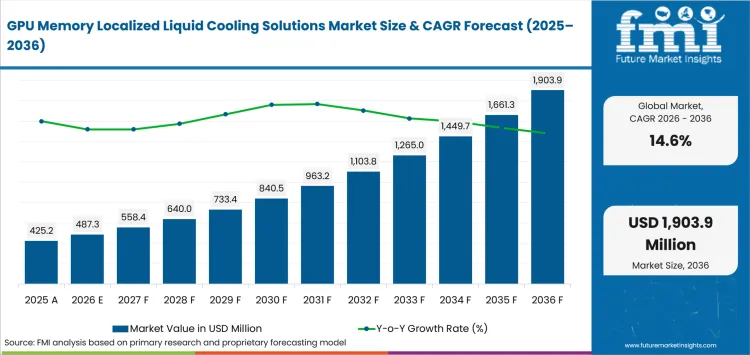
USD 487.3 Million in 2026 and USD 1903.9 Million by 2036 at a 14.6% CAGR.
GPU Memory Localized Liquid Cooling Solutions revenue is projected to rise from USD 487.3 million in 2026 to USD 1903.9 million by 2036 at a 14.6% CAGR. NVIDIA's October 2024 GB200 NVL72 design requires 120 kW of rack cooling capacity and uses direct liquid cooling with rack manifolds and blind-mate connections. The design shows why thermal interfaces are becoming part of the compute platform rather than a later room-cooling decision. This shift supports expansion from USD 487.3 Million in 2026 to USD 1,903.9 Million by 2036 at a 14.6% CAGR as more AI systems are engineered around liquid-native rack architectures.
Key Takeaways
- Higher accelerator density is pushing cooling closer to the GPU package and rack, bringing cold plates, manifolds, CDUs and heat rejection into the same deployment decision.
- Direct-to-chip liquid cooling accounts for 44.0% of Cooling Architecture in 2026, as it removes heat at the highest-load components while preserving familiar rack access.
- Dry coolers hold 29.0% of Heat Rejection / Secondary Loop in 2026, supported by warmer closed-loop designs that can reduce reliance on evaporative cooling.
- The 251-500 kW band accounts for 34.0% of Rack Density in 2026, reflecting the shift toward denser AI racks without moving every deployment into above-500 kW designs.
- Hyperscale AI holds 48.0% of Data Center Type in 2026, where large accelerator fleets support deeper thermal engineering and repeatable qualification.
- Cooling OEM direct accounts for 36.0% of Route to Market in 2026, as buyers increasingly prefer one technical owner for liquid-loop design and performance.
- Integration across cold plates, manifolds, CDUs, coolant chemistry and facility interfaces remains a key adoption challenge, while factory-tested rack packages and water-conscious heat rejection create room for wider deployment.
- JetCool, Vertiv, Boyd and nVent are among the notable companies profiled in the market.
Analyst Perspective
"Localized GPU and memory cooling creates value when the supplier can prove the full thermal chain, not just one component rating. Buyers need predictable interfaces from the cold plate through the manifold and CDU to heat rejection, with commissioning responsibility clear before high-density AI racks arrive on site. Suppliers that reduce this qualification burden can convert new accelerator generations into repeat infrastructure programs."
- Sudip saha, Principal Consultant, Future Market Insights
How is the GPU Memory Localized Liquid Cooling Solutions Market segmented?
The GPU Memory Localized Liquid Cooling Solutions Market is segmented by Cooling Architecture, Heat Rejection / Secondary Loop, Rack Density, Data Center Type, Route to Market and Region.
Cooling Architecture identifies where liquid captures heat, while Heat Rejection / Secondary Loop separates the equipment that moves captured heat to outdoor air, chillers or a shared facility loop. Rack Density reflects the thermal duty that the rack cooling system must support. Data Center Type separates hyperscale, colocation, enterprise and sovereign-compute purchasing patterns, while Route to Market identifies the party carrying primary design and delivery responsibility. These axes sit inside the wider AI liquid cooling ecosystem, but this market is narrower because it centers on localized heat removal around GPU and memory-intensive compute.
Why does Direct-to-chip liquid cooling lead the Cooling Architecture category?
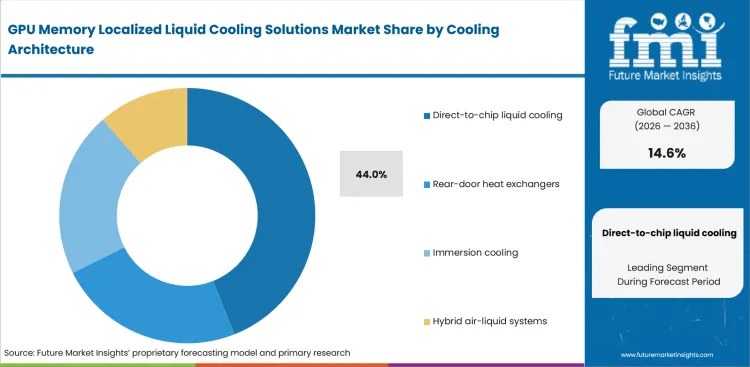
Direct-to-chip liquid cooling removes heat at the accelerator or processor package before it spreads through the server chassis. The architecture preserves serviceable rack formats while allowing liquid to carry the dominant heat load, which is why direct-to-chip cooling is increasingly engineered with the compute platform. NVIDIA's GB200 NVL72 contribution to the Open Compute Project uses direct liquid cooling, rack manifolds and blind-mate liquid connections for a 120 kW rack cooling requirement, illustrating the shift toward liquid-native accelerator infrastructure.
- Direct-to-chip liquid cooling holds a 44.0% share in 2026 because buyers can target the highest heat-flux devices without immersing the full server or rack.
- In June 2026, JetCool launched a liquid-cooled Dell PowerEdge XE7745 with SmartPlate direct-to-chip cooling, integrated rack infrastructure, CDUs, commissioning and ongoing maintenance. The offer shows how device cooling is being packaged with deployment accountability rather than sold only as a cold-plate component.
Why do Dry coolers lead the Heat Rejection / Secondary Loop category?
Dry coolers fit liquid-native AI designs when the primary loop can operate at temperatures high enough to reject heat to outdoor air. They reduce dependence on evaporative water and can limit compressor runtime where climate and supply-temperature targets permit. This does not remove the role of data center chillers, especially in hotter or lower-temperature applications, but it expands facility design options for closed loops that can carry more heat at warmer temperatures.
- Dry coolers hold a 29.0% share in 2026 because closed-loop heat rejection aligns with warmer liquid supply temperatures and water-conscious data center design.
- The USA Department of Energy highlighted ARPA-E COOLERCHIPS work in April 2024 as part of efforts to develop data center cooling technologies that reduce both energy consumption and water usage. That operating objective supports interest in secondary loops that can reject heat with less evaporative demand where local conditions allow.
Why does 251-500 kW lead the Rack Density category?
The 251-500 kW band captures the step between early liquid-native AI racks and the most extreme megawatt-class concepts. NVIDIA's GB200 NVL72 established a 120 kW liquid-cooling requirement in 2024, while the broader shift in data center GPUs continues to raise power density and memory bandwidth requirements. Operators therefore need cooling architectures that can scale beyond the 100-250 kW band without committing every site to above-500 kW rack conditions. The result pulls manifolds, pumps, controls and quick disconnects into a higher-capacity rack design.
- The 251-500 kW segment holds a 34.0% share in 2026 as operators prepare for higher-density GPU racks while retaining deployment flexibility below the most extreme rack class.
- NVIDIA's GB200 NVL72 design uses direct liquid cooling, rack manifolds and floating blind-mate connections to manage a 120 kW rack cooling requirement. The design provides a practical reference point for why rack cooling capacity is moving upward together with accelerator density.
Why does Hyperscale AI lead the Data Center Type category?
Hyperscale AI operators encounter localized thermal constraints early because they deploy large accelerator fleets and refresh platforms quickly. Their scale justifies engineering across the full thermal chain from cold plates and manifolds to coolant distribution and facility heat rejection. This creates a path for new architectures to move from qualification into volume and then into colocation or enterprise deployments.
- Hyperscale AI holds a 48.0% share in 2026 because fleet-scale accelerator deployment rewards repeatable thermal qualification and high-volume liquid-loop manufacturing.
- Boyd reported in September 2025 that it had delivered five million liquid cold plates to hyperscalers and described liquid cold plates for GPUs and CPUs connected through manifolds and quick disconnects. The production milestone illustrates the manufacturing scale required when package-level liquid cooling becomes standard across large AI fleets.
Why does Cooling OEM direct lead the Route to Market category?
Cooling OEM direct is well suited when thermal performance must be tuned to a specific accelerator or server design. Buyers need one party to own cold-plate pressure drop, manifold layout, CDU sizing and coolant requirements, including the selection and management of coolant fluids. A direct engineering relationship can shorten fault isolation during qualification and reduce the risk that responsibility sits between the server vendor and the mechanical contractor. MEP and server-OEM channels remain important for facility integration, but the direct cooling supplier often owns the most specialized liquid-loop performance questions.
- Cooling OEM direct holds a 36.0% share in 2026 because high-density deployments favor suppliers that can take direct responsibility for liquid-loop design and technical qualification.
- JetCool stated in June 2026 that its liquid-cooled Dell PowerEdge XE7745 would be available directly from JetCool with commissioning, deployment, maintenance and unified warranty coverage across the server and cooling environment. The model reduces the number of technical handoffs during enterprise deployment.
What are the drivers, restraints and opportunities in the GPU Memory Localized Liquid Cooling Solutions Market?
Rising accelerator heat density is moving cooling closer to GPU and memory packages, while multi-vendor liquid-loop integration remains the main purchase friction and factory-tested, water-aware systems create the clearest expansion path.
- Driver: Liquid-native AI racks concentrate thermal load around GPUs and adjacent memory, forcing heat capture closer to the package.
- Restraint: Buyers must validate cold plates, manifolds, CDUs, controls, coolant chemistry and facility interfaces as one liquid chain before production deployment.
- Opportunity: Factory-tested rack packages and warmer closed loops can open enterprise, colocation and water-constrained sites that cannot rebuild facility cooling around each GPU generation.
The core driver is the thermal concentration created by rack-scale AI compute. NVIDIA's GB200 NVL72 design places 72 Blackwell GPUs in one NVLink domain and requires 120 kW of rack cooling capacity. At that density, heat cannot be treated only as a diffuse room-load problem. Local liquid interfaces become part of server and rack qualification, and package-level temperature control becomes more important as compute and memory bandwidth rise together.
The binding restraint appears during integration and acceptance. A cold plate can meet device-level thermal targets while the complete loop still fails operator requirements for pressure, leak control, redundancy, service access or facility-water compatibility. NVIDIA's rack design uses blind-mate liquid connections and manifolds because mechanical reliability is part of the thermal problem. JetCool's 2026 enterprise offer responds by packaging rack hardware, CDUs, fluid distribution, commissioning and maintenance under one deployment model.
The clearest opportunity is to make localized liquid cooling deployable without a full mechanical-plant redesign. USA Department of Energy programs emphasize lower cooling energy and water use, while many enterprise and colocation sites have limited facility-water flexibility. Warmer coolant loops, liquid-to-air CDUs, dry coolers and modular assemblies can extend liquid cooling into these environments. Suppliers that bridge device heat capture with secondary-loop design can reduce repeat engineering work as new accelerator platforms arrive.
Which country CAGRs are profiled in the GPU Memory Localized Liquid Cooling Solutions Market?
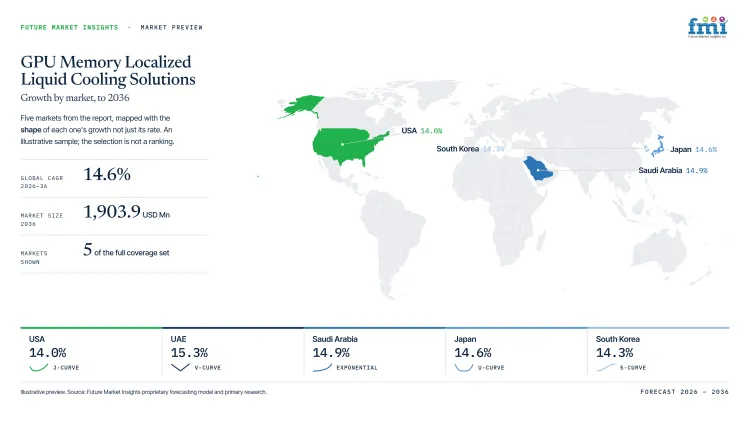
| Country | CAGR |
|---|---|
| USA | 14.0% |
| South Korea | 14.3% |
| Japan | 14.6% |
| Saudi Arabia | 14.9% |
| UAE | 15.3% |
| France | 15.6% |
How do country-level CAGRs compare in the GPU Memory Localized Liquid Cooling Solutions Market?
The six profiled countries span a 1.6 percentage-point range from USA at 14.0% to France at 15.6% from 2026 to 2036. France and UAE form the upper band at 15.6% and 15.3%, followed by Saudi Arabia at 14.9% and Japan at 14.6%. South Korea and USA are forecast at 14.3% and 14.0%. The gaps are narrow enough that project timing, power availability, site readiness, ambient conditions and supplier service depth can matter as much as the headline rate.
- France is 0.3 percentage points above UAE, supported by a policy push for AI infrastructure and an electricity system the government promotes as low carbon and suitable for new data center investment.
- UAE is 0.4 percentage points above Saudi Arabia, with greenfield AI campuses creating an opportunity to specify liquid cooling at the architecture stage rather than retrofit it later.
- Saudi Arabia is 0.3 percentage points above Japan, with new AI and cloud capacity programs increasing the importance of heat-rejection designs suited to high ambient temperatures.
- Japan is 0.3 percentage points above South Korea, while both markets are coordinating AI compute expansion with power and infrastructure planning that can influence site schedules.
- South Korea is 0.3 percentage points above USA, where a large installed data center base creates substantial retrofit opportunity but also exposes suppliers to diverse facility standards and commissioning requirements.
CAGR should not be read as absolute market size or supplier revenue certainty. A lower-growth country can contain a larger installed compute base, while a higher-growth country can depend on a smaller number of large projects with long commissioning cycles. The full report extends this comparison across North America, Latin America, Western Europe, Eastern Europe, East Asia, South Asia and Pacific, and Middle East and Africa.
Country-wise Analysis
- USA: Demand is forecast to expand at 14.0% CAGR from 2026 to 2036. A large installed data-center base creates substantial retrofit potential, but suppliers must work around varied electrical and mechanical plant designs. Efficient cooling and lower water use are becoming more important, increasing demand for solutions that can be integrated without major facility redesign.
- South Korea: Adoption is projected to rise at 14.3% CAGR through 2036. Government plans to expand high-performance GPU capacity and improve site and power availability are supporting new AI infrastructure. Suppliers need strong coordination with local system builders and secondary-loop designs suited to individual facilities.
- Japan: Demand is expected to grow at 14.6% CAGR from 2026 to 2036. The Watt-Bit Collaboration is encouraging closer planning between electricity and telecommunications infrastructure. This favors liquid-cooling systems that can fit into longer site-development cycles and operate efficiently within local power constraints.
- Saudi Arabia: Sales are projected to rise at 14.9% CAGR through 2036. New AI and cloud infrastructure programs are creating more opportunities for purpose-built liquid cooling. High ambient temperatures increase the importance of closed-loop, dry and hybrid heat-rejection systems backed by local commissioning support.
- UAE: Adoption is forecast to expand at 15.3% CAGR from 2026 to 2036. Large greenfield projects such as Stargate UAE allow liquid cooling to be built into the facility architecture from the start. Suppliers need scalable loops, water-conscious heat rejection and execution models suited to fast campus buildouts.
- France: Demand is projected to rise at 15.6% CAGR through 2036. AI infrastructure investment and available low-carbon electricity are supporting new data-center projects. Suppliers can benefit by offering facility-compatible liquid loops, efficient heat rejection and reliable commissioning support for repeat deployments.
Who are the notable companies in the GPU Memory Localized Liquid Cooling Solutions Market?
JetCool, Vertiv, Boyd and nVent
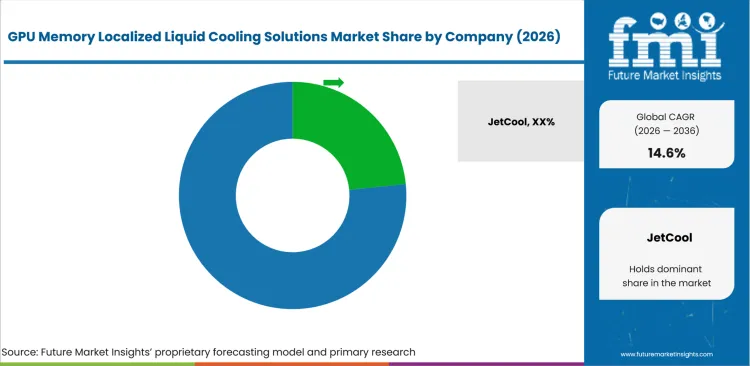
JetCool, Vertiv, nVent and Boyd participate at different points of the liquid-cooling chain. JetCool focuses on direct-to-chip cooling and turnkey rack deployments. Vertiv extends further into CDUs, heat rejection and facility infrastructure. nVent combines rack-level coolant distribution with broader liquid-cooling integration, while Boyd built scale in cold plates and liquid loops before its Thermal business was acquired by Eaton in March 2026. Buyers therefore evaluate how much of the thermal chain each supplier can own and how easily the same design can be repeated across multiple sites.
- JetCool: Direct-to-chip cooling, integrated Dell server programs and turnkey rack deployment for enterprise AI.
- Vertiv and nVent: Broader infrastructure positions spanning CDUs, rack loops, heat rejection and facility integration.
- Boyd: High-volume cold-plate and liquid-loop manufacturing capability, with the Thermal business now part of Eaton.
Competitive Benchmarking: GPU Memory Localized Liquid Cooling Solutions Market
| Company | Chip/Package Heat Capture | Rack Loop / CDU Integration | Facility Integration | Commercial Position |
|---|---|---|---|---|
| JetCool | High | High | Medium | Direct-to-chip specialist with turnkey enterprise rack deployment |
| Vertiv | High | High | High | End-to-end thermal and critical-infrastructure integration |
| Boyd | High | High | Medium | High-volume cold plates and liquid loops; Thermal business now part of Eaton |
| nVent | Medium | High | High | Rack and facility liquid-cooling infrastructure with capacity expansion |
Scoring basis: Chip/Package Heat Capture reflects depth in device-adjacent cooling, Rack Loop / CDU Integration reflects the ability to connect cold plates through manifolds and coolant distribution, and Facility Integration reflects breadth across heat rejection, controls and site deployment. High indicates broad capability within the criterion, while Medium indicates a narrower specialty. Scores describe portfolio fit within the defined thermal chain, not corporate scale or market share.
Key Developments in the GPU Memory Localized Liquid Cooling Solutions Market
- In June 2026, JetCool launched a liquid-cooled Dell PowerEdge XE7745 solution for enterprise AI. The package combines direct-to-chip SmartPlate cooling with rack infrastructure, CDUs, fluid distribution, commissioning, maintenance and unified warranty coverage across the server and cooling environment.
- In April 2026, Vertiv acquired Strategic Thermal Labs to strengthen its liquid-cooling engineering capabilities. The acquisition adds cold-plate design, server-side liquid cooling and high-density thermal validation expertise, extending Vertiv’s capabilities across design, integration and lifecycle operations.
- In March 2026, Eaton completed the acquisition of Boyd Thermal from Boyd Corporation. The transaction added liquid-cooling components and systems for data centers to Eaton’s portfolio, along with manufacturing operations across North America, Asia and Europe.
- In July 2026, nVent announced a new 160,000-square-foot manufacturing site in Blaine, Minnesota for data-center liquid-cooling solutions. The expansion is its third in three years and brings the company’s added liquid-cooling manufacturing space to more than 400,000 square feet, supporting growing AI and HPC demand.
Key Players in the GPU Memory Localized Liquid Cooling Solutions Market
Localized Direct-to-Chip and Turnkey Cooling
- JetCool
Facility-to-Rack Infrastructure Integration
- Vertiv
- nVent
High-Volume Cold-Plate and Liquid-Loop Platforms
- Boyd
GPU Memory Localized Liquid Cooling Solutions Market - Report Scope
| Coverage field | Report scope |
|---|---|
| Market breakdown | Cooling Architecture; Heat Rejection / Secondary Loop; Rack Density; Data Center Type; Route to Market; Region |
| Quantitative Units | USD Million |
| Market Definition | Revenue includes liquid-cooling hardware and integrated solutions sold to remove concentrated heat from GPU packages and adjacent high-bandwidth memory within AI and HPC systems. Included items span cold plates, package liquid interfaces, manifolds, CDUs, rack-level liquid architectures and secondary heat-rejection equipment supplied within this cooling boundary. Server, GPU, memory, finished data center and stand-alone adjacent HVAC revenue are excluded. |
| Regions Covered | North America; Latin America; Western Europe; Eastern Europe; East Asia; South Asia and Pacific; Middle East and Africa |
| Countries Covered | USA, South Korea, Japan, Saudi Arabia, UAE, France and more than twenty-five additional countries in the full report |
| Key Companies Profiled | JetCool, Vertiv, Boyd, nVent |
| Forecast Period | 2026 to 2036 |
| Approach | A hybrid bottom-up and top-down sizing approach reconciles cooling-system demand across architecture, rack density, data center type, route to market and country conditions while excluding adjacent revenue. |
GPU Memory Localized Liquid Cooling Solutions Market - Research Methodology
| Method | Approach |
|---|---|
| Primary Research | Industry assumptions are tested against feedback from cooling OEMs, MEP and EPC integrators, server and rack suppliers, data center operators, procurement teams and technical specialists. Discussion themes cover thermal specifications, qualification hurdles, pricing structures, installation requirements, maintenance needs and expansion triggers. |
| Desk Research | Analysis reviews government AI and digital-infrastructure programs, national energy and site-planning material, company filings, first-party technical documents, public product specifications, standards-related material and dated corporate announcements relevant to the defined cooling boundary. |
| Market Sizing and Forecasting | Sizing combines bottom-up solution demand with top-down checks on AI and HPC infrastructure expansion. Forecast assumptions consider accelerator density, rack architecture, secondary-loop requirements, data center type, route-to-market evolution, country build conditions and supplier capacity. |
| Data Validation | Quantitative estimates are triangulated across solution demand, infrastructure indicators, supplier activity and primary feedback. Scope checks remove double counting across cold plates, CDUs, rack packages and heat-rejection equipment and exclude server, GPU, memory and finished data center revenue. |
GPU Memory Localized Liquid Cooling Solutions Market by Segments
GPU Memory Localized Liquid Cooling Solutions Market segmented by Cooling Architecture:
- Direct-to-chip liquid cooling
- Rear-door heat exchangers
- Immersion cooling
- Hybrid air-liquid systems
GPU Memory Localized Liquid Cooling Solutions Market segmented by Heat Rejection / Secondary Loop:
- Dry coolers
- Chillers
- Cooling towers / evaporative
- Facility water loop / district interface
- Hybrid systems
GPU Memory Localized Liquid Cooling Solutions Market segmented by Rack Density:
- 251-500 kW
- 100-250 kW
- Below 100 kW
- Above 500 kW
GPU Memory Localized Liquid Cooling Solutions Market segmented by Data Center Type:
- Hyperscale AI
- Colocation AI
- Enterprise AI/HPC
- Research / sovereign compute
GPU Memory Localized Liquid Cooling Solutions Market segmented by Route to Market:
- Cooling OEM direct
- MEP / EPC integrator
- Server / rack OEM bundle
- Service & retrofit channel
GPU Memory Localized Liquid Cooling Solutions Market by Region:
- North America
- United States
- Canada
- Latin America
- Brazil
- Mexico
- Argentina
- Chile
- Western Europe
- Germany
- France
- United Kingdom
- Italy
- Spain
- Benelux
- Nordics
- Eastern Europe
- Poland
- Czech Republic
- Romania
- Hungary
- East Asia
- China
- Japan
- South Korea
- South Asia and Pacific
- India
- ASEAN
- Australia and New Zealand
- Middle East and Africa
- GCC Countries
- South Africa
- Türkiye
- Israel
Research Sources and Bibliography
- USA Department of Energy. (2024, April 29). DOE Announces New Actions to Enhance America's Global Leadership in Artificial Intelligence.
- NVIDIA Developer Blog. (2024, October 15). NVIDIA Contributes NVIDIA GB200 NVL72 Designs to Open Compute Project.
- Ministry of Science and ICT, Republic of Korea. (2025, February 20). Korea to Expand AI Computing Infrastructure to Strengthen National AI Capabilities and Achieve Global Leadership.
- Ministry of Economy, Trade and Industry, Japan. (2025, June 12). Report 1.0 of the Public-Private Advisory Council on Watt-Bit Collaboration Published.
- Saudi Press Agency. (2025, February 9). Saudi Arabia Solidifies Its Position as a Regional and Global Hub for AI with $14.9B in Investment at LEAP25.
- Abu Dhabi Media Office. (2025, May 22). Global tech alliance launches Stargate UAE.
- Élysée. (2025, February 11). Make France an AI powerhouse.
- JetCool. (2026, June 25). JetCool Launches Turnkey Liquid-Cooled Server Solution to Accelerate Enterprise AI Adoption.
- Vertiv. (2026, April 27). Vertiv strengthens liquid-cooling system capability with acquisition of Strategic Thermal Labs.
- Boyd. (2025, September 8). Boyd Has Delivered 5 Million Liquid Cold Plates to Hyperscalers through Reliable, High-Volume Global Manufacturing, Advancing AI Data Center Liquid Cooling Technology.
- Eaton. (2026, March 12). Eaton completes acquisition of leading liquid-cooling solutions provider Boyd Thermal, creating an industry-leading grid-to-chip solution for data centers.
- nVent. (2026, July 31). nVent Expands Data Center Liquid Cooling Capacity.
This bibliography is provided for reader reference and is not exhaustive. The full report contains the complete reference list and detailed citations.
This Report Answers
- Which accelerator-density and thermal mechanisms support demand for GPU memory localized liquid cooling solutions?
- Why does direct-to-chip liquid cooling remain central to package-level heat capture?
- How do dry coolers, chillers and facility-water interfaces change secondary-loop design?
- Why does the 251-500 kW rack-density band matter for next-generation AI infrastructure?
- How do adoption conditions differ across USA, South Korea, Japan, Saudi Arabia, UAE and France?
- How do JetCool, Vertiv, Boyd and nVent differ in localized heat capture and infrastructure integration?
- Which integration, coolant and commissioning constraints can delay production deployment?
- What should data center infrastructure decision-makers evaluate before purchasing a localized liquid-cooling solution?
Frequently Asked Questions
How big is the GPU Memory Localized Liquid Cooling Solutions Market in 2026?
The GPU Memory Localized Liquid Cooling Solutions Market is valued at USD 487.3 Million in 2026 and is forecast to reach USD 1,903.9 Million by 2036 as localized liquid paths become more tightly integrated with AI rack architectures.
What is the CAGR of the GPU Memory Localized Liquid Cooling Solutions Market from 2026 to 2036?
The GPU Memory Localized Liquid Cooling Solutions Market is forecast to expand at 14.6% CAGR from 2026 to 2036.
Which Cooling Architecture segment leads the GPU Memory Localized Liquid Cooling Solutions Market?
Direct-to-chip liquid cooling leads the Cooling Architecture category with 44.0% share in 2026 because it removes heat close to the accelerator while preserving familiar rack access and service patterns.
How much will the GPU Memory Localized Liquid Cooling Solutions Market add between 2026 and 2036?
The market is expected to add approximately USD 1,416.6 Million between 2026 and 2036, based on the difference between the USD 487.3 Million 2026 value and the USD 1,903.9 Million 2036 value.
Which companies are active in the GPU Memory Localized Liquid Cooling Solutions Market?
JetCool, Vertiv, Boyd and nVent are notable companies active across direct-to-chip cooling, rack coolant distribution, high-volume cold-plate manufacturing and facility-loop integration.
Preview the report firsthand - request a free sample
Get SampleGet the brochure for pricing and purchase details.
Get PDFTable of Content
- Key Takeaways
- Market Size and CAGR
- Top Growth Driver
- Fastest Growing Segment
- Leading Region
- Key Companies
- Emerging Opportunities
- Executive Summary
- Global Market Outlook
- Demand-side Trends
- Supply-side Trends
- Technology Roadmap Analysis
- Analysis and Recommendations
- Analyst Perspective (What is happening? Why now? What should investors know?)
- Key Questions Answered
- How large is the market?
- What is the CAGR?
- What are key trends?
- Which region dominates?
- Who are the leaders?
- Market Overview
- Market Coverage / Taxonomy
- Market Definition / Scope / Limitations
- Research Methodology
- Chapter Orientation
- Analytical Lens and Working Hypotheses
- Market Structure, Signals, and Trend Drivers
- Benchmarking and Cross-market Comparability
- Market Sizing, Forecasting, and Opportunity Mapping
- Research Design and Evidence Framework
- Desk Research Programme (Secondary Evidence)
- Expert Input and Fieldwork (Primary Evidence)
- Tooling, Models, and Reference Databases
- Data Engineering and Model Build
- Quality Assurance and Audit Trail
- Market Background
- Market Dynamics (Drivers, Restraints, Opportunity, Trends)
- Scenario Forecast (Optimistic, Likely, Conservative)
- Impact Analysis
- AI Impact
- Sustainability Impact
- Regulatory Impact
- Technology Impact
- Consumer / Buyer Analysis
- Purchase Drivers
- Adoption Barriers
- Buyer Journey
- Opportunity Map Analysis
- Product Life Cycle Analysis
- Supply Chain Analysis
- Investment Feasibility Matrix
- Value Chain Analysis
- PESTLE and Porter's Analysis
- Regulatory Landscape
- Regional Parent Market Outlook
- Production and Consumption Statistics
- Import and Export Statistics
- Global Market Analysis and Forecast, 2021 to 2036
- Historical Market Size Value (USD Million) Analysis, 2021 to 2025
- Current and Future Market Size Value (USD Million) Projections, 2026 to 2036
- Y-o-Y Growth Trend Analysis
- Absolute $ Opportunity Analysis
- Global Market Pricing Analysis, 2021 to 2036
- Global Market Analysis and Forecast, By Cooling Architecture, 2021 to 2036
- Introduction / Key Findings
- Historical Market Size Value (USD Million) Analysis By Cooling Architecture, 2021 to 2025
- Current and Future Market Size Value (USD Million) Analysis and Forecast By Cooling Architecture, 2026 to 2036
- Direct-to-chip liquid cooling
- Rear-door heat exchangers
- Immersion cooling
- Hybrid air-liquid systems
- Direct-to-chip liquid cooling
- Y-o-Y Growth Trend Analysis By Cooling Architecture, 2021 to 2025
- Absolute $ Opportunity Analysis By Cooling Architecture, 2026 to 2036
- Global Market Analysis and Forecast, By Heat Rejection / Secondary Loop, 2021 to 2036
- Introduction / Key Findings
- Historical Market Size Value (USD Million) Analysis By Heat Rejection / Secondary Loop, 2021 to 2025
- Current and Future Market Size Value (USD Million) Analysis and Forecast By Heat Rejection / Secondary Loop, 2026 to 2036
- Dry coolers
- Chillers
- Cooling towers / evaporative
- Facility water loop / district interface
- Hybrid systems
- Dry coolers
- Y-o-Y Growth Trend Analysis By Heat Rejection / Secondary Loop, 2021 to 2025
- Absolute $ Opportunity Analysis By Heat Rejection / Secondary Loop, 2026 to 2036
- Global Market Analysis and Forecast, By Rack Density, 2021 to 2036
- Introduction / Key Findings
- Historical Market Size Value (USD Million) Analysis By Rack Density, 2021 to 2025
- Current and Future Market Size Value (USD Million) Analysis and Forecast By Rack Density, 2026 to 2036
- 251–500 kW
- 100–250 kW
- Below 100 kW
- Above 500 kW
- 251–500 kW
- Y-o-Y Growth Trend Analysis By Rack Density, 2021 to 2025
- Absolute $ Opportunity Analysis By Rack Density, 2026 to 2036
- Global Market Analysis and Forecast, By Data Center Type, 2021 to 2036
- Introduction / Key Findings
- Historical Market Size Value (USD Million) Analysis By Data Center Type, 2021 to 2025
- Current and Future Market Size Value (USD Million) Analysis and Forecast By Data Center Type, 2026 to 2036
- Hyperscale AI
- Colocation AI
- Enterprise AI/HPC
- Research / sovereign compute
- Hyperscale AI
- Y-o-Y Growth Trend Analysis By Data Center Type, 2021 to 2025
- Absolute $ Opportunity Analysis By Data Center Type, 2026 to 2036
- Global Market Analysis and Forecast, By Route to Market, 2021 to 2036
- Introduction / Key Findings
- Historical Market Size Value (USD Million) Analysis By Route to Market, 2021 to 2025
- Current and Future Market Size Value (USD Million) Analysis and Forecast By Route to Market, 2026 to 2036
- Cooling OEM direct
- MEP / EPC integrator
- Server / rack OEM bundle
- Service & retrofit channel
- Cooling OEM direct
- Y-o-Y Growth Trend Analysis By Route to Market, 2021 to 2025
- Absolute $ Opportunity Analysis By Route to Market, 2026 to 2036
- Global Market Analysis and Forecast, By Region, 2021 to 2036
- Introduction
- Historical Market Size Value (USD Million) Analysis By Region, 2021 to 2025
- Current Market Size Value (USD Million) Analysis and Forecast By Region, 2026 to 2036
- North America
- Latin America
- Western Europe
- Eastern Europe
- East Asia
- South Asia and Pacific
- Middle East & Africa
- Market Attractiveness Analysis By Region
- North America Market Analysis and Forecast, By Country, 2021 to 2036
- Historical Market Size Value (USD Million) Trend Analysis By Market Taxonomy, 2021 to 2025
- Market Size Value (USD Million) Forecast By Market Taxonomy, 2026 to 2036
- By Country
- USA
- Canada
- By Cooling Architecture
- By Heat Rejection / Secondary Loop
- By Rack Density
- By Data Center Type
- By Route to Market
- By Country
- Market Attractiveness Analysis
- By Country
- By Cooling Architecture
- By Heat Rejection / Secondary Loop
- By Rack Density
- By Data Center Type
- By Route to Market
- Key Takeaways
- Latin America Market Analysis and Forecast, By Country
- Historical Market Size Value (USD Million) Trend Analysis By Market Taxonomy, 2021 to 2025
- Market Size Value (USD Million) Forecast By Market Taxonomy, 2026 to 2036
- By Country
- Brazil
- Mexico
- Chile
- Rest of Latin America
- By Cooling Architecture
- By Heat Rejection / Secondary Loop
- By Rack Density
- By Data Center Type
- By Route to Market
- By Country
- Market Attractiveness Analysis
- By Country
- By Cooling Architecture
- By Heat Rejection / Secondary Loop
- By Rack Density
- By Data Center Type
- By Route to Market
- Key Takeaways
- Western Europe Market Analysis and Forecast, By Country
- Historical Market Size Value (USD Million) Trend Analysis By Market Taxonomy, 2021 to 2025
- Market Size Value (USD Million) Forecast By Market Taxonomy, 2026 to 2036
- By Country
- Germany
- UK
- Italy
- Spain
- France
- Nordic
- BENELUX
- Rest of Western Europe
- By Cooling Architecture
- By Heat Rejection / Secondary Loop
- By Rack Density
- By Data Center Type
- By Route to Market
- By Country
- Market Attractiveness Analysis
- By Country
- By Cooling Architecture
- By Heat Rejection / Secondary Loop
- By Rack Density
- By Data Center Type
- By Route to Market
- Key Takeaways
- Eastern Europe Market Analysis and Forecast, By Country
- Historical Market Size Value (USD Million) Trend Analysis By Market Taxonomy, 2021 to 2025
- Market Size Value (USD Million) Forecast By Market Taxonomy, 2026 to 2036
- By Country
- Russia
- Poland
- Hungary
- Balkan & Baltic
- Rest of Eastern Europe
- By Cooling Architecture
- By Heat Rejection / Secondary Loop
- By Rack Density
- By Data Center Type
- By Route to Market
- By Country
- Market Attractiveness Analysis
- By Country
- By Cooling Architecture
- By Heat Rejection / Secondary Loop
- By Rack Density
- By Data Center Type
- By Route to Market
- Key Takeaways
- East Asia Market Analysis and Forecast, By Country
- Historical Market Size Value (USD Million) Trend Analysis By Market Taxonomy, 2021 to 2025
- Market Size Value (USD Million) Forecast By Market Taxonomy, 2026 to 2036
- By Country
- China
- Japan
- South Korea
- By Cooling Architecture
- By Heat Rejection / Secondary Loop
- By Rack Density
- By Data Center Type
- By Route to Market
- By Country
- Market Attractiveness Analysis
- By Country
- By Cooling Architecture
- By Heat Rejection / Secondary Loop
- By Rack Density
- By Data Center Type
- By Route to Market
- Key Takeaways
- South Asia and Pacific Market Analysis and Forecast, By Country
- Historical Market Size Value (USD Million) Trend Analysis By Market Taxonomy, 2021 to 2025
- Market Size Value (USD Million) Forecast By Market Taxonomy, 2026 to 2036
- By Country
- India
- ASEAN
- Australia & New Zealand
- Rest of South Asia and Pacific
- By Cooling Architecture
- By Heat Rejection / Secondary Loop
- By Rack Density
- By Data Center Type
- By Route to Market
- By Country
- Market Attractiveness Analysis
- By Country
- By Cooling Architecture
- By Heat Rejection / Secondary Loop
- By Rack Density
- By Data Center Type
- By Route to Market
- Key Takeaways
- Middle East & Africa Market Analysis and Forecast, By Country
- Historical Market Size Value (USD Million) Trend Analysis By Market Taxonomy, 2021 to 2025
- Market Size Value (USD Million) Forecast By Market Taxonomy, 2026 to 2036
- By Country
- Kingdom of Saudi Arabia
- Other GCC Countries
- Türkiye
- South Africa
- Other African Union
- Rest of Middle East & Africa
- By Cooling Architecture
- By Heat Rejection / Secondary Loop
- By Rack Density
- By Data Center Type
- By Route to Market
- By Country
- Market Attractiveness Analysis
- By Country
- By Cooling Architecture
- By Heat Rejection / Secondary Loop
- By Rack Density
- By Data Center Type
- By Route to Market
- Key Takeaways
- Key Countries Market Analysis
- USA
- Pricing Analysis
- Market Share Analysis, 2025
- By Cooling Architecture
- By Heat Rejection / Secondary Loop
- By Rack Density
- By Data Center Type
- By Route to Market
- Canada
- Pricing Analysis
- Market Share Analysis, 2025
- By Cooling Architecture
- By Heat Rejection / Secondary Loop
- By Rack Density
- By Data Center Type
- By Route to Market
- Mexico
- Pricing Analysis
- Market Share Analysis, 2025
- By Cooling Architecture
- By Heat Rejection / Secondary Loop
- By Rack Density
- By Data Center Type
- By Route to Market
- Brazil
- Pricing Analysis
- Market Share Analysis, 2025
- By Cooling Architecture
- By Heat Rejection / Secondary Loop
- By Rack Density
- By Data Center Type
- By Route to Market
- Chile
- Pricing Analysis
- Market Share Analysis, 2025
- By Cooling Architecture
- By Heat Rejection / Secondary Loop
- By Rack Density
- By Data Center Type
- By Route to Market
- Germany
- Pricing Analysis
- Market Share Analysis, 2025
- By Cooling Architecture
- By Heat Rejection / Secondary Loop
- By Rack Density
- By Data Center Type
- By Route to Market
- UK
- Pricing Analysis
- Market Share Analysis, 2025
- By Cooling Architecture
- By Heat Rejection / Secondary Loop
- By Rack Density
- By Data Center Type
- By Route to Market
- Italy
- Pricing Analysis
- Market Share Analysis, 2025
- By Cooling Architecture
- By Heat Rejection / Secondary Loop
- By Rack Density
- By Data Center Type
- By Route to Market
- Spain
- Pricing Analysis
- Market Share Analysis, 2025
- By Cooling Architecture
- By Heat Rejection / Secondary Loop
- By Rack Density
- By Data Center Type
- By Route to Market
- France
- Pricing Analysis
- Market Share Analysis, 2025
- By Cooling Architecture
- By Heat Rejection / Secondary Loop
- By Rack Density
- By Data Center Type
- By Route to Market
- India
- Pricing Analysis
- Market Share Analysis, 2025
- By Cooling Architecture
- By Heat Rejection / Secondary Loop
- By Rack Density
- By Data Center Type
- By Route to Market
- ASEAN
- Pricing Analysis
- Market Share Analysis, 2025
- By Cooling Architecture
- By Heat Rejection / Secondary Loop
- By Rack Density
- By Data Center Type
- By Route to Market
- Australia & New Zealand
- Pricing Analysis
- Market Share Analysis, 2025
- By Cooling Architecture
- By Heat Rejection / Secondary Loop
- By Rack Density
- By Data Center Type
- By Route to Market
- China
- Pricing Analysis
- Market Share Analysis, 2025
- By Cooling Architecture
- By Heat Rejection / Secondary Loop
- By Rack Density
- By Data Center Type
- By Route to Market
- Japan
- Pricing Analysis
- Market Share Analysis, 2025
- By Cooling Architecture
- By Heat Rejection / Secondary Loop
- By Rack Density
- By Data Center Type
- By Route to Market
- South Korea
- Pricing Analysis
- Market Share Analysis, 2025
- By Cooling Architecture
- By Heat Rejection / Secondary Loop
- By Rack Density
- By Data Center Type
- By Route to Market
- Russia
- Pricing Analysis
- Market Share Analysis, 2025
- By Cooling Architecture
- By Heat Rejection / Secondary Loop
- By Rack Density
- By Data Center Type
- By Route to Market
- Poland
- Pricing Analysis
- Market Share Analysis, 2025
- By Cooling Architecture
- By Heat Rejection / Secondary Loop
- By Rack Density
- By Data Center Type
- By Route to Market
- Hungary
- Pricing Analysis
- Market Share Analysis, 2025
- By Cooling Architecture
- By Heat Rejection / Secondary Loop
- By Rack Density
- By Data Center Type
- By Route to Market
- Kingdom of Saudi Arabia
- Pricing Analysis
- Market Share Analysis, 2025
- By Cooling Architecture
- By Heat Rejection / Secondary Loop
- By Rack Density
- By Data Center Type
- By Route to Market
- Türkiye
- Pricing Analysis
- Market Share Analysis, 2025
- By Cooling Architecture
- By Heat Rejection / Secondary Loop
- By Rack Density
- By Data Center Type
- By Route to Market
- South Africa
- Pricing Analysis
- Market Share Analysis, 2025
- By Cooling Architecture
- By Heat Rejection / Secondary Loop
- By Rack Density
- By Data Center Type
- By Route to Market
- USA
- Market Structure Analysis
- Competition Dashboard
- Competition Benchmarking
- Market Share Analysis of Top Players
- By Regional
- By Cooling Architecture
- By Heat Rejection / Secondary Loop
- By Rack Density
- By Data Center Type
- By Route to Market
- Emerging Startups
- Innovation Benchmarking
- Competition Analysis
- Competition Deep Dive
- JetCool
- Overview
- Product Portfolio
- Profitability by Market Segments
- Sales Footprint
- Strategy Overview
- Marketing Strategy
- Product Strategy
- Channel Strategy
- Vertiv
- Boyd
- nVent
- JetCool
- Case Studies
- Success Stories
- Recent Developments
- Competition Deep Dive
- Assumptions & Acronyms Used


