

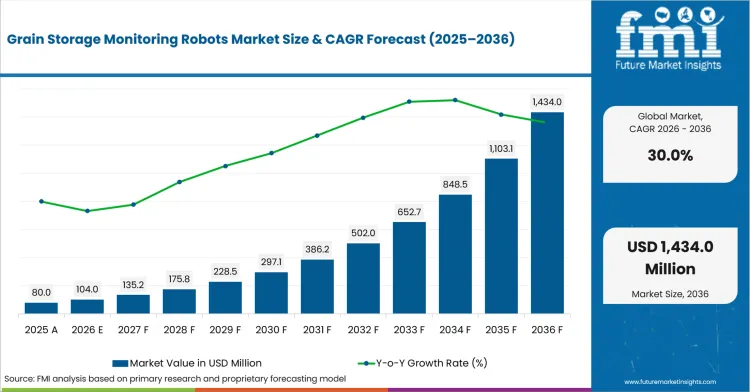
- Market Size (2026)
- USD 104.0 Mn
- Forecast (2036)
- USD 1434.0 Mn
- CAGR (2026 to 2036)
- 30.0%
How big is the Grain Storage Monitoring Robots Market in 2026?
USD 104.0 million in 2026 and USD 1,434.0 million by 2036 at a 30.0% CAGR.
Demand for grain storage monitoring robots is projected to expand at 30.0% CAGR between 2026 and 2036. Valuation is expected to rise from USD 104.0 million in 2026 to USD 1,434.0 million by 2036. These agricultural robot systems are anticipated to inspect heat and moisture patterns inside grain rather than infer risk from surface readings. USDA National Agricultural Statistics Service reported in January 2026 that USA corn stocks reached 13.3 billion bushels on December 1, 2025. That stored volume is expected to increase the value of fault detection before quality loss reaches saleable inventory. Commercial returns are projected to depend on timely aeration or sampling decisions after each alert.
Adoption is expected to differ by storage design and service coverage rather than cereal output. USA farm bins and elevators are likely to support recurring sensor service across storage networks. European cooperatives are expected to prioritize retrofit access and energy records across mixed silo ages. Russian facilities are anticipated to favor repairable hardware under harsh conditions and across long service routes. The European Commission reported in July 2025 that EU cereal production for 2025/26 was anticipated to rise 4.1%. This rebound is expected to widen the addressable inspection base without removing local installation limits. Procurement reviews are likely to compare calibration access and spare-part lead times with alert accuracy. Systems used with hermetic grain storage are expected to prove value through clear action thresholds. Credible offers are projected to convert each warning into a documented inspection or aeration decision.
Key Takeaways of Grain Storage Monitoring Robots Market
- Demand for grain storage monitoring robots is driven by the need to detect hidden deterioration inside stored grain during long holding periods, with temperature and moisture changes providing the earliest warning of localized storage problems.
- By component, hardware is expected to lead with 50.0% share in 2026, as reliable sensors and gateways determine whether software guidance can be trusted across storage cycles.
- Grain quality monitoring is the dominant application segment, projected to hold 44.0% share in 2026, connecting condition data with sampling and aeration decisions.
- In-silo crawler robots are estimated to lead the product type category with 40.0% share in 2026, valued for readings between fixed measurement points inside larger commercial grain bins.
- Storage scale and service quality remain critical factors, as systems that reduce unsafe entry and repeated manual probing depend on calibration and repair to keep readings comparable across harvest cycles.
- The United States, European Union, and Russia are expected to form the higher-growth region tier, advancing at 31.0%, 30.0%, and 27.0% CAGR respectively through 2036, supported by dealer coverage, retrofit demand, and durable field-repairable hardware.
- Competition centers on Crover, GSI, AGI Digital, Sukup Manufacturing, TeleSense, SafeGrain, and Javelot, with vendors differentiating through in-grain movement and sampling, fan-control integration, and remote condition monitoring.
Analyst Perspective
"The grain storage monitoring robots market creates value by helping operators detect developing storage issues before they result in measurable grain loss or quality deterioration. Storage managers are selecting systems that deliver dependable condition monitoring across complex silo environments, support timely intervention, and integrate with existing grain management practices. Providers that combine reliable sensing technologies with responsive service, practical calibration support, and actionable monitoring insights are expected to build lasting relationships across commercial grain storage operations."
- Nandini Roy Choudhury, Principal Analyst at Future Market Insights
Source: FMI's proprietary forecasting model and primary research
How is the Grain Storage Monitoring Robots Market segmented?
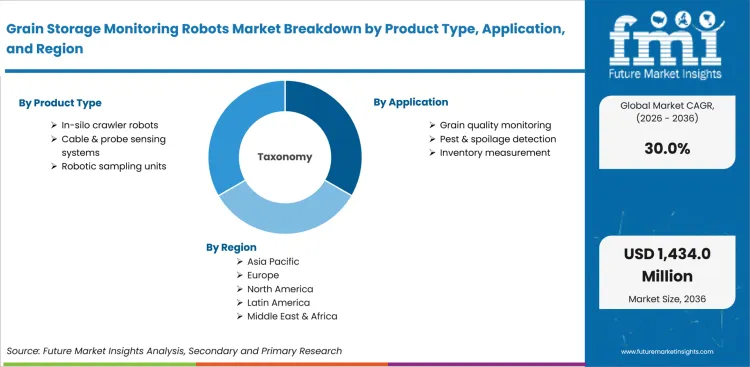
Product type, application, component, end user, business model, and region
The segmentation separates how equipment travels from the job it performs and how each site pays for it. Product type analysis covers in-silo crawlers and cable systems alongside robotic sampling units used for targeted checks. Application analysis distinguishes grain quality monitoring from pest detection and inventory measurement across different storage decisions. Component spending includes hardware and AI software alongside services for calibration and field support workflows. End users include commercial elevators and on-farm storage alongside ports and food processors handling stored grain. Business models compare subscriptions with equipment sales and service contracts across different ownership and support preferences. Regional coverage follows installed storage capacity and local maintenance routes that shape service economics directly. This structure is expected to compare mobile inspection with permanent sensing used across steel silo systems.
How do in-silo crawler robots shape demand within the product type category?
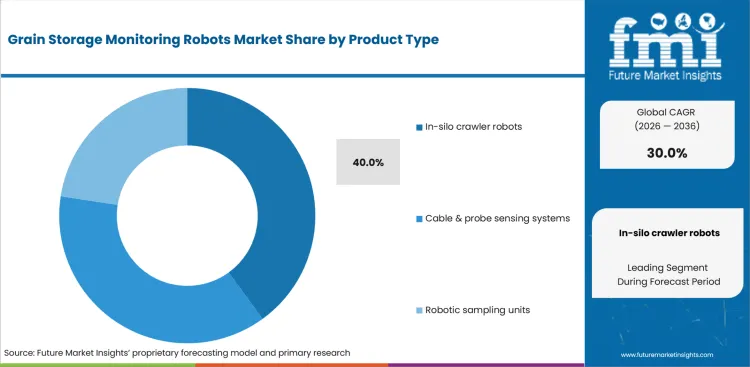
In-silo crawler robots are expected to address inspection blind spots that remain between fixed temperature cables inside larger bins. Their value is projected to come from readings at selected depths without relying on one permanent sensing line. Crover introduced in-app grain moisture sensor calibration during February 2026 for repeated checks across different grain types. The update is expected to improve measurement consistency across grain types during repeated inspection passes and later reviews. A crawler premium is likely to depend on comparable data that remains consistent across repeated inspection routes.
- With an estimated 40.0% of product type revenue in 2026, in-silo crawler robots are anticipated to lead through inspection beyond fixed sensing points. Internal movement is expected to narrow the search area around hidden hot spots during repeated inspection passes.
- In-silo crawler robots are drawing demand from commercial elevator operators owing to uneven grain conditions inside larger bins. Their inspection role is expected to complement grain cooling spears by directing follow-up checks toward the depth that triggered an alert. This targeted route is likely to reduce repeated manual probing during fault diagnosis inside large commercial bins.
What supports grain quality monitoring within the application category?
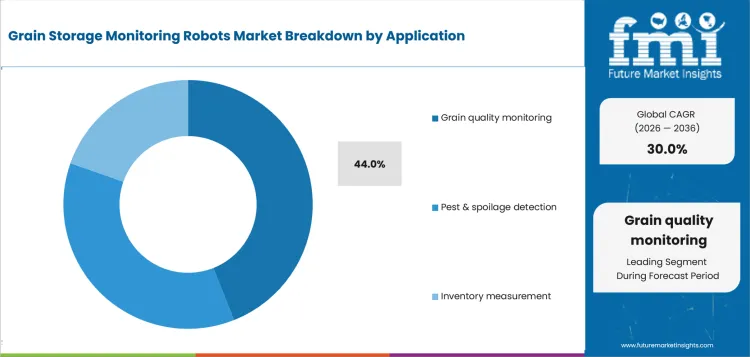
Grain quality monitoring is expected to lead because spoilage often begins with a local change in temperature or moisture. Javelot announced a partnership with Walagri in April 2025 to digitize cereal stocks and support ventilation control. The project is expected to connect condition readings with energy and storage decisions at cooperative sites. This application is likely to shorten the gap between an abnormal reading and a targeted response.
- By application, grain quality monitoring is expected to represent 44.0% in 2026 due to the need for earlier spoilage detection. Condition alerts are projected to guide sampling and aeration before a localized issue reduces saleable quality.
- Demand for grain quality monitoring is expected to grow among storage managers linked to tighter quality records. Alerts are likely to support mycotoxin testing programs after a temperature or carbon dioxide deviation requires confirmatory sampling. Clear thresholds are expected to make each intervention easier to document across storage teams and audit records.
How is hardware positioned within the component category?
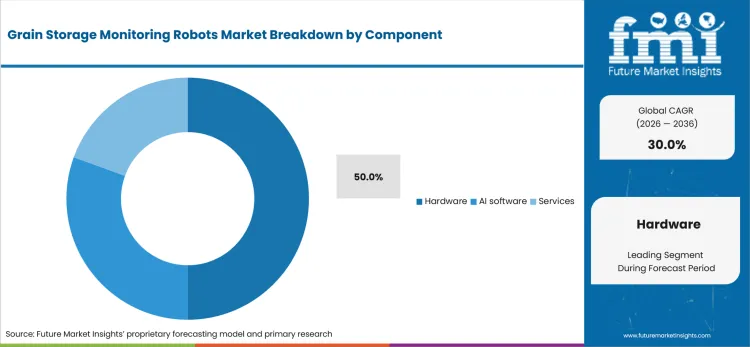
Hardware is expected to account for half of component spending because every software alert depends on the physical sensing layout. Crover reported in March 2026 that England's Farming Equipment and Technology Fund could cover up to 40% of eligible systems. The funding route is anticipated to lower the entry barrier for monitoring and sampling equipment. Hardware quality is likely to remain decisive since damaged probes or weak communications can make software guidance unusable.
- Physical sensing requirements are projected to push hardware to a 50.0% share across components in 2026. Sensors and mobility systems are expected to carry the cost burden that software cannot remove.
- Farm operators and elevator technicians are increasingly purchasing serviceable hardware led by the need to limit downtime. Accessible gateways are expected to connect with farm management software and remote alerts without forcing a complete bin rebuild. Local repair capacity is likely to protect reading continuity across several storage cycles and service events.
What are the drivers, restraints, and opportunities in the Grain Storage Monitoring Robots Market?
Driver: earlier detection of hidden deterioration | Restraint: safety and retrofit complexity | Opportunity: connected warehouse operations
- Driver: Hidden deterioration is expected to create demand for earlier inspection inside the grain mass. Mobile units and fixed sensors are projected to shorten the delay between a warning and corrective action.
- Restraint: Retrofit work is anticipated to slow projects across older bins with difficult entry points. Weak placement or maintenance is likely to create false confidence instead of dependable oversight across active storage sites.
- Opportunity: Warehouse digitization is projected to connect condition data with stock records and planned aeration. Public storage programs are expected to establish repeatable operating practices across several warehouses and related facilities.
Hidden deterioration is expected to make earlier inspection commercially valuable across large grain masses during extended storage periods. A surface check can miss a local hot spot until quality loss has spread through nearby grain layers. Control Union and Crover announced a strategic collaboration in July 2025 to use robotic inspection within grain storage operations. That link is expected to connect sensor readings with independent sampling and commercial quality decisions. Storage companies are likely to gain value when alerts reduce uncertainty before grain changes ownership or enters processing.
Retrofit work is expected to slow adoption because monitoring equipment must fit established entry and lockout procedures. The USA Occupational Safety and Health Administration reported in February 2026 that an Illinois grain silo operator violated guarding and lockout standards after a worker injury. That case is expected to raise scrutiny around installation and maintenance procedures inside active grain bins. Weak procedures can delay commissioning and increase liability even when the sensing need is clear.
Warehouse digitization is projected to widen the role of condition monitoring beyond a stand-alone alert screen. India's Department of Food and Public Distribution launched its Smart Warehousing System in June 2026 across 215 Central Warehousing Corporation sites. The Food Corporation of India was deploying the system across another 150 warehouses during the same program. This operating model is expected to connect environmental alerts with stock records and maintenance tasks. Similar links are likely to support temporary silo bags during harvest peaks and improve repeat installation prospects.
Which country CAGRs are profiled in the Grain Storage Monitoring Robots Market?
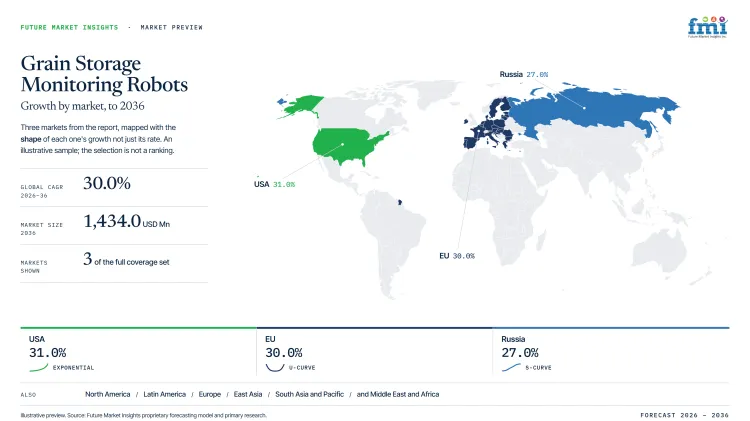
| Country | CAGR |
|---|---|
| EU | 30.0% |
| USA | 31.0% |
| Russia | 27.0% |
Source: FMI's proprietary forecasting model and primary research
How do country-level CAGRs compare in the Grain Storage Monitoring Robots Market?
The comparison spans 4.0 percentage points and highlights a relatively tight growth range across the grain storage monitoring robots market. The United States leads at 31.0% CAGR, closely followed by the European Union at 30.0%, while Russia records 27.0%. The differences reflect varying levels of grain storage modernization, warehouse automation and investment in technologies that improve grain quality management.
-
The United States leads the comparison with a CAGR of 31.0%. Grain handlers and storage operators are increasingly evaluating robotic inspection systems that monitor grain condition, identify moisture or temperature variations and reduce the need for manual silo inspections. Greater emphasis on minimizing storage losses and improving operational efficiency continues to encourage adoption.
-
Only 1.0 percentage point behind, the European Union posts a CAGR of 30.0%. Demand is associated with modernization of grain storage facilities and increasing use of automated monitoring technologies that help detect spoilage risks, improve inventory oversight and support consistent grain quality across storage operations. Adoption varies among member states according to storage infrastructure and investment priorities.
-
Russia records a CAGR of 27.0%, standing 3.0 percentage points below the European Union. The market outlook reflects continued attention to large-scale grain storage management, where robotic monitoring systems are being assessed to improve inspection efficiency, reduce manual intervention and support long-term grain preservation.
Comparable CAGRs do not necessarily result in identical commercial opportunities. Differences in storage capacity, agricultural infrastructure, automation readiness and grain handling practices influence deployment strategies and long-term market potential. The full report provides country-level CAGR analysis across North America, Latin America, Europe, East Asia, South Asia, Oceania and the Middle East and Africa.
Country-wise Analysis
Country growth is expected to reflect storage scale and service economics rather than crop volume. The United States combines large farm bins with broad dealer coverage and established control systems. EU demand is likely to be shaped by mixed silo ages and attention to energy records. Russia is anticipated to favor equipment that can tolerate long service routes and harsh operating conditions. These differences are expected to influence mobile versus fixed sensing choices across different storage networks. Integration with inventory control software is likely to carry greater weight at networked warehouses with shared records. Local calibration and spare-part access are projected to decide whether a pilot expands across several sites.
-
The EU storage mix is expected to shift toward monitored retrofit systems across modern terminals and older cooperative silos. The EU grain storage monitoring robots outlook is anticipated to advance at 30.0% CAGR over the assessment period, supported by retrofit demand across mixed silo ages. Eurostat reported in October 2025 that EU cereal production reached 257.7 million tonnes during 2024. That volume is expected to support broad inspection demand without producing uniform installation conditions across European storage regions. Javelot is likely to gain relevance through temperature monitoring and ventilation guidance that can be added to existing sites. European storage teams are projected to favor systems that document energy use and quality actions without requiring a complete silo rebuild.
- Commercial elevator operators across the USA are expected to assess service reach before approving new monitoring systems. Demand in the USA is forecast to rise at 31.0% CAGR through 2036, driven by large bin networks and established dealer coverage. The USA Grains & BioProducts Council reported in December 2025 that the 2025 corn crop was projected at 425.53 million metric tons. That volume is expected to sustain inspection needs across farm bins and commercial elevators throughout the storage cycle. GSI and AGI Digital are likely to hold an advantage where fixed sensing can connect with fan controls. Crover is expected to compete in locations that need targeted readings between permanent points inside larger grain bins.
- Russia's storage service base is anticipated to expand as monitoring volumes rise across distant cereal regions. Adoption of grain storage monitoring robots in Russia is estimated to expand at 27.0% CAGR through 2036, linked to demand for durable retrofit systems. The Food and Agriculture Organization reported in April 2026 that Russian cereal production reached 134.5 million tonnes during 2025. That output is expected to create a broad preservation need despite slower installation growth than the United States or EU.
Who are the notable companies in the Grain Storage Monitoring Robots Market?
Crover, TeleSense, GSI, AGI Digital, Sukup Manufacturing, SafeGrain, and Javelot are notable suppliers across mobile inspection, fixed sensing, automation, and ventilation control.
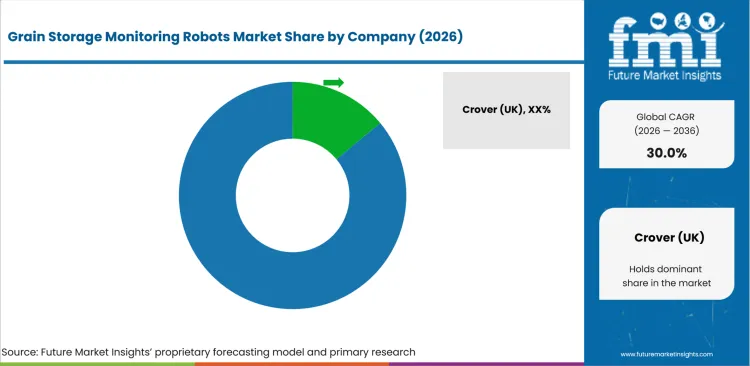
Competition is expected to separate mobile inspection from fixed monitoring and automated control across different storage workflows. Mobile systems are likely to earn premiums when storage teams need readings between permanent sensing points. Fixed platforms are anticipated to retain an advantage across bins that already use cables and fan controls. Remote monitoring is projected to widen service revenue through calibration and alert review across recurring storage cycles. Repair coverage is expected to matter because failed sensors can erase confidence across an entire storage cycle. Providers that connect condition data with fumigation products and ventilation records are likely to support broader warehouse workflows.
- Crover competes through movement inside the grain mass and direct sampling at depth. TeleSense and SafeGrain compete through remote temperature and moisture coverage across several storage formats. The commercial divide rests on localized investigation versus continuous fixed monitoring across each storage site.
- GSI and AGI Digital compete through sensing and fan control links across farm storage systems. Sukup Manufacturing competes through integrated bin equipment and local dealer relationships nationwide. Their installed equipment relationships reduce integration work across farm bins and control panels. Service reach supports repeat sales after the monitoring rollout across a storage network.
- Javelot competes through ventilation guidance and operating records across cooperative or commercial storage sites. Its platform approach supports networks that value energy records and procedural control. This model complements food preservation equipment used beyond the grain bin across wider handling operations.
Competitive Benchmarking: Grain Storage Monitoring Robots Market
| Company | Mobile Inspection Depth | Fixed Monitoring Breadth | Control Integration | Service Reach |
|---|---|---|---|---|
| Crover | High | Low | Medium | Europe and North America |
| TeleSense | Low | High | Medium | North America and Europe |
| GSI | Low | High | High | Global |
| AGI Digital | Low | High | High | Global |
| Sukup Manufacturing | Low | High | High | North America and selected export markets |
| SafeGrain | Low | High | Medium | North America and selected export markets |
| Javelot | Low | High | High | Europe and North America |
Scoring basis: High indicates direct capability supported by current products or operations. Medium indicates partial coverage. Low indicates limited direct evidence within the assessed dimension.
Source: Future Market Insights competitive analysis and official company materials, 2026.
Key Developments in the Grain Storage Monitoring Robots Market
- In November 2025, Crover launched CROVERPro Version 2.0 and began shipping the next-generation system to customers. The release is expected to sharpen competition around mobile inspection and repeatable in-grain sampling across commercial storage systems.
- In October 2025, AGI launched a farmer-facing website that explains its BinManager monitoring technology to farm storage operators. The hub is expected to lower the information barrier for retrofitting real-time monitoring across farm storage bins.
- In March 2025, Sukup Manufacturing announced a limited release of SYNK through its established grain equipment dealer network. The system combines temperature and moisture sensing with carbon dioxide detection and remote fan controls.
- In March 2025, Javelot introduced an operations management module that digitizes quality and maintenance procedures across grain storage sites. The module is expected to link quality and safety records with maintenance tasks across storage teams.
Key Players in the Grain Storage Monitoring Robots Market
Mobile in-grain inspection specialists
- Crover
Connected condition monitoring specialists
- TeleSense, a Decco and UPL business
- SafeGrain
- Javelot
Integrated storage control suppliers
- GSI, an AGCO brand
- AGI Digital
- Sukup Manufacturing
Grain Storage Monitoring Robots Market - Report Scope
| Report Attribute | Coverage |
|---|---|
| Market Breakdown | Product type, application, component, end user, business model, and region |
| Quantitative Units | Value in USD million, installed-system indicators, and compound annual growth rate |
| Market Definition | Robotic and connected systems used to inspect stored grain conditions or support sampling inside bins, silos, warehouses, and related storage structures |
| Regions Covered | North America, Latin America, Europe, East Asia, South Asia and Pacific, and Middle East and Africa |
| Countries Covered | United States, Canada, Brazil, Mexico, Argentina, EU, United Kingdom, Russia, China, Japan, South Korea, India, Australia, and other modeled countries |
| Key Companies Profiled | Crover, TeleSense, GSI, AGI Digital, Sukup Manufacturing, SafeGrain, and Javelot |
| Approach | Demand review across grain storage workflows combined with company portfolio analysis and country forecast reconciliation |
Grain Storage Monitoring Robots Market - Research Methodology
| Method | Application |
|---|---|
| Primary Research | FMI analysts gathered input from manufacturers, service providers, technology developers, distributors, end users, procurement teams, and subject-matter experts. Interviews examined purchasing decisions, product or service evaluation, adoption barriers, approval requirements, pricing considerations, and expectations for technical or commercial support. Respondents were also asked what evidence is required before a trial, pilot, or initial order develops into regular purchasing. |
| Desk Research | Desk research covered government statistics, regulatory publications, trade data, industry associations, technical literature, standards, company filings, product information, and official corporate announcements. Sources were reviewed for relevance, publication date, geographic coverage, and consistency with the defined market scope. Claims relating to performance, applications, approvals, capacity, investment, and commercial activity were retained only when supported by credible public evidence. |
| Market Sizing and Forecasting | The market model combined the baseline value with historical performance, segment structure, pricing and volume indicators, adoption levels, company participation, and country-level demand conditions. Forecast assumptions considered economic activity, investment trends, regulatory developments, technology adoption, purchasing cycles, supply availability, and barriers to wider market use. Segment and regional estimates were reconciled before the final market total was calculated. |
| Data Validation | Estimates were checked against multiple independent indicators, including public data, company activity, trade patterns, industry developments, and findings from primary interviews. Validation also tested whether products, services, applications, and company revenues fell within the defined market boundaries. Adjacent categories, unsupported claims, overlapping revenues, and activities without direct market relevance were excluded to reduce double counting and maintain consistency across segments and countries. |
Grain Storage Monitoring Robots Market by Segments
Grain Storage Monitoring Robots Market segmented by Product Type:
- In-silo crawler robots
- Cable and probe sensing systems
- Robotic sampling units
Grain Storage Monitoring Robots Market segmented by Application:
- Grain quality monitoring
- Pest and spoilage detection
- Inventory measurement
Grain Storage Monitoring Robots Market segmented by Component:
- Hardware
- AI software
- Services
Grain Storage Monitoring Robots Market segmented by End User:
- Commercial grain elevators
- On-farm storage
- Ports and traders
- Food processors
Grain Storage Monitoring Robots Market segmented by Business Model:
- Subscription
- Equipment sale
- Service contracts
Grain Storage Monitoring Robots Market by Region:
- North America
- United States
- Canada
- Latin America
- Brazil
- Mexico
- Argentina
- Rest of Latin America
- Europe
- EU
- United Kingdom
- Russia
- Rest of Europe
- East Asia
- China
- Japan
- South Korea
- South Asia and Pacific
- India
- Australia and New Zealand
- Southeast Asia
- Rest of South Asia and Pacific
- Middle East and Africa
- Gulf Cooperation Council countries
- South Africa
- Turkey
- Rest of Middle East and Africa
Research Sources and Bibliography
- Ag Growth International. (2025, October 27).
- Ag Growth International. (n.d.).
- Crover. (2025, November 6).
- Crover. (2025, November 6).
- Crover. (2026, February 18).
- Crover. (2026, March 3).
- European Commission. (2025, July 28).
- Eurostat. (2025, October 27).
- Food and Agriculture Organization of the United Nations. (2026, April 10).
- Javelot. (2025, February 27).
- Javelot. (2025, March 13).
- Javelot. (2025, April 23).
- Press Information Bureau of India. (2026, June 18).
- SafeGrain. (n.d.).
- Sukup Manufacturing. (2025, March 6).
- TeleSense. (n.d.).
- USA Department of Agriculture, National Agricultural Statistics Service. (2026, January 12).
- USA Department of Labor, Occupational Safety and Health Administration. (2026, February 24).
- USA Grains & BioProducts Council. (2025, December 2).
Sources were selected for direct relevance to stored grain monitoring and documented supplier activity across the profiled market.
This Report Answers
- How large is the grain storage monitoring robots market in 2026 and how quickly is it projected to expand?
- Which product type holds the disclosed 2026 share and why does its inspection method matter?
- Why is grain quality monitoring expected to lead the application category during 2026?
- How do hardware and AI software contribute differently to commercial value?
- Which operating conditions create demand for deeper in-grain inspection?
- Why do the United States and EU track above Russia in the disclosed forecast?
- Which companies focus on mobile inspection and which provide fixed monitoring?
- How do safety rules and retrofit conditions affect installation decisions?
- Which dated company actions show current commercial activity in this field?
- What should storage teams verify before expanding from one bin to several sites?
Frequently Asked Questions
What is driving growth in the Grain Storage Monitoring Robots Market?
Hidden moisture and temperature problems are expected to increase demand for earlier inspection inside stored grain. Faster alerts can support targeted aeration or sampling before quality loss spreads through nearby stored grain layers.
Who are the key players in the Grain Storage Monitoring Robots Market?
Crover represents mobile in-grain inspection within the profiled company set through its crawler and sampling approach. TeleSense and SafeGrain focus on fixed condition data as GSI and AGI link monitoring with storage controls.
What is a notable restraint in the Grain Storage Monitoring Robots Market?
Retrofit complexity can delay installation in older bins that have difficult access points or weak communications coverage. Maintenance procedures must protect sensor accuracy and worker safety throughout the complete grain storage cycle at each site.
Why should executives track the Grain Storage Monitoring Robots Market?
The market links stored-grain quality with automation and safer inspection across farm or commercial sites. Its forecast indicates that condition monitoring is expected to take a larger role in storage investment.
What business problem does the Grain Storage Monitoring Robots Market address?
These systems address the delay between deterioration inside a grain mass and visible evidence at the surface. Earlier warnings are expected to support targeted action before losses expand through nearby grain inside the storage structure.
What should procurement leaders evaluate before selecting suppliers?
Procurement leaders should compare sensor placement and calibration access before approving a supplier for repeated storage operations. They should confirm that alerts connect with the facility response process and local service route.
What limits return on investment for purchasers?
Return is reduced when a system cannot reach the risk area or produces alerts without a clear response. Poor maintenance and slow repair can create the same commercial problem across several bins during one storage cycle.
How do suppliers build long-term account confidence?
Suppliers build confidence through repeatable readings and documented calibration across several storage cycles at each customer site. Responsive field support is expected to protect the relationship after sensors or communications fail during active storage operations.
Preview the report firsthand - request a free sample
Get SampleGet the brochure for pricing and purchase details.
Get PDFTable of Content
- Key Takeaways
- Market Size and CAGR
- Top Growth Driver
- Fastest Growing Segment
- Leading Region
- Key Companies
- Emerging Opportunities
- Executive Summary
- Global Market Outlook
- Demand-side Trends
- Supply-side Trends
- Technology Roadmap Analysis
- Analysis and Recommendations
- Analyst Perspective (What is happening? Why now? What should investors know?)
- Key Questions Answered
- How large is the market?
- What is the CAGR?
- What are key trends?
- Which region dominates?
- Who are the leaders?
- Market Overview
- Market Coverage / Taxonomy
- Market Definition / Scope / Limitations
- Research Methodology
- Chapter Orientation
- Analytical Lens and Working Hypotheses
- Market Structure, Signals, and Trend Drivers
- Benchmarking and Cross-market Comparability
- Market Sizing, Forecasting, and Opportunity Mapping
- Research Design and Evidence Framework
- Desk Research Programme (Secondary Evidence)
- Expert Input and Fieldwork (Primary Evidence)
- Tooling, Models, and Reference Databases
- Data Engineering and Model Build
- Quality Assurance and Audit Trail
- Market Background
- Market Dynamics (Drivers, Restraints, Opportunity, Trends)
- Scenario Forecast (Optimistic, Likely, Conservative)
- Impact Analysis
- AI Impact
- Sustainability Impact
- Regulatory Impact
- Technology Impact
- Consumer / Buyer Analysis
- Purchase Drivers
- Adoption Barriers
- Buyer Journey
- Opportunity Map Analysis
- Product Life Cycle Analysis
- Supply Chain Analysis
- Investment Feasibility Matrix
- Value Chain Analysis
- PESTLE and Porter's Analysis
- Regulatory Landscape
- Regional Parent Market Outlook
- Production and Consumption Statistics
- Import and Export Statistics
- Global Market Analysis and Forecast, 2021 to 2036
- Historical Market Size Value (USD Million) Analysis, 2021 to 2025
- Current and Future Market Size Value (USD Million) Projections, 2026 to 2036
- Y-o-Y Growth Trend Analysis
- Absolute $ Opportunity Analysis
- Global Market Pricing Analysis, 2021 to 2036
- Global Market Analysis and Forecast, By Product Type, 2021 to 2036
- Introduction / Key Findings
- Historical Market Size Value (USD Million) Analysis By Product Type, 2021 to 2025
- Current and Future Market Size Value (USD Million) Analysis and Forecast By Product Type, 2026 to 2036
- In-silo crawler robots
- Cable & probe sensing systems
- Robotic sampling units
- In-silo crawler robots
- Y-o-Y Growth Trend Analysis By Product Type, 2021 to 2025
- Absolute $ Opportunity Analysis By Product Type, 2026 to 2036
- Global Market Analysis and Forecast, By Application, 2021 to 2036
- Introduction / Key Findings
- Historical Market Size Value (USD Million) Analysis By Application, 2021 to 2025
- Current and Future Market Size Value (USD Million) Analysis and Forecast By Application, 2026 to 2036
- Grain quality monitoring
- Pest & spoilage detection
- Inventory measurement
- Grain quality monitoring
- Y-o-Y Growth Trend Analysis By Application, 2021 to 2025
- Absolute $ Opportunity Analysis By Application, 2026 to 2036
- Global Market Analysis and Forecast, By Component, 2021 to 2036
- Introduction / Key Findings
- Historical Market Size Value (USD Million) Analysis By Component, 2021 to 2025
- Current and Future Market Size Value (USD Million) Analysis and Forecast By Component, 2026 to 2036
- Hardware
- AI software
- Services
- Hardware
- Y-o-Y Growth Trend Analysis By Component, 2021 to 2025
- Absolute $ Opportunity Analysis By Component, 2026 to 2036
- Global Market Analysis and Forecast, By End User, 2021 to 2036
- Introduction / Key Findings
- Historical Market Size Value (USD Million) Analysis By End User, 2021 to 2025
- Current and Future Market Size Value (USD Million) Analysis and Forecast By End User, 2026 to 2036
- Commercial grain elevators
- On-farm storage
- Ports & traders
- Food processors
- Commercial grain elevators
- Y-o-Y Growth Trend Analysis By End User, 2021 to 2025
- Absolute $ Opportunity Analysis By End User, 2026 to 2036
- Global Market Analysis and Forecast, By Business Model, 2021 to 2036
- Introduction / Key Findings
- Historical Market Size Value (USD Million) Analysis By Business Model, 2021 to 2025
- Current and Future Market Size Value (USD Million) Analysis and Forecast By Business Model, 2026 to 2036
- Subscription
- Equipment sale
- Service contracts
- Subscription
- Y-o-Y Growth Trend Analysis By Business Model, 2021 to 2025
- Absolute $ Opportunity Analysis By Business Model, 2026 to 2036
- Global Market Analysis and Forecast, By Region, 2021 to 2036
- Introduction
- Historical Market Size Value (USD Million) Analysis By Region, 2021 to 2025
- Current Market Size Value (USD Million) Analysis and Forecast By Region, 2026 to 2036
- North America
- Latin America
- Western Europe
- Eastern Europe
- East Asia
- South Asia and Pacific
- Middle East & Africa
- Market Attractiveness Analysis By Region
- North America Market Analysis and Forecast, By Country, 2021 to 2036
- Historical Market Size Value (USD Million) Trend Analysis By Market Taxonomy, 2021 to 2025
- Market Size Value (USD Million) Forecast By Market Taxonomy, 2026 to 2036
- By Country
- USA
- Canada
- By Product Type
- By Application
- By Component
- By End User
- By Business Model
- By Country
- Market Attractiveness Analysis
- By Country
- By Product Type
- By Application
- By Component
- By End User
- By Business Model
- Key Takeaways
- Latin America Market Analysis and Forecast, By Country
- Historical Market Size Value (USD Million) Trend Analysis By Market Taxonomy, 2021 to 2025
- Market Size Value (USD Million) Forecast By Market Taxonomy, 2026 to 2036
- By Country
- Brazil
- Mexico
- Chile
- Rest of Latin America
- By Product Type
- By Application
- By Component
- By End User
- By Business Model
- By Country
- Market Attractiveness Analysis
- By Country
- By Product Type
- By Application
- By Component
- By End User
- By Business Model
- Key Takeaways
- Western Europe Market Analysis and Forecast, By Country
- Historical Market Size Value (USD Million) Trend Analysis By Market Taxonomy, 2021 to 2025
- Market Size Value (USD Million) Forecast By Market Taxonomy, 2026 to 2036
- By Country
- Germany
- UK
- Italy
- Spain
- France
- Nordic
- BENELUX
- Rest of Western Europe
- By Product Type
- By Application
- By Component
- By End User
- By Business Model
- By Country
- Market Attractiveness Analysis
- By Country
- By Product Type
- By Application
- By Component
- By End User
- By Business Model
- Key Takeaways
- Eastern Europe Market Analysis and Forecast, By Country
- Historical Market Size Value (USD Million) Trend Analysis By Market Taxonomy, 2021 to 2025
- Market Size Value (USD Million) Forecast By Market Taxonomy, 2026 to 2036
- By Country
- Russia
- Poland
- Hungary
- Balkan & Baltic
- Rest of Eastern Europe
- By Product Type
- By Application
- By Component
- By End User
- By Business Model
- By Country
- Market Attractiveness Analysis
- By Country
- By Product Type
- By Application
- By Component
- By End User
- By Business Model
- Key Takeaways
- East Asia Market Analysis and Forecast, By Country
- Historical Market Size Value (USD Million) Trend Analysis By Market Taxonomy, 2021 to 2025
- Market Size Value (USD Million) Forecast By Market Taxonomy, 2026 to 2036
- By Country
- China
- Japan
- South Korea
- By Product Type
- By Application
- By Component
- By End User
- By Business Model
- By Country
- Market Attractiveness Analysis
- By Country
- By Product Type
- By Application
- By Component
- By End User
- By Business Model
- Key Takeaways
- South Asia and Pacific Market Analysis and Forecast, By Country
- Historical Market Size Value (USD Million) Trend Analysis By Market Taxonomy, 2021 to 2025
- Market Size Value (USD Million) Forecast By Market Taxonomy, 2026 to 2036
- By Country
- India
- ASEAN
- Australia & New Zealand
- Rest of South Asia and Pacific
- By Product Type
- By Application
- By Component
- By End User
- By Business Model
- By Country
- Market Attractiveness Analysis
- By Country
- By Product Type
- By Application
- By Component
- By End User
- By Business Model
- Key Takeaways
- Middle East & Africa Market Analysis and Forecast, By Country
- Historical Market Size Value (USD Million) Trend Analysis By Market Taxonomy, 2021 to 2025
- Market Size Value (USD Million) Forecast By Market Taxonomy, 2026 to 2036
- By Country
- Kingdom of Saudi Arabia
- Other GCC Countries
- Türkiye
- South Africa
- Other African Union
- Rest of Middle East & Africa
- By Product Type
- By Application
- By Component
- By End User
- By Business Model
- By Country
- Market Attractiveness Analysis
- By Country
- By Product Type
- By Application
- By Component
- By End User
- By Business Model
- Key Takeaways
- Key Countries Market Analysis
- USA
- Pricing Analysis
- Market Share Analysis, 2025
- By Product Type
- By Application
- By Component
- By End User
- By Business Model
- Canada
- Pricing Analysis
- Market Share Analysis, 2025
- By Product Type
- By Application
- By Component
- By End User
- By Business Model
- Mexico
- Pricing Analysis
- Market Share Analysis, 2025
- By Product Type
- By Application
- By Component
- By End User
- By Business Model
- Brazil
- Pricing Analysis
- Market Share Analysis, 2025
- By Product Type
- By Application
- By Component
- By End User
- By Business Model
- Chile
- Pricing Analysis
- Market Share Analysis, 2025
- By Product Type
- By Application
- By Component
- By End User
- By Business Model
- Germany
- Pricing Analysis
- Market Share Analysis, 2025
- By Product Type
- By Application
- By Component
- By End User
- By Business Model
- UK
- Pricing Analysis
- Market Share Analysis, 2025
- By Product Type
- By Application
- By Component
- By End User
- By Business Model
- Italy
- Pricing Analysis
- Market Share Analysis, 2025
- By Product Type
- By Application
- By Component
- By End User
- By Business Model
- Spain
- Pricing Analysis
- Market Share Analysis, 2025
- By Product Type
- By Application
- By Component
- By End User
- By Business Model
- France
- Pricing Analysis
- Market Share Analysis, 2025
- By Product Type
- By Application
- By Component
- By End User
- By Business Model
- India
- Pricing Analysis
- Market Share Analysis, 2025
- By Product Type
- By Application
- By Component
- By End User
- By Business Model
- ASEAN
- Pricing Analysis
- Market Share Analysis, 2025
- By Product Type
- By Application
- By Component
- By End User
- By Business Model
- Australia & New Zealand
- Pricing Analysis
- Market Share Analysis, 2025
- By Product Type
- By Application
- By Component
- By End User
- By Business Model
- China
- Pricing Analysis
- Market Share Analysis, 2025
- By Product Type
- By Application
- By Component
- By End User
- By Business Model
- Japan
- Pricing Analysis
- Market Share Analysis, 2025
- By Product Type
- By Application
- By Component
- By End User
- By Business Model
- South Korea
- Pricing Analysis
- Market Share Analysis, 2025
- By Product Type
- By Application
- By Component
- By End User
- By Business Model
- Russia
- Pricing Analysis
- Market Share Analysis, 2025
- By Product Type
- By Application
- By Component
- By End User
- By Business Model
- Poland
- Pricing Analysis
- Market Share Analysis, 2025
- By Product Type
- By Application
- By Component
- By End User
- By Business Model
- Hungary
- Pricing Analysis
- Market Share Analysis, 2025
- By Product Type
- By Application
- By Component
- By End User
- By Business Model
- Kingdom of Saudi Arabia
- Pricing Analysis
- Market Share Analysis, 2025
- By Product Type
- By Application
- By Component
- By End User
- By Business Model
- Türkiye
- Pricing Analysis
- Market Share Analysis, 2025
- By Product Type
- By Application
- By Component
- By End User
- By Business Model
- South Africa
- Pricing Analysis
- Market Share Analysis, 2025
- By Product Type
- By Application
- By Component
- By End User
- By Business Model
- USA
- Market Structure Analysis
- Competition Dashboard
- Competition Benchmarking
- Market Share Analysis of Top Players
- By Regional
- By Product Type
- By Application
- By Component
- By End User
- By Business Model
- Emerging Startups
- Innovation Benchmarking
- Competition Analysis
- Competition Deep Dive
- Crover (UK)
- Overview
- Product Portfolio
- Profitability by Market Segments
- Sales Footprint
- Strategy Overview
- Marketing Strategy
- Product Strategy
- Channel Strategy
- TeleSense (US)
- GSI - AGCO (US)
- Crover (UK)
- Case Studies
- Success Stories
- Recent Developments
- Competition Deep Dive
- Assumptions & Acronyms Used


