

- Market Size (2026)
- USD 727.5 Mn
- Forecast (2036)
- USD 1327.6 Mn
- CAGR (2026 to 2036)
- 6.2%
How big is Grease-Resistant Paper Liners Market in 2026?
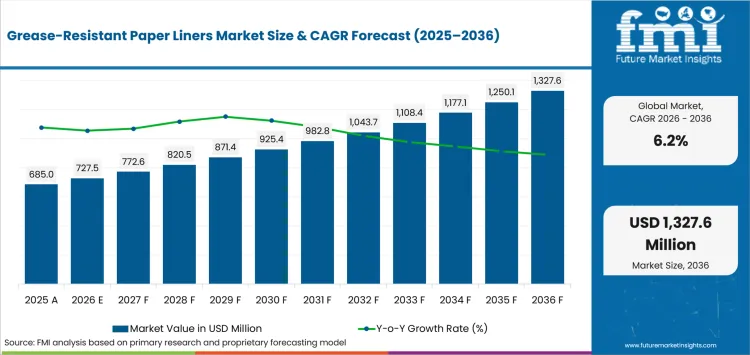
USD 727.5 million in 2026 and USD 1,327.6 million by 2036 at a 6.2% CAGR.
Demand for grease-resistant paper liners is projected to rise at a 6.2% CAGR between 2026 and 2036, with value rising from USD 727.5 million in 2026 to USD 1,327.6 million by 2036. Prepared-food transactions convert directly into liner orders as each wrap or tray sheet is discarded following service. USDA Economic Research Service reported in June 2026 that United States food-away-from-home spending reached USD 1.41 trillion during 2025. That spending base sustains repeated use across wraps and basket liners for high-frequency restaurant and takeaway orders. Bakery sheets and food interleavers add recurring orders across preparation workflows that discard each paper piece after one service cycle.
Country demand diverges as qualification and distribution determine whether foodservice activity becomes recurring liner orders. Brazil combines distributor-led coverage with foodservice activity concentrated across major urban centers and restaurant networks. Germany places greater weight on recyclability evidence and precise food-contact declarations during centralized reviews of converted formats. United States chains now screen PFAS-free chemistry across national restaurant and food-processing programs following the federal chemistry withdrawal. Each national program tests oil holdout and wet strength under actual food exposure during representative qualification trials. Print performance and pack-line behavior then determine approval for recurring commercial supply across participating paper plants.
Key Takeaways of Grease-Resistant Paper Liners Market
- Foodservice outlets increase recurring liner orders as PFAS-treated papers give way to alternatives tested under actual serving conditions.
- Natural greaseproof liners are projected to account for 30.0% of product-type revenue in 2026 due to barrier performance built into the sheet.
- Virgin kraft pulp is estimated to hold 36.0% by material in 2026 owing to repeatable purity and tear strength.
- The 30-50 GSM band is forecast to represent 46.0% share in 2026 driven by practical strength with lower fiber use.
- Application trials remain the main restraint as heat and moisture can expose weaknesses that food-contact documentation alone cannot resolve.
- Key companies in the industry include Ahlstrom and Nordic Paper with delfort and Koehler Paper plus Sappi and Mondi alongside UPM Specialty Papers and Metsä Tissue.
Analyst Perspective
“Paper mills earn repeat orders when one liner grade controls oil exposure and folding without slowing fast dispensing. Restaurant chains should compare migration files with line-trial data to confirm compliance under recurring operating conditions.”
- Nandini Roy Choudhury, Principal Consultant, Future Market Insights
How is the Grease-Resistant Paper Liners Market segmented?
The market is segmented by Product Type, Material, Basis Weight, Application, End Use, Sales Channel and Region.
Market taxonomy covers product type, material, basis weight, application, end use, sales channel and region. Product types include natural greaseproof, coated grease-resistant, fluorochemical-free barrier, glassine and other liner formats for commercial analysis. Materials comprise virgin kraft pulp, recycled fiber, vegetable parchment, glassine and other paper bases used across qualified food-contact structures. Basis weights span below 30 GSM, 30-50 GSM and above 50 GSM for different handling and barrier requirements. Applications include quick-service restaurants, bakery and confectionery, fried and snack foods, meat and deli counters and other uses. End uses cover foodservice, food processing, retail and household and other users, while sales channels comprise direct OEM supply, packaging distributors, online commerce and other routes.
What makes Natural Greaseproof Liners central to the Product Type category?
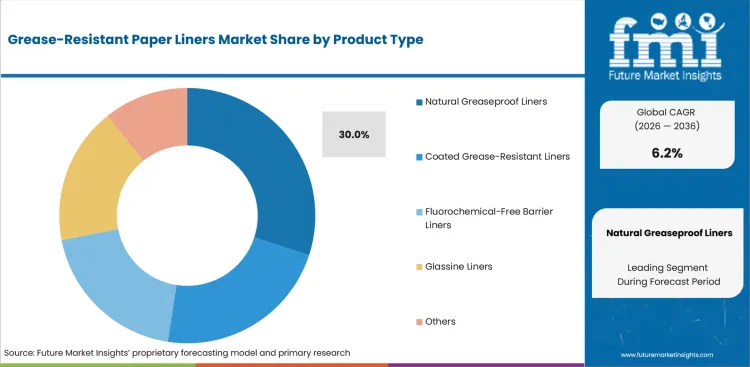
Natural greaseproof paper forms its oil barrier by refining fibers and controlling density across the finished sheet. The structure suits greaseproof paper sheets that need clean folds plus reliable performance along exposed cut edges. Each food format requires a holdout test under the intended temperature and contact time during commercial qualification.
- The product type category is forecast to be led by natural greaseproof liners at 30.0% share in 2026 due to broad food-contact use without a heavy surface coating.
- Cut edges and folds expose weak spots during foodservice use, so paper converters need consistent porosity and caliper across ordered reels. Regional inventory therefore affects qualification speed and repeat orders more than catalog breadth alone across national foodservice programs.
Why does Virgin Kraft Pulp lead the Material category?
Virgin kraft pulp provides long fibers and controlled cleanliness for demanding direct food-contact paper applications. It tolerates refining and coating without losing the tear strength required during serving or transport. Recycled fiber can suit secondary uses but faces tighter odor and migration checks across parchment formats.
- Virgin kraft pulp is projected to hold 36.0% share in 2026 owing to repeatable purity and wet-strength performance across foodservice formats.
- Food processors review fiber origin and wet strength across repeated lots as part of direct-contact paper approval for scheduled production. Consistent pulp quality reduces retesting whenever converters adjust sheet dimensions or coating weight for another food format.
How does 30-50 GSM support the Basis Weight category?
The 30-50 GSM range balances stiffness and grease holdout against material use across high-volume foodservice programs. It suits basket liners and sandwich wraps within baking and cooking paper programs that require dependable handling. Lighter sheets can lose stiffness around sauces or sharp food edges during fast service and delivery.
- In 2026, 30-50 GSM is expected to lead Basis Weight with 46.0% share because common formats need dependable folds without excess fiber.
- Paper converters test basis weight against grease exposure and line speed during approval of each commercial paper structure. Lower fiber use saves material if each sheet maintains fold integrity during storage and service.
What drives Quick-Service Restaurants in the Application category?
Quick-service restaurants consume liners across burgers and fries, and tacos or baked items create formats within fast food containers. National restaurant chains may use several grades per outlet to match grease exposure and presentation needs. Operations teams test dispensing speed across each paper wrap as brand teams review print consistency for national approval.
- Based on application, quick-service restaurants are projected to account for 30.0% in 2026 due to repeat liner use across high-frequency prepared-food transactions.
- Restaurant chains approve liners against the actual menu and packing process across representative outlet conditions. High-volume programs require stable food release and grease control across several locations to secure national purchasing approval.
What are the drivers, restraints and opportunities in the Grease-Resistant Paper Liners Market?
PFAS restrictions reset barrier chemistry while application trials delay conversion and low-coating papers reward proven recyclability on existing lines.
- Driver: Food-contact rules require restaurant chains and paper converters to replace PFAS grease barriers with documented alternatives.
- Restraint: Heat and moisture can weaken oil holdout during service despite a successful basic food-contact review.
- Opportunity: Paper mills can reduce coating weight where recyclability tests and commercial line trials confirm stable performance.
Regulation changes the liner specification and removes familiar greaseproofing chemistry from material-selection programs used by national foodservice chains. The FDA determined in January 2025 that 35 PFAS food-contact notifications for paper greaseproofing were no longer effective. Restaurant chains therefore need replacement paper packaging with documented chemistry and equivalent service-level oil control.
Fat type and serving temperature make qualification application-specific across normal foodservice use and short transport. Fold lines and sauces can expose leakage that standard flat-sheet laboratory tests fail to detect. Packaging engineers also assess printing and adhesive behavior during approval of a grade for repeated orders.
Low-coating papers become commercially useful once regulation and line compatibility favor the same converted structure. Regulation (EU) 2025/40 sets enforceable PFAS concentration limits for food-contact packaging from August 2026 across commercial formats. Paper mills need migration records and proven runnability to sell recyclable barrier packaging on existing equipment.
Which country CAGRs are profiled in the Grease-Resistant Paper Liners Market?
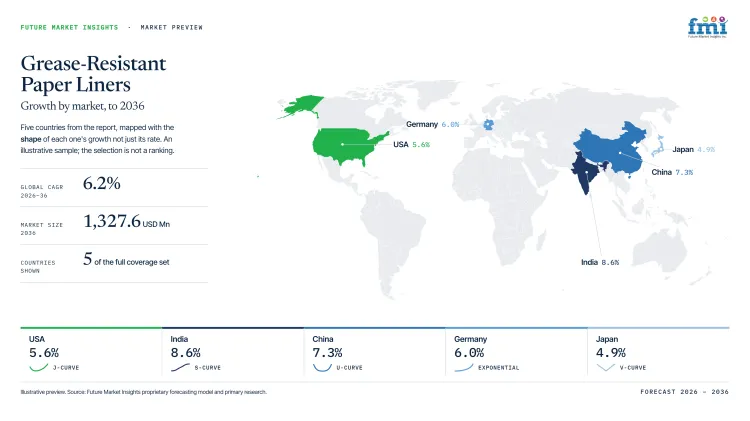
| Country | CAGR |
|---|---|
| Brazil | 6.6% |
| United Kingdom | 6.1% |
| Germany | 6.0% |
| United States | 5.6% |
| Japan | 4.9% |
How do country-level CAGRs compare in the Grease-Resistant Paper Liners Market?
The five profiled rates span 1.7 percentage points from Brazil at 6.6% to Japan at 4.9%. The spread measures forecast pace instead of the current revenue base within each national market.
- Brazil’s pace reflects expanding foodservice activity across distributor-led channels, although regional stock gaps can delay conversion to specialty grades.
- United Kingdom growth remains close to Germany as producer-responsibility fees favor paper classification but penalize fibre-based composite structures.
- Germany’s outlook reflects detailed food-contact and recycling reviews, and weak real hospitality turnover increases scrutiny of material cost per serving.
- United States expansion follows the removal of PFAS greaseproofing chemistry, though national chains require consistent inventory across several converter locations.
- Japan’s steadier pace combines recurring foodservice use with narrow dimensional tolerances that extend documentation and trial requirements.
Comparable CAGRs can reflect different market conditions as regulation and distribution requirements vary by country. The full report adds country-level analysis across every FMI region to show qualification costs and service requirements.
Country-wise Analysis
- Brazilian restaurant chains and independent food outlets rely on regional distributors that hold several liner sizes near major consumption centers and coordinate short-run converting near restaurant networks nationwide. Grease-resistant paper liner sales in Brazil are forecast to expand at 6.6% CAGR by 2036, supported by IBGE data showing food-service volume grew 5.5% during 2024. Regional stock gaps can lengthen replenishment for imported grades and expose smaller operators to minimum-order pressure during menu changes and seasonal demand peaks. Paper mills therefore need Portuguese compliance files and affordable sheets that retain oil holdout across fried foods plus varied serving temperatures and contact times.
- United Kingdom foodservice groups use established paper converters to compare material cost and producer-responsibility classification during chain-wide menu changes across bakery and takeaway formats nationwide. United Kingdom grease-resistant paper liner demand is projected to record 6.1% CAGR during the assessment period, reinforced by PackUK fees of GBP 196 for paper and GBP 423 for plastic. Composite construction can remove the fee advantage and prolong customer approvals for paper structures that contain heavier coatings or mixed material layers. Paper mills need low-coating grades with accurate declarations plus print and fold data from commercial line settings and representative food-contact trials across major restaurant accounts.
- German brand owners and paper converters use centralized quality teams for migration reviews and recyclability tests across national bakery and foodservice programs that require consistent converted formats. Adoption of grease-resistant paper liners in Germany is estimated to expand at 6.0% CAGR through 2036, shaped by Destatis data showing real hospitality turnover fell 2.1% during 2025. Weaker restaurant economics increase basis-weight scrutiny and reduce tolerance for failed trials across high-volume food formats and multiple converter plants nationwide during seasonal promotions. Mills need precise food-contact declarations plus stable coating behavior across printing and grease-exposure tests as part of formal national formulation approval.
- United States restaurant chains use national converter networks to qualify one liner grade across franchised and company-owned outlets under consistent paper specifications and packing-line settings. United States grease-resistant paper liner demand is predicted to advance at 5.6% CAGR through 2036, aided by FDA confirmation that PFAS greaseproofing materials were no longer sold in February 2024. Chain-scale approval raises the entry threshold and makes reformulation costly across menus that expose paper to different fats and serving temperatures during daily service. Paper mills need national inventory plus food-contact files and oil-holdout data covering representative foods to support changes in established supply contracts.
- Japanese convenience retailers and foodservice operators use local paper converters to maintain exact dimensions and low lot variation across high-volume bento and bakery programs with frequent replenishment. Japan’s grease-resistant paper liners outlook is anticipated to advance at 4.9% CAGR over the assessment period, supported by foodservice association data showing 2024 industry sales rose 8.4%. Positive-list documentation can extend formulation reviews and information transfer whenever an overseas mill changes its coating composition or direct-contact declaration for Japan. Overseas mills need Japanese records plus reliable technical support during coating changes across national restaurant and convenience accounts with narrow tolerances and frequent seasonal launches.
Who are the notable companies in the Grease-Resistant Paper Liners Market?
The profiled company set combines Ahlstrom and Nordic Paper with delfort and Koehler Paper plus Sappi and Mondi alongside UPM Specialty Papers and Metsä Tissue.
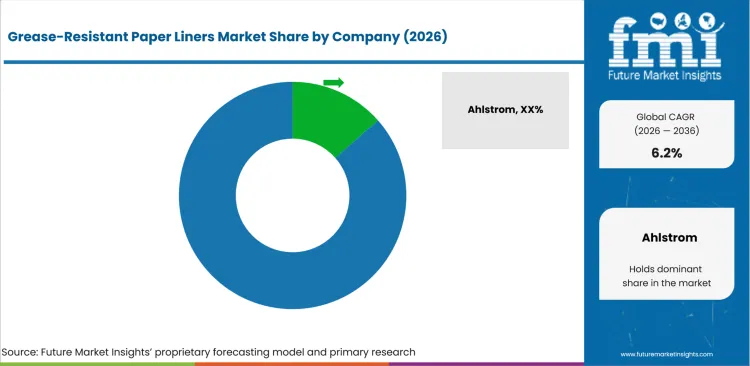
The competitive field remains fragmented across natural greaseproof mills, functional-barrier developers and integrated specialty-paper groups with different assets and qualification histories. Entry requires food-contact records plus stable mill output across repeated converter trials for defined food formats. Natural greaseproof producers compete on fiber control and direct-contact experience across preparation papers used by restaurants and bakeries. Coated-paper developers compete across flexible packaging papers that need moisture or oxygen protection plus commercial line compatibility. International paper groups add application laboratories and regional inventory coverage that support wider customer programs. No provider type covers every liner format and operating condition without application-specific testing across representative foods and converting lines.
- Nordic Paper, Metsä Tissue and Ahlstrom compete with natural greaseproof or parchment platforms for food preparation and direct-contact packaging.
- delfort and Koehler Paper join Sappi and UPM Specialty Papers in serving applications that require added moisture or oxygen control.
- Mondi combines specialty paper development with packaging conversion knowledge for customer programs that require line compatibility and broader geographic support.
Competitive Benchmarking: Grease-Resistant Paper Liners Market
| Company | Direct-Food-Contact Grease Barrier Depth | PFAS-Free and High-Barrier Platform Depth | Converter and Line Support | Geographic Reach |
|---|---|---|---|---|
| Ahlstrom | High | High | Medium | Global |
| Nordic Paper | High | Medium | Medium | Europe, North America and international sales |
| delfort | High | High | High | Europe, North America and Asia-Pacific |
| Koehler Paper | Medium | High | High | Europe and international markets |
| Sappi | Medium | High | High | Global |
| Mondi | Medium | High | High | Europe and selected global markets |
| UPM Specialty Papers | Medium | High | High | Global |
| Metsä Tissue | High | Medium | Medium | Europe and selected international markets |
Direct-food-contact depth is High for a documented range covering several food uses and Medium for a narrower verified paper platform. Low identifies one current food-contact format without broader documented grease-barrier coverage across several direct-contact applications. PFAS-free and high-barrier depth is High for several verified barrier routes or certifications and Medium for a narrower current platform. Low identifies one documented barrier route without wider qualification evidence across different food formats or sealing requirements. Converter support is High with completed line validation or application development and Medium with standard technical support for defined formats. Low identifies documented paper supply without a current commercial line program or completed application-development record for the intended use. Geographic reach remains descriptive and official company releases or annual reports support every capability rating in the table.
Key Developments in the Grease-Resistant Paper Liners Market
- In March 2026, UPM Specialty Papers and Paramelt introduced a bio-based food-packaging concept for bakery plus fast-food and convenience applications. The combined paper and coating provide grease protection at low coat weights on existing packaging lines.
- In August 2025, Mondi ramped up FunctionalBarrier Paper Ultimate production at its Solec plant in Poland, following its previously announced EUR 16 million investment in state-of-the-art technology. The expansion supports wider food-packaging supply with oxygen plus moisture and grease protection across qualified applications. The expansion supports wider food-packaging supply with oxygen plus moisture and grease protection across qualified applications.
- In June 2025, Metsä Tissue licensed SAGA consumer sales and distribution in Finland and the Baltics to Fredman Group. Metsä Tissue continues supplying greaseproof base paper from its Mänttä mill under the commercial arrangement.
Key Players in the Grease-Resistant Paper Liners Market
Natural Greaseproof and Parchment Platforms
- Ahlstrom
- Nordic Paper
- Metsä Tissue
Engineered Barrier Paper Developers
- delfort
- Koehler Paper
- Sappi
Integrated Specialty Paper Groups
- Mondi
- UPM Specialty Papers
Grease-Resistant Paper Liners Market - Report Scope
| Coverage field | Report scope |
|---|---|
| Market breakdown | By product type, material, basis weight, application, end use, sales channel and region. |
| Quantitative Units | Revenue in USD million and CAGR in %. |
| Market Definition | Commercial grease-resistant paper liners used for food preparation, serving, wrapping, tray lining and interleaving across qualified food-contact applications. |
| Regions Covered | North America, Latin America, Western Europe, Eastern Europe, East Asia, South Asia and Pacific and Middle East and Africa. |
| Countries Covered | United States, Germany, Japan, United Kingdom, Brazil, and 20+ countries included in the full report. |
| Key Companies Profiled | Ahlstrom, Nordic Paper, delfort, Koehler Paper, Sappi, Mondi, UPM Specialty Papers and Metsä Tissue. |
| Forecast Period | 2026 to 2036. |
| Approach | Primary and secondary research with market triangulation. |
Grease-Resistant Paper Liners Market - Research Methodology
| Method | Approach |
|---|---|
| Primary Research | FMI analysts gathered input from manufacturers, service providers, technology developers, distributors, end users, procurement teams, and subject-matter experts. Interviews examined purchasing decisions, product or service evaluation, adoption barriers, approval requirements, pricing considerations, and expectations for technical or commercial support. Respondents were also asked what evidence is required before a trial, pilot, or initial order develops into regular purchasing. |
| Desk Research | Desk research covered government statistics, regulatory publications, trade data, industry associations, technical literature, standards, company filings, product information, and official corporate announcements. Sources were reviewed for relevance, publication date, geographic coverage, and consistency with the defined market scope. Claims relating to performance, applications, approvals, capacity, investment, and commercial activity were retained only when supported by credible public evidence. |
| Market Sizing and Forecasting | The market model combined the baseline value with historical performance, segment structure, pricing and volume indicators, adoption levels, company participation, and country-level demand conditions. Forecast assumptions considered economic activity, investment trends, regulatory developments, technology adoption, purchasing cycles, supply availability, and barriers to wider market use. Segment and regional estimates were reconciled before the final market total was calculated. |
| Data Validation | Estimates were checked against multiple independent indicators, including public data, company activity, trade patterns, industry developments, and findings from primary interviews. Validation also tested whether products, services, applications, and company revenues fell within the defined market boundaries. Adjacent categories, unsupported claims, overlapping revenues, and activities without direct market relevance were excluded to reduce double counting and maintain consistency across segments and countries. |
Grease-Resistant Paper Liners Market by Segments
Grease-Resistant Paper Liners Market segmented by Product Type:
- Natural Greaseproof Liners
- Coated Grease-Resistant Liners
- Fluorochemical-Free Barrier Liners
- Glassine Liners
- Others
Grease-Resistant Paper Liners Market segmented by Material:
- Virgin Kraft Pulp
- Recycled Fiber
- Vegetable Parchment
- Glassine
- Others
Grease-Resistant Paper Liners Market segmented by Basis Weight:
- Below 30 GSM
- 30-50 GSM
- Above 50 GSM
Grease-Resistant Paper Liners Market segmented by Application:
- Quick-Service Restaurants
- Bakery & Confectionery
- Fried & Snack Foods
- Meat & Deli Counters
- Others
Grease-Resistant Paper Liners Market segmented by End Use:
- Foodservice
- Food Processing
- Retail & Household
- Others
Grease-Resistant Paper Liners Market segmented by Sales Channel:
- Direct - OEM Supply
- Packaging Distributors
- Online - E-commerce
- Others
Grease-Resistant Paper Liners Market by Region:
- North America
- United States
- Canada
- Latin America
- Brazil
- Mexico
- Chile
- Rest of Latin America
- Western Europe
- Germany
- United Kingdom
- Italy
- Spain
- France
- Nordics
- Benelux
- Rest of Western Europe
- Eastern Europe
- Russia
- Poland
- Hungary
- Balkan and Baltic States
- Rest of Eastern Europe
- East Asia
- China
- Japan
- South Korea
- South Asia and Pacific
- India
- ASEAN
- Australia and New Zealand
- Rest of South Asia and Pacific
- Middle East and Africa
- Kingdom of Saudi Arabia
- Other GCC Countries
- Türkiye
- South Africa
- Other African Union Countries
- Rest of Middle East and Africa
Research Sources and Bibliography
- USA Department of Agriculture, Economic Research Service. (2026, June 11). Total USA food spending reached $2.51 trillion in 2025.
- Brazilian Institute of Geography and Statistics. (2025, February 12). Volume de serviços recua 0,5% em dezembro e fecha 2024 com alta de 3,1%.
- USA Food and Drug Administration. (2025, January 3). FDA Determines Authorization for 35 Food Contact Notifications Related to PFAS Are No Longer Effective.
- European Parliament and Council of the European Union. (2025, January 22). Regulation (EU) 2025/40 of the European Parliament and of the Council of 19 December 2024 on packaging and packaging waste, amending Regulation (EU) 2019/1020 and Directive (EU) 2019/904, and repealing Directive 94/62/EC.
- PackUK. (2025, June 30). Extended producer responsibility for packaging: 2025 base fees.
- German Federal Statistical Office. (2026, February 19). Gastgewerbeumsatz 2025 real 2,1 % niedriger als im Vorjahr.
- USA Food and Drug Administration. (2024, February 28). FDA, Industry Actions End Sales of PFAS Used in US Food Packaging.
- Japan Foodservice Association. (2025, January 27).
- Ahlstrom. (2026, August). Ahlstrom launches Grease-Gard® PLUS and Grease-Gard® PRO grease-resistant papers for the North American quick service restaurant and foodservice market.
- Nordic Paper. (2025, March 21). Nordic Paper’s annual report and sustainability report 2024.
- delfort. (2025, June 17). new barrier paper for varying temperatures: thinbarrier 303 protects food from frozen to tropical.
- Koehler Paper. (2025, October 21). NORMA uses Koehler Paper packaging paper for cream of wheat and rice pudding.
- Sappi. (2025, September). Sappi celebrates future-proof paper packaging at FACHPACK 2025.
- Mondi. (2025, August 14). Mondi ramps up FunctionalBarrier Paper Ultimate to meet growing demand for high-barrier paper-based packaging.
- UPM. (2025, September 9). Walkers Chocolates introduces recyclable paper wrapper co-created with UPM and EvoPak.
- Metsä Tissue. (2025, June 18). Metsä Tissue’s greaseproof paper business licenses SAGA consumer business to Fredman Group.
- UPM. (2026, March 24). UPM and Paramelt introduce bio-based food packaging concept.
This bibliography is provided for reader reference and is not exhaustive. The full report contains the complete reference list and detailed citations.
This Report Answers
- How large is the Grease-Resistant Paper Liners Market in 2026 and what value is projected for 2036?
- How do PFAS restrictions alter qualification requirements for grease-resistant paper liners?
- Why do Natural Greaseproof Liners hold the largest current product-type share?
- How do basis weight and fiber selection affect foodservice performance and unit cost?
- Which applications convert prepared-food transactions into recurring liner consumption?
- How do country CAGRs differ across Brazil, the United Kingdom, Germany, the United States and Japan?
- Which companies supply natural greaseproof papers and engineered barrier formats?
- What operating tests delay conversion from conventional grease barriers?
- Where can low-coating structures improve recyclability without slowing existing equipment?
Frequently Asked Questions
What is the Grease-Resistant Paper Liners Market size in 2026?
The grease-resistant paper liners market is valued at USD 727.5 million in 2026 and is projected to reach USD 1,327.6 million by 2036. Growth is driven by rising foodservice demand and the shift toward PFAS-free grease-resistant packaging solutions.
What is the Grease-Resistant Paper Liners Market CAGR?
The grease-resistant paper liners market is projected to grow at a CAGR of 6.2% between 2026 and 2036. Expansion is supported by increasing adoption of sustainable food-contact papers and ongoing replacement of conventional grease-resistant materials.
Which segment holds the largest share of the Grease-Resistant Paper Liners Market?
The 30-50 GSM segment is projected to account for 46.0% of the market in 2026. Its leading share is driven by a balance of grease resistance, durability, and material efficiency for foodservice applications.
How much incremental opportunity will the Grease-Resistant Paper Liners Market add between 2026 and 2036?
The grease-resistant paper liners market is expected to create an incremental opportunity of USD 600.1 million between 2026 and 2036. Growth reflects continued consumption in food packaging and broader adoption of PFAS-free liner products.
Which companies are profiled in the Grease-Resistant Paper Liners Market?
Key companies operating in the market include Ahlstrom, Nordic Paper, delfort, Koehler Paper, Sappi, Mondi, UPM Specialty Papers, and Metsä Tissue. These companies offer greaseproof papers and barrier-based liner solutions for food packaging applications.
Preview the report firsthand - request a free sample
Get SampleGet the brochure for pricing and purchase details.
Get PDFTable of Content
- Key Takeaways
- Market Size and CAGR
- Top Growth Driver
- Fastest Growing Segment
- Leading Region
- Key Companies
- Emerging Opportunities
- Executive Summary
- Global Market Outlook
- Demand-side Trends
- Supply-side Trends
- Technology Roadmap Analysis
- Analysis and Recommendations
- Analyst Perspective (What is happening? Why now? What should investors know?)
- Key Questions Answered
- How large is the market?
- What is the CAGR?
- What are key trends?
- Which region dominates?
- Who are the leaders?
- Market Overview
- Market Coverage / Taxonomy
- Market Definition / Scope / Limitations
- Research Methodology
- Chapter Orientation
- Analytical Lens and Working Hypotheses
- Market Structure, Signals, and Trend Drivers
- Benchmarking and Cross-market Comparability
- Market Sizing, Forecasting, and Opportunity Mapping
- Research Design and Evidence Framework
- Desk Research Programme (Secondary Evidence)
- Expert Input and Fieldwork (Primary Evidence)
- Tooling, Models, and Reference Databases
- Data Engineering and Model Build
- Quality Assurance and Audit Trail
- Market Background
- Market Dynamics (Drivers, Restraints, Opportunity, Trends)
- Scenario Forecast (Optimistic, Likely, Conservative)
- Impact Analysis
- AI Impact
- Sustainability Impact
- Regulatory Impact
- Technology Impact
- Consumer / Buyer Analysis
- Purchase Drivers
- Adoption Barriers
- Buyer Journey
- Opportunity Map Analysis
- Product Life Cycle Analysis
- Supply Chain Analysis
- Investment Feasibility Matrix
- Value Chain Analysis
- PESTLE and Porter's Analysis
- Regulatory Landscape
- Regional Parent Market Outlook
- Production and Consumption Statistics
- Import and Export Statistics
- Global Market Analysis and Forecast, 2021 to 2036
- Historical Market Size Value (USD Million) Analysis, 2021 to 2025
- Current and Future Market Size Value (USD Million) Projections, 2026 to 2036
- Y-o-Y Growth Trend Analysis
- Absolute $ Opportunity Analysis
- Global Market Pricing Analysis, 2021 to 2036
- Global Market Analysis and Forecast, By Product Type, 2021 to 2036
- Introduction / Key Findings
- Historical Market Size Value (USD Million) Analysis By Product Type, 2021 to 2025
- Current and Future Market Size Value (USD Million) Analysis and Forecast By Product Type, 2026 to 2036
- Natural Greaseproof Liners
- Coated Grease-Resistant Liners
- Fluorochemical-Free Barrier Liners
- Glassine Liners
- Others
- Natural Greaseproof Liners
- Y-o-Y Growth Trend Analysis By Product Type, 2021 to 2025
- Absolute $ Opportunity Analysis By Product Type, 2026 to 2036
- Global Market Analysis and Forecast, By Material, 2021 to 2036
- Introduction / Key Findings
- Historical Market Size Value (USD Million) Analysis By Material, 2021 to 2025
- Current and Future Market Size Value (USD Million) Analysis and Forecast By Material, 2026 to 2036
- Virgin Kraft Pulp
- Recycled Fiber
- Vegetable Parchment
- Glassine
- Others
- Virgin Kraft Pulp
- Y-o-Y Growth Trend Analysis By Material, 2021 to 2025
- Absolute $ Opportunity Analysis By Material, 2026 to 2036
- Global Market Analysis and Forecast, By Basis Weight, 2021 to 2036
- Introduction / Key Findings
- Historical Market Size Value (USD Million) Analysis By Basis Weight, 2021 to 2025
- Current and Future Market Size Value (USD Million) Analysis and Forecast By Basis Weight, 2026 to 2036
- 30-50 GSM
- Above 50 GSM
- Below 30 GSM
- 30-50 GSM
- Y-o-Y Growth Trend Analysis By Basis Weight, 2021 to 2025
- Absolute $ Opportunity Analysis By Basis Weight, 2026 to 2036
- Global Market Analysis and Forecast, By Application, 2021 to 2036
- Introduction / Key Findings
- Historical Market Size Value (USD Million) Analysis By Application, 2021 to 2025
- Current and Future Market Size Value (USD Million) Analysis and Forecast By Application, 2026 to 2036
- Quick-Service Restaurants
- Bakery & Confectionery
- Fried & Snack Foods
- Meat & Deli Counters
- Others
- Quick-Service Restaurants
- Y-o-Y Growth Trend Analysis By Application, 2021 to 2025
- Absolute $ Opportunity Analysis By Application, 2026 to 2036
- Global Market Analysis and Forecast, By End Use, 2021 to 2036
- Introduction / Key Findings
- Historical Market Size Value (USD Million) Analysis By End Use, 2021 to 2025
- Current and Future Market Size Value (USD Million) Analysis and Forecast By End Use, 2026 to 2036
- Foodservice
- Food Processing
- Retail & Household
- Others
- Foodservice
- Y-o-Y Growth Trend Analysis By End Use, 2021 to 2025
- Absolute $ Opportunity Analysis By End Use, 2026 to 2036
- Global Market Analysis and Forecast, By Sales Channel
- Introduction / Key Findings
- Historical Market Size Value (USD Million) Analysis By Sales Channel, 2021 to 2025
- Current and Future Market Size Value (USD Million) Analysis and Forecast By Sales Channel, 2026 to 2036
- Direct - OEM Supply
- Packaging Distributors
- Online - E-commerce
- Others
- Direct - OEM Supply
- Y-o-Y Growth Trend Analysis By Sales Channel, 2021 to 2025
- Absolute $ Opportunity Analysis By Sales Channel, 2026 to 2036
- Global Market Analysis and Forecast, By Region, 2021 to 2036
- Introduction
- Historical Market Size Value (USD Million) Analysis By Region, 2021 to 2025
- Current Market Size Value (USD Million) Analysis and Forecast By Region, 2026 to 2036
- North America
- Latin America
- Western Europe
- Eastern Europe
- East Asia
- South Asia and Pacific
- Middle East & Africa
- Market Attractiveness Analysis By Region
- North America Market Analysis and Forecast, By Country, 2021 to 2036
- Historical Market Size Value (USD Million) Trend Analysis By Market Taxonomy, 2021 to 2025
- Market Size Value (USD Million) Forecast By Market Taxonomy, 2026 to 2036
- By Country
- USA
- Canada
- By Product Type
- By Material
- By Basis Weight
- By Application
- By End Use
- By Sales Channel
- By Country
- Market Attractiveness Analysis
- By Country
- By Product Type
- By Material
- By Basis Weight
- By Application
- By End Use
- By Sales Channel
- Key Takeaways
- Latin America Market Analysis and Forecast, By Country
- Historical Market Size Value (USD Million) Trend Analysis By Market Taxonomy, 2021 to 2025
- Market Size Value (USD Million) Forecast By Market Taxonomy, 2026 to 2036
- By Country
- Brazil
- Mexico
- Chile
- Rest of Latin America
- By Product Type
- By Material
- By Basis Weight
- By Application
- By End Use
- By Sales Channel
- By Country
- Market Attractiveness Analysis
- By Country
- By Product Type
- By Material
- By Basis Weight
- By Application
- By End Use
- By Sales Channel
- Key Takeaways
- Western Europe Market Analysis and Forecast, By Country
- Historical Market Size Value (USD Million) Trend Analysis By Market Taxonomy, 2021 to 2025
- Market Size Value (USD Million) Forecast By Market Taxonomy, 2026 to 2036
- By Country
- Germany
- UK
- Italy
- Spain
- France
- Nordic
- BENELUX
- Rest of Western Europe
- By Product Type
- By Material
- By Basis Weight
- By Application
- By End Use
- By Sales Channel
- By Country
- Market Attractiveness Analysis
- By Country
- By Product Type
- By Material
- By Basis Weight
- By Application
- By End Use
- By Sales Channel
- Key Takeaways
- Eastern Europe Market Analysis and Forecast, By Country
- Historical Market Size Value (USD Million) Trend Analysis By Market Taxonomy, 2021 to 2025
- Market Size Value (USD Million) Forecast By Market Taxonomy, 2026 to 2036
- By Country
- Russia
- Poland
- Hungary
- Balkan & Baltic
- Rest of Eastern Europe
- By Product Type
- By Material
- By Basis Weight
- By Application
- By End Use
- By Sales Channel
- By Country
- Market Attractiveness Analysis
- By Country
- By Product Type
- By Material
- By Basis Weight
- By Application
- By End Use
- By Sales Channel
- Key Takeaways
- East Asia Market Analysis and Forecast, By Country
- Historical Market Size Value (USD Million) Trend Analysis By Market Taxonomy, 2021 to 2025
- Market Size Value (USD Million) Forecast By Market Taxonomy, 2026 to 2036
- By Country
- China
- Japan
- South Korea
- By Product Type
- By Material
- By Basis Weight
- By Application
- By End Use
- By Sales Channel
- By Country
- Market Attractiveness Analysis
- By Country
- By Product Type
- By Material
- By Basis Weight
- By Application
- By End Use
- By Sales Channel
- Key Takeaways
- South Asia and Pacific Market Analysis and Forecast, By Country
- Historical Market Size Value (USD Million) Trend Analysis By Market Taxonomy, 2021 to 2025
- Market Size Value (USD Million) Forecast By Market Taxonomy, 2026 to 2036
- By Country
- India
- ASEAN
- Australia & New Zealand
- Rest of South Asia and Pacific
- By Product Type
- By Material
- By Basis Weight
- By Application
- By End Use
- By Sales Channel
- By Country
- Market Attractiveness Analysis
- By Country
- By Product Type
- By Material
- By Basis Weight
- By Application
- By End Use
- By Sales Channel
- Key Takeaways
- Middle East & Africa Market Analysis and Forecast, By Country
- Historical Market Size Value (USD Million) Trend Analysis By Market Taxonomy, 2021 to 2025
- Market Size Value (USD Million) Forecast By Market Taxonomy, 2026 to 2036
- By Country
- Kingdom of Saudi Arabia
- Other GCC Countries
- Türkiye
- South Africa
- Other African Union
- Rest of Middle East & Africa
- By Product Type
- By Material
- By Basis Weight
- By Application
- By End Use
- By Sales Channel
- By Country
- Market Attractiveness Analysis
- By Country
- By Product Type
- By Material
- By Basis Weight
- By Application
- By End Use
- By Sales Channel
- Key Takeaways
- Key Countries Market Analysis
- USA
- Pricing Analysis
- Market Share Analysis, 2025
- By Product Type
- By Material
- By Basis Weight
- By Application
- By End Use
- By Sales Channel
- Canada
- Pricing Analysis
- Market Share Analysis, 2025
- By Product Type
- By Material
- By Basis Weight
- By Application
- By End Use
- By Sales Channel
- Mexico
- Pricing Analysis
- Market Share Analysis, 2025
- By Product Type
- By Material
- By Basis Weight
- By Application
- By End Use
- By Sales Channel
- Brazil
- Pricing Analysis
- Market Share Analysis, 2025
- By Product Type
- By Material
- By Basis Weight
- By Application
- By End Use
- By Sales Channel
- Chile
- Pricing Analysis
- Market Share Analysis, 2025
- By Product Type
- By Material
- By Basis Weight
- By Application
- By End Use
- By Sales Channel
- Germany
- Pricing Analysis
- Market Share Analysis, 2025
- By Product Type
- By Material
- By Basis Weight
- By Application
- By End Use
- By Sales Channel
- UK
- Pricing Analysis
- Market Share Analysis, 2025
- By Product Type
- By Material
- By Basis Weight
- By Application
- By End Use
- By Sales Channel
- Italy
- Pricing Analysis
- Market Share Analysis, 2025
- By Product Type
- By Material
- By Basis Weight
- By Application
- By End Use
- By Sales Channel
- Spain
- Pricing Analysis
- Market Share Analysis, 2025
- By Product Type
- By Material
- By Basis Weight
- By Application
- By End Use
- By Sales Channel
- France
- Pricing Analysis
- Market Share Analysis, 2025
- By Product Type
- By Material
- By Basis Weight
- By Application
- By End Use
- By Sales Channel
- India
- Pricing Analysis
- Market Share Analysis, 2025
- By Product Type
- By Material
- By Basis Weight
- By Application
- By End Use
- By Sales Channel
- ASEAN
- Pricing Analysis
- Market Share Analysis, 2025
- By Product Type
- By Material
- By Basis Weight
- By Application
- By End Use
- By Sales Channel
- Australia & New Zealand
- Pricing Analysis
- Market Share Analysis, 2025
- By Product Type
- By Material
- By Basis Weight
- By Application
- By End Use
- By Sales Channel
- China
- Pricing Analysis
- Market Share Analysis, 2025
- By Product Type
- By Material
- By Basis Weight
- By Application
- By End Use
- By Sales Channel
- Japan
- Pricing Analysis
- Market Share Analysis, 2025
- By Product Type
- By Material
- By Basis Weight
- By Application
- By End Use
- By Sales Channel
- South Korea
- Pricing Analysis
- Market Share Analysis, 2025
- By Product Type
- By Material
- By Basis Weight
- By Application
- By End Use
- By Sales Channel
- Russia
- Pricing Analysis
- Market Share Analysis, 2025
- By Product Type
- By Material
- By Basis Weight
- By Application
- By End Use
- By Sales Channel
- Poland
- Pricing Analysis
- Market Share Analysis, 2025
- By Product Type
- By Material
- By Basis Weight
- By Application
- By End Use
- By Sales Channel
- Hungary
- Pricing Analysis
- Market Share Analysis, 2025
- By Product Type
- By Material
- By Basis Weight
- By Application
- By End Use
- By Sales Channel
- Kingdom of Saudi Arabia
- Pricing Analysis
- Market Share Analysis, 2025
- By Product Type
- By Material
- By Basis Weight
- By Application
- By End Use
- By Sales Channel
- Türkiye
- Pricing Analysis
- Market Share Analysis, 2025
- By Product Type
- By Material
- By Basis Weight
- By Application
- By End Use
- By Sales Channel
- South Africa
- Pricing Analysis
- Market Share Analysis, 2025
- By Product Type
- By Material
- By Basis Weight
- By Application
- By End Use
- By Sales Channel
- USA
- Market Structure Analysis
- Competition Dashboard
- Competition Benchmarking
- Market Share Analysis of Top Players
- By Regional
- By Product Type
- By Material
- By Basis Weight
- By Application
- By End Use
- By Sales Channel
- Emerging Startups
- Innovation Benchmarking
- Competition Analysis
- Competition Deep Dive
- Ahlstrom
- Overview
- Product Portfolio
- Profitability by Market Segments
- Sales Footprint
- Strategy Overview
- Marketing Strategy
- Product Strategy
- Channel Strategy
- Nordic Paper
- Twin Rivers Paper
- Delfort
- Koehler Paper
- Sappi
- Mondi
- UPM Specialty Papers
- Seaman Paper
- Pudumjee Paper Products
- Ahlstrom
- Case Studies
- Success Stories
- Recent Developments
- Competition Deep Dive
- Assumptions & Acronyms Used


