

- Market Size (2026)
- USD 10.4 Bn
- Forecast (2036)
- USD 19.9 Bn
- CAGR (2026 to 2036)
- 6.7%
How big is Healthcare Chromatography Instrument Market in 2026?
USD 10.4 billion in 2026 and USD 19.9 billion by 2036 at a 6.7% CAGR.
Sales of healthcare chromatography instruments are estimated to rise at 6.7% CAGR through 2036, increasing valuation from USD 10.4 billion in 2026 to USD 19.9 billion by 2036. Regulated laboratories increasingly evaluate each platform as part of a connected method and data workflow rather than a standalone detector. Waters enhanced its Alliance iS HPLC software in June 2025 with stronger traceability and data-integrity controls across analytical records. Stronger traceability and data-integrity controls make software governance part of chromatography instrumentation spending alongside sensitivity and throughput. A replacement system gives laboratories more usable capacity by preserving validated methods and shortening review work across routine release testing.
American quality laboratories often replace instruments to strengthen electronic records across regulated pharmaceutical manufacturing sites. United Kingdom laboratories place greater weight on licensed quality-system oversight during capital review and service planning. The FDA reported in March 2025 that deleted raw data and unrestricted access affected chromatographic systems at an inspected drug manufacturer. The FDA findings require laboratory information systems to preserve original injections and control user permissions for every analytical result. United Kingdom laboratories face similar record expectations through formal pharmaceutical quality systems that require controlled analytical records. Both routes favor instrument companies that combine dependable service with software controls to prevent prolonged downtime and unresolved data failures from limiting qualified capacity.
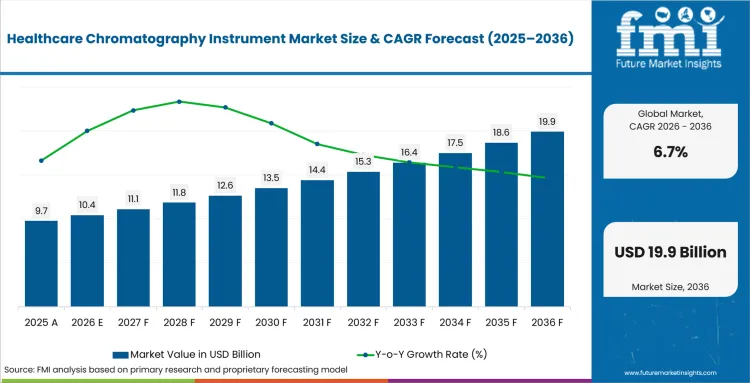
Key Takeaways of Healthcare Chromatography Instrument Market
- Pharmaceutical release testing and biologic characterization require reproducible separation so laboratories can approve results and investigate unexpected impurities across regulated workflows.
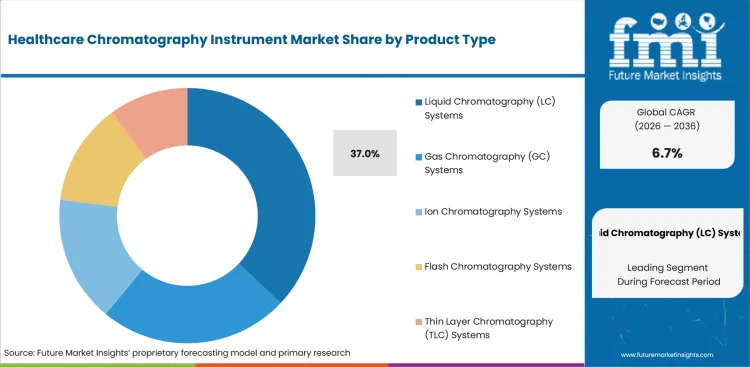
- By product type, liquid chromatography systems are projected to account for 37.0% share in 2026 due to broad method coverage across regulated pharmaceutical laboratories.
- Pharmaceutical analysis is estimated to hold 34.0% share in 2026 within application owing to repeated assay and impurity testing across commercial medicine lifecycles.
- In end user, pharmaceutical and biotechnology companies are forecast to represent 39.0% share in 2026 owing to concentrated analytical capacity and recurring method demand.
- High equipment prices and difficult method transfers extend purchasing cycles owing to qualification and specialist training costs beyond installation in smaller laboratories.
- Agilent Technologies and Waters Corporation compete alongside Thermo Fisher Scientific and Shimadzu Corporation through broad platforms whereas specialist companies focus on purification workflows.
Analyst Perspective
"Healthcare chromatography investment should be judged by method continuity rather than peak instrument specifications alone. A faster detector offers limited value if software controls or local service cannot preserve a validated release method. Commercially credible offers combine sensitive separation with practical method-transfer support and dependable electronic records across regulated quality workflows. Balanced technical and service performance protects pharmaceutical release capacity and supports recurring column and software revenue throughout the instrument lifecycle."
- Nikhil Kaitwade, Principal Analyst, Future Market Insights
How is the Healthcare Chromatography Instrument Market segmented?
The healthcare chromatography instrument market is segmented by Product Type, Application, End User, Distribution Channel, Technology, and Region.
The segmentation separates instrument design from laboratory purpose and from the commercial route used to purchase technical support. Product type covers liquid, gas, ion, flash, and planar chromatography systems used across routine or specialized separations. Application distinguishes pharmaceutical analysis, clinical diagnostics, biotechnology research, food testing, and toxicology work by the result each workflow must produce. End user identifies pharmaceutical companies, hospitals, research institutes, contract laboratories, and public agencies that control installed analytical capacity. Distribution channel compares direct contracts with distributors, dealers, online routes, and third-party networks that organize service responsibility. Technology separates established HPLC workflows from UHPLC, gas chromatography, ion chromatography, and linked mass-spectrometry techniques with different performance limits. Spending on laboratory automation fits within these categories whenever sample handling and reporting connect directly with a qualified chromatography method.
What keeps liquid chromatography systems ahead within product type?
Liquid chromatography systems support assay and impurity methods across pharmaceutical laboratories that handle chemically diverse samples. Stability programs also require chromatography software that preserves small degradation peaks across long sequences and changing analysts. The FDA reported in May 2026 that Sato Pharmaceutical failed to evaluate impurity peaks visible during HPLC stability testing. Reliable peak detection therefore affects shelf-life decisions and investigation quality throughout the validated method rather than serving as an isolated detector feature.
- The product type category is forecast to be led by liquid chromatography systems at 37.0% share in 2026 due to broad coverage across release and stability methods. Laboratories can preserve validated columns and detector settings during planned replacement cycles without rebuilding every analytical procedure. The established method base supports repeat instrument and consumable spending across regulated quality operations throughout each product lifecycle.
- Demand for liquid chromatography systems is expected to grow among quality-control laboratories as product portfolios increase routine assay volume. Application teams prefer platforms that transfer established methods and use familiar software across several instruments. Responsive service remains necessary to prevent one unavailable qualified system from overloading the remaining laboratory capacity and delaying release testing.
Which buying mechanism supports pharmaceutical analysis in the application category?
Pharmaceutical analysis converts each product specification into a repeatable assay for identity and impurity control across development and release testing. Validation teams must establish intended performance prior to transferring a method between instruments or separate laboratories. Australia adopted the ICH Q2(R2) guideline in May 2026 and linked analytical procedures with demonstrated fitness for purpose. The requirement increases demand for analytical laboratory services that support validation and transfer alongside the instrument purchase.
- Pharmaceutical analysis is projected to hold 34.0% share in 2026 owing to recurring release tests and continuing impurity characterization. Every marketed medicine can produce repeated analytical work across stability batches and manufacturing changes throughout its commercial life. The segment therefore converts validated methods into regular instrument use rather than depending on isolated research assignments.
- Quality laboratories are increasingly purchasing pharmaceutical analysis capacity to shorten routine investigations across broader product portfolios. Reproducible workflows let trained analysts compare results between instruments without rebuilding every calculation or acceptance rule. Continuing method support remains essential to resolve transfer failures and unexpected changes in the impurity profile following installation.
What supports pharmaceutical and biotechnology companies within the end user category?
Pharmaceutical and biotechnology companies combine discovery assays with regulated development and quality-control workflows across diverse therapeutic molecules. Limited biological material makes sensitivity and sample recovery particularly valuable during early characterization of complex therapeutic molecules. Waters introduced microflow LC columns in February 2026 that use less sample across bioseparation, DMPK, and omics applications. Lower sample consumption lets biopharmaceutical laboratories extend scarce material across more analyses and use molecular spectroscopy for separate characterization questions.
- In 2026, pharmaceutical and biotechnology companies are expected to lead end user with 39.0% share because their laboratories support discovery and regulated manufacturing together. Shared methods and service contracts spread qualification costs across more instruments at several development stages. Repeat column and software use also supports continuing account revenue beyond the original platform installation.
- Pharmaceutical and biotechnology companies are expected to favor integrated platforms that standardize analytical work across development and manufacturing laboratories. Common software and service arrangements reduce qualification effort during site expansion and support method transfer across laboratories. Central technical teams also resolve difficult assays without requiring every location to maintain the same level of specialist expertise.
Why does direct sales lead the distribution channel category?
Direct sales suits chromatography projects that require installation planning and regulated software configuration prior to laboratory qualification. Manufacturer specialists can coordinate site preparation and method transfer with service engineers under one accountable contract. Agilent opened a Hyderabad biopharma experience center in July 2025 with chromatography technologies and regulatory-ready training workflows. Direct technical access reduces configuration risk across laboratory benchtop automation projects with qualified software and installation requirements. Distributors remain useful for routine column replacement and simpler instruments purchased regionally by lower-volume laboratories.
- By distribution channel, direct sales are forecast to represent 41.0% in 2026 driven by complex configuration and continuing technical support requirements. Multisite pharmaceutical organizations often require common service terms and consistent software controls across qualified laboratories. Direct contracts can assign installation and uptime responsibilities without dividing accountability among several channel partners during a major platform rollout.
- Large pharmaceutical organizations favor direct sales for projects that combine instruments with software and qualification support. Application specialists can resolve method-transfer problems during configuration rather than following an unsuccessful installation. Local distributors remain useful across remote or lower-volume laboratories that purchase standard columns and simpler replacement equipment.
How does high-performance liquid chromatography shape demand in the technology category?
High-performance liquid chromatography remains embedded in validated pharmaceutical methods that depend on controlled pressure and defensible peak integration. The FDA reported in April 2026 that one manufacturer used shared credentials on HPLC equipment during impurity testing. The agency also identified deleted sequences and undocumented trial injections within the same regulated analytical workflow. Comparable HPLC tandem mass spectrometry workflows also require traceable sample handling and controlled analytical records across regulated testing.
- High-performance liquid chromatography is set to lead the technology category with 35.0% share in 2026 due to its validated installed base and broad assay coverage. Pharmaceutical laboratories can reuse established columns and acceptance criteria across replacement projects without rebuilding each approved method. Familiar workflows lower validation risk and newer formats compete through faster analysis or narrower application benefits across selected assays.
- Replacement demand for high-performance liquid chromatography is forecast to gain traction in regulated laboratories seeking stronger audit trails and instrument diagnostics. New systems must preserve established methods without forcing extensive laboratory redesign or routine analyst retraining. Technical teams also test local service response to prevent prolonged hardware downtime from erasing benefits delivered through software improvements.
What are the drivers, restraints, and opportunities in the Healthcare Chromatography Instrument Market?
Updated validation requirements support demand, while capital costs and difficult method transfers delay adoption. Integrated instrument packages and service contracts offer the clearest commercial route.
- Driver: Updated analytical-development and validation expectations increase demand for reproducible separation systems with defensible method records across pharmaceutical laboratories.
- Restraint: High acquisition costs combine with method-transfer work and specialist shortages to extend approval cycles across laboratories with limited analytical capacity.
- Opportunity: Integrated instrument packages can combine columns and software with qualification support to reduce implementation risk across regulated laboratory operations.
Updated analytical requirements strengthen demand for qualified chromatography platforms across pharmaceutical development and quality-control laboratories. Health Canada implemented ICH Q14 in January 2026 for analytical procedure development within regulated drug programs. The guideline gives laboratories a clearer basis for documenting method understanding and robustness throughout routine use. Instrument companies can support documented procedure development through method-development services that connect analytical knowledge with qualified hardware and software. Method-development support also strengthens software and column revenue during validation projects and later method transfers.
Inconsistent manual data processing remains a material restraint that can invalidate results from otherwise capable chromatography instruments. The FDA reported in December 2025 that an inspected laboratory used unjustified manual integration for HPLC assay peaks. The agency found that inconsistent integration was unsuitable for quantitative analysis and weakened associated laboratory data. Pharmaceutical teams therefore examine software permissions and analyst training prior to extending qualified methods across additional systems. Clear permission controls also reduce investigation effort during routine laboratory review and external regulatory inspection.
Regulatory testing programs support service packages that protect qualified chromatography capacity during uneven surveillance and investigation workloads. The Therapeutic Goods Administration reported in April 2026 that its laboratories test about 1,500 samples annually across surveillance and investigations. Variable laboratory workloads require chromatography consumables and engineer support to remain available throughout each regulated testing schedule. Service contracts gain practical value through defined response times and replacement coverage across the qualified laboratory workflow. Defined support coverage also helps public laboratories schedule annual maintenance without reducing the capacity available for national surveillance testing.
Which country CAGRs are profiled in the Healthcare Chromatography Instrument Market?
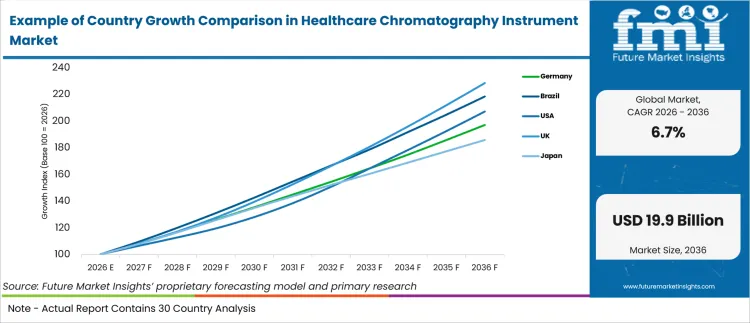
| Country | CAGR |
|---|---|
| UK | 8.6% |
| Brazil | 8.1% |
| USA | 7.6% |
| Germany | 7.0% |
| Japan | 6.4% |
| Australia | 5.9% |
| South Korea | 5.5% |
How do country-level CAGRs compare in the Healthcare Chromatography Instrument Market?
The seven-country comparison spans 3.1 percentage points between the United Kingdom and South Korea across the 2026 to 2036 outlook. The United Kingdom and Brazil form the upper group through current method modernization and formal quality-system requirements. The United States and Germany occupy the middle range through large installed bases although detailed qualification reviews can slow replacement decisions. Disciplined capital approval offsets strong validation needs and places Japan and Australia in a more gradual growth group. South Korea remains near the global pace as designated testing capacity expands within concentrated manufacturing clusters.
- The United Kingdom combines licensed quality-system oversight with continuing laboratory modernization across pharmaceutical testing and decentralized manufacturing operations.
- Brazil follows closely through current pharmacopoeial revisions although imported instruments and uneven service coverage complicate method transfer outside major centers.
- The United States occupies the middle range through extensive installed capacity despite detailed compliance review.
- Germany remains near the United States through official biological-product testing and established engineering support across major pharmaceutical manufacturing corridors.
- Careful capital approval offsets strong validation requirements and places Japan near Australia despite experienced local application support across established accounts.
- Australia stays close to Japan through centralized regulatory testing although long service distances constrain engineer coverage outside metropolitan laboratory centers.
- South Korea remains near the global pace through designated testing capacity although specialist staffing limits adoption across smaller independent laboratories.
Comparable CAGRs can represent materially different purchasing conditions across national healthcare chromatography instrument markets and service networks. Service access and qualification workload directly influence commercial conversion independently of each country's approved forecast rate. The full report provides country-level CAGR analysis across North America, Latin America, Europe, East Asia, South Asia, Oceania and the Middle East and Africa.
Country-wise Analysis
- United Kingdom pharmaceutical laboratories operate through licensed quality systems that assign responsibility for equipment and analytical records. In the United Kingdom, healthcare chromatography instrument demand is predicted to advance at 8.6% CAGR through 2036 supported by regulated manufacturing and laboratory modernization. MHRA guidance published in June 2025 requires a licensed United Kingdom Control Site for decentralized manufacture. The same guidance places equipment maintenance and calibration under formal oversight across approved remote operations. Centralized data control and consistent software governance therefore support qualified chromatography investment across approved pharmaceutical operations. Distributed sites face material friction from limited training and dependable engineer access beyond established service corridors.
- Brazilian quality laboratories rely on imported chromatography systems and local service networks that face uneven spare-part lead times. Healthcare chromatography instrument demand in Brazil is forecast to rise at 8.1% CAGR over the forecast period reinforced by current pharmacopoeial modernization. Revised national compendia require laboratories to review methods against updated quality and purity requirements across regulated testing portfolios. Anvisa reported in July 2026 that the eighth Brazilian Pharmacopoeia entered into force with 19 new texts and 122 revised texts. The update supports investment in stable instruments and practical method-transfer assistance across pharmaceutical testing organizations. Currency exposure and imported components remain material frictions outside established distributor networks and major manufacturing centers.
- United States laboratories operate within a large pharmaceutical manufacturing base and face frequent federal inspection of analytical controls. The United States healthcare chromatography instrument market is estimated to post 7.6% CAGR over the forecast period influenced by replacement demand and data-integrity investment. An FDA warning issued in August 2025 required an independent assessment of laboratory methods and equipment together with documentation and analyst competence. The requested review linked platform condition with reliable testing and competent laboratory practice across regulated contracts. Broad direct-service networks support adoption across major research clusters and pharmaceutical manufacturing centers throughout the country. Capital committees remain cautious toward replacing qualified instruments that retain useful life despite weaker software or service arrangements.
- German pharmaceutical laboratories work within a quality system that includes official batch testing for selected biological medicines. The German healthcare chromatography instrument sector is projected to record 7.0% CAGR during the assessment period underpinned by biopharmaceutical quality requirements. Official batch release connects experimental testing with formal records prior to regulated biological-product release decisions. The Paul-Ehrlich-Institut updated its batch-testing information in August 2025 and described experimental testing for national release and international certification. Established engineering support strengthens adoption across major pharmaceutical manufacturing corridors and nearby regulated testing laboratories. Detailed qualification and lifecycle-cost reviews remain material frictions for laboratories considering replacement of functional validated systems.
- Japanese laboratories emphasize compact equipment and repeatable results across quality teams that protect long-established analytical procedures. Adoption of healthcare chromatography instruments in Japan is estimated to expand at 6.4% CAGR through 2036 shaped by method validation and disciplined replacement cycles. PMDA published national ICH Q2(R2) analytical validation materials in October 2025 for pharmaceutical quality applications. The guidance supports instruments that demonstrate accuracy and robustness across intended operating ranges during regulated pharmaceutical testing. Experienced local application teams help transfer methods carefully across pharmaceutical accounts and established quality-control laboratories. Conservative capital approval remains a material friction despite incumbent systems meeting validated specifications across routine workloads.
- Australian testing capacity is concentrated across major cities and national regulatory laboratories that handle varied therapeutic products. Australia's healthcare chromatography instrument outlook is anticipated to advance at 5.9% CAGR over the assessment period linked to updated validation requirements and centralized testing. Complex formulations require documented analytical performance prior to using a transferred procedure for regulated quality decisions. The TGA updated analytical validation guidance in May 2025 for registered complementary medicines and their supporting test procedures. Regulatory alignment supports instruments with traceable software and dependable application service across complex therapeutic-product testing. Large travel distances constrain engineer response and preventive maintenance outside metropolitan service coverage across regional laboratories.
- South Korean pharmaceutical laboratories work through designated testing institutions within a growing biopharmaceutical manufacturing base. By 2036, South Korea's healthcare chromatography instrument market is projected to grow at 5.5% CAGR aided by expanding quality capacity. MFDS published its designated drug-testing institution list in May 2026 and maintained a formal network for official testing activity. The network supports standardized methods and qualified data systems across approved laboratories conducting official pharmaceutical testing. Dense industrial clusters improve access to practical training and responsive technical service around major manufacturing centers. Specialist staffing shortages remain a material friction for smaller facilities outside established biopharmaceutical centers and service networks.
Who are the notable companies in the Healthcare Chromatography Instrument Market?
Agilent Technologies, Waters Corporation, Thermo Fisher Scientific, Shimadzu Corporation, Bio-Rad Laboratories, Cytiva, Hitachi High-Tech Corporation, and Tosoh Bioscience are notable companies shaping this market.
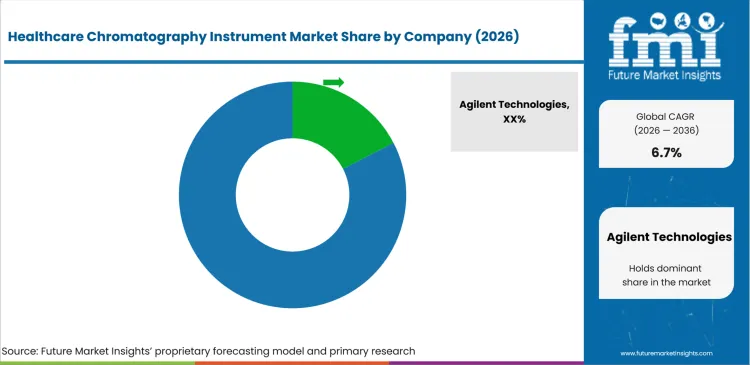
The competitive outlook combines four broad analytical-platform companies with four specialists focused on narrower separation workflows. Agilent Technologies and Thermo Fisher Scientific combine liquid and gas chromatography instruments with enterprise data systems across multisite accounts. Waters Corporation and Shimadzu Corporation compete through integrated liquid chromatography platforms that preserve established methods and controlled records. Bio-Rad Laboratories and Cytiva concentrate on protein purification and Tosoh Bioscience adds analytical columns across several separation modes. Hitachi High-Tech Corporation serves narrower HPLC accounts through selected regional channels and a focused liquid chromatography portfolio. Entry remains practical through specialized columns or compliant software but wider conversion requires lower revalidation effort and dependable local service.
- Agilent Technologies and Thermo Fisher Scientific provide broad analytical portfolios across instruments and regulated software. Their position depends on connecting detectors and data systems with responsive service across multisite laboratory networks. Broad coverage helps pharmaceutical organizations standardize technical support and preserve flexibility across liquid and gas separation methods.
- Waters Corporation and Shimadzu Corporation compete through integrated liquid chromatography platforms that preserve established methods. Laboratories compare traceability and application support with instrument performance to avoid revalidation costs that can outweigh modest hardware differences. Accounts with established methods value method continuity and controlled records across development and routine quality testing.
- Bio-Rad Laboratories and Cytiva emphasize protein purification through dedicated systems and process media for biopharmaceutical development and manufacturing laboratories. Tosoh Bioscience supplies analytical columns across several separation modes and Hitachi High-Tech Corporation serves narrower HPLC accounts through regional support. Specialist portfolios provide entry routes through application depth without matching the complete analytical breadth of larger platform companies.
Competitive Benchmarking: Healthcare Chromatography Instrument Market
| Company | Analytical Platform Breadth | Bioseparation Capability | Compliance Software | Geographic Reach |
|---|---|---|---|---|
| Agilent Technologies | High | Medium | High | Global |
| Waters Corporation | Medium | High | High | Global |
| Thermo Fisher Scientific | High | High | High | Global |
| Shimadzu Corporation | High | Medium | High | Global |
| Bio-Rad Laboratories | Low | High | Medium | Multi-region |
| Cytiva | Low | High | Medium | Global |
| Hitachi High-Tech Corporation | Medium | Low | Medium | Multi-region |
| Tosoh Bioscience | Medium | High | Medium | Multi-region |
Key Developments in the Healthcare Chromatography Instrument Market
- In September 2025, Agilent Technologies introduced Altura Ultra Inert HPLC columns for biotherapeutic development and quality-control testing. The launch addressed peptide and oligonucleotide analyses that need strong sensitivity with limited surface interaction. Agilent connected the columns with its bio-inert liquid chromatography systems across difficult biomolecule development and quality workflows. The expanded inert flow path gives laboratories another characterization route without requiring replacement of the complete analytical platform.
- In April 2025, Waters Corporation expanded the Alliance iS Bio HPLC line with integrated photodiode array detection. The platform added spectral information for impurity analysis across biopharmaceutical development and regulated quality-control laboratories. Waters also connected the system with Empower software and laboratory information systems for controlled records. The release broadens bioseparation capability and preserves one environment for instrument control and analytical review.
- In January 2025, Bio-Rad Laboratories launched Nuvia wPrime 2A mixed-mode resin for biomolecule purification across research and production scales. The media combines weak anion exchange with hydrophobic interaction across complex protein purification workflows at several scales. The launch gives process laboratories another polishing option for impurity removal across complex biotherapeutic purification programs. Commercial use depends on matching resin selectivity with scalable columns and validated operating conditions across production volumes.
- In April 2026, Shimadzu Corporation released the Nexera X4 ultra-high-performance liquid chromatograph for pharmaceutical R&D, food safety, environmental science, and chemistry applications. The platform combines a low-dispersion flow path with stable high-speed solvent control across complex analytical methods. Shimadzu reported shorter analysis through reduced peak broadening and stable flow under ultra-high-pressure conditions across comparison tests. The release strengthens replacement options for laboratories seeking higher throughput without abandoning established liquid chromatography methods.
Healthcare Chromatography Instrument Market - Report Scope
| Coverage field | Report scope |
|---|---|
| Market breakdown | Product Type, Application, End User, Distribution Channel, Technology, and Region. |
| Market Definition | Liquid, gas, ion, and related chromatography instruments with detectors, software, columns, service, and validation used across healthcare laboratories. |
| Regions Covered | North America, Latin America, Western Europe, Eastern Europe, East Asia, South Asia and Pacific, and Middle East and Africa. |
| Countries Covered | UK, Brazil, USA, Germany, Japan, Australia, and South Korea. |
| Key Companies Profiled | Agilent Technologies, Waters Corporation, Thermo Fisher Scientific, Shimadzu Corporation, Bio-Rad Laboratories, Cytiva, Hitachi High-Tech Corporation, and Tosoh Bioscience. |
| Forecast Period | 2026 to 2036. |
| Approach | Hybrid bottom-up and top-down market sizing supported by primary interviews and official desk research. |
Healthcare Chromatography Instrument Market - Research Methodology
| Method | Approach |
|---|---|
| Primary Research | FMI analysts gathered input from manufacturers, service providers, technology developers, distributors, end users, procurement teams, and subject-matter experts. Interviews examined purchasing decisions, product or service evaluation, adoption barriers, approval requirements, pricing considerations, and expectations for technical or commercial support. Respondents were also asked what evidence is required before a trial, pilot, or initial order develops into regular purchasing. |
| Desk Research | Desk research covered government statistics, regulatory publications, trade data, industry associations, technical literature, standards, company filings, product information, and official corporate announcements. Sources were reviewed for relevance, publication date, geographic coverage, and consistency with the defined market scope. Claims relating to performance, applications, approvals, capacity, investment, and commercial activity were retained only when supported by credible public evidence. |
| Market Sizing and Forecasting | The market model combined the baseline value with historical performance, segment structure, pricing and volume indicators, adoption levels, company participation, and country-level demand conditions. Forecast assumptions considered economic activity, investment trends, regulatory developments, technology adoption, purchasing cycles, supply availability, and barriers to wider market use. Segment and regional estimates were reconciled before the final market total was calculated. |
| Data Validation | Estimates were checked against multiple independent indicators, including public data, company activity, trade patterns, industry developments, and findings from primary interviews. Validation also tested whether products, services, applications, and company revenues fell within the defined market boundaries. Adjacent categories, unsupported claims, overlapping revenues, and activities without direct market relevance were excluded to reduce double counting and maintain consistency across segments and countries. |
Healthcare Chromatography Instrument Market by Segments
Healthcare Chromatography Instrument Market segmented by Product Type:
- Liquid Chromatography (LC) Systems
- HPLC Systems
- UHPLC Systems
- Gas Chromatography (GC) Systems
- GC-FID Systems
- GC-MS Systems
- Ion Chromatography Systems
- Anion Chromatography Systems
- Cation Chromatography Systems
- Flash Chromatography Systems
- Automated Flash Chromatography
- Manual Flash Chromatography
- Thin Layer Chromatography (TLC) Systems
- HPTLC Systems
- Conventional TLC Systems
Healthcare Chromatography Instrument Market segmented by Application:
- Pharmaceutical Analysis
- Drug Development
- Quality Control Testing
- Clinical Diagnostics
- Biomarker Analysis
- Therapeutic Drug Monitoring
- Biotechnology Research
- Protein Purification
- Biopharmaceutical Analysis
- Food & Nutritional Testing
- Food Safety Analysis
- Nutritional Compound Analysis
- Environmental & Toxicology Testing
- Water Quality Testing
- Toxicology Screening
Healthcare Chromatography Instrument Market segmented by End User:
- Pharmaceutical & Biotechnology Companies
- Pharmaceutical Manufacturers
- Biotechnology Companies
- Hospitals & Diagnostic Laboratories
- Clinical Laboratories
- Hospital Laboratories
- Academic & Research Institutes
- Universities
- Medical Research Centers
- Contract Research Organizations
- Preclinical CROs
- Analytical Testing CROs
- Government & Regulatory Laboratories
- Public Health Laboratories
- Food & Drug Regulatory Agencies
Healthcare Chromatography Instrument Market segmented by Distribution Channel:
- Direct Sales
- Key Account Sales
- Enterprise Contracts
- Authorized Distributors
- National Distributors
- Regional Distributors
- Laboratory Equipment Dealers
- Analytical Instrument Dealers
- Specialty Laboratory Suppliers
- Online Sales
- Manufacturer Websites
- B2B E-Commerce Platforms
- Third-Party Procurement Providers
- Laboratory Procurement Networks
- Government Procurement Agencies
Healthcare Chromatography Instrument Market segmented by Technology:
- High-Performance Liquid Chromatography (HPLC)
- Reverse Phase HPLC
- Normal Phase HPLC
- Ultra-High Performance Liquid Chromatography (UHPLC)
- Analytical UHPLC
- Preparative UHPLC
- Gas Chromatography (GC)
- GC-FID
- GC-MS
- Ion Chromatography (IC)
- Suppressed Ion Chromatography
- Non-Suppressed Ion Chromatography
- Hyphenated Chromatography Techniques
- LC-MS
- GC-MS/MS
Healthcare Chromatography Instrument Market by Region:
- North America
- United States
- Canada
- Latin America
- Brazil
- Mexico
- Argentina
- Chile
- Western Europe
- Germany
- France
- United Kingdom
- Italy
- Spain
- Benelux
- Nordics
- Eastern Europe
- Poland
- Czech Republic
- Romania
- Hungary
- East Asia
- China
- Japan
- South Korea
- South Asia and Pacific
- India
- ASEAN
- Australia and New Zealand
- Middle East and Africa
- GCC Countries
- South Africa
- Türkiye
- Israel
Research Sources and Bibliography
- Agência Nacional de Vigilância Sanitária. (2026, July 6).
- Agilent Technologies Inc. (2025, July 29).
- Agilent Technologies Inc. (2025, June 12).
- Agilent Technologies Inc. (2025, September 29).
- Bio-Rad Laboratories, Inc. (2025, January 14).
- Cytiva Korea. (2026, May 12).
- Hitachi High-Tech Corporation. (2025, March 31).
- Medicines and Healthcare products Regulatory Agency. (2025, June 10).
- Paul-Ehrlich-Institut. (2025, August 11).
- Pharmaceuticals and Medical Devices Agency. (2025, October 9).
- Shimadzu Corporation. (2025, September 1).
- Shimadzu Corporation. (2026, March 3).
- Therapeutic Goods Administration. (2025, May 9).
- Therapeutic Goods Administration. (2026, April 10).
- Therapeutic Goods Administration. (2026, July 2).
- Thermo Fisher Scientific. (2025, October 2).
- Tosoh Bioscience. (2025, June 15).
- USA Food and Drug Administration. (2025, August 20).
- USA Food and Drug Administration. (2025, December 19).
- USA Food and Drug Administration. (2025, March 10).
- USA Food and Drug Administration. (2026, April 14).
- USA Food and Drug Administration. (2026, May 18)
- Waters Corporation. (2025, April 1).
- Waters Corporation. (2025, June 17).
- Waters Corporation. (2026, February 17).
This bibliography is provided for reader reference and is not exhaustive. The full report contains the complete reference list and detailed citations.
This Report Answers
- How large is the healthcare chromatography instrument market in 2026 and 2036?
- Which testing requirements support chromatography instrument and data-system investment?
- Why do Liquid Chromatography Systems hold the largest Product Type share?
- How does Pharmaceutical Analysis influence instrument configuration and validation?
- Why do pharmaceutical and biotechnology companies hold the largest End User share?
- How do country growth rates differ across the seven profiled markets?
- Which companies provide broad analytical or specialized bioseparation capabilities?
- What limits returns from chromatography instrument purchases in regulated laboratories?
- How can service contracts and integrated software improve uptime and data integrity?
Frequently Asked Questions
How big is the Healthcare Chromatography Instrument Market in 2026?
The healthcare chromatography instrument market is valued at USD 10.4 billion in 2026 and is forecast to reach USD 19.9 billion by 2036. Growth is supported by regulated laboratories evaluating each platform as part of a connected method and data workflow that combines reproducible separation with defensible electronic records across pharmaceutical release and stability testing.
What is the CAGR of the Healthcare Chromatography Instrument Market from 2026 to 2036?
The healthcare chromatography instrument market grows at a CAGR of 6.7% between 2026 and 2036, supported by updated analytical validation requirements increasing demand for reproducible separation systems with defensible method records across pharmaceutical development, biologic characterization, and regulated quality-control laboratory workflows.
Which product type leads the Healthcare Chromatography Instrument Market?
Liquid chromatography systems account for 37.0% of the healthcare chromatography instrument market by product type in 2026, driven by broad coverage across release and stability methods that let laboratories preserve validated columns and detector settings during planned replacement cycles without rebuilding every approved analytical procedure.
How much will the Healthcare Chromatography Instrument Market add between 2026 and 2036?
The healthcare chromatography instrument market is set to add USD 9.5 billion between 2026 and 2036, growing from USD 10.4 billion to USD 19.9 billion as replacement demand, data-integrity investment, and updated validation guidelines drive recurring instrument and consumable spending across pharmaceutical and biotechnology laboratory networks worldwide.
Who are the leading companies in the Healthcare Chromatography Instrument Market?
Eight companies lead the healthcare chromatography instrument market, including Agilent Technologies, Waters Corporation, Thermo Fisher Scientific, Shimadzu Corporation, Bio-Rad Laboratories, Cytiva, Hitachi High-Tech Corporation, and Tosoh Bioscience, competing through analytical platform breadth, bioseparation capability, compliance software, and geographic service reach across regulated laboratory programs worldwide.
Preview the report firsthand - request a free sample
Get SampleGet the brochure for pricing and purchase details.
Get PDFTable of Content
- Key Takeaways
- Market Size and CAGR
- Top Growth Driver
- Fastest Growing Segment
- Leading Region
- Key Companies
- Emerging Opportunities
- Executive Summary
- Global Market Outlook
- Demand-side Trends
- Supply-side Trends
- Technology Roadmap Analysis
- Analysis and Recommendations
- Analyst Perspective (What is happening? Why now? What should investors know?)
- Key Questions Answered
- How large is the market?
- What is the CAGR?
- What are key trends?
- Which region dominates?
- Who are the leaders?
- Market Overview
- Market Coverage / Taxonomy
- Market Definition / Scope / Limitations
- Research Methodology
- Chapter Orientation
- Analytical Lens and Working Hypotheses
- Market Structure, Signals, and Trend Drivers
- Benchmarking and Cross-market Comparability
- Market Sizing, Forecasting, and Opportunity Mapping
- Research Design and Evidence Framework
- Desk Research Programme (Secondary Evidence)
- Expert Input and Fieldwork (Primary Evidence)
- Tooling, Models, and Reference Databases
- Data Engineering and Model Build
- Quality Assurance and Audit Trail
- Market Background
- Market Dynamics (Drivers, Restraints, Opportunity, Trends)
- Scenario Forecast (Optimistic, Likely, Conservative)
- Impact Analysis
- AI Impact
- Sustainability Impact
- Regulatory Impact
- Technology Impact
- Consumer / Buyer Analysis
- Purchase Drivers
- Adoption Barriers
- Buyer Journey
- Opportunity Map Analysis
- Product Life Cycle Analysis
- Supply Chain Analysis
- Investment Feasibility Matrix
- Value Chain Analysis
- PESTLE and Porter's Analysis
- Regulatory Landscape
- Regional Parent Market Outlook
- Production and Consumption Statistics
- Import and Export Statistics
- Global Market Analysis and Forecast, 2021 to 2036
- Historical Market Size Value (USD Billion) Analysis, 2021 to 2025
- Current and Future Market Size Value (USD Billion) Projections, 2026 to 2036
- Y-o-Y Growth Trend Analysis
- Absolute $ Opportunity Analysis
- Global Market Pricing Analysis, 2021 to 2036
- Global Market Analysis and Forecast, By Product Type, 2021 to 2036
- Introduction / Key Findings
- Historical Market Size Value (USD Billion) Analysis By Product Type, 2021 to 2025
- Current and Future Market Size Value (USD Billion) Analysis and Forecast By Product Type, 2026 to 2036
- Liquid Chromatography (LC) Systems
- HPLC Systems
- UHPLC Systems
- Gas Chromatography (GC) Systems
- GC-FID Systems
- GC-MS Systems
- Ion Chromatography Systems
- Anion Chromatography Systems
- Cation Chromatography Systems
- Flash Chromatography Systems
- Automated Flash Chromatography
- Manual Flash Chromatography
- Thin Layer Chromatography (TLC) Systems
- HPTLC Systems
- Conventional TLC Systems
- Liquid Chromatography (LC) Systems
- Y-o-Y Growth Trend Analysis By Product Type, 2021 to 2025
- Absolute $ Opportunity Analysis By Product Type, 2026 to 2036
- Global Market Analysis and Forecast, By Application, 2021 to 2036
- Introduction / Key Findings
- Historical Market Size Value (USD Billion) Analysis By Application, 2021 to 2025
- Current and Future Market Size Value (USD Billion) Analysis and Forecast By Application, 2026 to 2036
- Pharmaceutical Analysis
- Drug Development
- Quality Control Testing
- Clinical Diagnostics
- Biomarker Analysis
- Therapeutic Drug Monitoring
- Biotechnology Research
- Protein Purification
- Biopharmaceutical Analysis
- Food & Nutritional Testing
- Food Safety Analysis
- Nutritional Compound Analysis
- Environmental & Toxicology Testing
- Water Quality Testing
- Toxicology Screening
- Pharmaceutical Analysis
- Y-o-Y Growth Trend Analysis By Application, 2021 to 2025
- Absolute $ Opportunity Analysis By Application, 2026 to 2036
- Global Market Analysis and Forecast, By End User, 2021 to 2036
- Introduction / Key Findings
- Historical Market Size Value (USD Billion) Analysis By End User, 2021 to 2025
- Current and Future Market Size Value (USD Billion) Analysis and Forecast By End User, 2026 to 2036
- Pharmaceutical & Biotechnology Companies
- Pharmaceutical Manufacturers
- Biotechnology Companies
- Hospitals & Diagnostic Laboratories
- Clinical Laboratories
- Hospital Laboratories
- Academic & Research Institutes
- Universities
- Medical Research Centers
- Contract Research Organizations
- Preclinical CROs
- Analytical Testing CROs
- Government & Regulatory Laboratories
- Public Health Laboratories
- Food & Drug Regulatory Agencies
- Pharmaceutical & Biotechnology Companies
- Y-o-Y Growth Trend Analysis By End User, 2021 to 2025
- Absolute $ Opportunity Analysis By End User, 2026 to 2036
- Global Market Analysis and Forecast, By Distribution Channel, 2021 to 2036
- Introduction / Key Findings
- Historical Market Size Value (USD Billion) Analysis By Distribution Channel, 2021 to 2025
- Current and Future Market Size Value (USD Billion) Analysis and Forecast By Distribution Channel, 2026 to 2036
- Direct Sales
- Key Account Sales
- Enterprise Contracts
- Authorized Distributors
- National Distributors
- Regional Distributors
- Laboratory Equipment Dealers
- Analytical Instrument Dealers
- Specialty Laboratory Suppliers
- Online Sales
- Manufacturer Websites
- B2B E-Commerce Platforms
- Third-Party Procurement Providers
- Laboratory Procurement Networks
- Government Procurement Agencies
- Direct Sales
- Y-o-Y Growth Trend Analysis By Distribution Channel, 2021 to 2025
- Absolute $ Opportunity Analysis By Distribution Channel, 2026 to 2036
- Global Market Analysis and Forecast, By Technology, 2021 to 2036
- Introduction / Key Findings
- Historical Market Size Value (USD Billion) Analysis By Technology, 2021 to 2025
- Current and Future Market Size Value (USD Billion) Analysis and Forecast By Technology, 2026 to 2036
- High-Performance Liquid Chromatography (HPLC)
- Reverse Phase HPLC
- Normal Phase HPLC
- Ultra-High Performance Liquid Chromatography (UHPLC)
- Analytical UHPLC
- Preparative UHPLC
- Gas Chromatography (GC)
- GC-FID
- GC-MS
- Ion Chromatography (IC)
- Suppressed Ion Chromatography
- Non-Suppressed Ion Chromatography
- Hyphenated Chromatography Techniques
- LC-MS
- GC-MS/MS
- High-Performance Liquid Chromatography (HPLC)
- Y-o-Y Growth Trend Analysis By Technology, 2021 to 2025
- Absolute $ Opportunity Analysis By Technology, 2026 to 2036
- Global Market Analysis and Forecast, By Region, 2021 to 2036
- Introduction
- Historical Market Size Value (USD Billion) Analysis By Region, 2021 to 2025
- Current Market Size Value (USD Billion) Analysis and Forecast By Region, 2026 to 2036
- North America
- Latin America
- Western Europe
- Eastern Europe
- East Asia
- South Asia and Pacific
- Middle East & Africa
- Market Attractiveness Analysis By Region
- North America Market Analysis and Forecast, By Country, 2021 to 2036
- Historical Market Size Value (USD Billion) Trend Analysis By Market Taxonomy, 2021 to 2025
- Market Size Value (USD Billion) Forecast By Market Taxonomy, 2026 to 2036
- By Country
- USA
- Canada
- By Product Type
- By Application
- By End User
- By Distribution Channel
- By Technology
- By Country
- Market Attractiveness Analysis
- By Country
- By Product Type
- By Application
- By End User
- By Distribution Channel
- By Technology
- Key Takeaways
- Latin America Market Analysis and Forecast, By Country
- Historical Market Size Value (USD Billion) Trend Analysis By Market Taxonomy, 2021 to 2025
- Market Size Value (USD Billion) Forecast By Market Taxonomy, 2026 to 2036
- By Country
- Brazil
- Mexico
- Chile
- Rest of Latin America
- By Product Type
- By Application
- By End User
- By Distribution Channel
- By Technology
- By Country
- Market Attractiveness Analysis
- By Country
- By Product Type
- By Application
- By End User
- By Distribution Channel
- By Technology
- Key Takeaways
- Western Europe Market Analysis and Forecast, By Country
- Historical Market Size Value (USD Billion) Trend Analysis By Market Taxonomy, 2021 to 2025
- Market Size Value (USD Billion) Forecast By Market Taxonomy, 2026 to 2036
- By Country
- Germany
- UK
- Italy
- Spain
- France
- Nordic
- BENELUX
- Rest of Western Europe
- By Product Type
- By Application
- By End User
- By Distribution Channel
- By Technology
- By Country
- Market Attractiveness Analysis
- By Country
- By Product Type
- By Application
- By End User
- By Distribution Channel
- By Technology
- Key Takeaways
- Eastern Europe Market Analysis and Forecast, By Country
- Historical Market Size Value (USD Billion) Trend Analysis By Market Taxonomy, 2021 to 2025
- Market Size Value (USD Billion) Forecast By Market Taxonomy, 2026 to 2036
- By Country
- Russia
- Poland
- Hungary
- Balkan & Baltic
- Rest of Eastern Europe
- By Product Type
- By Application
- By End User
- By Distribution Channel
- By Technology
- By Country
- Market Attractiveness Analysis
- By Country
- By Product Type
- By Application
- By End User
- By Distribution Channel
- By Technology
- Key Takeaways
- East Asia Market Analysis and Forecast, By Country
- Historical Market Size Value (USD Billion) Trend Analysis By Market Taxonomy, 2021 to 2025
- Market Size Value (USD Billion) Forecast By Market Taxonomy, 2026 to 2036
- By Country
- China
- Japan
- South Korea
- By Product Type
- By Application
- By End User
- By Distribution Channel
- By Technology
- By Country
- Market Attractiveness Analysis
- By Country
- By Product Type
- By Application
- By End User
- By Distribution Channel
- By Technology
- Key Takeaways
- South Asia and Pacific Market Analysis and Forecast, By Country
- Historical Market Size Value (USD Billion) Trend Analysis By Market Taxonomy, 2021 to 2025
- Market Size Value (USD Billion) Forecast By Market Taxonomy, 2026 to 2036
- By Country
- India
- ASEAN
- Australia & New Zealand
- Rest of South Asia and Pacific
- By Product Type
- By Application
- By End User
- By Distribution Channel
- By Technology
- By Country
- Market Attractiveness Analysis
- By Country
- By Product Type
- By Application
- By End User
- By Distribution Channel
- By Technology
- Key Takeaways
- Middle East & Africa Market Analysis and Forecast, By Country
- Historical Market Size Value (USD Billion) Trend Analysis By Market Taxonomy, 2021 to 2025
- Market Size Value (USD Billion) Forecast By Market Taxonomy, 2026 to 2036
- By Country
- Kingdom of Saudi Arabia
- Other GCC Countries
- Türkiye
- South Africa
- Other African Union
- Rest of Middle East & Africa
- By Product Type
- By Application
- By End User
- By Distribution Channel
- By Technology
- By Country
- Market Attractiveness Analysis
- By Country
- By Product Type
- By Application
- By End User
- By Distribution Channel
- By Technology
- Key Takeaways
- Key Countries Market Analysis
- USA
- Pricing Analysis
- Market Share Analysis, 2025
- By Product Type
- By Application
- By End User
- By Distribution Channel
- By Technology
- Canada
- Pricing Analysis
- Market Share Analysis, 2025
- By Product Type
- By Application
- By End User
- By Distribution Channel
- By Technology
- Mexico
- Pricing Analysis
- Market Share Analysis, 2025
- By Product Type
- By Application
- By End User
- By Distribution Channel
- By Technology
- Brazil
- Pricing Analysis
- Market Share Analysis, 2025
- By Product Type
- By Application
- By End User
- By Distribution Channel
- By Technology
- Chile
- Pricing Analysis
- Market Share Analysis, 2025
- By Product Type
- By Application
- By End User
- By Distribution Channel
- By Technology
- Germany
- Pricing Analysis
- Market Share Analysis, 2025
- By Product Type
- By Application
- By End User
- By Distribution Channel
- By Technology
- UK
- Pricing Analysis
- Market Share Analysis, 2025
- By Product Type
- By Application
- By End User
- By Distribution Channel
- By Technology
- Italy
- Pricing Analysis
- Market Share Analysis, 2025
- By Product Type
- By Application
- By End User
- By Distribution Channel
- By Technology
- Spain
- Pricing Analysis
- Market Share Analysis, 2025
- By Product Type
- By Application
- By End User
- By Distribution Channel
- By Technology
- France
- Pricing Analysis
- Market Share Analysis, 2025
- By Product Type
- By Application
- By End User
- By Distribution Channel
- By Technology
- India
- Pricing Analysis
- Market Share Analysis, 2025
- By Product Type
- By Application
- By End User
- By Distribution Channel
- By Technology
- ASEAN
- Pricing Analysis
- Market Share Analysis, 2025
- By Product Type
- By Application
- By End User
- By Distribution Channel
- By Technology
- Australia & New Zealand
- Pricing Analysis
- Market Share Analysis, 2025
- By Product Type
- By Application
- By End User
- By Distribution Channel
- By Technology
- China
- Pricing Analysis
- Market Share Analysis, 2025
- By Product Type
- By Application
- By End User
- By Distribution Channel
- By Technology
- Japan
- Pricing Analysis
- Market Share Analysis, 2025
- By Product Type
- By Application
- By End User
- By Distribution Channel
- By Technology
- South Korea
- Pricing Analysis
- Market Share Analysis, 2025
- By Product Type
- By Application
- By End User
- By Distribution Channel
- By Technology
- Russia
- Pricing Analysis
- Market Share Analysis, 2025
- By Product Type
- By Application
- By End User
- By Distribution Channel
- By Technology
- Poland
- Pricing Analysis
- Market Share Analysis, 2025
- By Product Type
- By Application
- By End User
- By Distribution Channel
- By Technology
- Hungary
- Pricing Analysis
- Market Share Analysis, 2025
- By Product Type
- By Application
- By End User
- By Distribution Channel
- By Technology
- Kingdom of Saudi Arabia
- Pricing Analysis
- Market Share Analysis, 2025
- By Product Type
- By Application
- By End User
- By Distribution Channel
- By Technology
- Türkiye
- Pricing Analysis
- Market Share Analysis, 2025
- By Product Type
- By Application
- By End User
- By Distribution Channel
- By Technology
- South Africa
- Pricing Analysis
- Market Share Analysis, 2025
- By Product Type
- By Application
- By End User
- By Distribution Channel
- By Technology
- USA
- Market Structure Analysis
- Competition Dashboard
- Competition Benchmarking
- Market Share Analysis of Top Players
- By Regional
- By Product Type
- By Application
- By End User
- By Distribution Channel
- By Technology
- Emerging Startups
- Innovation Benchmarking
- Competition Analysis
- Competition Deep Dive
- Agilent Technologies
- Overview
- Product Portfolio
- Profitability by Market Segments
- Sales Footprint
- Strategy Overview
- Marketing Strategy
- Product Strategy
- Channel Strategy
- Waters Corporation
- Thermo Fisher Scientific
- Shimadzu Corporation
- PerkinElmer
- Bio-Rad Laboratories
- Merck KGaA
- Danaher Corporation (Cytiva)
- Hitachi High-Tech Corporation
- Tosoh Bioscience
- Agilent Technologies
- Case Studies
- Success Stories
- Recent Developments
- Competition Deep Dive
- Assumptions & Acronyms Used


